EP0351004B1 - Résistance non linéaire dépendent de la tension - Google Patents
Résistance non linéaire dépendent de la tension Download PDFInfo
- Publication number
- EP0351004B1 EP0351004B1 EP89201797A EP89201797A EP0351004B1 EP 0351004 B1 EP0351004 B1 EP 0351004B1 EP 89201797 A EP89201797 A EP 89201797A EP 89201797 A EP89201797 A EP 89201797A EP 0351004 B1 EP0351004 B1 EP 0351004B1
- Authority
- EP
- European Patent Office
- Prior art keywords
- layer
- resistance material
- zinc oxide
- dependent resistor
- doped
- Prior art date
- Legal status (The legal status is an assumption and is not a legal conclusion. Google has not performed a legal analysis and makes no representation as to the accuracy of the status listed.)
- Expired - Lifetime
Links
- 230000001419 dependent effect Effects 0.000 title claims description 23
- 239000000463 material Substances 0.000 claims description 73
- XLOMVQKBTHCTTD-UHFFFAOYSA-N Zinc monoxide Chemical compound [Zn]=O XLOMVQKBTHCTTD-UHFFFAOYSA-N 0.000 claims description 64
- 239000011787 zinc oxide Substances 0.000 claims description 30
- 229910052782 aluminium Inorganic materials 0.000 claims description 22
- XAGFODPZIPBFFR-UHFFFAOYSA-N aluminium Chemical compound [Al] XAGFODPZIPBFFR-UHFFFAOYSA-N 0.000 claims description 22
- 238000000034 method Methods 0.000 claims description 22
- 239000000843 powder Substances 0.000 claims description 13
- 229910052751 metal Inorganic materials 0.000 claims description 12
- 239000002184 metal Substances 0.000 claims description 12
- 238000005245 sintering Methods 0.000 claims description 12
- 239000000203 mixture Substances 0.000 claims description 11
- 239000010941 cobalt Substances 0.000 claims description 9
- GUTLYIVDDKVIGB-UHFFFAOYSA-N cobalt atom Chemical compound [Co] GUTLYIVDDKVIGB-UHFFFAOYSA-N 0.000 claims description 9
- 229910017052 cobalt Inorganic materials 0.000 claims description 8
- OYPRJOBELJOOCE-UHFFFAOYSA-N Calcium Chemical compound [Ca] OYPRJOBELJOOCE-UHFFFAOYSA-N 0.000 claims description 7
- 229910052777 Praseodymium Inorganic materials 0.000 claims description 7
- 229910052791 calcium Inorganic materials 0.000 claims description 7
- 239000011575 calcium Substances 0.000 claims description 7
- 238000004519 manufacturing process Methods 0.000 claims description 7
- PUDIUYLPXJFUGB-UHFFFAOYSA-N praseodymium atom Chemical compound [Pr] PUDIUYLPXJFUGB-UHFFFAOYSA-N 0.000 claims description 7
- GYHNNYVSQQEPJS-UHFFFAOYSA-N Gallium Chemical compound [Ga] GYHNNYVSQQEPJS-UHFFFAOYSA-N 0.000 claims description 6
- 150000001342 alkaline earth metals Chemical class 0.000 claims description 6
- 229910052733 gallium Inorganic materials 0.000 claims description 6
- 229910052738 indium Inorganic materials 0.000 claims description 6
- APFVFJFRJDLVQX-UHFFFAOYSA-N indium atom Chemical compound [In] APFVFJFRJDLVQX-UHFFFAOYSA-N 0.000 claims description 6
- 150000002739 metals Chemical class 0.000 claims description 6
- 150000002910 rare earth metals Chemical class 0.000 claims description 6
- 229910052784 alkaline earth metal Inorganic materials 0.000 claims description 5
- 239000000919 ceramic Substances 0.000 claims description 5
- 230000008569 process Effects 0.000 claims description 5
- 229910052761 rare earth metal Inorganic materials 0.000 claims description 5
- XEEYBQQBJWHFJM-UHFFFAOYSA-N Iron Chemical group [Fe] XEEYBQQBJWHFJM-UHFFFAOYSA-N 0.000 claims description 4
- 229910052709 silver Inorganic materials 0.000 claims description 4
- 239000004332 silver Substances 0.000 claims description 4
- 238000010438 heat treatment Methods 0.000 claims description 3
- 238000001816 cooling Methods 0.000 claims description 2
- 239000010410 layer Substances 0.000 claims 24
- 239000004411 aluminium Substances 0.000 claims 11
- 239000011247 coating layer Substances 0.000 claims 10
- 230000004044 response Effects 0.000 description 10
- ZOXJGFHDIHLPTG-UHFFFAOYSA-N Boron Chemical compound [B] ZOXJGFHDIHLPTG-UHFFFAOYSA-N 0.000 description 3
- VTYYLEPIZMXCLO-UHFFFAOYSA-L Calcium carbonate Chemical compound [Ca+2].[O-]C([O-])=O VTYYLEPIZMXCLO-UHFFFAOYSA-L 0.000 description 2
- BQCADISMDOOEFD-UHFFFAOYSA-N Silver Chemical compound [Ag] BQCADISMDOOEFD-UHFFFAOYSA-N 0.000 description 2
- 239000007864 aqueous solution Substances 0.000 description 2
- 229910052796 boron Inorganic materials 0.000 description 2
- 230000007423 decrease Effects 0.000 description 2
- 238000011161 development Methods 0.000 description 2
- 230000018109 developmental process Effects 0.000 description 2
- 230000000694 effects Effects 0.000 description 2
- VYZAMTAEIAYCRO-UHFFFAOYSA-N Chromium Chemical compound [Cr] VYZAMTAEIAYCRO-UHFFFAOYSA-N 0.000 description 1
- 229910000831 Steel Inorganic materials 0.000 description 1
- HCHKCACWOHOZIP-UHFFFAOYSA-N Zinc Chemical group [Zn] HCHKCACWOHOZIP-UHFFFAOYSA-N 0.000 description 1
- 239000000654 additive Substances 0.000 description 1
- 229910000272 alkali metal oxide Inorganic materials 0.000 description 1
- 150000001340 alkali metals Chemical class 0.000 description 1
- 229910000287 alkaline earth metal oxide Inorganic materials 0.000 description 1
- 230000004888 barrier function Effects 0.000 description 1
- 239000002585 base Substances 0.000 description 1
- 230000008901 benefit Effects 0.000 description 1
- 230000015572 biosynthetic process Effects 0.000 description 1
- 229910052810 boron oxide Inorganic materials 0.000 description 1
- 235000010216 calcium carbonate Nutrition 0.000 description 1
- 229910000019 calcium carbonate Inorganic materials 0.000 description 1
- 239000011651 chromium Substances 0.000 description 1
- 229910000423 chromium oxide Inorganic materials 0.000 description 1
- 229910000428 cobalt oxide Inorganic materials 0.000 description 1
- 239000000470 constituent Substances 0.000 description 1
- 238000009792 diffusion process Methods 0.000 description 1
- 238000009826 distribution Methods 0.000 description 1
- 239000002019 doping agent Substances 0.000 description 1
- 230000005496 eutectics Effects 0.000 description 1
- 238000001125 extrusion Methods 0.000 description 1
- 230000004907 flux Effects 0.000 description 1
- 239000007788 liquid Substances 0.000 description 1
- 239000007791 liquid phase Substances 0.000 description 1
- 238000005259 measurement Methods 0.000 description 1
- 238000002844 melting Methods 0.000 description 1
- 229910044991 metal oxide Inorganic materials 0.000 description 1
- 150000004706 metal oxides Chemical class 0.000 description 1
- 238000000465 moulding Methods 0.000 description 1
- 238000003825 pressing Methods 0.000 description 1
- 230000000750 progressive effect Effects 0.000 description 1
- 229910001404 rare earth metal oxide Inorganic materials 0.000 description 1
- 238000005096 rolling process Methods 0.000 description 1
- 239000002002 slurry Substances 0.000 description 1
- 239000010959 steel Substances 0.000 description 1
- 239000000758 substrate Substances 0.000 description 1
- 230000007704 transition Effects 0.000 description 1
- 229910052725 zinc Inorganic materials 0.000 description 1
Images
Classifications
-
- H—ELECTRICITY
- H01—ELECTRIC ELEMENTS
- H01C—RESISTORS
- H01C7/00—Non-adjustable resistors formed as one or more layers or coatings; Non-adjustable resistors made from powdered conducting material or powdered semi-conducting material with or without insulating material
- H01C7/10—Non-adjustable resistors formed as one or more layers or coatings; Non-adjustable resistors made from powdered conducting material or powdered semi-conducting material with or without insulating material voltage responsive, i.e. varistors
-
- H—ELECTRICITY
- H01—ELECTRIC ELEMENTS
- H01C—RESISTORS
- H01C7/00—Non-adjustable resistors formed as one or more layers or coatings; Non-adjustable resistors made from powdered conducting material or powdered semi-conducting material with or without insulating material
- H01C7/10—Non-adjustable resistors formed as one or more layers or coatings; Non-adjustable resistors made from powdered conducting material or powdered semi-conducting material with or without insulating material voltage responsive, i.e. varistors
- H01C7/105—Varistor cores
- H01C7/108—Metal oxide
- H01C7/112—ZnO type
-
- H—ELECTRICITY
- H01—ELECTRIC ELEMENTS
- H01C—RESISTORS
- H01C17/00—Apparatus or processes specially adapted for manufacturing resistors
- H01C17/30—Apparatus or processes specially adapted for manufacturing resistors adapted for baking
Definitions
- the invention relates to a nonlinear voltage-dependent resistor with a ceramic sintered body made of resistance material based on at least one alkaline earth metal, rare earth metal and iron group metal present as an oxide and with at least one of the metals from the group aluminum, gallium and / or indium doped zinc oxide and with electrodes attached to the opposing main surfaces of the sintered body.
- the invention further relates to a method for producing such a resistor.
- Varistors are used in many ways to protect electrical systems, devices and expensive components against overvoltages and voltage peaks.
- the operating voltages of varistors are in the order of 3 V to 3000 V.
- low-voltage varistors are increasingly required, whose response voltage U A is below approximately 30 V and the highest possible Have values for the non-linearity coefficient ⁇ .
- Varistors based on zinc oxide have relatively good non-linearity coefficients ⁇ in the range from 20 to 60.
- varistors based on zinc oxide with about 3 to 10 mol% of metal oxide additives such as Mg0, Ca0, La203, Pr203, Cr203, Co304 as doping.
- metal oxide additives such as Mg0, Ca0, La203, Pr203, Cr203, Co304 as doping.
- the interior of the polycrystalline Zn0 grains becomes low-resistance and high-resistance barriers form at the grain boundaries.
- the contact resistance between two grains is relatively high at voltages ⁇ 3.2 V, but decreases at voltages> 3.2 V with increasing voltage by several orders of magnitude.
- DE-OS 33 23 579 discloses varistors with sintered bodies based on zinc oxide doped with rare earth metal, cobalt, boron, alkaline earth metal and with at least one of the metals aluminum, gallium and / or indium.
- DE-PS 33 24 732 discloses varistors with sintered bodies based on rare earth metal, cobalt, alkaline earth metal, alkali metal, chromium, boron and zinc oxide doped with at least one of the metals aluminum, gallium and / or indium. Both the varistors known from DE-OS 33 23 579 and from DE-PS 33 24 732 only show useful values for the non-linearity coefficient ⁇ at response voltages U A above 100 V with ⁇ > 30.
- the usual way of producing low-voltage varistors based on doped zinc oxide is to use coarse-grained resistance material.
- Sintered bodies made of doped zinc oxide with a relatively coarse grain structure with grain sizes> 100 ⁇ m are obtained, for example, if material of the system Zn0-Bi203 is doped with about 0.3 to about 1 mol% Ti02.
- Ti02 forms a low-melting eutectic with Bi203 during sintering, which promotes the grain growth of polycrystalline Zn0.
- a disadvantage, however, is that relatively long, rod-shaped ZnO crystallites often form, which make it very difficult to control the microstructure of the ceramic structure.
- the invention has for its object to provide varistors and in particular low-voltage varistors that reproducibly low values for the response voltage U A in the range 30 V in addition to values for the non-linearity coefficient ⁇ > 30 and show methods for their production.
- the sintered body has a multilayer structure with at least one layer sequence consisting of a layer of resistance material on a carrier layer based on zinc oxide, which has a higher electrical conductivity than the resistance material.
- a cover layer based on zinc oxide, which has a higher electrical conductivity than the resistor material, is applied to the layer of resistor material.
- the invention is based on the knowledge that the response voltage U A in the case of varistors based on zinc oxide with dopants forming high-resistance grain boundaries is essentially determined by the number of grain boundaries that the current I must pass between the electrodes. If relatively thin layers of resistance material are present, the number of grain boundaries can be kept within relatively narrow limits.
- the invention is also the based on further knowledge that, in addition, a particularly uniform grain growth can be achieved in a relatively thin layer of resistance material if the layer of resistance material is covered in as large a surface area as possible by layers of a material which has a grain growth similar to that of the resistance material during the sintering process which, however, does not affect the resistance properties of the finished varistor.
- Nonlinear voltage-dependent resistors with average response voltages U A ⁇ 20 V are already obtained if the varistor has only one layer sequence made of a layer of resistance material on a carrier layer. If a cover layer is also provided, the layer of resistance material is covered in an even larger surface area by material with a similar sintering behavior, but with higher electrical conductivity, varistors with reproducible values for the response voltage U A ⁇ 10 V with improved values for the non-linearity coefficient ⁇ receive.
- the resistor material consists of 0.01 to 3.0 atom% praseodymium, 1.0 to 3.0 atom% cobalt, calcium to 1.0 atom% and 10 to 100 ppm aluminum doped zinc oxide, preferably from zinc atom doped with 0.5 atom% praseodymium, 2 atom% cobalt, 0.5 atom% calcium and 60 ppm aluminum.
- the material for the carrier layer (s) and for the cover layer is doped with aluminum; the material for the backing layer (s) and the covering layer is preferred doped with 30 to 100 ppm aluminum, in particular with 60 ppm aluminum.
- the electrodes are applied as layer electrodes without wire connections, preferably made predominantly of silver. This enables the varistors according to the invention to be used as SMD components.
- the layer (s) made of resistance material have a thickness in the range from 65 to 250 ⁇ m and the carrier layer (s) and the cover layer each have a thickness in the range from 250 to 600 ⁇ m .
- a method for producing a nonlinear voltage-dependent resistor with a ceramic sintered body based on zinc oxide as the resistance material which contains at least one alkaline earth metal, rare earth metal and iron group metal as well as at least one of the metals from the group aluminum, gallium and / or indium is endowed and with electrodes attached to the opposite main surfaces of the sintered body is characterized in that a multilayer sintered body is produced with at least one layer sequence consisting of a layer of resistance material on a carrier layer based on zinc oxide, which has a higher electrical conductivity than the resistance material.
- dry powder mixtures of the resistance material and the material for the carrier layer (s) and the cover layer are produced and these powder mixtures are compressed and deformed in accordance with the desired layer sequence and the desired layer thickness under pressure in such a way that that the powder mixtures are individually compacted one after the other in accordance with the layers to be produced and deformed in the process.
- the layers of the powder mixtures are preferably compressed at a pressure in the range from 8.107 to 1.8.108 Pa. It is advantageous to vary the pressure for pressing the individual layers of powder mixtures from layer to layer in such a way that the carrier layer is compressed at the highest pressure, the layer of resistance material is then compressed at a lower pressure, and the cover layer is compressed again when the pressure is reduced again. In this way it is ensured that there are relatively sharply delimited transitions between the individual layer layers, that is to say that material of the subsequent layer (s) is not pressed into the layer below, forming an undesirably deep boundary layer.
- the layer structure of the varistors according to the invention can of course also be produced by means of other manufacturing processes. E.g. it is also possible to use liquid slurries of the layer materials which are cast or layer structures can be produced from higher-viscosity masses by rolling or extrusion.
- the green shaped bodies pressed from the powder mixtures are sintered in air at a temperature in the range from 1260 to 1300 ° C. at a heating rate of ⁇ 10 ° C./min, the sintering of the shaped bodies preferably being carried out in this way is that the maximum sintering temperature is maintained for a period of 0 to 240 min before the cooling process is initiated.
- the level of the sintering temperature and also the duration of the maximum sintering temperature (holding time at maximum temperature) influence the grain growth in the layers in the sintered body and thus the values for the response voltage U A.
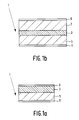
- FIGS. 1a and 1b each show a multi-layer varistor 1 with a layer 3 made of resistance material and a carrier layer 5 (FIG. 1a) and a cover layer 7 (FIG. 1b) and metal layer electrodes 9, 11 made of a silver-based contact material.
- the varistors according to FIGS. 1a and 1b represent only examples of several possible embodiments.
- Low-voltage varistors with good electrical properties can also be made from one Layer sequence made up of a multiplicity of layers 3 of resistance material, each on a carrier layer 5 and with a cover layer 7; the electrodes 9, 11 are then applied to the lower surface of the lowermost carrier layer 5 and to the upper surface of the cover layer 7 (compare principle in FIG. 1b).
- Zinc oxide was doped with 0.5 atom% praseodymium, 2 atom% cobalt, 0.5 atom% calcium and 60 ppm aluminum as the resistance material (designated IV in the tables below).
- aqueous solution 0.023 g Al (N03) 3.9H20 in a ball mill. The slip is then dried at a temperature of 100 ° C.
- Zinc oxide was doped with 60 ppm aluminum as the material for the carrier layer (s) 5 and the cover layer 7 (referred to as material A in the tables below).
- material A the material for the carrier layer (s) 5 and the cover layer 7
- 81.38 g of Zn0 are mixed with an aqueous solution of 0.023 g of Al (N03) 3.9H20 in a ball mill.
- the slip is then dried at a temperature of 100 ° C.
- Multi-layer varistors were manufactured as follows: The material A and the resistance material IV are combined with one another and sintered together, as shown in the schematic representations of FIGS. 1a and 1b. A summary of the combinations carried out is shown in Table 1 below.
- the combination of carrier layer / cover layer and layer of resistance material was carried out in the following way: 0.15 g of powder of material A (prepared according to the examples given above) were placed in a cylindrical steel die with a diameter of 9 mm under pressure mechanically compressed from 1.8.108 Pa.
- the resistance material (material IV) (produced according to the example given above) was then coated in amounts of 0.025 g to 0.1 g onto the pre-compressed substrate and pressed together with this under a pressure of 1.3.108 Pa.
- the pressed green moldings were then sintered in air at temperatures in the range from 1260 to 1300 ° C and with holding times of the maximum temperature in the range from 0 to 120 min at a heating rate of ⁇ 10 ° C / min.
- Table 2 The results of the electrical measurements are shown in Table 2 below.
- the values for the layer thickness given here refer to the resistance layer.
- Table 1 Sample No. Carrier layer / top layer Quantity Mat.
- A Resistance layer quantity Mat. IV
Landscapes
- Engineering & Computer Science (AREA)
- Microelectronics & Electronic Packaging (AREA)
- Physics & Mathematics (AREA)
- Electromagnetism (AREA)
- Manufacturing & Machinery (AREA)
- Thermistors And Varistors (AREA)
- Compositions Of Oxide Ceramics (AREA)
Claims (26)
- Résistance non-linéaire dépendant de la tension comportant un corps fritté céramique en matériau de résistance à base d'oxyde de zinc dopé chaque fois au moins d'un métal alcalino-terreux, d'un métal de terre rare et d'un métal du groupe de fer ainsi qu'au moins de l'un des métaux du groupe d'aluminium, de gallium et/ou d'indium, présents comme oxyde, et des électrodes disposées sur les surfaces principales mutuellement opposées, caractérisée en ce que le corps de frittage (1) est fabriqué de plusieurs couches comportant au moins une succession de couches constituée d'une couche (3) en matériau de résistance formée sur une couche de support (5) à base d'oxyde de zinc présentant une conductibilité électrique plus élevée par rapport au matériau de résistance.
- Résistance dépendant de la tension selon la revendication 1, caractérisée en ce qu'il est formé sur la couche (3) en matériau de résistance une couche de recouvrement (7) à base d'oxyde de zinc présentant une conductibilité électrique plus élevée par rapport au matériau de résistance.
- Résistance non-linéaire dépendant de la tension selon les revendications 1 et 2, caractérisée en ce que le matériau de résistance est constitué d'oxyde de zinc dopé de 0,01 à 3,0 % en atomes de praséodyme, de 1,0 à 3% en atomes de cobalt, jusqu'à 1,0 % en atomes de calcium et de 10 à 100 ppm d'aluminium.
- Résistance non-linéaire dépendant de la tension selon la revendication 3, caractérisée en ce que le matériau de résistance est constitué d'oxyde de zinc dopé de 0,5 % en atomes de praséodyme, de 2% en atomes de cobalt, de 0,5 % en atomes de calcium et de 60 ppm d'aluminium.
- Résistance non-linéaire dépendant de la tension selon au moins l'une des revendications 1 à 4, caractérisée en ce que le matériau destiné pour au moins une couche de support (5) et pour la couche de recouvrement (7) est dopé d'aluminium.
- Résistance non-linéaire dépendant de la tension selon la revendication 5, caractérisée en ce que le matériau destiné pour au moins une couche de support (5) et pour la couche de recouvrement (7) est dopé de 30 à 100 ppm d'aluminium.
- Résistance non-linéaire dépendant de la tension selon la revendication 6, caractérisée en ce que le matériau destiné pour au moins une couche de support (5) et pour la couche de recouvrement est dopé de 60 ppm d'aluminium.
- Résistance non-linéaire dépendant de la tension selon au moins l'une des revendications 1 à 7, caractérisée en ce que les électrodes (9, 11) sont prévues comme électrodes à couches.
- Résistance non-linéaire dépendant de la tension selon la revendication 8, caractérisée en ce que les électrodes (9, 11) sont sensiblement constituées d'argent.
- Résistance non linéaire dépendant de la tension selon au moins l'une des revendications 1 à 9, caractérisée en ce que l'épaisseur d'au moins une couche (3) en matériau de résistance est comprise entre 65 à 250 µm.
- Résistance non-linéaire dépendant de la tension selon au moins l'une des revendications 1 à 9, caractérisée en ce que l'épaisseur d'au moins une couche de support (5) et celle de la couche de recouvrement (7) sont comprises entre 250 et 600 µm.
- Procédé de fabrication d'une résistance non-linéaire dépendant de la tension comportant un corps fritté céramique à base d'oxyde de zinc comme matériau de résistance, dopé au moins d'un métal alcalino-terreux, d'un métal de terre rare et d'un métal du groupe de fer et au moins de l'un des métaux du groupe d'aluminium, de gallium et/ou d'indium, présents comme un oxyde et comportant des électrodes disposées sur les surfaces principales mutuellement opposées du corps fritté, particulièrement selon les revendications 1 à 11, caractérisé en ce qu'est fabriqué un corps fritté (1) à plusieurs couches comportant au moins une succession de couches constituée d'une couche (3) en matériau de résistance formée sur une couche de support (5) à base d'un oxyde de zinc présentant une conductibilité électrique plus élevée par rapport au matériau de résistance.
- Procédé selon la revendication 12, caractérisé en ce qu'est formée sur la couche (3) en matériau de résistance une couche de recouvrement (7) à base d'oxyde de zinc présentant une conductibilité électrique plus élevée par rapport au matériau de résistance.
- Procédé selon les revendications 12 et 13, caractérisé en ce que l'on utilise comme matériau de résistance de l'oxyde de zinc dopé de 0,01 à 3,0 % en atomes de praséodyme, de 1,0 à 3,0 % en atomes de cobalt, jusqu'à 1,0 % en atomes de calcium et de 10 à 100 ppm d'aluminium.
- Procédé selon la revendication 14, caractérisé en ce que l'on utilise comme matériau de résistance de l'oxyde de zinc dopé de 0,5 % en atomes de praséodyme, de 2% en atomes de cobalt, de 0,5 % en atomes de calcium et de 60 ppm d'aluminium.
- Procédé selon au moins l'une des revendications 13 à 15, caractérisé en ce que l'on utilise comme matériau de l'oxyde de zinc dopé d'aluminium pour au moins une couche de support (5) et la couche de recouvrement (7).
- Procédé selon la revendication 16, caractérisé en ce que l'on utilise comme matériau de l'oxyde de zinc dopé de 30 à 100 ppm d'aluminium pour au moins une couche de support (5) et la couche de recouvrement (7).
- Procédé selon la revendication 17, caractérisé en ce que l'on utilise de l'oxyde de zinc dopé de 60 ppm d'aluminium.
- Procédé selon au moins l'une des revendications 12 à 18, caractérisé en ce que sont préparés des mélanges de poudre sèche réalisés à partir de matériau de résistance et de matériau destiné pour au moins une couche de support (5) et la couche de recouvrement (7) et que lesdits mélanges de poudre sont comprimés et déformés sous pression dans une matrice en conformité avec la succession et avec l'épaisseur de couche désirées de telle manière que les mélanges de poudre sont comprimés individuellement et successivement, chaque fois couche après couche en conformité avec les couches à fabrique,r pour être déformés en même temps.
- Procédé selon la revendication 19, caractérisé en ce que les couches constituées de mélanges de poudre sont comprimées à une pression comprise entre 8.10⁷ et 1,8.10⁸ Pa.
- Procédé selon au moins l'une des revendications 12 à 20, caractérisé en ce que les corps moulés verts réalisés à partir des mélanges de poudre sont frittés dans l'air, à une température comprise entre 1260 et 1300°C, à une vitesse de chauffage de ≈ 10°C/min.
- Procédé selon la revendication 21, caractérisé en ce que le frittage des corps moulés est effectué de manière que la température de frittage maximale est maintenue pendant une période de 0 à 240 min. avant de ne démarrer le procédé de refroidissement.
- Procédé selon au moins l'une des revendications 12 à 22, caractérisé en ce qu'il est fabriqué au moins une couche (3) en matériau de résistance dont l'épaisseur est comprise entre 65 et 250 µm.
- Procédé selon au moins l'une des revendications 12 à 22, caractérisé en ce qu'il est fabriqué au moins une couche de support (5) et la couche de recouvrement (7) dont l'épaisseur est comprise entre 250 et 600 µm.
- Procédé selon au moins l'une des revendications 12 à 24, caractérisé en ce que des électrodes à couches métalliques (9, 11) sont prévues sur les surfaces principales mutuellement opposées du corps de frittage (1).
- Procédé selon la revendication 25, caractérisé en ce que l'on utilise pour les électrodes (9, 11) un matériau de contact à base d'argent.
Applications Claiming Priority (2)
| Application Number | Priority Date | Filing Date | Title |
|---|---|---|---|
| DE3823698A DE3823698A1 (de) | 1988-07-13 | 1988-07-13 | Nichtlinearer spannungsabhaengiger widerstand |
| DE3823698 | 1988-07-13 |
Publications (3)
| Publication Number | Publication Date |
|---|---|
| EP0351004A2 EP0351004A2 (fr) | 1990-01-17 |
| EP0351004A3 EP0351004A3 (en) | 1990-03-21 |
| EP0351004B1 true EP0351004B1 (fr) | 1993-10-06 |
Family
ID=6358567
Family Applications (1)
| Application Number | Title | Priority Date | Filing Date |
|---|---|---|---|
| EP89201797A Expired - Lifetime EP0351004B1 (fr) | 1988-07-13 | 1989-07-07 | Résistance non linéaire dépendent de la tension |
Country Status (5)
| Country | Link |
|---|---|
| US (1) | US5008646A (fr) |
| EP (1) | EP0351004B1 (fr) |
| JP (1) | JPH0266901A (fr) |
| KR (1) | KR0142574B1 (fr) |
| DE (2) | DE3823698A1 (fr) |
Families Citing this family (29)
| Publication number | Priority date | Publication date | Assignee | Title |
|---|---|---|---|---|
| DE69213296T2 (de) * | 1991-04-16 | 1997-03-20 | Philips Electronics Nv | SMD-Widerstand |
| US5167537A (en) * | 1991-05-10 | 1992-12-01 | Amphenol Corporation | High density mlv contact assembly |
| US5699035A (en) * | 1991-12-13 | 1997-12-16 | Symetrix Corporation | ZnO thin-film varistors and method of making the same |
| DE4142523A1 (de) * | 1991-12-21 | 1993-06-24 | Asea Brown Boveri | Widerstand mit ptc - verhalten |
| JPH05275958A (ja) * | 1992-03-25 | 1993-10-22 | Murata Mfg Co Ltd | ノイズフィルタ |
| EP0578046B1 (fr) * | 1992-07-10 | 1996-11-06 | Asahi Glass Company Ltd. | Couche conductrice transparente, et cible de pulvérisation et matériau pour la déposition de vapeur utilisés pour sa production |
| EP0617436B1 (fr) * | 1992-10-09 | 1998-03-11 | TDK Corporation | Element de resistance a sensibilite a la tension non lineaire et procede pour sa fabrication |
| US5441726A (en) * | 1993-04-28 | 1995-08-15 | Sunsmart, Inc. | Topical ultra-violet radiation protectants |
| US5391432A (en) * | 1993-04-28 | 1995-02-21 | Mitchnick; Mark | Antistatic fibers |
| WO1994025966A1 (fr) * | 1993-04-28 | 1994-11-10 | Mark Mitchnick | Polymeres conducteurs |
| EP0649150B1 (fr) * | 1993-10-15 | 1998-06-24 | Abb Research Ltd. | Matériau composite |
| ATE227881T1 (de) * | 1994-07-14 | 2002-11-15 | Surgx Corp | Verfahren zur herstellung von ein- und mehrschicht-schutzvorrichtungen gegen veränderliche spannung |
| JP3293403B2 (ja) * | 1995-05-08 | 2002-06-17 | 松下電器産業株式会社 | 酸化亜鉛バリスタ用側面高抵抗剤とそれを用いた酸化亜鉛バリスタとその製造方法 |
| JP3223830B2 (ja) * | 1997-02-17 | 2001-10-29 | 株式会社村田製作所 | バリスタ素子の製造方法 |
| US6519129B1 (en) * | 1999-11-02 | 2003-02-11 | Cooper Industries, Inc. | Surge arrester module with bonded component stack |
| DE10056283A1 (de) * | 2000-11-14 | 2002-06-13 | Infineon Technologies Ag | Künstliches Neuron, elektronische Schaltungsanordnung und künstliches neuronales Netz |
| US7015786B2 (en) * | 2001-08-29 | 2006-03-21 | Mcgraw-Edison Company | Mechanical reinforcement to improve high current, short duration withstand of a monolithic disk or bonded disk stack |
| KR100441863B1 (ko) * | 2002-03-28 | 2004-07-27 | 주식회사 에이피케이 | 프라세오디뮴계 산화아연 바리스터 및 그 제조방법 |
| JP4123957B2 (ja) * | 2003-02-10 | 2008-07-23 | 株式会社村田製作所 | 電圧依存性抵抗器 |
| US7436283B2 (en) * | 2003-11-20 | 2008-10-14 | Cooper Technologies Company | Mechanical reinforcement structure for fuses |
| US8117739B2 (en) * | 2004-01-23 | 2012-02-21 | Cooper Technologies Company | Manufacturing process for surge arrester module using pre-impregnated composite |
| US7075406B2 (en) * | 2004-03-16 | 2006-07-11 | Cooper Technologies Company | Station class surge arrester |
| US7633737B2 (en) * | 2004-04-29 | 2009-12-15 | Cooper Technologies Company | Liquid immersed surge arrester |
| JP4893371B2 (ja) * | 2007-03-02 | 2012-03-07 | Tdk株式会社 | バリスタ素子 |
| JP5304772B2 (ja) * | 2010-12-06 | 2013-10-02 | Tdk株式会社 | チップバリスタ及びチップバリスタの製造方法 |
| JP5375810B2 (ja) * | 2010-12-06 | 2013-12-25 | Tdk株式会社 | チップバリスタ |
| WO2016019569A1 (fr) * | 2014-08-08 | 2016-02-11 | Dongguan Littelfuse Electronics, Co., Ltd | Varistance présentant un revêtement multicouche et son procédé de fabrication |
| US12444522B2 (en) | 2022-01-05 | 2025-10-14 | Richards Mfg. Co. Sales, Llc | Manufacturing process for surge arrestor module using compaction bladder system |
| US11894166B2 (en) | 2022-01-05 | 2024-02-06 | Richards Mfg. Co., A New Jersey Limited Partnership | Manufacturing process for surge arrestor module using compaction bladder system |
Family Cites Families (6)
| Publication number | Priority date | Publication date | Assignee | Title |
|---|---|---|---|---|
| US3928242A (en) * | 1973-11-19 | 1975-12-23 | Gen Electric | Metal oxide varistor with discrete bodies of metallic material therein and method for the manufacture thereof |
| JPS5385400A (en) * | 1977-01-06 | 1978-07-27 | Tdk Corp | Porcelain composite for voltage non-linear resistor |
| JPS57164502A (en) * | 1981-04-03 | 1982-10-09 | Hitachi Ltd | Voltage nonlinear resistor and method of producing same |
| US4400683A (en) * | 1981-09-18 | 1983-08-23 | Matsushita Electric Industrial Co., Ltd. | Voltage-dependent resistor |
| US4477793A (en) * | 1982-06-30 | 1984-10-16 | Fuji Electric Co., Ltd. | Zinc oxide non-linear resistor |
| US4908597A (en) * | 1987-04-28 | 1990-03-13 | Christopher Sutton | Circuit module for multi-pin connector |
-
1988
- 1988-07-13 DE DE3823698A patent/DE3823698A1/de not_active Withdrawn
-
1989
- 1989-06-26 US US07/371,866 patent/US5008646A/en not_active Expired - Fee Related
- 1989-07-07 EP EP89201797A patent/EP0351004B1/fr not_active Expired - Lifetime
- 1989-07-07 DE DE89201797T patent/DE58905814D1/de not_active Expired - Fee Related
- 1989-07-10 JP JP1175754A patent/JPH0266901A/ja active Pending
- 1989-07-11 KR KR1019890009832A patent/KR0142574B1/ko not_active Expired - Fee Related
Also Published As
| Publication number | Publication date |
|---|---|
| EP0351004A2 (fr) | 1990-01-17 |
| JPH0266901A (ja) | 1990-03-07 |
| KR0142574B1 (ko) | 1998-08-17 |
| KR900002353A (ko) | 1990-02-28 |
| US5008646A (en) | 1991-04-16 |
| DE3823698A1 (de) | 1990-01-18 |
| DE58905814D1 (de) | 1993-11-11 |
| EP0351004A3 (en) | 1990-03-21 |
Similar Documents
| Publication | Publication Date | Title |
|---|---|---|
| EP0351004A2 (fr) | Résistance non linéaire dépendent de la tension | |
| DE4036997C2 (de) | Monolithischer Varistor | |
| DE2800495C2 (de) | Nichtlinearer Widerstand auf der Basis von Zinkoxid | |
| DE2740808A1 (de) | Metalloxydvaristor | |
| DE69632001T2 (de) | Verfahren zur Herstellung eines elektrischen Widerstandelements mit nichtlinearen spannungsabhängigen Eigenschaften | |
| DE68910640T2 (de) | Spannungsabhängiger nichtlinearer Widerstand und Verfahren zu seiner Herstellung. | |
| EP0040881B1 (fr) | Résistance dépendant de la tension et procédé pour la fabrication | |
| DE19915661A1 (de) | Monolithischer Varistor | |
| DE10142314A1 (de) | Widerstand mit nichtlinearer Spannungscharakteristik | |
| DE69021809T2 (de) | Verfahren zur herstellung keramischer kondensatoren mit varistor-kennzeichen. | |
| DE69707247T2 (de) | Keramischer vielschichtkondensator | |
| EP0066333B1 (fr) | Résistance non-linéaire et procédé pour sa fabrication | |
| EP0065806B1 (fr) | Résistance dépendant de la tension et procédé pour sa fabrication | |
| DE102009023846B4 (de) | Varistorkeramik, Vielschichtbauelement umfassend die Varistorkeramik, Herstellungsverfahren für die Varistorkeramik | |
| DE3018595C2 (de) | Spannungsabhängiger Widerstand und Verfahren zu dessen Herstellung | |
| EP0513903B1 (fr) | Matériaux céramiques pyroélectriques et leur utilisation | |
| DE3206502C2 (fr) | ||
| DE2641996B2 (de) | Spannungsabhängiges Widerstandselement | |
| DE2342172B2 (de) | Spannungsabhängiger Widerstand mit Zinkoxid als Hauptbestandteil | |
| EP0357113B1 (fr) | Procédé de production d'une résistance non linéaire dépendant de la tension | |
| DE1952840C3 (de) | Keramikkörper als spannungsabhangiger Widerstand | |
| DE3619620C2 (fr) | ||
| DE1765097B2 (de) | Spannungsabhaengiger widerstand aus einer gesinterten scheibe aus zinkoxid | |
| DE3541516C2 (fr) | ||
| DE1514012C3 (de) | Verfahren zur Herstellung eines Dünnschichtkondensators |
Legal Events
| Date | Code | Title | Description |
|---|---|---|---|
| PUAI | Public reference made under article 153(3) epc to a published international application that has entered the european phase |
Free format text: ORIGINAL CODE: 0009012 |
|
| AK | Designated contracting states |
Kind code of ref document: A2 Designated state(s): BE DE FR GB NL |
|
| PUAL | Search report despatched |
Free format text: ORIGINAL CODE: 0009013 |
|
| AK | Designated contracting states |
Kind code of ref document: A3 Designated state(s): BE DE FR GB NL |
|
| 17P | Request for examination filed |
Effective date: 19900919 |
|
| 17Q | First examination report despatched |
Effective date: 19921117 |
|
| GRAA | (expected) grant |
Free format text: ORIGINAL CODE: 0009210 |
|
| AK | Designated contracting states |
Kind code of ref document: B1 Designated state(s): BE DE FR GB NL |
|
| PG25 | Lapsed in a contracting state [announced via postgrant information from national office to epo] |
Ref country code: NL Effective date: 19931006 Ref country code: BE Effective date: 19931006 |
|
| REF | Corresponds to: |
Ref document number: 58905814 Country of ref document: DE Date of ref document: 19931111 |
|
| GBT | Gb: translation of ep patent filed (gb section 77(6)(a)/1977) |
Effective date: 19940106 |
|
| ET | Fr: translation filed | ||
| NLV1 | Nl: lapsed or annulled due to failure to fulfill the requirements of art. 29p and 29m of the patents act | ||
| PLBE | No opposition filed within time limit |
Free format text: ORIGINAL CODE: 0009261 |
|
| STAA | Information on the status of an ep patent application or granted ep patent |
Free format text: STATUS: NO OPPOSITION FILED WITHIN TIME LIMIT |
|
| 26N | No opposition filed | ||
| REG | Reference to a national code |
Ref country code: FR Ref legal event code: CD |
|
| REG | Reference to a national code |
Ref country code: FR Ref legal event code: CD |
|
| PGFP | Annual fee paid to national office [announced via postgrant information from national office to epo] |
Ref country code: FR Payment date: 20010725 Year of fee payment: 13 |
|
| PGFP | Annual fee paid to national office [announced via postgrant information from national office to epo] |
Ref country code: GB Payment date: 20010731 Year of fee payment: 13 |
|
| PGFP | Annual fee paid to national office [announced via postgrant information from national office to epo] |
Ref country code: DE Payment date: 20010919 Year of fee payment: 13 |
|
| REG | Reference to a national code |
Ref country code: GB Ref legal event code: IF02 |
|
| PG25 | Lapsed in a contracting state [announced via postgrant information from national office to epo] |
Ref country code: GB Free format text: LAPSE BECAUSE OF NON-PAYMENT OF DUE FEES Effective date: 20020707 |
|
| PG25 | Lapsed in a contracting state [announced via postgrant information from national office to epo] |
Ref country code: DE Free format text: LAPSE BECAUSE OF NON-PAYMENT OF DUE FEES Effective date: 20030201 |
|
| GBPC | Gb: european patent ceased through non-payment of renewal fee |
Effective date: 20020707 |
|
| PG25 | Lapsed in a contracting state [announced via postgrant information from national office to epo] |
Ref country code: FR Free format text: LAPSE BECAUSE OF NON-PAYMENT OF DUE FEES Effective date: 20030331 |
|
| REG | Reference to a national code |
Ref country code: FR Ref legal event code: ST |