EP0351073A2 - Lens comprising a resin having a large refractive index and process for preparing the lens - Google Patents
Lens comprising a resin having a large refractive index and process for preparing the lens Download PDFInfo
- Publication number
- EP0351073A2 EP0351073A2 EP89306175A EP89306175A EP0351073A2 EP 0351073 A2 EP0351073 A2 EP 0351073A2 EP 89306175 A EP89306175 A EP 89306175A EP 89306175 A EP89306175 A EP 89306175A EP 0351073 A2 EP0351073 A2 EP 0351073A2
- Authority
- EP
- European Patent Office
- Prior art keywords
- compounds
- isothiocyanate
- bis
- resin
- benzene
- Prior art date
- Legal status (The legal status is an assumption and is not a legal conclusion. Google has not performed a legal analysis and makes no representation as to the accuracy of the status listed.)
- Granted
Links
Classifications
-
- C—CHEMISTRY; METALLURGY
- C08—ORGANIC MACROMOLECULAR COMPOUNDS; THEIR PREPARATION OR CHEMICAL WORKING-UP; COMPOSITIONS BASED THEREON
- C08G—MACROMOLECULAR COMPOUNDS OBTAINED OTHERWISE THAN BY REACTIONS ONLY INVOLVING UNSATURATED CARBON-TO-CARBON BONDS
- C08G64/00—Macromolecular compounds obtained by reactions forming a carbonic ester link in the main chain of the macromolecule
-
- B—PERFORMING OPERATIONS; TRANSPORTING
- B29—WORKING OF PLASTICS; WORKING OF SUBSTANCES IN A PLASTIC STATE IN GENERAL
- B29C—SHAPING OR JOINING OF PLASTICS; SHAPING OF MATERIAL IN A PLASTIC STATE, NOT OTHERWISE PROVIDED FOR; AFTER-TREATMENT OF THE SHAPED PRODUCTS, e.g. REPAIRING
- B29C33/00—Moulds or cores; Details thereof or accessories therefor
- B29C33/56—Coatings, e.g. enameled or galvanised; Releasing, lubricating or separating agents
- B29C33/60—Releasing, lubricating or separating agents
-
- C—CHEMISTRY; METALLURGY
- C08—ORGANIC MACROMOLECULAR COMPOUNDS; THEIR PREPARATION OR CHEMICAL WORKING-UP; COMPOSITIONS BASED THEREON
- C08G—MACROMOLECULAR COMPOUNDS OBTAINED OTHERWISE THAN BY REACTIONS ONLY INVOLVING UNSATURATED CARBON-TO-CARBON BONDS
- C08G18/00—Polymeric products of isocyanates or isothiocyanates
- C08G18/06—Polymeric products of isocyanates or isothiocyanates with compounds having active hydrogen
- C08G18/28—Polymeric products of isocyanates or isothiocyanates with compounds having active hydrogen characterised by the compounds used containing active hydrogen
- C08G18/30—Low-molecular-weight compounds
- C08G18/32—Polyhydroxy compounds; Polyamines; Hydroxyamines
- C08G18/3203—Polyhydroxy compounds
-
- C—CHEMISTRY; METALLURGY
- C08—ORGANIC MACROMOLECULAR COMPOUNDS; THEIR PREPARATION OR CHEMICAL WORKING-UP; COMPOSITIONS BASED THEREON
- C08G—MACROMOLECULAR COMPOUNDS OBTAINED OTHERWISE THAN BY REACTIONS ONLY INVOLVING UNSATURATED CARBON-TO-CARBON BONDS
- C08G18/00—Polymeric products of isocyanates or isothiocyanates
- C08G18/06—Polymeric products of isocyanates or isothiocyanates with compounds having active hydrogen
- C08G18/28—Polymeric products of isocyanates or isothiocyanates with compounds having active hydrogen characterised by the compounds used containing active hydrogen
- C08G18/30—Low-molecular-weight compounds
- C08G18/32—Polyhydroxy compounds; Polyamines; Hydroxyamines
- C08G18/3203—Polyhydroxy compounds
- C08G18/3221—Polyhydroxy compounds hydroxylated esters of carboxylic acids other than higher fatty acids
-
- C—CHEMISTRY; METALLURGY
- C08—ORGANIC MACROMOLECULAR COMPOUNDS; THEIR PREPARATION OR CHEMICAL WORKING-UP; COMPOSITIONS BASED THEREON
- C08G—MACROMOLECULAR COMPOUNDS OBTAINED OTHERWISE THAN BY REACTIONS ONLY INVOLVING UNSATURATED CARBON-TO-CARBON BONDS
- C08G18/00—Polymeric products of isocyanates or isothiocyanates
- C08G18/06—Polymeric products of isocyanates or isothiocyanates with compounds having active hydrogen
- C08G18/28—Polymeric products of isocyanates or isothiocyanates with compounds having active hydrogen characterised by the compounds used containing active hydrogen
- C08G18/30—Low-molecular-weight compounds
- C08G18/38—Low-molecular-weight compounds having heteroatoms other than oxygen
- C08G18/3802—Low-molecular-weight compounds having heteroatoms other than oxygen having halogens
- C08G18/3804—Polyhydroxy compounds
- C08G18/3806—Polyhydroxy compounds having chlorine and/or bromine atoms
- C08G18/381—Polyhydroxy compounds having chlorine and/or bromine atoms having bromine atoms
-
- C—CHEMISTRY; METALLURGY
- C08—ORGANIC MACROMOLECULAR COMPOUNDS; THEIR PREPARATION OR CHEMICAL WORKING-UP; COMPOSITIONS BASED THEREON
- C08G—MACROMOLECULAR COMPOUNDS OBTAINED OTHERWISE THAN BY REACTIONS ONLY INVOLVING UNSATURATED CARBON-TO-CARBON BONDS
- C08G18/00—Polymeric products of isocyanates or isothiocyanates
- C08G18/06—Polymeric products of isocyanates or isothiocyanates with compounds having active hydrogen
- C08G18/28—Polymeric products of isocyanates or isothiocyanates with compounds having active hydrogen characterised by the compounds used containing active hydrogen
- C08G18/30—Low-molecular-weight compounds
- C08G18/38—Low-molecular-weight compounds having heteroatoms other than oxygen
- C08G18/3855—Low-molecular-weight compounds having heteroatoms other than oxygen having sulfur
- C08G18/3863—Low-molecular-weight compounds having heteroatoms other than oxygen having sulfur containing groups having sulfur atoms between two carbon atoms, the sulfur atoms being directly linked to carbon atoms or other sulfur atoms
-
- C—CHEMISTRY; METALLURGY
- C08—ORGANIC MACROMOLECULAR COMPOUNDS; THEIR PREPARATION OR CHEMICAL WORKING-UP; COMPOSITIONS BASED THEREON
- C08G—MACROMOLECULAR COMPOUNDS OBTAINED OTHERWISE THAN BY REACTIONS ONLY INVOLVING UNSATURATED CARBON-TO-CARBON BONDS
- C08G18/00—Polymeric products of isocyanates or isothiocyanates
- C08G18/06—Polymeric products of isocyanates or isothiocyanates with compounds having active hydrogen
- C08G18/28—Polymeric products of isocyanates or isothiocyanates with compounds having active hydrogen characterised by the compounds used containing active hydrogen
- C08G18/30—Low-molecular-weight compounds
- C08G18/38—Low-molecular-weight compounds having heteroatoms other than oxygen
- C08G18/3855—Low-molecular-weight compounds having heteroatoms other than oxygen having sulfur
- C08G18/3874—Low-molecular-weight compounds having heteroatoms other than oxygen having sulfur containing heterocyclic rings having at least one sulfur atom in the ring
-
- C—CHEMISTRY; METALLURGY
- C08—ORGANIC MACROMOLECULAR COMPOUNDS; THEIR PREPARATION OR CHEMICAL WORKING-UP; COMPOSITIONS BASED THEREON
- C08G—MACROMOLECULAR COMPOUNDS OBTAINED OTHERWISE THAN BY REACTIONS ONLY INVOLVING UNSATURATED CARBON-TO-CARBON BONDS
- C08G18/00—Polymeric products of isocyanates or isothiocyanates
- C08G18/06—Polymeric products of isocyanates or isothiocyanates with compounds having active hydrogen
- C08G18/28—Polymeric products of isocyanates or isothiocyanates with compounds having active hydrogen characterised by the compounds used containing active hydrogen
- C08G18/30—Low-molecular-weight compounds
- C08G18/38—Low-molecular-weight compounds having heteroatoms other than oxygen
- C08G18/3855—Low-molecular-weight compounds having heteroatoms other than oxygen having sulfur
- C08G18/3876—Low-molecular-weight compounds having heteroatoms other than oxygen having sulfur containing mercapto groups
-
- C—CHEMISTRY; METALLURGY
- C08—ORGANIC MACROMOLECULAR COMPOUNDS; THEIR PREPARATION OR CHEMICAL WORKING-UP; COMPOSITIONS BASED THEREON
- C08G—MACROMOLECULAR COMPOUNDS OBTAINED OTHERWISE THAN BY REACTIONS ONLY INVOLVING UNSATURATED CARBON-TO-CARBON BONDS
- C08G18/00—Polymeric products of isocyanates or isothiocyanates
- C08G18/06—Polymeric products of isocyanates or isothiocyanates with compounds having active hydrogen
- C08G18/70—Polymeric products of isocyanates or isothiocyanates with compounds having active hydrogen characterised by the isocyanates or isothiocyanates used
- C08G18/72—Polyisocyanates or polyisothiocyanates
-
- C—CHEMISTRY; METALLURGY
- C08—ORGANIC MACROMOLECULAR COMPOUNDS; THEIR PREPARATION OR CHEMICAL WORKING-UP; COMPOSITIONS BASED THEREON
- C08G—MACROMOLECULAR COMPOUNDS OBTAINED OTHERWISE THAN BY REACTIONS ONLY INVOLVING UNSATURATED CARBON-TO-CARBON BONDS
- C08G18/00—Polymeric products of isocyanates or isothiocyanates
- C08G18/06—Polymeric products of isocyanates or isothiocyanates with compounds having active hydrogen
- C08G18/70—Polymeric products of isocyanates or isothiocyanates with compounds having active hydrogen characterised by the isocyanates or isothiocyanates used
- C08G18/72—Polyisocyanates or polyisothiocyanates
- C08G18/74—Polyisocyanates or polyisothiocyanates cyclic
- C08G18/76—Polyisocyanates or polyisothiocyanates cyclic aromatic
-
- C—CHEMISTRY; METALLURGY
- C08—ORGANIC MACROMOLECULAR COMPOUNDS; THEIR PREPARATION OR CHEMICAL WORKING-UP; COMPOSITIONS BASED THEREON
- C08G—MACROMOLECULAR COMPOUNDS OBTAINED OTHERWISE THAN BY REACTIONS ONLY INVOLVING UNSATURATED CARBON-TO-CARBON BONDS
- C08G18/00—Polymeric products of isocyanates or isothiocyanates
- C08G18/06—Polymeric products of isocyanates or isothiocyanates with compounds having active hydrogen
- C08G18/70—Polymeric products of isocyanates or isothiocyanates with compounds having active hydrogen characterised by the isocyanates or isothiocyanates used
- C08G18/72—Polyisocyanates or polyisothiocyanates
- C08G18/77—Polyisocyanates or polyisothiocyanates having heteroatoms in addition to the isocyanate or isothiocyanate nitrogen and oxygen or sulfur
- C08G18/775—Polyisocyanates or polyisothiocyanates having heteroatoms in addition to the isocyanate or isothiocyanate nitrogen and oxygen or sulfur sulfur
-
- C—CHEMISTRY; METALLURGY
- C08—ORGANIC MACROMOLECULAR COMPOUNDS; THEIR PREPARATION OR CHEMICAL WORKING-UP; COMPOSITIONS BASED THEREON
- C08G—MACROMOLECULAR COMPOUNDS OBTAINED OTHERWISE THAN BY REACTIONS ONLY INVOLVING UNSATURATED CARBON-TO-CARBON BONDS
- C08G18/00—Polymeric products of isocyanates or isothiocyanates
- C08G18/06—Polymeric products of isocyanates or isothiocyanates with compounds having active hydrogen
- C08G18/70—Polymeric products of isocyanates or isothiocyanates with compounds having active hydrogen characterised by the isocyanates or isothiocyanates used
- C08G18/72—Polyisocyanates or polyisothiocyanates
- C08G18/77—Polyisocyanates or polyisothiocyanates having heteroatoms in addition to the isocyanate or isothiocyanate nitrogen and oxygen or sulfur
- C08G18/78—Nitrogen
- C08G18/7875—Nitrogen containing heterocyclic rings having at least one nitrogen atom in the ring
- C08G18/7893—Nitrogen containing heterocyclic rings having at least one nitrogen atom in the ring having three nitrogen atoms in the ring
Definitions
- the present invention relates to a resin having a high refractive index that is useful for preparing plastic lenses, lenses comprising the resin and processes for preparing the same.
- Plastic lenses have been rapidly popularized in recent years for use in optical elements such as lenses of eyeglasses and cameras. Plastic lenses are lightweight, less fragile than inorganic lenses and are capable of being dyed with ease.
- a resin currently widely used for producing lenses for optical elements is a radical polymerization product of diethylene glycol bisallyl carbonate (hereinafter abbreviated as DAC).
- DAC diethylene glycol bisallyl carbonate
- the resin has excellent impact resistance, is lightweight, has prominent dye-affinity and good machinability including cutting ability and polishing ability.
- refractive index 1.50
- resins having a higher refractive index that are useful for making lenses are desired.
- Resins having higher refractive indices that have been used to produce plastic lenses include polyurethane base resins obtained by reacting isocyanate compounds with hydroxyl compounds such as diethylene glycol (disclosed in Japanese Patent Laid-Open No. 136601/1982, U.S. Patent No. 4,443,588), with halogen containing hydroxyl compounds such as tetrabromobisphenol-A (Japanese Patent Laid-Open No. 164615/1983) and with diphenyl sulfide linkage containing hydroxyl compounds (Japanese Patent Laid-Open No. 194401/1985).
- hydroxyl compounds such as diethylene glycol
- halogen containing hydroxyl compounds such as tetrabromobisphenol-A
- diphenyl sulfide linkage containing hydroxyl compounds Japanese Patent Laid-Open No. 194401/1985.
- the present inventors have previously invented resins having high refractive indices that are useful for preparing lenses by reacting isocyanate compounds with sulfur containing hydroxyl compounds (Japanese Patent Laid-Open No. 217229/1985, U.S. Patent No. 4,680,369 and U.S. Patent No. 4,780,522) or with polythiol compounds (Japanese Patent Laid-Open No. 199016/1985, U.S. Patent No. 4,689,378, Japanese Patent Laid-Open Nos. 267316/1987 and 46213/1988, and U.S. Patent No. 4,775,733).
- the present inventors prepared plastic lenses from their polyurethane base resins.
- the refractive indices of these lenses are higher than those of lenses prepared from DAC, the maximum refractive index of these lenses is between approximately 1.65 and 1.68. Further improvement of the refractive index is desired.
- the resin molds When the polyolefin resin molds are applied, the resin molds are deformed at elevated temperatures which causes large profile irregularities on the molded lens. Thus, the resin molds cannot be applied to articles requiring high accuracy on the molded surface.
- Preferred embodiments of the present invention ameliorate or overcome the problems and disadvantages of the prior art by providing a resin having improved properties over prior art resins, a process for producing the same, and a lens containing the resin having superior properties over prior art lenses and a method of producing the same.
- An embodiment may desirably provide a colorless and transparent resin having a high refractive index and low dispersion of refractive index which is suitable for use in producing a plastic lens which is lightweight, and is excellent in weatherability and impact resistance.
- An embodiment may desirably provide a lens having high accuracy in the profile of surface and excellent optical properties and a process for producing the same which does not include specific release treatment of the inner mold surface of the mold used to make the lens.
- the invention provides a resin and a process for preparing the resin comprising reacting one or more isothiocyanate compounds with one or more active-hydrogen containing compounds selected from polyol compounds, polythiol compounds and mercapto group containing hydroxy compounds.
- the invention also provides a lens containing the resin and a process for preparing the lens comprising adding an internal mold releasing agent to a mixture of one or more isothiocyanate compounds and one or more active-hydrogen containing compounds and cast polymerizing the mixture to form a lens.
- a resin of the invention may be colorless, transparent, with a high refractive index and low dispersion of refractive index and be particularly suitable for producing lenses.
- Preferred lenses of the invention are excellent in weatherability, lightweight and exhibit excellent impact resistance.They may have excellent optical properties and be very accurate in the profile of the surface.
- Exemplary suitable isothiocyanate compounds for use in the process of the present invention include polyisothiocyanate compounds and isothiocyanate compounds containing isocyanate groups. Such isothiocyanate compounds may contain one or more sulfur atoms in addition to the isothiocyanate groups.
- Exemplary suitable polyisothiocyanate compounds contain two or more -NCS groups per molecule and include, for example, aliphatic polyisothiocyanate compounds such as ethane-1,2-diisothiocyanate, propane-1,3-diisothiocyanate, butane-1,4-diisothiocyanate, hexane-1,6-diisothiocyanate, p-phenylenediisopropylidene diisothiocyanate; alicyclic polyisothiocyanate compounds such as cyclohexane diisothiocyanate; aromatic polyisothiocyanate compounds such as benzene-1,2-diisothiocyanate, benzene-1,3-diisothiocyanate, benzene-1,4-diisothiocyanate, toluene-2,4-diisothiocyanate.
- aliphatic polyisothiocyanate compounds such as
- Exemplary suitable polyisothiocyanate compounds containing at least one sulfur atom in addition to the isothioycnate groups include sulfur containing aliphatic polyisothiocyanates such as thiobis(3-isothiocyanatopropane), thiobis(2-isothiocyanatoethane) and dithiobis(2-isothiocyanatoethane); sulfur containing aromatic polyisothiocyanates such as 1-isothiocyanato- 4- ⁇ (2-isothiocyanato)sulfonyl ⁇ benzene, thiobis(4-isothiocyanatobenzene), sulfonylbis(4-isothiocyanatobenzene), sulfinylbis(4-isothiocyanatobenzene), dithiobis(4-isothiocyanatobenzene), 4-isothiocyanato-1- ⁇ (4-isothiocyanatophenyl)sul
- Exemplary suitable isocyanate group containing isothiocyanate compounds include aliphatic and alicyclic compounds such as propane-1-isocyanato-3-isothiocyanate, pentane-1-isocyanato-5-isothiocyanate, hexane-1-isocyanato-6-isothiocyanate, isothiocyanatocarbonyl isocyanate and cyclohexane-1-isocyanato-4-isothiocyanate; heterocyclic compounds such as 1,3,5-triazine-2-isocyanato-4,6-diisothiocyanate; and compounds having sulfur atoms in addition to isothiocyanate groups such as 4-isocyanato-4 - isothiocyanatodiphenyl sulfide and 2-isocyanato-2'-isothiocyanatodiethyl disulfide.
- Exemplary suitable derivatives of the above isothiocyanate compounds for use in the invention include halogenated isothiocyanates such as chlorinated isothiocyanates and brominated isothiocyanates, alkylated isothiocyanates, alkoxylated isothiocyanates, nitrated isothiocyanates, prepolymer type addition products with polyhydric alcohols, carbodiimide modified isothiocyanates, urea modified isothiocyanates, biuret modified isothiocyanates, dimerization products and trimerization products.
- halogenated isothiocyanates such as chlorinated isothiocyanates and brominated isothiocyanates
- alkylated isothiocyanates alkoxylated isothiocyanates
- nitrated isothiocyanates prepolymer type addition products with polyhydric alcohols
- carbodiimide modified isothiocyanates urea modified isothiocyanates
- the isothiocyanate compounds may be used singly or in combination as a mixture.
- Exemplary active-hydrogen containing compounds suitable for use in the process of the invention are those selected from the group consisting of polyol compounds, polythiol compounds and mercapto group containing hydroxy compounds.
- Exemplary suitable polyol compounds include aliphatic polyols such as ethylene glycol, diethylene glycol, propylene glycol, dipropylene glycol, butyleneglycol, neopentyl glycol, glycerol, trimethylolethane, trimethylolpropane, butanetriol, 1,2-methylglucoside, pentaerythritol, dipentaerythritol, tripentaerythritol, sorbitol, erythritol, threitol, ribitol, arabinitol, xylitol, allitol, mannitol, duloitol, iditol, glycol, inositol, hexanetriol, triglycerol, diglycerol, triethylene glycol, polyethylene glycol, tris(2-hydroxyethyl)isocyanurate, cyclobutanediol, cycl
- Additional exemplary polyols suitable for use in the process of the invention include condensed products of above mentioned polyol compounds with organic acids such as oxalic acid, glutamic acid, adipic acid, acetic acid, propionic acid, cyclohexanecarboxylic acid, ⁇ -hydroxycyclohexanepropionic acid, dimer acid, phthalic acid, isophthalic acid, salicylic acid, 3-bromopropionic acid, 2-bromoglycolic acid, cyclohexanedicarboxylic acid, pyromellitic acid, butanetetracarboxylic acid and bromophthalic acid; addition products of alkylene oxides such as ethylene oxide and propylene oxide to the above polyol compounds and to alkylenepolyamine; and sulfur atom containing polyols such as bis[4-(hydroxyethoxy)phenyl]sulfide, bis[4-(2-hydroxypropoxy)phenyl] sulfide, bis[4
- Examplary suitable polythiols for use in the process of the invention include aliphatic polythiols such as methanedithiol, 1,2-ethanedithiol, 1,1-propanedithiol, 1,2-propanedithio, 1,3-propanedithiol, 2,2-propanedithiol, 1,6-hexanedithiol, 1,2,3-propanetrithiol, 1,1-cyclohexanedithiol, 1,2-cyclohexanedithiol, 2,2-dimethylpropane-1,3-dithiol, 3,4-dimethoxybutane-1,2-dithiol, 2-methylcyclohexane-2,3-dithiol, bicyclo[2,3,1]-hepta-exo-cis-2,3-dithiol, 1,1-bis(mercaptomethyl)cyclohexane, thiomalic acid bis(2-mercaptoethy
- Exemplary suitable mercapto group containing hydroxy compounds for use in the process of this invention include mercaptoalkanols, mercaptocycloalkonols and mercapto phenols such as 2-mercaptoethanol, 3-mercapto-1,2-propanediol, glycerol di(mercaptoacetate), 1-hydroxy-4-mercaptocyclohexane, 2,4-dimercaptophenol, 2-mercaptohydroquinone, 4-mercaptophenol, 3,4-dimercapto-2-propanol, 1,3-dimercapto-2-propanol, 2.3-dimercapto-1-propanol.
- mercaptoalkanols such as 2-mercaptoethanol, 3-mercapto-1,2-propanediol, glycerol di(mercaptoacetate), 1-hydroxy-4-mercaptocyclohexane, 2,4-dimercaptophenol, 2-mercaptohydroquinone, 4-
- 1,2-dimercapto-1,3-butanedioi pentaerythritol tris(3-mercaptopropionate), pentaerythritol mono(3-mercaptopropionate), pentaerythritol bis(3-mercaptopropionate), pentaerythritol tris(thioglycolate), pentaerythritol tetrakis(3-mercaptopropionate); and mercapto group and sulfur atom containing alkanols and phenols such as hydroxymethyltris(mercaptoethylthiomethyl)methane, 1-hydroxyethylthio-3-mercaptoethylthiobenzene, 4-hydroxy-4 -mercaptodiphenyl sulfone, 2-(2-mercap- toethylthio)ethanol, dihydroxyethyl sulfide mono(3-mercaptopropionate), dimercaptoethane mono
- Halogenated derivatives of these active-hydrogen containing compounds such as chlorinated derivatives and brominated derivatives may also be used.
- active-hydrogen containing compounds may be used singly or in combination as a mixture.
- the isothiocyanate compounds and the active-hydrogen containing compounds are employed in amount of from about 0.5 to about 3.0 moles of total functional isocyanate and isothiocyanate groups per mole of total hydroxyl and mercapto groups, preferably from about 0.5 to about 1.5 moles of sum of functional isocyanate group and isothiocyanate group per mole of sum of hydroxyl group and mercapto group.
- a portion of the isothiocyanate compounds used in the process of this invention may be replaced by polyisocyanate compounds.
- additives such as chain extending agents, cross linking agents, light stabilizers, ultraviolet absorbers, antioxidants, oil soluble dyestuffs and fillers may be incorporated to achieve particular desired properties.
- Known catalysts which are used for the preparation of polyurethane may also be used, if necessary, to adjust the reaction rate in the desired range.
- Exemplary suitable compounds for use as an internal mold releasing agent in the process of the invention include fluorine containing nonionic surface active agents, silicon containing nonionic surface active agents, alkyl quaternary ammonium salts, acid phosphate esters, liquid paraffins, waxes, higher fatty acids and their salts, higher fatty acid esters, higher aliphatic alcohols, bisamides, polysiloxanes, and adducts of ethylene oxide to aliphatic amines.
- the internal mold releasing agent is suitably selected on the basis of monomer combination, polymerization conditions, economy and readiness in handling.
- the agent may be used singly or as a mixture of two or more such agents.
- Exemplary suitable fluorine containing nonionic surface active agents and silicon containing nonionic surface active agents suitable for use in the process of the invention include compounds containing perfluoroalkyl groups or dimethyl polysiloxane groups and hydroxyalkyl groups or phosphate ester groups.
- Exemplary suitable fluorine containing nonionic surface active agents include UnidainTM: DS-401 and DS-403 (Products of Daikin Kogyo Co., Ltd.) and F-Top T ""; EF-122A, EF-126 and EF-301 (Products of Shin-Akita Chemical Co., Ltd.).
- An exemplary suitable silicon containing nonionic surface active agent is a trial product Q2-120A of DOW Chemical Co.
- Examplary suitable alkyl quaternary ammonium salts for use in the process of the invention include cationic surface active agents such as alkyl quaternary ammonium halogenides, phosphates and sulfates such as trimethylcetyl ammonium chloride, trimethylstearyl ammonium chloride, dimethylethylcetyl ammonium chloride, triethyldodecyl ammonium chloride, trioctylmethyl amonium chloride, and diethylcyclohexyl- dodecyl ammonium chloride.
- cationic surface active agents such as alkyl quaternary ammonium halogenides, phosphates and sulfates such as trimethylcetyl ammonium chloride, trimethylstearyl ammonium chloride, dimethylethylcetyl ammonium chloride, triethyldodecyl ammonium chloride, trioctylmethyl amonium chloride, and die
- Exemplary suitable acid phosphate esters for use in the process of the invention include isopropyl acid phosphate, diisopropyl acid phosphate, butyl acid phosphate, dibutyl acid phosphate, octyl acid phosphate, dioctyl acid phosphate, isodecyl acid phosphate, diisodecyl acid phosphate, tridecanol acid phosphate, and bis(tridecanol acid)phosphate.
- Exemplary suitable metal salts of higher fatty acid for use in this invention include zinc, calcium, magnesium, nickel and copper salts of stearic acid, oleic acid, octanoic acid, lauric acid, behenic acid and ricinoleic acid such as zinc stearate, zinc oleate, zinc palmitate, zinc laurate, calcium stearate, calcium oleate, calcium palmitate, calcium laurate, magnesium stearate, magnesium oleate, magnesium laurate, magnesium palmitate, nickel stearate, nickel oleate, nickel palmitate, nickel laurate, copper stearate, copper oleate copper laurate, and copper palmitate.
- Exemplary suitable higher fatty acid esters for use in the process of the invention include esters obtained by the reaction of higher fatty acids such as stearic acid, oleic acid, octanoic acid, lauric acid and ricinolic acid with alcohols such as ethylene glycol, propylene glycol, butane diol, neopentyl glycol and hexane diol.
- higher fatty acids such as stearic acid, oleic acid, octanoic acid, lauric acid and ricinolic acid
- alcohols such as ethylene glycol, propylene glycol, butane diol, neopentyl glycol and hexane diol.
- the internal mold releasing agent may be used singly or in combination.
- the total amount of the releasing agents used is from about 0.1 to about 10,000 ppm, preferably from about 1 to about 5,000 ppm per sum of the isothiocyanate compounds and active-hydrogen containing compounds. When used in an amount less than 0.1 ppm, demolding ability becomes poor. When used in an amount greater than 10,000 ppm, the molded lens causes haze. The excess amount also results in poor profile accuracy of the lens surface due to premature release of the molded lens from the mold surface during polymerization.
- the lens of the invention can usually be produced by casting polymerization.
- One or more isothiocyanate compounds are preferably mixed with one or more active-hydrogen containing compounds and internal mold releasing agents, incorporated with additives, catalysts or the like if necessary, and then poured into a mold to carry out polymerization. In this step, the resultant mixture is usually deaerated prior to pouring to prevent bubbling in the molded lens.
- the temperature and time of polymerization differ depending upon the type of monomer and additives such as mold releasing agent, the polymerization is generally carried out for from about 0.5 to about 72 hours at a temperature of from about -50 ° C to about 200 C, preferably from room temperature to about 150 ⁇ C, more preferably from room temperature to about 120 C.
- Annealing of the polymerized lens may be conducted when necessary.
- the polyurethane base lens obtained has a high profile accuracy of the molded surface and excellent optical properties, is lightweight, excellent in impact resistance and suitable for use as eyeglass lenses and camera lenses.
- the high refraction lens of this invention can be imparted with the following properties: antireflection, surface hardness, abrasion resistance, chemical resistance, fog resistance and fashionability by subjecting the lens to physical or chemical treatment such as surface polishing, antistatic treatment, hard coating, antireflection coating, dyeing and dimming.
- a mixture of 13.5 g (0.07 mole) of benzene-1,4-diisothiocyanate and 7.7 g (0.07 mole) of hydroquinone was poured into a mold consisting of a glass mold and a gasket. The mold was then gradually heated from room temperature to 120* C, taking 48 hours to complete the polymerization. The lens obtained was colorless and transparent. The lens had a refractive index of 1.78.
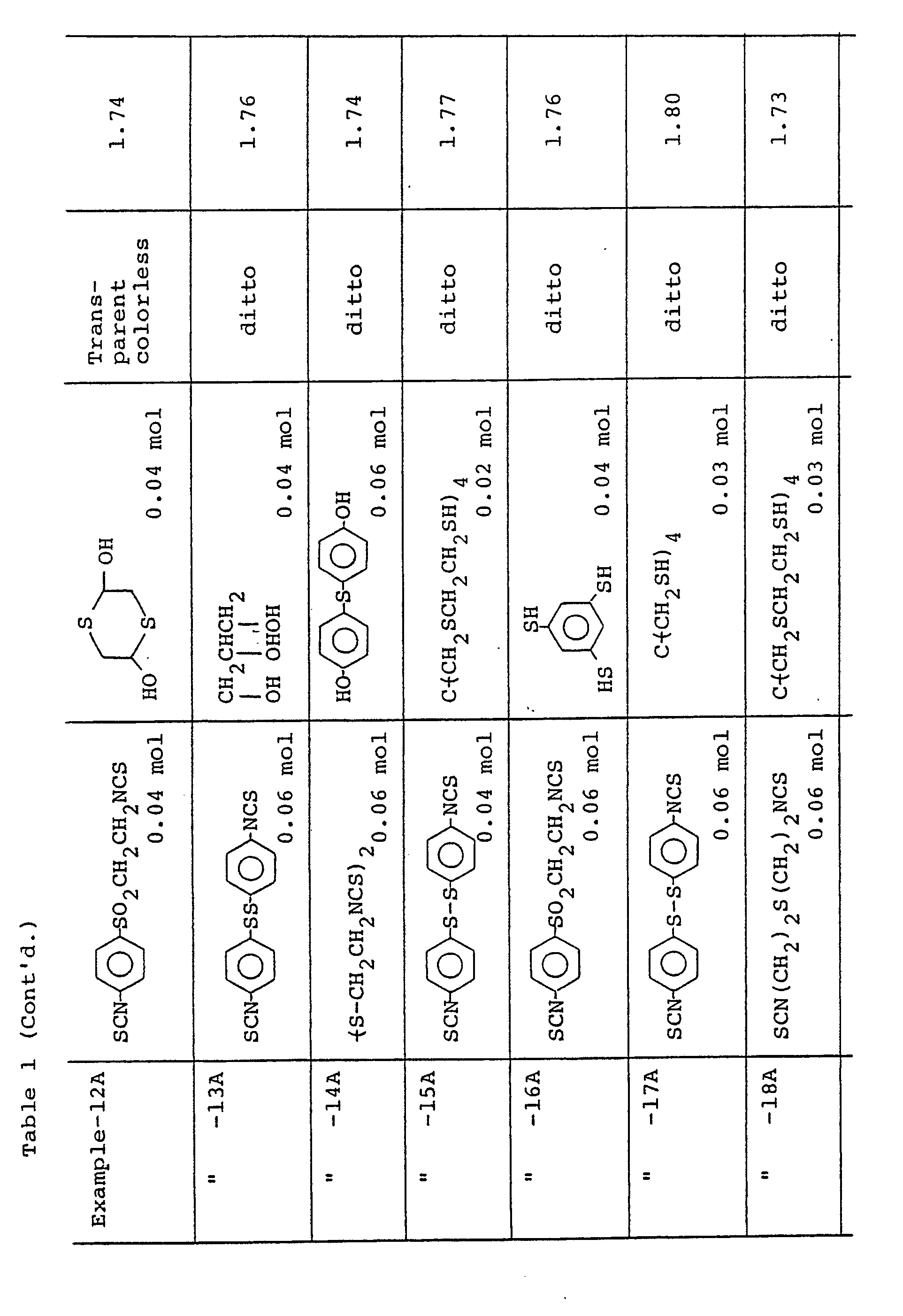
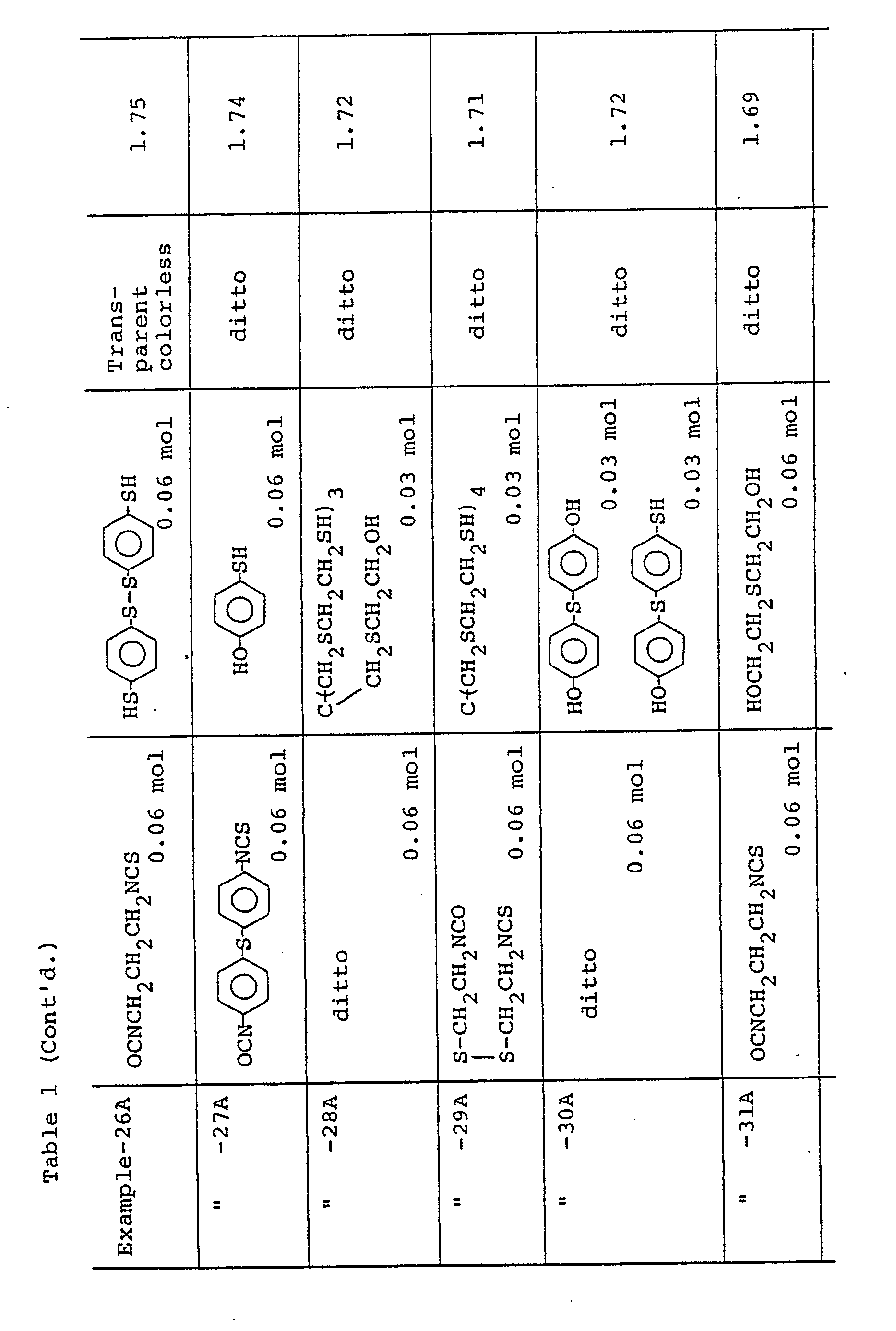
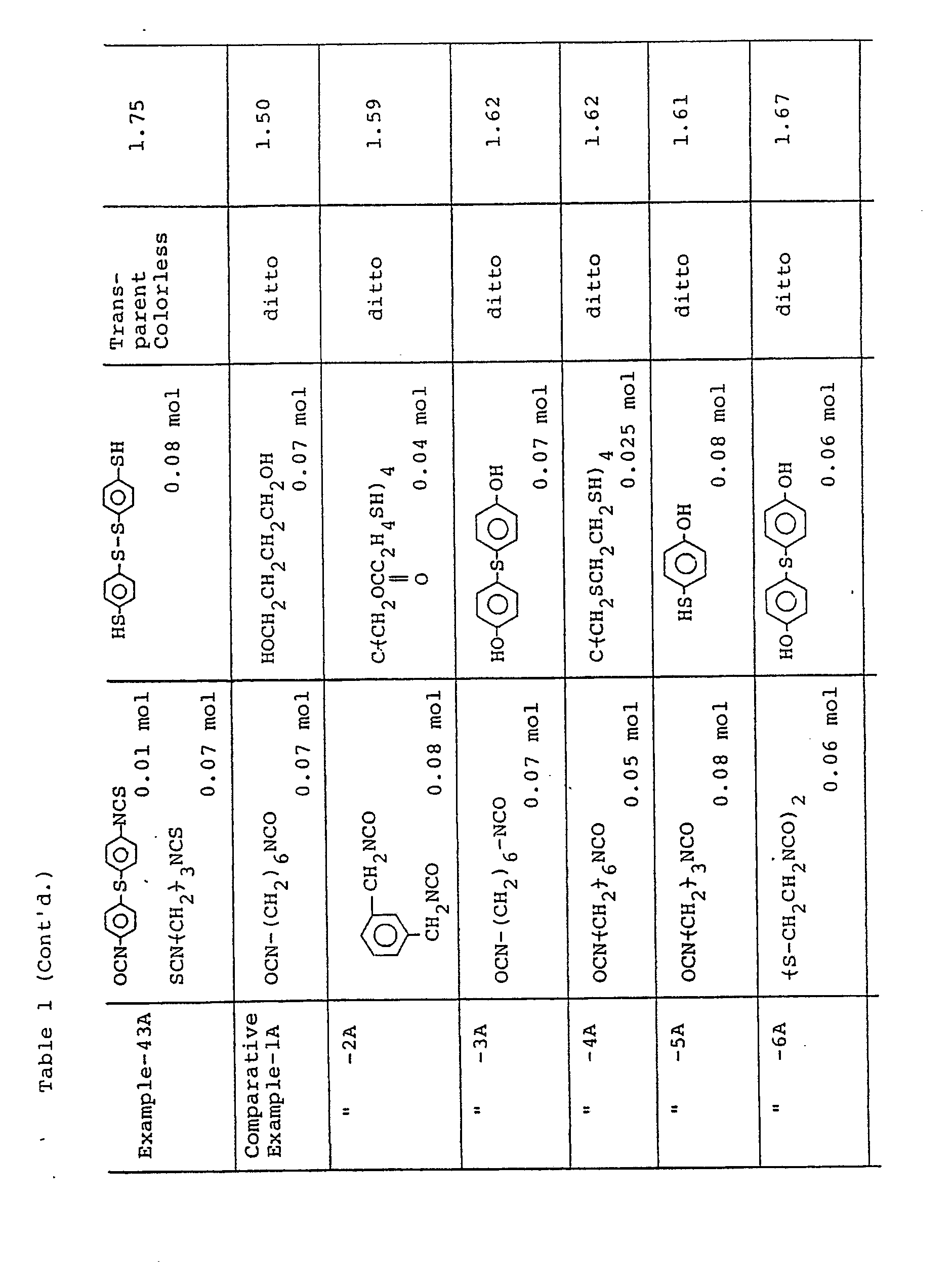
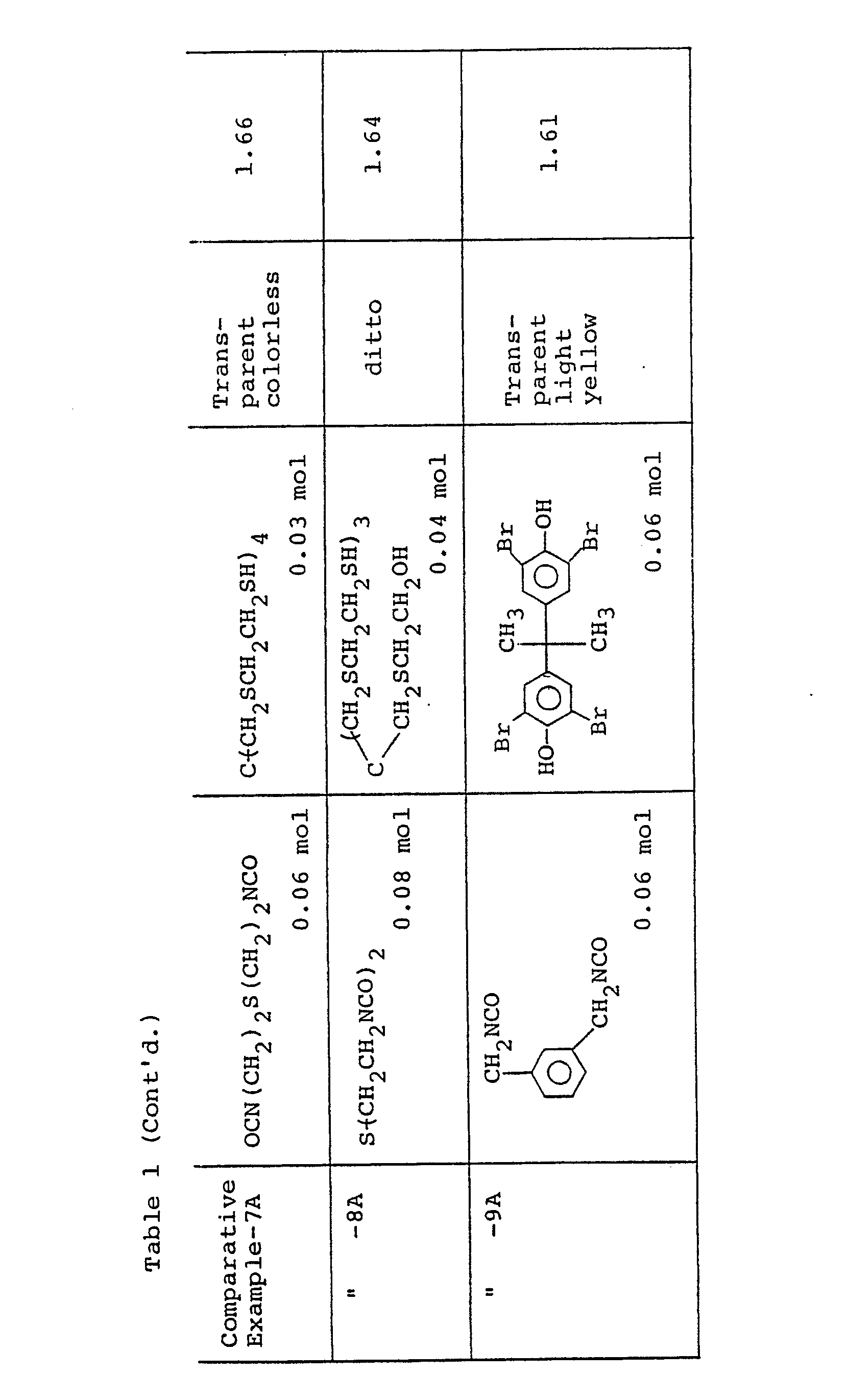
- Example 1A The same procedures as described in Example 1A were carried out for preparing lenses by using the composition illustrated in Table 1.
- a mixture of 13.5 g (0.07 mole) of benzene-1,4-diisothiocyanate, 7.7 g (0.07 mole) of hydroquinone and 0.02 g of dodecanol acid phosphate was poured into a mold consisting of a glass mold and a gasket. Then the mold was gradually heated from room temperature to 120°C,taking 24 hours to complete the polymerization. After completing the polymerization, the lens was readily released from the mold. The lens obtained had a good profile accuracy of surface was colorless and transparent, and had a refractive index n D of 1.78.
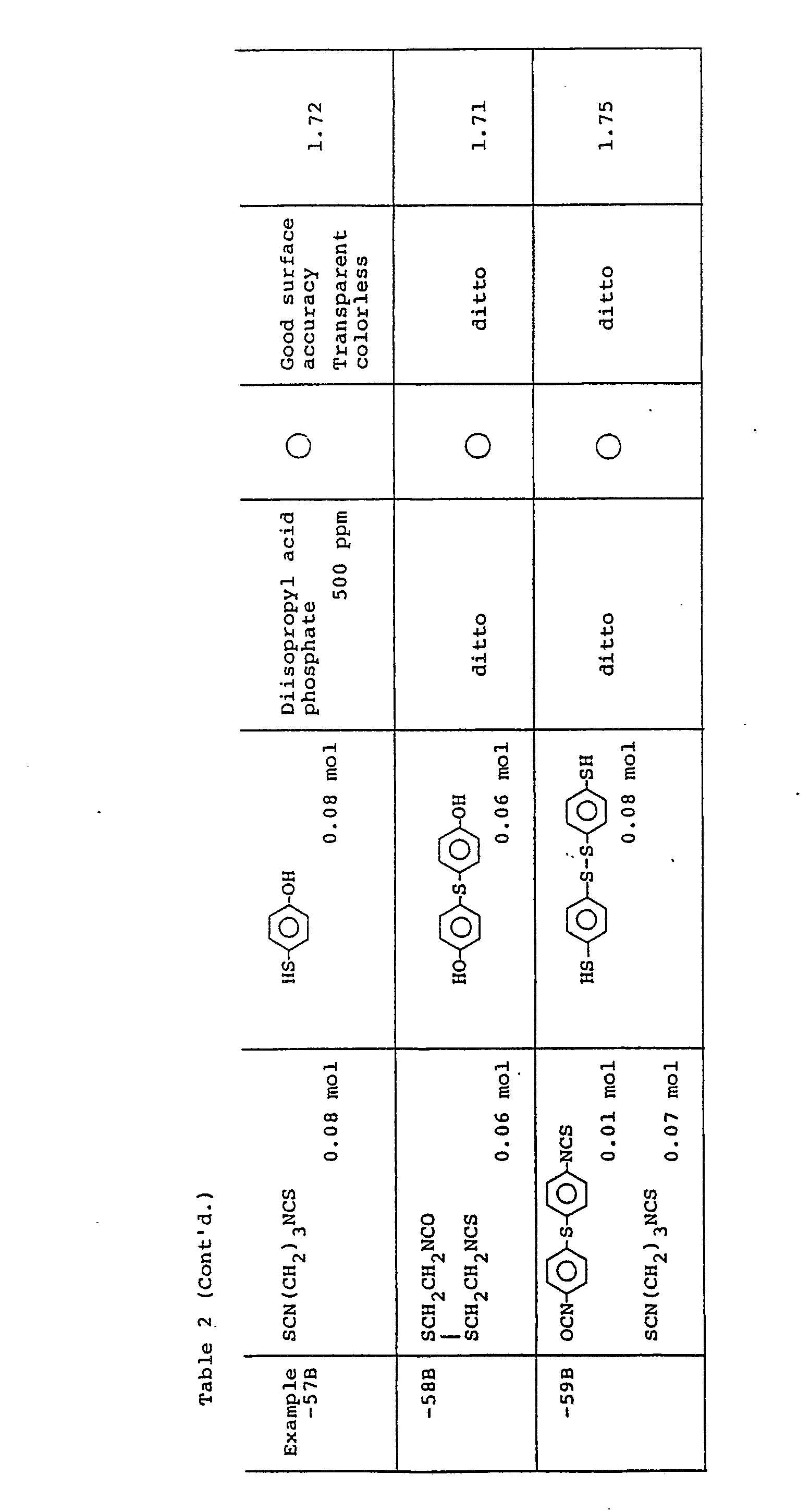
- Example 2 The same procedures as described in Example 1 B were carried out for preparing lenses by using the compositions illustrated in Table 2. Results on the physical property test are illustrated in Table 2.
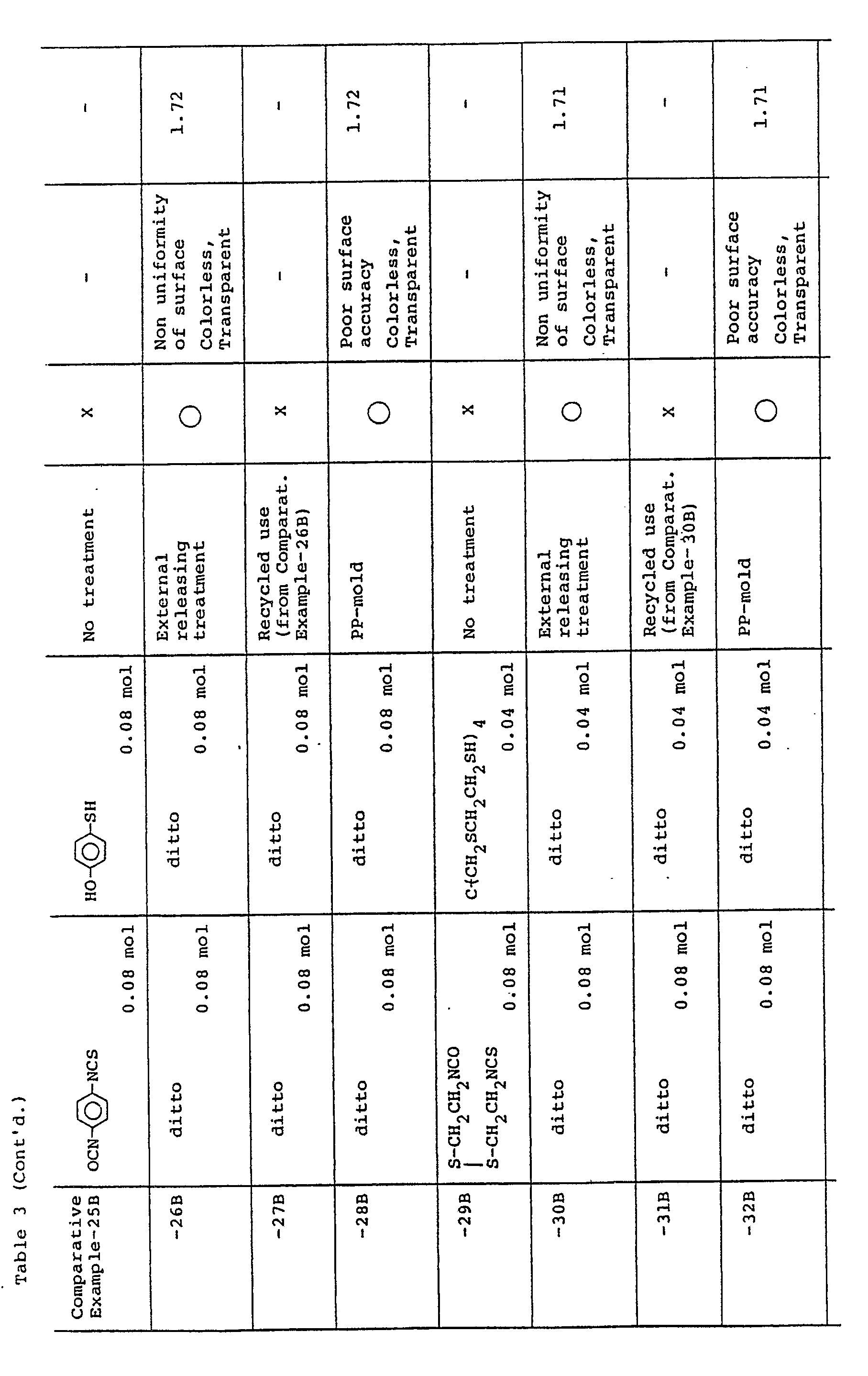
- Example 1 B The same procedures as described in Example 1 B were carried out for preparing lenses except that molds were used under conditions described below and compositions set forth in Table 3 were used. The results are summarized in Table 3.
Landscapes
- Chemical & Material Sciences (AREA)
- Health & Medical Sciences (AREA)
- Chemical Kinetics & Catalysis (AREA)
- Medicinal Chemistry (AREA)
- Polymers & Plastics (AREA)
- Organic Chemistry (AREA)
- Engineering & Computer Science (AREA)
- Mechanical Engineering (AREA)
- Polyurethanes Or Polyureas (AREA)
- Casting Or Compression Moulding Of Plastics Or The Like (AREA)
Abstract
Description
- The present invention relates to a resin having a high refractive index that is useful for preparing plastic lenses, lenses comprising the resin and processes for preparing the same.
- Plastic lenses have been rapidly popularized in recent years for use in optical elements such as lenses of eyeglasses and cameras. Plastic lenses are lightweight, less fragile than inorganic lenses and are capable of being dyed with ease.
- A resin currently widely used for producing lenses for optical elements is a radical polymerization product of diethylene glycol bisallyl carbonate (hereinafter abbreviated as DAC). The resin has excellent impact resistance, is lightweight, has prominent dye-affinity and good machinability including cutting ability and polishing ability.
- However, lenses prepared from the resin have a smaller refractive index (no = 1.50) than glass lenses (no = 1.52). In order to obtain equivalent optical properties to glass lenses, it is necessary to increase the center thickness, peripheral thickness and curvature of the lens and hence the lens as a whole becomes very thick. Therefore, resins having a higher refractive index that are useful for making lenses are desired.
- Resins having higher refractive indices that have been used to produce plastic lenses include polyurethane base resins obtained by reacting isocyanate compounds with hydroxyl compounds such as diethylene glycol (disclosed in Japanese Patent Laid-Open No. 136601/1982, U.S. Patent No. 4,443,588), with halogen containing hydroxyl compounds such as tetrabromobisphenol-A (Japanese Patent Laid-Open No. 164615/1983) and with diphenyl sulfide linkage containing hydroxyl compounds (Japanese Patent Laid-Open No. 194401/1985).
- The present inventors have previously invented resins having high refractive indices that are useful for preparing lenses by reacting isocyanate compounds with sulfur containing hydroxyl compounds (Japanese Patent Laid-Open No. 217229/1985, U.S. Patent No. 4,680,369 and U.S. Patent No. 4,780,522) or with polythiol compounds (Japanese Patent Laid-Open No. 199016/1985, U.S. Patent No. 4,689,378, Japanese Patent Laid-Open Nos. 267316/1987 and 46213/1988, and U.S. Patent No. 4,775,733). The present inventors prepared plastic lenses from their polyurethane base resins.
- In molding the polyurethane base lens, it is usually difficult to release the polymerized lens from the mold due to adhesion between the polyurethane compounds and the mold. In order to improve the mold releasing property, the present inventors previously proposed a process in which an external mold releasing agent is used (Japanese Patent Laid-Open No. 267316/1987) or a process in which a polyolefin resin mold is used (Japanese Patent Laid-Open No. 236818/1987) to improve the mold release properties in preparing lenses.
- Although the refractive indices of these lenses are higher than those of lenses prepared from DAC, the maximum refractive index of these lenses is between approximately 1.65 and 1.68. Further improvement of the refractive index is desired.
- The above methods are still insufficient for improving the mold releasing property in casting polymerization of polyurethane base lenses.
- In prior art processes in which external mold releasing agents are used, a portion of the agent that is applied to the inner surface of a mold migrates to the surface and interior of the polymerized lens which results in problems such as nonuniformity of the surface of the lens and turbidity of the lens. When a mold is used repeatedly, mold releasing treatment is required in each molding cycle. Such treatment lowers productivity in producing the lens and thus is extremely uneconomical in industrial production.
- When the polyolefin resin molds are applied, the resin molds are deformed at elevated temperatures which causes large profile irregularities on the molded lens. Thus, the resin molds cannot be applied to articles requiring high accuracy on the molded surface.
- Preferred embodiments of the present invention ameliorate or overcome the problems and disadvantages of the prior art by providing a resin having improved properties over prior art resins, a process for producing the same, and a lens containing the resin having superior properties over prior art lenses and a method of producing the same.
- An embodiment may desirably provide a colorless and transparent resin having a high refractive index and low dispersion of refractive index which is suitable for use in producing a plastic lens which is lightweight, and is excellent in weatherability and impact resistance.
- An embodiment may desirably provide a lens having high accuracy in the profile of surface and excellent optical properties and a process for producing the same which does not include specific release treatment of the inner mold surface of the mold used to make the lens.
- Additional advantages attainable by embodiments of the invention will be set forth in part in the description which follows, and in part will be obvious from the description, or may be learned by practice of the invention.
- Broadly, the invention provides a resin and a process for preparing the resin comprising reacting one or more isothiocyanate compounds with one or more active-hydrogen containing compounds selected from polyol compounds, polythiol compounds and mercapto group containing hydroxy compounds.
- The invention also provides a lens containing the resin and a process for preparing the lens comprising adding an internal mold releasing agent to a mixture of one or more isothiocyanate compounds and one or more active-hydrogen containing compounds and cast polymerizing the mixture to form a lens.
- A resin of the invention may be colorless, transparent, with a high refractive index and low dispersion of refractive index and be particularly suitable for producing lenses.
- Preferred lenses of the invention are excellent in weatherability, lightweight and exhibit excellent impact resistance.They may have excellent optical properties and be very accurate in the profile of the surface.
- Reference will now be made in detail to the present preferred embodiments of the invention.
- Exemplary suitable isothiocyanate compounds for use in the process of the present invention include polyisothiocyanate compounds and isothiocyanate compounds containing isocyanate groups. Such isothiocyanate compounds may contain one or more sulfur atoms in addition to the isothiocyanate groups. Exemplary suitable polyisothiocyanate compounds contain two or more -NCS groups per molecule and include, for example, aliphatic polyisothiocyanate compounds such as ethane-1,2-diisothiocyanate, propane-1,3-diisothiocyanate, butane-1,4-diisothiocyanate, hexane-1,6-diisothiocyanate, p-phenylenediisopropylidene diisothiocyanate; alicyclic polyisothiocyanate compounds such as cyclohexane diisothiocyanate; aromatic polyisothiocyanate compounds such as benzene-1,2-diisothiocyanate, benzene-1,3-diisothiocyanate, benzene-1,4-diisothiocyanate, toluene-2,4-diisothiocyanate. m-xylene-2,5-diisothiocyanate, 1,1 -biphenyl-4 ,4-diisothiocyanate, 1,1 -methylenebis(benzene-4-isothiocyanate), 1,1 -methylenebis(2-methylbenzene-4-isothiocyanate), 1,1 -methylenebis(3-methylbenzene-4-isothiocyanate), 1,1 -(1,2-ethane-diyl)bis(benzene-4-isothiocyanate), benzophenone-4,4 -diisothiocyanate, 3,3 -dimethylbenzophenone-4,4 -diisothiocyanate, benzanilide-3,4 -diisothiocyanate, diphenylether-4.4 -diisothiocyanate, and diphenylamine-4,4'-diisothiocyanate; heterocyclic polyisothiocyanate compounds such as 1.3,5-triazine-2,4.6-triisothiocyanate; and carbonyl polyisothiocyanate compounds such as hexanedioyl diisothiocyanate, nonanedioyl diisothiocyanate, carbonic diisothiocyanate, benzene-1,3-dicarbonyl diisothiocyanate, benzene-1,4-dicarbonyl diisothiocyanate and (2,2 -bipyridine)-4,4 -diisothiocyanate.
- Exemplary suitable polyisothiocyanate compounds containing at least one sulfur atom in addition to the isothioycnate groups include sulfur containing aliphatic polyisothiocyanates such as thiobis(3-isothiocyanatopropane), thiobis(2-isothiocyanatoethane) and dithiobis(2-isothiocyanatoethane); sulfur containing aromatic polyisothiocyanates such as 1-isothiocyanato- 4-{(2-isothiocyanato)sulfonyl}benzene, thiobis(4-isothiocyanatobenzene), sulfonylbis(4-isothiocyanatobenzene), sulfinylbis(4-isothiocyanatobenzene), dithiobis(4-isothiocyanatobenzene), 4-isothiocyanato-1-{(4-isothiocyanatophenyl)sulfonyl}-2-methoxybenzene, 4-methyl-3-isothiocyanatobenzenesulfonyl-4 -isothiocyanate phenyl ester and 4-methyl-3-isothiocyanatobenzenesulfonylanilide-3 -methyl-4 -isothiocyanate; and sulfur containing heterocyclic compounds such as thiophene-2,5-diisothiocyanate and 1,4-dithian-2,5-diisothiocyanate.
- Exemplary suitable isocyanate group containing isothiocyanate compounds include aliphatic and alicyclic compounds such as propane-1-isocyanato-3-isothiocyanate, pentane-1-isocyanato-5-isothiocyanate, hexane-1-isocyanato-6-isothiocyanate, isothiocyanatocarbonyl isocyanate and cyclohexane-1-isocyanato-4-isothiocyanate; heterocyclic compounds such as 1,3,5-triazine-2-isocyanato-4,6-diisothiocyanate; and compounds having sulfur atoms in addition to isothiocyanate groups such as 4-isocyanato-4 - isothiocyanatodiphenyl sulfide and 2-isocyanato-2'-isothiocyanatodiethyl disulfide.
- Exemplary suitable derivatives of the above isothiocyanate compounds for use in the invention include halogenated isothiocyanates such as chlorinated isothiocyanates and brominated isothiocyanates, alkylated isothiocyanates, alkoxylated isothiocyanates, nitrated isothiocyanates, prepolymer type addition products with polyhydric alcohols, carbodiimide modified isothiocyanates, urea modified isothiocyanates, biuret modified isothiocyanates, dimerization products and trimerization products.
- The isothiocyanate compounds may be used singly or in combination as a mixture.
- Exemplary active-hydrogen containing compounds suitable for use in the process of the invention are those selected from the group consisting of polyol compounds, polythiol compounds and mercapto group containing hydroxy compounds.
- Exemplary suitable polyol compounds include aliphatic polyols such as ethylene glycol, diethylene glycol, propylene glycol, dipropylene glycol, butyleneglycol, neopentyl glycol, glycerol, trimethylolethane, trimethylolpropane, butanetriol, 1,2-methylglucoside, pentaerythritol, dipentaerythritol, tripentaerythritol, sorbitol, erythritol, threitol, ribitol, arabinitol, xylitol, allitol, mannitol, duloitol, iditol, glycol, inositol, hexanetriol, triglycerol, diglycerol, triethylene glycol, polyethylene glycol, tris(2-hydroxyethyl)isocyanurate, cyclobutanediol, cyclopentanediol, cyclohexanediol, cycloheptonediol, cyclooctanediol, cyclohexanedimethanol, hydroxypropylcyclohexanol, tricyclo[5,2,1,02.6]decanedimethanol, bicyclo[4,3,0]nonanediol, dicyclohexanediol, tricyclo[5,3,1,1 ]dodecanediol, bicydo[4,3,0]nonanedimethand, tricyclo[5,3,1,1]-dodecanediethanol, hydroxypropyltricyclo[5,3,1,1]dodecanol, spiro[3,4]octanediol, butylcyclohexanediol, 1 ,1'-bicyclohexylidenediol, cyclohexanetriol, maltitol, lactitol; aromatic polyols such as dihydroxynaphthalene, trihydroxynaphthalene, tetrahydroxynaphthalene, hydroquinone, resorcinol, catechol, benzenetriol, biphenyl- tetraol, pyrogallol, (hydroxynaphthyl)pyrogallol, trihydroxyphenanthrene, bisphenol-A, bisphenol-F, xylyleneglycol, di(2-hydroxyethoxy)benzene, bisphenol A-bis(2-hydroxyethylether), tetrabromobisphenol-A, tetrabromobisphenol A-bis(2-hydroxyethylether); halogenated polyols such as dibromoneopentylglycol; and high molecular polyols such as epoxy resin.
- Additional exemplary polyols suitable for use in the process of the invention include condensed products of above mentioned polyol compounds with organic acids such as oxalic acid, glutamic acid, adipic acid, acetic acid, propionic acid, cyclohexanecarboxylic acid, β-hydroxycyclohexanepropionic acid, dimer acid, phthalic acid, isophthalic acid, salicylic acid, 3-bromopropionic acid, 2-bromoglycolic acid, cyclohexanedicarboxylic acid, pyromellitic acid, butanetetracarboxylic acid and bromophthalic acid; addition products of alkylene oxides such as ethylene oxide and propylene oxide to the above polyol compounds and to alkylenepolyamine; and sulfur atom containing polyols such as bis[4-(hydroxyethoxy)phenyl]sulfide, bis[4-(2-hydroxypropoxy)phenyl] sulfide, bis[4-(2,3-dihydroxypropoxy)phenyl] sulfide, bis[4-(4-hydrox- ycyclohexyloxy)phenyl] sulfide, bis[2-methyl-4-(hydroxyethoxy)-6-butylphenyl] sulfide, compounds obtained by the addition of ethylene oxide and/or propylene oxide to sulfur containing polyols in an amount of not more than about 3 moles per mole of hydroxyl group of the polyols, di(2-hydroxyethyl) sulfide, 1,2-bis(2-hydroxyethylmercapto)ethane, bis(2-hydroxyethyl)-disulfide, 1,4-dithian-2,5-diol, bis(2,3-dihydroxypropyl)-sulfide, tetrakis(4-hydroxy-2-thiabuty))methane, bis(4-hydroxyphenyl) sulfone (Trade Mark; Bisphenol-S), tetramethylbisphenol-S, 4,4 -thiobis(6-tert-butyl-3-methylphenol) and 1,3-bis(2-hydroxyethylthioethyl)-cyclohexane.
- Examplary suitable polythiols for use in the process of the invention include aliphatic polythiols such as methanedithiol, 1,2-ethanedithiol, 1,1-propanedithiol, 1,2-propanedithio, 1,3-propanedithiol, 2,2-propanedithiol, 1,6-hexanedithiol, 1,2,3-propanetrithiol, 1,1-cyclohexanedithiol, 1,2-cyclohexanedithiol, 2,2-dimethylpropane-1,3-dithiol, 3,4-dimethoxybutane-1,2-dithiol, 2-methylcyclohexane-2,3-dithiol, bicyclo[2,3,1]-hepta-exo-cis-2,3-dithiol, 1,1-bis(mercaptomethyl)cyclohexane, thiomalic acid bis(2-mercaptoethyl ester), 2,3-dimercaptosuccinic acid 2-mercaptoethyl ester, 2,3-dimercapto-1-propanol 2-mercaptoacetate, 2,3-dimercapto-1-propanol 3-mercaptopropionate, diethylene glycol bis(2-mercaptoacetate), diethylene glycol bis(3-mercaptopropionate), 1,2-dimercaptopropyl methyl ether, 2,3-dimercaptopropyl methyl ether, 2,2-bis-(mercaptomethyl)-1,3-rpopanedithiol, bis(2-mercaptoethyl) ether, ethylene glycol bis(2-mercaptoacetate), ethylene glycol bis(3-mercaptopropionate), trimethylolpropane bis(2-mercaptoacetate), trimethylolpropane bis(3-mercaptopropionate), pentaerythritol tetrakis(2-mercaptoacetate) and pentaerythritol tetrakis(3-mercaptopropionate); aromatic polythiols such as 1,2-dimercaptobenzene, 1,3-dimercaptobenzene, 1,4-dimercaptobenzene, 1,2-bis(mercaptomethyi)benzene, 1,3-bis(mercaptomethyl)benzene, 1,4-bis(mercaptomethyl)-benzene, 1,2-bis(mercaptoethyl)benzene, 1,3-bis(mercaptoethyl)benzene, 1,4-bis(mercaptoethyl)benzene, 1,2-bis(mercaptomethyleneoxy)benzene, 1,3-bis(mercaptomethyieneoxy)benzene, 1,4-bis-(mercaptomethyleneoxy)benzene, 1,2-bis(mercaptoethyleneoxy)benzene, 1,3-bis(mercaptoethylenoxy)-benzene, 1,4-bis(mercaptoethyleneoxy)benzene, 1,2,3-trimercaptobenzene, 1,2,4-trimercaptobenzene, 1,3,5-trimercaptobenzene, 1,2,3-tris(mercaptomethyl)benzene, 1,2,4-tris(mercaptomethyl)benzene, 1,3,5-tris-(mercaptomethyl)benzene, 1,2,3-tris(mercaptoethyl)benzene, 1,2,4-tris(mercaptoethyl)benzene, 1,3,5-tris-(mercaptoethyl)benzene, 1,2,3-tris(mercaptomethyleneoxy)benzene, 1,2,4-tris(mercaptomethyleneoxy)-benzene, 1,3,5-tris(mercaptomethyleneoxy)benzene, 1,2,3-tris(mercaptoethylenoxy)benzene, 1,2,4-tris-(mercaptoethyleneoxy)benzene, 1,3,5-tris(mercaptoethyleneoxy)benzene, 1,2,3,4-tetramercaptobenzene, 1,2,3,5-tetramercaptobenzene, 1,2,4,5-tetramercaptobenzene, 1,2,3,4-tetrakis(mercaptomethyl)benzene, 1,2,3,5-tetrakis(mercaptomethyi)benzene, 1,2,4,5-tetrakis(mercaptomethyl)benzene, 1,2,3,4-tetrakis-(mercaptoethyl)benzene, 1,2,3,5-tetrakis(mercaptoethyi)benzene, 1,2,4,5-tetrakis(mercaptoethyl)benzene, 1,2,3,4-tetrakis(mercaptomethyleneoxy)benzene, 1,2,3,5-tetrakis(mercaptomethyleneoxy)benzene, 1,2,4,5-tetrakis(mercaptomethyleneoxy)benzene, 1,2,3,4-tetrakis(mercaptoethyleneoxy)benzene, 1,2,3,5-tetrakis-(mercaptoethyleneoxy)benzene, 1,2,4,5-tetrakis(mercaptoethyleneoxy) benzene, 2,2 -dimercaptobiphenyi, 4,4-dimercaptobiphenyl, 2,5-toluenedithiol, 3,4-toluenedithiol, 1,4-naphthalenedithiol, 1,5-naphthalenedithiol, 2,6-naphthalenedithiol, 2,7-naphthalenedithiol, 2,4-dimethylbenzene-1,3-dithiol, 4,5-dimethylbenzene-1,3-dithiol, 9,10-anthracenedimethanethiol, 1,3-di(p-methoxyphenyl)propane-2,2-dithiol, 1,3-diphenylpropane-2,2-dithiol, phenylmethane-1,1-dithiol and 2,4-di(p-mercaptophenyl)pentane; chlorinated and brominated aromatic polythiols such as 2,5-dichlorobenzene-1,3-dithiol, 1,3-(p-chlorophenyl)propane-2,2-dithiol, 3,4,5-tribromo-1,2-dimercaptobenzene and 2,3,4,6-tetrachloro-1,5-bis(mercaptomethyl)benzene; heterocyclic polythiols such as 2-methylamino-3,6-dithiol-sym-triazine, 2-ethylamino-4,6-dithiol-sym-triazine, 2-amino-4,6-dithiol-sym-triazine, 2-morphoiino-4,6-dithioi-symtriazine, 2-cyclohexylamino-4,6-dithiol-sym-triazine, 2-methoxy-4,6-dithiol-sym-triazine, 2-phenoxy-4,6-dithiol-sym-triazine, 2-thiobenzeneoxy-4,6-dithiol-sym-t and 2-thiobutyloxy-4,6-dithiol-sym-triazine; aromatic polythiols containing sulfur atoms in addition to mercapto groups such as 1,2-bis(mercaptomethylthio)benzene, 1,3-bis(mercaptomethylthio)benzene, 1,4-bis-(mercaptomethylthio)benzene, 1,2-bis(mercaptoethylthio)benzene, 1,3-bis(mercaptoethylthio)benzene, 1,4- bis(mercaptoethylthio)benzene, 1,2,3-tris(mercaptomethylthio) benzene, 1,2,4-tris(mercaptomethylthio)-benzene, 1,3,5-tris(mercaptomethylthio)benzene, 1,2,3-tris(mercaptoethyithio)benzene, 1,2,4-tris-(mercaptoethylthio)benzene, 1,3,5-tris(mercaptoethylthio)benzene, 1,2,3,4-tetrakis(mercaptomethylthio)-benzene, 1,2,3,5-tetrakis(mercaptomethylthio)benzene, 1,2,4,5-tetrakis(mercaptomethylthio)benzene, 1,2,3,4-tetrakis(mercaptoethylthio)benzene, 1,2,3,5-tetrakis(mercaptoethylthio)benzene, 1,2,4,5-tetrakis-(mercaptoethylthio)benzene and aromatic ring alkylated derivatives of these polythiols; aliphatic polythiols containing sulfur atoms in addition to mercapto groups such as bis(mercaptomethyl) sulfide, bis-(mercaptoethyl) sulfide, bis(mercaptopropyl) sulfide, bis(mercaptomethylthio)methane, bis(2-mercaptoethyl- thio)methane, bis(3-mercaptopropyl)methane, 1,2-bis(mercaptomethylthio)ethane, 1,2-bis(2-mercaptoethyl- thio)ethane, 1,2-bis(3-mercaptopropyl)ethane, 1,3-bis(mercaptomethylthio)propane, 1,3-bis(2-mercaptoethyl- thio)propane, 1,3-bis(3-mercaptopropylthio)propane, 1,2,3-tris(mercaptomethylthio)propane, 1,2,3-tris(2-mer- captoethylthio)propane, 1,2,3-tris(3-mercaptopropylthio)propane, tetrakis(mercaptomethylthiomethyl)-methane, tetrakis(2-mercaptoethylthiomethyl)methane, tetrakis(3-mercaptopropylthiomethyl)methane, bis-(2,3-dimercaptopropyl) sulfide, 2,5-dimercapto-1,4-dithian, bis(mercaptomethyl) disulfide, bis(mercaptoethyl) disulfide and bis(mercaptopropyl) disulfide; esters of mercaptoacetic acid, mercaptopropionic acid and mercaptobutyric acid with sulfur containing compounds such as hydroxymethyl sulfide bis(2-mercaptoacetate), hydroxymethyl sulfide bis(3-mercaptopropionate), hydroxyethyl sulfide bis(2-mercaptoacetate), hydroxyethyl sulfide bis(3-mercaptopropionate), hydroxypropyl sulfide bis(2-mercaptoacetate), hydroxypropyl sulfide bis(3-mercaptopropionate), hydroxymethyl disulfide bis(2-mercaptoacetate), hydroxymethyl disulfide bis(3-mercaptopropionate), hydroxyethyl disulfide bis(2-mercaptoacetate), hydroxyethyl disulfide bis(3-mercaptopropionate), hydroxypropyl disulfide bis(2-mercaptoacetate), hydroxypropyl disulfide bis(3-mercaptopropionate), 2-mercaptoethyl ether bis(2-mercaptoacetate), 2-mercaptoethyl ether bis(3-mercaptopropionate). 1,4-dithian-2,5-diol bis(2-mercaptoacetate), 1,4-dithian-2,5-diot bis(3-mercaptopropionate), thiodiglycolic acid bis(2-mercaptoethyl ester), thiodipropionic acid bis(2-mercaptoethyl ester), 4,4-thiodibutyric acid bis(2-mercaptoethyl ester), dithiodiglycolic acid bis(2-mercaptoethyl ester), dithiodipropionic acid bis(2-mercaptoethyl ester), 4,4-dithiodibutyric acid bis(2-mercaptoethyl ester), thiodiglycolic acid bis(2,3-dimercaptopropyl ester), thiodipropionic acid bis(2,3-dimercaptopropyl ester), dithiodiglycolic acid bis(2,3- dimercaptopropyl ester) and dithiodipropionic acid bis(2,3-dimercaptopropyl ester); and heterocyclic compounds containing sulfur atoms in addition to mercapto groups such as 3,4-thiophene-dithiol and 2,5-dimercapto-1,3,4-thiadiazol.
- Exemplary suitable mercapto group containing hydroxy compounds for use in the process of this invention include mercaptoalkanols, mercaptocycloalkonols and mercapto phenols such as 2-mercaptoethanol, 3-mercapto-1,2-propanediol, glycerol di(mercaptoacetate), 1-hydroxy-4-mercaptocyclohexane, 2,4-dimercaptophenol, 2-mercaptohydroquinone, 4-mercaptophenol, 3,4-dimercapto-2-propanol, 1,3-dimercapto-2-propanol, 2.3-dimercapto-1-propanol. 1,2-dimercapto-1,3-butanedioi, pentaerythritol tris(3-mercaptopropionate), pentaerythritol mono(3-mercaptopropionate), pentaerythritol bis(3-mercaptopropionate), pentaerythritol tris(thioglycolate), pentaerythritol tetrakis(3-mercaptopropionate); and mercapto group and sulfur atom containing alkanols and phenols such as hydroxymethyltris(mercaptoethylthiomethyl)methane, 1-hydroxyethylthio-3-mercaptoethylthiobenzene, 4-hydroxy-4 -mercaptodiphenyl sulfone, 2-(2-mercap- toethylthio)ethanol, dihydroxyethyl sulfide mono(3-mercaptopropionate), dimercaptoethane monosalicylate, and hydroxyethylthiomethyl-tris(mercaptoethylthiomethyl)methane.
- Halogenated derivatives of these active-hydrogen containing compounds such as chlorinated derivatives and brominated derivatives may also be used.
- These active-hydrogen containing compounds may be used singly or in combination as a mixture.
- The isothiocyanate compounds and the active-hydrogen containing compounds are employed in amount of from about 0.5 to about 3.0 moles of total functional isocyanate and isothiocyanate groups per mole of total hydroxyl and mercapto groups, preferably from about 0.5 to about 1.5 moles of sum of functional isocyanate group and isothiocyanate group per mole of sum of hydroxyl group and mercapto group.
- A portion of the isothiocyanate compounds used in the process of this invention may be replaced by polyisocyanate compounds.
- Various additives such as chain extending agents, cross linking agents, light stabilizers, ultraviolet absorbers, antioxidants, oil soluble dyestuffs and fillers may be incorporated to achieve particular desired properties.
- Known catalysts which are used for the preparation of polyurethane may also be used, if necessary, to adjust the reaction rate in the desired range.
- Exemplary suitable compounds for use as an internal mold releasing agent in the process of the invention include fluorine containing nonionic surface active agents, silicon containing nonionic surface active agents, alkyl quaternary ammonium salts, acid phosphate esters, liquid paraffins, waxes, higher fatty acids and their salts, higher fatty acid esters, higher aliphatic alcohols, bisamides, polysiloxanes, and adducts of ethylene oxide to aliphatic amines.
- The internal mold releasing agent is suitably selected on the basis of monomer combination, polymerization conditions, economy and readiness in handling. The agent may be used singly or as a mixture of two or more such agents.
- Exemplary suitable fluorine containing nonionic surface active agents and silicon containing nonionic surface active agents suitable for use in the process of the invention include compounds containing perfluoroalkyl groups or dimethyl polysiloxane groups and hydroxyalkyl groups or phosphate ester groups. Exemplary suitable fluorine containing nonionic surface active agents include Unidain™: DS-401 and DS-403 (Products of Daikin Kogyo Co., Ltd.) and F-TopT""; EF-122A, EF-126 and EF-301 (Products of Shin-Akita Chemical Co., Ltd.). An exemplary suitable silicon containing nonionic surface active agent is a trial product Q2-120A of DOW Chemical Co.
- Examplary suitable alkyl quaternary ammonium salts for use in the process of the invention include cationic surface active agents such as alkyl quaternary ammonium halogenides, phosphates and sulfates such as trimethylcetyl ammonium chloride, trimethylstearyl ammonium chloride, dimethylethylcetyl ammonium chloride, triethyldodecyl ammonium chloride, trioctylmethyl amonium chloride, and diethylcyclohexyl- dodecyl ammonium chloride.
- Exemplary suitable acid phosphate esters for use in the process of the invention include isopropyl acid phosphate, diisopropyl acid phosphate, butyl acid phosphate, dibutyl acid phosphate, octyl acid phosphate, dioctyl acid phosphate, isodecyl acid phosphate, diisodecyl acid phosphate, tridecanol acid phosphate, and bis(tridecanol acid)phosphate.
- Exemplary suitable metal salts of higher fatty acid for use in this invention include zinc, calcium, magnesium, nickel and copper salts of stearic acid, oleic acid, octanoic acid, lauric acid, behenic acid and ricinoleic acid such as zinc stearate, zinc oleate, zinc palmitate, zinc laurate, calcium stearate, calcium oleate, calcium palmitate, calcium laurate, magnesium stearate, magnesium oleate, magnesium laurate, magnesium palmitate, nickel stearate, nickel oleate, nickel palmitate, nickel laurate, copper stearate, copper oleate copper laurate, and copper palmitate.
- Exemplary suitable higher fatty acid esters for use in the process of the invention include esters obtained by the reaction of higher fatty acids such as stearic acid, oleic acid, octanoic acid, lauric acid and ricinolic acid with alcohols such as ethylene glycol, propylene glycol, butane diol, neopentyl glycol and hexane diol.
- The internal mold releasing agent may be used singly or in combination. The total amount of the releasing agents used is from about 0.1 to about 10,000 ppm, preferably from about 1 to about 5,000 ppm per sum of the isothiocyanate compounds and active-hydrogen containing compounds. When used in an amount less than 0.1 ppm, demolding ability becomes poor. When used in an amount greater than 10,000 ppm, the molded lens causes haze. The excess amount also results in poor profile accuracy of the lens surface due to premature release of the molded lens from the mold surface during polymerization.
- The lens of the invention can usually be produced by casting polymerization. One or more isothiocyanate compounds are preferably mixed with one or more active-hydrogen containing compounds and internal mold releasing agents, incorporated with additives, catalysts or the like if necessary, and then poured into a mold to carry out polymerization. In this step, the resultant mixture is usually deaerated prior to pouring to prevent bubbling in the molded lens.
- Although the temperature and time of polymerization differ depending upon the type of monomer and additives such as mold releasing agent, the polymerization is generally carried out for from about 0.5 to about 72 hours at a temperature of from about -50 ° C to about 200 C, preferably from room temperature to about 150 ` C, more preferably from room temperature to about 120 C.
- Annealing of the polymerized lens may be conducted when necessary.
- The polyurethane base lens obtained has a high profile accuracy of the molded surface and excellent optical properties, is lightweight, excellent in impact resistance and suitable for use as eyeglass lenses and camera lenses.
- The high refraction lens of this invention can be imparted with the following properties: antireflection, surface hardness, abrasion resistance, chemical resistance, fog resistance and fashionability by subjecting the lens to physical or chemical treatment such as surface polishing, antistatic treatment, hard coating, antireflection coating, dyeing and dimming.
- This invention will hereinafter be illustrated by way of the following examples and comparative examples, which are intended to be purely exemplary of the invention. In testing properties of the lens resin obtained, refractive index, Abbe's number, weatherability, mold release property and appearance were measured by the following methods.
- Refractive index and Abbe's number:
- Measured at 20 °C with a Pulfrich refractometer.
- Mold release property:
- After completing the polymerization, a teflon wedge was struck in the interface of the lens and glass mold. The results were divided into the following two classes.
- 0 Quite readily released.
- X Release was partly or wholly impossible.
- Appearance:
- Evaluation was conducted by visual observation.
- A mixture of 13.5 g (0.07 mole) of benzene-1,4-diisothiocyanate and 7.7 g (0.07 mole) of hydroquinone was poured into a mold consisting of a glass mold and a gasket. The mold was then gradually heated from room temperature to 120* C, taking 48 hours to complete the polymerization. The lens obtained was colorless and transparent. The lens had a refractive index

- The same procedures as described in Example 1A were carried out for preparing lenses by using the composition illustrated in Table 1.
- Results of testing physical properties are summarized in Table 1.
- A mixture of 13.5 g (0.07 mole) of benzene-1,4-diisothiocyanate, 7.7 g (0.07 mole) of hydroquinone and 0.02 g of dodecanol acid phosphate was poured into a mold consisting of a glass mold and a gasket. Then the mold was gradually heated from room temperature to 120°C,taking 24 hours to complete the polymerization. After completing the polymerization, the lens was readily released from the mold. The lens obtained had a good profile accuracy of surface was colorless and transparent, and had a refractive index nD of 1.78.
- The same procedures as described in Example 1 B were carried out for preparing lenses by using the compositions illustrated in Table 2. Results on the physical property test are illustrated in Table 2.
- The same procedures as described in Example 1 B were carried out for preparing lenses except that molds were used under conditions described below and compositions set forth in Table 3 were used. The results are summarized in Table 3.
- The descriptions in the mold treatment column in Table 3 also indicates the following conditions.
- (1) No treatment ..... A glass mold was used without any releasing treatment.
- (2) External releasing treatment ..... External mold releasing agent YSR-6209TM (product of Toshiba Silicon Co.) was applied and baked on the inner surface of a glass mold.
- (3) Recycled use ..... The glass mold obtained by the external releasing treatment was once employed for the polymerization and then used again without any further treatment.
- (4) PP-mold ..... A polypropylene mold was prepared by injection molding and used in place of the glass mold without any surface treatment.










Claims (10)
Applications Claiming Priority (20)
| Application Number | Priority Date | Filing Date | Title |
|---|---|---|---|
| JP176064/88 | 1988-07-14 | ||
| JP17606488 | 1988-07-14 | ||
| JP18036188 | 1988-07-21 | ||
| JP18036288 | 1988-07-21 | ||
| JP180361/88 | 1988-07-21 | ||
| JP180362/88 | 1988-07-21 | ||
| JP18757088 | 1988-07-27 | ||
| JP18756988 | 1988-07-27 | ||
| JP187569/88 | 1988-07-27 | ||
| JP187570/88 | 1988-07-27 | ||
| JP187571/88 | 1988-07-27 | ||
| JP18757188 | 1988-07-27 | ||
| JP19268188 | 1988-08-03 | ||
| JP192681/88 | 1988-08-03 | ||
| JP213751/88 | 1988-08-30 | ||
| JP21375288 | 1988-08-30 | ||
| JP213752/88 | 1988-08-30 | ||
| JP21375188 | 1988-08-30 | ||
| JP22135588 | 1988-09-06 | ||
| JP221355/88 | 1988-09-06 |
Publications (3)
| Publication Number | Publication Date |
|---|---|
| EP0351073A2 true EP0351073A2 (en) | 1990-01-17 |
| EP0351073A3 EP0351073A3 (en) | 1991-02-13 |
| EP0351073B1 EP0351073B1 (en) | 1994-09-21 |
Family
ID=27580366
Family Applications (1)
| Application Number | Title | Priority Date | Filing Date |
|---|---|---|---|
| EP89306175A Expired - Lifetime EP0351073B1 (en) | 1988-07-14 | 1989-06-19 | Lens comprising a resin having a large refractive index and process for preparing the lens |
Country Status (8)
| Country | Link |
|---|---|
| US (1) | US5084545A (en) |
| EP (1) | EP0351073B1 (en) |
| JP (4) | JP3088428B2 (en) |
| KR (1) | KR920010139B1 (en) |
| CN (3) | CN1092211C (en) |
| AU (1) | AU605428B2 (en) |
| BR (1) | BR8903481A (en) |
| DE (1) | DE68918356T2 (en) |
Cited By (8)
| Publication number | Priority date | Publication date | Assignee | Title |
|---|---|---|---|---|
| EP0490778A1 (en) * | 1990-12-14 | 1992-06-17 | Rhone-Poulenc Chimie | Sulphur compounds and polymers obtained therefrom |
| EP0530757A1 (en) * | 1991-09-03 | 1993-03-10 | Hoya Corporation | Polymer for optical products and process for preparation thereof |
| EP0553801A1 (en) * | 1992-01-31 | 1993-08-04 | MITSUI TOATSU CHEMICALS, Inc. | Use of sulfur-containing acid phosphoric ester as internal release agent |
| US5326501A (en) * | 1989-12-28 | 1994-07-05 | Hoya Corporation | Polythiol compound, and optical material and product produced therefrom |
| WO2011041476A3 (en) * | 2009-09-30 | 2011-07-14 | Battelle Memorial Institute | Biobased polyol cross-linkers for use in preparing polyesters and reversible polyurethanes |
| US8624047B2 (en) | 2005-04-26 | 2014-01-07 | Battelle Memorial Institute | Solvent-less preparation of polyols by ozonolysis |
| US8871960B2 (en) | 2005-04-26 | 2014-10-28 | Battelle Memorial Institute | Preparation of esters and polyols by initial oxidative cleavage of fatty acids followed by esterification reactions |
| US8940914B2 (en) | 2006-02-07 | 2015-01-27 | Battelle Memorial Institute | Esters of 5-hydroxymethylfurfural and methods for their preparation |
Families Citing this family (39)
| Publication number | Priority date | Publication date | Assignee | Title |
|---|---|---|---|---|
| FR2649711B1 (en) * | 1989-07-13 | 1993-01-22 | Essilor Int | POLYTHIOURETHANE POLYMER COMPOSITIONS FOR THE MANUFACTURE OF ORGANIC GLASSES |
| US5194559A (en) * | 1991-03-25 | 1993-03-16 | Mitsui Toatsu Chemicals, Inc. | Optical urethane resins and plastic lenses comprising the same |
| US5446173A (en) * | 1992-03-24 | 1995-08-29 | Daiso Co., Ltd. | Cyclic sulfide compound, polymerizable compositions for optical products and optical products formed thereof |
| US5420186A (en) * | 1993-01-26 | 1995-05-30 | Air Products And Chemicals, Inc. | Internal mold release agents comprising metallic soaps compatibilized with liquid quaternary ammonium salts |
| JP2695599B2 (en) * | 1993-09-29 | 1997-12-24 | ホーヤ株式会社 | Manufacturing method of polyurethane lens |
| US6008296A (en) | 1995-04-19 | 1999-12-28 | Optima, Inc. | Optical terpolymer of polyisocyanate, polythiol and polyene monomers |
| US6274694B1 (en) | 1995-11-20 | 2001-08-14 | Hoya Corporation | Process for the production of polyurethane lens |
| US5908876A (en) * | 1996-04-19 | 1999-06-01 | Mitsui Chemicals, Inc. | Optical resin composition comprising a thiourethane prepolymer and use thereof |
| JP3791973B2 (en) * | 1996-07-30 | 2006-06-28 | 三井化学株式会社 | Isocyanate derivatives and uses thereof |
| JP3995427B2 (en) * | 2000-03-27 | 2007-10-24 | 三井化学株式会社 | Polymerizable composition containing novel polythiol, resin obtained by polymerizing the same, and lens |
| KR100746067B1 (en) | 2002-11-13 | 2007-08-03 | 닛뽕소다 가부시키가이샤 | Dispersoid having metal-oxygen bond, metal oxide film, and monomolecular film |
| JP4231702B2 (en) * | 2003-01-17 | 2009-03-04 | 日東電工株式会社 | Micro lens array |
| GB0310270D0 (en) * | 2003-05-03 | 2003-06-11 | Univ Edinburgh | Biomolecular devices |
| CN1325943C (en) * | 2003-05-14 | 2007-07-11 | 上海康耐特光学有限公司 | Method for producing optical resin material with high-refractivity |
| JP4716249B2 (en) * | 2005-03-24 | 2011-07-06 | 三菱瓦斯化学株式会社 | Polymerizable composition |
| WO2010078491A1 (en) | 2008-12-31 | 2010-07-08 | Battelle Memorial Institute | Pre-esterification of primary polyols to improve solubility in solvents used in polyol process |
| US20070037897A1 (en) * | 2005-08-12 | 2007-02-15 | Guigui Wang | Method for making contact lenses |
| JP3947751B2 (en) * | 2005-10-07 | 2007-07-25 | セイコーエプソン株式会社 | Plastic lens and method for manufacturing plastic lens |
| JP2007246690A (en) * | 2006-03-16 | 2007-09-27 | Seiko Epson Corp | Manufacturing method of optical substrate |
| KR100939451B1 (en) * | 2007-12-24 | 2010-01-29 | 주식회사 케이오씨솔루션 | Optical resin composition excellent in heat resistance and impact resistance after multi-coating, plastic spectacle lens using the same and manufacturing method thereof |
| MX2011006961A (en) | 2008-12-31 | 2011-09-27 | Battelle Memorial Institute | Use of fatty acids as feed material in polyol process. |
| US9359572B2 (en) | 2009-03-13 | 2016-06-07 | Battelle Memorial Institute | Modified vegetable oil lubricants |
| EP2445947B1 (en) | 2009-06-23 | 2018-05-23 | Carl Zeiss Vision Australia Holdings Limited | Thiourethane-based lens elements and processes for their production |
| WO2011055540A1 (en) * | 2009-11-06 | 2011-05-12 | 三井化学株式会社 | Method for producing internal mold release agent for optical material, internal mold release agent for optical material, and polymerizable composition including the same |
| WO2012064699A1 (en) | 2010-11-10 | 2012-05-18 | Novartis Ag | Method for making contact lenses |
| TWI543995B (en) * | 2013-07-08 | 2016-08-01 | 旭化成化學股份有限公司 | Modified resin and resin composition |
| JP6791546B2 (en) | 2013-09-30 | 2020-11-25 | ホヤ レンズ タイランド リミテッドHOYA Lens Thailand Ltd | Transparent plastic substrate and plastic lens |
| US10519060B2 (en) * | 2015-08-06 | 2019-12-31 | Mitsui Chemicals, Inc. | Process for producing polymerizable composition for optical material and polymerizable composition for optical material |
| KR101869785B1 (en) * | 2016-03-24 | 2018-06-22 | 미쯔비시 가스 케미칼 컴파니, 인코포레이티드 | Composition for a novel optical material containing a thiol compound |
| CN107189509A (en) * | 2016-05-19 | 2017-09-22 | 湖北航天化学技术研究所 | A kind of coating composition, optical film and preparation method thereof |
| KR102289317B1 (en) * | 2017-03-08 | 2021-08-11 | 미쯔이가가꾸가부시끼가이샤 | Polymerizable composition and molded article |
| CN108215410B (en) * | 2017-12-21 | 2019-10-11 | 东莞市雄林新材料科技股份有限公司 | A kind of TPU film and preparation method thereof can be used for certificate false proof protection |
| CN108084385B (en) * | 2017-12-28 | 2020-11-03 | 山东益丰生化环保股份有限公司 | Ultrahigh-toughness blue-light-proof resin lens and preparation method thereof |
| CN108219109A (en) * | 2017-12-28 | 2018-06-29 | 山东益丰生化环保股份有限公司 | A kind of resin lens of superhigh tenacity and preparation method thereof |
| KR101894921B1 (en) * | 2018-01-19 | 2018-09-04 | 에스케이씨 주식회사 | Polythiol composition for plastic optical lens |
| CN108864392A (en) * | 2018-07-27 | 2018-11-23 | 望江县天长光学科技有限公司 | A kind of optical resin product and preparation method thereof |
| CN112521607B (en) * | 2020-12-03 | 2021-10-15 | 浙江大学 | A kind of polythiocarbonyl urethane compound and its preparation method and application |
| CN115434073B (en) * | 2022-09-13 | 2023-06-02 | 上海迅江科技有限公司 | Polyurethane nanofiber waterproof and moisture-permeable membrane and preparation method and application thereof |
| CN116162050A (en) * | 2023-01-15 | 2023-05-26 | 湖北安卡新材料科技有限公司 | Polythiols and preparation method of high refractive index optical resin thereof |
Family Cites Families (14)
| Publication number | Priority date | Publication date | Assignee | Title |
|---|---|---|---|---|
| US3226354A (en) * | 1953-08-07 | 1965-12-28 | Monsanto Co | Adhesive products of polyisocyanates and polyisothiocyanates |
| JPS60199016A (en) * | 1984-03-23 | 1985-10-08 | Mitsui Toatsu Chem Inc | Thiocarbomic acid s-alkyl ester resin for lens |
| JPS60217229A (en) * | 1984-04-11 | 1985-10-30 | Mitsui Toatsu Chem Inc | Sulfur atom-containing polyurethane resin for lens |
| US4608042A (en) * | 1985-09-25 | 1986-08-26 | Warner-Lambert Company | Apparatus for sequential infusion of medical solutions |
| AU573471B2 (en) * | 1986-03-01 | 1988-06-09 | Mitsui Chemicals, Inc. | Polythiocarbamate lense material |
| JPS62236818A (en) * | 1986-04-07 | 1987-10-16 | Mitsui Toatsu Chem Inc | Casting of sulfur-containing urethane resin |
| JPS62267316A (en) * | 1986-05-16 | 1987-11-20 | Mitsui Toatsu Chem Inc | Resin for plastic lens having high refractive index |
| JPH0777733B2 (en) * | 1986-12-15 | 1995-08-23 | 三井東圧化学株式会社 | Cast polymerization method for lenses made of sulfur-containing urethane resin |
| US4829099A (en) * | 1987-07-17 | 1989-05-09 | Bioresearch, Inc. | Metabolically acceptable polyisocyanate adhesives |
| US4929707A (en) | 1988-02-16 | 1990-05-29 | Mitsui Toatsu Chemicals, Inc. | Polyurethane base lens resin, plastic lens comprising the resin and preparation method of the lens |
| JP2615182B2 (en) | 1988-02-17 | 1997-05-28 | 三井東圧化学株式会社 | Method for producing high refractive index optical element and plastic lens, optical element obtained by the method, and plastic lens |
| CA1320806C (en) | 1988-02-17 | 1993-08-03 | Teruyuki Nagata | Plastic lenses having a high-refracting index and process for the preparation thereof |
| JP2615183B2 (en) | 1988-02-18 | 1997-05-28 | 三井東圧化学株式会社 | Method for producing optical element and lens made of thiocarbamic acid S-alkyl ester resin, optical element and lens obtained by the method |
| CA1316315C (en) | 1988-02-22 | 1993-04-20 | Nobuyuki Kajimoto | Highly-refractive plastic lens and process for making the lens |
-
1989
- 1989-06-19 DE DE68918356T patent/DE68918356T2/en not_active Expired - Lifetime
- 1989-06-19 EP EP89306175A patent/EP0351073B1/en not_active Expired - Lifetime
- 1989-06-26 JP JP01160959A patent/JP3088428B2/en not_active Expired - Lifetime
- 1989-06-28 AU AU37136/89A patent/AU605428B2/en not_active Ceased
- 1989-07-10 KR KR1019890009799A patent/KR920010139B1/en not_active Expired
- 1989-07-13 US US07/379,378 patent/US5084545A/en not_active Expired - Lifetime
- 1989-07-14 CN CN89104786A patent/CN1092211C/en not_active Expired - Lifetime
- 1989-07-14 BR BR898903481A patent/BR8903481A/en not_active Application Discontinuation
-
1994
- 1994-05-20 CN CN 94105127 patent/CN1036463C/en not_active Expired - Lifetime
-
1996
- 1996-07-24 CN CN96108539A patent/CN1069331C/en not_active Expired - Lifetime
-
1998
- 1998-12-01 JP JP10342047A patent/JP3093190B2/en not_active Expired - Lifetime
- 1998-12-01 JP JP10342048A patent/JPH11231104A/en active Pending
- 1998-12-03 JP JP10344576A patent/JP3093191B2/en not_active Expired - Lifetime
Cited By (12)
| Publication number | Priority date | Publication date | Assignee | Title |
|---|---|---|---|---|
| US5326501A (en) * | 1989-12-28 | 1994-07-05 | Hoya Corporation | Polythiol compound, and optical material and product produced therefrom |
| US5403938A (en) * | 1989-12-28 | 1995-04-04 | Hoya Corporation | Polythiol compound, and optical material and product produced therefrom |
| EP0490778A1 (en) * | 1990-12-14 | 1992-06-17 | Rhone-Poulenc Chimie | Sulphur compounds and polymers obtained therefrom |
| FR2670486A1 (en) * | 1990-12-14 | 1992-06-19 | Rhone Poulenc Chimie | NOVEL SULFUR COMPOUNDS AND NOVEL POLYMERS OBTAINED FROM SUCH SULFUR COMPOUNDS. |
| WO1992010472A3 (en) * | 1990-12-14 | 1992-08-20 | Rhone Poulenc Chimie | New sulphurous compounds and new polymers obtained therefrom |
| EP0530757A1 (en) * | 1991-09-03 | 1993-03-10 | Hoya Corporation | Polymer for optical products and process for preparation thereof |
| EP0553801A1 (en) * | 1992-01-31 | 1993-08-04 | MITSUI TOATSU CHEMICALS, Inc. | Use of sulfur-containing acid phosphoric ester as internal release agent |
| US5389708A (en) * | 1992-01-31 | 1995-02-14 | Mitsui Toatsu Chemicals, Inc. | Sulfur-containing acid phosphoric ester internal release agent |
| US8624047B2 (en) | 2005-04-26 | 2014-01-07 | Battelle Memorial Institute | Solvent-less preparation of polyols by ozonolysis |
| US8871960B2 (en) | 2005-04-26 | 2014-10-28 | Battelle Memorial Institute | Preparation of esters and polyols by initial oxidative cleavage of fatty acids followed by esterification reactions |
| US8940914B2 (en) | 2006-02-07 | 2015-01-27 | Battelle Memorial Institute | Esters of 5-hydroxymethylfurfural and methods for their preparation |
| WO2011041476A3 (en) * | 2009-09-30 | 2011-07-14 | Battelle Memorial Institute | Biobased polyol cross-linkers for use in preparing polyesters and reversible polyurethanes |
Also Published As
| Publication number | Publication date |
|---|---|
| CN1039429A (en) | 1990-02-07 |
| JPH11237501A (en) | 1999-08-31 |
| JPH11231103A (en) | 1999-08-27 |
| EP0351073B1 (en) | 1994-09-21 |
| DE68918356D1 (en) | 1994-10-27 |
| BR8903481A (en) | 1990-03-13 |
| CN1069331C (en) | 2001-08-08 |
| DE68918356T2 (en) | 1995-05-11 |
| JP3093190B2 (en) | 2000-10-03 |
| AU3713689A (en) | 1990-04-26 |
| KR920010139B1 (en) | 1992-11-16 |
| AU605428B2 (en) | 1991-01-10 |
| CN1098723A (en) | 1995-02-15 |
| JPH11231104A (en) | 1999-08-27 |
| JP3088428B2 (en) | 2000-09-18 |
| JPH02167330A (en) | 1990-06-27 |
| JP3093191B2 (en) | 2000-10-03 |
| EP0351073A3 (en) | 1991-02-13 |
| KR900001752A (en) | 1990-02-27 |
| CN1036463C (en) | 1997-11-19 |
| US5084545A (en) | 1992-01-28 |
| CN1092211C (en) | 2002-10-09 |
| CN1149066A (en) | 1997-05-07 |
Similar Documents
| Publication | Publication Date | Title |
|---|---|---|
| EP0351073B1 (en) | Lens comprising a resin having a large refractive index and process for preparing the lens | |
| EP0329387B1 (en) | Plastic lens, and method for its preparation | |
| US5126388A (en) | Highly-refractive plastic lens and process for making the lens | |
| US5059673A (en) | Resin for urethane lenses, lenses comprising the resin, and a process for preparation of the resin and the lenses | |
| JP2615182B2 (en) | Method for producing high refractive index optical element and plastic lens, optical element obtained by the method, and plastic lens | |
| EP0506315B1 (en) | Optical urethane resins and plastic lenses comprising the same | |
| JP3222182B2 (en) | Plastic lens made of resin with improved hue, total light transmittance and optical distortion of urethane resin for optical use | |
| EP0676428B1 (en) | Composition for low-specific gravity urethane-base plastic lens | |
| JP2614427B2 (en) | Urethane lens | |
| JP3263150B2 (en) | Urethane resin molding method and transparent urethane resin molded product | |
| JP3110571B2 (en) | Molding method of sulfur-containing urethane resin and molded article of transparent sulfur-containing urethane resin | |
| JPH08269161A (en) | Method for producing resin for high refractive index plastic lens and plastic lens obtained by the method | |
| JPH0892345A (en) | Method for producing thermosetting polyurethane resin-based molded article | |
| JP3357348B2 (en) | Method for improving hue, total light transmittance and optical distortion of urethane resin for optical use | |
| JP3325561B2 (en) | Method for improving hue, total light transmittance and optical distortion of urethane resin for optical use | |
| JP2003043201A (en) | Plastic lens made of urethane resin for optics | |
| JP2615182C (en) |
Legal Events
| Date | Code | Title | Description |
|---|---|---|---|
| PUAI | Public reference made under article 153(3) epc to a published international application that has entered the european phase |
Free format text: ORIGINAL CODE: 0009012 |
|
| 17P | Request for examination filed |
Effective date: 19890811 |
|
| AK | Designated contracting states |
Kind code of ref document: A2 Designated state(s): CH DE FR GB IT LI NL |
|
| PUAL | Search report despatched |
Free format text: ORIGINAL CODE: 0009013 |
|
| AK | Designated contracting states |
Kind code of ref document: A3 Designated state(s): CH DE FR GB IT LI NL |
|
| 17Q | First examination report despatched |
Effective date: 19921106 |
|
| GRAA | (expected) grant |
Free format text: ORIGINAL CODE: 0009210 |
|
| AK | Designated contracting states |
Kind code of ref document: B1 Designated state(s): CH DE FR GB IT LI NL |
|
| REF | Corresponds to: |
Ref document number: 68918356 Country of ref document: DE Date of ref document: 19941027 |
|
| ITF | It: translation for a ep patent filed | ||
| ET | Fr: translation filed | ||
| PG25 | Lapsed in a contracting state [announced via postgrant information from national office to epo] |
Ref country code: GB Effective date: 19950619 |
|
| PG25 | Lapsed in a contracting state [announced via postgrant information from national office to epo] |
Ref country code: LI Effective date: 19950630 Ref country code: CH Effective date: 19950630 |
|
| PLBE | No opposition filed within time limit |
Free format text: ORIGINAL CODE: 0009261 |
|
| STAA | Information on the status of an ep patent application or granted ep patent |
Free format text: STATUS: NO OPPOSITION FILED WITHIN TIME LIMIT |
|
| 26N | No opposition filed | ||
| PG25 | Lapsed in a contracting state [announced via postgrant information from national office to epo] |
Ref country code: NL Effective date: 19960101 |
|
| GBPC | Gb: european patent ceased through non-payment of renewal fee |
Effective date: 19950619 |
|
| PG25 | Lapsed in a contracting state [announced via postgrant information from national office to epo] |
Ref country code: FR Effective date: 19960229 |
|
| REG | Reference to a national code |
Ref country code: CH Ref legal event code: PL |
|
| NLV4 | Nl: lapsed or anulled due to non-payment of the annual fee |
Effective date: 19960101 |
|
| REG | Reference to a national code |
Ref country code: FR Ref legal event code: ST |
|
| PG25 | Lapsed in a contracting state [announced via postgrant information from national office to epo] |
Ref country code: IT Free format text: LAPSE BECAUSE OF NON-PAYMENT OF DUE FEES;WARNING: LAPSES OF ITALIAN PATENTS WITH EFFECTIVE DATE BEFORE 2007 MAY HAVE OCCURRED AT ANY TIME BEFORE 2007. THE CORRECT EFFECTIVE DATE MAY BE DIFFERENT FROM THE ONE RECORDED. Effective date: 20050619 |
|
| PGFP | Annual fee paid to national office [announced via postgrant information from national office to epo] |
Ref country code: DE Payment date: 20080626 Year of fee payment: 20 |