EP0351154B1 - Form mit Metallüberzug für Kunststoffgegenstände und Verfahren zu deren Herstellung - Google Patents
Form mit Metallüberzug für Kunststoffgegenstände und Verfahren zu deren Herstellung Download PDFInfo
- Publication number
- EP0351154B1 EP0351154B1 EP89306960A EP89306960A EP0351154B1 EP 0351154 B1 EP0351154 B1 EP 0351154B1 EP 89306960 A EP89306960 A EP 89306960A EP 89306960 A EP89306960 A EP 89306960A EP 0351154 B1 EP0351154 B1 EP 0351154B1
- Authority
- EP
- European Patent Office
- Prior art keywords
- mould
- layer
- backing layer
- shape
- blank
- Prior art date
- Legal status (The legal status is an assumption and is not a legal conclusion. Google has not performed a legal analysis and makes no representation as to the accuracy of the status listed.)
- Expired - Lifetime
Links
- 229910052751 metal Inorganic materials 0.000 title claims abstract description 42
- 239000002184 metal Substances 0.000 title claims abstract description 42
- 238000000034 method Methods 0.000 title claims abstract description 38
- 239000004033 plastic Substances 0.000 title claims abstract description 27
- 238000004519 manufacturing process Methods 0.000 title claims description 17
- 239000007788 liquid Substances 0.000 claims abstract description 15
- 238000004880 explosion Methods 0.000 claims abstract description 9
- 238000005266 casting Methods 0.000 claims description 6
- 239000002990 reinforced plastic Substances 0.000 claims description 6
- 239000000463 material Substances 0.000 claims description 5
- 239000004567 concrete Substances 0.000 claims description 4
- 238000001816 cooling Methods 0.000 claims description 4
- 238000010438 heat treatment Methods 0.000 claims description 4
- 238000000465 moulding Methods 0.000 claims description 3
- 239000002986 polymer concrete Substances 0.000 claims 2
- 238000007493 shaping process Methods 0.000 abstract description 5
- 239000000047 product Substances 0.000 description 33
- 239000002360 explosive Substances 0.000 description 4
- 239000004593 Epoxy Substances 0.000 description 2
- PXHVJJICTQNCMI-UHFFFAOYSA-N Nickel Chemical compound [Ni] PXHVJJICTQNCMI-UHFFFAOYSA-N 0.000 description 2
- HCHKCACWOHOZIP-UHFFFAOYSA-N Zinc Chemical compound [Zn] HCHKCACWOHOZIP-UHFFFAOYSA-N 0.000 description 2
- 239000004411 aluminium Substances 0.000 description 2
- 229910052782 aluminium Inorganic materials 0.000 description 2
- XAGFODPZIPBFFR-UHFFFAOYSA-N aluminium Chemical compound [Al] XAGFODPZIPBFFR-UHFFFAOYSA-N 0.000 description 2
- 210000004027 cell Anatomy 0.000 description 2
- 238000003754 machining Methods 0.000 description 2
- 238000003825 pressing Methods 0.000 description 2
- 238000009418 renovation Methods 0.000 description 2
- 229910052725 zinc Inorganic materials 0.000 description 2
- 239000011701 zinc Substances 0.000 description 2
- RYGMFSIKBFXOCR-UHFFFAOYSA-N Copper Chemical compound [Cu] RYGMFSIKBFXOCR-UHFFFAOYSA-N 0.000 description 1
- 229910000831 Steel Inorganic materials 0.000 description 1
- 238000004026 adhesive bonding Methods 0.000 description 1
- 238000005452 bending Methods 0.000 description 1
- 238000007664 blowing Methods 0.000 description 1
- 210000003850 cellular structure Anatomy 0.000 description 1
- 239000007795 chemical reaction product Substances 0.000 description 1
- 230000006835 compression Effects 0.000 description 1
- 238000007906 compression Methods 0.000 description 1
- 238000000748 compression moulding Methods 0.000 description 1
- 229910052802 copper Inorganic materials 0.000 description 1
- 239000010949 copper Substances 0.000 description 1
- 239000003822 epoxy resin Substances 0.000 description 1
- LNEPOXFFQSENCJ-UHFFFAOYSA-N haloperidol Chemical compound C1CC(O)(C=2C=CC(Cl)=CC=2)CCN1CCCC(=O)C1=CC=C(F)C=C1 LNEPOXFFQSENCJ-UHFFFAOYSA-N 0.000 description 1
- 238000002347 injection Methods 0.000 description 1
- 239000007924 injection Substances 0.000 description 1
- 238000001746 injection moulding Methods 0.000 description 1
- 238000010030 laminating Methods 0.000 description 1
- 238000003475 lamination Methods 0.000 description 1
- 238000012986 modification Methods 0.000 description 1
- 230000004048 modification Effects 0.000 description 1
- 238000010137 moulding (plastic) Methods 0.000 description 1
- 229910052759 nickel Inorganic materials 0.000 description 1
- 229920000647 polyepoxide Polymers 0.000 description 1
- 229920000728 polyester Polymers 0.000 description 1
- 229920001225 polyester resin Polymers 0.000 description 1
- 239000004645 polyester resin Substances 0.000 description 1
- 238000005086 pumping Methods 0.000 description 1
- 239000002994 raw material Substances 0.000 description 1
- 230000001105 regulatory effect Effects 0.000 description 1
- 230000003014 reinforcing effect Effects 0.000 description 1
- 238000005476 soldering Methods 0.000 description 1
- 239000010959 steel Substances 0.000 description 1
- 238000003466 welding Methods 0.000 description 1
Images

Classifications
-
- B—PERFORMING OPERATIONS; TRANSPORTING
- B29—WORKING OF PLASTICS; WORKING OF SUBSTANCES IN A PLASTIC STATE IN GENERAL
- B29C—SHAPING OR JOINING OF PLASTICS; SHAPING OF MATERIAL IN A PLASTIC STATE, NOT OTHERWISE PROVIDED FOR; AFTER-TREATMENT OF THE SHAPED PRODUCTS, e.g. REPAIRING
- B29C33/00—Moulds or cores; Details thereof or accessories therefor
- B29C33/56—Coatings, e.g. enameled or galvanised; Releasing, lubricating or separating agents
-
- B—PERFORMING OPERATIONS; TRANSPORTING
- B23—MACHINE TOOLS; METAL-WORKING NOT OTHERWISE PROVIDED FOR
- B23P—METAL-WORKING NOT OTHERWISE PROVIDED FOR; COMBINED OPERATIONS; UNIVERSAL MACHINE TOOLS
- B23P15/00—Making specific metal objects by operations not covered by a single other subclass or a group in this subclass
- B23P15/24—Making specific metal objects by operations not covered by a single other subclass or a group in this subclass dies
Definitions
- the present invention concerns a metal-coated plastic product mould and a procedure for manufacturing the same.
- Such a mould is usually employed into which the reinforced plastic is laminated or cast and from which the product after the hardening of the plastic can be detached.
- the quality of the surface of the plastic is highly important because it creates the exterior of the product.
- a procedure of prior art to prepare plastic product moulds is a reinforced plastic layer to be laminated on top of a model piece, which thereafter, when appropriately strengthened, is used as the actual mould.
- the most common plastic raw material in that step is polyester resin.
- a drawback related to said moulds is poor heat and wear resistances, and its surface becomes easily cracked, which spoils the exterior of the products and shortens the life of the mould.
- Moulds have also prepared from epoxy resins, but the poor feature related thereto is the poor quality of the surface because it is difficult to provide the epoxy plastic with a non-porous surface.
- the plastic coated moulds are also sensitive to blows.
- Such metal-coated moulds are also known in the art in which the underlayer is coated with a thin metal layer.
- the surface obtained by means of zinc injection is, however, porous and poor in quality, which affects the exterior of the products and encumbers the detaching of the product from the mould.
- Metal-coated moulds have also made by casting from aluminium or zinc, but the drawback related thereto is poor surface quality and poor stability of dimensions.
- Metal-coated moulds may also be produced using electrolytic procedures, for instance from nickel and copper, whereby a good quality is achieved, though the mould becomes costly.
- the best moulds are provided by machining from aluminium or steel, but hereby, the cost of the moulds rises very high, and the manufacturing of small or medium-sized product series with said moulds is not economical.
- the object of the present invention is therefore a metal-coated plastic product mould and a procedure for producing a metal-coated plastic product mould in which a good quality of the surface and good wear resistance are achieved.
- a second object of the present invention is a metal-coated plastic product mould and a procedure for producing a metal coated plastic product mould provided with a good heat resistance.
- a metal-coated mould for manufacturing plastic products which mould comprises a backing or supporting layer (40) having a surface consistent with the shape of the product, and a replaceable thin metal layer (30) in contact with said backing layer, characterized in that the metal layer has been produced by stretching a thin metal sheet against a surface consistent with the shape of the product by using deep drawing, liquid bulging or explosion forming technique, thereby to form a replaceable mould surface to be placed in contact with the backing layer.
- the invention also provides a process for producing a metal-coated mould for manufacturing plastic products, which mould comprises a backing or supporting layer (40) having a surface consistent with the shape of the product, and a replaceable thin metal layer (30) in contact with the backing layer, characterized in that the metal layer is produced by stretching a thin metal sheet against a surface consistent with the shape of the product by using a deep drawing, liquid bulging or explosion forming technique, thereby forming a replaceable mould surface to be placed in contact with the backing layer.
- Deep drawing in the present context refers to a technique in which a rather thin metal sheet is pressed on top of a model piece, whereby it is moulded to adopt the shape of the model piece.
- the procedure sets no very high requirements concerning strength for the pieces to be used for model and pressing tool, and the surface of the mould surface blank thus obtained is good.
- Several mould surface blanks can be produced at the same time, which reduces renovation costs of said moulds.
- the material can be selected according to the purpose, and in that way, for material can be used any deep-drawable metal sheet.
- the thickness of said metal sheet is selected according to the use, but in the procedure of the invention, even very thin materials can be applied because, as taught by the basic idea of the invention, the metallic mould surface blank is attached to a separate backing layer which holds the mould blank in its final shape.
- a mould surface blank produced in which one of the above described shaping techniques has been used cannot be utilized as such directly as a plastic product mould, but it is, as taught by the invention, first fixed to a backing layer, the shape thereof being consistent with the shape of the mould surface blank.
- the backing layer supports the mould surface blank and holds it in its form. Also heating and/or cooling elements may readily be placed in the backing layer, for instance passages or resistance wires, with the aid of which the hardening of the product can be regulated in the course of manufacturing said product.
- the backing layer also makes repairing and/or renovation of the cast mould feasible in that the mould surface blank is completely or partly removed from the backing layer and replaced completely or partly by a new mould surface blank.
- the backing layer may be produced using any technique.
- the main thing is that a layer which sufficiently adapts itself to the shape of the mould surface blank can be produced therefrom so that its strength properties are adequate, and that it is attachable to the mould surface blank.
- the backing layer may be produced e.g. by casting from plastic, such as epoxy plastic, polyester, plastic concrete, concrete or metal, and it may contain reinforcing or gripping members, layers or fibres. Establishing a support layer may be carried out either directly on top of a mould surface blank or on top of a separate specimen. Backing layers produced by machining are also feasible.
- the mould surface blank can be fixed to the backing layer using any technique. Therefore, for instance glueing technique, lamination technique can be employed and, in the instance when metal support layers are used, also welding or soldering technique.
- a basic prerequisite is that the backing layer and the mould surface blank remain fixed to one another in manufacturing said product.
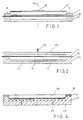
- the mould surface blank is produced for a product which is rather low in profile.
- reference numeral 10 is indicated a draw ring, its inner surface being formed to conform to the shape of the product.
- a sheet stopper 11 holds in place a metal sheet 20 from which the mould surface blank is produced.
- a ram 12 the shape of which also is consistent with the shape of the mould surface blank to be produced, is at point 13 pressed against the metal sheet 20, owing to the compression force (arrow A) directed at said ram and forces it to stretch and be moulded against the surface of the draw ring 10.
- Either the specimen of the desired end product or a separate piece produced to conform thereto may constitute said ram 12.
- no very high strength properties need be set for the strength of the ram because the mould surface blank being formed will later be supported to the backing layer.
- a similar mould surface blank is produced as the one presented in Fig. 1, now using the liquid bulging method.
- reference numeral 10a is presented a lower mould, its inner surface being formed to be consistent with the shape of the product.
- the upper mould 11a holds the metal sheet 20 in place in that between the metal sheet 20 and the upper mould is defined a liquid space 12a, whereto pressurized liquid is conducted from a connector 13a.
- the pressurized liquid forces the sheet 20 downwards, whereby it stretches and moulds itself to the surface of the lower mould 10a.
- reference numeral 14 are indicated air outlet passages.
- a similar mould surface blank is produced as in Fig. 1, but using the explosion method.
- 10a is presented a lower mould, the inner sruface whereof is formed to be consistent with the shape of the product.
- a sheet stopper 11 holds in place the metal sheet 20 from which the mould surface blank is produced.
- On top of the sheet stopper 11 is placed an air cellular structure 12b which relieves the explosion pressure.
- Above the air cell 12b is placed the explosive charge 16.
- the whole structure has been positioned in a liquid volume 15 which when the explosive charge 16 explodes leads the pressure wave through the air cell 12b into the metal sheet 20, which stretches and moulds itself to the surface of the lower mould 10a.
- 14 is indicated an air outlet duct.
- Fig. 4 presents a mould structure of the invention.
- a mould surface blank which has been produced with any technique shown in Fig. 1, 2 or 3.
- reference numeral 40 is indicated the backing layer whereto the mould surface blank 30 is fixed in the present embodiment with the aid of a gripping layer 41.
- reference numeral 42 are indicated the heating and/or cooling members with which the backing layer 40 can be heated and/or cooled, and with reference numeral 43, backing elements placed in the backing layer 40.
- the mould can now be used as a casting mould or laminating when producing products 50.
- the moulds of the invention can be used in production processes for various plastic products.
- Typical production techniques are, for instance, injection moulding, compression moulding, blowing into a mould, vacuum moulding and reinforced plastic moulding.
Landscapes
- Engineering & Computer Science (AREA)
- Mechanical Engineering (AREA)
- Moulds For Moulding Plastics Or The Like (AREA)
- Laminated Bodies (AREA)
- Shaping Metal By Deep-Drawing, Or The Like (AREA)
- Casting Or Compression Moulding Of Plastics Or The Like (AREA)
- Pens And Brushes (AREA)
- Manufacture Of Macromolecular Shaped Articles (AREA)
Claims (9)
- Form mit Metallüberzug zur Herstellung von Kunststoffgegenständen, wobei die Form eine Unterlag- oder Trägerschicht (40) mit einer der Gestalt des Gegenstands entsprechenden Oberfläche sowie eine mit dieser Unterlagschicht in Berührung stehende, ersetzbare dünne Metallschicht (30) umfaßt, dadurch gekennzeichnet, daß die Metallschicht durch Strecken einer dünnen Metallfolie gegenüber einer der Gestalt des Gegenstands entsprechenden Fläche mittels einer Technik wie Tiefziehen, Ausbauchen mit Flüssigkeitsdruck oder Explosionsformung hergestellt wird, um dadurch eine ersetzbare, mit der Unterlagschicht in Berührung zu bringende Formfläche zu bilden.
- Form nach Anspruch 1, dadurch gekennzeichnet, daß sie zwischen dem Formflächenrohling (30) und der Unterlagschicht (40) eine Haftschicht (41) aufweist.
- Form nach Anspruch 1 oder 2, dadurch gekennzeichnet, daß die Unterlagschicht (40) durch eine Schicht gebildet ist, die sich der Gestalt des Formflächenrohlings (30) anpaßt und aus verstärktem Kunststoff, Polymerbeton oder Normalbeton oder einem anderen, gegen auf die Form gerichtete Spannungen widerstandsfähigen Werkstoff besteht.
- Form nach einem der vorhergehenden Ansprüche, dadurch gekennzeichnet, daß die Trägerschicht (40) Heiz- und/oder Kühlelemente (42) enthält.
- Verfahren zur Herstellung einer Form mit Metallüberzug zur Herstellung von Kunststoffgegenständen, wobei die Form eine Unterlag- oder Trägerschicht (40) mit einer der Gestalt des Gegenstands entsprechenden Oberfläche sowie eine mit der Unterlagschicht in Berührung stehende, ersetzbare dünne Metallschicht (30) umfaßt, dadurch gekennzeichnet, daß die Metallschicht durch Strecken einer dünnen Metallfolie gegenüber einer der Gestalt des Gegenstands entsprechenden Fläche mittels einer Technik wie Tiefziehen, Ausbauchen mit Flüssigkeitsdruck oder Explosionsformung hergestellt wird und dadurch eine ersetzbare, mit der Unterlagschicht in Berührung zu bringende Formfläche bildet.
- Verfahren nach Anspruch 5, dadurch gekennzeichnet, daß die Befestigung des Formflächenrohlings (30) durch Verwendung einer entsprechenden Haftschicht (41) zwischen diesem und der Unterlagschicht (40) erfolgt.
- Verfahren nach Anspruch 5 oder 6, dadurch gekennzeichnet, daß die Unterlagschicht (40) so ausgebildet wird, daß sie sich der Gestalt des Formflächenrohlings anschmiegt, wobei diese Schicht aus verstärktem Kunststoff, Polymerbeton oder Normalbeton oder einem anderen, gegen auf die Form gerichtete Spannungen widerstandsfähigen Werkstoff hergestellt wird.
- Verfahren nach Anspruch 7, dadurch gekennzeichnet, daß die Unterlagschicht (40) mit Heiz- und/oder Kühlelementen (42) versehen wird.
- Verfahren nach einem der Ansprüche 5-8, dadurch gekennzeichnet, daß die Unterlagschicht (40) durch Gießen oder sonstige Formung über jenem Formflächenrohling (30) hergestellt wird.
Applications Claiming Priority (2)
| Application Number | Priority Date | Filing Date | Title |
|---|---|---|---|
| FI883349A FI82412C (fi) | 1988-07-14 | 1988-07-14 | Plastform med metallyta och foerfarande foer framstaellning av denna. |
| FI883349 | 1988-07-14 |
Publications (3)
| Publication Number | Publication Date |
|---|---|
| EP0351154A2 EP0351154A2 (de) | 1990-01-17 |
| EP0351154A3 EP0351154A3 (de) | 1991-04-24 |
| EP0351154B1 true EP0351154B1 (de) | 1994-12-14 |
Family
ID=8526827
Family Applications (1)
| Application Number | Title | Priority Date | Filing Date |
|---|---|---|---|
| EP89306960A Expired - Lifetime EP0351154B1 (de) | 1988-07-14 | 1989-07-10 | Form mit Metallüberzug für Kunststoffgegenstände und Verfahren zu deren Herstellung |
Country Status (6)
| Country | Link |
|---|---|
| EP (1) | EP0351154B1 (de) |
| AT (1) | ATE115460T1 (de) |
| DE (1) | DE68919929T2 (de) |
| DK (1) | DK347489A (de) |
| FI (1) | FI82412C (de) |
| NO (1) | NO892829L (de) |
Cited By (3)
| Publication number | Priority date | Publication date | Assignee | Title |
|---|---|---|---|---|
| DE102007010099A1 (de) * | 2007-03-02 | 2008-09-04 | Kraussmaffei Technologies Gmbh | Beheizbares Werkzeug |
| US8931751B2 (en) | 2006-12-07 | 2015-01-13 | Fibertemp GmbH & Co.KG | Molding tool for original shaping or reshaping of components composed of materials that can be thermally influenced |
| US10427329B2 (en) | 2014-06-27 | 2019-10-01 | Sabic Global Technologies B.V. | Induction heated mold apparatus with multimaterial core and method of using the same |
Families Citing this family (8)
| Publication number | Priority date | Publication date | Assignee | Title |
|---|---|---|---|---|
| DE4130560A1 (de) * | 1991-09-13 | 1993-03-18 | Rieter Werke Haendle | Pressform fuer eine dachziegelpresse |
| GB9716738D0 (en) * | 1997-08-08 | 1997-10-15 | Ciba Geigy Ag | Tools |
| DE19806870C2 (de) * | 1998-02-19 | 2003-06-12 | Fraunhofer Ges Forschung | Verfahren zur Oberflächenstrukturierung von Werkstücken oder Werkzeugen |
| EP1115533A2 (de) * | 1999-05-28 | 2001-07-18 | Uni-Span Formwork & Scaffolding (Proprietary) Limited | Form für zementhaltige materialien |
| DE102006057638B4 (de) * | 2006-12-05 | 2008-11-20 | Eads Deutschland Gmbh | Verfahren zum Herstellen eines Formwerkzeugs |
| DE102006057640A1 (de) * | 2006-12-05 | 2008-06-12 | Eads Deutschland Gmbh | Verfahren zum Herstellen eines Formwerkzeugs mit einer Verschleißschutzschicht |
| DE102011119613B4 (de) * | 2011-11-29 | 2017-07-27 | Airbus Defence and Space GmbH | Formwerkzeug und Herstellvorrichtung zum Herstellen von Kunststoffbauteilen sowie Formwerkzeugherstellverfahren |
| FR3055570B1 (fr) * | 2016-09-07 | 2019-11-01 | Amvalor | Dispositif multicouche avec peau metallique de moule et procede de fabrication d'un tel dispositif multicouche |
Family Cites Families (4)
| Publication number | Priority date | Publication date | Assignee | Title |
|---|---|---|---|---|
| NL246191A (de) * | 1959-06-09 | |||
| DE2050733A1 (de) * | 1970-10-15 | 1972-04-20 | Hennecke Gmbh Maschf | Form zur Herstellung von Schaumstoffkörpern |
| FR2159231A1 (en) * | 1971-11-12 | 1973-06-22 | Anziani Vente Bernard | Mould with heat-transfer passages mfr - by nesting moulded shels for lining the cavity |
| GB2105251A (en) * | 1981-07-16 | 1983-03-23 | New Press Tools Limited | A mould for use in the moulding of plastics materials |
-
1988
- 1988-07-14 FI FI883349A patent/FI82412C/fi not_active IP Right Cessation
-
1989
- 1989-07-07 NO NO89892829A patent/NO892829L/no unknown
- 1989-07-10 DE DE68919929T patent/DE68919929T2/de not_active Expired - Fee Related
- 1989-07-10 AT AT89306960T patent/ATE115460T1/de not_active IP Right Cessation
- 1989-07-10 EP EP89306960A patent/EP0351154B1/de not_active Expired - Lifetime
- 1989-07-13 DK DK347489A patent/DK347489A/da not_active Application Discontinuation
Cited By (3)
| Publication number | Priority date | Publication date | Assignee | Title |
|---|---|---|---|---|
| US8931751B2 (en) | 2006-12-07 | 2015-01-13 | Fibertemp GmbH & Co.KG | Molding tool for original shaping or reshaping of components composed of materials that can be thermally influenced |
| DE102007010099A1 (de) * | 2007-03-02 | 2008-09-04 | Kraussmaffei Technologies Gmbh | Beheizbares Werkzeug |
| US10427329B2 (en) | 2014-06-27 | 2019-10-01 | Sabic Global Technologies B.V. | Induction heated mold apparatus with multimaterial core and method of using the same |
Also Published As
| Publication number | Publication date |
|---|---|
| NO892829L (no) | 1990-01-15 |
| EP0351154A3 (de) | 1991-04-24 |
| DK347489A (da) | 1990-01-15 |
| FI883349L (fi) | 1990-01-15 |
| DK347489D0 (da) | 1989-07-13 |
| FI82412B (fi) | 1990-11-30 |
| ATE115460T1 (de) | 1994-12-15 |
| NO892829D0 (no) | 1989-07-07 |
| DE68919929D1 (de) | 1995-01-26 |
| FI883349A0 (fi) | 1988-07-14 |
| DE68919929T2 (de) | 1995-05-11 |
| EP0351154A2 (de) | 1990-01-17 |
| FI82412C (fi) | 1991-03-11 |
Similar Documents
| Publication | Publication Date | Title |
|---|---|---|
| CA1243177A (en) | Forming fibre-plastics composites | |
| US4744846A (en) | Method of shaping resin laminate sheet | |
| EP0351154A2 (de) | Form mit Metallüberzug für Kunststoffgegenstände und Verfahren zu deren Herstellung | |
| KR20180007257A (ko) | 복합 성형 장치 | |
| CA1275867C (en) | Process and device for pressforming sheet material having a small elongation | |
| CN114269548A (zh) | 用于制造由纤维复合材料构成的构件的方法和装置 | |
| JP2005530617A (ja) | 缶蓋シェルを作る方法および装置 | |
| CN113021953A (zh) | 一种碳纤维外壳成型方法及模具 | |
| CN113557116B (zh) | 模具 | |
| CN100368108C (zh) | 利用低熔点合金模具进行弯曲拉深的成型方法及其装置 | |
| KR101773803B1 (ko) | 멀티 성형 방법 | |
| CN106623714A (zh) | 镁合金制品的制造方法 | |
| US4784920A (en) | Thin fiber-reinforced plastic composite plate and method of molding the same | |
| CN101406916B (zh) | 一种生产金属隔热防护部件s型翻边的方法 | |
| EP0393767A3 (de) | Verfahren und Vorrichtung zum Formen von vorgeformtem Werkstoff | |
| CN106553026B (zh) | 薄壁曲母线铝合金内衬成型方法及成型模具 | |
| CN109570310A (zh) | 一种新型钛合金曲面成型方法 | |
| RU2086337C1 (ru) | Способ изготовления изделия из двух склеиваемых деталей | |
| JP4448823B2 (ja) | 複合材料からサンドイッチパネルコアを製造するための方法 | |
| US4137105A (en) | Method of forming tooling for superplastic metal sheet | |
| JP4298048B2 (ja) | 複合材の成形方法および成形装置 | |
| EP0371018A1 (de) | Formungsverfahren für metalle. | |
| US4569256A (en) | Method of making a seamless punch | |
| JPH0563286B2 (de) | ||
| CA2422784A1 (en) | Method and apparatus for the manufacturing of structural members |
Legal Events
| Date | Code | Title | Description |
|---|---|---|---|
| PUAI | Public reference made under article 153(3) epc to a published international application that has entered the european phase |
Free format text: ORIGINAL CODE: 0009012 |
|
| AK | Designated contracting states |
Kind code of ref document: A2 Designated state(s): AT BE CH DE FR GB IT LI LU NL SE |
|
| 17P | Request for examination filed |
Effective date: 19900314 |
|
| PUAL | Search report despatched |
Free format text: ORIGINAL CODE: 0009013 |
|
| AK | Designated contracting states |
Kind code of ref document: A3 Designated state(s): AT BE CH DE FR GB IT LI LU NL SE |
|
| 17Q | First examination report despatched |
Effective date: 19930406 |
|
| GRAA | (expected) grant |
Free format text: ORIGINAL CODE: 0009210 |
|
| AK | Designated contracting states |
Kind code of ref document: B1 Designated state(s): AT BE CH DE FR GB IT LI LU NL SE |
|
| REF | Corresponds to: |
Ref document number: 115460 Country of ref document: AT Date of ref document: 19941215 Kind code of ref document: T |
|
| REF | Corresponds to: |
Ref document number: 68919929 Country of ref document: DE Date of ref document: 19950126 |
|
| ITF | It: translation for a ep patent filed | ||
| ET | Fr: translation filed | ||
| PG25 | Lapsed in a contracting state [announced via postgrant information from national office to epo] |
Ref country code: LU Free format text: LAPSE BECAUSE OF NON-PAYMENT OF DUE FEES Effective date: 19950731 |
|
| PLBE | No opposition filed within time limit |
Free format text: ORIGINAL CODE: 0009261 |
|
| STAA | Information on the status of an ep patent application or granted ep patent |
Free format text: STATUS: NO OPPOSITION FILED WITHIN TIME LIMIT |
|
| 26N | No opposition filed | ||
| PGFP | Annual fee paid to national office [announced via postgrant information from national office to epo] |
Ref country code: FR Payment date: 19960618 Year of fee payment: 8 |
|
| PGFP | Annual fee paid to national office [announced via postgrant information from national office to epo] |
Ref country code: BE Payment date: 19960624 Year of fee payment: 8 |
|
| PGFP | Annual fee paid to national office [announced via postgrant information from national office to epo] |
Ref country code: GB Payment date: 19960701 Year of fee payment: 8 |
|
| PGFP | Annual fee paid to national office [announced via postgrant information from national office to epo] |
Ref country code: AT Payment date: 19960712 Year of fee payment: 8 |
|
| PGFP | Annual fee paid to national office [announced via postgrant information from national office to epo] |
Ref country code: SE Payment date: 19960716 Year of fee payment: 8 |
|
| PGFP | Annual fee paid to national office [announced via postgrant information from national office to epo] |
Ref country code: NL Payment date: 19960731 Year of fee payment: 8 |
|
| PGFP | Annual fee paid to national office [announced via postgrant information from national office to epo] |
Ref country code: CH Payment date: 19961104 Year of fee payment: 8 |
|
| PG25 | Lapsed in a contracting state [announced via postgrant information from national office to epo] |
Ref country code: GB Free format text: LAPSE BECAUSE OF NON-PAYMENT OF DUE FEES Effective date: 19970710 Ref country code: AT Free format text: LAPSE BECAUSE OF NON-PAYMENT OF DUE FEES Effective date: 19970710 |
|
| PG25 | Lapsed in a contracting state [announced via postgrant information from national office to epo] |
Ref country code: SE Effective date: 19970711 |
|
| PG25 | Lapsed in a contracting state [announced via postgrant information from national office to epo] |
Ref country code: LI Free format text: LAPSE BECAUSE OF NON-PAYMENT OF DUE FEES Effective date: 19970731 Ref country code: CH Free format text: LAPSE BECAUSE OF NON-PAYMENT OF DUE FEES Effective date: 19970731 Ref country code: BE Free format text: LAPSE BECAUSE OF NON-PAYMENT OF DUE FEES Effective date: 19970731 |
|
| PGFP | Annual fee paid to national office [announced via postgrant information from national office to epo] |
Ref country code: DE Payment date: 19970829 Year of fee payment: 9 |
|
| BERE | Be: lapsed |
Owner name: NESTE OY Effective date: 19970731 |
|
| PG25 | Lapsed in a contracting state [announced via postgrant information from national office to epo] |
Ref country code: NL Free format text: LAPSE BECAUSE OF NON-PAYMENT OF DUE FEES Effective date: 19980201 |
|
| GBPC | Gb: european patent ceased through non-payment of renewal fee |
Effective date: 19970710 |
|
| REG | Reference to a national code |
Ref country code: CH Ref legal event code: PL |
|
| PG25 | Lapsed in a contracting state [announced via postgrant information from national office to epo] |
Ref country code: FR Free format text: LAPSE BECAUSE OF NON-PAYMENT OF DUE FEES Effective date: 19980331 |
|
| NLV4 | Nl: lapsed or anulled due to non-payment of the annual fee |
Effective date: 19980201 |
|
| EUG | Se: european patent has lapsed |
Ref document number: 89306960.9 |
|
| REG | Reference to a national code |
Ref country code: FR Ref legal event code: ST |
|
| PG25 | Lapsed in a contracting state [announced via postgrant information from national office to epo] |
Ref country code: DE Free format text: LAPSE BECAUSE OF NON-PAYMENT OF DUE FEES Effective date: 19990501 |
|
| PG25 | Lapsed in a contracting state [announced via postgrant information from national office to epo] |
Ref country code: IT Free format text: LAPSE BECAUSE OF NON-PAYMENT OF DUE FEES Effective date: 20050710 |