EP0351352A2 - 2-Substituierte Ergoline, ihre Herstellung und Verwendung - Google Patents
2-Substituierte Ergoline, ihre Herstellung und Verwendung Download PDFInfo
- Publication number
- EP0351352A2 EP0351352A2 EP89730164A EP89730164A EP0351352A2 EP 0351352 A2 EP0351352 A2 EP 0351352A2 EP 89730164 A EP89730164 A EP 89730164A EP 89730164 A EP89730164 A EP 89730164A EP 0351352 A2 EP0351352 A2 EP 0351352A2
- Authority
- EP
- European Patent Office
- Prior art keywords
- ergolinyl
- diethyl
- urea
- propyl
- alkyl
- Prior art date
- Legal status (The legal status is an assumption and is not a legal conclusion. Google has not performed a legal analysis and makes no representation as to the accuracy of the status listed.)
- Granted
Links
- 0 *N(C[C@](C1)N*N)C(C2)C1c1cccc3c1c2c(C=O)[n]3 Chemical compound *N(C[C@](C1)N*N)C(C2)C1c1cccc3c1c2c(C=O)[n]3 0.000 description 3
Classifications
-
- C—CHEMISTRY; METALLURGY
- C07—ORGANIC CHEMISTRY
- C07D—HETEROCYCLIC COMPOUNDS
- C07D457/00—Heterocyclic compounds containing indolo [4, 3-f, g] quinoline ring systems, e.g. derivatives of ergoline, of the formula:, e.g. lysergic acid
- C07D457/10—Heterocyclic compounds containing indolo [4, 3-f, g] quinoline ring systems, e.g. derivatives of ergoline, of the formula:, e.g. lysergic acid with hetero atoms directly attached in position 8
- C07D457/12—Nitrogen atoms
-
- A—HUMAN NECESSITIES
- A61—MEDICAL OR VETERINARY SCIENCE; HYGIENE
- A61P—SPECIFIC THERAPEUTIC ACTIVITY OF CHEMICAL COMPOUNDS OR MEDICINAL PREPARATIONS
- A61P25/00—Drugs for disorders of the nervous system
-
- A—HUMAN NECESSITIES
- A61—MEDICAL OR VETERINARY SCIENCE; HYGIENE
- A61P—SPECIFIC THERAPEUTIC ACTIVITY OF CHEMICAL COMPOUNDS OR MEDICINAL PREPARATIONS
- A61P43/00—Drugs for specific purposes, not provided for in groups A61P1/00-A61P41/00
Definitions
- the invention relates to 2-substituted ergolinyl urea derivatives, their preparation and use as intermediates and in medicaments.
- 2-Substituted ergolinyl urea derivatives are known from EP-A-160 842 and EP-A-250 357, whereby due to their apomorphine-antagonistic activity and / or their ⁇ 2-receptor-blocking effect, the 2-substituted derivatives described, in particular as neuroleptics are suitable.
- a longer-chain hydrocarbon radical is introduced in the 6-position on 2-substituted ergolinylurea derivatives, the effect is shifted from dopamine antagonism to dopamine agonism, and at the same time the metabolic stability of the compounds is maintained or improved.
- the invention relates to compounds of general formula I. wherein C2 ... C3 and C9 ... C10 a single or double bond, X oxygen or sulfur R2 C1 ⁇ 10 alkyl, optionally substituted with halogen C2 ⁇ 10 alkenyl, CH2YR3, CR12 (OR4) R5, CH2-CHR9-COR10 or COR12 wherein Y is oxygen or sulfur, R3 is hydrogen, C1 ⁇ 4 alkyl, phenyl, C2 ⁇ 5 acyl or phenyl C1 ⁇ 4 alkyl, R4 hydrogen or C2 ⁇ 5 acyl, R5 C1 ⁇ 9 alkyl, R9 COCH3 or COO-C1 ⁇ 4-alkyl, R10 C1 ⁇ 4-alkyl or O-C1 ⁇ 4-alkyl, R12 is hydrogen or C1 ⁇ 9-alkyl and R6 are C2 ⁇ 10-alkyl, C3 ⁇ 10-alkenyl or C3 ⁇ 7-cycloalkyl-C1 ⁇ 3-alky
- Alkyl is in each case to be understood as a straight-chain or branched alkyl radical, such as, for example, methyl, ethyl, propyl, isopropyl, butyl, isobutyl, sec. Butyl, tert. Butyl, pentyl, hexyl, heptyl, octyl, nonyl, 1,2-dimethylheptyl, decyl, 2,2-dimethylpropyl, 2-methylbutyl, 3-methylbutyl and others
- Alkenyl in each case means, for example, vinyl, 1-propenyl, 2-propenyl, 3-methyl-2-propenyl, 1-butenyl, methallyl.
- the alkenyl radical R 2 can be substituted once or twice with halogen such as fluorine, chlorine, bromine or iodine, with fluorine and chlorine being preferred.
- halogen such as fluorine, chlorine, bromine or iodine
- Aliphatic carboxylic acids such as, for example, acetic acid, propionic acid, butyric acid, caproic acid and trimethyl acetic acid and others are suitable as acyl groups
- R6 is a cycloalkyl-alkyl group, for example cyclopropylmethyl, cyclopropylethyl, cyclobutylmethyl, cyclobutylethyl, cyclopentylmethyl, cyclohexylmethyl, cycloheptylmethyl and others. meant.
- radical R6 are alkyl, alkenyl and cycloalkyl-alkyl having up to 4 carbon atoms.
- the radicals R5 and R12 together should not exceed 10, preferably not 6, carbon atoms.
- physiologically acceptable acid addition salts are derived from the known inorganic and organic acids, e.g. Hydrochloric acid, sulfuric acid, hydrobromic acid, citric acid, maleic acid, fumaric acid or tartaric acid.
- the compounds of general formula I and their pharmaceutically acceptable acid addition salts have pharmacological effects, in particular central dopaminergic activity, and can therefore be used as medicaments.
- the dopamine agonistic effect was determined with the help of the method of automatic stereotype registration in rats described by Horowski (Pharm. Forsch. 12 , 2281-2286, 1978): Immediately after intraperitoneal test substance or vehicle administration, male Wistar rats (90-120 g) individually placed in acyl glass compulsory cages. The number of contacts on a steel cup with a central metal rod as a result of the stereotypical chewing, leakage and gnawing movements is recorded for 60 minutes using an electrodynamic recording system in front of the animal's head.
- the mean values ⁇ SEM of the number of contacts during 60 minutes for the different treatment groups, each of which was populated with 12 animals, are calculated and the significance of the differences between the mean values of the different test substance doses compared to the vehicle-treated control group using the simple analysis of variance in Connection determined with the Dunnett test.
- the compounds according to the invention are distinguished by a dopamine agonistic action, they are particularly suitable for the treatment of Parkinson's disease.
- a pharmaceutical preparation which, in addition to the active ingredient for enteral or parenteral administration, has suitable pharmaceutical, organic or inorganic inert carrier materials, such as water, gelatin, gum arabic, milk sugar, starch, Contains magnesium stearate, talc, vegetable oils, polyalkylene glycols etc.
- the pharmaceutical preparations can be in solid form, for example as tablets, dragées, suppositories, capsules or in liquid form, for example as solutions, suspensions or emulsions. If necessary, they also contain auxiliary substances such as preservatives, stabilizers, wetting agents or emulsifiers, salts for changing the osmotic pressure or buffers.
- the compounds of the formula I according to the invention can be prepared by methods known per se.
- the oxidation of the Mannich base of the formula II by process a) can be carried out, for example, at temperatures from 0 ° C. to -40 ° C. in inert solvents such as ethers with tert-butyl hypochlorite.
- a 5-6-membered saturated heterocycle -NR7R8 which may optionally be interrupted by an oxygen atom, piperidine, morpholine or pyrrolidine is suitable, for example.
- reaction of the compounds of the formula II and IIa by the process b) can be carried out by the methods described in EP-A-250 357.
- Aminomethyl compound with sodium borohydride in polar solvents such as alcohols can be reduced to the 2-methyl compound or substituted with nucleophilic anions to give compounds of the formula I in which R2 is CH2YR3 or CH2CHR9COR10.
- the nucleophilic exchange takes place after quaternization of the aminomethyl group with C1 ⁇ 4-alkyl halides, for example with methyl iodide, in an inert solvent such as alcohols, ethers or chlorinated hydrocarbons at room temperature or elevated temperature, with the nucleophilic anions being, for example, mercaptides, alcoholates and ß-dicarbonyl compounds such as malonic esters , Acetoacetic ester and Acetylacetone can be implemented.
- an inert solvent such as alcohols, ethers or chlorinated hydrocarbons
- the optional subsequent conversion of the CH2-O-benzyl group into the CH2-OH group can be carried out, for example, by splitting off the benzyl radical, with sodium or lithium in liquid ammonia and an inert solvent such as ether.
- esterification of the hydroxyl group can be carried out in each case by the customary methods, for example by reaction with acid anhydrides in the presence of the corresponding aliphatic carboxylic acid and its alkali metal salts in protic solvents or by reaction with acid chlorides in the presence of organic bases.
- the conversion of the 2-formyl compounds of the formula Ia into compounds of the formula I in which R2 is an optionally halogen-substituted C2 ⁇ 10 alkenyl radical can be carried out in a Wittig reaction, for example by using a compound of the formula Ia with a conventional one Wittig reagent, such as triphenylphosphine, tetrahalomethane, alkyl triphenylphosphonium halide or haloalkyl triphenylphosphine tetrafluoroborate, optionally after the introduction of conventional protective groups on proton donors.
- a conventional one Wittig reagent such as triphenylphosphine, tetrahalomethane, alkyl triphenylphosphonium halide or haloalkyl triphenylphosphine tetrafluoroborate, optionally after the introduction of conventional protective groups on proton donors.
- the Wittig reaction can be carried out in polar solvents such as cyclic and acyclic ethers, chlorinated hydrocarbons, dimethylformamide or dimethyl sulfoxide at temperatures from -50 ° C to the boiling point of the reaction mixture, strong bases such as alkali metal alcoholates, lithium organyl and others being used to produce the ylene. be added.
- polar solvents such as cyclic and acyclic ethers, chlorinated hydrocarbons, dimethylformamide or dimethyl sulfoxide
- the preparation can be carried out, for example, by Grignardation or lithium alkylation.
- the Grignardation can be carried out with the usual Grignard reagents such as alkyl magnesium halides in an aprotic solvent such as cyclic and acyclic ethers at low temperatures (- 70 ° C to 0 ° C).
- the reaction with alkyl lithium takes place under analogous conditions.
- the esterification of the hydroxyl group can be carried out according to the methods described above.
- the optional subsequent introduction of the double bond can be carried out using the customary dehydration methods, such as, for example, using sulfonates or acetates, such as methanesulfonyl chloride in polar solvents, such as ethers, in the presence of a base and, if appropriate, with heating.
- customary dehydration methods such as, for example, using sulfonates or acetates, such as methanesulfonyl chloride in polar solvents, such as ethers, in the presence of a base and, if appropriate, with heating.
- the substituent R2 contains an exocyclic double bond
- this can be reduced in the usual way to the corresponding alkyl derivative.
- the reduction can be carried out catalytically with palladium / carbon or Raney nickel at room temperature in an aliphatic alcohol or the reduction can be carried out with sodium in liquid ammonia in an inert solvent such as cyclic and acyclic ethers in the presence of a proton donor such as aliphatic alcohols.
- substituent R2 contains a 2-hydroxyl group
- this can be reduced to the corresponding 2-alkyl derivative, for example by reaction with NaBH4 in glacial acetic acid.
- Process d) can be carried out, for example, by the methods described in EP-A-160 842, such as the reaction of 2-lithium ergolines with an electrophilic reagent or the reaction of 2-halogen-ergolines in the presence of a palladium catalyst and a base.
- Process e describes the 6-alkylation of ergolines substituted in the 2-position with R2.
- This synthetic route can, for example, according to A. Cerny et al. Coll. Chech. Chem. Comm. 49 2828 (1984) by reducing the 6-cyanergoline to the 6-H compound and then alkylating it with corresponding halides or by the process described in EP-21206.
- the urea derivatives can be converted into the thiourea derivatives, for example, by the process described in EP-A-217 730 by reaction with phosphorus oxychloride and a thiolating agent.
- the 2,3 double bond can be reduced, for example, by the processes described in EP-A-286575 using organylsilanes in the presence of an acid, such as trifluoroacetic acid or by sodium borohydride.
- the compounds of formula I are isolated either as free bases or in the form of their acid addition salts.
- a compound of the formula I is dissolved, for example, in a little methanol or methylene chloride and mixed with a concentrated solution of the desired acid.
- the isomer mixtures can be separated into the diastereomers or E / Z isomers by conventional methods such as, for example, crystallization, chromatography or salt formation.
- the invention also relates to the compounds of the formula IIa, Ia and Ib, which are valuable intermediates for the preparation of pharmacologically active compounds.
- the intermediate products are converted into active substances by the process described above.
- the compounds of formula V can be obtained by a coupling reaction of 2-halogen ergolines with an organometallic compound with metal catalysis (analogous to German patent application P 3824659).
- an organometallic compound with metal catalysis an organometallic compound with metal catalysis
- Preferred are bromine and iodine derivatives which are reacted in an inert solvent such as cyclic and acyclic ethers, hydrocarbons or dimethylformamide in the presence of a nickel or palladium catalyst with an organometallic compound at temperatures up to the boiling point of the reaction mixture.
- Suitable organometallic compounds are C1 ⁇ 10 alkyl and C2 ⁇ 10 alkenyl-Me-X n derivatives in which Me is zinc, magnesium, tin or boron, X halogen, preferably chlorine or bromine, C1 ⁇ 4 alkyl or hydroxy and n can be one to three times depending on the value of the metal atom.
- 1,3-diphenylphosphinopropane-nickel-II chloride is used as the nickel catalyst.
- palladium catalysts for example, the bis-tri-o-tolylphosphine-palladium-II-chloride, the bis-triphenylphosphine-palladium-II-chloride, the tetrakis-triphenylphosphine-palladium-II-chloride and the 1,1'-bis -diphenylphosphinoferrocene-palladium-II-chloride can be used.
- a solution of 2.0 mmol of quaternary salt in 20 ml of methanol is added dropwise at 0 ° C. to a solution of 230 mg (10.0 mmol) of sodium in 20 ml of dry methanol. After the addition has ended, the mixture is stirred at 0 ° C. for 15 min and at room temperature for 30 min. For working up, it is poured onto ice / NH3 solution and extracted with dichloromethane. After drying the organic phases over Na2SO4 and stripping off the solvent i. Vac. obtained crude product is purified by crystallization or chromatography.
- 1,1-diethyl-3- (2,6-diethyl-8 ⁇ -ergolinyl) urea Yield after chromatography (ethyl acetate / methanol 97: 3): 85% (40% crystalline from ethyl acetate), [ ⁇ ] D + 6.2 ° (c 0.5 in chloroform).
Landscapes
- Chemical & Material Sciences (AREA)
- Organic Chemistry (AREA)
- Health & Medical Sciences (AREA)
- Life Sciences & Earth Sciences (AREA)
- General Health & Medical Sciences (AREA)
- General Chemical & Material Sciences (AREA)
- Medicinal Chemistry (AREA)
- Nuclear Medicine, Radiotherapy & Molecular Imaging (AREA)
- Bioinformatics & Cheminformatics (AREA)
- Pharmacology & Pharmacy (AREA)
- Engineering & Computer Science (AREA)
- Animal Behavior & Ethology (AREA)
- Chemical Kinetics & Catalysis (AREA)
- Public Health (AREA)
- Veterinary Medicine (AREA)
- Nitrogen Condensed Heterocyclic Rings (AREA)
- Biomedical Technology (AREA)
- Neurology (AREA)
- Neurosurgery (AREA)
- Pharmaceuticals Containing Other Organic And Inorganic Compounds (AREA)
Abstract
Description
- Die Erfindung betrifft 2-substituierte Ergolinylharnstoffderivate, ihre Herstellung und Verwendung als Zwischenprodukte sowie in Arzneimitteln.
- 2-substituierte Ergolinylharnstoffderivate sind aus der EP-A-160 842 und EP-A-250 357 bekannt, wobei auf Grund ihrer apomorphin-antagonistischen Wirksamkeit und/oder ihrer α₂-rezeptor-blockierenden Wirkung, die beschriebenen 2-substituierten Derivate insbesondere als Neuroleptika geeignet sind. Überraschenderweise wurde nun gefunden, daß bei Einführung eines längerkettigen Kohlenwasserstoffrestes in 6-Stellung an 2-substituierten Ergolinylharnstoffderivaten, die Wirkung vom Dopaminantagonismus zum Dopaminagonismus verschoben wird, und gleichzeitig die metabolische Stabilität der Verbindungen erhalten bleibt oder verbessert wird.
- Die Erfindung betrifft Verbindungen der allgemeinen Formel I

C₂...C3 und C₉...C₁₀ eine Einfach- oder Doppelbindung,
X Sauerstoff oder Schwefel
R² C₁₋₁₀-Alkyl, gegebenenfalls mit Halogen substituiertes C₂₋₁₀-Alkenyl, CH₂YR³, CR¹²(OR⁴)R⁵, CH₂-CHR⁹-COR¹⁰ oder COR¹²
worin Y Sauerstoff oder Schwefel, R³ Wasserstoff, C₁₋₄-Alkyl, Phenyl, C₂₋₅-Acyl oder Phenyl-C₁₋₄-Alkyl, R⁴ Wasserstoff oder C₂₋₅-Acyl, R⁵ C₁₋₉-Alkyl, R⁹ COCH₃ oder COO-C₁₋₄-Alkyl, R¹⁰ C₁₋₄-Alkyl oder O-C₁₋₄-Alkyl, R¹² Wasserstoff oder C₁₋₉-Alkyl bedeuten und
R⁶ C₂₋₁₀-Alkyl, C₃₋₁₀-Alkenyl oder C₃₋₇-Cycloalkyl-C₁₋₃-alkyl sind sowie deren Säureadditionssalze, Isomeren und Isomerengemische. - Stellt C₉...C₁₀ eine Einfachbindung dar, so steht das Wasserstoffatom in 10-Stellung α-ständig, stellt C₂...C₃ eine Einfachbindung dar, so steht das Wasserstoffatom in 3-Stellung β-ständig. Die Verbindungen der Formel I können als E- oder Z-Isomere oder, falls eine chirales Zentrum im Rest R² vorhanden ist, als Diastereomere und als Gemische derselben auftreten.
- Unter Alkyl ist jeweils ein geradkettiger oder verzweigter Alkylrest zu verstehen, wie beispielsweise Methyl, Ethyl, Propyl, Isopropyl, Butyl, Isobutyl, sek. Butyl, tert. Butyl, Pentyl, Hexyl, Heptyl, Octyl, Nonyl, 1,2-Dimethylheptyl, Decyl, 2,2-Dimethylpropyl,2-Methylbutyl, 3-Methylbutyl u.a.
- Alkenyl bedeutet jeweils beispielsweise Vinyl, 1-Propenyl, 2-Propenyl, 3-Methyl-2-propenyl, 1-Butenyl, Methallyl.
- Der Alkenylrest R² kann ein- oder zweifach mit Halogen wie Fluor, Chlor, Brom oder Jod substituiert sein, wobei Fluor und Chlor bevorzugt sind.
- Als Acylgruppen sind jeweils aliphatische Carbonsäuren geeignet wie beispielsweise Essigsäure, Propionsäure, Buttersäure, Capronsäure und Trimethylessigsäure u.a.
- Bedeutet R⁶ eine Cycloalkyl-alkyl-Gruppe, so ist beispielsweise Cyclopropylmethyl, Cyclopropylethyl, Cyclobutylmethyl, Cyclobutylethyl, Cyclopentylmethyl, Cyclohexylmethyl, Cycloheptylmethyl u.a. gemeint.
- Bevorzugt sind für den Rest R⁶ Alkyl-, Alkenyl und Cycloalkyl-alkyl- mit bis zu 4-C-Atomen. Die Reste R⁵ und R¹² sollen zusammen nicht 10 vorzugsweise nicht 6 Kohlenstoffatome überschreiten.
- Die physiologisch verträglichen Säureadditionssalze leiten sich von den bekannten anorganischen und organischen Säuren ab, wie z.B. Salzsäure, Schwefelsäure, Bromwasserstoffsäure, Zitronensäure, Maleinsäure, Fumarsäure oder Weinsäure.
- Die Verbindungen der allgemeinen Formel I und ihre pharmazeutisch akzeptablen Säureadditionssalze weisen pharmakologische Wirkungen, insbesondere zentral dopaminerge Wirksamkeit auf, und sind daher als Arzneimittel verwendbar.
- Die dopaminagonistische Wirkung wurde mit Hilfe der von Horowski beschriebenen Methode der automatischen Registrierung von Stereotypien an Ratten bestimmt (Arzneim. Forsch. 12, 2281-2286, 1978): Unmittelbar nach intraperitonealer Prüfsubstanz- bzw. Vehikelverabreichung werden männliche Wistar-Ratten (90-120 g) einzeln in Zwangskäfige aus Acylglas gesetzt. Über ein vor dem Kopf der Tiere angebrachtes elektrodynamisches Aufnahmesystem wird die Zahl der Kontakte an einem stählernen Becher mit einem zentralen Metallstab als Folge der stereotypen Kau-, Leck- und Nagebewegungen während 60 Minuten registriert. Die Mittelwerte ± S.E.M. der Anzahl der Kontakte während 60 Minuten für die verschiedenen Behandlungsgruppen, die mit jeweils 12 Tieren besetzt sind, werden berechnet und die Signifikanz der Unterschiede zwischen den Mittelwerten der verschiedenen Prüfsubstanzdosen im Vergleich zur Vehikel-behandelten Kontrollgruppe mit Hilfe der einfachen Varianzanalyse in Verbindung mit dem Dunnett-Test ermittelt.
- Da sich die erfindungsgemäßen Verbindungen durch dopaminagonistische Wirkung auszeichnen, eignen sie sich insbesondere zur Behandlung des Morbus Parkinson.
- Zur Verwendung der erfindungsgemäßen Verbindungen als Arzneimittel werden diese in die Form eines pharmazeutischen Präparats gebracht, das neben dem Wirkstoff für die enterale oder parenterale Applikation geeignete pharmazeutische, organische oder anorganische inerte Trägermaterialien, wie zum Beispiel Wasser, Gelatine, Gummi arabicum, Milchzucker, Stärke, Magnesiumstearat, Talk, pflanzliche Ole, Polyalkylenglykole usw. enthält. Die pharmazeutischen Präparate können in fester Form, zum Beispiel als Tabletten, Dragées, Suppositorien, Kapseln oder in flüssiger Form, zum Beispiel als Lösungen, Suspensionen oder Emulsionen vorliegen. Gegebenenfalls enthalten sie darüber hinaus Hilfsstoffe wie Konservierungs-, Stabilisierungs-, Netzmittel oder Emulgatoren, Salze zur Veränderung des osmotischen Drucks oder Puffer.
- Die Herstellung der erfindungsgemäßen Verbindungen der Formel I kann nach an sich bekannten Methoden durchgeführt werden.
- Beispielsweise gelangt man zu Verbindungen der Formel I, in dem man
- a) eine Verbindung der Formel II


- b) das quartäre Salz der Formel IIa

- c) eine Verbindung der Formel Ia

α) mit einem Wittig Reagenz umsetzt zu einer Verbindung der Formel I, worin R² einen gegebenenfalls mit Halogen substituierten C₂₋₁₀-Alkenylrest darstellt oder
β) in eine Verbindung der Formel I mit R² in der Bedeutung CH(OH)R⁵ überführt, und gewünschtenfalls anschließend in eine Verbindung der Formel I, worin R² für C₂₋₁₀-Alkenyl oder C₂₋₁₀-Alkyl steht, überführt oder die Hydroxylgruppe verestert oder zum Keton oxidiert und gewünschtenfalls anschließend die so erhaltene Verbindung der Formel Ib
und gewünschtenfalls anschließend die nach α) oder ß) erhaltenen ungesättigten Verbindungen reduziert zu Verbindungen der Formel I, worin R² für C₂₋₁₀-Alkyl steht, - d) eine Verbindung der Formel IV

- e) eine Verbindung der Formel V

- Die Oxidation der Mannichbase der Formel II nach dem Verfahren a) kann beispielsweise bei Temperaturen von 0° C bis -40° C in inerten Lösungsmitteln wie Ethern mit tert.-Butylhypochlorit durchgeführt werden.
- Als 5-6-gliedriger gesättigter Heterocyclus -NR⁷R⁸, der gegebenenfalls durch ein Sauerstoffatom unterbrochen sein kann, ist beispielsweise Piperidin, Morpholin oder Pyrrolidin geeignet.
- Die Umsetzung der Verbindungen der Formel II und IIa nach dem Verfahren b) kann nach den in der EP-A-250 357 beschriebenen Methoden durchgeführt werden. Beispielsweise kann man in 2-Stellung des Ergolins das Quartärsalz einer disubst.-Aminomethyl-Verbindung mit Natriumborhydrid in polaren Lösungsmitteln wie Alkoholen zur 2-Methyl-Verbindung reduzieren oder mit nucleophilen Anionen substituieren zu Verbindungen der Formel I, worin R² CH₂YR³ oder CH₂CHR⁹COR¹⁰ bedeutet. Der nucleophile Austausch erfolgt nach Quartärnisierung der Aminomethylgruppe mit C₁₋₄-Alkylhalogeniden, beispielsweise mit Methyliodid, in einem inerten Lösungsmittel wie Alkoholen, Ethern oder chlorierten Kohlenwasserstoffen bei Raumtemperatur oder erhöhter Temperatur, wobei als nucleophile Anionen beispielsweise Mercaptide, Alkoholate und ß-Dicarbonylverbindungen wie Malonester, Acetessigester und Acetylaceton umgesetzt werden können.
- Die fakultativ nachfolgende Umwandlung der CH₂-O-Benzyl-Gruppe in die CH₂-OH-Gruppe kann beispielsweise durch Abspaltung des Benzyl-Restes, mit Natrium oder Lithium in flüssigem Ammoniak und einem inerten Lösungsmittel wie Ether erfolgen.
- Die Veresterung der Hydroxylgruppe kann jeweils nach den üblichen Methoden wie beispielsweise durch Umsetzung mit Säureanhydriden in Gegenwart der entsprechenden aliphatischen Carbonsäure und deren Alkalisalze in protischen Lösungsmitteln oder durch Umsetzung mit Säurechloriden in Gegenwart organischer Basen erfolgen.
- Die Umwandlung der 2-Formyl-Verbindungen der Formel Ia in Verbindungen der Formel I, worin R₂ einen gegebenenfalls Halogen-substituierten C₂₋₁₀-Alkenylrest bedeutet, kann in einer Wittig-Reaktion erfolgen, indem man beispielsweise eine Verbindung der Formel Ia mit einem üblichen Wittig-Reagenz, wie beispielsweise Triphenylphosphin, Tetrahalogenmethan, Alkyl-triphenylphosphonium-halogenid oder Halogenalkyl-triphenylphosphintetrafluoroborat, gegebenenfalls nach Einführung üblicher Schutzgruppen an Protonendonatoren, umsetzt. Die Wittig-Reaktion kann in polaren Lösungsmitteln wie cyclischen und acyclischen Ethern, chlorierten Kohlenwasserstoffen, Dimethylformamid oder Dimethylsulfoxid bei Temperaturen von -50° C bis zur Siedetemperatur des Reaktionsgemisches vorgenommen werden, wobei zur Erzeugung des Ylens starke Basen wie Alkalialkoholate, Lithiumorganyl u.a. zugesetzt werden.
- Werden nach dem Verfahren c) Verbindungen der Formel I, worin R² CR¹²(OH)R⁵ bedeutet, hergestellt, so kann die Darstellung beispielsweise durch Grignardierung oder Lithium-alkylierung erfolgen. Die Grignardierung kann mit den üblichen Grignard-Reagenzen wie Alkylmagnesium-halogeniden in einem aprotischen Lösungsmittel wie cyclischen und acyclischen Ethern bei tiefen Temperaturen (- 70° C bis 0° C) erfolgen. Die Umsetzung mit Alkyl-Lithium erfolgt unter analogen Bedingungen. Die Veresterung der Hydroxylgruppe kann nach den vorne beschriebenen Verfahren vorgenommen werden.
- Die Oxidation zu einer 2-CHO nach Verfahren b) oder einer 2-CO-R⁵-Verbindung nach Verfahren c) kann jeweils analog dem in R.A. Jones et al. Synthetic Communications 16, 1799 (1986) beschriebenen Verfahren erfolgen, beispielsweise mit Braunstein in inerten Lösungsmitteln wie halogenierten Kohlenwasserstoffen bei Raumtemperatur.
- Die fakultativ nachfolgende Einführung der Doppelbindung kann mit den üblichen Dehydratisierungsmethoden erfolgen, wie beispielsweise mit Sulfonaten oder Acetaten, wie Methansulfonsäurechlorid in polaren Lösungsmitteln, wie Ethern in Gegenwart einer Base und gegebenenfalls unter Erhitzen.
- Enthält der Substituent R² eine exocyclische Doppelbindung, so kann diese in üblicher Weise reduziert werden zum entsprechenden Alkylderivat. Beispielsweise kann die Reduktion katalytisch mit Palladium/Kohle oder Raney-Nickel bei Raumtemperatur in einem aliphatischen Alkohol erfolgen oder die Reduktion kann mit Natrium in flüssigem Ammoniak in einem inerten Lösungsmittel wie cyclischen und acyclischen Ethern in Gegenwart eines Protonenspenders wie aliphatischen Alkoholen vorgenommen werden.
- Enthält der Substituent R² eine 2-Hydroxylgruppe, so kann diese beispielsweise durch Umsetzung mit NaBH₄ in Eisessig zum entsprechenden 2-Alkylderivat reduziert werden.
- Das Verfahren d) kann beispielsweise nach den in der EP-A-160 842 beschriebenen Methoden wie Umsetzung von 2-Lithium-Ergolinen mit einem elektrophilen Reagenz oder Umsetzung von 2-Halogen-Ergolinen in Gegenwart eines Palladium-Katalysators und einer Base erfolgen.
- Das Verfahren e) beschreibt die 6-Alkylierung von in 2-Stellung mit R² substituierten Ergolinen. Dieser Syntheseweg kann beispielsweise nach A. Cerny et al. Coll. Chech. Chem. Comm. 49 2828 (1984) erfolgen, indem man das 6-Cyan-Ergolin zur 6-H-Verbindung reduziert und diese anschließend mit entsprechenden Halogeniden alkyliert oder nach dem in der EP-21206 beschriebenen Verfahren.
- Die Überführung der Harnstoffderivate in die Thioharnstoffderivate kann beispielsweise nach dem in der EP-A-217 730 beschriebenen Verfahren durch Umsetzung mit Phosphoroxychlorid und einem Thiolierungsmittel erfolgen. Die Reduktion der 2,3 Doppelbindung kann beispielsweise nach den in der EP-A-286575 beschriebenen Verfahren mit Organylsilanen in Gegenwart einer Säure, wie Trifluoressigsäure oder durch Natriumborhydrid erfolgen. Die Verbindungen der Formel I werden entweder als freie Basen oder in Form ihrer Säureadditionssalze isoliert.
- Zur Bildung von Salzen wird eine Verbindung der Formel I beispielsweise in wenig Methanol oder Methylenchlorid gelöst und mit einer konzentrierten Lösung der gewünschten Säure versetzt.
- Die Isomerengemische können nach üblichen Methoden wie beispielsweise Kristallisation, Chromatographie oder Salzbildung in die Diastereomeren bzw. E/Z-Isomeren aufgetrennt werden.
- Die Erfindung betrifft auch die Verbindungen der Formel IIa, Ia und Ib, die wertvolle Zwischenprodukte zur Herstellung pharmakologisch wirksamer Verbindungen darstellen. Die Umwandlung der Zwischenprodukte in Wirksubstanzen erfolgt nach dem oben beschriebenen Verfahren.
- Die Verbindungen der Formel V können durch eine Kupplungsreaktion von 2-Halogen-Ergolinen mit einer metallorganischen Verbindung unter Metallkatalyse erhalten werden (analog der Deutschen Patentanmeldung P 3824659). Bevorzugt sind Brom- und Jod-Derivate, die in einem inerten Lösungsmittel wie cyclischen und acyclischen Ethern, Kohlenwasserstoffen oder Dimethylformamid in Gegenwart eines Nickel- oder Palladiumkatalysators mit einer metallorganischen Verbindung bei Temperaturen bis zum Siedepunkt des Reaktionsgemisches umgesetzt werden. Als metallorganische Verbindungen sind C₁₋₁₀Alkyl-und C₂₋₁₀-Alkenyl-Me-Xn-Derivate geeignet, worin Me Zink, Magnesium, Zinn oder Bor, X Halogen, vorzugsweise Chlor oder Brom, C₁₋₄-Alkyl oder Hydroxy sind und n je nach Wertigkeit des Metallatoms ein -bis dreifach stehen kann.
- Als Nickel-Katalysator wird beispielsweise das 1,3-Diphenylphosphinopropannickel-II-chlorid verwendet. Als Palladium-Katalysatoren können beispielsweise das Bis-tri-o-tolylphosphin-palladium-II-chlorid, das Bis-triphenylphosphin-palladium-II-chlorid, das Tetrakis-triphenylphosphin-palladium-II-chlorid und das 1,1′-Bis-diphenylphosphinoferrocen-palladium-II-chlorid verwendet werden.
- Soweit die Herstellung der Ausgangsverbindungen nicht beschrieben wird, sind diese bekannt oder analog zur bekannten Verbindungen oder hier beschriebenen Verfahren herstellbar.
- Die nachfolgenden Beispiele sollen das erfindungsgemäße Verfahren erläutern:
- 30 mmol Ergolin, 24.0g (0.19 mol) Morpholinhydrochlorid, 4.5g (0.15 mol) Paraformaldehyd und 220 ml trockenes Dimethylformamid werden in der angegebenen Reihenfolge zusammengegeben und die Mischung in einem auf 100°C vorgeheizten Ölbad 30 min gerührt. Zur Aufarbeitung gießt man die Reaktionslösung auf Eis, stellt mit 25%iger NH₃-Lösung alkalisch und extrahiert mit Toluol. Das nach Trocknen über Na₂SO₄ und Abziehen des Toluols i. Vak. erhaltene Rohprodukt wird in 100 ml Trifluoressigsäure gelöst und 30 min bei 60°C gerührt. Danach gießt man die Reaktionsmischung auf Eis und stellt mit 25%iger NH₃-Lösung alkalisch. Nach Extraktion mit Dichlormethan, Trocknen über Na₂SO₄ und Abziehen des Lösungsmittels i. Vak. erhält man ein dunkles Öl, das durch Chromatographie gereinigt wird.
- Folgende Verbindungen wurden dargestellt:
1,1-Diethyl-3-(2-morpholinomethyl-6-n-propyl-8α-ergolinyl)-harnstoff
Ausbeute nach Chromatographie (SiO₂, Dichlormethan/Methanol 97:3): 78 - 89%, [α]D +11.3° (c=0.5 in Chloroform).
1,1 Diethyl-3-(2-morpholinomethyl-6-n-propyl-8α-ergolinyl)-harnstoff, L-Hydrogentartrat
Ausbeute: 84% (kristallin), [α]D +1.6° (c=0.5 in Methanol).
1,1 Diethyl-3-(2-morpholinomethyl-6-cyclopropylmethyl-8α-ergolinyl)-harnstoff
Ausbeute nach Chromatographie (SiO₂, Dichlormethan/Methanol 99:1 - 97:3): 66%, [α]D -0.8° (c=0.5 in Chloroform).
3-(6-Allyl-2-morpholinomethyl-8α-ergolinyl)-1,1-diethyl-harnstoff
Ausbeute nach Chromatographie (SiO₂, Dichlormethan/Methanol 97:3): 71 - 97% (36 - 59% kristallin), [α]D +2.4° (c=0.5 in Chloroform).
1,1-Diethyl-3-(6-ethyl-2-morpholinomethyl-8α-ergolinyl)-harnstoff
Ausbeute nach Chromatographie (SiO₂, Dichlormethan/Methanol 99:1 - 95:5): 81% (46% kristallin), [α]D +4.0° (c=0.5 in Chloroform).
3-(6-Cyano-9,10-didehydro-2-morpholinomethyl-8α-ergolinyl)-1,1-diethyl-harnstoff
Ausbeute nach Chromatographie (Essigester/Methanol 98:2 - 96:4): 46% (24% kristallin aus Essigester), [α]D + 301.6° (c=0.5 in Chloroform). - 10 mmol Ergolin werden in ca. 200 ml Tetrahydrofuran gelöst und mit 4.0 ml (65 mmol) Methyliodid versetzt. Man läßt 17 - 22h bei Raumtemperatur rühren. Anschließend wird die Mischung, aus der bereits nach ca. 4h das Produkt auszufallen beginnt, im Eisbad gekühlt und tropfenweise mit 100 ml Diisopropylether versetzt. Nach 30 min bei 0°C wird das Quartärsalz abgesaugt. Das so erhaltene Material wird ohne Charakterisierung für die weiteren Umsetzungen verwendet.
- Folgende Verbindungen wurden hergestellt:
N-(8α-(3,3-diethylureido)-6-n-propyl-2-ergolinyl-methyl)-N-methyl-morpholiniumiodid
Ausbeute: 70 - 81%
N-(6-Allyl-8α-(3,3-diethylureido)-2-ergolinyl-methyl)-N-methyl-morpholiniumiodid
Ausbeute: 59 - 70%
N-(6-Cyclopropylmethyl-8α-(3,3-diethylureido)-2-ergolinyl-methyl)-N-methyl-morpholiniumiodid
Ausbeute 64 - 80%
N-(6-Ethyl-8α-(3,3-diethylureido)-2-ergolinyl-methyl)-N-methyl-morpholiniumiodid
Ausbeute: 87%
N-(6-Cyano-9,10-didehydro-8α-(3,3-diethylureido)-2-ergolinyl-methyl)-N-methyl-morpholiniumiodid
Ausbeute: 82%
- 3-(2-Brom-8α-ergolinyl)-1,1-diethyl-harnstoff
Herstellung und Daten siehe EP-56358 - 1.00 g (2.47 mmol) 3-(2-Brom-8α-ergolinyl)-1,1-diethyl-harnstoff wird in 10 ml Toluol gelöst, mit 90 mg (0.12 mmol) 1,1′-Bis-(diphenylphoshino)-ferrocen-palladium-II-chlorid versetzt und 15 min bei Raumtemperatur gerührt. Danach werden 5.5 ml Triethylboran (1 M Lösung in Tetrahydrofuran) und 2.5 ml 4 N Kalilauge hinzugefügt und die Mischung 4 h unter Rückfluß erhitzt. Die Reaktionsmischung wird mit 2 N Salzsäure angesäuert, mit konz. Ammoniak alkalisch gestellt und mit Dichlormethan extrahiert. Das nach Trocknung der organischen Phasen (Natriumsulfat) und Abziehen des Lösungsmittels i. Vak. erhaltene Rohprodukt wird an Kieselgel chromatographiert. (Dichlormethan/Methanol 98 : 2). Ausbeute nach Kristallisation (Essigester): 307 mg (35%)
[α]D + 47.6° (c=0.5 in Chloroform), - (1) A. Cerny et al. Collection Czechoslavak Chem. Commun. 1984, 49, 2828)
- Folgende Verbindungen wurden aus den 6-Cyano-Derivaten hergestellt:
3-(9,10-Didehydro-2-methyl-8α-ergolinyl)-1,1-diethyl-harnstoff
3-(9,10-Didehydro-2-methoxymethyl-8α-ergolinyl)-1,1-diethyl-harnstoff
3-(9,10-Didehydro-2-methylthiomethyl-8α-ergolinyl)-1,1-diethyl-harnstoff
3-(9,10-Didehydro-2-hydroxymethyl-8α-ergolinyl)-1,1-diethyl-harnstoff
3-(9,10-Didehydro-2-ethyl-8α-ergolinyl)-1,1-diethyl-harnstoff - Herstellung analog Beispiel 1
- Herstellung analog Beispiel 2
- Herstellung analog Beispiel 4
- wurde durch Reduktion der 2-Formyl-verbindung erhalten.
- Herstellung analog Beispiel 8
- Herstellung analog Beispiel 13
- 1.00 mmol Ergolin werden in 25 ml trockenem Ethanol gelöst, mit 184.6 mg (5.00 mmol) pulverisiertem NaBH₄ versetzt und bei Raumtemperatur gerührt. Nach Ende der Umsetzung (DC) gießt man auf Eis und extrahiert mit Dichlormethan. Das nach Trocknen über Na₂SO₄ und Abziehen des Lösungsmittels i. Vak. erhaltene Rohprodukt wird durch Chromatographie oder Kristallisation gereinigt.
- Folgende Verbindungen wurden hergestellt: 3-(6-Cyclopropylmethyl-2-methyl-8α-ergolinyl)-1,1-diethyl-harnstoff
Ausbeute nach Kristallisation (Essigester/Diisopropylether): 61%, [α]D -5.2° (c=0.5 in Chloroform).
3-(6-Allyl-2-methyl-8α-ergolinyl)-1,1-diethyl-harnstoff
Ausbeute nach Chromatographie (SiO₂, Dichlormethan/Methanol 95:5): 67% (37% kristallin), [α]D -2.0° (c=0.5 in Chloroform).
1,1-Diethyl-3-(6-ethyl-2-methyl-8α-ergolinyl)-harnstoff
Ausbeute nach Chromatographie (SiO₂, Dichlormethan/Methanol 97:3): 33% (13% kristallin), [α]D +3.2° (c=0.5 in Chloroform).
3-(6-n-Propyl-2-methyl-8α-ergolinyl)-1,1-diethyl-harnstoff
Ausbeute nach Kristallisation (Essigester/Diisopropylether) : 65%, [α]D + 34o (c = 0,5 in Pyridin) - 1.00 mmol Ergolin werden in 50 ml Dichlormethan gelöst und mit 600 - 800 mg (8.56 - 11.14 mmol) NaSCH₃ versetzt. Man rührt 5 - 17h bei Raumtemperatur, falls nötig wird weiteres NaSCH₃ nachgegeben (DC). Zur Aufarbeitung gießt man auf Eis/NH₃-Lösung und extrahiert mit Dichlormethan. Das nach Trocknen über Na₂SO₄ und Abziehen des Lösungmittels i. Vak. erhaltene Material wird durch Chromatographie weiter gereinigt.
- Folgende Verbindungen wurden hergestellt:
1,1-Diethyl-3-(2-methylthiomethyl-6-n-propyl-8α-ergolinyl)-harnstoff
Ausbeute nach Chromatographie (SiO₂, Essigester/Methanol 97:3): 43% (34% kristallin), [α]D +12.8° (c=0.5 in Chloroform).
3-(6-Cyclopropylmethyl-2-methylthiomethyl-8α-ergolinyl)-1,1-diethyl-harnstoff
Ausbeute nach Chromatographie (SiO₂, Dichlormethan/Methanol 97:3): 46% (40% kristallin), [α]D -2.4° (c=0.5 in Chloroform),
3-(6-Allyl-2-methylthiomethyl-8α-ergolinyl)-1,1-diethyl-harnstoff
Ausbeute nach Chromatographie (SiO₂, Essigester/Methanol 97:3): 51% (42% kristallin), [α]D 0.0° (c=0.5 in Chloroform).
1,1-Diethyl-3-(6-ethyl-2-methylthiomethyl-8α-ergolinyl)-harnstoff
Ausbeute nach Chromatographie (SiO₂, Dichlormethan/ Methanol 97:3): 38% (24% kristallin), [α]D +8.1° (c=0.5 in Chloroform). - 1.17 g (0.05 mol) Natrium in kleinen Stücken werden unter Erwärmen in 40 ml trockenem Benzylalkohol aufgelöst. 10 mmol des Quartärsalzes werden in der minimalen Menge Benzylalkohol (25 - 50 ml) gelöst und langsam zu der auf Raumtemperatur abgekühlten Benzylat-Lösung getropft. Nach beendeter Zugabe läßt man noch bis zu 30 min rühren (DC). Zur Aufarbeitung wird die Reaktionslösung direkt chromatographiert (1.3 kg SiO₂, Dichlormethan). Der Benzylalkohol wird mit Dichlormethan eluiert (ca. 10 l). Durch Zusatz von 1 - 3% Methanol zum Laufmittel wird schließlich das Produkt erhalten.
- Folgende Verbindungen wurden hergestellt:
3-(2-Benzyloxymethyl-6-n-propyl-8α-ergolinyl)-1,1-diethyl-harnstoff
Ausbeute: 93%.
3-(2-Benzyloxymethyl-6-n-propyl-8α-ergolinyl)-1,1-diethyl-harnstoff, L-Hydrogentartrat
Ausbeute: 43%, [α]D +12.4° (c=0.5 in Methanol)
3-(2-Benzyloxymethyl-6-cyclopropylmethyl-8α-ergolinyl)-1,1-diethyl-harnstoff
Ausbeute: 43% (15% kristallin), [α]D -8.2° (c=0.5 in Chloroform).
3-(6-Allyl-2-benzyloxymethyl-8α-ergolinyl)-1,1-diethyl-harnstoff
Ausbeute: 75% (31% kristallin), [α]D -9.2° (c=0.5 in Chloroform).
3-(2-Benzyloxymethyl-6-ethyl-8α-ergolinyl)-1,1-diethyl-harnstoff
Ausbeute: 57%.
3-(2-Benzyloxymethyl-6-ethyl-8α-ergolinyl)-1,1-diethyl-harnstoff, L-Hydrogentartrat
Ausbeute: 67%, [α]D +8.8° (c=0.5 in Methanol). - Zu einer Lösung von 230 mg (10.0 mmol) Natrium in 20 ml trockenem Methanol wird eine Lösung von 2.0 mmol Quartärsalz in 20 ml Methanol bei 0°C tropfenweise zugegeben. Man rührt nach beendeter Zugabe 15 min bei 0°C und 30 min bei Raumtemperatur. Zur Aufarbeitung gießt man auf Eis/NH₃-Lösung und extrahiert mit Dichlormethan. Das nach Trocknung der organischen Phasen über Na₂SO₄ und Abziehen des Lösungsmittels i. Vak. erhaltene Rohprodukt wird durch Kristallisation oder Chromatographie gereinigt.
- Folgende Verbindungen wurden hergestellt:
1,1-Diethyl-3-(2-methoxymethyl-6-n-propyl-8α-ergolinyl)-harnstoff
Ausbeute nach Chromatographie (SiO₂, Dichlormethan/Methanol 95:5): 44% (28% kristallin), [α]D + 5.8° (c=0.5 in Chloroform).
3-(6-Cyclopropylmethyl-2-methoxymethyl-8α-ergolinyl)-1,1-diethyl-harnstoff
Ausbeute nach Chromatographie (SiO₂, Dichlormethan/Methanol 97:3): 13% (8% kristallin), [α]D -3.6° (c=0.5 in Chloroform).
3-(6-Allyl-2-methoxymethyl-8α-ergolinyl)-1,1-diethyl-harnstoff
Ausbeute nach Kristallisation (Essigester/Diisopropylether): 23%, [α]D -3.0° (c=0.5 in Chloroform).
1,1-Diethyl-3-(6-ethyl-2-methoxymethyl-8α-ergolinyl)-harnstoff
Ausbeute nach Kristallisation (Essigester/Diisopropylether): 36%, [α]D -0.9° (c=0.5 in Chloroform). - 2.00 mmol Ergolin werden in 25 ml trockenem Tetrahydrofuran gelöst und bei -70°C in 40 ml NH₃ getropft. Man gibt portionsweise 180 - 550 mg (8 - 24 mmol) Natrium in kleinen Stücken zu, wobei mit der Zugabe jeweils solange gewartet wird, bis das zuletzt zugegebene Natrium abreagiert ist. Nachdem das Edukt verbraucht ist (DC), wird Methanol zugegeben und das Kühlbad entfernt. Das nach dem Abdampfen des Ammoniaks verbliebene Lösungsmittel wird i. Vak. entfernt und der Rückstand in Wasser aufgenommen. Nach Extraktion mit Dichlormethan, Trocknen der organischen Phasen über Na₂SO₄ und Abziehen des Lösungsmittels i. Vak erhält man das Rohprodukt, welches durch Kristallisation oder Chromatographie weiter gereinigt wird.
- Folgende Verbindungen wurden hergestellt:
1,1-Diethyl-3-(2-hydroxymethyl-6-n-propyl-8α-ergolinyl)-harnstoff
Ausbeute nach Chromatographie (Dichlormethan/Methanol 96:4): 88% (58% kristallin aus Essigester/Diisopropylether), [α]D +14.2° (c=0.5 in Chloroform).
3-(6-Allyl-2-hydroxymethyl-8α-ergolinyl)-1,1-diethyl-harnstoff
Ausbeute nach Chromatographie (Dichlormethan/Methanol 97:3) 61% (36% kristallin aus Essigester/Diisopropylether), [α]D +3.4° (c=0.5 in Chloroform).
Außerdem wurden 18% des 3-(6-Allyl-2-methyl-8α-ergolinyl)-1,1-diethyl-harnstoffs isoliert.
1,1-Diethyl-3-(6-ethyl-2-hydroxymethyl-8α-ergolinyl)-harnstoff
Ausbeute nach Chromatographie (Dichlormethan/Methanol 97:3 und 90:10) 69% (36% kristallin aus Essigester/Diisopropylether), [α]D +9.8° (c=0.5 in Chloroform).
3-(6-Cyclopropylmethyl-2-hydroxymethyl-8α-ergolinyl)-1,1-diethyl-harnstoff
Ausbeute nach Chromatographie (Dichlormethan/Methanol 95:5) 44% (27% kristallin aus Essigester/Diisopropylether), [α]D -0.4° a(c=0.5 in Chloroform). - 1.0 mmol Ergolin wird in 10 ml Eisessig gelöst. Man gibt 5 ml (0.05 mol) Acetanhydrid und 0.8 g (0.01 mol) wasserfreies Natriumacetat zu und läßt über Nacht bei Raumtemperatur rühren. Zur Aufarbeitung gibt man Eis zu, rührt 30 min und versetzt mit NH₃-Lösung. Nach Extraktion mit Dichlormethan, Trocknen der organischen Phasen über Na₂SO₄ und Abziehen des Lösungsmittels i. Vak erhält man das Rohprodukt, welches durch Kristallisation oder Chromatographie weiter gereinigt wird.
- Folgende Verbindungen wurden hergestellt:
3-(2-Acetoxymethyl-6-n-propyl-8α-ergolinyl)-1,1-diethyl-harnstoff
Ausbeute nach Kristallisation: 34% (aus Essigester/Diisopropylether), [α]D +3.2° (c=0.5 in Chloroform).
3-(2-Acetoxymethyl-6-cyclopropylmethyl-8α-ergolinyl)-1,1-diethyl-harnstoff
Ausbeute nach Kristallisation: 69% (aus Essigester/Diisopropylether), [α]D -5.6° (c=0.5 in Chloroform).
3-(2-Acetoxymethyl-6-ethyl-8α-ergolinyl)-1,1-diethyl-harnstoff
Ausbeute nach Chromatographie (Dichlormethan/Methanol 95:5) 69% (48% kristallin aus Essigester), [α]D -2.3° (c=0.5 in Chloroform).
3-(2-Acetoxymethyl-9,10-didehydro-6-n-propyl-8α-ergolinyl)-1,1-diethyl-harnstoff - 213.6 mg (0.54 mmol) 3-(6-Allyl-2-hydroxymethyl-8α-ergolinyl)-1,1-diethyl-harnstoff wurden in 5 ml Pyridin gelöst und mit 10 ml (0.11 mol) Acetanhydrid versetzt. Nach 2h rühren bei Raumtemperatur wurde die Reaktionsmischung auf Eis gegeben, 1h gerührt und in der oben angegebenen Weise aufgearbeitet. Ausbeute nach Kristallisation: 64% (aus Essigester/Diisopropylether), [α]D -7.2° (c=0.5 in Chloroform).
- 5.00 mmol Ergolin werden in 150 ml trockenem Tetrahydrofuran gelöst und auf -65°C gekühlt. Es werden 10 - 15 mmol Methyl-Lithium (1.6M Lösung in Ether) in 5 - 7 Portionen zugegeben. Nach der letzten Zugabe läßt man auftauen und rührt noch 30 min bei Raumtemperatur. Der Reaktionsverlauf wird dünnschichtchromatographisch verfolgt. Zur Aufarbeitung gießt man auf Eis, alkalisiert mit 25%iger NH₃-Lösung und extrahiert mit Essigester. Das nach Abziehen des Lösungsmittels erhaltene Rohprodukt wird chromatographiert.
- Folgende Verbindungen wurden hergestellt:
1,1-Diethyl-3-[2-(1-hydroxyethyl)-6-n-propyl-8α-ergolinyl]-harnstoff (Diastereomerengemisch)
Ausbeute nach Chromatographie (Essigester/Methanol 97:3 bis 95:5): 66% (78% bez. auf Umsatz).
3-(6-Allyl-2-(1-hydroxyethyl-8α-ergolinyl)-1,1-diethyl-harnstoff
Ausbeute nach Chromatographie (Dichlormethan/Methanol 97:3): 28% (Diastereomerengemisch), (Das unpolarere Diastereomer wurde bei der Chromatographie rein erhalten und aus Essigester/Diisopropylether kristallisiert. Die angegebenen Daten beziehen sich auf dieses Isomere). [α]D -42.8° (c=0.5 in Chloroform).
1,1-Diethyl-3-[6-ethyl-2-(1-hydroxyethyl)-8α-ergolinyl)-harnstoff (Diastereomerengemisch)
Ausbeute nach Chromatographie (Essigester/Methanol 95:5 bis 90:10): 74% (67% kristallin aus Essigester/Diisopropylether).
(-)-3-[6-Cyclopropylmethyl-2-(1-hydroxyethyl)-8α-ergolinyl]-1,1-diethyl-harnstoff
[α]D -13.6° (c=0.5 in Chloroform), (unplareres Isomer)
und
(+)-3-[6-cyclopropylmethyl-2-(1-hydroxyethyl)-8α-ergolinyl]-1,1-diethyl-harnstoff
[α]D +16.7° (c=0.5 in Chloroform), (polareres Isomer)
Gesamtausbeute nach Chromatographie (Essigester/Methanol 97:3 und 95:5): 58% (66% bez. auf Umsatz)
1,1-Diethyl-3-(2-(1-hydroxy-1-methyl-ethyl)-6-n-propyl-8α-ergolinyl)-harnstoff
Ausbeute nach Chromatographie (Dichlormethan/Methanol 98:2): 73%, (47% kristallin aus Essigester), [α]D +23.0° (c=0.5 in Chloroform). - a. 1.28 g (3.2 mmol) 1,1-Diethyl-3-(6-n-propyl-2-formyl-8α-ergolinyl)-harnstoff wurden mit 20 mmol Ethylmagnesiumbromid (10 ml 2M-Lösung in Ether) wie oben angegeben umgesetzt. Das Rohprodukt wurde zunächst an 2 hintereinandergeschalteten Fertigsäulen C (Fa. Merck) chromatographiert (Essigester/Methanol 97:3) Hierbei wurde das polarere Diastereomer in 36% Ausbeute rein isoliert.
1,1-Diethyl-3-[2-(1-hydroxy-n-propyl)-6-n-propyl-8α-ergolinyl]-harnstoff
[α]D +26.1° (c=0.5 in Chloroform), (polareres Isomer) Die erhaltenen Mischfraktionen wurden nochmals chromatographiert (Dichlormethan/Methanol 98:2), wobei das unpolarere Diastereomer in 18% Ausbeute rein erhalten wurde. 1,1-Diethyl-3-[2-(1-hydroxy-n-propyl)-6-n-propyl-8α-ergolinyl]-harnstoff
[α]D +6.2° (c=0.5 in Chloroform), (unpolareres Isomer) Außerdem erhielt man noch 21% Mischfraktion und 11% Edukt. Gesamtausbeute: 74% (82% bez. auf Umsatz). - b. 1.70 g (4.3 mmol) 1,1-Diethyl-3-(6-n-propyl-2-formyl-8α-ergolinyl)-harnstoff wurden mit 43 mmol n-Pentyl-magnesium bromid (10 ml 2M-Lösung in Ether) wie oben angegeben umgesetzt.
1,1-Diethyl-3-[2-(1-hydroxy-n-hexyl)-6-n-propyl-8α-ergolinyl]-harnstoff (Diastereomerengemisch)
Ausbeute nach Chromatographie (DIchlormethan/Methanol 97:3): 25% - 1.00 mmol Ergolin wird in 40 ml Tetrahydrofuran p.A. gelöst und mit 1.4 ml (10 mmol) Triethylamin versetzt. Nach Zugabe von 0.8 ml (10 mmol) Methansulfonsäurechlorid rührt man noch 30 min bei Raumtemperatur (DC nach 5 min). Anschließend gießt man die Mischung auf Eis, alkalisiert mit 25%iger NH₃-Lösung und extrahiert mit Essigester. Das nach Abdampfen des Lösungsmittels i. Vak. erhaltene Rohprodukt wird chromatographiert.
- Folgende Verbindungen wurden hergestellt:
1,1-Diethyl-3-(6-n-propyl-2-vinyl-8α-ergolinyl)-harnstoff
Ausbeute nach Chromatographie (Dichlormethan/Methanol 97:3): 47% (11% kristallin aus Essigester/Diisopropylether), [α]D +44.0° (c=0.5 in Chloroform).
1,1-Diethyl-3-(6-ethyl-2-vinyl-8α-ergolinyl)-harnstoff
Ausbeute nach Chromatographie (Essigester/Methanol 97:3): 41% (24% kristallin aus Essigester/Diiospropylether), [α]D +34.2° (c=0.5 in Chloroform).
3-(6-Allyl-2-vinyl-8α-ergolinyl)-1,1-diethyl-harnstoff
Ausbeute nach Chromatographie (Aluminiumoxid/Essigester): 53% (31% kristallin aus Essigester/Dissopropylether), [α]D +3.3° (c=0.5 in Chloroform).
3-(6-Cyclopropylmethyl-2-vinyl-8α-ergolinyl)-1,1-diethyl-harnstoff
Ausbeute nach Chromatographie (Aluminiumoxid/Essigester): 46% (24% kristallin aus Essigester/Dissopropylether), [α]D +20.3° (c=0.5 in Chloroform).
1,1-Diethyl-3-(2-isopropenyl-6-n-propyl-8 -ergolinyl)-harnstoff
Ausbeute nach Kristallisation (Essigester/Diisopropylether): 46%, [α]D +79.0° (c=0.5 in Chloroform).
1,1-Diethyl-3-(9,10-didehydro-6-n-propyl-2-vinyl-8α-ergolinyl)-harnstoff
Ausbeute 59 %, [α]D + 355 o (c=0.5 in Chloroform) - Zu einer Suspension von 5.35 g (14 mmol) Fluormethyltriphenyl-phosphin-tetrafluoroborat (Burton, D.J., Wiemers, D.M., J. Fluor, Chem. 27, 85 (1984).) in 120 ml trockenem Dioxan wurden 1.58 g (14 mmol) Kalium-tert-butanolat in drei Portionen in 2-3 minütigem Abstand zugesetzt. Man ließ 30 min bei Raumtemperatur rühren und tropfte dann eine Lösung von 560 mg (1.4 mmol) 1,1-Diethyl-3-(2-formyl-6-n-propyl-8α-ergolinyl)-harnstoff in 15 ml Dioxan zu. Nach 30 min (DC) wurde der Ansatz auf Eis gegossen und mit fester Citronensäure ein pH von 3 eingestellt. Man extrahierte mit Essigester und wusch die organische Phase mit 2N Citronensäure. Die vereinigten wässrigen Phasen wurden unter Kühlung mit 25%iger NH₃-Lösung alkalisiert und mit Dichlormethan extrahiert. Diese organischen Phasen wurden mit Wasser gewaschen, über MgSO₄ getrocknet und das Lösungsmittel i. Vak. entfernt. Nach Chromatographie (Fertigsäulen C; Merck, Diisopropylether/ Methanol 95:5) erhielt man eine Gesamtausbeute von 279 mg (48%) Fluorvinyl-Verbindung. Durch Kristallisation einzelner Fraktionen wurden beide Isomere rein erhalten.
(E)-1,1-Diethyl-3-[2-(2-fluorethylenyl)-6-n-propyl-8α-ergolinyl]-harnstoff
und
(Z)-1,1-Diethyl-3-[2-(2-fluorethylenyl)-6-n-propyl-8α-ergolinyl]-harnstoff - Ca. 15 ml Ammoniak werden bei -65°C mit 345 mg (15 mmol) Natrium versetzt und 5 min bei dieser Temperatur gerührt. Eine Lösung von 1.00 mmol Ergolin in 25 ml trockenem Tetrahydrofuran wird schnell zugetropft, wobei sich die tiefblaue Lösung nach halber Zugabe entfärbt. Nach 15 min gibt man 3 Mal je 0.2 ml Ethanol innerhalb von 5 min zu. Danach wird nach 10 min bei -65°C gerührt und dann durch Zugabe von 15 ml Ethanol und 15 ml Wasser die Reaktion beendet. Man läßt das Ammoniak abdampfen gibt auf Eis und extrahiert mit Dichlormethan. Das nach Abziehen das Lösungsmittels i. Vak. erhaltene Rohprodukt wird chromatographiert oder direkt kristallisiert.
- Folgende Verbindungen wurden hergestellt:
3-(6-Allyl-2-ethyl-8α-ergolinyl)-1,1-diethyl-harnstoff
Ausbeute nach Chromatographie (Dichlormethan/Methanol 98:2 und 97:3): 76% (27% kristallin aus Essigester/Diisopropylether), [α]D +2.9° (c=0.5 in Chloroform).
1,1-Diethyl-3-(2,6-diethyl-8α-ergolinyl)-harnstoff
Ausbeute nach Chromatographie (Essigester/Methanol 97:3): 85% (40% kristallin aus Essigester), [α]D +6.2° (c=0.5 in Chloroform). - 2.00 mmol Ergolin werden in 25 ml Eisessig gelöst und unter Argon 1.0 g (26.4 mmol) Natriumborhydrid (halbe Tabletten) zugegeben. Nach Ende der Reaktion (DC) gießt man auf Eis, alkalisiert unter Kühlung mit 25%iger NH₃-Lösung und extrahiert mit Dichlormethan. Das nach Abziehen das Lösungsmittels i. Vak. erhaltene Rohprodukt wird chromatographiert oder direkt kristallisiert.
- Folgende Verbindungen wurden hergestellt:
3-(6-Cyclopropylmethyl-2-ethyl-8α-ergolinyl)-1,1-diethyl-harnstoff
Ausbeute nach Chromatographie (Essigester/Methanol 97:3): 65% (56% kristallin aus Essigester/Diisopropylether), [α]D -0.8° (c=0.5 in Chloroform).
1,1-Diethyl-3-(2,6-di-n-propyl-8α-ergolinyl)-harnstoff
Ausbeute nach Chromatographie (Essigester/Methanol 97:3): 63% (53% kristallin aus Essigester/Diisopropylether), [α]D +14.4° (c=0.5 in Chloroform).
1,1-Diethyl-3-(2-n-hexyl-6-n-propyl-8α-ergolinyl)-harnstoff
Ausbeute nach Chromatographie (Essigester/Methanol 95:5): 70% (43% kristallin aus Essigester/Hexan), [α]D +14.4° (c=0.5 in Chloroform).
1,1-Diethyl-3-(2-isopropyl-6-n-propyl-8α-ergolinyl)-harnstoff
Bei der Reduktion mit Natriumborhydrid entstand ein Gemisch der gewünschten Verbindung und 1,1-Diethyl-3-(2-isopropenyl-6-n-propyl-8α-ergolinyl)-harnstoff. Daher wurde die Rohmischung mit Na/NH₃ (s. Beispiel 12) nachreduziert. Ausbeute nach Kristallisation (Essigester): 28% [α]D +17.6° (c=0.5 in Chloroform). - Die Reaktion erfolgt nach literaturbekannten Methoden (EP-21206)
- Folgende Verbindungen wurden hergestellt:
1,1-Diethyl-3-(2-ethyl-6-n-propyl-8α-ergolinyl)-harnstoff
Ausbeute nach Chromatographie: 64% (34% kristallin aus tert.- Butylmethylether/Hexan), [α]D +42.8° (c=0.5 in Pyridin).
3-(9,10-Didehydro-2-methyl-6-n-propyl-8α-ergolinyl)-1,1-diethyl-harnstoff, Ausbeute 63 %, [α]D +284o (c=0.5 in Chloroform).
3-(6-Allyl-9,10-didehydro-2-methyl-8α-ergolinyl)-1,1-diethyl-harnstoff,Ausbeute 53 %, [α]D +308o (c=0.5 in Chloroform).
3-(6-Cyclopropylmethyl-9,10-didehydro-2-methyl-8α-ergolinyl)-1,1-diethyl-harnstoff, Ausbeute 42 %, [α]D +293o (c=0.5 in chloroform).
3-(9,10-Didehydro-6-ethyl-2-methyl-8α-ergolinyl)-1,1-diethyl-harnstoff,Ausbeute 69 %, [α]D +311o(c=0.5 in Chloroform)
3-(9,10-Didehydro-2-methoxymethyl-6-n-propyl-8α-ergolinyl)-1,1-diethyl-harnstoff, Ausbeute 26 %, [α]D +260o (c=0.5 in Chloroform).
3-(9,10-Didehydro-2-methylthiomethyl-6-n-propyl-8α-ergolinyl)-1,1-diethyl-harnstoff, Ausbeute 50 % als Hydrogentartrat, [α]D+169o (c=0,5 in Pyridin)
3-(9,10-Didehydro-2-hydroxymethyl-6-n-propyl-8α-ergolinyl)-1,1-diethyl-harnstoff
3-(9,10-Didehydro-2-ethyl-6-n-propyl-8α-ergolinyl)-1,1-diethyl-harnstoff, Ausbeute 38 %, [α]D + 287o (c=0.5 in Chloroform). - 1.0 mmol Ergolin wird in 20 ml Dichlormethan p.A. gelöst und 865 mg (10 mmol) MnO₂ (gefällt aktiv der Fa. Merck) zugegeben. Man läßt über Nacht bei Raumtemperatur rühren, filtriert über Aluminiumoxid/Celite und wäscht gut mit Dichlormethan und Essigester nach. Das reine Produkt wird durch Kristallisation oder Chromatographie erhalten.
- Folgende Verbindungen wurden hergestellt:
3-(6-Allyl-2-formyl-8α-ergolinyl)-1,1-diethyl-harnstoff
Ausbeute nach Chromatographie (Dichlormethan/Methanol 97:3): 94% (65% kristallin aus Essigester/Diisopropylether), [α]D +21.3° (c=0.5 in Chloroform)·
3-(6-Cyclopropylmethyl-2-formyl-8α-ergolinyl)-1,1-diethyl-harnstoff
Ausbeute nach Kristallisation: 70% (aus Essigester/Diisopropylether), [α]D +27.0° (c=0.5 in Chloroform).
3-(2-Acetyl-6-n-propyl-8α-ergolinyl)-1,1-diethyl-harnstoff
Ausbeute: 88% (57% kristallin aus Essigester), [α]D +20.3° (c=0.5 in Chloroform). - 10.0 mmol Ergolin werden in 160 ml Tetrahydrofuran p.A. gelöst, auf -40°C gekühlt und 1.6 - 3.2 ml (11.5 - 23.0 mmol) Triethylamin zugesetzt. Anschließend wird eine Lösung von 1.5 ml (12.3 mmol) tert-Butylhypochlorid in 25 ml Tetrahydrofuran zügig zugetropft. Nach 5 min wird die Mischung dünnschichtchromatographisch kontrolliert. Falls sich noch Edukt nachweisen läßt, wird noch Hypochlorid nachgegeben. 30 min nach der letzten Zugabe (DC) gießt man den Ansatz auf Eis, alkalisiert mit 25%iger NH₃-Lösung und extrahiert mit Essigester. Das nach Abziehen des Lösungsmittels i. Vak. erhaltene Rohprodukt muß chromatographiert werden.
- Folgende Verbindungen wurden hergestellt:
1,1-Diethyl-3-(2-formyl-6-n-propyl-8α-ergolinyl)-harnstoff
Ausbeute nach Chromatographie (Essigester/Methanol 98:2 bis 95:5): 36 - 64%
3-(6-Allyl-2-formyl-8α-ergolinyl)-1,1-diethyl-harnstoff
Ausbeute nach Chromatographie (Essigester/Methanol 97:3): 32 - 65%
3-(6-Cyclopropylmethyl-2-formyl-8α-ergolinyl)-1,1-diethyl-harnstoff
Ausbeute nach Filtration über Aluminiumoxid Akt. III (Essigester): 82%
1,1-Diethyl-3-(6-ethyl-2-formyl-8α-ergolinyl)-harnstoff
Ausbeute nach Chromatographie (Dichlormethan/Methanol 97:3): 28 - 62%, (kristallisiert aus Essigester/Diisopropylether), [α]D +43.8° (c=0.5 in Chloroform).
3-(6-Cyano-9,10-didehydro-2-formyl-8α-ergolinyl)-1,1-diethyl-harnstoff, Ausbeute 63 %. - Bei -20o löst man in 5 ml Dichlormethan nacheinander 0,13 ml frisch destilliertes Phosphoroxychlorid (1,4 mmol) und 0,23 mmol Ergolinylharnstoff. Die Mischung wird über Nacht bei Raumtemperatur gerührt, dann die flüchtigen Anteile sorgfältig im Vakuum abgezogen und der Rückstand in 10 ml Acetonitril gelöst. Dazu gibt man bei Raumtemperatur die Lösung von 205 mg Kaliumethylxanthogenat (1,4 mmol) in 20 ml Acetonitril, rührt 2 Stunden bei Raumtemperatur und versetzt mit Eis und konz. Ammoniaklösung. Die Mischung wird mit Dichlormethan extrahiert, die organischen Phasen mit Natriumsulfat mit Essigester chromatographiert und aus Essigester/Diisopropylether kristallisiert.
- Folgende Verbindungen wurden hergestellt:
3-(9,10-Didehydro-2-ethyl-6-n-propyl-8α-ergolinyl)-diethyl-thioharnstoff
Ausbeute 15 %, [α]D = +373o (0,25 % in Chloroform)
3-(9, 10-Didehydro-2-methyl-6-n-propyl-8α-ergolinyl)-diethyl-thioharnstoff
Ausbeute 39 %, [α]D = + 419 o (0,5 % in Chloroform)
1,1-Diethyl-3-(2,6-di-n-propyl-8α-ergolinyl)-thioharnstoff
Ausbeute 51 %, [α]D = + 91 o (0,25 % in Chloroform)
1,1-Diethyl-3-(2-methyl-6-n-propyl-8α-ergolinyl)-thioharnstoff
Ausbeute 61 %, [α]D = + 49o (0,5 % in Chloroform) - Man löst 880 mg 3-(9,10-Didehydro-2-methyl-6-n-propyl-8α-ergolinyl)-1,1-diethylharnstoff (2,3 mmol) in 30 ml Trifluoressigsäure und gibt bei Raumtemperatur 1,48 ml Triethylsilan in drei gleichen Portionen im Abstand von 5 Minuten zu. Dann rührt man 60 Minuten, fügt erst Eis und anschließend 25%ige Ammoniaklösung unter Kühlen zu und schüttelt die alkalische Lösung mit Dichlormethan aus. Die organischen Phasen werden getrocknet und eingedampft, Ausbeute nach Chromatographie 378 mg. Durch Kristallisation aus Essigester/Diisopropylether können 106 mg erhalten werden (12 % d. Th.), [α]D = + 204o (0,5 % in Chloroform).
1,1-Diethyl-3-(2,3β-dihydro-2-methyl-6-n-propyl-8α-ergolinyl)-harnstoff
Ausbeute 63 %
1,1-Diethyl-3-(2,3β-dihydro-6-ethyl-2-methyl-8α-ergolinyl)-harnstoff
Ausbeute 34 %, [α]D = + 50o (0,5 % in Chloroform)
1,1-Diethyl-3-(2,3β-dihydro-2,6-di-n-propyl-8α-ergolinyl)-harnstoff
Ausbeute 33 %, [α]D = + 63o (0,5% in Chloroform)
1,1-Diethyl-3-(2,3β-dihydro-6-ethyl-2-methyl-8α-ergolinyl)-thioharnstoff
Ausbeute 28 %, [α]D = + 70o (0,5% in Chloroform)
Claims (5)
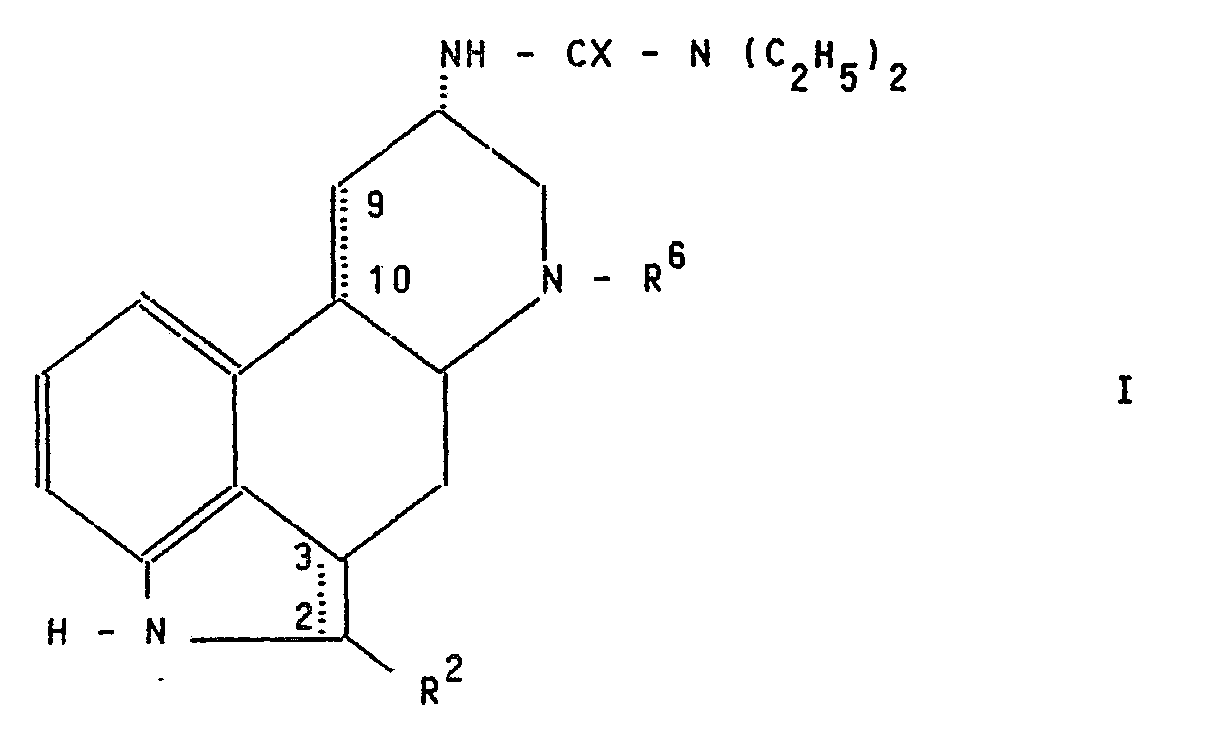
C₂ ... C₃ und C₉ ... C₁₀ eine Einfach - oder Doppelbindung,
X Sauerstoff oder Schwefel,
R² C₁₋₁₀-Alkyl, gegebenenfalls mit Halogen substituiertes C₂₋₁₀-Alkenyl, CH₂YR³, CR¹²(OR⁴)R⁵, CH₂-CHR⁹-COR¹⁰ oder COR¹²
worin Y Sauerstoff oder Schwefel, R³ Wasserstoff, C₁₋₄-Alkyl, Phenyl, C₂₋₅-Acyl oder Phenyl-C₁₋₄-Alkyl, R⁴ Wasserstoff oder C₂₋₅-Acyl, R⁵ C₁₋₉-Alkyl, R⁹ COCH₃ oder COO-C₁₋₄-Alkyl, R¹⁰ C₁₋₄-Alkyl oder O-C₁₋₄-Alkyl, R¹² Wasserstoff oder C₁₋₉ Alkyl bedeuten und
R⁶ C₂₋₁₀-Alkyl, C₃₋₁₀-Alkenyl oder C₃₋₇-Cycloalkyl-C₁₋₃-alkyl sind,
sowie deren Säureadditionssalze, Isomeren und Isomerengemische.
3-(6-Allyl-2-methyl-8α-ergolinyl)-1,1-diethyl-harnstoff
1,1-Diethyl-3-(6-ethyl-2-methyl-8α-ergolinyl)-harnstoff
1,1-Diethyl-3-(2-methyl-6-n-propyl-8α-ergolinyl)-harnstoff
1,1-Diethyl-3-(2-methylthiomethyl-6-n-propyl-8α-ergolinyl)-harnstoff
3-(9,10-Didehydro-2-methylthiomethyl-6-n-propyl-8α-ergolinyl)-1,1-diethyl-harnstoff
3-(6-Allyl-2-methylthiomethyl-8α-ergolinyl)-1,1-diethyl-harnstoff
1,1-Diethyl-3-(6-ethyl-2-methylthiomethyl-8α-ergolinyl)-harnstoff
3-(2-Benzyloxymethyl-6-n-propyl-8α-ergolinyl)-1,1-diethyl-harnstoff
1,1-Diethyl-3-(2-methoxymethyl-6-n-propyl-8α-ergolinyl)-harnstoff
3-(9,10-Didehydro-2-methoxymethyl-6-n-propyl-8α-ergolinyl)-1,1-diethyl-harnstoff
3-(6-Allyl-2-methoxymethyl-8α-ergolinyl)-1,1-diethyl-harnstoff
1,1-Diethyl-3-(6-ethyl-2-methoxymethyl-8α-ergolinyl)-harnstoff
1,1-Diethyl-3-(2-hydroxymethyl-6-n-propyl-8α-ergolinyl)-harnstoff
3-(9,10-Didehydro-2-methyl-6-n-propyl-8α-ergolinyl)-1,1-diethyl-harnstoff
3-(9,10-Didehydro-2-ethyl-6-n-propyl-8α-ergolinyl)-1,1-diethyl-harnstoff
3-(9,10-Didehydro-6-ethyl-2-methyl-8α-ergolinyl)-1,1-diethyl-harnstoff
1,1-Diethyl-3-(2-methyl-6-n-propyl-8α-ergolinyl)-thioharnstoff
1,1-Diethyl-3-(2,3β-dihydro-6-ethyl-2-methyl-8α-ergolinyl)-thioharnstoff
1,1-Diethyl-3-(2-acetoxymethyl-6-n-propyl-8α-ergolinyl)-harnstoff
1,1-Diethyl-3-[2-(1-hydroxyethyl)-6-n-propyl-8α-ergolinyl]-harnstoff
1,1-Diethyl-3-(6-ethyl-2-vinyl-8α-ergolinyl)-harnstoff
1,1-Diethyl-3-(9,10-didehydro-6-n-propyl-2-vinyl-8α-ergolinyl)-harnstoff
1,1-Diethyl-3-(6-cyclopropylmethyl-2-vinyl-8α-ergolinyl)-harnstoff
1,1-Diethyl-3-(6-n-propyl-2-vinyl-8α-ergolinyl)-1,1-diethyl-harnstoff
1,1-Diethyl-3-(2-ethyl-6-n-propyl-8α-ergolinyl)-harnstoff
1,1-Diethyl-3-(9,10-didehydro-2-methyl-6-n-propyl-8α-ergolinyl)-thioharnstoff
1,1-Diethyl-3-(9,10-didehydro-2,3β-dihydro-2β-methyl-6-n-propyl-8α-ergolinyl)-harnstoff
1,1-Diethyl-3-(2,3β-dihydro-2-methyl-6-n-propyl-8α-ergolinyl)-harnstoff
1,1-Diethyl-3-(2,3β-dihydro-2,6-di-n-propyl-8α-ergolinyl)-harnstoff
(E)-1,1-Diethyl-3-[2-(2-fluorethylenyl)-6-n-propyl-8α-ergolinyl]-harnstoff
(Z)-1,1-Diethyl-3-[2-(2-fluorethylenyl)-6-n-propyl-8α-ergolinyl]-harnstoff
3-(6-Allyl-2-ethyl-8α-ergolinyl)-1,1-diethyl-harnstoff
1,1-Diethyl-3-(2,6-diethyl-8α-ergolinyl)-harnstoff
3-(6-Cyclopropylmethyl-2-ethyl-8α-ergolinyl)-1,1-diethyl-harnstoff
1,1-Diethyl-3-(2,6-di-n-propyl-8α-ergolinyl)-harnstoff
1,1-Diethyl-3-(2-n-hexyl-6-n-propyl-8α-ergolinyl)-harnstoff

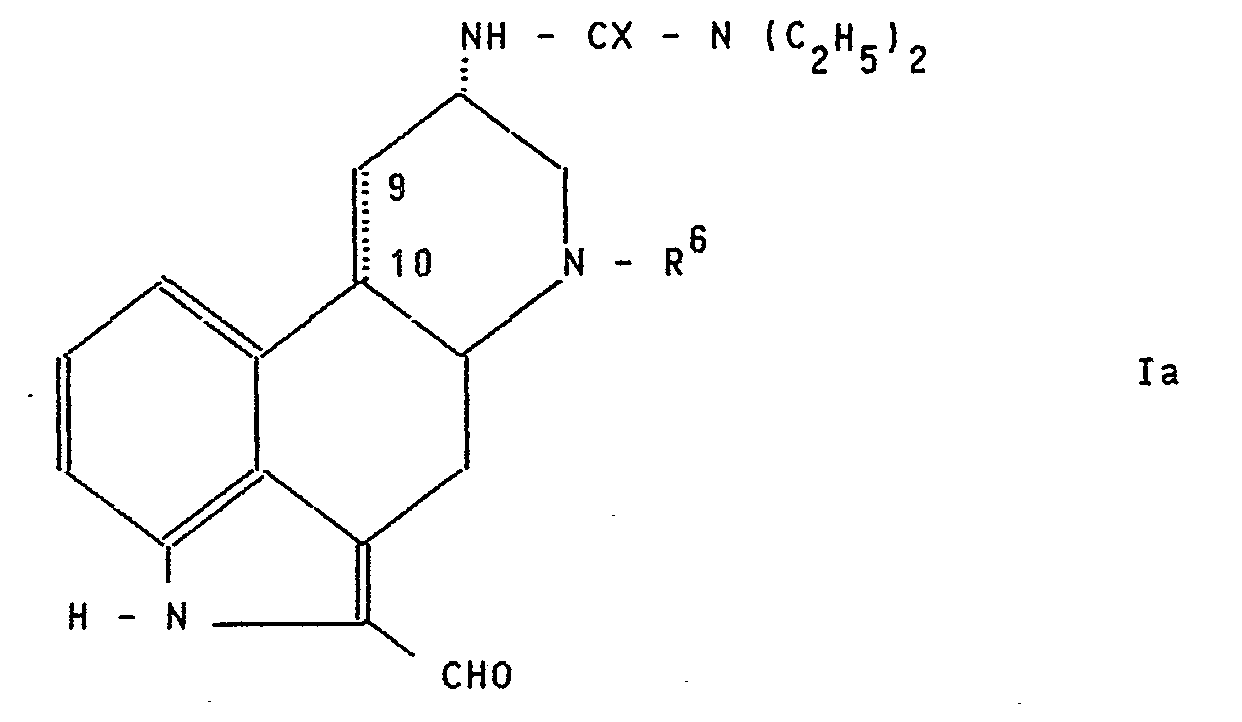

α) mit einem Wittig Reagenz umsetzt zu einer Verbindung der Formel I, worin R² einen gegebenenfalls mit Halogen substituierten C₂₋₁₀-Alkenylrest darstellt oder
β) in CH(OH)R⁵ überführt, und gewünschtenfalls anschließend in eine Verbindung der Formel I, worin R² für C₂₋₁₀-Alkenyl oder C₂₋₁₀-Alkyl steht, überführt oder die Hydroxylgruppe verestert oder zum Keton oxidiert und gewünschtenfalls anschließend die so erhaltene Verbindung der Formel Ib

und gewünschtenfalls anschließend die nach α) oder ß) erhaltenen ungesättigten Verbindungen reduziert zu Verbindungen der Formel I, worin R² für C₂₋₁₀-Alkyl steht,


Applications Claiming Priority (4)
| Application Number | Priority Date | Filing Date | Title |
|---|---|---|---|
| DE3824661 | 1988-07-15 | ||
| DE19883824661 DE3824661A1 (de) | 1988-07-15 | 1988-07-15 | 2'-substituierte 3-(8'(alpha)-ergolinyl)-1,1-diethylharnstoffe bzw. -thioharnstoffe, ihre herstellung und verwendung als zwischenprodukte sowie in arzneimitteln |
| DE19893917268 DE3917268A1 (de) | 1989-05-23 | 1989-05-23 | 2-substituierte ergoline, ihre herstellung und verwendung |
| DE3917268 | 1989-05-23 |
Publications (3)
| Publication Number | Publication Date |
|---|---|
| EP0351352A2 true EP0351352A2 (de) | 1990-01-17 |
| EP0351352A3 EP0351352A3 (de) | 1991-07-03 |
| EP0351352B1 EP0351352B1 (de) | 1995-03-08 |
Family
ID=25870307
Family Applications (1)
| Application Number | Title | Priority Date | Filing Date |
|---|---|---|---|
| EP89730164A Expired - Lifetime EP0351352B1 (de) | 1988-07-15 | 1989-07-14 | 2-Substituierte Ergoline, ihre Herstellung und Verwendung |
Country Status (10)
| Country | Link |
|---|---|
| US (2) | US5037832A (de) |
| EP (1) | EP0351352B1 (de) |
| JP (1) | JPH02142790A (de) |
| AT (1) | ATE119529T1 (de) |
| CA (1) | CA1339584C (de) |
| DE (1) | DE58909077D1 (de) |
| DK (1) | DK338789A (de) |
| ES (1) | ES2072917T3 (de) |
| HU (1) | HU211486A9 (de) |
| PT (1) | PT91154B (de) |
Cited By (3)
| Publication number | Priority date | Publication date | Assignee | Title |
|---|---|---|---|---|
| WO1992013857A1 (de) * | 1991-02-08 | 1992-08-20 | Schering Aktiengesellschaft | Verfahren zur herstellung von ergolin-derivaten |
| WO1993001185A1 (de) * | 1991-07-12 | 1993-01-21 | Schering Aktiengesellschaft Berlin Und Bergkamen | 2,14-disubstituierte ergoline, deren herstellung und verwendung in arzneimitteln |
| EP0659355A3 (de) * | 1993-12-22 | 1997-04-16 | Hoechst Ag | Filter zur Entfernung von Stickoxiden aus Tabakrauch. |
Families Citing this family (10)
| Publication number | Priority date | Publication date | Assignee | Title |
|---|---|---|---|---|
| US5242678A (en) * | 1986-07-10 | 1993-09-07 | Schering Aktiengesellschaft | BR*-diagnostics for monoamine receptors |
| DK338789A (da) * | 1988-07-15 | 1990-01-16 | Schering Ag | 2-substituerede ergolinylurinstofderivater og fremgangsmaade til fremstilling deraf, deres anvendelse som laegemidler samt mellemprodukter til fremstilling deraf |
| PT99864B (pt) * | 1990-12-21 | 1999-06-30 | Schering Ag | Processo para a preparacao de novas composicoes farmaceuticas contendo antagonistas de receptor de quisqualato |
| EP2515654A4 (de) * | 2009-12-23 | 2013-04-24 | Map Pharmaceuticals Inc | Neue ergolinanaloga |
| EP2723735A4 (de) | 2011-06-23 | 2015-02-18 | Map Pharmaceuticals Inc | Neue fluorergolin-analoga |
| AU2012355982A1 (en) | 2011-12-19 | 2014-07-10 | Map Pharmaceuticals, Inc. | Novel iso-ergoline derivatives |
| US8946420B2 (en) | 2011-12-21 | 2015-02-03 | Map Pharmaceuticals, Inc. | Neuromodulatory compounds |
| CN104822264A (zh) * | 2012-06-22 | 2015-08-05 | Map药物公司 | 新的卡麦角林衍生物 |
| US9012640B2 (en) | 2012-06-22 | 2015-04-21 | Map Pharmaceuticals, Inc. | Cabergoline derivatives |
| EP2934529A1 (de) * | 2012-12-21 | 2015-10-28 | MAP Pharmaceuticals, Inc. | Neuartige ergolinderivate und verwendungen davon |
Family Cites Families (19)
| Publication number | Priority date | Publication date | Assignee | Title |
|---|---|---|---|---|
| DE3063869D1 (en) * | 1979-06-13 | 1983-07-28 | Schering Ag | (ergolin-yl)-n', n'-diethyl urea derivatives, their preparation and pharmaceutical compositions containing them |
| DE3151912A1 (de) * | 1981-12-23 | 1983-06-30 | Schering Ag, 1000 Berlin Und 4619 Bergkamen | Neue ergolin-aminoderivate, verfahren zu ihrer herstellung und deren verwendung als arzneimittel |
| DE3309493A1 (de) * | 1983-03-14 | 1984-09-20 | Schering AG, 1000 Berlin und 4709 Bergkamen | Neue ergolin-derivate, verfahren zu ihrer herstellung sowie verwendung als arzneimittel |
| PH21123A (en) * | 1983-04-28 | 1987-07-27 | Erba Farmitalia | Ergoline derivatives |
| CH664568A5 (de) * | 1984-01-12 | 1988-03-15 | Sandoz Ag | 8-alpha-acylaminoergoline. |
| DE3411981A1 (de) * | 1984-03-28 | 1985-10-10 | Schering AG, Berlin und Bergkamen, 1000 Berlin | Verfahren zur herstellung von 2.3-dihydroergolinen |
| DE3413659A1 (de) * | 1984-04-09 | 1985-10-17 | Schering AG, 1000 Berlin und 4709 Bergkamen | Neue 2-substituierte ergolin-derivate |
| ATE107647T1 (de) * | 1984-04-09 | 1994-07-15 | Schering Ag | 2-substituierte ergolin-derivate, verfahren zu ihrer herstellung und ihre verwendung als arzneimittel. |
| HU195810B (en) * | 1984-12-24 | 1988-07-28 | Sandoz Ag | Process for preparing new 8alpha-acyl-amino-ergoline derivatives and pharmaceutical compositions containing such compounds |
| DE3533675A1 (de) * | 1985-09-19 | 1987-03-26 | Schering Ag | Neue 12- und 13-brom-ergolinderivate |
| DE3533672A1 (de) * | 1985-09-19 | 1987-03-26 | Schering Ag | Neue 12- und 13-substituierte ergolinderivate |
| DE3535929A1 (de) * | 1985-10-04 | 1987-04-09 | Schering Ag | 1,2-disubstituierte ergolinderivate |
| DE3535930A1 (de) * | 1985-10-04 | 1987-04-09 | Schering Ag | Neue 2-substituierte ergolinderivate |
| NL8700046A (nl) * | 1986-01-24 | 1987-08-17 | Sandoz Ag | 8 alfa-acylaminoergolinen, werkwijzen voor hun bereiding en farmaceutische preparaten die ze bevatten. |
| DE3620293A1 (de) * | 1986-06-16 | 1987-12-17 | Schering Ag | 1-und/oder 2-substituierte ergolinderivate |
| DE3623437C2 (de) * | 1986-07-10 | 1998-04-09 | Schering Ag | In 2-Stellung mit radioaktivem Brom markierte Ergolinylharnstoffderivate, Verfahren zu ihrer Herstellung und ihre Verwendung als Diagnostika |
| DE3623438C2 (de) * | 1986-07-10 | 1998-04-09 | Schering Ag | In 2-Stellung mit radioaktivem Iod markierte Ergolinylharnstoffderivate, Verfahren zu ihrer Herstellung und ihre Verwendung als Diagnostika |
| DE3708028A1 (de) * | 1987-03-10 | 1988-09-22 | Schering Ag | Verfahren zur herstellung von 2,3ss-dihydroergolinen, 2-substituierte 2,3ss-dihydroergoline und ihre verwendung als arzneimittel |
| DK338789A (da) * | 1988-07-15 | 1990-01-16 | Schering Ag | 2-substituerede ergolinylurinstofderivater og fremgangsmaade til fremstilling deraf, deres anvendelse som laegemidler samt mellemprodukter til fremstilling deraf |
-
1989
- 1989-07-07 DK DK338789A patent/DK338789A/da not_active Application Discontinuation
- 1989-07-13 PT PT91154A patent/PT91154B/pt not_active IP Right Cessation
- 1989-07-14 EP EP89730164A patent/EP0351352B1/de not_active Expired - Lifetime
- 1989-07-14 ES ES89730164T patent/ES2072917T3/es not_active Expired - Lifetime
- 1989-07-14 AT AT89730164T patent/ATE119529T1/de not_active IP Right Cessation
- 1989-07-14 JP JP1180659A patent/JPH02142790A/ja active Pending
- 1989-07-14 DE DE58909077T patent/DE58909077D1/de not_active Expired - Lifetime
- 1989-07-17 US US07/380,352 patent/US5037832A/en not_active Expired - Fee Related
- 1989-07-17 CA CA000605654A patent/CA1339584C/en not_active Expired - Fee Related
-
1991
- 1991-06-26 US US07/720,996 patent/US5158957A/en not_active Expired - Fee Related
-
1995
- 1995-06-20 HU HU95P/P00291P patent/HU211486A9/hu unknown
Cited By (3)
| Publication number | Priority date | Publication date | Assignee | Title |
|---|---|---|---|---|
| WO1992013857A1 (de) * | 1991-02-08 | 1992-08-20 | Schering Aktiengesellschaft | Verfahren zur herstellung von ergolin-derivaten |
| WO1993001185A1 (de) * | 1991-07-12 | 1993-01-21 | Schering Aktiengesellschaft Berlin Und Bergkamen | 2,14-disubstituierte ergoline, deren herstellung und verwendung in arzneimitteln |
| EP0659355A3 (de) * | 1993-12-22 | 1997-04-16 | Hoechst Ag | Filter zur Entfernung von Stickoxiden aus Tabakrauch. |
Also Published As
| Publication number | Publication date |
|---|---|
| EP0351352A3 (de) | 1991-07-03 |
| JPH02142790A (ja) | 1990-05-31 |
| ATE119529T1 (de) | 1995-03-15 |
| HU211486A9 (en) | 1995-11-28 |
| DK338789D0 (da) | 1989-07-07 |
| DK338789A (da) | 1990-01-16 |
| ES2072917T3 (es) | 1995-08-01 |
| US5037832A (en) | 1991-08-06 |
| PT91154A (pt) | 1990-02-08 |
| EP0351352B1 (de) | 1995-03-08 |
| US5158957A (en) | 1992-10-27 |
| CA1339584C (en) | 1997-12-16 |
| DE58909077D1 (de) | 1995-04-13 |
| PT91154B (pt) | 1995-01-31 |
Similar Documents
| Publication | Publication Date | Title |
|---|---|---|
| EP0160842B1 (de) | 2-substituierte Ergolin-Derivate, Verfahren zu ihrer Herstellung und ihre Verwendung als Arzneimittel | |
| EP0351352B1 (de) | 2-Substituierte Ergoline, ihre Herstellung und Verwendung | |
| EP0161218A2 (de) | Benzo-(pyrano und thiopyrano)-pyridine | |
| EP0217736B1 (de) | 1,2-Disubstituierte Ergolinderivate | |
| WO1993001185A1 (de) | 2,14-disubstituierte ergoline, deren herstellung und verwendung in arzneimitteln | |
| DE3413657A1 (de) | Neue ergoline | |
| EP0217734A1 (de) | 12- und 13-Brom-Ergolinderivate | |
| EP0418990B1 (de) | 13-Brom und 13, 14-Dibrom-Ergoline, ihre Herstellung und Verwendung in Arzneimitteln | |
| EP0427827B1 (de) | 8-alpha-ACYLAMINO-ERGOLINE, IHRE HERSTELLUNG UND VERWENDUNG ALS ARZNEIMITTEL | |
| US5411966A (en) | 2, 13-disubstituted ergolines, their production and use in pharmaceutical agents | |
| EP0420953A1 (de) | 8-beta-substituierte ergoline, verfahren zu ihrer herstellung und ihre verwendung | |
| DE3824661A1 (de) | 2'-substituierte 3-(8'(alpha)-ergolinyl)-1,1-diethylharnstoffe bzw. -thioharnstoffe, ihre herstellung und verwendung als zwischenprodukte sowie in arzneimitteln | |
| DE3917268A1 (de) | 2-substituierte ergoline, ihre herstellung und verwendung | |
| EP0463139B1 (de) | 2,13-disubstituierte ergoline, deren herstellung und verwendung in arzneimitteln | |
| EP0250357A1 (de) | 1- und/oder 2-substituierte Ergolinderivate | |
| DE3520104A1 (de) | Naphthoxazine, ihre herstellung und verwendung | |
| DD251289A5 (de) | Verfahren zur herstellung einer neuartigen racemischen oder optisch aktiven verbindung | |
| DE3824659A1 (de) | 2-, 12- oder 13-substituierte 3-(8'(alpha)-ergolinyl)-1,1-diethylharnstoffe, ihre herstellung und verwendung in arzneimitteln | |
| DE3700825A1 (de) | 8(alpha)-acylaminoergoline, ihre herstellung und verwendung | |
| EP0217735A2 (de) | Neue 2-substituierte Ergolinderivate | |
| EP0429153A1 (de) | Neue Agroclavin- und Elymoclavin-Derivate, Verfahren zu deren Herstellung und deren Verwendung in Arzneimitteln | |
| DE3941967A1 (de) | Neue phosphor- und phosphorigsaeureamide von ergolinen | |
| DE3713150A1 (de) | Neue ergolin-derivate | |
| DE4333287A1 (de) | Fluorierte Ergoline | |
| EP0432099A2 (de) | Hydrierte Stickstoffheterocyclen |
Legal Events
| Date | Code | Title | Description |
|---|---|---|---|
| PUAI | Public reference made under article 153(3) epc to a published international application that has entered the european phase |
Free format text: ORIGINAL CODE: 0009012 |
|
| 17P | Request for examination filed |
Effective date: 19890728 |
|
| AK | Designated contracting states |
Kind code of ref document: A2 Designated state(s): AT BE CH DE ES FR GB GR IT LI LU NL SE |
|
| PUAL | Search report despatched |
Free format text: ORIGINAL CODE: 0009013 |
|
| AK | Designated contracting states |
Kind code of ref document: A3 Designated state(s): AT BE CH DE ES FR GB GR IT LI LU NL SE |
|
| 17Q | First examination report despatched |
Effective date: 19920831 |
|
| RAP1 | Party data changed (applicant data changed or rights of an application transferred) |
Owner name: SCHERING AKTIENGESELLSCHAFT |
|
| GRAA | (expected) grant |
Free format text: ORIGINAL CODE: 0009210 |
|
| AK | Designated contracting states |
Kind code of ref document: B1 Designated state(s): AT BE CH DE ES FR GB GR IT LI LU NL SE |
|
| REF | Corresponds to: |
Ref document number: 119529 Country of ref document: AT Date of ref document: 19950315 Kind code of ref document: T |
|
| REF | Corresponds to: |
Ref document number: 58909077 Country of ref document: DE Date of ref document: 19950413 |
|
| ITF | It: translation for a ep patent filed | ||
| ET | Fr: translation filed | ||
| GBT | Gb: translation of ep patent filed (gb section 77(6)(a)/1977) |
Effective date: 19950619 |
|
| REG | Reference to a national code |
Ref country code: ES Ref legal event code: FG2A Ref document number: 2072917 Country of ref document: ES Kind code of ref document: T3 |
|
| REG | Reference to a national code |
Ref country code: GR Ref legal event code: FG4A Free format text: 3016339 |
|
| PLBE | No opposition filed within time limit |
Free format text: ORIGINAL CODE: 0009261 |
|
| STAA | Information on the status of an ep patent application or granted ep patent |
Free format text: STATUS: NO OPPOSITION FILED WITHIN TIME LIMIT |
|
| 26N | No opposition filed | ||
| PGFP | Annual fee paid to national office [announced via postgrant information from national office to epo] |
Ref country code: FR Payment date: 19980611 Year of fee payment: 10 |
|
| PGFP | Annual fee paid to national office [announced via postgrant information from national office to epo] |
Ref country code: AT Payment date: 19980616 Year of fee payment: 10 |
|
| PGFP | Annual fee paid to national office [announced via postgrant information from national office to epo] |
Ref country code: SE Payment date: 19980622 Year of fee payment: 10 |
|
| PGFP | Annual fee paid to national office [announced via postgrant information from national office to epo] |
Ref country code: GB Payment date: 19980623 Year of fee payment: 10 |
|
| PGFP | Annual fee paid to national office [announced via postgrant information from national office to epo] |
Ref country code: NL Payment date: 19980629 Year of fee payment: 10 Ref country code: DE Payment date: 19980629 Year of fee payment: 10 |
|
| PGFP | Annual fee paid to national office [announced via postgrant information from national office to epo] |
Ref country code: GR Payment date: 19980630 Year of fee payment: 10 |
|
| PGFP | Annual fee paid to national office [announced via postgrant information from national office to epo] |
Ref country code: LU Payment date: 19980701 Year of fee payment: 10 Ref country code: CH Payment date: 19980701 Year of fee payment: 10 |
|
| PGFP | Annual fee paid to national office [announced via postgrant information from national office to epo] |
Ref country code: ES Payment date: 19980710 Year of fee payment: 10 |
|
| PGFP | Annual fee paid to national office [announced via postgrant information from national office to epo] |
Ref country code: BE Payment date: 19980713 Year of fee payment: 10 |
|
| PG25 | Lapsed in a contracting state [announced via postgrant information from national office to epo] |
Ref country code: DE Free format text: LAPSE BECAUSE OF THE APPLICANT RENOUNCES Effective date: 19981110 |
|
| PG25 | Lapsed in a contracting state [announced via postgrant information from national office to epo] |
Ref country code: LU Free format text: LAPSE BECAUSE OF NON-PAYMENT OF DUE FEES Effective date: 19990714 Ref country code: GB Free format text: LAPSE BECAUSE OF NON-PAYMENT OF DUE FEES Effective date: 19990714 Ref country code: AT Free format text: LAPSE BECAUSE OF NON-PAYMENT OF DUE FEES Effective date: 19990714 |
|
| PG25 | Lapsed in a contracting state [announced via postgrant information from national office to epo] |
Ref country code: ES Free format text: LAPSE BECAUSE OF NON-PAYMENT OF DUE FEES Effective date: 19990715 |
|
| PG25 | Lapsed in a contracting state [announced via postgrant information from national office to epo] |
Ref country code: SE Free format text: THE PATENT HAS BEEN ANNULLED BY A DECISION OF A NATIONAL AUTHORITY Effective date: 19990730 |
|
| PG25 | Lapsed in a contracting state [announced via postgrant information from national office to epo] |
Ref country code: LI Free format text: LAPSE BECAUSE OF NON-PAYMENT OF DUE FEES Effective date: 19990731 Ref country code: GR Free format text: LAPSE BECAUSE OF NON-PAYMENT OF DUE FEES Effective date: 19990731 Ref country code: FR Free format text: THE PATENT HAS BEEN ANNULLED BY A DECISION OF A NATIONAL AUTHORITY Effective date: 19990731 Ref country code: CH Free format text: LAPSE BECAUSE OF NON-PAYMENT OF DUE FEES Effective date: 19990731 Ref country code: BE Free format text: LAPSE BECAUSE OF NON-PAYMENT OF DUE FEES Effective date: 19990731 |
|
| BERE | Be: lapsed |
Owner name: SCHERING A.G. Effective date: 19990731 |
|
| PG25 | Lapsed in a contracting state [announced via postgrant information from national office to epo] |
Ref country code: NL Free format text: LAPSE BECAUSE OF NON-PAYMENT OF DUE FEES Effective date: 20000201 |
|
| GBPC | Gb: european patent ceased through non-payment of renewal fee |
Effective date: 19990714 |
|
| REG | Reference to a national code |
Ref country code: CH Ref legal event code: PL |
|
| EUG | Se: european patent has lapsed |
Ref document number: 89730164.4 |
|
| NLV4 | Nl: lapsed or anulled due to non-payment of the annual fee |
Effective date: 20000201 |
|
| REG | Reference to a national code |
Ref country code: FR Ref legal event code: ST |
|
| REG | Reference to a national code |
Ref country code: ES Ref legal event code: FD2A Effective date: 20000810 |
|
| PG25 | Lapsed in a contracting state [announced via postgrant information from national office to epo] |
Ref country code: IT Free format text: LAPSE BECAUSE OF NON-PAYMENT OF DUE FEES;WARNING: LAPSES OF ITALIAN PATENTS WITH EFFECTIVE DATE BEFORE 2007 MAY HAVE OCCURRED AT ANY TIME BEFORE 2007. THE CORRECT EFFECTIVE DATE MAY BE DIFFERENT FROM THE ONE RECORDED. Effective date: 20050714 |