EP0351388A2 - Optimisation de temps d'accès utilisant des degrés de groupement - Google Patents
Optimisation de temps d'accès utilisant des degrés de groupement Download PDFInfo
- Publication number
- EP0351388A2 EP0351388A2 EP89850195A EP89850195A EP0351388A2 EP 0351388 A2 EP0351388 A2 EP 0351388A2 EP 89850195 A EP89850195 A EP 89850195A EP 89850195 A EP89850195 A EP 89850195A EP 0351388 A2 EP0351388 A2 EP 0351388A2
- Authority
- EP
- European Patent Office
- Prior art keywords
- index
- rows
- clustering
- pages
- degree
- Prior art date
- Legal status (The legal status is an assumption and is not a legal conclusion. Google has not performed a legal analysis and makes no representation as to the accuracy of the status listed.)
- Withdrawn
Links
Images

Classifications
-
- G—PHYSICS
- G06—COMPUTING OR CALCULATING; COUNTING
- G06F—ELECTRIC DIGITAL DATA PROCESSING
- G06F16/00—Information retrieval; Database structures therefor; File system structures therefor
- G06F16/20—Information retrieval; Database structures therefor; File system structures therefor of structured data, e.g. relational data
- G06F16/22—Indexing; Data structures therefor; Storage structures
- G06F16/2228—Indexing structures
- G06F16/2246—Trees, e.g. B+trees
-
- G—PHYSICS
- G06—COMPUTING OR CALCULATING; COUNTING
- G06F—ELECTRIC DIGITAL DATA PROCESSING
- G06F16/00—Information retrieval; Database structures therefor; File system structures therefor
- G06F16/20—Information retrieval; Database structures therefor; File system structures therefor of structured data, e.g. relational data
- G06F16/22—Indexing; Data structures therefor; Storage structures
- G06F16/2228—Indexing structures
- G06F16/2272—Management thereof
-
- G—PHYSICS
- G06—COMPUTING OR CALCULATING; COUNTING
- G06F—ELECTRIC DIGITAL DATA PROCESSING
- G06F16/00—Information retrieval; Database structures therefor; File system structures therefor
- G06F16/20—Information retrieval; Database structures therefor; File system structures therefor of structured data, e.g. relational data
- G06F16/24—Querying
- G06F16/245—Query processing
- G06F16/2453—Query optimisation
- G06F16/24534—Query rewriting; Transformation
- G06F16/24542—Plan optimisation
-
- Y—GENERAL TAGGING OF NEW TECHNOLOGICAL DEVELOPMENTS; GENERAL TAGGING OF CROSS-SECTIONAL TECHNOLOGIES SPANNING OVER SEVERAL SECTIONS OF THE IPC; TECHNICAL SUBJECTS COVERED BY FORMER USPC CROSS-REFERENCE ART COLLECTIONS [XRACs] AND DIGESTS
- Y10—TECHNICAL SUBJECTS COVERED BY FORMER USPC
- Y10S—TECHNICAL SUBJECTS COVERED BY FORMER USPC CROSS-REFERENCE ART COLLECTIONS [XRACs] AND DIGESTS
- Y10S707/00—Data processing: database and file management or data structures
- Y10S707/99931—Database or file accessing
- Y10S707/99932—Access augmentation or optimizing
Definitions
- This invention relates to information management, and more particularly to data base management systems.
- a data base management system is a computer system for recording and maintaining data.
- data is stored as rows in a table, with collections of tables being called data bases.
- requests are nonprocedural (also referred to as navigational). That is, users simply specify what is wanted, rather than specifying how to accomplish it.
- the system's optimizer must determine the optimal way (or access path) to get the data for the user.
- One way to access data is to sequentially scan every row in a table for those rows which match the search criteria. This is known as a table scan, because the entire table is scanned in sequence from beginning to end.
- Rows of data are stored on pages on physical storage devices, usually disk drives or files. Data is transferred between the physical storage and the computer system's processing unit page by page even though only a single row may be needed from a given page.
- the time it takes to transfer data between physical storage and the processing unit is many times greater than the time it takes to process the data in the processing unit.
- the time it takes to randomly access separate physical pages is as much as ten times longer than the time needed to sequentially access adjacent pages.
- To manipulate data in a relational data base the rows must first be transferred from physical storage to the processing unit, then processed in the processing unit, and finally transferred back to physical storage. Because transferring takes so much longer than processing, the total time required to manipulate the data can be dramatically reduced if the number of transfers can be reduced.
- index is a list stored separately from the rows and used to access the rows in a selected order.
- An index comprises many index entries, each containing a key value and an identifier of or pointer to one or more rows which contain that key value. Indexes are physically stored on index pages.
- B-tree One method of storing an index's pages is as a B-tree, with a root page, intermediate pages depending from the root, and leaf pages depending from the intermediate pages at the lowest level of the tree.
- the term B-tree is short for "balanced tree", and refers to the balanced or roughly equal number of pages to which each such root or intermediate index page points.
- the B-tree's leaf pages contain the index entries. To scan a table's rows in the order specified by the index, the index's leaf pages are scanned sequentially and the index entries on each leaf page are used to access the rows in the index's order. This scan is called an index sequential scan, or index scan for short.
- index is perfectly clustered if, when scanning the index leaf pages sequentially, each data page is accessed only once. For this to occur the data rows, when accessed in index order, must be in the same sequence as the sequence in which they are stored in the data pages of physical storage.
- An index scan through a clustered index (also referred to as a clustered index scan) is fast because the number of data page accesses is minimized since there are no duplicate accesses to the same data page and because both the index leaf pages and the data pages can be accessed sequentially rather than at random.
- index is nonclustered if, when scanning the index leaf pages sequentially, the data pages are accessed back and forth at random. Index scans through nonclustered indexes (also referred to as nonclustered index scans) are extremely slow, because there is much thrashing back and forth between data pages as the index requires separate data pages to be randomly accessed and transferred into and out of the processing unit's main memory but only accesses one row from the many on each such page.
- index's key When an index's key is used as a search criterion in a query, that index can often provide an efficient access path for identifying these data rows which satisfy or match the search criteria.
- the data base system's optimizer When a complex query having several criteria is presented, the data base system's optimizer often has a number of indexes available, each having a key the same as one of the search criteria. The optimizer must then select the best index with which to access the data rows.
- One object of this invention is to measure degrees of physical clustering of indexes.
- Another object of this invention is to provide a method for using such degrees of clustering in selecting access paths for data base management systems.
- Yet another object of this invention is to select access paths by accurately estimating the page accesses required during an index scan based on the degree of clustering of the index.
- a method for estimating the number of data pages to be accessed during an index scan of a relational data base table first calculates a clustering coefficient which is directly proportional to the number of rows which, when in index order, are in a sequence which is the same as the sequence in which they are stored on the data pages. This clustering coefficient is then used to estimate the number of pages to be accessed during the index scan. The number of page accesses may then be used to select an access path for a query, join, or other indexed data base operation.
- the clustering coefficient is preferably calculated by multiplying the ratio of clustered rows to total rows by a factor which is greater than 1, in order to account for the advantage of accessing rows which .are on nearby pages but not sequentially adjacent to each other.
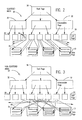
- a data base table 10 having rows 12 of employee data might be physically stored on data pages 13 in the order in which the employees were hired.
- Such a table 10 could have a first index 14 for placing the rows 12 in increasing (ascending) alphabetical order by last name, a second index 16 for placing the rows in ascending order by age, and a third index 18 for placing the rows in decreasing (descending) order by salary.
- Each index 14,16,18 comprises many index entries 20, each index entry containing a key value 22 (e.g., last name, age, or salary) and an identifier of or pointer 24 to one or more rows 12 which contain that key value.
- the indexes 14,16,18 are physically stored on index pages.
- FIG. 2 shows a perfectly clustered B-tree index 26.
- the root page 28 of the tree is at the top of the drawing, the leaf pages 30 are along the bottom, and intermediate pages 32 are interposed between the root and the leaves.
- This query requests the last names of all employees at least 40 years old and earning $40,000 or less.
- the conditions that age be greater than or equal to 40 and salary be less than or equal to $40,000 are the search criteria for this query. It will be seen from inspecting the employee table 10 that only Thomas and Sanderson satisfy both of these criteria.
- the simplest access path by which the optimizer could determine which rows satisfy these search criteria is a table scan, i.e., a sequential scan through all of the rows 12 in the table 10 in the order in which they are stored, checking each row to determine whether it matches the search criteria.
- a table scan would require transferring three data pages to and from main memory, and processing all six rows of the table.
- the time required to do this search can be estimated as follows. Each sequential access of a page requires about 2 milliseconds (2 ms), each random access requires 20 ms, and the processing of each row requires about 0.1 ms.
- the Age index 16 would be searched for the first entry matching the age search criterion, i.e., the first entry equal to or greater than 40.
- An index scan would then be performed from that point in the index onward.
- the first data page would be randomly accessed and the Matthews row processed and discarded, followed by the third data page (again randomly) for the Thomas row, the first data page again for the Baker row, and finally the second data page for the Sanderson row.
- a clustered index scan through a perfectly clustered index is not available as an option in this example. Neither of the indexes corresponding to the search criteria, the Age index 16 and the Salary index 18, is perfectly clustered. According to the prior art, then, either of these indexes would be equally efficient as an access path for this query and an optimizer using prior art methods of access path selection would make its choice accordingly.
- the Salary index 18 while not completely clustered, is nearly so. An index scan through the Salary index 18 would be less time consuming, and therefore more efficient, than either the table scan through the entire employee table 10 or the index scan through the Age index 14, discussed above.
- the index Using the Salary index 18 as the access path for this query, the index would be scanned for the first entry matching the Salary search criterion, i.e., with a salary equal to or less than $40,000. The first such entry appears on the second index page of the Salary index 18. An index scan would then be performed through the remainder of this index, and each row identified by the index processed according to the query. Thus, the third data page would be transferred (random access) and the Thomas row processed and selected.
- the relatively clustered Salary index 18 provides a much better access path for this sample query than the completely nonclustered Age index 16.
- the degree of clustering is defined as the number of clustered rows in a given index divided by the total number of rows in the table.
- the degree of clustering is proportional to the number of rows which when in index order is in the same sequence as that sequence in which they are stored.
- the number of clustered rows may be determined by performing an index scan through the entire table. A row is considered to be clustered if it is physically stored immediately following the row previously specified by the index. If all rows of an index are clustered according to this definition, then the index is completely clustered as understood in the prior art. If ninety percent (90%) of the table's rows immediately follow their predecessor rows in index order, then according to this invention the index is ninety percent (90%) clustered. This measure of the degree of clustering has been found to be extremely valuable in selecting between indexed access paths into a table.
- the optimizer's task when presented with a query into a data base table, is to select the fastest access path for that query.
- the optimizer can choose between a sequential table scan through the entire table, or an index scan using an index corresponding to one of the query's search criteria. Where two or more search criteria have corresponding indexes, the optimizer must choose between these alternative candidate indexes.
- Example 1 shows a program fragment written in pseudocode (also known as program development language) for determining the fastest indexed access path for a table.
- Lines 101-105 gather information relating to the data base table and to unit times which do not depend on which candidate index is being considered.
- NR stores the total number of rows in the table.
- NP stores the total number of data pages on which the NR rows are stored.
- TAR stores the time required for one random page access, while TAS stores the time required for a sequential page access. TAR is typically much greater than TAS.
- TPR of line 105 stores the time required for processing one row in the data base system's central processing unit.
- the DO-loop between lines 106 and 121 considers in turn each index which corresponds to one of the search criteria in the query presented to the optimizer.
- the degree of clustering DC is calculated in line 108 by dividing the number of clustered rows NCR for the candidate index by the total number of rows NR in the table.
- the number of clustered rows NCR may be calculated by performing an index scan through the index under consideration, and counting the number of rows which are physically stored immediately following the row previously accessed during the index scan. This number of clustered rows NCR is preferably calculated and stored once for each index, rather than performing an index scan each time an index's degree of clustering is required to be known.
- the number of leaf pages NLP in the index is stored in line 109.
- Line 110 calculates the number of levels NL in the index. Referring briefly to FIG. 2, the index 26 shown there has three levels: the root page 28 level, one level of intermediate pages 32 , and the leaf page 30 level.
- the number of levels NL is included in the calculation of the number of page accesses required during an index scan, because before the index's leaf pages 30 may be scanned, the index tree 26 must be traversed or "walked" to get to the first leaf page 30 having an index entry 20 satisfying the query's search criterion which corresponds to the index.
- the index's filter factor FF is calculated in lines 111-112 as the number of rows NRI matching the selection criterion corresponding to the index divided by the total number of rows NR in the table.
- the difference between the number of rows NRI matching the index's search criterion and the total number of rows NR reflects the efficiency of accessing only the few rows NRI which match one of the search criteria instead of performing a table scan through all the rows NR of the table, many of which do not match any of the search criteria.
- the filter factor FF thus corresponds to the index's selectivity in eliminating nonmatching rows during an index scan.
- An index scan requires a combination of random and sequential page accesses. As discussed above, random page accesses typically require as much as ten times longer to execute than sequential page accesses, and thus can contribute an inordinately large part of the total time required for an index scan. Random page accesses are required to traverse or walk the index's tree 26, and to access the nonclustered rows scattered over separate data pages 13. The number of random page accesses required to traverse or walk the index's tree 26 is equal to the number of levels NL in the index, calculated above at line 110. The number of page accesses required to access the nonclustered rows is assumed to be equal to the number of nonclustered rows matching the search criterion corresponding to the index.
- the total number of nonclustered rows in the table is calculated as the total rows in the table NR multiplied by the difference between 1 and the degree of clustering DC for the index.
- the number of nonclustered rows matching the index's corresponding search criterion is calculated by multiplying the previous sum by the index's filter factor FF. To this is added the number of index levels NL to arrive at the total number of random page access NAR required for the index scan.
- the number of sequential page accesses NAS required for the index scan is calculated in line 114.
- the index leaf pages 30 are accessed in order, requiring sequential page accesses.
- the number of leaf pages 30 to be accessed during the partial index scan is equal to the total number of leaf pages NLP in the index, multiplied by the index's filter factor FF to reflect the index's selectivity in eliminating nonmatching rows.
- Sequential page accesses are also used to access the clustered rows lying on adjacent data pages 13.
- the number of clustered rows to be accessed is equal to the number of data pages 13 which are clustered and which match the search criterion corresponding to the candidate index.
- the number is calculated as the total number of data pages NP multiplied by both the index's filter factor FF and by the index's degree of clustering DC.
- the total number of sequential accesses NAS equals the previously calculated product plus the number of index leaf pages to be accessed as described above.
- the total time required for page accesses is calculated in line 115 by multiplying those numbers by the time required for each. To this is added the total processing time required for the index scan, calculated on lines 116-117, to arrive at the estimated total time TIME for using the index as the access path to the tables for the query.
- the name of the index is saved if its total time TIME is the shortest of the indexes considered so far. After all candidate indexes have been considered in the DO-loop of lines 106-120, the index whose name is currently saved will have the shortest estimated total time TIME, taking into consideration the degrees of clustering of all the candidate indexes. If used as the access path for the query, the index so identified will process the query faster than any of the other candidate indexes. This index's name can then the passed to the optimizer as a significant factor to be used in ultimately selecting the access path for the query.
- the four-fold improvement in performance, i.e., the seventy-five percent (75%) reduction in total time, achieved by using the ninety percent (90%) clustered index as the access path to the table is entirely due to the large reduction in the number of random page accesses required for the more tightly clustered rows.
- the sixty percent (60%) clustered index will require 8,005 random page accesses.
- the ninety percent (90%) clustered index requires only 2,005 random accesses, a seventy-five percent (75%) reduction over the sixty percent (60%) clustered index, and at a cost of only 300 additional sequential page accesses.
- the degree of clustering can be calculated not simply as the ratio of clustered rows to total rows, but might include a multiplier greater than 1 to account for the advantage of sequentially accessing nonadjacent rows which are nevertheless on adjacent or nearby data pages. Such a multiplier would more accurately reflect the true value of using an index with a degree of clustering.
- this invention is not limited to relational data base queries, but can be readily applied to optimizing the access paths in joining relational data base tables. Further, the invention is considered to have value outside the field of relational data base management systems, in the broader realm of estimating page accesses in other data processing applications. It will be understood that outside the area of relational data bases, there is commonly considered to be stored in "records", and other structures (analogous to the indexes described above) are used to access the records in sequences other than the claims immediately following claim 2. Accordingly, the scope and protection of the invention is not limited except as by the following claims.
Landscapes
- Engineering & Computer Science (AREA)
- Theoretical Computer Science (AREA)
- Data Mining & Analysis (AREA)
- Databases & Information Systems (AREA)
- Physics & Mathematics (AREA)
- General Engineering & Computer Science (AREA)
- General Physics & Mathematics (AREA)
- Software Systems (AREA)
- Operations Research (AREA)
- Computational Linguistics (AREA)
- Information Retrieval, Db Structures And Fs Structures Therefor (AREA)
Applications Claiming Priority (2)
| Application Number | Priority Date | Filing Date | Title |
|---|---|---|---|
| US07/219,622 US5043872A (en) | 1988-07-15 | 1988-07-15 | Access path optimization using degrees of clustering |
| US219622 | 1988-07-15 |
Publications (2)
| Publication Number | Publication Date |
|---|---|
| EP0351388A2 true EP0351388A2 (fr) | 1990-01-17 |
| EP0351388A3 EP0351388A3 (fr) | 1992-10-14 |
Family
ID=22820033
Family Applications (1)
| Application Number | Title | Priority Date | Filing Date |
|---|---|---|---|
| EP19890850195 Withdrawn EP0351388A3 (fr) | 1988-07-15 | 1989-06-14 | Optimisation de temps d'accès utilisant des degrés de groupement |
Country Status (3)
| Country | Link |
|---|---|
| US (1) | US5043872A (fr) |
| EP (1) | EP0351388A3 (fr) |
| JP (1) | JPH0776936B2 (fr) |
Cited By (5)
| Publication number | Priority date | Publication date | Assignee | Title |
|---|---|---|---|---|
| DE4323947A1 (de) * | 1992-08-20 | 1994-02-24 | Hewlett Packard Co | Informationswiedergewinnung in einem verteilten Datenbank-Managementsystem unter Verwendung einer synthetischen DBMS-Kalibrierung |
| WO1997022939A1 (fr) | 1995-12-20 | 1997-06-26 | British Telecommunications Public Limited Company | Index identificateurs destines a des bases de donnees relationnelles |
| US6728720B1 (en) | 1999-07-02 | 2004-04-27 | Robert Stephen Gerard Lenzie | Identifying preferred indexes for databases |
| AU2005100125B4 (en) * | 2005-02-11 | 2006-11-30 | Mojarrabi, Bahram Mr | Scale free network of urban traffic |
| CN119862220A (zh) * | 2024-12-09 | 2025-04-22 | 清华大学 | 一种数据库原生时间序列聚类方法和装置 |
Families Citing this family (62)
| Publication number | Priority date | Publication date | Assignee | Title |
|---|---|---|---|---|
| EP0360387B1 (fr) * | 1988-09-23 | 1996-05-08 | International Business Machines Corporation | Système de gestion de base de données |
| US5161223A (en) * | 1989-10-23 | 1992-11-03 | International Business Machines Corporation | Resumeable batch query for processing time consuming queries in an object oriented database management system |
| US5241648A (en) * | 1990-02-13 | 1993-08-31 | International Business Machines Corporation | Hybrid technique for joining tables |
| EP0444358B1 (fr) * | 1990-02-27 | 1998-08-19 | Oracle Corporation | Optimisation dynamique d'un seul accès relationnel |
| US5261088A (en) * | 1990-04-26 | 1993-11-09 | International Business Machines Corporation | Managing locality in space reuse in a shadow written B-tree via interior node free space list |
| JPH0415839A (ja) * | 1990-05-10 | 1992-01-21 | Toshiba Corp | 分散データベース管理装置 |
| US5355473A (en) * | 1991-06-20 | 1994-10-11 | Lawrence Au | Indexed record locating and counting mechanism |
| JPH077422B2 (ja) * | 1991-08-23 | 1995-01-30 | インターナショナル・ビジネス・マシーンズ・コーポレイション | コンピュータ処理データベース・システムにおけるジョインの実行方法及びシステム |
| US5301317A (en) * | 1992-04-27 | 1994-04-05 | International Business Machines Corporation | System for adapting query optimization effort to expected execution time |
| US5404510A (en) * | 1992-05-21 | 1995-04-04 | Oracle Corporation | Database index design based upon request importance and the reuse and modification of similar existing indexes |
| US5765146A (en) * | 1993-11-04 | 1998-06-09 | International Business Machines Corporation | Method of performing a parallel relational database query in a multiprocessor environment |
| CA2124094C (fr) * | 1994-05-20 | 1999-07-20 | K. Bernhard Schiefer | Methode et dispositif pour optimiser l'extraction de donnees utilisant une exploration d'indices |
| US5758144A (en) * | 1994-06-24 | 1998-05-26 | International Business Machines Corporation | Database execution cost and system performance estimator |
| US5664172A (en) * | 1994-07-19 | 1997-09-02 | Oracle Corporation | Range-based query optimizer |
| US5671403A (en) * | 1994-12-30 | 1997-09-23 | International Business Machines Corporation | Iterative dynamic programming system for query optimization with bounded complexity |
| US5548755A (en) * | 1995-02-17 | 1996-08-20 | International Business Machines Corporation | System for optimizing correlated SQL queries in a relational database using magic decorrelation |
| US5778354A (en) * | 1995-06-07 | 1998-07-07 | Tandem Computers Incorporated | Database management system with improved indexed accessing |
| US5778364A (en) * | 1996-01-02 | 1998-07-07 | Verity, Inc. | Evaluation of content of a data set using multiple and/or complex queries |
| US5670912A (en) * | 1996-01-31 | 1997-09-23 | Motorola, Inc. | Variable supply biasing method and apparatus for an amplifier |
| US5913205A (en) * | 1996-03-29 | 1999-06-15 | Virage, Inc. | Query optimization for visual information retrieval system |
| US5924088A (en) * | 1997-02-28 | 1999-07-13 | Oracle Corporation | Index selection for an index access path |
| US5903888A (en) * | 1997-02-28 | 1999-05-11 | Oracle Corporation | Method and apparatus for using incompatible types of indexes to process a single query |
| US6047284A (en) | 1997-05-14 | 2000-04-04 | Portal Software, Inc. | Method and apparatus for object oriented storage and retrieval of data from a relational database |
| US6285996B1 (en) * | 1997-07-10 | 2001-09-04 | International Business Machines Corp. | Run-time support for user-defined index ranges and index filters |
| US6266663B1 (en) | 1997-07-10 | 2001-07-24 | International Business Machines Corporation | User-defined search using index exploitation |
| US6192358B1 (en) | 1997-07-10 | 2001-02-20 | Internatioanal Business Machines Corporation | Multiple-stage evaluation of user-defined predicates |
| US6253196B1 (en) | 1997-07-10 | 2001-06-26 | International Business Machines Corporation | Generalized model for the exploitation of database indexes |
| US6278994B1 (en) | 1997-07-10 | 2001-08-21 | International Business Machines Corporation | Fully integrated architecture for user-defined search |
| US6219662B1 (en) | 1997-07-10 | 2001-04-17 | International Business Machines Corporation | Supporting database indexes based on a generalized B-tree index |
| US6278990B1 (en) | 1997-07-25 | 2001-08-21 | Claritech Corporation | Sort system for text retrieval |
| US5940819A (en) * | 1997-08-29 | 1999-08-17 | International Business Machines Corporation | User specification of query access paths in a relational database management system |
| US7711672B2 (en) * | 1998-05-28 | 2010-05-04 | Lawrence Au | Semantic network methods to disambiguate natural language meaning |
| US8396824B2 (en) * | 1998-05-28 | 2013-03-12 | Qps Tech. Limited Liability Company | Automatic data categorization with optimally spaced semantic seed terms |
| US20070294229A1 (en) * | 1998-05-28 | 2007-12-20 | Q-Phrase Llc | Chat conversation methods traversing a provisional scaffold of meanings |
| US6112197A (en) * | 1998-05-29 | 2000-08-29 | Oracle Corporation | Method and apparatus for transmission of row differences |
| US6389425B1 (en) | 1998-07-09 | 2002-05-14 | International Business Machines Corporation | Embedded storage mechanism for structured data types |
| US6470330B1 (en) * | 1998-11-05 | 2002-10-22 | Sybase, Inc. | Database system with methods for estimation and usage of index page cluster ratio (IPCR) and data page cluster ratio (DPCR) |
| US6397204B1 (en) | 1999-06-25 | 2002-05-28 | International Business Machines Corporation | Method, system, and program for determining the join ordering of tables in a join query |
| US6374235B1 (en) | 1999-06-25 | 2002-04-16 | International Business Machines Corporation | Method, system, and program for a join operation on a multi-column table and satellite tables including duplicate values |
| US6446063B1 (en) | 1999-06-25 | 2002-09-03 | International Business Machines Corporation | Method, system, and program for performing a join operation on a multi column table and satellite tables |
| RU2163393C1 (ru) * | 2000-02-01 | 2001-02-20 | Халин Евгений Васильевич | Автоматизированная система учета несчастных случаев на производстве |
| US6678675B1 (en) | 2000-03-30 | 2004-01-13 | Portal Software, Inc. | Techniques for searching for best matches in tables of information |
| US8099393B2 (en) | 2002-03-22 | 2012-01-17 | Oracle International Corporation | Transaction in memory object store |
| US7447786B2 (en) * | 2003-05-09 | 2008-11-04 | Oracle International Corporation | Efficient locking of shared data that is accessed for reads in a cluster database |
| US20050197860A1 (en) * | 2004-02-23 | 2005-09-08 | Rademr, Inc. | Data management system |
| US8046354B2 (en) * | 2004-09-30 | 2011-10-25 | International Business Machines Corporation | Method and apparatus for re-evaluating execution strategy for a database query |
| US8223935B2 (en) | 2005-04-30 | 2012-07-17 | Oracle International Corporation | Revenue management systems and methods |
| US8116326B2 (en) | 2005-06-28 | 2012-02-14 | Oracle International Corporation | Revenue management system and method |
| US7809675B2 (en) * | 2005-06-29 | 2010-10-05 | Oracle International Corporation | Sharing state information among a plurality of file operation servers |
| EP1938193A4 (fr) | 2005-07-28 | 2010-08-04 | Oracle Int Corp | Systeme et procede de gestion des recettes |
| US8223777B2 (en) | 2005-11-15 | 2012-07-17 | Oracle International Corporation | Gateway for achieving low latency and high availability in a real time event processing system |
| US7930559B1 (en) * | 2006-06-30 | 2011-04-19 | Emc Corporation | Decoupled data stream and access structures |
| US7640262B1 (en) * | 2006-06-30 | 2009-12-29 | Emc Corporation | Positional allocation |
| US8789028B2 (en) * | 2006-06-30 | 2014-07-22 | International Business Machines Corporation | Memory access monitoring |
| US20080189268A1 (en) * | 2006-10-03 | 2008-08-07 | Lawrence Au | Mechanism for automatic matching of host to guest content via categorization |
| US8200660B2 (en) * | 2009-10-22 | 2012-06-12 | Hewlett-Packard Development Company, L.P. | System and method for executing queries |
| US9171044B2 (en) * | 2010-02-16 | 2015-10-27 | Oracle International Corporation | Method and system for parallelizing database requests |
| US10417611B2 (en) | 2010-05-18 | 2019-09-17 | Salesforce.Com, Inc. | Methods and systems for providing multiple column custom indexes in a multi-tenant database environment |
| US8935233B2 (en) * | 2010-09-28 | 2015-01-13 | International Business Machines Corporation | Approximate index in relational databases |
| JP6020448B2 (ja) | 2011-06-08 | 2016-11-02 | 日本電気株式会社 | データベース性能予測装置及びデータベース予測方法 |
| US10108648B2 (en) * | 2011-07-13 | 2018-10-23 | Salesforce.Com, Inc. | Creating a custom index in a multi-tenant database environment |
| US10459810B2 (en) | 2017-07-06 | 2019-10-29 | Oracle International Corporation | Technique for higher availability in a multi-node system using replicated lock information to determine a set of data blocks for recovery |
Family Cites Families (4)
| Publication number | Priority date | Publication date | Assignee | Title |
|---|---|---|---|---|
| US4631673A (en) * | 1985-01-22 | 1986-12-23 | International Business Machines Corporation | Method for refreshing multicolumn tables in a relational data base using minimal information |
| US4769772A (en) * | 1985-02-28 | 1988-09-06 | Honeywell Bull, Inc. | Automated query optimization method using both global and parallel local optimizations for materialization access planning for distributed databases |
| US4817050A (en) * | 1985-11-22 | 1989-03-28 | Kabushiki Kaisha Toshiba | Database system |
| US4805134A (en) * | 1986-01-09 | 1989-02-14 | International Business Machines Corporation | Electronic system for accessing graphical and textual information |
-
1988
- 1988-07-15 US US07/219,622 patent/US5043872A/en not_active Expired - Fee Related
-
1989
- 1989-06-14 EP EP19890850195 patent/EP0351388A3/fr not_active Withdrawn
- 1989-06-19 JP JP1154809A patent/JPH0776936B2/ja not_active Expired - Lifetime
Non-Patent Citations (3)
| Title |
|---|
| IBM RESEARCH REPORT, RJ2429(32240) 1 August 1979, YORKTOWN HEIGHTS, NEW YORK pages 13 - 59; SELINGER ET AL.: 'ACCESS PATH SELECTION IN A RELATIONAL DATABASE MANAGEMENT SYSTEM' * |
| IEEE CONFERENCE PROCEEDINGS. FOUNDATIONS OF DATA ORGANIZATION. 24 May 1985, KYOTO, JAPAN pages 487 - 500; KYU-YOUNG WHANG: 'INDEX SELECTION IN RELATIONAL DATABASES' Chapter 6. INDEX SELECTION WHEN THERE IS A CLUSTERING COLUMN * |
| INFORMATION PROCESSING LETTERS no. 19, 19 October 1984, NORTH-HOLLAND pages 157 - 161; MAIO ET AL.: 'ON ESTIMATING ACCESS COSTS IN RELATIONAL DATABASES' * |
Cited By (8)
| Publication number | Priority date | Publication date | Assignee | Title |
|---|---|---|---|---|
| DE4323947A1 (de) * | 1992-08-20 | 1994-02-24 | Hewlett Packard Co | Informationswiedergewinnung in einem verteilten Datenbank-Managementsystem unter Verwendung einer synthetischen DBMS-Kalibrierung |
| DE4323947C2 (de) * | 1992-08-20 | 1998-01-29 | Hewlett Packard Co | Verfahren zum Steuern von Datenbankabfragen in einem heterogenen, verteilten Datenbanksystem |
| WO1997022939A1 (fr) | 1995-12-20 | 1997-06-26 | British Telecommunications Public Limited Company | Index identificateurs destines a des bases de donnees relationnelles |
| AU712636B2 (en) * | 1995-12-20 | 1999-11-11 | British Telecommunications Public Limited Company | Specifying indexes for relational databases |
| US6182079B1 (en) | 1995-12-20 | 2001-01-30 | British Telecommunications Public Limited Company | Specifying indexes by evaluating costs savings for improving operation in relational databases |
| US6728720B1 (en) | 1999-07-02 | 2004-04-27 | Robert Stephen Gerard Lenzie | Identifying preferred indexes for databases |
| AU2005100125B4 (en) * | 2005-02-11 | 2006-11-30 | Mojarrabi, Bahram Mr | Scale free network of urban traffic |
| CN119862220A (zh) * | 2024-12-09 | 2025-04-22 | 清华大学 | 一种数据库原生时间序列聚类方法和装置 |
Also Published As
| Publication number | Publication date |
|---|---|
| JPH0776936B2 (ja) | 1995-08-16 |
| JPH0254347A (ja) | 1990-02-23 |
| EP0351388A3 (fr) | 1992-10-14 |
| US5043872A (en) | 1991-08-27 |
Similar Documents
| Publication | Publication Date | Title |
|---|---|---|
| EP0351388A2 (fr) | Optimisation de temps d'accès utilisant des degrés de groupement | |
| US5758146A (en) | Method and apparatus for optimizing data retrieval using index scanning | |
| Olken et al. | Random sampling from databases: a survey | |
| US6161109A (en) | Accumulating changes in a database management system by copying the data object to the image copy if the data object identifier of the data object is greater than the image identifier of the image copy | |
| JP4132136B2 (ja) | リレーショナルデータベースのインデックスを形成するための方法 | |
| US4956774A (en) | Data base optimizer using most frequency values statistics | |
| US7562090B2 (en) | System and method for automating data partitioning in a parallel database | |
| Bruno et al. | Evaluating top-k queries over web-accessible databases | |
| US6266660B1 (en) | Secondary index search | |
| US6233573B1 (en) | System and method for selecting rows from dimensional databases having temporal dimention | |
| US4933848A (en) | Method for enforcing referential constraints in a database management system | |
| US6122644A (en) | System for halloween protection in a database system | |
| US6549895B1 (en) | Method and apparatus for analyzing data retrieval using index scanning | |
| US7080072B1 (en) | Row hash match scan in a partitioned database system | |
| US20030167255A1 (en) | Getpage-workload based index optimizer | |
| US6944633B1 (en) | Performing a join in a partitioned database system | |
| US7188334B1 (en) | Value-ordered primary index and row hash match scan | |
| Yao et al. | Evaluation of database access paths | |
| EP1196867B1 (fr) | Procede et appareil de traitement des demandes vers une base de donnees | |
| Zhu et al. | Developing cost models with qualitative variables for dynamic multidatabase environments | |
| US20040236744A1 (en) | Method for ensuring referential integrity in highly concurrent datbase environments | |
| US10810219B2 (en) | Top-k projection | |
| US8818990B2 (en) | Method, apparatus and computer program for retrieving data | |
| US7127457B1 (en) | Method and system for executing database queries | |
| US6694324B1 (en) | Determination of records with a specified number of largest or smallest values in a parallel database system |
Legal Events
| Date | Code | Title | Description |
|---|---|---|---|
| PUAI | Public reference made under article 153(3) epc to a published international application that has entered the european phase |
Free format text: ORIGINAL CODE: 0009012 |
|
| AK | Designated contracting states |
Kind code of ref document: A2 Designated state(s): DE FR GB |
|
| 17P | Request for examination filed |
Effective date: 19900512 |
|
| PUAL | Search report despatched |
Free format text: ORIGINAL CODE: 0009013 |
|
| AK | Designated contracting states |
Kind code of ref document: A3 Designated state(s): DE FR GB |
|
| 17Q | First examination report despatched |
Effective date: 19941107 |
|
| GRAG | Despatch of communication of intention to grant |
Free format text: ORIGINAL CODE: EPIDOS AGRA |
|
| STAA | Information on the status of an ep patent application or granted ep patent |
Free format text: STATUS: THE APPLICATION IS DEEMED TO BE WITHDRAWN |
|
| 18D | Application deemed to be withdrawn |
Effective date: 19970101 |