EP0351590A2 - Thermoplastische Formmassen auf Basis von modifiziertem Polyphenylenether und Polyamid - Google Patents
Thermoplastische Formmassen auf Basis von modifiziertem Polyphenylenether und Polyamid Download PDFInfo
- Publication number
- EP0351590A2 EP0351590A2 EP89111528A EP89111528A EP0351590A2 EP 0351590 A2 EP0351590 A2 EP 0351590A2 EP 89111528 A EP89111528 A EP 89111528A EP 89111528 A EP89111528 A EP 89111528A EP 0351590 A2 EP0351590 A2 EP 0351590A2
- Authority
- EP
- European Patent Office
- Prior art keywords
- weight
- components
- polyphenylene ether
- group
- molding compositions
- Prior art date
- Legal status (The legal status is an assumption and is not a legal conclusion. Google has not performed a legal analysis and makes no representation as to the accuracy of the status listed.)
- Withdrawn
Links
- 229920001955 polyphenylene ether Polymers 0.000 title claims abstract description 48
- 239000004952 Polyamide Substances 0.000 title claims abstract description 19
- 229920002647 polyamide Polymers 0.000 title claims abstract description 19
- 239000004415 thermoplastic moulding composition Substances 0.000 title 1
- 239000000203 mixture Substances 0.000 claims abstract description 54
- 229920000642 polymer Polymers 0.000 claims abstract description 32
- 229920001971 elastomer Polymers 0.000 claims abstract description 27
- 238000002156 mixing Methods 0.000 claims abstract description 24
- 239000005060 rubber Substances 0.000 claims abstract description 24
- 229920002554 vinyl polymer Polymers 0.000 claims abstract description 18
- 239000000654 additive Substances 0.000 claims abstract description 10
- 238000009757 thermoplastic moulding Methods 0.000 claims abstract description 9
- 238000002360 preparation method Methods 0.000 claims abstract description 6
- 239000006057 Non-nutritive feed additive Substances 0.000 claims abstract description 5
- 125000004432 carbon atom Chemical group C* 0.000 claims description 32
- 238000000465 moulding Methods 0.000 claims description 32
- 239000000178 monomer Substances 0.000 claims description 26
- 125000000217 alkyl group Chemical group 0.000 claims description 15
- 125000003118 aryl group Chemical group 0.000 claims description 15
- 150000001875 compounds Chemical class 0.000 claims description 15
- 239000003999 initiator Substances 0.000 claims description 14
- 238000000034 method Methods 0.000 claims description 13
- 125000003545 alkoxy group Chemical group 0.000 claims description 12
- 150000003951 lactams Chemical group 0.000 claims description 11
- 229910052739 hydrogen Inorganic materials 0.000 claims description 10
- 239000001257 hydrogen Substances 0.000 claims description 10
- 125000000753 cycloalkyl group Chemical group 0.000 claims description 9
- 238000004519 manufacturing process Methods 0.000 claims description 9
- 125000003700 epoxy group Chemical group 0.000 claims description 8
- 125000004435 hydrogen atom Chemical class [H]* 0.000 claims description 8
- 125000002887 hydroxy group Chemical group [H]O* 0.000 claims description 8
- 230000008569 process Effects 0.000 claims description 8
- IJGRMHOSHXDMSA-UHFFFAOYSA-N Atomic nitrogen Chemical compound N#N IJGRMHOSHXDMSA-UHFFFAOYSA-N 0.000 claims description 6
- 125000003368 amide group Chemical group 0.000 claims description 5
- 229910052757 nitrogen Inorganic materials 0.000 claims description 5
- 125000004178 (C1-C4) alkyl group Chemical group 0.000 claims description 4
- 125000003504 2-oxazolinyl group Chemical group O1C(=NCC1)* 0.000 claims description 4
- ZAMOUSCENKQFHK-UHFFFAOYSA-N Chlorine atom Chemical compound [Cl] ZAMOUSCENKQFHK-UHFFFAOYSA-N 0.000 claims description 4
- 125000002947 alkylene group Chemical group 0.000 claims description 4
- 125000004104 aryloxy group Chemical group 0.000 claims description 4
- 125000001997 phenyl group Chemical group [H]C1=C([H])C([H])=C(*)C([H])=C1[H] 0.000 claims description 4
- 125000003710 aryl alkyl group Chemical group 0.000 claims description 3
- 239000000460 chlorine Substances 0.000 claims description 3
- 229910052801 chlorine Inorganic materials 0.000 claims description 3
- 125000000000 cycloalkoxy group Chemical group 0.000 claims description 3
- 150000001990 dicarboxylic acid derivatives Chemical class 0.000 claims description 3
- NINIDFKCEFEMDL-UHFFFAOYSA-N Sulfur Chemical compound [S] NINIDFKCEFEMDL-UHFFFAOYSA-N 0.000 claims description 2
- 150000001335 aliphatic alkanes Chemical class 0.000 claims description 2
- QVGXLLKOCUKJST-UHFFFAOYSA-N atomic oxygen Chemical compound [O] QVGXLLKOCUKJST-UHFFFAOYSA-N 0.000 claims description 2
- 125000005842 heteroatom Chemical group 0.000 claims description 2
- 125000000623 heterocyclic group Chemical group 0.000 claims description 2
- 125000001624 naphthyl group Chemical group 0.000 claims description 2
- 229910052760 oxygen Inorganic materials 0.000 claims description 2
- 239000001301 oxygen Substances 0.000 claims description 2
- 229910052717 sulfur Inorganic materials 0.000 claims description 2
- 239000011593 sulfur Substances 0.000 claims description 2
- 240000003517 Elaeocarpus dentatus Species 0.000 abstract description 3
- RTZKZFJDLAIYFH-UHFFFAOYSA-N Diethyl ether Chemical compound CCOCC RTZKZFJDLAIYFH-UHFFFAOYSA-N 0.000 description 20
- PPBRXRYQALVLMV-UHFFFAOYSA-N Styrene Chemical compound C=CC1=CC=CC=C1 PPBRXRYQALVLMV-UHFFFAOYSA-N 0.000 description 16
- NAQMVNRVTILPCV-UHFFFAOYSA-N hexane-1,6-diamine Chemical compound NCCCCCCN NAQMVNRVTILPCV-UHFFFAOYSA-N 0.000 description 16
- -1 poly (2,6-diethyl-1,4-phenylene) Polymers 0.000 description 15
- KAKZBPTYRLMSJV-UHFFFAOYSA-N Butadiene Chemical compound C=CC=C KAKZBPTYRLMSJV-UHFFFAOYSA-N 0.000 description 14
- JBKVHLHDHHXQEQ-UHFFFAOYSA-N epsilon-caprolactam Chemical compound O=C1CCCCCN1 JBKVHLHDHHXQEQ-UHFFFAOYSA-N 0.000 description 12
- 150000003254 radicals Chemical class 0.000 description 12
- KKEYFWRCBNTPAC-UHFFFAOYSA-N Terephthalic acid Chemical compound OC(=O)C1=CC=C(C(O)=O)C=C1 KKEYFWRCBNTPAC-UHFFFAOYSA-N 0.000 description 10
- 238000007872 degassing Methods 0.000 description 9
- VZCYOOQTPOCHFL-OWOJBTEDSA-N Fumaric acid Chemical compound OC(=O)\C=C\C(O)=O VZCYOOQTPOCHFL-OWOJBTEDSA-N 0.000 description 8
- 125000002496 methyl group Chemical group [H]C([H])([H])* 0.000 description 8
- 125000001424 substituent group Chemical group 0.000 description 8
- NIXOWILDQLNWCW-UHFFFAOYSA-M Acrylate Chemical compound [O-]C(=O)C=C NIXOWILDQLNWCW-UHFFFAOYSA-M 0.000 description 7
- CERQOIWHTDAKMF-UHFFFAOYSA-N Methacrylic acid Chemical class CC(=C)C(O)=O CERQOIWHTDAKMF-UHFFFAOYSA-N 0.000 description 7
- 150000001991 dicarboxylic acids Chemical class 0.000 description 7
- VZCYOOQTPOCHFL-UHFFFAOYSA-N trans-butenedioic acid Natural products OC(=O)C=CC(O)=O VZCYOOQTPOCHFL-UHFFFAOYSA-N 0.000 description 7
- XLYOFNOQVPJJNP-UHFFFAOYSA-N water Substances O XLYOFNOQVPJJNP-UHFFFAOYSA-N 0.000 description 7
- NIXOWILDQLNWCW-UHFFFAOYSA-N 2-Propenoic acid Natural products OC(=O)C=C NIXOWILDQLNWCW-UHFFFAOYSA-N 0.000 description 6
- NLHHRLWOUZZQLW-UHFFFAOYSA-N Acrylonitrile Chemical compound C=CC#N NLHHRLWOUZZQLW-UHFFFAOYSA-N 0.000 description 6
- UFHFLCQGNIYNRP-UHFFFAOYSA-N Hydrogen Chemical compound [H][H] UFHFLCQGNIYNRP-UHFFFAOYSA-N 0.000 description 6
- QAOWNCQODCNURD-UHFFFAOYSA-N Sulfuric acid Chemical compound OS(O)(=O)=O QAOWNCQODCNURD-UHFFFAOYSA-N 0.000 description 6
- 238000002474 experimental method Methods 0.000 description 6
- QQVIHTHCMHWDBS-UHFFFAOYSA-N isophthalic acid Chemical compound OC(=O)C1=CC=CC(C(O)=O)=C1 QQVIHTHCMHWDBS-UHFFFAOYSA-N 0.000 description 6
- 125000000999 tert-butyl group Chemical group [H]C([H])([H])C(*)(C([H])([H])[H])C([H])([H])[H] 0.000 description 6
- SMZOUWXMTYCWNB-UHFFFAOYSA-N 2-(2-methoxy-5-methylphenyl)ethanamine Chemical compound COC1=CC=C(C)C=C1CCN SMZOUWXMTYCWNB-UHFFFAOYSA-N 0.000 description 5
- 229920002943 EPDM rubber Polymers 0.000 description 5
- VGGSQFUCUMXWEO-UHFFFAOYSA-N Ethene Chemical compound C=C VGGSQFUCUMXWEO-UHFFFAOYSA-N 0.000 description 5
- 239000005977 Ethylene Substances 0.000 description 5
- 239000004793 Polystyrene Substances 0.000 description 5
- 230000000052 comparative effect Effects 0.000 description 5
- 238000004132 cross linking Methods 0.000 description 5
- 150000001993 dienes Chemical class 0.000 description 5
- FPYJFEHAWHCUMM-UHFFFAOYSA-N maleic anhydride Chemical compound O=C1OC(=O)C=C1 FPYJFEHAWHCUMM-UHFFFAOYSA-N 0.000 description 5
- 239000002245 particle Substances 0.000 description 5
- 239000000243 solution Substances 0.000 description 5
- 229920000181 Ethylene propylene rubber Polymers 0.000 description 4
- RRHGJUQNOFWUDK-UHFFFAOYSA-N Isoprene Chemical compound CC(=C)C=C RRHGJUQNOFWUDK-UHFFFAOYSA-N 0.000 description 4
- 229920002292 Nylon 6 Polymers 0.000 description 4
- 239000002253 acid Substances 0.000 description 4
- WNLRTRBMVRJNCN-UHFFFAOYSA-N adipic acid Chemical compound OC(=O)CCCCC(O)=O WNLRTRBMVRJNCN-UHFFFAOYSA-N 0.000 description 4
- XYLMUPLGERFSHI-UHFFFAOYSA-N alpha-Methylstyrene Chemical compound CC(=C)C1=CC=CC=C1 XYLMUPLGERFSHI-UHFFFAOYSA-N 0.000 description 4
- MTAZNLWOLGHBHU-UHFFFAOYSA-N butadiene-styrene rubber Chemical compound C=CC=C.C=CC1=CC=CC=C1 MTAZNLWOLGHBHU-UHFFFAOYSA-N 0.000 description 4
- 229920001577 copolymer Polymers 0.000 description 4
- HQQADJVZYDDRJT-UHFFFAOYSA-N ethene;prop-1-ene Chemical group C=C.CC=C HQQADJVZYDDRJT-UHFFFAOYSA-N 0.000 description 4
- 239000001530 fumaric acid Substances 0.000 description 4
- 238000004898 kneading Methods 0.000 description 4
- 239000012071 phase Substances 0.000 description 4
- 229920002223 polystyrene Polymers 0.000 description 4
- HRPVXLWXLXDGHG-UHFFFAOYSA-N Acrylamide Chemical compound NC(=O)C=C HRPVXLWXLXDGHG-UHFFFAOYSA-N 0.000 description 3
- WVDDGKGOMKODPV-UHFFFAOYSA-N Benzyl alcohol Chemical compound OCC1=CC=CC=C1 WVDDGKGOMKODPV-UHFFFAOYSA-N 0.000 description 3
- OKKJLVBELUTLKV-UHFFFAOYSA-N Methanol Chemical compound OC OKKJLVBELUTLKV-UHFFFAOYSA-N 0.000 description 3
- ZMXDDKWLCZADIW-UHFFFAOYSA-N N,N-Dimethylformamide Chemical compound CN(C)C=O ZMXDDKWLCZADIW-UHFFFAOYSA-N 0.000 description 3
- 239000005062 Polybutadiene Substances 0.000 description 3
- OFOBLEOULBTSOW-UHFFFAOYSA-N Propanedioic acid Natural products OC(=O)CC(O)=O OFOBLEOULBTSOW-UHFFFAOYSA-N 0.000 description 3
- 150000007513 acids Chemical class 0.000 description 3
- 150000001298 alcohols Chemical class 0.000 description 3
- 150000008064 anhydrides Chemical class 0.000 description 3
- 229920001400 block copolymer Polymers 0.000 description 3
- 125000003178 carboxy group Chemical group [H]OC(*)=O 0.000 description 3
- 239000000806 elastomer Substances 0.000 description 3
- 150000002148 esters Chemical class 0.000 description 3
- 239000000835 fiber Substances 0.000 description 3
- 125000003055 glycidyl group Chemical group C(C1CO1)* 0.000 description 3
- VOZRXNHHFUQHIL-UHFFFAOYSA-N glycidyl methacrylate Chemical compound CC(=C)C(=O)OCC1CO1 VOZRXNHHFUQHIL-UHFFFAOYSA-N 0.000 description 3
- 239000008187 granular material Substances 0.000 description 3
- VZCYOOQTPOCHFL-UPHRSURJSA-N maleic acid Chemical compound OC(=O)\C=C/C(O)=O VZCYOOQTPOCHFL-UPHRSURJSA-N 0.000 description 3
- 239000011976 maleic acid Substances 0.000 description 3
- 239000000155 melt Substances 0.000 description 3
- FQPSGWSUVKBHSU-UHFFFAOYSA-N methacrylamide Chemical class CC(=C)C(N)=O FQPSGWSUVKBHSU-UHFFFAOYSA-N 0.000 description 3
- 125000002347 octyl group Chemical group [H]C([*])([H])C([H])([H])C([H])([H])C([H])([H])C([H])([H])C([H])([H])C([H])([H])C([H])([H])[H] 0.000 description 3
- 230000003647 oxidation Effects 0.000 description 3
- 238000007254 oxidation reaction Methods 0.000 description 3
- RPQRDASANLAFCM-UHFFFAOYSA-N oxiran-2-ylmethyl prop-2-enoate Chemical compound C=CC(=O)OCC1CO1 RPQRDASANLAFCM-UHFFFAOYSA-N 0.000 description 3
- 229920002857 polybutadiene Polymers 0.000 description 3
- 125000002924 primary amino group Chemical group [H]N([H])* 0.000 description 3
- 229920003048 styrene butadiene rubber Polymers 0.000 description 3
- 239000000126 substance Substances 0.000 description 3
- 238000012360 testing method Methods 0.000 description 3
- OJOWICOBYCXEKR-APPZFPTMSA-N (1S,4R)-5-ethylidenebicyclo[2.2.1]hept-2-ene Chemical compound CC=C1C[C@@H]2C[C@@H]1C=C2 OJOWICOBYCXEKR-APPZFPTMSA-N 0.000 description 2
- HGTUJZTUQFXBIH-UHFFFAOYSA-N (2,3-dimethyl-3-phenylbutan-2-yl)benzene Chemical compound C=1C=CC=CC=1C(C)(C)C(C)(C)C1=CC=CC=C1 HGTUJZTUQFXBIH-UHFFFAOYSA-N 0.000 description 2
- HIDBROSJWZYGSZ-UHFFFAOYSA-N 1-phenylpyrrole-2,5-dione Chemical compound O=C1C=CC(=O)N1C1=CC=CC=C1 HIDBROSJWZYGSZ-UHFFFAOYSA-N 0.000 description 2
- HECLRDQVFMWTQS-RGOKHQFPSA-N 1755-01-7 Chemical compound C1[C@H]2[C@@H]3CC=C[C@@H]3[C@@H]1C=C2 HECLRDQVFMWTQS-RGOKHQFPSA-N 0.000 description 2
- QQOMQLYQAXGHSU-UHFFFAOYSA-N 2,3,6-Trimethylphenol Chemical group CC1=CC=C(C)C(O)=C1C QQOMQLYQAXGHSU-UHFFFAOYSA-N 0.000 description 2
- 239000005995 Aluminium silicate Substances 0.000 description 2
- HEDRZPFGACZZDS-UHFFFAOYSA-N Chloroform Chemical compound ClC(Cl)Cl HEDRZPFGACZZDS-UHFFFAOYSA-N 0.000 description 2
- LFQSCWFLJHTTHZ-UHFFFAOYSA-N Ethanol Chemical compound CCO LFQSCWFLJHTTHZ-UHFFFAOYSA-N 0.000 description 2
- GYCMBHHDWRMZGG-UHFFFAOYSA-N Methylacrylonitrile Chemical compound CC(=C)C#N GYCMBHHDWRMZGG-UHFFFAOYSA-N 0.000 description 2
- AFBPFSWMIHJQDM-UHFFFAOYSA-N N-methylaniline Chemical compound CNC1=CC=CC=C1 AFBPFSWMIHJQDM-UHFFFAOYSA-N 0.000 description 2
- 229920002302 Nylon 6,6 Polymers 0.000 description 2
- 239000002174 Styrene-butadiene Substances 0.000 description 2
- QYKIQEUNHZKYBP-UHFFFAOYSA-N Vinyl ether Chemical class C=COC=C QYKIQEUNHZKYBP-UHFFFAOYSA-N 0.000 description 2
- 150000001252 acrylic acid derivatives Chemical class 0.000 description 2
- 239000001361 adipic acid Substances 0.000 description 2
- 235000011037 adipic acid Nutrition 0.000 description 2
- 235000012211 aluminium silicate Nutrition 0.000 description 2
- 238000010539 anionic addition polymerization reaction Methods 0.000 description 2
- ADCOVFLJGNWWNZ-UHFFFAOYSA-N antimony trioxide Chemical compound O=[Sb]O[Sb]=O ADCOVFLJGNWWNZ-UHFFFAOYSA-N 0.000 description 2
- 239000007864 aqueous solution Substances 0.000 description 2
- CQEYYJKEWSMYFG-UHFFFAOYSA-N butyl acrylate Chemical compound CCCCOC(=O)C=C CQEYYJKEWSMYFG-UHFFFAOYSA-N 0.000 description 2
- 238000007334 copolymerization reaction Methods 0.000 description 2
- ZSWFCLXCOIISFI-UHFFFAOYSA-N cyclopentadiene Chemical compound C1C=CC=C1 ZSWFCLXCOIISFI-UHFFFAOYSA-N 0.000 description 2
- LSXWFXONGKSEMY-UHFFFAOYSA-N di-tert-butyl peroxide Chemical compound CC(C)(C)OOC(C)(C)C LSXWFXONGKSEMY-UHFFFAOYSA-N 0.000 description 2
- 150000001470 diamides Chemical class 0.000 description 2
- 150000004985 diamines Chemical class 0.000 description 2
- 125000001495 ethyl group Chemical group [H]C([H])([H])C([H])([H])* 0.000 description 2
- 229920001038 ethylene copolymer Polymers 0.000 description 2
- 238000001125 extrusion Methods 0.000 description 2
- 230000009477 glass transition Effects 0.000 description 2
- 229920000578 graft copolymer Polymers 0.000 description 2
- PYGSKMBEVAICCR-UHFFFAOYSA-N hexa-1,5-diene Chemical compound C=CCCC=C PYGSKMBEVAICCR-UHFFFAOYSA-N 0.000 description 2
- 150000002431 hydrogen Chemical group 0.000 description 2
- 150000003949 imides Chemical class 0.000 description 2
- 125000000959 isobutyl group Chemical group [H]C([H])([H])C([H])(C([H])([H])[H])C([H])([H])* 0.000 description 2
- NLYAJNPCOHFWQQ-UHFFFAOYSA-N kaolin Chemical compound O.O.O=[Al]O[Si](=O)O[Si](=O)O[Al]=O NLYAJNPCOHFWQQ-UHFFFAOYSA-N 0.000 description 2
- 150000002734 metacrylic acid derivatives Chemical class 0.000 description 2
- BPCNEKWROYSOLT-UHFFFAOYSA-N n-phenylprop-2-enamide Chemical compound C=CC(=O)NC1=CC=CC=C1 BPCNEKWROYSOLT-UHFFFAOYSA-N 0.000 description 2
- ACVYVLVWPXVTIT-UHFFFAOYSA-N phosphinic acid Chemical class O[PH2]=O ACVYVLVWPXVTIT-UHFFFAOYSA-N 0.000 description 2
- 150000003014 phosphoric acid esters Chemical class 0.000 description 2
- 229920001195 polyisoprene Polymers 0.000 description 2
- 238000006116 polymerization reaction Methods 0.000 description 2
- 239000011115 styrene butadiene Substances 0.000 description 2
- 235000011149 sulphuric acid Nutrition 0.000 description 2
- CIHOLLKRGTVIJN-UHFFFAOYSA-N tert‐butyl hydroperoxide Chemical compound CC(C)(C)OO CIHOLLKRGTVIJN-UHFFFAOYSA-N 0.000 description 2
- 238000012546 transfer Methods 0.000 description 2
- 125000000391 vinyl group Chemical group [H]C([*])=C([H])[H] 0.000 description 2
- RRKODOZNUZCUBN-CCAGOZQPSA-N (1z,3z)-cycloocta-1,3-diene Chemical class C1CC\C=C/C=C\C1 RRKODOZNUZCUBN-CCAGOZQPSA-N 0.000 description 1
- WRXCBRHBHGNNQA-UHFFFAOYSA-N (2,4-dichlorobenzoyl) 2,4-dichlorobenzenecarboperoxoate Chemical compound ClC1=CC(Cl)=CC=C1C(=O)OOC(=O)C1=CC=C(Cl)C=C1Cl WRXCBRHBHGNNQA-UHFFFAOYSA-N 0.000 description 1
- KDGNCLDCOVTOCS-UHFFFAOYSA-N (2-methylpropan-2-yl)oxy propan-2-yl carbonate Chemical compound CC(C)OC(=O)OOC(C)(C)C KDGNCLDCOVTOCS-UHFFFAOYSA-N 0.000 description 1
- WQJUBZMZVKITBU-UHFFFAOYSA-N (3,4-dimethyl-4-phenylhexan-3-yl)benzene Chemical compound C=1C=CC=CC=1C(C)(CC)C(C)(CC)C1=CC=CC=C1 WQJUBZMZVKITBU-UHFFFAOYSA-N 0.000 description 1
- PRBHEGAFLDMLAL-GQCTYLIASA-N (4e)-hexa-1,4-diene Chemical compound C\C=C\CC=C PRBHEGAFLDMLAL-GQCTYLIASA-N 0.000 description 1
- 125000004169 (C1-C6) alkyl group Chemical group 0.000 description 1
- 125000004209 (C1-C8) alkyl group Chemical group 0.000 description 1
- ZQHJVIHCDHJVII-OWOJBTEDSA-N (e)-2-chlorobut-2-enedioic acid Chemical compound OC(=O)\C=C(\Cl)C(O)=O ZQHJVIHCDHJVII-OWOJBTEDSA-N 0.000 description 1
- SPTHWAJJMLCAQF-UHFFFAOYSA-N 1,2-di(propan-2-yl)benzene;hydrogen peroxide Chemical compound OO.CC(C)C1=CC=CC=C1C(C)C SPTHWAJJMLCAQF-UHFFFAOYSA-N 0.000 description 1
- KOMNUTZXSVSERR-UHFFFAOYSA-N 1,3,5-tris(prop-2-enyl)-1,3,5-triazinane-2,4,6-trione Chemical compound C=CCN1C(=O)N(CC=C)C(=O)N(CC=C)C1=O KOMNUTZXSVSERR-UHFFFAOYSA-N 0.000 description 1
- UBRWPVTUQDJKCC-UHFFFAOYSA-N 1,3-bis(2-tert-butylperoxypropan-2-yl)benzene Chemical compound CC(C)(C)OOC(C)(C)C1=CC=CC(C(C)(C)OOC(C)(C)C)=C1 UBRWPVTUQDJKCC-UHFFFAOYSA-N 0.000 description 1
- PECLZIRCLUPWGS-UHFFFAOYSA-N 1-(3,5-dimethylphenyl)pyrrole-2,5-dione Chemical compound CC1=CC(C)=CC(N2C(C=CC2=O)=O)=C1 PECLZIRCLUPWGS-UHFFFAOYSA-N 0.000 description 1
- KCFXNGDHQPMIAQ-UHFFFAOYSA-N 1-(4-methylphenyl)pyrrole-2,5-dione Chemical compound C1=CC(C)=CC=C1N1C(=O)C=CC1=O KCFXNGDHQPMIAQ-UHFFFAOYSA-N 0.000 description 1
- FYBFGAFWCBMEDG-UHFFFAOYSA-N 1-[3,5-di(prop-2-enoyl)-1,3,5-triazinan-1-yl]prop-2-en-1-one Chemical compound C=CC(=O)N1CN(C(=O)C=C)CN(C(=O)C=C)C1 FYBFGAFWCBMEDG-UHFFFAOYSA-N 0.000 description 1
- MKRBAPNEJMFMHU-UHFFFAOYSA-N 1-benzylpyrrole-2,5-dione Chemical compound O=C1C=CC(=O)N1CC1=CC=CC=C1 MKRBAPNEJMFMHU-UHFFFAOYSA-N 0.000 description 1
- JNPCNDJVEUEFBO-UHFFFAOYSA-N 1-butylpyrrole-2,5-dione Chemical compound CCCCN1C(=O)C=CC1=O JNPCNDJVEUEFBO-UHFFFAOYSA-N 0.000 description 1
- BQTPKSBXMONSJI-UHFFFAOYSA-N 1-cyclohexylpyrrole-2,5-dione Chemical compound O=C1C=CC(=O)N1C1CCCCC1 BQTPKSBXMONSJI-UHFFFAOYSA-N 0.000 description 1
- BBMCTIGTTCKYKF-UHFFFAOYSA-N 1-heptanol Chemical class CCCCCCCO BBMCTIGTTCKYKF-UHFFFAOYSA-N 0.000 description 1
- BAWHYOHVWHQWFQ-UHFFFAOYSA-N 1-naphthalen-1-ylpyrrole-2,5-dione Chemical compound O=C1C=CC(=O)N1C1=CC=CC2=CC=CC=C12 BAWHYOHVWHQWFQ-UHFFFAOYSA-N 0.000 description 1
- BJELTSYBAHKXRW-UHFFFAOYSA-N 2,4,6-triallyloxy-1,3,5-triazine Chemical compound C=CCOC1=NC(OCC=C)=NC(OCC=C)=N1 BJELTSYBAHKXRW-UHFFFAOYSA-N 0.000 description 1
- DSAYAFZWRDYBQY-UHFFFAOYSA-N 2,5-dimethylhexa-1,5-diene Chemical compound CC(=C)CCC(C)=C DSAYAFZWRDYBQY-UHFFFAOYSA-N 0.000 description 1
- 150000003923 2,5-pyrrolediones Chemical class 0.000 description 1
- XMNIXWIUMCBBBL-UHFFFAOYSA-N 2-(2-phenylpropan-2-ylperoxy)propan-2-ylbenzene Chemical compound C=1C=CC=CC=1C(C)(C)OOC(C)(C)C1=CC=CC=C1 XMNIXWIUMCBBBL-UHFFFAOYSA-N 0.000 description 1
- JJRUAPNVLBABCN-UHFFFAOYSA-N 2-(ethenoxymethyl)oxirane Chemical compound C=COCC1CO1 JJRUAPNVLBABCN-UHFFFAOYSA-N 0.000 description 1
- GOXQRTZXKQZDDN-UHFFFAOYSA-N 2-Ethylhexyl acrylate Chemical compound CCCCC(CC)COC(=O)C=C GOXQRTZXKQZDDN-UHFFFAOYSA-N 0.000 description 1
- LIZVXGBYTGTTTI-UHFFFAOYSA-N 2-[(4-methylphenyl)sulfonylamino]-2-phenylacetic acid Chemical compound C1=CC(C)=CC=C1S(=O)(=O)NC(C(O)=O)C1=CC=CC=C1 LIZVXGBYTGTTTI-UHFFFAOYSA-N 0.000 description 1
- FGDWASZPMIGAFI-UHFFFAOYSA-N 2-but-1-enylbutanedioic acid Chemical compound CCC=CC(C(O)=O)CC(O)=O FGDWASZPMIGAFI-UHFFFAOYSA-N 0.000 description 1
- SBYMUDUGTIKLCR-UHFFFAOYSA-N 2-chloroethenylbenzene Chemical compound ClC=CC1=CC=CC=C1 SBYMUDUGTIKLCR-UHFFFAOYSA-N 0.000 description 1
- KRDXTHSSNCTAGY-UHFFFAOYSA-N 2-cyclohexylpyrrolidine Chemical compound C1CCNC1C1CCCCC1 KRDXTHSSNCTAGY-UHFFFAOYSA-N 0.000 description 1
- BQBSIHIZDSHADD-UHFFFAOYSA-N 2-ethenyl-4,5-dihydro-1,3-oxazole Chemical class C=CC1=NCCO1 BQBSIHIZDSHADD-UHFFFAOYSA-N 0.000 description 1
- YIWUKEYIRIRTPP-UHFFFAOYSA-N 2-ethylhexan-1-ol Chemical compound CCCCC(CC)CO YIWUKEYIRIRTPP-UHFFFAOYSA-N 0.000 description 1
- OZTWDFWAMMUDHQ-UHFFFAOYSA-N 2-hydroperoxy-4-methyl-1-propan-2-ylcyclohexane Chemical compound CC(C)C1CCC(C)CC1OO OZTWDFWAMMUDHQ-UHFFFAOYSA-N 0.000 description 1
- IJSVVICYGLOZHA-UHFFFAOYSA-N 2-methyl-n-phenylprop-2-enamide Chemical compound CC(=C)C(=O)NC1=CC=CC=C1 IJSVVICYGLOZHA-UHFFFAOYSA-N 0.000 description 1
- BODRLKRKPXBDBN-UHFFFAOYSA-N 3,5,5-Trimethyl-1-hexanol Chemical compound OCCC(C)CC(C)(C)C BODRLKRKPXBDBN-UHFFFAOYSA-N 0.000 description 1
- FRIBMENBGGCKPD-UHFFFAOYSA-N 3-(2,3-dimethoxyphenyl)prop-2-enal Chemical compound COC1=CC=CC(C=CC=O)=C1OC FRIBMENBGGCKPD-UHFFFAOYSA-N 0.000 description 1
- CXJAFLQWMOMYOW-UHFFFAOYSA-N 3-chlorofuran-2,5-dione Chemical compound ClC1=CC(=O)OC1=O CXJAFLQWMOMYOW-UHFFFAOYSA-N 0.000 description 1
- AYKYXWQEBUNJCN-UHFFFAOYSA-N 3-methylfuran-2,5-dione Chemical compound CC1=CC(=O)OC1=O AYKYXWQEBUNJCN-UHFFFAOYSA-N 0.000 description 1
- DEOAUPOSQUNSJM-UHFFFAOYSA-N 3-prop-2-enoylazepan-2-one Chemical compound C=CC(=O)C1CCCCNC1=O DEOAUPOSQUNSJM-UHFFFAOYSA-N 0.000 description 1
- YBRVSVVVWCFQMG-UHFFFAOYSA-N 4,4'-diaminodiphenylmethane Chemical compound C1=CC(N)=CC=C1CC1=CC=C(N)C=C1 YBRVSVVVWCFQMG-UHFFFAOYSA-N 0.000 description 1
- JLBJTVDPSNHSKJ-UHFFFAOYSA-N 4-Methylstyrene Chemical compound CC1=CC=C(C=C)C=C1 JLBJTVDPSNHSKJ-UHFFFAOYSA-N 0.000 description 1
- DZIHTWJGPDVSGE-UHFFFAOYSA-N 4-[(4-aminocyclohexyl)methyl]cyclohexan-1-amine Chemical compound C1CC(N)CCC1CC1CCC(N)CC1 DZIHTWJGPDVSGE-UHFFFAOYSA-N 0.000 description 1
- NWPQAENAYWENSD-UHFFFAOYSA-N 5-butylidenebicyclo[2.2.1]hept-2-ene Chemical compound C1C2C(=CCCC)CC1C=C2 NWPQAENAYWENSD-UHFFFAOYSA-N 0.000 description 1
- DMGCMUYMJFRQSK-UHFFFAOYSA-N 5-prop-1-en-2-ylbicyclo[2.2.1]hept-2-ene Chemical compound C1C2C(C(=C)C)CC1C=C2 DMGCMUYMJFRQSK-UHFFFAOYSA-N 0.000 description 1
- GVNWZKBFMFUVNX-UHFFFAOYSA-N Adipamide Chemical compound NC(=O)CCCCC(N)=O GVNWZKBFMFUVNX-UHFFFAOYSA-N 0.000 description 1
- OMPJBNCRMGITSC-UHFFFAOYSA-N Benzoylperoxide Chemical compound C=1C=CC=CC=1C(=O)OOC(=O)C1=CC=CC=C1 OMPJBNCRMGITSC-UHFFFAOYSA-N 0.000 description 1
- 229920000049 Carbon (fiber) Polymers 0.000 description 1
- 101000869592 Daucus carota Major allergen Dau c 1 Proteins 0.000 description 1
- 239000004908 Emulsion polymer Substances 0.000 description 1
- 239000004593 Epoxy Substances 0.000 description 1
- 241000237858 Gastropoda Species 0.000 description 1
- 101000650136 Homo sapiens WAS/WASL-interacting protein family member 3 Proteins 0.000 description 1
- 239000004609 Impact Modifier Substances 0.000 description 1
- KFZMGEQAYNKOFK-UHFFFAOYSA-N Isopropanol Chemical compound CC(C)O KFZMGEQAYNKOFK-UHFFFAOYSA-N 0.000 description 1
- JHWNWJKBPDFINM-UHFFFAOYSA-N Laurolactam Chemical compound O=C1CCCCCCCCCCCN1 JHWNWJKBPDFINM-UHFFFAOYSA-N 0.000 description 1
- YIVJZNGAASQVEM-UHFFFAOYSA-N Lauroyl peroxide Chemical compound CCCCCCCCCCCC(=O)OOC(=O)CCCCCCCCCCC YIVJZNGAASQVEM-UHFFFAOYSA-N 0.000 description 1
- CERQOIWHTDAKMF-UHFFFAOYSA-M Methacrylate Chemical compound CC(=C)C([O-])=O CERQOIWHTDAKMF-UHFFFAOYSA-M 0.000 description 1
- VVQNEPGJFQJSBK-UHFFFAOYSA-N Methyl methacrylate Chemical compound COC(=O)C(C)=C VVQNEPGJFQJSBK-UHFFFAOYSA-N 0.000 description 1
- LRHPLDYGYMQRHN-UHFFFAOYSA-N N-Butanol Chemical compound CCCCO LRHPLDYGYMQRHN-UHFFFAOYSA-N 0.000 description 1
- AMQJEAYHLZJPGS-UHFFFAOYSA-N N-Pentanol Chemical class CCCCCO AMQJEAYHLZJPGS-UHFFFAOYSA-N 0.000 description 1
- 229920000572 Nylon 6/12 Polymers 0.000 description 1
- 229910019142 PO4 Inorganic materials 0.000 description 1
- 102100027539 WAS/WASL-interacting protein family member 3 Human genes 0.000 description 1
- FDLQZKYLHJJBHD-UHFFFAOYSA-N [3-(aminomethyl)phenyl]methanamine Chemical compound NCC1=CC=CC(CN)=C1 FDLQZKYLHJJBHD-UHFFFAOYSA-N 0.000 description 1
- 150000003926 acrylamides Chemical class 0.000 description 1
- 125000003647 acryloyl group Chemical group O=C([*])C([H])=C([H])[H] 0.000 description 1
- 230000004913 activation Effects 0.000 description 1
- 239000002318 adhesion promoter Substances 0.000 description 1
- 125000003342 alkenyl group Chemical group 0.000 description 1
- 150000001412 amines Chemical class 0.000 description 1
- 239000004760 aramid Substances 0.000 description 1
- 229920003235 aromatic polyamide Polymers 0.000 description 1
- 239000010425 asbestos Substances 0.000 description 1
- MNFORVFSTILPAW-UHFFFAOYSA-N azetidin-2-one Chemical class O=C1CCN1 MNFORVFSTILPAW-UHFFFAOYSA-N 0.000 description 1
- CJYXCQLOZNIMFP-UHFFFAOYSA-N azocan-2-one Chemical compound O=C1CCCCCCN1 CJYXCQLOZNIMFP-UHFFFAOYSA-N 0.000 description 1
- 235000019400 benzoyl peroxide Nutrition 0.000 description 1
- 235000019445 benzyl alcohol Nutrition 0.000 description 1
- MRNZSTMRDWRNNR-UHFFFAOYSA-N bis(hexamethylene)triamine Chemical compound NCCCCCCNCCCCCCN MRNZSTMRDWRNNR-UHFFFAOYSA-N 0.000 description 1
- 238000012662 bulk polymerization Methods 0.000 description 1
- NTXGQCSETZTARF-UHFFFAOYSA-N buta-1,3-diene;prop-2-enenitrile Chemical compound C=CC=C.C=CC#N NTXGQCSETZTARF-UHFFFAOYSA-N 0.000 description 1
- UPIWXMRIPODGLE-UHFFFAOYSA-N butyl benzenecarboperoxoate Chemical compound CCCCOOC(=O)C1=CC=CC=C1 UPIWXMRIPODGLE-UHFFFAOYSA-N 0.000 description 1
- 125000000484 butyl group Chemical group [H]C([*])([H])C([H])([H])C([H])([H])C([H])([H])[H] 0.000 description 1
- 235000012241 calcium silicate Nutrition 0.000 description 1
- 239000004917 carbon fiber Substances 0.000 description 1
- 125000002915 carbonyl group Chemical group [*:2]C([*:1])=O 0.000 description 1
- 150000001244 carboxylic acid anhydrides Chemical class 0.000 description 1
- 150000001732 carboxylic acid derivatives Chemical class 0.000 description 1
- 125000002843 carboxylic acid group Chemical group 0.000 description 1
- 150000001735 carboxylic acids Chemical class 0.000 description 1
- 238000006243 chemical reaction Methods 0.000 description 1
- HNEGQIOMVPPMNR-IHWYPQMZSA-N citraconic acid Chemical compound OC(=O)C(/C)=C\C(O)=O HNEGQIOMVPPMNR-IHWYPQMZSA-N 0.000 description 1
- 239000003086 colorant Substances 0.000 description 1
- 238000009833 condensation Methods 0.000 description 1
- 230000005494 condensation Effects 0.000 description 1
- 239000000470 constituent Substances 0.000 description 1
- IFDVQVHZEKPUSC-UHFFFAOYSA-N cyclohex-3-ene-1,2-dicarboxylic acid Chemical compound OC(=O)C1CCC=CC1C(O)=O IFDVQVHZEKPUSC-UHFFFAOYSA-N 0.000 description 1
- MGNZXYYWBUKAII-UHFFFAOYSA-N cyclohexa-1,3-diene Chemical class C1CC=CC=C1 MGNZXYYWBUKAII-UHFFFAOYSA-N 0.000 description 1
- HPXRVTGHNJAIIH-UHFFFAOYSA-N cyclohexanol Chemical compound OC1CCCCC1 HPXRVTGHNJAIIH-UHFFFAOYSA-N 0.000 description 1
- UKJLNMAFNRKWGR-UHFFFAOYSA-N cyclohexatrienamine Chemical group NC1=CC=C=C[CH]1 UKJLNMAFNRKWGR-UHFFFAOYSA-N 0.000 description 1
- 125000004956 cyclohexylene group Chemical group 0.000 description 1
- XJOBOFWTZOKMOH-UHFFFAOYSA-N decanoyl decaneperoxoate Chemical compound CCCCCCCCCC(=O)OOC(=O)CCCCCCCCC XJOBOFWTZOKMOH-UHFFFAOYSA-N 0.000 description 1
- 150000005690 diesters Chemical class 0.000 description 1
- 150000002028 dodecanols Chemical class 0.000 description 1
- 239000000975 dye Substances 0.000 description 1
- 230000000694 effects Effects 0.000 description 1
- 238000000635 electron micrograph Methods 0.000 description 1
- 239000000839 emulsion Substances 0.000 description 1
- 238000007720 emulsion polymerization reaction Methods 0.000 description 1
- CJBXJRJIJSTXJL-UHFFFAOYSA-N ethyl n-ethenyl-n-methylcarbamate Chemical compound CCOC(=O)N(C)C=C CJBXJRJIJSTXJL-UHFFFAOYSA-N 0.000 description 1
- 230000008020 evaporation Effects 0.000 description 1
- 238000001704 evaporation Methods 0.000 description 1
- 239000000945 filler Substances 0.000 description 1
- 239000003063 flame retardant Substances 0.000 description 1
- 238000010528 free radical solution polymerization reaction Methods 0.000 description 1
- 125000000524 functional group Chemical group 0.000 description 1
- 239000003365 glass fiber Substances 0.000 description 1
- 239000010440 gypsum Substances 0.000 description 1
- 229910052602 gypsum Inorganic materials 0.000 description 1
- 150000002366 halogen compounds Chemical class 0.000 description 1
- 239000012760 heat stabilizer Substances 0.000 description 1
- ZSIAUFGUXNUGDI-UHFFFAOYSA-N hexan-1-ol Chemical class CCCCCCO ZSIAUFGUXNUGDI-UHFFFAOYSA-N 0.000 description 1
- FUZZWVXGSFPDMH-UHFFFAOYSA-M hexanoate Chemical compound CCCCCC([O-])=O FUZZWVXGSFPDMH-UHFFFAOYSA-M 0.000 description 1
- 229920005669 high impact polystyrene Polymers 0.000 description 1
- 239000004797 high-impact polystyrene Substances 0.000 description 1
- 238000005984 hydrogenation reaction Methods 0.000 description 1
- 150000002432 hydroperoxides Chemical class 0.000 description 1
- 230000006872 improvement Effects 0.000 description 1
- 238000002347 injection Methods 0.000 description 1
- 239000007924 injection Substances 0.000 description 1
- 238000001746 injection moulding Methods 0.000 description 1
- 229920000554 ionomer Polymers 0.000 description 1
- ZXEKIIBDNHEJCQ-UHFFFAOYSA-N isobutanol Chemical compound CC(C)CO ZXEKIIBDNHEJCQ-UHFFFAOYSA-N 0.000 description 1
- 125000001449 isopropyl group Chemical group [H]C([H])([H])C([H])(*)C([H])([H])[H] 0.000 description 1
- 239000004611 light stabiliser Substances 0.000 description 1
- 239000007788 liquid Substances 0.000 description 1
- 239000000314 lubricant Substances 0.000 description 1
- 239000011159 matrix material Substances 0.000 description 1
- 238000005259 measurement Methods 0.000 description 1
- 125000005397 methacrylic acid ester group Chemical group 0.000 description 1
- 238000006011 modification reaction Methods 0.000 description 1
- 239000006082 mold release agent Substances 0.000 description 1
- 239000012778 molding material Substances 0.000 description 1
- 229940088644 n,n-dimethylacrylamide Drugs 0.000 description 1
- YLGYACDQVQQZSW-UHFFFAOYSA-N n,n-dimethylprop-2-enamide Chemical compound CN(C)C(=O)C=C YLGYACDQVQQZSW-UHFFFAOYSA-N 0.000 description 1
- WEWMLPXWLVIVNW-UHFFFAOYSA-N n-(2-ethylhexyl)prop-2-enamide Chemical compound CCCCC(CC)CNC(=O)C=C WEWMLPXWLVIVNW-UHFFFAOYSA-N 0.000 description 1
- 125000004108 n-butyl group Chemical group [H]C([H])([H])C([H])([H])C([H])([H])C([H])([H])* 0.000 description 1
- PMJFVKWBSWWAKT-UHFFFAOYSA-N n-cyclohexylprop-2-enamide Chemical compound C=CC(=O)NC1CCCCC1 PMJFVKWBSWWAKT-UHFFFAOYSA-N 0.000 description 1
- SEEYREPSKCQBBF-UHFFFAOYSA-N n-methylmaleimide Chemical compound CN1C(=O)C=CC1=O SEEYREPSKCQBBF-UHFFFAOYSA-N 0.000 description 1
- 125000004123 n-propyl group Chemical group [H]C([H])([H])C([H])([H])C([H])([H])* 0.000 description 1
- HYBLFDUGSBOMPI-UHFFFAOYSA-N octa-1,4-diene Chemical compound CCCC=CCC=C HYBLFDUGSBOMPI-UHFFFAOYSA-N 0.000 description 1
- 210000000056 organ Anatomy 0.000 description 1
- 238000005691 oxidative coupling reaction Methods 0.000 description 1
- 125000004430 oxygen atom Chemical group O* 0.000 description 1
- 150000002978 peroxides Chemical class 0.000 description 1
- 150000002989 phenols Chemical class 0.000 description 1
- 239000010452 phosphate Substances 0.000 description 1
- NBIIXXVUZAFLBC-UHFFFAOYSA-K phosphate Chemical compound [O-]P([O-])([O-])=O NBIIXXVUZAFLBC-UHFFFAOYSA-K 0.000 description 1
- XRBCRPZXSCBRTK-UHFFFAOYSA-N phosphonous acid Chemical class OPO XRBCRPZXSCBRTK-UHFFFAOYSA-N 0.000 description 1
- 239000000049 pigment Substances 0.000 description 1
- 229920003023 plastic Polymers 0.000 description 1
- 239000004033 plastic Substances 0.000 description 1
- 229920000058 polyacrylate Polymers 0.000 description 1
- 229920001083 polybutene Polymers 0.000 description 1
- 229920000573 polyethylene Polymers 0.000 description 1
- 229920002959 polymer blend Chemical group 0.000 description 1
- HJWLCRVIBGQPNF-UHFFFAOYSA-N prop-2-enylbenzene Chemical compound C=CCC1=CC=CC=C1 HJWLCRVIBGQPNF-UHFFFAOYSA-N 0.000 description 1
- BDERNNFJNOPAEC-UHFFFAOYSA-N propan-1-ol Chemical compound CCCO BDERNNFJNOPAEC-UHFFFAOYSA-N 0.000 description 1
- KOPQZJAYZFAPBC-UHFFFAOYSA-N propanoyl propaneperoxoate Chemical compound CCC(=O)OOC(=O)CC KOPQZJAYZFAPBC-UHFFFAOYSA-N 0.000 description 1
- 125000001436 propyl group Chemical group [H]C([*])([H])C([H])([H])C([H])([H])[H] 0.000 description 1
- 125000004805 propylene group Chemical group [H]C([H])([H])C([H])([*:1])C([H])([H])[*:2] 0.000 description 1
- 238000010992 reflux Methods 0.000 description 1
- 239000012744 reinforcing agent Substances 0.000 description 1
- 229910052895 riebeckite Inorganic materials 0.000 description 1
- 239000012266 salt solution Substances 0.000 description 1
- DCKVNWZUADLDEH-UHFFFAOYSA-N sec-butyl acetate Chemical compound CCC(C)OC(C)=O DCKVNWZUADLDEH-UHFFFAOYSA-N 0.000 description 1
- 150000003335 secondary amines Chemical class 0.000 description 1
- 239000007787 solid Substances 0.000 description 1
- 239000007790 solid phase Substances 0.000 description 1
- 238000003860 storage Methods 0.000 description 1
- 229920000468 styrene butadiene styrene block copolymer Polymers 0.000 description 1
- 125000003011 styrenyl group Chemical group [H]\C(*)=C(/[H])C1=C([H])C([H])=C([H])C([H])=C1[H] 0.000 description 1
- 239000000725 suspension Substances 0.000 description 1
- 238000010557 suspension polymerization reaction Methods 0.000 description 1
- 239000000454 talc Substances 0.000 description 1
- 229910052623 talc Inorganic materials 0.000 description 1
- KXYJPVZMZBJJBZ-UHFFFAOYSA-N tert-butyl 2-ethylbutaneperoxoate Chemical compound CCC(CC)C(=O)OOC(C)(C)C KXYJPVZMZBJJBZ-UHFFFAOYSA-N 0.000 description 1
- PFBLRDXPNUJYJM-UHFFFAOYSA-N tert-butyl 2-methylpropaneperoxoate Chemical compound CC(C)C(=O)OOC(C)(C)C PFBLRDXPNUJYJM-UHFFFAOYSA-N 0.000 description 1
- SWAXTRYEYUTSAP-UHFFFAOYSA-N tert-butyl ethaneperoxoate Chemical compound CC(=O)OOC(C)(C)C SWAXTRYEYUTSAP-UHFFFAOYSA-N 0.000 description 1
- UFDHBDMSHIXOKF-UHFFFAOYSA-N tetrahydrophthalic acid Natural products OC(=O)C1=C(C(O)=O)CCCC1 UFDHBDMSHIXOKF-UHFFFAOYSA-N 0.000 description 1
- 230000008646 thermal stress Effects 0.000 description 1
- 229920001169 thermoplastic Polymers 0.000 description 1
- 229920006346 thermoplastic polyester elastomer Polymers 0.000 description 1
- 239000004416 thermosoftening plastic Substances 0.000 description 1
- 150000003573 thiols Chemical class 0.000 description 1
- JOYRKODLDBILNP-UHFFFAOYSA-N urethane group Chemical group NC(=O)OCC JOYRKODLDBILNP-UHFFFAOYSA-N 0.000 description 1
- 229920001567 vinyl ester resin Polymers 0.000 description 1
- 239000010456 wollastonite Substances 0.000 description 1
- 229910052882 wollastonite Inorganic materials 0.000 description 1
- 238000004383 yellowing Methods 0.000 description 1
- 150000003953 γ-lactams Chemical class 0.000 description 1
Classifications
-
- C—CHEMISTRY; METALLURGY
- C08—ORGANIC MACROMOLECULAR COMPOUNDS; THEIR PREPARATION OR CHEMICAL WORKING-UP; COMPOSITIONS BASED THEREON
- C08L—COMPOSITIONS OF MACROMOLECULAR COMPOUNDS
- C08L71/00—Compositions of polyethers obtained by reactions forming an ether link in the main chain; Compositions of derivatives of such polymers
- C08L71/08—Polyethers derived from hydroxy compounds or from their metallic derivatives
- C08L71/10—Polyethers derived from hydroxy compounds or from their metallic derivatives from phenols
- C08L71/12—Polyphenylene oxides
Definitions
- the quantities of components A) to F) in% by weight relate to the total weight of components A) to F).
- the invention also relates to a process for the production of such molding compositions and their use for the production of moldings.
- Thermoplastic molding compositions based on polyphenylene ethers and polyamides are e.g. in EP-A 24 120, EP-A 46 040, EP-A 244 090, EP-A 262 901 and WO-A 87-00540. Due to the known incompatibility of polyphenylene ether and polyamide, low-molecular and high-molecular adhesion promoters are sometimes added. According to EP-A 226 910, carboxylated polyphenylene ether can also be used. However, it was found that the notched impact strength of these molding compositions is in need of improvement, especially at low operating temperatures.
- DE-A 37 01 582, DE-A 37 07 796, DE-A 37 22 502 and DE 37 26 283 therefore disclose molding compositions whose components, when mixed together, are only heated to temperatures which are well below 350 ° C.
- the object of the present invention was to provide thermoplastic molding compositions which have good impact strength, in particular in the cold, and at the same time have a light inherent color and resistance to oxidation.
- thermoplastic molding compositions defined at the outset are thermoplastic molding compositions defined at the outset.
- compositions of this type a process for their preparation and their use for the production of moldings can be found in the subclaims.
- Component A) is present in the molding compositions according to the invention in an amount of 5 to 95, preferably 30 to 65, in particular 30 to 45% by weight.
- the proportion of component a1), based on the sum of components a1) to a5) is 50 to 99.95, preferably 50 to 98 and in particular 70 to 98.6% by weight.
- Component a 1) is known polyphenylene ether, which can be prepared, for example, by oxidative coupling from phenols disubstituted in the o-position.
- those polyphenylene ethers are used which are compatible with vinyl aromatic polymers, i.e. are wholly or largely soluble in these polymers (cf. A. Noshay, Block Copolymers, pp. 8 to 10, Academic Press, 1977 and O. Olabisi, Polymer-Polymer Miscibility, 1979, pp. 117 to 189).
- the polyphenylene ethers used generally have a molecular weight (weight average) in the range from 10,000 to 80,000, preferably from 20,000 to 60,000.
- polyphenylene ethers such as those listed below. in O. Olabisi, lc, pp. 224 to 230 and 245, such as poly (2,6-diethyl-1,4-phenylene) ether, poly (2-methyl-6-ethyl-1,4-phenylene) ether, poly (2-methyl-6-propyl-1,4-phenylene) ether, poly (2,6-dipropyl-1,4-phenylene) ether, poly (2-ethyl-6-propyl-1,4) -phenylene) ether, preferably poly (2,6-dimethyl-1,4-phenylene) ether or copolymers, such as those which contain units of 2,3,6-trimethylphenol, and also polymer mixtures.
- poly (2,6-dimethyl-1,4-phenylene) ether is particularly preferred.
- Component a2) which is optionally added in the preparation of the modified polyphenylene ether, is a vinyl aromatic polymer which is preferably compatible with the polyphenylene ether used.
- the molecular weight of these polymers is generally in the range from 1500 to 2,000,000, preferably in the range from 70,000 to 1,000,000.
- vinyl aromatic polymers compatible with polyphenylene ethers can be found in the already mentioned monograph by Olabisi, pp. 224 to 230 and 245.
- Vinyl aromatic polymers made from styrene, chlorostyrene, ⁇ -methylstyrene and p-methylstyrene are only representative here; In minor proportions (preferably not more than 20, in particular not more than 8% by weight), comonomers such as (meth) acrylonitrile or (meth) acrylic acid esters can also be involved in the structure.
- Particularly preferred vinyl aromatic polymers are polystyrene and impact modified polystyrene. It is understood that mixtures of these polymers can also be used.
- bulk, suspension, emulsion or solution polymerization may be mentioned as a suitable polymerization process.
- the proportion of vinylaromatic polymer a2) in component A) is in the range from 0 to 45, preferably 1 to 35 and in particular 1 to 20% by weight.
- At least one of the compounds a31) and a32) is used in the preparation of the modified polyphenylene ether A).
- mixtures of different compounds a31) and a32) can be used, but the use of only one of these compounds is generally advantageous.
- the component a31) is a compound of the general formula I.
- the substituents of the compound I must, of course, be such that they do not prevent the modification reaction. It is therefore generally the compounds a31) to ⁇ , ß-unsaturated dicarboxylic acids, their anhydrides, imides, monoesters, or diesters of these dicarboxylic acids.
- dicarboxylic acids are maleic acid, fumaric acid, methylmaleic acid, butenylsuccinic acid, tetrahydrophthalic acid and chloromaleic acid, of which fumaric acid is particularly preferred.
- anhydrides include maleic anhydride, methyl maleic anhydride and chloromaleic anhydride.
- Preferred imides are derived from maleic acid.
- the substituents R2, R3 are hydrogen and R5 is an alkyl group with 1 to 4 carbon atoms, for example methyl, ethyl or n-, i- or t-butyl, a cycloakyl group with up to 8 carbon atoms or a phenyl group , where R5 can be substituted by C1-C4 alkyl groups.
- maleimides include N-methylmaleinimide, N-butylmaleinimide, N-cyclohexylmaleinimide, N-phenylmaleinimide, N- (p-methylphenyl) maleinimide, N- (3,5-dimethylphenyl) maleinimide, N-benzylmaleinimide, N- (1- Naphthyl) maleimide or mixtures thereof called. Of these, N-phenylmaleimide is particularly preferred.
- the half esters are preferably derived from primary and secondary monoalcohols, such as methanol, ethanol, n- and i-propanol, n- and i-butanol, pentanols, hexanols, heptanols, octanols, e.g. 2-ethylhexyl alcohol and higher alcohols such as dodecanols and cycloaliphatic alcohols, e.g. Cyclohexanol. Alcohols with aromatic structural units such as e.g. Benzyl alcohol. However, alkanols having 1 to 6 carbon atoms are preferred.
- primary and secondary monoalcohols such as methanol, ethanol, n- and i-propanol, n- and i-butanol, pentanols, hexanols, heptanols, octanols, e.g. 2-eth
- component a3) are the compounds a32).
- These can be monomers containing at least one amide group with a polymerizable double bond or triple bond, preferably those of the general formulas II or III where R6, R7, R8, R9, R10 and R11 are hydrogen, alkyl or alkoxy groups with 1 to 12 C atoms, cycloalkyl groups with up to 12 C atoms or aryl groups and Z represent alkenyl groups with 1 to 12 C atoms and n den Has value 0 or 1, preferably 0.
- Preferred substituents R7, R8, R10 and R11 are hydrogen, alkyl groups with 1 to 10 C atoms, cycloalkyl groups with up to 8 C atoms or aryl groups, preferably phenyl.
- R6 and R9 sid are preferably H or methyl.
- Examples include acrylamide, N-methyl, N-ethyl, N-propyl, N-butyl, N-pentyl, N-hexyl, N-heptyl, N-octyl, N-nonyl, N- (2-ethylhexyl) acrylamide, N-cyclohexylacrylamide, N-phenylacrylamide, the corresponding N, N derivatives such as N, N-dimethylacrylamide and the corresponding methacrylamides and mixtures thereof.
- Acrylamide, methacrylamide, N-phenylacrylamide and N-phenylmethacrylamide are preferably used.
- Another group of preferred monomers containing amide groups are mono- and diamides of dicarboxylic acids, which result when in the general formula I (component a31) R1 and / or R darstellen represent an NH2 group.
- the dicarboxylic acids or their anhydrides can be reacted with the corresponding amines.
- secondary amines such as N-methyl- or N-ethylalkylamines and N-alkylanilines, e.g. Called N-methylaniline.
- At least one lactam group-containing monomer with a polymerizable double bond can also be used as component a32).
- Lactams of the general structure IV used where X is a linear or branched alkylene group having 2 to 15 carbon atoms and Y is the general formula Has, wherein R12 is a hydrogen atom, an alkyl or alkoxy group having 1 to 4 carbon atoms and R13 is a divalent substituent where n is an integer from 1 to 4.
- Preferred substituents Y are very generally vinyl, acryloyl, methacryloyl or radicals with basic styrene structures.
- Lactam units which are polymerizable or copolymerizable to polyamides, such as those in Houben-Weyl, methods of organ. Chemie, Volume X / 2, pp. 511 to 587, (1958) and Volume XIV / 2, pp. 111 to 131.
- Examples include: ⁇ -propiolactams (azetidin-2-ones), such as where R are the same or different alkyl groups with 1 to 6 carbon atoms or hydrogen.
- ⁇ -propiolactams azetidin-2-ones
- R are the same or different alkyl groups with 1 to 6 carbon atoms or hydrogen.
- Such compounds are described in R. Graf, Angewandte Chemie, 74, 523 to 530, (1962) and H. Bastian, Angewandte Chemie, 80, 304 to 312, (1968).
- Lactam units which are also preferred are 2-methylpyrrolidones ⁇ -caprolactam, such as and also 7-enantholactam, 8-capryllactam and 12-laurolactam, as described in K. Dachs, Angewandte Chemie, 74, 540 to 545, (1962). 2-Pyrrolidones and 6-caprolactams are very particularly preferred.
- the lactam units are preferably incorporated into the polyphenylene ether A via a carbonyl group on nitrogen, as is shown generally below.
- a particularly preferred example of a component containing lactam group is only N- (meth) acryloyl- ⁇ -caprolactam called, where R14 can be a hydrogen atom or a methyl group.
- any compound having a polymerizable double bond or triple bond which has an epoxy group in the molecule is suitable as monomer a32) containing epoxy groups.
- monomers which carry glycidyl groups in particular glycidyl acrylate and glycidyl methacrylate.
- glycidyl derivatives of other acids and glycidylallyl and vinyl ethers are also suitable. These are general due to the structural unit characterized in the molecule.
- hydroxyl group-containing monomers a32) compounds with a polymerizable double or triple bond are generally used.
- ⁇ -Hydroxyalkyl acrylates or methacrylates with a C1-C8 alkylene radical are particularly preferred.
- the proportion of component a3) is 0.05 to 10, preferably 0.1 to 5 and in particular 0.3 to 3% by weight, based on the sum of components a1) to a5).
- component a4) up to 5% by weight of radical initiators can be used in the production of the modified polyphenylene ether A).
- the proportion of component a4) is generally less than the sum of the proportions of components a3) and a5).
- radical initiators 0 to 5, preferably 0.02 - 0.09% by weight of radical initiators are used.
- free radical initiators the half-life of which is sufficiently long to ensure that a significant amount of active free radical initiator is present at the time when the polyphenylene ether has melted.
- radical initiators are: Di- (2,4-dichlorobenzoyl) peroxide, tert-butyl peroxide, di- (3,5,5-trimethylhexanol) peroxide, dilauroyl peroxide, didecanoyl peroxide, dipropionyl peroxide, dibenzoyl peroxide, tert-butyl peroxy-2-ethylhexoate, tert-butyl peroxydiethylacetate , tert-butyl peroxy isobutyrate, 1,1-di-tert-butyl peroxy-3,3,5-trimethylcyclohexane, tert-butyl peroxy isopropyl carbonate, tert-butyl peroxy-3,3,5-trimethyl hexoate, tert-butyl peracetate, tert.
- Organic hydroperoxides such as di-isopropylbenzene monohydroperoxide, cumene hydroperoxide, tert-butyl hydroperoxide, p-menthyl hydroperoxide and pinane hydroperoxide and in particular highly branched alkanes of the general structure are preferred where R23 to R28 independently of one another alkyl groups with 1-8 C atoms, alkoxy groups with 1-8 C atoms, aryl groups such as phenyl, naphthyl or 5- or 6-membered heterocycles with a ⁇ -electron system and nitrogen, oxygen or sulfur as heteroatoms represent.
- the substituents R23 to R28 can in turn contain functional groups as substituents, such as carboxyl, carboxyl derivative, hydroxyl, amino, thiol or epoxy groups.
- comonomers a5) can be used in the preparation of the modified polyphenylene ether A), which react under the production conditions with the components a1) and optionally a2) or graft onto them.
- acrylic acid, methacrylic acid, acrylates, methacrylates and vinyl aromatic monomers such as styrene, ⁇ -methylstyrene and vinyl toluene may be mentioned, to name just a few.
- the proportion of component a5) is 0 to 80, preferably 0 to 20% by weight, based on the sum of components a1) to a5). Molding compositions which contain no component a5) are particularly preferred.
- components a1) to a5) can be reacted with one another at 250 to 350 ° C., preferably 270 to 350 ° C.
- Extruders are particularly suitable for this purpose, since they generally achieve thorough mixing of the components.
- the average residence times are generally in the range from 0.25 to 3, preferably between 0.3 and 1 minute.
- the molding compositions contain 5 to 95, preferably 5 to 80, in particular 25 to 65% by weight, based on the total weight of A) to F) of at least one polyamide.
- Linear polyamides are suitable e.g. with a relative viscosity of 2.2 to 4.5, measured in 1 wt .-% solution in 96 wt .-% sulfuric acid at 23 ° C.
- Preferred are polyamides derived from lactams with 7 to 13 ring members, such as polycaprolactam, polycapryllactam or polyaurine lactam, and polyamides obtained by reacting dicarboxylic acids with diamines. Examples include polyamide-6,6, polyamide-6,12 and the polyamide-4,6 described in EP-A 39 524.
- Suitable dicarboxylic acids are, for example, alkanedicarboxylic acids having 5 to 12, in particular 6 to 10, carbon atoms, and terephthalic acid and isophthalic acid, and any mixtures of these acids.
- diamines examples include alkanediamines having 4 to 12, in particular 4 to 8, carbon atoms, also m-xylylenediamine, bis (4-aminophenyl) methane, bis (4-aminocyclohexyl) methane or bis (4-aminophenyl) propane-2,2 or the like Called mixtures.
- Polyamide-6 polycaprolactam
- polyamide-66 polyhexamethylene adipinamide
- polyamides which are composed of hexamethylene diamine and isophthalic acid and terephthalic acid have acquired particular technical importance.
- Partly aromatic copolyamides based on caprolactam, adipic acid, hexamethylenediamine, terephthalic acid and / or isophthalic acid may also be mentioned.
- copolyamides with repeating units derived from caprolactam and / or adipic acid / hexamethylenediamine on the one hand and terephthalic acid and hexamethylenediamine on the other hand should be mentioned.
- component C an unmodified polyphenylene ether
- This preferably corresponds to the polyphenylene ether that can be used as component a 1), which is why reference is made here to the comments there on suitable compounds.
- the proportion of component C), if present, is a maximum of 90, preferably less than 40, in particular up to 5% by weight, based on the sum of components A) to F).
- the molding compositions according to the invention can optionally contain vinylaromatic polymers (based on the sum of components A) to F)) in an amount of up to 45, preferably up to 30, in particular up to 5% by weight.
- Suitable polymers are preferably compatible with polyphenylene ethers, as have already been described as component a2). For more details, please refer to the comments on component a2).
- Component D) can also be impact modified.
- Such polymers are known to the person skilled in the art as impact-resistant polystyrene (HIPS).
- HIPS impact-resistant polystyrene
- the vinyl aromatic polymers are produced in the presence of an impact modifier or the vinyl aromatic polymers are mixed with grafted rubbers.
- Rubber-like polymers that may be mentioned are, for example, polybutadiene, styrene-butadiene, styrene-b-butadiene, acrylonitrile-butadiene, ethylene-propylene, polyacrylate and polyisoprene rubber.
- component D In addition to the grafted rubbers optionally present in component D), such as polybutadiene, acrylate, styrene / butadiene, polybutene rubber, hydrogenated styrene / butadiene, acrylonitrile / butadiene, ethylene / propylene and polyisoprene rubbers, these can be used can also be added ungrafted as component E).
- styrene-grafted ethylene / propylene rubbers thermoplastic ethylene-propylene rubbers, thermoplastic polyester elastomers, ethylene rubbers and ionomers, particularly preferably styrene-butadiene block copolymers including AB-, ABA-, ABA-smeared ( taper), ABAB, ABAB-smeared star block copolymers and similar, analog isoprene block polymers and (partially) hydrogenated block copolymers.
- Examples include rubbers based on ethylene, propylene, butadiene or acrylate or mixtures of these monomers.
- the first group to be mentioned is the so-called ethylene-propylene (EPM) or ethylene-propylene-diene (EPDM) rubbers, which preferably have a ratio of ethylene residues to propylene residues in the range from 40:60 to 65:35.
- EPM ethylene-propylene
- EPDM ethylene-propylene-diene
- EPM rubbers generally have practically no more double bonds, while EPDM rubbers can have 1 to 20 double bonds / 100 carbon atoms.
- diene monomers for EPDM rubbers are conjugated dienes such as isoprene and butadiene, non-conjugated dienes with 5 to 25 carbon atoms such as hexa-1,4-diene, hexa-1,5-diene, 2,5-dimethyl hexa-1,5-diene and octa-1,4-diene, cyclic dienes such as cyclopentadiene, cyclohexadienes, cyclooctadienes and dicyclopentadiene and alkenylnorbornenes such as 5-ethylidene-2-norbornene, 5-butylidene-2-norbornene, 2-methylallyl-5 -norbornene, 2-isopropenyl-5-norbornene and tricyclodienes such as 3-methyl-tricyclo (5.2.1.0.2.6) -3,8-decadiene or mixtures thereof.
- conjugated dienes such as isoprene and
- the diene content of the EPDM rubbers is preferably 0.5 to 10, in particular 1 to 8,% by weight, based on the total weight of the rubber.
- EPM or EPDM rubbers can also be grafted with reactive carboxylic acids or their derivatives.
- Acrylic acid, methacrylic acid and their derivatives as well as maleic anhydride are only representative here.
- Another group of rubbers are copolymers of ethylene with acrylic and / or methacrylic acid esters, especially those which additionally contain epoxy groups, such as vinyl glycidyl ether, alkyl glycidyl ether with C1 to C8 alkyl groups, glycidyl acrylate and glycidyl methacrylate.
- epoxy groups such as vinyl glycidyl ether, alkyl glycidyl ether with C1 to C8 alkyl groups, glycidyl acrylate and glycidyl methacrylate.
- Copolymers of are suitable 50 to 98 % By weight Ethylene, 1 to 40 % By weight Glycidyl acrylate and / or Glycidyl methacrylate or maleic anhydride, 1 to 45 % By weight n-butyl acrylate and / or 2-ethylhexyl acrylate.
- esters of acrylic and / or methacrylic acid are the methyl, ethyl, propyl and i- or t-butyl esters.
- Acrylic acid or methacrylic acid itself can also be used advantageously.
- vinyl esters and vinyl ethers can also be used as comonomers.
- the ethylene copolymers described above can be prepared by processes known per se, preferably by random copolymerization under high pressure and elevated temperature. Appropriate methods are described in the literature.
- the melt index of the ethylene copolymers is generally in the range from 1 to 80 g / 10 min (measured in accordance with DIN 53 735 at 190 ° C. and a load of 2.16 kg).
- Suitable elastomers E) are also graft copolymers of butadiene, butadiene / styrene, butadiene / acrylonitrile and acrylic esters, such as those e.g. in DE-A-16 94 174 and DE-A-23 48 377.
- ABS polymers are to be mentioned in particular, as are described in DE-A-20 35 390, DE-A-22 48 242 and EP-A-22 216, the latter being particularly preferred.
- Graft polymers can also be used as rubber E) 25 to 98% by weight of an acrylate rubber with a glass transition temperature of below -20 ° C as a graft base and 2 to 75% by weight of a copolymerizable ethylenically unsaturated monomer, the homo- or copolymers of which have a glass transition temperature of more than 25 ° C. as a graft be used.
- the graft base is acrylate or methacrylate rubbers, which may contain up to 40% by weight of other comonomers.
- the C1-C8 esters of acrylic acid or methacrylic acid and their halogenated derivatives as well as aromatic acrylic acid esters and mixtures thereof are preferred.
- As comonomers in the graft base are acrylonitrile, methacrylonitrile, styrene, ⁇ -methylstyrene, acrylamides, methacrylamides and vinyl-C1-C6-alkyl ethers.
- the graft base can be uncrosslinked or partially or fully crosslinked.
- Crosslinking is achieved by copolymerization of generally 0.02 to 5% by weight, in particular 0.05 to 2% by weight, of a crosslinking monomer with more than one double bond.
- Suitable crosslinking monomers are e.g. described in DE-A-27 26 256 and EP-A-50 265.
- Preferred crosslinking monomers are triallyl cyanurate, triallyl isocyanurate and triacryloylhexahydro-s-triazine.
- crosslinking monomers have more than 2 polymerizable double bonds, it is advantageous to limit their amount to not more than 1% by weight, based on the graft base.
- Emulsion polymers with a gel content of more than 60% by weight are very suitable graft bases.
- Particularly suitable graft monomers are styrene, ⁇ -methylstyrene, acrylonitrile, methacrylonitrile and methyl methacrylate or mixtures thereof, in particular those of styrene and acrylonitrile in a weight ratio of 90/10 to 50/50.
- Suitable monomers are, for example, those which have carboxylic acid groups, carboxylic acid-supplying groups, carboxylic acid anhydride, carboxylic acid amide, epoxy or urethane groups in the molecule.
- Examples include (meth) acrylic acid, fumaric acid, tert-butyl (meth) acrylate, maleic anhydride, (meth) acrylamide, glycidyl (meth) acrylate or N-vinyl methyl urethane.
- the grafting yield ie the quotient of the amount of the grafted-on monomer and the amount of the grafted monomer used, is generally in the range from 20 to 80%.
- Rubbers based on acrylates which can be used according to the invention are e.g. described in DE-A-24 44 584 and DE-A-27 26 256.
- Component E) can be present in the molding compositions according to the invention in amounts of 0 to 40, preferably 0 to 30, in particular 5 to 20% by weight, based on the total weight of A) to F).
- thermoplastic molding compositions according to the invention can also contain customary additives and processing aids F).
- the proportion of these additives is generally not more than 60, in particular not more than 40,% by weight, based on the total weight of components A) to F).
- additives May be mentioned as additives, heat and light stabilizers, lubricants and mold release agents, colorants such as dyes and pigments in customary amounts.
- Further additives are reinforcing agents, such as glass fibers, asbestos fibers, carbon fibers, aromatic polyamide fibers and / or fillers, gypsum fibers, synthetic calcium silicates, kaolin, calcined kaolin, wollastonite, talc, chalk, and also flame retardants such as phosphate, phosphoric acid esters, phosphoric acid esters, phosphinic acid esters, phosphinic acid esters or phosphonous acid esters , Halogen compounds, possibly in combinations with synergists, such as antimony trioxide.
- additives can also be used.
- Other low-molecular or high-molecular polymers can also be used as additives.
- molding compositions according to the invention give good results in which components A) and optionally C) form a phase dispersed in discrete particles, the mean particle diameter (volume average) of which is between 0.05 and 2.5 ⁇ m, preferably between 0.1 and 1.5 ⁇ m, in particular between 0.5 and 1.0 ⁇ m.
- the continuous phase (matrix) contains the polyamide B).
- the remaining components in these preferred molding compositions can be in the disperse and / or in the continuous phase, or can at least partially form their own phase.
- the particle diameters mentioned can be obtained in the usual way by evaluating electron micrographs of ultrathin sections of extruded granules. The thin sections are known in the Made perpendicular to the direction of extrusion of the granules. In general, at least 500 particles are evaluated.
- the molding compositions according to the invention can be obtained by mixing the components at temperatures between 270 and 370, preferably 300 to 370 ° C. with an average residence time of 15 to 90, preferably 15 to 50, in particular 15 to 25 seconds, with component A) at the beginning of the Mixing has a temperature above 350 ° C and below 370 ° C, preferably from 352 to 365 ° C.
- the other components generally have a temperature of 250 to 350, preferably 260 to 320 ° C. at the start of the mixing.
- h means the narrowest gap width between the barrel of the extruder and the outermost edge of the screw rotating in the cylinder (in cm), U the rotation speed of the screw (in revolutions per second) and d the diameter of the barrel in cm).
- the process described below is particularly preferred for producing the molding compositions according to the invention, since it advantageously reduces the thermal stress on the polphenylene ether.
- a twin-screw extruder with co-rotating screws is used.
- the screw conveyors can have push edges and kneading elements and / or mixing elements can be present. Furthermore, it is possible and often advantageous, in part, i.e. to use sections of stagnant or returning elements in the extruder in order to influence the dwell time and mixing properties.
- the extruder is divided into at least two, preferably three and possibly also more zones.
- the modified polyphenylene ether is produced in this particularly preferred process in the first zone of the extruder by reacting components a1) to a5) under the conditions specified above and then used to produce the molding composition according to the invention in the following part of the extruder.
- Conveyor elements are preferably attached to the screw in the vicinity of the metering opening in the first zone; kneading elements can also be located in the further course. At the end of the first zone, there is particularly preferably at least one returning element with which the residence time in the first zone can be influenced.
- Components B) to F) are added together to the modified polyphenylene ether A) at the beginning of the second zone.
- the metering is preferably carried out using a side extruder with a temperature-controlled jacket in which components B) to F) are metered in, melted and fed to the start of the second zone of the extruder.
- the screw diameter of the side extruder is smaller than that of the main extruder and the screw length is in the range from 5 to 40 D, preferably between 10 to 20 D.
- the temperature of the components which are fed from the side extruder to the modified polyphenylene ether A) is Range from 250 to 350 ° C, preferably from 260 to 320 ° C.
- the screw of the side extruder can be designed so that the components are already premixed before metering into the main extruder.
- the second zone of the main extruder in which the modified polyphenylene ether A) is then mixed with the components metered in from the beginning of the second zone, generally has a length of 5 to 40 D, preferably 10 to 20 D.
- the temperature of the modified polyphenylene ether is at the start of mixing with the other components, ie where the components are fed from the side extruder, above 350 ° C and below 370 ° C, preferably between 352 and 365 ° C.
- the average residence times in this zone are 15 to 90, preferably 15 to 50, in particular 15 to 25 seconds.
- this further extruder zone is located between the first and the second zone. Suitable apparatus embodiments of such degassing zones are known. Good results are achieved if the degassing is supported by applying a vacuum.
- This additional extruder zone can also be used, independently of degassing, to bring the modified polyphenylene ether to the temperature required at the start of mixing with components B) and optionally C) to F). This is particularly preferred when the polyphenylene ether is modified at lower temperatures.
- the length of this zone can be freely selected in other areas, lengths between 3 and 10 D have proven their worth.
- degassing can advantageously be carried out in a further zone. Suitable apparatus embodiments of such degassing zones are known per se.
- the length of this zone is preferably from 3 to 10 D, the temperature is in the range from 250 to 300 ° C.
- the degassing is preferably supported by applying a vacuum.
- the mixture produced by these particularly preferred processes is discharged from the extruder and then processed further in a manner known per se.
- molding compositions according to the invention are distinguished by a particularly light intrinsic color, high resistance to oxidation and high impact strength.
- molding compositions according to the invention comprise 30 to 45% by weight of A), 42 to 50% by weight of B), 0 to 5% by weight of C), 0 to 5% by weight of D) and 10 to 15% by weight of E), the% by weight here being based on the total weight from A) to E), a notched impact strength at -40 ° C, measured according to DIN 53 453 on standard small bars injected at 280 ° C, of more than 12 kJ / m2.
- the molding compositions according to the invention are particularly suitable for the production of moldings by injection molding or extrusion.
- the molding compositions of the examples and comparative experiments were produced in a twin-screw extruder (Werner & Pfleiderer).
- the screw diameter was 80 mm.
- the lengths of the individual zones are given in multiples of the screw diameter (D).
- the first zone of the extruder was 14 D long and initially had an inlet opening for solid substances a1) to a5). These substances were supplied via doses. Under the feed opening, the screw elements were designed to promote conveyance; this zone part (5D) was cooled to 20 ° C. The extruder jacket of the next zone part (5D) was heated to 280 ° C. The rest of the first zone (4D) had a jacket temperature of 280 ° C. In the middle part of the first zone there were kneading elements on the screw. A returning element was installed at the end of the screw. In all examples and comparative experiments, the polyphenylene ether was modified within an average of 30 seconds.
- the second zone of the extruder was 16 D long and initially had an inlet opening on the side. The rest of the second zone was closed except for the degassing zone. Components B), C), D) and E) were conveyed through the side feed opening into the second zone with a side extruder. The extruder jacket of the second zone was heated to 285 ° C. The snail carried kneading elements.
- the side extruder was a twin-screw extruder with a screw diameter of 64 mm and 134 D in length.
- the temperature of the extruder shells of the side extruder was 280 ° C.
- the substances were fed through metering scales and at the end of the side extruder into the side feed opening of the second zone.
- the vent zone of the extruder was 8 D long and initially had a vent opening to which a vacuum of 100 torr was applied. A pressure was built up in the second part of the degassing zone in order to discharge the product through a perforated nozzle. The product was drawn through a water bath and then granulated and dried.
- a1 poly (2,6-dimethyl-1,4-phenylene) ether with a relative viscosity of 0.63, measured in 1 wt.% CHCl3 solution at 25 ° C.
- a3 / 1 fumaric acid
- a3 / 2 maleic acid
- a4 / 2,3-diphenyl-2,3-dimethylbutane (initiator D 407 from Akzo Chemie)
- B / 1 polyamide-6.6 with a relative viscosity of 3.0, measured at 23 ° C in 1% by weight solution in 96% H2SO4.
- B / 2 polyamide-6 with a relative viscosity of 2.2, measured at 23 ° C in 1 wt .-% solution in 96% H2SO4.
- B / 3 partly aromatic copolyamide, produced according to the following regulation:
- An aqueous solution consisting of 35 kg of ⁇ -caprolactam, 55 kg of terephthalic acid, 38.5 kg of hexamethylenediamine and 128.5 kg of water was removed from a heated storage container at about 80 ° C. at a rate corresponding to a quantity of polyamide of 5 kg / hour a metering pump in a partly horizontally, partly vertically arranged tube evaporator.
- the evaporator was heated with a liquid heat transfer medium, which had a temperature of 295 ° C, with vigorous circulation.
- the evaporator had a length of 3 m and a content of 180 ml and a heat transfer surface of about 1300 cm2.
- the residence time in the evaporator was 50 seconds.
- the mixture of prepolymers and water vapor emerging from the evaporator had a temperature of 290 ° C. and was separated in a separator into water vapor and melt.
- the melt remained in the separator for a further 10 minutes and was then discharged in the form of strands by means of a discharge screw with an evaporation zone, solidified in a water bath and then pelletized.
- the separator and the evaporator zone were kept under a pressure of 5 bar by means of a pressure maintaining device which was arranged after the column.
- the water vapor separated off in the separator was passed into a packed column with about 10 theoretical plates, into which about 1 l of vapor condensate per hour were added at the top to produce reflux.
- the water vapor emerging after the expansion valve was condensed and had a hexamethylenediamine content of less than 0.05% by weight and a content of ⁇ -caprolactam of less than 0.1% by weight.
- the bottom of the column was an aqueous solution of hexamethylene diamine, which contained 80% by weight of hexamethylene diamine and 1 to 3% ⁇ -caprolactam, each based on the polyamide produced. This solution was added to the starting salt solution again via a pump before entering the evaporator.
- the polyamide had a very light intrinsic color and an extremely low content of bis-hexamethylenetriamine of 0.17% and a relative viscosity of 1.65 to 1.80, measured in 96% by weight sulfuric acid 20 ° C.
- the product had approximately equivalence of carboxyl and amino end groups.
- the melt was then depressurized to normal pressure in the discharge extruder and practically no longer condensed with a residence time of less than 1 minute.
- E / 3 ethylene polymer of 70% by weight of ethylene, 29% by weight of n-butyl acrylate and 1% by weight of maleic anhydride with an MFI of 20 g / 10 min.
- Table 1 shows the amounts used of the components and the manufacturing conditions of the molding compositions. Table 1 (Quantities in parts by weight) Comparative Experiment I Comparative experiment II example 1
- Example 2 Example 3 First zone a1 30th 40 34 30th 40 a2 4th 2nd 2.5 4th 2nd a3 0.6 (a3 / 2) 0.6 (a3 / 1) 0.4 (a3 / 1) 0.6 (a3 / 2) 0.6 (a3 / 1) a4 0.027 0.013 0.015 0.027 0.013 second zone B 45.5 B2 46 B3 44 B1 45.5 B2 46 B3 C.
Landscapes
- Chemical & Material Sciences (AREA)
- Health & Medical Sciences (AREA)
- Chemical Kinetics & Catalysis (AREA)
- Medicinal Chemistry (AREA)
- Polymers & Plastics (AREA)
- Organic Chemistry (AREA)
- Compositions Of Macromolecular Compounds (AREA)
Abstract
- A) 5 - 95 Gew.-% eines modifizierten Polyphenylenethers,
- B) 5 - 95 Gew.-% eines Polyamids sowie darüber hinaus
- C) 0 - 90 Gew.-% eines nicht-modifizierten Polyphenylenethers,
- D) 0 - 45 Gew.-% eines vinylaromatischen Polymeren,
- E) 0 - 40 Gew.-% eines schlagzäh modifizierenden Kautschuks und
- F) 0 - 60 Gew.-% Zusatzstoffe und Verarbeitungshilfsmittel,
Description
- Die Erfindung betrifft thermoplastische Formmassen, enthaltend als wesentliche Komponenten
- (A) 5 - 95 Gew.-% eines modifizierten Polyphenylenethers,
- (B) 5 - 95 Gew.-% eines Polyamids sowie darüber hinaus
- (C) 0 - 90 Gew.-% eines nicht-modifizierten Polyphenylenethers,
- (D) 0 - 45 Gew.-% eines vinylaromatischen Polymeren,
- (E) 0 - 40 Gew.-% eines schlagzäh modifizierenden Kautschuks und
- (F) 0 - 60 Gew.-% Zusatzstoffe und Verarbeitungshilfsmittel,
- Die Mengenangaben der Komponenten A) bis F) in Gew.-% beziehen sich auf das Gesamtgewicht der Komponenten A) bis F).
- Außerdem betrifft die Erfindung ein Verfahren zur Herstellung derartiger Formmassen und ihre Verwendung zur Herstellung von Formkörpern.
- Thermoplastische Formmassen auf der Basis von Polyphenylenethern und Polyamiden sind z.B. in der EP-A 24 120, EP-A 46 040, EP-A 244 090, EP-A 262 901 und WO-A 87-00540 beschrieben. Aufgrund der bekannten Unverträglichkeit von Polyphenylenether und Polyamid werden zum Teil niedermolekulare und hochmolekulare Haftvermittler zugesetzt. Gemäß EP-A 226 910 kann auch carboxylierter Polyphenylenether eingesetzt werden. Es zeigte sich jedoch, daß die Kerbschlagzähigkeit dieser Formmassen insbesondere bei tiefer Gebrauchstemperatur verbesserungsbedürftig ist.
- Werden die Komponenten der Formmassen beim Zusammenmischen zu hohen Temperaturen ausgesetzt, so neigen solche Formmassen aufgrund ihrer schlechten Oxidationsbeständigkeit zum Vergilben, was insbesondere bei helleingefärbten Formteilen von Nachteil ist. In DE-A 37 01 582, DE-A 37 07 796, DE-A 37 22 502 und DE 37 26 283 werden daher Formmassen offenbart, deren Komponenten beim Zusammenmischen nur auf Temperaturen erhitzt werden, die deutlich unter 350°C liegen.
- Aufgabe der vorliegenden Erfindung war es, thermoplastiche Formmassen bereitzustellen, die eine gute Schlagzähigkeit insbesondere in der Kälte und gleichzeitig helle Eigenfarbe und Oxidationsbeständigkeit aufweisen.
- Erfindungsgemäß wird diese Aufgabe gelöst durch die eingangs definierten thermoplastischen Formmassen.
- Bevorzugte Massen dieser Art, ein Verfahren zu ihrer Herstellung und ihre Verwendung zur Herstellung von Formkörpern sind den Unteransprüchen zu entnehmen.
- Die Komponente A) ist in den erfindungsgemäßen Formmassen zu 5 bis 95, bevorzugt 30 bis 65, insbesondere 30 bis 45 Gew.-% vorhanden.
- Modifizierte Polyphenylenether A) werden im allgemeinen hergestellt aus
- a₁) 50 bis 99,95 Gew.% eines Polyphenylenethers
- a₂) 0 bis 45 Gew.% eines vinylaromatischen Polymeren
- a₃) 0,05 bis 10 Gew.%
- a₃₁) einer α,ß-ungesättigten Dicarbonsäure oder deren Derivaten der allgemeinen Formel I

R¹ und R⁴ Hydroxylgruppen, Aryloxy-, Alkoxy-, Aralkoxy- oder Cycloalkoxygruppen mit bis zu 12 C-Atomen oder gemeinsam -O-oder -NR⁵-,
R² und R³ eine Alkyl- oder Cycloalkylgruppe mit bis zu 12 C-Atomen, eine Arylgruppe, Chlor oder gemeinsam eine Alkylengruppe mit 4 bis 12 C-Atomen oder insbesondere Wasserstoff
R⁵ Wasserstoff, eine Alkyl-, Cycloalkyl-, Aralkyl- oder Arylgruppe mit bis zu 12 C-Atomen, die ihrerseits durch C₁-C₄-Alkyl- oder -Alkoxygruppen substituiert sein kann,
darstellen, und/oder - a₃₂) eines mindestens eine Amid-Gruppe Lactamgruppe, Epoxidgruppe, Hydroxylgruppe oder Oxazolingruppe enthaltenden Monomeren sowie darüber hinaus
- a₄) 0 bis 5 Gew.-% eines Radikalstarters und
- a₅) 0 bis 80 Gew.-% weiterer pfropfaktiver Monomerer
- Der Anteil der Komponente a₁), bezogen auf die Summe der Komponenten a₁) bis a₅) beträgt 50 bis 99,95, vorzugsweise 50 bis 98 und insbesondere 70 bis 98,6 Gew.%.
- Bei der Komponente a₁) handelt es sich um an sich bekannte Polyphenylenether, die beispielsweise durch oxidative Kupplung aus in o-Position disubstituierten Phenolen hergestellt werden können. Vorzugsweise werden solche Polyphenylenether eingesetzt, die mit vinylaromatischen Polymeren verträglich, d.h. ganz oder weitgehend in diesen Polymeren löslich sind (vgl. A. Noshay, Block Copolymers, S. 8 bis 10, Academic Press, 1977 und O. Olabisi, Polymer-Polymer Miscibility, 1979, S. 117 bis 189).
- Die eingesetzten Polyphenylenether weisen im allgemeinen ein Molekulargewicht (Gewichtsmittelwert) im Bereich von 10.000 bis 80.000, vorzugsweise von 20.000 bis 60.000 auf.
- Nur beispielsweise seien hier einige Polyphenylenether aufgeführt, wie sie u.a. in O. Olabisi, l.c., S. 224 bis 230 und 245 genannt werden, wie Poly(2,6-diethyl-1,4-phenylen)ether, Poly(2-methyl-6-ethyl-1,4-phenylen)ether, Poly(2-methyl-6-propyl-1,4-phenylen)ether, Poly-(2,6-dipropyl-1,4-phenylen)ether, Poly(2-ethyl-6-propyl-1,4-phenylen)ether, bevorzugt Poly(2,6-dimethyl-1,4-phenylen)ether oder Copolymere, wie solche, die Einheiten von 2,3,6-Trimethylphenol enthalten, außerdem Polymermischungen. Besonders bevorzugt ist jedoch Poly(2,6-dimethyl-1,4-phenylen)ether.
- Die Komponente a₂), die gegebenenfalls bei der Herstellung des modifizierten Polyphenylenethers zugegeben wird, ist ein vinylaromatisches Polymer, das vorzugsweise mit dem eingesetzten Polyphenylenether verträglich ist.
- Das Molekulargewicht dieser Polymeren liegt im allgemeinen im Bereich von 1500 bis 2.000.000, vorzugsweise im Bereich von 70.000 bis 1.000.000.
- Beispiele für bevorzugte, mit Polyphenylenethern verträgliche vinylaromatische Polymere sind der bereits erwähnten Monographie von Olabisi, S. 224 bis 230 und 245 zu entnehmen. Nur stellvertretend seien hier vinylaromatische Polymere aus Styrol, Chlorstyrol, α-Methylstyrol und p-Methylstyrol genannt; in untergeordneten Anteilen (vorzugsweise nicht mehr als 20, insbesondere nicht mehr als 8 Gew.%), können auch Comonomere wie (Meth)acrylnitril oder (Meth)acrylsäureester am Aufbau beteiligt sein. Besonders bevorzugte vinylaromatische Polymere sind Polystyrol und schlagzäh modifiziertes Polystyrol. Es versteht sich, daß auch Mischungen dieser Polymeren eingesetzt werden können.
- Verfahren zur Herstellung solcher vinylaromatischer Polymeren sind an sich bekannt und in der Literatur beschrieben, so daß sich hier nähere Angaben erübrigen.
- Nur beispielsweise seien hier als geeignete Polymerisationsverfahren die Masse-, Suspensions-, Emulsions- oder Lösungspolymerisation erwähnt.
- Der Anteil des vinylaromatischen Polymeren a₂) an der Komponente A) liegt im Bereich von 0 bis 45, vorzugsweise 1 bis 35 und insbesondere 1 bis 20 Gew.%.
- Als Komponente a₃) wird bei der Herstellung des modifizierten Polyphenylenethers A) mindestens eine der Verbindungen a₃₁) und a₃₂) eingesetzt.
- Prinzipiell können auch Mischungen verschiedener Verbindungen a₃₁) und a₃₂) eingesetzt werden, doch ist im allgemeinen die Verwendung nur einer dieser Verbindungen vorteilhaft.
- Bei der Komponente a₃₁) handelt es sich um Verbindungen der allgemeinen Formel I. Die Substituenten der Verbindung I müssen, was sich allerdings von selbst versteht, so beschaffen sein, daß sie die Modifizierungsreaktion nicht verhindern. Es handelt sich daher im allgemeinen bei den Verbindungen a₃₁) um α,ß-ungesättigte Dicarbonsäuren, deren Anhydride, Imide, Monoester, oder Diester dieser Dicarbonsäuren.
- Als Beispiele für Dicarbonsäuren seien Maleinsäure, Fumarsäure, Methylmaleinsäure, Butenylbernsteinsäure, Tetrahydrophthalsäure und Chlormaleinsäure genannt, von denen Fumarsäure besonders bevorzugt wird.
- Als Anhydride beispielhaft erwähnt Maleinsäureanhydrid, Methylmaleinsäureanhydrid und Chlormaleinsäureanhydrid.
- Bevorzugte Imide leiten sich von der Maleinsäure ab. Die Substituenten R², R³ sind dabei Wasserstoff und R⁵ ist eine Alkylgruppe mit 1 bis 4 C-Atomen, beispielsweise Methyl-, Ethyl- oder n-, i- oder t-Butyl, eine Cycloakylgruppe mit bis zu 8 C-Atomen oder eine Phenylgruppe, wobei R⁵ durch C₁-C₄-Alkylgruppen substituiert sein kann. Nur beispielhaft seien als Maleinimide N-Methylmaleinimid, N-Butylmaleinimid, N-Cyclohexylmaleinimid, N-Phenylmaleinimid, N-(p-Methylphenyl)maleinimid, N-(3,5-Dimethylphenyl)maleinimid, N-Benzylmaleinimid, N-(1-Naphthyl)maleinimid oder deren Mischungen genannt. Von diesen wird N-Phenylmaleinimid besonders bevorzugt.
- Die Halbester leiten sich bevorzugt von primären und sekundären Monoalkoholen, wie Methanol, Ethanol, n- und i-Propanol, n- und i-Butanol, Pentanolen, Hexanolen, Heptanolen, Octanolen, z.B. 2-Ethylhexylalkohol und höheren Alkoholen wie Dodecanolen und cycloaliphatischen Alkoholen, z.B. Cyclohexanol ab. Weiter eignen sich auch Alkohole mit aromatischen Struktureinheiten wie z.B. Benzylalkohol. Bevorzugt werden jedoch Alkanole mit 1 bis 6 C-Atomen.
- Ebenfalls geeignet als Komponente a₃) sind die Verbindungen a₃₂). Es kann sich dabei um mindestens eine Amidgruppe enthaltende Monomere mit einer polymerisierbaren Doppelbindung oder Dreifachbindung handeln, vorzugsweise solche der allgemeinen Formeln II oder III

- Bevorzugte Substituenten R⁷, R⁸, R¹⁰ und R¹¹ sind Wasserstoff, Alkylgruppen mit 1 bis 10 C-Atomen, Cycloalkylgruppen mit bis zu 8 C-Atomen oder Arylgruppen, vorzugsweise Phenyl. R⁶ und R⁹ sid bevorzugt H oder Methyl.
- Beispielhaft seien hier Acrylamid, N-Methyl-, N-Ethyl-, N-Propyl-, N-Butyl-, N-Pentyl-, N-Hexyl-, N-Heptyl-, N-Octyl-, N-Nonyl-, N-(2-ethylhexyl)-acrylamid, N-Cyclohexylacrylamid, N-Phenylacrylamid, die entsprechenden N,N-Derivate wie N,N-Dimethylacrylamid und die entsprechenden Methacrylamide sowie deren Mischungen genannt.
- Bevorzugt werden Acrylamid, Methacrylamid, N-Phenylacrylamid und N-Phenylmethacrylamid verwendet.
- Eine weitere Gruppe bevorzugt verwendeter Amid-Gruppen enthaltender Monomerer sind Mono- und Diamide der Dicarbonsäuren, die sich ergeben, wenn in der allgemeinen Formel I (Komponente a₃₁) R¹ und/oder R⁴ eine NH₂-Gruppe darstellen.
- Zur Herstellung dieser Mono- und Diamide können die Dicarbonsäuren oder deren Anhydride mit den entsprechenden Aminen umgesetzt werden. Als Amine seien hier nur sekundäre Amine wie N-Methyl- oder N-Ethylalkylamine und N-Alkylaniline, z.B. N-Methylanilin genannt.
- Als Komponente a₃₂) kann auch mindestens eine Lactam-Gruppe enthaltendes Monomer mit einer polymerisierbaren Doppelbindung eingesetzt werden.
- Vorzugsweise werden Lactame der allgemeinen Struktur IV


wobei R¹² ein Wasserstoffatom, eine Alkyl- oder Alkoxygruppe mit 1 bis 4 C-Atomen und R¹³ einen zweibindigen Substituenten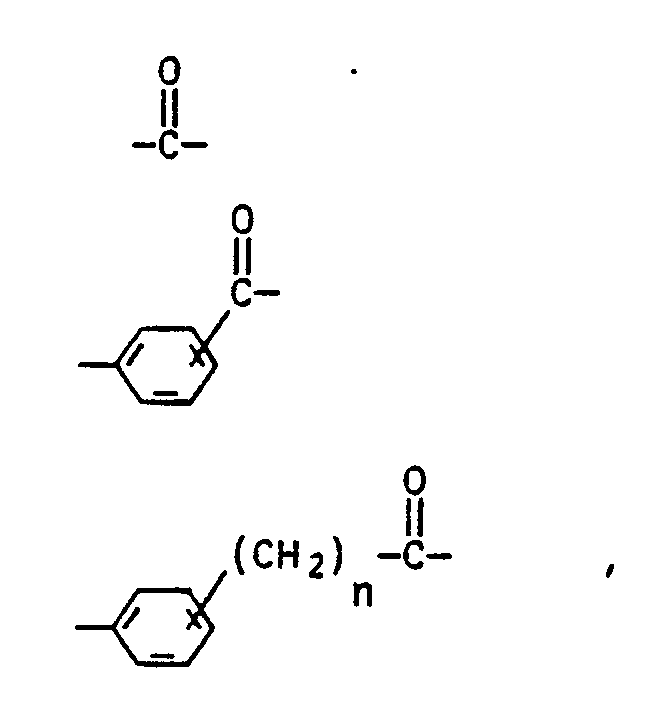
- Bevorzugte Substitueten Y sind ganz allgemein Vinyl-, Acryloyl-, Methacryloyl- oder Reste mit Styrol-Grundstrukturen.
- Besonders bevorzugt sind Lactameinheiten, die zu Polyamiden polymerisierbar oder copolymerisierbar sind, wie diese in Houben-Weyl, Methoden der organ. Chemie, Band X/2, S. 511 bis 587, (1958) und Band XIV/2, S. 111 bis 131, beschrieben werden.
- Beispielsweise seien genannt:
ß-Propiolactame (Azetidin-2-one), wie
- Nur beispielhaft sei als ein Vertreter dieser Gruppe 3,3′-Dimethyl-3-propiolactam genannt.
- Ebenfalls bevorzugte Lactam-Einheiten sind 2-Methylpyrrolidone


- Es können auch Mischungen dieser Verbindungen eingesetzt werden.
- Vorzugsweise werden die Lactameinheiten über eine Carbonylgruppe am Stickstoff in den Polyphenylenether A eingebaut, wie dies nachstehend allgemein dargestellt ist.

- Als besonders bevorzugtes Beispiel einer Lactamgruppe enthaltenden Komponente sei hier nur N-(Meth)acryloyl-ε-caprolactam

wobei R¹⁴ ein Wasserstoffatom oder eine Methylgruppe sein kann. - Als epoxidgruppenhaltiges Monomers a₃₂) ist prinzipiell jede Verbindung mit einer polymerisierbaren Doppelbindung oder Dreifachbindung geeignet, die eine Epoxidgruppe im Molekül aufweist. Vorzugsweise werden jedoch Monomere verwendet, die Glycidylgruppen tragen, insbesondere Glycidylacrylat und Glycidylmethacrylat. Es eignen sich jedoch auch Glycidylderivate anderer Säuren und Glycidylallyl- und Vinylether. Diese sind allgemein durch die Struktureinheit

- Die Oxazolin-Gruppen enthaltenden Monomeren a₃₂) haben üblicherweise die allgemeine Formel V

CH₂=CR¹⁵- ′
CH₂=CR¹⁵-- ′


- Als Hydroxylgruppen enthaltene Monomere a₃₂) werden im allgemeinen Verbindungen mit einer polymerisierbaren Doppel- oder Dreifachbindung eingesetzt. Vorteilhaft sind Verbindungen der allgemeinen Formel VII
CH₂ = CR¹⁶ - K - OH VII,
wobei R¹⁶ = H oder C₁- bis C₈-Alkyl und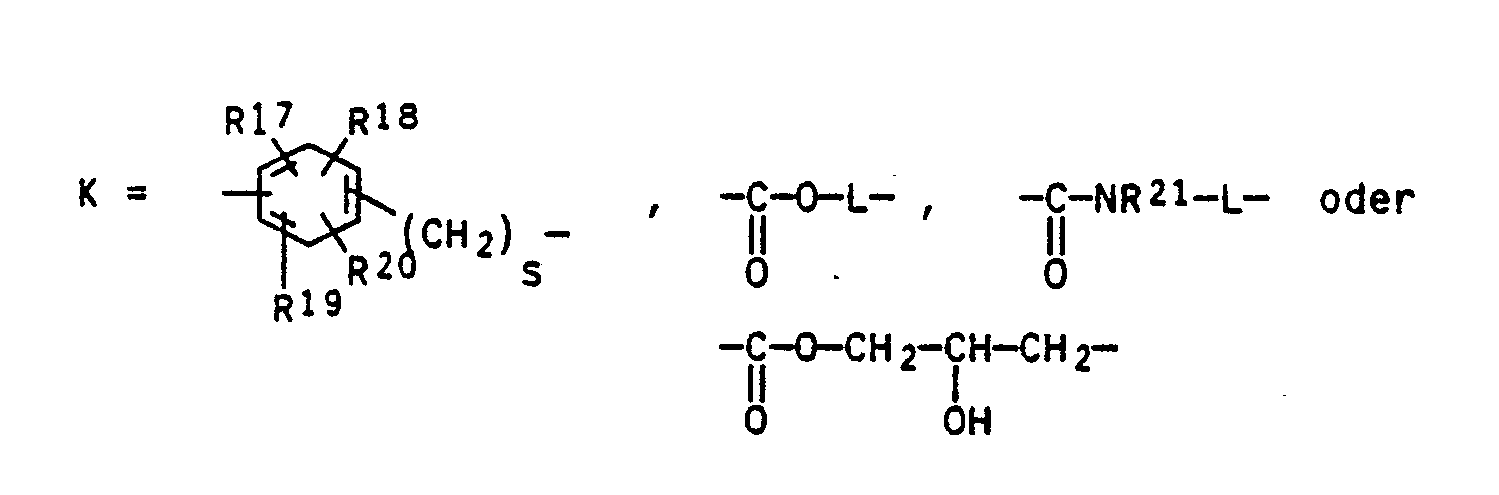
oder
L = -(CH₂)j-O-[-(CH₂)₅-]k-,
wobei j = 2 bis 10 und k = 1 bis 10 ist,
oder
L = -(CH₂-CH₂-O-)h-CH₂-CH₂-,
- Besonders bevorzugt sind ω-Hydroxyalkylacrylate oder -methacrylate mit einem C₁-C₈-Alkylenrest.
- Der Anteil der Komponente a₃) beträgt 0,05 bis 10, vorzugsweise 0,1 bis 5 und insbesondere 0,3 bis 3 Gew.%, bezogen auf die Summe der Komponenten a₁) bis a₅).
- Als Komponente a₄) können bei der Herstellung der modifizierten Polyphenylenether A) bis zu 5 Gew.% an Radikalstartern eingesetzt werden.
- Der Anteil der Komponente a₄) ist in der Regel geringer als die Summe der Anteile der Komponenten a₃) und a₅).
- Es werden 0 bis 5, vorzugsweise 0,02 - 0,09 Gew.-% an Radikalstartern eingesetzt.
- Prinzipiell können als Radikalstarter die für diesen Zweck bekannten und in der Literatur (z.B. J.K. Kochi, Free Radicals, J. Wiley-Verlag. New York 1973) beschriebenen Verbindungen eingesetzt werden.
- In einigen Fällen hat es sich als vorteilhaft herausgestellt, Radikalstarter einzusetzen, deren Halbwertzeit ausreichend groß ist, um sicherzustellen, daß zu dem Zeitpunkt, zu dem der Polyphenylenether aufgeschmolzen ist, eine signifikante Menge an aktivem Radikalstarter vorhanden ist.
- Dies hat zur Folge, daß die Komponenten a₃₁) bis a₃₂) in einer relativ eindeutigen Reaktion mit dem durch den Radikalstarter aktivierten Polyphenylenether reagieren und diesen modifizieren können.
- Es ist noch nicht eindeutig geklärt, an welcher Stelle des Polyphenylenether-Moleküls der Radikalstarter angreift, doch deuten erste Erkenntnisse darauf hin, daß die Aktivierung des Poly(2,6-Dimethyl-1,4-phenylen)ethers an den Methylsubstituenten in o-Stellung zum Sauerstoffatom stattfindet und die Komponenten b₃₁) bis b₃₂) dementsprechend auch überwiegend in dieser Position angreifen.
- Beispielsweise seien als Radikalstarter genannt:
Di-(2,4-dichlorbenzoyl)peroxid, tert.-Butylperoxid, Di-(3,5,5-trimethylhexanol)peroxid, Dilauroylperoxid, Didecanoylperoxid, Dipropionylperoxid, Dibenzoylperoxid, tert.-Butylperoxy-2-ethylhexoat, tert.-Butylperoxydiethylacetat, tert.-Butylperoxyisobutyrat, 1,1-Di-tert.-butylperoxy-3,3,5-trimethylcyclohexan, tert.-Butylperoxyisopropylcarbonat, tert.-Butylperoxy-3,3,5-trimethylhexoat, tert.-Butylperacetat, tert.-Butylperbenzoat, 4,4-Di-tert.-butylperoxyvalerisansäure-butylester, 2,2-Ditert.-butylperoxybutan, Dicumylperoxid, tert.-Butylcumylperoxid, 1,3-Di(tert.-butylperoxyisopropyl)benzol und Di-tert.-butylperoxid. Bevorzugt werden organische Hydroperoxide wie Di-isopropylbenzolmonohydroperoxid, Cumolhydroperoxid, tert.-Butylhydroperoxid, p-Menthylhydroperoxid und Pinanhydroperoxid sowie insbesondere hochverzweigte Alkane der allgemeinen Struktur
- Als Beispiel hierfür seien

- Gegebenenfalls können bei der Herstellung des modifizierten Polyphenylenethers A) auch weitere Comonomere a₅) eingesetzt werden, die unter den Herstellungsbedingungen mit den Komponenten a₁) und gegebenenfalls a₂) reagieren bzw. auf diese aufpfropfen. Beispielsweise seien hier Acrylsäure, Methacrylsäure, Acrylate, Methacrylate und vinylaromatische Monomere wie Styrol, α-Methylstyrol und Vinyltoluol genannt, um nur einige aufzuführen.
- Der Anteil der Komponente a₅) beträgt 0 bis 80, vorzugsweise 0 bis 20 Gew.%, bezogen auf die Summe der Komponenten a₁) bis a₅). Besonders bevorzugt werden Formmassen, die keine Komponente a₅) enthalten.
- Zur Herstellung des modifizierten Polyphenylenethers A können die Komponenten a₁) bis a₅) bei 250 bis 350°C, vorzugsweise 270 bis 350°C, miteinander umgesetzt werden. Hierzu eignen sich besonders Extruder, da in diesen im allgemeinen eine gute Durchmischung der Komponenten erzielt wird. Die mittleren Verweilzeiten liegen im allgemeinen im Bereich von 0,25 bis 3, bevorzugt zwischen 0,3 und 1 Minute.
- Als Komponente B enthalten die Formmassen 5 bis 95, bevorzugt 5 bis 80, insbesondere 25 bis 65 Gew.%, bezogen auf das Gesamtgewicht von A) bis F) mindestens eines Polyamids. Geeignet sind lineare Polyamide z.B. mit einer relativen Viskosität von 2,2 bis 4,5, gemessen in 1 gew.-%iger Lösung in 96 gew.-%iger Schwefelsäure bei 23°C. Bevorzugt seien genannt Polyamide, die sich von Lactamen mit 7 bis 13 Ringgliedern ableiten, wie Polycaprolactam, Polycapryllactam oder Polyaurinlactam sowie Polyamide, die durch Umsatz von Dicarbonsäuren mit Diaminen erhalten werden. Beispiele hierfür sind Polyamid-6,6, Polyamid-6,12 und das in der EP-A 39 524 beschriebene Polyamid-4,6.
- Geeignete Dicarbonsäuren sind beispielsweise Alkandicarbonsäuren mit 5 bis 12, insbesondere 6 bis 10 Kohlenstoffatomen sowie Terephthalsäure und Isophthalsäure sowie beliebige Mischungen dieser Säuren.
- Als Diamine seien beispielsweise Alkandiamine mit 4 bis 12, insbesondere 4 bis 8 Kohlenstoffatomen, ferner m-Xylylendiamin, Bis(4-aminophenyl)methan, Bis(4-aminocyclohexyl)methan oder Bis(4-aminophenyl)propan-2,2 oder deren Mischungen genannt.
- Es ist auch möglich und manchmal vorteilhaft, Mischungen der genannten Polyamide zu verwenden. Besondere technische Bedeutung haben Polyamid-6 (Polycaprolactam), Polyamid-66 (Polyhexamethylenadipinamid) sowie Polyamide, die aus Hexamethylendiamin und Isophthalsäure sowie Terephthalsäure aufgebaut sind, erlangt.
- Weiterhin seien genannt teilaromatische Copolyamide auf der Basis von Caprolactam, Adipinsäure, Hexamethylendiamin, Terephthalsäure und/oder Isophthalsäure. Von diesen seien Copolyamide mit wiederkehrenden Einheiten, die sich von Caprolactam und/oder Adipinsäure/Hexamethylendiamin einerseits sowie Terephthalsäure und Hexamethylendiamin andererseits ableiten, genannt.
- Manchmal ist es vorteilhaft, als Komponente C) einen nichtmodifizierten Polyphenylenether zuzugeben. Dieser entspricht bevorzugt dem als Komponente a₁) einsetzbaren Polyphenylenether, weshalb hier auf die dortigen Ausführungen zu geeigneten Verbindungen verwiesen wird. Der Anteil der Komponente C) beträgt, falls vorhanden, maximal 90, vorzugsweise weniger als 40, insbesondere bis zu 5 Gew.%, bezogen auf die Summe der Komponenten A) bis F).
- Als weiterer Bestandteil D) können die erfindungsgemäßen Formmassen gegebenenfalls in einer Menge bis zu 45, vorzugsweise bis zu 30, insbesondere bis zu 5 Gew.%, vinylaromatische Polymere (bezogen auf die Summe der Komponenten A) bis F)) enthalten. Geeignet sind bevorzugt mit Polyphenylenethern verträgliche Polymere, wie sie bereits als Komponente a₂) beschrieben wurden. Für nähere Einzelheiten sei deshalb auf die Ausführungen zur Komponente a₂) verwiesen.
- Die Komponente D) kann auch schlagzäh modifiziert sein. Solche Polymere sind dem Fachmann als schlagzähes Polystyrol (HIPS) bekannt. Dabei werden die vinylaromatischen Polymeren in Gegenwart eines Schlagzähmodifiers hergestellt oder die vinylaromatischen Polymeren mit gepfropften Kautschuken abgemischt. Als kautschukartige Polymere seien beispielsweise Polybutadien-, Styrolbutadien-, Styrol-b-butadien, Acrylnitrilbutadien, Ethylenpropylen-, Polyacrylat- und Polyisopren-Kautschuk genannt.
- Neben den in der Komponente D) gegebenenfalls vorhandenen, gepfropften Kautschuken, wie Polybutadien-, Acrylat-, Styrol/Butadien-, Polybuten-Kautschuk, hydrierten Styrol/Butadien-, Acrylnitril/Butadien-, Ethylen/Propylen- und Polyisopren-Kautschuken können diese auch ungepfropft als Komponente E) zugesetzt werden. Als schlagzäh modifizierende Kautschuke E) seien weiter erwähnt styrolgepfropfte Ethylen/Propylen-Kautschuke, thermoplastische Ethylen-Propylen-Kautschuke, thermoplastische Polyester-Elastomere, Ethylenkautschuke und Ionomere, besonders bevorzugt Styrol-Butadien-Blockcopolymere einschließlich AB-, ABA-, ABA-verschmiert (taper)-, ABAB-, ABAB-verschmierte Stern-Block-Copolymere und ähnliche, analoge Isopren-Blockpolymerisate und (teil)hydrierte Blockcopolymere.
- Daneben kommen als Komponente E) bekannte schlagzähigkeitsverbessernde Elastomere (Kautschuke) für Polyamide in Frage.
- Nur beispielsweise seien Kautschuke auf Ethylen-, Propylen-, Butadien- oder Acrylatbasis oder Mischungen dieser Monomeren genannt.
- Derartige Polymere werden z.B. in Houben-Weyl, Methoden der organischen Chemie, Bd. 14/1 (Georg-Thieme-Verlag, Stuttgart, 1961), Seiten 392 bis 406 und in der Monographie von C.B. Bucknall, "Toughened Plastics" (Applied Science Publishers, London, 1977) beschrieben.
- Im folgenden werden einige bevorzugte Arten solcher Elastomerer vorgestellt.
- Als erste Gruppe sind die sogenannten Ethylen-Propylen (EPM) bzw. Ethylen-Propylen-Dien-(EPDM)-kautschuke zu nennen, die vorzugsweise ein Verhältnis von Ethylenresten zu Propylenresten im Bereich von 40:60 bis 65:35 aufweisen.
- EPM-Kautschuke haben im allgemeinen praktisch keine Doppelbindungen mehr, während EPDM-Kautschuke 1 bis 20 Doppelbindungen/100 C-Atome aufweisen können.
- Als Dien-Monomere für EPDM-Kautschuke seien beispielsweise konjugierte Diene wie Isopren und Butadien, nicht konjugierte Diene mit 5 bis 25 C-Atomen wie Hexa-1,4-dien, Hexa-1,5-dien, 2,5-Dimethyl-hexa-1,5-dien und Octa-1,4-dien, cyclische Diene wie Cyclopentadien, Cyclohexadiene, Cyclooctadiene und Dicyclopentadien sowie Alkenylnorbornene wie 5-Ethyliden-2-norbornen, 5-Butyliden-2-norbornen, 2-Methylallyl-5-norbornen, 2-Isopropenyl-5-norbornen und Tricyclodiene wie 3-Methyl-tricyclo(5.2.1.0.2.6)-3,8-decadien oder deren Mischungen genannt. Bevorzugt werden Hexa-1,5-dien, 5-Ethyliden-2-Norbornen und Dicyclopentadien. Der Diengehalt der EPDM-Kautschuke beträgt vorzugsweise 0,5 bis 10, insbesondere 1 bis 8 Gew.%, bezogen auf das Gesamtgewicht des Kautschuks.
- EPM- bzw. EPDM-Kautschuke können auch mit reaktiven Carbonsäuren oder deren Derivaten gepfropft sein. Hier seien nur stellvertretend Acrylsäure, Methacrylsäure und deren Derivate sowie Maleinsäureanhydrid genannt.
- Eine weitere Gruppe von Kautschuken sind Copolymere des Ethylens mit Acrylsäure- und/oder Methacrylsäureestern, insbesondere solche die zusätzlich noch Epoxid-Gruppen enthalten, wie Vinylglycidylether, Alkylglycidylether mit C₁- bis C₈-Alkylgruppen, Glycidylacrylat und Glycidylmethacrylat.
- Geeignet sind Copolymerisate aus
50 bis 98 Gew.% Ethylen, 1 bis 40 Gew.% Glycidylacrylat und/oder Glycidylmethacrylat oder Maleinsäureanhydrid, 1 bis 45 Gew.% n-Butylacrylat und/oder 2-Ethylhexylacrylat. - Weitere geeignete Ester der Acryl- und/oder Methacrylsäure sind die Methyl-, Ethyl-, Propyl- und i- bzw. t-Butylester. Auch Acrylsäure bzw. Methacrylsäure selbst können vorteilhaft eingesetzt werden.
- Daneben können auch Vinylester und Vinylether als Comonomere eingesetzt werden.
- Die Herstellung der vorstehend beschriebenen Ethylencopolymeren kann nach an sich bekannten Verfahren erfolgen, vorzugsweise durch statistische Copolymerisation unter hohem Druck und erhöhter Temperatur. Entsprechende Verfahren sind in der Literatur beschrieben.
- Der Schmelzindex der Ethylencopolymeren liegt im allgemeinen im Bereich von 1 bis 80 g/10 min (gemessen nach DIN 53 735 bei 190°C und 2,16 kg Belastung).
- Geeignete Elastomere E) sind weiterhin Pfropfcopolymerisate aus Butadien, Butadien/Styrol-, Butadien/Acrylnitril und Acrylestern, wie sie z.B. in den DE-A-16 94 174 und DE-A-23 48 377 beschrieben werden.
- Von diesen sind insbesondere die sogenannten ABS-Polymerisate zu nennen, wie sie in den DE-A-20 35 390, DE-A-22 48 242 und der EP-A-22 216 beschrieben werden, wobei letztere besonders bevorzugt sind.
- Als Kautschuk E) können auch Pfropfpolymerisate aus
25 bis 98 Gew.% eines Acrylatkautschuks mit einer Glasübergangstemperatur von unter -20°C als Pfropfgrundlage
und
2 bis 75 Gew.% eines copolymerisierbaren ethylenisch ungesättigten Monomeren, dessen Homo- bzw. Copolymerisate eine Glasübergangstemperatur von mehr als 25°C aufweisen, als Pfropfauflage
eingesetzt werden. - Die Pfropfgrundlage sind Acrylat bzw. Methacrylatkautschuke, wobei bis zu 40 Gew.% weiterer Comonomerer enthalten sein können. Die C₁-C₈-Ester der Acrylsäure bzw. Methacrylsäure sowie deren halogenierte Derivate wie auch aromatische Acrylsäureester und deren Mischungen werden bevorzugt. Als Comonomere in der Pfropfgrundlage seien Acrylnitril, Methacrylnitril, Styrol, α-Methylstyrol, Acrylamide, Methacrylamide sowie Vinyl-C₁-C₆-Alkylether angeführt.
- Die Pfropfgrundlage kann unvernetzt oder teilweise oder vollständig vernetzt sein. Die Vernetzung wird durch Copolymerisation von im allgemeinen 0,02 bis 5 Gew.%, insbesondere 0,05 bis 2 Gew.% eines vernetzenden Monomeren mit mehr als einer Doppelbindung erzielt. Geeignete vernetzende Monomere werden z.B. in der DE-A-27 26 256 und der EP-A-50 265 beschrieben.
- Bevorzugte vernetzende Monomere sind Triallylcyanurat, Triallylisocyanurat und Triacryloylhexahydro-s-triazin.
- Falls die vernetzenden Monomeren mehr als 2 polymerisierbare Doppelbindungen aufweisen, ist es vorteilhaft, ihre Menge auf nicht mehr als 1 Gew.%, bezogen auf die Pfropfgrundlage, zu beschränken.
- Gut geeignete Pfropfgrundlagen sind Emulsionspolymerisate mit einem Gelgehalt von mehr als 60 Gew.% (bestimmt in Dimethylformamid bei 25°C nach M. Hoffmann, H. Krömer, R. Kuhn, Polymeranalytik, Georg-Thieme-Verlag, Stuttgart, 1977).
- Ebenfalls geeignet als Pfropfgrundlage sind Acrylat-Kautschuke mit einem Dienkern, wie sie z.B. in der EP-A-50 262 beschrieben werden.
- Als Pfropfmonomere eignen sich besonders Styrol, α-Methylstyrol, Acrylnitril, Methacrylnitril und Methylmethacrylat oder deren Mischungen, insbesondere solche aus Styrol und Acrylnitril im Gewichtsverhältnis 90/10 bis 50/50.
- Es ist in einigen Fällen vorteilhaft, die Polymerisate selbst inhomogen aufzubauen, indem man beispielsweise Monomere, die eine Haftung mit der Komponente B) bewirken, erst gegen Ende der Polymerisation zusetzt. Dadurch wird bewirkt, daß zumindest die Oberfläche der Polymerisatteilchen Molekülgruppen aufweist, die eine Haftung an der Komponente B) bewirken.
- Geeignete Monomere sind beispielsweise solche, die im Molekül Carbonsäuregruppen, Carbonsäure liefernde Gruppen, Carbonsäureanhydrid-, Carbonsäureamid-, Epoxid- oder Urethangruppen aufweisen. Beispielhaft seien genannt (Meth-)acrylsäure, Fumarsäure, tert.-Butyl(meth-)acrylat, Maleinsäureanhydrid, (Meth-)acrylamid, Glycidyl(meth-)acrylat oder N-Vinyl-methylurethan.
- Die Pfropfausbeute, d.h. der Quotient aus der Menge des aufgepfropften Monomeren und der Menge des eingesetzten Pfropfmonomeren liegt im allgemeinen im Bereich von 20 bis 80 %.
- Kautschuke auf der Basis von Acrylaten, die erfindungsgemäß verwendet werden können, werden z.B. in der DE-A-24 44 584 und der DE-A-27 26 256 beschrieben.
- Es versteht sich, daß auch Mischungen der vorstehend aufgeführten Kautschuktypen eingesetzt werden können.
- Die Komponente E) kann in Mengen von 0 bis 40, bevorzugt 0 bis 30, insbesondere 5 bis 20 Gew.%, bezogen auf das Gesamtgewicht von A) bis F), in den erfindungsgemäßen Formmassen vorhanden sein.
- Neben den Komponenten A) bis E) können die erfindungsgemäßen thermoplastischen Formmassen auch übliche Zusatzstoffe und Verarbeitungshilfsmittel F) enthalten. Der Anteil dieser Zusätze beträgt im allgemeinen nicht mehr als 60, insbesondere nicht mehr als 40 Gew.%, bezogen auf das Gesamtgewicht der Komponenten A) bis F).
- Als Zusatzstoffe seien genannt, Hitze- und Lichtstabilisatoren, Gleit- und Entformungsmittel, Färbemittel, wie Farbstoffe und Pigmente in üblichen Mengen. Weitere Zusatzstoffe sind Verstärkungsmittel, wie Glasfasern, Asbestfasern, Kohlenstoffasern, aromatische Polyamidfasern und/oder Füllstoffe, Gipsfasern, synthetische Calciumsilikate, Kaolin, calciniertes Kaolin, Wollastonit, Talkum, Kreide, ferner Flammschutzmittel wie Phosphat, Phosphorsäureester, Phosphorigsäureester, Phosphinsäureester, Phosphonigsäureester oder organische Phosphinoxide, Halogenverbindungen, ggf. in Kombinationen mit Synergisten, wie Antimontrioxid.
- Es können auch Kombinationen solcher Zusatzstoffe eingesetzt werden.Auch andere niedermolekulare oder hochmolekulare Polymere kommen als Zusatzstoffe in Betracht.
- Die bisherigen Versuche ergaben, daß solche erfindungsgäßen Formmassen gute Ergebnisse liefern, in denen die Komponenten A) und ggf. C) eine in diskrete Teilchen dispergierte Phase bilden, deren mittlerer Teilchendurchmesser (Volumenmittelwert) zwischen 0,05 und 2,5 µm, bevorzugt zwischen 0,1 und 1,5 µm, insbesondere zwischen 0,5 und 1,0 µm beträgt. In solchen Formmassen enthält die kontinuierliche Phase (Matrix) das Polyamid B). Die übrigen Komponenten können sich in diesen bevorzugten Formmassen in der dispersen und/oder in der kontinuierlichen Phase befinden, oder auch zumindest teilweise eine eigene Phase bilden. Die genannten Teilchendurchmesser kann man auf üblichem Wege über die Auswertung von elektronenmikroskopischen Aufnahmen von Ultradünnschnitten von extrudiertem Granulat erhalten. Die Dünnschnitte werden in bekannter Weise senkrecht zur Extrusionsrichtung des Granulates hergestellt. Im allgemeinen werden mindestens 500 Teilchen ausgewertet.
- Die erfindungsgemäßen Formmassen sind erhältlich durch Vermischen der Komponenten bei Temperaturen zwischen 270 und 370, bevorzugt 300 bis 370°C bei einer mittleren Verweilzeit von 15 bis 90, bevorzugt 15 bis 50, insbesondere 15 bis 25 Sekunden, wobei die Komponente A) zu Beginn des Mischens eine Temperatur über 350°C und unter 370°C, bevorzugt von 352 bis 365°C aufweist. Die anderen Komponenten haben zu Beginn des Mischens im allgemeinen eine Temperatur von 250 bis 350, vorzugsweise von 260 bis 320°C.
- Geeignet zur Herstellung der Formmassen sind übliche Mischvorrichtungen, wie Einschneckenextruder oder vorzugsweise Zweischneckenextruder, die die obengenannten Arbeitsbedingungen erlauben. Um eine möglichst homogene Formmasse zu erhalten, ist eine intensive Durchmischung notwendig. Die Abmischreihenfolge der Komponenten kann variiert werden, so können zwei oder ggf. drei Komponenten vorgemischt werden, es können aber auch alle Komponenten gemeinsam gemischt werden. Die Mischungen werden in bekannter Weise weiterverarbeitet.
- Wie der Fachmann erkennt, ist es zur Einstellung der Temperatur und der Verweilzeit erforderlich, die Temperierung und die Fördergeschwindigkeit aufeinander abzustimmen, was in einfachen Vorversuchen leicht geschehen kann. Es hat sich darüber hinaus gezeigt, daß auch das beim Mischen angewandte Schergefälle, wie es z.B. in VDI, Messen an Extrusionsanlagen, VDI-Verlag GmbH, Düsseldorf, 1978, S. 2 beschrieben wird, eine Rolle spielen kann.
- Gute Ergebnisse werden erzielt, wenn in einem Extruder die Komponenten A) bis F) beim Mischen einem maximalen Schergefälle j zwischen 800 und 1500 sec⁻¹, bevorzugt 900 bis 1300 sec⁻¹ ausgesetzt werden. Das maximale Schergefälle im Sinne dieser Erfindung nach der Formel

- Zur Herstellung der erfindungsgemäßen Formmassen wird das im folgenden beschriebene Verfahren besonders bevorzugt, da es die thermische Belastung des Polphenylenethers vorteilhaft verringert.
- Es wird ein Zweischneckenextruder mit gleichlaufenden Schnecken eingesetzt. Die Förderschnecken können Schubkanten aufweisen, und es können Knetelemente und/oder Mischelemente vorhanden sein. Darüber hinaus ist es möglich und häufig vorteilhaft, teilweise, d.h. abschnittsweise stauende oder rückfördernde Elemente im Extruder zu verwenden, um Verweilzeit und Mischungseigenschaften zu beeinflussen.
- Der Extruder ist in mindestens zwei, vorzugsweise drei und ggf. auch in mehr Zonen unterteilt.
- Der modifizierte Polyphenylenether wird bei diesem besonders bevorzugten Verfahren in der ersten Zone des Extruders durch Umsetzen der Komponenten a₁) bis a₅) unter den oben angegebenen Bedingungen hergestellt und anschließend zur Herstellung der erfindungsgemäßen Formmasse im folgenden Teil des Extruders eingesetzt. Die erste Zone des Extruders weist im allgemeinen eine Länge von 3,5 bis 30, bevorzugt 10 bis 25 D (D = Durchmesser der Schnecke) auf.
- In der Nähe der Dosieröffnung in der ersten Zone sind an der Schnecke bevorzugt Förderelemente angebracht, im weiteren Verlauf können sich auch Knetelemente befinden. Am Ende der ersten Zone ist besonders bevorzugt mindestens ein rückförderndes Element vorhanden, mit dem die Verweilzeit in der ersten Zone beeinflußt werden kann.
- Zum modifizierten Polyphenylenether A) werden zu Beginn der zweiten Zone die Komponenten B) bis F) gemeinsam zugegeben. Bevorzugt erfolgt die Dosierung mit einem Seitenextruder mit temperierbarem Mantel, in dem die Komponenten B) bis F) eindosiert, aufgeschmolzen und dem Anfang der zweiten Zone des Extruders zugeführt werden.
- Im allgemeinen ist der Schneckendurchmesser des Seitenextruders geringer als der des Hauptextruders und die Schneckenlänge liegt im Bereich von 5 bis 40 D, vorzugsweise zwischen 10 bis 20 D. Die Temperatur der Komponenten, die aus dem Seitenextruder dem modifizierten Polyphenylenether A) zugeführt werden, liegt im Bereich von 250 bis 350°C, vorzugsweise von 260 bis 320°C. Die Schnecke des Seitenextruders kann so gestaltet sein, daß die Komponenten vor der Dosierung in den Hauptextruder bereits vorgemischt sind.
- Die zweite Zone des Hauptextruders, in der dann der modifizierte Polyphenylenether A) mit den aus dem Beginn der zweiten Zone zudosierten Komponenten abgemischt wird, hat im allgemeinen eine Länge von 5 bis 40 D, vorzugsweise von 10 bis 20 D. Die Temperatur des modifizierten Polyphenylenethers liegt bei Beginn des Mischens mit den anderen Komponenten, d.h. dort, wo die Komponenten aus dem Seitenextruder zugeführt werden, über 350°C und unter 370°C, bevorzugt zwischen 352 und 365°C. Die mittleren Verweilzeiten in dieser Zone betragen 15 bis 90, bevorzugt 15 bis 50, insbesondere 15 bis 25 Sekunden.
- In manchen Fällen kann es vorteilhaft sein, den in der ersten Extruderzone modifizierten Polyphenylenether vor dem Zusammenmischen mit den Komponenten B) bis F), das in der zweiten Extruderzone stattfindet, in einer weiteren Extruderzone zu entgasen, d.h. von flüchtigen Anteilen zu befreien. Diese weiteren Extruderzone befindet sich, wenn vorhanden, zwischen der ersten und der zweiten Zone. Geeignete apparative Ausführungsformen solcher Entgasungszonen sind bekannt. Gute Ergebnisse werden erzielt, wenn man das Entgasen durch Anlegen von Vakuum unterstützt. Diese weitere Extruderzone kann unabhängig von einer Entgasung auch dazu benutzt werden, um den modifizierten Polyphenylenether auf die beim Beginn des Mischens mit den Komponenten B) und ggf. C) bis F) nötige Temperatur zu bringen. Dieses wird insbesondere dann bevorzugt, wenn man den Polyphenylenether bei tieferen Temperaturen modifiziert. Die Länge dieser Zone ist in weiteren Bereichen frei wählbar, Längen zwischen 3 und 10 D haben sich bewährt.
- Nach der Zugabe aller Komponenten und deren Abmischung in den verschiedenen erwähnten Zonen des Hauptextruders kann vorteilhaft in einer weiteren Zone eine Entgasung durchgeführt werden. Geeignete apparative Ausführungsformen solcher Entgasungszonen sind an sich bekannt. Die Länge dieser Zone beträgt vorzugsweise von 3 bis 10 D, die Temperatur liegt im Bereich von 250 bis 300°C. Bevorzugt wird die Entgasung durch Anlegen eines Vakuums unterstützt.
- Nach der Entgasung wird die nach diesen besonders bevorzugte Verfahren hergestellte Mischung aus dem Extruder ausgetragen und anschließend in an sich bekannter Weise weiterverarbeitet.
- Die erfindungsgemäßen Formmassen zeichnen sich durch eine besondere helle Eigenfarbe, hohe Oxidationsbeständigkeit und eine hohe Schlagzähigkeit aus. Beispielsweise weisen erfindungsgemäße Formmassen aus 30 bis 45 Gew.% A), 42 bis 50 Gew.% B), 0 bis 5 Gew.% C), 0 bis 5 Gew.% D) und 10 bis 15 Gew.% E), wobei die Gew.% hier jeweils auf das Gesamtgewicht von A) bis E) bezogen sind, eine Kerbschlagzähigkeit bei -40°C, gemessen nach DIN 53 453 an bei 280°C gespritzten Normkleinstäben, von über 12 kJ/m² auf.
- Die erfindungsgemäßen Formmassen eignen sich besonders zur Herstellung von Formkörpern durch Spritzguß oder Extrusion.
- Die Formmassen der Beispiele und Vergleichsversuche wurden in einem Zweischneckenextruder (Firma Werner & Pfleiderer) hergestellt. Der Schneckendurchmesser betrug 80 mm. Die Längen der einzelnen Zonen sind in Vielfachen des Schneckendurchmessers (D) angegeben.
- Die erste Zone des Extruders war 14 D lang und hatte am Anfang eine Einspeiseöffnung für feste Substanzen a₁) bis a₅). Diese Substanzen wurden über Dosierwaren zugeführt. Unter der Einspeiseöffnung waren die Schneckenelemente förderwirksam ausgestaltet, dieser Zonenteil (5D) wurde gekühlt auf 20°C. Der Extrudermantel des nächsten Zonenteils (5D) wurde auf 280°C erhitzt. Der Rest der ersten Zone (4D) hatte eine Manteltemperatur von 280°C. Im mittleren Teil der ersten Zone befanden sich Knetelemente auf der Schnecke. Am Ende der Schnecke war ein zurückförderndes Element eingebaut. In allen Beispielen und Vergleichsversuchen wurde der Polyphenylenether innerhalb von im Mittel 30 Sekunden modifiziert.
- Es schließt sich eine weitere Zone des Extruders von 4 D Länge an, die zur Temperaturanpassung des modifizierten Polyphenylenethers dient.
- Die zweite Zone des Extruders war 16 D lang und hatte am Anfang seitlich eine Einspeiseöffnung. Der Rest der zweiten Zone war außer zur Entgasungszone hin geschlossen. Die Komponenten B), C), D) und E) wurden durch die seitliche Einspeiseöffnung in die zweite Zone mit einem Seitenextruder gefördert. Der Extrudermantel der zweiten Zone wurde auf 285°C erhitzt. Die Schnecke trug Knetelemente.
- Der Seitenextruder war ein Zweischneckenextruder mit einem Schneckendurchmesser von 64 mm und 134 D Länge. Die Temperatur der Extrudermäntel des Seitenextruders betrugen 280°C. Am Anfang des Seitenextruders wurden die Substanzen durch Dosierwaagen zugeführt und am Ende des Seitenextruders in die seitliche Einspeiseöffnung der zweiten Zone zugeführt.
- Die Entgasungszone des Extruders war 8 D lang und hatte am Anfang eine Entgasungsöffnung, an die ein Vakuum von 100 Torr angelegt wurde. Im zweiten Teil der Entgasungszone wurde ein Druck aufgebaut, um das Produkt über eine Lochdüse auszutragen. Das Produkt wurde durch ein Wasserbad gezogen und anschließend granuliert und getrocknet.
- Im einzelnen wurden folgende Komponenten eingesetzt:
a₁: Poly-(2,6-dimethyl-1,4-phenylen)ether mit einer relativen Viskosität von 0,63, gemessen in 1 gew.%iger CHCl₃-Lösung bei 25°C.
a₂: Polystyrol PS 144 C, Fa. BASF, MFI 200/5,0 = 24 g/10 min.
a₃/1: Fumarsäure
a₃/2: Maleinsäure
a₄/: 2,3-Diphenyl-2,3-dimethylbutan (Initiator D 407 der Fa. Akzo Chemie)
B/1: Polyamid-6,6 mit einer relativen Viskosität von 3,0, gemessen bei 23°C in 1-gew.%iger Lösung in 96 %iger H₂SO₄.
B/2: Polyamid-6 mit einer relativen Viskosität von 2,2, gemessen bei 23°C in 1 gew.-%iger Lösung in 96 %iger H₂SO₄.
B/3: Teilaromatisches Copolyamid, hergestellt nach folgender Vorschrift: - Eine wäßrige Lösung, bestehend aus 35 kg ε-Caprolactam, 55 kg Terephthalsäure, 38,5 kg Hexamethylendiamin und 128,5 kg Wasser wurde aus einem beheizten Vorratsbehälter bei ca. 80°C mit einer Geschwindigkeit entsprechend einer Polyamidmenge von 5 kg/Stunde mittels einer Dosierpumpe in einen teilweise horizontal, teilweise vertikal angeordneten Röhrenverdampfer befördert. Der Verdampfer war mit einem flüssigen Wärmeträger, der eine Temperatur von 295°C hatte, bei kräftiger Umwälzung beheizt. Der Verdampfer hatte eine Länge von 3 m und einen Inhalt von 180 ml und eine wärmeübertragende Oberfläche von etwa 1300 cm². Die Verweilzeit im Verdampfer betrug 50 sec. Das aus dem Verdampfer austretende Gemisch aus Präpolymeren und Wasserdampf hatte eine Temperatur von 290°C und wurde in einem Abscheider in Wasserdampf und Schmelze getrennt. Die Schmelze verweilte im Abscheider noch 10 Minuten und wurde dann mittels einer Austragsschnecke mit Ausdampfzone in Form von Strängen ausgetragen, in einem Wasserbad verfestigt und anschließend granuliert. Der Abscheider und die Verdampferzone wurden mittels einer Druckhalteeinrichtung, die nach der Kolonne angeordnet war, unter einem Druck von 5 bar gehalten. Der im Abscheider abgetrennte Wasserdampf wurde in eine Füllkörperkolonne mit ca. 10 theoretischen Böden geführt, in die am Kopf ca. 1 l Brüdenkondensat pro Stunde zur Erzeugung von Rücklauf aufgegeben wurden. Am Kolonnenkopf stellte sich eine Temperatur von 152°C ein. Der nach dem Entspannungsventil austretende Wasserdampf wurde kondensiert und hatte einen Gehalt an Hexamethylendiamin von weniger als 0,05 Gew.% und einen Gehalt an ε-Caprolactam von weniger als 0,1 Gew.%. Als Kolonnensumpf erhielt man eine wäßrige Lösung von Hexamethylendiamin, die 80 Gew.% Hexamethylendiamin und 1 bis 3 % ε-Caprolactam, jeweils bezogten auf erzeugtes Polyamid enthielt. Diese Lösung wurde über eine Pumpe wieder vor dem Eintritt in den Verdampfer der Ausgangssalzlösung zugegeben.
- Nach Austritt der Polymerschmelze aus dem Abscheider hatte das Polyamid eine sehr helle Eigenfarbe und einen äußerst niedrigen Gehalt an Bis-hexamethylentriamin von 0,17 % sowie eine relative Viskosität von 1,65 bis 1,80, gemessen in 96 gew.%iger Schwefelsäure bei 20°C.
- Das Produkt wies in etwa eine Äquivalenz von Carboxyl- und Aminoendgruppen auf.
- Im Austragsextruder wurde die Schmelze dann auf Normaldruck entspannt und bei einer Verweilzeit von weniger als 1 Minute praktisch nicht mehr weiter kondensiert. Das erhaltene Granulat wurde durch kontinuierliche Festphasenkondensation mit überhitztem Wasserdampf bei 195°C und einer Verweilzeit von 30 Stunden auf eine Endviskosität von η-rel = 2,50 kondensiert.
C: Entspricht Komponente a₁
D: Entspricht Komponente a₂
E/1: Styrol-Butadien-Styrol-Blockcopolymerisat, hergestellt durch anionische Polymerisation (32 Gew.% Styrol, 68 Gew.% Butadien) mit Mw = 95 000
E/2: Styrol-Butadien(hydriert)-styrol-blockkautschuk, hergestellt durch anionische Polymerisation mit anschließender Hydrierung des Polybutadienblockes mit 35 Gew.% Styrol, 65 Gew.% Butadien (hydriert) mit Mw = 65 000.
E/3: Ethylenpolymeres aus 70 Gew.% Ethylen, 29 Gew.% n-Butylacrylat und 1 Gew.% Maleinsäureanhydrid mit einem MFI von 20 g/10 min. - In Tabelle 1 sind die Einsatzmengen der Komponenten und die Herstellbedingungen der Formmassen angegeben.
Tabelle 1 (Mengenangaben in Gew.-Teilen) Vergleichsversuch I Vergleichsversuch II Beispiel 1 Beispiel 2 Beispiel 3 Erste Zone a₁ 30 40 34 30 40 a₂ 4 2 2,5 4 2 a₃ 0,6 (a₃/2) 0,6 (a₃/1) 0,4 (a₃/1) 0,6 (a₃/2) 0,6 (a₃/1) a₄ 0,027 0,013 0,015 0,027 0,013 zweite Zone B 45,5 B₂ 46 B₃ 44 B₁ 45,5 B₂ 46 B₃ C 4 3,5 4 D 4,5 2,0 4,5 E 12 E₂ 10 E₁ 14 E₁ 12 E₂ 10 E₁ 2 E₂ 2 E₂ Drehzahl des Hauptextruders [Upm] 380 185 250 270 290 Drehzahl des Seitenextruders [Upm] 300 300 300 300 300 mittlere Verweilzeit beim Mischen [s] 20 20 20 Temperatur von A) bei Beginn des Mischens*) 385 337 352 358 363 *) gemessen an der Stelle der zweiten Zone des Hauptextruders, an der die Einspeiseöffnung für den Seitenextruder liegt. - Die Ergebnisse der Messungen der Kerbschlagzähigkeit nach DIN 53 453 sind in Tabelle 2 aufgeführt. Die entsprechenden Prüfkörper (Normkleinstäbe) wurden bei 280°C im Spritzguß hergestellt.
Tabelle 2 Kerbschlagzähigkeit Raumtemperatur [kJ/m2] -40°C Beispiel 1 36 17 2 45 15 3 32 14 Vergleichsversuch I 11 5 II 17 10
Claims (10)
A) 5 - 95 Gew.-% eines modifizierten Polyphenylenethers,
B) 5 - 95 Gew.-% eines Polyamids sowie darüber hinaus
C) 0 - 95 Gew.-% eines nicht-modifizierten Polyphenylenethers,
D) 0 - 45 Gew.-% eines vinylaromatischen Polymeren,
E) 0 - 40 Gew.-% eines schlagzäh modifizierenden Kautschuks und
F) 0 - 60 Gew.-% Zusatzstoffe und Verarbeitungshilfsmittel,
herstellbar durch Vermischen der Komponenten A) bis F) bei Temperaturen zwischen 270 und 370°C während 15 bis 90 Sekunden, wobei die Komponente A) zu Beginn des Mischens eine Temperatur über 350 und unter 370°C aufweist.
30 - 45 Gew.-% A),
25 - 65 Gew.-% B),
0 - 40 Gew.-% C),
0 - 30 Gew.-% D),
5 - 20 Gew.-% E) und
0 - 40 Gew.-% F.
a₁) 50 - 99,95 Gew.-% eines Polyphenylenethers
a₂) 0 - 45 Gew.-% eines vinylaromatischen Polymeren,
a₃) 0,05 - 10 Gew.-% einer α,ß-ungesättigten Dicarbonsäure oder deren Derivaten der allgemeinen Formel I

R¹ und R⁴ Hydroxylgruppen, Aryloxy-, Alkoxy-, Aralkoxy- oder Cycloalkoxygruppen mit bis zu 12 C-Atomen oder gemeinsam -O-oder -NR⁵-,
R² und R³ Wasserstoff, eine Alkyl- oder Cycloalkylgruppe mit bis zu 12 C-Atomen, eine Arylgruppe, Chlor oder gemeinsam eine Alkylengruppe mit 4 bis 12 C-Atomen,
R⁵ Wasserstoff, eine Alkyl-, Cycloalkyl-, Aralkyl- oder Arylgruppe mit bis zu 12 C-Atomen, die ihrerseits durch C₁-C₄-Alkyl- oder -Alkoxygruppen substituiert sein kann, darstellen,
a₄) 0 bis 5 Gew.-% eines Radikalstarters
und
a₅) 0 bis 80 Gew.-% weiterer pfropfaktiver Monomerer,
wobei die Angaben der Komponenten a₁) bis a₅) in Gew.-% sich jeweils auf das Gesamtgewicht der Komponenten a₁) bis a₅) beziehen.
a₁) 50 - 99,95 Gew.-% eines Polyphenylenethers
a₂) 0 - 45 Gew.-% eines vinylaromatischen Polymeren,
a₃) 0,05 - 10 Gew.-% eines mindestens eine Amidgruppe, Lactamgruppe, Epoxidgruppe, Hydroxylgruppe oder Oxazolingruppe enthaltenden Monomeren und
a₄) 0,02 - 0,09 Gew.-% eines Radikalstarters,
wobei die Angaben der Komponenten a₁) bis a₄) in Gew.-% sich jeweils auf das Gesamtgewicht der Komponenten a₁) bis a₄) beziehen.

I) in einer ersten Zone bei Temperaturen von 240 bis 350°C durch Umsetzen von
a₁) 50 - 99,95 Gew.-% eines Polyphenylenethers
a₂) 0 - 45 Gew.-% eines vinylaromatischen Polymeren,
a₃) 0,05 - 10 Gew.-% mindestens einer Verbindung aus der Gruppe
a₃₁)einer α,ß-ungesättigten Dicarbonsäure oder deren Derivaten der allgemeinen Formel I

R¹ und R⁴ Hydroxylgruppen, Aryloxy-, Alkoxy-, Aralkoxy- oder Cycloalkoxygruppen mit bis zu 12 C-Atomen oder gemeinsam -O-oder -NR⁵-,
R² und R³ Wasserstoff, eine Alkyl- oder Cycloalkylgruppe mit bis zu 12 C-Atomen, eine Arylgruppe, Chlor oder gemeinsam eine Alkylengruppe mit 4 bis 12 C-Atomen,
R⁵ Wasserstoff, eine Alkyl-, Cycloalkyl-, Aralkyl- oder Arylgruppe mit bis zu 12 C-Atomen, die ihrerseits durch C₁-C₄-Alkyl- oder -Alkoxygruppen substituiert sein kann, darstellen, und
a₃₂)eines mindestens eine Amidgruppe, Lactamgruppe, Epoxidgruppe, Hydroxylgruppe oder Oxazolingruppe enthaltenden Monomeren sowie darüber hinaus
a₄) 0 bis 5 Gew.-% eines Radikalstarters und
a₅) 0 bis 80 Gew.-% weiterer pfropfaktiver Monomerer, wobei die Angaben der Komponenten a₁) bis a₅) in Gew.-% sich jeweils auf das Gesamtgewicht der Komponenten a₁) bis a₅) beziehen,
über einen Zeitraum von 0,25 bis 3 min einen modifizierten Polyphenylenether (A) herstellt und
II) anschließend 5 bis 95 Gew.% dieses modifizierten Polyphenylenethers A) in einer zweiten Zone des Extruders bei 270 bis 370°C während 15 bis 90 Sekunden mit
B) 5 bis 95 Gew.-% eines Polyamids,
C) 0 bis 90 Gew.-% eines nicht-modifizierten Polyphenylenethers
D) 0 bis 45 Gew.-% eines vinylaromatischen Polymeren,
E) 0 bis 40 Gew.-% eines schlagzäh modifizierenden Kautschuks und
F) 0 bis 60 Gew.-% Zusatzstoffen und Verarbeitungshilfsmitteln, wobei sich die Angaben der Komponenten A) bis F) in Gew.-% auf das Gesamtgewicht der Komponenten A) bis F) beziehen,
so vermischt, daß die Komponente A) zu Beginn des Mischens eine Temperatur über 350 und unter 370°C aufweist.
Applications Claiming Priority (2)
| Application Number | Priority Date | Filing Date | Title |
|---|---|---|---|
| DE3824144 | 1988-07-16 | ||
| DE19883824144 DE3824144A1 (de) | 1988-07-16 | 1988-07-16 | Thermoplastische formmassen auf basis von modifiziertem polyphenylenether und polyamid |
Publications (2)
| Publication Number | Publication Date |
|---|---|
| EP0351590A2 true EP0351590A2 (de) | 1990-01-24 |
| EP0351590A3 EP0351590A3 (de) | 1991-03-13 |
Family
ID=6358808
Family Applications (1)
| Application Number | Title | Priority Date | Filing Date |
|---|---|---|---|
| EP19890111528 Withdrawn EP0351590A3 (de) | 1988-07-16 | 1989-06-24 | Thermoplastische Formmassen auf Basis von modifiziertem Polyphenylenether und Polyamid |
Country Status (3)
| Country | Link |
|---|---|
| EP (1) | EP0351590A3 (de) |
| JP (1) | JPH0269558A (de) |
| DE (1) | DE3824144A1 (de) |
Cited By (3)
| Publication number | Priority date | Publication date | Assignee | Title |
|---|---|---|---|---|
| EP0439817A3 (en) * | 1990-01-26 | 1992-01-22 | Basf Aktiengesellschaft | Continuous process for the preparation of moulding compositions based on polyphenylene ether and a high impact polystyrene |
| EP0548684A1 (de) * | 1991-12-21 | 1993-06-30 | BASF Aktiengesellschaft | Verfahren zur Herstellung thermoplastischer Formmassen |
| EP0510383A3 (en) * | 1991-04-23 | 1993-09-01 | Basf Aktiengesellschaft | High impact resistant moulding masses |
Families Citing this family (2)
| Publication number | Priority date | Publication date | Assignee | Title |
|---|---|---|---|---|
| JP2855272B2 (ja) * | 1988-09-06 | 1999-02-10 | 旭化成工業株式会社 | 難燃性ポリアミド樹脂組成物 |
| DE19523840B4 (de) * | 1995-06-30 | 2004-12-30 | Sachse, Hans E., Prof. Dr.Med. | Anordnung mit einer Ureterschiene und einem damit über eine Verschraubung verbindbaren Mandrin, sowie einer Hilfsschiene |
Family Cites Families (5)
| Publication number | Priority date | Publication date | Assignee | Title |
|---|---|---|---|---|
| DE3443154A1 (de) * | 1984-11-27 | 1986-05-28 | Basf Ag, 6700 Ludwigshafen | Selbstverloeschende thermoplastische polyamid-formmassen |
| US4732938A (en) * | 1985-12-06 | 1988-03-22 | Borg-Warner Chemicals, Inc. | Thermoplastic polyamide--polyphenylene ether compositions |
| DE3750923T3 (de) * | 1986-09-30 | 1999-03-25 | Sumitomo Chemical Co., Ltd., Osaka | Thermoplastische Harzzusammensetzung. |
| DE3702582A1 (de) * | 1987-01-29 | 1988-08-11 | Basf Ag | Kontinuierliches verfahren zur herstellung von formmassen auf der basis von polyphenylenethern und polyamiden |
| DE3707796A1 (de) * | 1987-03-11 | 1988-09-22 | Basf Ag | Thermoplastische formmassen auf der basis von polyphenylenethern und polyamiden |
-
1988
- 1988-07-16 DE DE19883824144 patent/DE3824144A1/de not_active Withdrawn
-
1989
- 1989-06-24 EP EP19890111528 patent/EP0351590A3/de not_active Withdrawn
- 1989-07-17 JP JP18273889A patent/JPH0269558A/ja active Pending
Cited By (3)
| Publication number | Priority date | Publication date | Assignee | Title |
|---|---|---|---|---|
| EP0439817A3 (en) * | 1990-01-26 | 1992-01-22 | Basf Aktiengesellschaft | Continuous process for the preparation of moulding compositions based on polyphenylene ether and a high impact polystyrene |
| EP0510383A3 (en) * | 1991-04-23 | 1993-09-01 | Basf Aktiengesellschaft | High impact resistant moulding masses |
| EP0548684A1 (de) * | 1991-12-21 | 1993-06-30 | BASF Aktiengesellschaft | Verfahren zur Herstellung thermoplastischer Formmassen |
Also Published As
| Publication number | Publication date |
|---|---|
| EP0351590A3 (de) | 1991-03-13 |
| JPH0269558A (ja) | 1990-03-08 |
| DE3824144A1 (de) | 1990-01-18 |
Similar Documents
| Publication | Publication Date | Title |
|---|---|---|
| EP0309907B1 (de) | Selbstverlöschende thermoplastische Polyphenylenether-Polyamid-Formmassen | |
| DE3726283A1 (de) | Thermoplastische formmassen | |
| EP0416436B1 (de) | Füllstoffhaltige thermoplastische Formmassen | |
| EP0320725B1 (de) | Thermoplastische Formmassen, Verfahren zu ihrer Herstellung und ihre Verwendung | |
| EP0276768B1 (de) | Kontinuierliches Verfahren zur Herstellung von Formmassen auf der Basis von Polyphenylenethern und Polyamiden | |
| EP0678555A1 (de) | Polyphenylenether/Polyamid-Formmassen | |
| EP0253123A1 (de) | Thermoplastische Formmassen | |
| EP0281916A2 (de) | Thermoplastische Formmassen auf der Basis von Polyphenylenethern und Polyamiden | |
| EP0387824A2 (de) | Thermoplastische Formmassen auf Basis von schlagzäh modifiziertem Polyamid und funktionalisiertem Polyphenylenäther | |
| EP0298365B1 (de) | Thermoplastische Formmassen | |
| DE19519855A1 (de) | Thermoplastische Formmasse mit hoher Zähigkeit und Steifigkeit | |
| EP0501175A1 (de) | Faserverstärkte thermoplastische Formmassen | |
| DE3834912A1 (de) | Thermoplastische formmassen auf basis von polyphenylenethern und polyamiden und ihre herstellung | |
| EP0351590A2 (de) | Thermoplastische Formmassen auf Basis von modifiziertem Polyphenylenether und Polyamid | |
| EP0529378B1 (de) | Thermoplastische Formmasse auf Basis von Polyamiden und Polyphenylenethern | |
| EP0314000A2 (de) | Thermoplastische Formmassen | |
| EP0416430B1 (de) | Thermoplastische Formmasse mit erhöhter Wärmeformsbeständigkeit | |
| EP0285970B1 (de) | Thermoplastische Formmassen auf Basis von Polyphenylenether | |
| EP0480228A2 (de) | Thermoplastische Formmassen auf der Basis von Polyamid | |
| EP0281005B1 (de) | Thermoplastische Formmasse, Verfahren zu deren Herstellung und Verwendung derselben | |
| DE3831992A1 (de) | Flammfeste thermoplastische formmassen auf basis von polyphenylenether und polyamid | |
| DE3828497A1 (de) | Thermoplastische formmassen auf basis von polyphenylenether und polyamid | |
| EP0359119B1 (de) | Thermoplastische Formmassen auf Basis von modifiziertem Polyphenylenether | |
| EP0452783B1 (de) | Thermoplastische Formmassen auf Basis von Polyphenylenethern und Polyamiden | |
| DE3833956A1 (de) | Verfahren zur herstellung von thermoplastischen formmassen auf basis von modifiziertem polyphenylenether und gepfropftem schlagzaehem polystyrol |
Legal Events
| Date | Code | Title | Description |
|---|---|---|---|
| PUAI | Public reference made under article 153(3) epc to a published international application that has entered the european phase |
Free format text: ORIGINAL CODE: 0009012 |
|
| AK | Designated contracting states |
Kind code of ref document: A2 Designated state(s): BE DE FR GB IT NL |
|
| PUAL | Search report despatched |
Free format text: ORIGINAL CODE: 0009013 |
|
| 17P | Request for examination filed |
Effective date: 19901227 |
|
| AK | Designated contracting states |
Kind code of ref document: A3 Designated state(s): BE DE FR GB IT NL |
|
| STAA | Information on the status of an ep patent application or granted ep patent |
Free format text: STATUS: THE APPLICATION HAS BEEN WITHDRAWN |
|
| 17Q | First examination report despatched |
Effective date: 19930728 |
|
| 18W | Application withdrawn |
Withdrawal date: 19930819 |