EP0351648B1 - Thermoplastische Polycarbonatformmassen mit flammwidrigen Eigenschaften - Google Patents
Thermoplastische Polycarbonatformmassen mit flammwidrigen Eigenschaften Download PDFInfo
- Publication number
- EP0351648B1 EP0351648B1 EP89112305A EP89112305A EP0351648B1 EP 0351648 B1 EP0351648 B1 EP 0351648B1 EP 89112305 A EP89112305 A EP 89112305A EP 89112305 A EP89112305 A EP 89112305A EP 0351648 B1 EP0351648 B1 EP 0351648B1
- Authority
- EP
- European Patent Office
- Prior art keywords
- weight
- parts
- thermoplastic
- molding compounds
- mixture
- Prior art date
- Legal status (The legal status is an assumption and is not a legal conclusion. Google has not performed a legal analysis and makes no representation as to the accuracy of the status listed.)
- Expired - Lifetime
Links
- 239000000203 mixture Substances 0.000 title claims description 59
- 229920000515 polycarbonate Polymers 0.000 title claims description 33
- 239000004417 polycarbonate Substances 0.000 title claims description 32
- 229920001169 thermoplastic Polymers 0.000 title claims description 29
- 238000000465 moulding Methods 0.000 title claims description 27
- 239000004416 thermosoftening plastic Substances 0.000 title claims description 27
- 230000000979 retarding effect Effects 0.000 title 1
- PPBRXRYQALVLMV-UHFFFAOYSA-N Styrene Chemical compound C=CC1=CC=CC=C1 PPBRXRYQALVLMV-UHFFFAOYSA-N 0.000 claims description 26
- -1 alkyl methacrylate Chemical compound 0.000 claims description 25
- 229920000578 graft copolymer Polymers 0.000 claims description 21
- 229920000642 polymer Polymers 0.000 claims description 21
- 239000000839 emulsion Substances 0.000 claims description 17
- 229920001971 elastomer Polymers 0.000 claims description 16
- 239000005060 rubber Substances 0.000 claims description 16
- 150000001875 compounds Chemical class 0.000 claims description 15
- BFKJFAAPBSQJPD-UHFFFAOYSA-N tetrafluoroethene Chemical group FC(F)=C(F)F BFKJFAAPBSQJPD-UHFFFAOYSA-N 0.000 claims description 15
- NLHHRLWOUZZQLW-UHFFFAOYSA-N Acrylonitrile Chemical compound C=CC#N NLHHRLWOUZZQLW-UHFFFAOYSA-N 0.000 claims description 12
- 238000000034 method Methods 0.000 claims description 12
- 125000002496 methyl group Chemical group [H]C([H])([H])* 0.000 claims description 11
- 239000002245 particle Substances 0.000 claims description 11
- 125000005250 alkyl acrylate group Chemical group 0.000 claims description 10
- 150000003440 styrenes Chemical class 0.000 claims description 10
- 125000003118 aryl group Chemical group 0.000 claims description 9
- VVQNEPGJFQJSBK-UHFFFAOYSA-N Methyl methacrylate Chemical compound COC(=O)C(C)=C VVQNEPGJFQJSBK-UHFFFAOYSA-N 0.000 claims description 8
- XYLMUPLGERFSHI-UHFFFAOYSA-N alpha-Methylstyrene Chemical compound CC(=C)C1=CC=CC=C1 XYLMUPLGERFSHI-UHFFFAOYSA-N 0.000 claims description 8
- 238000004519 manufacturing process Methods 0.000 claims description 7
- 239000002216 antistatic agent Substances 0.000 claims description 6
- 150000001733 carboxylic acid esters Chemical class 0.000 claims description 6
- 239000003795 chemical substances by application Substances 0.000 claims description 6
- 239000006082 mold release agent Substances 0.000 claims description 6
- 150000003018 phosphorus compounds Chemical class 0.000 claims description 6
- 239000000049 pigment Substances 0.000 claims description 6
- 229920002492 poly(sulfone) Polymers 0.000 claims description 6
- 229920001281 polyalkylene Polymers 0.000 claims description 6
- 229920006393 polyether sulfone Polymers 0.000 claims description 6
- 239000003381 stabilizer Substances 0.000 claims description 6
- 239000004734 Polyphenylene sulfide Substances 0.000 claims description 5
- XTXRWKRVRITETP-UHFFFAOYSA-N Vinyl acetate Chemical class CC(=O)OC=C XTXRWKRVRITETP-UHFFFAOYSA-N 0.000 claims description 5
- 125000000217 alkyl group Chemical group 0.000 claims description 5
- FPYJFEHAWHCUMM-UHFFFAOYSA-N maleic anhydride Chemical compound O=C1OC(=O)C=C1 FPYJFEHAWHCUMM-UHFFFAOYSA-N 0.000 claims description 5
- 229910052698 phosphorus Inorganic materials 0.000 claims description 5
- 239000011574 phosphorus Substances 0.000 claims description 5
- 229920000069 polyphenylene sulfide Polymers 0.000 claims description 5
- GYCMBHHDWRMZGG-UHFFFAOYSA-N Methylacrylonitrile Chemical compound CC(=C)C#N GYCMBHHDWRMZGG-UHFFFAOYSA-N 0.000 claims description 4
- 238000009757 thermoplastic moulding Methods 0.000 claims description 4
- 239000000470 constituent Substances 0.000 claims description 3
- KPUWHANPEXNPJT-UHFFFAOYSA-N disiloxane Chemical class [SiH3]O[SiH3] KPUWHANPEXNPJT-UHFFFAOYSA-N 0.000 claims description 3
- 125000003837 (C1-C20) alkyl group Chemical group 0.000 claims description 2
- 125000002947 alkylene group Chemical group 0.000 claims description 2
- 238000001704 evaporation Methods 0.000 claims description 2
- 230000008020 evaporation Effects 0.000 claims description 2
- 125000005843 halogen group Chemical group 0.000 claims description 2
- 239000003960 organic solvent Substances 0.000 claims description 2
- PEEHTFAAVSWFBL-UHFFFAOYSA-N Maleimide Chemical class O=C1NC(=O)C=C1 PEEHTFAAVSWFBL-UHFFFAOYSA-N 0.000 claims 2
- 125000001118 alkylidene group Chemical group 0.000 claims 1
- 239000011521 glass Substances 0.000 claims 1
- 150000003568 thioethers Chemical class 0.000 claims 1
- YMWUJEATGCHHMB-UHFFFAOYSA-N Dichloromethane Chemical compound ClCCl YMWUJEATGCHHMB-UHFFFAOYSA-N 0.000 description 11
- 229910019142 PO4 Inorganic materials 0.000 description 10
- 235000021317 phosphate Nutrition 0.000 description 10
- 238000012360 testing method Methods 0.000 description 10
- XZZNDPSIHUTMOC-UHFFFAOYSA-N triphenyl phosphate Chemical compound C=1C=CC=CC=1OP(OC=1C=CC=CC=1)(=O)OC1=CC=CC=C1 XZZNDPSIHUTMOC-UHFFFAOYSA-N 0.000 description 10
- 239000000243 solution Substances 0.000 description 9
- IISBACLAFKSPIT-UHFFFAOYSA-N bisphenol A Chemical compound C=1C=C(O)C=CC=1C(C)(C)C1=CC=C(O)C=C1 IISBACLAFKSPIT-UHFFFAOYSA-N 0.000 description 8
- 239000003063 flame retardant Substances 0.000 description 8
- 150000003013 phosphoric acid derivatives Chemical class 0.000 description 8
- 229920002379 silicone rubber Polymers 0.000 description 7
- CDMGNVWZXRKJNS-UHFFFAOYSA-N 2-benzylphenol Chemical compound OC1=CC=CC=C1CC1=CC=CC=C1 CDMGNVWZXRKJNS-UHFFFAOYSA-N 0.000 description 6
- ISWSIDIOOBJBQZ-UHFFFAOYSA-N Phenol Chemical compound OC1=CC=CC=C1 ISWSIDIOOBJBQZ-UHFFFAOYSA-N 0.000 description 6
- YXVFYQXJAXKLAK-UHFFFAOYSA-N biphenyl-4-ol Chemical compound C1=CC(O)=CC=C1C1=CC=CC=C1 YXVFYQXJAXKLAK-UHFFFAOYSA-N 0.000 description 6
- 239000000178 monomer Substances 0.000 description 6
- 229920001343 polytetrafluoroethylene Polymers 0.000 description 6
- DUYBDYAAZCCXIH-UHFFFAOYSA-N bis(2-benzylphenyl) phenyl phosphate Chemical class C=1C=CC=C(CC=2C=CC=CC=2)C=1OP(OC=1C(=CC=CC=1)CC=1C=CC=CC=1)(=O)OC1=CC=CC=C1 DUYBDYAAZCCXIH-UHFFFAOYSA-N 0.000 description 5
- 229910052736 halogen Inorganic materials 0.000 description 5
- 150000002367 halogens Chemical class 0.000 description 5
- 150000003014 phosphoric acid esters Chemical class 0.000 description 5
- 229920002857 polybutadiene Polymers 0.000 description 5
- 239000004810 polytetrafluoroethylene Substances 0.000 description 5
- 238000002360 preparation method Methods 0.000 description 5
- 150000003254 radicals Chemical class 0.000 description 5
- WOYIYFOFUCRZLF-UHFFFAOYSA-N tris(2-benzylphenyl) phosphate Chemical compound C=1C=CC=C(CC=2C=CC=CC=2)C=1OP(OC=1C(=CC=CC=1)CC=1C=CC=CC=1)(=O)OC1=CC=CC=C1CC1=CC=CC=C1 WOYIYFOFUCRZLF-UHFFFAOYSA-N 0.000 description 5
- VXQYYCAYEIGMKW-UHFFFAOYSA-N (2-benzylphenyl) diphenyl phosphate Chemical class C=1C=CC=CC=1OP(OC=1C(=CC=CC=1)CC=1C=CC=CC=1)(=O)OC1=CC=CC=C1 VXQYYCAYEIGMKW-UHFFFAOYSA-N 0.000 description 4
- RNFJDJUURJAICM-UHFFFAOYSA-N 2,2,4,4,6,6-hexaphenoxy-1,3,5-triaza-2$l^{5},4$l^{5},6$l^{5}-triphosphacyclohexa-1,3,5-triene Chemical compound N=1P(OC=2C=CC=CC=2)(OC=2C=CC=CC=2)=NP(OC=2C=CC=CC=2)(OC=2C=CC=CC=2)=NP=1(OC=1C=CC=CC=1)OC1=CC=CC=C1 RNFJDJUURJAICM-UHFFFAOYSA-N 0.000 description 4
- 229920002943 EPDM rubber Polymers 0.000 description 4
- 239000005062 Polybutadiene Substances 0.000 description 4
- 229920001577 copolymer Polymers 0.000 description 4
- 238000007720 emulsion polymerization reaction Methods 0.000 description 4
- 239000004816 latex Substances 0.000 description 4
- 229920000126 latex Polymers 0.000 description 4
- 239000000047 product Substances 0.000 description 4
- WYZIVNCBUWDCOZ-UHFFFAOYSA-N 2-(1-phenylethyl)phenol Chemical compound C=1C=CC=C(O)C=1C(C)C1=CC=CC=C1 WYZIVNCBUWDCOZ-UHFFFAOYSA-N 0.000 description 3
- NIXOWILDQLNWCW-UHFFFAOYSA-M Acrylate Chemical compound [O-]C(=O)C=C NIXOWILDQLNWCW-UHFFFAOYSA-M 0.000 description 3
- OAICVXFJPJFONN-UHFFFAOYSA-N Phosphorus Chemical compound [P] OAICVXFJPJFONN-UHFFFAOYSA-N 0.000 description 3
- 150000001993 dienes Chemical class 0.000 description 3
- SYSQUGFVNFXIIT-UHFFFAOYSA-N n-[4-(1,3-benzoxazol-2-yl)phenyl]-4-nitrobenzenesulfonamide Chemical class C1=CC([N+](=O)[O-])=CC=C1S(=O)(=O)NC1=CC=C(C=2OC3=CC=CC=C3N=2)C=C1 SYSQUGFVNFXIIT-UHFFFAOYSA-N 0.000 description 3
- 229920003986 novolac Polymers 0.000 description 3
- IWDCLRJOBJJRNH-UHFFFAOYSA-N p-cresol Chemical compound CC1=CC=C(O)C=C1 IWDCLRJOBJJRNH-UHFFFAOYSA-N 0.000 description 3
- UMVZPPNANKTUGR-UHFFFAOYSA-N phenyl bis[2-(1-phenylethyl)phenyl] phosphate Chemical compound C=1C=CC=C(OP(=O)(OC=2C=CC=CC=2)OC=2C(=CC=CC=2)C(C)C=2C=CC=CC=2)C=1C(C)C1=CC=CC=C1 UMVZPPNANKTUGR-UHFFFAOYSA-N 0.000 description 3
- 125000001997 phenyl group Chemical group [H]C1=C([H])C([H])=C(*)C([H])=C1[H] 0.000 description 3
- 238000012545 processing Methods 0.000 description 3
- 125000004169 (C1-C6) alkyl group Chemical group 0.000 description 2
- 125000004209 (C1-C8) alkyl group Chemical group 0.000 description 2
- 125000006736 (C6-C20) aryl group Chemical group 0.000 description 2
- MYRTYDVEIRVNKP-UHFFFAOYSA-N 1,2-Divinylbenzene Chemical compound C=CC1=CC=CC=C1C=C MYRTYDVEIRVNKP-UHFFFAOYSA-N 0.000 description 2
- CJWNFAKWHDOUKL-UHFFFAOYSA-N 2-(2-phenylpropan-2-yl)phenol Chemical compound C=1C=CC=C(O)C=1C(C)(C)C1=CC=CC=C1 CJWNFAKWHDOUKL-UHFFFAOYSA-N 0.000 description 2
- IJGRMHOSHXDMSA-UHFFFAOYSA-N Atomic nitrogen Chemical compound N#N IJGRMHOSHXDMSA-UHFFFAOYSA-N 0.000 description 2
- SDDLEVPIDBLVHC-UHFFFAOYSA-N Bisphenol Z Chemical compound C1=CC(O)=CC=C1C1(C=2C=CC(O)=CC=2)CCCCC1 SDDLEVPIDBLVHC-UHFFFAOYSA-N 0.000 description 2
- KAKZBPTYRLMSJV-UHFFFAOYSA-N Butadiene Chemical compound C=CC=C KAKZBPTYRLMSJV-UHFFFAOYSA-N 0.000 description 2
- QIGBRXMKCJKVMJ-UHFFFAOYSA-N Hydroquinone Chemical compound OC1=CC=C(O)C=C1 QIGBRXMKCJKVMJ-UHFFFAOYSA-N 0.000 description 2
- RRHGJUQNOFWUDK-UHFFFAOYSA-N Isoprene Chemical compound CC(=C)C=C RRHGJUQNOFWUDK-UHFFFAOYSA-N 0.000 description 2
- BAPJBEWLBFYGME-UHFFFAOYSA-N Methyl acrylate Chemical compound COC(=O)C=C BAPJBEWLBFYGME-UHFFFAOYSA-N 0.000 description 2
- YGYAWVDWMABLBF-UHFFFAOYSA-N Phosgene Chemical compound ClC(Cl)=O YGYAWVDWMABLBF-UHFFFAOYSA-N 0.000 description 2
- JUJWROOIHBZHMG-UHFFFAOYSA-N Pyridine Chemical compound C1=CC=NC=C1 JUJWROOIHBZHMG-UHFFFAOYSA-N 0.000 description 2
- 229910004283 SiO 4 Inorganic materials 0.000 description 2
- OCKWAZCWKSMKNC-UHFFFAOYSA-N [3-octadecanoyloxy-2,2-bis(octadecanoyloxymethyl)propyl] octadecanoate Chemical compound CCCCCCCCCCCCCCCCCC(=O)OCC(COC(=O)CCCCCCCCCCCCCCCCC)(COC(=O)CCCCCCCCCCCCCCCCC)COC(=O)CCCCCCCCCCCCCCCCC OCKWAZCWKSMKNC-UHFFFAOYSA-N 0.000 description 2
- 239000000654 additive Substances 0.000 description 2
- ROOXNKNUYICQNP-UHFFFAOYSA-N ammonium persulfate Chemical compound [NH4+].[NH4+].[O-]S(=O)(=O)OOS([O-])(=O)=O ROOXNKNUYICQNP-UHFFFAOYSA-N 0.000 description 2
- 238000012662 bulk polymerization Methods 0.000 description 2
- 125000004432 carbon atom Chemical group C* 0.000 description 2
- MVPPADPHJFYWMZ-UHFFFAOYSA-N chlorobenzene Chemical compound ClC1=CC=CC=C1 MVPPADPHJFYWMZ-UHFFFAOYSA-N 0.000 description 2
- 238000000975 co-precipitation Methods 0.000 description 2
- 239000006185 dispersion Substances 0.000 description 2
- 150000002148 esters Chemical class 0.000 description 2
- 125000001495 ethyl group Chemical group [H]C([H])([H])C([H])([H])* 0.000 description 2
- 238000010528 free radical solution polymerization reaction Methods 0.000 description 2
- 239000008187 granular material Substances 0.000 description 2
- 238000010438 heat treatment Methods 0.000 description 2
- 125000002887 hydroxy group Chemical group [H]O* 0.000 description 2
- 238000002347 injection Methods 0.000 description 2
- 239000007924 injection Substances 0.000 description 2
- 238000005259 measurement Methods 0.000 description 2
- 238000002156 mixing Methods 0.000 description 2
- JSTUKMRYYAHONK-UHFFFAOYSA-N phenyl bis[2-(2-phenylpropan-2-yl)phenyl] phosphate Chemical compound C=1C=CC=C(OP(=O)(OC=2C=CC=CC=2)OC=2C(=CC=CC=2)C(C)(C)C=2C=CC=CC=2)C=1C(C)(C)C1=CC=CC=C1 JSTUKMRYYAHONK-UHFFFAOYSA-N 0.000 description 2
- NBIIXXVUZAFLBC-UHFFFAOYSA-K phosphate Chemical compound [O-]P([O-])([O-])=O NBIIXXVUZAFLBC-UHFFFAOYSA-K 0.000 description 2
- 239000010452 phosphate Substances 0.000 description 2
- 239000000843 powder Substances 0.000 description 2
- GHMLBKRAJCXXBS-UHFFFAOYSA-N resorcinol Chemical compound OC1=CC=CC(O)=C1 GHMLBKRAJCXXBS-UHFFFAOYSA-N 0.000 description 2
- 239000007787 solid Substances 0.000 description 2
- 239000002904 solvent Substances 0.000 description 2
- 238000010557 suspension polymerization reaction Methods 0.000 description 2
- XLYOFNOQVPJJNP-UHFFFAOYSA-N water Substances O XLYOFNOQVPJJNP-UHFFFAOYSA-N 0.000 description 2
- WGDAZHKATGFIAR-UHFFFAOYSA-N (2-benzyl-3,4-diphenylphenyl) dihydrogen phosphate Chemical compound C=1C=CC=CC=1C1=C(CC=2C=CC=CC=2)C(OP(O)(=O)O)=CC=C1C1=CC=CC=C1 WGDAZHKATGFIAR-UHFFFAOYSA-N 0.000 description 1
- 125000006833 (C1-C5) alkylene group Chemical group 0.000 description 1
- WVAFEFUPWRPQSY-UHFFFAOYSA-N 1,2,3-tris(ethenyl)benzene Chemical compound C=CC1=CC=CC(C=C)=C1C=C WVAFEFUPWRPQSY-UHFFFAOYSA-N 0.000 description 1
- 125000004343 1-phenylethyl group Chemical group [H]C1=C([H])C([H])=C(C([H])=C1[H])C([H])(*)C([H])([H])[H] 0.000 description 1
- BJELTSYBAHKXRW-UHFFFAOYSA-N 2,4,6-triallyloxy-1,3,5-triazine Chemical compound C=CCOC1=NC(OCC=C)=NC(OCC=C)=N1 BJELTSYBAHKXRW-UHFFFAOYSA-N 0.000 description 1
- KDBZVULQVCUNNA-UHFFFAOYSA-N 2,5-di-tert-butylphenol Chemical compound CC(C)(C)C1=CC=C(C(C)(C)C)C(O)=C1 KDBZVULQVCUNNA-UHFFFAOYSA-N 0.000 description 1
- SMZOUWXMTYCWNB-UHFFFAOYSA-N 2-(2-methoxy-5-methylphenyl)ethanamine Chemical compound COC1=CC=C(C)C=C1CCN SMZOUWXMTYCWNB-UHFFFAOYSA-N 0.000 description 1
- KAIRTVANLJFYQS-UHFFFAOYSA-N 2-(3,5-dimethylheptyl)phenol Chemical compound CCC(C)CC(C)CCC1=CC=CC=C1O KAIRTVANLJFYQS-UHFFFAOYSA-N 0.000 description 1
- GOXQRTZXKQZDDN-UHFFFAOYSA-N 2-Ethylhexyl acrylate Chemical compound CCCCC(CC)COC(=O)C=C GOXQRTZXKQZDDN-UHFFFAOYSA-N 0.000 description 1
- 125000003903 2-propenyl group Chemical group [H]C([*])([H])C([H])=C([H])[H] 0.000 description 1
- VEORPZCZECFIRK-UHFFFAOYSA-N 3,3',5,5'-tetrabromobisphenol A Chemical compound C=1C(Br)=C(O)C(Br)=CC=1C(C)(C)C1=CC(Br)=C(O)C(Br)=C1 VEORPZCZECFIRK-UHFFFAOYSA-N 0.000 description 1
- UKVACXRSMJENMU-UHFFFAOYSA-N 3-methyl-2-(1-phenylethyl)phenol Chemical compound CC=1C=CC=C(O)C=1C(C)C1=CC=CC=C1 UKVACXRSMJENMU-UHFFFAOYSA-N 0.000 description 1
- CUAUDSWILJWDOD-UHFFFAOYSA-N 4-(3,5-dimethylheptyl)phenol Chemical compound CCC(C)CC(C)CCC1=CC=C(O)C=C1 CUAUDSWILJWDOD-UHFFFAOYSA-N 0.000 description 1
- KJWMCPYEODZESQ-UHFFFAOYSA-N 4-Dodecylphenol Chemical compound CCCCCCCCCCCCC1=CC=C(O)C=C1 KJWMCPYEODZESQ-UHFFFAOYSA-N 0.000 description 1
- JLBJTVDPSNHSKJ-UHFFFAOYSA-N 4-Methylstyrene Chemical compound CC1=CC=C(C=C)C=C1 JLBJTVDPSNHSKJ-UHFFFAOYSA-N 0.000 description 1
- ODJUOZPKKHIEOZ-UHFFFAOYSA-N 4-[2-(4-hydroxy-3,5-dimethylphenyl)propan-2-yl]-2,6-dimethylphenol Chemical compound CC1=C(O)C(C)=CC(C(C)(C)C=2C=C(C)C(O)=C(C)C=2)=C1 ODJUOZPKKHIEOZ-UHFFFAOYSA-N 0.000 description 1
- NIRYBKWMEWFDPM-UHFFFAOYSA-N 4-[3-(4-hydroxyphenyl)-3-methylbutyl]phenol Chemical compound C=1C=C(O)C=CC=1C(C)(C)CCC1=CC=C(O)C=C1 NIRYBKWMEWFDPM-UHFFFAOYSA-N 0.000 description 1
- IGFHQQFPSIBGKE-UHFFFAOYSA-N 4-nonylphenol Chemical compound CCCCCCCCCC1=CC=C(O)C=C1 IGFHQQFPSIBGKE-UHFFFAOYSA-N 0.000 description 1
- ISAVYTVYFVQUDY-UHFFFAOYSA-N 4-tert-Octylphenol Chemical compound CC(C)(C)CC(C)(C)C1=CC=C(O)C=C1 ISAVYTVYFVQUDY-UHFFFAOYSA-N 0.000 description 1
- QHPQWRBYOIRBIT-UHFFFAOYSA-N 4-tert-butylphenol Chemical compound CC(C)(C)C1=CC=C(O)C=C1 QHPQWRBYOIRBIT-UHFFFAOYSA-N 0.000 description 1
- 235000001674 Agaricus brunnescens Nutrition 0.000 description 1
- WKBOTKDWSSQWDR-UHFFFAOYSA-N Bromine atom Chemical compound [Br] WKBOTKDWSSQWDR-UHFFFAOYSA-N 0.000 description 1
- OKTJSMMVPCPJKN-UHFFFAOYSA-N Carbon Chemical group [C] OKTJSMMVPCPJKN-UHFFFAOYSA-N 0.000 description 1
- 239000004215 Carbon black (E152) Substances 0.000 description 1
- ZAMOUSCENKQFHK-UHFFFAOYSA-N Chlorine atom Chemical compound [Cl] ZAMOUSCENKQFHK-UHFFFAOYSA-N 0.000 description 1
- 239000004971 Cross linker Substances 0.000 description 1
- JIGUQPWFLRLWPJ-UHFFFAOYSA-N Ethyl acrylate Chemical compound CCOC(=O)C=C JIGUQPWFLRLWPJ-UHFFFAOYSA-N 0.000 description 1
- YCKRFDGAMUMZLT-UHFFFAOYSA-N Fluorine atom Chemical compound [F] YCKRFDGAMUMZLT-UHFFFAOYSA-N 0.000 description 1
- DGAQECJNVWCQMB-PUAWFVPOSA-M Ilexoside XXIX Chemical compound C[C@@H]1CC[C@@]2(CC[C@@]3(C(=CC[C@H]4[C@]3(CC[C@@H]5[C@@]4(CC[C@@H](C5(C)C)OS(=O)(=O)[O-])C)C)[C@@H]2[C@]1(C)O)C)C(=O)O[C@H]6[C@@H]([C@H]([C@@H]([C@H](O6)CO)O)O)O.[Na+] DGAQECJNVWCQMB-PUAWFVPOSA-M 0.000 description 1
- TWRXJAOTZQYOKJ-UHFFFAOYSA-L Magnesium chloride Chemical compound [Mg+2].[Cl-].[Cl-] TWRXJAOTZQYOKJ-UHFFFAOYSA-L 0.000 description 1
- CERQOIWHTDAKMF-UHFFFAOYSA-N Methacrylic acid Chemical compound CC(=C)C(O)=O CERQOIWHTDAKMF-UHFFFAOYSA-N 0.000 description 1
- 239000004721 Polyphenylene oxide Substances 0.000 description 1
- 229920000388 Polyphosphate Polymers 0.000 description 1
- ZLMJMSJWJFRBEC-UHFFFAOYSA-N Potassium Chemical compound [K] ZLMJMSJWJFRBEC-UHFFFAOYSA-N 0.000 description 1
- 229910020485 SiO4/2 Inorganic materials 0.000 description 1
- 229920006362 Teflon® Polymers 0.000 description 1
- KYPYTERUKNKOLP-UHFFFAOYSA-N Tetrachlorobisphenol A Chemical compound C=1C(Cl)=C(O)C(Cl)=CC=1C(C)(C)C1=CC(Cl)=C(O)C(Cl)=C1 KYPYTERUKNKOLP-UHFFFAOYSA-N 0.000 description 1
- QYKIQEUNHZKYBP-UHFFFAOYSA-N Vinyl ether Chemical compound C=COC=C QYKIQEUNHZKYBP-UHFFFAOYSA-N 0.000 description 1
- 239000002253 acid Substances 0.000 description 1
- 150000007513 acids Chemical class 0.000 description 1
- 150000001252 acrylic acid derivatives Chemical class 0.000 description 1
- 150000001298 alcohols Chemical class 0.000 description 1
- 125000005907 alkyl ester group Chemical group 0.000 description 1
- 229910001870 ammonium persulfate Inorganic materials 0.000 description 1
- 235000019395 ammonium persulphate Nutrition 0.000 description 1
- 239000012736 aqueous medium Substances 0.000 description 1
- 238000000149 argon plasma sintering Methods 0.000 description 1
- 150000005840 aryl radicals Chemical class 0.000 description 1
- VCCBEIPGXKNHFW-UHFFFAOYSA-N biphenyl-4,4'-diol Chemical group C1=CC(O)=CC=C1C1=CC=C(O)C=C1 VCCBEIPGXKNHFW-UHFFFAOYSA-N 0.000 description 1
- BSNCHTCSRRSJLA-UHFFFAOYSA-N bis[2,6-dimethyl-4-(1-phenylethyl)phenyl] phenyl phosphate Chemical compound C=1C(C)=C(OP(=O)(OC=2C=CC=CC=2)OC=2C(=CC(=CC=2C)C(C)C=2C=CC=CC=2)C)C(C)=CC=1C(C)C1=CC=CC=C1 BSNCHTCSRRSJLA-UHFFFAOYSA-N 0.000 description 1
- 229920001400 block copolymer Polymers 0.000 description 1
- GDTBXPJZTBHREO-UHFFFAOYSA-N bromine Substances BrBr GDTBXPJZTBHREO-UHFFFAOYSA-N 0.000 description 1
- 229910052794 bromium Inorganic materials 0.000 description 1
- 125000000484 butyl group Chemical group [H]C([*])([H])C([H])([H])C([H])([H])C([H])([H])[H] 0.000 description 1
- 239000003054 catalyst Substances 0.000 description 1
- 239000007795 chemical reaction product Substances 0.000 description 1
- 239000000460 chlorine Substances 0.000 description 1
- 229910052801 chlorine Inorganic materials 0.000 description 1
- 230000001112 coagulating effect Effects 0.000 description 1
- 230000015271 coagulation Effects 0.000 description 1
- 238000005345 coagulation Methods 0.000 description 1
- 238000013329 compounding Methods 0.000 description 1
- 238000010276 construction Methods 0.000 description 1
- 238000004132 cross linking Methods 0.000 description 1
- 230000007423 decrease Effects 0.000 description 1
- 230000002950 deficient Effects 0.000 description 1
- 229920003244 diene elastomer Polymers 0.000 description 1
- 238000004870 electrical engineering Methods 0.000 description 1
- 238000001125 extrusion Methods 0.000 description 1
- 238000010304 firing Methods 0.000 description 1
- 229910052731 fluorine Inorganic materials 0.000 description 1
- 239000011737 fluorine Substances 0.000 description 1
- 238000004108 freeze drying Methods 0.000 description 1
- 230000009477 glass transition Effects 0.000 description 1
- 229930195733 hydrocarbon Natural products 0.000 description 1
- 238000001746 injection moulding Methods 0.000 description 1
- 150000002576 ketones Chemical class 0.000 description 1
- 239000000463 material Substances 0.000 description 1
- 239000002609 medium Substances 0.000 description 1
- 238000013508 migration Methods 0.000 description 1
- 230000005012 migration Effects 0.000 description 1
- 125000004108 n-butyl group Chemical group [H]C([H])([H])C([H])([H])C([H])([H])C([H])([H])* 0.000 description 1
- 229910052757 nitrogen Inorganic materials 0.000 description 1
- 150000002894 organic compounds Chemical class 0.000 description 1
- PNJWIWWMYCMZRO-UHFFFAOYSA-N pent‐4‐en‐2‐one Natural products CC(=O)CC=C PNJWIWWMYCMZRO-UHFFFAOYSA-N 0.000 description 1
- 230000005501 phase interface Effects 0.000 description 1
- 229920001084 poly(chloroprene) Polymers 0.000 description 1
- 229920000728 polyester Polymers 0.000 description 1
- 229920001195 polyisoprene Polymers 0.000 description 1
- 230000000379 polymerizing effect Effects 0.000 description 1
- 239000001205 polyphosphate Substances 0.000 description 1
- 235000011176 polyphosphates Nutrition 0.000 description 1
- 229920000137 polyphosphoric acid Polymers 0.000 description 1
- 229920005990 polystyrene resin Polymers 0.000 description 1
- 239000011591 potassium Substances 0.000 description 1
- 235000019394 potassium persulphate Nutrition 0.000 description 1
- SCUZVMOVTVSBLE-UHFFFAOYSA-N prop-2-enenitrile;styrene Chemical compound C=CC#N.C=CC1=CC=CC=C1 SCUZVMOVTVSBLE-UHFFFAOYSA-N 0.000 description 1
- 125000001436 propyl group Chemical group [H]C([*])([H])C([H])([H])C([H])([H])[H] 0.000 description 1
- UMJSCPRVCHMLSP-UHFFFAOYSA-N pyridine Natural products COC1=CC=CN=C1 UMJSCPRVCHMLSP-UHFFFAOYSA-N 0.000 description 1
- 238000010526 radical polymerization reaction Methods 0.000 description 1
- 239000011541 reaction mixture Substances 0.000 description 1
- 239000011342 resin composition Substances 0.000 description 1
- 150000003839 salts Chemical class 0.000 description 1
- 229930195734 saturated hydrocarbon Natural products 0.000 description 1
- 238000004062 sedimentation Methods 0.000 description 1
- 239000011734 sodium Substances 0.000 description 1
- 229910052938 sodium sulfate Inorganic materials 0.000 description 1
- 235000011152 sodium sulphate Nutrition 0.000 description 1
- 238000001694 spray drying Methods 0.000 description 1
- 238000003860 storage Methods 0.000 description 1
- 229920000638 styrene acrylonitrile Polymers 0.000 description 1
- 229920003048 styrene butadiene rubber Polymers 0.000 description 1
- 239000000725 suspension Substances 0.000 description 1
- 125000000999 tert-butyl group Chemical group [H]C([H])([H])C(*)(C([H])([H])[H])C([H])([H])[H] 0.000 description 1
- 238000003856 thermoforming Methods 0.000 description 1
- 238000002411 thermogravimetry Methods 0.000 description 1
- 238000005199 ultracentrifugation Methods 0.000 description 1
- 230000004580 weight loss Effects 0.000 description 1
Classifications
-
- C—CHEMISTRY; METALLURGY
- C08—ORGANIC MACROMOLECULAR COMPOUNDS; THEIR PREPARATION OR CHEMICAL WORKING-UP; COMPOSITIONS BASED THEREON
- C08K—Use of inorganic or non-macromolecular organic substances as compounding ingredients
- C08K5/00—Use of organic ingredients
- C08K5/49—Phosphorus-containing compounds
- C08K5/51—Phosphorus bound to oxygen
- C08K5/52—Phosphorus bound to oxygen only
- C08K5/521—Esters of phosphoric acids, e.g. of H3PO4
- C08K5/523—Esters of phosphoric acids, e.g. of H3PO4 with hydroxyaryl compounds
-
- C—CHEMISTRY; METALLURGY
- C08—ORGANIC MACROMOLECULAR COMPOUNDS; THEIR PREPARATION OR CHEMICAL WORKING-UP; COMPOSITIONS BASED THEREON
- C08L—COMPOSITIONS OF MACROMOLECULAR COMPOUNDS
- C08L25/00—Compositions of, homopolymers or copolymers of compounds having one or more unsaturated aliphatic radicals, each having only one carbon-to-carbon double bond, and at least one being terminated by an aromatic carbocyclic ring; Compositions of derivatives of such polymers
- C08L25/02—Homopolymers or copolymers of hydrocarbons
- C08L25/04—Homopolymers or copolymers of styrene
- C08L25/08—Copolymers of styrene
-
- C—CHEMISTRY; METALLURGY
- C08—ORGANIC MACROMOLECULAR COMPOUNDS; THEIR PREPARATION OR CHEMICAL WORKING-UP; COMPOSITIONS BASED THEREON
- C08L—COMPOSITIONS OF MACROMOLECULAR COMPOUNDS
- C08L27/00—Compositions of homopolymers or copolymers of compounds having one or more unsaturated aliphatic radicals, each having only one carbon-to-carbon double bond, and at least one being terminated by a halogen; Compositions of derivatives of such polymers
- C08L27/02—Compositions of homopolymers or copolymers of compounds having one or more unsaturated aliphatic radicals, each having only one carbon-to-carbon double bond, and at least one being terminated by a halogen; Compositions of derivatives of such polymers not modified by chemical after-treatment
- C08L27/12—Compositions of homopolymers or copolymers of compounds having one or more unsaturated aliphatic radicals, each having only one carbon-to-carbon double bond, and at least one being terminated by a halogen; Compositions of derivatives of such polymers not modified by chemical after-treatment containing fluorine atoms
- C08L27/18—Homopolymers or copolymers or tetrafluoroethene
-
- C—CHEMISTRY; METALLURGY
- C08—ORGANIC MACROMOLECULAR COMPOUNDS; THEIR PREPARATION OR CHEMICAL WORKING-UP; COMPOSITIONS BASED THEREON
- C08L—COMPOSITIONS OF MACROMOLECULAR COMPOUNDS
- C08L51/00—Compositions of graft polymers in which the grafted component is obtained by reactions only involving carbon-to-carbon unsaturated bonds; Compositions of derivatives of such polymers
- C08L51/04—Compositions of graft polymers in which the grafted component is obtained by reactions only involving carbon-to-carbon unsaturated bonds; Compositions of derivatives of such polymers grafted on to rubbers
-
- C—CHEMISTRY; METALLURGY
- C08—ORGANIC MACROMOLECULAR COMPOUNDS; THEIR PREPARATION OR CHEMICAL WORKING-UP; COMPOSITIONS BASED THEREON
- C08L—COMPOSITIONS OF MACROMOLECULAR COMPOUNDS
- C08L69/00—Compositions of polycarbonates; Compositions of derivatives of polycarbonates
Definitions
- Polycarbonate molding compositions which contain phosphate esters of the formula (II), wherein R1, R2 and R3 are the same or different and are C1-C20 hydrocarbon radicals, at least two of the radicals R1, R2 and R3 representing substituted or unsubstituted aryl radicals are known.
- R1, R2 and R3 are the same or different and are C1-C20 hydrocarbon radicals
- R1, R2 and R3 representing substituted or unsubstituted aryl radicals
- Polycarbonate molding compositions which contain phosphorus compounds of the formula (III) wherein R1, R2 and R3 independently of one another are an optionally halogenated C1-C8-alkyl or an optionally halogenated C6-C20-aryl and "n" 0 or 1 are also known.
- a disadvantage of these molding compositions containing phosphates of the formulas (II) and (III) is predominantly that the phosphoric acid esters described in these references are partially volatile under manufacturing and processing conditions.
- Increasing the molecular weight of the phosphates by lengthening the alkyl chains on aromatics generally hardly reduces the volatility, but leads to a reduction in the effectiveness of the phosphates for flame-retardant settings, since the phosphorus content decreases.
- larger amounts of phosphorus additives must therefore be used, which, for example, reduce the Vicat temperature in an undesirable manner.
- molding compositions have the disadvantage that, since they are mixed with polymeric phosphates, they do not achieve the desired high degree of flowability.
- the phosphoric acid esters of formula (I) according to the invention e.g. Benzylphenol, 4-phenylphenol, 1-phenylethyl-phenol and 1-methyl-1-phenylethyl-phenol, which have good properties such as impact resistance, surface properties and a high degree of flame retardancy, but which improve the heat resistance (measured as Vicat B) and the tendency to evaporate the phosphoric acid esters during processing of the molding compositions and the migration during storage, particularly in the heat, are decisively suppressed.
- Benzylphenol, 4-phenylphenol, 1-phenylethyl-phenol and 1-methyl-1-phenylethyl-phenol which have good properties such as impact resistance, surface properties and a high degree of flame retardancy, but which improve the heat resistance (measured as Vicat B) and the tendency to evaporate the phosphoric acid esters during processing of the molding compositions and the migration during storage, particularly in the heat, are decisively suppressed.
- the polycarbonates according to component A) which are suitable according to the invention can be both homopolycarbonates and copolycarbonates from the diphenols of the formula (IV).
- the polycarbonates of component A) can in particular also be copolycarbonates from the diphenols (IV) and (IVa).
- A is a single bond, C1-C5-alkylene, a C2-C5-alkylidene, a C5-C6-cycloalkylidene, -O-, -S- or -SO2-, which aromatic regions can be substituted by methyl groups or halogen atoms
- n 1 or is zero
- the R's are the same or different and are a linear C1-C20-alkyl, branched C3-C20-alkyl or C6-C20-aryl, preferably CH3, and m is a number between 5 and 100, preferably between 20 and 80 and the proportion by weight of diphenols of the formula (IVa) in the copolycarbonates is in each case such that the content of diorganosiloxy units (V) in polycarbonate A) is between 1 and 25% by weight, preferably between 2.5 and 25% by weight.
- the polycarbonates according to component A) can be either linear or branched, they can contain aromatically bound halogen, preferably bromine and / or chlorine, but they can also be free of aromatically bound halogen, ie halogen-free.
- the polycarbonates of component A) can be used either individually or in a mixture.
- the siloxane-containing polycarbonates can also contain a content of diorganosiloxy units of more than 25% by weight, provided that the mixture with the siloxane-free polycarbonates means that The polycarbonate mixture content is again between 1 and 25% by weight.
- the diphenols of the formula (IV) are either known from the literature or can be prepared by processes known from the literature; Polydiorganosiloxanes with hydroxyaryloxy end groups of the formula (IVa) are also known (see, for example, U.S. Patent 3,419,634) or can be prepared by processes known from the literature.
- polycarbonates according to component A) which are suitable according to the invention is known from the literature and can be carried out, for example, with phosgene according to the phase interface process or with phosgene according to the process in a homogeneous phase (the so-called pyridine process), the molecular weight to be set in each case being known by a corresponding amount of known ones Chain breakers is achieved.
- phosgene according to the phase interface process or with phosgene according to the process in a homogeneous phase (the so-called pyridine process)
- the molecular weight to be set in each case being known by a corresponding amount of known ones Chain breakers is achieved.
- polydiorganosiloxane-containing polycarbonates see, for example, DE-OS 3 334 782).
- Suitable chain terminators are e.g. Phenol or p-tert-butylphenol, but also long-chain alkylphenols such as 4- (1,3-tetramethylbutyl) phenol according to DE-OS 2 842 005 or monoalkylphenols or dialkylphenols with a total of 8 to 20 C atoms in the alkyl substituents according to German Offenlegungsschrift No.
- 35 06 472 such as p-nonylphenol, 2,5-di-tert-butylphenol, p-tert-octylphenol, p-dodecylphenol, 2- (3,5-dimethylheptyl) phenol and 4- (3,5-dimethylheptyl) phenol.
- the amount of chain terminators to be used is generally between 0.5 and 10 mol%, based on the sum of the diphenols (IV) and (IVa) used in each case.
- polycarbonates according to component A) which are suitable according to the invention can be branched in a known manner, preferably by incorporating 0.05 to 2.0 mol%, based on the sum of the diphenols used, of three- or more than three-functional compounds, e.g. those with three or more than three phenolic OH groups.
- M w average weight-average molecular weights ( measured for example by ultracentrifugation or scattered light measurement) from 10,000 to 200,000, preferably from 20,000 to 80,000.
- Suitable diphenols of the formula (IV) are, for example, hydroquinone, resorcinol, 4,4'-dihydroxydiphenyl, 2,2-bis (4-hydroxyphenyl) propane, 2,4-bis (4-hydroxyphenyl) -2-methylbutane, 2,2-bis (4-hydroxy-3,5-dimethylphenyl) propane, 2,2-bis (4-hydroxy-3,5-dichlorophenyl) propane, 2,2-bis (4-hydroxy-3, 5-dibromophenyl) propane or 1,1-bis (4-hydroxyphenyl) cyclohexane.
- Preferred diphenols of the formula (IV) are 2,2-bis (4-hydroxyphenyl) propane and 1,1-bis (4-hydroxyphenyl) cyclohexane. Mixtures of diphenols can also be used.
- Suitable diphenols of the formula (IVa) are those in which R is methyl, ethyl, propyl, n-butyl, tert-butyl and phenyl. Mixtures of diphenols of the formula (IVa) can also be used.
- Preferred diphenols of the formula (IVa) are those of the formula (IVb) wherein the R's are the same and have the meaning given above, that is to say methyl etc. and phenyl and m is in turn an integer between 5 and 100, preferably between 20 and 80.
- Preferred polydiorganosiloxane-polycarbonate block copolymers are copolycarbonates of the diphenols of the formula (IV) with diphenols of the formula (IVb).
- Thermoplastic copolymers according to component B) which are suitable according to the invention are resin-like, thermoplastic and rubber-free.
- Particularly preferred polymers B) are those composed of styrene, ⁇ -methylstyrene, alkylated styrene, halogen styrene or mixtures thereof with acrylonitrile, methacrylonitrile, alkyl acrylate, alkyl methacrylate, maleic anhydride, N-substituted maleimide, vinyl acetate or mixtures thereof.
- Nuclear substituted styrenes include nuclear alkylated styrenes such as p-methylstyrene to understand.
- thermoplastic polymer B Particularly preferred weight ratios in the thermoplastic polymer B) are e.g. 60 to 80% by weight of styrene, ⁇ -methylstyrene, nucleus-substituted styrene, halostyrene or mixtures thereof and 20 to 40% by weight of acrylonitrile.
- the polymers according to component B) are known and can be prepared by radical polymerization, in particular by emulsion, suspension, solution or bulk polymerization.
- the polymers according to component B) preferably have molecular weights M w (weight average, determined by light scattering or sedimentation) between 15,000 and 200,000.
- Rubbers suitable for producing the graft polymers according to component C) are in particular polybutadienes, polychloroprene, polyisoprene, styrene-butadiene copolymer rubbers, acrylonitrile-butadiene copolymer rubbers with gel contents (measured at 20 ° C.) greater than 30% by weight of alkyl acrylate rubbers, EPDM (ethylene propylene -Diene monomer) rubbers and silicone rubbers.
- Suitable butadiene-styrene copolymer rubbers can contain up to 30% by weight, based on the rubber weight, of a lower alkyl ester of acrylic or methacrylic acid (for example methyl methacrylate, ethyl acrylate, methyl acrylate).
- a lower alkyl ester of acrylic or methacrylic acid for example methyl methacrylate, ethyl acrylate, methyl acrylate.
- Suitable alkyl acrylate rubbers are those based on C1-C8 alkyl acrylates, especially ethyl, butyl, ethylhexyl acrylate. These alkyl acrylate rubbers can optionally contain up to 30% by weight, based on the weight of the rubber, of monomers such as vinyl acetate, acrylonitrile, styrene, alkylated styrene, halogenated styrene, methyl methacrylate and / or vinyl ether in copolymerized form.
- alkyl acrylate rubbers can furthermore contain minor amounts, preferably up to 5% by weight, based on the weight of the rubber, of crosslinking ethylenically unsaturated monomers.
- crosslinkers are, for example, alkylenediol di (meth) acrylates, polyester di (meth) acrylate, divinylbenzene, trivinylbenzene, triallyl cyanurate, allyl (meth) acrylate, butadiene or isoprene.
- alkyl acrylates are known.
- Acrylate rubbers as a graft base can also be products that conjugate a cross-linked diene rubber from one or more Dienes, such as polybutadiene, or a copolymer of a conjugated diene with an ethylenically unsaturated monomer, such as styrene and / or acrylonitrile, as the core.
- Dienes such as polybutadiene
- a copolymer of a conjugated diene with an ethylenically unsaturated monomer such as styrene and / or acrylonitrile
- the amounts of the individual siloxane units are such that for 100 mol units of the formula R2SiO 2/2 0 to 0.5 mol units R2R3SiO 1/2 , 0 to 10 mol units of the formula RSiO 3/2 and 0 to 3 Mol units of the formula SiO 4/2 are present.
- At least 80% of all R R groups are CH3 groups.
- one of the three radicals R represents a hydroxyl group.
- the particularly preferred end group is the dimethylhydroxysiloxy unit.
- the silicone rubbers contain groups b) in amounts of 2 to 10 mol%, based on the totality of all radicals R.
- Preferred rubbers for the preparation of the graft polymers C) are diene, alkyl acrylate and silicone rubbers.
- the gums are present in the graft polymers C) in the form of at least partially crosslinked particles having an average particle size of 0.1 to 3.0 ⁇ m, in particular 0.2 to 0.6 ⁇ m. They are at least partially crosslinked, ie they have gel contents of greater than 20% by weight, particularly greater than 50% by weight, particularly preferably in the range from 73 to 98% by weight.
- the graft polymers C) are prepared by radical graft copolymers of the monomer mixtures defined at the outset from C.1.1) and C.1.2) in the presence of the rubbers C.2) to be grafted and are known throughout.
- Preferred production processes for the graft polymers C) are emulsion, solution, bulk or suspension polymerization.
- the so-called ABS polymers are particularly preferred graft polymers C).
- the phosphorus compounds according to component D) which are suitable according to the invention can generally be prepared by known processes (see, for example, Ullmann, Encyclopedia of Industrial Chemistry, vol. 18, pp. 301 ff, 1979; Houben-Weyl, Methods of Organic Chemistry, vol. 12/1, P. 43; Beilstein, vol. 6, p. 177).
- aromatic regions of the phosphorus compounds suitable according to the invention can be alkyl substituted, and the carbon chain can contain up to about 4 carbon atoms.
- Phosphorus compounds according to component D), formula (I), which are suitable according to the invention are, for example, phosphoric acid bis-phenyl (benzylphenyl) esters, phosphoric acid phenyl bis (benzylphenyl) esters, Phosphoric acid tris (benzylphenyl) ester, phosphoric acid phenyl bis - [(1-phenylethyl) phenyl] ester, phosphoric acid phenyl bis - [(1-methyl-1-phenylethyl) phenyl] ester and Phosphoric acid phenyl bis [4- (1-phenylethyl) -2,6-dimethylphenyl] ester.
- The, phosphoric acid phenyl bis - [(1-phenylethyl) phenyl] ester and the phosphoric acid phenyl bis (benzylphenyl) ester are particularly preferred.
- the phosphoric acid esters according to the invention can also be used in a mixture with one another and in a mixture with polyphosphoric acid esters of novolaks (US Pat. No. 4,105,825).
- the tetrafluoroethylene polymers according to component E) which are suitable according to the invention are polymers with fluorine contents of 65-76% by weight, preferably 70-76% by weight.
- Examples include polytetrafluoroethylene, tetrafluoroethylene-hexafluoropropylene copolymers or tetrafluoroethylene copolymers with small amounts of fluorine-free, copolymerizable, ethylenically unsaturated monomers.
- Such polymers are known.
- They can be prepared by known processes, for example by polymerizing tetrafluoroethylene in an aqueous medium with a free radical-forming catalyst, for example sodium, potassium or ammonium peroxydisulfate at pressures of 7-71 kg / cm2 and at temperatures of 0-200 ° C, preferably at temperatures of 20-100 ° C (for more details see, for example, US Patent 2,393,967).
- a free radical-forming catalyst for example sodium, potassium or ammonium peroxydisulfate
- the suitable polytetrafluoroethylenes according to the invention have average particle sizes of 0.05 to 20 ⁇ m, preferably 0.08 to 10 ⁇ m and a density of 1.2-1.9 g / cm 3.
- tetrafluoroethylene polymers in particular reduces or completely prevents the mold melt from dripping off during the firing process.
- molding compositions according to the invention are now prepared, for example, by melt compounding in kneaders or extruders from granules or powders of components A) to D) and a polytetrafluoroethylene powder with customary particle size and density, molding compositions of high flame resistance are obtained; Moldings made from it sometimes have a defective surface, for example microcracks or streaks.
- Suitable tetrafluoroethylene polymerate emulsions usually have solids contents of 30 to 70% by weight, in particular 50-60% by weight.
- the emulsions of the graft polymers C) to be used have solids contents of 25 to 60% by weight, in particular 30 to 45% by weight.
- the weight ratio of the graft polymer C) to the tetrafluoroethylene polymer E) in the emulsion mixture is between 95: 5 and 60:40.
- the emulsion mixture is then coagulated in a known manner, for example by spray drying, freeze drying or coagulation by adding inorganic or organic salts, acids, bases or organic, water-miscible solvents, such as alcohols, ketones, preferably at temperatures from 20 to 150 ° C. especially from 50 to 100 ° C. If necessary, can be dried at 50 to 200 ° C, preferably 70 to 100 ° C.
- Suitable tetrafluoroethylene polymer emulsions are commercially available products and are offered, for example, by DuPont as Teflon® 30N.
- the graft polymers C) to be used according to the invention are used by premixing their emulsions with emulsions of the components E), the preparation of the component C) by the emulsion polymerization process is most expedient.
- the ratio of polytetrafluoroethylene E) and graft polymer C) used should be selected so that the total content of E) in the mixture of A) + B) and C) is between 0.1 and 3.0 parts by weight.
- thermoplastic molding compositions according to the invention may contain other thermoplastics such as polyalkylene carboxylic acid esters, polysulfones, polyether sulfones, polyphenylene sulfides and further additives, such as stabilizers, pigments, flow agents, mold release agents, antistatic agents and / or other flame retardants, which are suitable for components A), B) and optionally C) .
- other thermoplastics such as polyalkylene carboxylic acid esters, polysulfones, polyether sulfones, polyphenylene sulfides and further additives, such as stabilizers, pigments, flow agents, mold release agents, antistatic agents and / or other flame retardants, which are suitable for components A), B) and optionally C) .
- the present invention thus also relates to polycarbonate molding compositions comprising components A), B), D), E) and optionally C), thermoplastic polyalkylene carboxylic acid esters, thermoplastic polysulfones, thermoplastic polyether sulfones, thermoplastic polyphenylene sulfides, stabilizers, pigments, flow agents, mold release agents, antistatic agents and / or other flame retardants.
- thermoplastic molding compositions containing components A); B), D), E) and optionally C), thermoplastic polyalkylene carboxylic acid esters, thermoplastic polysulfones, thermoplastic polyether sulfones, thermoplastic polyphenylene sulfides, stabilizers, pigments, flow agents, mold release agents, antistatic agents, and / or other flame retardants are prepared by using the respective ones of the aforementioned Components mixed in a known manner and melt-compounded or melt-extruded at temperatures of 200 ° C to 330 ° C in conventional units such as internal kneaders, extruders or twin-screw screws, or by mixing the solutions of the respective components mentioned above in suitable organic solvents, for example in chlorobenzene and evaporate the solution mixtures in conventional units, for example in evaporation extruders.
- the individual constituents can be mixed in a known manner both successively and simultaneously, both at about 20 ° C. (room temperature) and at a higher temperature.
- the present invention thus also relates to a process for the preparation of thermoplastic polycarbonate molding compositions comprising components A), B), D), E) and optionally C), polyalkylene carboxylic acid esters, polysulfones, polyether sulfones, polyphenylene sulfides, stabilizers, pigments, flow agents, mold release agents, antistatic agents and / or other flame retardants, which is characterized in that the respective components mentioned above are mixed in a known manner and then melt-compounded or melt-extruded at temperatures of 200 ° C. to 330 ° C. in conventional units, or that the solutions of the respective components mentioned above are used in suitable organic compounds Mixes solvents and evaporates the solution mixtures in conventional units.
- molding compositions of the present invention can be used for the production of moldings of any kind.
- moldings can be produced by injection molding.
- moldings that can be produced are: all types of housing parts (e.g. for household appliances such as juicers, coffee machines, mixers) or cover plates for the construction sector and parts for the motor vehicle sector. They are also used in the field of electrical engineering because they have very good electrical properties.
- Another form of processing is the production of molded articles by deep drawing or thermoforming sheets or films previously produced by extrusion.
- Particle size always means average particle diameter d50, determined by ultracentrifuge measurements according to W. Scholtan et al., Kolloid-Z. u. Z. Polymer 250 (1972), 782-796.
- the distillate is 387.3 g of crystallized product with the OH number 578. It contains 375.5 g phenol (4 mol phenol: 376.5 g).
- the residue in the flask is taken up in methylene chloride and washed several times with water. The methylene chloride solution is then dried and concentrated. The resinous residue is 895.4 g, which corresponds to a yield of 88.6%.
- the OH number is 0 Phosphorus content 6.0% (theoretically 6.1%).
- the product is predominantly available as phosphoric acid phenyl bis (benzylphenyl) ester.
- benzylphenol e.g. 4-phenylphenol, 1-phenylethylphenol and 1-methyl-1-phenylethylphenol can also be used.
- 1-phenylethylphenol (mixture of isomers) and 1 methyl-1-phenylethylphenol (mixture of isomers) can also be used.
- a phosphate is obtained predominantly with the structure of phosphoric acid bisphenyl (benzylphenyl) ester and phosphoric acid tris (benzylphenyl) ester.
- the constituents 1 to VI, IX, X and XIII are mixed at 230 ° C. to 240 ° C. in the amounts given in table 3 (parts by weight) on an internal kneader as in Example 3.
- Example 3 The molding compositions are then injection molded into test specimens at 260 ° C. as in Example 3 and subjected to the tests likewise given in Example 3.
- Table 4 shows the test data obtained.
- Tables 1-4 of Examples 3 and 4 show that the phosphates according to the invention alone, in a mixture with triphenyl phosphate or with one another or in mixtures with still less volatile phosphates, blends of polycarbonate and ABS components in the presence of customary amounts of polytetrafluoroethylene provide flame protection , which has the VO rating for 1.6 mm thick test specimens according to UL 94.
- the heat resistance is in all cases above the sample, which is equipped with triphenyl phosphate. With 60% polycarbonate and 15% triphenyl phosphate in the fire test according to UL 94, this is only a "fail".
- the phosphates according to the invention have a significantly lower volatility than triphenyl phosphate.
Landscapes
- Chemical & Material Sciences (AREA)
- Health & Medical Sciences (AREA)
- Chemical Kinetics & Catalysis (AREA)
- Medicinal Chemistry (AREA)
- Polymers & Plastics (AREA)
- Organic Chemistry (AREA)
- Compositions Of Macromolecular Compounds (AREA)
Description
- Gegenstand der vorliegenden Erfindung sind thermoplastische Formmassen enthaltend
- A) 40 bis 90 Gewichtsteile, vorzugsweise 50-70 Gewichtsteile, eines thermoplastischen aromatischen Polycarbonats,
- B) 10-50 Gewichtsteile, vorzugsweise 15-35 Gewichtsteile eines thermoplastischen Copolymerisats aus 50-95 Gew.-% Styrol, α-Methylstyrol, kernalkyliertem Styrol, Halogenstyrol oder Mischungen daraus und 5-50 Gew.-% Acrylnitril, Methacrylnitril, Alkylacrylat, Alkylmethacrylat, Maleinsäureanhydrid, N-substituiertem Maleinimid, Vinylacetat oder Mischungen daraus,
- C) 0-25 Gewichtsteile, vorzugsweise 0-20 Gewichtsteile Pfropfpolymerisat hergestellt aus
- C.1) 5-90 Gewichtsteilen, vorzugsweise 30-80 Gewichtsteilen, einer Mischung aus:
- C.1.1) 50-95 Gew.-% Styrol, α-Methylstyrol, Halogenstyrol, kernalkyliertem Styrol, Methylmethacrylat oder Mischungen daraus, und
- C.1.2) 5-50 Gew.-% (Meth)Acrylnitril, Methylmethacrylat, Maleinsäureanhydrid, N-substituiertem Maleinimid oder Mischungen daraus, auf
- C.2) 10-95 Gewichtsteilen, vorzugsweise 20-70 Gewichtsteilen eines Kautschuks mit einer Glastemperatur TG ≦ 10°C, aus beispielsweise Polybutadien-, Alkylacrylat-, EPDM-(Ethylen-Propylen-Dien-Monomer)-oder Silikon-Kautschuken,
- D) 1 bis 25 Gew.-Teile, vorzugsweise 2 bis 20 Gew.-Teile, bezogen jeweils auf 100 Gew.-Teile Gesamtgewicht aus A)+B) und gegebenenfalls C), einer Phosphorverbindung,
- E) 0,05 bis 5,0 Gew.-Teile, vorzugsweise 0,1 bis 1,0 Gew.-Teile, bezogen auf 100 Gew.-Teile A)+B) und gegebenenfalls C), eines Tetrafluorethylenpolymerisats mit mittleren Teilchengrößen von 0,05 bis 20 µm und einer Dichte von 1,2 bis 1,9 g/cm³, wobei vorzugsweise eine koagulierte Mischung von Emulsionen der Tetrafluorethylenpolymerisate E) mit Emulsionen von Pfropfpolymerisaten C) eingesetzt wird, worin das Gewichtsverhältnis Pfropfpolymerisat C) zum Tetrafluorethylenpolymerisat E) zwischen 95:5 und 60:40 liegt und der Gehalt an Cofällung von C) und E) bezogen auf 100 Gewichtsteile A), B) und gegebenenfalls C) zwischen 0,1 und 20,0 Gewichtsteilen liegt,
die dadurch gekennzeichnet sind, daß sie als Phosphorverbindungen D) solche der Formel (I) enthalten,

- x
- 0, 1 oder 2 ist und die aromatischen Bereiche auch Alkyl substituiert sein können.
- Polycarbonatformmassen, die Phosphatester der Formel (II) enthalten,

worin
R₁, R₂ und R₃ gleich oder verschieden und C₁-C₂₀-Kohlenwasserstoffreste sind, wobei mindestens zwei der Reste R₁, R₂ und R₃ substituierte oder unsubstituierte Arylreste darstellen, sind bekannt. (Siehe DE-OS 3 429 481 (Le A 23 063) und DE-OS 3 430 234 (Le A 22 925). Die Verbindungen der Formel (I) kommen darin jedoch nicht vor. - Poylcarbonatformmassen, die Phosphorverbindungen der Formel (III) enthalten

worin
R₁, R₂ und R₃ unabhängig voneinander ein gegebenenfalls halogeniertes C₁-C₈-Alkyl oder ein gegebenenfalls halogeniertes C₆-C₂₀-Aryl und "n" 0 oder 1 ist, sind ebenfalls bekannt.
(Siehe EP-OS 0 174 493 (Le A 23 043-EP), DE-OS 3 444 869 (Le A 23 527), DE-OS 3 444 868 (Le A 23 502), DE-OS 3 516 807 (Le A 23 790), DE-OS 3 521 888 (Le A 23 877), DE-OS 3 523 316 (Le A 23 927), DE-OS 3 523 314 (Le A 23 940), DE-OS 3 545 609 (Le A 24 039), DE-OS 3 615 768 (Le A 24 500), DE-OS 3 617 511 (Le A 24 501), DE-OS 3 628 904 (Le A 24 683) und DE-OS 3 629 546 (Le A 24 695)).
Die Verbindungen der Formel (I) sind darin wiederum nicht genannt. - Nachteilig bei diesen Formmassen mit einem Gehalt an Phosphaten der Formeln (II) und (III) ist vorwiegend, daß die in diesen Literaturstellen beschriebenen Phosphorsäureester unter Herstell- und Verarbeitungsbedingungen teilweise flüchtig sind. Eine Molekulargewichtserhöhung der Phosphate durch Verlängerung der Alkylketten an Aromaten reduziert im allgemeinen kaum die Flüchtigkeit, führt jedoch zu einer Wirksamkeitsminderung der Phosphate für flammwidrige Einstellungen, da der Phoshorgehalt abnimmt. Zur Wiederherstellung der flammwidrigen Eigenschaften müssen daher größere Mengen an Phosphoradditiven eingesetzt werden, die z.B. die Vicattemperatur in unerwünschter Weise herabsetzen.
- Bekannt ist auch, Polycarbonatformmassen durch Polyphosphate flammwidrig auszurüsten. (Siehe US-Patente 4 463 130 (Le A 21 835) und 4 481 338 (Le A 21 841)).
- Derartige Formmassen haben jedoch den Nachteil, daß sie, da sie mit polymeren Phosphaten versetzt sind, nicht das gewünschte hohe Maß an Fließfähigkeit erreichen.
- Überraschend wurde gefunden, daß bei Verwendung der erfindungsgemäßen Phosphorsäureester der Formel (I), von z.B. Benzylphenol, 4-Phenylphenol, 1-Phenylethyl-phenol und 1-Methyl-1-phenylethyl-phenol, die gute Werte der Eigenschaften wie Schlagzähigkeit, Oberflächenbeschaffenheit und ein hoher Grad von Flammwidrigkeit erreicht werden, die Wärmeformbeständigkeit (gemessen als Vicat B) aber verbessert und die Neigung zum Verdampfen der Phosphorsäureester bei der Verarbeitung der Formmassen sowie die Migration bei Lagerung besonders in der Wärme entscheidend zurückgedrängt werden.
- Eine Gruppe der Verbindungen der Formel (I), nämlich Phosphate vom 4-Phenyl phenol ist als Flammschutzmittel bislang für PPO-Harzmassen (siehe US-PS 4 683 255) beschrieben, die gegebenenfalls Polystyrol-Harze enthalten können.
- Die erfindungsgemäß geeigneten Polycarbonate gemäß Komponente A) können sowohl Homopolycarbonate als auch Copolycarbonate aus den Diphenolen der Formel (IV) sein.

Darüber hinaus können die Polycarbonate der Komponente A) insbesondere auch Copolycarbonate aus den Diphenolen (IV) und (IVa) sein.
worin
A eine Einfachbindung, C₁-C₅-Alkylen, ein C₂-C₅-Alkyliden, ein C₅-C₆-Cycloalkyliden, -O-, -S- oder -SO₂-, die aromatischen Bereiche durch Methylgruppen oder Halogenatome substituiert sein können, n = 1 oder null ist, die R's gleich oder verschieden sind und ein lineares C₁-C₂₀-Alkyl, verzweigtes C₃-C₂₀-Alkyl oder C₆-C₂₀-Aryl, vorzugsweise CH₃, sind und m eine Zahl zwischen 5 und 100, vorzugsweise zwischen 20 und 80 ist, und wobei der Gewichtsanteil an Diphenolen der Formel (IVa) in den Copolycarbonaten jeweils so bemessen ist, daß der Gehalt an Diorganosiloxy-Einheiten (V)
in Polycarbonat A) zwischen 1 und 25 Gew.-%, vorzugsweise zwischen 2,5 und 25 Gew.-%, beträgt. - Die Polycarbonate gemäß Komponente A) können sowohl linear als auch verzweigt sein, sie können aromatisch gebundenes Halogen, vorzugsweise Brom und/oder Chlor enthalten, sie können aber auch frei von aromatisch gebundenem Halogen also halogenfrei sein.
- Die Polycarbonate der Komponente A) können sowohl einzeln als auch im Gemisch eingesetzt werden. In den Fällen, in denen die Komponente A) ein Gemisch aus siloxanhaltigen Polycarbonaten und siloxanfreien Polycarbonaten ist, können die siloxanhaltigen Polycarbonate auch einen Gehalt an Diorganosiloxy-Einheiten von mehr als 25 Gew.-% enthalten, sofern durch die Abmischung mit den siloxanfreien Polycarbonaten der Gehalt an Polycarbonatgemisch wiederum zwischen 1 und 25 Gew.-% liegt.
- Die Diphenole der Formel (IV) sind entweder literaturbekannt oder nach literaturbekannten Verfahren herstellbar; Polydiorganosiloxane mit Hydroxyaryloxy-Endgruppen gemäß Formel (IVa) sind ebenfalls bekannt (siehe z.B. US-Patent 3 419 634) bzw. nach literaturbekannten Verfahren herstellbar .
- Die Herstellung der erfindungsgemäß geeigneten Polycarbonate gemäß Komponente A) ist literaturbekannt und kann z.B. mit Phosgen nach dem Phasengrenzflächenverfahren oder mit Phosgen nach dem Verfahren in homogener Phase (dem sogenannten Pyridinverfahren) erfolgen, wobei das jeweils einzustellende Molekulargewicht in bekannter Weise durch eine entsprechende Menge an bekannten Kettenabbrechern erzielt wird. (Bezüglich polydiorganosiloxanhaltiger Polycarbonate siehe z.B. DE-OS 3 334 782).
- Geeignete Kettenabbrecher sind z.B. Phenol oder p-tert.-Butylphenol, aber auch langkettige Alkylphenole wie 4-(1,3-Tetramethyl-butyl)-phenol gemäß DE-OS 2 842 005 oder Monoalkylphenole oder Dialkylphenole mit insgesamt 8 bis 20 C-Atomen in den Alkylsubstituenten gemäß deutscher Offenlegungsschrift Nr. 35 06 472, wie z.B. p-Nonylphenol, 2,5-di-tert.-Butylphenol, p-tert.-Octylphenol, p-Dodecylphenol, 2-(3,5-Dimethylheptyl)-phenol und 4-(3,5-Dimethylheptyl)-phenol. Die Menge an einzusetzenden Kettenabbrechern beträgt im allgemeinen zwischen 0,5 und 10 Mol-%, bezogen auf die Summe der jeweils eingesetzten Diphenole (IV) und (IVa).
- Die erfindungsgemäß geeigneten Polycarbonte gemäß Komponente A) können in bekannter Weise verzweigt sein, und zwar vorzugsweise durch den Einbau von 0,05 bis 2,0 Mol-%, bezogen auf die Summe der eingesetzten Diphenole, an drei- oder mehr als dreifunktionellen Verbindungen, z.B. solchen mit drei oder mehr als drei phenolischen OH-Gruppen.
- Sie haben mittlere Gewichtsmittelmolekulargewichte (
M w, gemessen z.B. durch Ultrazentrifugation oder Streulichtmessung) von 10 000 bis 200 000, vorzugsweise von 20 000 bis 80 000. - Geeignete Diphenole der Formel (IV) sind z.B. Hydrochinon, Resorcin, 4,4′-Dihydroxydiphenyl, 2,2-Bis-(4-hydroxyphenyl)-propan, 2,4-Bis-(4-hydroxyphenyl)-2-methylbutan, 2,2-Bis-(4-hydroxy-3,5-dimethylphenyl)propan, 2,2-Bis(4-hydroxy-3,5-dichlorphenyl)propan, 2,2-Bis-(4-hydroxy-3,5-dibromphenyl)-propan oder 1,1-Bis-(4-hydroxyphenyl)-cyclohexan.
- Bevorzugte Diphenole der Formel (IV) sind 2,2-Bis-(4-hydroxyphenyl)propan und 1,1-Bis(4-hydroxy-phenyl)cyclohexan. Es können auch Mischungen von Diphenolen eingesetzt werden.
- Geeignete Diphenole der Formel (IVa) sind solche, in denen R Methyl, Ethyl, Propyl, n-Butyl, tert.-Butyl und Phenyl ist. Es können auch Mischungen von Diphenolen der Formel (IVa) eingesetzt werden.
- Bevorzugte Diphenole der Formel (IVa) sind die der Formel (IVb)

worin
die R's gleich sind und die vorstehend genannte Bedeutung haben, also Methyl etc. und Phenyl bedeuten und m wiederum eine ganze Zahl zwischen 5 und 100, vorzugsweise zwischen 20 und 80, ist. - Bevorzugte Polydiorganosiloxan-Polycarbonat-Blockcopolymere sind Copolycarbonate der Diphenole der Formel (IV) mit Diphenolen der Formel (IVb).
- Erfindungsgemäß geeignete thermoplastische Copolymerisate gemäß Komponente B) sind harzartig, thermoplastisch und kautschukfrei. Besonders bevorzugte Polymerisate B) sind solche aus Styrol, α-Methylstyrol, kernalkyliertem Styrol, Halogenstyrol oder Mischungen daraus mit Acrylnitril, Methacrylnitril, Alkylacrylat, Alkylmethacrylat, Maleinsäureanhydrid, N-substituiertem Maleinimid, Vinylacetat oder Mischungen daraus. Unter kernsubstituierten Styrolen sind kernalkylierte Styrole, wie z.B. p-Methylstyrol, zu verstehen.
- Besonders bevorzugte Gewichtsverhältnisse im thermoplastischen Polymerisat B) sind z.B. 60 bis 80 Gew.-% Styrol, α-Methylstyrol, kernsubstituiertes Styrol, Halogenstyrol oder Mischungen daraus und 20 bis 40 Gew.-% Acrylnitril.
- Die Polymerisate gemäß Komponente B) sind bekannt und lassen sich durch radikalische Polymerisation, insbesondere durch Emulsions-, Suspensions-, Lösungs- oder Massepolymerisation, herstellen. Die Polymerisate gemäß Komponente B) besitzen vorzugsweise Molekulargewichte
M w (Gewichtsmittel, ermittelt durch Lichtstreuung oder Sedimentation) zwischen 15 000 und 200 000. - Zur Herstellung der Pfropfpolymerisate gemäß Komponente C) geeignete Kautschuke sind insbesondere Polybutadiene, Polychloroprene, Polyisoprene, Styrol-Butadiencopolymerkautschuke, Acrylnitril-Butadien-Copolymerkautschuke mit Gelgehalten (gemessen bei 20°C) größer als 30 Gew.-% Alkylacrylatkautschuke, EPDM (Ethylen-Propylen-Dien-Monomer)-Kautschuke und Siliconkautschuke.
- Geeignete Butadien-Styrol-Copolymerkautschuke können bis zu 30 Gew.-%, bezogen auf Kautschukgewicht, eines niederen Alkylesters von Acryl- oder Methacrylsäure (beispeilsweise Methylmethacrylat, Ethylacrylat, Methylacrylat) enthalten.
- Geeignete Alkylacrylatkautschuke sind solche auf Basis von C₁-C₈-Alkylacrylaten, insbesondere Ethyl-, Butyl-, Ethylhexylacrylat. Diese Alkylacrylatkautschuke können gegebenenfalls bis zu 30 Gew.-%, bezogen auf Kautschukgewicht, Monomere wie Vinylacetat, Acrylnitril, Styrol, kernalkyliertes Styrol, Halogenstyrol, Methylmethacrylat und/oder Vinylether copolymerisiert enthalten. Diese Alkylacrylatkautschuke können weiterhin kleinere Mengen, vorzugsweise bis zu 5 Gew.-%, bezogen auf Kautschukgewicht, vernetzend wirkende ethylenisch ungesättigte Monomere enthalten. Solche Vernetzer sind z.B. Alkylendioldi(meth)-acrylate, Polyesterdi-(meth)-acrylat, Divinylbenzol, Trivinylbenzol, Triallylcyanurat, Allyl(meth)-acrylat, Butadien oder Isopren. Solche Alkylacrylate sind bekannt. Acrylatkautschuke als Pfropfgrundlage können auch Produkte sein, die einen vernetzten Dienkautschuk aus einem oder mehreren konjugierten Dienen, wie Polybutadien, oder ein Copolymerisat eines konjugierten Diens mit einem ethylenisch ungesättigten Monomer, wie Styrol und/oder Acrylnitril, als Kern enthalten.
- Die erfindungsgemäß geeigneten Silikonkautschuke enthalten in dispergierter Form wenigstens teilvernetzte, teilchenförmige Silikonkautschuke mit im wesentlichen chemisch eingebauten Gruppen der allgemeinen Formeln
- a) R₂SiO2/2, RSiO3/2, R₂R³SiO1/2, SiO4/2 und gegebenenfalls Gruppen der Formel
- b) R¹CH=CH-(R²)-, gegebenenfalls in Kombination mit SH-Gruppen
- R =
- einwertiger, gesättigter Kohlenwasserstoffrest, insbesondere -CH₃, -C₆H₅, gegebenenfalls durch -SH, Halogen, -C₁-C₆-Oxalkyl substituiert,
- R¹ =
- H, C₁-C₆-Alkyl, insbesondere H, CH₃,
- R² =
- Einfachbindung, C₁-C₄-Alkylen, insbesondere -CH₂-, -C₂H₄- und
- R³ =
- R oder OH
- Die Mengen der einzelnen Siloxaneinheiten sind dabei so bemessen, daß auf 100 Mol-Einheiten der Formel R₂SiO2/2 0 bis 0,5 Mol-Einheiten R₂R³SiO1/2, 0 bis 10 Mol Einheiten der Formel RSiO3/2 und 0 bis 3 Mol-Einheiten der Formel SiO4/2 vorhanden sind.
- In bevorzugten Silikonkautschuken sind mindestens 80 % aller Reste R CH₃-Gruppen.
- Im Falle der Gruppe R₂R³SiO1/2 ist des weiteren möglich, daß einer der drei Reste R eine Hydroxylgruppe darstellt. Besonders bevorzugte Endgruppe ist die Dimethylhydroxysiloxyeinheit.
- Die Silikonkautschuke enthalten die Gruppen b) in Mengen von 2 bis 10 Mol-%, bezogen auf die Gesamtheit aller Reste R.
- Bevorzugte Kautschuke zur Herstellung der Propfpolymerisate C) sind Dien-, Alkylacrylat- und Silikonkautschuke.
- Die Kautschuke liegen in den Pfropfpolymerisaten C) in Form wenigstens partiell vernetzter Teilchen einer mittleren Teilchengröße von 0,1 bis 3,0 µm, insbesondere 0,2 bis 0,6 µm vor. Sie sind wenigstens teilvernetzt, d.h. sie besitzen Gelgehalte von größer 20 Gew.-%, besonders größer 50 Gew.-%, besonders bevorzugt im Bereich von 73 bis 98 Gew.-%.
- Die Pfropfpolymerisate C) werden durch radikalische Pfropfcopolymerisate der eingangs definierten Monomergemische aus C.1.1) und C.1.2) in Gegenwart der zu pfropfenden Kautschuke C.2) hergestellt und sind durchweg bekannt. Bevorzugte Herstellungsverfahren für die Pfropfpolymerisate C) sind Emulsions-, Lösungs-, Masse-oder Suspensionspolymerisation. Besonders bevorzugte Pfropfpolymerisate C) sind die sogenannten ABS-Polymerisate.
- Die erfindungsgemäß geeigneten Phosphorverbindungen gemäß Komponente D) sind generell nach bekannten Verfahren herstellbar (siehe beispielsweise Ullmann, Enzyklopädie der technischen Chemie, Bd. 18. S. 301 ff, 1979; Houben-Weyl, Methoden der Organischen Chemie, Bd. 12/1, S. 43; Beilstein, Bd. 6, S. 177).
- Die aromatischen Bereiche der erfindungsgemäß geeigneten Phosphorverbindungen können Alkyl substituiert sein, wobei die Kohlenstoffkette bis zu etwa 4 Kohlenstoffatome enthalten kann.
- Erfindungsgemäß geeignete Phosphorverbindungen gemäß Komponente D), Formel (I), sind beispielsweise, Phosphorsäure-bis-phenyl-(benzylphenyl)-ester, Phosphorsäure-phenyl-bis-(benzylphenyl)-ester, Phosphorsäure-tris-(benzylphenyl)-ester, Phosphorsäure-phenyl-bis-[(1-phenylethyl)-phenyl]-ester, Phosphorsäure-phenyl-bis-[(1-methyl-1-phenylethyl)-phenyl]-ester und Phosphorsäure-phenyl-bis-[4-(1-phenylethyl)-2,6-dimethylphenyl]-ester.
- Speziell bevorzugt sind der, Phosphorsäure-phenyl-bis-[(1-phenylethyl)-phenyl]-ester und der Phosphorsäure-phenyl-bis-(benzylphenyl)-ester. Verwendet werden können die erfindungsgemäßen Phosphorsäureester auch in Mischung miteinander sowie in Mischung mit Polyphosphorsäureestern von Novolaken (US 4 105 825).
- Die erfindungsgemäß geeigneten Tetrafluorethylenpolymerisate gemäß Komponente E) sind Polymere mit Fluorgehalten von 65-76 Gew.-%, vorzugsweise 70-76 Gew.-%. Beispiele sind u.a. Polytetrafluorethylen, Tetrafluorethylen-Hexafluorpropylen-Copolymere oder Tetrafluorethylencopolymerisate mit geringen Mengen fluorfreier copolymerisierbarer ethylenisch ungesättigter Monomerer. Derartige Polymerisate sind bekannt. Sie können nach bekannten Verfahren hergestellt werden, so beispielsweise durch Polymerisation von Tetrafluorethylen in wäßrigem Medium mit einem freie Radikale bildenden Katalysator, beispielsweise Natrium-, Kalium- oder Ammoniumperoxidisulfat bei Drücken von 7-71 kg/cm² und bei Temperaturen von 0-200°C, vorzugsweise bei Temperaturen von 20-100°C (nähere Einzelheiten siehe beispielsweise US-Patent 2 393 967).
- Die erfindungsgemäßen geeigneten Polytetrafluorethylene haben mittlere Teilchengrößen von 0,05 bis 20 µm, vorzugsweise 0,08 bis 10 µm und eine Dichte von 1,2-1,9 g/cm³ .
- Durch den Zusatz von Tetrafluorethylenpolymerisaten wird insbesondere das Abtropfen der Formmassenschmelze während des Brandvorganges reduziert oder ganz verhindert.
- Stellt man nun die erfindungsgemäßen Formmassen beispielsweise durch Schmelzcompoundierung in Knetern oder Extrudern aus Granulaten oder Pulvern der Komponenten A) bis D) sowie einem Polytetrafluorethylen-Pulver mit üblicher Teilchengröße und Dichte her, so werden zwar Formmassen hoher Flammwidrigkeit erhalten; Formkörper daraus haben aber manchmal eine mangelhafte Oberfläche, beispielsweise Mikrorisse oder Schlieren.
- Das wird mit Sicherheit vermieden, wenn die sehr feinteiligen und zudem ungesinterten Tetrafluorethylenpolymerisate in Form einer koagulierten Mischung von Emulsionen der Tetrafluorethylenpolymerisate E) mit Emulsionen der Pfropfpolymerisate C) eingesetzt werden.
- Zur Herstellung einer entsprechenden Mischung wird zuerst eine wäßrige Emulsion (Latex) eines Pfropfpolymerisates C) mit mittleren Latexteilchengrößen von 0,1 bis 2,0 µm, insbesondere 0,2 bis 0,6 µm, mit einer feinteiligen Emulsion eines Tetrafluorethylenpolymerisats in Wasser mit mittleren Teilchengrößen von 0,05 bis 20 µm, insbesondere von 0,08 bis 10 µm vermischt; geeignete Tetrafluorethylenpolymersat-Emulsionen besitzen üblicherweise Feststoffgehalte von 30 bis 70 Gew.-%, insbesondere von 50-60 Gew.-%. Die einzusetzenden Emulsionen der Pfropfpolymerisate C) besitzen Feststoffgehalte von 25 bis 60 Gew.-%, insbesondere von 30 bis 45 Gew.-%.
- In der Emulsionsmischung liegt das Gewichtsverhältnis Pfropfpolymerisat C) zum Tetrafluorethylenpolymerisat E) zwischen 95:5 und 60:40. Anschließend wird die Emulsionsmischung in bekannter Weise koaguliert, beispielsweise durch Sprühtrocknung, Gefriertrocknung oder Koagulation mittels Zusatz von anorganischen oder organischen Salzen, Säuren, Basen oder organischen, mit Wasser mischbaren Lösungsmitteln, wie Alkoholen, Ketonen, vorzugsweise bei Temperaturen von 20 bis 150°C, insbesondere von 50 bis 100°C. Falls erforderlich, kann bei 50 bis 200°C, bevorzugt 70 bis 100°C getrocknet werden.
- Geeignete Tetrafluorethylenpolymerisat-Emulsionen sind handelsübliche Produkte und werden beispielsweise von der Firma DuPont als Teflon® 30N angeboten.
- Da der Einsatz der erfindungsgemäß zu verwendenden Pfropfpolymerisate C) durch Vorabmischung ihrer Emulsionen mit Emulsionen der Komponenten E) erfolgt, ist die Herstellung der Komponente C) nach dem Verfahren der Emulsionspolymerisation am zweckmäßigsten.
- Das eingesetzte Verhältnis von Polytetrafluorethylen E) und Pfropfpolymerisat C) ist so zu wählen, daß der Gesamtgehalt an E) in der Mischung aus A) + B) und C) zwischen 0,1 und 3,0 Gewichtsteilen liegt.
- Die erfindungsgemäßen thermoplastischen Formmassen können weitere Thermoplasten wie Polyalkylencarbonsäureester, Polysulfone, Polyethersulfone, Polyphenylensulfide sowie weitere für die Komponenten A), B) und gegebenenfalls C) geeignete Zusätze wie Stabilisatoren, Pigmente, Fließmittel, Entformungsmittel, Antistatika und/oder andere Flammschutzmittel in üblichen Mengen enthalten.
- Gegenstand der vorliegenden Erfindung sind somit auch Polycarbonatformmassen enthaltend die Komponenten A), B), D), E) und gegebenenfalls C), thermoplastische Polyalkylencarbonsäureester, thermoplastische Polysulfone, thermoplastische Polyethersulfone, thermoplastische Polyphenylensulfide, Stabilisatoren, Pigmente, Fließmittel, Entformungsmittel, Antistatika und/oder andere Flammschutzmittel.
- Die erfindungsgemäßen thermoplastischen Formmassen enthaltend die Komponenten A); B), D), E) und gegebenenfalls C), thermoplastische Polyalkylencarbonsäureester, thermoplastische Polysulfone, thermoplastische Polyethersulfone, thermoplastische Polyphenylensulfide, Stabilisatoren, Pigmente, Fließmittel, Entformungsmittel, Antistatika, und/oder andere Flammschutzmittel werden hergestellt, indem man die jeweiligen der vorstehend genannten Bestandteile in bekannter Weise vermischt und bei Temperaturen von 200°C bis 330°C in üblichen Aggregaten wie Innenknetern, Extrudern oder Doppelwellenschnecken schmelzcompoundiert oder schmelzextrudiert, oder indem man die Lösungen der jeweiligen der vorstehend genannten Bestandteile in geeigneten organischen Lösungsmitteln, beispielsweise in Chlorbenzol, mischt und die Lösungsgemische in üblichen Aggregaten, beispielsweise in Eindampfextrudern, eindampft.
- Die Vermischung der einzelnen Bestandteile kann in bekannter Weise sowohl sukzessiv als auch simultan erfolgen, und zwar sowohl bei etwa 20°C (Raumtemperatur) als auch bei höherer Temperatur.
- Gegenstand der vorliegenden Erfindung ist somit auch ein Verfahren zur Herstellung von thermoplastischen Polycarbonatformmassen enthaltend die Komponenten A), B), D), E) und gegebenenfalls C), Polyalkylencarbonsäureester, Polysulfone, Polyethersulfone, Polyphenylensulfide, Stabilisatoren, Pigmente, Fließmittel, Entformungsmittel, Antistatika und/oder andere Flammschutzmittel, das dadurch gekennzeichnet ist, daß man die jeweiligen der vorstehend genannten Bestandteile in bekannter Weise vermischt und danach bei Temperaturen von 200°C bis 330°C in üblichen Aggregaten schmelzcompoundiert oder schmelzextrudiert, oder daß man die Lösungen der jeweiligen der vorstehend genannten Bestandteile in geeigneten organischen Lösungsmitteln mischt und die Lösungsgemische in üblichen Aggregaten eindampft.
- Die Formmassen der vorliegenden Erfindung können zur Herstellung von Formkörpern jeder Art verwendet werden. Insbesondere können Formkörper durch Spritzguß hergestellt werden. Beispiele für herstellbare Formkörper sind: Gehäuseteile jeder Art (z.B. für Haushaltsgeräte wie Saftpressen, Kaffeemaschinen, Mixer) oder Abdeckplatten für den Bausektor und Teile für den Kfz-Sektor. Sie werden außerdem auf dem Gebiet der Elektrotechnik eingesetzt, weil sie sehr gute elektrische Eigenschaften besitzen.
- Eine weitere Form der Verarbeitung ist die Herstellung von Formkörpern durch Tiefziehen oder Warmverformen zuvor durch Extrusion hergestellter Platten oder Folien.
- Teilchengröße bedeutet immer mittlerer Teilchendurchmesser d₅₀, ermittelt durch Ultrazentrifugenmessungen nach W. Scholtan et al., Kolloid-Z. u. Z. Polymere 250 (1972), 782-796.
- In einem mit Kapillare, Vigreux-Kolonne mit absteigendem Kühler und Thermometer versehenen 4 l-Kolben, der durch eine Pilzheizhaube beheizt wird, werden 652,6 g Triphenylphosphat (2 Mol) 737,0 g Benzylphenol (4 Mol, Isomerengemisch, und 9,5 g wasserfreies Magnesiumchlorid (0,1 Mol) auf 150°C erwärmt. Dann wird der Druck langsam auf 300 mbar zurückgenommen und auf 200°C erwärmt. Ein über die Kapillare eintretender Stickstoffstrom durchmischt den Kolbeninhalt. Nach ca. einer Stunde wird bei ca. 200°C der Druck weiter auf 40 mbar zurückgenommen und in ca. 3 Stunden der größte Teil des sich abspaltenden Phenols abdestilliert. Danach wird in drei weiteren Stunden bei auf ca. 240°C steigender Temperatur und bei auf 5 mbar abfallendem Druck das Reaktionsgemisch ausgeheizt.
- Als Destillat liegen 387,3 g kristallisiertes Produkt mit der OH-Zahl 578 vor. Es enthält 375,5 g Phenol (4 Mol Phenol:376,5 g).
- Der Rückstand im Kolben wird in Methylenchlorid aufgenommen und mit Wasser mehrmals gewaschen. Die Methylenchloridlösung wird dann getrocknet und eingeengt. Der harzige Rückstand beträgt 895,4 g, die einer Ausbeute von 88,6 % entsprechen. Die OH-Zahl beträgt 0, der Phosphorgehalt 6,0 % (theoretisch 6,1 %). Das Produkt liegt vorwiegend als Phosphorsäure-phenyl-bis-(benzylphenyl)-ester vor.
- Statt Benzylphenol können z.B. auch 4-Phenylphenol, 1-Phenylethyl-phenol und 1-Methyl-1-phenylethyl -phenol eingesetzt werden.
- Statt Benzylphenol können auch z.B., 1-Phenylethyl-phenol (Isomerengemisch) und 1 Methyl-1-phenylethylphenol (Isomerengemisch) eingesetzt werden.
- In dynamischen TGA-Messungen (Aufheizrate 10°C/Min.) wurde ermittelt, daß bei 290°C die gesamte flüchtige Menge des obigen, erfindungsgemäßen Phosphats gegenüber Triphenylphosphat mit 100 % Gewichtsverlust ca. 5 Gew.-% beträgt.
- Werden statt 4 Mol Benzylphenol 2 Mol oder 6 Mol Benzylphenol nach Beispiel 1 eingesetzt, so erhält man ein Phosphat überwiegend mit der Struktur von Phosphorsäure-bis-phenyl-(benzylphenyl)-ester sowie Phosphorsäure-tris-(benzylphenyl)-ester.
- Verwendete Materialien:
- I. Aromatisches Polycarbonat aus 100 Gew.-% Bisphenol A mit relativer Viskosität, gemessen in Methylenchlorid bei 25°C, von 1,284 (0,5 Gew.-%ige Lösung).
- II. Thermoplastisches Polymerisat aus Styrol und Acrylnitril mit einem Acrylnitrilgehalt von 29 Gew.-% und einem mittleren Molekulargewicht von 60 000.
- III. ABS-Pfropfpolymerisate von 50 Gew.-Styrol-Acrylnitrilgemisch (im Verhältnis von 72:28) auf 50 Gew.-% teilchenförmigem Polybutadien eines mittleren Teilchendurchmessers (d₅₀) von 0,4 µm, erhalten durch Emulsionspolymerisation.
- IV. 10,0 Gew.-% Polytetrafluorethylen enthaltendes Polymerisat nach III., dadurch hergestellt, daß das ABS-Pfropfpolymerisat als Latex und das Polytetrafluorethylen als Dispersion gemischt, koaguliert und als Cofällung gemeinsam aufgearbeitet werden.
- V. Pentaerythrittetrastearat
- VI. Triphenylphosphat
- VII. Phosphorsäure-bis-phenyl-(benzylphenyl)-ester
- VIII. Phosphorsäure-tris-(benzylphenyl)-ester
- IX. Phosphorsäure-phenyl-bis-(benzylphenyl)-ester
- X. Phosphorsäure-phenyl-bis-(4-phenylphenyl)-ester
- XI. Phosphorsäure-phenyl-bis-[(1-phenylethyl)-phenyl]-ester
- XII. Phosphorsäure-phenyl-bis-[(1-methyl-1-phenylethyl)-phenyl]-ester
- XIII. Umsetzungsprodukte aus einem Novolak (aus p-Kresol) und aus Triphenylphosphat nach US 4 105 825
- Auf einem Banbury-Innenkneter (Fa. Pomini-Farrel) vom Typ BR (1,2 l) oder Typ OOC (3 l) werden die Bestandteile I.-V. und jeweils einer der Bestandteile VI.-XII. bei 230-240°C in den in Tabelle 1 angegebenen Mengen (Angaben in Gewichtsteilen) gemischt und zu Granulat aufgearbeitet.
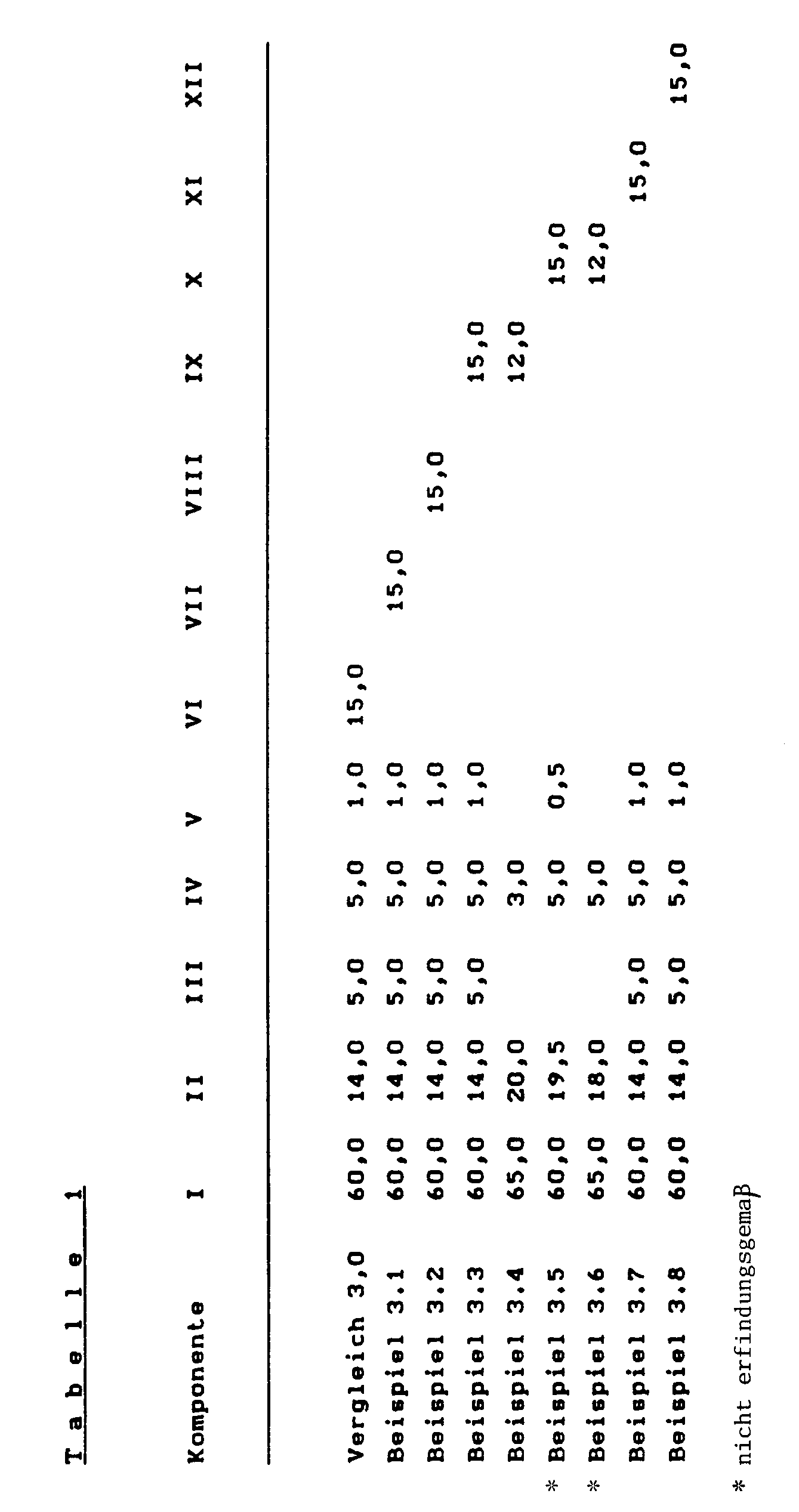
- Die Formmassen werden bei 260°C zu Prüfkörpern spritzgegossen (Aggregat: Werner-Pfleiderer-Schnecke DKS 275, Schließkraft 275 MP, Schneckendurchmesser 56 mm, Länge L:D-23:1) und folgenden Tests unterzogen:
- Schlagzähigkeit nach DIN 43 543 (an)
- Kerbschlagzähigkeit nach DIN 53 543 (ak)
- Wärmeformbeständigkeit nach DIN 53 460 (Vicat B)
- Brandtest nach Vorschrift Underwriter Laboratories (UL 94)
- Auf einem Innenkneter wie in Beispiel 3 werden die Bestandteile 1 bis VI, IX, X und XIII bei 230°C bis 240°C in den in Tabelle 3 angegebenen Mengen (Angaben in Gewichtsteilen) gemischt.
- Daraufhin werden die Formmassen bei 260°C wie in Beispiel 3 zu Prüfkörpern spritzgegossen und den ebenfalls in Beispiel 3 angegebenen Tests unterzogen.
- Tabelle 4 zeigt die erhaltenen Prüfdaten.


- Aus den Tabellen 1-4 der Beispiele 3 und 4 geht hervor, daß die erfindungsgemäßen Phosphate allein, in Mischung mit Triphenylphosphat oder untereinander bzw. in Mischungen mit noch geringer flüchtigen Phosphaten Blends aus Polycarbonat und ABS-Komponenten in Gegenwart üblicher Mengen Polytetrafluorethylen einen Flammschutz geben, der die Beurteilung V-O bei 1,6 mm dicken Prüfkörpern nach UL 94 zukommt.
- Die Wärmeformbeständigkeit liegt dabei in allen Fällen über der Probe, die mit Triphenylphosphat ausgerüstet ist. Dieser kommt mit 60 % Polycarbonat und 15 % Triphenylphosphat im Brandtest nach UL 94 nur ein "Nicht bestanden" zu. Den erfindungsgemäßen Phosphaten kommt eine deutlich geringere Flüchtigkeit als Triphenylphosphat zu.

Claims (9)
- Thermoplastische Polycarbonatformmassen enthaltendA) 40 bis 90 Gewichtsteile eines thermoplastischen, aromatischen PolycarbonatsB) 10-50 Gewichtsteile eines thermoplastischen Copolymerisats aus 50-95 Gew.-% Styrol, α-Methylstyrol, kernalkyliertem Styrol, Halogenstyrol oder Mischungen daraus und 5-50 Gew.-% Acrylnitril, Methacrylnitril, Alkylacrylat, Alkylmethacrylat, Maleinsäureanhydrid, N-substituiertem Maleinimid, Vinylacetat oder Mischungen daraus, gegebenenfallsC) 0-25 Gewichtsteile Pfropfpolymerisat hergestellt ausC.1) 5-90 Gewichtsteilen, einer Mischung aus:C.1.1) 50-95 Gew.-% Styrol, α-Methylstyrol, Halogenstyrol, kernalkyliertem Styrol, Methylmethacrylat oder Mischungen daraus, undC.1.2) 5-50 Gew.-% (Meth)Acrylnitril, Methylmethacrylat, Maleinsäureanhydrid, N-substiutiertem Maleinimid oder Mischungen daraus, aufC.2) 10-95 Gewichtsteilen, eines Kautschuks mit einer Glastemperatur TG ≦ 10°C,D) 1 bis 25 Gew.-Teile, bezogen jeweils auf 100 Gew.-Teile der Gewichtssumme aus A)+B)+ gegebenenfalls C), einer Phosphorverbindung,E) 0,05 bis 5,0 Gew.-Teile bezogen jeweils auf 100 Gew.-Teile der Gewichtssumme aus A)+B)+ gegebenenfalls C), eines Tetrafluorethylenpolymerisats mit mittleren Teilchengrößen von 0,05 bis 20 µm und einer Dichte von 1,2 bis 1,9 g/cm³,
dadurch gekennzeichnet, daß sie als Phosphorverbindungen D)
solche der Formel (I) enthalten,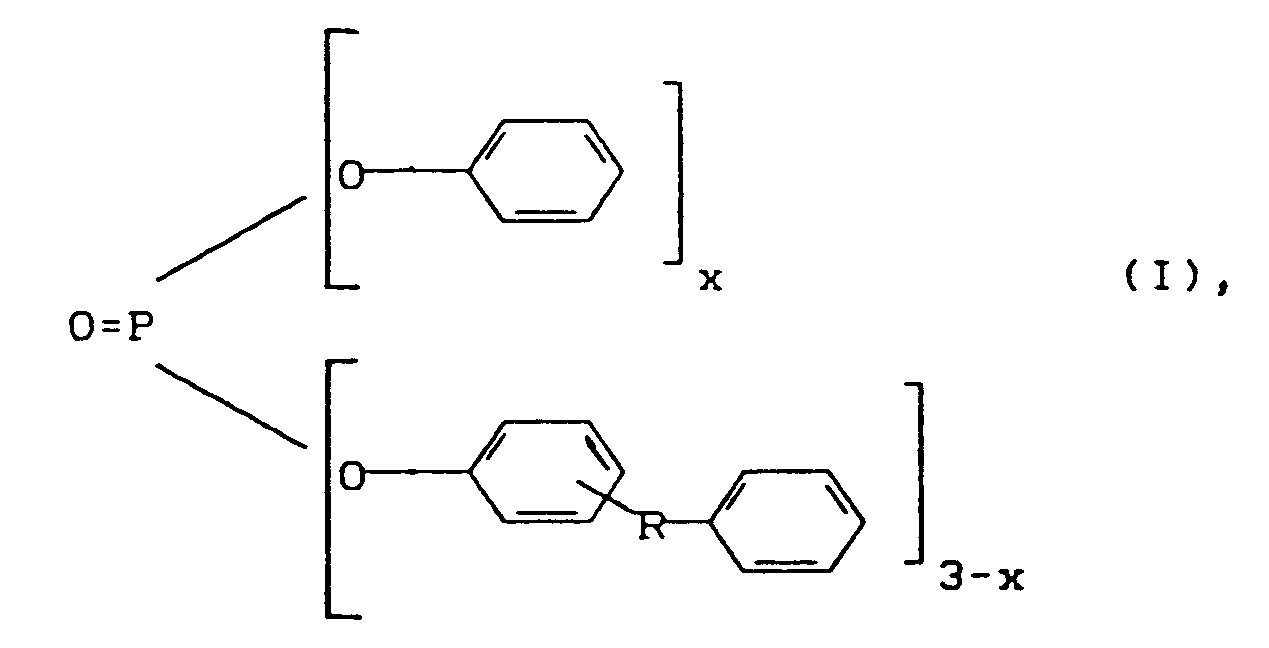
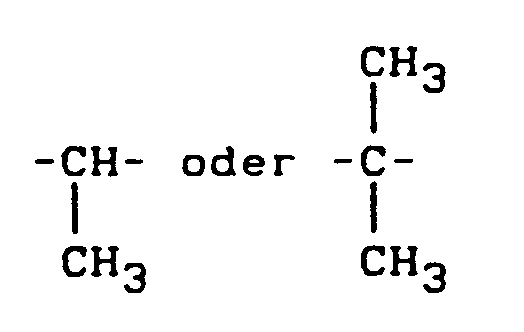 x 0, 1 oder 2 ist und die aromatischen Bereiche auch Alkyl substituiert sein können.
 - Formmassen gemäß Anspruch 1, dadurch gekennzeichnet, daß die Komponente D) in Mengen von 2 bis 20 Gew.-Teilen vorliegt.
- Thermoplastische Polycarbonatformmassen gemäß Anspruch 1, dadurch gekennzeichnet, daß die Komponente A) ein thermoplastisches Polycarbonat auf Basis der Diphenole der Formel (IV)

 A eine Einfachbindung, C₁-C₅-Alkylen, ein C₂-C₅-Alkyliden, ein C₅-C₆-Cycloalkyliden, -O-, -S-oder -SO₂-, die aromatischen Bereiche durch Halogenatome substituiert sein können, n = 1 oder null ist, die R's gleich oder verschieden sind und ein lineares C₁-C₂₀-Alkyl, verzweigtes C₃-C₂₀-Alkyl oder C₆-C₂₀-Aryl, vorzugsweise CH₃, sind und m eine Zahl zwischen 5 und 100, vorzugsweise zwischen 20 und 80 ist, und wobei der Gewichtsanteil an Diphenolen der Formel (IVa) in den Copolycarbonaten jeweils so bemesen ist, daß der Gehalt an Diorganosiloxy-Einheiten (V)in Polycarbonat A) zwischen 1 und 25 Gew.-% beträgt.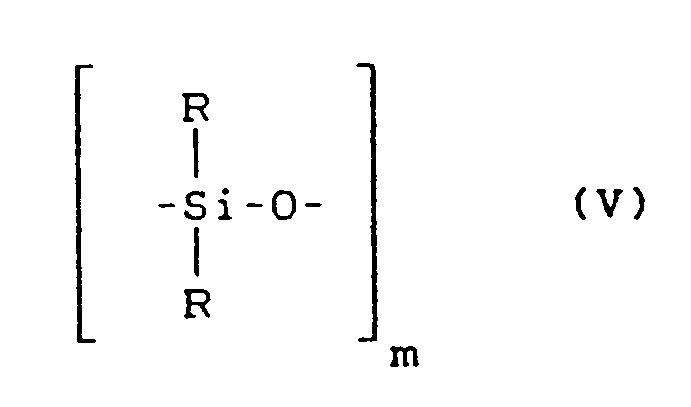
- Polycarbonatformmassen gemäß Anspruch 1, dadurch gekennzeichnet, daß die Komponente A) ein Gemisch aus siloxanhaltigen Polycarbonaten und siloxanfreien Polycarbonaten ist.
- Formmassen gemäß Anspruch 1, dadurch gekennzeichnet, daß die Komponente E) in Mengen von 0,1 bis 1,0 Gew.-Teilen vorliegt.
- Formmassen gemäß Anspruch 1, dadurch gekennzeichnet, daß die Komponente E) als koagulierte Mischung von Emulsionen der Tetrafluorethylenpolymerisate E) mit Emulsionen der Pfropfpolymerisate C) eingesetzt wird, worin das Gewichtsverhältnis Pfropfpolymerisat C) zum Tetrafluorethylenpolymerisat E) zwischen 95:5 und 60:40 liegt und der Gehalt an Cofällung von C) und E) bezogen auf 100 Gewichtsteile A), B) und gegebenenfalls C) zwischen 0,1 und 20,0 Gewichtsteilen liegt.
- Formmassen gemäß Anspruch 1, dadurch gekennzeichnet, daß C) ausC.1) 30 bis 80 Gewichtsteilen einer Mischung aus C.1.1) und C.1.2) undC.2) 20 bis 70 Gewichtsteilen hergestellt ist.
- Formmassen gemäß Anspruch 1, enthaltend zusätzlich thermoplastische Polyalkylencarbonsäureester, thermoplastische Polysulfone, thermoplastische Polyethersulfone, thermoplastische Polyphenylensulfide, Stabilisatoren, Pigmente, Fließmittel, Entformungsmittel, Antistatika und/oder andere Flammschutzmittel.
- Verfahren zur Herstellung der Polycarbonatformmassen der Ansprüche 1 bis 8, dadurch gekennzeichnet, daß man die Komponenten A), B), D), E) und gegebenenfalls C), thermoplastische Polyalkylencarbonsäureester, thermoplastische Polysulfone, thermoplastische Polyethersulfone, thermoplastische Polyphenylensulfide, Stabilisatoren, Pigmente, Fließmittel, Entformungsmittel, Antistatika und/oder andere Flammschutzmittel in bekannter Weise vermischt und bei Temperaturen von 200°C bis 330°C in üblichen Aggregaten schmelzcompoundiert oder schmelzextrudiert, oder daß man Lösungen der jeweiligen der vorstehend genannten Bestandteile in geeigneten organischen Lösungsmitteln mischt und die Lösungsgemische in üblichen Aggregaten eindampft.
Applications Claiming Priority (2)
| Application Number | Priority Date | Filing Date | Title |
|---|---|---|---|
| DE3824356A DE3824356A1 (de) | 1988-07-19 | 1988-07-19 | Thermoplastische polycarbonatformmassen mit flammwidrigen eigenschaften |
| DE3824356 | 1988-07-19 |
Publications (3)
| Publication Number | Publication Date |
|---|---|
| EP0351648A2 EP0351648A2 (de) | 1990-01-24 |
| EP0351648A3 EP0351648A3 (de) | 1991-03-06 |
| EP0351648B1 true EP0351648B1 (de) | 1994-04-13 |
Family
ID=6358956
Family Applications (1)
| Application Number | Title | Priority Date | Filing Date |
|---|---|---|---|
| EP89112305A Expired - Lifetime EP0351648B1 (de) | 1988-07-19 | 1989-07-06 | Thermoplastische Polycarbonatformmassen mit flammwidrigen Eigenschaften |
Country Status (4)
| Country | Link |
|---|---|
| US (1) | US4988748A (de) |
| EP (1) | EP0351648B1 (de) |
| JP (1) | JPH0269557A (de) |
| DE (2) | DE3824356A1 (de) |
Families Citing this family (37)
| Publication number | Priority date | Publication date | Assignee | Title |
|---|---|---|---|---|
| DE3940927A1 (de) * | 1989-12-12 | 1991-06-13 | Bayer Ag | Thermoplastische polycarbonatformmassen mit flammwidrigen eigenschaften |
| DE4016416A1 (de) * | 1990-05-22 | 1991-11-28 | Bayer Ag | Flammgeschuetzte, nicht tropfende polyalkylenterephthalat-formmassen |
| US5036126A (en) * | 1990-05-30 | 1991-07-30 | General Electric Company | Flame retardant blends of polycarbonate, ABS and a terpolymer |
| DE4027104A1 (de) * | 1990-06-22 | 1992-01-02 | Bayer Ag | Thermoplastische polycarbonatformmassen mit flammwidrigen eigenschaften |
| US5240978A (en) * | 1990-06-26 | 1993-08-31 | Bayer Aktiengesellschaft | Thermoplastic polycarbonate moulding compositions with flame-resistant properties |
| DE4020258A1 (de) * | 1990-06-26 | 1992-01-02 | Bayer Ag | Thermoplastische polycarbonatformmassen mit flammwidrigen eigenschaften |
| DE4024670A1 (de) * | 1990-08-03 | 1992-02-06 | Bayer Ag | Mischungen und ihre verwendung als flammschutzmittel |
| DE4024667C2 (de) * | 1990-08-03 | 1997-04-30 | Bayer Ag | Flammschutzmittel für Polycarbonate und Verfahren zur Einarbeitung in Polycarbonate |
| EP0483628B1 (de) * | 1990-10-29 | 1996-05-29 | BASF Aktiengesellschaft | Chlor- und bromfreie, flammfeste thermoplastische Formmassen auf der Basis von Polycarbonaten und Styrol/Acrylnitril-Copolymerisaten |
| DE4123041A1 (de) * | 1991-07-12 | 1993-01-14 | Bayer Ag | Thermoplastische polycarbonatformmassen mit flammwidrigen eigenschaften |
| DE4132172A1 (de) * | 1991-09-27 | 1993-04-01 | Basf Ag | Flammwidrig ausgeruestete chlor- und bromfreie formmasse |
| DE4132264A1 (de) * | 1991-09-27 | 1993-04-01 | Basf Ag | Flammwidrig ausgeruestete formmasse |
| WO1993022382A1 (fr) * | 1992-04-24 | 1993-11-11 | Ge Plastics Japan, Ltd. | Composition a base de resine de polycarbonate |
| US5314925A (en) * | 1992-12-03 | 1994-05-24 | General Electric Company | Use of polytetrafluoroethylene resins as a nucleating agent for foam molded thermoplastics |
| SG72704A1 (en) * | 1995-11-01 | 2000-05-23 | Gen Electric | Flame retardant thermoplastic composition containing aromatic polycarbonate resins and a rubber modified graft copolymer |
| DE19713509A1 (de) * | 1997-04-01 | 1998-10-08 | Bayer Ag | Pfropfpolymerisat-Formmassen mit reduzierter Belagsbildung |
| DE19714003A1 (de) * | 1997-04-04 | 1998-10-08 | Basf Ag | Flammwidrige thermoplastische Formmassen mit guter Fließfähigkeit |
| US6051641A (en) * | 1998-05-05 | 2000-04-18 | Teknor Apex Company | Articles having reduced pigment swirling |
| JP3662420B2 (ja) | 1998-08-13 | 2005-06-22 | 出光興産株式会社 | 熱可塑性樹脂組成物および射出成形品 |
| JP3926938B2 (ja) * | 1998-12-03 | 2007-06-06 | 三菱エンジニアリングプラスチックス株式会社 | 難燃性ポリカーボネート樹脂組成物 |
| DE19907831A1 (de) | 1999-02-24 | 2000-08-31 | Bayer Ag | Flammwidrige thermoplastische Formmasse |
| JP3891272B2 (ja) | 2002-03-05 | 2007-03-14 | 信越化学工業株式会社 | 難燃性樹脂組成物及びその成型品 |
| KR100650910B1 (ko) * | 2004-10-13 | 2006-11-27 | 제일모직주식회사 | 난연성 열가소성 수지 조성물 |
| KR100722149B1 (ko) * | 2005-12-30 | 2007-05-28 | 제일모직주식회사 | 압출가공성 및 내충격성이 우수한 난연성 폴리카보네이트계열가소성 수지 조성물 |
| WO2007078083A1 (en) * | 2005-12-30 | 2007-07-12 | Cheil Industries Inc. | Flame retardant polycarbonate thermoplastic resin composition having good extrusion moldability and impact resistance |
| KR101004040B1 (ko) * | 2007-12-18 | 2010-12-31 | 제일모직주식회사 | 상용성이 향상된 난연 내스크래치 열가소성 수지 조성물 |
| KR100885819B1 (ko) * | 2007-12-18 | 2009-02-26 | 제일모직주식회사 | 굴절률이 우수한 분지형 아크릴계 공중합체 및 그 제조방법 |
| KR100902352B1 (ko) * | 2008-03-13 | 2009-06-12 | 제일모직주식회사 | 상용성이 향상된 열가소성 수지 조성물 |
| KR100886348B1 (ko) * | 2008-04-14 | 2009-03-03 | 제일모직주식회사 | 상용성이 개선된 난연 내스크래치 열가소성 수지 조성물 |
| KR101188349B1 (ko) * | 2008-12-17 | 2012-10-05 | 제일모직주식회사 | 투명성 및 내스크래치성이 향상된 폴리카보네이트계 수지 조성물 |
| US8735490B2 (en) * | 2009-12-30 | 2014-05-27 | Cheil Industries Inc. | Thermoplastic resin composition having improved impact strength and melt flow properties |
| EP2881408B1 (de) | 2013-12-04 | 2017-09-20 | Lotte Advanced Materials Co., Ltd. | Styrolbasierte Copolymere und thermoplastische Harzzusammensetzung damit |
| US9902850B2 (en) | 2014-06-26 | 2018-02-27 | Lotte Advanced Materials Co., Ltd. | Thermoplastic resin composition |
| US9856371B2 (en) | 2014-06-27 | 2018-01-02 | Lotte Advanced Materials Co., Ltd. | Thermoplastic resin composition and low-gloss molded article made therefrom |
| US9850333B2 (en) | 2014-06-27 | 2017-12-26 | Lotte Advanced Materials Co., Ltd. | Copolymers and thermoplastic resin composition including the same |
| US9790362B2 (en) | 2014-06-27 | 2017-10-17 | Lotte Advanced Materials Co., Ltd. | Thermoplastic resin composition and molded article made using the same |
| KR101822697B1 (ko) | 2014-11-18 | 2018-01-30 | 롯데첨단소재(주) | 외관 특성이 우수한 열가소성 수지 조성물 및 이를 이용한 성형품 |
Family Cites Families (8)
| Publication number | Priority date | Publication date | Assignee | Title |
|---|---|---|---|---|
| US3428714A (en) * | 1965-05-24 | 1969-02-18 | Hooker Chemical Corp | Triaryl phosphates |
| US3576780A (en) * | 1969-03-28 | 1971-04-27 | Eastman Kodak Co | Processable bisphenol polyester compositions |
| DE3377138D1 (en) * | 1982-09-10 | 1988-07-28 | Bayer Ag | Flame-retardant polymer mixtures |
| DE3378125D1 (en) * | 1982-09-10 | 1988-11-03 | Bayer Ag | Flame-retardant polymer mixtures |
| EP0174493B1 (de) * | 1984-08-17 | 1988-05-25 | Bayer Ag | Thermoplastische Formmassen mit flammwidrigen Eigenschaften |
| US4683255A (en) * | 1985-02-27 | 1987-07-28 | Mitsubishi Gas Chemical Company, Inc. | Polyphenylene ether resin composition having excellent fire retardancy |
| DE3516807A1 (de) * | 1985-05-10 | 1986-11-13 | Bayer Ag, 5090 Leverkusen | Flammwidrige, schlagzaehe polycarbonat-formmassen |
| DE3628904A1 (de) * | 1986-08-26 | 1988-03-03 | Bayer Ag | Schlagzaehe, flammwidrige polycarbonatformmassen |
-
1988
- 1988-07-19 DE DE3824356A patent/DE3824356A1/de not_active Withdrawn
-
1989
- 1989-07-06 EP EP89112305A patent/EP0351648B1/de not_active Expired - Lifetime
- 1989-07-06 DE DE58907437T patent/DE58907437D1/de not_active Expired - Fee Related
- 1989-07-10 US US07/377,078 patent/US4988748A/en not_active Expired - Fee Related
- 1989-07-14 JP JP1180617A patent/JPH0269557A/ja active Pending
Also Published As
| Publication number | Publication date |
|---|---|
| EP0351648A2 (de) | 1990-01-24 |
| EP0351648A3 (de) | 1991-03-06 |
| DE3824356A1 (de) | 1990-01-25 |
| US4988748A (en) | 1991-01-29 |
| DE58907437D1 (de) | 1994-05-19 |
| JPH0269557A (ja) | 1990-03-08 |
Similar Documents
| Publication | Publication Date | Title |
|---|---|---|
| EP0351648B1 (de) | Thermoplastische Polycarbonatformmassen mit flammwidrigen Eigenschaften | |
| EP0174493B1 (de) | Thermoplastische Formmassen mit flammwidrigen Eigenschaften | |
| EP0716125B1 (de) | Flammgeschützte, thermoplastische Polycarbonatformmassen | |
| EP0287895B1 (de) | Flammwidrige, antistatische Polycarbonatformmassen | |
| EP0463467B1 (de) | Thermoplastische Polycarbonatformmassen mit flammwidrigen Eigenschaften | |
| EP0707045B1 (de) | Flammgeschützte, thermoplastische Polycarbonat-Formmassen | |
| EP0206058A1 (de) | Thermoplastische Formmassen mit flammwidrigen Eigenschaften | |
| DE4123041A1 (de) | Thermoplastische polycarbonatformmassen mit flammwidrigen eigenschaften | |
| EP0432581B1 (de) | Thermoplastische Polycarbonatformmassen mit flammwidrigen Eigenschaften | |
| DE4016417A1 (de) | Flammwidrige polycarbonate | |
| EP0199193B1 (de) | Thermoplastische Formmassen aus Polycarbonaten, Pfropfpolymerisaten und Copolymerisaten | |
| EP0210510A1 (de) | Thermoplastische Formmassen mit verbesserter Verarbeitbarkeit | |
| EP0488930B1 (de) | ABS-Formmassen | |
| EP0697441A2 (de) | Flammgeschützte thermoplastische Polycarbonat-Formmassen | |
| DE3619059A1 (de) | Leicht entformbare formmassen | |
| EP0179290B1 (de) | Thermoplastische Formmassen mit verbesserter Wärmeformbeständigkeit | |
| EP0224805B1 (de) | Thermoplastische Polycarbonatformmassen | |
| EP0247430B1 (de) | Flammwidrige, thermoplastische Formmassen | |
| EP0258728A2 (de) | Schlagzähe, flammwidrige Formmassen | |
| EP0337105B1 (de) | Thermoplastische Formmassen enthaltend aliphatische Polycarbonate | |
| DE19842713A1 (de) | Thermoplastische Harzzusammensetzung | |
| DE4040243A1 (de) | Thermoplastische polycarbonatformmassen mit flammwidrigen eigenschaften | |
| EP0176811B1 (de) | Neue Stabilisatoren für ABS-Kunststoffe und ABS-Legierungen | |
| EP0463495A2 (de) | Thermoplastische Polycarbonatformmassen mit flammwidrigen Eigenschaften | |
| EP0245683A2 (de) | Thermoplastische Formmassen mit flammwidrigen Eigenschaften |
Legal Events
| Date | Code | Title | Description |
|---|---|---|---|
| PUAI | Public reference made under article 153(3) epc to a published international application that has entered the european phase |
Free format text: ORIGINAL CODE: 0009012 |
|
| 17P | Request for examination filed |
Effective date: 19890706 |
|
| AK | Designated contracting states |
Kind code of ref document: A2 Designated state(s): DE FR GB IT NL |
|
| PUAL | Search report despatched |
Free format text: ORIGINAL CODE: 0009013 |
|
| AK | Designated contracting states |
Kind code of ref document: A3 Designated state(s): DE FR GB IT NL |
|
| 17Q | First examination report despatched |
Effective date: 19930305 |
|
| GRAA | (expected) grant |
Free format text: ORIGINAL CODE: 0009210 |
|
| AK | Designated contracting states |
Kind code of ref document: B1 Designated state(s): DE FR GB IT NL |
|
| REF | Corresponds to: |
Ref document number: 58907437 Country of ref document: DE Date of ref document: 19940519 |
|
| ITF | It: translation for a ep patent filed | ||
| GBT | Gb: translation of ep patent filed (gb section 77(6)(a)/1977) |
Effective date: 19940505 |
|
| ET | Fr: translation filed | ||
| PLBE | No opposition filed within time limit |
Free format text: ORIGINAL CODE: 0009261 |
|
| STAA | Information on the status of an ep patent application or granted ep patent |
Free format text: STATUS: NO OPPOSITION FILED WITHIN TIME LIMIT |
|
| 26N | No opposition filed | ||
| PGFP | Annual fee paid to national office [announced via postgrant information from national office to epo] |
Ref country code: DE Payment date: 19960618 Year of fee payment: 8 |
|
| PGFP | Annual fee paid to national office [announced via postgrant information from national office to epo] |
Ref country code: GB Payment date: 19960627 Year of fee payment: 8 Ref country code: FR Payment date: 19960627 Year of fee payment: 8 |
|
| PGFP | Annual fee paid to national office [announced via postgrant information from national office to epo] |
Ref country code: NL Payment date: 19960731 Year of fee payment: 8 |
|
| PG25 | Lapsed in a contracting state [announced via postgrant information from national office to epo] |
Ref country code: GB Free format text: LAPSE BECAUSE OF NON-PAYMENT OF DUE FEES Effective date: 19970706 |
|
| PG25 | Lapsed in a contracting state [announced via postgrant information from national office to epo] |
Ref country code: NL Free format text: LAPSE BECAUSE OF NON-PAYMENT OF DUE FEES Effective date: 19980201 |
|
| GBPC | Gb: european patent ceased through non-payment of renewal fee |
Effective date: 19970706 |
|
| PG25 | Lapsed in a contracting state [announced via postgrant information from national office to epo] |
Ref country code: FR Free format text: LAPSE BECAUSE OF NON-PAYMENT OF DUE FEES Effective date: 19980331 |
|
| NLV4 | Nl: lapsed or anulled due to non-payment of the annual fee |
Effective date: 19980201 |
|
| PG25 | Lapsed in a contracting state [announced via postgrant information from national office to epo] |
Ref country code: DE Free format text: LAPSE BECAUSE OF NON-PAYMENT OF DUE FEES Effective date: 19980401 |
|
| REG | Reference to a national code |
Ref country code: FR Ref legal event code: ST |
|
| PG25 | Lapsed in a contracting state [announced via postgrant information from national office to epo] |
Ref country code: IT Free format text: LAPSE BECAUSE OF NON-PAYMENT OF DUE FEES;WARNING: LAPSES OF ITALIAN PATENTS WITH EFFECTIVE DATE BEFORE 2007 MAY HAVE OCCURRED AT ANY TIME BEFORE 2007. THE CORRECT EFFECTIVE DATE MAY BE DIFFERENT FROM THE ONE RECORDED. Effective date: 20050706 |