EP0351719A2 - Temperaturkompensierte bipolare Schaltungen - Google Patents
Temperaturkompensierte bipolare Schaltungen Download PDFInfo
- Publication number
- EP0351719A2 EP0351719A2 EP89112892A EP89112892A EP0351719A2 EP 0351719 A2 EP0351719 A2 EP 0351719A2 EP 89112892 A EP89112892 A EP 89112892A EP 89112892 A EP89112892 A EP 89112892A EP 0351719 A2 EP0351719 A2 EP 0351719A2
- Authority
- EP
- European Patent Office
- Prior art keywords
- gate
- resistor
- temperature
- resistors
- resistance
- Prior art date
- Legal status (The legal status is an assumption and is not a legal conclusion. Google has not performed a legal analysis and makes no representation as to the accuracy of the status listed.)
- Granted
Links
- 229910021420 polycrystalline silicon Inorganic materials 0.000 claims abstract description 41
- 229920005591 polysilicon Polymers 0.000 claims abstract description 41
- 229910052710 silicon Inorganic materials 0.000 claims abstract description 38
- 239000010703 silicon Substances 0.000 claims abstract description 38
- 230000008878 coupling Effects 0.000 claims abstract description 15
- 238000010168 coupling process Methods 0.000 claims abstract description 15
- 238000005859 coupling reaction Methods 0.000 claims abstract description 15
- XUIMIQQOPSSXEZ-UHFFFAOYSA-N Silicon Chemical compound [Si] XUIMIQQOPSSXEZ-UHFFFAOYSA-N 0.000 claims description 36
- 230000003071 parasitic effect Effects 0.000 claims description 11
- 239000000758 substrate Substances 0.000 claims description 9
- 238000005516 engineering process Methods 0.000 claims description 8
- 230000001603 reducing effect Effects 0.000 claims description 4
- 125000006850 spacer group Chemical group 0.000 claims description 3
- 230000000087 stabilizing effect Effects 0.000 claims 1
- 238000000034 method Methods 0.000 description 6
- 230000008901 benefit Effects 0.000 description 4
- 239000000463 material Substances 0.000 description 4
- 230000008569 process Effects 0.000 description 4
- 230000007423 decrease Effects 0.000 description 3
- 230000003247 decreasing effect Effects 0.000 description 3
- 239000003990 capacitor Substances 0.000 description 2
- 238000010586 diagram Methods 0.000 description 2
- 230000000694 effects Effects 0.000 description 2
- 239000007943 implant Substances 0.000 description 2
- 238000002955 isolation Methods 0.000 description 2
- 230000000052 comparative effect Effects 0.000 description 1
- 230000000295 complement effect Effects 0.000 description 1
- 239000002131 composite material Substances 0.000 description 1
- 230000017525 heat dissipation Effects 0.000 description 1
- 239000012535 impurity Substances 0.000 description 1
- 238000004519 manufacturing process Methods 0.000 description 1
- 230000000873 masking effect Effects 0.000 description 1
- 239000002184 metal Substances 0.000 description 1
- 238000012986 modification Methods 0.000 description 1
- 230000004048 modification Effects 0.000 description 1
- 230000009467 reduction Effects 0.000 description 1
- 230000009291 secondary effect Effects 0.000 description 1
- 229910021332 silicide Inorganic materials 0.000 description 1
- FVBUAEGBCNSCDD-UHFFFAOYSA-N silicide(4-) Chemical compound [Si-4] FVBUAEGBCNSCDD-UHFFFAOYSA-N 0.000 description 1
- 150000003376 silicon Chemical class 0.000 description 1
Images

Classifications
-
- H—ELECTRICITY
- H03—ELECTRONIC CIRCUITRY
- H03K—PULSE TECHNIQUE
- H03K17/00—Electronic switching or gating, i.e. not by contact-making and –breaking
- H03K17/14—Modifications for compensating variations of physical values, e.g. of temperature
-
- H—ELECTRICITY
- H03—ELECTRONIC CIRCUITRY
- H03F—AMPLIFIERS
- H03F3/00—Amplifiers with only discharge tubes or only semiconductor devices as amplifying elements
- H03F3/45—Differential amplifiers
- H03F3/45071—Differential amplifiers with semiconductor devices only
- H03F3/45479—Differential amplifiers with semiconductor devices only characterised by the way of common mode signal rejection
Definitions
- This invention relates to bipolar technology circuits and gates with improved temperature compensation.
- the invention provides ECL gates with improved temperature compensation for the total gate current and signal swing voltage without substantially increasing parasitic capacitance of the ECL gate.
- the invention is applicable for temperature compensation in any bipolar technology such as transistor transistor logic (TTL) and Schottky transistor logic (STL) circuit applications to provide flat or stable switching speed at active nodes across a specified temperature range.
- TTL transistor transistor logic
- STL Schottky transistor logic
- a typical ECL gate 10, illustrated in Figure 1, includes a pair of gate transistors Q1 and Q2 forming an input transistor Q1 and a reference transistor Q2 with common emitter coupling at node 12.
- the gate transistors Q1 and Q2 provide alternative current paths through respective collector resistors or swing voltage resistors R1 and R2 from high potential V CC .
- An ECL current source transistor Q3 is coupled between the common emitter coupling node 12 and low potential V EE through current source resistor or tail resistor R3.
- the ECL gate resistances R1, R2 and R3 are equal.
- Current source Q3 generates gate current in the alternative current paths according to the input signal V IN at the base of input transistor Q1.
- a bias voltage generator also known as a current source voltage generator or reference voltage generator not shown provides the reference voltage V BB applied at the base of reference transistor Q2 and the current source voltage V CS applied at the base of the current source transistor Q3.
- Typical ECL gates also include the differential signal input configuration in which the gate transistors constitute differential input transistors for differential inputs V IN and V IN instead of an input transistor and reference transistor having inputs V IN and V BB .
- ECL circuits generally operate in the negative voltage range with the high potential level V CC for example at ground potential and low potential V EE for example at -5.0 volts. Alternatively if V CC is set at +5.0 volts then low potential V EE may be set at ground potential.
- the reference voltage level V BB is referenced to high potential V CC and set for example in the range of -1.2 to -2.0 volts.
- the logic high and low level voltage signals are set on either side of the reference voltage. For example with a reference voltage of -1.2 volts the signal voltage swings between a high level voltage signal in the range of for example -0.8 volts and a low level voltage signal in the range of for example -1.6 volts. For a reference voltage V BB of for example -2.0 volts the signal voltage may swing between for example -1.6 volts and -2.4 volts.
- the current source transistor Q3 is base driven by the current source voltage V CS derived from the separate bias voltage generator or current source voltage generator, not shown.
- the current source voltage V CS may have a variety of different temperature characteristics according to the type of generator used.
- the current source transistor Q3 in cooperation with the current source voltage generator generates the ECL gate current or tail current through current source resistor R3.
- the gate current passes through either of the alternative transistor collector paths, that is, through resistor R1 or resistor R2, according to the high or low level voltage input signal V IN applied to the base of input transistor Q1.
- Complementary ECL gate output signals may be taken from the collectors respectively of input transistor Q1 and reference transistor Q2 and the output signal voltage swing is set by the swing resistors R1 and R2 and the gate current.
- the ECL gate resistors are formed from doped silicon and have a positive temperature coefficient. Therefore as the temperature increases so does the value of the respective resistances, decreasing the gate current. If V CS is made to vary so that the gate current is constant, the signal voltage swing will increase significantly with higher temperature due to the positive temperature coefficient of the silicon resistors. This increase in the swing voltage results in slow down of the ECL gate at higher temperatures. Slow down of the ECL gate may also occur at low temperatures because the resistance of silicon base resistors at typical doping levels also increases as temperature falls below room temperature.
- V CS In order to maintain a relatively constant signal swing voltage, V CS must vary negatively with increasing temperature in the same manner as the base emitter voltage drop V BE varies. The objective is to stabilize the tail voltage V′. According to this prior art arrangement the gate current decreases with increasing temperature. As noted above, this reduction in gate current tends to slow down the operation of the ECL gate.
- temperature compensation is provided by adjusting the temperature coefficient of the voltage generator output.
- This compensation can be arranged to achieve either a constant gate current I tail or constant signal voltage swing but not both.
- undesirable parasitic capacitance is introduced.
- the typical silicon resistor consists of a portion of the epitaxial silicon layer doped for example with P-type silicon during the base implant step.
- This silicon resistor referred to as the base resistor, overlies the N-type silicon buried layer.
- the N-type silicon buried layer in turn overlies the P-type silicon substrate of the integrated circuit die.
- the silicon resistor is therefore capacitively coupled to the substrate through two PN junction capacitors. This parasitic capacitance results in high power dissipation by the compensated ECL gate.
- a secondary effect is also associated with conventional temperature compensating methods using base resistors. While the base resistors of P-type silicon start out with high capacitance, this capacitive coupling to the substrate increases with temperature slowing down the operation of the gate even more.
- the same method adjustment of the voltage generator output is also subject to limitations.
- the prior art polyresistor network can provide only constant gate current or constant voltage swing but not both.
- Another object of the invention is to provide temperature compensation in integrated circuit ECL gates incorporating resistor materials with negative temperature coefficients but without incurring the risks of thermal runaway.
- a further object of the invention is to reduce the parasitic capacitance and accompanying power dissipation in the temperature compensation of ECL gate integrated circuits by incorporating low capacitance negative temperature coefficient resistance materials, and in addition to offset the effects of the negative temperature coefficient materials.
- the object of the invention is to provide temperature compensation in any bipolar technology circuits and gates to provide flat and stable switching speeds at active nodes over a desired temperature range.
- the broadest aspect of the invention is defined by claim 1.
- the present invention provides temperature compensated bipolar circuits including ECL, TTL and STL circuits in which the active node circuit resistances are each composed of a pair of opposite polarity temperature coefficient resistors.
- the opposite polarity temperature coefficient resistors are preferably coupled in series and are selected to provide the specified total resistance of the respective active node circuit resistance while providing substantial temperature compensation for the switching speed over a specified temperature range.
- each pair of opposite polarity temperature coefficient resistors includes a silicon resistor and a polysilicon resistor having relatively low capacitance for temperature compensation without substantially increasing power dissipation.
- a temperature compensated ECL gate typically includes a first gate transistor element and a second gate transistor element coupled at a common emitter coupling or node providing alternative collector current paths from high potential.
- the alternative collector current paths are the first gate transistor collector path with collector resistance and the second gate transistor collector path with collector resistance.
- a current source transistor element is coupled between the common emitter coupling of the gate transistor elements and low potential through the current source or tail resistance.
- the current source base driven by current source voltage from a bias voltage generator, generates gate current through the alternative gate transistor collector current paths according to signals applied at the base of the gate transistor elements.
- the ECL gate provides output signals at the collectors of the gate transistors with signal swing voltage between high and low logic levels.
- the gate transistors may be either an input transistor and reference transistor with inputs V IN and V BB or differential input transistors with inputs V IN and V IN .
- each of the resistances of the ECL gate namely the collector resistances and the current source resistance
- the second resistor is selected to have relatively low capacitance, that is relatively low resistor to substrate capacitance coupling in the case of integrated circuits.
- the sum of the resistances of the first and second resistors is selected to provide the selected circuit resistance of the ECL gate.
- the ratio of the resistances is selected according to the temperature characteristics of the current source voltage generator and the temperature characteristics of the two types of resistors for substantial temperature compensation of the gate current and signal swing voltage over the specified temperature range.
- a negative temperature coefficient polysilicon resistor is selected as a component of each of the ECL gate circuit resistances because of its low parasitic capacitance and low power dissipation requirements.
- the negative temperature coefficient of the polysilicon resistor of each pair is then offset by the positive temperature coefficient base resistor.
- the silicon first resistor and polysilicon second resistor are arranged so that the polysilicon second resistor is interposed between the silicon first resistor and respective active element transistor further reducing the effect of any parasitic capacitance.
- the programmed temperature coefficient pair of resistors according to the invention may also be substituted for resistances at the active nodes of TTL and circuits to provide flat, even or stable speed over a desired temperature range.
- a temperature compensated ECL gate 20 is illustrated in Fig. 2. Components performing substantially the same function as in the ECL gate of Fig. 1 are indicated by the same reference designations.
- each of the ECL gate resistances R1,R2 and R3 of the circuit of Fig. 1 is replaced by a pair of resistors including a silicon resistor such as a P-type silicon base resistor and a polysilicon resistor which can be either P-type or N-type polysilicon resistors.
- the collector resistance for input transistor Q1 consists of the base resistor R11 and poly resistor R12 connected in series.
- the collector resistance for reference transistor Q2 consists of base resistor R21 and poly resistor R22 connected in series while the tail resistance for current source transistor Q3 consists of series connected base resistor R31 and poly resistor R32.
- the poly resistor in comparison with the base resistor is characterized by much lower parasitic capacitance as hereafter described, and a temperature coefficient that is negative.
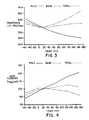
- the comparative temperature coefficient characteristics of a base resistor alone, a poly resistor alone, and a combination of base resistor and poly resistor with substantially the same total resistance is illustrated in the example of Figs. 3 and 4.
- the conventional base resistor with a resistance of approximately 740 ohms/square ( ⁇ /sq.) at approximately 10°C (50°F) and a positive temperature coefficient increases in resistance with increasing temperature. In the temperature range from 10°C to 180°C the resistance increases over the range from 740 ⁇ /sq. to approximately 880 ⁇ /sq.
- the base resistor resistance also increases slightly as the temperature drops below 10°C.
- the corresponding gate current or tail current I tail through resistor R3 is shown in Fig. 4 decreasing over the temperature range from 10°C to 180°C.
- the poly resistor of substantially the same resistance at 10°C but with negative temperature coefficient is characterized by a resistance decrease in the range from 800 ⁇ /sq. to 650 ⁇ /sq. as the temperature increases from -60°C to 180°C as shown in Fig. 3.
- the corresponding gate current or tail current I tail through resistor R3 is shown in Fig. 4 increasing substantially over the specified temperature range with the possibility of "thermal runaway.”
- the gate current or tail current I tail through current source resistors R31,R32 is shown in Fig. 4.
- Substantial temperature compensation is provided by the resistor pair having temperature coefficients of opposite polarity and the gate current is substantially stable over the temperature range from 10°C to 180°C. Resistance combinations to provide any desired temperature compensation characteristics can be constructed according to the invention, and the foregoing example is presented by way of illustration only.
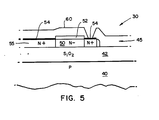
- FIG. 5 An integrated circuit polysilicon resistor suitable for use in a temperature compensated ECL gate according to the invention is illustrated in Figure 5.
- the polysilicon integrated circuit structure 30 is fabricated according to a bipolar modified isoplanar process such as described for example in U.S. Patent Application Serial No. 940,573 filed December 11, 1986 entitled ENHANCED DENSITY MODIFIED ISOPLANAR PROCESS.
- the polysilicon resistor structure is fabricated on a P-type silicon substrate 40 on which has been grown an N-type epitaxial silicon layer.
- the epitaxial silicon layer is divided into epitaxial islands by isolation oxide regions 42 and the polysilicon resistor structure is formed over the spacer or isolation oxide 42.
- a portion 50 of the polysilicon layer 45 is doped with an N- concentration or P- concentration of impurities.
- the high resistance N- or P- concentration polysilicon region 50 forms the resistor with higher conductivity N+ or P+ concentration polysilicon on either side to provide electrical leads.
- An oxide cap 52 protects the high resistance polysilicon region 50 which forms the polysilicon resistor.
- the higher conductance N+ or P+ polysilicon regions are covered bY silicide 54 for surface contact locations.
- Dielectric.masking layer 60 is used to form metal contacts.
- the electrical interconnect region 55 of the polysilicon layer can provide electrical lead interconnection for example to a series coupled P-type silicon base resistor at the level of the epitaxial layer in accordance with the invention.
- a feature and advantage of the polysilicon resistor is that direct capacitive coupling to the substrate is eliminated by the oxide spacer layer greatly reducing parasitic capacitance in comparison with a silicon base implant resistor.
- the base epitaxial silicon resistor is characterized by direct capacitor coupling PN junctions between the resistor and buried collector layer and between the buried collector layer and substrate.
- the invention is applicable to any bipolar technology circuit applications such as TTL and STL circuits and gates.
- the resistance of a component at an active node is replaced with two resistors according to the invention having opposite polarity temperature coefficients such as a silicon base resistor and a polysilicon resistor.
- the combination is designed to yield the desired composite temperature coefficient to maintain even, flat, or stable switching speed at the active node taking into account variable V BE 's at base emitter junctions associated with the active node.
- any bias resistors are replaced with the desired combination of a pair of resistors of opposite polarity temperature coefficients.
- any swing resistors are replaced with the desired programmed temperature coefficient combination of base resistor and polysilicon resistor.
- the present invention provides the primary benefit of a programmed temperature coefficient that yields the desired speed characteristics and the secondary benefit of decreased total capacitance.
- the invention is intended to cover all modifications and equivalents within the scope of the following claims.
Landscapes
- Engineering & Computer Science (AREA)
- Power Engineering (AREA)
- Bipolar Integrated Circuits (AREA)
- Logic Circuits (AREA)
- Semiconductor Integrated Circuits (AREA)
- Electronic Switches (AREA)
Applications Claiming Priority (2)
| Application Number | Priority Date | Filing Date | Title |
|---|---|---|---|
| US07/221,322 US4853646A (en) | 1988-07-19 | 1988-07-19 | Temperature compensated bipolar circuits |
| US221322 | 1988-07-19 |
Publications (3)
| Publication Number | Publication Date |
|---|---|
| EP0351719A2 true EP0351719A2 (de) | 1990-01-24 |
| EP0351719A3 EP0351719A3 (de) | 1991-04-24 |
| EP0351719B1 EP0351719B1 (de) | 1994-12-28 |
Family
ID=22827327
Family Applications (1)
| Application Number | Title | Priority Date | Filing Date |
|---|---|---|---|
| EP89112892A Expired - Lifetime EP0351719B1 (de) | 1988-07-19 | 1989-07-14 | Temperaturkompensierte bipolare Schaltungen |
Country Status (6)
| Country | Link |
|---|---|
| US (1) | US4853646A (de) |
| EP (1) | EP0351719B1 (de) |
| JP (1) | JPH0286322A (de) |
| KR (1) | KR0142104B1 (de) |
| CA (1) | CA1292289C (de) |
| DE (1) | DE68920219T2 (de) |
Cited By (3)
| Publication number | Priority date | Publication date | Assignee | Title |
|---|---|---|---|---|
| EP0520432A3 (en) * | 1991-06-27 | 1993-10-27 | Canon Kk | Signal processing circuit and system for detection of absolute value |
| DE4227282C1 (de) * | 1992-08-18 | 1993-11-25 | Siemens Ag | Digitaler Stromschalter |
| EP0920123A3 (de) * | 1997-11-27 | 2001-10-17 | Nec Corporation | Halbleiterschaltung mit Kompensation für Verzerrungen aufgrund von Umgebungstemperaturveränderungen |
Families Citing this family (16)
| Publication number | Priority date | Publication date | Assignee | Title |
|---|---|---|---|---|
| JP2560888B2 (ja) * | 1990-05-17 | 1996-12-04 | 日本電気株式会社 | レベル検波回路 |
| JPH0555903A (ja) * | 1991-08-27 | 1993-03-05 | Nec Corp | バツフア回路 |
| US5323068A (en) * | 1992-11-17 | 1994-06-21 | National Semiconductor Corporation | Low power low temperature ECL output driver circuit |
| US5701097A (en) * | 1995-08-15 | 1997-12-23 | Harris Corporation | Statistically based current generator circuit |
| US5751180A (en) * | 1996-09-03 | 1998-05-12 | Motorola, Inc. | Electrical device structure having reduced crowbar current and power consumption |
| EP0887936A1 (de) * | 1997-06-24 | 1998-12-30 | STMicroelectronics S.r.l. | Oszillator für Betrieb mit niedriger Versorgungsspannung |
| JP3166678B2 (ja) * | 1997-09-22 | 2001-05-14 | 日本電気株式会社 | 半導体集積回路 |
| US5889441A (en) * | 1997-12-12 | 1999-03-30 | Scenix Semiconductor, Inc. | Temperature and voltage independent on-chip oscillator system and method |
| DE10220587B4 (de) * | 2002-05-08 | 2007-07-19 | Infineon Technologies Ag | Temperatursensor für MOS-Schaltungsanordnung |
| JP4791700B2 (ja) * | 2004-03-29 | 2011-10-12 | 株式会社リコー | 半導体装置、半導体装置の調整方法および電子装置 |
| DE102004062357A1 (de) * | 2004-12-14 | 2006-07-06 | Atmel Germany Gmbh | Versorgungsschaltung zur Erzeugung eines Referenzstroms mit vorgebbarer Temperaturabhängigkeit |
| JP4854393B2 (ja) * | 2006-06-21 | 2012-01-18 | 三星電子株式会社 | 電圧発生回路 |
| JP5660115B2 (ja) * | 2012-12-18 | 2015-01-28 | 株式会社村田製作所 | ヘテロ接合バイポーラトランジスタ、これを用いた電力増幅器、及びヘテロ接合バイポーラトランジスタの製造方法 |
| US9182767B2 (en) * | 2013-03-11 | 2015-11-10 | Qualcomm Incorporated | Devices and methods for calibrating and operating a snapback clamp circuit |
| JP7329378B2 (ja) * | 2019-07-09 | 2023-08-18 | ローム株式会社 | 差動信号送信回路 |
| US20230135542A1 (en) * | 2020-02-25 | 2023-05-04 | Rohm Co., Ltd. | Constant voltage generation circuit |
Family Cites Families (6)
| Publication number | Priority date | Publication date | Assignee | Title |
|---|---|---|---|---|
| US4207538A (en) * | 1978-08-29 | 1980-06-10 | Rca Corporation | Temperature compensation circuit |
| JPS5911666A (ja) * | 1982-07-13 | 1984-01-21 | Nec Corp | 集積回路装置 |
| JP2525346B2 (ja) * | 1983-10-27 | 1996-08-21 | 富士通株式会社 | 定電流源回路を有する差動増幅回路 |
| JPS60174527A (ja) * | 1984-02-21 | 1985-09-07 | Nec Corp | 論理回路 |
| US4730126A (en) * | 1986-08-27 | 1988-03-08 | Advanced Micro Devices, Inc. | Temperature compensated high performance hysteresis buffer |
| US4757273A (en) * | 1987-07-13 | 1988-07-12 | Derek Bray | Complementary transconductance amplifiers |
-
1988
- 1988-07-19 US US07/221,322 patent/US4853646A/en not_active Expired - Lifetime
-
1989
- 1989-07-14 EP EP89112892A patent/EP0351719B1/de not_active Expired - Lifetime
- 1989-07-14 DE DE68920219T patent/DE68920219T2/de not_active Expired - Fee Related
- 1989-07-18 KR KR1019890010118A patent/KR0142104B1/ko not_active Expired - Fee Related
- 1989-07-18 CA CA000605971A patent/CA1292289C/en not_active Expired - Fee Related
- 1989-07-19 JP JP1184835A patent/JPH0286322A/ja active Pending
Cited By (5)
| Publication number | Priority date | Publication date | Assignee | Title |
|---|---|---|---|---|
| EP0520432A3 (en) * | 1991-06-27 | 1993-10-27 | Canon Kk | Signal processing circuit and system for detection of absolute value |
| US5642070A (en) * | 1991-06-27 | 1997-06-24 | Canon Kabushiki Kaisha | Signal processing circuit and system for detection of absolute value |
| DE4227282C1 (de) * | 1992-08-18 | 1993-11-25 | Siemens Ag | Digitaler Stromschalter |
| EP0920123A3 (de) * | 1997-11-27 | 2001-10-17 | Nec Corporation | Halbleiterschaltung mit Kompensation für Verzerrungen aufgrund von Umgebungstemperaturveränderungen |
| US6437634B1 (en) | 1997-11-27 | 2002-08-20 | Nec Corporation | Semiconductor circuit in which distortion caused by change in ambient temperature is compensated |
Also Published As
| Publication number | Publication date |
|---|---|
| DE68920219T2 (de) | 1995-08-10 |
| KR0142104B1 (ko) | 1998-07-15 |
| JPH0286322A (ja) | 1990-03-27 |
| CA1292289C (en) | 1991-11-19 |
| EP0351719A3 (de) | 1991-04-24 |
| DE68920219D1 (de) | 1995-02-09 |
| US4853646A (en) | 1989-08-01 |
| KR900002559A (ko) | 1990-02-28 |
| EP0351719B1 (de) | 1994-12-28 |
Similar Documents
| Publication | Publication Date | Title |
|---|---|---|
| EP0351719B1 (de) | Temperaturkompensierte bipolare Schaltungen | |
| EP1040521B1 (de) | VERFAHREN ZUM BETRIEB EINES SILIZIUM-OXID-ISOLATOR (SOI)-HALBLEITERs MIT SELEKTIV ANGESCHLOSSENEM BEREICH | |
| KR950006477B1 (ko) | 반도체장치 및 그 제조방법 | |
| JP2003133428A (ja) | 半導体素子の駆動方法 | |
| JPH0653417A (ja) | 抵抗器回路およびそれを形成する方法 | |
| US4937639A (en) | Input protector device for semiconductor device | |
| US6621138B1 (en) | Zener-like trim device in polysilicon | |
| JP2710113B2 (ja) | 相補性回路技術による集積回路 | |
| JPS62115765A (ja) | 半導体装置 | |
| US6600205B2 (en) | Method for making low voltage transistors with increased breakdown voltage to substrate having three different MOS transistors | |
| CN110400791A (zh) | 一种多晶硅电阻 | |
| US6987309B2 (en) | Semiconductor device applied to a variable capacitance capacitor and amplifier | |
| GB2077496A (en) | Integrated r-c network devices | |
| US5279887A (en) | Polycrystalline silicon contact structure | |
| US4584594A (en) | Logic structure utilizing polycrystalline silicon Schottky diodes | |
| JPS6165468A (ja) | 高出力集積回路装置 | |
| EP0151347A1 (de) | Integrierter Stromkreis mit bipolaren Anordnungen und Feldeffektanordnungen und Verfahren zum Herstellen | |
| US4613887A (en) | Semiconductor device with a means for discharging carriers | |
| JP3131525B2 (ja) | Mosパワー・トランジスタ・デバイス | |
| US10333497B1 (en) | Calibration devices for I/O driver circuits having switches biased differently for different temperatures | |
| EP0538807A1 (de) | Integrierte Halbleiterschaltungsanordnung mit einem Zusätzlichen Kondensator, welcher die parasitäre Kapazität eines Widerstandes herabsetzt | |
| US5567969A (en) | Compound modulated integrated transistor structure with reduced bipolar switch back effect | |
| US7485931B2 (en) | Semiconductor integrated circuit | |
| US4223335A (en) | Semiconductor device body having identical isolated composite resistor regions | |
| US4672237A (en) | Logic circuit having delay time free from temperature affection |
Legal Events
| Date | Code | Title | Description |
|---|---|---|---|
| PUAI | Public reference made under article 153(3) epc to a published international application that has entered the european phase |
Free format text: ORIGINAL CODE: 0009012 |
|
| AK | Designated contracting states |
Kind code of ref document: A2 Designated state(s): DE FR GB IT NL |
|
| PUAL | Search report despatched |
Free format text: ORIGINAL CODE: 0009013 |
|
| AK | Designated contracting states |
Kind code of ref document: A3 Designated state(s): DE FR GB IT NL |
|
| RHK1 | Main classification (correction) |
Ipc: H03K 19/003 |
|
| 17P | Request for examination filed |
Effective date: 19910904 |
|
| 17Q | First examination report despatched |
Effective date: 19930804 |
|
| GRAA | (expected) grant |
Free format text: ORIGINAL CODE: 0009210 |
|
| AK | Designated contracting states |
Kind code of ref document: B1 Designated state(s): DE FR GB IT NL |
|
| PG25 | Lapsed in a contracting state [announced via postgrant information from national office to epo] |
Ref country code: IT Free format text: LAPSE BECAUSE OF FAILURE TO SUBMIT A TRANSLATION OF THE DESCRIPTION OR TO PAY THE FEE WITHIN THE PRE;WARNING: LAPSES OF ITALIAN PATENTS WITH EFFECTIVE DATE BEFORE 2007 MAY HAVE OCCURRED AT ANY TIME BEFORE 2007. THE CORRECT EFFECTIVE DATE MAY BE DIFFERENT FROM THE ONE RECORDED.SCRIBED TIME-LIMIT Effective date: 19941228 Ref country code: NL Effective date: 19941228 Ref country code: FR Effective date: 19941228 |
|
| REF | Corresponds to: |
Ref document number: 68920219 Country of ref document: DE Date of ref document: 19950209 |
|
| EN | Fr: translation not filed | ||
| NLV1 | Nl: lapsed or annulled due to failure to fulfill the requirements of art. 29p and 29m of the patents act | ||
| PG25 | Lapsed in a contracting state [announced via postgrant information from national office to epo] |
Ref country code: GB Effective date: 19950714 |
|
| PLBE | No opposition filed within time limit |
Free format text: ORIGINAL CODE: 0009261 |
|
| STAA | Information on the status of an ep patent application or granted ep patent |
Free format text: STATUS: NO OPPOSITION FILED WITHIN TIME LIMIT |
|
| 26N | No opposition filed | ||
| GBPC | Gb: european patent ceased through non-payment of renewal fee |
Effective date: 19950714 |
|
| PGFP | Annual fee paid to national office [announced via postgrant information from national office to epo] |
Ref country code: DE Payment date: 20000703 Year of fee payment: 12 |
|
| PG25 | Lapsed in a contracting state [announced via postgrant information from national office to epo] |
Ref country code: DE Free format text: LAPSE BECAUSE OF NON-PAYMENT OF DUE FEES Effective date: 20020501 |