EP0351747B1 - Verfahren zur Herstelllung von Siliziumnitrid enthaltendem keramischem Material aus polymeren Hydridochlorsilazanen - Google Patents
Verfahren zur Herstelllung von Siliziumnitrid enthaltendem keramischem Material aus polymeren Hydridochlorsilazanen Download PDFInfo
- Publication number
- EP0351747B1 EP0351747B1 EP89113047A EP89113047A EP0351747B1 EP 0351747 B1 EP0351747 B1 EP 0351747B1 EP 89113047 A EP89113047 A EP 89113047A EP 89113047 A EP89113047 A EP 89113047A EP 0351747 B1 EP0351747 B1 EP 0351747B1
- Authority
- EP
- European Patent Office
- Prior art keywords
- polymeric
- silicon nitride
- infusible
- containing silicon
- fiber
- Prior art date
- Legal status (The legal status is an assumption and is not a legal conclusion. Google has not performed a legal analysis and makes no representation as to the accuracy of the status listed.)
- Expired - Lifetime
Links
- 229910052581 Si3N4 Inorganic materials 0.000 title claims description 20
- HQVNEWCFYHHQES-UHFFFAOYSA-N silicon nitride Chemical compound N12[Si]34N5[Si]62N3[Si]51N64 HQVNEWCFYHHQES-UHFFFAOYSA-N 0.000 title claims description 14
- 229910010293 ceramic material Inorganic materials 0.000 title claims description 8
- 238000004519 manufacturing process Methods 0.000 title claims description 7
- 239000000835 fiber Substances 0.000 claims description 27
- 238000000197 pyrolysis Methods 0.000 claims description 19
- 239000000155 melt Substances 0.000 claims description 14
- 238000000034 method Methods 0.000 claims description 14
- 239000000919 ceramic Substances 0.000 claims description 10
- 238000000576 coating method Methods 0.000 claims description 10
- 239000002904 solvent Substances 0.000 claims description 9
- 239000003960 organic solvent Substances 0.000 claims description 8
- 125000000217 alkyl group Chemical group 0.000 claims description 7
- 125000004432 carbon atom Chemical group C* 0.000 claims description 7
- 239000011248 coating agent Substances 0.000 claims description 7
- 229910052757 nitrogen Inorganic materials 0.000 claims description 6
- 229910052801 chlorine Inorganic materials 0.000 claims description 5
- 239000011261 inert gas Substances 0.000 claims description 5
- 238000002844 melting Methods 0.000 claims description 5
- 230000008018 melting Effects 0.000 claims description 5
- 229910052739 hydrogen Inorganic materials 0.000 claims description 4
- 229920006395 saturated elastomer Polymers 0.000 claims description 4
- 238000009987 spinning Methods 0.000 claims description 4
- 238000005524 ceramic coating Methods 0.000 claims description 3
- 125000004435 hydrogen atom Chemical group [H]* 0.000 claims description 3
- 238000000465 moulding Methods 0.000 claims description 3
- 125000004433 nitrogen atom Chemical group N* 0.000 claims description 3
- 238000009877 rendering Methods 0.000 claims 5
- 230000008016 vaporization Effects 0.000 claims 1
- 238000009834 vaporization Methods 0.000 claims 1
- QGZKDVFQNNGYKY-UHFFFAOYSA-N Ammonia Chemical compound N QGZKDVFQNNGYKY-UHFFFAOYSA-N 0.000 description 30
- 238000006243 chemical reaction Methods 0.000 description 17
- 229910000069 nitrogen hydride Inorganic materials 0.000 description 13
- YXFVVABEGXRONW-UHFFFAOYSA-N Toluene Chemical compound CC1=CC=CC=C1 YXFVVABEGXRONW-UHFFFAOYSA-N 0.000 description 12
- VLKZOEOYAKHREP-UHFFFAOYSA-N n-Hexane Chemical compound CCCCCC VLKZOEOYAKHREP-UHFFFAOYSA-N 0.000 description 10
- WYURNTSHIVDZCO-UHFFFAOYSA-N Tetrahydrofuran Chemical compound C1CCOC1 WYURNTSHIVDZCO-UHFFFAOYSA-N 0.000 description 8
- NLXLAEXVIDQMFP-UHFFFAOYSA-N Ammonia chloride Chemical compound [NH4+].[Cl-] NLXLAEXVIDQMFP-UHFFFAOYSA-N 0.000 description 5
- 239000000203 mixture Substances 0.000 description 5
- XKRFYHLGVUSROY-UHFFFAOYSA-N Argon Chemical compound [Ar] XKRFYHLGVUSROY-UHFFFAOYSA-N 0.000 description 4
- HEDRZPFGACZZDS-MICDWDOJSA-N Trichloro(2H)methane Chemical compound [2H]C(Cl)(Cl)Cl HEDRZPFGACZZDS-MICDWDOJSA-N 0.000 description 4
- 235000019270 ammonium chloride Nutrition 0.000 description 4
- 239000007789 gas Substances 0.000 description 4
- 239000000463 material Substances 0.000 description 4
- 239000000843 powder Substances 0.000 description 4
- 238000002360 preparation method Methods 0.000 description 4
- UHOVQNZJYSORNB-UHFFFAOYSA-N Benzene Chemical compound C1=CC=CC=C1 UHOVQNZJYSORNB-UHFFFAOYSA-N 0.000 description 3
- 229920000642 polymer Polymers 0.000 description 3
- 239000000376 reactant Substances 0.000 description 3
- 238000007493 shaping process Methods 0.000 description 3
- 239000000126 substance Substances 0.000 description 3
- 238000005160 1H NMR spectroscopy Methods 0.000 description 2
- IJGRMHOSHXDMSA-UHFFFAOYSA-N Atomic nitrogen Chemical compound N#N IJGRMHOSHXDMSA-UHFFFAOYSA-N 0.000 description 2
- RTZKZFJDLAIYFH-UHFFFAOYSA-N Diethyl ether Chemical compound CCOCC RTZKZFJDLAIYFH-UHFFFAOYSA-N 0.000 description 2
- MCMNRKCIXSYSNV-UHFFFAOYSA-N Zirconium dioxide Chemical compound O=[Zr]=O MCMNRKCIXSYSNV-UHFFFAOYSA-N 0.000 description 2
- 229910021529 ammonia Inorganic materials 0.000 description 2
- 238000004458 analytical method Methods 0.000 description 2
- 229910052786 argon Inorganic materials 0.000 description 2
- 239000006227 byproduct Substances 0.000 description 2
- 229910052799 carbon Inorganic materials 0.000 description 2
- MVPPADPHJFYWMZ-UHFFFAOYSA-N chlorobenzene Chemical compound ClC1=CC=CC=C1 MVPPADPHJFYWMZ-UHFFFAOYSA-N 0.000 description 2
- -1 chlorobenzene Chemical compound 0.000 description 2
- 239000000470 constituent Substances 0.000 description 2
- 238000001816 cooling Methods 0.000 description 2
- NNBZCPXTIHJBJL-UHFFFAOYSA-N decalin Chemical compound C1CCCC2CCCCC21 NNBZCPXTIHJBJL-UHFFFAOYSA-N 0.000 description 2
- DIOQZVSQGTUSAI-UHFFFAOYSA-N decane Chemical compound CCCCCCCCCC DIOQZVSQGTUSAI-UHFFFAOYSA-N 0.000 description 2
- MHDVGSVTJDSBDK-UHFFFAOYSA-N dibenzyl ether Chemical compound C=1C=CC=CC=1COCC1=CC=CC=C1 MHDVGSVTJDSBDK-UHFFFAOYSA-N 0.000 description 2
- KTQYJQFGNYHXMB-UHFFFAOYSA-N dichloro(methyl)silicon Chemical compound C[Si](Cl)Cl KTQYJQFGNYHXMB-UHFFFAOYSA-N 0.000 description 2
- 238000005516 engineering process Methods 0.000 description 2
- 150000002170 ethers Chemical class 0.000 description 2
- 238000010438 heat treatment Methods 0.000 description 2
- 239000005048 methyldichlorosilane Substances 0.000 description 2
- 239000003921 oil Substances 0.000 description 2
- 229920005594 polymer fiber Polymers 0.000 description 2
- 229920001709 polysilazane Polymers 0.000 description 2
- 239000011541 reaction mixture Substances 0.000 description 2
- 230000035484 reaction time Effects 0.000 description 2
- 239000011347 resin Substances 0.000 description 2
- 229920005989 resin Polymers 0.000 description 2
- 229910052710 silicon Inorganic materials 0.000 description 2
- 239000007858 starting material Substances 0.000 description 2
- XLYOFNOQVPJJNP-UHFFFAOYSA-N water Chemical compound O XLYOFNOQVPJJNP-UHFFFAOYSA-N 0.000 description 2
- AZUYLZMQTIKGSC-UHFFFAOYSA-N 1-[6-[4-(5-chloro-6-methyl-1H-indazol-4-yl)-5-methyl-3-(1-methylindazol-5-yl)pyrazol-1-yl]-2-azaspiro[3.3]heptan-2-yl]prop-2-en-1-one Chemical compound ClC=1C(=C2C=NNC2=CC=1C)C=1C(=NN(C=1C)C1CC2(CN(C2)C(C=C)=O)C1)C=1C=C2C=NN(C2=CC=1)C AZUYLZMQTIKGSC-UHFFFAOYSA-N 0.000 description 1
- RRQYJINTUHWNHW-UHFFFAOYSA-N 1-ethoxy-2-(2-ethoxyethoxy)ethane Chemical compound CCOCCOCCOCC RRQYJINTUHWNHW-UHFFFAOYSA-N 0.000 description 1
- 229910000838 Al alloy Inorganic materials 0.000 description 1
- 229910004721 HSiCl3 Inorganic materials 0.000 description 1
- UFHFLCQGNIYNRP-UHFFFAOYSA-N Hydrogen Chemical compound [H][H] UFHFLCQGNIYNRP-UHFFFAOYSA-N 0.000 description 1
- CTQNGGLPUBDAKN-UHFFFAOYSA-N O-Xylene Chemical compound CC1=CC=CC=C1C CTQNGGLPUBDAKN-UHFFFAOYSA-N 0.000 description 1
- 238000002441 X-ray diffraction Methods 0.000 description 1
- 239000000853 adhesive Substances 0.000 description 1
- 230000001070 adhesive effect Effects 0.000 description 1
- 125000001931 aliphatic group Chemical group 0.000 description 1
- 150000001338 aliphatic hydrocarbons Chemical class 0.000 description 1
- 229910052782 aluminium Inorganic materials 0.000 description 1
- XAGFODPZIPBFFR-UHFFFAOYSA-N aluminium Chemical compound [Al] XAGFODPZIPBFFR-UHFFFAOYSA-N 0.000 description 1
- PNEYBMLMFCGWSK-UHFFFAOYSA-N aluminium oxide Inorganic materials [O-2].[O-2].[O-2].[Al+3].[Al+3] PNEYBMLMFCGWSK-UHFFFAOYSA-N 0.000 description 1
- 238000005915 ammonolysis reaction Methods 0.000 description 1
- 150000004945 aromatic hydrocarbons Chemical class 0.000 description 1
- 125000003118 aryl group Chemical group 0.000 description 1
- 238000009835 boiling Methods 0.000 description 1
- 239000007795 chemical reaction product Substances 0.000 description 1
- 150000008280 chlorinated hydrocarbons Chemical class 0.000 description 1
- 230000007797 corrosion Effects 0.000 description 1
- 238000005260 corrosion Methods 0.000 description 1
- 229910052593 corundum Inorganic materials 0.000 description 1
- 239000011222 crystalline ceramic Substances 0.000 description 1
- 229910002106 crystalline ceramic Inorganic materials 0.000 description 1
- 238000005520 cutting process Methods 0.000 description 1
- 125000004122 cyclic group Chemical group 0.000 description 1
- 229940019778 diethylene glycol diethyl ether Drugs 0.000 description 1
- 238000000921 elemental analysis Methods 0.000 description 1
- 238000000605 extraction Methods 0.000 description 1
- 238000012681 fiber drawing Methods 0.000 description 1
- 238000001914 filtration Methods 0.000 description 1
- 229930195733 hydrocarbon Natural products 0.000 description 1
- 150000002430 hydrocarbons Chemical class 0.000 description 1
- 239000001257 hydrogen Substances 0.000 description 1
- 239000007788 liquid Substances 0.000 description 1
- CPLXHLVBOLITMK-UHFFFAOYSA-N magnesium oxide Inorganic materials [Mg]=O CPLXHLVBOLITMK-UHFFFAOYSA-N 0.000 description 1
- 238000002074 melt spinning Methods 0.000 description 1
- 229910052751 metal Inorganic materials 0.000 description 1
- 239000002184 metal Substances 0.000 description 1
- 150000002739 metals Chemical class 0.000 description 1
- 239000013080 microcrystalline material Substances 0.000 description 1
- 229910003465 moissanite Inorganic materials 0.000 description 1
- 229910052756 noble gas Inorganic materials 0.000 description 1
- 150000002835 noble gases Chemical class 0.000 description 1
- 230000003647 oxidation Effects 0.000 description 1
- 238000007254 oxidation reaction Methods 0.000 description 1
- 230000008092 positive effect Effects 0.000 description 1
- 239000002244 precipitate Substances 0.000 description 1
- 239000000047 product Substances 0.000 description 1
- 230000001681 protective effect Effects 0.000 description 1
- 238000000425 proton nuclear magnetic resonance spectrum Methods 0.000 description 1
- 230000002787 reinforcement Effects 0.000 description 1
- 230000035939 shock Effects 0.000 description 1
- 229910010271 silicon carbide Inorganic materials 0.000 description 1
- 239000007787 solid Substances 0.000 description 1
- ZDHXKXAHOVTTAH-UHFFFAOYSA-N trichlorosilane Chemical compound Cl[SiH](Cl)Cl ZDHXKXAHOVTTAH-UHFFFAOYSA-N 0.000 description 1
- PXXNTAGJWPJAGM-UHFFFAOYSA-N vertaline Natural products C1C2C=3C=C(OC)C(OC)=CC=3OC(C=C3)=CC=C3CCC(=O)OC1CC1N2CCCC1 PXXNTAGJWPJAGM-UHFFFAOYSA-N 0.000 description 1
- 239000008096 xylene Substances 0.000 description 1
- 229910001845 yogo sapphire Inorganic materials 0.000 description 1
Classifications
-
- C—CHEMISTRY; METALLURGY
- C08—ORGANIC MACROMOLECULAR COMPOUNDS; THEIR PREPARATION OR CHEMICAL WORKING-UP; COMPOSITIONS BASED THEREON
- C08L—COMPOSITIONS OF MACROMOLECULAR COMPOUNDS
- C08L83/00—Compositions of macromolecular compounds obtained by reactions forming in the main chain of the macromolecule a linkage containing silicon with or without sulfur, nitrogen, oxygen or carbon only; Compositions of derivatives of such polymers
- C08L83/16—Compositions of macromolecular compounds obtained by reactions forming in the main chain of the macromolecule a linkage containing silicon with or without sulfur, nitrogen, oxygen or carbon only; Compositions of derivatives of such polymers in which all the silicon atoms are connected by linkages other than oxygen atoms
-
- C—CHEMISTRY; METALLURGY
- C04—CEMENTS; CONCRETE; ARTIFICIAL STONE; CERAMICS; REFRACTORIES
- C04B—LIME, MAGNESIA; SLAG; CEMENTS; COMPOSITIONS THEREOF, e.g. MORTARS, CONCRETE OR LIKE BUILDING MATERIALS; ARTIFICIAL STONE; CERAMICS; REFRACTORIES; TREATMENT OF NATURAL STONE
- C04B35/00—Shaped ceramic products characterised by their composition; Ceramics compositions; Processing powders of inorganic compounds preparatory to the manufacturing of ceramic products
- C04B35/515—Shaped ceramic products characterised by their composition; Ceramics compositions; Processing powders of inorganic compounds preparatory to the manufacturing of ceramic products based on non-oxide ceramics
- C04B35/58—Shaped ceramic products characterised by their composition; Ceramics compositions; Processing powders of inorganic compounds preparatory to the manufacturing of ceramic products based on non-oxide ceramics based on borides, nitrides, i.e. nitrides, oxynitrides, carbonitrides or oxycarbonitrides or silicides
- C04B35/584—Shaped ceramic products characterised by their composition; Ceramics compositions; Processing powders of inorganic compounds preparatory to the manufacturing of ceramic products based on non-oxide ceramics based on borides, nitrides, i.e. nitrides, oxynitrides, carbonitrides or oxycarbonitrides or silicides based on silicon nitride
- C04B35/589—Shaped ceramic products characterised by their composition; Ceramics compositions; Processing powders of inorganic compounds preparatory to the manufacturing of ceramic products based on non-oxide ceramics based on borides, nitrides, i.e. nitrides, oxynitrides, carbonitrides or oxycarbonitrides or silicides based on silicon nitride obtained from Si-containing polymer precursors or organosilicon monomers
Definitions
- silicon nitride Si3N4 mechanical strength, hardness, corrosion, oxidation and thermal shock resistance - make silicon nitride-containing ceramic material an interesting material of considerable commercial importance.
- the shaping can now take place at the stage of the polysilazane, ie the "preceramic polymer”, either by dissolving it in a solvent or by melting it and then bringing it into the desired shape.
- a fundamental disadvantage of processing from the melt is that the molded article produced initially by Reaction with a reactive gas such as HSiCl3 (US-A-4 535 007) or with water vapor (US-A-3 853 567) must be made infusible to avoid melting again in the subsequent pyrolysis.
- DE-A-37 33 727 and DE-A-37 33 729 describe the preparation of polymeric hydridochlorosilazanes, which are then dissolved in an organic solvent and reacted with liquid or gaseous NH 3 to form polyhydridosilazanes ("ammonolysis"). These can be converted into a practically C-free, silicon nitride-containing ceramic material by pyrolysis in an NH3 atmosphere.
- the present invention thus represents a process by which meltable polymeric hydridochlorosilazanes can be pyrolyzed to a largely chlorine- and carbon-free ceramic material containing silicon nitride, without the bodies formed from the polymeric hydridochlorosilazanes, such as fibers, layers or monolithic workpieces during pyrolysis melt.
- R, R ′, R ⁇ , R * are preferably alkyl groups having 1 to 3 carbon atoms.
- a possible embodiment is that the polymeric hydridochlorosilazane is heated in an atmosphere containing NH3 from a temperature below the softening point to the selected pyrolysis temperature.
- the polymer is made infusible at the beginning of the heating and pyrolyzed immediately afterwards.
- the polymer can first be made infusible and then pyrolyzed in a later step.
- the polymeric hydridochlorosilazanes used as starting products can be obtained by using oligohydridoalkylsilazanes of the general formula (R1SiHNH) n wherein n is about 3 to 12 and R1 is an alkyl group having 1 to 6 C atoms, with a dichlorohydridoalkylsilane of the general formula R2SiHCl2, in which R2 represents an alkyl group with 1 to 6 carbon atoms, at 30 to 300 ° C implemented. Volatile by-products are formed. These are removed during the reaction.
- the oligchydridoalkylsilazanes (R1SiHNH) n just mentioned can in turn be obtained by reacting a dichlorohydridoalkylsilane of the formula R1SiHCl2, where R1 has the above meaning, with excess NH3 in a solvent, as described in US Pat. No. 4,482,669 (see there especially columns 4, 5, 7, 8). This generally results in a mixture of linear and cyclic oligomers with different chain lengths n.
- the radicals R1 and R2 in the oligohydridoalkylsilazanes (R1SiHNH) n (hereinafter also referred to as “oligosilazanes”) or in dichlorohydridoalkylsilane R2SiHCl2 (hereinafter also referred to as “dichloroalkylsilane”) can be the same or different, preferably they have 1 to 4 C. -Atoms.
- the molar ratio of the reactants (in the above reaction to the polymeric hydridochlorosilazane) dichloroalkylsilane: R 1 SiHNH unit of the oligosilazane is preferably about 0.2: 1 to 1.5: 1, in particular 0.3: 1 to 1: 1.
- the oligosilazanes are preferably introduced and the dichloroalkylsilane is added. Since the reaction is exothermic, the temperature is preferably first kept at 30 to 50 ° C. when the reactants are combined. The mixture is then heated to temperatures from 100 to 300 ° C., preferably to 120 to 250 ° C.
- the low boilers formed as by-products in the preparation of the polymeric hydridochlorosilazanes, such as RSiHCl2, RSiClH2, RSiCl3, HCl, H2, NH3 (where R R1 or R2), partially escape during the reaction. After the reaction has ended, the remaining low boilers are generally removed from the reaction vessel by applying a vacuum.
- the NH4Cl also formed in this reaction sublimates from the reaction mixture for the most part in the course of the reaction. Any remaining NH4Cl can be separated from the polymeric hydridochlorosilazane by extraction with an inert organic solvent, such as n-hexane, toluene, ether.
- an inert organic solvent such as n-hexane, toluene, ether.
- the reaction time depends on the rate of heating and the reaction temperature. A reaction time of 5 to 7 hours is generally sufficient.
- Suitable solvents are those which are inert to the reactants and have a sufficiently high boiling point, e.g. saturated aliphatic or aromatic hydrocarbons such as n-decane, decalin, xylene, toluene, chlorinated hydrocarbons such as chlorobenzene, or ethers such as dibenzyl ether, diethylene glycol diethyl ether.
- saturated aliphatic or aromatic hydrocarbons such as n-decane, decalin, xylene, toluene
- chlorinated hydrocarbons such as chlorobenzene
- ethers such as dibenzyl ether, diethylene glycol diethyl ether.
- the process can also be carried out under reduced pressure. You can also work at pressures in the range of 1 to 10 atmospheres.
- the polymeric hydridochlorosilazanes can also be prepared continuously.
- the polymeric hydridochlorosilazanes have a network-like structure.
- the values of the mole fractions b and c are higher (and accordingly the value of a is lower), the higher the ratio of dichloroalkylsilane: R 1 SiHNH unit of the oligosilazane.
- Preferred polymeric hydridochlorosilazanes are those in which the values for a and b are 0.1 to 0.5, in particular 0.2 to 0.4. The preferred values for c are 0.1 to 0.6, in particular 0.3 to 0.6.
- these values can be set via the relative proportion of dichloroalkylsilane in the reaction mixture and via check the analytical methods mentioned.
- the preferred values for a, b, c just mentioned have proven particularly useful when a fiber is to be produced as the end products of pyrolysis (after conversion of the polymeric hydridochlorosilazanes into polyhydridosilazanes).
- the polymeric hydridochlorosilazanes are excellent starting materials for the production of preceramics.
- they are soluble in organic solvents and form sufficiently stable melts to be able to use a whole range of shaping processes, in particular they form clear, bubble-free melts, so that continuous, defect-free fibers can be spun from these melts.
- Fibers can be obtained, for example, by spinning a melt of the polymeric hydridochlorosilazane through a spinneret, which preferably has a diameter of approximately 80 to 200 ⁇ m. The fiber is then tapered by subsequent stretching, so that a very strong fiber of 2 to 20 ⁇ m in diameter is formed after pyrolysis. The temperature of the spinning melt is generally 100 to 200 ° C. The polymer fibers thus obtained are then exposed to an NH3-containing atmosphere and then pyrolyzed in a reducing atmosphere such as ammonia, hydrogen or mixtures thereof with inert gases such as nitrogen or noble gases.
- a reducing atmosphere such as ammonia, hydrogen or mixtures thereof with inert gases such as nitrogen or noble gases.
- the fibers produced by pyrolysis are used as mechanical reinforcement in fiber-reinforced aluminum, aluminum alloys and ceramic components.
- polymeric hydridochlorosilazanes Another important processing option for the polymeric hydridochlorosilazanes is the production of dense, good adhesive amorphous or microcrystalline ceramic coatings on metals or ceramics such as Al2O3, ZrO2, MgO, SiC or Si3N4.
- the coating takes place, for example, by immersing the body to be coated in a melt of the polymeric hydridochlorosilazane at 100-200 ° C.
- the melt for spinning or coating is preferably produced under inert gas protection.
- the ceramic coatings are particularly suitable for surface finishing of mechanically and chemically stressed machine components.
- solutions of the polymeric hydridochlorosilazanes in organic solvents such as ethers, aliphatic and aromatic, optionally chlorinated, hydrocarbons can also be used to produce fibers and coatings.
- Fibers can be drawn from highly viscous solutions of the polymeric hydridochlorosilazane in solvents such as toluene, THF or hexane.
- the fiber drawing is advantageously carried out again by means of spinnerets of 80 to 150 ⁇ m in diameter, the thread being tapered again by subsequent stretching, so that after pyrolysis a very solid thread of 2 to 20 ⁇ m, in particular 5 to 15 ⁇ m in diameter, is formed.
- the thread is then made infusible and pyrolyzed, as described above for the fibers spun from the melt.
- the coating can also be carried out using a solution of the polymeric hydridochlorosilazane in organic solvents such as toluene, THF, hexane.
- organic solvents such as toluene, THF, hexane.
- the coating is then applied after the solvent has largely evaporated made infusible and pyrolyzed as described above for the fibers spun from the melt.
- the resulting fibers were treated at room temperature with NH3 gas and thereby made infusible and then pyrolyzed in an oven under an NH3 atmosphere. For this purpose, the temperature was raised from 25 ° C. to 1200 ° C. over 7 hours and held at 1200 ° C. for 1 hour and then lowered back to room temperature over 4 hours.
- the resulting fiber was X-ray amorphous and, in addition to Si and N, contained 0.1% C, 0.6% Cl and 2.0% 0 as the main constituents.
- the ceramic yield of the pyrolysis was 64% by weight.
- the tensile strength of the fiber was 2 GPa.
- the polymer fiber was made infusible by means of NH3 treatment at 25 ° C. and then heated in an NH3 atmosphere to 1300 ° C. in 7 hours, pyrolyzed at this temperature for 1 hour and then the temperature slowly lowered to room temperature over 5 hours.
- the resulting fiber consisted of crystalline ⁇ -Si3N4 in addition to amorphous material due to the X-ray diffraction analysis.
- the chemical analysis revealed the main constituents to be 0.1% C, 1.1% Cl and 1.3% by weight 0.
- the tensile strength of the fiber was 2.2 GPa.
Landscapes
- Chemical & Material Sciences (AREA)
- Engineering & Computer Science (AREA)
- Organic Chemistry (AREA)
- Ceramic Engineering (AREA)
- Materials Engineering (AREA)
- Structural Engineering (AREA)
- Manufacturing & Machinery (AREA)
- Health & Medical Sciences (AREA)
- Chemical Kinetics & Catalysis (AREA)
- Medicinal Chemistry (AREA)
- Polymers & Plastics (AREA)
- Ceramic Products (AREA)
- Inorganic Fibers (AREA)
- Silicon Polymers (AREA)
Description
- Die hervorragenden Eigenschaften von Siliziumnitrid Si₃N₄-mechanische Festigkeit, Härte, Korrosions-, Oxidations- und Thermoschockbeständigkeit - machen Siliziumnitrid enthaltendes keramisches Material zu einem interessanten Werkstoff von erheblicher kommerzieller Bedeutung.
- Dieselben positiven Eigenschaften erschweren allerdings auch die Formgebung, so daß sich auf pulvertechnologischem Weg, d.h. unter Einsatz von Si₃N₄-Pulver, keramische Formteile, wie Schneidewerkzeuge nur unter großem Aufwand herstellen lassen. Spezielle Formen, wie dünne Schichten und keramische Fasern lassen sich mittels der Pulvertechnologie praktisch überhaupt nicht erzeugen. Es ist bekannt, daß die Pyrolyse von löslichen oder schmelzbaren Polysilizanen in einer inerten Atmosphäre (N₂ oder Argon) ein Siliziumnitrid enthaltendes keramisches Material liefert, so daß dieser Weg eine vielversprechende Alternative zur pulvertechnologischen Herstellung derartiger Werkstücke darstellt (R.R. Wills et al., Ceramic Bulletin, Vol. 62 (1983), 904 - 915).
- Es wurde ebenfalls vorgeschlagen, die Pyrolyse von Polysilazanen in NH₃ durchzuführen, da in diesem Fall ein sehr reines, kohlenstofffreies Si₃N₄ gebildet wird (EP-A-250073).
- Die Formgebung kann nun bereits auf der Stufe des Polysilazans, d.h. des "präkeramischen Polymers" erfolgen, indem dieses entweder in einem Lösungsmittel gelöst oder geschmolzen und dann in die gewünschte Form gebracht wird. Ein prinzipieller Nachteil der Verarbeitung aus der Schmelze ist jedoch, daß der hergestellte Formkörper zunächst durch Reaktion mit einem reaktiven Gas wie HSiCl₃ (US-A-4 535 007) oder mit Wasserdampf (US-A-3 853 567) unschmelzbar gemacht werden muß, um ein erneutes Schmelzen bei der folgenden Pyrolyse zu vermeiden. In DE-A-37 33 727 und DE-A-37 33 729 wird die Herstellung von polymeren Hydridochlorsilazanen beschrieben, die dann in einem organischen Lösungsmittel gelöst und mit flüssigem oder gasförmigem NH₃ zu Polyhydridosilazanen umgesetzt werden ("Ammonolyse"). Diese können durch Pyrolyse in NH₃-Atmosphäre zu einem praktisch C-freien, Siliziumnitrid enthaltenden keramischen Material umgewandelt werden. Es wurde nun überraschenderweise gefunden, daß auch die direkte Pyrolyse der genannten polymeren Hydridochlorsilazane (ohne vorherige Umwandlung in chlorfreie Polyhydridosilazane gemäß DE-A-37 33 729) in einer NH₃ enthaltenden Atmosphäre eine im wasentlichen aus Siliziumnitrid aufgebaute Keramik ergibt, die nicht nur praktisch kohlenstofffrei, sondern auch weitgehend chlorfrei ist. Die polymeren Hydridochlorsilazane werden durch diese Behandlung mit NH₃ unschmelzbar. Damit stellt die vorliegende Erfindung ein Verfahren dar, mit dem schmelzbare polymere Hydridochlorsilazane zu einem weitgehend chlor- und kohlenstofffreien, Siliziumnitrid enthaltenden keramischen Material pyrolysiert werden können, ohne daß die aus den polymeren Hydridochlorsilazanen geformten Körper, wie Fasern, Schichten oder monolithische Werkstücke bei der Pyrolyse schmelzen.
- Gegenstand der vorliegenden Erfindung ist ein Verfahren zur Herstellung von Siliziumnitrid enthaltendem keramischem Material, dadurch gekennzeichnet, daß man polymere Hydridochlorsilazane der Formel
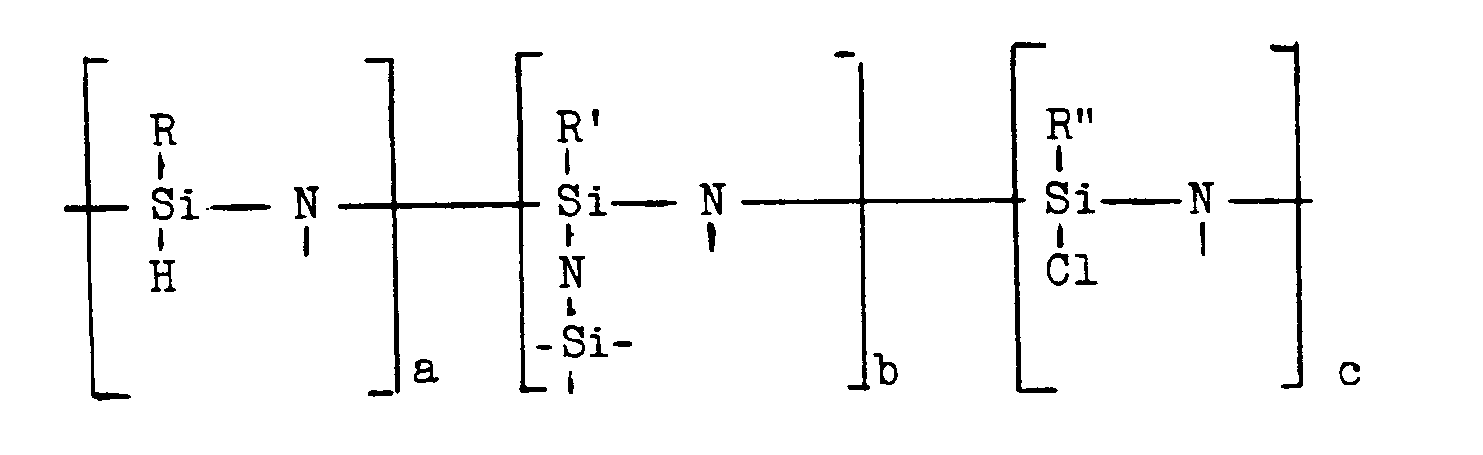
wobei die freien Valenzen der Stickstoffatome mit H-Atomen oder Silylresten R*SiXN< (X = H, Cl, N<) abgesättigt sind und wobei R, R′, R˝, R* Alkylgruppen mit 1 bis 6 C-Atomen und a, b, c die Molfraktionen der jeweiligen Struktureinheiten bedeuten, bei einer Temperatur unterhalb des Erweichungspunktes der polymeren Hydridochlorsilazane durch Behandlung mit gasförmigem NH₃ unschmelzbar macht und sie dann in einer NH₃ enthaltenden Atmosphäre bei Temperaturen von 700 bis 1500°C pyrolysiert. - Vorzugsweise sind R, R′, R˝, R* Alkylgruppen mit 1 bis 3 C-Atomen. Besonders bevorzugt ist R = R′ = R˝ = R* = CH₃.
- Eine mögliche Ausführungsform besteht darin, daß man das polymere Hydridochlorsilazan in einer NH₃ enthaltenden Atmosphäre von einer Temperatur unterhalb des Erweichungspunktes bis zur gewählten Pyrolysetemperatur aufheizt. Dabei wird das Polymere zu Beginn des Aufheizens unschmelzbar gemacht und direkt anschließend pyrolysiert.
- Man kann aber auch das Polymere zunächst unschmelzbar machen und dann in einem späteren Schritt pyrolysieren.
- Bei Pyrolysetemperaturen unterhalb 1200°C entstehen amorphe Werkstoffe, während sich bei Pyrolysetemperaturen im Bereich von 1200 bis 1500°C mikrokristalline bis kristalline keramische Werkstoffe bilden, die als kristalline Phase α-Si₃N₄ enthalten.
- Die als Ausgangsprodukte eingesetzten polymeren Hydridochlorsilazane können dadurch erhalten werden, daß man Oligohydridoalkylsilazane der allgemeinen Formel (R¹SiHNH)n worin n etwa 3 bis 12 ist und R¹ eine Alkylgruppe mit 1 bis 6 C-Atomen bedeutet, mit einem Dichlorhydridoalkylsilan der allgemeinen Formel R²SiHCl₂, worin R² eine Alkylgruppe mit 1 bis 6 C-Atomen bedeutet, bei 30 bis 300°C umsetzt. Es werden dabei leichtflüchtige Nebenprodukte gebildet. Diese werden während der Reaktion entfernt.
- Die eben genannten Oligchydridoalkylsilazane (R¹SiHNH)n können wiederum dadurch erhalten werden, daß man ein Dichlorhydridoalkylsilan der Formel R¹SiHCl₂, wobei R¹ die obige Bedeutung hat, mit überschüssigem NH₃ in einem Lösungsmittel umsetzt, wie in US-A-4 482 669 beschrieben (siehe dort insbesondere Spalten 4, 5, 7, 8). Dabei entsteht im allgemeinen ein Gemisch linearer und cyclischer Oligomerer mit verschiedenen Kettenlängen n.
- Die Reste R¹ und R² in den Oligohydridoalkylsilazanen (R¹SiHNH)n (im folgenden auch kurz "Oligosilazane" genannt) bzw. im Dichlorhydridoalkylsilan R²SiHCl₂ (im folgenden auch kurz "Dichloralkylsilan" genannt) können gleich oder verschieden sein, vorzugsweise haben sie 1 bis 4 C-Atome.
- Besonders bevorzugt ist es, daß R¹ = R² = CH₃ ist. Vorzugsweise beträgt das molare Verhältnis der Reaktanten (bei der obigen Umsetzung zum polymeren Hydridochlorsilazan) Dichloralkylsilan:R¹SiHNH-Einheit des Oligosilazans etwa 0,2:1 bis 1,5:1, insbesondere 0,3:1 bis 1:1.
- Zur Bildung der polymeren Hydridochlorsilazane werden vorzugsweise die Oligosilazane vorgelegt und das Dichloralkylsilan zugegeben. Da die Reaktion exotherm ist, wird beim Zusammengeben der Reaktanten vorzugsweise zunächst die Temperatur bei 30 bis 50°C gehalten. Anschließend erhitzt man auf Temperaturen von 100 bis 300°C, vorzugsweise auf 120 bis 250°C.
- Die bei der Herstellung der polymeren Hydridochlorsilazane als Nebenprodukte gebildeten Leichtsieder, wie RSiHCl₂, RSiClH₂, RSiCl₃, HCl, H₂, NH₃ (wobei R = R¹ oder R² ist), entweichen während der Reaktion teilsweise. Nach beendeter Umsetzung werden die restlichen Leichtsieder im allgemeinen durch Anlegen von Vakuum aus dem Reaktionsgefäß entfernt.
- Das bei dieser Reaktion ebenfalls entstehende NH₄Cl sublimiert im Verlauf der Reaktion zum größten Teil aus dem Reaktionsgemisch ab. Der eventuell verbliebene Rest des NH₄Cl kann durch Extraktion mit einem inerten organischen Lösungsmittel, wie n-Hexan, Toluol, Ether von dem polymeren Hydridochlorsilazan abgetrennt werden.
- Die Reaktionsdauer richtet sich nach der Geschwindigkeit des Aufheizens und der Reaktionstemperatur. Im allgemeinen genügt eine Reaktionszeit von 5 bis 7 Stunden.
- Es ist auch möglich, die polymeren Hydridochlorsilazane in einem organischen Lösungsmittel herzustellen. Geeignet sind solche Lösungsmittel, die sich inert gegenüber den Reaktanten verhalten und einen ausreichend hohen Siedepunkt aufweisen, also z.B. gesättigte aliphatische oder aromatische Kohlenwasserstoffe wie n-Decan, Decalin, Xylol, Toluol, chlorierte Kohlenwasserstoff wie Chlorbenzol, oder Ether wie Dibenzylether, Diethylenglykoldiethylether. Bei Verwendung eines Lösungsmittels, in dem das gebildete NH₄Cl unlöslich ist, kann letzteres durch Filtration abgetrennt werden. Die polymeren Hydridochlorsilazane werden dann durch Abdestillation des Lösungsmittels unter reduziertem Druck erhalten.
- Gegebenenfalls kann das Verfahren auch unter vermindertem Druck durchgeführt werden. Auch bei Drücken im Bereich von 1 bis 10 Atmosphären kann gearbeitet werden.
- Die Herstellung der polymeren Hydridochlorsilazane kann auch kontinuierlich durchgeführt werden.
- Die polymeren Hydridochlorsilazane, die als Ausgangsprodukte für das Siliziumnitrid enthaltende keramische Material eingesetzt werden, haben eine molekulare Struktur, die durch die Formel

wiedergegeben werden kann, wobei die freien Valenzen an den Stickstoffatomen mit H-Atomen oder Silylresten R*SiXN< (X = H, Cl oder N<) abgesättigt sind. R, R′, R˝, R* bedeuten dabei Alkylgruppen mit 1 bis 6, vorzugsweise 1 bis 3 C-Atomen, und a, b, c bedeuten die Molfraktionen der jeweiligen Struktureinheiten. Es ist a + b + c = 1. Besonders bevorzugt ist R = R′ = R˝ = R* = CH₃. Die polymeren Hydridochlorsilazane haben eine netzartige Struktur. - Die Werte der Molfraktionen b und c sind umso höher (und entsprechend der Wert von a umso niedriger), je höher das Verhältnis Dichloralkylsilan:R¹SiHNH-Einheit des Oligosilazans ist. Die jeweils vorliegenden Werte von a, b, c können durch Integration der ¹H-NMR-Spktren und durch die Elementaranalyse ermittelt werden. Im allgemeinen liegen die Werte a, b, c, bei 0,1 bis 0,8 wobei a + b + c = 1 ist. Bevorzugt sind solche polymeren Hydridochlorsilazane, bei denen die Werte für a und b bei 0,1 bis 0,5 liegen, insbesondere bei 0,2 bis 0,4. Die bevorzugten Werte für c liegen bei 0,1 bis 0,6, insbesondere bei 0,3 bis 0,6. Diese Werte lassen sich, wie gesagt, über den relativen Anteil des Dichloralkylsilans im Reaktionsgemisch einstellen und über die genannten Analysenmethoden kontrollieren. Die eben genannten bevorzugten Werte für a, b, c haben sich besonders bewährt, wenn als Endprodukte der Pyrolyse (nach Umwandlung der polymeren Hydridochlorsilazane in Polyhydridosilazane) eine Faser hergestellt werden soll.
- Die polymeren Hydridochlorsilazane sind aufgrund ihrer physikalischen und chemischen Eigenschaften hervorragende Ausgangsmaterialien für die Herstellung präkeramischer Formkörper. Sie sind beispielsweise in organischen Lösungsmitteln löslich und bilden hinreichend stabile Schmelzen, um eine ganze Reihe von Formgebungsverfahren anwenden zu können, insbesondere bilden sie klare, blasenfreie Schmelzen, so daß aus diesen Schmelzen kontinuierliche, fehlerfreie Fasern gesponnen werden können.
- Fasern lassen sich beispielsweise durch Spinnen einer Schmelze des polymeren Hydridochlorsilazans durch eine Spinndüse erhalten, die vorzugsweise einen Durchmesser von etwa 80 bis 200 µm hat. Durch anschließendes Strecken wird die Faser verjüngt, so daß nach der Pyrolyse eine sehr feste Faser von 2 bis 20 µm Durchmesser entsteht. Die Temperatur der Spinnschmelze liegt im allgemeinen bei 100 bis 200°C. Die so erhaltenen Polymerfasern werden dann einer NH₃-haltigen Atmosphäre ausgesetzt und anschließend in einer reduzierenden Atmosphäre wie Ammoniak, Wasserstoff oder deren Mischungen mit inerten Gasen, wie Stickstoff oder Edelgasen, pyrolysiert.
- Die durch die Pyrolyse hergestellten Fasern finden Verwendung als mechanische Verstärkungseinlagerungen in faserverstärktem Aluminium, Aluminiumlegierungen und Keramikbauteilen.
- Eine weitere wichtige Verarbeitungsmöglichkeit der polymeren Hydridochlorsilazane besteht in der Herstellung dichter, gut haftender amorpher oder mikrokristalliner keramischer Beschichtungen auf Metallen oder Keramiken wie Al₂O₃, ZrO₂, MgO, SiC oder Si₃N₄. Die Beschichtung erfolgt z.B. durch Eintauchen des zu beschichtenden Körpers in eine Schmelze des polymeren Hydridochlorsilazans bei 100 - 200°C. Die Schmelze zum Verspinnen oder Beschichten wird vorzugsweise unter Inertgasschutz hergestellt.
- Die keramischen Beschichtungen eignen sich wegen ihrer hervorragenden Haftung, hohen Härte und Oberflächengüte besonders zur Oberflächenveredelung von mechanisch und chemisch beanspruchten Maschinenbauteilen.
- Selbstverständlich können zur Herstellung von Fasern und Beschichtungen auch Lösungen der polymeren Hydridochlorsilazane in organischen Lösungsmitteln, wie Ethern, aliphatischen und aromatischen, ggf. chlorierten, Kohlenwasserstoffen eingesetzt werden.
- Dabei lassen sich Fasern aus hochviskosen Lösungen des polymeren Hydridochlorsilazans in Lösungsmitteln, wie Toluol, THF oder Hexan ziehen. Das Fasernziehen geschieht vorteilhafterweise wieder mittels Spinndüsen von 80 bis 150 µm Durchmesser, wobei wieder durch anschließendes Strecken der Faden verjüngt wird, so daß nach der Pyrolyse ein sehr fester Faden von 2 bis 20 µm, insbesondere 5 bis 15 µm Durchmesser entsteht. Anschließend wird der Faden nach weitgehender Verdampfung des Lösungsmittels unschmelzbar gemacht und pyrolysiert, wie oben bei den aus der Schmelze gesponnenen Fasern beschrieben.
- Auch die Beschichtung kann mit Hilfe einer Lösung des polymeren Hydridochlorsilazans in organischen Lösungsmitteln wie Toluol, THF, Hexan erfolgen. Anschließend wird die Beschichtung nach weitgehender Verdampfung des Lösungsmittels unschmelzbar gemacht und pyrolysiert, wie oben bei den aus der Schmelze gesponnenen Fasern beschrieben.
- Das Unschmelzbarmachen und die pyrolytische Umwandlung in amorphes bzw. mikrokristallines Material erfolgt also auf die gleiche Weise, wie oben beschrieben, gleichgültig ob es sich um dreidimensionale Formkörper oder aus Schmelzen oder Lösungen gewonnenen Fasern oder Beschichtungen handelt.
- In 800 ml absolutem THF wurden 100 ml (0.97 mol) Methyldichlorsilan gelöst und für 3 Stunden Ammoniak eingeleitet (Einleitungsgeschwindigkeit: 0,5 l/min). Durch Kühlen mit einem Eisbad wurde die Reaktionstemperatur im Bereich von 20 bis 25°C gehalten. Zur Vervollständigung der Reaktion wurde 1 Stunde bei Raumtemperatur gerührt und anschließend unter Argon das Ammoniumchlorid abgetrennt. Der Niederschlag wurde zweimal mit je 350 ml THF gewaschen und die vereinigten THF-Lösungen unter reduziertem Druck eingeengt. Man erhielt ein klares, leicht bewegliches Öl von (CH₃SiHNH)n in einer Ausbeute von 44,5 g = 78 % der Theorie.
- 108,8 g (1,84 mol) Oligohydridomethylsilazan wurden bei 30 bis 45°C mit 176,1 g (1.53 mol) Methyldichlorsilan versetzt und im Ölbad innerhalb von 7 Stunden auf 200°C erhitzt. Dabei stieg die Innentemperatur von 46°C auf 164°C an. Oberhalb von 100°C setzte eine kräftige Gasentwicklung ein. Nach beendeter Reaktion und Abkühlung erhielt man ein sprödes Harz. Der Gesamtinhalt des Reaktionskolbens betrug 134 g. Das Harz wurde mit 500 ml THF extrahiert, der Rückstand anschließend mit 50 ml n-Hexan gewaschen und die organischen Lösungsmittel im Vakuum abgezogen. Zurück blieben 109 g eines weißen Pulvers der chemischen Zusammensetzung C₁H3,62Cl0,38N0,8Si₁ .

Molmasse: 1865 g/mol, osmometrisch in Benzol - ¹H-NMR:
- (100 MHz, CDCl₃, ppm): δ = 0,2 - 0,8 (br, 3H, SiCH₃), 1,5 - 1,9 (br, 0,1H, NH), 4,5 (br), 4,7 - 5,0 (br) und 5,1 (br, 0,4H, SiH).
- IR:
- (KBr, cm⁻¹): 3380 (sh), 3150 (br, vs), 3050 (s), 2840 (w), 2160 (s), 1410 (vs), 1270 (vs), 1200 - 950 (br), 900 (br, vs), 760 (br, s).
- 20 g des polymeren Hydridochlorsilazans wurden unter N₂-Schutzgas in eine Schmelzspinnapparatur gegeben, auf 140°C erhitzt, und die Schmelze mittels eines Kolbens durch eine Spinndüse von 0,7 mm Durchmesser gedrückt. Unter dem eigenen Gewicht wurde die Spinnfaser zu einer Faserstärke von 20 µm gestreckt.
- Die resultierenden Fasern wurden bei Raumtemperatur mit NH₃-Gas behandelt und dadurch unschmelzbar gemacht und anschließend in einem Ofen unter NH₃-Atmosphäre pyrolysiert. Dazu wurde die Temperatur während 7 Stunden von 25°C auf 1200°C erhöht, 1 Stunde bei 1200°C gehalten und dann während 4 Stunden wieder auf Raumtemperatur gesenkt. Die resultierende Faser war röntgenamorph und enthielt neben Si und N als Hauptbestandteilen noch 0,1 % C, 0,6 % Cl und 2,0 % 0. Die keramische Ausbeute der Pyrolyse betrug 64 Gew.-%. Die Zugfestigkeit der Faser betrug 2 GPa.
- Man arbeitete wie in Beispiel 1a) bis 1c). Anschließend wurde jedoch bei 1300°C statt bei 1200°C pyrolysiert:
- Die Polymerfaser wurde mittels NH₃-Behandlung bei 25°C unschmelzbar gemacht und anschließend unter NH₃-Atmosphäre in 7 Stunden auf 1300°C erhitzt, 1 Stunde bei dieser Temperatur pyrolysiert und dann die Temperatur langsam während 5 Stunden auf Raumtemperatur gesenkt. Die resultierende Faser bestand aufgrund der Röntgenbeugungsanalyse teilweise aus kristallinem α-Si₃N₄ neben amorphem Material. Die chemische Analyse ergab neben Si und N als Hauptbestandteilen noch 0,1 % C sowie 1,1 % Cl und 1,3 Gew.-% 0. Die Zugfestigkeit der Faser betrug 2,2 GPa.
Claims (10)

Applications Claiming Priority (2)
| Application Number | Priority Date | Filing Date | Title |
|---|---|---|---|
| DE3824614 | 1988-07-20 | ||
| DE3824614A DE3824614A1 (de) | 1988-07-20 | 1988-07-20 | Verfahren zur herstellung von siliziumnitrid enthaltendem keramischem material aus polymeren hydridochlorsilazanen |
Publications (3)
| Publication Number | Publication Date |
|---|---|
| EP0351747A2 EP0351747A2 (de) | 1990-01-24 |
| EP0351747A3 EP0351747A3 (de) | 1991-01-23 |
| EP0351747B1 true EP0351747B1 (de) | 1992-07-01 |
Family
ID=6359130
Family Applications (1)
| Application Number | Title | Priority Date | Filing Date |
|---|---|---|---|
| EP89113047A Expired - Lifetime EP0351747B1 (de) | 1988-07-20 | 1989-07-15 | Verfahren zur Herstelllung von Siliziumnitrid enthaltendem keramischem Material aus polymeren Hydridochlorsilazanen |
Country Status (4)
| Country | Link |
|---|---|
| US (1) | US5075266A (de) |
| EP (1) | EP0351747B1 (de) |
| JP (1) | JP2749883B2 (de) |
| DE (2) | DE3824614A1 (de) |
Families Citing this family (3)
| Publication number | Priority date | Publication date | Assignee | Title |
|---|---|---|---|---|
| US5189132A (en) * | 1988-12-03 | 1993-02-23 | Hoechst Aktiengesellschaft | Polymeric hydridochlorosilazanes, process for their preparation, ceramic materials containing silicon nitride which can be manufactured therefrom, and their manufacture |
| DE4002384A1 (de) * | 1990-01-27 | 1991-08-01 | Hoechst Ag | (alpha),(omega)-chlorsilazane und verfahren zu ihrer herstellung |
| DE4031315A1 (de) * | 1990-10-04 | 1992-04-09 | Hoechst Ag | Verfahren zur herstellung von polymeren chlorsilazanen |
Family Cites Families (12)
| Publication number | Priority date | Publication date | Assignee | Title |
|---|---|---|---|---|
| DE2218960A1 (de) * | 1972-04-19 | 1973-11-08 | Bayer Ag | Formkoerper aus mogenen mischungen von siliciumcarbid und siliciumnitrid und verfahren zu ihrer erstellung |
| DE2243527A1 (de) * | 1972-09-05 | 1974-04-18 | Bayer Ag | Formkoerper aus homogenen mischungen von siliciumcarbid und siliciumnitrid und verfahren zu ihrer herstellung |
| US4535007A (en) * | 1984-07-02 | 1985-08-13 | Dow Corning Corporation | Silicon nitride-containing ceramics |
| US4757035A (en) * | 1984-09-21 | 1988-07-12 | Dow Corning Corporation | Ceramic materials with increased crystallinity from silazane polymers |
| JPS61295274A (ja) * | 1985-06-24 | 1986-12-26 | チッソ株式会社 | セラミツク成形体の製造方法 |
| FR2590584B1 (fr) * | 1985-11-28 | 1988-03-04 | Rhone Poulenc Spec Chim | Procede de preparation, en deux etapes, de reticulats d'organopolysilazanes de tenue thermique amelioree pouvant servir notamment comme precurseur ceramique |
| JPS62290730A (ja) * | 1986-06-10 | 1987-12-17 | Shin Etsu Chem Co Ltd | 有機シラザン重合体の製造方法 |
| JPH0764642B2 (ja) * | 1986-06-13 | 1995-07-12 | 東燃株式会社 | 窒化物系セラミツクスの製法 |
| US4743662A (en) * | 1986-11-03 | 1988-05-10 | Dow Corning Corporation | Infusible preceramic polymers via plasma treatment |
| US4742143A (en) * | 1986-11-04 | 1988-05-03 | Dow Corning Corporation | Preceramic polymers derived from cyclic silazanes, and halosilanes and a method for their preparation |
| US4800182A (en) * | 1987-01-22 | 1989-01-24 | Mitsubishi Gas Chemical Company, Inc. | Silicon nitride-silicon carbide composite material and process for production thereof |
| EP0305759A1 (de) * | 1987-08-31 | 1989-03-08 | Gte Laboratories Incorporated | Si3N4-Verfahren unter Verwendung von Polysilan oder Polysilazan als Binder |
-
1988
- 1988-07-20 DE DE3824614A patent/DE3824614A1/de not_active Withdrawn
-
1989
- 1989-07-15 DE DE8989113047T patent/DE58901767D1/de not_active Expired - Fee Related
- 1989-07-15 EP EP89113047A patent/EP0351747B1/de not_active Expired - Lifetime
- 1989-07-18 US US07/381,501 patent/US5075266A/en not_active Expired - Fee Related
- 1989-07-19 JP JP1184853A patent/JP2749883B2/ja not_active Expired - Lifetime
Also Published As
| Publication number | Publication date |
|---|---|
| EP0351747A2 (de) | 1990-01-24 |
| DE58901767D1 (de) | 1992-08-06 |
| JPH02153808A (ja) | 1990-06-13 |
| JP2749883B2 (ja) | 1998-05-13 |
| EP0351747A3 (de) | 1991-01-23 |
| DE3824614A1 (de) | 1990-01-25 |
| US5075266A (en) | 1991-12-24 |
Similar Documents
| Publication | Publication Date | Title |
|---|---|---|
| EP0372381B1 (de) | Verfahren zur Herstellung von Faserverbundkeramik | |
| EP0319794B1 (de) | Polysilazane, Verfahren zu ihrer Herstellung und Verfahren zur Herstellung von Siliziumnitrid enthaltenden keramischen Materiallen. | |
| DE3805796A1 (de) | Verfahren zur herstellung von organischen silazanpolymeren und keramikmaterialien daraus | |
| EP0315907B1 (de) | Polysilazane, Verfahren zu ihrer Herstellung, sowie die Herstellung Siliziumnitrid enthaltender keramischer Materialen. | |
| EP0313878B1 (de) | Polymere Hydridosilazane und Verfahren zu ihrer Herstellung sowie ihre Verwendung | |
| EP0312825B1 (de) | Polymere Hydridochlorsilazane und Verfahren zu ihrer Herstellung | |
| EP0351747B1 (de) | Verfahren zur Herstelllung von Siliziumnitrid enthaltendem keramischem Material aus polymeren Hydridochlorsilazanen | |
| EP0444555B1 (de) | Faserverstärkte Verbundwerkstoffe und Verfahren zu ihrer Herstellung | |
| EP0372379B1 (de) | Chlorhaltige Silazanpolymere, Verfahren zu ihrer Herstellung, Verfahren zur Herstellung von Siliziumnitrid enthaltenden keramischen Materialien | |
| EP0375974B1 (de) | Polysubstituierte chlorhaltige Silazanpolymere, Verfahren zu ihrer Herstellung, sowie deren Verwendung zur Herstellung Siliziumnitrid enthaltender keramischer Materialien | |
| EP0375973B1 (de) | Polymere Chlorsilazane, Verfahren zu ihrer Herstellung sowie Verfahren zur Herstellung von Siliziumnitrid enthaltenden keramischen Materialien | |
| EP0383164B1 (de) | Hochfeste Verbundkeramik, Verfahren zu ihrer Herstellung sowie ihre Verwendung | |
| EP0372377B1 (de) | Polymere ethylenverbrückte Chlorsilazane, Verfahren zu ihrer Herstellung, sowie ein Verfahren zur Herstellung von Siliziumnitrid enthaltenden keramischen Materialien. | |
| DE3840776A1 (de) | Oligomere silazane und verfahren zu ihrer herstellung | |
| EP0375972B1 (de) | Polymere Hydridochlorsilazane, Verfahren zu ihrer Herstellung, sowie deren Verwendung zur Herstellung Siliziumnitrid enthaltender keramischer Materialien | |
| EP0321916B1 (de) | Polymere Hydridosilazane, Verfahren zu ihrer Herstellung, sowie die Herstellung Siliziumnitrid enthaltender keramischer Materialien | |
| EP0321917B1 (de) | Polymere Hydridothiosilazane, Verfahren zu ihrer Herstellung, sowie die Herstellung Siliziumnitrid enthaltender keramischer Materialien | |
| EP0439844A2 (de) | SiC1-Gruppen enthaltende Silazanpolymere, Verfahren zu ihrer Herstellung, aus ihnen herstellbare, Siliciumnitrid enthaltende keramische Materialien, sowie deren Herstellung | |
| DE3840778A1 (de) | Polysubstituierte oligosilazane und verfahren zu ihrer herstellung |
Legal Events
| Date | Code | Title | Description |
|---|---|---|---|
| PUAI | Public reference made under article 153(3) epc to a published international application that has entered the european phase |
Free format text: ORIGINAL CODE: 0009012 |
|
| AK | Designated contracting states |
Kind code of ref document: A2 Designated state(s): BE DE FR GB IT NL |
|
| PUAL | Search report despatched |
Free format text: ORIGINAL CODE: 0009013 |
|
| AK | Designated contracting states |
Kind code of ref document: A3 Designated state(s): BE DE FR GB IT NL |
|
| 17P | Request for examination filed |
Effective date: 19901221 |
|
| 17Q | First examination report despatched |
Effective date: 19910809 |
|
| GRAA | (expected) grant |
Free format text: ORIGINAL CODE: 0009210 |
|
| AK | Designated contracting states |
Kind code of ref document: B1 Designated state(s): BE DE FR GB IT NL |
|
| REF | Corresponds to: |
Ref document number: 58901767 Country of ref document: DE Date of ref document: 19920806 |
|
| ITF | It: translation for a ep patent filed | ||
| GBT | Gb: translation of ep patent filed (gb section 77(6)(a)/1977) | ||
| ET | Fr: translation filed | ||
| PLBE | No opposition filed within time limit |
Free format text: ORIGINAL CODE: 0009261 |
|
| STAA | Information on the status of an ep patent application or granted ep patent |
Free format text: STATUS: NO OPPOSITION FILED WITHIN TIME LIMIT |
|
| 26N | No opposition filed | ||
| PGFP | Annual fee paid to national office [announced via postgrant information from national office to epo] |
Ref country code: NL Payment date: 19980527 Year of fee payment: 10 |
|
| PGFP | Annual fee paid to national office [announced via postgrant information from national office to epo] |
Ref country code: GB Payment date: 19980603 Year of fee payment: 10 |
|
| PGFP | Annual fee paid to national office [announced via postgrant information from national office to epo] |
Ref country code: FR Payment date: 19980609 Year of fee payment: 10 Ref country code: BE Payment date: 19980609 Year of fee payment: 10 |
|
| PGFP | Annual fee paid to national office [announced via postgrant information from national office to epo] |
Ref country code: DE Payment date: 19980910 Year of fee payment: 10 |
|
| PG25 | Lapsed in a contracting state [announced via postgrant information from national office to epo] |
Ref country code: GB Free format text: LAPSE BECAUSE OF NON-PAYMENT OF DUE FEES Effective date: 19990715 |
|
| PG25 | Lapsed in a contracting state [announced via postgrant information from national office to epo] |
Ref country code: FR Free format text: THE PATENT HAS BEEN ANNULLED BY A DECISION OF A NATIONAL AUTHORITY Effective date: 19990731 Ref country code: BE Free format text: LAPSE BECAUSE OF NON-PAYMENT OF DUE FEES Effective date: 19990731 |
|
| BERE | Be: lapsed |
Owner name: HOECHST A.G. Effective date: 19990731 |
|
| PG25 | Lapsed in a contracting state [announced via postgrant information from national office to epo] |
Ref country code: NL Free format text: LAPSE BECAUSE OF NON-PAYMENT OF DUE FEES Effective date: 20000201 |
|
| GBPC | Gb: european patent ceased through non-payment of renewal fee |
Effective date: 19990715 |
|
| NLV4 | Nl: lapsed or anulled due to non-payment of the annual fee |
Effective date: 20000201 |
|
| PG25 | Lapsed in a contracting state [announced via postgrant information from national office to epo] |
Ref country code: DE Free format text: LAPSE BECAUSE OF NON-PAYMENT OF DUE FEES Effective date: 20000503 |
|
| REG | Reference to a national code |
Ref country code: FR Ref legal event code: ST |
|
| PG25 | Lapsed in a contracting state [announced via postgrant information from national office to epo] |
Ref country code: IT Free format text: LAPSE BECAUSE OF NON-PAYMENT OF DUE FEES;WARNING: LAPSES OF ITALIAN PATENTS WITH EFFECTIVE DATE BEFORE 2007 MAY HAVE OCCURRED AT ANY TIME BEFORE 2007. THE CORRECT EFFECTIVE DATE MAY BE DIFFERENT FROM THE ONE RECORDED. Effective date: 20050715 |