EP0351848A2 - Dispositif de synthèse de la parole - Google Patents
Dispositif de synthèse de la parole Download PDFInfo
- Publication number
- EP0351848A2 EP0351848A2 EP89113343A EP89113343A EP0351848A2 EP 0351848 A2 EP0351848 A2 EP 0351848A2 EP 89113343 A EP89113343 A EP 89113343A EP 89113343 A EP89113343 A EP 89113343A EP 0351848 A2 EP0351848 A2 EP 0351848A2
- Authority
- EP
- European Patent Office
- Prior art keywords
- wave
- pitch
- segment
- segments
- voice
- Prior art date
- Legal status (The legal status is an assumption and is not a legal conclusion. Google has not performed a legal analysis and makes no representation as to the accuracy of the status listed.)
- Granted
Links
Images




Classifications
-
- G—PHYSICS
- G10—MUSICAL INSTRUMENTS; ACOUSTICS
- G10L—SPEECH ANALYSIS TECHNIQUES OR SPEECH SYNTHESIS; SPEECH RECOGNITION; SPEECH OR VOICE PROCESSING TECHNIQUES; SPEECH OR AUDIO CODING OR DECODING
- G10L13/00—Speech synthesis; Text to speech systems
- G10L13/06—Elementary speech units used in speech synthesisers; Concatenation rules
Definitions
- the present invention relates to a voice synthesizing device which compiles wave segments such as pitch wave segments and quasi-voice wave segments to reproduce a voice wave.
- the waves of voiced sounds such as vowels have a redundant pitch structure in which essentially the same wave is repeated from several to dozen times within a cycle of from 2 or 3 ms to 10 ms.
- voice synthesizers have employed a phoneme segment compiling method using the above pitch structure to generate a synthesized voice.
- Voice synthesizers of this type repeat and connect pitch wave segments or quasi-voice wave segments for a predetermined period to synthesize a voice wave. This serves to reduce the amount of wave segment data for said pitch wave segments or quasi-voice wave segments, and maintains high quality in the eventually synthesized voice.
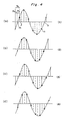
- Fig. 4 shows an example of the pitch wave segment used in voice waveform synthesis.
- Each double circle in Fig. 4 shows the sampled value at every sampling time (hereafter referred to as a sampled value); the solid lines drawn perpendicular to the time axis from these points represent the sampling time; the dotted lines drawn perpendicular to the time axis between these sampling points represent the interpolated sampling time at which said sampled value is interpolated to output the interpolated value during the waveform synthesis.
- the pitch wave segment shown in Fig. 4 may be of one of the following four wave types depending on the position at which the wave crosses the zero point.
- the sampling time period Ts is divided into two phases, the first referred to as P1 and the later as P2.
- P1 the first referred to as P1
- P2 the first referred to as P2
- P3 the first referred to as P2
- P3 the first referred to as P2
- P2 the first referred to as P2
- P3 the first referred to as P2
- P2 the first referred to as P2
- P2 the zero cross point o for the interpolated waveform of end sampled value of the pitch segment falls within the range P2.
- wave type (2) shown in Fig. 4(b) the zero cross point for the interpolated waveform of top sampled value of the pitch segment falls within the range P1
- the zero cross point for the interpolated waveform of end sampled value of the pitch segment falls within the range P1.
- the zero cross point for the interpolated waveform of top sampled value of the pitch segment falls within the range P2, and the zero cross point for the interpolated waveform of end sampled value of the pitch segment falls within the range P1.
- wave type (4) shown in Fig. 4(d) the zero cross point for the interpolated waveform of top sampled value of the pitch segment falls within the range P1
- the zero cross point for the interpolated waveform of end sampled value of the pitch segment falls within the range P2.
- one pitch wave segment is cut out, temporarily converted to a frequency axis wave by fast Fourier transformation (FFT) analysis, and reconverted to a time axis wave by reverse FFT after phase adjustment so that both ends of the pitch wave segment can approach zero.
- FFT fast Fourier transformation
- LPC linear predictive coding
- a voice synthesizing device of the present invention for compiling wave segments such as pitch wave segments in speech to synthesize speech is characterized by the provision of a connection type memory for storing a connection type descriptive of the connection state of that point where said wave segments are connected; and a wave segment connector which, when said wave segments are connected, connects the end sampling point and the lead sampling point of the wave segments with a conventional sampling period, or with a conventional sampling period compressed or expanded by only 1/2 of the sampling period according to the connection type stored in said connection type memory.
- connection type stored in the connection type memory is referenced.
- the end and leading sampling points of the wave segments are connected with a conventional sampling period, or with a conventional sampling period compressed or expanded by only 1/2 of the sampling period so that said wave segments are connected smoothly to provide a synthesized voice wave.
- FIG. 1 shows a block diagram of a voice synthesizing device according to the present invention.
- Reference number 1 is a control ROM (read-only memory) which stores a control program used by CPU (central processing unit) 5 for voice synthesis;
- reference numeral 2 is a RAM (random access memory) used as a work memory during voice synthesis;
- reference numeral 3 is a data ROM used to store voice coding data;
- reference numeral 4 is an I/O interface through which input/output signals pass at the start of voice synthesis and other processes;
- control ROM 1, RAM 2, data ROM 3, I/O interface 4, CPU 5, and D/A convertor 6, all used in the voice synthesizing device of the above construction can be integrated together on a single chip, and it is also possible to employ an external data ROM 9 for storing voice coding data for systems expansion.
- a start signal necessary to initiate the voice synthesis is input to a voice synthesizing device of the above construction from an external source through I/O interface 4,
- CPU 5 begins the voice synthesizing operation based on the control program stored in the control ROM 1.
- a voice synthesis wave data is generated by CPU 5 based on the voice coding data stored in the data ROM 3.
- the generated voice synthesis wave data is converted to an analog signal by D/A convertor 6, then amplified by amplifier 7 and is finally outputted as a synthesized voice from the loudspeaker 8.
- the voice synthesizing device generates a synthesized voice free of distortion in the pitch wave rise by connecting wave segments such as pitch wave segments or quasi-voice wave segments to generate the synthesized voice.
- connection type 0a when the connection of such pitch wave segments as just described shall be referred to as connection type 0a.
- connection type 2-(a) the connection of such pitch wave segments as just described shall be referred to as connection type 2-(a).
- sampling is performed at a cycle twice (twice the frequency) that defined by the Nyquist theorem.
- the sampling data used for voice synthesis is resampled at the standard Nyquist theorem cycle from the sampling point which is nearest the pitch segment rise.
- This wave is illustrated in Fig. 6.
- the even-numbered sampling points are the sampling points (those shown by a solid line in Fig. 6) occurring in the Nyquist theorem cycle
- the odd-numbered sampling points are the sampling points occurring between even-numbered sampling points.
- sampling data obtained at the sampling points indicated by a double circle are the sampled values (which are hereinafter referred to as object samples) which will be the object of voice synthesis.
- These segments may be either wave type (1) or type (2).
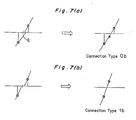
- connection type 0b connection of such pitch wave segments
- connection type 1b connection of such pitch wave segments
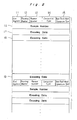
- Fig. 2 shows one example of the data format when, for example, the pitch wave segments are analyzed and the resulting pitch wave segment data is stored in ROM 3 (see Fig. 1).
- the illustrated data format is comprised of encoding data of multiple pitch wave segments, each of said encoding data for each pitch wave segment including interpolation data and voice data.
- the interpolation data consists of end segment data 11 identifying whether the pitch wave segment is the last pitch wave segment or not, encoding method data 12 identifying the method used to encode the sampled data of the pitch wave segment, repeat number data 13 telling how many times the pitch wave segment was repeated, connection type data 14, as shown in Fig. 5 and Fig.
- connection type data 15 (hereinafter referred to as a next pitch wave segment connection type) for when the given pitch wave segment is connected to the next adjacent pitch wave segment.
- the voice data includes a sample number data 16 specifying the number of encoded datum included in the pitch wave segment, and a series of multiple encoded data 17 to 19 for each sampling point used in voice synthesis.
- This encoded data is stored as a bit string according to the encoding method (e.g., pulse encode modulation (PCM) or adaptive differential pulse encode modulation (ADPCM)) stored in the encoding method data 12 for the interpolation data.
- PCM pulse encode modulation
- ADPCM adaptive differential pulse encode modulation
- step S1 1 byte of interpolation data is read from the pitch wave segment data stored in the data ROM 3 according to the format shown in Fig. 2, and the byte is divided into the end segment data 11, the encoding method data 12, the repeat number data 13, the connection type data 14, and the next pitch wave segment connection type 15. Based on the obtained information, the end segment data flag, encoding method flag, repeat counter, repeat connection type, and next pitch wave segment connection type are each set in RAM 2.
- RAM 2 has an area for storing the repeat connection type for wave segment connection and a pitch wave segment connection type for wave segment connection, and the repeat connection type of the preceding pitch wave segment data and the next pitch wave segment connection type are both set therein.
- sample number data 16 specifying the encoded datum number of one pitch wave segment is read from the data ROM 3, and this number is set in RAM 2 as the sample number count.
- the first coded datum is read from data ROM 3.
- step S4 the first coded datum is decoded according to the encoding method set in the encoding method flag of RAM 2, and the top sampled value of the pitch wave segment is computed.
- the interpolated value of the period between this top sampled value and the following sampled value (based on the second encoded datum) is then computed.
- the interpolation processing required for connection with the preceding pitch wave segment is then executed according to the next pitch wave segment connection type of the preceding pitch wave segment data set in the repeat connection type for pitch wave segments in RAM 2.
- connection type 0a and 0b the normal timing is outputted; if connection type 1a and 1b, the timing of a sampling cycle advanced by one-half is outputted; if connection type 2a and 2b, the timing of a sampling cycle delayed by one-half is output
- connection type 0a and 0b the normal timing is outputted; if connection type 1a and 1b, the timing of a sampling cycle advanced by one-half is outputted; if connection type 2a and 2b, the timing of a sampling cycle delayed by one-half is output
- step S5 the top sampled value computed at step S4 and the output timing of the preceding and following interpolated values computed in step S4 are outputted to D/A convertor 6.
- step S6 the next encoded data (second encoded datum) is read from data ROM 3.
- step S7 the next encoded datum is decoded according to the encoding method, and the next sampled value is computed. Then, the interpolated value of the period to the next sampled value is computed. The computed sampled value and the interpolated value are outputted to D/A convertor 6 at the normal timing (specifically, the normal sampling point).
- step S8 the sample counter is decremented by 1, and it is determined based on this value whether the processing of the encoded data of the current pitch wave segment has been completed or not. If the result is that all processing has been completed, the flow advances to step S9; if not, the flow returns to step S6; and in both cases processing of the next encoded data is executed.
- the repeat connection type of the preceding pitch wave segment data set at the repeat connection type for pitch wave segments in RAM 2 is reset to the repeat connection type of the current pitch wave segment data set in the repeat connection type in RAM 2.
- step S10 the repeat counter in RAM 2 is decremented by 1, and it is determined based on this value whether all repetitions of the current pitch wave segment are completed or not. If the result is completion, the flow advances to step S11; if not, the flow returns to step S3, the first encoded data of the current pitch wave segment is again inputted, and repeat processing is executed.
- next pitch wave segment connection type of the preceding pitch wave segment data set in the next pitch wave segment connection type for pitch wave segments in RAM 2 is reset to the next pitch wave segment connection type of the current pitch wave segment data set in the next pitch wave segment connection type of RAM 2.
- step S12 the end segment data flag in RAM 2 is referenced to determine whether the current pitch wave segment is the end segment. If the result is "yes”, the voice synthesis operation is completed; if "no", the flow returns to step S1, the next pitch wave segment data is read, and processing of the next pitch wave segment data begins.
- wave segment connection types are categorized by the combination of the connections of the pitch wave segments of differing wave types.
- the period between the end sampling point and the leading sampling point of connected pitch wave segments may be compressed or expanded by one-half of the normal sampling period, or the normal sampling period may be used to connect the wave segments. Therefore, pitch wave segments can be connected smoothly by a simple operation without producing any phase shift in the connection of the pitch wave segments.
- distortion does not occur in the rise of the pitch wave segment and sound quality deterioration is not produced.
- a pitch wave segment is used as the wave segment, but the present invention shall not be so limited, and a voice wave segment conforming to a pitch wave segment may also be used.
- no phase shift in the connection of wave segments occur in the synthesized voice generated by the voice synthesizing device according to the present invention because such voice synthesizing device is provided with the wave segment connector which stores a connection type which expresses the type of connection between the wave segments in the voice in a connection type memory, and when said wave segments are connected to synthesize a voice, the end and leading sampling points of said wave segments are connected by a normal sampling period or by a sampling period compressed or expanded by one-half period depending upon the connection type stored in the connection type memory.
- the period between pitch wave segments can be interpolated and the segments smoothly connected by a simple operation. Therefore, according to the present invention, voice synthesis free of distortion in the rise of connected wave segments and with no deterioration of sound quality can be achieved.
Landscapes
- Engineering & Computer Science (AREA)
- Computational Linguistics (AREA)
- Health & Medical Sciences (AREA)
- Audiology, Speech & Language Pathology (AREA)
- Human Computer Interaction (AREA)
- Physics & Mathematics (AREA)
- Acoustics & Sound (AREA)
- Multimedia (AREA)
- Electrophonic Musical Instruments (AREA)
- Compression, Expansion, Code Conversion, And Decoders (AREA)
Applications Claiming Priority (2)
| Application Number | Priority Date | Filing Date | Title |
|---|---|---|---|
| JP63183906A JPH0727397B2 (ja) | 1988-07-21 | 1988-07-21 | 音声合成装置 |
| JP183906/88 | 1988-07-21 |
Publications (3)
| Publication Number | Publication Date |
|---|---|
| EP0351848A2 true EP0351848A2 (fr) | 1990-01-24 |
| EP0351848A3 EP0351848A3 (en) | 1990-03-21 |
| EP0351848B1 EP0351848B1 (fr) | 1994-05-18 |
Family
ID=16143883
Family Applications (1)
| Application Number | Title | Priority Date | Filing Date |
|---|---|---|---|
| EP89113343A Expired - Lifetime EP0351848B1 (fr) | 1988-07-21 | 1989-07-20 | Dispositif de synthèse de la parole |
Country Status (4)
| Country | Link |
|---|---|
| US (1) | US5111505A (fr) |
| EP (1) | EP0351848B1 (fr) |
| JP (1) | JPH0727397B2 (fr) |
| DE (1) | DE68915353T2 (fr) |
Cited By (2)
| Publication number | Priority date | Publication date | Assignee | Title |
|---|---|---|---|---|
| EP0688010A1 (fr) * | 1994-06-16 | 1995-12-20 | Canon Kabushiki Kaisha | Procédé et appareil pour la synthèse du langage |
| WO2000011647A1 (fr) * | 1998-08-19 | 2000-03-02 | Christoph Buskies | Procede et dispositif permettant de concatener des segments audio en tenant compte de la coarticulation |
Families Citing this family (11)
| Publication number | Priority date | Publication date | Assignee | Title |
|---|---|---|---|---|
| DE4138016A1 (de) * | 1991-11-19 | 1993-05-27 | Philips Patentverwaltung | Einrichtung zur erzeugung einer ansageinformation |
| US5463715A (en) * | 1992-12-30 | 1995-10-31 | Innovation Technologies | Method and apparatus for speech generation from phonetic codes |
| JPH06232826A (ja) * | 1993-02-08 | 1994-08-19 | Hitachi Ltd | 音声差分pcmデータ伸長方法 |
| US6278974B1 (en) | 1995-05-05 | 2001-08-21 | Winbond Electronics Corporation | High resolution speech synthesizer without interpolation circuit |
| GB9600774D0 (en) * | 1996-01-15 | 1996-03-20 | British Telecomm | Waveform synthesis |
| US6112169A (en) * | 1996-11-07 | 2000-08-29 | Creative Technology, Ltd. | System for fourier transform-based modification of audio |
| US6249766B1 (en) * | 1998-03-10 | 2001-06-19 | Siemens Corporate Research, Inc. | Real-time down-sampling system for digital audio waveform data |
| US6182042B1 (en) | 1998-07-07 | 2001-01-30 | Creative Technology Ltd. | Sound modification employing spectral warping techniques |
| RU2296377C2 (ru) * | 2005-06-14 | 2007-03-27 | Михаил Николаевич Гусев | Способ анализа и синтеза речи |
| US8473298B2 (en) * | 2005-11-01 | 2013-06-25 | Apple Inc. | Pre-resampling to achieve continuously variable analysis time/frequency resolution |
| KR102306537B1 (ko) * | 2014-12-04 | 2021-09-29 | 삼성전자주식회사 | 소리 신호를 처리하는 방법 및 디바이스. |
Family Cites Families (9)
| Publication number | Priority date | Publication date | Assignee | Title |
|---|---|---|---|---|
| US4214125A (en) * | 1977-01-21 | 1980-07-22 | Forrest S. Mozer | Method and apparatus for speech synthesizing |
| US4419540A (en) * | 1980-02-04 | 1983-12-06 | Texas Instruments Incorporated | Speech synthesis system with variable interpolation capability |
| JPS57125999A (en) * | 1981-01-29 | 1982-08-05 | Seiko Instr & Electronics | Voice synthesizer |
| US4392018A (en) | 1981-05-26 | 1983-07-05 | Motorola Inc. | Speech synthesizer with smooth linear interpolation |
| JPS602680B2 (ja) * | 1981-06-18 | 1985-01-23 | 三洋電機株式会社 | 音声合成装置 |
| US4601052A (en) * | 1981-12-17 | 1986-07-15 | Matsushita Electric Industrial Co., Ltd. | Voice analysis composing method |
| US4433434A (en) * | 1981-12-28 | 1984-02-21 | Mozer Forrest Shrago | Method and apparatus for time domain compression and synthesis of audible signals |
| US4619359A (en) * | 1983-07-05 | 1986-10-28 | Patrick Howard Gibson | Materials handling and weighing apparatus |
| US4692941A (en) * | 1984-04-10 | 1987-09-08 | First Byte | Real-time text-to-speech conversion system |
-
1988
- 1988-07-21 JP JP63183906A patent/JPH0727397B2/ja not_active Expired - Fee Related
-
1989
- 1989-07-20 DE DE68915353T patent/DE68915353T2/de not_active Expired - Fee Related
- 1989-07-20 EP EP89113343A patent/EP0351848B1/fr not_active Expired - Lifetime
-
1990
- 1990-10-16 US US07/598,826 patent/US5111505A/en not_active Expired - Lifetime
Cited By (4)
| Publication number | Priority date | Publication date | Assignee | Title |
|---|---|---|---|---|
| EP0688010A1 (fr) * | 1994-06-16 | 1995-12-20 | Canon Kabushiki Kaisha | Procédé et appareil pour la synthèse du langage |
| US5682502A (en) * | 1994-06-16 | 1997-10-28 | Canon Kabushiki Kaisha | Syllable-beat-point synchronized rule-based speech synthesis from coded utterance-speed-independent phoneme combination parameters |
| WO2000011647A1 (fr) * | 1998-08-19 | 2000-03-02 | Christoph Buskies | Procede et dispositif permettant de concatener des segments audio en tenant compte de la coarticulation |
| US7047194B1 (en) | 1998-08-19 | 2006-05-16 | Christoph Buskies | Method and device for co-articulated concatenation of audio segments |
Also Published As
| Publication number | Publication date |
|---|---|
| US5111505A (en) | 1992-05-05 |
| JPH0727397B2 (ja) | 1995-03-29 |
| EP0351848B1 (fr) | 1994-05-18 |
| EP0351848A3 (en) | 1990-03-21 |
| JPH0232399A (ja) | 1990-02-02 |
| DE68915353D1 (de) | 1994-06-23 |
| DE68915353T2 (de) | 1994-10-20 |
Similar Documents
| Publication | Publication Date | Title |
|---|---|---|
| EP0380572B1 (fr) | Synthese vocale a partir de segments de signaux vocaux coarticules enregistres numeriquement | |
| US3828132A (en) | Speech synthesis by concatenation of formant encoded words | |
| US5682502A (en) | Syllable-beat-point synchronized rule-based speech synthesis from coded utterance-speed-independent phoneme combination parameters | |
| EP0351848B1 (fr) | Dispositif de synthèse de la parole | |
| JPS623439B2 (fr) | ||
| AU724355B2 (en) | Waveform synthesis | |
| US5808222A (en) | Method of building a database of timbre samples for wave-table music synthesizers to produce synthesized sounds with high timbre quality | |
| KR100327969B1 (ko) | 음성재생속도변환장치및음성재생속도변환방법 | |
| US4601052A (en) | Voice analysis composing method | |
| US5416264A (en) | Waveform-forming device having memory storing non-compressed/compressed waveform samples | |
| EP0144731B1 (fr) | Synthétiseur de parole | |
| JP3086333B2 (ja) | 音声合成装置及び音声合成方法 | |
| JP2002244693A (ja) | 音声合成装置および音声合成方法 | |
| EP0205298A1 (fr) | Dispositif pour la synthèse de la parole | |
| JPS59162595A (ja) | 楽音合成装置 | |
| JPS58105199A (ja) | 音声分析合成方法 | |
| JPS6295595A (ja) | 音声応答方式 | |
| KR970003092B1 (ko) | 음성 합성 단위를 구성하는 방법 및 이에 상응하는 문장 음성 합성 방법 | |
| JPS59177597A (ja) | 楽音合成装置 | |
| JPS58105197A (ja) | 音声分析合成方法 | |
| JPS6036597B2 (ja) | 音声合成装置 | |
| JPS61279900A (ja) | 音声分析合成方式 | |
| JPS58134697A (ja) | 波形編集型音声合成装置 | |
| JPS5917440B2 (ja) | 音声分析合成方法 | |
| JPH01207800A (ja) | 音声合成方式 |
Legal Events
| Date | Code | Title | Description |
|---|---|---|---|
| PUAI | Public reference made under article 153(3) epc to a published international application that has entered the european phase |
Free format text: ORIGINAL CODE: 0009012 |
|
| AK | Designated contracting states |
Kind code of ref document: A2 Designated state(s): DE FR |
|
| PUAL | Search report despatched |
Free format text: ORIGINAL CODE: 0009013 |
|
| AK | Designated contracting states |
Kind code of ref document: A3 Designated state(s): DE FR |
|
| 17P | Request for examination filed |
Effective date: 19900827 |
|
| 17Q | First examination report despatched |
Effective date: 19920326 |
|
| GRAA | (expected) grant |
Free format text: ORIGINAL CODE: 0009210 |
|
| AK | Designated contracting states |
Kind code of ref document: B1 Designated state(s): DE FR |
|
| REF | Corresponds to: |
Ref document number: 68915353 Country of ref document: DE Date of ref document: 19940623 |
|
| ET | Fr: translation filed | ||
| PLBE | No opposition filed within time limit |
Free format text: ORIGINAL CODE: 0009261 |
|
| STAA | Information on the status of an ep patent application or granted ep patent |
Free format text: STATUS: NO OPPOSITION FILED WITHIN TIME LIMIT |
|
| 26N | No opposition filed | ||
| PGFP | Annual fee paid to national office [announced via postgrant information from national office to epo] |
Ref country code: FR Payment date: 20030711 Year of fee payment: 15 |
|
| PGFP | Annual fee paid to national office [announced via postgrant information from national office to epo] |
Ref country code: DE Payment date: 20030731 Year of fee payment: 15 |
|
| PG25 | Lapsed in a contracting state [announced via postgrant information from national office to epo] |
Ref country code: DE Free format text: LAPSE BECAUSE OF NON-PAYMENT OF DUE FEES Effective date: 20050201 |
|
| PG25 | Lapsed in a contracting state [announced via postgrant information from national office to epo] |
Ref country code: FR Free format text: LAPSE BECAUSE OF NON-PAYMENT OF DUE FEES Effective date: 20050331 |
|
| REG | Reference to a national code |
Ref country code: FR Ref legal event code: ST |