EP0351969A2 - Einmalsemantik in einem Transaktionsdurchführungswarteschlangensystem - Google Patents
Einmalsemantik in einem Transaktionsdurchführungswarteschlangensystem Download PDFInfo
- Publication number
- EP0351969A2 EP0351969A2 EP89306538A EP89306538A EP0351969A2 EP 0351969 A2 EP0351969 A2 EP 0351969A2 EP 89306538 A EP89306538 A EP 89306538A EP 89306538 A EP89306538 A EP 89306538A EP 0351969 A2 EP0351969 A2 EP 0351969A2
- Authority
- EP
- European Patent Office
- Prior art keywords
- task
- data base
- transaction
- queue
- application
- Prior art date
- Legal status (The legal status is an assumption and is not a legal conclusion. Google has not performed a legal analysis and makes no representation as to the accuracy of the status listed.)
- Withdrawn
Links
Images



Classifications
-
- G—PHYSICS
- G06—COMPUTING OR CALCULATING; COUNTING
- G06F—ELECTRIC DIGITAL DATA PROCESSING
- G06F9/00—Arrangements for program control, e.g. control units
- G06F9/06—Arrangements for program control, e.g. control units using stored programs, i.e. using an internal store of processing equipment to receive or retain programs
- G06F9/46—Multiprogramming arrangements
- G06F9/466—Transaction processing
-
- G—PHYSICS
- G06—COMPUTING OR CALCULATING; COUNTING
- G06F—ELECTRIC DIGITAL DATA PROCESSING
- G06F11/00—Error detection; Error correction; Monitoring
- G06F11/07—Responding to the occurrence of a fault, e.g. fault tolerance
- G06F11/14—Error detection or correction of the data by redundancy in operations
- G06F11/1474—Error detection or correction of the data by redundancy in operations in transactions
Definitions
- the present invention generally relates to reliable distributed computing, and more particularly to transaction processing. Specifically, the present invention relates to a method of insuring that a desired transaction either happens exactly once in entirety or not at all, even when there is a partial system failure while the transaction is processed.
- a desirable feature of a computing system is the ability to recover from partial system failures.
- a partial system failure occurs, for example, when the system "crashes" due to an infrequent software error in the operating system, and the operating system can be restarted. If an application program has a memory write operation in progress at the time of the system failure, it is most likely that the memory record will become erroneous. To enable the recovery of memory records after a partial system failure, it is necessary for the application program to keep backup copies of the records in nonvolatile memory. When the operating system is restarted, the memory records to be recovered are replaced with the backup copies. Then the application program must be restarted to repeat the operations having occurred after the backup copies were made.
- the operating system typically provides an established set of memory management procedures that can be invoked or called from an application program.
- a typical example is a "recovery unit journaling" feature of Records Management Services (RMS) software sold by Digital Equipment Corporation, Maynard, MA 01754, for use with the VAX/VMS operating system.
- RMS Records Management Services
- an initial portion of an application program allocates nonvolatile memory for backup copies by invoking an RMS procedure called by the program statement "$SET FILE [FILENAME]/RU_JOURNAL" where FILENAME is the name of the file including the memory record to be recovered.
- the application program invokes an RMS procedure called by the statement "$START_RU”.
- the application program invokes an RMS procedure called by the statement "$COMMIT_RU”. If a partial system failure occurs during execution of the "recovery unit,” then the memory record is recovered from the backup copy.
- a “recovery unit” is comprised of a set of program statements between the "$START_RU” statement and the "$COMMIT_RU” statement. All of the statements in the "recovery unit” must be completed before the memory records modified by the statements in the recovery unit are made available for subsequent processing. In other words, the statements in the "recovery unit” specify operations in a single “transaction.” The operations in a “transaction” are either all completed at once, or none of them is completed.
- the operations in a transaction may modify multiple files in different data bases which could be accessed by multiple processors or nodes in a distributed computing system.
- the application program can ensure internal consistency of the data stored in the files.
- a group of related operations as a recovery unit, for example, a transfer of funds involving the debiting of a first account and the crediting of a second account, the programmer can ensure that all of the operations in the transaction will be complete before the updated records are made available for further use.
- the files defined as recoverable will be recovered or updated only to the most recently completed recovery unit, and the data in the files will be consistent. For example, in a transfer of funds application, a system failure will not cause the first account to be debited without the crediting of the second account.
- the "START” operation causes “write locks” to be put on the permanent memory records for all of the objects manipulated by the respective transaction.
- the "START” operation then causes the states of the objects to be saved in the permanent memory records which hold the states of the objects, and the records are copied so that a copy is kept for modification during execution of the recovery unit. Then the transaction defined by the recovery unit is performed upon the copy kept for modification.
- the "COMMIT” operation causes the states in permanent memory of all of the objects manipulated by the recovery unit to be updated, in one "atomic” step, with the modifications having been made during the transaction. Finally, the write locks on the permanent memory records having been updated are released.
- an “atomic” step is a step that is performed in its entirety, or not at all, regardless of a partial system failure or abnormal termination of the application program.
- an “atomic step” could be performed directly by a specially designed memory unit, it can also be performed indirectly in any conventional computing system by allocating two permanent memory records for every object manipulated during a transaction, and allocating an additional permanent memory location as a flag or switch indicating which permanent memory record holds the permanent state of the object; the other permanent memory record is used whenever the volatile state of the object is written to permanent memory. Therefore, the updating of the permanent memory state of all objects manipulated by the recovery unit can be performed in one atomic step by execution of a single machine instruction that changes the flag or switch for the permanent memory records of the objects modified by the transaction.
- a "partial system failure” is any failure which insures that the single machine instruction is either completed in its entirety or not at all.
- the "START” operation write locks the respective permanent memory files defined for a respective processor against access by other processors, and saves the respective files by causing any write operations to be performed upon copies in respective permanent memory flagged for use whenever writing to permanent memory.
- the "COMMIT” operation switches the flag for the respective files, and finally removes the write locks.
- the state restoration method insures that the updates made by any given processor are made consistently, even when a crash may prevent all of the updates from being made at any given node.
- a more difficult problem is ensuring that after a crash, the state of the system can be automatically restored and processing may continue until completion with the assurance that the transactions interrupted by the crash are completed exactly once.
- at-least-once semantics is acceptable.
- a transaction that updates the mailing addresses of newspaper subscribers could be performed more than once without any adverse consequences.
- exactly-once semantics is crucial.
- a transaction that debits one account and credits another must be performed exactly once for each real-world financial transaction.
- each transaction is assigned a unique "transaction identification number" and each object is assigned a unique "object identification number” so that the respective operation to be performed or acknowledged for a transaction by any given processor can be signalled by the receipt or transmission of the transaction identification number, and the changes to the state of an object can be communicated along with the object identification number.
- One processor in the system is assigned the role of a coordinator which initiates a transaction. To begin a transaction, the coordinator sends a prepare command to all of the processors participating in the transaction.
- each processor participating in the transaction Upon receipt of the "prepare" command, each processor participating in the transaction performs the "START" operation described above, writes the transaction ID into permanent memory to remember that it is prepared for the transaction, and then sends an acknowledgment back to the coordinator processor, but does not yet perform its part of the transaction.
- the coordinator waits for acknowledgments from all of the participants. When the coordinator receives acknowledgments from all of the participants, the coordinator records in permanent memory a list of the participants and a notation that the transaction is now being completed.
- the coordinator then sends "commit" commands to all of the participants.
- each participant Upon receipt of the "commit” commands, each participant checks its permanent memory for the transaction ID to determined whether it has been prepared for the transaction, and if it has, it performs its part of the transaction, and then performs the "COMMIT" operation described above (which in the process clears the transaction ID from permanent memory when permanent memory is updated), and finally sends an acknowledgment back to the coordinator; if the transaction ID cannot be found in permanent memory, the participant just sends an acknowledgment back to the coordinator.
- the coordinator receives acknowledgments from all of the participants, it erases the list of participants from permanent memory, and the transaction is finished.
- the coordinator may use its list of participants to ensure completion of any transaction that was being completed but which did not finish. "Commit" commands are retransmitted to each of the participants included in the list. Any participant that did not complete its portion of the transaction because of the crash (as indicated by its permanent memory having a record of preparation for the transaction ID) will complete its portion for the first time. Any participant that had already completed its portion of the transaction (as indicated by its permanent memory having no record of preparation for the transaction ID) will not repeat its portion of the transaction. Therefore, the two-phase commit protocol ensures that all portions of an interrupted transaction are performed exactly once when the recovery is finished.
- Exactly-once semantics in a transaction processing system are provided by queuing requests for data base transactions in a "task queue” and assigning a unique identification number (TASK_ID) to each request or "task” placed in the task queue.
- the identification number is available during execution of the requested data-base transaction.
- the identification number is written in the data base at the same time (i.e., during the same "recovery unit") as updates are made as a result of execution of the requested transaction.
- the data base is read to obtain any preexisting identification number before any updates are made. Presuming that the portion of the data base allocated for the identification number is initially formatted or cleared, the number read from the data base will match the identification number for the task if and only if the task has already been completed. Therefore, if a match occurs, the current execution of the requested transaction is terminated without performing the update a second time.
- This method of ensuring exactly-once semantics, in combination with the task queues provides an elegant recovery mechanism. After completion of each task placed on the task queue, the task is removed from the queue. If a partial system failure occurs during servicing of the task queue, the servicing may restart in the usual fashion by servicing the task at the head of the queue. In the event that the partial system failure occurred just after the completion of a task but before the task could be removed from the task queue, the reservicing of the same task would be aborted upon discovering that the identification number of the task matches the identification number having been written into the data base just prior to the partial system failure.
- FIG. 1 there is shown a block diagram of a transaction processing system generally designated 10 incorporating various aspects of the present invention.
- a transaction is a series of operations that must execute as a unit or not at all. By subdividing data processing operations into individual transactions, the operations and the data managed by the system remain consistent. Also, since the data processing operations are subdivided into individual units, it is possible to expand or change the configuration of the system, without changing the programing that defines the transactions.
- transaction processing is preferable over alternatives such as time sharing or batch processing when the system must support a moderate to large number of users at the same time
- the data processing operations may be subdivided into transactions that use the same set of data files or data bases, and the data processing operations involve predefined, structured work.
- Transaction processing is useful, for example, in inventory systems, reservation systems, and other data base management systems.
- a user typically begins a transaction in a transaction processing system by entering information into a form displayed on a terminal.
- the system 10 in FIG. 1 includes five video display terminals 11 to 15.
- the system 10 processes the information and interacts with one or more files in an application data base 16.
- the performance of a transaction processing system can be improved by executing the terminal and menu functions separate from the data base and computation functions.
- the system 10 has terminal and menu processes 17 separate from application data base and computation processes 18.
- the processes 17 controlling the terminal and menu functions are referred to as the "front end" of the transaction processing system, and the data base and computation processes 18 are referred to as the "back end” of the system.
- the terminal and menu processes 17 and the application data base and computation processes 18 could be performed by separate data processors, or they could be performed by a single data processor having an operating system that supports a multiprocessing environment.
- a system 10 employing a single processor is referred to as a "single-node" system and a system having more than one data processor is referred to as a "multiple-node” system or network.
- the performance and resource sharing of the system is improved by installing the terminal and menu processes 17 on one computer or set of computers, and the application, data base and computation processes 18 on another computer or set of computers.
- data provided by the terminal and menu processes 17 is transmitted to the application data base and computation processes 18 through a "task queue" 19.
- the system performance is especially improved for transaction processing applications requiring data capture and deferred processing of data, high application availability and transaction persistence.
- An example of such an application is the processing of time card data that is entered into a system in a very short amount of time during a shift change. In such an application, the processing of each data item immediately could have an adverse effect on the overall performance of the system, so that it is useful to be able to capture the data and store it in the task queue 19 for future processing.
- This type of processing is also known as "desynchronized processing" because the data capture and the data processing are not synchronized.
- the task queue 19 enhances the availability of the system when the terminal and menu processes 17 are performed by at least one processor that is separate from the processor or processors performing the application data base and computation processes 18. In such a distributed environment, if the back-end processor or processors fail, the front-end processor or processors can continue processing by submitting the tasks to the task queue 19.
- the task queue 19 can be used in conjunction with queueing facilities that permit a transaction to be completed after a partial system failure or other abnormal termination interrupts the processing of the transaction.
- the system 10 shown in FIG. 1, for example, has a queued task initiator 20 that will reinitiate an interrupted task until the task is completed. Once the task is completed, it is removed from the task queue 19.
- Completion of a task does not necessarily mean that the application associated with the task was successfully performed because the application data base and computation processes 18 may detect the presence of an error in the data to be processed or a failure in the system 10 that prevents the application from being performed.
- the queued task initiator 20 places an error code for the task in an error queue 21 before removing the task from the task queue 19.
- the error codes placed in the error queue 21, for example, are periodically reviewed by a system operator (not shown) to take appropriate corrective action.
- the application data base and computation processes 18 update the application data base 16 through an exactly-once semantics interface 22 that permits the system 10 to automatically recover from a partial system failure or other abnormal termination of an application in such a way that the interrupted task or tasks are performed exactly once. Without the once-only semantics interface 22, the system 10 could possibly cause an interrupted task to update the application data base 16 twice.
- the queued task initiator 20 were to submit a task to the application data base and computation processes 18, and a partial system failure or abnormal termination of the application were to occur after completion of the requested transaction but before the queued task initiator 20 were to remove the task from the task queue 19, then it would be possible that the application data base 16 would be updated a second time when the queued task initiator 20 were to reinitiate the interrupted task during the automatic recovery.
- the exactly-once semantics interface 22 includes means operative after a partial system failure or other abnormal termination of an application process for detecting that reinitiation of the interrupted application is attempting a duplicate update of the application data base 16. Upon detecting such a reinitiation of the application process, the exactly-once semantics interface 22 prevents any duplicate update of the application data base 16 and returns a completion message to the queued task initiator 20. Upon receipt of the completion signal, the queued task initiator 20 removes the task from the task queue 19.
- the exactly-once semantics interface 22 preferably detects the attempted duplicate update of the application data base 16 by comparing a unique task identification number corresponding to each task initiated by the queued task initiator 20 to a record of one or more task identification numbers having been previously stored in the application data base 16. It is assumed that the application data base is initially formatted in such a way that no recognizable task identification number is initially recorded in the application data base. Whenever the interface 22 finds a match between the task identification number of the task to be performed and a previously recorded task identification number, it determines that a duplicate update of the application data base 16 is being attempted and prevents the duplicate update from occurring.
- FIG. 2 there is shown a preferred format for a record of task data that is stored in the task queue (19 of FIG. 1).
- the terminal and menu processes 17 Whenever the terminal and menu processes 17 have gathered data for a transaction to be performed by the application data base and computation processes (18 in FIG. 1), the terminal and menu processes create a "TASK_ID" for the requested transaction or task to be placed in the task queue 19.
- the TASK_ID is unique across time and space.
- any two tasks generated by the terminal and menu processes 17 at different times will necessarily have different respective tasks identification numbers, and also even if different processes create respective tasks at exactly the same time (for example, because they are created in different processors of a multiprocessor system) the task identification numbers will still be different.
- the uniqueness of the task identification number over time and space is guaranteed by forming the task identification number from the concatenation of the time of task creation 31 as signaled by a clock in the system, and an identification number 32 of the processor or node that created the task.
- the task data stored in the task queue for each task further include the name 33 of a respective application process requested by the task.
- a prestored routine or application program is executed to perform the transaction requested by the task.
- the task data stored in the task queue 19 for each task may further include task data 34 having been gathered by the terminal and menu processes for performance of the transaction requested by the task.
- task data 34 having been gathered by the terminal and menu processes for performance of the transaction requested by the task.
- the respective task data gathered by the terminal and menu processes is used as input data possibly in conjunction with other input data read from the application data base 16.
- the task queue 19 will receive task data in the format of FIG. 2.
- the task queue 19 is organized as a file in permanent memory permitting all of the tasks data for any given task to be written into the task queue in one "atomic" operation. This can be done, for example, by using the "recovery journaling" feature of any number of conventional data base management programs, such as the RMS system sold by Digital Equipment Corporation, Maynard, Mass. 01754.
- the program instructions for writing the task data into the task queue 19 are included in one "recovery unit.”
- a person of ordinary programing skill should learn how the task queue 19 can be organized to permit the task data of FIG. 2 to be placed in the task queue during a single "atomic" operation.
- a partial system failure occurs while a user is entering data at any one of the terminals 11 to 15, it is most likely that the failure will require the user to reenter the data for the task.
- the data currently being entered at each terminal for a task could be stored in a respective queue, and upon the partial system failure the data in the queue could be dequeued and then the user could continue data entry from the interrupted point.
- the system 10 can be designed to automatically recover from a partial system error or other abnormal termination of an application program.
- the task queues (19 in FIG. 1) preferably is structured as a single-keyed indexed file.
- the key of the file preferably is formed by concatenating a preassigned priority number to the system clock time when the task was created, so that the numerical ordering of the keys correspond to the order in which the tasks are placed on the queue and are to be initiated.
- the operations of queuing a task, dequeuing a task, and reading the date for the next task can then be performed by conventional facilities for managing key-indexed files such as the facilities provided the RMS software.
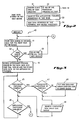
- FIG. 3 there is shown a flowchart generally designated 40 of the procedure performed by the queued task initiator (20 in FIG. 1).
- the queued task initiator reads the task queue 19 to obtain data for the next task in the queue. (In a system having a single application processor, the data appears at the head of the queue).
- the task queue could be empty.
- the queued task initiator delays for a certain amount of time to permit the task queue to be filled by the terminal and the menu processes (17 in FIG. 1) before the task queue initiator again reads the task queue.
- step 44 invokes the application process named in the task data (33 in FIG. 2) and passes the task identification number and the other task data (34 in FIG. 2) to the application process.
- step 45 the queued task initiator checks whether an application process is complete. If not, in step 46 the queued task initiator checks whether an application processor is available. If an application processor is not available, step 45 is performed again; otherwise, data for the next task in the task queue can be read in step 41. (Step 46 need not be performed in a single processor system, since in a single-processor system, the sole application processor will not be available unit its current process is complete).
- step 47 the queued task initiator 20 determines in step 47 whether the process has successfully completed. If not, then in step 48 the task identification number and an error condition code for the process having unsuccessfully completed is placed in the error queue 21. Finally, in step 49, the completed task is removed from the task queue, and the task initiation cycle is repeated beginning in step 46.
- step 44 need merely be a subroutine call which passes execution to the invoked application process until the invoked application process has been completed.
- a subroutine call which passes execution to the invoked application process until the invoked application process has been completed.
- a potential conflict known as "deadlock” may occur, for example, when each processor in a pair of processors needs a resource that is currently being used by the other processor. In this case, the deadlock must be resolved before either of the processors can complete their assigned application.
- Another source of potential conflict arises when the net result of two simultaneously performed applications is dependent upon whether a particular step in one application is performed before or after a particular step in another application. In such a case, it is desirable for the system to provide a consistent result that is dependent only upon the order in which the tasks appear in the task queue 19.
- a particularly simple way is to inhibit the queued task initiator 20 from reading the next task in the queue and dispatching it to the next available application processor until the previously invoked task has seized control or "opened" all of the files that it might need. In other words, step 44 should not be completed until the invoked process has opened all of the files that it might need.
- the exactly-once semantics interface (22 in FIG. 1) performs two functions.
- the first function is the usual function of ensuring that the update made by the transaction requested by the task is made in one "atomic" operation. In other words, immediately after a partial system failure or other abnormal termination of the application data base and computation processes, the state of the application data base (16 in FIG. 1) will contain all of the updates of the transaction having last completed and will not include any updates of any partially completed transactions.
- the exactly-once semantics interface 22 performs a second function of ensuring that when the system recovers, the application data base will not be updated more than once by a previously completed transaction.
- the first function of the exactly-once semantics interface 22, that of ensuring atomic updates to the application data base, can be performed by using an existing memory or data base management facility, such as the RMS journaling facility described above. When such a facility is used, access to the application data base is controlled in a certain way so that it appears that all of the updates for a transaction occur simultaneously.
- the second function of the exactly-once semantics interface 22 is provided by comparing the transaction identification number of the transaction accessing the application data base to a transaction identification number or numbers having been previously stored in the application data base. If there is a match, then an attempted duplicate update of the application data base is detected and a duplicate update is prevented from occurring. When an update of the application data base is made for a transaction, the identification number of the task requesting the transaction is written into the application data base to be available for comparison during the performance of a future transaction.
- the exactly-once semantics interface 22 can be provided by high level language code incorporated into the high level language code for each application.
- high level code could appear as:
- the code for the application data base and computation process corresponding to the application name appears sandwiched between the code for the exactly-once semantics interface.
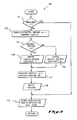
- the exactly-once semantics interface affects the organization of the application data base and the reading and writing between the application data base and computation processes and the application data base. Therefore, the exactly-once semantics interface 22 need not be implemented as code at the same level as the code for the application data base and computation processes. Instead, the exactly-once semantics interface can be implemented in the deeper level subroutines which open the application file, read and write application records and close an application file. Such an organization is depicted in the flowchart 50 of FIG. 4.
- each application has an associated application file including records which define the permanent states of the objects which are modified by the transactions performed by the application.
- the application may have the organization depicted in the flowchart 50 of FIG. 4.
- the application file is opened. If the application file cannot be opened, the application must terminate without success. Otherwise, in step 52, the application may read and write application records in the application file. Finally, in step 53, the application file is closed, and execution returns successfully.
- the exactly-once semantics interface can be implemented in the routines which open the application file, read and write application records, and close the application file.
- the step 51 of opening the application file may delimit the beginning of recovery unit for the application, and the step 53 of closing the application file may delimit the end of the recovery unit.
- the matching of the task identification number may be performed in the step 51 of opening the application file, and if a match occurs, then execution may return immediately after the application file is closed. Otherwise, the task identification number may be written into the application file during the step 53 of closing the application file.
- the task identification numbers can be stored in the application data base in any number of ways. If the queued task initiator 20 (FIG. 1) and the application data base and computation processes (18 in FIG. 1) are implemented on the same computer or processor, then attempted duplicate updating of an application data base after a partial system failure or abnormal termination will attempt to update the application data base a second time with the same task identification number that was just previously stored in the application data base. Therefore, it is only necessary to store a single task identification number in the application data base.
- the queued task initiator 20 and application data base and computation processes are performed by multiple computers or processors such that multiple applications may access different application data base files at the same time
- the data base must store the task identification number of every task on the queue that has been invoked, because it is possible that each such task may have been completed but not removed from the queue at the time of abnormal termination.
- the number of task identification numbers that must be stored can be cut down to one per application file by insuring that the queued task initiator will not invoke an application when the task queue has on it a prior task using the same application; in other words, in step 41 of FIG. 3, steps 42 and 44 will be skipped (and the "next task" pointer will not be advanced) if the next task data read from the queue has an application name matching an application name in the queue at a position closer to the head of the queue.
- FIG. 5 there is shown a specific organization for an application file that could be used.
- each application there is provided a corresponding application file having a certain number of records holding the states of all of the objects modified by the transaction performed by the application.
- each application file in the application data base can be written to by only one respective application.
- each application may read any number of application files.
- the application file 60 includes a header record 61 storing a master switch 62 and duplicate sets of application data records 63. If it is desired, for example, to update all of the application data in the application file 60, this can be done by changing the master switch 62 in a single atomic operation.
- the application file 60 is also organized to permit only a selected subset of the application data records 63 to be simultaneously updated. For this purpose, the application file 60 includes duplicate copies 64 and 65 of a switch record including a respective copy of a respective switch for each of the data records.
- the copy of a specified record which defines the current state of an object updated by the application can be found by reading the header record 61 to obtain the master switch 62, reading one of the two copies of the switch record as indicated by the state of the master switch, and then reading the particular copy of the desired application data record as indicated by the respective switch in the copy of the switch record having been read.
- the simultaneous updating then occurs in the single atomic operation of throwing the master switch.
- step 51 in FIG. 4 of opening the application file can be performed by a subroutine in the exactly-once semantics interface (22 in FIG. 1) corresponding to the flowchart 70 in FIG. 6.
- the application file in the application data base is opened. In other words, other processes are precluded from accessing the application file until the application file is closed.
- the header record of the application file is read in order to obtain the state of the master switch. The state is tested in step 73, and if the master switch has a value of 0, then copy 0 of the switch record is read in step 74, and otherwise copy 1 of the switch record is read in step 75.
- step 76 the task identification number of the current task is compared to the task identification number read from the switch record. If they match, then in step 77 the application file in the application data base is closed, and in step 78 the return code is set to indicate duplicated queued task invokation. Execution therefore returns with a return code causing the application itself to terminate upon recognizing the return code.
- step 79 a "READ ONLY” flag is set to one and an "ALREADY_WRITTEN” array is cleared.
- the "READ_ONLY” flag is used to eliminate the need for updating the header record and the switch record when the application file is only read during the current transaction.
- the "ALREADY_WRITTEN” array is used so that the application will be transparent to the organization of the application file when reading the same record after writing changes to it, and so that the switch for a respective record is thrown only once during the performance of a transaction when its respective data record is first accessed by the application for a write operation.
- FIG. 7 there is shown a flowchart generally designated 90 that is called by the application to read a specified record n of its application file.
- a respective one of the two copies of the selected record is read depending upon the state of the switch for the specified record having been read from the switch record.
- the respective switch is tested in step 91.
- Either copy 0 of the specified record is read in step 92 when the switch is zero, or copy 1 of the specified record is read in step 93 when the switch is one.
- FIG. 8 there is shown a flowchart generally designated 100 of a subroutine in the exactly-once semantics interface 22 for permitting the application to write a specified record n to its application file.
- the respective entry of the "ALLREADY_WRITTEN" array is tested. Initially this entry will be zero, and in this case the switch for the specified record is tested in step 102 to determine whether the specified record should be written into copy 1 or copy 0 of the specified record in the application file. If the specified switch is 0, then in step 103 the record is written into copy 1; otherwise in step 104 the record is written into copy 0.
- step 105 the switch is tested in step 105 in order to write to the same copy of the same record.
- step 106 the respective entry in the "ALREADY_WRITTEN” array is tested to determine whether the specified record is being written to for the first time for the current task. If the record is being written for the first time, then in step 107 the respective switch is changed, the respective element of the "ALREADY_WRITTEN” array is set, and the "READ_ONLY" flag is cleared.
- step 111 the "READ_ONLY" flag is tested to determine whether the application program has only read its application file during the current transaction. If so, then the application file need merely be closed in step 112 without any updates to the switch record or the header. Otherwise, in step 114 the master switch is tested to determine whether the current switch record should be written into copy 1 of the switch record in step 115 or copy 0 in step 116. In step 117 the master switch is changed, and in step 118 the changed state of the master switch is written into the header of the application file. Finally, in step 112 the application file is closed.
- a transaction processing system having a task queue initiator that operates in conjunction with an exactly-once semantics interface to provide automatic recovery from a partial system error or other abnormal termination.
- An application program can be installed into the system with little or no revision.
- the exactly-once semantics interface can be implemented in high-level code invoking the "recovery unit" feature of a conventional memory management or data base utility, or it can be implemented as low-level subroutines for opening, reading, writing, and closing application files.
- the system is easily adapted to multiprocessor configurations.
Landscapes
- Engineering & Computer Science (AREA)
- Software Systems (AREA)
- Theoretical Computer Science (AREA)
- Physics & Mathematics (AREA)
- General Engineering & Computer Science (AREA)
- General Physics & Mathematics (AREA)
- Information Retrieval, Db Structures And Fs Structures Therefor (AREA)
- Hardware Redundancy (AREA)
Applications Claiming Priority (2)
| Application Number | Priority Date | Filing Date | Title |
|---|---|---|---|
| US07/220,502 US4949251A (en) | 1988-07-18 | 1988-07-18 | Exactly-once semantics in a TP queuing system |
| US220502 | 1988-07-18 |
Publications (2)
| Publication Number | Publication Date |
|---|---|
| EP0351969A2 true EP0351969A2 (de) | 1990-01-24 |
| EP0351969A3 EP0351969A3 (de) | 1992-09-02 |
Family
ID=22823797
Family Applications (1)
| Application Number | Title | Priority Date | Filing Date |
|---|---|---|---|
| EP19890306538 Withdrawn EP0351969A3 (de) | 1988-07-18 | 1989-06-27 | Einmalsemantik in einem Transaktionsdurchführungswarteschlangensystem |
Country Status (4)
| Country | Link |
|---|---|
| US (1) | US4949251A (de) |
| EP (1) | EP0351969A3 (de) |
| JP (1) | JPH0296849A (de) |
| CA (1) | CA1315400C (de) |
Families Citing this family (53)
| Publication number | Priority date | Publication date | Assignee | Title |
|---|---|---|---|---|
| US5613106A (en) * | 1989-09-15 | 1997-03-18 | Motorola, Inc. | Method for processing and storing a transaction in a distributed database system |
| US5170480A (en) * | 1989-09-25 | 1992-12-08 | International Business Machines Corporation | Concurrently applying redo records to backup database in a log sequence using single queue server per queue at a time |
| US5161225A (en) * | 1989-10-23 | 1992-11-03 | International Business Machines Corporation | Persistent stream for processing time consuming and reusable queries in an object oriented database management system |
| US5317733A (en) * | 1990-01-26 | 1994-05-31 | Cisgem Technologies, Inc. | Office automation system for data base management and forms generation |
| DE59108472D1 (de) * | 1991-02-01 | 1997-02-20 | Siemens Ag | Verfahren für den fehlerbedingten Neustart eines Multiprozessorrechners eines Fernmeldevermittlungssystems |
| US5369757A (en) | 1991-06-18 | 1994-11-29 | Digital Equipment Corporation | Recovery logging in the presence of snapshot files by ordering of buffer pool flushing |
| US5450592A (en) * | 1992-09-02 | 1995-09-12 | Data General Corporation | Shared resource control using a deferred operations list |
| JPH07319747A (ja) * | 1994-05-24 | 1995-12-08 | Nec Telecom Syst Ltd | データ更新システム |
| US5778168A (en) * | 1995-09-11 | 1998-07-07 | Sun Microsystems, Inc. | Transaction device driver technique for a journaling file system to ensure atomicity of write operations to a computer mass storage device |
| US5799305A (en) * | 1995-11-02 | 1998-08-25 | Informix Software, Inc. | Method of commitment in a distributed database transaction |
| US5878428A (en) * | 1995-11-20 | 1999-03-02 | International Business Machines Corporation | System, method, and article of manufacture for adding transactional recovery to a binary class in an object oriented system |
| US5963960A (en) * | 1996-10-29 | 1999-10-05 | Oracle Corporation | Method and apparatus for queuing updates in a computer system |
| US5918248A (en) * | 1996-12-30 | 1999-06-29 | Northern Telecom Limited | Shared memory control algorithm for mutual exclusion and rollback |
| US6035379A (en) * | 1997-01-09 | 2000-03-07 | Microsoft Corporation | Transaction processing for user data employing both logging and shadow copying |
| JP3113841B2 (ja) * | 1997-07-30 | 2000-12-04 | インターナショナル・ビジネス・マシーンズ・コーポレ−ション | 並列トランザクション処理システム |
| US6081906A (en) * | 1997-11-21 | 2000-06-27 | Fuji Xerox Co., Ltd. | Multi-thread processing with queuing and recovery |
| US7953788B2 (en) * | 2001-09-29 | 2011-05-31 | Siebel Systems, Inc. | System and method for queuing data for an application server |
| US6457105B1 (en) * | 1999-01-15 | 2002-09-24 | Hewlett-Packard Company | System and method for managing data in an asynchronous I/O cache memory |
| US20040034686A1 (en) * | 2000-02-22 | 2004-02-19 | David Guthrie | System and method for delivering targeted data to a subscriber base via a computer network |
| US6549929B1 (en) * | 1999-06-02 | 2003-04-15 | Gateway, Inc. | Intelligent scheduled recording and program reminders for recurring events |
| US6799166B2 (en) | 1999-09-02 | 2004-09-28 | International Business Machines Corporation | Method and apparatus for preventing duplicate transactions on batch mode failure recovery in a data processing system |
| US7305475B2 (en) * | 1999-10-12 | 2007-12-04 | Webmd Health | System and method for enabling a client application to operate offline from a server |
| US7519905B2 (en) * | 1999-10-12 | 2009-04-14 | Webmd Corp. | Automatic formatting and validating of text for a markup language graphical user interface |
| US7877492B2 (en) * | 1999-10-12 | 2011-01-25 | Webmd Corporation | System and method for delegating a user authentication process for a networked application to an authentication agent |
| US6970945B1 (en) * | 1999-11-01 | 2005-11-29 | Seebeyond Technology Corporation | Systems and methods of message queuing |
| US20050028171A1 (en) * | 1999-11-12 | 2005-02-03 | Panagiotis Kougiouris | System and method enabling multiple processes to efficiently log events |
| US20040034833A1 (en) * | 1999-11-12 | 2004-02-19 | Panagiotis Kougiouris | Dynamic interaction manager for markup language graphical user interface |
| US20020007284A1 (en) * | 1999-12-01 | 2002-01-17 | Schurenberg Kurt B. | System and method for implementing a global master patient index |
| DE10059006B4 (de) * | 1999-12-30 | 2004-04-15 | International Business Machines Corp. | Verfahren und System zur sicheren Verwaltung von Dateien in nichtflüchtigen Speichern |
| US8775197B2 (en) * | 2000-02-24 | 2014-07-08 | Webmd, Llc | Personalized health history system with accommodation for consumer health terminology |
| US8712792B2 (en) * | 2000-02-24 | 2014-04-29 | Webmd, Llc | Personalized health communication system |
| US8612245B2 (en) * | 2000-02-24 | 2013-12-17 | Webmd Llc | Personalized health history system with accommodation for consumer health terminology |
| US7310803B2 (en) * | 2001-10-19 | 2007-12-18 | 419638 Canada Inc. | Method and system for executing multiple tasks in a task set |
| US7707181B2 (en) * | 2003-02-19 | 2010-04-27 | Microsoft Corporation | System and method of distributing replication commands |
| US7103603B2 (en) * | 2003-03-28 | 2006-09-05 | International Business Machines Corporation | Method, apparatus, and system for improved duplicate record processing in a sort utility |
| US8326767B1 (en) | 2005-01-31 | 2012-12-04 | Sprint Communications Company L.P. | Customer data privacy implementation |
| US8296162B1 (en) | 2005-02-01 | 2012-10-23 | Webmd Llc. | Systems, devices, and methods for providing healthcare information |
| US7757242B2 (en) * | 2006-05-26 | 2010-07-13 | International Business Corporation | Apparatus, system, and method for asynchronous outbound transaction event processing into an SAP application using service oriented architecture |
| US8380530B2 (en) | 2007-02-02 | 2013-02-19 | Webmd Llc. | Personalized health records with associative relationships |
| US20100174817A1 (en) * | 2009-01-06 | 2010-07-08 | Chetuparambil Madhu K | Splicing proxied web requests with callback for subsequent requests |
| US8689231B2 (en) * | 2009-06-30 | 2014-04-01 | Sap Ag | System and method for ordering tasks with complex interrelationships |
| CN102004702B (zh) * | 2009-08-31 | 2015-09-09 | 国际商业机器公司 | 请求控制设备、请求控制方法及相关的处理器 |
| US9063932B2 (en) | 2009-12-18 | 2015-06-23 | Vertafore, Inc. | Apparatus, method and article to manage electronic or digital documents in a networked environment |
| US8700682B2 (en) | 2009-12-24 | 2014-04-15 | Vertafore, Inc. | Systems, methods and articles for template based generation of markup documents to access back office systems |
| CN102385558B (zh) * | 2010-08-31 | 2015-08-19 | 国际商业机器公司 | 请求控制装置、请求控制方法及相关的处理器 |
| US9384198B2 (en) | 2010-12-10 | 2016-07-05 | Vertafore, Inc. | Agency management system and content management system integration |
| US8731973B2 (en) | 2011-04-19 | 2014-05-20 | Vertafore, Inc. | Overlaying images in automated insurance policy form generation |
| EP3514693A1 (de) * | 2013-10-29 | 2019-07-24 | Huawei Technologies Co., Ltd. | Transaktionsverarbeitungsverfahren und -vorrichtung |
| US20150121306A1 (en) * | 2013-10-30 | 2015-04-30 | United Video Properties, Inc. | Methods and systems for customizing functions of media guidance applications |
| US9507814B2 (en) | 2013-12-10 | 2016-11-29 | Vertafore, Inc. | Bit level comparator systems and methods |
| US9367435B2 (en) | 2013-12-12 | 2016-06-14 | Vertafore, Inc. | Integration testing method and system for web services |
| US9747556B2 (en) | 2014-08-20 | 2017-08-29 | Vertafore, Inc. | Automated customized web portal template generation systems and methods |
| US9600400B1 (en) | 2015-10-29 | 2017-03-21 | Vertafore, Inc. | Performance testing of web application components using image differentiation |
Family Cites Families (7)
| Publication number | Priority date | Publication date | Assignee | Title |
|---|---|---|---|---|
| JPS5714961A (en) * | 1980-06-30 | 1982-01-26 | Nec Corp | File control system |
| JPS5852740A (ja) * | 1981-09-24 | 1983-03-29 | Fujitsu Ltd | 区分編成フアイルの復元処理制御方式 |
| US4627019A (en) * | 1982-07-08 | 1986-12-02 | At&T Bell Laboratories | Database management system for controlling concurrent access to a database |
| AU576774B2 (en) * | 1983-06-30 | 1988-09-08 | Commonwealth Scientific And Industrial Research Organisation | Optically based measurement of fluid parameters |
| US4615001A (en) * | 1984-03-29 | 1986-09-30 | At&T Bell Laboratories | Queuing arrangement for initiating execution of multistage transactions |
| JPS6257041A (ja) * | 1985-09-05 | 1987-03-12 | Nec Corp | デ−タの復旧方式 |
| JPS62105246A (ja) * | 1985-10-31 | 1987-05-15 | Nec Corp | デ−タ復旧方式 |
-
1988
- 1988-07-18 US US07/220,502 patent/US4949251A/en not_active Expired - Lifetime
-
1989
- 1989-06-27 EP EP19890306538 patent/EP0351969A3/de not_active Withdrawn
- 1989-06-27 CA CA000604070A patent/CA1315400C/en not_active Expired - Fee Related
- 1989-07-17 JP JP1184396A patent/JPH0296849A/ja active Pending
Also Published As
| Publication number | Publication date |
|---|---|
| EP0351969A3 (de) | 1992-09-02 |
| JPH0296849A (ja) | 1990-04-09 |
| US4949251A (en) | 1990-08-14 |
| CA1315400C (en) | 1993-03-30 |
Similar Documents
| Publication | Publication Date | Title |
|---|---|---|
| US4949251A (en) | Exactly-once semantics in a TP queuing system | |
| CA1322422C (en) | Single-keyed indexed file for tp queue repository | |
| US6256637B1 (en) | Transactional virtual machine architecture | |
| JP2558052B2 (ja) | 仮定コミット2フェーズコミットプロトコルを用いるトランザクション処理システム及びその動作方法 | |
| US5923833A (en) | Restart and recovery of OMG-compliant transaction systems | |
| EP0772136B1 (de) | Bindungsverfahren in einer Transaktion in einer verteilten Datenbank | |
| US5504900A (en) | Commitment ordering for guaranteeing serializability across distributed transactions | |
| AU678804B2 (en) | Apparatus and method for moving open files | |
| US6766471B2 (en) | User-level checkpoint and restart for groups of processes | |
| EP1062569B1 (de) | Isolationsebenen und kompensierende transaktionen in einem informationssystem | |
| EP1341088B1 (de) | Sichere Rekonstruktion von "in-doubt" Zuständen nach mehreren Systemausfällen in einem Transactionsverarbeitungssystem | |
| CA2151254C (en) | A system for taking backup in a data base | |
| EP0119806B1 (de) | Asynchrones Wiederanlaufkennzeichnungsmethode für Fehlerkorrektur | |
| Mueller et al. | A nested transaction mechanism for LOCUS | |
| EP0365728B1 (de) | Betriebsmittelzugriff für Multiprozessorrechnersystem | |
| MX2008001159A (es) | Memoria de transaccion de software de actualizacion directa. | |
| US5450590A (en) | Authorization method for conditional command execution | |
| US7536582B1 (en) | Fault-tolerant match-and-set locking mechanism for multiprocessor systems | |
| WO1996041263A1 (en) | Management of units of work on a computer system log | |
| JP2005063435A (ja) | ソフトウェアフォールトを封じ込める方法およびシステム | |
| Son et al. | A token-based synchronization scheme using epsilon-serializability and its performance for real-time distributed database systems | |
| JPH0581099A (ja) | トランザクシヨン コントロール | |
| Mock | Remote activation of atomic objects | |
| JPH0120451B2 (de) |
Legal Events
| Date | Code | Title | Description |
|---|---|---|---|
| PUAI | Public reference made under article 153(3) epc to a published international application that has entered the european phase |
Free format text: ORIGINAL CODE: 0009012 |
|
| 17P | Request for examination filed |
Effective date: 19890714 |
|
| AK | Designated contracting states |
Kind code of ref document: A2 Designated state(s): AT BE CH DE ES FR GB GR IT LI LU NL SE |
|
| PUAL | Search report despatched |
Free format text: ORIGINAL CODE: 0009013 |
|
| AK | Designated contracting states |
Kind code of ref document: A3 Designated state(s): AT BE CH DE ES FR GB GR IT LI LU NL SE |
|
| STAA | Information on the status of an ep patent application or granted ep patent |
Free format text: STATUS: THE APPLICATION IS DEEMED TO BE WITHDRAWN |
|
| 18D | Application deemed to be withdrawn |
Effective date: 19950103 |