EP0352013B1 - Hydroxymethyl cyclobutyl purines - Google Patents
Hydroxymethyl cyclobutyl purines Download PDFInfo
- Publication number
- EP0352013B1 EP0352013B1 EP89307088A EP89307088A EP0352013B1 EP 0352013 B1 EP0352013 B1 EP 0352013B1 EP 89307088 A EP89307088 A EP 89307088A EP 89307088 A EP89307088 A EP 89307088A EP 0352013 B1 EP0352013 B1 EP 0352013B1
- Authority
- EP
- European Patent Office
- Prior art keywords
- compound
- formula
- carbons
- phenyl
- amino
- Prior art date
- Legal status (The legal status is an assumption and is not a legal conclusion. Google has not performed a legal analysis and makes no representation as to the accuracy of the status listed.)
- Expired - Lifetime
Links
- 0 CC(CNC([*@](C)C=C)=C(C(C)=O)N)N Chemical compound CC(CNC([*@](C)C=C)=C(C(C)=O)N)N 0.000 description 2
- JDOWWAMADZWCID-UHFFFAOYSA-N CN(C12)C=NC1C([ClH]C)=NC(N)=CC2=C Chemical compound CN(C12)C=NC1C([ClH]C)=NC(N)=CC2=C JDOWWAMADZWCID-UHFFFAOYSA-N 0.000 description 1
- MRXMWMZANYDWMV-WTKPLQERSA-N CN(CN)/C=N\C(CN)I Chemical compound CN(CN)/C=N\C(CN)I MRXMWMZANYDWMV-WTKPLQERSA-N 0.000 description 1
- HAMDRXFDFMEYHV-BRJRFNKRSA-N CN1C=NC2[C@@H]1N=C(N)NC2 Chemical compound CN1C=NC2[C@@H]1N=C(N)NC2 HAMDRXFDFMEYHV-BRJRFNKRSA-N 0.000 description 1
Classifications
-
- C—CHEMISTRY; METALLURGY
- C07—ORGANIC CHEMISTRY
- C07D—HETEROCYCLIC COMPOUNDS
- C07D239/00—Heterocyclic compounds containing 1,3-diazine or hydrogenated 1,3-diazine rings
- C07D239/02—Heterocyclic compounds containing 1,3-diazine or hydrogenated 1,3-diazine rings not condensed with other rings
- C07D239/24—Heterocyclic compounds containing 1,3-diazine or hydrogenated 1,3-diazine rings not condensed with other rings having three or more double bonds between ring members or between ring members and non-ring members
- C07D239/28—Heterocyclic compounds containing 1,3-diazine or hydrogenated 1,3-diazine rings not condensed with other rings having three or more double bonds between ring members or between ring members and non-ring members with hetero atoms or with carbon atoms having three bonds to hetero atoms with at the most one bond to halogen, directly attached to ring carbon atoms
- C07D239/46—Two or more oxygen, sulphur or nitrogen atoms
- C07D239/47—One nitrogen atom and one oxygen or sulfur atom, e.g. cytosine
-
- A—HUMAN NECESSITIES
- A61—MEDICAL OR VETERINARY SCIENCE; HYGIENE
- A61P—SPECIFIC THERAPEUTIC ACTIVITY OF CHEMICAL COMPOUNDS OR MEDICINAL PREPARATIONS
- A61P31/00—Antiinfectives, i.e. antibiotics, antiseptics, chemotherapeutics
- A61P31/12—Antivirals
-
- C—CHEMISTRY; METALLURGY
- C07—ORGANIC CHEMISTRY
- C07C—ACYCLIC OR CARBOCYCLIC COMPOUNDS
- C07C309/00—Sulfonic acids; Halides, esters, or anhydrides thereof
- C07C309/63—Esters of sulfonic acids
- C07C309/64—Esters of sulfonic acids having sulfur atoms of esterified sulfo groups bound to acyclic carbon atoms
- C07C309/65—Esters of sulfonic acids having sulfur atoms of esterified sulfo groups bound to acyclic carbon atoms of a saturated carbon skeleton
- C07C309/66—Methanesulfonates
-
- C—CHEMISTRY; METALLURGY
- C07—ORGANIC CHEMISTRY
- C07C—ACYCLIC OR CARBOCYCLIC COMPOUNDS
- C07C309/00—Sulfonic acids; Halides, esters, or anhydrides thereof
- C07C309/63—Esters of sulfonic acids
- C07C309/72—Esters of sulfonic acids having sulfur atoms of esterified sulfo groups bound to carbon atoms of six-membered aromatic rings of a carbon skeleton
- C07C309/73—Esters of sulfonic acids having sulfur atoms of esterified sulfo groups bound to carbon atoms of six-membered aromatic rings of a carbon skeleton to carbon atoms of non-condensed six-membered aromatic rings
-
- C—CHEMISTRY; METALLURGY
- C07—ORGANIC CHEMISTRY
- C07C—ACYCLIC OR CARBOCYCLIC COMPOUNDS
- C07C31/00—Saturated compounds having hydroxy or O-metal groups bound to acyclic carbon atoms
- C07C31/34—Halogenated alcohols
- C07C31/44—Halogenated alcohols containing saturated rings
-
- C—CHEMISTRY; METALLURGY
- C07—ORGANIC CHEMISTRY
- C07C—ACYCLIC OR CARBOCYCLIC COMPOUNDS
- C07C35/00—Compounds having at least one hydroxy or O-metal group bound to a carbon atom of a ring other than a six-membered aromatic ring
- C07C35/02—Compounds having at least one hydroxy or O-metal group bound to a carbon atom of a ring other than a six-membered aromatic ring monocyclic
- C07C35/04—Compounds having at least one hydroxy or O-metal group bound to a carbon atom of a ring other than a six-membered aromatic ring monocyclic containing a three or four-membered rings
-
- C—CHEMISTRY; METALLURGY
- C07—ORGANIC CHEMISTRY
- C07D—HETEROCYCLIC COMPOUNDS
- C07D239/00—Heterocyclic compounds containing 1,3-diazine or hydrogenated 1,3-diazine rings
- C07D239/02—Heterocyclic compounds containing 1,3-diazine or hydrogenated 1,3-diazine rings not condensed with other rings
- C07D239/24—Heterocyclic compounds containing 1,3-diazine or hydrogenated 1,3-diazine rings not condensed with other rings having three or more double bonds between ring members or between ring members and non-ring members
- C07D239/28—Heterocyclic compounds containing 1,3-diazine or hydrogenated 1,3-diazine rings not condensed with other rings having three or more double bonds between ring members or between ring members and non-ring members with hetero atoms or with carbon atoms having three bonds to hetero atoms with at the most one bond to halogen, directly attached to ring carbon atoms
- C07D239/46—Two or more oxygen, sulphur or nitrogen atoms
- C07D239/52—Two oxygen atoms
- C07D239/54—Two oxygen atoms as doubly bound oxygen atoms or as unsubstituted hydroxy radicals
-
- C—CHEMISTRY; METALLURGY
- C07—ORGANIC CHEMISTRY
- C07D—HETEROCYCLIC COMPOUNDS
- C07D473/00—Heterocyclic compounds containing purine ring systems
Definitions
- R1 is R2 is hydrogen, or wherein R3 is hydrogen, alkyl, substituted alkyl, or aryl.
- EP-A-159264 describes for example antiviral compounds which are similar to those of the present invention but differ principally in having a cyclopropyl ring (and not a cyclobutyl ring) which is connected to the purine radical via a CH2 group.
- US Patent US-A-4177348 discloses antiviral compounds in which pyrimidine derivatives are attached to a cyclopentyl ring.
- alkyl refers to both straight and branched chain groups having 1 to 10 carbons.
- substituted alkyl refers to alkyl groups having one or more substituents selected from halogen, amino, azido, hydroxy, cyano, alkoxy of 1 to 6 carbons, phenyl and carboxy.
- aryl refers to phenyl and phenyl substituted with one, two or three substituents selected from alkyl of 1 to 6 carbons, alkoxy of 1 to 6 carbons, halogen, trifluoromethyl, amino, alkylamino, dialkylamino, nitro, cyano, alkanoyloxy of 2 to 11 carbons, carboxy, carbamoyl and hydroxy.
- the compounds of formula 1 are antiviral agents that can be used to treat viral infection in mammalian species such as domesticated animals (e.g. , dogs, cats, horses and the like) and humans, and avian species (e.g. , chickens and turkeys).
- the compounds of formula 1 wherein R1 is are effective against one or more of the following viruses: herpes simplex virus 1 and 2, varicella-zoster virus , murine leukemia virus and human immunodeficiency virus (HIV). They are also believed to be active against a variety of other DNA and retroviruses.
- Exemplary DNA viruses in addition to those named above include other herpes viruses (e.g.
- Epstein-Barr virus Epstein-Barr virus, pseudorabies virus, other poxviruses (e.g. monkey pox and myoma), papovaviruses (e.g. , the papilloma viruses), hepatitis B virus, and adenoviruses.
- poxviruses e.g. monkey pox and myoma
- papovaviruses e.g. , the papilloma viruses
- hepatitis B virus e.g. adenoviruses
- exemplary retroviruses in addition to those named above include those effecting man, such as human T-cell lymphotropic viruses (HTLV), and those effecting other animals, such as feline leukemia virus and equine infectious anemia virus.
- HTLV human T-cell lymphotropic viruses
- All of the other compounds of formula 1 are believed to be active against one or more of the following viruses: herpes simplex virus 1 and 2, varicella-zoster virus, cytomegalovirus, murine leukemia virus, human immunodeficiency virus and the other viruses described above.
- the compounds of this invention may be administered parenterally (for example, by intravenous, intraperitoneal or intramuscular injection), orally or topically.
- the compounds may be administered orally or parenterally in an amount effective to treat the infection.
- the dosage will, of course, depend on the severity of the infection, but will likely be in the range of about 1.0 to 50 mg/kg of body weight.
- the desired dose may be administered several times daily at appropriate intervals.
- compositions may be applied to the infected part of the body of the patient topically as an ointment, cream, aerosol, gel, powder, lotion, suspension or solution (e.g. as in eye drops).
- concentration of the compound in the vehicle will, of course, depend on the severity of the infection, but will likely be in the range of about 0.1 to 7% by weight.
- a compound of formula 1 wherein R1 is and R2 is hydrogen can be prepared from an intermediate of formula wherein P is a protecting group such as acyl, or silyl, and X is a leaving group selected from chloro, bromo, iodo, p-toluenesulfonyloxy and methanesulfonyloxy.
- P is a protecting group such as acyl, or silyl
- X is a leaving group selected from chloro, bromo, iodo, p-toluenesulfonyloxy and methanesulfonyloxy.
- acyl refers to groups wherein R5 is a lower alkyl group of 1-6 branched or straight chain carbon atoms or a phenyl group.
- sil refers to silyl protecting groups well known in the art [e.g ., t-butyldimethylsilyl, t-butyldiphenylsilyl, (triphenylmethyl)dimethylsilyl, methyldiisopropylsilyl, or triisopropylsilyl].
- the reaction can be run in the presence of a metal chelating agent such as 18-crown-6 (1,4,7,10,13,16-hexaoxacyclooctadecane) or 15-crown-5 (1,4,7,10,13-pentaoxacyclopentadecane).
- a metal chelating agent such as 18-crown-6 (1,4,7,10,13,16-hexaoxacyclooctadecane) or 15-crown-5 (1,4,7,10,13-pentaoxacyclopentadecane).
- the protecting group P in 4 is an acyl group
- the protecting group P can be selectively removed using, for example, catalytic sodium methoxide in methanol or methanolic ammonia.
- Subsequent removal of the O-benzyl protecting group on the purine moiety can be accomplished by treatment with aqueous alcoholic mineral acid (e.g ., aqueous methanolic hydrochloric acid), sodium in liquid ammonia, or by hydrogenolysis (e.g. , palladium hydroxide on carbon in cyclohexene and ethanol).
- aqueous alcoholic mineral acid e.g ., aqueous methanolic hydrochloric acid
- hydrogenolysis e.g. , palladium hydroxide on carbon in cyclohexene and ethanol.
- the purine O-benzyl protecting group can be removed initially, followed by removal of the acyl protecting group.
- the group P in compound 4 is a silyl protecting group
- removal of the P group can be accomplished using fluoride ion (e.g. , tetrabutylammonium fluoride in tetrahydrofuran).
- fluoride ion e.g. , tetrabutylammonium fluoride in tetrahydrofuran.
- the purine O-benzyl protecting group can then be removed with aqueous alcoholic mineral acid, sodium in liquid ammonia, or by hydrogenolysis.
- a compound of formula 2 can be synthesized from a compound of formula 5 , whose preparation is described in the literature (See C. J. Michejda et al. , J. Org. Chem. , 40 , 1046 (1975) and C. Beard et al. , Chem. Ber. , 95, 2535 (1962)). Heating a compound of formula 5 in vacuo according to the literature (C. Beard et al. , Chem. , Ber. , 95 , 2535 (1962); J. Safanda et al. , Coll. Czech. Chem. Communs. , 47, 2441 (1982)) affords a compound of formula 6 , having a m.p.
- the compound of formula 10 can be converted to a compound of formula 2 by methods known in the art. For example, treatment of 10 with p-toluenesulfonyl chloride or methanesulfonyl chloride in pyridine yields a compound of formula 2 wherein X is p-toluenesulfonyloxy or methanesulfonyloxy, respectively.
- the compound of formula 2 wherein P is benzoyl and X is p-toluenesulfonyloxy has a melting point 81-82°, and its structure was confirmed by a single crystal X-ray analysis.
- the compound of formula 2 wherein X is p-toluenesulfonyloxy or methanesulfonyloxy can also be prepared from a compound of formula 13 by treatment with p-toluenesulfonic acid or methanesulfonic acid, respectively, in the presence of triethylamine, triphenylphosphine, and diethyl or diisopropyl azodicarboxylate in a solvent such a toluene, ether or dioxane.
- the compound of formula 13 can be prepared from a compound of formula 7 following the methodology used to convert compound 6 to the compound of formula 10 .
- Treatment of 7 with lithium aluminum hydride affords a compound of formula 11 .
- Protection of the hydroxyl group in 11 yields a compound of formula 12 and debenzylation gives the compound of formula 13 .
- a compound of formula 2 wherein X is chloro, bromo, or iodo can be prepared from the compound of formula 13 using triphenylphosphine, diethyl (or diisopropyl) azodicarboxylate, and a source of halide such as methyl iodide, methyl bromide, or dichloromethane according to methodology known in the art. See, for example, H. Loibner et al. Helv. Chim. Acta. 59 , 2100 (1976).
- Selective removal of the protecting group P provides a compound of formula 1 wherein R1 is and R2 is hydrogen.
- R1 is and R2 is hydrogen.
- the protecting group P in 15 is acyl
- the P group can be selectively removed using, for example, catalytic sodium methoxide in methanol.
- the protecting group P in 15 is silyl
- the protecting group can be selectively removed by treatment with fluoride ion (e.g. , tetrabutylammonium fluoride).
- Acid hydrolysis e.g. , using hot aqueous hydrochloric acid
- a compound of formula 1 wherein R1 is and R2 is hydrogen can be prepared from a compound of formula 15 .
- the chloro group can first be reduced by hydrogenation (e.g. ammonium formate and palladium on carbon in methanol or ethanol; palladium on carbon and cyclohexene in ethanol; or palladium on carbon, hydrogen and ethanol) and then the protecting group P can be removed using either catalytic sodium methoxide in methanol or methanolic ammonia when P is acyl, and fluoride ion when P is silyl.
- the acyl or silyl protecting group P can be removed first and then the chloro group can be reduced.
- this compound of formula 1 can be prepared by reacting an optionally protected compound of formula with a compound of formula 2 according to procedures analogous to those used in the preparation of a compound of formula 4 , followed by removal of the protecting groups by methods known in the art.
- An optionally protected form of compound 16 can be protected at the amino (-NH2) group by such exemplary groups as acyl, trityl, or substituted trityl.
- exemplary substituted trityl groups are 4-monomethoxytrityl and 4,4′-dimethoxytrityl.
- a compound of formula 1 wherein R1 is and R2 is hydrogen can be prepared from a compound of formula 15 by treatment with hot methanolic ammonia according to methods known in the art (e.g. , J.C. Martin, et al. , J. Med. Chem. 28 , 358(1985)).
- the protecting group P in 15 is acyl
- treatment with hot methanolic ammonia results in substitution of the chloro group by an amino group and simultaneous removal of the acyl protecting group.
- the protecting group P is a silyl group, replacement of the chloro group by an amino group can be accomplished first, and then the protecting group P can be removed, for example, by treatment with fluoride ion.
- this compound of formula 1 can be prepared by reacting an optionally protected compound of formula with a compound of formula 2 according to procedures analogous to those used in the preparation of a compound of formula 4 , followed by removal of the protecting groups by methods known in the art.
- An optionally protected form of 17 can be protected at the amino (-NH2) group by such exemplary groups as acyl, trityl or substituted trityl.
- the compounds of formula 1 can form acid addition salts with inorganic or organic acids, Illustrative are the hydrohalide (e.g. , hydrochloride and hydrobromide), alkylsulfonate, sulfate, phosphate and carboxylate salts.
- the compounds of formula 1 wherein R1 is can form basic salts with inorganic and organic bases.
- Illustrative are alkali metal salts (e.g. , sodium and potassium), alkaline earth metal salts (e.g. calcium and magnesium), ammonium and substituted ammonium salts.
- trans isomer 10% of the trans isomer.
- the combined fractions of trans isomer were recrystallized from pentane-diisopropyl ether to give 13 g of crystals (m.p. 46-48°) consisting of 95% ( trans )-3-(phenylmethoxy)-cyclobutanecarboxylic acid and 5% ( cis )-3-(phenylmethoxy)cyclobutanecarboxylic acid.
- Trans isomer 1HNMR (CDCl3, 400MHz) ⁇ 7.2 - 7.4 (m, 5H), 4.41 (s, 2H), 4.30 (quintet, 1H), 3.07 (m, 1H), 2.53 (m, 2H), 2.34 (m, 2H).
- Cis isomer 1HNMR (CDCl3, 400MHz) ⁇ 7.2 - 7.4 (m, 5H), 4.43 (s, 2H), 3.96 (septet, 1H), 2.64 (m, 1H), 2.50 (m, 2H), 2.29 (m, 2H).
- reaction mixture was concentrated in vacuo to an oil, absorbed onto Baker silica gel using dichloromethane and chromatographed over 200 ml of LPS-1 silica gel, using ethyl acetate-hexane (7:3), to give 447 mg of desired product as a residue.
- HSV-1 (herpes simplex virus type 1, strain Schooler), HSV-2 (herpes simplex virus type 2, strain 186), VZV (varicella zoster virus, strain ELLEN), MuLV (murine leukemia virus, strain CAS), HIV (human immunodeficiency virus, strain HTLV-IIIB).
- Cell Culture Assays HSV-1, HSV-2, and VZV antiviral assays: Virus was adsorbed to WI-38 cell culture monolayers in 6 well culture plates (Costar, Cambridge, MA) for 1 hour prior to addition of maintenance medium containing duplicate dilutions of the test compound.
- MuLV antiviral assay Antiviral assays using MuLV were performed with some modification, as described by Rowe et al. and Shannon et al. . SC-1 cells were planted at approximately 2 x 10⁵ cell per well in 6 well plates. After overnight incubation at 37°C, the cell cultures were sensitized with DEAE-Dextran for one hour at 37°C, rinsed and inoculated with MuLV. Cultures were re-fed with growth medium containing different concentrations of the test compound. After three more days at 37°C, cultures were re-fed with fresh medium plus test compounds and incubated at 37°C for an additional 3 days.
- HIV antiviral assay Suspensions of CEM cells (P.L. Nara, et. al., Nature 332 , 469(1988)) were infected at a multiplicity of infection of 0.12 TCID50/cell with HIV (strain HTLV-III B). After adsorption for 1-2 hours at 37°C, infected cells were diluted in growth medium (RPMI 1640 containing the antibiotics penicillin plus streptomycin and 10% fetal calf serum) to give a final cell concentration of 1 x 10⁴ viable cells/culture well in the presence of serial dilutions of the test compound, starting at 100 ⁇ g/ml. Triplicate samples at each drug concentration were used.
- CPE viral cytopathic effect
Landscapes
- Organic Chemistry (AREA)
- Chemical & Material Sciences (AREA)
- Health & Medical Sciences (AREA)
- Life Sciences & Earth Sciences (AREA)
- General Chemical & Material Sciences (AREA)
- Pharmacology & Pharmacy (AREA)
- Oncology (AREA)
- Chemical Kinetics & Catalysis (AREA)
- Virology (AREA)
- Medicinal Chemistry (AREA)
- Nuclear Medicine, Radiotherapy & Molecular Imaging (AREA)
- Communicable Diseases (AREA)
- Animal Behavior & Ethology (AREA)
- General Health & Medical Sciences (AREA)
- Public Health (AREA)
- Veterinary Medicine (AREA)
- Pharmaceuticals Containing Other Organic And Inorganic Compounds (AREA)
- Organic Low-Molecular-Weight Compounds And Preparation Thereof (AREA)
Description
- Antiviral activity is exhibited by compounds having the formula

and its pharmaceutically acceptable salts. In formula I, and throughout the specification, the symbols are as defined below. - R₁ is

R₂ is hydrogen, or
wherein R₃ is hydrogen, alkyl, substituted alkyl, or aryl. - European Patent Application EP-A-159264 describes for example antiviral compounds which are similar to those of the present invention but differ principally in having a cyclopropyl ring (and not a cyclobutyl ring) which is connected to the purine radical via a CH₂ group. US Patent US-A-4177348 discloses antiviral compounds in which pyrimidine derivatives are attached to a cyclopentyl ring.
- Preferred compounds of formula 1 are when R₁ is
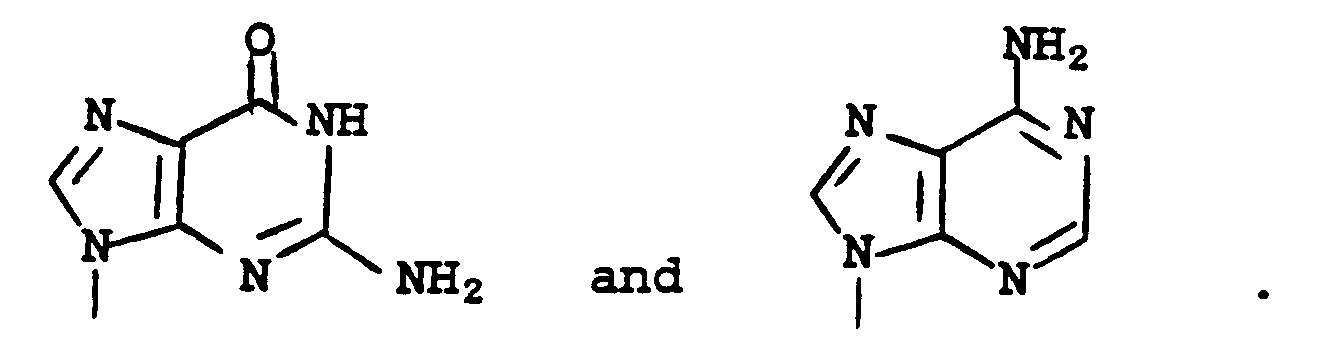
The term "alkyl" refers to both straight and branched chain groups having 1 to 10 carbons. The term "substituted alkyl" refers to alkyl groups having one or more substituents selected from halogen, amino, azido, hydroxy, cyano, alkoxy of 1 to 6 carbons, phenyl and carboxy. The term "aryl" as used here, refers to phenyl and phenyl substituted with one, two or three substituents selected from alkyl of 1 to 6 carbons, alkoxy of 1 to 6 carbons, halogen, trifluoromethyl, amino, alkylamino, dialkylamino, nitro, cyano, alkanoyloxy of 2 to 11 carbons, carboxy, carbamoyl and hydroxy. - The compounds of formula 1, and the pharmaceutically acceptable salts thereof, are antiviral agents that can be used to treat viral infection in mammalian species such as domesticated animals (e.g., dogs, cats, horses and the like) and humans, and avian species (e.g., chickens and turkeys). The compounds of formula 1 wherein R₁ is

are effective against one or more of the following viruses: herpes simplex virus 1 and 2, varicella-zoster virus , murine leukemia virus and human immunodeficiency virus (HIV). They are also believed to be active against a variety of other DNA and retroviruses. Exemplary DNA viruses in addition to those named above include other herpes viruses (e.g., Epstein-Barr virus, pseudorabies virus, other poxviruses (e.g. monkey pox and myoma), papovaviruses (e.g., the papilloma viruses), hepatitis B virus, and adenoviruses. Exemplary retroviruses in addition to those named above include those effecting man, such as human T-cell lymphotropic viruses (HTLV), and those effecting other animals, such as feline leukemia virus and equine infectious anemia virus. All of the other compounds of formula 1 are believed to be active against one or more of the following viruses: herpes simplex virus 1 and 2, varicella-zoster virus, cytomegalovirus, murine leukemia virus, human immunodeficiency virus and the other viruses described above. - The compounds of this invention may be administered parenterally (for example, by intravenous, intraperitoneal or intramuscular injection), orally or topically.
- The compounds may be administered orally or parenterally in an amount effective to treat the infection. The dosage will, of course, depend on the severity of the infection, but will likely be in the range of about 1.0 to 50 mg/kg of body weight. The desired dose may be administered several times daily at appropriate intervals.
- For infections of the eye, or other external tissues, e.g. mouth and skin, the compositions may be applied to the infected part of the body of the patient topically as an ointment, cream, aerosol, gel, powder, lotion, suspension or solution (e.g. as in eye drops). The concentration of the compound in the vehicle will, of course, depend on the severity of the infection, but will likely be in the range of about 0.1 to 7% by weight.
- A compound of formula 1 wherein R₁ is

and R₂ is hydrogen can be prepared from an intermediate of formula
wherein P is a protecting group such as acyl, or silyl, and X is a leaving group selected from chloro, bromo, iodo, p-toluenesulfonyloxy and methanesulfonyloxy. - The term "acyl" refers to groups

wherein R₅ is a lower alkyl group of 1-6 branched or straight chain carbon atoms or a phenyl group. The term "silyl" refers to silyl protecting groups well known in the art [e.g., t-butyldimethylsilyl, t-butyldiphenylsilyl, (triphenylmethyl)dimethylsilyl, methyldiisopropylsilyl, or triisopropylsilyl]. - Reaction of a compound of formula 2 with a protected form of guanine such as a compound of formula

in the presence of a base such as potassium carbonate, sodium hydride, or potassium hydride in an aprotic polar solvent such as dimethylformamide, dimethyl sulfoxide, or sulfolane (tetramethylene sulfone) yields the corresponding compound of formula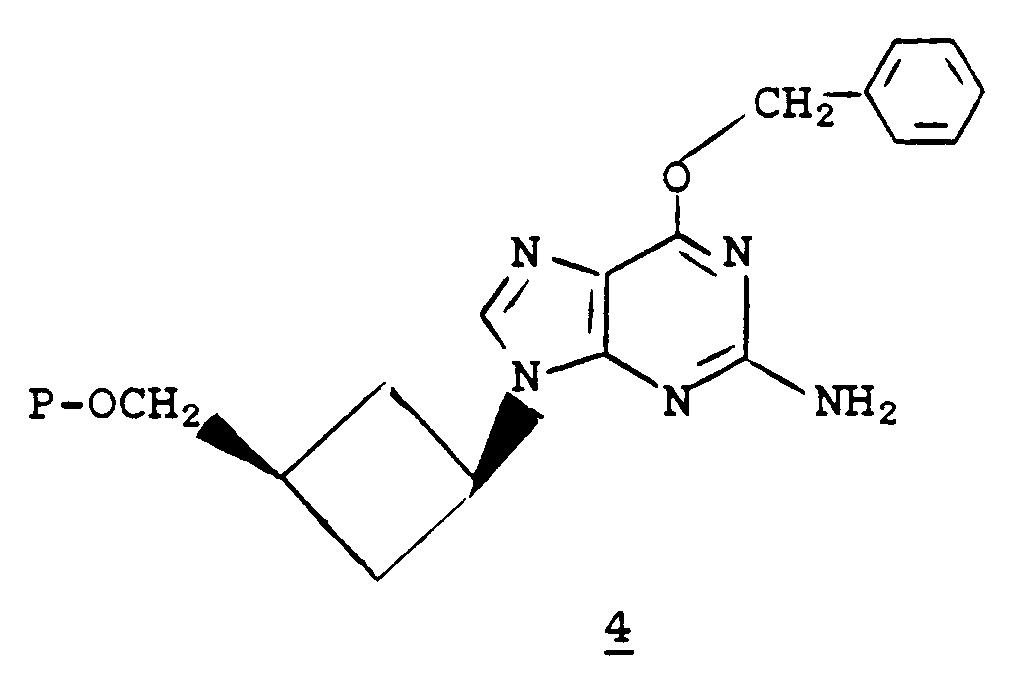
- Optionally, the reaction can be run in the presence of a metal chelating agent such as 18-crown-6 (1,4,7,10,13,16-hexaoxacyclooctadecane) or 15-crown-5 (1,4,7,10,13-pentaoxacyclopentadecane). Removal of the protecting groups from a compound of formula 4 yields a compound of formula 1 wherein R₁ is

and R₂ is hydrogen. - When the protecting group P in 4 is an acyl group, the protecting group P can be selectively removed using, for example, catalytic sodium methoxide in methanol or methanolic ammonia. Subsequent removal of the O-benzyl protecting group on the purine moiety can be accomplished by treatment with aqueous alcoholic mineral acid (e.g., aqueous methanolic hydrochloric acid), sodium in liquid ammonia, or by hydrogenolysis (e.g., palladium hydroxide on carbon in cyclohexene and ethanol). Alternatively, the purine O-benzyl protecting group can be removed initially, followed by removal of the acyl protecting group.
- When the group P in compound 4 is a silyl protecting group, removal of the P group can be accomplished using fluoride ion (e.g., tetrabutylammonium fluoride in tetrahydrofuran). The purine O-benzyl protecting group can then be removed with aqueous alcoholic mineral acid, sodium in liquid ammonia, or by hydrogenolysis.
- The preparation of a compound of formula 2 is outlined in the following schematic:
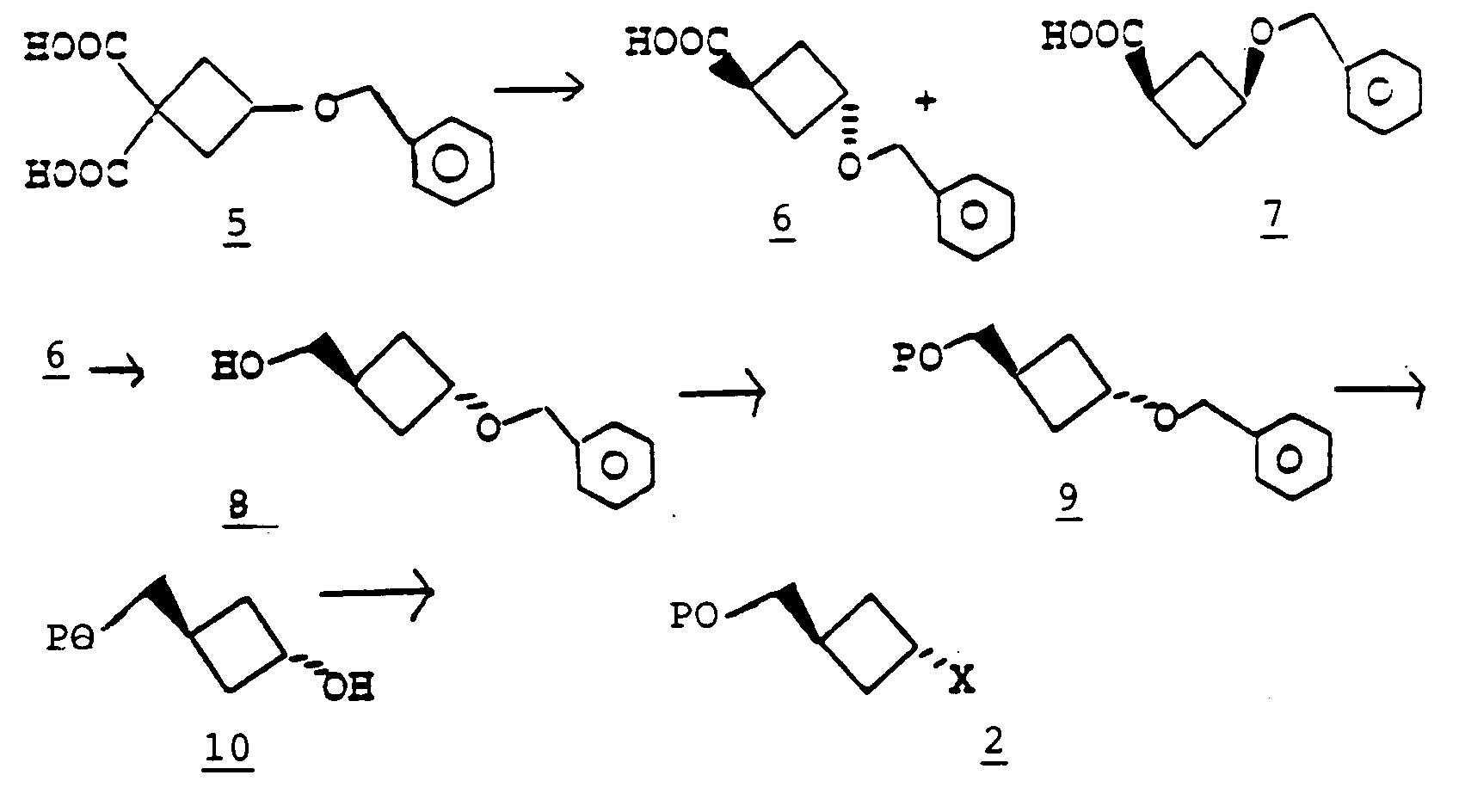
- A compound of formula 2 can be synthesized from a compound of formula 5, whose preparation is described in the literature (See C. J. Michejda et al., J. Org. Chem., 40, 1046 (1975) and C. Beard et al., Chem. Ber., 95, 2535 (1962)). Heating a compound of formula 5 in vacuo according to the literature (C. Beard et al., Chem., Ber., 95, 2535 (1962); J. Safanda et al., Coll. Czech. Chem. Communs., 47, 2441 (1982)) affords a compound of formula 6, having a m.p. 46-48°, and a more polar compound of formula 7 as an oil. (Note: C. Beard et al. and J. Safanda et al. incorrectly designated the crystalline product as having structure 7 and the more polar oily product as having structure 6). Treatment of the crystalline compound of formula 6 with a reducing agent such as lithium aluminum hydride in a solvent such as diethyl ether or tetrahydrofuran yields alcohol 8. The hydroxyl group can be protected as an acyl ester or a silyl ether by methods known in the art, yielding a compound of formula 9. Reduction of the benzyl group in 9 using for example, palladium hydroxide on carbon, ethanol and cyclohexene, provides a compound of formula 10. The compound of formula 10 can be converted to a compound of formula 2 by methods known in the art. For example, treatment of 10 with p-toluenesulfonyl chloride or methanesulfonyl chloride in pyridine yields a compound of formula 2 wherein X is p-toluenesulfonyloxy or methanesulfonyloxy, respectively. The compound of formula 2 wherein P is benzoyl and X is p-toluenesulfonyloxy has a melting point 81-82°, and its structure was confirmed by a single crystal X-ray analysis. The compound of formula 2 wherein X is p-toluenesulfonyloxy or methanesulfonyloxy can also be prepared from a compound of formula 13 by treatment with p-toluenesulfonic acid or methanesulfonic acid, respectively, in the presence of triethylamine, triphenylphosphine, and diethyl or diisopropyl azodicarboxylate in a solvent such a toluene, ether or dioxane.
- The compound of formula 13 can be prepared from a compound of formula 7 following the methodology used to convert compound 6 to the compound of formula 10. Treatment of 7 with lithium aluminum hydride affords a compound of formula 11. Protection of the hydroxyl group in 11 yields a compound of formula 12 and debenzylation gives the compound of formula 13.
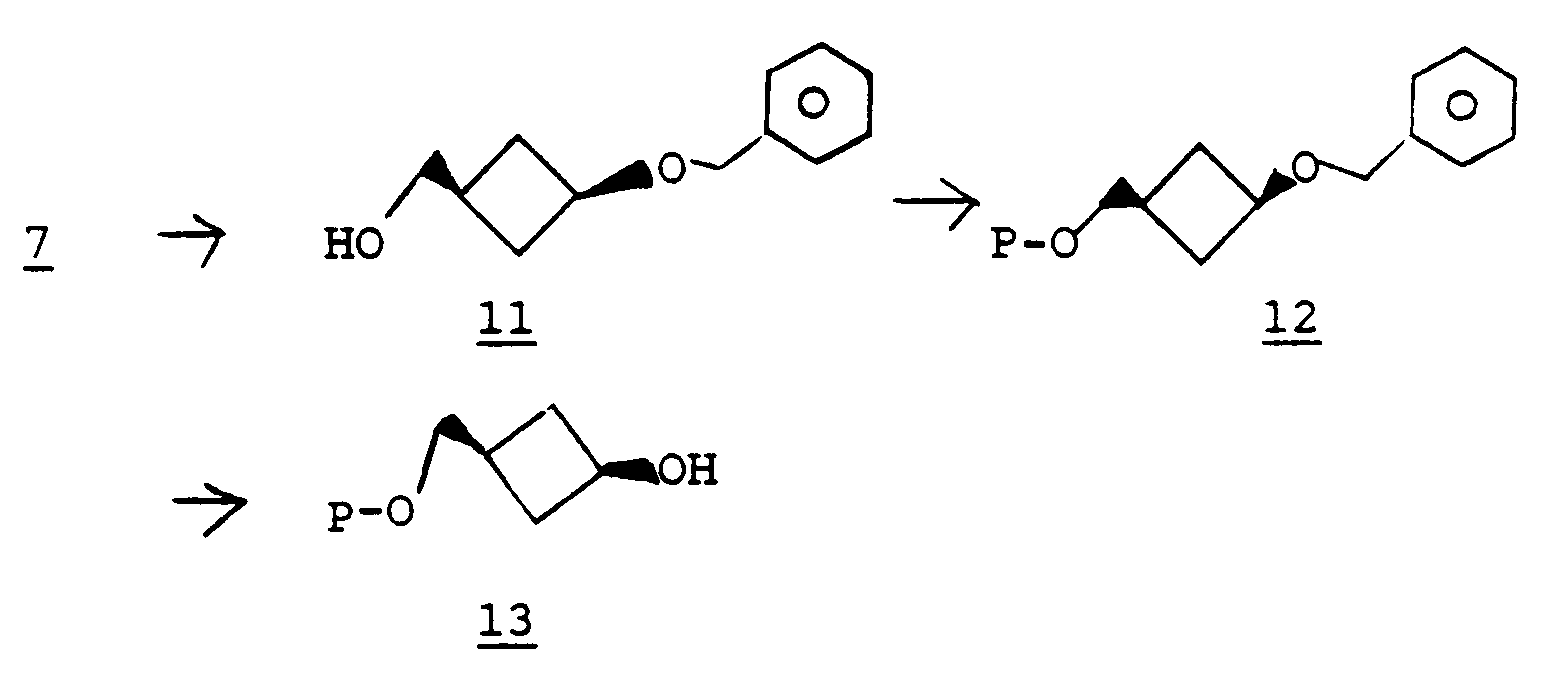
- Alternatively, treatment of the compound of formula 13 with a methyltriphenoxyphosphonium halide or methyltriphenylphosphonium halide (i.e, chloride, bromide or iodide) in a solvent such as dimethylformamide provides a compound of formula 2 wherein X is chloro, bromo, iodo. In yet another alternative, a compound of formula 2 wherein X is chloro, bromo, or iodo can be prepared from the compound of formula 13 using triphenylphosphine, diethyl (or diisopropyl) azodicarboxylate, and a source of halide such as methyl iodide, methyl bromide, or dichloromethane according to methodology known in the art. See, for example, H. Loibner et al. Helv. Chim. Acta. 59, 2100 (1976).
- Reaction of a compound of formula 2 with compound

under conditions analogous to those used in the preparation of compound 4 provides a compound of formula
- Selective removal of the protecting group P provides a compound of formula 1 wherein R₁ is

and R₂ is hydrogen. For example, when the protecting group P in 15 is acyl, the P group can be selectively removed using, for example, catalytic sodium methoxide in methanol. When the protecting group P in 15 is silyl, the protecting group can be selectively removed by treatment with fluoride ion (e.g., tetrabutylammonium fluoride). - Acid hydrolysis (e.g., using hot aqueous hydrochloric acid) of the chloro group of a compound of formula 1 wherein R₁ is

and R₂ is hydrogen provides a compound of formula 1 wherein R₁ is
and R₂ is hydrogen. - A compound of formula 1 wherein R₁ is

and R₂ is hydrogen can be prepared from a compound of formula 15. For example, when the P group in 15 is an acyl or silyl protecting group, the chloro group can first be reduced by hydrogenation (e.g. ammonium formate and palladium on carbon in methanol or ethanol; palladium on carbon and cyclohexene in ethanol; or palladium on carbon, hydrogen and ethanol) and then the protecting group P can be removed using either catalytic sodium methoxide in methanol or methanolic ammonia when P is acyl, and fluoride ion when P is silyl. Alternatively, the acyl or silyl protecting group P can be removed first and then the chloro group can be reduced. - Alternatively, this compound of formula 1 can be prepared by reacting an optionally protected compound of formula

with a compound of formula 2 according to procedures analogous to those used in the preparation of a compound of formula 4, followed by removal of the protecting groups by methods known in the art. An optionally protected form of compound 16 can be protected at the amino (-NH₂) group by such exemplary groups as acyl, trityl, or substituted trityl. Exemplary substituted trityl groups are 4-monomethoxytrityl and 4,4′-dimethoxytrityl. - A compound of formula 1 wherein R₁ is

and R₂ is hydrogen can be prepared from a compound of formula 15 by treatment with hot methanolic ammonia according to methods known in the art (e.g., J.C. Martin, et al., J. Med. Chem. 28, 358(1985)). When the protecting group P in 15 is acyl, for example, treatment with hot methanolic ammonia results in substitution of the chloro group by an amino group and simultaneous removal of the acyl protecting group. When the protecting group P is a silyl group, replacement of the chloro group by an amino group can be accomplished first, and then the protecting group P can be removed, for example, by treatment with fluoride ion. - Alternatively, this compound of formula 1 can be prepared by reacting an optionally protected compound of formula

with a compound of formula 2 according to procedures analogous to those used in the preparation of a compound of formula 4, followed by removal of the protecting groups by methods known in the art. An optionally protected form of 17 can be protected at the amino (-NH₂) group by such exemplary groups as acyl, trityl or substituted trityl. - Compounds of formula 1 wherein R₂ is

can be prepared from the corresponding compounds of formula 1 wherein R₂ is hydrogen by methods known in the art. - For examples of acylation procedures see: "Synthetic Procedures in Nucleic Acid Chemistry", Vol. 1, W. W. Zorbach and R. S. Tipson, Eds., John Wiley and Sons, 1968; "Nucleic Acid Chemistry," Part 1, L.B. Townsend and R. S. Tipson, Eds., John Wiley and Sons, 1978; S. Nishino, et al., Nucleosides and Nucleotides, 5, 159 (1986); J.C. Martin, et al., J. Pharm. Sci., 76, 180 (1987); A. Matsuda, et al., Synthesis, 385 (1986); J. Zemlicka, et al., Collect. Czech. Chem. Commun., 32, 3159 (1967).
- The compounds of formula 1 can form acid addition salts with inorganic or organic acids, Illustrative are the hydrohalide (e.g., hydrochloride and hydrobromide), alkylsulfonate, sulfate, phosphate and carboxylate salts.
- The compounds of formula 1 wherein R₁ is

can form basic salts with inorganic and organic bases. Illustrative are alkali metal salts (e.g., sodium and potassium), alkaline earth metal salts (e.g. calcium and magnesium), ammonium and substituted ammonium salts. - The following examples are specific embodiments of this invention.
- A mixture of benzyl bromide (127 g, 0.74 mol), epichlorohydrin (69 g, 0.74 mol) and 63 mg of mercuric chloride was stirred under nitrogen at 150° for 16 hours. Distillation of the reaction mixture gave 118 g of the desired product as an oil having b.p. 104°/0.5 mm.
- To a stirred suspension of oil-free sodium hydride (10.7 g, 0.446 mol) in 270 ml of dry dioxane under nitrogen at room temperature was added over twenty minutes 69.1 g (0.432 mol) of diethyl malonate. After the addition, 1-chloro-2-benzyloxy-3-bromopropane (115 g, 0.437 mol) was added over 20 minutes, and the reaction was refluxed for 44 hours. The reaction was cooled to room temperature, and then a slurry of 10.7 g (0.446 mol) of oil-free sodium hydride in 100 ml of dioxane was cautiously added in portions. The mixture was refluxed for 120 hours and cooled to room temperature. The inorganics were removed by filtration, and the filtrate was concentrated in vacuo to an oil, which was partitioned between ether and water. The ether layer was dried (Na₂SO₄) and concentrated to an oil, which was distilled to give 58.8 g of desired product having a b.p. 142-146°/0.3mm.
- A mixture of 88 g (0.286 mol) of 3-(phenylmethoxy)-1,1-cyclobutanedicarboxylic acid, diethyl ester in a solution of 72.6 g (1.30 mol) of potassium hydroxide, 183 ml of 95% ethanol and 42 ml of water was refluxed under nitrogen for 2 hours. The reaction mixture was cooled to room temperature and concentrated to a residue, which was taken up in water. After two extractions with ether, the aqueous layer was cooled to 5° and acidified with 25 ml of 6N hydrochloric acid, yielding a brown oil which crystallized upon warming to room temperature. The crystals were collected by filtration and recrystallized from 125 ml of hot water to give 49.8 g of desired product with a m.p. 159-161°C.
- 3-(Phenylmethoxy)-1,1-cyclobutanecarboxylic acid (42.4 g, 0.169 mol) was heated in vacuo with stirring at 175° and 11 mm for 1 hour and distilled to give 29.2 g of a mixture of (trans) and (cis)-3-(phenylmethoxy)cyclobutanecarboxylic acid as a colorless oil with b.p. 146-150°/0.4 mm. Chromatography of this oil over 750 g of Whatman LPS-1 silica gel using pentane-ethyl acetate-acetic acid (79:20:1) provided 5.5 g of the crystalline trans isomer and 22 g of a mixture of cis and trans isomers. Chromatography of the 22 g over 750 g of LPS-1 silica gel using the same solvent system afforded additional trans isomer (5.1 g) and 17 g of a mixture of cis and trans isomer. A similar chromatography of the 17 g mixture gave 3 g of the trans isomer and 14 g of (cis)-3-phenylmethoxy)-cyclobutanecarboxylic acid as an oil, containing ca. 10% of the trans isomer. The combined fractions of trans isomer were recrystallized from pentane-diisopropyl ether to give 13 g of crystals (m.p. 46-48°) consisting of 95% (trans)-3-(phenylmethoxy)-cyclobutanecarboxylic acid and 5% (cis)-3-(phenylmethoxy)cyclobutanecarboxylic acid.
Trans isomer: ¹HNMR (CDCl₃, 400MHz) δ 7.2 - 7.4 (m, 5H), 4.41 (s, 2H), 4.30 (quintet, 1H), 3.07 (m, 1H), 2.53 (m, 2H), 2.34 (m, 2H).
Cis isomer: ¹HNMR (CDCl₃, 400MHz) δ 7.2 - 7.4 (m, 5H), 4.43 (s, 2H), 3.96 (septet, 1H), 2.64 (m, 1H), 2.50 (m, 2H), 2.29 (m, 2H). - To a stirred suspension of 1.14 g (30 mmol) of lithium aluminum hydride in 120 ml of ether under nitrogen at 0 - 5° was added, dropwise over 20 minutes, 4.12 g (20 mmol) of (3-phenylmethoxy)cyclobutanecarboxylic acid (95% trans + 5% cis) in 60 ml of ether. The cooling bath was removed, and the mixture was stirred at room temperature for 1 hour. Wet ether was added dropwise to the mixture cooled in an ice-water bath. The pH was adjusted to 1.5 using 6N HCl and the phases were separated. The aqueous layer was extracted twice with ether, and the combined ether extracts were dried (Na₂SO₄) and evaporated in vacuo to give 3.9 g of desired product as an oil.
- Benzoyl chloride (2.37 ml, 20.5 mmol) was added dropwise to a stirred solution of the above preparation of (trans)-3-(phenylmethoxy)cyclobutanemethanol (3.9 g) in 35 ml of dry pyridine under nitrogen cooled in an ice-water bath. The bath was removed, and the mixture was stirred for 2 hours at room temperature. Water (17 ml) was added, and the reaction was stirred overnight. The solvents were removed in vacuo, and the residue was taken up in ethyl acetate and water. The ethyl acetate layer was washed sequentially with 1N HCl, water, saturated aqueous NaHCO₃, and water, and then dried (Na₂SO₄) and concentrated in vacuo to give 5.7 g of desired product as an oil.
- A stirred mixture of 3.6 g of the above preparation of (trans)-3-(phenylmethoxy)cyclobutanemethanol, benzoate ester, 2.52 g of 20% palladium hydroxide on carbon, 144 ml of absolute ethanol, and 44 ml of cyclohexene was refluxed under nitrogen for 15 minutes. The reaction mixture was cooled to room temperature and filtered through Celite. Concentration of the filtrate in vacuo gave 2.6 g of desired product as an oil.
- p-Toluenesulfonyl chloride (3.47 g, 18.2 mmol) was added to a solution of the above preparation of (trans)-3-hydroxycyclobutanemethanol, benzoate ester (2.5 g) in dry pyridine (35 ml) under nitrogen, and the mixture was stirred at 60° for 18 hours. Water (20 ml) was added, and heating was continued for 4 hours longer. The reaction was cooled to room temperature and concentrated in vacuo to a solid, which was dissolved in ethyl acetate and water. The ethyl acetate layer was washed with water, saturated aqueous NaHCO₃, and water, dried (Na₂SO₄), and concentrated to a solid (3.8 g). This solid was combined with 1.5 g of solid from a similar preparation. Chromatography of these solids over 200 g of LP-1 silica gel, using hexane-ethyl acetate (6:1), gave (trans)-3-[[(4-methylphenyl)sulfonyl]oxy]cyclobutanemethanol, benzoate ester containing varying amounts of its cis-isomer as shown below:
Column Fraction Amount (g) % trans 1 0.25 100 2 0.38 >95 3 1.9 95 4 1.9 80 - A mixture of 3-[[(4-methylphenyl)sulfonyl]oxy]cyclobutanemethanol, benzoate ester (95% trans + 5% cis, 720 mg, 2 mmol), 2-amino-6-(phenylmethoxy)-9H-purine (724 mg, 3 mmol), 18-crown-6 (528 mg, 2 mmol), and potassium carbonate (414 mg, 3 mmol) in 20 ml of dry dimethylformamide under nitrogen was stirred at 110° for 18 hours. The reaction mixture was concentrated in vacuo to an oil, absorbed onto Baker silica gel using dichloromethane and chromatographed over 200 ml of LPS-1 silica gel, using ethyl acetate-hexane (7:3), to give 447 mg of desired product as a residue.
- To 440 mg (1.03 mmol) of (cis)-3-[2-amino-6-(phenylmethoxy)-9H-purin-9-yl]cyclobutanemethanol, benzoate ester in 15 ml of dry methanol under nitrogen was added 68 µl of 25% sodium methoxide in methanol. The mixture was stirred at 40° for 2 hours and then concentrated to a residue. The residue was suspended in water, and the pH was adjusted to 7.0 using 1N HCl. Removal of water in vacuo gave a residue, which was triturated with hexane. Evaporation of the hexane afforded 330 mg of crude desired product as a foam.
- To a solution of the above preparation of (cis)-3-[2-amino-6-(phenylmethoxy)-9H-purin-9-yl]cyclobutanemethanol (330 mg) in 5.2 ml of methanol was added 2.6 ml of 3N HCl. The mixture was stirred under nitrogen at 40° for 2 hours and concentrated in vacuo to a solid, which was suspended in water. The pH was adjusted to 7.0 using 1N KOH, and the water was removed in vacuo leaving a solid. Chromatography of this solid on 80 ml of CHP-20P resin (Mitsubishi Chemical Industries) water and then 5% dimethylformamide in water gave 140 mg of (cis)-2-amino-1,9-dihydro-9-[3-(hydroxymethyl)cyclobutyl]-6H-purin-6-one as a solid having m.p. 275-278° (dec.).
- Assays were performed in cell culture systems to determine the concentrations of compounds that are effective in preventing several kinds of viral infections. The assays are described below, and the results are presented in
- HSV-1 (herpes simplex virus type 1, strain Schooler), HSV-2 (herpes simplex virus type 2, strain 186), VZV (varicella zoster virus, strain ELLEN), MuLV (murine leukemia virus, strain CAS), HIV (human immunodeficiency virus, strain HTLV-IIIB). Cell Culture Assays:
HSV-1, HSV-2, and VZV antiviral assays:
Virus was adsorbed to WI-38 cell culture monolayers in 6 well culture plates (Costar, Cambridge, MA) for 1 hour prior to addition of maintenance medium containing duplicate dilutions of the test compound. Inhibition of plaque development was evaluated on fixed and stained monolayers after 4 days incubation at 37°C for HSV-1 and HSV-2 and after 6-7 days incubation at 37°C for VZV. ID₅₀ values were determined from the drug concentration which conferred at least a 50% plaque reduction compared to virus controls. - MuLV antiviral assay: Antiviral assays using MuLV were performed with some modification, as described by Rowe et al. and Shannon et al.. SC-1 cells were planted at approximately 2 x 10⁵ cell per well in 6 well plates. After overnight incubation at 37°C, the cell cultures were sensitized with DEAE-Dextran for one hour at 37°C, rinsed and inoculated with MuLV. Cultures were re-fed with growth medium containing different concentrations of the test compound. After three more days at 37°C, cultures were re-fed with fresh medium plus test compounds and incubated at 37°C for an additional 3 days. Cultures were then washed to remove medium, ultraviolet light irradiated, and planted with approximately 5 x 10⁵ XC cells per well in cell growth medium containing the appropriate concentration of the test compound. The cultures were then incubated for an additional 4 days, with a re-feed using growth medium containing test compound at the second day following XC cell overlay. Finally the cultures were rinsed, stained and syncytial plaques were counted. References:
Rowe, W.P., Pugh, W.E., and Hartley, J.W., (1970), Plaque Assay Techniques for Murine Leukemia Viruses, Virology, 42: 1136-1139. - Shannon, W.M, Brockman, R.W., Westbrook L., Shaddix, S., and Shabel, F.M., (1974) Inhibition of Gross Leukemia Virus-Induced Plaque Formation in XC Cells by 3-Deazauridine, J. Natl., Cancer Inst., 52:199-205.
- HIV antiviral assay: Suspensions of CEM cells (P.L. Nara, et. al., Nature 332, 469(1988)) were infected at a multiplicity of infection of 0.12 TCID₅₀/cell with HIV (strain HTLV-III B). After adsorption for 1-2 hours at 37°C, infected cells were diluted in growth medium (RPMI 1640 containing the antibiotics penicillin plus streptomycin and 10% fetal calf serum) to give a final cell concentration of 1 x 10⁴ viable cells/culture well in the presence of serial dilutions of the test compound, starting at 100µg/ml. Triplicate samples at each drug concentration were used. Cultures of uninfected CEM cells were similarly prepared and incubated with serial dilutions of test compound in duplicate. All assays were performed in 96 well disposable cell culture plates. Untreated (infected and uninfected) cells were included as controls. All cultures were incubated for 7 days at 37°C in a humidified atmosphere containing 5% CO₂. Following incubation, viable cell numbers were counted in each well using a colorimetric assay following incubation of cells with XTT-PMS solution (XTT tetrazolium reagent plus phenazine methosulfate, PMS).
- Percent reduction of viral cytopathic effect (CPE) in drug treated compared to untreated virus infected cells, and percent reduction of cell viability in drug treated uninfected cells compared to untreated controls were calculated and plotted versus the drug concentrations tested. From these plots, the ID₅₀ (the minimum drug concentration that inhibits CPE by 50%) for each drug was calculated. 2′,3′-Dideoxycytidine was used as a positive drug control.

Claims (10)
- A compound having the formula


R₃ is alkyl of 1 to 10 carbons; alkyl of 1 to 10 carbons having a substituent selected from halogen, amino, azido, hydroxy, cyano, alkoxy of 1 to 6 carbons, phenyl and carboxy; phenyl;
monosubstituted phenyl; disubstituted phenyl; and
trisubstituted phenyl wherein said phenyl substituents are selected from alkyl of 1 to 6 carbons, alkoxy of 1 to 6 carbons, halogen, trifluoromethyl, amino, alkylamino of 1 to 6 carbons, dialkylamino wherein each alkyl is of 1 to 6 carbons, nitro, cyano, alkanoyloxy of 2 to 11 carbons, carboxy, carbamoyl and hydroxy. - A compound in accordance with claim 1 wherein R₂ is hydrogen.
- A compound according to claim 1 wherein R₁ is

- A compound according to claim 1 wherein R₁ is

- A compound according to claim 1 wherein R₁ is

- A compound according to claim 1, (cis)-2-amino-1,9-dihydro-9-[3-(hydroxymethyl)cyclobutyl]-6H-purin-6-one.
- A compound of the formula

- A compound of formula

X is a leaving group selected from chloro, bromo, iodo, p-toluenesulfonyloxy, and methanesulfonyloxy; and
P is a hydroxy protecting group. - A compound according to any one of claims 1-8 for use in the treatment of viral infections.
- Use of a compound according to any one of claims 1-8 for the manufacture of a medicament for treating viral infections.
Applications Claiming Priority (2)
| Application Number | Priority Date | Filing Date | Title |
|---|---|---|---|
| US22084988A | 1988-07-18 | 1988-07-18 | |
| US220849 | 1988-07-18 |
Publications (3)
| Publication Number | Publication Date |
|---|---|
| EP0352013A2 EP0352013A2 (en) | 1990-01-24 |
| EP0352013A3 EP0352013A3 (en) | 1991-11-06 |
| EP0352013B1 true EP0352013B1 (en) | 1996-05-01 |
Family
ID=22825237
Family Applications (1)
| Application Number | Title | Priority Date | Filing Date |
|---|---|---|---|
| EP89307088A Expired - Lifetime EP0352013B1 (en) | 1988-07-18 | 1989-07-13 | Hydroxymethyl cyclobutyl purines |
Country Status (5)
| Country | Link |
|---|---|
| US (1) | US5369098A (en) |
| EP (1) | EP0352013B1 (en) |
| JP (1) | JPH0273072A (en) |
| CA (1) | CA1340496C (en) |
| DE (1) | DE68926367T2 (en) |
Families Citing this family (4)
| Publication number | Priority date | Publication date | Assignee | Title |
|---|---|---|---|---|
| US5359044A (en) * | 1991-12-13 | 1994-10-25 | Isis Pharmaceuticals | Cyclobutyl oligonucleotide surrogates |
| US5874578A (en) * | 1992-07-13 | 1999-02-23 | Bristol-Myers Squibb | Process for preparing guanine-containing antiviral agents and purinyl salts useful in such process |
| US5994361A (en) * | 1994-06-22 | 1999-11-30 | Biochem Pharma | Substituted purinyl derivatives with immunomodulating activity |
| TW202019941A (en) | 2018-07-27 | 2020-06-01 | 日商富士軟片股份有限公司 | Cyclobutylpurine derivative or its salt |
Family Cites Families (14)
| Publication number | Priority date | Publication date | Assignee | Title |
|---|---|---|---|---|
| US4232154A (en) * | 1977-12-13 | 1980-11-04 | United States Of America | Carbocyclic analogs of cytosine nucleosides exhibiting antiviral and antineoplasticactivity |
| US4177348A (en) * | 1977-12-13 | 1979-12-04 | United States Government | Carbocyclic analogs of cytosine nucleosides |
| US4859680A (en) * | 1984-04-10 | 1989-08-22 | Merck & Co., Inc. | Pyrimidine derivatives as antiviral compounds |
| US4617304A (en) * | 1984-04-10 | 1986-10-14 | Merck & Co., Inc. | Purine derivatives |
| EP0184473A1 (en) * | 1984-10-26 | 1986-06-11 | Merck & Co. Inc. | Regioselective synthesis of 9-substituted purine acyclonucleoside derivatives |
| US4743689A (en) * | 1984-11-20 | 1988-05-10 | Nippon Kayaku Kabushiki Kaisha | Antibiotic derivative of adenine |
| US4810710A (en) * | 1985-10-01 | 1989-03-07 | Eli Lilly And Company | 4-hydroxycyclohexyl 1-isopropyl-9,10-dihydro-lysergate for the treatment of migraine |
| IN164556B (en) * | 1986-03-06 | 1989-04-08 | Takeda Chemical Industries Ltd | |
| JPS62208295A (en) * | 1986-03-07 | 1987-09-12 | Nippon Kayaku Co Ltd | Novel compound containing hypoxanthine base and production thereof |
| US4782062A (en) * | 1987-05-11 | 1988-11-01 | Merck & Co., Inc. | 9-(2-hydroxymethyl)cycloalkylmethyl) guanines |
| JPH0228161A (en) * | 1987-05-25 | 1990-01-30 | Nippon Kayaku Co Ltd | Novel cyclobutane derivative |
| US4855466A (en) * | 1987-12-28 | 1989-08-08 | E. R. Squibb & Sons, Inc. | Purinyl cyclobutanes |
| JPH02131473A (en) * | 1988-02-29 | 1990-05-21 | Nippon Kayaku Co Ltd | New cyclobutane derivative |
| US4918075A (en) * | 1988-12-20 | 1990-04-17 | E. R. Squibb & Sons, Inc. | Purinyl and pyrimidinyl cyclobutanes and their use as antiviral agents |
-
1989
- 1989-06-16 US US07/367,167 patent/US5369098A/en not_active Expired - Lifetime
- 1989-07-11 CA CA000605279A patent/CA1340496C/en not_active Expired - Fee Related
- 1989-07-13 EP EP89307088A patent/EP0352013B1/en not_active Expired - Lifetime
- 1989-07-13 DE DE68926367T patent/DE68926367T2/en not_active Expired - Fee Related
- 1989-07-18 JP JP1187189A patent/JPH0273072A/en active Pending
Non-Patent Citations (1)
| Title |
|---|
| CHEMISCHE BERICHTE, vo. 121, no. 5, May 1988, pages 1013-1016, VCH Verlagsgesellschaft mbH, Weinheim, DE; W. KIRMSE et al.: "2-oxabicyclo [2.1.1] hexan und 2-oxabicyclo [2.1.1] hex-5-yl-derivate" * |
Also Published As
| Publication number | Publication date |
|---|---|
| EP0352013A3 (en) | 1991-11-06 |
| EP0352013A2 (en) | 1990-01-24 |
| DE68926367T2 (en) | 1996-09-19 |
| DE68926367D1 (en) | 1996-06-05 |
| US5369098A (en) | 1994-11-29 |
| CA1340496C (en) | 1999-04-13 |
| JPH0273072A (en) | 1990-03-13 |
Similar Documents
| Publication | Publication Date | Title |
|---|---|---|
| US5723609A (en) | Bis (hydroxymethyl) cyclobutyl purines | |
| US5206244A (en) | Hydroxymethyl (methylenecyclopentyl) purines and pyrimidines | |
| US4605659A (en) | Purinyl or pyrimidinyl substituted hydroxycyclopentane compounds useful as antivirals | |
| DE3850645T2 (en) | Cyclobutanes containing purine groups. | |
| US5126345A (en) | Bis (hydroxymethyl) cyclobutyl triazolopyrimidines | |
| US5369098A (en) | Hydroxymethyl cyclobutyl purines | |
| US5130462A (en) | Cyclobutane derivatives | |
| EP0394893B1 (en) | Purinyl and pyrimidinyl tetrahydrofurans | |
| US5374625A (en) | Adenine and guanine derivatives for the treatment of hepatitis virus infections | |
| US5185459A (en) | Bis protected (hydroxymethyl)cyclobutanols | |
| DE69122437T2 (en) | Purinyl and Pyrimidinyltetrahydrofurane | |
| US20050113393A1 (en) | 2,2-bis-(hydroxymethyl)cyclopropylidenemethyl-purines and pyrmindines as antiviral agents | |
| US5272152A (en) | Purinyl and pyrimidinyl tetrahydrofurans | |
| CA1339647C (en) | Bis-(hydroxymethyl) cyclobutyl purines and pyrimidines | |
| US4704392A (en) | Tricyclic derivatives of substituted pyrimidines | |
| HK1001343B (en) | Hydroxymethyl ( methylenecyclopentyl ) purines and pyrimidines |
Legal Events
| Date | Code | Title | Description |
|---|---|---|---|
| PUAI | Public reference made under article 153(3) epc to a published international application that has entered the european phase |
Free format text: ORIGINAL CODE: 0009012 |
|
| AK | Designated contracting states |
Kind code of ref document: A2 Designated state(s): DE FR GB IT |
|
| 17P | Request for examination filed |
Effective date: 19901219 |
|
| PUAL | Search report despatched |
Free format text: ORIGINAL CODE: 0009013 |
|
| AK | Designated contracting states |
Kind code of ref document: A3 Designated state(s): DE FR GB IT |
|
| 17Q | First examination report despatched |
Effective date: 19940916 |
|
| GRAH | Despatch of communication of intention to grant a patent |
Free format text: ORIGINAL CODE: EPIDOS IGRA |
|
| GRAA | (expected) grant |
Free format text: ORIGINAL CODE: 0009210 |
|
| AK | Designated contracting states |
Kind code of ref document: B1 Designated state(s): DE FR GB IT |
|
| REF | Corresponds to: |
Ref document number: 68926367 Country of ref document: DE Date of ref document: 19960605 |
|
| ET | Fr: translation filed | ||
| ITF | It: translation for a ep patent filed | ||
| GRAH | Despatch of communication of intention to grant a patent |
Free format text: ORIGINAL CODE: EPIDOS IGRA |
|
| PLBE | No opposition filed within time limit |
Free format text: ORIGINAL CODE: 0009261 |
|
| STAA | Information on the status of an ep patent application or granted ep patent |
Free format text: STATUS: NO OPPOSITION FILED WITHIN TIME LIMIT |
|
| 26N | No opposition filed | ||
| REG | Reference to a national code |
Ref country code: GB Ref legal event code: IF02 |
|
| PGFP | Annual fee paid to national office [announced via postgrant information from national office to epo] |
Ref country code: DE Payment date: 20050707 Year of fee payment: 17 |
|
| PGFP | Annual fee paid to national office [announced via postgrant information from national office to epo] |
Ref country code: FR Payment date: 20050708 Year of fee payment: 17 |
|
| PGFP | Annual fee paid to national office [announced via postgrant information from national office to epo] |
Ref country code: GB Payment date: 20050713 Year of fee payment: 17 |
|
| PG25 | Lapsed in a contracting state [announced via postgrant information from national office to epo] |
Ref country code: GB Free format text: LAPSE BECAUSE OF NON-PAYMENT OF DUE FEES Effective date: 20060713 |
|
| PGFP | Annual fee paid to national office [announced via postgrant information from national office to epo] |
Ref country code: IT Payment date: 20060731 Year of fee payment: 18 |
|
| PG25 | Lapsed in a contracting state [announced via postgrant information from national office to epo] |
Ref country code: DE Free format text: LAPSE BECAUSE OF NON-PAYMENT OF DUE FEES Effective date: 20070201 |
|
| GBPC | Gb: european patent ceased through non-payment of renewal fee |
Effective date: 20060713 |
|
| REG | Reference to a national code |
Ref country code: FR Ref legal event code: ST Effective date: 20070330 |
|
| PG25 | Lapsed in a contracting state [announced via postgrant information from national office to epo] |
Ref country code: FR Free format text: LAPSE BECAUSE OF NON-PAYMENT OF DUE FEES Effective date: 20060731 |
|
| PG25 | Lapsed in a contracting state [announced via postgrant information from national office to epo] |
Ref country code: IT Free format text: LAPSE BECAUSE OF NON-PAYMENT OF DUE FEES Effective date: 20070713 |