EP0352211B1 - Entfernen von Kohlenstoff aus keramischen Schichtsubstraten - Google Patents
Entfernen von Kohlenstoff aus keramischen Schichtsubstraten Download PDFInfo
- Publication number
- EP0352211B1 EP0352211B1 EP89480099A EP89480099A EP0352211B1 EP 0352211 B1 EP0352211 B1 EP 0352211B1 EP 89480099 A EP89480099 A EP 89480099A EP 89480099 A EP89480099 A EP 89480099A EP 0352211 B1 EP0352211 B1 EP 0352211B1
- Authority
- EP
- European Patent Office
- Prior art keywords
- ceramic substrate
- sintering
- oxide
- carbon
- metal oxide
- Prior art date
- Legal status (The legal status is an assumption and is not a legal conclusion. Google has not performed a legal analysis and makes no representation as to the accuracy of the status listed.)
- Expired - Lifetime
Links
Images


Classifications
-
- C—CHEMISTRY; METALLURGY
- C04—CEMENTS; CONCRETE; ARTIFICIAL STONE; CERAMICS; REFRACTORIES
- C04B—LIME, MAGNESIA; SLAG; CEMENTS; COMPOSITIONS THEREOF, e.g. MORTARS, CONCRETE OR LIKE BUILDING MATERIALS; ARTIFICIAL STONE; CERAMICS; REFRACTORIES; TREATMENT OF NATURAL STONE
- C04B35/00—Shaped ceramic products characterised by their composition; Ceramics compositions; Processing powders of inorganic compounds preparatory to the manufacturing of ceramic products
- C04B35/622—Forming processes; Processing powders of inorganic compounds preparatory to the manufacturing of ceramic products
- C04B35/626—Preparing or treating the powders individually or as batches ; preparing or treating macroscopic reinforcing agents for ceramic products, e.g. fibres; mechanical aspects section B
- C04B35/63—Preparing or treating the powders individually or as batches ; preparing or treating macroscopic reinforcing agents for ceramic products, e.g. fibres; mechanical aspects section B using additives specially adapted for forming the products, e.g.. binder binders
- C04B35/632—Organic additives
- C04B35/634—Polymers
- C04B35/63404—Polymers obtained by reactions only involving carbon-to-carbon unsaturated bonds
- C04B35/6342—Polyvinylacetals, e.g. polyvinylbutyral [PVB]
-
- B—PERFORMING OPERATIONS; TRANSPORTING
- B32—LAYERED PRODUCTS
- B32B—LAYERED PRODUCTS, i.e. PRODUCTS BUILT-UP OF STRATA OF FLAT OR NON-FLAT, e.g. CELLULAR OR HONEYCOMB, FORM
- B32B18/00—Layered products essentially comprising ceramics, e.g. refractory products
-
- C—CHEMISTRY; METALLURGY
- C04—CEMENTS; CONCRETE; ARTIFICIAL STONE; CERAMICS; REFRACTORIES
- C04B—LIME, MAGNESIA; SLAG; CEMENTS; COMPOSITIONS THEREOF, e.g. MORTARS, CONCRETE OR LIKE BUILDING MATERIALS; ARTIFICIAL STONE; CERAMICS; REFRACTORIES; TREATMENT OF NATURAL STONE
- C04B35/00—Shaped ceramic products characterised by their composition; Ceramics compositions; Processing powders of inorganic compounds preparatory to the manufacturing of ceramic products
- C04B35/622—Forming processes; Processing powders of inorganic compounds preparatory to the manufacturing of ceramic products
- C04B35/626—Preparing or treating the powders individually or as batches ; preparing or treating macroscopic reinforcing agents for ceramic products, e.g. fibres; mechanical aspects section B
- C04B35/63—Preparing or treating the powders individually or as batches ; preparing or treating macroscopic reinforcing agents for ceramic products, e.g. fibres; mechanical aspects section B using additives specially adapted for forming the products, e.g.. binder binders
- C04B35/632—Organic additives
- C04B35/634—Polymers
-
- C—CHEMISTRY; METALLURGY
- C04—CEMENTS; CONCRETE; ARTIFICIAL STONE; CERAMICS; REFRACTORIES
- C04B—LIME, MAGNESIA; SLAG; CEMENTS; COMPOSITIONS THEREOF, e.g. MORTARS, CONCRETE OR LIKE BUILDING MATERIALS; ARTIFICIAL STONE; CERAMICS; REFRACTORIES; TREATMENT OF NATURAL STONE
- C04B35/00—Shaped ceramic products characterised by their composition; Ceramics compositions; Processing powders of inorganic compounds preparatory to the manufacturing of ceramic products
- C04B35/622—Forming processes; Processing powders of inorganic compounds preparatory to the manufacturing of ceramic products
- C04B35/626—Preparing or treating the powders individually or as batches ; preparing or treating macroscopic reinforcing agents for ceramic products, e.g. fibres; mechanical aspects section B
- C04B35/63—Preparing or treating the powders individually or as batches ; preparing or treating macroscopic reinforcing agents for ceramic products, e.g. fibres; mechanical aspects section B using additives specially adapted for forming the products, e.g.. binder binders
- C04B35/638—Removal thereof
-
- C—CHEMISTRY; METALLURGY
- C04—CEMENTS; CONCRETE; ARTIFICIAL STONE; CERAMICS; REFRACTORIES
- C04B—LIME, MAGNESIA; SLAG; CEMENTS; COMPOSITIONS THEREOF, e.g. MORTARS, CONCRETE OR LIKE BUILDING MATERIALS; ARTIFICIAL STONE; CERAMICS; REFRACTORIES; TREATMENT OF NATURAL STONE
- C04B35/00—Shaped ceramic products characterised by their composition; Ceramics compositions; Processing powders of inorganic compounds preparatory to the manufacturing of ceramic products
- C04B35/622—Forming processes; Processing powders of inorganic compounds preparatory to the manufacturing of ceramic products
- C04B35/64—Burning or sintering processes
- C04B35/645—Pressure sintering
-
- H—ELECTRICITY
- H10—SEMICONDUCTOR DEVICES; ELECTRIC SOLID-STATE DEVICES NOT OTHERWISE PROVIDED FOR
- H10W—GENERIC PACKAGES, INTERCONNECTIONS, CONNECTORS OR OTHER CONSTRUCTIONAL DETAILS OF DEVICES COVERED BY CLASS H10
- H10W70/00—Package substrates; Interposers; Redistribution layers [RDL]
- H10W70/01—Manufacture or treatment
- H10W70/05—Manufacture or treatment of insulating or insulated package substrates, or of interposers, or of redistribution layers
-
- C—CHEMISTRY; METALLURGY
- C04—CEMENTS; CONCRETE; ARTIFICIAL STONE; CERAMICS; REFRACTORIES
- C04B—LIME, MAGNESIA; SLAG; CEMENTS; COMPOSITIONS THEREOF, e.g. MORTARS, CONCRETE OR LIKE BUILDING MATERIALS; ARTIFICIAL STONE; CERAMICS; REFRACTORIES; TREATMENT OF NATURAL STONE
- C04B2235/00—Aspects relating to ceramic starting mixtures or sintered ceramic products
- C04B2235/65—Aspects relating to heat treatments of ceramic bodies such as green ceramics or pre-sintered ceramics, e.g. burning, sintering or melting processes
- C04B2235/658—Atmosphere during thermal treatment
- C04B2235/6582—Hydrogen containing atmosphere
-
- C—CHEMISTRY; METALLURGY
- C04—CEMENTS; CONCRETE; ARTIFICIAL STONE; CERAMICS; REFRACTORIES
- C04B—LIME, MAGNESIA; SLAG; CEMENTS; COMPOSITIONS THEREOF, e.g. MORTARS, CONCRETE OR LIKE BUILDING MATERIALS; ARTIFICIAL STONE; CERAMICS; REFRACTORIES; TREATMENT OF NATURAL STONE
- C04B2235/00—Aspects relating to ceramic starting mixtures or sintered ceramic products
- C04B2235/65—Aspects relating to heat treatments of ceramic bodies such as green ceramics or pre-sintered ceramics, e.g. burning, sintering or melting processes
- C04B2235/658—Atmosphere during thermal treatment
- C04B2235/6588—Water vapor containing atmospheres
-
- C—CHEMISTRY; METALLURGY
- C04—CEMENTS; CONCRETE; ARTIFICIAL STONE; CERAMICS; REFRACTORIES
- C04B—LIME, MAGNESIA; SLAG; CEMENTS; COMPOSITIONS THEREOF, e.g. MORTARS, CONCRETE OR LIKE BUILDING MATERIALS; ARTIFICIAL STONE; CERAMICS; REFRACTORIES; TREATMENT OF NATURAL STONE
- C04B2237/00—Aspects relating to ceramic laminates or to joining of ceramic articles with other articles by heating
- C04B2237/30—Composition of layers of ceramic laminates or of ceramic or metallic articles to be joined by heating, e.g. Si substrates
- C04B2237/32—Ceramic
- C04B2237/34—Oxidic
-
- C—CHEMISTRY; METALLURGY
- C04—CEMENTS; CONCRETE; ARTIFICIAL STONE; CERAMICS; REFRACTORIES
- C04B—LIME, MAGNESIA; SLAG; CEMENTS; COMPOSITIONS THEREOF, e.g. MORTARS, CONCRETE OR LIKE BUILDING MATERIALS; ARTIFICIAL STONE; CERAMICS; REFRACTORIES; TREATMENT OF NATURAL STONE
- C04B2237/00—Aspects relating to ceramic laminates or to joining of ceramic articles with other articles by heating
- C04B2237/30—Composition of layers of ceramic laminates or of ceramic or metallic articles to be joined by heating, e.g. Si substrates
- C04B2237/32—Ceramic
- C04B2237/34—Oxidic
- C04B2237/341—Silica or silicates
-
- C—CHEMISTRY; METALLURGY
- C04—CEMENTS; CONCRETE; ARTIFICIAL STONE; CERAMICS; REFRACTORIES
- C04B—LIME, MAGNESIA; SLAG; CEMENTS; COMPOSITIONS THEREOF, e.g. MORTARS, CONCRETE OR LIKE BUILDING MATERIALS; ARTIFICIAL STONE; CERAMICS; REFRACTORIES; TREATMENT OF NATURAL STONE
- C04B2237/00—Aspects relating to ceramic laminates or to joining of ceramic articles with other articles by heating
- C04B2237/30—Composition of layers of ceramic laminates or of ceramic or metallic articles to be joined by heating, e.g. Si substrates
- C04B2237/32—Ceramic
- C04B2237/34—Oxidic
- C04B2237/343—Alumina or aluminates
-
- C—CHEMISTRY; METALLURGY
- C04—CEMENTS; CONCRETE; ARTIFICIAL STONE; CERAMICS; REFRACTORIES
- C04B—LIME, MAGNESIA; SLAG; CEMENTS; COMPOSITIONS THEREOF, e.g. MORTARS, CONCRETE OR LIKE BUILDING MATERIALS; ARTIFICIAL STONE; CERAMICS; REFRACTORIES; TREATMENT OF NATURAL STONE
- C04B2237/00—Aspects relating to ceramic laminates or to joining of ceramic articles with other articles by heating
- C04B2237/30—Composition of layers of ceramic laminates or of ceramic or metallic articles to be joined by heating, e.g. Si substrates
- C04B2237/32—Ceramic
- C04B2237/36—Non-oxidic
- C04B2237/363—Carbon
-
- C—CHEMISTRY; METALLURGY
- C04—CEMENTS; CONCRETE; ARTIFICIAL STONE; CERAMICS; REFRACTORIES
- C04B—LIME, MAGNESIA; SLAG; CEMENTS; COMPOSITIONS THEREOF, e.g. MORTARS, CONCRETE OR LIKE BUILDING MATERIALS; ARTIFICIAL STONE; CERAMICS; REFRACTORIES; TREATMENT OF NATURAL STONE
- C04B2237/00—Aspects relating to ceramic laminates or to joining of ceramic articles with other articles by heating
- C04B2237/50—Processing aspects relating to ceramic laminates or to the joining of ceramic articles with other articles by heating
- C04B2237/68—Forming laminates or joining articles wherein at least one substrate contains at least two different parts of macro-size, e.g. one ceramic substrate layer containing an embedded conductor or electrode
-
- C—CHEMISTRY; METALLURGY
- C04—CEMENTS; CONCRETE; ARTIFICIAL STONE; CERAMICS; REFRACTORIES
- C04B—LIME, MAGNESIA; SLAG; CEMENTS; COMPOSITIONS THEREOF, e.g. MORTARS, CONCRETE OR LIKE BUILDING MATERIALS; ARTIFICIAL STONE; CERAMICS; REFRACTORIES; TREATMENT OF NATURAL STONE
- C04B2237/00—Aspects relating to ceramic laminates or to joining of ceramic articles with other articles by heating
- C04B2237/50—Processing aspects relating to ceramic laminates or to the joining of ceramic articles with other articles by heating
- C04B2237/70—Forming laminates or joined articles comprising layers of a specific, unusual thickness
- C04B2237/704—Forming laminates or joined articles comprising layers of a specific, unusual thickness of one or more of the ceramic layers or articles
Definitions
- the present invention relates to the removal of organic binders from ceramic substrate laminates. More specifically, the present invention teaches a method and sintering arrangement for achieving superior binder removal while sintering a ceramic body in an oxygen-containing environment without oxidizing any associated metallurgy.
- ceramics serve as superior insulators and carriers for metallurgy.
- the ceramics can be sintered to a dense state wherein they exhibit strength as well as favorable dielectric properties. Ceramics may be pre-fired and subsequently metallized, as is done commonly for simple chip carriers; however, in packages for use in high performance computers, greater circuit densities are desirable. Greater circuit density may be realized in a multilayer body wherein unfired ceramics are cast into sheets, patterned and metallized and subsequently aligned and stacked. The stack is then laminated and fired to form a fully sintered body.
- the firing of stacked and metallized ceramics involves careful selection of materials and processing conditions.
- the firing temperatures and environment must be compatible with the metallurgy associated with the ceramic.
- the binders and plasticizers which are added to the ceramic slurry must be removed prior to the densification of the ceramic particles.
- the binders and plasticizers are chosen so that they depolymerize into volatile hydrocarbons and carbonaceous residues upon heating to a particular temperature. If the carbonaceous residue (hereinafter referred to simply as carbon) is not fully removed, the ceramic obtained will be porous, weak and of inferior insulating characteristics.
- the time-temperature-ambient regimen used in substrate laminate sintering is generally called the firing cycle.
- Various firing cycles have been proposed wherein oxygen in the form of steam is provided to the substrate laminate in carefully controlled amounts in order to facilitate the removal of the carbon.
- the steam reacts with the carbon to form carbon dioxide and hydrogen.
- the partial pressure of oxygen in the ambient is controlled by introducing controlled amounts of free hydrogen with the steam, thereby recapturing any free oxygen to prohibit it from reacting with the associated metallurgy.
- This patent further illustrate a system wherein the associated metallurgy is copper and the ceramic is a glass ceramic.
- the associated metallurgy is copper and the ceramic is a glass ceramic.
- U.S.-A 4.504.339 also teaches a system for firing a ceramic and metal stack in an oxygen-containing ambient. It similarly claims control of the partial pressure of the oxygen at low pre-densification temperatures to prohibit oxidation of the conductors.
- U.S.-A 4.627.160 have proposed adding a catalyst to the slurry of ceramic particles, binder and solvent as an aid in promoting the effective removal of the carbonaceous materials.
- Proposed for use as catalysts are copper and copper oxides.
- the maximum amount of catalyst is limited to about 0,15 weight percent. More than this will adversely affect the strength and dielectric properties of the ceramic substrate. It has been found that the catalyst is effective in use. There, however, remains a problem in maintaining the correct ratio of hydrogen to steam during the binder burnoff phase of the firing cycle.
- Patent 4.474.731 proposes the use of nickel oxide as the catalyst to promote the removal of carbonaceous materials from a ceramic substrate.
- U.S.-A Patent 4.189.760 proposes a capacitor wherein layers of ceramic are coated with nickel oxide. Thereafter, the nickel oxide is reduced to nickel which may then serve as the capacitor electrodes.
- U.S.-A Patent 4.386.985 proposes additions of nickel oxide to a ceramic capacitor to increase the dielectric constant of the capacitor. It was also found that the nickel oxide prevents the nickel electrodes from dissolving in the ceramic during sintering.
- U.S.-A Patent 2.993.815 discloses the formation of a ceramic printed circuit board wherein a layer of copper is formed on a refractory substrate. Initially, copper of copper oxide is mixed with a glass-containing paste and then applied to the surface of a green refractory substrate. Thereafter, the coated substrate is fired in an oxidizing atmosphere to remove the carbonaceous residues and also to make sure that the copper that is present is in the form of copper oxide. During this step a refractory substrate-to-glass-to-copper bond is formed. Finally, the coated substrate is heated in a reducing atmosphere to reduce the copper oxide to copper.
- This patent discloses a ceramic composition containing a copper oxide. During a reducing heat treatment, the copper ions move to the surface of the ceramic. Thereafter, the ceramic coated with copper ions undergoes heating in an oxidizing atmosphere followed by heating in a reducing atmosphere. The end result is a ceramic substrate having a very thin coating of copper.
- One aspect of the invention relates to a method of enhancing the removal of carbon from multilayer ceramic substrate laminates during the sintering thereof, comprising the steps of : providing a multilayer ceramic substrate laminate having metallic lines and vias and a reducible metal oxide in close proximity to the multilayer ceramic substrate laminate, the multilayer ceramic substrate laminate containing a polymeric binder which upon heating depolymerizes into carbon; and sintering the substrate laminate in an atmosphere which is reducing with respect to the reducible metal oxide and which is oxidizing with respect to the carbon.
- Another aspect of the invention relates to a sintering arrangement for enhancing the removal of carbon from multilayer ceramic substrate laminate during the sintering thereof, comprising : a ceramic substrate laminate having metallic lines and vias and containing a polymeric binder which upon heating depolymerizes into carbon; and a reducible metal oxide on at least one surface of the substrate laminate wherein the reducible metal oxide is chosen such that when the substrate laminate is sintered in an atmosphere which is oxidizing with respect to the carbon, the reducible metal oxide undergoes reduction to form an adherent layer of metal on the surface of the multilayer ceramic substrate.
- a further aspect of the invention relates to a sintering arrangement for enhancing the removal of carbon from multilayer ceramic substrate laminate during the sintering thereof, comprising : a multilayer ceramic substrate laminate having metallic lines and vias and a polymeric binder which upon heating depolymerizes into carbon; and at least one setter tile proximate with the multilayer ceramic substrate laminate, the setter tile comprising a refractory oxide and a reducible metal oxide wherein the reducible metal oxide is chosen such that upon sintering the ceramic substrate laminate in an atmosphere which is oxidizing with respect to the carbon, the reductible metal oxide undergoes reduction to the non-oxide form.
- a final aspect of the invention relates to a partially sintered setter tile composition
- a partially sintered setter tile composition comprising copper oxide and an refractory oxide with the copper oxide constituting at least 20 weight % of the composition.
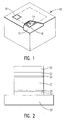
- Figure 1 is a perspective view of a known multi-layer ceramic substrate.
- Figure 2 is a side view of a multi-layer ceramic substrate laminate and sintering arrangement according to the invention.
- Figure 3 is a graph illustrating the equilibrium between copper, carbon and their oxides in a H2/ H2O ambient.
- Figure 4 is an exploded perspective view of a setter tile according to the invention.
- Figure 5 is a cross-sectional view of another embodiment of a setter tile according to the invention.
- the multi-layer ceramic substrate is comprised of a plurality of layers of ceramic material one of which 12 is shown. Each of the layers of the ceramic material has metallic lines 14 and vias 16. Additionally, the multi-layer ceramic substrate comprises top surface metallurgy 18 and bottom surface metallurgy (not shown).
- the method comprises the steps of first providing an unfired multi-layer ceramic substrate laminate 10′ having metallic lines 14 and vias 16. The method further comprises providing a reducible metal oxide in close proximity to the multi-layer ceramic substrate laminate 10′.
- the multi-layer ceramic substrate laminate contains a polymeric binder which upon heating depolymerizes into carbon as is well known in the art.
- the sintering arrangement will typically further comprise, as disclosed in U.S. Patent Application Serial No. 859,093, a non-sintering ceramic sheet 22 on top of the ceramic substrate laminate and a non-sintering ceramic sheet 24 underneath the ceramic substrate laminate.
- Each of the non-sintering ceramic sheets may be, for example, an alumina green sheet.
- On top of this sintering arrangement will be a weight 26.
- the entire sintering arrangement sits on a setter tile 28. In place of weight 26 there may be a second setter tile.
- the next step in the method comprises sintering the substrate laminate 10′ in an atmosphere which is reducing with respect to the reducible metal oxide and which is oxidizing with respect to the carbon.
- a sintering cycle is well known and is disclosed in the patents discussed previously.
- the steps of sintering converts the substrate laminate 10′ into the substrate 10.
- the preferred ceramic substrate laminate according to the invention has metallic lines and vias made from copper or copper alloys. It should be understood however, that the copper or the copper alloys may be replaced by other metals or alloys of good conductivity such as, nickel, molybdenum, silver, palladium or mixtures thereof. Further, it is preferred that where the metallic lines and vias are copper or copper alloys the reducible metal oxide is a copper oxide selected from the group consisting of Cu2O (cuprous oxide) and CuO (cupric oxide). If one of the other metals or alloys is used as the metallic lines and vias then the reducible metal oxide will be replaced so as to be the oxide of that other metal or alloy.
- the most important aspect of the present invention is the prevision of the reducible metal oxide in close proximity to the multilayer ceramic substrate laminate.
- binder burnoff occurs during the steam segment of the firing cycle.
- the temperature for binder burnoff will be between about 700 and 785°C.
- This is marked as point X in figure 3.
- Figure 3 is taken directly from the U.S.-A Patent 4.234.367. Similar reasoning will apply to other metallurgies besides copper.
- copper metallurgy is discussed. It should be understood, however, that other metals and alloys are included within the scope of the invention.
- the present invention provides a method of practicing the steam segment at nearly ideal maximum rates for the carbon-steam reaction.
- the amount of CuO or Cu2O to be initially place proximate to the substrate laminate is determined such that there is an excess of Cu2O left, over and above the amount required to consume all of the hydrogen from the carbon reaction.
- Both Cu2O can be present, but the amount required is greater for Cu2O than for CuO because of its lower oxygen content.
- This kind of self-regulating buffered system maintains the ideal H2/ H2O ratio directly at the surface of the substrate laminate.
- the present invention should thus be considered as an improvement of, rather than a substitute for, the process of U.S.-A Patent 4.627.160 wherein a copper oxide or other reducible metal oxide is incorporated in the ceramic substrate laminate itself. While the copper oxide catalyst within the ceramic substrate laminate aids in the removal of carbon from the ceramic substrate laminate, the additional reducible metal oxide of the present invention in proximity to the multilayer ceramic substrate laminate serves to enhance that removal of carbon, as will be shown in more detail hereafter.
- the polymeric binder will comprise polyvinyl butyral (PVB) resin.
- PVB polyvinyl butyral
- the polymeric binder it is within the scope of the invention for the polymeric binder to comprise polymethyl methacrylate (PMMA), polyalphamethyl styrene, or other well known ceramic binder systems.
- the ceramic substrate laminate comprises a ceramic selected from the group consisting of cordierite type glass ceramics and spodumene type glass ceramics such as that disclosed in U.S.-A Patent Nos. 4.413.061 and 4.301.324, the disclosures of which are incorporated by reference herein.
- the preferred sintering atmosphere is an atmosphere of steam and hydrogen wherein the hydrogen/steam ratio is in the range of 10 ⁇ 4 to 10 -6,5 .
- the sintering temperature must be less than the melting point of the metallic lines and vias.
- the reducible metal oxide While the reducible metal oxide must be in close proximity to the multi-layer ceramic substrate laminate 10′ it may be situated in a number of different locations just so long as it is proximate to the substrate laminate.
- the reducible metal oxide may be on at least one surface of the ceramic substrate laminate.
- the reducible metal oxide 20 is directly on the top (or horizontal) surface of the ceramic substrate laminate 10′.
- the reducible metal oxide 20 may also be located directly on the bottom surface of the ceramic substrate laminate as well.
- the reducible metal oxide first at least partially dissolves into the ceramic substrate laminate and subsequently forms an adherent layer of metal on its surface.
- An advantage of forming this layer of metal directly on the ceramic substrate is that instead of the top or bottom surface metallurgy being screened on and then fired, the metallurgy may be simply formed directly on the substrate in situ and then patterned by photolithographic steps.
- the reducible metal oxide may be located in at least one setter tile proximate to the ceramic substrate laminate. This latter embodiment will be discussed in more detail shortly.
- the sintering arrangement as shown in Figure 2 thus represents one aspect of the invention.
- the setter tile 28 comprises a refractory oxide and a reducible metal oxide.
- the reducible metal oxide is chosen such that upon sintering the ceramic substrate laminate in an atmosphere which is oxidizing with respect to the carbon, the reducible metal oxide undergoes reduction to the non-oxide (or metallic) form.
- the setter tile may be any refractory oxide although it is preferred that it be alumina (A12O3), silica (SiO2), magnesia (MgO), zirconia (ZrO2) or combinations thereof.
- the setter tile is partially sintered, thereby ensuring a porous body.
- the porosity is desirable since it allows the ambient gases to flow through the setter tile and contact the ceramic substrate laminate, thereby rendering more efficient the removal of the binder decomposition products.
- partially sintered means having at least 40% porosity and optimally, 45-50% porosity.
- a partially sintered body may be obtained by sintering between 1000-1350°C for about 12 to 24 hours after a preliminary heating cycle at lower temperatures for removal of the binder.
- Setter tile 128 comprises a plurality of layers 130 of refractory oxide having the reducible metal oxide screened thereon.
- each layer 130 has a pattern 132 of reducible metal oxide screened thereon.
- On either side of the plurality of screened layers 130 is at least one layer 134 which simply comprises refractory oxide without any reducible metal oxide thereon. Since either side of the setter tile 128 may be placed in direct contact with the ceramic substrate without the necessity of the plain non-sintering ceramic sheets 24 and 22 as discussed previously.
- setter tile 228 comprises refractory oxide 230 having the reducible metal oxide 232 dispersed therein.
- This particular setter tile 228 has porosity 234 which aids in the flow of gases from the ambient to the surface of the multi-layer ceramic substrate laminate.
- the amount of reducible metal oxide present should be in excess of that required for complete buffering of the ambient. This in turn will vary depending on the amount of binder present. In general, the amount of reducible metal oxide present in the fired setter tile should be between about 20 and 70 weight percent, with the remainder being the refractory oxide.
- the reducible metal oxide is preferably a copper oxide selected from the group consisting of cuprous oxide (Cu2O) and cupric oxide (CuO).
- Cu2O cuprous oxide
- CuO cupric oxide
- the reducible metal oxide may be changed if the metal lines and vias of the multi-layer ceramic substrate laminate are other than copper or copper alloys.
- a final aspect of the invention relates to a partially sintered setter tile composition
- a partially sintered setter tile composition comprising copper oxide and refractory oxide with the copper oxide constituting at least 20 weight % of the composition.
- the copper oxide may be selected from the group consisting of cupric oxide and cuprous oxide.
- the refractory oxide may be any of those discussed previously.
- a suitable organic binder such as polyvinyl butyral and solvents such as methyl-isobutyl-ketone
- a paste prepared by mixing cuprous oxide (Cu2O) and a suitable paste vehicle such as Texanol (consisting of 70% by weight of cuprous oxide) was then screened over the top and bottom surfaces of the substrate laminate to form a layer of approximate thickness of 50 microns.
- the prepared laminate was placed on a refractory setter tile.
- a similar setter tile was also placed on top of the laminate to exert downward pressure on the laminate during sintering and constrain its sintering in the plane of the laminate.
- the assembly was then sintered in a programmable furnace as follows. The initial heating of the laminate was carried out in an inert ambient of nitrogen to decompose and carbonize the binder.
- the sintering atmosphere was changed to one consisting of water vapor and hydrogen in the proportion of 10 ⁇ 4:1 at which carbon oxidizes while copper does not.
- the laminate was heated in nitrogen for several hours to expel water dissolved in the glass powder, before being heated to the final sintering temperature of about 950°C in a reducing ambient of hydrogen.
- the laminate was cooled to room temperature in nitrogen ambient.
- the sintered, glass ceramic substrate thus prepared was found to have an integral surface layer of pure copper metal of thickness of about 20 microns. It was also found that the presence of the copper oxide layer on the substrate surface had aided in the complete removal of carbon residues uniformly through its thickness.
- Setter tiles were prepared in the following manner. A slurry of alumina, glass, binders, solvents and other organic additives was cast into green sheets. (The final composition after firing was 92 weight % alumina, 8 weight % glass). Thereafter, a paste consisting of CuO and a suitable paste vehicle such as PVB or ethyl cellulose was prepared. The CuO comprised 82 weight % of the paste. The paste was then patterned in a square hatch pattern, such as that shown in Figure 4, on the green sheets. There was about 5 to 8 grams of paste per green sheet.
- a plurality of the screened green sheets were stacked together. On the top and bottom of the stack were 2 or 3 unscreened green sheets. The stack was then laminated at 75°C and 6000 psi pressure followed by pre-sintering at about 980°C to remove the organics. The final laminate had 45 to 50% open porosity.
- a conventional glass-ceramic substrate laminate such as that described in the U.S.-A patents 4.413.061 and 4.301.324, was prepared, except that the substrate contained about 0,15% copper oxide as taught in the U.S.-A Patent No. 4.627.160.
- One setter tile was placed on the top and underneath the bottom of the glass ceramic substrate laminate. The arrangement so formed then underwent a conventional sintering cycle. The temperature of the steam segment was 730°C and the H2/H2O ratio was 10 ⁇ 4.
- binder burnoff After 18 hours there was complete binder burnoff. Under the same sintering conditions, but without the copper oxide-containing setter tile, binder burnoff would have occurred in about 30 hours.
- Setter tiles were prepared by making a slurry of a composition consisting in weight percent of CuO 49,99 Al2O3 25,26 Butvar B-90 2,58 Benzoflex 0,90 Methanol 5,37 Methylisobutylketone 16,12 which was then cast into green sheets. Twenty green sheets were laminate together under heat and pressure to form the tile which was then heated to about 965°C to remove the binders and to partially sinter it. The partially-sintered setter tiles contained about 40% connected porosity. The final composition of the setter tile was 66,33 weight % CuO, 33,67 weight % A12O3.
Landscapes
- Chemical & Material Sciences (AREA)
- Engineering & Computer Science (AREA)
- Ceramic Engineering (AREA)
- Manufacturing & Machinery (AREA)
- Inorganic Chemistry (AREA)
- Materials Engineering (AREA)
- Structural Engineering (AREA)
- Organic Chemistry (AREA)
- Chemical Kinetics & Catalysis (AREA)
- Production Of Multi-Layered Print Wiring Board (AREA)
Claims (12)
- Sinteranordnung zur Steigerung der Entfernung von Kohlenstoff aus mehrschichtigen, keramischen Substratlaminaten während deren Sinterns, dadurch gekennzeichnet, daß sie beinhaltet:
ein keramisches Substratlaminat (10), das metallische Leitungen und Durchkontaktierungen (16) aufweist und ein polymeres Bindemittel enthält, das bei Erwärmen in Kohlenstoff depolymerisiert; und
ein reduzierbares Metalloxid auf wenigstens einer Oberfläche des Substratlaminats (10), wobei das reduzierbare Metalloxid so gewählt ist, daß, wenn das Substratlaminat in einer Atmosphäre gesintert wird, die bezüglich des Kohlenstoffs oxidierend wirkt, das reduzierbare Metalloxid eine Reduktion erfährt, um eine haftende Schicht aus Metallmaterial auf der Oberfläche des mehrschichtigen Keramiksubstrats zu bilden. - Sinteranordnung zur Steigerung der Entfernung von Kohlenstoff aus mehrschichtigen, keramischen Substratlaminaten während deren Sinterns, dadurch gekennzeichnet, daß sie beinhaltet:
ein mehrschichtiges, keramisches Substratlaminat (10), das metallische Leitungen (14) und Durchkontaktierungen (16) aufweist und ein polymeres Bindemittel enthält, das bei Erwärmen in Kohlenstoff depolymerisiert; und
wenigstens eine Ofenstützplatte (28) nahe des mehrschichtigen, keramischen Substratlaminats, wobei die Ofenstützplatte (28) ein hochschmelzendes Oxid und ein reduzierbares Metalloxid (20) beinhaltet, wobei das reduzierbare Metalloxid so gewählt ist, daß beim Sintern des keramischen Substratlaminats in einer Atmosphäre, die bezüglich des Kohlenstoffs oxidierend wirkt, das reduzierbare Metalloxid eine Reduktion in die nicht-oxidische Form erfährt. - Sinteranordnung nach Anspruch 2, wobei sich die Ofenstützplatte (28) in direktem Kontakt mit dem keramischen Substratlaminat befindet.
- Sinteranordnung nach Anspruch 2 oder 3, wobei die Ofenstützplatte (128) eine Mehrzahl von Schichten (130) aus einem hochschmelzenden Oxid (230) beinhaltet, auf denen das reduzierbare Metalloxid (232) durch Siebdruck aufgebracht ist.
- Sinteranordnung nach Anspruch 2, 3 oder 4, wobei die Ofenstützplatte (128) ein hochschmelzendes Oxid beinhaltet, in dem das reduzierbare Metalloxid (232) dispergiert vorliegt.
- Sinteranordnung nach einem der vorhergehenden Ansprüche, wobei die Ofenstützplatte (28, 128) teilweise gesintert ist.
- Sinteranordnung nach einem der vorhergehenden Ansprüche, wobei das hochschmelzende Oxid aus der Gruppe ausgewählt ist, die aus Aluminiumoxid, Silizium(IV)-Oxid, Magnesiumoxid, Zirkoniumoxid und Mischungen daraus besteht, die metallischen Leitungen (14) und Durchkontaktierungen (16) aus Kupfer oder Kupferlegierungen bestehen, das reduzierbare Metalloxid (20, 232) ein Kupferoxid ist, das aus der Gruppe ausgewählt ist, die aus CuO und Cu₂O besteht, und das polymere Bindemittel Polyvinylbutyralharz beinhaltet.
- Teilweise gesinterte Ofenstützplatten-Zusammensetzung, die Kupferoxid und ein hochschmelzendes Oxid beinhaltet, wobei das Kupferoxid wenigstens 20 Gewichtsprozent der Zusammensetzung ausmacht.
- Ofenstützplatten-Zusammensetzung nach Anspruch 8, wobei das Kupferoxid aus der Gruppe ausgewählt ist, die aus CuO und Cu₂O besteht.
- Verfahren zur Steigerung der Entfernung von Kohlenstoff aus mehrschichtigen, keramischen Substratlaminaten während deren Sinterns, wie in einem der vorhergehenden Ansprüche festgelegt, dadurch gekennzeichnet, daß es die folgenden Schritte umfaßt:
Bereitstellen eines mehrschichtigen, keramischen Substratlaminats mit metallischen Leitungen und Durchkontaktierungen sowie einem reduzierbaren Metalloxid auf wenigstens einer Oberfläche des mehrschichtigen, keramischen Substratlaminats, das ein polymeres Bindemittel enthält, das bei Erwärmen in Kohlenstoff depolymerisiert; und
Sintern des Substratlaminats in einer Atmosphäre, die bezüglich des reduzierbaren Metalloxids reduzierend und bezüglich des Kohlenstoffs oxidierend wirkt. - Verfahren nach Anspruch 10, wobei die Atmosphäre eine Dampf- und Wasserstoffatmosphäre ist und das Wasserstoff-zu-Dampf-Verhältnis im Bereich von 10⁻⁴ bis 10-6,5 liegt und die Sintertemperaturen niedriger als der Schmelzpunkt der metallischen Leitungen und der Durchkontaktierungen sind.
- Verfahren nach Anspruch 10, wobei das reduzierbare Metalloxid bei der Reduktion zum Metall eine haftende Schicht aus Metall auf dem gesinterten Keramiksubstrat bildet.
Applications Claiming Priority (2)
| Application Number | Priority Date | Filing Date | Title |
|---|---|---|---|
| US07/220,192 US4971738A (en) | 1988-07-18 | 1988-07-18 | Enhanced removal of carbon from ceramic substrate laminates |
| US220192 | 1988-07-18 |
Publications (3)
| Publication Number | Publication Date |
|---|---|
| EP0352211A2 EP0352211A2 (de) | 1990-01-24 |
| EP0352211A3 EP0352211A3 (de) | 1991-11-21 |
| EP0352211B1 true EP0352211B1 (de) | 1994-05-18 |
Family
ID=22822452
Family Applications (1)
| Application Number | Title | Priority Date | Filing Date |
|---|---|---|---|
| EP89480099A Expired - Lifetime EP0352211B1 (de) | 1988-07-18 | 1989-06-08 | Entfernen von Kohlenstoff aus keramischen Schichtsubstraten |
Country Status (4)
| Country | Link |
|---|---|
| US (1) | US4971738A (de) |
| EP (1) | EP0352211B1 (de) |
| JP (1) | JP2525898B2 (de) |
| DE (1) | DE68915354T2 (de) |
Families Citing this family (13)
| Publication number | Priority date | Publication date | Assignee | Title |
|---|---|---|---|---|
| KR920002589B1 (ko) * | 1990-03-30 | 1992-03-30 | 삼성코닝 주식회사 | 금속 인쇄된 세라믹 팩키지의 제조방법 |
| JPH06169174A (ja) * | 1992-08-17 | 1994-06-14 | Praxair Technol Inc | 多層セラミック構造物からのバインダー除去 |
| US6353250B1 (en) | 1997-11-07 | 2002-03-05 | Nippon Telegraph And Telephone Corporation | Semiconductor photo-detector, semiconductor photo-detection device, and production methods thereof |
| US6254925B1 (en) | 1998-07-28 | 2001-07-03 | International Business Machines Corporation | Source metal embedded in an inert material and process thereof |
| DE19848474C1 (de) * | 1998-10-21 | 2000-01-13 | Bosch Gmbh Robert | Verfahren und Vorrichtung zur Herstellung keramischer Formkörper mittels Setterplatten und Verendung des Verfahrens zur Herstellung keramischer Mehrschichthybride |
| JP4062845B2 (ja) * | 1999-02-26 | 2008-03-19 | 三菱マテリアル株式会社 | 脱脂・焼成用セッター及びその製造方法 |
| JP3884669B2 (ja) * | 2002-04-05 | 2007-02-21 | 株式会社デンソー | セラミック積層体の製造方法 |
| JP4533129B2 (ja) * | 2004-12-28 | 2010-09-01 | 日本特殊陶業株式会社 | 配線基板の製造方法 |
| US8206025B2 (en) | 2007-08-07 | 2012-06-26 | International Business Machines Corporation | Microfluid mixer, methods of use and methods of manufacture thereof |
| JP2011129568A (ja) * | 2009-12-15 | 2011-06-30 | Tdk Corp | 電子部品の製造方法及び電子部品 |
| JP2011134875A (ja) * | 2009-12-24 | 2011-07-07 | Tdk Corp | 電子部品の製造方法 |
| US10471418B2 (en) | 2015-10-16 | 2019-11-12 | International Business Machines Corporation | Selectively functionalized porous material |
| CA3106174A1 (en) * | 2018-01-30 | 2019-07-30 | Tekna Plasma Systems Inc. | Metallic powders for use as electrode material in multilayer ceramic capacitors and method of manufacturing and of using same |
Family Cites Families (15)
| Publication number | Priority date | Publication date | Assignee | Title |
|---|---|---|---|---|
| US2993815A (en) * | 1959-05-25 | 1961-07-25 | Bell Telephone Labor Inc | Metallizing refractory substrates |
| US3790360A (en) * | 1972-02-23 | 1974-02-05 | Ishizuka Glass | Process for producing metal coated glass-ceramic articles |
| US4189760A (en) * | 1973-05-13 | 1980-02-19 | Erie Technological Products, Inc. | Monolithic capacitor with non-noble metal electrodes and method of making the same |
| US4301324A (en) * | 1978-02-06 | 1981-11-17 | International Business Machines Corporation | Glass-ceramic structures and sintered multilayer substrates thereof with circuit patterns of gold, silver or copper |
| US4413061A (en) * | 1978-02-06 | 1983-11-01 | International Business Machines Corporation | Glass-ceramic structures and sintered multilayer substrates thereof with circuit patterns of gold, silver or copper |
| US4234367A (en) * | 1979-03-23 | 1980-11-18 | International Business Machines Corporation | Method of making multilayered glass-ceramic structures having an internal distribution of copper-based conductors |
| US4386985A (en) * | 1980-06-30 | 1983-06-07 | North American Philips Corporation | Method of making ceramic dielectric for base metal electrode capacitors |
| JPS59995A (ja) * | 1982-06-16 | 1984-01-06 | 富士通株式会社 | 銅導体多層構造体の製造方法 |
| US4474731A (en) * | 1983-03-28 | 1984-10-02 | International Business Machines Corporation | Process for the removal of carbon residues during sintering of ceramics |
| US4627160A (en) * | 1985-08-02 | 1986-12-09 | International Business Machines Corporation | Method for removal of carbonaceous residues from ceramic structures having internal metallurgy |
| JPS62173798A (ja) * | 1986-01-27 | 1987-07-30 | 株式会社日立製作所 | 多層セラミツク回路基板の製法 |
| US4795512A (en) * | 1986-02-26 | 1989-01-03 | Matsushita Electric Industrial Co., Ltd. | Method of manufacturing a multilayer ceramic body |
| CA1274430A (en) * | 1986-10-14 | 1990-09-25 | E. I. Du Pont De Nemours And Company | Controlled atmosphere firing process |
| JPS63128791A (ja) * | 1986-11-12 | 1988-06-01 | インタ−ナショナル・ビジネス・マシ−ンズ・コ−ポレ−ション | 金属導体を有する高密度多層ガラス・セラミツク構造体の製造方法 |
| JP2535580B2 (ja) * | 1988-01-29 | 1996-09-18 | 富士通株式会社 | 焼成炉制御装置 |
-
1988
- 1988-07-18 US US07/220,192 patent/US4971738A/en not_active Expired - Fee Related
-
1989
- 1989-05-12 JP JP1117597A patent/JP2525898B2/ja not_active Expired - Lifetime
- 1989-06-08 DE DE68915354T patent/DE68915354T2/de not_active Expired - Fee Related
- 1989-06-08 EP EP89480099A patent/EP0352211B1/de not_active Expired - Lifetime
Also Published As
| Publication number | Publication date |
|---|---|
| DE68915354T2 (de) | 1994-11-24 |
| JP2525898B2 (ja) | 1996-08-21 |
| EP0352211A3 (de) | 1991-11-21 |
| EP0352211A2 (de) | 1990-01-24 |
| DE68915354D1 (de) | 1994-06-23 |
| US4971738A (en) | 1990-11-20 |
| JPH0234571A (ja) | 1990-02-05 |
Similar Documents
| Publication | Publication Date | Title |
|---|---|---|
| EP0332457B1 (de) | Mehrschichtige keramische Unterlagen und Verfahren zu ihrer Herstellung | |
| EP0098067B1 (de) | Verfahren zum Herstellen einer mehrschichtigen Glas-Keramik-Struktur mit auf Kupfer basierenden Leitern | |
| US3852877A (en) | Multilayer circuits | |
| US4627160A (en) | Method for removal of carbonaceous residues from ceramic structures having internal metallurgy | |
| EP0570855A2 (de) | Verfahren zur Herstellung eines mehrlagigen Substrats | |
| US4971738A (en) | Enhanced removal of carbon from ceramic substrate laminates | |
| US5073180A (en) | Method for forming sealed co-fired glass ceramic structures | |
| JPH05102666A (ja) | 多層セラミツク基板の製造方法 | |
| US5336444A (en) | Ceramic via composition, multilayer ceramic circuit containing same, and process for using same | |
| US4678683A (en) | Process for cofiring structure comprised of ceramic substrate and refractory metal metallization | |
| EP0159690A2 (de) | Verfahren zum Kontrollieren des Sinterns von Metallpulvern | |
| US5139975A (en) | Sintering arrangement for enhancing removal of carbon from ceramic substrate laminates | |
| US5053361A (en) | Setter tile for use in sintering of ceramic substrate laminates | |
| US5503787A (en) | Method for manufacturing multilayer ceramic substrate | |
| US4776978A (en) | Method of controlling the sintering of metal particles | |
| JP2506520B2 (ja) | 多層セラミック物品を熱加工する方法 | |
| US5662755A (en) | Method of making multi-layered ceramic substrates | |
| EP0267602A2 (de) | Verfahren zur Herstellung einer Mehrschichtstruktur hoher Dichte aus Glaskeramik mit metallischen Leitern | |
| JPH06350254A (ja) | 多層セラミック基板の製造方法 | |
| US5167913A (en) | Method of forming an adherent layer of metallurgy on a ceramic substrate | |
| JPH05136572A (ja) | 多層セラミツク基板の製造方法 | |
| JPH06326470A (ja) | 多層セラミック基板の製造方法 | |
| JPS61292392A (ja) | セラミツク配線基板の製造方法 | |
| JPS6126293A (ja) | セラミック多層配線基板の製造方法 | |
| JPH0321109B2 (de) |
Legal Events
| Date | Code | Title | Description |
|---|---|---|---|
| PUAI | Public reference made under article 153(3) epc to a published international application that has entered the european phase |
Free format text: ORIGINAL CODE: 0009012 |
|
| AK | Designated contracting states |
Kind code of ref document: A2 Designated state(s): DE FR GB |
|
| 17P | Request for examination filed |
Effective date: 19900512 |
|
| PUAL | Search report despatched |
Free format text: ORIGINAL CODE: 0009013 |
|
| AK | Designated contracting states |
Kind code of ref document: A3 Designated state(s): DE FR GB |
|
| 17Q | First examination report despatched |
Effective date: 19920324 |
|
| GRAA | (expected) grant |
Free format text: ORIGINAL CODE: 0009210 |
|
| AK | Designated contracting states |
Kind code of ref document: B1 Designated state(s): DE FR GB |
|
| REF | Corresponds to: |
Ref document number: 68915354 Country of ref document: DE Date of ref document: 19940623 |
|
| ET | Fr: translation filed | ||
| PLBE | No opposition filed within time limit |
Free format text: ORIGINAL CODE: 0009261 |
|
| STAA | Information on the status of an ep patent application or granted ep patent |
Free format text: STATUS: NO OPPOSITION FILED WITHIN TIME LIMIT |
|
| 26N | No opposition filed | ||
| PGFP | Annual fee paid to national office [announced via postgrant information from national office to epo] |
Ref country code: GB Payment date: 19960520 Year of fee payment: 8 |
|
| PGFP | Annual fee paid to national office [announced via postgrant information from national office to epo] |
Ref country code: FR Payment date: 19960607 Year of fee payment: 8 |
|
| PG25 | Lapsed in a contracting state [announced via postgrant information from national office to epo] |
Ref country code: GB Free format text: LAPSE BECAUSE OF NON-PAYMENT OF DUE FEES Effective date: 19970608 |
|
| PGFP | Annual fee paid to national office [announced via postgrant information from national office to epo] |
Ref country code: DE Payment date: 19970624 Year of fee payment: 9 |
|
| GBPC | Gb: european patent ceased through non-payment of renewal fee |
Effective date: 19970608 |
|
| PG25 | Lapsed in a contracting state [announced via postgrant information from national office to epo] |
Ref country code: FR Free format text: LAPSE BECAUSE OF NON-PAYMENT OF DUE FEES Effective date: 19980227 |
|
| REG | Reference to a national code |
Ref country code: FR Ref legal event code: ST |
|
| REG | Reference to a national code |
Ref country code: FR Ref legal event code: ST |
|
| PG25 | Lapsed in a contracting state [announced via postgrant information from national office to epo] |
Ref country code: DE Free format text: LAPSE BECAUSE OF NON-PAYMENT OF DUE FEES Effective date: 19990401 |