EP0352650A2 - Semelle intérieure - Google Patents
Semelle intérieure Download PDFInfo
- Publication number
- EP0352650A2 EP0352650A2 EP89113406A EP89113406A EP0352650A2 EP 0352650 A2 EP0352650 A2 EP 0352650A2 EP 89113406 A EP89113406 A EP 89113406A EP 89113406 A EP89113406 A EP 89113406A EP 0352650 A2 EP0352650 A2 EP 0352650A2
- Authority
- EP
- European Patent Office
- Prior art keywords
- insole
- cushion insert
- cushion
- area
- insert
- Prior art date
- Legal status (The legal status is an assumption and is not a legal conclusion. Google has not performed a legal analysis and makes no representation as to the accuracy of the status listed.)
- Withdrawn
Links
- 230000002787 reinforcement Effects 0.000 claims description 9
- 229910000831 Steel Inorganic materials 0.000 claims description 4
- 239000010959 steel Substances 0.000 claims description 4
- 229920001821 foam rubber Polymers 0.000 claims description 3
- 239000002657 fibrous material Substances 0.000 claims description 2
- 239000006260 foam Substances 0.000 claims description 2
- 230000002045 lasting effect Effects 0.000 abstract description 7
- 238000004519 manufacturing process Methods 0.000 abstract description 2
- 210000002683 foot Anatomy 0.000 description 9
- 210000004744 fore-foot Anatomy 0.000 description 3
- XEEYBQQBJWHFJM-UHFFFAOYSA-N Iron Chemical compound [Fe] XEEYBQQBJWHFJM-UHFFFAOYSA-N 0.000 description 2
- 240000002871 Tectona grandis Species 0.000 description 2
- 239000000853 adhesive Substances 0.000 description 2
- 230000001070 adhesive effect Effects 0.000 description 2
- 239000000835 fiber Substances 0.000 description 2
- 239000010985 leather Substances 0.000 description 2
- 239000000463 material Substances 0.000 description 2
- 230000000399 orthopedic effect Effects 0.000 description 2
- 229920001169 thermoplastic Polymers 0.000 description 2
- 239000004416 thermosoftening plastic Substances 0.000 description 2
- 229920002678 cellulose Polymers 0.000 description 1
- 239000001913 cellulose Substances 0.000 description 1
- 230000001627 detrimental effect Effects 0.000 description 1
- 239000013013 elastic material Substances 0.000 description 1
- 229910052742 iron Inorganic materials 0.000 description 1
- 238000000034 method Methods 0.000 description 1
- 239000004745 nonwoven fabric Substances 0.000 description 1
- 230000035699 permeability Effects 0.000 description 1
- 229920002994 synthetic fiber Polymers 0.000 description 1
- 239000004758 synthetic textile Substances 0.000 description 1
Images


Classifications
-
- A—HUMAN NECESSITIES
- A43—FOOTWEAR
- A43B—CHARACTERISTIC FEATURES OF FOOTWEAR; PARTS OF FOOTWEAR
- A43B7/00—Footwear with health or hygienic arrangements
- A43B7/14—Footwear with health or hygienic arrangements with foot-supporting parts
- A43B7/1405—Footwear with health or hygienic arrangements with foot-supporting parts with pads or holes on one or more locations, or having an anatomical or curved form
- A43B7/1415—Footwear with health or hygienic arrangements with foot-supporting parts with pads or holes on one or more locations, or having an anatomical or curved form characterised by the location under the foot
- A43B7/1425—Footwear with health or hygienic arrangements with foot-supporting parts with pads or holes on one or more locations, or having an anatomical or curved form characterised by the location under the foot situated under the ball of the foot, i.e. the joint between the first metatarsal and first phalange
-
- A—HUMAN NECESSITIES
- A43—FOOTWEAR
- A43B—CHARACTERISTIC FEATURES OF FOOTWEAR; PARTS OF FOOTWEAR
- A43B13/00—Soles; Sole-and-heel integral units
- A43B13/38—Built-in insoles joined to uppers during the manufacturing process, e.g. structural insoles; Insoles glued to shoes during the manufacturing process
- A43B13/40—Built-in insoles joined to uppers during the manufacturing process, e.g. structural insoles; Insoles glued to shoes during the manufacturing process with cushions
Definitions
- the invention relates to an insole in which a part, in particular the edge area, is inelastic and a second part, in particular the ball area, is elastic.
- DE-AS 10 00 716 describes that insoles of this type have already been proposed in order to eliminate foot problems. According to DE-AS 10 00 716, however, this is considered to be disadvantageous since the requirements that are to be placed on soles with non-uniformly flexible locations with regard to the orthopedic requirements were not taken into account.
- a foot pad in the form of an insole or the like is therefore proposed, in which those places where lifting of foot parts or a special foot support is advantageous from an orthopedic point of view are hard-elastic and those places where deep storage of foot parts is desired becomes soft are elastic and slightly yielding under pressure. In this publication, however, it is not described how a sole is to be designed which consists of softer material only at certain points.
- DE-AS 27 23 061 An insole is described in DE-AS 27 23 061, which has padding in the ball area, so as to bed the sensitive foot as softly as possible. While a corresponding cushion layer was previously applied to the insole and this cushion layer was then covered with an insole, DE-AS 27 23 061 further develops an insole that is split from the tip and in which an air-permeable layer is formed in the gap between the two insole layers Upholstery part is introduced, which is fixed by appropriate connection of the two insole layers in the gap.
- the object of the present invention is therefore to create an insole for a twisted air cushion shoe or boot which can be produced using conventional lasting machines.
- the insole has an opening forming the elastic region, in which a cushion insert is inserted, that the cushion insert essentially fills the opening in the insole, that the thickness of the cushion insert is slightly larger than the thickness of the insole and that the upholstery insert merges into a flat edge section which rests on the insole.
- the insole according to the invention can be mounted in a conventional manner, the upper being able to be attached using a conventional thermoplastic adhesive or teak.
- the sole can be attached to the lasting edge of the shoe upper and the insole.
- the padding of the insole is designed so that it is neither visible nor that it must be taken into account in the forefoot height of the last.
- the cushion insert projects downward from the insole. This ensures that when the sole is loaded, the foot does not sink into the opening in the insole and thereby also pulls the flat edge section into the opening. In such a case, the foot would feel the edge of the opening in the insole, which would be detrimental to the wearing behavior.
- the shoe has particularly pleasant wearing properties if the cushion insert is made of a soft, elastic, in particular air-permeable foam. Synthetic latex foam has proven to be particularly suitable.
- this soft elastic material can be exploited in a further development of the inventive concept in that the flat edge section of the cushion insert is essentially flush with the outer contour of the insole. This also saves you an additional insole.
- the flat edge portion of the cushion insert can also be easily glued to the insole and thus the cushion insert can also be securely fastened in the insole.
- the insole or the like from a press fiber. exists, under which a hard cardboard is glued in the heel area and, if necessary, a steel joint is arranged between them as additional reinforcement, it is provided that the lower surface of the cushion insert protruding from the insole is flush with the hard cardboard. This means that no compensating means need to be provided in order to be able to securely fasten the surface of the insole to the outsole.
- the insole 1 shown in Fig. 1 initially has a conventional structure and consists of conventional materials such as leather, leather slits, nonwovens made of cellulose or synthetic textile fibers or a pressed fiber material or the like.
- a hardboard under the insole 1 (Pressed cardboard) existing reinforcement 2 glued.
- a steel joint 3 can be fastened to the latter between the insole 1 and the reinforcement 2 by means of rivets 4 and 5.
- an opening 6 is punched into the insole 1, into which an elastic cushion insert 7 is inserted.
- the cushion insert 7 has a shape that fits exactly into the opening 6 and fills it.
- the surface 8 of the cushion insert 7 merges into a flat edge section 9 (FIG. 6) which has such an extent that the entire edge region 10 in the ball area 11 of the insole 1 is covered by the edge section 9 of the cushion insert 7.
- the edge section 9 of the cushion insert 7 is glued to the edge region 10 of the insole 1, the projecting part of the edge section 9 being cut off such that the edge section 9 of the cushion insert 7 is essentially flush with the outer contour of the insole 1.
- the cushion insert 7 consisting of a synthetic latex foam has a thickness which is greater than the thickness of the insole 1.
- the cushion insert 7 thus protrudes downward from the insole 1 (FIGS. 3 and 4).
- the thickness of the cushion insert 7 is expediently chosen so that the lower surface 12 of the cushion insert 7 is aligned with the reinforcement 2 made of iron cardboard.
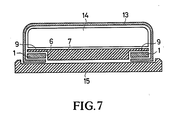
- Such an insole 1 can be processed with conventional lasting machines. This is illustrated in the schematic illustration in FIG. 7.
- a shaft 13 is connected to the insole 1 by means of a last 14 by means of a conventional overtaking and lasting machine.
- the shaft can be attached using conventional thermoplastic adhesive or teaks.
- an outsole 15 is glued to the lasting edge of the shoe upper 13 and the insole 1. This completes the shoe that is can act any gusseted shoe or boot that is to be designed as a bubble shoe or boot.
Landscapes
- Health & Medical Sciences (AREA)
- Epidemiology (AREA)
- General Health & Medical Sciences (AREA)
- Public Health (AREA)
- Footwear And Its Accessory, Manufacturing Method And Apparatuses (AREA)
Applications Claiming Priority (2)
| Application Number | Priority Date | Filing Date | Title |
|---|---|---|---|
| DE8809477U | 1988-07-25 | ||
| DE8809477U DE8809477U1 (de) | 1988-07-25 | 1988-07-25 | Brandsohle |
Publications (2)
| Publication Number | Publication Date |
|---|---|
| EP0352650A2 true EP0352650A2 (fr) | 1990-01-31 |
| EP0352650A3 EP0352650A3 (fr) | 1991-05-29 |
Family
ID=6826277
Family Applications (1)
| Application Number | Title | Priority Date | Filing Date |
|---|---|---|---|
| EP19890113406 Withdrawn EP0352650A3 (fr) | 1988-07-25 | 1989-07-21 | Semelle intérieure |
Country Status (2)
| Country | Link |
|---|---|
| EP (1) | EP0352650A3 (fr) |
| DE (1) | DE8809477U1 (fr) |
Cited By (2)
| Publication number | Priority date | Publication date | Assignee | Title |
|---|---|---|---|---|
| AT398157B (de) * | 1990-11-21 | 1994-10-25 | M & C Oswald Gmbh | Schuh mit einer mehrschichtigen brandsohle, brandsohle für einen solchen schuh und verfahren zur herstellung einer brandsohle |
| DE102014015920A1 (de) | 2014-10-16 | 2016-04-21 | Tanja Bastek | Brandsohle |
Families Citing this family (1)
| Publication number | Priority date | Publication date | Assignee | Title |
|---|---|---|---|---|
| DE4118311A1 (de) * | 1991-06-04 | 1992-12-10 | Stefan Lederer | Schuh |
Family Cites Families (3)
| Publication number | Priority date | Publication date | Assignee | Title |
|---|---|---|---|---|
| US2055574A (en) * | 1933-11-17 | 1936-09-29 | Josef Muller | Insole |
| US2405443A (en) * | 1945-01-25 | 1946-08-06 | Frank S Mees | Platform sole |
| GB8700349D0 (en) * | 1987-01-08 | 1987-02-11 | Clarks Ltd | Insole assemblies |
-
1988
- 1988-07-25 DE DE8809477U patent/DE8809477U1/de not_active Expired
-
1989
- 1989-07-21 EP EP19890113406 patent/EP0352650A3/fr not_active Withdrawn
Cited By (3)
| Publication number | Priority date | Publication date | Assignee | Title |
|---|---|---|---|---|
| AT398157B (de) * | 1990-11-21 | 1994-10-25 | M & C Oswald Gmbh | Schuh mit einer mehrschichtigen brandsohle, brandsohle für einen solchen schuh und verfahren zur herstellung einer brandsohle |
| EP0574392B1 (fr) * | 1990-11-21 | 1997-01-22 | ALPHA Beteiligungs- und Verwaltungsgesellschaft m.b.H. | Chaussure et semelle interieure |
| DE102014015920A1 (de) | 2014-10-16 | 2016-04-21 | Tanja Bastek | Brandsohle |
Also Published As
| Publication number | Publication date |
|---|---|
| EP0352650A3 (fr) | 1991-05-29 |
| DE8809477U1 (de) | 1988-09-15 |
Similar Documents
| Publication | Publication Date | Title |
|---|---|---|
| DE3220025A1 (de) | Sohle | |
| DD294627B5 (de) | Sportschuh mit elastischer Einlage im Absatz | |
| DE3245964A1 (de) | Sportschuh mit fersendaempfung | |
| DE69921566T2 (de) | Brandsohle für Sportschuhe | |
| DE7902981U1 (de) | Schuh, insbesondere für die ersten Schritte eines Kindes | |
| DE2623723A1 (de) | Fusschutz aus kunststoff | |
| DE2159526B2 (de) | Schischuh aus kunststoff | |
| AT398157B (de) | Schuh mit einer mehrschichtigen brandsohle, brandsohle für einen solchen schuh und verfahren zur herstellung einer brandsohle | |
| EP0707803B1 (fr) | Procédé de fabrication de semelles pour chaussures | |
| EP0352650A2 (fr) | Semelle intérieure | |
| EP0044549A1 (fr) | Semelle à garniture incorporée résistant au percement | |
| DE6926864U (de) | Zusammengesetzte schuhsohle | |
| EP0080456B1 (fr) | Semelle de chaussure, moule et procédé pour sa fabrication | |
| DE3144646A1 (de) | Schuetzende zwischensohle fuer schuhwerk | |
| DE2630389A1 (de) | Verfahren zum herstellen von verleisteten, mit verstaerkungseinlagen versehenen sicherheitsschuhen sowie ein erzeugnis zur verwendung bei der herstellung solcher schuhe | |
| DE1685713A1 (de) | Schuh,insbesondere Kinderschuh und Werkzeug zum Herstellen einer Laufsohle fuer einen solchen Schuh | |
| DE9211560U1 (de) | Einlegesohle für Schuhe | |
| DE1918537B2 (de) | Brandsohle und Verfahren zu ihrer Herstellung | |
| DE1906421U (de) | Strassenschuh. | |
| DE3733411C2 (fr) | ||
| DE8534695U1 (de) | Schuhsohle aus Polyurethanschaum | |
| DE2222413A1 (de) | Brandsohle | |
| DE4228582A1 (de) | Einlegesohle für Schuhe | |
| DE1485658C3 (fr) | ||
| DE1485658B2 (de) | Schuhsohle aus gummielastischem material |
Legal Events
| Date | Code | Title | Description |
|---|---|---|---|
| PUAI | Public reference made under article 153(3) epc to a published international application that has entered the european phase |
Free format text: ORIGINAL CODE: 0009012 |
|
| AK | Designated contracting states |
Kind code of ref document: A2 Designated state(s): AT BE CH DE ES FR GB GR IT LI LU NL SE |
|
| RBV | Designated contracting states (corrected) |
Designated state(s): AT BE CH DE ES FR GB GR IT LI LU NL |
|
| PUAL | Search report despatched |
Free format text: ORIGINAL CODE: 0009013 |
|
| AK | Designated contracting states |
Kind code of ref document: A3 Designated state(s): AT BE CH DE ES FR GB GR IT LI LU NL SE |
|
| STAA | Information on the status of an ep patent application or granted ep patent |
Free format text: STATUS: THE APPLICATION IS DEEMED TO BE WITHDRAWN |
|
| 18D | Application deemed to be withdrawn |
Effective date: 19920201 |