EP0353580B1 - Verfahren zur Herstellung von konzentrierten fliessfähigen wässrigen Lösungen von Betainen - Google Patents
Verfahren zur Herstellung von konzentrierten fliessfähigen wässrigen Lösungen von Betainen Download PDFInfo
- Publication number
- EP0353580B1 EP0353580B1 EP89113570A EP89113570A EP0353580B1 EP 0353580 B1 EP0353580 B1 EP 0353580B1 EP 89113570 A EP89113570 A EP 89113570A EP 89113570 A EP89113570 A EP 89113570A EP 0353580 B1 EP0353580 B1 EP 0353580B1
- Authority
- EP
- European Patent Office
- Prior art keywords
- betaine
- water
- weight
- solution
- aqueous
- Prior art date
- Legal status (The legal status is an assumption and is not a legal conclusion. Google has not performed a legal analysis and makes no representation as to the accuracy of the status listed.)
- Expired - Lifetime
Links
- KWIUHFFTVRNATP-UHFFFAOYSA-N Betaine Natural products C[N+](C)(C)CC([O-])=O KWIUHFFTVRNATP-UHFFFAOYSA-N 0.000 title claims description 115
- 229960003237 betaine Drugs 0.000 title claims description 58
- 238000002360 preparation method Methods 0.000 title claims description 17
- 238000000034 method Methods 0.000 title claims description 12
- KWIUHFFTVRNATP-UHFFFAOYSA-O N,N,N-trimethylglycinium Chemical compound C[N+](C)(C)CC(O)=O KWIUHFFTVRNATP-UHFFFAOYSA-O 0.000 title 1
- 239000012530 fluid Substances 0.000 title 1
- 239000000243 solution Substances 0.000 claims description 69
- LFQSCWFLJHTTHZ-UHFFFAOYSA-N Ethanol Chemical compound CCO LFQSCWFLJHTTHZ-UHFFFAOYSA-N 0.000 claims description 43
- XLYOFNOQVPJJNP-UHFFFAOYSA-N water Substances O XLYOFNOQVPJJNP-UHFFFAOYSA-N 0.000 claims description 40
- 235000014113 dietary fatty acids Nutrition 0.000 claims description 37
- 239000000194 fatty acid Substances 0.000 claims description 37
- 229930195729 fatty acid Natural products 0.000 claims description 37
- 150000004665 fatty acids Chemical class 0.000 claims description 33
- 239000002736 nonionic surfactant Substances 0.000 claims description 28
- 239000000203 mixture Substances 0.000 claims description 23
- -1 aliphatic alcohols Chemical class 0.000 claims description 18
- 239000007864 aqueous solution Substances 0.000 claims description 16
- 125000006353 oxyethylene group Chemical group 0.000 claims description 16
- 239000011541 reaction mixture Substances 0.000 claims description 11
- 125000004432 carbon atom Chemical group C* 0.000 claims description 10
- PEDCQBHIVMGVHV-UHFFFAOYSA-N Glycerine Chemical compound OCC(O)CO PEDCQBHIVMGVHV-UHFFFAOYSA-N 0.000 claims description 9
- 229920000056 polyoxyethylene ether Polymers 0.000 claims description 8
- 150000002148 esters Chemical class 0.000 claims description 7
- 230000009969 flowable effect Effects 0.000 claims description 7
- 229920003171 Poly (ethylene oxide) Polymers 0.000 claims description 6
- 150000003839 salts Chemical class 0.000 claims description 6
- 239000004094 surface-active agent Substances 0.000 claims description 6
- 238000006243 chemical reaction Methods 0.000 claims description 5
- 239000002253 acid Substances 0.000 claims description 4
- 150000002191 fatty alcohols Chemical class 0.000 claims description 4
- QGZKDVFQNNGYKY-UHFFFAOYSA-O Ammonium Chemical compound [NH4+] QGZKDVFQNNGYKY-UHFFFAOYSA-O 0.000 claims description 3
- FBPFZTCFMRRESA-FSIIMWSLSA-N D-Glucitol Natural products OC[C@H](O)[C@H](O)[C@@H](O)[C@H](O)CO FBPFZTCFMRRESA-FSIIMWSLSA-N 0.000 claims description 3
- 239000000600 sorbitol Substances 0.000 claims description 3
- 150000003512 tertiary amines Chemical class 0.000 claims description 3
- 150000007513 acids Chemical class 0.000 claims description 2
- 230000001476 alcoholic effect Effects 0.000 claims description 2
- 229910052736 halogen Inorganic materials 0.000 claims description 2
- 150000005846 sugar alcohols Polymers 0.000 claims description 2
- 229910001413 alkali metal ion Inorganic materials 0.000 claims 1
- GPRLSGONYQIRFK-UHFFFAOYSA-N hydron Chemical group [H+] GPRLSGONYQIRFK-UHFFFAOYSA-N 0.000 claims 1
- WCUXLLCKKVVCTQ-UHFFFAOYSA-M Potassium chloride Chemical compound [Cl-].[K+] WCUXLLCKKVVCTQ-UHFFFAOYSA-M 0.000 description 22
- 235000013162 Cocos nucifera Nutrition 0.000 description 11
- 244000060011 Cocos nucifera Species 0.000 description 11
- 239000001103 potassium chloride Substances 0.000 description 10
- 235000011164 potassium chloride Nutrition 0.000 description 10
- FOCAUTSVDIKZOP-UHFFFAOYSA-N chloroacetic acid Chemical compound OC(=O)CCl FOCAUTSVDIKZOP-UHFFFAOYSA-N 0.000 description 8
- 238000010992 reflux Methods 0.000 description 8
- 238000005956 quaternization reaction Methods 0.000 description 7
- 238000003756 stirring Methods 0.000 description 7
- 238000001816 cooling Methods 0.000 description 5
- IUNMPGNGSSIWFP-UHFFFAOYSA-N dimethylaminopropylamine Chemical compound CN(C)CCCN IUNMPGNGSSIWFP-UHFFFAOYSA-N 0.000 description 5
- 239000002904 solvent Substances 0.000 description 5
- 229920001213 Polysorbate 20 Polymers 0.000 description 4
- 239000000706 filtrate Substances 0.000 description 4
- 239000000499 gel Substances 0.000 description 4
- 239000007788 liquid Substances 0.000 description 4
- 229940051841 polyoxyethylene ether Drugs 0.000 description 4
- 239000000256 polyoxyethylene sorbitan monolaurate Substances 0.000 description 4
- 235000010486 polyoxyethylene sorbitan monolaurate Nutrition 0.000 description 4
- OKTJSMMVPCPJKN-UHFFFAOYSA-N Carbon Chemical compound [C] OKTJSMMVPCPJKN-UHFFFAOYSA-N 0.000 description 3
- OKKJLVBELUTLKV-UHFFFAOYSA-N Methanol Chemical compound OC OKKJLVBELUTLKV-UHFFFAOYSA-N 0.000 description 3
- 235000004443 Ricinus communis Nutrition 0.000 description 3
- HEMHJVSKTPXQMS-UHFFFAOYSA-M Sodium hydroxide Chemical compound [OH-].[Na+] HEMHJVSKTPXQMS-UHFFFAOYSA-M 0.000 description 3
- 229910052799 carbon Inorganic materials 0.000 description 3
- 238000004519 manufacturing process Methods 0.000 description 3
- ZQPPMHVWECSIRJ-KTKRTIGZSA-N oleic acid group Chemical group C(CCCCCCC\C=C/CCCCCCCC)(=O)O ZQPPMHVWECSIRJ-KTKRTIGZSA-N 0.000 description 3
- 239000000047 product Substances 0.000 description 3
- PUPZLCDOIYMWBV-UHFFFAOYSA-N (+/-)-1,3-Butanediol Chemical compound CC(O)CCO PUPZLCDOIYMWBV-UHFFFAOYSA-N 0.000 description 2
- JNYAEWCLZODPBN-JGWLITMVSA-N (2r,3r,4s)-2-[(1r)-1,2-dihydroxyethyl]oxolane-3,4-diol Chemical compound OC[C@@H](O)[C@H]1OC[C@H](O)[C@H]1O JNYAEWCLZODPBN-JGWLITMVSA-N 0.000 description 2
- FBPFZTCFMRRESA-JGWLITMVSA-N D-glucitol Chemical compound OC[C@H](O)[C@@H](O)[C@H](O)[C@H](O)CO FBPFZTCFMRRESA-JGWLITMVSA-N 0.000 description 2
- KFZMGEQAYNKOFK-UHFFFAOYSA-N Isopropanol Chemical compound CC(C)O KFZMGEQAYNKOFK-UHFFFAOYSA-N 0.000 description 2
- FAPWRFPIFSIZLT-UHFFFAOYSA-M Sodium chloride Chemical compound [Na+].[Cl-] FAPWRFPIFSIZLT-UHFFFAOYSA-M 0.000 description 2
- 239000013543 active substance Substances 0.000 description 2
- 239000003513 alkali Chemical group 0.000 description 2
- 229940077464 ammonium ion Drugs 0.000 description 2
- 239000002280 amphoteric surfactant Substances 0.000 description 2
- 239000003945 anionic surfactant Substances 0.000 description 2
- 230000015572 biosynthetic process Effects 0.000 description 2
- 239000007795 chemical reaction product Substances 0.000 description 2
- 150000001875 compounds Chemical class 0.000 description 2
- 238000001914 filtration Methods 0.000 description 2
- 238000010438 heat treatment Methods 0.000 description 2
- 229940049964 oleate Drugs 0.000 description 2
- 238000004806 packaging method and process Methods 0.000 description 2
- 239000002798 polar solvent Substances 0.000 description 2
- 230000035484 reaction time Effects 0.000 description 2
- 229920006395 saturated elastomer Polymers 0.000 description 2
- 239000000344 soap Substances 0.000 description 2
- 238000003860 storage Methods 0.000 description 2
- ALSTYHKOOCGGFT-KTKRTIGZSA-N (9Z)-octadecen-1-ol Chemical compound CCCCCCCC\C=C/CCCCCCCCO ALSTYHKOOCGGFT-KTKRTIGZSA-N 0.000 description 1
- XZIIFPSPUDAGJM-UHFFFAOYSA-N 6-chloro-2-n,2-n-diethylpyrimidine-2,4-diamine Chemical compound CCN(CC)C1=NC(N)=CC(Cl)=N1 XZIIFPSPUDAGJM-UHFFFAOYSA-N 0.000 description 1
- VEXZGXHMUGYJMC-UHFFFAOYSA-M Chloride anion Chemical compound [Cl-] VEXZGXHMUGYJMC-UHFFFAOYSA-M 0.000 description 1
- IAYPIBMASNFSPL-UHFFFAOYSA-N Ethylene oxide Chemical group C1CO1 IAYPIBMASNFSPL-UHFFFAOYSA-N 0.000 description 1
- NWGKJDSIEKMTRX-AAZCQSIUSA-N Sorbitan monooleate Chemical compound CCCCCCCC\C=C/CCCCCCCC(=O)OC[C@@H](O)[C@H]1OC[C@H](O)[C@H]1O NWGKJDSIEKMTRX-AAZCQSIUSA-N 0.000 description 1
- 150000001298 alcohols Chemical class 0.000 description 1
- 229910052783 alkali metal Inorganic materials 0.000 description 1
- 150000001408 amides Chemical class 0.000 description 1
- 150000003863 ammonium salts Chemical class 0.000 description 1
- 239000012736 aqueous medium Substances 0.000 description 1
- 238000009835 boiling Methods 0.000 description 1
- 229940106681 chloroacetic acid Drugs 0.000 description 1
- 238000004140 cleaning Methods 0.000 description 1
- 235000019864 coconut oil Nutrition 0.000 description 1
- 239000003240 coconut oil Substances 0.000 description 1
- 230000000052 comparative effect Effects 0.000 description 1
- 239000002537 cosmetic Substances 0.000 description 1
- 238000010790 dilution Methods 0.000 description 1
- 239000012895 dilution Substances 0.000 description 1
- 238000004821 distillation Methods 0.000 description 1
- 125000003438 dodecyl group Chemical group [H]C([H])([H])C([H])([H])C([H])([H])C([H])([H])C([H])([H])C([H])([H])C([H])([H])C([H])([H])C([H])([H])C([H])([H])C([H])([H])C([H])([H])* 0.000 description 1
- 239000000975 dye Substances 0.000 description 1
- 230000000694 effects Effects 0.000 description 1
- 239000003925 fat Substances 0.000 description 1
- 235000019197 fats Nutrition 0.000 description 1
- 239000006260 foam Substances 0.000 description 1
- 150000003977 halocarboxylic acids Chemical class 0.000 description 1
- 229910052739 hydrogen Inorganic materials 0.000 description 1
- 239000001257 hydrogen Substances 0.000 description 1
- 125000004435 hydrogen atom Chemical group [H]* 0.000 description 1
- 125000002887 hydroxy group Chemical group [H]O* 0.000 description 1
- 244000005700 microbiome Species 0.000 description 1
- YWFWDNVOPHGWMX-UHFFFAOYSA-N n,n-dimethyldodecan-1-amine Chemical compound CCCCCCCCCCCCN(C)C YWFWDNVOPHGWMX-UHFFFAOYSA-N 0.000 description 1
- DVEKCXOJTLDBFE-UHFFFAOYSA-N n-dodecyl-n,n-dimethylglycinate Chemical compound CCCCCCCCCCCC[N+](C)(C)CC([O-])=O DVEKCXOJTLDBFE-UHFFFAOYSA-N 0.000 description 1
- GOQYKNQRPGWPLP-UHFFFAOYSA-N n-heptadecyl alcohol Natural products CCCCCCCCCCCCCCCCCO GOQYKNQRPGWPLP-UHFFFAOYSA-N 0.000 description 1
- GLDOVTGHNKAZLK-UHFFFAOYSA-N n-octadecyl alcohol Natural products CCCCCCCCCCCCCCCCCCO GLDOVTGHNKAZLK-UHFFFAOYSA-N 0.000 description 1
- 238000006386 neutralization reaction Methods 0.000 description 1
- 229940055577 oleyl alcohol Drugs 0.000 description 1
- XMLQWXUVTXCDDL-UHFFFAOYSA-N oleyl alcohol Natural products CCCCCCC=CCCCCCCCCCCO XMLQWXUVTXCDDL-UHFFFAOYSA-N 0.000 description 1
- 235000011837 pasties Nutrition 0.000 description 1
- 239000002304 perfume Substances 0.000 description 1
- 239000001818 polyoxyethylene sorbitan monostearate Substances 0.000 description 1
- 235000010989 polyoxyethylene sorbitan monostearate Nutrition 0.000 description 1
- 239000003755 preservative agent Substances 0.000 description 1
- 230000002335 preservative effect Effects 0.000 description 1
- BDERNNFJNOPAEC-UHFFFAOYSA-N propan-1-ol Chemical compound CCCO BDERNNFJNOPAEC-UHFFFAOYSA-N 0.000 description 1
- 238000005204 segregation Methods 0.000 description 1
- 239000002453 shampoo Substances 0.000 description 1
- 239000011780 sodium chloride Substances 0.000 description 1
- FDRCDNZGSXJAFP-UHFFFAOYSA-M sodium chloroacetate Chemical compound [Na+].[O-]C(=O)CCl FDRCDNZGSXJAFP-UHFFFAOYSA-M 0.000 description 1
- 159000000000 sodium salts Chemical class 0.000 description 1
- 239000011877 solvent mixture Substances 0.000 description 1
- 229940035044 sorbitan monolaurate Drugs 0.000 description 1
- 235000020354 squash Nutrition 0.000 description 1
- 125000004079 stearyl group Chemical group [H]C([*])([H])C([H])([H])C([H])([H])C([H])([H])C([H])([H])C([H])([H])C([H])([H])C([H])([H])C([H])([H])C([H])([H])C([H])([H])C([H])([H])C([H])([H])C([H])([H])C([H])([H])C([H])([H])C([H])([H])C([H])([H])[H] 0.000 description 1
- 239000000126 substance Substances 0.000 description 1
- 239000002562 thickening agent Substances 0.000 description 1
Classifications
-
- C—CHEMISTRY; METALLURGY
- C07—ORGANIC CHEMISTRY
- C07C—ACYCLIC OR CARBOCYCLIC COMPOUNDS
- C07C233/00—Carboxylic acid amides
- C07C233/01—Carboxylic acid amides having carbon atoms of carboxamide groups bound to hydrogen atoms or to acyclic carbon atoms
- C07C233/34—Carboxylic acid amides having carbon atoms of carboxamide groups bound to hydrogen atoms or to acyclic carbon atoms having the nitrogen atom of at least one of the carboxamide groups bound to a carbon atom of a hydrocarbon radical substituted by amino groups
- C07C233/35—Carboxylic acid amides having carbon atoms of carboxamide groups bound to hydrogen atoms or to acyclic carbon atoms having the nitrogen atom of at least one of the carboxamide groups bound to a carbon atom of a hydrocarbon radical substituted by amino groups with the substituted hydrocarbon radical bound to the nitrogen atom of the carboxamide group by an acyclic carbon atom
- C07C233/36—Carboxylic acid amides having carbon atoms of carboxamide groups bound to hydrogen atoms or to acyclic carbon atoms having the nitrogen atom of at least one of the carboxamide groups bound to a carbon atom of a hydrocarbon radical substituted by amino groups with the substituted hydrocarbon radical bound to the nitrogen atom of the carboxamide group by an acyclic carbon atom having the carbon atom of the carboxamide group bound to a hydrogen atom or to a carbon atom of an acyclic saturated carbon skeleton
-
- C—CHEMISTRY; METALLURGY
- C07—ORGANIC CHEMISTRY
- C07C—ACYCLIC OR CARBOCYCLIC COMPOUNDS
- C07C227/00—Preparation of compounds containing amino and carboxyl groups bound to the same carbon skeleton
- C07C227/04—Formation of amino groups in compounds containing carboxyl groups
- C07C227/06—Formation of amino groups in compounds containing carboxyl groups by addition or substitution reactions, without increasing the number of carbon atoms in the carbon skeleton of the acid
- C07C227/08—Formation of amino groups in compounds containing carboxyl groups by addition or substitution reactions, without increasing the number of carbon atoms in the carbon skeleton of the acid by reaction of ammonia or amines with acids containing functional groups
-
- C—CHEMISTRY; METALLURGY
- C07—ORGANIC CHEMISTRY
- C07C—ACYCLIC OR CARBOCYCLIC COMPOUNDS
- C07C229/00—Compounds containing amino and carboxyl groups bound to the same carbon skeleton
- C07C229/02—Compounds containing amino and carboxyl groups bound to the same carbon skeleton having amino and carboxyl groups bound to acyclic carbon atoms of the same carbon skeleton
- C07C229/04—Compounds containing amino and carboxyl groups bound to the same carbon skeleton having amino and carboxyl groups bound to acyclic carbon atoms of the same carbon skeleton the carbon skeleton being acyclic and saturated
- C07C229/06—Compounds containing amino and carboxyl groups bound to the same carbon skeleton having amino and carboxyl groups bound to acyclic carbon atoms of the same carbon skeleton the carbon skeleton being acyclic and saturated having only one amino and one carboxyl group bound to the carbon skeleton
- C07C229/10—Compounds containing amino and carboxyl groups bound to the same carbon skeleton having amino and carboxyl groups bound to acyclic carbon atoms of the same carbon skeleton the carbon skeleton being acyclic and saturated having only one amino and one carboxyl group bound to the carbon skeleton the nitrogen atom of the amino group being further bound to acyclic carbon atoms or to carbon atoms of rings other than six-membered aromatic rings
- C07C229/12—Compounds containing amino and carboxyl groups bound to the same carbon skeleton having amino and carboxyl groups bound to acyclic carbon atoms of the same carbon skeleton the carbon skeleton being acyclic and saturated having only one amino and one carboxyl group bound to the carbon skeleton the nitrogen atom of the amino group being further bound to acyclic carbon atoms or to carbon atoms of rings other than six-membered aromatic rings to carbon atoms of acyclic carbon skeletons
-
- C—CHEMISTRY; METALLURGY
- C07—ORGANIC CHEMISTRY
- C07C—ACYCLIC OR CARBOCYCLIC COMPOUNDS
- C07C231/00—Preparation of carboxylic acid amides
- C07C231/12—Preparation of carboxylic acid amides by reactions not involving the formation of carboxamide groups
Definitions
- the invention relates in particular to the production of flowable aqueous or aqueous-ethanolic betaine solutions with the highest possible betaine content, which are homogeneous and have high low-temperature stability.
- Betaines of formula I have become increasingly important in the manufacture of personal cleansers in recent years. They combine excellent cleaning properties with good skin tolerance.
- the betaines form a stable, dense foam in aqueous solution, which does not collapse even in the presence of soap.
- the betaines of the prior art are usually marketed in the form of their 30% strength by weight aqueous solutions. There has been no shortage of attempts to prepare betaine solutions with a higher concentration in order to make transport and storage of betaine solutions cheaper. However, if water is removed from the betaine solutions available according to the prior art, the viscosity of the solutions increases rapidly. Solutions of betaines based on hardened coconut fatty acid become pasty at a content of about 35 to 37% by weight betaine and solidify increasingly with further dewatering. The concentration, from which betaine solutions are no longer flowable, is influenced by the number of carbon atoms in the radicals R1 and R4. The greater the chain length of the alkyl radical or of the fatty acid or of the fatty acid mixture used to prepare the betaine, the greater the viscosity of the betaine solutions as the concentration increases.
- step e) a further solvent, preferably an aliphatic diol, is added to adjust the desired concentration of the betaine solution.
- the betaine solutions preferably have the following composition: 70 to 90% by weight betaine 2 to 15 wt% aliphatic diol 0.5 to 10 wt% ethanol 0 to 5 wt% water
- aqueous solutions of betaines of the formula I which are as concentrated as possible and which, despite their comparatively high concentration, are flowable and pumpable and preferably free of solvents, apart from water and, if appropriate, lower alcohols, such as methanol, ethanol, propanol or Isopropanol.
- the low viscosity of the aqueous solutions is particularly necessary in order to be able to convey and dose the betaine solutions during further processing.
- there is considerable economic interest in reducing the packaging, transport and storage costs as well as the handling effort. It is particularly important that the concentrated aqueous or aqueous-alcoholic solutions can be distributed in water without dilution when diluted.
- flowable solutions of betaines of the general formula I can be prepared according to the invention by adding nonionic, water-soluble surfactants to the reaction mixture before or during the quaternization reaction or the resulting solution of the betaine in such amounts that the finished solution 3 to Contains 20 wt .-%, preferably 3 to 15 wt .-%, nonionic surfactants.
- Preferred water-soluble, nonionic surfactants are the polyoxyethylene esters of fatty acids or the polyoxyethylene ethers of partial fatty acid esters of polyhydric alcohols, such as glycerol or sorbitol.
- the fatty acids used to prepare these nonionic surfactants are preferably the naturally occurring fatty acids with 8 to 18 carbon atoms. They can be saturated or unsaturated and optionally have hydroxyl groups, such as castor fatty acid. Examples of such fatty acids are lauric, stearic, oleic and castor fatty acids as well as fatty acid mixtures obtained from natural fats.
- fatty alcohols are lauryl, stearyl and oleyl alcohol.
- the HLB value of these nonionic surfactants should preferably be in a range from 14 to ⁇ 20.
- R1 has the meaning of an alkyl radical
- the preferred HLB range is 14 to 18. If R1 has the meaning of the radical R4CONH (CH2) x , the preferred HLB range is 16 to ⁇ 20.
- Particularly suitable and preferred nonionic surfactants are the polyoxyethylene esters of fatty acids or polyoxyethylene ethers of partial fatty acid esters of glycerol or sorbitol, with an average content of 10 to 250 oxyethylene units.
- betaines whose radical R1 is R4CONH- (CH2) x - are: Polyoxyethylene ether of sorbitan monolauric acid ester with 120 oxyethylene units, Polyoxyethylene ether of sorbitan monooleic acid ester with 200 oxyethylene units, Polyoxyethylene ether of sorbitan monostearic acid ester with 80 oxyethylene units, Polyoxyethylene esters of castor fatty acid with 120 oxyethylene units, Polyoxyethylene ester of coconut oil fatty acid with 80 oxyethylene units.
- R 1 is an alkyl radical
- the aforementioned compounds are more suitable if their content of oxyethylene units is significantly reduced.
- a sorbitan monolaurate with 20 oxyethylene units is particularly suitable.
- a further embodiment of the method according to the invention is therefore characterized in that the quaternization reaction is carried out in aqueous solution containing at least 20% by weight of ethanol, the precipitated salt is filtered off after the quaternization reaction and the desired concentration of betaine in the solution is obtained by distilling off the water or . of the water / ethanol mixture. It is of course also possible to adjust the highly concentrated solution obtained by distilling off the water or water / ethanol mixture to the desired concentration using water or water / ethanol mixtures.
- the ethanol used as solvent can be circulated in the production process, the concentration of the ethanol in the water corresponding to that of the azeotropic-boiling water / ethanol mixture.
- the viscosity of the aqueous or aqueous-alcoholic betaine solutions naturally also depends on the nature of the radical R 1 in formula I. In general, the viscosity of the solutions increases at the same concentration with increasing carbon number of the radical R1.
- Preferred radicals R1 are therefore alkyl radicals with an average carbon number of 8 to 14 or R4CONH- (CH2) x radicals, the rest of which R4 has an average carbon number of 7 to 13.
- the following Table I shows what influence the number of carbon atoms of the radical R4 has on the viscosity of the solutions prepared according to the invention.
- the concentration of a betaine solution prepared according to the invention is determined, which has a viscosity of approx. 20,000 mPa.s at 25 ° C., ie is still just free-flowing. This area can be called the yield point.
- the viscosity is also determined by the content of nonionic surfactant in the solution prepared according to the invention.
- Table II shows the dependence of the viscosity on the concentration of the nonionic surfactant in the betaine solution.
- the composition of the solution is: Betaine 43% by weight non-ionic surfactant 2 to 6% by weight Potassium chloride 10% by weight water 45 to 41% by weight Table II %
- x Viscosity mPa.s at 25 ° C 2nd gel 4th 50,000 6 5,000 * Polyoxyethylene ether of monolauric sorbitan ester with 120 oxyethylene units
- nonionic surfactants does not interfere with the further use of the betaine solutions, since the betaine solutions are generally compounded with nonionic surfactants when they are used to produce shampoos or shower gels.
- the addition of 3 to 20% by weight of nonionic surfactants is therefore only to be understood as a minimum amount in order to ensure the desired reduction in viscosity. It is of course also possible to add larger amounts of nonionic surfactants to the betaine solutions if this is desired from the point of view of the intended use.
- the method according to the invention thus allows liquid, pumpable and meterable betaine solutions, e.g. based on coconut fatty acid, with a betaine content of at least 37 wt .-% to about 75 wt .-%, wherein, as already stated, the maximum achievable concentration in particular of the rest R1, the amount of added nonionic surfactant and the content of low Alcohol depends.
- the solutions prepared according to the invention can be easily diluted and generally do not form any gel structures when diluted.
- the betaine solutions can be assembled in the usual way.
- the term “packaging” is intended to mean the setting of the desired concentration, optionally addition of dyes, perfuming agents, other skin-care substances and / or thickening agents.
- the reaction mixture is left to react for a further 8 hours at 80 ° C. with stirring.
- the reaction mixture is then cooled to room temperature within 1 hour.
- 65 g of precipitated, contaminated KCl are filtered off by filtration.
- the filter residue contains 52 g of purified KCl.
- 35 g of a polyoxyethylene glycerol monorizin oleate with 15 oxyethylene units are added to the filtrate with stirring.
- 104 g of ethanol are distilled off in a water bath up to a maximum of 100 ° C.
- aqueous ethanolic betaine solution with the following composition are obtained: Betaine 65% by weight KCl 5.5% by weight Ethanol 8% by weight non-ionic surfactant 6.5% by weight water 15% by weight
- the solution is pale yellow and homogeneous.
- the viscosity is approx. 7,000 mPa.s at 25 ° C.
- the reaction mixture is then cooled to room temperature within 1 hour. Filtration then gives 83 g of contaminated KCl.
- the filter residue contains 67 g of cleaned KCl.
- 28.3 g of a polyoxyethylene glycerol monorizin oleate with 15 oxyethylene units are added to the filtrate.
- 127 g of ethanol and 59 g of water are distilled off in a water bath at a maximum of 100 ° C.
- aqueous ethanolic betaine solution with the following composition are obtained: Betaine 75% by weight KCl 4.1% by weight Ethanol 6% by weight non-ionic surfactant 7.6% by weight water 6.5% by weight
- the product is homogeneous, liquid and has a viscosity of approx. 20,000 mPa.s at 25 ° C.
- the residual KCl remains dissolved in the filtrate.
- 45 g of a polyoxyethylene sorbitan monostearate with 80 ethylene oxide units are added to the filtrate.
- the viscosity of the solution is 300 mPa.s at 25 ° C.
- an aqueous betaine solution of the following composition 825 g of an aqueous betaine solution of the following composition are obtained: Betaine 43.4% by weight KCl 10.3% by weight non-ionic surfactant 5.0% by weight water 39.8% by weight
- the solution has a light yellow color and a viscosity of approx. 6,500 mPa.s at 25 ° C.
- the end product obtained is 990 g of a 36% aqueous solution of the desired betaine with the onset of gel formation and a viscosity of approximately 2,000 mPa.s at 25 ° C.
- the sodium chloride content is about 6.5%.
- the product obtained after cooling has a viscosity of about 20,000 mPa.s at 25 ° C at room temperature and is just pourable.
- the yield is 530 g betaine solution. It has the following composition: Dodecyl betaine 53% by weight KCl 15.5% by weight non-ionic surfactant 10.2% by weight water 20.8% by weight
Landscapes
- Chemical & Material Sciences (AREA)
- Organic Chemistry (AREA)
- Chemical Kinetics & Catalysis (AREA)
- Detergent Compositions (AREA)
- Cosmetics (AREA)
- Organic Low-Molecular-Weight Compounds And Preparation Thereof (AREA)
- Agricultural Chemicals And Associated Chemicals (AREA)
- Medicinal Preparation (AREA)
Description
- Die Erfindung betrifft ein Verfahren zur Herstellung von konzentrierten fließfähigen wäßrigen, gegebenenfalls niedere aliphatische Alkohole, vorzugsweise Ethanol, enthaltenden Lösungen von Betainen der allgemeinen Formel

- R¹
- Alkylrest mit 6 bis 18 Kohlenstoffatomen oder der Rest R⁴CONH(CH₂)x-, wobei R⁴ ein von einer Fettsäure mit 6 bis 18 Kohlenstoffatomen abgeleiteter Alkylrest und x = 2 oder 3 ist,
- R², R³
- gleich oder ungleich, Alkylrest mit 1 bis 4 Kohlenstoffatomen,
- x
- 2 oder 3,
- y
- 1,2 oder 3,
- Die Erfindung betrifft insbesondere die Herstellung von fließfähigen wäßrigen oder wäßrig-ethanolischen Betainlösungen mit möglichst hohem Betaingehalt, welche homogen sind und eine hohe Kältestabilität aufweisen.
- Betaine der Formel I haben in den vergangenen Jahren zunehmende Bedeutung zur Herstellung von Körperreinigungsmitteln erlangt. Sie verbinden ausgezeichnete Reinigungseigenschaften mit guter Hautverträglichkeit. Die Betaine bilden in wäßriger Lösung einen stabilen dichten Schaum aus, der auch in Gegenwart von Seife nicht zusammenfällt.
- Die Herstellung dieser Betaine ist in vielen Patentschriften beschrieben, von denen die US-PS 3 225 074 stellvertretend genannt wird. Im allgemeinen setzt man dabei das entsprechende tertiäre Amin der allgemeinen Formel II mit dem Alkalisalz einer ω-Halogencarbonsäure, in der Regel dem Natriumsalz der Chloressigsäure, um. Die Reaktion läuft vorzugsweise in wäßrigem Medium ab. Das bei der Reaktion entstandene Alkalichlorid verbleibt in der Lösung und wird nicht entfernt.
- Die Betaine des Standes der Technik werden meist in Form ihrer 30 gew.-%igen wäßrigen Lösungen in den Handel gebracht. Es hat nicht an Versuchen gefehlt, höher konzentrierte Lösungen der Betaine herzustellen, um den Transport und die Lagerung der Betainlösungen zu verbilligen. Entzieht man jedoch den nach dem Stand der Technik erhältlichen Betainlösungen Wasser, steigt die Viskosität der Lösungen schnell an. Lösungen von Betainen auf Basis gehärteter Kokosfettsäure werden bei einem Gehalt von etwa 35 bis 37 Gew.-% Betain pastös und verfestigen sich bei weiterer Entwässerung zunehmend. Die Konzentration, von der ab Betainlösungen nicht mehr fließfähig sind, wird durch die Kohlenstoffanzahl des Restes R¹ bzw. R⁴ beeinflußt. Je größer die Kettenlänge des Alkylrestes bzw. der Fettsäure oder des zur Herstellung des Betains verwendeten Fettsäuregemisches ist, um so stärker erhöht sich die Viskosität der Betainlösungen bei steigender Konzentration.
- Es ist dem Fachmann zwar bekannt, daß mit steigender Konzentration einer wäßrigen Tensidlösung auch die Viskosität ansteigt. Häufig zeigt sich jedoch bei Überschreiten einer Konzentration von etwa 60 bis 70 Gew.-%, daß die Viskosität bei weiterer Konzentrationserhöhung auf ein Minimum abfällt, um dann erneut stark anzusteigen. Zur Erklärung dieser Viskositätsanomalie nimmt man an, daß sich in der Lösung eine G-Phase mit lamellarer Struktur ausbildet (Soap, Perfumery, Cosmetics, 1982, 507 bis 509). Ein solches Verhalten konnte aber bei Betainen nicht beobachtet werden. Auch bei weiterem Wasserentzug verflüssigen sich die verfestigten Produkte nicht mehr.
- In der DE-PS 36 13 944 ist ein Verfahren zur Herstellung einer fließ- und pumpfähigen, mindestens 70 Gew.-% Betain der Formel I enthaltenden Lösung beschrieben, bei dem man
- a) als Salz der Halogencarbonsäure das Ammoniumsalz einsetzt,
- b) die Quaternierung in einem organischen polaren Lösungsmittel, welches höchstens 20 Gew.-% Wasser enthalten darf, durchführt,
- c) nach der Quaternierung das gegebenenfalls enthaltene Wasser azeotrop abdestilliert und das ausgefallene Ammoniumhalogenid abtrennt, danach
- d) das Lösungsmittel ganz oder teilweise abdestilliert und
- e) vor, gleichzeitig oder nach der Destillation die gewünschte Konzentration des Betains in dem anwendungstechnisch gewünschten Lösungsmittel oder Lösungsmittelgemisch einstellt.
- Bei diesem Verfahren muß somit die Quaternierung in einem organischen polaren Lösungsmittel, welches höchstens 20 Gew.-% Wasser enthalten darf, durchgeführt werden. Bei dem Schritt e) wird ein weiteres Lösungsmittel, vorzugsweise ein aliphatisches Diol, zur Einstellung der gewünschten Konzentration der Betainlösung zugesetzt. Die Betainlösungen haben dabei vorzugsweise folgende Zusammensetzung:
70 bis 90 Gew.-% Betain
2 bis 15 Gew.-% aliphatisches Diol
0,5 bis 10 Gew.-% Ethanol
0 bis 5 Gew.-% Wasser
Es besteht jedoch nach wie vor der Bedarf, möglichst konzentrierte wäßrige Lösungen von Betainen der Formel I herzustellen, welche trotz ihrer vergleichsweise hohen Konzentration fließ- und pumpfähig und vorzugsweise frei von Lösungsmitteln, außer Wasser und gegebenenfalls niederen Alkoholen, wie Methanol, Ethanol, Propanol oder Isopropanol, sind. Die niedrige Viskosität der wäßrigen Lösungen ist insbesondere erforderlich, um die Betainlösungen bei der Weiterverarbeitung fördern und dosieren zu können. Darüber hinaus besteht ein erhebliches wirtschaftliches Interesse, die Verpackungs-, Transport- und Lagerkosten sowie den Handhabungsaufwand zu erniedrigen. Dabei ist es von besonderer Wichtigkeit, daß die konzentrierten wäßrigen oder wäßrig-alkoholischen Lösungen beim Verdünnen ohne Gelbildung in Wasser verteilt werden können. - Ein weiterer Vorteil ist, daß die konzentrierten Tensidlösungen von sich aus vor einem Befall mit Mikroorganismen geschützt sind und deshalb nicht mehr konserviert werden müssen. Dies allein ist schon ein entscheidender Vorteil, da es auf diese Weise möglich ist, dem Verwender die freie Wahl eines Konservierungsstoffes in seinem verdünnten Endprodukt zu überlassen.
- Überraschenderweise wurde nun gefunden, daß man fließfähige Lösungen von Betainen der allgemeinen Formel I erfindungsgemäß dadurch herstellen kann, daß man dem Reaktionsgemisch vor oder während der Quaternierungsreaktion oder der erhaltenen Lösung des Betains nichtionogene, wasserlösliche Tenside in solchen Mengen zusetzt, daß die fertige Lösung 3 bis 20 Gew.-%, vorzugsweise 3 bis 15 Gew.-%, nichtionogene Tenside enthält.
- Durch den erfindungsgemäßen Zusatz der nichtionogenen Tenside wird die Betainlösung bezüglich ihrer Verarbeitungseigenschaften mehrfach verbessert:
- a) Die Lösungen weisen eine derart erniedrigte Viskosität auf, daß eine einfache Handhabung der Lösungen möglich ist. Die Lösungen sind ohne weiteres fließfähig. Sie lassen sich ohne Schwierigkeiten fördern und dosieren.
- b) Die Lösungen lassen sich in Wasser leicht verdünnen.
- c) Die Lösungen sind in weiten Konzentrationsbereichen homogen und zeigen keine Entmischung.
- d) Die Lösungen sind kältestabil und trüben bis zu Temperaturen von etwa 0°C nicht ein.
- Als wasserlösliche, nichtionogene Tenside sind die Polyoxyethylenester von Fettsäuren oder die Polyoxyethylenether von partiellen Fettsäureestern mehrwertiger Alkohole, wie Glycerin oder Sorbit, bevorzugt. Die zur Herstellung dieser nichtionogenen Tenside verwendeten Fettsäuren sind vorzugsweise die in der Natur vorkommenden Fettsäuren mit 8 bis 18 Kohlenstoffatomen. Sie können gesättigt oder ungesättigt sein und gegebenenfalls Hydroxylgruppen, wie die Rizinusfettsäure, aufweisen. Beispiele solcher Fettsäuren sind die Laurin-, Stearin-, Öl- und Rizinusfettsäure sowie aus natürlichen Fetten gewonnene Fettsäuregemische.
- Geeignet, wenn auch nicht bevorzugt, sind die Polyoxyethylenether von Fettalkoholen mit 8 bis 18 Kohlenstoffatomen, wobei der Fettalkohol gesättigt oder ungesättigt, substituiert oder unsubstituiert sein kann. Beispiele solcher Fettalkohole sind der Lauryl-, Stearyl- und Oleylalkohol.
- Vorzugsweise soll der HLB-Wert dieser nichtionogenen Tenside in einem Bereich von 14 bis < 20 liegen.
- Hat R¹ die Bedeutung eines Alkylrestes, ist der bevorzugte HLB-Bereich 14 bis 18. Hat R¹ die Bedeutung des Restes R⁴CONH(CH₂)x, ist der bevorzugte HLB-Bereich 16 bis < 20.
- Besonders geeignete und bevorzugte nichtionogene Tenside sind die Polyoxyethylenester von Fettsäuren oder Polyoxyethylenether von partiellen Fettsäureestern des Glycerins oder des Sorbits, mit einem durchschnittlichen Gehalt von 10 bis 250 Oxyethyleneinheiten. Für Betaine, deren Rest R¹ die Bedeutung R⁴CONH-(CH₂)x- hat, können als Beispiele genannt werden:
Polyoxyethylenether von Sorbitanmonolaurinsäureester mit 120 Oxyethyleneinheiten,
Polyoxyethylenether von Sorbitanmonoölsäureester mit 200 Oxyethyleneinheiten,
Polyoxyethylenether von Sorbitanmonostearinsäureester mit 80 Oxyethyleneinheiten,
Polyoxyethylenester von Rizinusfettsäure mit 120 Oxyethyleneinheiten,
Polyoxyethylenester von Kokosölfettsäure mit 80 Oxyethyleneinheiten. - Ist R¹ dagegen ein Alkylrest, sind die vorgenannten Verbindungen besser geeignet, wenn ihr Gehalt an Oxyethyleneinheiten deutlich verringert ist. So ist z.B. ein Sorbitanmonolaurat mit 20 Oxyethyleneinheiten besonders geeignet.
- Die Bildung niedrigviskoser hochkonzentrierter Betainlösungen wird noch dadurch unterstützt, daß man den Salzgehalt der Betainlösung möglichst niedrig hält. Eine weitere Ausgestaltung des erfindungsgemäßen Verfahrens ist deshalb dadurch gekennzeichnet, daß man die Quaternierungsreaktion in wäßriger, mindestens 20 Gew.-% Ethanol enthaltender Lösung durchführt, das ausgefallene Salz nach der Quaternierungsreaktion abfiltriert und die gewünschte Konzentration des Betains in der Lösung durch Abdestillieren des Wassers bzw. des Wasser/Ethanolgemisches einstellt. Es ist natürlich auch möglich, die durch Abdestillation des Wassers oder Wasser/Ethanolgemisches erhaltene hochkonzentrierte Lösung mit Wasser oder Wasser/Ethanolmischungen auf die gewünschte Konzentration einzustellen. Der als Lösungsmittel verwendete Ethanol kann bei dem Herstellungsverfahren im Kreislauf geführt werden, wobei die Konzentration des Ethanols im Wasser der des azeotrop siedenden Wasser/Ethanolgemisches entsprechen kann.
- Es ist bekannt, daß die Viskosität wäßriger Lösungen anionaktiver Tenside durch Zusatz von amphoteren Tensiden erniedrigt werden kann. Zu diesem Stand der Technik wird die US-PS 4 243 549 genannt. In der Patentschrift wird eine wäßrige, gießfähige Tensidzubereitung beschrieben, die im wesentlichen aus Wasser und einer Wirksubstanzmischung besteht, wobei die Zubereitung auf eine Tensidkonzentration von 5 bis 30 Gew.-% verdünnbar sein soll. Die Wirksubstanzmischung besteht zu jeweils wenigstens 10 Gew.-% aus einem amphoteren und einem anionaktiven Tensid. Diesem Gemisch kann zusätzlich noch ein nichtionogenes Tensid zugegeben werden. Die Anwesenheit des amphoteren Tensids ist aber zwingend vorgeschrieben. Es war deshalb überraschend, daß wäßrige Lösungen von Betainen allein durch Zusatz geringer Mengen nichtionogener Tenside verflüssigt werden können.
- Die Viskosität der wäßrigen bzw. wäßrig-alkoholischen Betainlösungen hängt natürlich auch von der Art des Restes R¹ in der Formel I ab. Im allgemeinen gilt, daß sich die Viskosität der Lösungen bei gleicher Konzentration mit steigender Kohlenstoffzahl des Restes R¹ erhöht. Bevorzugt sind deshalb als Reste R¹ Alkylreste mit einer mittleren Kohlenstoffzahl von 8 bis 14 bzw. R⁴CONH-(CH₂)x-Reste, deren Rest R⁴ eine mittlere Kohlenstoffzahl von 7 bis 13 aufweist. In der folgenden Tabelle I wird gezeigt, welchen Einfluß die Kohlenstoffanzahl des Restes R⁴ auf die Viskosität der erfindungsgemäß hergestellten Lösungen hat. Es wird dabei die Konzentration einer erfindungsgemäß hergestellten Betainlösung ermittelt, die eine Viskosität von ca. 20 000 mPa.s bei 25°C aufweist, also noch gerade fließfähig ist. Dieser Bereich kann als Fließgrenze bezeichnet werden.

- Die Viskosität wird auch durch den Gehalt der erfindungsgemäß hergestellten Lösung an nichtionogenem Tensid bestimmt. In der folgenden Tabelle II ist die Abhängigkeit der Viskosität von der Konzentration des nichtionogenen Tensids in der Betainlösung gezeigt. Als Betain wird eine Verbindung der Formel

R⁴ = Alkylrest der gehärteten Kokosfettsäure
verwendet. Die Zusammensetzung der Lösung beträgt:Betain 43 Gew.-% nichtionogenes Tensid 2 bis 6 Gew.-% Kaliumchlorid 10 Gew.-% Wasser 45 bis 41 Gew.-% Tabelle II Gew.-% nichtionogenes Tensid* x = Viskosität mPa.s bei 25°C 2 Gel 4 50 000 6 5 000 * Polyoxyethylenether von Monolaurinsäuresorbitanester mit 120 Oxyethyleneinheiten - Der Zusatz der nichtionogenen Tenside stört bei der weiteren Verwendung der Betainlösungen nicht, da die Betainlösungen bei ihrer Verwendung zur Herstellung von Shampoos oder Duschgelen im allgemeinen mit nichtionogenen Tensiden compoundiert werden. Der Zusatz von 3 bis 20 Gew.-% nichtionogener Tenside ist deshalb nur als Mindestmenge zu verstehen, um die gewünschte Viskositätserniedrigung sicherzustellen. Es ist selbstverständlich möglich, den Betainlösungen auch größere Mengen an nichtionogenen Tensiden zuzusetzen, wenn dies vom Verwendungszweck her betrachtet erwünscht ist.
- Das erfindungsgemäße Verfahren gestattet es somit, flüssige, pump- und dosierfähige Betainlösungen, z.B. auf Basis von Kokosfettsäure, mit einem Betaingehalt von mindestens 37 Gew.-% bis etwa 75 Gew.-% herzustellen, wobei, wie bereits ausgeführt, die maximal erreichbare Konzentration insbesondere vom Rest R¹, der Menge des zugesetzten nichtionogenen Tensids und dem Gehalt an niederem Alkohol abhängt.
- Die erfindungsgemäß hergestellten Lösungen lassen sich ohne weiteres verdünnen und bilden beim Verdünnen in der Regel keine Gelstrukturen. Die Betainlösungen können in üblicher Weise konfektioniert werden. Dabei soll unter dem Begriff Konfektionierung die Einstellung der gewünschten Konzentration, gegebenenfalls Zusatz von Farbstoffen, Parfümierungsmitteln, anderen hautpflegenden Substanzen und/oder Verdikkungsmitteln verstanden werden.
- In den folgenden Beispielen werden das erfindungsgemäße Verfahren und der Effekt der Viskositätserniedrigung noch näher erläutert.
- Herstellung einer wäßrig-ethanolischen Lösung eines Betains der Formel

R⁴ = Alkylrest einer gehärteten Kokosfettsäure
300 g eines Fettsäuredimethylaminopropylamids auf der Basis von gehärteter Kokosfettsäure werden mit 103 g Monochloressigsäure und 150 g Ethanol (96 %ig) in einen 1-l-Vierhalskolben, ausgerüstet mit Rührer, Thermometer, Rückflußkühler und Tropftrichter, eingewogen. Man heizt dieses Gemisch auf 80°C auf, rührt dabei und läßt sodann unter Beibehaltung der Temperatur innerhalb von 3 Stunden 72 g KOH (86 %ig), gelöst in 55 g Wasser, zutropfen. Nach Zugabe der KOH läßt man das Reaktionsgemisch weitere 8 Stunden bei 80°C unter Rühren reagieren. Danach wird das Reaktionsgemisch innerhalb von 1 Stunde auf Raumtemperatur abgekühlt. Durch Filtration werden 65 g ausgefallenes, verunreinigtes KCl abfiltriert. Der Filterrückstand enthält 52 g gereinigtes KCl. Dem Filtrat werden 35 g eines Polyoxyethylenglycerinmonorizinoleates mit 15 Oxyethyleneinheiten unter Rühren zugesetzt. Anschließend werden im Wasserbad bis maximal 100°C 104 g Ethanol abdestilliert. - Es werden 541 g wäßrig-ethanolische Betainlösung mit folgender Zusammensetzung erhalten:
Betain 65 Gew.-% KCl 5,5 Gew.-% Ethanol 8 Gew.-% nichtionogenes Tensid 6,5 Gew.-% Wasser 15 Gew.-% - Die Lösung ist schwach gelb gefärbt und homogen. Die Viskosität beträgt ca. 7 000 mPa.s bei 25°C.
- Herstellung einer wäßrig-ethanolischen Lösung eines Betains der Formel

R⁴ = Alkylrest einer C₈-Fettsäure
229 g Fettsäuredimethylaminopropylamid auf der Basis einer C₈-Fettsäure werden mit 103 g Monochloressigsäure und 150 g Ethanol (96 %ig) in einen 1-l-Vierhalskolben, ausgerüstet mit Rührer, Thermometer, Rückflußkühler und Tropftrichter eingewogen. Man heizt dieses Gemisch unter Rühren auf 80°C auf und läßt sodann unter Beibehaltung der Temperatur innerhalb von 3 Stunden 71,6 g KOH (86 %ig), gelöst in 55 g Wasser, zutropfen. Man läßt das Reaktionsgemisch weitere 8 Stunden bei 80°C reagieren. Danach wird das Reaktionsgemisch innerhalb 1 Stunde auf Raumtemperatur abgekühlt. Durch Filtration werden dann 83 g verunreinigtes KCl erhalten. Der Filterrückstand enthält 67 g gereinigtes KCl. Dem Filtrat werden 28,3 g eines Polyoxyethylenglycerinmonorizinoleates mit 15 Oxyethyleneinheiten zugesetzt. Anschließend werden im Wasserbad bei maximal 100°C 127 g Ethanol und 59 g Wasser abdestilliert. - Es werden 367 g wäßrig-ethanolische Betainlösung mit folgender Zusammensetzung erhalten:
Betain 75 Gew.-% KCl 4,1 Gew.-% Ethanol 6 Gew.-% nichtionogenes Tensid 7,6 Gew.-% Wasser 6,5 Gew.-% - Das Produkt ist homogen, flüssig und hat eine Viskosität von ca. 20 000 mPa.s bei 25°C.
- Herstellung einer ethanolisch-wäßrigen Lösung eines Betains der Formel

R⁴ = Alkylrest einer gehärteten Kokosfettsäure
In einen 1-l-Vierhalskolben, bestückt mit Rührer, Thermometer, Rückflußkühler und Tropftrichter, werden 300 g Kokosfettsäuredimethylaminopropylamid, 103 g Monochloressigsäure und 74 g Ethanol (96 %ig) eingewogen. Unter Rühren läßt man bei 80°C 73 g KOH (86 %ig), gelöst in 85 g Wasser, verteilt über 3 Stunden zutropfen. Man läßt ca. 8 Stunden nachreagieren, bis der Amidamingehalt < 2 % ist. Nach dem Abkühlen wird das ausgefallene KCl (= 54 g, entsprechend 65 % der Theorie) abfiltriert. Der Restgehalt KCl verbleibt im Filtrat gelöst. Dem Filtrat werden 45 g eines Polyoxyethylensorbitanmonostearates mit 80 Ethylenoxideinheiten zugesetzt. - Man erhält 614 g der gewünschten Lösung folgender Zusammensetzung:
Betain 57 Gew.-% KCl 4,7 Gew.-% Ethanol 12 Gew.-% nichtionogenes Tensid 7,3 Gew.-% Wasser 19 Gew.-% - Die Viskosität der Lösung beträgt 300 mPa.s bei 25°C.
- Herstellung einer wäßrigen Lösung eines Betains der Formel

R⁴ = Alkylrest einer gehärteten Kokosfettsäure
In einen 1-l-Vierhalskolben, ausgerüstet mit Rührer, Thermometer, Rückflußkühler und Tropftrichter, werden 104 g Monochloressigsäure und 315 g Wasser eingewogen. Man fügt unter Kühlung 72 g KOH (86 %ig) portionsweise unter Rühren zu. - Nach Zugabe von 41,5 g Polyoxyethylensorbitanmonolaurat mit 120 Oxyethyleneinheiten heizt man auf 80°C auf und läßt über einen Zeitraum von 4 Stunden 300 g Kokosfettsäuredimethylaminopropylamid zutropfen. Nach weiteren 9 Stunden Reaktionszeit bei 80°C liegt der Amidgehalt deutlich unter 2 %.
- Es werden 825 g einer wäßrigen Betainlösung der folgenden Zusammensetzung erhalten:
Betain 43,4 Gew.-% KCl 10,3 Gew.-% nichtionogenes Tensid 5,0 Gew.-% Wasser 39,8 Gew.-% - Die Lösung hat hellgelbe Farbe und eine Viskosität von ca. 6 500 mPa.s bei 25°C.
- Herstellung einer wäßrigen Lösung eines Betains der Formel

R⁴ = Alkylrest einer gehärteten Kokosfettsäure
In einen 1-l-Vierhalskolben, ausgerüstet mit Rührer, Thermometer, Rückflußkühler und Tropftrichter, werden 128 g Natriumchloracetat, 290 g Kokosfettsäuredimethylaminopropylamid und 585 g Wasser unter Rühren auf 95°C erwärmt und 1 Stunde bei dieser Temperatur gehalten. Sodann werden 3 g Natronlauge (50 %ig) zugegeben und das Reaktionsgemisch weitere 5 Stunden auf dieser Temperatur gehalten. Nach dem Abkühlen des Reaktionsgemisches erhält man als Endprodukt 990 g einer 36 %igen wäßrigen Lösung des gewünschten Betains mit beginnender Gelbildung und einer Viskosität von ca. 2 000 mPa.s bei 25°C. Der Natriumchloridgehalt beträgt etwa 6,5 %. - Herstellung einer wäßrigen Lösung eines Betains der Formel

R⁴ = Alkylrest einer C₁₀-Fettsäure
In einen 1-l-Vierhalskolben mit Rührer, Thermometer, Rückflußkühler und Tropftrichter werden 104 g Monochloressigsäure und 95 g Wasser eingewogen und unter Erwärmen auf 30 bis 40°C gelöst. Danach werden vorsichtig 75 g KOH (86 %ig) zugegeben und gelöst. Nach der Neutralisation wird das Reaktionsgemisch auf 95°C erwärmt. Man läßt 252 g Decylamidopropyldimethylamin in einem Zeitraum von 2,5 Stunden zutropfen, wobei die Temperatur auf 95°C gehalten wird. Nach weiteren 2 Stunden bei 95°C werden 34 g Polyoxyethylensorbitanmonolaurat mit 120 Oxyethyleneinheiten zugegeben. Das Gemisch wird weitere 2 Stunden bei 95°C gerührt. Man erhält eine wäßrige Betainlösung, die bei Raumtemperatur flüssig ist und einen Betaingehalt von 57 Gew.-% aufweist. - Herstellung einer wäßrigen Losung eines Betains der Formel

R⁴ = Alkylrest einer C₈-Fettsäure
In einen 1-l-Vierhalskolben mit Rührer, Thermometer, Rückflußkühler und Tropftrichter werden 104 g Monochloressigsäure und 20 g Wasser eingewogen und unter Erwärmen auf 40 bis 50°C gelöst. Danach werden vorsichtig 75 g KOH (86 %ig) zugegeben und gelöst. Anschließend wird das Reaktionsgemisch auf 95°C erwärmt. Man läßt 228 g Octylamidopropyldimethylamin in einem Zeitraum von 2,5 Stunden zutropfen. Nach weiteren 2 Stunden bei 95°C werden 27 g Polyoxyethylensorbitanmonolaurat mit 120 Oxyethyleneinheiten zugegeben. Man rührt weitere 2 Stunden bei 95°C. Die erhaltene Betainlösung ist bei Raumtemperatur noch flüssig und gießfähig. Der Betaingehalt beträgt 65 %. - Herstellung einer wäßrigen Lösung eines Betains der Formel

- In einen 1-l-Vierhalskolben, ausgerüstet mit Rührer, Thermometer, Rückflußkühler und Tropftrichter, werden 104 g Monochloressigsäure, 92 g Wasser und 75 g KOH (86 %ig) eingewogen und unter Rühren und Kühlen umgesetzt. Sodann wird die Lösung auf 95°C erwärmt und mit 220 g Dodecyldimethylamin über einen Zeitraum von 2,5 Stunden versetzt. Nach weiteren 2 Stunden Reaktionszeit bei 95°C werden 55 g Polyoxyethylensorbitanmonolaurat mit 20 Oxyethyleneinheiten zugegeben. Das Reaktionsgemisch wird weitere 2 Stunden bei 95°C belassen. Das nach dem Abkühlen erhaltene Produkt weist bei Raumtemperatur eine Viskosität von ca. 20 000 mPa.s bei 25°C auf und ist gerade noch gießfähig. Die Ausbeute beträgt 530 g Betainlösung. Diese hat folgende Zusammensetzung:
Dodecylbetain 53 Gew.-% KCl 15,5 Gew.-% nichtionogenes Tensid 10,2 Gew.-% Wasser 20,8 Gew.-% - Aus den Beispielen ergibt sich, daß durch den Zusatz der nichtionogenen Tenside die Viskosität der Betainlösungen wesentlich herabgesetzt wird:

R¹-NR²R³ II
mit ω-Halogenalkylcarbonsäuren X(CH₂)yCOOY oder deren Salzen (X = Halogenrest, Y = Wasserstoff-, Alkali- oder Ammoniumion) in wäßriger oder wäßrig-alkoholischer Lösung bei erhöhten Temperaturen.
Claims (5)
- Verfahren zur Herstellung von konzentrierten fließfähigen wäßrigen, gegebenenfalls niedere aliphatische Alkohole, vorzugsweise Ethanol, enthaltenden Lösungen von Betainen der allgemeinen Formel
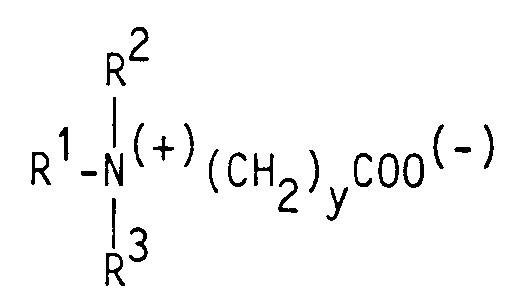 R¹ Alkylrest mit 6 bis 18 Kohlenstoffatomen oder der Rest R⁴CONH(CH₂)x-, wobei R⁴ ein von einer Fettsäure mit 6 bis 18 Kohlenstoffatomen abgeleiteter Alkylrest und x = 2 oder 3 ist,R², R³ gleich oder ungleich, Alkylrest mit 1 bis 4 Kohlenstoffatomen,x 2 oder 3,y 1,2 oder 3,durch Quaternierung eines tertiären Amins der allgemeinen Formel
R¹-NR²R³
mit ω-Halogenalkylcarbonsäuren X(CH₂)yCOOY oder deren Salzen (X = Halogenrest, Y = Wasserstoff-, Alkali- oder Ammoniumion) in wäßriger oder wäßrig-alkoholischer Lösung bei erhöhten Temperaturen, dadurch gekennzeichnet, daß man dem Reaktionsgemisch vor oder während der Quaternierungsreaktion oder der erhaltenen Lösung des Betains nichtionogene, wasserlösliche Tenside in solchen Mengen zusetzt, daß die fertige Lösung 3 bis 20 Gew.-% nichtionogene Tenside enthält. - Verfahren nach Anspruch 1, dadurch gekennzeichnet, daß man die nichtionogenen Tenside in solchen Mengen zusetzt, daß die fertige Lösung 3 bis 15 Gew.-% nichtionogene Tenside enthält.
- Weitere Ausbildung des Verfahrens nach Anspruch 1, dadurch gekennzeichnet, daß man die Quaternierungsreaktion in wäßriger, mindestens 20 Gew.-% Ethanol enthaltender Lösung durchführt, das ausgefallene Salz nach der Quaternierungsreaktion abfiltriert und die gewünschte Konzentration des Betains in der Lösung durch Abdestillieren des Wassers bzw. des Wasser/Ethanolgemisches einstellt.
- Verfahren nach Anspruch 1 oder 2, dadurch gekennzeichnet, daß man als wasserlösliche, nichtionogene Tenside Polyoxyethylenderivate von Fettalkoholen, Fettsäuren oder partiellen Fettsäureestern mehrwertiger Alkohole mit einem HLB-Wert von 14 bis < 20 zusetzt.
- Verfahren nach Anspruch 4, dadurch gekennzeichnet, daß man als nichtionogene Tenside Polyoxyethylenester von Fettsäuren oder Polyoxyethylenether von partiellen Fettsäureestern des Glycerins oder des Sorbits, mit einem durchschnittlichen Gehalt von 10 bis 250 Oxyethyleneinheiten zusetzt.
Applications Claiming Priority (2)
| Application Number | Priority Date | Filing Date | Title |
|---|---|---|---|
| DE3826654 | 1988-08-05 | ||
| DE3826654A DE3826654C1 (de) | 1988-08-05 | 1988-08-05 |
Publications (3)
| Publication Number | Publication Date |
|---|---|
| EP0353580A2 EP0353580A2 (de) | 1990-02-07 |
| EP0353580A3 EP0353580A3 (de) | 1991-01-30 |
| EP0353580B1 true EP0353580B1 (de) | 1993-09-29 |
Family
ID=6360312
Family Applications (1)
| Application Number | Title | Priority Date | Filing Date |
|---|---|---|---|
| EP89113570A Expired - Lifetime EP0353580B1 (de) | 1988-08-05 | 1989-07-24 | Verfahren zur Herstellung von konzentrierten fliessfähigen wässrigen Lösungen von Betainen |
Country Status (4)
| Country | Link |
|---|---|
| EP (1) | EP0353580B1 (de) |
| JP (1) | JP2523885B2 (de) |
| DE (2) | DE3826654C1 (de) |
| ES (1) | ES2045290T3 (de) |
Families Citing this family (22)
| Publication number | Priority date | Publication date | Assignee | Title |
|---|---|---|---|---|
| SE9001862D0 (sv) * | 1990-05-23 | 1990-05-23 | Berol Nobel Ab | Nya kvaeveinnehaallande foereningar, foerfarande foer deras framstaellning samt anvaendning av foereningarna |
| EP0570383B1 (de) * | 1991-02-08 | 1995-07-05 | Albemarle Corporation | Verfahren zur Herstellung von festen Betainen |
| DE4135115A1 (de) * | 1991-10-24 | 1993-04-29 | Trigon Chemie Gmbh | Kationaktive tenside |
| DE4207386C2 (de) * | 1992-03-09 | 1997-02-13 | Goldschmidt Ag Th | Wäßrige flüssige Lösung eines Betains mit mindestens 40 Gew.-% Festkörpergehalt |
| DE4211190A1 (de) * | 1992-04-03 | 1993-10-07 | Hoechst Ag | Verfahren zur Herstellung von wäßrigen Betainlösungen |
| DE4305083A1 (de) * | 1993-02-19 | 1994-08-25 | Henkel Kgaa | Verfahren zur Herstellung wasserfreier Detergensgemische |
| DE4334467A1 (de) * | 1993-10-08 | 1995-04-13 | Rewo Chemische Werke Gmbh | Verfahren zur Herstellung hochkonzentrierter fließfähiger wäßriger Lösungen von Betainen |
| DE4337324C2 (de) * | 1993-11-02 | 1998-05-20 | Henkel Kgaa | Verfahren zur Herstellung von Detergensgemischen |
| DE4340423C1 (de) * | 1993-11-27 | 1995-07-13 | Henkel Kgaa | Niedrigviskose wäßrige Konzentrate von Betaintensiden |
| DE59305412D1 (de) * | 1993-12-02 | 1997-03-20 | Witco Surfactants Gmbh | Verfahren zur Herstellung hochkonzentrierter fliessfähiger wässriger Lösungen von Betainen |
| DE4408183C1 (de) * | 1994-03-11 | 1995-08-10 | Henkel Kgaa | Verfahren zur Herstellung von niedrigviskosen wäßrigen Konzentraten von Betaintensiden |
| DE4408228C2 (de) * | 1994-03-11 | 1997-02-20 | Henkel Kgaa | Verfahren zur Herstellung niedrigviskoser wäßriger Betaintensidkonzentrate |
| DE4412481A1 (de) * | 1994-04-12 | 1995-10-19 | Witco Surfactants Gmbh | Verfahren zur Herstellung hochkonzentrierter fließfähiger wäßriger Lösungen von Betainen |
| DE4435495C2 (de) * | 1994-10-04 | 1997-08-14 | Henkel Kgaa | Pumpfähige wäßrige Tensidkonzentrate |
| US5792737A (en) * | 1994-11-07 | 1998-08-11 | Th. Goldschmidt Ag | Mild, aqueous, surfactant preparation for cosmetic purposes and as detergent |
| DE19505196C1 (de) * | 1995-02-16 | 1996-05-02 | Henkel Kgaa | Niedrigviskose wäßrige Konzentrate von Betaintensiden |
| DE19515883A1 (de) * | 1995-04-29 | 1996-10-31 | Witco Surfactants Gmbh | Verfahren zur Herstellung hochkonzentrierter fließfähiger wäßriger Lösungen von Betainen |
| ES2126495B1 (es) | 1996-11-05 | 1999-12-01 | Kao Corp Sa | Composiciones acuosas concentradas de tensioactivos del tipo de las betainas y su procedimiento de obtencion. |
| FR2786781B1 (fr) * | 1998-12-07 | 2001-02-02 | Ceca Sa | Compositions hydroalcooliques concentrees fluides d'alkylamidopropylbetaines de coprah ou de palmiste hydrogene |
| DE10207924A1 (de) * | 2002-02-23 | 2003-09-04 | Clariant Gmbh | Hochkonzentrierte wässrige Lösungen von Betainen oder Aminoxiden |
| DE102004055549A1 (de) * | 2004-11-17 | 2006-05-18 | Goldschmidt Gmbh | Verfahren zur Herstellung hochkonzentrierter fließfähiger wässriger Lösungen von Betainen |
| EP3002275B1 (de) * | 2014-10-01 | 2021-07-14 | Hayat Kimya Sanayi Anonim Sirketi | Verfahren zur herstellung konzentrierter, nicht gelbildender, wässriger lösungen eines betains |
Family Cites Families (5)
| Publication number | Priority date | Publication date | Assignee | Title |
|---|---|---|---|---|
| US3225074A (en) * | 1959-12-28 | 1965-12-21 | American Cyanamid Co | Betaines |
| FR2398797B1 (fr) * | 1977-07-26 | 1981-02-06 | Albright & Wilson | Compositions tensioactives aqueuses concentrees |
| DE2926479C2 (de) * | 1979-06-30 | 1981-10-08 | Th. Goldschmidt Ag, 4300 Essen | Verfahren zur Herstellung von Betainen |
| DE3613944C1 (de) * | 1986-04-24 | 1987-08-13 | Goldschmidt Ag Th | Verfahren zur Herstellung einer hochkonzentrierten,fliess- und pumpfaehigen Betainloesung |
| DE3726322C1 (de) * | 1987-08-07 | 1988-12-08 | Goldschmidt Ag Th | Verfahren zur Herstellung konzentrierter fliessfaehiger waessriger Loesungen von Betainen |
-
1988
- 1988-08-05 DE DE3826654A patent/DE3826654C1/de not_active Expired - Lifetime
-
1989
- 1989-07-24 EP EP89113570A patent/EP0353580B1/de not_active Expired - Lifetime
- 1989-07-24 ES ES89113570T patent/ES2045290T3/es not_active Expired - Lifetime
- 1989-07-24 DE DE89113570T patent/DE58905750D1/de not_active Expired - Lifetime
- 1989-08-04 JP JP1201510A patent/JP2523885B2/ja not_active Expired - Lifetime
Also Published As
| Publication number | Publication date |
|---|---|
| EP0353580A2 (de) | 1990-02-07 |
| ES2045290T3 (es) | 1994-01-16 |
| JPH0291050A (ja) | 1990-03-30 |
| DE58905750D1 (de) | 1993-11-04 |
| JP2523885B2 (ja) | 1996-08-14 |
| EP0353580A3 (de) | 1991-01-30 |
| DE3826654C1 (de) | 1991-01-31 |
Similar Documents
| Publication | Publication Date | Title |
|---|---|---|
| DE3826654C1 (de) | ||
| EP0243619B1 (de) | Verfahren zur Herstellung einer hochkonzentrierten, fliess- und pumpfähigen Betainlösung | |
| EP0302329B1 (de) | Verfahren zur Herstellung konzentrierter fliessfähiger wässriger Lösungen von Betainen | |
| DE2941584C2 (de) | ||
| EP0020907B1 (de) | Verfahren zur Herstellung von Betainen | |
| EP0560114B1 (de) | Wässrige flüssige Lösung eines Betains mit mindestens 40 Gew.-% Festkörpergehalt | |
| DE3785627T2 (de) | Oberflaechenaktives mittel, abgeleitet von hydroxy-substituierten bi- oder tri-carbonsaeuren. | |
| DE69516584T2 (de) | Verfahren zur Herstellung von Amidoethercarbonsäure oder deren Salz und diese enthaltende oberflächenaktive Mischung | |
| DE2752116C2 (de) | Salze von N-[N',N'-Bis(2-carboxyethyl)-aminoethyl]-N-(2-hydroxyethyl)-carbonsäureamiden, Verfahren zu ihrer Herstellung und ihre Verwendung als grenzflächenaktive Stoffe | |
| EP0671382B1 (de) | Fluorhaltige Carboxylbetaine und Alkylsulfobetaine sowie deren Mischungen mit gesättigten Fluoralkyaminen | |
| DE4340423C1 (de) | Niedrigviskose wäßrige Konzentrate von Betaintensiden | |
| DE3308922A1 (de) | Verfahren zur herstellung von fettsaeureestern der ascorbinsaeure | |
| EP0452349B1 (de) | Verfahren zur herstellung von amphoteren grenzflächenaktiven imidazolinderivaten | |
| EP0749412B1 (de) | Niedrigviskose wässrige konzentrate von betaintensiden | |
| EP0005446B1 (de) | Amphotere oberflächenaktive Aminoetherverbindungen und Verfahren zu ihrer Herstellung | |
| EP0492228B1 (de) | Verfahren zur Herstellung fliessfähiger wässriger Dispersionen von Betainen | |
| EP1033363A1 (de) | Verfahren zur Herstellung von Verdickungsmitteln auf Basis von Fettsäure-monoisopropanolamid, ihre Verwendung und diese enhaltende Zubereitungen | |
| DE2643794A1 (de) | Neue amphotere oberflaechenaktive verbindungen | |
| DE69314698T2 (de) | Verwendung eines Amids als Verdickungsmittel und dieses enthaltende Zusammensetzung | |
| AT266050B (de) | Cellulosedispersion | |
| DE19622981A1 (de) | Säure-Addukte von Fettsäurepolyhydroxyalkylamiden | |
| DE2359155C3 (de) | Flüssiges Reinigungs- und Waschmittel | |
| AT205480B (de) | Verfahren zur Herstellung von reinen aliphatischen N-Chlor-N-alkylacetamiden | |
| DE974767C (de) | Verfahren zur Herstellung von Polyglykolaethern hoeherer Alkohole | |
| DE19545134A1 (de) | Verfahren zur Herstellung hellfarbiger Betaine |
Legal Events
| Date | Code | Title | Description |
|---|---|---|---|
| PUAI | Public reference made under article 153(3) epc to a published international application that has entered the european phase |
Free format text: ORIGINAL CODE: 0009012 |
|
| 17P | Request for examination filed |
Effective date: 19890729 |
|
| AK | Designated contracting states |
Kind code of ref document: A2 Designated state(s): CH DE ES FR GB IT LI SE |
|
| PUAL | Search report despatched |
Free format text: ORIGINAL CODE: 0009013 |
|
| AK | Designated contracting states |
Kind code of ref document: A3 Designated state(s): CH DE ES FR GB IT LI SE |
|
| 17Q | First examination report despatched |
Effective date: 19930115 |
|
| ITF | It: translation for a ep patent filed | ||
| GRAA | (expected) grant |
Free format text: ORIGINAL CODE: 0009210 |
|
| AK | Designated contracting states |
Kind code of ref document: B1 Designated state(s): CH DE ES FR GB IT LI SE |
|
| REF | Corresponds to: |
Ref document number: 58905750 Country of ref document: DE Date of ref document: 19931104 |
|
| GBT | Gb: translation of ep patent filed (gb section 77(6)(a)/1977) |
Effective date: 19931020 |
|
| ET | Fr: translation filed | ||
| REG | Reference to a national code |
Ref country code: ES Ref legal event code: FG2A Ref document number: 2045290 Country of ref document: ES Kind code of ref document: T3 |
|
| PLBE | No opposition filed within time limit |
Free format text: ORIGINAL CODE: 0009261 |
|
| STAA | Information on the status of an ep patent application or granted ep patent |
Free format text: STATUS: NO OPPOSITION FILED WITHIN TIME LIMIT |
|
| 26N | No opposition filed | ||
| EAL | Se: european patent in force in sweden |
Ref document number: 89113570.9 |
|
| REG | Reference to a national code |
Ref country code: CH Ref legal event code: PFA Free format text: TH. GOLDSCHMIDT AG TRANSFER- GOLDSCHMIDT AG |
|
| REG | Reference to a national code |
Ref country code: FR Ref legal event code: CD |
|
| REG | Reference to a national code |
Ref country code: GB Ref legal event code: IF02 |
|
| PGFP | Annual fee paid to national office [announced via postgrant information from national office to epo] |
Ref country code: CH Payment date: 20020619 Year of fee payment: 14 |
|
| PG25 | Lapsed in a contracting state [announced via postgrant information from national office to epo] |
Ref country code: LI Free format text: LAPSE BECAUSE OF NON-PAYMENT OF DUE FEES Effective date: 20030731 Ref country code: CH Free format text: LAPSE BECAUSE OF NON-PAYMENT OF DUE FEES Effective date: 20030731 |
|
| REG | Reference to a national code |
Ref country code: CH Ref legal event code: PL |
|
| PGFP | Annual fee paid to national office [announced via postgrant information from national office to epo] |
Ref country code: SE Payment date: 20050714 Year of fee payment: 17 |
|
| PG25 | Lapsed in a contracting state [announced via postgrant information from national office to epo] |
Ref country code: IT Free format text: LAPSE BECAUSE OF NON-PAYMENT OF DUE FEES;WARNING: LAPSES OF ITALIAN PATENTS WITH EFFECTIVE DATE BEFORE 2007 MAY HAVE OCCURRED AT ANY TIME BEFORE 2007. THE CORRECT EFFECTIVE DATE MAY BE DIFFERENT FROM THE ONE RECORDED. Effective date: 20050724 |
|
| REG | Reference to a national code |
Ref country code: FR Ref legal event code: CJ Ref country code: FR Ref legal event code: CD |
|
| PG25 | Lapsed in a contracting state [announced via postgrant information from national office to epo] |
Ref country code: SE Free format text: LAPSE BECAUSE OF NON-PAYMENT OF DUE FEES Effective date: 20060725 |
|
| EUG | Se: european patent has lapsed | ||
| PGFP | Annual fee paid to national office [announced via postgrant information from national office to epo] |
Ref country code: ES Payment date: 20080729 Year of fee payment: 20 Ref country code: DE Payment date: 20080722 Year of fee payment: 20 |
|
| PGFP | Annual fee paid to national office [announced via postgrant information from national office to epo] |
Ref country code: FR Payment date: 20080715 Year of fee payment: 20 |
|
| PGFP | Annual fee paid to national office [announced via postgrant information from national office to epo] |
Ref country code: GB Payment date: 20080722 Year of fee payment: 20 |
|
| REG | Reference to a national code |
Ref country code: GB Ref legal event code: PE20 Expiry date: 20090723 |
|
| REG | Reference to a national code |
Ref country code: ES Ref legal event code: FD2A Effective date: 20090725 |
|
| PG25 | Lapsed in a contracting state [announced via postgrant information from national office to epo] |
Ref country code: ES Free format text: LAPSE BECAUSE OF EXPIRATION OF PROTECTION Effective date: 20090725 |
|
| PG25 | Lapsed in a contracting state [announced via postgrant information from national office to epo] |
Ref country code: GB Free format text: LAPSE BECAUSE OF EXPIRATION OF PROTECTION Effective date: 20090723 |