EP0353653A2 - Composition fluorescente - Google Patents
Composition fluorescente Download PDFInfo
- Publication number
- EP0353653A2 EP0353653A2 EP89113988A EP89113988A EP0353653A2 EP 0353653 A2 EP0353653 A2 EP 0353653A2 EP 89113988 A EP89113988 A EP 89113988A EP 89113988 A EP89113988 A EP 89113988A EP 0353653 A2 EP0353653 A2 EP 0353653A2
- Authority
- EP
- European Patent Office
- Prior art keywords
- phosphor
- fluorescent composition
- in2o3
- zno
- adhered
- Prior art date
- Legal status (The legal status is an assumption and is not a legal conclusion. Google has not performed a legal analysis and makes no representation as to the accuracy of the status listed.)
- Granted
Links
Images
Classifications
-
- C—CHEMISTRY; METALLURGY
- C09—DYES; PAINTS; POLISHES; NATURAL RESINS; ADHESIVES; COMPOSITIONS NOT OTHERWISE PROVIDED FOR; APPLICATIONS OF MATERIALS NOT OTHERWISE PROVIDED FOR
- C09K—MATERIALS FOR MISCELLANEOUS APPLICATIONS, NOT PROVIDED FOR ELSEWHERE
- C09K11/00—Luminescent materials, e.g. electroluminescent or chemiluminescent
- C09K11/02—Use of particular materials as binders, particle coatings or suspension media therefor
- C09K11/025—Use of particular materials as binders, particle coatings or suspension media therefor non-luminescent particle coatings or suspension media
-
- C—CHEMISTRY; METALLURGY
- C09—DYES; PAINTS; POLISHES; NATURAL RESINS; ADHESIVES; COMPOSITIONS NOT OTHERWISE PROVIDED FOR; APPLICATIONS OF MATERIALS NOT OTHERWISE PROVIDED FOR
- C09K—MATERIALS FOR MISCELLANEOUS APPLICATIONS, NOT PROVIDED FOR ELSEWHERE
- C09K11/00—Luminescent materials, e.g. electroluminescent or chemiluminescent
- C09K11/08—Luminescent materials, e.g. electroluminescent or chemiluminescent containing inorganic luminescent materials
- C09K11/56—Luminescent materials, e.g. electroluminescent or chemiluminescent containing inorganic luminescent materials containing sulfur
- C09K11/562—Chalcogenides
- C09K11/565—Chalcogenides with zinc cadmium
Definitions
- the present invention relates to improvement in a fluorescent composition containing therein, as the principal component, a sulfide phosphor with zinc sulfide (ZnS), cadmium sulfide (CdS), or their solid-solution as the host material, and, in particular, exhibiting its light-emitting property of high luminance under low-velocity electron beam excitation at an acceleration voltage of 1 kV or lower.
- a sulfide phosphor with zinc sulfide (ZnS), cadmium sulfide (CdS) or their solid-solution as the host material, and, in particular, exhibiting its light-emitting property of high luminance under low-velocity electron beam excitation at an acceleration voltage of 1 kV or lower.
- Those fluorescent composition prepared by mixing electrically conductive materials such as indium oxide (In2O3), zinc oxide (ZnO), tin oxide (SnO2), and others into a group of sulfide phosphors consisting essentially of a sulfide represented by the formula (Zn 1-x , Cd x )S [where: x is a number satisfying a condition of 0 ⁇ x ⁇ 1], as the host material, which are activated by zinc (Zn), silver (Ag), gold (Au), copper (Cu), manganese (Mn), and so forth, and further co-activated by halogen, aluminum (Al), gallium (Ga), indium (In), and others (such sulfide phosphor consisting essentially of a sulfide represented by the formula (Zn 1-x , Cd x )S [where: x is a number satisfying a condition of 0 ⁇ x ⁇ 1], as the host material, will hereinafter be ab
- a multi-color fluorescent display tube is constructed by providing the fluorescent screen made up of ZnO:Zn which emits green-white light, and a fluorescent screen which is made up of a fluorescent composition containing therein, as the principal constituent, (Zn 1-x , Cd x )S series sulfide phosphor, as the other light-emitting color component such as, for example, a yellow light ⁇ red light emitting component, the luminance of a portion to be displayed in yellow ⁇ red is still lower than that of a portion to be displayed in green-white with the consequence that readability of this portion is yet to be improved.
- the fluorescent display tube which is constructed by use of the fluorescent composition containing therein, as the principal component, these (Zn 1-x , Cd x )S series sulfide phosphors is employed as the display element for the meters to be mounted in automotive vehicles
- the fluorescent display tube is still insufficient in its luminance, because of limitation to the acceleration voltage to be imposed on the display tube in connection with a power source to be used. This poses a problem of lacking in readability of a displayed image under the external day-light.
- the present invention has been made in view of such circumstances as mentioned above, and aims at providing a fluorescent composition of improved quality containing therein the (Zn 1-x , Cd x )S series sulfide phosphor as the principal component, and which emits light with higher luminance than that of the conventional fluorescent component, particularly when it is excited with a low-velocity electron beam at its acceleration voltage of 1 kV or below.
- the present inventors have made strenuous efforts in researching and studying the kinds of the electrically conductive materials to be mixed with the (Zn 1-x , Cd x )S series sulfide phosphor and the method of blending these materials as well.
- the fluorescent composition obtained by mixing an electrically conductive material consisting of indium oxide (In2O3), and zinc oxide (ZnO) or compounds of zinc which can be converted to ZnO by heat-treatment (such compounds will hereinafter be called in general term "Zncompound”) with (Zn 1-x , Cd x )S series sulfide phosphor unexpectedly improved its luminance in comparison with conventional fluorescent compositions obtained by mixing In2O3, ZnO, or other well-known electrically conductive materials alone with the (Zn 1-x , Cd x )S series sulfide phosphor; and that the synergistic effect to be derived from the selective mixing of these three components, i.e., (Zn 1-x , Cd x )S series sulfide phosphor, In2O3 and "Zn-compound”, becomes particularly eminent when the "Zn- compound" is caused to adhere onto, at least, the surface of the (Zn 1-x , Cd x
- the fluorescent composition according to the present invention is characterized in that (Zn 1-x , Cd x )S series sulfide phosphor and In2O3 are mixed together or caused to adhere each other, and that a "Zn-compound" is adhered onto the surface of the above-mentioned phosphor or the respective surfaces of the above-mentioned phosphor and In2O3.
- (Zn 1-x , Cd x )S series sulfide phosphor there may be used any of known sulfides such as those sulfide host materials represented by the formula of: (Zn 1-x , Cd x )S, actual examples of which are ZnS:Zn; ZnS:Ag, Cl; ZnS:Ag, Cl, Li; ZnS:Ag, Al; ZnS:Mn, Cl; (Zn,Cd)S:Cu, Al; (Zn,Cd)S:Au, Al; (Zn,Cd)S:Au, Cu, Al; CdS:Ag, and so forth, which have been activated by an activator such as zinc (Zn), silver (Ag), copper (Cu), gold (Au), manganese (Mn), and other, and which have further been co-activated, depending on necessity, by a first co-activator such as aluminum (Al), halogen (Cl, Br
- sulfide phosphors with the solid-solution of ZnS and CdS as the host material, with the value of x in the above-mentioned composition formula being in a range of 0.4 ⁇ x ⁇ 0.85, or more preferred use may be made of the (Zn 1-x , Cd x )S: Ag series sulfide phosphors with the value of x being in the above-mentioned range, and which have been activated by 200 to 2,000 ⁇ g of silver (Ag) per 1 g of the host material, when the highest luminance can be attained with such phosphor compound.
- the "Zn-compounds" to be adhered on the surface of the (Zn 1-x , Cd x )S series sulfide phosphor or on the surface of a mixture of this sulfide phosphor and In2O3, or on the surface of a combination of these two materials adhered each other there may be used zinc oxide (ZnO) or compounds of zinc, at least one portion of which can be converted to ZnO by thermal decomposition due to heat-treatment at a temperature ranging from 100°C to 700°C, such as hydroxides, sulfates, nitrates, acetates, oxalates, carbonates, halogenides of zinc (Zn), or double salts of these compounds (hydroxy chloride, zinc hydroxysulfate, and other hydroxy salts).
- ZnO zinc oxide
- compounds of zinc at least one portion of which can be converted to ZnO by thermal decomposition due to heat-treatment at a temperature ranging from 100°C to 700°C, such
- At least one portion of these "Zn-compounds” should preferably be zinc oxide (ZnO), zinc hydroxide ⁇ Zn(OH)2 ⁇ , or double salts (hydroxy salt) containing therein Zn(OH)2.
- the phosphor compound is subjected to alkaline treatment or heat-treatment so that at least one portion thereof may be converted to ZnO, Zn(OH)2, hydroxy salt, and so forth.
- In2O3 to be used in the fluorescent composition according to the present invention there may be used In2O3 reagent, or In2O3 obtained by calcination of salts of indium such as In(NO3)3, InCl3, and so on. Besides these, there may also be used In2O3 activated with rare earth elements such as Eu, Ce, etc., or solid-solution of In2O3 and SnO2, as disclosed in, for example, Japanese Unexamined Patent Publication No. 110181/1980.
- the fluorescent composition according to the present invention which is composed of a mixture of (Zn 1-x , Cd x )S series sulfide phosphor and In2O3 can be obtained by various methods such that the (Zn 1-x , Cd x )S series sulfide phosphor having desired composition and a predetermined quantity of In2O3 is sufficiently mixed by use of a mortar, a ball mill, a mixer mill, and so forth; or In2O3 is adhered onto the surface of the (Zn 1-x , Cd x )S series sulfide phosphor by the known methods such as use of gelatin and gum arabic, for example, as the adhesive agent (vide: Japanese Examined Patent Publication No.
- the thus obtained fluorescent composition and the "Zn-compound” are thrown into pure water and sufficiently agitated, after which the aqueous solution was filtered or dried by evaporation to thereby absorb the "Zn-compound” on the respective surface of the (Zn 1-x , Cd x )S series sulfide phosphor and In2O3, and finally the solid phosphor is subjected to heat-treatment at a temperature ranging from 130°C to 700°C.
- water-soluble "Zn-compound” such as sulfate, nitrate, halide, etc. of zinc (Zn) is added, as the above-mentioned "Zn-compound", to aqueous suspension of the fluorescent composition consisting of the (Zn 1-x , Cd x )S series sulfide phosphor and In2O3; then NH4OH, NaOH and other alkalis, ammonium carbonate, oxalic acid, and so on are added to this solution to thereby deposite, on the respective surfaces of the (Zn 1-x , Cd x )S series sulfide phosphor and In2O3, the initially added "Zn-compound” in the form of its hydroxide, carbonate, oxalate, etc.
- the fluorescent composition with the deposited substance is filtered, it is heat-treated at a temperature ranging from 130°C to 700°C.
- the "Zn-compound” can be uniformly adhered onto the surface of the sulfide phosphor and In2O3, and the resulting fluorescent composition has its improved luminance.
- the fluorescent composition according to the present invention can also be produced by a method such that, in place of adhering the "Zn-compound” on the surface of the fluorescent composition obtained by mixing or adhering In2O3 with or onto the (Zn 1-x , Cd x )S series sulfide phosphor, as mentioned above, such "Zn-compound” is adhered beforehand on the surface of the (Zn 1-x , Cd x )S series sulfide phosphor, and then In2O3 ("Zn-compound” may also be adhered, in advance, to the surface of In2O3, as the case may be) is mixed with or adhered to the sulfide phosphor.
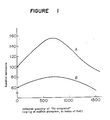
- Figure 1 is a graphical representation showing a relationship between the adhered quantity of the "Zn-compound” and the luminance of the fluorescent composition when it is excited with low-velocity electron beam at its accelerating voltage of 30V, for each of the fluorescent composition obtained by adhering the "Zn-compound” onto the surface of a mixture of (Zn 1-x , Cd x )S series sulfide phosphor and In2O3, and the (Zn 1-x , Cd x )S series sulfide phosphor with the "Zn-compound” being adhered on its surface.
- the curve A is of the fluorescent composition obtained by adhering, onto the surface of a mixture of (Zn 0.6 , Cd 0.4 )S:Ag, Li, Cl phosphor and 5% by weight of In2O3, zinc oxide (ZnO) which is obtained by converting, through heat-treatment, a sedimentation deposited on the surface of a mixture by adding NaOH to aqueous solution of nitrate, in which this mixture is suspended.
- the curve B is of the fluorescent composition, for the purpose of comparison, made up of (Zn 0.6 , Cd 0.4 )S:Ag, Cl, Li phosphor with ZnO alone (obtained in the same manner as mentioned above) being adhered onto the surface thereof.
- the luminance on the axis of ordinate is indicated in terms of a relative value, when the luminance of the conventional fluorescent composition made up of a mixture of (Zn 0.6 , Cd 0.4 )S:Ag, Cl, Li phosphor and In2O3 is taken as 100.
- the fluorescent composition obtained by adhesion of ZnO onto the surface of the mixture of (Zn 0.6 , Cd 0.4 )S:Ag, Cl, Li phosphor and In2O3 (curve A) is seen to have improved its luminance to a remarkable degree in comparison with the fluorescent composition obtained by adhesion of ZnO onto the surface of (Zn 0.6 , Cd 0.4 )S:Ag, Cl, Li phosphor, not containing therein In2O3.
- the luminance of the fluorescent composition is higher than that of the conventional fluorescent composition which is made up of In2O3 and (Zn 0.6 , Cd 0.4 )S:Ag, Li, Cl phosphor having no ZnO adhered thereon.
- the improvement in its luminance is remarkable when the adhered quantity of ZnO is in a range of from about 300 ⁇ g to 1,000 ⁇ g per 1 g of the sulfide phosphor.
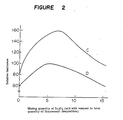
- Figure 2 indicates a relationship between the mixing quantity of In2O3 and the luminance of the fluorescent composition when it is excited with low-velocity electron beam at its accelerating voltage of 30V, for each of the fluorescent composition made up of a mixture of (Zn 1-x , Cd x )S series sulfide phosphor and In2O3, onto which surface the "Zn-compound" is adhered, and the conventional fluorescent composition also made up of (Zn 1-x , Cd x )S series sulfide phosphor and In2O3, onto which surface no "Zn-compound" is adhered.
- the curve C in Figure 2 indicates a case, wherein 560 ⁇ g of ZnO per 1 g of the sulfide phosphor (prepared in the same manner as in the case with the fluorescent composition shown in Figure 1) was adhered onto the surface of a mixture composed of (Zn 0.6 , Cd 0.4 )S:Ag, Cl, Li phosphor and In2O3 while the curve D indicates, for the purpose of comparison, a case of the conventional fluorescent composition having the same composition as that of the curve C, with the exception that no ZnO is adhered on its surface.
- the axis of ordinate in the graph of Figure 2 denotes the luminance of the fluorescent composition of the present invention in terms of a relative value, when the luminance of the conventional fluorescent composition composed of a mixture of (Zn 0.6 , Cd 0.4 )S:Ag, Cl, Li phosphor and 5 wt% of In2O3, without ZnO being adhered on its surface, is taken as 100.
- the fluorescent composition of the present invention in comparison with that of the conventional fluorescent composition, when use is made of the (Zn 1-x , Cd x )S series sulfide phosphor of other compositions than that mentioned above and the "Zn-compound" other than the above-mentioned ZnO, wherein the "Zn-compound” in a quantity of 1,400 ⁇ g or below (more preferably from 300 ⁇ g to 1,000 ⁇ g) in terms of a weight of ZnO per 1 g of the sulfide phosphor is adhered onto the surface of (Zn 1-x , Cd x )S series sulfide phosphor or onto both surfaces the sulfide phosphor and In2O3 of the fluorescent composition obtained by mixing or adhering 0.5 to 15% by weight (or more preferably from 4 to 10% by weight) of In2O3 with respect to the total quantity of the fluorescent composition, with or onto the (Zn 1-
- the fluorescent composition obtained by simply mixing predetermined quantities of the three components, i.e., (Zn 1-x , Cd x )S series sulfide phosphor, In2O3, and "Zn-compound” is inferior in its luminance to the above-mentioned phosphor composition obtained by adhering the "Zn-compound” on the surface of (Zn 1-x , Cd x )S series sulfide phosphor, or on both surfaces of the sulfide phosphor and In2O3, but is still higher than that of the conventional two-component system fluorescent compositions made up of a mixture of (Zn 1-x , Cd x )S series sulfide phosphor and In2O3, or a mixture made up of the same sulfide phosphor and the "Zn-compound".
- Table 1 indicates each and every composition for the Examples and the Comparative Examples to be explained hereinbelow, and the relative luminance of each composition.
- this liquid mixture was agitated for about ten minutes, followed by gradually adding NaOH to this phosphor suspension liquid to adjust the pH value of this phosphor suspension liquid to approximately 9, thereby depositing, on the surface of the phosphor, sedimentation of the Zn-compound which is difficult to dissolve in water.
- the suspension liquid was dehydrated, it was placed in a heat-resistant vessel to be baked for 24 hours in an electric furnace maintained at a temperature of 180°C. Subsequently, the baked substance was taken out, and about 560 ⁇ g of Zn-compound per 1 g of the phosphor was adhered onto its surface.
- the fluorescent composition [II] was obtained in the same manner as in the fluorescent composition [I] above, with the exception that 105 g of the fluorescent composition obtained by mixing beforehand in a ball mill 95% parts by weight of (Zn 0.6 , Cd 0.4 )S:Ag, Cl, Li phosphor and 5 parts by weight of In2O3 having an average particle size of 0.24 ⁇ m was used in place of 100 ⁇ g of (Zn 0.6 , Cd 0.4 )S:Ag, Cl, Li phosphor, by adhering 560 ⁇ g of the Zn-compound per 1 g of (Zn 0.6 , Cd, 0.4 )S:Ag, Cl, Li phosphor onto both surfaces of the phosphor and In2O3.
- the fluorescent composition [R-II] was prepared in the same manner as in the fluorescent composition [I] above, with the exception that no In2O3 having an average particle size of 0.24 ⁇ m was mixed with the fluorescent composition [I] above, by adhering 560 ⁇ g of the Zn-compound per 1 g of the (Zn 0.6 , Cd 0.4 )S:Ag, Cl, Li phosphor to the surface of the phosphor.
- the thus obtained fluorescent compositions [I], [II], [R-I] and [R-II] were respectively coated on a metal base plate by the precipitation coating method, thereby forming the fluorescent screen thereon.
- the metal base plate and the fluorescent screen formed thereon were then placed in a demountable low-velocity electron beam generating apparatus, and irradiated by low-velocity electron beam at its accelerating voltage of 30V.
- dispersion liquid of phosphor and dispersion liquid of In2O3 were mixed, while stirring, to adjust the pH value of the liquid mixture to 4.
- 1 part by weight of formalin was added gradually, while stirring.
- the solid component was dried to obtain the fluorescent composition with In2O3 having been adhered onto the (Zn 0.86 , Cd 0.14 )S:Au, Al phosphor.
- the suspension liquid of the above-mentioned fluorescent composition was subjected to dehydration, after which the solid component was placed in a heat-resistant vessel and baked in an electric furnace maintained at a temperature of 180°C for 24 hours. After this baking, the heat-treated component was taken outside. There was thus obtained the fluorescent composition [III] with approximately 589 ⁇ g of the Zn-compound per 1 g of the phosphor (in terms of ZnO) having been adhered to the both surfaces of the (Zn 0.86 , Cd 0.4 )S:Au, Al phosphor and In2O3.
- Phosphor composition Adhered quantity of "Zn-compound" (per 1 gr of phosphor; in terms of ZnO) Mixing (or adhering) qty of In2O3 to total qty of fluorescent composition Relative luminance [I] (Zn 0.6 , Cd 0.4 )S:Ag,Cl,Li 560 ⁇ g 5 wt% 140 [II] (Zn 0.6 , Cd 0.4 )S:Ag,Cl,Li " " 150 [R-I] (Zn 0.6 , Cd 0.4 )S:Ag,Cl,Li --- " 100 [R-II] (Zn 0.6 , Cd 0.4 )S:Ag,Cl,Li 560 ⁇ g --- 80 [III] (Zn 0.86 , Cd 0.14 )S:Au,Al 840 ⁇ g 14 wt% 135 [R-III] (Zn 0.86 , Cd 0.14 )S:
- the fluorescent composition according to the present invention which is composed of (Zn 1-x , Cd x )S series sulfide phosphor and In2O3, with the "Zn-compound" being adhered on the surface of the (Zn 1-x , Cd x )S series sulfide phosphor or on both surfaces of this phosphor and In2O3, could remarkably improve its luminance under excitation by the low-velocity electron beams, hence it is extremely useful for the purpose of manufacturing a multi-color fluorescent display tube having luminance sufficient to perform its multi-color displaying.
Landscapes
- Chemical & Material Sciences (AREA)
- Engineering & Computer Science (AREA)
- Materials Engineering (AREA)
- Organic Chemistry (AREA)
- Inorganic Chemistry (AREA)
- Luminescent Compositions (AREA)
Applications Claiming Priority (2)
| Application Number | Priority Date | Filing Date | Title |
|---|---|---|---|
| JP63192375A JP2525649B2 (ja) | 1988-08-01 | 1988-08-01 | 発光組成物 |
| JP192375/88 | 1988-08-01 |
Publications (3)
| Publication Number | Publication Date |
|---|---|
| EP0353653A2 true EP0353653A2 (fr) | 1990-02-07 |
| EP0353653A3 EP0353653A3 (en) | 1990-08-01 |
| EP0353653B1 EP0353653B1 (fr) | 1994-01-26 |
Family
ID=16290245
Family Applications (1)
| Application Number | Title | Priority Date | Filing Date |
|---|---|---|---|
| EP89113988A Expired - Lifetime EP0353653B1 (fr) | 1988-08-01 | 1989-07-28 | Composition fluorescente |
Country Status (5)
| Country | Link |
|---|---|
| US (1) | US5006277A (fr) |
| EP (1) | EP0353653B1 (fr) |
| JP (1) | JP2525649B2 (fr) |
| KR (1) | KR0133534B1 (fr) |
| DE (1) | DE68912674T2 (fr) |
Cited By (3)
| Publication number | Priority date | Publication date | Assignee | Title |
|---|---|---|---|---|
| EP0466053A1 (fr) * | 1990-07-09 | 1992-01-15 | Kasei Optonix, Ltd. | Composition fluorescente pour excitation par rayon électronique de faible vitesse |
| US5167990A (en) * | 1988-12-08 | 1992-12-01 | Kasei Optonix, Ltd. | Method for treating the surface of a phosphor |
| EP1078969A1 (fr) * | 1999-08-23 | 2001-02-28 | Sony Corporation | Composition fluorescente, procédé pour sa fabrication et appareil d'affichage |
Families Citing this family (12)
| Publication number | Priority date | Publication date | Assignee | Title |
|---|---|---|---|---|
| JPH0717899B2 (ja) * | 1990-04-27 | 1995-03-01 | 日亜化学工業株式会社 | 発光組成物 |
| KR0178976B1 (ko) * | 1990-07-24 | 1999-04-01 | 손욱 | 저속전자선용 적색형광체 및 그 제조방법 |
| DE4312778C3 (de) * | 1993-04-20 | 2001-10-25 | Vossloh Schwabe Gmbh | Elektrische Anschlußklemmeinrichtung |
| US5905480A (en) * | 1996-03-28 | 1999-05-18 | Ut Automotive Dearborn, Inc. | Flat panel icon display scheme |
| TWI273091B (en) | 2002-09-06 | 2007-02-11 | Masakazu Kobayashi | Compound semiconductor particles and production process thereof |
| JP2006140001A (ja) * | 2004-11-11 | 2006-06-01 | Futaba Corp | 蛍光表示管 |
| CN101374925A (zh) * | 2006-01-27 | 2009-02-25 | 株式会社半导体能源研究所 | 发光材料、发光器件和电子设备 |
| US20070194321A1 (en) * | 2006-02-17 | 2007-08-23 | Semiconductor Energy Laboratory Co., Ltd. | Light emitting element, light emitting device, and electronic device |
| EP1821579A3 (fr) * | 2006-02-17 | 2008-04-02 | Semiconductor Energy Laboratory Co., Ltd. | Élément électroluminescent, dispositif électroluminescent, et appareil électronique |
| WO2007108390A1 (fr) | 2006-03-21 | 2007-09-27 | Semiconductor Energy Laboratory Co., Ltd. | Element electroluminescent, dispositif d'affichage et appareil electronique |
| RU2315187C1 (ru) * | 2006-04-03 | 2008-01-20 | Виктор Федорович Карбушев | Устройство для поддержания уровня масла в масляном фильтре |
| WO2013051280A1 (fr) * | 2011-10-07 | 2013-04-11 | コニカミノルタアドバンストレイヤー株式会社 | Liquide de dispersion de substance luminescente et procédé de production pour dispositif à diodes électroluminescentes le mettant en œuvre |
Family Cites Families (8)
| Publication number | Priority date | Publication date | Assignee | Title |
|---|---|---|---|---|
| DE2906505C2 (de) * | 1978-02-20 | 1985-10-24 | Japan Electric Industry Development Association, Tokio/Tokyo | Fluoreszenzmischung und deren Verwendung in einem Fluoreszenzschirm einer durch langsame Elektronen angeregten Fluoreszenz-Anzeigevorrichtung |
| JPS6039310B2 (ja) * | 1979-04-07 | 1985-09-05 | 大日本塗料株式会社 | 赤色発光組成物および低速電子線励起螢光表示管 |
| JPS562384A (en) * | 1979-06-22 | 1981-01-12 | Kasei Optonix Co Ltd | Composition emitting yellow light and fluorescent display tube excited with low-speed electron beam |
| JPS5933156B2 (ja) * | 1979-07-10 | 1984-08-14 | 双葉電子工業株式会社 | けい光体及びこのけい光体を用いたけい光表示管 |
| JPS58225183A (ja) * | 1982-06-21 | 1983-12-27 | Futaba Corp | 導電物質を混合した青色「けい」光体及びこの「けい」光体を用いた「けい」光表示管 |
| JPS61127783A (ja) * | 1984-11-28 | 1986-06-16 | Futaba Corp | 低速電子線励起螢光体およびその製造方法 |
| JPS61145277A (ja) * | 1984-12-18 | 1986-07-02 | Kasei Optonix Co Ltd | 発光組成物および低速電子線励起螢光表示管 |
| US4791336A (en) * | 1986-06-26 | 1988-12-13 | Futaba Denshi Kogyo Kabushiki Kaisha | Fluorescent composition and fluorescent luminous device |
-
1988
- 1988-08-01 JP JP63192375A patent/JP2525649B2/ja not_active Expired - Fee Related
-
1989
- 1989-07-28 US US07/386,238 patent/US5006277A/en not_active Expired - Fee Related
- 1989-07-28 EP EP89113988A patent/EP0353653B1/fr not_active Expired - Lifetime
- 1989-07-28 DE DE68912674T patent/DE68912674T2/de not_active Expired - Fee Related
- 1989-08-01 KR KR1019890010998A patent/KR0133534B1/ko not_active Expired - Fee Related
Cited By (4)
| Publication number | Priority date | Publication date | Assignee | Title |
|---|---|---|---|---|
| US5167990A (en) * | 1988-12-08 | 1992-12-01 | Kasei Optonix, Ltd. | Method for treating the surface of a phosphor |
| EP0466053A1 (fr) * | 1990-07-09 | 1992-01-15 | Kasei Optonix, Ltd. | Composition fluorescente pour excitation par rayon électronique de faible vitesse |
| US5132044A (en) * | 1990-07-09 | 1992-07-21 | Kasei Optonix, Ltd. | Fluorescent composition for low velocity electron beam excitation |
| EP1078969A1 (fr) * | 1999-08-23 | 2001-02-28 | Sony Corporation | Composition fluorescente, procédé pour sa fabrication et appareil d'affichage |
Also Published As
| Publication number | Publication date |
|---|---|
| DE68912674D1 (de) | 1994-03-10 |
| DE68912674T2 (de) | 1994-09-01 |
| EP0353653A3 (en) | 1990-08-01 |
| JP2525649B2 (ja) | 1996-08-21 |
| JPH0241389A (ja) | 1990-02-09 |
| US5006277A (en) | 1991-04-09 |
| EP0353653B1 (fr) | 1994-01-26 |
| KR0133534B1 (ko) | 1998-04-20 |
| KR900003328A (ko) | 1990-03-26 |
Similar Documents
| Publication | Publication Date | Title |
|---|---|---|
| US5032316A (en) | Fluorescent composition | |
| EP0353653B1 (fr) | Composition fluorescente | |
| US4208299A (en) | Method of preparing zinc sulfide phosphor coactivated with copper and gold | |
| EP0839889B1 (fr) | Complexe de matériau luminescent amélioré de haute brillance | |
| JP2532586B2 (ja) | 低速電子線励起蛍光体及びその製造方法 | |
| EP0390194B1 (fr) | Matériau luminescent à base de borate d'indium et tube à rayons cathodiques l'utilisant | |
| EP0034059B1 (fr) | Tube à rayons cathodiques avec composé sulfure de zinc-phosphore activé de cuivre et d'aluminium et procédé pour produire ce phosphore ainsi qu'utilisation de ce tube à rayons cathodiques pour téléviseurs polychromes | |
| DE60303078T2 (de) | Leuchtstoff für VUV angeregtes lichtemittierendes Element | |
| JP3425470B2 (ja) | 赤色発光組成物 | |
| JP3007893B2 (ja) | 低速電子線用発光組成物 | |
| JP2811083B2 (ja) | 低速電子線用発光組成物 | |
| JPH07110942B2 (ja) | 発光組成物 | |
| KR100428621B1 (ko) | 고휘도녹색형광체및그제조방법 | |
| JPS59133284A (ja) | 低速電子線励起用螢光体 | |
| KR100241602B1 (ko) | 고휘도의 녹색 형광체 및 그의 제조 방법 | |
| JPH0549719B2 (fr) | ||
| KR900003177B1 (ko) | 음극선관의 제조방법 | |
| JPH07110943B2 (ja) | 発光組成物 | |
| KR100226512B1 (ko) | 고휘도의 적색 형광체 및 그 제조 방법 | |
| JPH07310073A (ja) | 赤色発光組成物 | |
| KR19980019749A (ko) | ZnS계 소립자 형광체의 제조방법 | |
| JPH0129834B2 (fr) | ||
| JPS6146028B2 (fr) | ||
| JPS6144913B2 (fr) | ||
| KR19990033390A (ko) | 고휘도 녹색 형광체 및 그의 제조 방법 |
Legal Events
| Date | Code | Title | Description |
|---|---|---|---|
| PUAI | Public reference made under article 153(3) epc to a published international application that has entered the european phase |
Free format text: ORIGINAL CODE: 0009012 |
|
| AK | Designated contracting states |
Kind code of ref document: A2 Designated state(s): DE FR GB NL |
|
| PUAL | Search report despatched |
Free format text: ORIGINAL CODE: 0009013 |
|
| AK | Designated contracting states |
Kind code of ref document: A3 Designated state(s): DE FR GB NL |
|
| 17P | Request for examination filed |
Effective date: 19910123 |
|
| 17Q | First examination report despatched |
Effective date: 19920302 |
|
| GRAA | (expected) grant |
Free format text: ORIGINAL CODE: 0009210 |
|
| AK | Designated contracting states |
Kind code of ref document: B1 Designated state(s): DE FR GB NL |
|
| REF | Corresponds to: |
Ref document number: 68912674 Country of ref document: DE Date of ref document: 19940310 |
|
| ET | Fr: translation filed | ||
| PLBE | No opposition filed within time limit |
Free format text: ORIGINAL CODE: 0009261 |
|
| STAA | Information on the status of an ep patent application or granted ep patent |
Free format text: STATUS: NO OPPOSITION FILED WITHIN TIME LIMIT |
|
| 26N | No opposition filed | ||
| PGFP | Annual fee paid to national office [announced via postgrant information from national office to epo] |
Ref country code: FR Payment date: 19980619 Year of fee payment: 10 |
|
| PGFP | Annual fee paid to national office [announced via postgrant information from national office to epo] |
Ref country code: GB Payment date: 19980624 Year of fee payment: 10 |
|
| PGFP | Annual fee paid to national office [announced via postgrant information from national office to epo] |
Ref country code: NL Payment date: 19980730 Year of fee payment: 10 |
|
| PGFP | Annual fee paid to national office [announced via postgrant information from national office to epo] |
Ref country code: DE Payment date: 19980930 Year of fee payment: 10 |
|
| PG25 | Lapsed in a contracting state [announced via postgrant information from national office to epo] |
Ref country code: GB Free format text: LAPSE BECAUSE OF NON-PAYMENT OF DUE FEES Effective date: 19990728 |
|
| PG25 | Lapsed in a contracting state [announced via postgrant information from national office to epo] |
Ref country code: FR Free format text: THE PATENT HAS BEEN ANNULLED BY A DECISION OF A NATIONAL AUTHORITY Effective date: 19990731 |
|
| PG25 | Lapsed in a contracting state [announced via postgrant information from national office to epo] |
Ref country code: NL Free format text: LAPSE BECAUSE OF NON-PAYMENT OF DUE FEES Effective date: 20000201 |
|
| GBPC | Gb: european patent ceased through non-payment of renewal fee |
Effective date: 19990728 |
|
| NLV4 | Nl: lapsed or anulled due to non-payment of the annual fee |
Effective date: 20000201 |
|
| PG25 | Lapsed in a contracting state [announced via postgrant information from national office to epo] |
Ref country code: DE Free format text: LAPSE BECAUSE OF NON-PAYMENT OF DUE FEES Effective date: 20000503 |
|
| REG | Reference to a national code |
Ref country code: FR Ref legal event code: ST |