EP0353859A2 - Réseau avec évitement du transit - Google Patents
Réseau avec évitement du transit Download PDFInfo
- Publication number
- EP0353859A2 EP0353859A2 EP89306571A EP89306571A EP0353859A2 EP 0353859 A2 EP0353859 A2 EP 0353859A2 EP 89306571 A EP89306571 A EP 89306571A EP 89306571 A EP89306571 A EP 89306571A EP 0353859 A2 EP0353859 A2 EP 0353859A2
- Authority
- EP
- European Patent Office
- Prior art keywords
- router
- local domain
- circuits
- domain
- external
- Prior art date
- Legal status (The legal status is an assumption and is not a legal conclusion. Google has not performed a legal analysis and makes no representation as to the accuracy of the status listed.)
- Withdrawn
Links
- 230000002265 prevention Effects 0.000 title description 3
- 238000004891 communication Methods 0.000 claims abstract description 31
- 230000006854 communication Effects 0.000 claims abstract description 31
- 238000000034 method Methods 0.000 claims description 6
- 241000269627 Amphiuma means Species 0.000 claims 1
- 239000010410 layer Substances 0.000 description 47
- 230000006870 function Effects 0.000 description 11
- 230000005540 biological transmission Effects 0.000 description 9
- 238000012790 confirmation Methods 0.000 description 5
- DNXHEGUUPJUMQT-CBZIJGRNSA-N Estrone Chemical compound OC1=CC=C2[C@H]3CC[C@](C)(C(CC4)=O)[C@@H]4[C@@H]3CCC2=C1 DNXHEGUUPJUMQT-CBZIJGRNSA-N 0.000 description 3
- 238000013459 approach Methods 0.000 description 3
- 230000009471 action Effects 0.000 description 2
- 230000008859 change Effects 0.000 description 2
- 238000013461 design Methods 0.000 description 2
- 238000012423 maintenance Methods 0.000 description 2
- 238000007792 addition Methods 0.000 description 1
- 230000015572 biosynthetic process Effects 0.000 description 1
- 239000000969 carrier Substances 0.000 description 1
- 238000006243 chemical reaction Methods 0.000 description 1
- 238000010586 diagram Methods 0.000 description 1
- 239000002346 layers by function Substances 0.000 description 1
- 238000003012 network analysis Methods 0.000 description 1
- 230000008520 organization Effects 0.000 description 1
- 230000000704 physical effect Effects 0.000 description 1
- 230000008569 process Effects 0.000 description 1
- 230000001629 suppression Effects 0.000 description 1
- 238000012546 transfer Methods 0.000 description 1
Images




Classifications
-
- H—ELECTRICITY
- H04—ELECTRIC COMMUNICATION TECHNIQUE
- H04L—TRANSMISSION OF DIGITAL INFORMATION, e.g. TELEGRAPHIC COMMUNICATION
- H04L45/00—Routing or path finding of packets in data switching networks
- H04L45/02—Topology update or discovery
- H04L45/04—Interdomain routing, e.g. hierarchical routing
-
- H—ELECTRICITY
- H04—ELECTRIC COMMUNICATION TECHNIQUE
- H04L—TRANSMISSION OF DIGITAL INFORMATION, e.g. TELEGRAPHIC COMMUNICATION
- H04L12/00—Data switching networks
- H04L12/28—Data switching networks characterised by path configuration, e.g. LAN [Local Area Networks] or WAN [Wide Area Networks]
- H04L12/46—Interconnection of networks
Definitions
- This invention is generally related to the field of digital communications networks and, more specifically, to the field of interdomain routing of data packets in a "connectionless" mode.
- the invention provides a simple means for preventing "transit" of data packets through a domain if such data packets neither originate within nor are addressed to a node within that domain.
- Fig. 1 depicts an exemplary network, wherein the circular "nodes" (11, 12, 13, etc.) include processor sites, and the lines connecting them (111, 112, 121, etc.) are physical transmission media or "circuits" by which the nodes communicate, by wire, by microwave (wireless), optically, or otherwise, including combinations of media.
- this diagram is in "connection space”; that is, it depicts data connection relationships and not geographic relationships. For example, nodes 13 and 14 may be in the same room, while node 15 may be miles or thousands of miles away.
- OSI Open Systems Interconnection
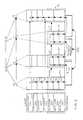
- Fig. 2 depicts the layers and data flow in the OSI Reference Model for a hypothetical network segment.
- the Physical Layer 207 includes the functions necessary for transmission and reception of data on the transmission or physical medium 208, involving, for example, the conversion of digital data signals to and from the signal format used in the medium 208.
- the Data Link Layer 206 includes functions for facilitating communications between directly-connected nodes in a network; these functions are not of particular interest here.
- the Network Layer 205 to which the present invention primarily relates, routes user data between nodes in the network.
- a "router" 209 comprises the functions of layers 205 through 207, to the extent the functions of such layers are implemented.
- a physical implementation of a router may perform only those functions, as de picted in node 23, or may be the portion (e.g., routers 211, 221 and 241) of a "full service" processor (e.g., nodes 21, 22, and 24) which performs the router functions, among other functions.
- a "full service" processor e.g., nodes 21, 22, and 24
- the Transport Layer 204 provides end-to-end services between communicating nodes, such as requesting confirmation of receipt of transmissions, transmissions of such confirmations, and retransmissions if no such confirmations are received.
- the higher levels i.e., the Session, Presentation, and Application Layers (203, 202 and 201, respectively) support standardized application protocols which are not the subject of this disclosure.
- Data stream 20 in Fig. 2 is exemplary of how information is transferred in the OSI Reference Model, in this case, from a user at node 21 to a user at node 24, by way of intermediate nodes 22 and 23.
- Routing decisions in the nodes are made at the Network Layer 205 in general accordance with routing strategies known in the art such as "shortest path,” “best efforts,” “least expensive” and the like, programmed or hard-wired into processors or circuits associated with the Network Layer 205.
- the routing decisions generally require an identification of the destination (intermediate or ultimate) for information received on physical medium 208 (corresponding to a "circuit"), an identifi cation which may be carried along in the data stream.
- Other information may also be used (which may also be carried in the data stream), such as quality of service requested, which may determine which of alternative forwarding paths to use.
- Network data communications in contrast to voice communications, often are made in a "connectionless” mode.
- "data packets” or “datagrams” of contiguous signals led by identifying "header” signals are routed from node to node between end users (e.g., node 21 to node 22 to node 23 to node 24 in Fig. 2) without "connection” in the sense of dedication of the entire end-to-end transmission path at any instant to the transmission.
- a "virtual connection" 34-34 is nonetheless made at the Transport Layer 204. This is a connection in the sense that while there is no physical connection at any one time, communication is established between nodes 21 and 24 at Transport Layer 204 and above without reference to how data is communicated at the Network Layer 205 and below. That is, insofar as the layers 204 and up are concerned, there is a direct connection between nodes 21 and 24.
- connection 34-34 is made at the Transport Layer 204 in OSI connectionless mode service when a datagram carrying a request for connection reaches node 24, that datagram is interpreted at the Transport Layer of node 24 as a request for connection, node 24 responds with a datagram confirming connection sent to node 21, and the Transport Layer of node 21 recognizes the confirmation.
- OSI defines protocols for or structures of data recognized at the respective layers. These structures are known as Protocol Data Units ("PDUs").
- Fig. 3 depicts general PDU data structures for each layer. As suggested in Fig. 3, the PDUs are “nested” in the sense that each PDU includes the "client” PDU for the next higher or “client” layer, along with a "service header.”
- a service header provides "protocol control information" relevant to its particular layer.
- the "Network Service Header" 305 may include destination and quality of service information for Network Layer (routing) decisions.
- user information to be communicated starts as an application data unit 31 and is prepared for transmission on the physical medium 208 (descending through the OSI layers 201 through 207) at originating node 21 by sequentially adding service headers 302 through 307.
- These headers provide information for servicing of the datagram that is interpreted and acted upon by the appropriate functional layer in subsequent nodes through which the datagram is routed, nodes 22, 23, and 24 in the example.
- the headers are generally stripped away in sequence in ascent through the OSI layers.
- the "Network Protocol Data Unit” (“NPDU”) 35 (Figs. 2 and 3) includes protocol control information in the Network Service Header 305 (Fig. 3).
- NPDU 35 when NPDU 35 reaches the network layer of router 221 in node 21, the Network Service Header is interpreted by the network layer processor and forwarded according to its routing program on a circuit to the next node, node 23 in this example.
- Router 221 may alter the service header to include different protocol control information for use by router 23, resulting in a modified NPDU 35′ at the Network Layer.
- Router 23 in turn may generate a modified NPDU 35 ⁇ to be serviced by router 241 at the Network Layer, which in the example terminates the transmission of the datagram since node 24, containing router 241, is the end user node.
- NPDU Network Layer
- nodes 13 and 14 may be in the same building, but in different domains (node 13 being "external” to domain 10 and node 14 being “internal”), while nodes 14 and 15, both internal to domain 10 may be separated by many miles.
- interdomain communication is one of the goals of OSI, there are occasions in which there is a need to prevent the mere "transit” (e.g., data path 100 in Fig. 1) through a domain of data packets which neither originate within nor are addressed to a node within that domain.
- "traffic" or data e.g., originating at external node 11
- a given "local" domain e.g., domain 10
- one point e.g., node 14
- an external destination e.g., node 19
- the resources of the local domain such as routers (e.g., routers at nodes 14 through 18), communications channels (e.g., in circuits 142, 151, etc.), and the like.
- Such transit merely uses the resources of the local domain without “substantively" communicating with the domain.
- such transit uses the lower or network layer communications resources of the domain without communications at the higher or user layers. It may result in denial of resources to traffic involving user communications between local nodes. It may also result in tarriffs charged to the local domain administration in those cases where the local domain uses public network links, e.g., telephone company circuits, with tarriffs proportional to the traffic carried. It may also make the domain a "common carrier" in violation of local laws.
- the Estrin visa scheme can be used to implement a blanket prevention of transit by preventing entry into the domain of any NPDU which does not have a destination within the domain.
- that scheme in its fully implemented form with time limits on visas, relies upon relatively frequent updates of visa information at the gateways, thus calling for operation considerably more complex than required by the present invention.
- the Estrin visa approach suffers from the same disadvantage as other approaches of rejecting transit traffic at the point of entry into the local domain.
- the disadvantage is the requirement of know ledge, at each point of entry, of which destinations are members of the local domain. Such knowledge would require the maintenance of a complete list of domain members at each point of entry (by updating from the access control server) or provision of distributed access to a common list, plus comparison of the destinations of entering data packets with the list. This resource drain would be exacerbated in the context of existing domains which contain hundreds and even thousands of nodes, with commensurate numbers of intended entry points and with additional potential entry points at the connections to common carriers.
- Knowledge of the domain membership status of the destination of incoming data packets might also be provided in the destination node addresses by assignment of codes to member nodes indicating their domain membership. For example, the same prefix may be given to the node addresses for each node that is a member of the domain, so that only traffic destined for node addresses with that prefix are allowed to enter the domain.
- the address code approach is not believed to be manageable because it would require reservation of such codes for present and future domains, the number and size of which are not predictable. There may be other constraints on node addresses that would interfere with such a scheme.
- the invention provides a simple means for preventing transit of data packets through a domain by allowing data packets which enter the domain on circuits designated "external" by the domain administrator to be routed within the domain unchanged, but deleting such packets at any node or router at which forwarding over an external circuit is attempted.
- Each data packet originating within the domain is flagged with an "internally originated” code at origination, and it carries that code until it is either received at its terminal destination within the domain or forwarded over an external circuit, at which time the "internally originated” code is removed.
- Nodes at the domain boundary need only store the designation of the circuits connected to it as “external” or not and have the capabilitiesities of detecting on which kind of circuit a given data packet was received and whether that packet was flagged as "internally originated.” Only when a circuit at a domain member node is newly connected to or removed from direct communication with a node outside the domain is domain administrative action required, and then only at the member node connected to that circuit.
- connection data packet (as well as any other externally originated traffic) at the node at which exit from the domain is attempted, if not rejected for other reasons at the point of entry. Because these connection requests do not reach their destination, no ccnfirmations are returned. Thus, no Transport Layer connections are made, and no communications established using transit routing through the domain.
- a Transport Layer or higher layer decision might be made to try a different routing strategy, typically using an alternative destination node address. Such action still would not succeed in establishing Transport Layer connection if either connection request or confirmation data packets were routed in an attempt to transit a domain in which the invention is implemented.
- the present invention while allowing some partial transit at the Network Layer, prevents full transit at that layer and prevents connection at the Transport Layer. Because, as a general matter, communications following Transport Layer connection use far more network resources than the request for connection and any retransmissions of that request, the invention effectively solves the problem of transit use of local domain resources in a simple and efficient manner compared to the prior art.
- Fig. 1 transit along data path 100 through domain 10 is prevented at an exemplary node 18 when forwarding is attempted over external circuit 181.
- Traffic originating on an external circuit for example, circuit 141
- Traffic originating on an external circuit is allowed to enter domain 11 and to terminate, for example, at node 17.
- any traffic originating within domain 10, for example, at node 17 is allowed to exit, for example, at node 18 over external circuit 181.
- traffic originating on an external circuit, for example, circuit 141 is deleted when an attempt is made to forward it on an external circuit, for example, at node 18 when forwarding is attempted on circuit 181.
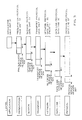
- Fig. 4 shows an exemplary router 40 used in a network domain in which the invention is implemented, further showing the logical components and data flow involved in the implementation. Only if router 40 has at least one external circuit connected to it, and is thus a "boundary router,” is it necessary that all the functions be implemented as shown. All that is required by the invention for a domain member router that has no external circuits is that any data packet originating at 43 at the node of which the router is a part be flagged at 44 with an "internally originated" code. Pure router nodes in which no data transfer occurs above the Network Layer require no change from their ordinary function.
- Fig. 5 shows the router decision flow for a general or boundary router, with steps keyed to Fig. 4. It should be understood that the router functions shown in Figs. 4 and 5 may be programmed in software or hard-wired by those skilled in the art.
- each circuit 41 attached to a local domain router 40 can be designated by the network administrator 42 to be either “external” or, by lack of designation, "internal.”
- a circuit is designated “external” according to the invention if it connects directly to nodes outside the local domain and is considered “internal” if it connects directly only to nodes within the local domain (including boundary nodes).
- circuits 141, 143, 162, and 181 are designated "external.” This designation, as well as the subsequent determinations at means 52 whether a data packet arrived on an external circuit and at means 53 whether a data packet is sought to be forwarded over an external circuit, can be accomplished by means well known to communications engineers, including software switches and jumpers.
- any data packet originating at originating user 43 within the local domain node associated with router 40 is flagged at means 44 (which may be part of the router) with an "internally originated” code.
- "internally originated” status could be the default status, and any data packet received on an "external” circuit flagged with an "externally originated” code.
- Those data packets designated “internally originated” carry the designation until termination at terminating user 49 or exit from the local domain at means 47.
- a lack of an "internally originated” designation i.s similarly unchanged except that data units so designated are not allowed to exit from the local domain (see means 45 and 46 in Figs. 4 and 5).
- the "internally originated" designation is included in the Network Service Header 32 for each NPDU.
- the ISO “Protocol for Providing the Connectionless-Mode Network Service” (ISO 8473) includes no field explicitly allocated to carry such "transit type” information. However, an option is provided to carry security information.
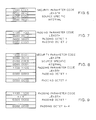
- the "internally originated” type is encoded by the presence of a particular security code, Fig. 6, in Network Service Header 32, and “externally originated” by the absence of that code.
- the security code used is a standard "source specific" code, which indicates that it has meaning for the source node, rather than for the destination node or for all nodes in the network.
- the "internally originated” code will generally have no meaning outside the local domain and may, if present, cause a data packet to be rejected downstream, when an "internally originated” NPDU is to be transmitted over an external circuit, it is necessary to remove the "internally originated” code. It is not permitted by ISO 8473 to change the length of the Network Service Header, so that the removal of the "internally originated” flag is effected in the illustrative embodiment by converting at means 47 (Figs. 4 and 5) the security option into an ISO 8473 padding option, Fig. 7. If a padding option is otherwise implemented, in the illustrative embodiment, it is implemented adjacent to the security option so that the "internally originated” code is shown in Fig. 8, and the existing padding option is extended at means 47 to replace the security option as shown in Fig. 9 when the "internally originated” code is removed for forwarding on an external circuit.
- an NPDU arriving over an external circuit must be rejected if it carries the "internally originated" flag, since it would have a different meaning in the external domain or be an attempt to masquerade as an "internally originated” NPDU in the instant domain.
- the packet is deleted at means 46 (Figs. 4 and 5).
- NPDU without an "internally originated" code is received by a router 40 and is not terminated at user 49 of that node, it will be forwarded only on an internal circuit. If, after the routing decision is made at router 40, it is determined at means 53 that forwarding is sought on an external circuit, the packet is deleted at means 46 (Figs. 4 and 5). Thus, transit, for example, over data path 100, of a non-locally originated data packet is prevented.
Landscapes
- Engineering & Computer Science (AREA)
- Computer Networks & Wireless Communication (AREA)
- Signal Processing (AREA)
- Data Exchanges In Wide-Area Networks (AREA)
- Communication Control (AREA)
Applications Claiming Priority (2)
| Application Number | Priority Date | Filing Date | Title |
|---|---|---|---|
| GB8818368 | 1988-08-02 | ||
| GB888818368A GB8818368D0 (en) | 1988-08-02 | 1988-08-02 | Network transit prevention |
Publications (2)
| Publication Number | Publication Date |
|---|---|
| EP0353859A2 true EP0353859A2 (fr) | 1990-02-07 |
| EP0353859A3 EP0353859A3 (fr) | 1992-04-01 |
Family
ID=10641495
Family Applications (1)
| Application Number | Title | Priority Date | Filing Date |
|---|---|---|---|
| EP19890306571 Withdrawn EP0353859A3 (fr) | 1988-08-02 | 1989-06-28 | Réseau avec évitement du transit |
Country Status (6)
| Country | Link |
|---|---|
| US (1) | US5134610A (fr) |
| EP (1) | EP0353859A3 (fr) |
| JP (1) | JPH0281539A (fr) |
| AU (1) | AU610747B2 (fr) |
| CA (1) | CA1317015C (fr) |
| GB (1) | GB8818368D0 (fr) |
Cited By (3)
| Publication number | Priority date | Publication date | Assignee | Title |
|---|---|---|---|---|
| EP0607681A3 (fr) * | 1993-01-19 | 1994-12-14 | Int Computers Ltd | Système d'ordinateur parallèle. |
| EP0607546A3 (en) * | 1992-12-29 | 1995-08-23 | Ibm | Apparatus for fiber distributed data interface dynamic station bypass via skipping and hopping. |
| FR2736230A1 (fr) * | 1992-04-02 | 1997-01-03 | Inst Nat Rech Inf Automat | Installation du type reseau radio de transmission de donnees avec rouage |
Families Citing this family (25)
| Publication number | Priority date | Publication date | Assignee | Title |
|---|---|---|---|---|
| JPH05114905A (ja) * | 1991-04-08 | 1993-05-07 | Digital Equip Corp <Dec> | 単一アドレス及びプロトコール・テーブル・ブリツジを使用したメツセージの処置フイルタリング |
| US5255268A (en) * | 1992-02-04 | 1993-10-19 | International Business | Data distribution network with improved broadcast feature |
| FR2687878A1 (fr) * | 1992-02-21 | 1993-08-27 | Bull Sa | Systeme de relais de transport osi entre reseau en mode connecte et un reseau en mode non connecte. |
| US5313465A (en) * | 1992-05-13 | 1994-05-17 | Digital Equipment Corporation | Method of merging networks across a common backbone network |
| CA2153281C (fr) * | 1994-07-08 | 2000-05-16 | Ronald Schwartz | Acces assiste a un reseau intelligent |
| US5546390A (en) * | 1994-12-29 | 1996-08-13 | Storage Technology Corporation | Method and apparatus for radix decision packet processing |
| US5566170A (en) * | 1994-12-29 | 1996-10-15 | Storage Technology Corporation | Method and apparatus for accelerated packet forwarding |
| US5598410A (en) * | 1994-12-29 | 1997-01-28 | Storage Technology Corporation | Method and apparatus for accelerated packet processing |
| US6510151B1 (en) * | 1996-09-19 | 2003-01-21 | Enterasys Networks, Inc. | Packet filtering in connection-based switching networks |
| US6229808B1 (en) * | 1997-03-07 | 2001-05-08 | Advanced Micro Devices, Inc. | Method of communication for a computer using packet switches for internal data transfer |
| US6587462B2 (en) * | 2001-02-16 | 2003-07-01 | Dunti Corporation | Address mapping mechanism enabling multi-domain addressing in communication networks |
| US7970929B1 (en) | 2002-03-19 | 2011-06-28 | Dunti Llc | Apparatus, system, and method for routing data to and from a host that is moved from one location on a communication system to another location on the communication system |
| US7778259B1 (en) | 1999-05-14 | 2010-08-17 | Dunti Llc | Network packet transmission mechanism |
| DE10114208A1 (de) * | 2001-03-23 | 2002-05-08 | Trw Automotive Safety Sys Gmbh | Gassack-Modul |
| US8458453B1 (en) | 2004-06-11 | 2013-06-04 | Dunti Llc | Method and apparatus for securing communication over public network |
| US8155014B2 (en) * | 2005-03-25 | 2012-04-10 | Cisco Technology, Inc. | Method and system using quality of service information for influencing a user's presence state |
| US8015403B2 (en) | 2005-03-28 | 2011-09-06 | Cisco Technology, Inc. | Method and system indicating a level of security for VoIP calls through presence |
| US8079062B2 (en) * | 2005-05-16 | 2011-12-13 | Cisco Technology, Inc. | Method and system using presence information to manage network access |
| US7920847B2 (en) * | 2005-05-16 | 2011-04-05 | Cisco Technology, Inc. | Method and system to protect the privacy of presence information for network users |
| US7764699B2 (en) * | 2005-05-16 | 2010-07-27 | Cisco Technology, Inc. | Method and system using shared configuration information to manage network access for network users |
| US7852783B2 (en) * | 2006-12-07 | 2010-12-14 | Cisco Technology, Inc. | Identify a secure end-to-end voice call |
| US8683572B1 (en) | 2008-01-24 | 2014-03-25 | Dunti Llc | Method and apparatus for providing continuous user verification in a packet-based network |
| US9282036B2 (en) | 2013-02-20 | 2016-03-08 | International Business Machines Corporation | Directed route load/store packets for distributed switch initialization |
| US9215087B2 (en) | 2013-03-15 | 2015-12-15 | International Business Machines Corporation | Directed route load/store packets for distributed switch initialization |
| US9621520B2 (en) | 2015-03-19 | 2017-04-11 | Cisco Technology, Inc. | Network service packet header security |
Family Cites Families (10)
| Publication number | Priority date | Publication date | Assignee | Title |
|---|---|---|---|---|
| US3890471A (en) * | 1973-12-17 | 1975-06-17 | Bell Telephone Labor Inc | Loop data transmission arrangement employing an interloop communication terminal |
| EP0109964B1 (fr) * | 1982-11-26 | 1986-04-23 | International Business Machines Corporation | Synchronisation dans un réseau de télécommunication à boucles interconnectés |
| US4597078A (en) * | 1983-10-19 | 1986-06-24 | Digital Equipment Corporation | Bridge circuit for interconnecting networks |
| US4550401A (en) * | 1983-12-21 | 1985-10-29 | At&T Bell Laboratories | Delivery information packet switching system |
| US4706081A (en) * | 1984-12-14 | 1987-11-10 | Vitalink Communications Corporation | Method and apparatus for bridging local area networks |
| US4644532A (en) * | 1985-06-10 | 1987-02-17 | International Business Machines Corporation | Automatic update of topology in a hybrid network |
| US4769811A (en) * | 1986-12-31 | 1988-09-06 | American Telephone And Telegraph Company, At&T Bell Laboratories | Packet switching system arranged for congestion control |
| US4769810A (en) * | 1986-12-31 | 1988-09-06 | American Telephone And Telegraph Company, At&T Bell Laboratories | Packet switching system arranged for congestion control through bandwidth management |
| JPS6467046A (en) * | 1987-09-08 | 1989-03-13 | Ricoh Kk | Multiplex repeating installation device for variable communication network |
| US4939726A (en) * | 1989-07-18 | 1990-07-03 | Metricom, Inc. | Method for routing packets in a packet communication network |
-
1988
- 1988-08-02 GB GB888818368A patent/GB8818368D0/en active Pending
-
1989
- 1989-03-06 US US07/320,178 patent/US5134610A/en not_active Expired - Lifetime
- 1989-06-28 EP EP19890306571 patent/EP0353859A3/fr not_active Withdrawn
- 1989-07-19 CA CA000606095A patent/CA1317015C/fr not_active Expired - Fee Related
- 1989-08-01 AU AU39201/89A patent/AU610747B2/en not_active Ceased
- 1989-08-02 JP JP1201154A patent/JPH0281539A/ja active Pending
Cited By (4)
| Publication number | Priority date | Publication date | Assignee | Title |
|---|---|---|---|---|
| FR2736230A1 (fr) * | 1992-04-02 | 1997-01-03 | Inst Nat Rech Inf Automat | Installation du type reseau radio de transmission de donnees avec rouage |
| EP0607546A3 (en) * | 1992-12-29 | 1995-08-23 | Ibm | Apparatus for fiber distributed data interface dynamic station bypass via skipping and hopping. |
| EP0607681A3 (fr) * | 1993-01-19 | 1994-12-14 | Int Computers Ltd | Système d'ordinateur parallèle. |
| US5588121A (en) * | 1993-01-19 | 1996-12-24 | International Computers Limited | Parallel computer having MAC-relay layer snooped transport header to determine if a message should be routed directly to transport layer depending on its destination |
Also Published As
| Publication number | Publication date |
|---|---|
| AU610747B2 (en) | 1991-05-23 |
| US5134610A (en) | 1992-07-28 |
| GB8818368D0 (en) | 1988-09-07 |
| JPH0281539A (ja) | 1990-03-22 |
| EP0353859A3 (fr) | 1992-04-01 |
| CA1317015C (fr) | 1993-04-27 |
| AU3920189A (en) | 1990-02-08 |
Similar Documents
| Publication | Publication Date | Title |
|---|---|---|
| US5134610A (en) | Network transit prevention | |
| EP1386455B1 (fr) | Procede et appareil de realisation d'acheminement dans un reseau | |
| CA2289394C (fr) | Architecture de transmission vocale sur reseau ip (protocole internet) | |
| US5734651A (en) | Transaction message routing in digital communication networks | |
| EP2225663B1 (fr) | Fourniture de services à des flux de paquets dans un réseau | |
| US7983281B2 (en) | VPN composing method, interwork router, packet communication method, data communication apparatus, and packet relaying apparatus | |
| US20080130661A1 (en) | System and Communication Method of Ip Telecommunication Network and its Application | |
| US7120156B2 (en) | Policy information transfer in 3GPP networks | |
| JPH06209346A (ja) | データ伝送システム | |
| JPH05344161A (ja) | ローカルエリアネットワーク間の接続ルータ | |
| MXPA03008472A (es) | Rutedor marginal de equipo de premisas del cliente consciente de la red privada virtual (vpn). | |
| JP2013009406A (ja) | インターネットにアクセスする加入者への所望のサービス・ポリシーの提供 | |
| US7136382B1 (en) | System and method for providing quality of service operations using IP addresses | |
| US20050144289A1 (en) | Connection control system, connection control equipment and connection management equipment | |
| JP2002190824A (ja) | ルータ及びipパケットの転送方式 | |
| EP1701516B1 (fr) | Méthode pour faciliter la fonctionnalité d'un serveur d'application et noeud correspondant | |
| JP3514279B2 (ja) | 相手選択型アドレス解決方法及びその装置 | |
| JP2004528756A (ja) | サービス拒否攻撃に耐えるために、仮想私設網(vpn)およびベストエフォートトラフィックを隔離するシステム、方法および装置 | |
| JPH11355353A (ja) | 呼番号とインタ―ネット発信アドレスで構成されるペアの使用方法 | |
| US7703124B2 (en) | System and method for implementing a private virtual backbone on a common network infrastructure | |
| JP2004533149A (ja) | IPQoSのサービス拒否攻撃に耐えるための仮想私設網を採用するシステム、方法および装置 | |
| CN115883256B (zh) | 基于加密隧道的数据传输方法、装置及存储介质 | |
| JP2004312380A (ja) | 帯域管理システム | |
| JP4042410B2 (ja) | 通信装置 | |
| JPH07231330A (ja) | マルチプロトコルネットワークおよびパケットフィルタ |
Legal Events
| Date | Code | Title | Description |
|---|---|---|---|
| PUAI | Public reference made under article 153(3) epc to a published international application that has entered the european phase |
Free format text: ORIGINAL CODE: 0009012 |
|
| 17P | Request for examination filed |
Effective date: 19890714 |
|
| AK | Designated contracting states |
Kind code of ref document: A2 Designated state(s): AT BE CH DE ES FR GB GR IT LI LU NL SE |
|
| PUAL | Search report despatched |
Free format text: ORIGINAL CODE: 0009013 |
|
| AK | Designated contracting states |
Kind code of ref document: A3 Designated state(s): AT BE CH DE ES FR GB GR IT LI LU NL SE |
|
| 17Q | First examination report despatched |
Effective date: 19940322 |
|
| STAA | Information on the status of an ep patent application or granted ep patent |
Free format text: STATUS: THE APPLICATION IS DEEMED TO BE WITHDRAWN |
|
| 18D | Application deemed to be withdrawn |
Effective date: 19940802 |