EP0354485A2 - Verfahren zur Herstellung von polymeren Produkten von Lignin bzw. Ligninderivaten - Google Patents
Verfahren zur Herstellung von polymeren Produkten von Lignin bzw. Ligninderivaten Download PDFInfo
- Publication number
- EP0354485A2 EP0354485A2 EP89114398A EP89114398A EP0354485A2 EP 0354485 A2 EP0354485 A2 EP 0354485A2 EP 89114398 A EP89114398 A EP 89114398A EP 89114398 A EP89114398 A EP 89114398A EP 0354485 A2 EP0354485 A2 EP 0354485A2
- Authority
- EP
- European Patent Office
- Prior art keywords
- matrix
- enzyme
- lignin
- organic solvents
- gels
- Prior art date
- Legal status (The legal status is an assumption and is not a legal conclusion. Google has not performed a legal analysis and makes no representation as to the accuracy of the status listed.)
- Ceased
Links
- 229920005610 lignin Polymers 0.000 title claims description 18
- 238000004519 manufacturing process Methods 0.000 title description 6
- 229920000642 polymer Polymers 0.000 title description 2
- 239000011159 matrix material Substances 0.000 claims abstract description 45
- 108090000790 Enzymes Proteins 0.000 claims abstract description 35
- 102000004190 Enzymes Human genes 0.000 claims abstract description 35
- 239000003960 organic solvent Substances 0.000 claims abstract description 18
- 150000004676 glycans Chemical class 0.000 claims abstract description 7
- 229920001282 polysaccharide Polymers 0.000 claims abstract description 7
- 239000005017 polysaccharide Substances 0.000 claims abstract description 7
- 239000002904 solvent Substances 0.000 claims description 14
- XLYOFNOQVPJJNP-UHFFFAOYSA-N water Substances O XLYOFNOQVPJJNP-UHFFFAOYSA-N 0.000 claims description 14
- 239000000499 gel Substances 0.000 claims description 13
- 239000000243 solution Substances 0.000 claims description 12
- 108010029541 Laccase Proteins 0.000 claims description 9
- 229920006395 saturated elastomer Polymers 0.000 claims description 7
- 230000002209 hydrophobic effect Effects 0.000 claims description 5
- 108090000854 Oxidoreductases Proteins 0.000 claims description 4
- 102000004316 Oxidoreductases Human genes 0.000 claims description 4
- 229920005654 Sephadex Polymers 0.000 claims description 4
- 238000004587 chromatography analysis Methods 0.000 claims description 4
- 238000004132 cross linking Methods 0.000 claims description 4
- 238000000034 method Methods 0.000 claims description 4
- 238000002360 preparation method Methods 0.000 claims description 4
- 238000006911 enzymatic reaction Methods 0.000 claims description 3
- 230000007717 exclusion Effects 0.000 claims description 3
- 108010054320 Lignin peroxidase Proteins 0.000 claims description 2
- 108010059896 Manganese peroxidase Proteins 0.000 claims description 2
- 239000011543 agarose gel Substances 0.000 claims description 2
- 239000007853 buffer solution Substances 0.000 claims description 2
- 238000002156 mixing Methods 0.000 claims description 2
- XEKOWRVHYACXOJ-UHFFFAOYSA-N Ethyl acetate Chemical compound CCOC(C)=O XEKOWRVHYACXOJ-UHFFFAOYSA-N 0.000 description 27
- WEVYAHXRMPXWCK-UHFFFAOYSA-N Acetonitrile Chemical compound CC#N WEVYAHXRMPXWCK-UHFFFAOYSA-N 0.000 description 15
- CSCPPACGZOOCGX-UHFFFAOYSA-N Acetone Chemical compound CC(C)=O CSCPPACGZOOCGX-UHFFFAOYSA-N 0.000 description 12
- WYURNTSHIVDZCO-UHFFFAOYSA-N Tetrahydrofuran Chemical compound C1CCOC1 WYURNTSHIVDZCO-UHFFFAOYSA-N 0.000 description 10
- 238000006243 chemical reaction Methods 0.000 description 10
- HEMHJVSKTPXQMS-UHFFFAOYSA-M Sodium hydroxide Chemical compound [OH-].[Na+] HEMHJVSKTPXQMS-UHFFFAOYSA-M 0.000 description 9
- YARKTHNUMGKMGS-LQGKIZFRSA-N chembl3193980 Chemical compound COC1=C(O)C(OC)=CC(\C=N\N=C\C=2C=C(OC)C(O)=C(OC)C=2)=C1 YARKTHNUMGKMGS-LQGKIZFRSA-N 0.000 description 7
- UHOVQNZJYSORNB-UHFFFAOYSA-N Benzene Chemical compound C1=CC=CC=C1 UHOVQNZJYSORNB-UHFFFAOYSA-N 0.000 description 6
- OKKJLVBELUTLKV-UHFFFAOYSA-N Methanol Chemical compound OC OKKJLVBELUTLKV-UHFFFAOYSA-N 0.000 description 6
- YXFVVABEGXRONW-UHFFFAOYSA-N Toluene Chemical compound CC1=CC=CC=C1 YXFVVABEGXRONW-UHFFFAOYSA-N 0.000 description 6
- 238000010521 absorption reaction Methods 0.000 description 6
- 239000000758 substrate Substances 0.000 description 6
- KLIDCXVFHGNTTM-UHFFFAOYSA-N 2,6-dimethoxyphenol Chemical compound COC1=CC=CC(OC)=C1O KLIDCXVFHGNTTM-UHFFFAOYSA-N 0.000 description 5
- LFQSCWFLJHTTHZ-UHFFFAOYSA-N Ethanol Chemical compound CCO LFQSCWFLJHTTHZ-UHFFFAOYSA-N 0.000 description 5
- 239000007979 citrate buffer Substances 0.000 description 5
- 239000000047 product Substances 0.000 description 5
- YLQBMQCUIZJEEH-UHFFFAOYSA-N tetrahydrofuran Natural products C=1C=COC=1 YLQBMQCUIZJEEH-UHFFFAOYSA-N 0.000 description 5
- HEDRZPFGACZZDS-UHFFFAOYSA-N Chloroform Chemical compound ClC(Cl)Cl HEDRZPFGACZZDS-UHFFFAOYSA-N 0.000 description 4
- RTZKZFJDLAIYFH-UHFFFAOYSA-N Diethyl ether Chemical compound CCOCC RTZKZFJDLAIYFH-UHFFFAOYSA-N 0.000 description 4
- VLKZOEOYAKHREP-UHFFFAOYSA-N n-Hexane Chemical compound CCCCCC VLKZOEOYAKHREP-UHFFFAOYSA-N 0.000 description 4
- RYHBNJHYFVUHQT-UHFFFAOYSA-N 1,4-Dioxane Chemical compound C1COCCO1 RYHBNJHYFVUHQT-UHFFFAOYSA-N 0.000 description 3
- KRKNYBCHXYNGOX-UHFFFAOYSA-N citric acid Chemical compound OC(=O)CC(O)(C(O)=O)CC(O)=O KRKNYBCHXYNGOX-UHFFFAOYSA-N 0.000 description 3
- JMFRWRFFLBVWSI-NSCUHMNNSA-N coniferol Chemical compound COC1=CC(\C=C\CO)=CC=C1O JMFRWRFFLBVWSI-NSCUHMNNSA-N 0.000 description 3
- 230000000694 effects Effects 0.000 description 3
- 238000005259 measurement Methods 0.000 description 3
- 239000000203 mixture Substances 0.000 description 3
- 230000003647 oxidation Effects 0.000 description 3
- 238000007254 oxidation reaction Methods 0.000 description 3
- 239000004033 plastic Substances 0.000 description 3
- 229920003023 plastic Polymers 0.000 description 3
- 239000000126 substance Substances 0.000 description 3
- SCYULBFZEHDVBN-UHFFFAOYSA-N 1,1-Dichloroethane Chemical compound CC(Cl)Cl SCYULBFZEHDVBN-UHFFFAOYSA-N 0.000 description 2
- NXXYKOUNUYWIHA-UHFFFAOYSA-N 2,6-Dimethylphenol Chemical compound CC1=CC=CC(C)=C1O NXXYKOUNUYWIHA-UHFFFAOYSA-N 0.000 description 2
- XDTMQSROBMDMFD-UHFFFAOYSA-N Cyclohexane Chemical compound C1CCCCC1 XDTMQSROBMDMFD-UHFFFAOYSA-N 0.000 description 2
- MHAJPDPJQMAIIY-UHFFFAOYSA-N Hydrogen peroxide Chemical compound OO MHAJPDPJQMAIIY-UHFFFAOYSA-N 0.000 description 2
- NHTMVDHEPJAVLT-UHFFFAOYSA-N Isooctane Chemical compound CC(C)CC(C)(C)C NHTMVDHEPJAVLT-UHFFFAOYSA-N 0.000 description 2
- PXIPVTKHYLBLMZ-UHFFFAOYSA-N Sodium azide Chemical compound [Na+].[N-]=[N+]=[N-] PXIPVTKHYLBLMZ-UHFFFAOYSA-N 0.000 description 2
- 125000000217 alkyl group Chemical group 0.000 description 2
- JVSWJIKNEAIKJW-UHFFFAOYSA-N dimethyl-hexane Natural products CCCCCC(C)C JVSWJIKNEAIKJW-UHFFFAOYSA-N 0.000 description 2
- 125000000956 methoxy group Chemical group [H]C([H])([H])O* 0.000 description 2
- ZYECOAILUNWEAL-NUDFZHEQSA-N (4z)-4-[[2-methoxy-5-(phenylcarbamoyl)phenyl]hydrazinylidene]-n-(3-nitrophenyl)-3-oxonaphthalene-2-carboxamide Chemical compound COC1=CC=C(C(=O)NC=2C=CC=CC=2)C=C1N\N=C(C1=CC=CC=C1C=1)/C(=O)C=1C(=O)NC1=CC=CC([N+]([O-])=O)=C1 ZYECOAILUNWEAL-NUDFZHEQSA-N 0.000 description 1
- HJFZAYHYIWGLNL-UHFFFAOYSA-N 2,6-DiMepyz Natural products CC1=CN=CC(C)=N1 HJFZAYHYIWGLNL-UHFFFAOYSA-N 0.000 description 1
- IAAASXBHFUJLHW-UHFFFAOYSA-N 3,5-diethyl-1-phenyl-2-propyl-2h-pyridine Chemical compound C1=C(CC)C=C(CC)C(CCC)N1C1=CC=CC=C1 IAAASXBHFUJLHW-UHFFFAOYSA-N 0.000 description 1
- RYGMFSIKBFXOCR-UHFFFAOYSA-N Copper Chemical compound [Cu] RYGMFSIKBFXOCR-UHFFFAOYSA-N 0.000 description 1
- 238000011993 High Performance Size Exclusion Chromatography Methods 0.000 description 1
- ISWSIDIOOBJBQZ-UHFFFAOYSA-N Phenol Chemical compound OC1=CC=CC=C1 ISWSIDIOOBJBQZ-UHFFFAOYSA-N 0.000 description 1
- 229920002684 Sepharose Polymers 0.000 description 1
- 239000012736 aqueous medium Substances 0.000 description 1
- 239000007864 aqueous solution Substances 0.000 description 1
- 239000007900 aqueous suspension Substances 0.000 description 1
- 239000011324 bead Substances 0.000 description 1
- 238000006065 biodegradation reaction Methods 0.000 description 1
- 125000004432 carbon atom Chemical group C* 0.000 description 1
- 229940119526 coniferyl alcohol Drugs 0.000 description 1
- 239000000470 constituent Substances 0.000 description 1
- 229910052802 copper Inorganic materials 0.000 description 1
- 239000010949 copper Substances 0.000 description 1
- ZPWVASYFFYYZEW-UHFFFAOYSA-L dipotassium hydrogen phosphate Chemical compound [K+].[K+].OP([O-])([O-])=O ZPWVASYFFYYZEW-UHFFFAOYSA-L 0.000 description 1
- 229910000396 dipotassium phosphate Inorganic materials 0.000 description 1
- 235000019797 dipotassium phosphate Nutrition 0.000 description 1
- 229920001971 elastomer Polymers 0.000 description 1
- MHYCRLGKOZWVEF-UHFFFAOYSA-N ethyl acetate;hydrate Chemical compound O.CCOC(C)=O MHYCRLGKOZWVEF-UHFFFAOYSA-N 0.000 description 1
- 238000002474 experimental method Methods 0.000 description 1
- 125000002768 hydroxyalkyl group Chemical group 0.000 description 1
- 239000007788 liquid Substances 0.000 description 1
- 229910052751 metal Inorganic materials 0.000 description 1
- 239000002184 metal Substances 0.000 description 1
- 150000002739 metals Chemical class 0.000 description 1
- ZIUHHBKFKCYYJD-UHFFFAOYSA-N n,n'-methylenebisacrylamide Chemical compound C=CC(=O)NCNC(=O)C=C ZIUHHBKFKCYYJD-UHFFFAOYSA-N 0.000 description 1
- 230000001590 oxidative effect Effects 0.000 description 1
- 239000002574 poison Substances 0.000 description 1
- 231100000614 poison Toxicity 0.000 description 1
- 238000006116 polymerization reaction Methods 0.000 description 1
- 230000002285 radioactive effect Effects 0.000 description 1
- 230000036632 reaction speed Effects 0.000 description 1
- 238000003756 stirring Methods 0.000 description 1
- 239000006228 supernatant Substances 0.000 description 1
- KCDXJAYRVLXPFO-UHFFFAOYSA-N syringaldehyde Chemical compound COC1=CC(C=O)=CC(OC)=C1O KCDXJAYRVLXPFO-UHFFFAOYSA-N 0.000 description 1
- COBXDAOIDYGHGK-UHFFFAOYSA-N syringaldehyde Natural products COC1=CC=C(C=O)C(OC)=C1O COBXDAOIDYGHGK-UHFFFAOYSA-N 0.000 description 1
Images


Classifications
-
- C—CHEMISTRY; METALLURGY
- C12—BIOCHEMISTRY; BEER; SPIRITS; WINE; VINEGAR; MICROBIOLOGY; ENZYMOLOGY; MUTATION OR GENETIC ENGINEERING
- C12P—FERMENTATION OR ENZYME-USING PROCESSES TO SYNTHESISE A DESIRED CHEMICAL COMPOUND OR COMPOSITION OR TO SEPARATE OPTICAL ISOMERS FROM A RACEMIC MIXTURE
- C12P1/00—Preparation of compounds or compositions, not provided for in groups C12P3/00 - C12P39/00, by using microorganisms or enzymes
-
- C—CHEMISTRY; METALLURGY
- C12—BIOCHEMISTRY; BEER; SPIRITS; WINE; VINEGAR; MICROBIOLOGY; ENZYMOLOGY; MUTATION OR GENETIC ENGINEERING
- C12N—MICROORGANISMS OR ENZYMES; COMPOSITIONS THEREOF; PROPAGATING, PRESERVING, OR MAINTAINING MICROORGANISMS; MUTATION OR GENETIC ENGINEERING; CULTURE MEDIA
- C12N11/00—Carrier-bound or immobilised enzymes; Carrier-bound or immobilised microbial cells; Preparation thereof
- C12N11/02—Enzymes or microbial cells immobilised on or in an organic carrier
- C12N11/04—Enzymes or microbial cells immobilised on or in an organic carrier entrapped within the carrier, e.g. gel or hollow fibres
Definitions
- the present invention relates to enzyme-matrix complexes consisting of lignin-modifying enzymes which are embedded in a polysaccharide-based matrix, as well as processes for their preparation and their use for enzyme reactions in hydrophilic and hydrophobic organic solvents.
- the invention enables the use of lignin-modifying enzymes in organic solvents for the first time and thus enables u. a. the production of polymer products of lignin or lignin derivatives.
- the production of the phenol oxidizing enzyme laccase is described for example in DE-PS 30 37 992.
- the enzyme is obtained in aqueous solution.
- the further reactions of the enzyme are also carried out in aqueous media. Reactions of the enzyme in organic solvents are not mentioned in this document.
- the object of the present invention is to create new enzyme-matrix complexes of lignin-modifying enzymes which largely retain their enzyme activity even in organic solvents and thus enable, for example, the conversion of lignin or lignin derivatives in organic solvents.
- lignin-modifying enzymes are suitable as constituents of the enzyme-matrix complexes according to the invention.
- polysaccharides which form a porous, inert, solvent-resistant matrix gel can be used as the matrix-forming polysaccharides.
- agarose gels and dextran gels as well as their derivatives and crosslinking products are particularly preferred.
- the derivatives are e.g. B. alkyl or hydroxyalkyl derivatives whose alkyl group can contain 1 to 3 or up to 4 carbon atoms.
- Crosslinking products with other organic substances that can cause crosslinking such as. B. N, N'-methylenebis (acrylamide) are suitable as matrix gels.
- the matrix gels used should preferably have an exclusion limit in a molecular weight range of approximately 30,000 to approximately 1,000,000, since the customary lignin-modifying enzymes can preferably be embedded in such matrix gels.
- the enzyme matrix complexes according to the invention are effective in almost all organic solvents, both in hydrophilic and in hydrophobic solvents. Only solvents that form chelates with metals are excluded from use, since, for example, the laccases contain copper.
- the enzyme-matrix complexes according to the invention can be used in the following organic solvents: Ethyl acetate, benzene, toluene, ether, isooctane, n-hexane, cyclohexane, chloroform, dichloroethane, acetonitrile, acetone, methanol, ethanol, 1,4-dioxane, tetrahydrofuran and others
- the presence of at least small amounts of water is necessary. Therefore, when used in hydrophilic organic solvents, about 1 to 80% by volume of water, preferably about 3.5 to 50% by volume, based on the amount of solvent, is added. When using hydrophobic organic solvents, they are saturated with water.
- the enzyme-matrix complexes according to the invention also show a high degree of activity in organic solvents, which is independent of the hydrophilic nature of the solvents. They have high stability, even at higher temperatures, and high tolerance to enzyme poisons such as sodium azide and hydrogen peroxide.
- the enzyme matrix complexes according to the invention enable the biodegradation of substances which can be degraded by lignin-modifying enzymes, as well as biological oxidation and polymerization reactions which are brought about by such enzymes.
- highly reactive lignins can be produced from lignin or lignin derivatives. Oxidized groups in the lignin molecule can be obtained as reactive groups. In this way it is possible to obtain lignin prepolymers which can be used in the production of plastics.
- the enzyme-matrix complexes according to the invention can be prepared in a simple manner by mixing solutions of the enzymes with the matrix substance in question.
- the enzyme is dissolved in a buffer solution with the following composition:
- aqueous 0.1 M solution of citric acid is adjusted to a pH of 4.5 with an aqueous 0.2 M solution of K2HPO4.
- the complex can also be prepared by applying the buffered enzyme solution to a chromatography column filled with the matrix gel.
- the matrix gel containing the enzyme-matrix complex is obtained and lyophilized (freeze-dried).
- a 1.9 x 9 cm chromatography column was packed with an aqueous suspension of a Sepharose CL 6 B dextrangel (1.3 g dry weight) and the filling was equilibrated with 0.1 M citrate buffer (pH 4.5). The exclusion volume of this column was 7 ml.
- Example 2 5.5 mg of the complex obtained according to Example 1 were suspended in 10 ml of ethyl acetate which was saturated with water. 100 ⁇ l of these were placed in a 3 ml cuvette (light pass 10 mm) and 2.5 ml of substrate in ethyl acetate saturated with water were added. The effective amount of enzyme was 5.7 ⁇ g enzyme protein.
- FIG. 1a and 1b show the change in absorption due to the oxidation of the two substrates by the enzyme-matrix complex.
- the reaction rate is shown in the form of the change in absorption at 458 nm per minute with an amount of enzyme of 5.7 ⁇ g (for DMP) and syringaldazine (55 ⁇ g of complexes containing 5.7 ⁇ g of enzyme). The reaction rate is thus defined as 458 nm. min ⁇ 1 mg enzyme ⁇ 1
- Example 2 syringaldazine was reacted in various solvents with the enzyme-matrix complex obtained according to Example 1. The results obtained are summarized in Table 2.
- mg enzyme saturated with water Ethyl acetate 216 toluene 104 benzene 81 Ether 75 Isooctane 68 n-hexane 62 Cyclohexane 48 chloroform 15 Dichloroethane 8th Solvent + 3.5 vol% water: Acetonitrile 116 acetone 80 Ethanol 28 1,4-dioxane 16 Tetrahydrofuran 11 Methanol 10th
- organosolv lignin 150 mg were dissolved in 3 ml of dioxane containing 20% by volume of water, the solution was centrifuged and 15 mg of the enzyme-matrix complex obtained according to Example 1 were added to the supernatant. The mixture was shaken for 3 days at 25 ° in the dark. Then the mixture was centrifuged and the clear solution subjected to HPSEC chromatography as in Wat. Sci. Techn., Vol. 20, p. 161.170, 1988.
- the result is shown in Fig. 3.
- the starting product had a molecular weight of approx. 7000.
- the molecular weight was almost unchanged after shaking for 3 days without enzyme. After the enzyme treatment, the molecular weight increased to approximately 240,000.
- Examples 4 and 5 show that the treatment with the enzyme-matrix complex in the case of lignin does not convert -OCH3 groups which are not reactive into highly reactive -OH groups and that, in addition, higher molecular weight prepolymers can be obtained from the lignin.
- These reactive prepolymers are suitable for use in the manufacture of plastics. They have the advantage over conventional plastics of being biodegradable.
Landscapes
- Chemical & Material Sciences (AREA)
- Life Sciences & Earth Sciences (AREA)
- Organic Chemistry (AREA)
- Wood Science & Technology (AREA)
- Engineering & Computer Science (AREA)
- Zoology (AREA)
- Genetics & Genomics (AREA)
- Bioinformatics & Cheminformatics (AREA)
- Health & Medical Sciences (AREA)
- General Health & Medical Sciences (AREA)
- General Engineering & Computer Science (AREA)
- Microbiology (AREA)
- Biochemistry (AREA)
- Biotechnology (AREA)
- Mycology (AREA)
- Chemical Kinetics & Catalysis (AREA)
- General Chemical & Material Sciences (AREA)
- Dispersion Chemistry (AREA)
- Biomedical Technology (AREA)
- Preparation Of Compounds By Using Micro-Organisms (AREA)
- Compounds Of Unknown Constitution (AREA)
- Compositions Of Macromolecular Compounds (AREA)
- Immobilizing And Processing Of Enzymes And Microorganisms (AREA)
Abstract
Description
- Die vorliegende Erfindung betrifft Enzym-Matrix-Komplexe, die aus ligninmodifizierenden Enzymen bestehen, die in eine Matrix auf Polysaccharidbasis eingebettet sind, sowie Verfahren zu deren Herstellung und ihre Verwendung für Enzymreaktionen in hydrophilen und hydrophoben organischen Lösungsmitteln. Die Erfindung ermöglicht erstmalig die Anwendung ligninmodifizierender Enzyme in organischen Lösungsmitteln und ermöglicht damit u. a. die Herstellung polymerer Produkte von Lignin bzw. Ligninderivaten.
- Die Herstellung des phenoloxidierenden Enzyms Laccase ist beispielsweise in der DE-PS 30 37 992 beschrieben. Bei diesem Herstellungsverfahren fällt das Enzym in wässriger Lösung an. Auch die weiteren Reaktionen des Enzyms werden in wässrigen Medien durchgeführt. Umsetzungen des Enzyms in organischen Lösungsmitteln sind in dieser Druckschrift nicht erwähnt.
- Aufgabe der vorliegenden Erfindung ist es, neue Enzym-Matrix-Komplexe von ligninmodifizierenden Enzymen zu schaffen, die ihre Enzymaktivität auch in organischen Lösungsmitteln weitgehend beibehalten und damit beispielsweise die Umsetzung von Lignin bzw. Ligninderivaten in organischen Lösungsmitteln ermöglichen.
- Gelöst wird diese Aufgabe durch die im Hauptanspruch gekennzeichneten Enzym-Matrix-Komplexe.
- Als Bestandteile der erfindungsgemäßen Enzym-Matrix-Komplexe eignen sich alle ligninmodifizierenden Enzyme. Hierunter fallen Oxidasen, wie beispielsweise Laccasen, Lignin-Peroxidasen, Mn-Peroxidasen oder Poly-Blue-Oxidasen.
- Als Matrix-bildende Polysaccharide können beispielsweise alle Polysaccharide verwendet werden, die ein poröses, inertes, lösungsmittelfestes Matrixgel bilden. Unter ihnen sind Agarosegele und Dextrangele sowie deren Derivate und Vernetzungsprodukte besonders bevorzugt. Unter den Derivaten sind z. B. Alkyl- oder Hydroxyalkylderivate, deren Alkylgruppe 1 bis 3 bzw. bis 4 Kohlenstoffatome enthalten kann. Auch Vernetzungsprodukte mit anderen organischen Stoffen, die eine Vernetzung bewirken können, wie z. B. N,N′-Methylenbis(acrylamid) sind als Matrixgele geeignet.
- Die verwendeten Matrixgele sollen bevorzugt eine Ausschlußgrenze in einem Molgewichtsbereich von etwa 30.000 bis etwa 1.000.000 aufweisen, da die üblichen ligninmodifizierenden Enzyme bevorzugt in solche Matrixgele eingebettet werden können.
- Die erfindungsgemäßen Enzym-Matrix-Komplexe sind in nahezu allen organischen Lösungsmitteln wirksam, sowohl in hydrophilen als auch in hydrophoben Lösungsmitteln. Von der Verwendung sind lediglich solche Lösungsmittel ausgeschlossen, die mit Metallen Chelate bilden, da beispielsweise die Laccasen Kupfer enthalten. Insbesondere lassen sich die erfindungsgemäßen Enzym-Matrix-Komplexe in den folgenden organischen Lösungsmitteln verwenden:
Ethylacetat, Benzol, Toluol, Ether, Isooctan, n-Hexan, Cyclohexan, Chloroform, Dichlorethan, Acetonitril, Aceton, Methanol, Ethanol, 1,4-Dioxan, Tetrahydrofuran u.a. - Beim Einsatz der erfindungsgemäßen Enzym-Matrix-Komplexe für Enzymreaktionen in organischen Lösungsmitteln ist die Gegenwart zumindest kleiner Mengen an Wasser erforderlich. Deshalb werden bei der Verwendung in hydrophilen organischen Lösungsmittel etwa 1 bis 80 Vol.-% Wasser, vorzugsweise etwa 3,5 bis 50 Vol.-%, bezogen auf die Lösungsmittelmenge, hinzugegeben. Beim Einsatz von Hydrphoben organischen Lösungsmitteln werden diese mit Wasser gesättigt.
- Überraschenderweise zeigen die erfindungsgemäßen Enzym-Matrix-Komplexe auch in organischen Lösungsmitteln einen hohen Aktivitätsgrad, der unabhängig ist vom hydrophilen Charakter der Lösungsmittels. Sie haben eine hohe Stabilität, auch bei höheren temperaturen, und hohe Toleranz gegenüber Enzymgiften, wie Natriumazid und Wasserstoffperoxid.
- Die erfindungsgemäßen Enzym-Matrix-Komplexe ermöglichen den biologischen Abbau von durch ligninmodifizierende Enzyme abbaubaren Stoffen, sowie biologische Oxidations- und Polymerisationsreaktionen, die durch solche Enzyme bewirkt werden. So können beispielsweise aus Lignin oder Ligninderivaten hochreaktive Lignine hergestellt werden. Als reaktive Gruppen können dabei oxidierte Gruppen im Ligninmolekül erhalten werden. Auf diese Weise ist es möglich, Ligninprepolymere zu erhalten, die bei der Herstellung von Kunststoffen Verwendung finden können.
- Die Herstellung der erfindungsgemäßen Enzym-Matrix-Komplexe kann in einfacher Weise durch Vermischen von Lösungen der Enzyme mit der betreffenden Matrixsubstanz erfolgen. Dabei wird das Enzym in einer Pufferlösung der folgenden Zusammensetzung gelöst:
- Eine wässrige 0,1 M Lösung von Citronensäure wird mit einer wässrigen 0,2 M Lösung von K₂HPO₄ auf einen pH-Wert von 4,5 eingestellt.
- Die Herstellung des Komplexes kann aber auch durch Aufbringen der gepufferten Enzymlösung auf eine mit dem Matrixgel gefüllte Chromatographie-Säule erfolgen. Das den Enzym-Matrix-Komplex enthaltende Matrixgel wird gewonnen und lyophilisiert (gefriergetrocknet).
- Die Erfindung wird nachfolgend anhand der Beispiele näher erläutert, wobei alle in den Beispielen enthaltenen Merkmale als erfindungswesentlich angesehen werden.
- Eine 1,9 x 9 cm Chromatographie-Säule wurde mit einer wässrigen Suspension eines Dextrangels vom Typ Sepharose CL 6 B (1,3 g Trockengewicht) gepackt und die Füllung mit 0,1 M Citratpuffer (pH-Wert 4,5) äquilibriert. Das Ausschlußvolumen dieser Säule betrug 7 ml.
- 7,5 ml einer Lösung von Laccase in Citratpuffer, enthaltend 135 mg Laccase-Protein, wurden auf die Säule gegeben und in die Säule einlaufen gelassen. Nach dem Einlauf der Lösung wurde das Laccase-haltige Gelbett aus der Säule entnommen und bei -80° eingefroren. Das gefrorene Gel wurde dann lyophilisiert und ergab frei fließende Gelkügelchen, die die Laccase enthielten. Der Gehalt des Enzym-Matrix-Komplexes an Laccase betrug im Mittel 104 µg Enzymprotein pro 1 mg Gel.
- 5,5 mg des nach Beispiel 1 erhaltenen Komplexes wurden in 10 ml Ethylacetat, das mit Wasser gesättigt war, suspendiert. Davon wurden 100 µl in eine 3 ml Küvette (Lichtpaß 10 mm) gegeben und 2,5 ml Substrat in mit Wasser gesättigtem Ethylacetat zugegeben. Die wirksame Enzymmenge betrug 5,7 µg Enzymprotein.
- Die Küvetten wurden unter Rühren bei 30° thermostatisiert. Infolge der Oxidation von DMP bzw. Syringaldazin färbte sich die Lösung schnell gelb bzw. rotviolett. Die Figuren 1a und 1b zeigen die Änderung der Absorption infolge der Oxidation der beiden Substrate durch den Enzym-Matrix-Komplex. Die Reaktionsgeschwindigkeit wird dargestellt in Form der Ånderungder Absorption bei 458 nm pro Minute bei einer eingesetzten Enzymmenge von 5,7 ug (für DMP) und Syringaldazin (55 µg Komplexe enthalten5,7 ug Enzym). Die Reaktionsgeschwindigkeit ist somit definiert als
458 nm . min⁻¹ mg Enzym⁻¹ - Die Messungen wurden mit den folgenden Lösungsmitteln wiederholt, die jeweils 7,0 Vol.-% Wasser enthielten:
Acetonitril, Aceton und Tetrahydrofuran. - Die Ergebnisse sind in der Tabelle 1 zusammengestellt.
- Entsprechende Messungen wurden mit Syringaldazin durchgeführt. Die Änderung der Absorption bei 520 nm in Abhängigkeit von der Zeit ist in Figur 1b dargestellt. Die Reaktionsgeschwindigkeit für Syringaldehyd ist definiert als µmol oxidiertes Syringaldazin-Substrat pro Minute pro mg Enzym. Gemäß J. M. Harkin und J. R. Obst (Experientia Vol. 29, S. 381-7, 1973) entspricht eine Änderung der Absorption um 0,065 einer Menge von 1 µmol oxidiertem Produkt. Die Reaktionsgeschwindigkeit ist demnach definiert als
1 µmol . min⁻¹ . mg Enzym⁻¹ Die Ergebnisse sind in Tabelle 1 zusammengestellt.Tabelle 1 Substrat Lösungsmittel Reaktionsgeschwindigkeit 2,6-DMP Ethylacetata 11,6 468 nm . min⁻¹ . mg E⁻¹ Acetonitrilb 12,6 " Acetonb 21,3 " Tetrahydrofuranb 3,4 " Syringaldazin Ethylacetata 216 µmol · min⁻¹ . mg E⁻¹ Acetonitrilb 282 " Acetonb 206 " Tetrahydrofuran 36 " a Ethylacetat, gesättigt mit Wasser b Lösungsmittel, enthaltend 7,0 Vol.-% Wasser - Entsprechend Beispiel 2 wurde Syringaldazin in verschiedenen Lösungsmitteln mit dem nach Beispiel 1 erhaltenen Enzym-Matrix-Komplex umgesetzt. Die dabei erhaltenen Ergebnisse sind in Tabelle 2 zusammengestellt.
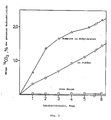
Tabelle 2 Lösungsmittel Reaktionsgeschwindigkeit umol|min|mg Enzym mit Wasser gesättigtes Ethylacetet 216 Toluol 104 Benzol 81 Ether 75 Isooctan 68 n-Hexan 62 Cyclohexan 48 Chloroform 15 Dichlorethan 8 Lösungsmittel + 3,5 Vol.-% Wasser: Acetonitril 116 Aceton 80 Ethanol 28 1,4-Dioxan 16 Tetrahydrofuran 11 Methanol 10 - Als Substrat wurde synthetisches Lignin aus Coniferylalkohol (DHP) verwendet, dessen -OCH₃-Gruppen mit radioaktivem ¹⁴C markiert waren. Radioaktivität von 1 mg = 615.570 dpm.
- Die Reaktion wurde in einem mit einem Gummideckel verschlossenen Erlenmeyerkolben durchgeführt, in dem sich ein von der Bodenflüssigkeit getrenntes Absorptionsgefäß befand, das mit 1 ml Natronlauge gefüllt war.
* DHP = synthetisches Lignin - In dem Erlenmeyerkolben wurden 1 mg DHP* in 10 ml Ethylacetat (mit Wasser gesättigt) mit 15 mg Enzym-Matrix-Komplex nach Beispiel 1 bei 25° vorsichtig geschüttelt. Die Natronlauge im Absorptionsgefäß wurde täglich gewechselt. Die Radioaktivität in den jeweiligen Natronlauge-Proben wurde bestimmt nach Haider und Trojanowski, Arch. Microbiol. 105, 33-41, 1975.
- Als Kontrolle wurden jeweils Messungen durchgeführt, in denen Ethylacetat durch Citratpuffer ersetzt worden war. Die Ergebnisse sind in der Figur 2 dargestellt. Ein weiterer Kontrollversuch wurde ohne aktives Enzym (mit Ethylacetat und DHP thermisch inaktiviert) durchgeführt.
Die Aktivität des Enzym-Matrix-Komplexes beträgt in organischen Lösungsmitteln mehr als das Doppelte des Wertes in Citratpuffer. - 150 mg Organosolv-Lignin wurden in 3 ml Dioxan, enthaltend 20 Vol.-% Wasser, gelöst, die Lösung zentrifugiert und der Überstand mit 15 mg des nach Beispiel 1 erhaltenen Enzym-Matrix-Komplexes versetzt. Das Gemisch wurde 3 tage bei 25° im Dunkeln geschüttelt. Dann wurde das gemisch zentrifugiert und die klare Lösung einer HPSEC-Chromatographie unterworfen, wie in Wat. Sci. Techn., Vol. 20, S. 161.170, 1988 beschrieben ist.
- Das Ergebnis ist in Fig. 3 dargestellt. Das Ausgangsprodukt hatte ein Molekulargewicht von ca. 7000. Das Molekulargewicht war nach 3tägigem Schütteln ohne Enzym nahezu unverändert. Nach der Enzymbehandlung erhöhte sich das Molekulargewicht auf ca. 240.000.
- Die Ergebnisse der Beispiele 4 und 5 zeigen, daß durch die Behandlung mit dem Enzym-Matrix-Komplex bei Lignin nicht reaktive -OCH₃-Gruppen in hochreaktive -OH-Gruppen umgesetzt werden und daß außerdem aus dem Lignin höhermolekulare Prepolymere erhalten werden können. Diese reaktiven Prepolymere eignen sich zum Einsatz in der Kunststoffherstellung. Sie haben gegenüber herkömmlichen Kunststoffen den Vorteil, biologisch abbaubar zu sein.
Claims (10)
Applications Claiming Priority (2)
| Application Number | Priority Date | Filing Date | Title |
|---|---|---|---|
| DE3827001 | 1988-08-09 | ||
| DE19883827001 DE3827001C1 (de) | 1988-08-09 | 1988-08-09 |
Publications (2)
| Publication Number | Publication Date |
|---|---|
| EP0354485A2 true EP0354485A2 (de) | 1990-02-14 |
| EP0354485A3 EP0354485A3 (de) | 1990-08-08 |
Family
ID=6360511
Family Applications (1)
| Application Number | Title | Priority Date | Filing Date |
|---|---|---|---|
| EP89114398A Ceased EP0354485A3 (de) | 1988-08-09 | 1989-08-03 | Verfahren zur Herstellung von polymeren Produkten von Lignin bzw. Ligninderivaten |
Country Status (2)
| Country | Link |
|---|---|
| EP (1) | EP0354485A3 (de) |
| DE (1) | DE3827001C1 (de) |
Cited By (1)
| Publication number | Priority date | Publication date | Assignee | Title |
|---|---|---|---|---|
| WO1994001488A1 (en) * | 1992-07-02 | 1994-01-20 | Novo Nordisk A/S | POLYMERIZATION OF LIGNIN AT ALKALINE pH |
Family Cites Families (2)
| Publication number | Priority date | Publication date | Assignee | Title |
|---|---|---|---|---|
| IT1141249B (it) * | 1980-02-28 | 1986-10-01 | Italfarmaco Spa | Procedimento per la preparazione di copolimeri di polisaccaridi supprotanti attivita' enzimatica,e copolimeri cosi' ottenuti |
| JP3646225B2 (ja) * | 1992-07-21 | 2005-05-11 | 日本農薬株式会社 | 芳香族エステル誘導体及びその中間体並びにそれらの製造方法 |
-
1988
- 1988-08-09 DE DE19883827001 patent/DE3827001C1/de not_active Expired
-
1989
- 1989-08-03 EP EP89114398A patent/EP0354485A3/de not_active Ceased
Non-Patent Citations (2)
| Title |
|---|
| APPLIED MICROBIOLOGY AND BIOTECHNOLOGY, Band 31, 1989, Seiten 70-74, Springer-Verlag; O. MILSTEIN et al.: "Oxidation of aromatic compounds in organic solvents with laccase from Trametes versicolor" * |
| CHEMICAL ABSTRACTS, Band 83, Nr. 21, 24. November 1975, Seite 239, Zusammenfassung Nr. 174760b, Columbus, Ohio, US; S.C. FROEHNER et al.: "Properties of the glycoprotein laccase immobilized by two methods", & ACTA CHEM. SCAND., SER. B 1975, B29(6), 691-4 * |
Cited By (2)
| Publication number | Priority date | Publication date | Assignee | Title |
|---|---|---|---|---|
| WO1994001488A1 (en) * | 1992-07-02 | 1994-01-20 | Novo Nordisk A/S | POLYMERIZATION OF LIGNIN AT ALKALINE pH |
| US5665573A (en) * | 1992-07-02 | 1997-09-09 | Novo Nordisk A/S | Polymerization of lignin at alkaline pH |
Also Published As
| Publication number | Publication date |
|---|---|
| EP0354485A3 (de) | 1990-08-08 |
| DE3827001C1 (de) | 1989-12-28 |
Similar Documents
| Publication | Publication Date | Title |
|---|---|---|
| DE2413220C3 (de) | Selektiv adsorbierende Partikel und deren Verwendung zum Trennen von organischen Verbindungen | |
| DE19642882B4 (de) | Verfahren zur Herstellung eines ultradünnen Filmreaktors mit immobilisiertem Protein und Verfahren zur chemischen Reaktion unter Verwendung des ultradünnen Filmreaktors mit immobilisiertem Protein | |
| EP0521970B1 (de) | Wasserunlösliche cyclodextrin-polymerisate und verfahren zu deren herstellung | |
| EP0098947A1 (de) | Polymere Mono-, Di-, Tri- und Tetrasulfidverbindungen, Verfahren zu ihrer Herstellung und Verwendung | |
| DE69822934T2 (de) | Chirale Trennung von pharmazeutischen Verbindungen mit geladenen Cyclodextrinen durch Kapillarelektrophorese | |
| DE2717965C2 (de) | Verfahren zur Herstellung von porösen Zelluloseperlen | |
| DE2646879A1 (de) | Matrix aus einem in wasser unloeslichen beta-1,3-glucangel und verfahren zu ihrer herstellung | |
| DE1944418A1 (de) | Stabilisiertes Enzympraeparat und Verfahren zu seiner Herstellung | |
| DE69126939T2 (de) | Verfahren zur Herstellung eines Phenolharzes durch Verwendung von Sojaperoxidase | |
| EP0097898A2 (de) | Makroporöse, hydrophile Träger für Enzyme | |
| DE2948869C2 (de) | ||
| EP1402008B1 (de) | Verfahren zur aufreinigung eines enzyms und hiernach hergestelltes, aufgereinigtes enzym sowie verwendung des enzyms | |
| DE2915135A1 (de) | Verfahren zur herstellung von immobilisierten enzymprodukten, die dabei erhaltenen produkte und deren verwendung | |
| DE2005408B2 (de) | Verfahren zur Herstellung von Ionenaustauschern und danach hergestellte Ionenaustauscher | |
| DE2229298C3 (de) | In wäßrigen Medien unlösliches Produkt mit enzymatischer Aktivität sowie Verfahren zu seiner Herstellung | |
| DE4009840A1 (de) | Cyclodextrin-polymerisate und verfahren zu deren herstellung | |
| EP0323494B1 (de) | Lecithingele | |
| DE4429018A1 (de) | Verfahren zur Herstellung eines Enzyme immobilisierenden Trägers und immobilisierte Enzyme | |
| DE3827001C1 (de) | ||
| EP0277359A1 (de) | Klebstoffmischung | |
| DE3886484T2 (de) | Heterogen vielfältig verzweigte Cyclodextrine und Verfahren zu deren Herstellung. | |
| DE2534412A1 (de) | Immobilisierte glycoenzyme, verfahren zu ihrer herstellung und ihre verwendung | |
| DE2707024A1 (de) | Verfahren zum fixieren eines proteins auf einem traeger | |
| DE2646269A1 (de) | Stabilisierte s-adenosyl-l-methionin- zubereitung und verfahren zur herstellung derselben | |
| DE102012108345A1 (de) | Verfahren zur Herstellung eines Polyglycerin-Nanogels zur Verkapselung und Freisetzung biologisch aktiver Substanzen |
Legal Events
| Date | Code | Title | Description |
|---|---|---|---|
| PUAI | Public reference made under article 153(3) epc to a published international application that has entered the european phase |
Free format text: ORIGINAL CODE: 0009012 |
|
| AK | Designated contracting states |
Kind code of ref document: A2 Designated state(s): AT BE CH DE ES FR GB GR IT LI LU NL SE |
|
| PUAL | Search report despatched |
Free format text: ORIGINAL CODE: 0009013 |
|
| RHK1 | Main classification (correction) |
Ipc: C12N 11/04 |
|
| AK | Designated contracting states |
Kind code of ref document: A3 Designated state(s): AT BE CH DE ES FR GB GR IT LI LU NL SE |
|
| 17P | Request for examination filed |
Effective date: 19910207 |
|
| RBV | Designated contracting states (corrected) |
Designated state(s): AT BE CH FR GB IT LI NL SE |
|
| REG | Reference to a national code |
Ref country code: DE Ref legal event code: 8566 |
|
| 17Q | First examination report despatched |
Effective date: 19930215 |
|
| STAA | Information on the status of an ep patent application or granted ep patent |
Free format text: STATUS: THE APPLICATION HAS BEEN REFUSED |
|
| 18R | Application refused |
Effective date: 19940918 |