EP0354618A2 - Appareil d'analyse chimique - Google Patents
Appareil d'analyse chimique Download PDFInfo
- Publication number
- EP0354618A2 EP0354618A2 EP89202036A EP89202036A EP0354618A2 EP 0354618 A2 EP0354618 A2 EP 0354618A2 EP 89202036 A EP89202036 A EP 89202036A EP 89202036 A EP89202036 A EP 89202036A EP 0354618 A2 EP0354618 A2 EP 0354618A2
- Authority
- EP
- European Patent Office
- Prior art keywords
- matrix
- values
- substances
- concentration
- carrier substance
- Prior art date
- Legal status (The legal status is an assumption and is not a legal conclusion. Google has not performed a legal analysis and makes no representation as to the accuracy of the status listed.)
- Withdrawn
Links
- 239000000126 substance Substances 0.000 title claims abstract description 135
- 238000004458 analytical method Methods 0.000 title claims abstract description 17
- 239000011159 matrix material Substances 0.000 claims abstract description 86
- 230000003595 spectral effect Effects 0.000 claims abstract description 53
- 238000005259 measurement Methods 0.000 claims abstract description 34
- 238000011156 evaluation Methods 0.000 claims abstract description 19
- 238000000354 decomposition reaction Methods 0.000 claims abstract description 12
- 239000007788 liquid Substances 0.000 claims abstract description 9
- 239000013598 vector Substances 0.000 claims description 22
- 238000004364 calculation method Methods 0.000 claims description 8
- 238000004811 liquid chromatography Methods 0.000 claims description 5
- 230000002123 temporal effect Effects 0.000 claims description 3
- 230000006870 function Effects 0.000 claims description 2
- 238000001228 spectrum Methods 0.000 description 12
- 238000012886 linear function Methods 0.000 description 5
- 239000000203 mixture Substances 0.000 description 4
- 238000000926 separation method Methods 0.000 description 4
- 239000002245 particle Substances 0.000 description 3
- 239000010453 quartz Substances 0.000 description 3
- VYPSYNLAJGMNEJ-UHFFFAOYSA-N silicon dioxide Inorganic materials O=[Si]=O VYPSYNLAJGMNEJ-UHFFFAOYSA-N 0.000 description 3
- 238000004128 high performance liquid chromatography Methods 0.000 description 2
- 230000003993 interaction Effects 0.000 description 2
- 230000031700 light absorption Effects 0.000 description 2
- 239000000463 material Substances 0.000 description 2
- 230000009466 transformation Effects 0.000 description 2
- NAWXUBYGYWOOIX-SFHVURJKSA-N (2s)-2-[[4-[2-(2,4-diaminoquinazolin-6-yl)ethyl]benzoyl]amino]-4-methylidenepentanedioic acid Chemical compound C1=CC2=NC(N)=NC(N)=C2C=C1CCC1=CC=C(C(=O)N[C@@H](CC(=C)C(O)=O)C(O)=O)C=C1 NAWXUBYGYWOOIX-SFHVURJKSA-N 0.000 description 1
- 230000008859 change Effects 0.000 description 1
- 238000000034 method Methods 0.000 description 1
- 238000010606 normalization Methods 0.000 description 1
- 230000008569 process Effects 0.000 description 1
- 239000002904 solvent Substances 0.000 description 1
Images
Classifications
-
- G—PHYSICS
- G01—MEASURING; TESTING
- G01N—INVESTIGATING OR ANALYSING MATERIALS BY DETERMINING THEIR CHEMICAL OR PHYSICAL PROPERTIES
- G01N30/00—Investigating or analysing materials by separation into components using adsorption, absorption or similar phenomena or using ion-exchange, e.g. chromatography or field flow fractionation
- G01N30/02—Column chromatography
- G01N30/86—Signal analysis
- G01N30/8603—Signal analysis with integration or differentiation
-
- G—PHYSICS
- G01—MEASURING; TESTING
- G01N—INVESTIGATING OR ANALYSING MATERIALS BY DETERMINING THEIR CHEMICAL OR PHYSICAL PROPERTIES
- G01N21/00—Investigating or analysing materials by the use of optical means, i.e. using sub-millimetre waves, infrared, visible or ultraviolet light
- G01N21/17—Systems in which incident light is modified in accordance with the properties of the material investigated
- G01N21/25—Colour; Spectral properties, i.e. comparison of effect of material on the light at two or more different wavelengths or wavelength bands
- G01N21/31—Investigating relative effect of material at wavelengths characteristic of specific elements or molecules, e.g. atomic absorption spectrometry
-
- G—PHYSICS
- G01—MEASURING; TESTING
- G01N—INVESTIGATING OR ANALYSING MATERIALS BY DETERMINING THEIR CHEMICAL OR PHYSICAL PROPERTIES
- G01N30/00—Investigating or analysing materials by separation into components using adsorption, absorption or similar phenomena or using ion-exchange, e.g. chromatography or field flow fractionation
- G01N30/02—Column chromatography
- G01N30/86—Signal analysis
- G01N30/8603—Signal analysis with integration or differentiation
- G01N2030/862—Other mathematical operations for data preprocessing
-
- G—PHYSICS
- G01—MEASURING; TESTING
- G01N—INVESTIGATING OR ANALYSING MATERIALS BY DETERMINING THEIR CHEMICAL OR PHYSICAL PROPERTIES
- G01N2201/00—Features of devices classified in G01N21/00
- G01N2201/12—Circuits of general importance; Signal processing
- G01N2201/129—Using chemometrical methods
-
- G—PHYSICS
- G01—MEASURING; TESTING
- G01N—INVESTIGATING OR ANALYSING MATERIALS BY DETERMINING THEIR CHEMICAL OR PHYSICAL PROPERTIES
- G01N30/00—Investigating or analysing materials by separation into components using adsorption, absorption or similar phenomena or using ion-exchange, e.g. chromatography or field flow fractionation
- G01N30/02—Column chromatography
- G01N30/62—Detectors specially adapted therefor
- G01N30/74—Optical detectors
Definitions
- the invention relates to a chemical analysis device for determining the concentration values and the spectral values of temporally separated substances of a sample in a liquid or gaseous carrier substance with a detector arrangement which has at least one light source for transmitting light onto the temporally separated substances of the sample and the carrier substance and which contains a receiver arrangement for measuring the intensity of the light influenced by the substances over a predetermined spectral range and over a predetermined duration, and with an evaluation unit which summarizes the spectral values of each measurement determined by the detector arrangement in a data matrix X and which determines the concentration values of a substance after a singular value decomposition of the data matrix X by estimation.
- Such chemical analysis devices are, for example, a gas chromatograph, a liquid chromatograph or an infrared spectrometer.
- the liquid or gaseous substances of the sample located in a liquid or gaseous carrier substance are separated in time in a separation arrangement.
- the separation is carried out in a chromatographic column which is filled with quartz particles.
- the sample is injected into the carrier substance, which is pumped through this column, which remains in the column for some time due to interaction with the surface of the column material (quartz particles).
- the sample substances appear in time successively in variable concentrations at the exit of the separation arrangement.
- concentration profile chromatogram
- the carrier substance with sample components emerging from the separation arrangement is passed through a detector arrangement.
- the detector arrangement light from a light source is radiated onto the substances present in the sample and the carrier substance.
- the absorption of light at different wavelengths is measured by a number (for example 128) of photodiodes (receiver arrangement).
- a measurement of the spectrum (measurement of the intensity of the absorbed light) of the substances passing through the detector arrangement is carried out in equidistant periods, for example every second.
- the total measurement generally takes between 3 and 30 minutes, ie between 180 and 2400 measurements of the spectrum are carried out.
- the measured spectral values are delivered from the detector arrangement to an evaluation unit.
- the evaluation unit determines the spectrum and the concentration curve of each substance of the sample from the measured values, such as that from the publication BGM Vandeginste, W. Derks, G. Kateman, MULTICOMPONENT SELF-MODELING CURVE RESOLUTION IN HIGH-PERFORMANCE LIQUID CHROMATOGRAPHY BY ITERATIVE TARGET TRANSFORMATION ANALYSIS Analytica Chimica Acta, 173 (1985), pages 253-264.
- the evaluation unit summarizes the spectral values measured by the detector arrangement in an (M * L) data matrix X (M rows, L columns): the spectral values (L wavelengths) from one measurement and the spectral values of a wavelength from M measurements are accommodated in one row.
- the spectral values of a measurement are sorted in succession according to their temporal occurrence.
- the data matrix X largely corresponds to the product of a concentration matrix C ′ and a spectral matrix S ′:
- concentration values of a substance for the M measurements are listed in a column.
- concentration values of a column form a chromatogram of a substance.
- the number of chromatograms or columns is equal to the number of N substances.
- S ′ the L spectral values of a substance for L wavelengths are listed in one line. The spectral values of a line thus form a spectrum of a substance.
- the number of spectra or rows is equal to the number of N substances.
- the spectral matrix S 'or concentration matrix C ' is often standardized using a Euclidean norm. This only results in changed scale units.
- the spectral values and the concentration values can only be approximated. In practice, however, it has been shown that the error between the actual and the approximated spectral or concentration values is very small.
- the data matrix X can thus be approximated by an approximate spectral matrix S and a concentration matrix C : X ⁇ C S (3).
- the data matrix X in which the measured values are combined, contains redundancies. It therefore consists of information components from which the spectral or concentration values of the substances can be calculated and noise components. With the help of the singular value decomposition, the matrix is separated into information components and noise components.
- the columns of the (M * L) matrix U are the L orthonormal eigenvectors of X X T
- the columns of the (L * L) matrix V are the L orthonormal eigenvectors of X T X
- the noise components are separated by reducing the matrices U , V and G to the significant columns.
- the number of columns corresponds to the number of N substances.
- the singular values of the diagonal matrix are rearranged so that: g1 ⁇ g2 ⁇ ... ⁇ g i ⁇ ... ⁇ g L (6).
- the coefficients d jk of the formula (9) are determined by an estimate.
- an estimated value d jk is determined using the equation: determined, the values u jk being assigned to a column vector u k .
- estimates of a concentration vector c j are inserted into equation (14).
- Such a first estimated concentration vector contains only one delta pulse, the position of which is determined by a line search or Varimax rotation (for more information, see the publication BGM Vandeginste, W.
- the measured spectral values of the data matrix X are also influenced by the carrier substance.
- This information relating to the carrier substance is of no interest for the chemical analysis of the sample substance.
- a pre-spectra measurement of the carrier substance without a sample has previously been carried out before the measurement with the sample.
- a carrier substance data matrix is formed from M identical spectra from a measurement of the spectrum, which is then subtracted from the data matrix X.
- the matrix obtained after the subtraction is used to determine the concentration values as described above.
- the spectral values of the individual sample substances are then determined from the formulas (13) and (11) after determining the concentration vectors.
- the determination of the concentration values and the spectral values of sample substances which has been carried out to date is time-consuming, since a measurement is carried out with the carrier substance before the actual measurement.
- the calculated spectral values and concentration values of the individual substances may have errors if changes in the measuring apparatus, e.g. Change in the light intensity of the light source compared to the pre-measurement.
- the invention is therefore based on the object of providing a chemical analysis device in which it is not necessary to pre-measure the spectrum of the carrier substance in order to determine the concentration values and spectral values of the sample substances.
- the object is achieved in that the evaluation circuit also determines the concentration values of the carrier substance by means of approximation by means of a linear course over time and calculates the spectral values of the substances of the sample and the carrier substance therefrom.
- the evaluation unit performs a singular value decomposition and then determines the concentration values of the sample substances by means of an estimate.
- concentration values of the carrier substance are determined by means of an approximation by means of a linear course over time.
- the carrier substance usually consists of various individual substances. If the composition of the individual substances is kept constant during the measurement, the same concentration value for the carrier substance always results during the measurement. If the composition of the carrier substance is constant over time, there is a constant concentration curve. A variation of the individual substances during the measurement results in a largely linear increase or decrease in the concentration curve of the carrier substance.
- the concentration vector which contains the concentration values of the carrier substance, is formed from a linear combination of a column vector which belongs to a matrix formed by singular value decomposition (see formula (9)).
- This linear combination is set equal to a linear function representing the concentration curve.
- the unknowns of the overdetermined System of equations are approximated by an approximation. Inserting the two unknowns into the linear function gives the concentration vector (concentration curve) of the carrier substance.
- the linear course can only be approximated because the measurements do not take place under ideal conditions.
- the evaluation unit determines the spectral values of the substances. Since the concentration values and the spectral values of the carrier substances are determined from an approximation from the measured values, no pre-measurement as in the prior art is necessary. As a result, the measuring time is reduced. In addition, it is also possible to carry out a chemical analysis with time-varying solvent compositions
- the system of equations forms an overdetermined system of equations, which is known from a compensation calculation, such as that from the book by Josef Stoer "Introduction to Numerical Mathematics I", 2nd edition, Springer Verlag, Berlin Heidelberg New York, 1976, pages 165 to 175 , can be solved.
- A11e vectors c j and c b form a matrix C.
- the chemical analysis device can advantageously be used for liquid chromatography. It is provided that a chromatographic column is arranged in front of the detector arrangement, in which the carrier substance with the substances of the sample can be separated in time, and that a number of photodiodes are provided in the detector arrangement as receiver arrangement, which absorb the intensity of the substances that can be separated Measure light at different wavelengths.
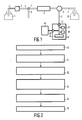
- the chemical analysis device for liquid chromatography shown schematically in FIG. 1 has a container 1 in which a liquid carrier substance is stored.
- a line 2 which is connected to a pump 3, projects into the liquid carrier substance consisting of several individual substances.
- the pump 3 conveys the carrier substance via the line 2 from the container 1 into a line 4 which runs to a chromatographic column 5.
- the pump ensures a constant flow of the carrier substance through the chromatographic column 5.
- the line 4 has a branch 6 into which the sample substances are entered via a valve 7, the concentrations and spectra of which are to be determined.
- the carrier substance with the sample components emerging from the chromatographic column 5 is passed through a detector arrangement 8.
- the detector arrangement contains a light source which emits ultraviolet light onto the substances and whose light absorption is measured by a receiver arrangement.
- the receiver arrangement consists of a number of photodiodes (e.g. 128) which measure the light at different wavelengths.
- the measured substances are passed into a collecting container 10 via a drain 9.
- the detector arrangement 8 carries out a measurement of the substances passing through it in equidistant time intervals, for example every second. A total measurement usually takes between 3 and 30 minutes, ie between 180 and 2400 measurements of the spectrum are made.
- the data are fed to an evaluation unit 12 via electrical lines 11.
- the evaluation unit 12 contains a central processing unit 14, for example a microprocessor, at least one read / write memory 15 (RAM), at least one read-only memory 16 (ROM), an input module 17 and an output module 18. After each measurement, the measured spectral values are transmitted via line 11 , read the input module 17 into the read / write memory 15.
- the evaluation unit 12 calculates the concentration values and the spectral values of the individual sample substances and the carrier substance from the measured spectral values. The results are sent to a display unit 19 via an output module 18.
- FIG. 2 shows a flow chart with which the individual program steps are explained, which the evaluation unit 12 carries out to determine the concentration values and the spectral values of the sample substances and the carrier substance.
- the data stored in the read / write memory 15 are combined in a data matrix X , as shown by the formula (1) (block 20).
- the singular value decomposition (block 31) of the data matrix X is then carried out, as described by the formula (5).
- the smaller g i in terms of amount are caused by noise components that generally do not exceed a certain amount.
- This amount serves as a threshold with which the individual g i are compared.
- the singular value which is just larger than the threshold value, is called g N.
- the matrix G is then reduced by the (N + 1) th to L th column and row, so that the singular values g N + 1 , ..., g L fall out.
- the matrices U and V are reduced by the (N + 1) th to L th column.
- the matrices thus obtained are designated U N and V N (see formula (7)).
- the coefficients d jk are then determined by estimation (block 33), as described above (see formulas (9) and (14)). With the determination of the coefficients d jk , the concentration vectors c j for the sample substances are calculated.
- the concentration values for the vehicle are calculated.
- the generally over-determined system of equations is solved by a compensation calculation, as is known, for example, from the book by Josef Stoer "Introduction to Numerical Mathematics I", 2nd edition, Springer Verlag, Berlin Heidelberg New York, 1976 from page 175
- the concentration vector c b of the carrier is calculated.
- the matrix T is calculated using equation (20) and then determines the spectral matrix S by calculating equation (21) (block 35). After determining the spectral values and the concentration values of the sample substances and the carrier substance, the identification of the individual sample substances can be carried out.
Landscapes
- Physics & Mathematics (AREA)
- General Physics & Mathematics (AREA)
- Chemical & Material Sciences (AREA)
- Immunology (AREA)
- Health & Medical Sciences (AREA)
- Analytical Chemistry (AREA)
- Biochemistry (AREA)
- General Health & Medical Sciences (AREA)
- Spectroscopy & Molecular Physics (AREA)
- Life Sciences & Earth Sciences (AREA)
- Pathology (AREA)
- Algebra (AREA)
- Mathematical Analysis (AREA)
- Mathematical Optimization (AREA)
- Pure & Applied Mathematics (AREA)
- Investigating Or Analysing Materials By Optical Means (AREA)
Applications Claiming Priority (2)
| Application Number | Priority Date | Filing Date | Title |
|---|---|---|---|
| DE3827066 | 1988-08-10 | ||
| DE19883827066 DE3827066A1 (de) | 1988-08-10 | 1988-08-10 | Chemisches analysegeraet |
Publications (2)
| Publication Number | Publication Date |
|---|---|
| EP0354618A2 true EP0354618A2 (fr) | 1990-02-14 |
| EP0354618A3 EP0354618A3 (fr) | 1991-05-15 |
Family
ID=6360546
Family Applications (1)
| Application Number | Title | Priority Date | Filing Date |
|---|---|---|---|
| EP19890202036 Withdrawn EP0354618A3 (fr) | 1988-08-10 | 1989-08-04 | Appareil d'analyse chimique |
Country Status (3)
| Country | Link |
|---|---|
| EP (1) | EP0354618A3 (fr) |
| JP (1) | JPH0282159A (fr) |
| DE (1) | DE3827066A1 (fr) |
Cited By (1)
| Publication number | Priority date | Publication date | Assignee | Title |
|---|---|---|---|---|
| EP0643289A1 (fr) * | 1993-09-15 | 1995-03-15 | Philips Patentverwaltung GmbH | Procédé d'inspection pour évaluer des spectres dépendant de la localisation |
Families Citing this family (2)
| Publication number | Priority date | Publication date | Assignee | Title |
|---|---|---|---|---|
| DE19808213A1 (de) * | 1998-02-27 | 1999-09-30 | Flow Comp Systemtechnik Gmbh | Verfahren zur Messung der Gasbeschaffenheit und Gasbeschaffenheitsmeßgerät |
| JP6849388B2 (ja) * | 2015-10-26 | 2021-03-24 | エーザイ・アール・アンド・ディー・マネジメント株式会社 | 特異値解析法を用いた電子ノイズ除去法 |
Family Cites Families (3)
| Publication number | Priority date | Publication date | Assignee | Title |
|---|---|---|---|---|
| US3555260A (en) * | 1968-03-04 | 1971-01-12 | Perkin Elmer Corp | Chromatogram analyzer |
| DE3323744A1 (de) * | 1983-07-01 | 1985-01-17 | Bodenseewerk Perkin-Elmer & Co GmbH, 7770 Überlingen | Einrichtung zur kompensation der basisliniendrift einer chromatographischen trennsaeule |
| US4802102A (en) * | 1987-07-15 | 1989-01-31 | Hewlett-Packard Company | Baseline correction for chromatography |
-
1988
- 1988-08-10 DE DE19883827066 patent/DE3827066A1/de not_active Withdrawn
-
1989
- 1989-08-04 EP EP19890202036 patent/EP0354618A3/fr not_active Withdrawn
- 1989-08-08 JP JP20398389A patent/JPH0282159A/ja active Pending
Cited By (2)
| Publication number | Priority date | Publication date | Assignee | Title |
|---|---|---|---|---|
| EP0643289A1 (fr) * | 1993-09-15 | 1995-03-15 | Philips Patentverwaltung GmbH | Procédé d'inspection pour évaluer des spectres dépendant de la localisation |
| US5812630A (en) * | 1993-09-15 | 1998-09-22 | U.S. Philips Corporation | Examination method for the evaluation of location-dependent spectra |
Also Published As
| Publication number | Publication date |
|---|---|
| JPH0282159A (ja) | 1990-03-22 |
| EP0354618A3 (fr) | 1991-05-15 |
| DE3827066A1 (de) | 1990-02-15 |
Similar Documents
| Publication | Publication Date | Title |
|---|---|---|
| DE69224028T2 (de) | Verfahren zur Durchflussmessung. | |
| DE69128357T2 (de) | Verfahren um eigenschaften und/oder zusammensetzungsdaten einer probe zu bestimmen | |
| DE4317246C2 (de) | Verfahren zum Entfalten eines Massenspektrums | |
| DE69027233T2 (de) | Verfahren und Vorrichtung zur Signalbehandlung | |
| EP0076356B1 (fr) | Procédé et dispositif pour la mesure de la concentration d'un composant absorbant un rayonnement infrarouge, proche infrarouge, visible ou ultraviolet dans un mélange | |
| EP1193488B1 (fr) | Procede et dispositif pour determiner la nature de gaz naturel | |
| DE3642922C2 (de) | Fotoelektrische Farbmeßeinrichtung | |
| EP0174496B1 (fr) | Méthode pour déterminer la longueur d'onde et la puissance de rayonnement de sources de lumière monochromatique avec correction de l'influence de la longueur d'onde et dispositif pour réaliser ce procédé | |
| EP0643289B1 (fr) | Procédé d'inspection pour évaluer des spectres dépendant de la localisation | |
| EP0420108B1 (fr) | Pyromètre à plusieurs longueurs d'onde | |
| EP0130574A1 (fr) | Dispositif pour compenser la dérive de la ligne de base d'une colonne chromatographique | |
| EP0415151A1 (fr) | Procédé pour la détermination de concentration au moyen de spectroscopie d'émission | |
| DE4111187C2 (de) | Verfahren zur Messung des optischen Absorptionsvermögens von Proben unter Eliminierung des Anzeigefehlers hinsichtlich gas-physikalischer Eigenschaften und Vorrichtung zur Durchführung des Verfahrens | |
| DE3713643C2 (de) | Verfahren zum Bestimmen der Zeitkonstanten von Meßgrößenaufnehmern und Vorrichtung zum Durchführung des Verfahrens | |
| DE3827066A1 (de) | Chemisches analysegeraet | |
| EP0952441A1 (fr) | Procédé et dispositif pour déterminer la fluorescence induite par le soleil | |
| DE3444768C2 (fr) | ||
| DE19810917A1 (de) | Automatisches Kalibrationsverfahren | |
| EP0076886A1 (fr) | Procédé et dispositif pour la mesure du rapport des concentrations de 2 composants absorbant l'infrarouge, le proche infrarouge, le visible ou l'ultraviolet dans un mélange | |
| DE10140945B4 (de) | Verfahren zur Konzentrationsmessung mehrerer Gaskomponenten in einer Gasprobe | |
| DE2919517C2 (fr) | ||
| DE69024301T2 (de) | Gerät zur Analysierung von vorübergehender Wellenform | |
| EP0020877B1 (fr) | Circuit d'évaluation des signaux pour appareil de mesure d'extinction | |
| DE2738574A1 (de) | Densitometer | |
| DE69425691T2 (de) | Hochleistungsflüssigkeitschromatographiegerät mit Kontrollvorrichtung und Verfahren zur Kontrolle des Betriebs dieses Chromatographiegerätes |
Legal Events
| Date | Code | Title | Description |
|---|---|---|---|
| PUAI | Public reference made under article 153(3) epc to a published international application that has entered the european phase |
Free format text: ORIGINAL CODE: 0009012 |
|
| AK | Designated contracting states |
Kind code of ref document: A2 Designated state(s): DE FR GB |
|
| PUAL | Search report despatched |
Free format text: ORIGINAL CODE: 0009013 |
|
| AK | Designated contracting states |
Kind code of ref document: A3 Designated state(s): DE FR GB |
|
| 17P | Request for examination filed |
Effective date: 19911111 |
|
| STAA | Information on the status of an ep patent application or granted ep patent |
Free format text: STATUS: THE APPLICATION HAS BEEN WITHDRAWN |
|
| 18W | Application withdrawn |
Withdrawal date: 19920124 |