EP0354639A2 - Schneidgerät für nichtkreisförmige Querschnitte - Google Patents
Schneidgerät für nichtkreisförmige Querschnitte Download PDFInfo
- Publication number
- EP0354639A2 EP0354639A2 EP89304112A EP89304112A EP0354639A2 EP 0354639 A2 EP0354639 A2 EP 0354639A2 EP 89304112 A EP89304112 A EP 89304112A EP 89304112 A EP89304112 A EP 89304112A EP 0354639 A2 EP0354639 A2 EP 0354639A2
- Authority
- EP
- European Patent Office
- Prior art keywords
- central shaft
- electromagnets
- tool
- movable plate
- shaft
- Prior art date
- Legal status (The legal status is an assumption and is not a legal conclusion. Google has not performed a legal analysis and makes no representation as to the accuracy of the status listed.)
- Granted
Links
Images





Classifications
-
- B—PERFORMING OPERATIONS; TRANSPORTING
- B23—MACHINE TOOLS; METAL-WORKING NOT OTHERWISE PROVIDED FOR
- B23B—TURNING; BORING
- B23B5/00—Turning-machines or devices specially adapted for particular work; Accessories specially adapted therefor
-
- G—PHYSICS
- G05—CONTROLLING; REGULATING
- G05B—CONTROL OR REGULATING SYSTEMS IN GENERAL; FUNCTIONAL ELEMENTS OF SUCH SYSTEMS; MONITORING OR TESTING ARRANGEMENTS FOR SUCH SYSTEMS OR ELEMENTS
- G05B19/00—Program-control systems
- G05B19/02—Program-control systems electric
- G05B19/18—Numerical control [NC], i.e. automatically operating machines, in particular machine tools, e.g. in a manufacturing environment, so as to execute positioning, movement or co-ordinated operations by means of program data in numerical form
- G05B19/182—Numerical control [NC], i.e. automatically operating machines, in particular machine tools, e.g. in a manufacturing environment, so as to execute positioning, movement or co-ordinated operations by means of program data in numerical form characterised by the machine tool function, e.g. thread cutting, cam making, tool direction control
- G05B19/184—Generation of cam-like surfaces
-
- Y—GENERAL TAGGING OF NEW TECHNOLOGICAL DEVELOPMENTS; GENERAL TAGGING OF CROSS-SECTIONAL TECHNOLOGIES SPANNING OVER SEVERAL SECTIONS OF THE IPC; TECHNICAL SUBJECTS COVERED BY FORMER USPC CROSS-REFERENCE ART COLLECTIONS [XRACs] AND DIGESTS
- Y10—TECHNICAL SUBJECTS COVERED BY FORMER USPC
- Y10T—TECHNICAL SUBJECTS COVERED BY FORMER US CLASSIFICATION
- Y10T82/00—Turning
- Y10T82/13—Pattern section
-
- Y—GENERAL TAGGING OF NEW TECHNOLOGICAL DEVELOPMENTS; GENERAL TAGGING OF CROSS-SECTIONAL TECHNOLOGIES SPANNING OVER SEVERAL SECTIONS OF THE IPC; TECHNICAL SUBJECTS COVERED BY FORMER USPC CROSS-REFERENCE ART COLLECTIONS [XRACs] AND DIGESTS
- Y10—TECHNICAL SUBJECTS COVERED BY FORMER USPC
- Y10T—TECHNICAL SUBJECTS COVERED BY FORMER US CLASSIFICATION
- Y10T82/00—Turning
- Y10T82/25—Lathe
- Y10T82/2531—Carriage feed
- Y10T82/2541—Slide rest
Definitions
- the present invention relates to a cutting apparatus for a noncircular cross section for machining a workpiece having a noncircular cross section such as a piston for an internal combustion engine, an outer circumferential surface of which has a noncircular cross section.
- profiling machining process in order to work a workpiece having a noncircular cross section, a profiling machining process using a master cam has often been utilized.
- profiling machining process has several disadvantages, for example, it is necessary to use the master cam, the manufacture of which requires much time and cost. Further, the configuration of the master cam which can be formed is restricted to a certain allowable extent because of its peculiar problem of making the master cam, and therefore it is impossible to form the workpiece to an optional configuration.
- the servo-motor is frequently changed or reversed in its rotational direction, and thus the response characteristic of the servo-motor can not be improved because of various factors such as inertia of the motor, elastic deformations of a ball screw and of a feed table.
- the workpiece can be rotated at a high speed to be subject to a high speed cutting operation; the cycle-time of the machine can be substantially decreased; any configuration of the workpiece can be machined: the change of the configuration of the workpiece can easily be accommodated by said apparatus; and high accuracy of working can be maintained for a long time.
- a cutting apparatus for a noncircular cross section characterized in that said apparatus is provided with a tool advancing and retreating means, said means comprising:
- the rotation of the main shaft to which a workpiece is attached causes said rotating angle detecting means to synchronously rotate, said rotating angle detecting means detecting a rotation number and a rotating angle of said main shaft.
- an electric current passing through said electromagnets is controlled by way of said control means correspondingly to said rotation number and rotating angle. While this control of said electric current causes an attracting force exerted on said movable plate by means of said electromagnets to be controlled, said movable plate and said central shaft fixed thereto are longitudinally displaced.
- This displaced condition is detected by means of said displacement sensor and said speed sensor which generate respective output signals, on the basis of which a feed-back control is performed while the tool attached onto the central shaft is advanced to or retreated from the workpiece, as a result of which the workpiece can be cut or machined to be provided with the noncircular cross section.
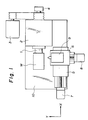
- a reference numeral 1 denotes a main shaft provided with a workpiece holder means
- 2 denotes a headstock
- 3 denotes a servo-motor for rotating the main shaft
- 4 denotes a rotation angle detecting means
- 5 denotes a feed table to be adapted to move in a directions parallel to the main shaft
- 6 denotes a feed table to be adapted to move in a direction perpendicular to the main shaft
- 7 denotes a servo-motor for driving the feed table 5
- 8 denotes a servo-motor for driving the feed table 6
- 9 denotes a tool advancing and retreating means mounted on the feed table 6
- 10 denotes a bed
- 11 denotes a mount
- 12 denotes a movable plate
- 13a, 13a and 13b, 13b denote electromagnets opposite to each other so that the movable plate is interposed between said electromagnets with a predetermined clearance therebetween
- the feed table 5 is slidably mounted on the bed 10 so that the feed table 5 can slide in a direction parallel to the main shaft 1 (i.e. X axial direction), that is, the feed table 5 is adapted to be controllably fed by means of a screw feeder mechanism to be driven by servo-motor 7. Further, another feed table 6 is mounted to slide on said feed table 5 so that the feed table 6 can slide in a direction perpendicular to said X axial direction (i.e. Y axial direction), that is, the feed table 6 is adapted to be controllably fed by means of another screw feeder mechanism to be driven by another servo-motor 8.
- the tool advancing and retreating means 9 is mounted on the feed table 6 in order to advance or retreat tool 18 in Y axial direction (i.e. a radial direction of workpiece W).
- Fig. 2 is a plan view and Fig.3 is a side view.
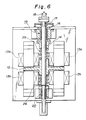
- the electromagnets 13a, 13a and 13b, 13b (for example four pieces) opposite to each other are attached to the mount 11, between which the movable plate 12 is interposed with a predetermined clearance therebetween.
- the movable plate 12 is securely attached to the central shaft 14.
- the central shaft 14 is axially movably but nonrotatably journaled with the ball spline 19 at one end near the tool 18 to be attached to the central shaft 14, and is axially movably journaled with the linear bush 20 at the other end of the central shaft 14.
- An electric current passing through the electromagnets 13a, 13a or 13b, 13b causes the movable plate 12 to be attracted towards the electromagnets 13a, 13a or 13b, 13b through which the electric current passes, and at the same time, the central shaft 14 is longitudinally moved together with the movable plate 12.
- the tool 18 is attached to the one end of the central shaft 14, and is adapted to move back and forth in a direction perpendicular to a rotating shaft, i.e. the main shaft 1 on which the workpiece W is secured, whereby the workpiece W can be machined so that its cross section perpendicular to the axis of the main shaft 1 has a desired noncircular configuration.
- the passing of an electric current through said electromagnets 13a, 13a or 13b, 13b is adapted to be effected by means of a control means (not shown) on the basis of an output signal from the means 4 for detecting a rotating angle of the main shaft 1 and synchronously with the rotation of the main shaft 1, so that the tool 18 can be advanced or retreated a small distance in a direction perpendicular to the main shaft 1 at a predetermined angular position during one rotation of the workpiece.
- the workpiece W can be machined so as to have a noncircular cross section perpendicular to the axis of the main shaft 1.
- a displacement measuring plate 15 is secured, the amount of displacement of which is adapted to be detected by the displacement sensor 16 attached to the supporting base 21.
- a speed sensor 17 is attached, which is adapted to detect a displacement speed of the movable plate 14.
- the values measured respectively by the displacement sensor 16 and the speed sensor 17 as feed-back data are inputted into a numerical control device (not shown) and are utilized to control the attracting force and frequency response characteristics of the electromagnets 13a, 13a and 13b, 13b.
- servo-motors 7 and 8 are simultaneously controlled to thereby feed-control simultaneously the feed tables 5 and 6, whereby a generatrix of the outer circumferencial surface of the workpiece W can be changed along its axial direction.
- the ball spline 19 is utilized to journal the one end of the central shaft 14, and therefore balls within the spline 19 are abroaded through its use for a long period of time, thus possibly exerting a bad influence upon the working accuracy.
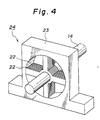
- journal means 24 for the central shaft 14 for eliminating the above-described problem is shown in Fig. 4, and the tool advancing and retreating means incorporating this journal means 24 is shown in Fig. 5.
- the central shaft 14 adapted to have the tool attached to the one end thereof is secured to a holder 23 by way of a laminated product made by laminating many flexible thin leaf springs 22, 22 of a cross configuration.
- the leaf springs 22, 22 are secured to the central shaft 14 at central bores of the springs, and to the holder 23 at outer end portions of the leg portions extending outwardly from the central bores, respectively.
- the central shaft 14 is supported by the journal means 24 instead of the ball spline 19 and linear bush 20 in the example of Fig. 2, and the holders 23, 23 of journal means 24 are secured to the mount 11 by screw means etc.
- the flexible leaf springs 22, 22 are bent to allow this axial movement of displacement of the central shaft 14, but the rotation of the central shaft 14 is prevented by the springs 22, 22 secured to the holders 23, 23, whereby the central shaft 14 can sufficiently support a cutting reaction force exerted by the tool 18 which is cutting the workpiece W.
- a pair of coil springs 25, 26 are disposed around the central shaft 14 which are adapted to damp the axial movement of the central shaft 14.
- the movable plate preferably consists of a laminated silicon steel plate, but is required to have such a rigidity or stiffness that it can not be affected or bent by the attracting force of the electromagnets in this apparatus.
- the steel plate is therefore used, but when it is attracted by the electromagnets an eddy current may be generated therein, thus lowering the frequency response characteristic. Therefore, in order to avoid the eddy current loss, slits may be formed in the plate.
- Other elements are the same as that shown in Fig. 2.
- F K ⁇ I2 d2 (1)
- I an electric current passing through the electromagnets
- d a distance between the electromagnets and said body
- K is a constant dependent upon or determined by the electromagnets.
- the motion equation of the movable plate 12 can be represented by the following formula (2) obtained from the formula (1), where, m is mass of the movable plate 12, x is a displacement of the movable plate 12 from a datum point at which the movable plate 12 is positioned in an equal distance do from both electromagnets 13z and 13b, the direction of x from the movable plate 12 towards the electromagnet 13z being represented by positive sign (+), and i is a control electric current.
- reference numeral 27 denotes a control circuit
- reference numerals 28 and 29 denote constant-current amplifiers, respectively.
- the first item of the right side of the formula (4) is an electric current for obtaining an external force necessary for moving the movable plate 12, and the second item is an electric current necessary for cancelling the unstable force resulting from the negative spring constant.
- the values of the electric current represented by the second item and of the amplitude ia are also increased, and in addition the movable plate is required to have larger rigidity.
- the control system represented by the formula (3) is unstable, it is required to feed-back the displacement signal of the movable plate 12 to thereby stabilize this system.
- the static rigidity of the movable plate is determined by the feed-back gain f1 of the position, using the following formula (5):
- each parameter is substituted by concrete values, and the simulation on the basis of a non-linear model is effected, the results of which are shown in Fig. 10 and Fig. 11.
- Fig. 10 is a graph showing a relation between the positioning or displacement (mm) of the movable plate 12 and time (sec).
- Fig. 11 is a graph showing a relation between the electric current (A) passing through the electromagnets and time (sec).
- (1) represents a result of the case in which no springs are not provided, and (2) represents a result of the case in which the springs having the spring constant determined by the formula (8) are provided, respectively.
- this method enables a stable and approximately linear system to be constructed, and thus the linear control can easily be applied, and the improvement of the accuracy of the positioning of the movable plate 12 is also possible. Further, when the positioning of the movable plate has to be performed using this mechanism while the movable plate is subject to an external force such as a working force, if the pressurization force which can resist said external force is imparted to the movable plate, the control of the electric current can be performed without being influenced by any external disturbance.
- the present invention is constructed as described above, according to the present invention, the problem of the follow-up characteristic as in the conventional profiling machining device can be eliminated, the response speed is high because of a simple mechanism utilizing the attracting force by the electromagnets, the workpiece can be rotated at a high speed to be subject to a high speed cutting operation, the cycle-time of the machine can be substantially decreased, any configuration of the workpiece can be formed, the change of the configuration of the workpiece can easily be accommodated by the present apparatus, and the high working accuracy can be maintained for a long time.
Landscapes
- Engineering & Computer Science (AREA)
- Human Computer Interaction (AREA)
- Manufacturing & Machinery (AREA)
- Physics & Mathematics (AREA)
- General Physics & Mathematics (AREA)
- Automation & Control Theory (AREA)
- Mechanical Engineering (AREA)
- Automatic Control Of Machine Tools (AREA)
- Turning (AREA)
- Machine Tool Units (AREA)
- Drilling And Boring (AREA)
- Magnetic Bearings And Hydrostatic Bearings (AREA)
Applications Claiming Priority (2)
| Application Number | Priority Date | Filing Date | Title |
|---|---|---|---|
| JP197251/88 | 1988-08-09 | ||
| JP63197251A JP2635378B2 (ja) | 1987-09-01 | 1988-08-09 | 非円形切削装置 |
Publications (3)
| Publication Number | Publication Date |
|---|---|
| EP0354639A2 true EP0354639A2 (de) | 1990-02-14 |
| EP0354639A3 EP0354639A3 (de) | 1991-09-11 |
| EP0354639B1 EP0354639B1 (de) | 1996-06-19 |
Family
ID=16371358
Family Applications (1)
| Application Number | Title | Priority Date | Filing Date |
|---|---|---|---|
| EP89304112A Expired - Lifetime EP0354639B1 (de) | 1988-08-09 | 1989-04-25 | Schneidgerät für nichtkreisförmige Querschnitte |
Country Status (10)
| Country | Link |
|---|---|
| US (1) | US5022294A (de) |
| EP (1) | EP0354639B1 (de) |
| KR (1) | KR930002408B1 (de) |
| CN (1) | CN1016240B (de) |
| AU (1) | AU605689B2 (de) |
| BR (1) | BR8902811A (de) |
| CA (1) | CA1315576C (de) |
| DE (1) | DE68926700T2 (de) |
| ES (1) | ES2088892T3 (de) |
| MX (1) | MX172388B (de) |
Cited By (5)
| Publication number | Priority date | Publication date | Assignee | Title |
|---|---|---|---|---|
| WO2005002788A3 (en) * | 2003-05-29 | 2005-04-14 | Massachusetts Inst Technology | Fast tool servo system and method for cutting a workpiece |
| US7437980B2 (en) | 2002-05-29 | 2008-10-21 | Massachusetts Institute Of Technology | Flux-biased electromagnetic fast tool servo systems and methods |
| US7574947B2 (en) | 2002-05-29 | 2009-08-18 | Massachusetts Institute Of Technology | Rotary fast tool servo system and methods |
| US7616084B2 (en) | 2003-10-31 | 2009-11-10 | Massachusetts Institute Of Technology | Variable reluctance fast positioning system and methods |
| US7765905B2 (en) | 2002-05-29 | 2010-08-03 | Massachusetts Institute Of Technology | Magnetic micropositioner and method of providing the same |
Families Citing this family (10)
| Publication number | Priority date | Publication date | Assignee | Title |
|---|---|---|---|---|
| JPH0667716A (ja) * | 1992-08-19 | 1994-03-11 | Mitsubishi Electric Corp | 数値制御装置並びに数値制御方法 |
| US5331870A (en) * | 1992-10-29 | 1994-07-26 | Chin Long Wu | Apparatus and method for use in controlling machining chip and length of such machining chip |
| US5429021A (en) * | 1993-10-18 | 1995-07-04 | Tri Tool Inc. | Elliptical manway cutter |
| CN1066377C (zh) * | 1996-10-25 | 2001-05-30 | 宝山钢铁(集团)公司 | 一种三辊张力减径机轧辊加工方法 |
| US6202521B1 (en) | 1998-12-14 | 2001-03-20 | Lord Corporation | Method, apparatus and controller for machining non-circular work pieces |
| DE102004049951A1 (de) * | 2004-10-13 | 2006-04-20 | Schneider Gmbh + Co. Kg | Hochdynamische Linsenbearbeitungsmaschine |
| JP2006239801A (ja) * | 2005-03-02 | 2006-09-14 | Yamazaki Mazak Corp | 非円形加工装置 |
| CN102736556A (zh) * | 2012-06-13 | 2012-10-17 | 深圳众为兴技术股份有限公司 | 一种非圆切削加工控制装置及控制方法 |
| CN105583685B (zh) * | 2014-10-24 | 2018-05-04 | 富鼎电子科技(嘉善)有限公司 | 刹车机构及采用该刹车机构的加工装置 |
| CN104924102B (zh) * | 2015-07-03 | 2017-03-29 | 颜荣土 | 一种装卡定位锁紧装置 |
Family Cites Families (10)
| Publication number | Priority date | Publication date | Assignee | Title |
|---|---|---|---|---|
| US1941655A (en) * | 1926-09-23 | 1934-01-02 | Blomqvist Gustav Mart Justinus | Electromagnetic hammer |
| US2561405A (en) * | 1947-10-03 | 1951-07-24 | Pierce John B Foundation | Resilient motivating device |
| US2881366A (en) * | 1952-07-02 | 1959-04-07 | Baso Inc | Magnetic control structure |
| GB1291102A (en) * | 1969-01-21 | 1972-09-27 | Sperry Rand Ltd | Improvements in, or relating to, fluid flow control valves |
| US3649092A (en) * | 1970-01-19 | 1972-03-14 | Gen Ind Co The | Means for mounting self-aligning bearing |
| DE2724808C3 (de) * | 1977-06-02 | 1980-01-17 | Purolator Filter Gmbh, 7110 Oehringen | Antriebsvorrichtung für die Quervorschubbewegung des Werkzeugs an Einrichtungen zum Materia] abtragenden Bearbeiten von Drehteilen |
| US4726395A (en) * | 1983-03-17 | 1988-02-23 | Kunkle Valve Company, Inc. | Flexible guide |
| GB8416380D0 (en) * | 1984-06-27 | 1984-08-01 | Ae Plc | Manufacture of pistons |
| US4653360A (en) * | 1985-05-07 | 1987-03-31 | The Cross Company | CNC turning machine |
| US4739684A (en) * | 1986-10-31 | 1988-04-26 | The Cross Company | Apparatus for finishing pistons and the like and method therefor |
-
1989
- 1989-04-17 US US07/338,841 patent/US5022294A/en not_active Expired - Fee Related
- 1989-04-19 AU AU33210/89A patent/AU605689B2/en not_active Ceased
- 1989-04-25 DE DE68926700T patent/DE68926700T2/de not_active Expired - Fee Related
- 1989-04-25 EP EP89304112A patent/EP0354639B1/de not_active Expired - Lifetime
- 1989-04-25 ES ES89304112T patent/ES2088892T3/es not_active Expired - Lifetime
- 1989-05-02 KR KR1019890005912A patent/KR930002408B1/ko not_active Expired - Fee Related
- 1989-05-13 CN CN89103327A patent/CN1016240B/zh not_active Expired
- 1989-05-31 CA CA000601324A patent/CA1315576C/en not_active Expired - Fee Related
- 1989-06-13 BR BR898902811A patent/BR8902811A/pt not_active IP Right Cessation
- 1989-08-04 MX MX017081A patent/MX172388B/es unknown
Cited By (6)
| Publication number | Priority date | Publication date | Assignee | Title |
|---|---|---|---|---|
| US7275468B2 (en) | 2002-05-29 | 2007-10-02 | Massachusetts Institute Of Technology | Rotary fast tool servo system and methods |
| US7437980B2 (en) | 2002-05-29 | 2008-10-21 | Massachusetts Institute Of Technology | Flux-biased electromagnetic fast tool servo systems and methods |
| US7574947B2 (en) | 2002-05-29 | 2009-08-18 | Massachusetts Institute Of Technology | Rotary fast tool servo system and methods |
| US7765905B2 (en) | 2002-05-29 | 2010-08-03 | Massachusetts Institute Of Technology | Magnetic micropositioner and method of providing the same |
| WO2005002788A3 (en) * | 2003-05-29 | 2005-04-14 | Massachusetts Inst Technology | Fast tool servo system and method for cutting a workpiece |
| US7616084B2 (en) | 2003-10-31 | 2009-11-10 | Massachusetts Institute Of Technology | Variable reluctance fast positioning system and methods |
Also Published As
| Publication number | Publication date |
|---|---|
| CN1040162A (zh) | 1990-03-07 |
| EP0354639A3 (de) | 1991-09-11 |
| EP0354639B1 (de) | 1996-06-19 |
| ES2088892T3 (es) | 1996-10-01 |
| DE68926700D1 (de) | 1996-07-25 |
| CA1315576C (en) | 1993-04-06 |
| BR8902811A (pt) | 1990-09-04 |
| AU605689B2 (en) | 1991-01-17 |
| US5022294A (en) | 1991-06-11 |
| KR900002879A (ko) | 1990-03-23 |
| AU3321089A (en) | 1990-02-15 |
| KR930002408B1 (ko) | 1993-03-30 |
| CN1016240B (zh) | 1992-04-15 |
| MX172388B (es) | 1993-12-15 |
| DE68926700T2 (de) | 1997-01-23 |
Similar Documents
| Publication | Publication Date | Title |
|---|---|---|
| EP0354639A2 (de) | Schneidgerät für nichtkreisförmige Querschnitte | |
| Okazaki | A micro-positioning tool post using a piezoelectric actuator for diamond turning machines | |
| US5448146A (en) | Method for applying constant force with nonlinear feedback control and constant force device using same | |
| US6690133B2 (en) | Momentum-decoupled drive train | |
| US4669359A (en) | Positioning system | |
| GB1597681A (en) | Servo control system | |
| US5105135A (en) | Feedback controller for NC controlled machine tools | |
| JPH04181198A (ja) | ステージ装置 | |
| EP0065993A1 (de) | Antriebsvorrichtung für kopiernocken einer werkzeugmaschine | |
| Altintas et al. | A piezo tool actuator for precision turning of hardened shafts | |
| US4016784A (en) | Tool setting device | |
| GB2112963A (en) | Micro-adjustable displacement and rotation setting apparatus | |
| US4986150A (en) | Micro-positioning tool post | |
| US6019013A (en) | Machine tool operated by gyroscopic precession | |
| Nachtigal et al. | Active control of machine-tool chatter | |
| US4860500A (en) | Passive actuator to maintain a constant normal cutting force during robotic deburring | |
| Martinez et al. | Vibration control for precision manufacturing using piezoelectric actuators | |
| Hanson et al. | Development of a fast tool servo for variable-depth-of-cut machining | |
| Klein et al. | The application of active control to improve boring bar performance | |
| US6621241B2 (en) | System and method for reducing oscillating tool-induced reaction forces | |
| JP2635378B2 (ja) | 非円形切削装置 | |
| Hanson et al. | Reducing cutting force induced bore cylindricity errors by learning control and variable depth of cut machining | |
| US5095258A (en) | Longitudinal motion error compensation apparatus method and apparatus for multiaxis CNC machine | |
| RU2399475C2 (ru) | Металлорежущий станок с автоматическим управлением | |
| RU2111091C1 (ru) | Способ управления уровнем колебаний в металлорежущих станках |
Legal Events
| Date | Code | Title | Description |
|---|---|---|---|
| PUAI | Public reference made under article 153(3) epc to a published international application that has entered the european phase |
Free format text: ORIGINAL CODE: 0009012 |
|
| AK | Designated contracting states |
Kind code of ref document: A2 Designated state(s): BE CH DE ES FR GB IT LI NL SE |
|
| PUAL | Search report despatched |
Free format text: ORIGINAL CODE: 0009013 |
|
| AK | Designated contracting states |
Kind code of ref document: A3 Designated state(s): BE CH DE ES FR GB IT LI NL SE |
|
| 17P | Request for examination filed |
Effective date: 19920110 |
|
| 17Q | First examination report despatched |
Effective date: 19930824 |
|
| GRAH | Despatch of communication of intention to grant a patent |
Free format text: ORIGINAL CODE: EPIDOS IGRA |
|
| GRAH | Despatch of communication of intention to grant a patent |
Free format text: ORIGINAL CODE: EPIDOS IGRA |
|
| GRAA | (expected) grant |
Free format text: ORIGINAL CODE: 0009210 |
|
| AK | Designated contracting states |
Kind code of ref document: B1 Designated state(s): BE CH DE ES FR GB IT LI NL SE |
|
| PG25 | Lapsed in a contracting state [announced via postgrant information from national office to epo] |
Ref country code: NL Free format text: LAPSE BECAUSE OF FAILURE TO SUBMIT A TRANSLATION OF THE DESCRIPTION OR TO PAY THE FEE WITHIN THE PRESCRIBED TIME-LIMIT Effective date: 19960619 Ref country code: LI Effective date: 19960619 Ref country code: CH Effective date: 19960619 Ref country code: BE Effective date: 19960619 |
|
| REF | Corresponds to: |
Ref document number: 68926700 Country of ref document: DE Date of ref document: 19960725 |
|
| ET | Fr: translation filed | ||
| ITF | It: translation for a ep patent filed | ||
| REG | Reference to a national code |
Ref country code: ES Ref legal event code: FG2A Ref document number: 2088892 Country of ref document: ES Kind code of ref document: T3 |
|
| REG | Reference to a national code |
Ref country code: ES Ref legal event code: FG2A Ref document number: 2088892 Country of ref document: ES Kind code of ref document: T3 |
|
| NLV1 | Nl: lapsed or annulled due to failure to fulfill the requirements of art. 29p and 29m of the patents act | ||
| REG | Reference to a national code |
Ref country code: CH Ref legal event code: PL |
|
| PGFP | Annual fee paid to national office [announced via postgrant information from national office to epo] |
Ref country code: FR Payment date: 19970409 Year of fee payment: 9 |
|
| PGFP | Annual fee paid to national office [announced via postgrant information from national office to epo] |
Ref country code: GB Payment date: 19970416 Year of fee payment: 9 |
|
| PGFP | Annual fee paid to national office [announced via postgrant information from national office to epo] |
Ref country code: SE Payment date: 19970418 Year of fee payment: 9 |
|
| PLBE | No opposition filed within time limit |
Free format text: ORIGINAL CODE: 0009261 |
|
| STAA | Information on the status of an ep patent application or granted ep patent |
Free format text: STATUS: NO OPPOSITION FILED WITHIN TIME LIMIT |
|
| PGFP | Annual fee paid to national office [announced via postgrant information from national office to epo] |
Ref country code: ES Payment date: 19970428 Year of fee payment: 9 |
|
| PGFP | Annual fee paid to national office [announced via postgrant information from national office to epo] |
Ref country code: DE Payment date: 19970505 Year of fee payment: 9 |
|
| 26N | No opposition filed | ||
| PG25 | Lapsed in a contracting state [announced via postgrant information from national office to epo] |
Ref country code: GB Free format text: LAPSE BECAUSE OF NON-PAYMENT OF DUE FEES Effective date: 19980425 |
|
| PG25 | Lapsed in a contracting state [announced via postgrant information from national office to epo] |
Ref country code: SE Free format text: LAPSE BECAUSE OF NON-PAYMENT OF DUE FEES Effective date: 19980426 |
|
| PG25 | Lapsed in a contracting state [announced via postgrant information from national office to epo] |
Ref country code: ES Free format text: LAPSE BECAUSE OF EXPIRATION OF PROTECTION Effective date: 19980427 |
|
| PG25 | Lapsed in a contracting state [announced via postgrant information from national office to epo] |
Ref country code: FR Free format text: THE PATENT HAS BEEN ANNULLED BY A DECISION OF A NATIONAL AUTHORITY Effective date: 19980430 |
|
| GBPC | Gb: european patent ceased through non-payment of renewal fee |
Effective date: 19980425 |
|
| EUG | Se: european patent has lapsed |
Ref document number: 89304112.9 |
|
| PG25 | Lapsed in a contracting state [announced via postgrant information from national office to epo] |
Ref country code: DE Free format text: LAPSE BECAUSE OF NON-PAYMENT OF DUE FEES Effective date: 19990202 |
|
| REG | Reference to a national code |
Ref country code: FR Ref legal event code: ST |
|
| REG | Reference to a national code |
Ref country code: ES Ref legal event code: FD2A Effective date: 20000301 |
|
| PG25 | Lapsed in a contracting state [announced via postgrant information from national office to epo] |
Ref country code: IT Free format text: LAPSE BECAUSE OF NON-PAYMENT OF DUE FEES;WARNING: LAPSES OF ITALIAN PATENTS WITH EFFECTIVE DATE BEFORE 2007 MAY HAVE OCCURRED AT ANY TIME BEFORE 2007. THE CORRECT EFFECTIVE DATE MAY BE DIFFERENT FROM THE ONE RECORDED. Effective date: 20050425 |