EP0354850A2 - Herstellung von immobilisierten Lipasen und deren Verwendung zur Synthese von Glyceriden - Google Patents
Herstellung von immobilisierten Lipasen und deren Verwendung zur Synthese von Glyceriden Download PDFInfo
- Publication number
- EP0354850A2 EP0354850A2 EP89402261A EP89402261A EP0354850A2 EP 0354850 A2 EP0354850 A2 EP 0354850A2 EP 89402261 A EP89402261 A EP 89402261A EP 89402261 A EP89402261 A EP 89402261A EP 0354850 A2 EP0354850 A2 EP 0354850A2
- Authority
- EP
- European Patent Office
- Prior art keywords
- concentration
- glutaraldehyde
- cross
- lipase
- lipase enzyme
- Prior art date
- Legal status (The legal status is an assumption and is not a legal conclusion. Google has not performed a legal analysis and makes no representation as to the accuracy of the status listed.)
- Ceased
Links
Images









Classifications
-
- C—CHEMISTRY; METALLURGY
- C12—BIOCHEMISTRY; BEER; SPIRITS; WINE; VINEGAR; MICROBIOLOGY; ENZYMOLOGY; MUTATION OR GENETIC ENGINEERING
- C12N—MICROORGANISMS OR ENZYMES; COMPOSITIONS THEREOF; PROPAGATING, PRESERVING, OR MAINTAINING MICROORGANISMS; MUTATION OR GENETIC ENGINEERING; CULTURE MEDIA
- C12N11/00—Carrier-bound or immobilised enzymes; Carrier-bound or immobilised microbial cells; Preparation thereof
- C12N11/02—Enzymes or microbial cells immobilised on or in an organic carrier
-
- C—CHEMISTRY; METALLURGY
- C12—BIOCHEMISTRY; BEER; SPIRITS; WINE; VINEGAR; MICROBIOLOGY; ENZYMOLOGY; MUTATION OR GENETIC ENGINEERING
- C12P—FERMENTATION OR ENZYME-USING PROCESSES TO SYNTHESISE A DESIRED CHEMICAL COMPOUND OR COMPOSITION OR TO SEPARATE OPTICAL ISOMERS FROM A RACEMIC MIXTURE
- C12P7/00—Preparation of oxygen-containing organic compounds
- C12P7/64—Fats; Fatty oils; Ester-type waxes; Higher fatty acids, i.e. having at least seven carbon atoms in an unbroken chain bound to a carboxyl group; Oxidised oils or fats
- C12P7/6436—Fatty acid esters
- C12P7/6445—Glycerides
- C12P7/6454—Glycerides by esterification
Definitions
- the present invention relates to a dry porous macromolecular matrix comprising a cross-linked mixture of an inert protein, a lipase enzyme and a cross-linking agent.
- This matrix is particularly suitable or adapted to catalyze the reaction of fatty acids such as oleic acid and glycerol to produce mono-, di- and tri-olein.
- immobilized lipase preparations for the transesterification of fats is well known.
- an immobilized lipase suitable for transesterification is attached on an indifferent particulate carrier which may be diatomaceous earth or alumina and which exhibits a very high surface area.
- an immobilized lipase preparation for interesterification with n-hexane as a solvent comprising lipase and a strong anion exchange resin (see European Journal of Applied Microbiology and Biotechnology, no. 14, p. 1-5 (1982)).
- E.P.O. application No. 0069599 discloses a lipase enzyme supported on a carrier such as Celite® for continuous interesterification in a column.
- the method comprises the cross-linking of an enzyme molecule with an inactive protein, such as albumin, in the presence of a bifunctional cross-linking agent without any preformed matrix.
- this article teaches the mixing of albumin, glutaraldehyde and an enzyme in a phosphate buffer, freezing the solution obtained at -30°C and allowing the frozen mass to warm at 4°C. After standing for 4 hours at 4°C, the spongelike proteinic copolymer is thoroughly rinsed, lyophilized and ground. It is then suitable for suspending in a mixed solution of substrate or for pouring into a column with a flux of substrate solution flowing through it. Examples using glucose oxidase, urease, trypsin and catalase are given.
- a dry porous macromolecular matrix which comprises a cross-linked mixture of 69.9% to 86.6% by weight of an inert protein, 0.4% to 10.2% by weight of a lipase enzyme and a cross-linking agent, the amount of cross-linking agent being from about 11.7% to 23% by weight.
- an improvement in the process for preparing the dry porous macromolecular matrix of the present invention whereby a reaction mixture of the lipase enzyme, inert protein, cross-linking agent and buffer is frozen at a temperature ranging from -20°C to -195°C and allowed to thaw in distilled water at a temperature ranging from 4°C to 25°C after which the matrix is rinsed with water and acetone. The matrix is then vigorously wrung and dried at room temperature for a period of about 12 hours.
- the matrix of the present invention may be used for the catalysis of fatty acids such as oleic acid with glycerol into compounds such as mono-, di- and tri-olein.
- the dry porous macromolecular matrix of the present invention is a cross-linked mixture of an inert carrier, a lipase enzyme and a cross-linking agent, preferably a bifunctional cross-linking agent. More specifically, the matrix contains from 69.9% to 86.6% of inert protein, 0.4% to 10.2% by weight of lipase enzyme and 11.7 to 23% by weight of cross-linking agent.
- the matrix can be used as such in esterification procedures or can be ground to a fine powder.
- the inert support is used as an enzyme carrier. It may be in the form of powder, fibers or the like although it is preferable that the carrier be in the form of granules in view of the continuous use of the resulting enzyme preparation. It is usually preferred to use inert proteins which are, in the context of the present invention, very suitable inert supports.
- inert protein human and animal albumin may be used, for example, bovine albumin, fibrinogen, hemoglobin and the like.
- the amount of inert protein in the initial mixture is 5% by weight.
- the quantity of inert protein may range from 69.9% to 86.6% by weight.
- the lipase enzyme used for immobilization purposes in accordance with the present invention may be selected from lipases originating from Candida cylindracea , Mucor miehei , Rhizopus arrhizus , Rhizopus delemar and the like. These enzymes are bonded to an inert protein carrier through a cross-linking agent. The mixture ratios of the enzyme to the carrier may vary from 6.3:1200 to 157.1:1200.
- the cross-linking agent is used to bound the enzyme onto the inert carrier. Although it is possible to employ various types of cross-linking agents, it has been found that glutaraldehyde in quantities ranging between 11.7% and 23% by weight is preferred.
- the enzyme or the enzyme-containing material in or to the carrier, for example, the enzyme or the enzyme-containing material is dissolved in a buffer solution and the resulting solution is admixed with the carrier.
- an inert carrier preferably an inert protein
- a cross-linking agent 50 to 440 ⁇ l of lipase enzyme diluted in the buffer.
- the mixture After allowing the mixture to stand at room temperature for a period of from 5 to 10 minutes to allow prereticulation or cross-linking between the inert carrier and the enzyme via the cross-linking agent, the mixture is then frozen at a temperature ranging from -20°C to -195°C until ready to use.
- the frozen mixture is thawed slowly up to a temperature that may vary from 4°C to 25°C in distilled water, thereby yielding a solid matrix.
- the matrix After thorough washing with water to remove any unreacted compound and any free enzyme, the matrix is blotted dry on filter paper and shaked in acetone for about two hours to eliminate any water in the core of the matrix.
- the matrix is then allowed to dry on filter paper at room temperature for a period of 3 to 24 hours.
- the reaction mixture is to be frozen at -80°C, thawed at 4°C and allowed to dry for 12 hours.
- the drying step is essential to the process of the present invention since the presence of water prevents the catalytic reaction of fatty acids with glycerol.
- the final product obtained is a porous macromolecular matrix.
- fatty substrate used in the context of the present invention is a mixture of fatty acids and short alcohols such as methanol, ethanol, glycerol and the like.
- the substrate may include other fatty esters on which a lipolytic enzyme can act, such as monoglycerides, diglycerides, methyl esters, ethyl esters or the like.
- fatty acids having C3 to C22 carbon atoms may be used as substrates either alone or together with these fatty esters.
- the substrate should be a liquid at the reaction temperature, and no organic solvent should be used.
- the reaction medium is composed of only the required substrates for the reaction.
- the most desirable substrate to be used in the context of the present invention is a mixture of oleic acid and glycerol in stoichiometric proportions.
- the catalytic reaction of the present invention through which fatty acids and alcohols, such as oleic acids and glycerol, are preferably transformed into mono-, di- and tri-olein is carried out by continuously or repeatedly contacting the enzyme or the enzyme preparation with a supply of the fatty acids and glycerol.
- the enzymatic reaction of the present invention can be carried out in a batchwise operation or in a continuous operation using for example a fluidized bed of the enzyme preparation or a column packed with the enzyme preparation.
- a mixture containing between 0.5 to 10 g of oleic acid and between 0.0543 to 1.086 g of glycerol and from 50 to 440 ⁇ l of lipase immobilized in the previously described matrix is strongly agitated at a temperature ranging between 25°C and 60°C for a time ranging from 10 to 1000 hours. From time to time, samples of the reaction mixture are analyzed in order to measure the amount of substrate still in solution and to analyze the various reaction products.
- the immobilization technique of the present invention it is possible to use the immobilized enzyme for up to four successive cycles before observing a decline in enzymatic activity.
- the mixture is then allowed to stand at room temperature for 10 minutes in order to permit prereticulation or crosslinking between the albumin and the lipase via glutaraldehyde.
- the resulting mixture is then frozen at -80°C.
- the mixture is slowly thawed up to a temperature of 4°C in distilled water.
- the resulting matrix is then thoroughly rinsed, vigorously wrung out, washed with acetone and dried on filter paper at room temperature for 12 hours.
- the final matrix demonstrated a final albumin concentration of 81.3% and a final glutaraldehyde concentration 18.3%.
- Example 2 The procedure described in Example 1 was repeated in order to obtain a final glutaraldehyde concentration of 0.75% in the mixture which necessitated the use of 0.36 ml of glutaraldehyde 5% in the initial reaction mixture. After drying, the albumin concentration was 86.6% and the glutaraldehyde concentration 13%.
- Example 2 The procedure described in Example 1 was repeated in order to obtain a final glutaraldehyde concentration of 1.5% in the mixture which necessitated the use of 0.36 ml of glutaraldehyde 10% in the initial reaction mixture. After drying, the albumine concentration was 76.6% and the glutaraldehyde concentration 23%.
- Example 1 The procedure described in Example 1 was repeated using 440 ⁇ l (1571.4 units, 15.71 mg protein) of a commercially available concentrated lipase originated from Rhizopus delemar instead of lipase originated from Rhizopus arrhizus .
- the procedure of Example 1 was repeated in order to obtain a final glutaraldehyde concentration of 0.75% in the mixture which necessitated the use of 0.36 ml of glutaraldehyde 5% in the initial reaction mixture. After drying, the albumin concentration was 78.1% and the glutaraldehyde concentration 11.7%.
- Example 4 The procedure described in Example 4 was repeated in order to obtain a final glutaraldehyde concentration of 1.125% in the mixture which necessitated the use of 0.36 ml of glutaraldehyde 7.5% in the initial reaction mixture. After drying, the albumin concentration was 73.8% and the glutaraldehyde concentration 16.6%.
- Example 4 The procedure described in Example 4 was repeated in order to obtain a final glutaraldehyde concentration of 1.5% in the mixture, which necessitated the use of 0.36 ml of glutaraldehyde 10% in the initial reaction mixture. After drying, the albumin concentration was 69.9% and the glutaraldehyde concentration 21%.
- Example 1 The procedure described in Example 1 was repeated using 440 ⁇ l (1571.4 units, 3.96 mg protein) of a commercially available concentrated lipase originated from Candida cylindracea instead of lipase originated from Rhizopus arrhizus .
- the procedure of Example 1 was repeated in order to obtain a final glutaraldehyde concentration of 0.75% in the mixture which necessitated the use of 0.36 ml of glutaraldehyde 5% in the initial reaction mixture. After drying, the albumin concentration was 84.5% and the glutaraldehyde concentration 12.7%.
- Example 7 The procedure described in Example 7 was repeated in order to obtain a final glutaraldehyde concentration of 1.5% in the mixture which necessitated the use of 0.36 ml of glutaraldehyde 10% in the initial reaction mixture. After drying, the albumin concentration was 75% and the glutaraldehyde concentration 22.5%.
- Example 7 The procedure described in Example 7 was repeated in order to obtain a final glutaraldehyde concentration of 1.125% in the mixture which necessitated the use of 0.36 ml of glutaraldehyde 7.5% in the initial reaction mixture. After drying, the albumin concentration was 79.5% and the glutaraldehyde concentration 17.9%.
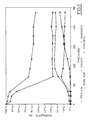
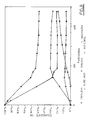
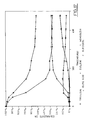
- Example 10 The procedure described in Example 10 was repeated but 50 ⁇ l of a solution of free lipase obtained from Rhizopus arrhizus were used instead of the support of Example 1. Results are shown in Figure 6.
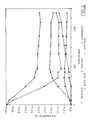
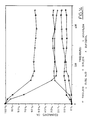
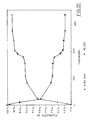
- Example 10 The procedure described in Example 10 was repeated using the support of Example 2 as the source of lipase. Results are shown in Figure 14.
- Example 10 The procedure described in Example 10 was repeated using the support of Example 3 as the source of lipase. Results are shown in Figure 15.
- Example 10 The procedure described in Example 10 was repeated using the support of Example 4 as the source of lipase. Results are shown in Figure 16.
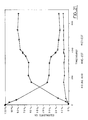
- Example 10 The procedure described in Example 10 was repeated using the support of Example 6 as the source of lipase. Results are shown in Figure 17.
- Example 10 The procedure described in Example 10 was repeated using the support of Example 7 as the source of lipase. Results are shown in Figure 18.
- Example 10 The procedure described in Example 10 was repeated using the support of Example 8 as the source of lipase. Results are shown in Figure 19.
- Example 10 The procedure described in Example 10 was repeated using the support of Example 5 as the source of lipase.
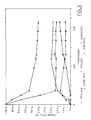
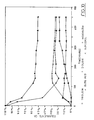
- Figures 7 to 11 represent the successive cycles of glycerides synthesis when reusing the same support.
- Example 10 The procedure described in Example 10 was repeated using the support of Example 9 as the source of lipase.
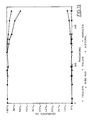
- Figures 12 and 13 represent the successive cycles of glycerides synthesis when reusing the same support twice.
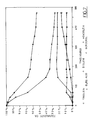
- Example 21 The procedure described in Example 21 was repeated using 103 ⁇ l of ethanol instead of methanol.
- Figure 21 represents the appearance of oleic acid ethyl ester and the consumption of oleic acid. After 358 hours of reaction, 52 ⁇ l of ethanol was added.
Landscapes
- Chemical & Material Sciences (AREA)
- Organic Chemistry (AREA)
- Zoology (AREA)
- Life Sciences & Earth Sciences (AREA)
- Engineering & Computer Science (AREA)
- Wood Science & Technology (AREA)
- Bioinformatics & Cheminformatics (AREA)
- Health & Medical Sciences (AREA)
- Genetics & Genomics (AREA)
- Biotechnology (AREA)
- Microbiology (AREA)
- Biochemistry (AREA)
- General Engineering & Computer Science (AREA)
- General Health & Medical Sciences (AREA)
- Biomedical Technology (AREA)
- Oil, Petroleum & Natural Gas (AREA)
- Chemical Kinetics & Catalysis (AREA)
- General Chemical & Material Sciences (AREA)
- Preparation Of Compounds By Using Micro-Organisms (AREA)
- Immobilizing And Processing Of Enzymes And Microorganisms (AREA)
Applications Claiming Priority (2)
| Application Number | Priority Date | Filing Date | Title |
|---|---|---|---|
| US07/231,221 US5010006A (en) | 1988-08-11 | 1988-08-11 | Lipase immdoilized by cross-linking with inert protein for glyceride synthesis |
| US231221 | 1988-08-11 |
Publications (2)
| Publication Number | Publication Date |
|---|---|
| EP0354850A2 true EP0354850A2 (de) | 1990-02-14 |
| EP0354850A3 EP0354850A3 (de) | 1990-09-19 |
Family
ID=22868262
Family Applications (1)
| Application Number | Title | Priority Date | Filing Date |
|---|---|---|---|
| EP19890402261 Ceased EP0354850A3 (de) | 1988-08-11 | 1989-08-10 | Herstellung von immobilisierten Lipasen und deren Verwendung zur Synthese von Glyceriden |
Country Status (3)
| Country | Link |
|---|---|
| US (1) | US5010006A (de) |
| EP (1) | EP0354850A3 (de) |
| DK (1) | DK387389A (de) |
Families Citing this family (4)
| Publication number | Priority date | Publication date | Assignee | Title |
|---|---|---|---|---|
| US5232843A (en) * | 1989-10-20 | 1993-08-03 | Unilever Patent Holdings Bv | Preparation of immobilized lipase by adsorption of lipase and a non-lipase protein on a support |
| SK283185B6 (sk) * | 1990-08-03 | 2003-03-04 | Vertex Pharmaceuticals Incorporated | Zosietené kryštály proteínov, zariadenie ich obsahujúce a ich použitie |
| US8889373B2 (en) | 2010-08-12 | 2014-11-18 | Eastman Chemical Company | Enzyme catalyst immobilized on porous fluoropolymer support |
| CN116286731B (zh) * | 2023-04-19 | 2024-06-11 | 中国农业科学院农产品加工研究所 | 蛋白基固定化酶及其制备方法及高效制备甘油二酯的方法 |
Family Cites Families (6)
| Publication number | Priority date | Publication date | Assignee | Title |
|---|---|---|---|---|
| US4464468A (en) * | 1968-03-29 | 1984-08-07 | Agence Nationale De Valorisation De La Recherche (Anvar) | Immobilization of active protein by cross-linking to inactive protein |
| US3705084A (en) * | 1970-03-18 | 1972-12-05 | Monsanto Co | Macroporous enzyme reactor |
| US3796634A (en) * | 1970-03-19 | 1974-03-12 | Us Health Education & Welfare | Insolubilized biologically active enzymes |
| DE3163939D1 (en) * | 1980-03-08 | 1984-07-12 | Fuji Oil Co Ltd | Method for enzymatic interesterification of lipid and enzyme used therein |
| DK402583D0 (da) * | 1983-09-05 | 1983-09-05 | Novo Industri As | Fremgangsmade til fremstilling af et immobiliseret lipasepraeparat og anvendelse deraf |
| FR2580666B1 (fr) * | 1985-04-19 | 1988-01-15 | Elf Aquitaine | Perfectionnement a l'immobilisation d'enzymes |
-
1988
- 1988-08-11 US US07/231,221 patent/US5010006A/en not_active Expired - Fee Related
-
1989
- 1989-08-08 DK DK387389A patent/DK387389A/da not_active Application Discontinuation
- 1989-08-10 EP EP19890402261 patent/EP0354850A3/de not_active Ceased
Also Published As
| Publication number | Publication date |
|---|---|
| DK387389D0 (da) | 1989-08-08 |
| DK387389A (da) | 1990-02-12 |
| US5010006A (en) | 1991-04-23 |
| EP0354850A3 (de) | 1990-09-19 |
Similar Documents
| Publication | Publication Date | Title |
|---|---|---|
| JP3670284B2 (ja) | 固定化酵素調製品の製造方法および固定化酵素調製品の使用 | |
| Bloomer et al. | Triglyceride interesterification by lipases. 1. Cocoa butter equivalents from a fraction of palm oil | |
| Soares et al. | Characterization and utilization of Candida rugosa lipase immobilized on controlled pore silica | |
| AU637113B2 (en) | Enzymes and their use | |
| Triantafyllou et al. | Effects of sorbitol addition on the action of free and immobilized hydrolytic enzymes in organic media | |
| US6605452B1 (en) | Fatty acid polyol ester-coated lipase complex immobilized on insoluble matrix | |
| Wisdom et al. | Enzymic interesterification of fats: Laboratory and pilot‐scale studies with immobilized lipase from Rhizopus arrhizus | |
| KR100351887B1 (ko) | 고정화리파아제 | |
| Otero et al. | Immobilization/stabilization of lipase from Candida rugosa | |
| EP0294520B1 (de) | Verfahren zur Herstellung von Enzympreparationen | |
| EP1163329A2 (de) | In einem unlöslichem matrix immobilisierter tensid-lipase komplex | |
| US5316927A (en) | Production of monoglycerides by enzymatic transesterification | |
| Basri et al. | Immobilization of lipase from Candida rugosa on synthetic polymer beads for use in the synthesis of fatty esters | |
| De La Casa et al. | Modification of the activities of two different lipases from Candida rugosa with dextrans | |
| de Castro et al. | Immobilization of porcine pancreatic lipase on celite for application in the synthesis of butyl butyrate in a nonaqueous system | |
| US5010006A (en) | Lipase immdoilized by cross-linking with inert protein for glyceride synthesis | |
| Snoch et al. | Hollow silica microspheres as robust immobilization carriers | |
| US5508182A (en) | Esterification of hydrophilic polyols by adsorption onto a solid support and employing a substrate-immiscible solvent | |
| CA2000143A1 (en) | Production of monoglycerides by enzymatic transesterification | |
| Kaga et al. | Stabilization of Candida lipase against acetaldehyde by adsorption onto celite | |
| CA1318624C (en) | Preparation of immobilized lipases and their use in the synthesis of glycerides | |
| Fukunaga et al. | Immobilization of organic solvent-soluble lipase in nonaqueous conditions and properties of the immobilized enzymes | |
| Cao et al. | Esterification and transesterification with immobilized lipase in organic solvent | |
| Kaimal et al. | Enhancement of catalytic activity of porcine pancreatic lipase by reductive alkylation | |
| Lambrecht et al. | The adsorptive immobilization of phospholipids D mediated by calcium ions |
Legal Events
| Date | Code | Title | Description |
|---|---|---|---|
| PUAI | Public reference made under article 153(3) epc to a published international application that has entered the european phase |
Free format text: ORIGINAL CODE: 0009012 |
|
| AK | Designated contracting states |
Kind code of ref document: A2 Designated state(s): AT BE CH DE ES FR GB GR IT LI LU NL SE |
|
| PUAL | Search report despatched |
Free format text: ORIGINAL CODE: 0009013 |
|
| AK | Designated contracting states |
Kind code of ref document: A3 Designated state(s): AT BE CH DE ES FR GB GR IT LI LU NL SE |
|
| 17P | Request for examination filed |
Effective date: 19901231 |
|
| 17Q | First examination report despatched |
Effective date: 19930316 |
|
| STAA | Information on the status of an ep patent application or granted ep patent |
Free format text: STATUS: THE APPLICATION HAS BEEN REFUSED |
|
| 18R | Application refused |
Effective date: 19930904 |