EP0354923B1 - Procede de marquage d'anticorps a l'aide d'un ion metallique - Google Patents
Procede de marquage d'anticorps a l'aide d'un ion metallique Download PDFInfo
- Publication number
- EP0354923B1 EP0354923B1 EP88904758A EP88904758A EP0354923B1 EP 0354923 B1 EP0354923 B1 EP 0354923B1 EP 88904758 A EP88904758 A EP 88904758A EP 88904758 A EP88904758 A EP 88904758A EP 0354923 B1 EP0354923 B1 EP 0354923B1
- Authority
- EP
- European Patent Office
- Prior art keywords
- antibody
- fragment
- fab
- vial
- technetium
- Prior art date
- Legal status (The legal status is an assumption and is not a legal conclusion. Google has not performed a legal analysis and makes no representation as to the accuracy of the status listed.)
- Expired - Lifetime
Links
- 238000000034 method Methods 0.000 title claims abstract description 97
- 238000002372 labelling Methods 0.000 title claims abstract description 52
- 229910021645 metal ion Inorganic materials 0.000 title description 4
- GKLVYJBZJHMRIY-OUBTZVSYSA-N Technetium-99 Chemical compound [99Tc] GKLVYJBZJHMRIY-OUBTZVSYSA-N 0.000 claims abstract description 66
- 102000008394 Immunoglobulin Fragments Human genes 0.000 claims abstract description 65
- 108010021625 Immunoglobulin Fragments Proteins 0.000 claims abstract description 65
- 229940056501 technetium 99m Drugs 0.000 claims abstract description 65
- 239000003638 chemical reducing agent Substances 0.000 claims abstract description 41
- 239000000203 mixture Substances 0.000 claims abstract description 39
- 239000003446 ligand Substances 0.000 claims abstract description 35
- 125000003396 thiol group Chemical group [H]S* 0.000 claims abstract description 34
- XLYOFNOQVPJJNP-UHFFFAOYSA-N water Substances O XLYOFNOQVPJJNP-UHFFFAOYSA-N 0.000 claims abstract description 13
- 239000012634 fragment Substances 0.000 claims description 61
- NAOLWIGVYRIGTP-UHFFFAOYSA-N 1,3,5-trihydroxyanthracene-9,10-dione Chemical compound C1=CC(O)=C2C(=O)C3=CC(O)=CC(O)=C3C(=O)C2=C1 NAOLWIGVYRIGTP-UHFFFAOYSA-N 0.000 claims description 21
- 150000003839 salts Chemical class 0.000 claims description 18
- 238000012546 transfer Methods 0.000 claims description 15
- 238000000163 radioactive labelling Methods 0.000 claims description 13
- TXUICONDJPYNPY-UHFFFAOYSA-N (1,10,13-trimethyl-3-oxo-4,5,6,7,8,9,11,12,14,15,16,17-dodecahydrocyclopenta[a]phenanthren-17-yl) heptanoate Chemical group C1CC2CC(=O)C=C(C)C2(C)C2C1C1CCC(OC(=O)CCCCCC)C1(C)CC2 TXUICONDJPYNPY-UHFFFAOYSA-N 0.000 claims description 11
- 229910021626 Tin(II) chloride Inorganic materials 0.000 claims description 11
- 239000001119 stannous chloride Substances 0.000 claims description 11
- 235000011150 stannous chloride Nutrition 0.000 claims description 11
- DSLZVSRJTYRBFB-LLEIAEIESA-N D-glucaric acid Chemical compound OC(=O)[C@@H](O)[C@@H](O)[C@H](O)[C@@H](O)C(O)=O DSLZVSRJTYRBFB-LLEIAEIESA-N 0.000 claims description 9
- 239000007864 aqueous solution Substances 0.000 claims description 9
- 229950003499 fibrin Drugs 0.000 claims description 8
- DGAQECJNVWCQMB-PUAWFVPOSA-M Ilexoside XXIX Chemical compound C[C@@H]1CC[C@@]2(CC[C@@]3(C(=CC[C@H]4[C@]3(CC[C@@H]5[C@@]4(CC[C@@H](C5(C)C)OS(=O)(=O)[O-])C)C)[C@@H]2[C@]1(C)O)C)C(=O)O[C@H]6[C@@H]([C@H]([C@@H]([C@H](O6)CO)O)O)O.[Na+] DGAQECJNVWCQMB-PUAWFVPOSA-M 0.000 claims description 7
- 229910052708 sodium Inorganic materials 0.000 claims description 7
- 239000011734 sodium Substances 0.000 claims description 7
- QXKAIJAYHKCRRA-JJYYJPOSSA-N D-arabinonic acid Chemical compound OC[C@@H](O)[C@@H](O)[C@H](O)C(O)=O QXKAIJAYHKCRRA-JJYYJPOSSA-N 0.000 claims description 6
- DSLZVSRJTYRBFB-UHFFFAOYSA-N Galactaric acid Natural products OC(=O)C(O)C(O)C(O)C(O)C(O)=O DSLZVSRJTYRBFB-UHFFFAOYSA-N 0.000 claims description 6
- DSLZVSRJTYRBFB-DUHBMQHGSA-N galactaric acid Chemical compound OC(=O)[C@H](O)[C@@H](O)[C@@H](O)[C@H](O)C(O)=O DSLZVSRJTYRBFB-DUHBMQHGSA-N 0.000 claims description 6
- WUAPFZMCVAUBPE-NJFSPNSNSA-N 188Re Chemical compound [188Re] WUAPFZMCVAUBPE-NJFSPNSNSA-N 0.000 claims description 5
- WUAPFZMCVAUBPE-IGMARMGPSA-N rhenium-186 Chemical compound [186Re] WUAPFZMCVAUBPE-IGMARMGPSA-N 0.000 claims description 5
- WUAPFZMCVAUBPE-AKLPVKDBSA-N rhenium-189 Chemical compound [189Re] WUAPFZMCVAUBPE-AKLPVKDBSA-N 0.000 claims description 4
- 206010033128 Ovarian cancer Diseases 0.000 claims description 3
- 206010061535 Ovarian neoplasm Diseases 0.000 claims description 3
- 230000000844 anti-bacterial effect Effects 0.000 claims description 3
- 230000000536 complexating effect Effects 0.000 claims description 3
- 230000001590 oxidative effect Effects 0.000 claims description 3
- 230000001419 dependent effect Effects 0.000 claims description 2
- 230000000259 anti-tumor effect Effects 0.000 claims 4
- 206010006187 Breast cancer Diseases 0.000 claims 2
- 208000026310 Breast neoplasm Diseases 0.000 claims 2
- 206010009944 Colon cancer Diseases 0.000 claims 2
- 208000001333 Colorectal Neoplasms Diseases 0.000 claims 2
- 206010060862 Prostate cancer Diseases 0.000 claims 2
- 208000000236 Prostatic Neoplasms Diseases 0.000 claims 2
- 230000000702 anti-platelet effect Effects 0.000 claims 2
- 239000003146 anticoagulant agent Substances 0.000 claims 2
- 206010058467 Lung neoplasm malignant Diseases 0.000 claims 1
- 201000005202 lung cancer Diseases 0.000 claims 1
- 208000020816 lung neoplasm Diseases 0.000 claims 1
- 235000018102 proteins Nutrition 0.000 description 40
- 102000004169 proteins and genes Human genes 0.000 description 40
- 108090000623 proteins and genes Proteins 0.000 description 40
- 239000000243 solution Substances 0.000 description 27
- 238000002360 preparation method Methods 0.000 description 19
- 206010028980 Neoplasm Diseases 0.000 description 17
- 239000003153 chemical reaction reagent Substances 0.000 description 16
- FAPWRFPIFSIZLT-UHFFFAOYSA-M Sodium chloride Chemical compound [Na+].[Cl-] FAPWRFPIFSIZLT-UHFFFAOYSA-M 0.000 description 15
- 229910052702 rhenium Inorganic materials 0.000 description 15
- WUAPFZMCVAUBPE-UHFFFAOYSA-N rhenium atom Chemical compound [Re] WUAPFZMCVAUBPE-UHFFFAOYSA-N 0.000 description 15
- 229910052713 technetium Inorganic materials 0.000 description 15
- GKLVYJBZJHMRIY-UHFFFAOYSA-N technetium atom Chemical compound [Tc] GKLVYJBZJHMRIY-UHFFFAOYSA-N 0.000 description 14
- DYODAJAEQDVYFX-UHFFFAOYSA-N brallobarbital Chemical compound BrC(=C)CC1(CC=C)C(=O)NC(=O)NC1=O DYODAJAEQDVYFX-UHFFFAOYSA-N 0.000 description 13
- 238000006243 chemical reaction Methods 0.000 description 13
- 238000002347 injection Methods 0.000 description 9
- 239000007924 injection Substances 0.000 description 9
- 238000004816 paper chromatography Methods 0.000 description 9
- 239000002738 chelating agent Substances 0.000 description 8
- VHJLVAABSRFDPM-QWWZWVQMSA-N dithiothreitol Chemical compound SC[C@@H](O)[C@H](O)CS VHJLVAABSRFDPM-QWWZWVQMSA-N 0.000 description 8
- 230000000694 effects Effects 0.000 description 8
- 210000004185 liver Anatomy 0.000 description 8
- 239000011780 sodium chloride Substances 0.000 description 8
- WEVYAHXRMPXWCK-UHFFFAOYSA-N Acetonitrile Chemical compound CC#N WEVYAHXRMPXWCK-UHFFFAOYSA-N 0.000 description 7
- 241000699666 Mus <mouse, genus> Species 0.000 description 7
- 241000699670 Mus sp. Species 0.000 description 7
- 102000003505 Myosin Human genes 0.000 description 7
- 108060008487 Myosin Proteins 0.000 description 7
- 210000004369 blood Anatomy 0.000 description 7
- 239000008280 blood Substances 0.000 description 7
- 238000003384 imaging method Methods 0.000 description 7
- 238000001727 in vivo Methods 0.000 description 7
- 238000010348 incorporation Methods 0.000 description 7
- 238000000746 purification Methods 0.000 description 7
- QTBSBXVTEAMEQO-UHFFFAOYSA-N Acetic acid Chemical compound CC(O)=O QTBSBXVTEAMEQO-UHFFFAOYSA-N 0.000 description 6
- 241000282472 Canis lupus familiaris Species 0.000 description 6
- 102000009123 Fibrin Human genes 0.000 description 6
- 108010073385 Fibrin Proteins 0.000 description 6
- BWGVNKXGVNDBDI-UHFFFAOYSA-N Fibrin monomer Chemical compound CNC(=O)CNC(=O)CN BWGVNKXGVNDBDI-UHFFFAOYSA-N 0.000 description 6
- 208000010125 myocardial infarction Diseases 0.000 description 6
- KCXVZYZYPLLWCC-UHFFFAOYSA-N EDTA Chemical compound OC(=O)CN(CC(O)=O)CCN(CC(O)=O)CC(O)=O KCXVZYZYPLLWCC-UHFFFAOYSA-N 0.000 description 5
- 229920005654 Sephadex Polymers 0.000 description 5
- 239000012507 Sephadex™ Substances 0.000 description 5
- 206010000269 abscess Diseases 0.000 description 5
- 230000027455 binding Effects 0.000 description 5
- 201000011510 cancer Diseases 0.000 description 5
- 238000004128 high performance liquid chromatography Methods 0.000 description 5
- 229940055742 indium-111 Drugs 0.000 description 5
- APFVFJFRJDLVQX-AHCXROLUSA-N indium-111 Chemical compound [111In] APFVFJFRJDLVQX-AHCXROLUSA-N 0.000 description 5
- 238000013459 approach Methods 0.000 description 4
- 238000009472 formulation Methods 0.000 description 4
- 150000002500 ions Chemical class 0.000 description 4
- HEKURBKACCBNEJ-UHFFFAOYSA-M potassium;1,1-dioxo-1,2-benzothiazol-2-id-3-one Chemical compound [K+].C1=CC=C2C(=O)[N-]S(=O)(=O)C2=C1 HEKURBKACCBNEJ-UHFFFAOYSA-M 0.000 description 4
- 238000002560 therapeutic procedure Methods 0.000 description 4
- LWIHDJKSTIGBAC-UHFFFAOYSA-K tripotassium phosphate Chemical compound [K+].[K+].[K+].[O-]P([O-])([O-])=O LWIHDJKSTIGBAC-UHFFFAOYSA-K 0.000 description 4
- VEXZGXHMUGYJMC-UHFFFAOYSA-N Hydrochloric acid Chemical compound Cl VEXZGXHMUGYJMC-UHFFFAOYSA-N 0.000 description 3
- 206010061216 Infarction Diseases 0.000 description 3
- QPCDCPDFJACHGM-UHFFFAOYSA-N N,N-bis{2-[bis(carboxymethyl)amino]ethyl}glycine Chemical compound OC(=O)CN(CC(O)=O)CCN(CC(=O)O)CCN(CC(O)=O)CC(O)=O QPCDCPDFJACHGM-UHFFFAOYSA-N 0.000 description 3
- ZLMJMSJWJFRBEC-UHFFFAOYSA-N Potassium Chemical compound [K] ZLMJMSJWJFRBEC-UHFFFAOYSA-N 0.000 description 3
- 208000007536 Thrombosis Diseases 0.000 description 3
- 239000012736 aqueous medium Substances 0.000 description 3
- 230000015572 biosynthetic process Effects 0.000 description 3
- 239000000032 diagnostic agent Substances 0.000 description 3
- 229940039227 diagnostic agent Drugs 0.000 description 3
- 238000002523 gelfiltration Methods 0.000 description 3
- 230000001024 immunotherapeutic effect Effects 0.000 description 3
- 238000011534 incubation Methods 0.000 description 3
- 230000007574 infarction Effects 0.000 description 3
- 210000003734 kidney Anatomy 0.000 description 3
- 210000000056 organ Anatomy 0.000 description 3
- 229960003330 pentetic acid Drugs 0.000 description 3
- XKRFYHLGVUSROY-UHFFFAOYSA-N Argon Chemical compound [Ar] XKRFYHLGVUSROY-UHFFFAOYSA-N 0.000 description 2
- 241000894006 Bacteria Species 0.000 description 2
- BVKZGUZCCUSVTD-UHFFFAOYSA-M Bicarbonate Chemical compound OC([O-])=O BVKZGUZCCUSVTD-UHFFFAOYSA-M 0.000 description 2
- FEWJPZIEWOKRBE-JCYAYHJZSA-N Dextrotartaric acid Chemical compound OC(=O)[C@H](O)[C@@H](O)C(O)=O FEWJPZIEWOKRBE-JCYAYHJZSA-N 0.000 description 2
- DHMQDGOQFOQNFH-UHFFFAOYSA-N Glycine Chemical compound NCC(O)=O DHMQDGOQFOQNFH-UHFFFAOYSA-N 0.000 description 2
- 229910019142 PO4 Inorganic materials 0.000 description 2
- 241000220010 Rhode Species 0.000 description 2
- CDBYLPFSWZWCQE-UHFFFAOYSA-L Sodium Carbonate Chemical compound [Na+].[Na+].[O-]C([O-])=O CDBYLPFSWZWCQE-UHFFFAOYSA-L 0.000 description 2
- UIIMBOGNXHQVGW-UHFFFAOYSA-M Sodium bicarbonate Chemical compound [Na+].OC([O-])=O UIIMBOGNXHQVGW-UHFFFAOYSA-M 0.000 description 2
- 239000007983 Tris buffer Substances 0.000 description 2
- 239000002253 acid Substances 0.000 description 2
- 150000007513 acids Chemical class 0.000 description 2
- 229910052784 alkaline earth metal Inorganic materials 0.000 description 2
- 230000001580 bacterial effect Effects 0.000 description 2
- 239000007853 buffer solution Substances 0.000 description 2
- 239000000084 colloidal system Substances 0.000 description 2
- 230000000052 comparative effect Effects 0.000 description 2
- 238000001514 detection method Methods 0.000 description 2
- 238000010828 elution Methods 0.000 description 2
- 238000011156 evaluation Methods 0.000 description 2
- 238000002474 experimental method Methods 0.000 description 2
- 210000002429 large intestine Anatomy 0.000 description 2
- 239000012931 lyophilized formulation Substances 0.000 description 2
- 239000000463 material Substances 0.000 description 2
- 229910052751 metal Inorganic materials 0.000 description 2
- 239000002184 metal Substances 0.000 description 2
- 210000004789 organ system Anatomy 0.000 description 2
- NBIIXXVUZAFLBC-UHFFFAOYSA-K phosphate Chemical compound [O-]P([O-])([O-])=O NBIIXXVUZAFLBC-UHFFFAOYSA-K 0.000 description 2
- 239000010452 phosphate Substances 0.000 description 2
- 229910000160 potassium phosphate Inorganic materials 0.000 description 2
- 239000008057 potassium phosphate buffer Substances 0.000 description 2
- 235000011009 potassium phosphates Nutrition 0.000 description 2
- 239000011541 reaction mixture Substances 0.000 description 2
- 230000010410 reperfusion Effects 0.000 description 2
- 210000002966 serum Anatomy 0.000 description 2
- 241000894007 species Species 0.000 description 2
- 210000000952 spleen Anatomy 0.000 description 2
- 238000003860 storage Methods 0.000 description 2
- 239000011592 zinc chloride Substances 0.000 description 2
- 235000005074 zinc chloride Nutrition 0.000 description 2
- JIAARYAFYJHUJI-UHFFFAOYSA-L zinc dichloride Chemical compound [Cl-].[Cl-].[Zn+2] JIAARYAFYJHUJI-UHFFFAOYSA-L 0.000 description 2
- VPYQMEOYEWOVKO-UHFFFAOYSA-N 3h-dithiole-3,5-diamine Chemical compound NC1SSC(N)=C1 VPYQMEOYEWOVKO-UHFFFAOYSA-N 0.000 description 1
- 102000013602 Cardiac Myosins Human genes 0.000 description 1
- 108010051609 Cardiac Myosins Proteins 0.000 description 1
- 208000001778 Coronary Occlusion Diseases 0.000 description 1
- 206010011086 Coronary artery occlusion Diseases 0.000 description 1
- RGHNJXZEOKUKBD-SQOUGZDYSA-M D-gluconate Chemical compound OC[C@@H](O)[C@@H](O)[C@H](O)[C@@H](O)C([O-])=O RGHNJXZEOKUKBD-SQOUGZDYSA-M 0.000 description 1
- BWGNESOTFCXPMA-UHFFFAOYSA-N Dihydrogen disulfide Chemical compound SS BWGNESOTFCXPMA-UHFFFAOYSA-N 0.000 description 1
- 102000005593 Endopeptidases Human genes 0.000 description 1
- 108010059378 Endopeptidases Proteins 0.000 description 1
- 102000008946 Fibrinogen Human genes 0.000 description 1
- 108010049003 Fibrinogen Proteins 0.000 description 1
- 239000004471 Glycine Substances 0.000 description 1
- XUJNEKJLAYXESH-REOHCLBHSA-N L-Cysteine Chemical compound SC[C@H](N)C(O)=O XUJNEKJLAYXESH-REOHCLBHSA-N 0.000 description 1
- GUBGYTABKSRVRQ-QKKXKWKRSA-N Lactose Natural products OC[C@H]1O[C@@H](O[C@H]2[C@H](O)[C@@H](O)C(O)O[C@@H]2CO)[C@H](O)[C@@H](O)[C@H]1O GUBGYTABKSRVRQ-QKKXKWKRSA-N 0.000 description 1
- OFOBLEOULBTSOW-UHFFFAOYSA-L Malonate Chemical compound [O-]C(=O)CC([O-])=O OFOBLEOULBTSOW-UHFFFAOYSA-L 0.000 description 1
- 241001465754 Metazoa Species 0.000 description 1
- 241001529936 Murinae Species 0.000 description 1
- 102000057297 Pepsin A Human genes 0.000 description 1
- 108090000284 Pepsin A Proteins 0.000 description 1
- 229920002684 Sepharose Polymers 0.000 description 1
- 231100000987 absorbed dose Toxicity 0.000 description 1
- 238000009825 accumulation Methods 0.000 description 1
- 239000003513 alkali Substances 0.000 description 1
- 150000001342 alkaline earth metals Chemical class 0.000 description 1
- 235000001014 amino acid Nutrition 0.000 description 1
- 150000001413 amino acids Chemical class 0.000 description 1
- 230000002946 anti-pancreatic effect Effects 0.000 description 1
- 229910052786 argon Inorganic materials 0.000 description 1
- QVGXLLKOCUKJST-UHFFFAOYSA-N atomic oxygen Chemical compound [O] QVGXLLKOCUKJST-UHFFFAOYSA-N 0.000 description 1
- 239000002585 base Substances 0.000 description 1
- 230000004071 biological effect Effects 0.000 description 1
- 210000000481 breast Anatomy 0.000 description 1
- FATUQANACHZLRT-KMRXSBRUSA-L calcium glucoheptonate Chemical compound [Ca+2].OC[C@@H](O)[C@@H](O)[C@H](O)[C@@H](O)C(O)C([O-])=O.OC[C@@H](O)[C@@H](O)[C@H](O)[C@@H](O)C(O)C([O-])=O FATUQANACHZLRT-KMRXSBRUSA-L 0.000 description 1
- 150000004697 chelate complex Chemical class 0.000 description 1
- 239000003795 chemical substances by application Substances 0.000 description 1
- 238000004587 chromatography analysis Methods 0.000 description 1
- 210000004351 coronary vessel Anatomy 0.000 description 1
- 230000008878 coupling Effects 0.000 description 1
- 238000010168 coupling process Methods 0.000 description 1
- 238000005859 coupling reaction Methods 0.000 description 1
- 235000018417 cysteine Nutrition 0.000 description 1
- XUJNEKJLAYXESH-UHFFFAOYSA-N cysteine Natural products SCC(N)C(O)=O XUJNEKJLAYXESH-UHFFFAOYSA-N 0.000 description 1
- 238000011026 diafiltration Methods 0.000 description 1
- 238000003745 diagnosis Methods 0.000 description 1
- 238000002405 diagnostic procedure Methods 0.000 description 1
- 238000010790 dilution Methods 0.000 description 1
- 239000012895 dilution Substances 0.000 description 1
- 238000009826 distribution Methods 0.000 description 1
- 238000005516 engineering process Methods 0.000 description 1
- 229940012952 fibrinogen Drugs 0.000 description 1
- 230000002496 gastric effect Effects 0.000 description 1
- 238000001641 gel filtration chromatography Methods 0.000 description 1
- 229940050410 gluconate Drugs 0.000 description 1
- 210000002149 gonad Anatomy 0.000 description 1
- 238000010438 heat treatment Methods 0.000 description 1
- 230000005847 immunogenicity Effects 0.000 description 1
- 239000008101 lactose Substances 0.000 description 1
- 210000004072 lung Anatomy 0.000 description 1
- 230000014759 maintenance of location Effects 0.000 description 1
- 238000004519 manufacturing process Methods 0.000 description 1
- 239000002609 medium Substances 0.000 description 1
- 244000005700 microbiome Species 0.000 description 1
- 238000002156 mixing Methods 0.000 description 1
- 210000003205 muscle Anatomy 0.000 description 1
- 230000009871 nonspecific binding Effects 0.000 description 1
- 230000002611 ovarian Effects 0.000 description 1
- 238000007254 oxidation reaction Methods 0.000 description 1
- 239000001301 oxygen Substances 0.000 description 1
- 229910052760 oxygen Inorganic materials 0.000 description 1
- 229940111202 pepsin Drugs 0.000 description 1
- UBYZGUWQNIEQMH-SBBOJQDXSA-M potassium;(2s,3s,4s,5r)-2,3,4,5,6-pentahydroxy-6-oxohexanoate Chemical compound [K+].OC(=O)[C@@H](O)[C@@H](O)[C@H](O)[C@@H](O)C([O-])=O UBYZGUWQNIEQMH-SBBOJQDXSA-M 0.000 description 1
- 239000002243 precursor Substances 0.000 description 1
- 125000002924 primary amino group Chemical group [H]N([H])* 0.000 description 1
- 230000002285 radioactive effect Effects 0.000 description 1
- 239000000700 radioactive tracer Substances 0.000 description 1
- 239000012217 radiopharmaceutical Substances 0.000 description 1
- 229940121896 radiopharmaceutical Drugs 0.000 description 1
- 230000002799 radiopharmaceutical effect Effects 0.000 description 1
- 230000029058 respiratory gaseous exchange Effects 0.000 description 1
- 208000011581 secondary neoplasm Diseases 0.000 description 1
- 238000000926 separation method Methods 0.000 description 1
- 210000000813 small intestine Anatomy 0.000 description 1
- 235000017557 sodium bicarbonate Nutrition 0.000 description 1
- 229910000030 sodium bicarbonate Inorganic materials 0.000 description 1
- 235000017550 sodium carbonate Nutrition 0.000 description 1
- 229910000029 sodium carbonate Inorganic materials 0.000 description 1
- JVBXVOWTABLYPX-UHFFFAOYSA-L sodium dithionite Chemical compound [Na+].[Na+].[O-]S(=O)S([O-])=O JVBXVOWTABLYPX-UHFFFAOYSA-L 0.000 description 1
- 239000001488 sodium phosphate Substances 0.000 description 1
- 229910000162 sodium phosphate Inorganic materials 0.000 description 1
- 239000012064 sodium phosphate buffer Substances 0.000 description 1
- 239000007790 solid phase Substances 0.000 description 1
- ANOBYBYXJXCGBS-UHFFFAOYSA-L stannous fluoride Chemical compound F[Sn]F ANOBYBYXJXCGBS-UHFFFAOYSA-L 0.000 description 1
- 229960002799 stannous fluoride Drugs 0.000 description 1
- 210000002784 stomach Anatomy 0.000 description 1
- 229940095064 tartrate Drugs 0.000 description 1
- 210000001519 tissue Anatomy 0.000 description 1
- 238000006276 transfer reaction Methods 0.000 description 1
- LENZDBCJOHFCAS-UHFFFAOYSA-N tris Chemical compound OCC(N)(CO)CO LENZDBCJOHFCAS-UHFFFAOYSA-N 0.000 description 1
- RYFMWSXOAZQYPI-UHFFFAOYSA-K trisodium phosphate Chemical compound [Na+].[Na+].[Na+].[O-]P([O-])([O-])=O RYFMWSXOAZQYPI-UHFFFAOYSA-K 0.000 description 1
Images


Classifications
-
- A—HUMAN NECESSITIES
- A61—MEDICAL OR VETERINARY SCIENCE; HYGIENE
- A61K—PREPARATIONS FOR MEDICAL, DENTAL OR TOILETRY PURPOSES
- A61K51/00—Preparations containing radioactive substances for use in therapy or testing in vivo
- A61K51/02—Preparations containing radioactive substances for use in therapy or testing in vivo characterised by the carrier, i.e. characterised by the agent or material covalently linked or complexing the radioactive nucleus
- A61K51/04—Organic compounds
- A61K51/08—Peptides, e.g. proteins, carriers being peptides, polyamino acids, proteins
- A61K51/10—Antibodies or immunoglobulins; Fragments thereof, the carrier being an antibody, an immunoglobulin or a fragment thereof, e.g. a camelised human single domain antibody or the Fc fragment of an antibody
- A61K51/1018—Antibodies or immunoglobulins; Fragments thereof, the carrier being an antibody, an immunoglobulin or a fragment thereof, e.g. a camelised human single domain antibody or the Fc fragment of an antibody against material from animals or humans
-
- A—HUMAN NECESSITIES
- A61—MEDICAL OR VETERINARY SCIENCE; HYGIENE
- A61K—PREPARATIONS FOR MEDICAL, DENTAL OR TOILETRY PURPOSES
- A61K2123/00—Preparations for testing in vivo
Definitions
- Radiometals Proteins have been labeled with various radiometals and other radioisotopic elements for use in immunodiagnostic and immunotherapeutic procedures. Some radiometals have superior properties for use in these techniques.
- Technetium-99m is an ideal radionuclide for scintigraphic imaging because of its nuclear properties. It has a single photon energy of 140keV, a half-life of about 6 hours, and it is readily available from a 99Mo- 99m Tc generator.
- Rhenium radioisotopes are beta-emitters which can kill target cells and thus are useful in therapy.
- Rhenium-186 and -188 also have gamma emission which, as an added feature, allows it to be imaged by scintigraphic techniques.
- the first is the direct labeling method by which the radiometal is bound to the protein molecule itself.
- the second is the indirect labeling method in which a chelating agent is coupled to the protein and the radiometal is attached to the protein via the chelating agent.
- a chelating agent such as diethylenetriaminepentaacetic acid (DTPA) is conjugated onto the protein and then the metal ion is labeled onto the chelating agent attached to the protein molecule.
- DTPA diethylenetriaminepentaacetic acid
- Khaw et al ., Science 209 : 295-297 (1980) discloses antibodies to cardiac myosin labeled with indium-111 via DTPA and use of the labeled antibodies to image for myocardial infarction. See also, Krejcarek et al ., Biochem . Biophys . Res . Commun . 77 : 581-585 (1977); Childs, R.L.
- This invention pertains to a simple, rapid and efficient method of labeling sulfhydryl-containing antibodies or antibody fragments with the radiometals technetium-99m rhenium-186, rhenium-188, rhenium-189 and rhenium-191.
- the method comprises:
- EP-A-0 237 150 was published on 16.09.87 and claims a priority date of 12.03.86, and therefore is acknowledged pursuant to Art. 54(3) EPC. It discloses a method and kit for preparing a radionuclide-labeled protein from a protein precursor having at least one di-sulfide linkage. The method involves the use of a disulfide reducing agent, and the labeling species is e.g. a labile, soluble complex of reduced Tc-99m, complexed by use of a weak chelating agent. Specific examples of the chelating agents disclosed in EP-A-0 237 150 are gluconate, glucoheptonate, tartrate and malonate species. There is no teaching of the ligands saccharic acid, galactaric acid, arabonic acid and salts thereof, the use of which the present invention claims.
- the technetium-99m labeled antibodies or antibody fragments of the present invention are useful for radioimminodiagnostic purposes such as immunoscintigraphy.
- the rhenium labeled antibodies or antibody fragments can be used for therapy.
- the especially preferred ligand is saccharic acid, (D-glucaric acid). Saccharic acid quickly and stably complexes with technetium-99m in its reduced state and without the formation of significant technetium colloids. When contacted with a sulfhydryl-containing antibody, Technetium-99mm is preferentially transferred to the antibody to form a stable labeled antibody.
- the preferred reducing agents for use in the method are stannous reducing agents such as stannous chloride. These reagents effectively reduce technetium and are pharmacologically acceptable.
- the method of this invention can be used to label whole antibodies (e.g., IgG) or antibody fragments (e.g., Fab').
- Whole antibodies can be reduced with the reducing agent dithiothreitol (DTT) for example, to produce sulfhydryl containing antibodies.
- DTT dithiothreitol
- Fab' fragments are especially suited for labeling by the procedure. Under nonoxidizing conditions, these fragments contain free sulfhydryl groups (as they are produced by reduction of disulfide bridges present in F(ab)'2 fragments.
- antibody fragments such as Fab' fragments are preferred and thus, the labeling procedure of this invention is particularly suited for preparing radiopharmaceuticals for these techniques.
- kits can be provided with the reagents in a form ready for use on site by the clinician.
- a kit can include a first vial containing a reducing agent (e.g. stannous ions) and the water soluble ligand (e.g. saccharic acid or a salt thereof) and a second vial containing a Fab' fragment suited for the particular diagnostic or therapeutic procedure.
- the reactions are preferably carried out in an aqueous medium although the reagents may be supplied in lyophilized, frozen or aqueous form.
- technetium-99m labeled fragments For the preparation of technetium-99m labeled fragments, technetium-99m (generally in the form of pertechnetate) is added to the first vial and then the contents of the first and second vial are mixed and incubated for a time sufficient to effect a quantitative transfer of the technetium-99m to the Fab' fragment. The composition can then be injected into the patient without purification.
- technetium-99m generally in the form of pertechnetate
- rhenium isotopes in the form of a perrhenate
- the rhenium labeled Fab' fragment is also suitable for injection without purification.
- the radiolabeling can be performed in a single vial.
- a kit can include a single vial containing an antibody mixture comprised of a sulfhydryl containing antibody or antibody fragment, a reducing agent (e.g. stannous ions), and preferably a water soluble ligand (e.g. D-glucaric acid or a salt thereof).
- the antibody mixture is preferably supplied in lyophilized form although frozen or aqueous forms are also suitable.
- Technetium-99m (generally in the form of 99m Tc pertechnetate) is added to the vial and the resulting mixture is incubated for a time sufficient to effect a quantitative transfer of the technetium-99m to the antibody or antibody fragment.
- the technetium-99m-labeled antibodies and antibody fragments prepared by the method of this invention can be used for diagnostic purposes such as immunoscintigraphy of tumor, myocardial infarction, thromboses or bacterial abscess.
- Rhenium-labeled antibodies can be used to selectively deliver a rhenium radioisotope in vivo for therapy.
- the method of this invention has several important advantages.
- the ligands employed are capable of complexing technetium-99m quantitatively in stable form as a complex without the formation of a significant amount of technetium colloid.
- the complexed technetium-99m is transferred substantially quantitatively to sulfhydryl-containing antibodies so that radiodiagnostic composition can be prepared with very high specific activity.
- the antibody or antibody fragments labeled by the method retain their original immunoreactivity and consequently their target specificity.
- the radiolabeled antibody is stable in solution and in serum.
- the labeling method can be performed rapidly (it can be completed in less than one hour) and the method can be performed at room temperature and at pH 5-9.
- the labeled product does not require purification before use.
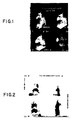
- Figure 1 shows gamma scintigrams of a dog at various times after injection of technetium-99m labeled myosin-specific Fab' fragment.
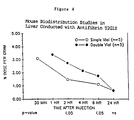
- Figure 2 shows gamma scintigrams of the same dog taken from different views.
- FIG 3 shows the results of mouse biodistribution studies in blood conducted with antifibrin T2G1S prepared in single vial and double vial labeling kits.
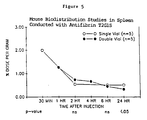
- FIG 4 shows the results of mouse biodistribution studies in liver conducted with antifibrin T2G1S prepared in single vial and double vial labeling kits.
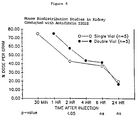
- Figure 5 shows the results of mouse biodistribution studies in spleen conducted with antifibrin T2G1S prepared in single vial and double vial labeling kits.
- Figure 6 shows the results of mouse biodistribution studies in kidney conducted with antifibrin T2G1S prepared in single vial and double vial labeling kits.
- Figure 7 shows the results of mouse biodistribution studies in large intestine conducted with antifibrin T2G1S prepared in single vial and double vial labeling kits.
- the method of this invention is performed by reacting Technetium-99m (in an oxidized state) with a water-soluble ligand in the presence of a reducing agent to form a stable complex between technetium-99m in a reduced state (e.g., IV or V valence state) and the ligand and then reacting the complex with an antibody or antibody fragment which contains one or more sulfhydryl groups.
- a reducing agent e.g., a reduced state
- an antibody or antibody fragment which contains one or more sulfhydryl groups.
- aqueous sodium 99m-pertechnetate is mixed with a aqueous solution of a stannous reducing agent and saccharic acid (or a salt thereof) to form a 99m Tc-saccharate complex.
- the complex is then contacted with an Fab' fragment and incubated for a period of time and under conditions which allow an exchange of technetium-99m from the complex to the Fab' fragment to form a technetium-labeled Fab' fragment.
- the entire procedure can be conducted in less than one hour at room temperature and at a pH of about 5-9. Under these conditions an essentially complete transfer of technetium-99m (from the 99m-Tc-saccharate complex to the antibody protein) can be attained without significant loss of antibody immunoreactivity.
- This invention provides a method of radiolabeling protein in a single vial.
- the reduction of the oxidized form of technetium-99m and the radiolabeling reaction i.e., the coupling of the radioisotope to protein
- vial refers to any type of reaction vessel and is not intended to be limiting in any way.
- the method is simple, efficient, and reproducible and it minimizes the safety hazards to persons performing the radiolabeling.
- the method of this invention is particularly suited for labeling antibodies (polyclonal and monoclonal) for diagnosis. Antibodies can be labeled by this method to a high specific activity with minimal loss of immunoreactivity.
- Advantages with the present one vial method over methods using two vials and other known methods for labeling with technetium-99m include: (1) Rapid labeling at ambient conditions. Labeling yields greater than 90% can be achieved in 5-15 minutes at ambient temperature without heating. The clinical advantages of near instantaneous preparation of a diagnostic agent can be substantial. (2) Stability of the lyophilized formulation of the single vial method is superior to the comparable formulation employed in a two vial method. (3) Biodistribution studies of the product resulting from the one vial method show statistically significant differences in key major organs. Uptake in kidney and liver is lower with product produced by this method. Blood clearance is significantly faster.
- Plasma stability of the product is greater. This provides more viable intact product to serve as the diagnostic agent in vivo.
- an antibody mixture comprised sylfhydryl containing antibody or antibody fragment, a reducing agent and a water soluble ligand are added to a vial.
- sealable reaction vial is used which has means for the introduction and withdrawal of reagent preferably under sterile or semi-sterile conditions.
- a vial which contains a port for syringe injection is preferred. All reagents can be injected and withdrawn from the reaction vial by syringe, thereby reducing the risk of exposure to radio- or biohazardous reagents.
- the mixture is lyophilized and the vial is presealed and supplied for use in that form.
- technetium-99m in an oxidized state is contacted with the antibody mixture.
- the radiolabelling reaction is then allowed to proceed.
- the duration and condition of incubation are not critical. Preferably, incubation is conducted for a period from about one minute to about 60 minutes, and most preferably from about 5 minutes to about 30 minutes.
- the labeled antibody or antibody fragment is withdrawn from the vial. No separation or purification is required.
- the entire procedure can be conducted in less than 15 minutes at ambient temperature and at a pH of about 5-9. Under these conditions an essentially complete labeling of the antibody or antibody fragment with technetium-99m can be attained without significant loss of antibody immunoreactivity.
- the ligands useful in the method of this invention are water-soluble (or can be made water soluble) chelators which are capable of complexing technetium-99m or any of the rhenium radioisotopes in their reduced state to form a stable metal ion/ligand complex.
- the complex is capable of exchanging the technetium-99 with a sulfhydryl containing antibody or antibody fragment.
- the ligands used in this invention are polyhydroxydicarboxylic acids having a molecular weight of less than about 10,000 daltons, and are selected from saccharic acid, galactaric acid, arabonic acid, and salts thereof.
- the particularly preferred ligand for use in this method is saccharic acid.
- saccharic acid complexes with technetium-99m quickly to form a stable technetium-99m-saccharate complex.
- a sulfhydryl-containing antibody or antibody fragment substantially quantitative transfer of technetium-99m from the complex to the protein is achieved rapidly and under mild conditions.
- the technetium-99m is preferentially transfered to favored binding sites on the protein molecules. This preferential transfer results in a labeled antibody or fragment which is immunoreactive and exceptionally stable in vivo .
- Reducing agents for use in the method are physiologically acceptable for reducing technetium-99m from its oxidized state to the IV or IV oxidization state or for reducing rhenium from its oxidized state.
- reducing agents which can be used in the method are stannous chloride, stannous fluoride, stannous tartarate, and sodium dithionite; the preferred agents are stannous reducing agents especially stannous chloride.
- the source of Technetium-99m should preferably be water soluble. Preferred sources are alkali and alkaline earth metal pertechnetate (TcO4 ⁇ ).
- the technetium-99m is most preferably obtained in the form of fresh sodium pertechnetate from a sterile technetium-99m generator (e.g., from a conventional 99Mo/99mTc generator). Any other source of physiologically acceptable technetium-99m, however, may be used.
- Rhenium radioisotopes (the isotopes 186, 188, 189 and 191) in the form of perrhenate salts can be produced by suitable reactor technology or made by a suitable generator.
- the perrhenate salts are stable, soluble salts and behave similarly to pertechnetate.
- Perrhenate requires a slightly greater reduction potential to reduce, and tends to return to perrhenate in the presence of oxygen more readily than pertechnetate. For this reason, different conditions may be required to reduce and stabilize rhenium in its reduced state. These can be ascertained empirically by a person of ordinary skill in the art.
- the sulfhydryl containing whole antibodies or lower molecular weight antibody fragments can be labeled by the method of this invention. It is believed that sulfhydryl groups constitute at least a part of favored binding sites which exist on molecules and that by the method of this invention, the radiometals are preferentially exchanged from the radiometal-ligand complex to these favored sites on the molecules. The preferential labeling of these sites on the antibodies molecules results in labeled antibodies of exceptional stability.
- Whole antibodies e.g. IgG
- a reducing agent such as dithiothreitol DTT.
- DTT dithiothreitol
- antibody fragments are preferred reagents.
- Antibody fragments have a number of advantages over whole antibodies for imaging procedures including, in general, more rapid distribution and accumulation at target site and less immunogenicity.
- Fab' fragments are monovalent antibody binding which contain free sulfhydryl groups (when maintained under non-oxidizing conditions). These fragments can be labelled efficiently by the method of this invention.
- Fab' fragments can be prepared from whole antibodies as follows: An antibody molecule is first treated with an endopeptidase such as pepsin to remove the Fc portion of the antibody molecule. The resultant F(ab)'2 fragment is treated with a reducing agent such as DTT or cysteine to break disulfide bonds present on the F(ab)'2 fragment resulting in exposed the sulfhydryl groups present on the molecules and thereby producing two Fab' molecules for each antibody molecule.
- an endopeptidase such as pepsin
- a reducing agent such as DTT or cysteine
- the amount of reducing agent is the amount necessary to reduce the technetium to provide for the binding to the ligand in a reduced state.
- stannous chloride (SnCl2) is the reducing agent and can range from 1-1,000 ug/ml preferably about 30-500 ug/ml.
- the amount of saccharic acid (as potassium saccharate) can range from about 0.5 mg/ml up to the amount maximally soluble in the medium. Preferred amounts of saccharic acid range from 30-15 ug/ml.
- the amount of antibody (or fragment) can range from 0.01 to about 30 mg/ml preverably about .17 to about 1.5 mg/ml.
- technetium-99m in the form of pertechnetate can be in amounts used up to about 500 uCi/ml preferably about 1-50 mCi/ml.
- the amount of mCi per mg of antibody is preferably about 3-150.
- the reaction between the and the metal ion-transfer ligand complex is preferably carried out in an aqueous solution at a pH at which the protein is stable.
- stable it is meant that the protein remains soluble and retains its biological activity.
- the pH for the reaction will be a pH from about 5 to 9, the preferred pH being about 6-8.
- the metal ion-transfer chelate complex and the antibody are incubated, preferably at a temperature from about 20°C to about 60°C, most preferably from about 20°C to about 37°C, for a sufficient amount of time to allow transfer of the metal ion from the ligand complex to the antibody. Generally, less than one hour is sufficient to complete the transfer reaction under these conditions.
- kits for convenient performance of the method in the clinic can consist of a one component a vial (sealed and sterile) containing a reducing agent (preferably stannous ions) and saccharic acid or a salt thereof. These kits can be used when the antibody or antibody fragment is provided by the user.
- a kit for radiolabeling antibody or antibody fragments with the radiometals can consist of a one component a vial (sealed and sterile) containing a reducing agent (preferably stannous ions) and saccharic acid or a salt thereof.
- Kits may also include a second vial containing the sulfhydryl-containing antibody or antibody fragment to be labeled.
- Two component kits would include:
- Kits can be designed to contain the appropriate antibody or antibody fragment(s) for any particular immunodiagnostic or immunotherapeutic procedure (some of which are discussed below).
- the reagents in the kit can be provided in aqueous, lyophilized or from form. Lyophilized preparations can be diluted with aqueous medium upon use. The amount of reagents in each vial can vary according to the chosen parameters of the method (see above under Reaction Conditions).
- the labeling procedure can be performed simply as a two vial technique.
- Technetium-99m for example, in the form of aqueous sodium pertechnetate
- the contents of the two vials are then mixed and incubated for a time sufficient to effect labeling of the antibody or antibody fragment.
- the radiolabeled antibody or antibody fragment can then be used immediately without purification.
- the kit contains one vial (sealed and sterile) containing a sulfhydryl containing antibody or antibody fragment, a reducing agent (preferably stannous ions) and a water soluble ligand (preferably D-glucaric acid or a salt thereof).
- a sulfhydryl containing antibody or antibody fragment preferably stannous ions
- a water soluble ligand preferably D-glucaric acid or a salt thereof.
- kits can be used when technetium-99m is provided by the user.
- the kits are designed to contain the appropriate antibody or antibody fragment(s) for any particular immunodiagnostic or immunotherapeutic procedure (some of which are discussed below).
- the reagents in the kit can be provided in aqueous, frozen or lyophilized form. Lyophilized preparations can be diluted with aqueous medium upon use.
- the amount of reagents in each vial can vary according to the chosen parameters of the method (see above under Reaction Conditions).
- the labeling procedure can be performed simply by adding technetium-99m (for example, in the form of aqueous sodium pertechnetate) to the vial containing the antibody or antibody fragment, reducing agent and, in a preferred embodiment, water soluble ligand. The contents of the vial are then mixed and incubated for a time sufficient to effect labeling of the antibody or antibody fragment. The radiolabeled antibody or antibody fragment can then be used immediately without purification.
- Technetium-99m labeled antibodies or antibody fragments can be used in immunoscintigraphy. One important use is in the imaging of tumors. As mentioned, antibody fragments are preferred for most immunoscintigraphic techniques. Labeled Fab' fragments of tumor specific antibodies can be prepared and used to image primary or secondary tumors. In general, the technetium-99m labeled antibody fragment is prepared by forming an aqueous mixture of (i) 99m Tc; and (ii) a reducing agent and a water-soluble ligand; and contacting the mixture with an Fab' fragment specific for the tumor.
- the labeled Fab' fragment can then be injected parenterally (preferably intraveneously) into a subject. After injection, sufficient time is allowed for the labeled Fab' fragment to accumulate at the site of the tumor. The subject is then scanned with a gamma camera to detect the gamma emission of the technetium-99m and to thereby to obtain an image of the tumor. In this way the tumor can be localized and its size can be determined.
- Tumor-specific antibody fragments for use in these procedures can be derived from anticolorectal cancer antibody, antilung cancer antibody anti-ovarian cancer antibody, antibreast cancer antibody, and antiprostate cancer antibody.
- tumor specific antibodies which can be labeled by the method of this invention and used to image tumors are the monoclonal antibodies 17-1A and 19-9 (gastrointestinal), CA 125 (ovarian) and 103D2 (breast).
- Antibodies labeled by the method of this invention can be used to label myocardial infarcts.
- the imaging of myocardial infarcts to determine their size and location is described by Haber, U.S. Patent No. 4,421,735.
- an image of a mycocardial infarct in a subject can be obtained by first preparing a Tc-99m labeled myosin specific Fab' fragment by first forming an aqueous mixture of (i) 99m Tc and (ii) a reducing agent and a water soluble ligand for 99m Tc; and then contacting the mixture with a myosin specific Fab' fragment.
- the labeled myosin specific fragment is then intraveneously injected into a subject (for example, after coronary occlusion).
- the labeled fragment is allowed to localize at the site of the infarct and an image of the infarct is obtained by scanning the area of the heart with a gamma camera.
- a preferred antibody for production of labeled myosin-specific Fab' fragments is the monoclonal antibody R11D10.
- fibrin-specific Fab' fragments can be labelled by the procedure of this invention to provide reagents for imaging blood clots.
- a Tc-99m labeled fibrin-specific fragment is prepared by forming an aqueous mixture of (i) 99m Tc and (ii) a reducing agent and a water soluble ligand for 99m Tc and contacting the mixture with a fibrin specific Fab' fragment.
- the 99m Tc-labeled fibrin specific fragment is injected into the subject. After allowing the fragment to localize at the site of the blood clot, the subject is scanned to obtain an image of the clot.
- Fibrin-specific antibodies which are not cross-reactive with fibrinogen are the preferred antibodies for this imaging technique.
- Antibody fragments specific for bacteria can be used in immunoscintigraphic techniques for obtaining an image of a bacterial abscess in a subject.
- anti-bacterial or anti-macrophage antibody fragments are employed.
- Antibodies against a common determinant of gram-negative bacteria e.g., anti-lipid A antibody
- the antibody is labeled with technetium-99m as described above injected into the subject and allowed to localize at the abscess.
- the subject is then scanned with the photoscanning equipment to obtain an image of the abscess.
- Rhenium-labeled antibody or antibody fragments can be used to selectively deliver rhenium radioisotopes to target cells in vivo .
- rhenium labeled antibodies can selectively seek out and destroy cancer cells.
- tumor specific antibodies such as those described above, can be labeled by the method of this invention and the resulting labeled antibody can be injected parenterally into a subjected afflicted with the tumor.
- the invention is further illustration by the following exemplification.
- Monopotassium saccharate 25 mg was dissolved in 0.2M bicarbonate (1.0 ml) at pH 8.0.
- To 500 ul of saccharate solution was added 40 ul of stannous chloride (2.5 mg/ml) in 0.1M acetic acid followed by 500 ul of Tc-99m generator eluate (_60mCi/mg protein).
- the resulting solution was allowed to stand for 5 minutes at room temperature and then analyzed for radiochemical purity by paper chromatography (Whatman 3MM, 60% CH3CN:40%H2O).
- Antimyosin monoclonal antibody R11D10 F(ab')2 5mg/ml in 40mM TRIS pH 7.0 was reduced with 10mM DTT for 60 minutes at room temperature and then passed through a Sephadex G-25 column to remove the reducing agent.
- the resulting solution contained _80% Fab' fragment by gel-filtration HPLC.
- Antimyosin antibody R11D10 Fab' 500 ul of a 1 mg/ml solution in 50mM phosphate, 0.35 mM ZnCl2, pH 6.5 was mixed with 500 ul of 99m Tc-saccharate solution and allowed to stand at room temperature for 5-60 minutes.
- the resulting 99m Tc-labeled protein was analyzed for radiochemical purity by paper chromatography (Whatman 3MM; 60% CH3CN: 40%H2O) and gel-filtration HPLC, and for immunoreactivity using a myosin affinity column.
- the 99m Tc-labeled R11D10 Fab' was nearly 80% immunoreactive after 3 hours and 70% immunoreactive after 20 hours. The latter corresponded to 80% retention of immunoreactivity found immediately after labeling.
- FIG. 1 shows the gamma scintigrams of a dog after 35 min. (upper left), 1.5 hours (upper right), 2.5 hours (lower left) and 5 hours (lower right) of antibody injection.
- Figure 2 shows the gamma images of the same dog as shown in Figure 1, right lateral (upper left), posterior anterior (lower right) views. Clear myocardial infarct images were observed in all views except the posterior position. More importantly, this figure shows no significant liver uptake 3 hours after injection of Tc-R11D10-Fab'.
- mice Biodistribution studies were carried out in Balb/c mice.
- the mice (4 mice per group) were injected I.V. with either 150 uCi of technetium-99m labeled R11D10 Fab' (4 uCi/ug) or 10 uCi of indium-111 labeled R11D10 Fab-DTPA (4 uCi/ug).
- mice were sacrificed at 1,4 and 8 hours after receiving the injections and organs removed, weighed and counted. Table VII summarizes the percent injected dose per gram obtained for each preparation.
- the 99m Tc-R11D10 Fab' cleared rapidly from both the blood and liver.
- the percent of injected dose for Tc-R11D10 Fab' in the blood at 1 hour was 13.6% and dropped to 2.0% after eight hours.
- a similar drop in radioactivity was observed in the liver at the latter time point (6.4% in 1 hour and 2.4% in eight hours).
- the indium-111 labeled preparation showed much higher radioactivity in both liver (10.8%) and blood (5.1%) at the eighth hour after injection.
- Monopotassium arabonate (20 mg) was dissolved in 0.1M Na2CO3 (1.0 ml) at pH 10.0.
- To 500 ul of arabonate solution was added 500 ul of Tc-99m generator eluate (approx. 60mCi/mg protein) followed by 40 ul of stannous chloride (2.5 mg/ml) in 0.1M acetic acid.
- the resulting solution was allowed to stand at room temperature for 30 minutes and then adjusted to pH 7 using 1.0M hydrochloric acid.
- the sample was analyzed for radiochemical purity by paper chromatography (Whatman 3MM, 60% CH3CN:40% H2O).
- Antimyosin antibody R11D10 Fab' 500 ul of a 1 mg/ml solution in 50mM phosphate, 0.35 mM ZnCl2, pH 6.5 was mixed with 500 ul of 99m Tc-arabonate solution and allowed to stand at room temperature for 60 minutes. The resulting 99m Tc-labeled protein was analyzed for radiochemical purity as previously noted in Example 1. The results showed quantitative transfer of 99m Tc to the protein under these conditions.
- T2G1s F(ab')2 antibody fragment (162 mg) in tris buffer (15.5 ml, 0.05M, pH 8.0) with sodium chloride (0.1M) was treated with DTT (1mM) for 1-2 hours at ambient temperature.
- the resulting mixture was purified by diafiltration under argon by exchange with 20 volumes of sodium phosphate buffer (0.05M, pH 6.4) containing sodium chloride (0.1M) and EDTA (0.001M) to yield a solution containing T2G1s Fab' (135 mg, concentration 1 mg/mL).
- a vial was prepared to contain T2G1s Fab' (0.5 mg), prepared substantially as described above in subsection A.1 above, in a buffer solution (1.0 mL) of potassium phosphate (0.05M, pH 6.4), sodium chloride (0.1M) and EDTA (0.001M). The vial was sealed with a rubber vial closure.
- a vial was prepared to contain T2G1s Fab' (0.5 mg), prepared substantially as described above in subsection A.1 above, in a buffer solution (1.0 mL) of potassium phosphate (0.05M, pH 6.4), sodium chloride (0.05M), lactose (0.05M) and EDTA (0.0005M). The contents of the vial were lyophilized and then sealed with a rubber vial closure.
- vials were prepared to contain a solution (1.0 ml) of monopotassium D-glucaric acid (12.5 mg, 0.05 mmol), stannous chloride (150 ug, 0.79 umol) and sodium bicarbonate (16.8 mg, 0.2 mmol, pH 7.6).
- the contents of vial were lyophilized and then sealed with a rubber vial closure.
- Immunoreactivity of the labeled antibody was tested by applying an aliquot of the antibody reaction mixtures to an affinity column (the first seven amino acids of the amino terminus of the beta chain of human fibrin, coupled to CNBr-Sepharose® 6B). The volume of the packed bed was 1 mL. The column was eluted with 10 mL of 1% BSA in 0.01M sodium phosphate, 0.145M NaCl, pH 7.0, followed by elution with 10 mL of 0.1M glycine, pH 2.5. During these elutions, 1 milliliter fractions were collected and counted in a NaI(Tl) well counter. The percent immunoreactivity was computed as: The results are shown in Tables VIII and IX.
- Table 1 also shows rates of labeling for the one vial and two vial kits as determined by % protein incorporation according to the paper chromatography technique described in subsection A.3 above. The results show that the one vial kit produces labeled product faster than the two vial kits.
- Table VIII Labeling Ratio of One Vial and Two Vial Kits Kit Storage Temp (°C) Age When Tested (Days) % Protein Incorporation Immunoreactivity (%) 5' 15' 30' 60' Two Vial Solution 4° 7 NA 65 78 87 78 Two Vial Lyophilized 4° 7 61 86 89 93 93 One Vial 4° 6 93 94 95 95 98
- the stability of the one vial and two vial kits were determined by % protein incorporation according to the paper chromatography described in subsection A.3 above at both 4° and 37°. The results are shown in Table 2. The results demonstrate that the one vial kit maintains superior labeling efficiency in the 12-17 day period when stored at 37°.
- Labeled antibody was prepared as described in the above examples and comparative experiment (solution formulation).
- the 99m Tc labeled T2G1s Fab' fragments (100 uL) were added to citrated plasma (50 uL).
- Table XI compares the plasma stability as determined by % protein incorporation at 37° of the products from the one vial and two vial kits versus control (no plasma added). The results shorn that the plasma stability of the one vial kit is better than the two vial kit.
Landscapes
- Health & Medical Sciences (AREA)
- Life Sciences & Earth Sciences (AREA)
- Proteomics, Peptides & Aminoacids (AREA)
- Pharmacology & Pharmacy (AREA)
- Physics & Mathematics (AREA)
- Chemical & Material Sciences (AREA)
- Medicinal Chemistry (AREA)
- Optics & Photonics (AREA)
- Immunology (AREA)
- Epidemiology (AREA)
- Animal Behavior & Ethology (AREA)
- General Health & Medical Sciences (AREA)
- Public Health (AREA)
- Veterinary Medicine (AREA)
- Medicines Containing Antibodies Or Antigens For Use As Internal Diagnostic Agents (AREA)
- Peptides Or Proteins (AREA)
Claims (26)
- Procédé de marquage direct d'un anticorps ou fragment d'anticorps contenant le radical sulfhydryle par un métal radioactif choisi dans le groupe formé par le technétium-99m, le rhénium-186, le rhénium-188, le rhénium-189 et le rhénium-191, comprenant les étapes suivantes :a. former un mélange de :i) le métal radioactif ; etii) un agent réducteur et un ligand polyhydroxycarboxylique hydrosoluble choisi parmi l'acide saccharique, l'acide galactarique, l'acide arabonique et leurs sels, le ligand étant capable de complexer le métal radioactif pour former un complexe soluble métal radioactif-ligand ;b. mettre en contact le mélange avec un anticorps ou fragment d'anticorps contenant le radical sulfhydryle dans des conditions permettant le transfert du métal radioactif à l'anticorps ou au fragment pour former un anticorps ou fragment d'anticorps marqué par le métal radioactif.
- Procédé de la revendication 1, dans lequel l'anticorps contenant le radical sulfhydryle est une IgG réduite.
- Procédé de la revendication 1, dans lequel le fragment d'anticorps est un fragment Fab'.
- Procédé de la revendication 1, dans lequel Fab' est produit par réduction d'un F(ab')₂ avec DTT.
- Procédé de la revendication 1, dans lequel l'agent réducteur est un agent réducteur stanneux.
- Procédé de la revendication 3, dans lequel le fragment Fab' est dérivé d'un anticorps antimyosine, antifibrine ou antiplaquettaire.
- Procédé de la revendication 3, dans lequel le fragment Fab' est dérivé d'un anticorps antitumoral.
- Procédé de la revendication 7, dans lequel l'anticorps antitumoral est un anticorps anti-cancer rectocolique, un anticorps anti-cancer ovarien, un anticorps anti-cancer du poumon, un anticorps anti-cancer du sein ou un anticorps anti-cancer de la prostate.
- Procédé de la revendication 3, dans lequel le fragment Fab' est dérivé d'un anticorps antibactérien ou antimacrophages.
- Procédé de la revendication 1 ou la revendication 5, dans lequel le fragment d'anticorps est un fragment Fab', le métal radioactif est le technétium-99m en solution aqueuse et le ligand hydrosoluble comprend un acide saccharique ou un sel de celui-ci.
- Procédé de la revendication 10 sous la dépendance de la revendication 5, dans lequel le mélange de technétium-99m, d'acide saccharique ou de son sel et d'agent réducteur stanneux est formé dans un premier flacon, et le contenu de ce premier flacon est ensuite mélangé avec le contenu d'un second flacon qui contient le fragment Fab' en solution aqueuse dans des conditions non oxydantes.
- Composition pour le radiomarquage direct d'anticorps ou fragments d'anticorps contenant le radical sulfhydryle par un métal radioactif choisi dans le groupe formé par le technétium-99m, le rhénium-186, le rhénium-188, le rhénium-189 et le rhénium-191, comprenant un mélange du métal radioactif, d'un agent réducteur et d'acide saccharique ou d'un sel de celui-ci dans une solution aqueuse ayant un pH de 5 à 9.
- Composition de la revendication 12, dans laquelle l'agent réducteur est un agent réducteur stanneux.
- Composition de la revendication 13, dans laquelle l'agent réducteur stanneux est le chlorure stanneux.
- Nécessaire pour le radiomarquage d'un anticorps ou fragment d'anticorps contenant le radical sulfhydryle par un métal radioactif choisi dans le groupe formé par le technétium-99m, le rhénium-186, le rhénium-188, le rhénium-189 et le rhénium-191, comprenant :a. un flacon contenant un mélange d'un agent réducteur et d'un ligand polyhydroxycarboxylique hydrosoluble choisi parmi l'acide saccharique, l'acide galactarique, l'acide arabonique et leurs sels ; etb. un flacon contenant un fragment Fab' dans des conditions non oxydantes.
- Nécessaire de la revendication 15, dans lequel le fragment d'anticorps est un fragment Fab', le métal radioactif est le technétium-99m et le ligand hydrosoluble est un sel d'acide saccharique.
- Nécessaire de la revendication 15 ou la revendication 16, dans lequel l'agent réducteur est un agent réducteur stanneux.
- Nécessaire de la revendication 16, dans lequel le fragment Fab' est dérivé d'un anticorps antimyosine, antifibrine ou antiplaquettaire.
- Nécessaire de la revendication 16, dans lequel le fragment Fab' est dérivé d'un anticorps antitumoral.
- Nécessaire de la revendication 19, dans lequel l'anticorps antitumoral est un anticorps anti-cancer rectocolique, un anticorps anti-cancer ovarien, un anticorps anti-cancer du sein ou un anticorps anti-cancer de la prostate.
- Nécessaire de la revendication 16, dans lequel le fragment Fab' est dérivé d'un anticorps antibactérien ou antimacrophages.
- Procédé de marquage d'un fragment d'anticorps Fab' contenant le radical sulfhydryle par le technétium-99m, consistant àa. obtenir un flacon contenant un mélange lyophilisé de :i. le fragment d'anticorps Fab' ;ii. un agent réducteur stanneux ; etiii. acide D-glucarique ; etb. ajouter au flacon une solution aqueuse de (99mTc)-pertechnétate de sodium.
- Nécessaire à flacon unique pour le marquage d'un anticorps ou fragment d'anticorps contenant le radical sulfhydryle par le technétium-99m, comprenant un mélange d'anticorps constitué d'un anticorps ou fragment d'anticorps contenant le radical sulfhydryle, d'un agent réducteur et d'un ligand polyhydroxycarboxylique hydrosoluble choisi parmi l'acide saccharique, l'acide galactarique, l'acide arabonique et leurs sels, au moyen duquel le mélange d'anticorps est mis en contact avec du technétium-99m en un état oxydé pour produire un anticorps ou fragment d'anticorps marqué.
- Nécessaire à flacon unique de la revendication 23, dans lequel le mélange d'anticorps est fourni sous forme lyophilisée.
- Procédé de la revendication 1, dans lequel les conditions qui permettent le transfert du métal radioactif sont : une température d'environ 20°C à environ 60°C, dans une solution aqueuse ayant un pH d'environ 5 à environ 9, pendant environ 1 heure.
- Procédé de la revendication 10, dans lequel les conditions dans lesquelles est exécutée l'étape (b) sont : une température d'environ 20°C à environ 60°C, dans une solution aqueuse ayant un pH d'environ 5 à environ 9, pendant environ 1 heure.
Applications Claiming Priority (5)
| Application Number | Priority Date | Filing Date | Title |
|---|---|---|---|
| US07/034,003 US5053493A (en) | 1987-04-02 | 1987-04-02 | Method for labeling antibodies with a metal ion |
| US12832887A | 1987-12-03 | 1987-12-03 | |
| US128328 | 1987-12-03 | ||
| PCT/US1988/001048 WO1988007382A2 (fr) | 1987-04-02 | 1988-04-01 | Procede de marquage d'anticorps a l'aide d'un ion metallique |
| US34003 | 2001-12-28 |
Publications (2)
| Publication Number | Publication Date |
|---|---|
| EP0354923A1 EP0354923A1 (fr) | 1990-02-21 |
| EP0354923B1 true EP0354923B1 (fr) | 1994-06-29 |
Family
ID=26710430
Family Applications (1)
| Application Number | Title | Priority Date | Filing Date |
|---|---|---|---|
| EP88904758A Expired - Lifetime EP0354923B1 (fr) | 1987-04-02 | 1988-04-01 | Procede de marquage d'anticorps a l'aide d'un ion metallique |
Country Status (6)
| Country | Link |
|---|---|
| EP (1) | EP0354923B1 (fr) |
| JP (1) | JPH02504387A (fr) |
| AT (1) | ATE107862T1 (fr) |
| CA (1) | CA1317544C (fr) |
| DE (1) | DE3850497T2 (fr) |
| WO (1) | WO1988007382A2 (fr) |
Families Citing this family (32)
| Publication number | Priority date | Publication date | Assignee | Title |
|---|---|---|---|---|
| US5328679A (en) * | 1988-04-01 | 1994-07-12 | Immunomedics, Inc. | Methods for technetium/rhenium labeling of proteins |
| US5061641A (en) * | 1988-04-01 | 1991-10-29 | Immunomedics, Inc. | Method for radiolabeling proteins |
| US5128119A (en) * | 1989-06-12 | 1992-07-07 | Immunomedics, Inc. | Methods for technetium/rhenium labeling of f(ab1)2 fragments |
| US5024829A (en) * | 1988-11-21 | 1991-06-18 | Centocor, Inc. | Method of imaging coronary thrombi |
| IT1232864B (it) * | 1989-06-28 | 1992-03-05 | Sorin Biomedica Spa | Dispositivo e procedimento per effettuare una pluralita' di trasformazioni sequenziali di un substrato |
| DK0486622T3 (da) * | 1989-08-09 | 1999-07-19 | Rhomed Inc | Direkte radiomærkning af antistoffer og andre proteiner med technetium eller rhenium |
| US5078985A (en) * | 1989-08-09 | 1992-01-07 | Rhomed, Incorporated | Radiolabeling antibodies and other proteins with technetium or rhenium by regulated reduction |
| US5346687A (en) * | 1989-08-09 | 1994-09-13 | Rhomed Incorporated | Direct radiolabeling of antibody against stage specific embryonic antigen for diagnostic imaging |
| US5443816A (en) * | 1990-08-08 | 1995-08-22 | Rhomed Incorporated | Peptide-metal ion pharmaceutical preparation and method |
| US5460785A (en) * | 1989-08-09 | 1995-10-24 | Rhomed Incorporated | Direct labeling of antibodies and other protein with metal ions |
| CA2065362A1 (fr) * | 1989-08-24 | 1991-02-25 | Fook-Thean Lee | Anticorps marques radioactivement pour imagerie |
| CA1340250C (fr) * | 1989-09-18 | 1998-12-15 | Hans J. Hansen | Methode pour le radiomarquage rapide d'un fragment d'anticorps monovalent a l'aide de technetium |
| US5277892A (en) * | 1990-08-08 | 1994-01-11 | Rhomed Incorporated | In vivo lymphocyte tagging |
| FI920459A7 (fi) * | 1991-02-05 | 1992-08-06 | Cis Bio Int | Menetelmä teknetium-99m:llä leimatun elinspesifisen aineen valmistamiseksi |
| US5849261A (en) * | 1991-02-08 | 1998-12-15 | Diatide, Inc. | Radiolabeled vasoactive intestinal peptides for diagnosis and therapy |
| US7238340B1 (en) | 1991-11-27 | 2007-07-03 | Cis Bio International | Monoamine, diamide, thiol-containing metal chelating agents |
| US5443815A (en) * | 1991-11-27 | 1995-08-22 | Diatech, Inc. | Technetium-99m labeled peptides for imaging |
| US5317091A (en) * | 1991-02-27 | 1994-05-31 | Akzo N.V. | Technetium-99m labeling of proteins |
| KR100238558B1 (ko) * | 1991-02-27 | 2000-02-01 | 에프.쥐.엠.헤르만스 | 단백질의 테크네튬-99m 표지화 |
| US5225180A (en) * | 1991-09-10 | 1993-07-06 | Diatech, Inc. | Technetium-99m labeled somatostatin-derived peptides for imaging |
| US5783170A (en) * | 1991-11-27 | 1998-07-21 | Diatide, Inc. | Peptide-metal chelate conjugates |
| CA2127284C (fr) * | 1992-01-03 | 2002-02-05 | Buck A. Rhodes | Applications pharmaceutiques a base de proteines et de peptides comportant un ion metallique |
| US5643549A (en) * | 1992-02-20 | 1997-07-01 | Rhomed Incorporated | Leukostimulatory agent for in vivo leukocyte tagging |
| US5326856A (en) * | 1992-04-09 | 1994-07-05 | Cytogen Corporation | Bifunctional isothiocyanate derived thiocarbonyls as ligands for metal binding |
| US5871711A (en) * | 1992-06-23 | 1999-02-16 | Diatide, Inc. | Radioactively-labeled somatostatin-derived peptides for imaging and therapeutic uses |
| US5716596A (en) * | 1992-06-23 | 1998-02-10 | Diatide, Inc. | Radioactively labeled somatostatin-derived peptides for imaging and therapeutic uses |
| US6017512A (en) * | 1992-06-23 | 2000-01-25 | Diatide, Inc. | Radiolabeled peptides |
| US5620675A (en) | 1992-06-23 | 1997-04-15 | Diatech, Inc. | Radioactive peptides |
| US6051206A (en) * | 1994-06-03 | 2000-04-18 | Diatide, Inc | Radiolabeled somatostatin-derived peptides for imaging and therapeutic uses |
| CN1062566C (zh) * | 1996-04-23 | 2001-02-28 | 中国科学院上海细胞生物学研究所 | 核素标记免疫球蛋白m单抗片段 |
| US6080384A (en) * | 1997-03-25 | 2000-06-27 | American Biogenetic Sciences, Inc. | Methods for radionuclide-labeling of biomolecules and kits utilizing the same |
| GB0416062D0 (en) * | 2004-07-19 | 2004-08-18 | Amersham Plc | Improved N4 chelator conjugates |
Family Cites Families (7)
| Publication number | Priority date | Publication date | Assignee | Title |
|---|---|---|---|---|
| DD118526A5 (fr) * | 1974-04-30 | 1976-03-12 | ||
| US4027005A (en) * | 1974-06-07 | 1977-05-31 | New England Nuclear Corporation | Diagnostic agents |
| US4418052A (en) * | 1980-08-12 | 1983-11-29 | Wong Dennis W | Diagnostic compositions and method for radiologic imaging of fibrinogen deposition in the body |
| US4673562A (en) * | 1983-08-19 | 1987-06-16 | The Children's Medical Center Corporation | Bisamide bisthiol compounds useful for making technetium radiodiagnostic renal agents |
| US4652440A (en) * | 1984-05-03 | 1987-03-24 | Paik Chang H | Method of stably radiolabeling antibodies with technetium and rhenium |
| ATE66469T1 (de) * | 1985-01-14 | 1991-09-15 | Neorx Corp | Metall-radionuklid markiertes protein fuer diagnose und therapie. |
| US4877868A (en) * | 1986-03-12 | 1989-10-31 | Neorx Corporation | Radionuclide antibody coupling |
-
1988
- 1988-04-01 WO PCT/US1988/001048 patent/WO1988007382A2/fr not_active Ceased
- 1988-04-01 EP EP88904758A patent/EP0354923B1/fr not_active Expired - Lifetime
- 1988-04-01 AT AT88904758T patent/ATE107862T1/de not_active IP Right Cessation
- 1988-04-01 DE DE3850497T patent/DE3850497T2/de not_active Expired - Fee Related
- 1988-04-01 JP JP88504358A patent/JPH02504387A/ja active Pending
- 1988-04-05 CA CA000563273A patent/CA1317544C/fr not_active Expired - Fee Related
Also Published As
| Publication number | Publication date |
|---|---|
| WO1988007382A3 (fr) | 1988-11-17 |
| DE3850497T2 (de) | 1995-02-23 |
| WO1988007382A2 (fr) | 1988-10-06 |
| JPH02504387A (ja) | 1990-12-13 |
| DE3850497D1 (de) | 1994-08-04 |
| CA1317544C (fr) | 1993-05-11 |
| EP0354923A1 (fr) | 1990-02-21 |
| ATE107862T1 (de) | 1994-07-15 |
Similar Documents
| Publication | Publication Date | Title |
|---|---|---|
| EP0354923B1 (fr) | Procede de marquage d'anticorps a l'aide d'un ion metallique | |
| US5648471A (en) | One vial method for labeling antibodies with Technetium-99m | |
| US5053493A (en) | Method for labeling antibodies with a metal ion | |
| US5128119A (en) | Methods for technetium/rhenium labeling of f(ab1)2 fragments | |
| JP3070763B2 (ja) | テクネチウムまたはレニウムでの抗体または他のタンパク質の直接放射能標識 | |
| US4424200A (en) | Method for radiolabeling proteins with technetium-99m | |
| US5011676A (en) | Method to directly radiolabel antibodies for diagnostic imaging and therapy | |
| US5328679A (en) | Methods for technetium/rhenium labeling of proteins | |
| US5116596A (en) | Process for the preparation of an organ-specific substance labeled with technetium-99m | |
| EP0237150A2 (fr) | Couplage de radionuclide et d'anticorps | |
| US5130118A (en) | Methods and materials for the preparation of metal labelled antibody solutions | |
| US5746996A (en) | Thiolation of peptides for radionuclide-based radiodetection and radiotherapy | |
| IL95723A (en) | Method for producing a solution of a technetium-labeled antibody fragment and a kit for radiolabeling an antibody fragment | |
| Gansow et al. | Chelates and antibodies: current methods and new directions | |
| Mardirossian et al. | The stability of 99Tcm directly labelled to an Fab'antibody via stannous ion and mercaptoethanol reduction | |
| US5723102A (en) | Process for the preparation of an organ-specific substance labeled with technetium-99m | |
| US5177192A (en) | Method for labeling antibodies with a metal ion | |
| AU709219B2 (en) | Thiolation of peptides for radionuclide-based radiodetection and radiotherapy | |
| EP0569531B1 (fr) | Fragments d'anticorps stabilises | |
| AU658403B2 (en) | Technetium-99m labeling of proteins | |
| USH735H (en) | Lead-203 as a label for radioimaging | |
| Griffiths et al. | Preparation of a pure 99mTc-F (ab′) 2 radioimmunoconjugate by direct labeling methods | |
| RHODES | Tumor Imaging with 99mTc-Labelled Antibody Fragmentst | |
| Gano | Technetium-99m labelling of the ior-CEA-1 monoclonal antibody: Evaluation of different methods | |
| IL113168A (en) | Method and kit for radiolabeling a protein using a radioisotope of rhenium |
Legal Events
| Date | Code | Title | Description |
|---|---|---|---|
| PUAI | Public reference made under article 153(3) epc to a published international application that has entered the european phase |
Free format text: ORIGINAL CODE: 0009012 |
|
| 17P | Request for examination filed |
Effective date: 19890929 |
|
| AK | Designated contracting states |
Kind code of ref document: A1 Designated state(s): AT BE CH DE FR GB IT LI LU NL SE |
|
| 17Q | First examination report despatched |
Effective date: 19910709 |
|
| GRAA | (expected) grant |
Free format text: ORIGINAL CODE: 0009210 |
|
| RAP1 | Party data changed (applicant data changed or rights of an application transferred) |
Owner name: CENTOCOR, INC. |
|
| AK | Designated contracting states |
Kind code of ref document: B1 Designated state(s): AT BE CH DE FR GB IT LI LU NL SE |
|
| PG25 | Lapsed in a contracting state [announced via postgrant information from national office to epo] |
Ref country code: IT Free format text: LAPSE BECAUSE OF FAILURE TO SUBMIT A TRANSLATION OF THE DESCRIPTION OR TO PAY THE FEE WITHIN THE PRE;WARNING: LAPSES OF ITALIAN PATENTS WITH EFFECTIVE DATE BEFORE 2007 MAY HAVE OCCURRED AT ANY TIME BEFORE 2007. THE CORRECT EFFECTIVE DATE MAY BE DIFFERENT FROM THE ONE RECORDED.SCRIBED TIME-LIMIT Effective date: 19940629 Ref country code: NL Effective date: 19940629 Ref country code: BE Effective date: 19940629 Ref country code: AT Effective date: 19940629 |
|
| REF | Corresponds to: |
Ref document number: 107862 Country of ref document: AT Date of ref document: 19940715 Kind code of ref document: T |
|
| REF | Corresponds to: |
Ref document number: 3850497 Country of ref document: DE Date of ref document: 19940804 |
|
| PG25 | Lapsed in a contracting state [announced via postgrant information from national office to epo] |
Ref country code: SE Effective date: 19940929 |
|
| ET | Fr: translation filed | ||
| NLV1 | Nl: lapsed or annulled due to failure to fulfill the requirements of art. 29p and 29m of the patents act | ||
| PLBE | No opposition filed within time limit |
Free format text: ORIGINAL CODE: 0009261 |
|
| STAA | Information on the status of an ep patent application or granted ep patent |
Free format text: STATUS: NO OPPOSITION FILED WITHIN TIME LIMIT |
|
| PG25 | Lapsed in a contracting state [announced via postgrant information from national office to epo] |
Ref country code: LI Effective date: 19950430 Ref country code: LU Free format text: LAPSE BECAUSE OF NON-PAYMENT OF DUE FEES Effective date: 19950430 Ref country code: CH Effective date: 19950430 |
|
| 26N | No opposition filed | ||
| REG | Reference to a national code |
Ref country code: CH Ref legal event code: PL |
|
| REG | Reference to a national code |
Ref country code: GB Ref legal event code: IF02 |
|
| PGFP | Annual fee paid to national office [announced via postgrant information from national office to epo] |
Ref country code: GB Payment date: 20060329 Year of fee payment: 19 |
|
| PGFP | Annual fee paid to national office [announced via postgrant information from national office to epo] |
Ref country code: DE Payment date: 20060330 Year of fee payment: 19 |
|
| PGFP | Annual fee paid to national office [announced via postgrant information from national office to epo] |
Ref country code: FR Payment date: 20060410 Year of fee payment: 19 |
|
| GBPC | Gb: european patent ceased through non-payment of renewal fee |
Effective date: 20070401 |
|
| PG25 | Lapsed in a contracting state [announced via postgrant information from national office to epo] |
Ref country code: DE Free format text: LAPSE BECAUSE OF NON-PAYMENT OF DUE FEES Effective date: 20071101 |
|
| PG25 | Lapsed in a contracting state [announced via postgrant information from national office to epo] |
Ref country code: GB Free format text: LAPSE BECAUSE OF NON-PAYMENT OF DUE FEES Effective date: 20070401 |
|
| PG25 | Lapsed in a contracting state [announced via postgrant information from national office to epo] |
Ref country code: FR Free format text: LAPSE BECAUSE OF NON-PAYMENT OF DUE FEES Effective date: 20070430 |