EP0355055B2 - Elektrisch betätigtes Fluidventil - Google Patents
Elektrisch betätigtes Fluidventil Download PDFInfo
- Publication number
- EP0355055B2 EP0355055B2 EP19890308094 EP89308094A EP0355055B2 EP 0355055 B2 EP0355055 B2 EP 0355055B2 EP 19890308094 EP19890308094 EP 19890308094 EP 89308094 A EP89308094 A EP 89308094A EP 0355055 B2 EP0355055 B2 EP 0355055B2
- Authority
- EP
- European Patent Office
- Prior art keywords
- valve
- port
- valves
- closure
- housing
- Prior art date
- Legal status (The legal status is an assumption and is not a legal conclusion. Google has not performed a legal analysis and makes no representation as to the accuracy of the status listed.)
- Expired - Lifetime
Links
Images


Classifications
-
- B—PERFORMING OPERATIONS; TRANSPORTING
- B60—VEHICLES IN GENERAL
- B60T—VEHICLE BRAKE CONTROL SYSTEMS OR PARTS THEREOF; BRAKE CONTROL SYSTEMS OR PARTS THEREOF, IN GENERAL; ARRANGEMENT OF BRAKING ELEMENTS ON VEHICLES IN GENERAL; PORTABLE DEVICES FOR PREVENTING UNWANTED MOVEMENT OF VEHICLES; VEHICLE MODIFICATIONS TO FACILITATE COOLING OF BRAKES
- B60T8/00—Arrangements for adjusting wheel-braking force to meet varying vehicular or ground-surface conditions, e.g. limiting or varying distribution of braking force
- B60T8/32—Arrangements for adjusting wheel-braking force to meet varying vehicular or ground-surface conditions, e.g. limiting or varying distribution of braking force responsive to a speed condition, e.g. acceleration or deceleration
- B60T8/34—Arrangements for adjusting wheel-braking force to meet varying vehicular or ground-surface conditions, e.g. limiting or varying distribution of braking force responsive to a speed condition, e.g. acceleration or deceleration having a fluid pressure regulator responsive to a speed condition
- B60T8/36—Arrangements for adjusting wheel-braking force to meet varying vehicular or ground-surface conditions, e.g. limiting or varying distribution of braking force responsive to a speed condition, e.g. acceleration or deceleration having a fluid pressure regulator responsive to a speed condition including a pilot valve responding to an electromagnetic force
- B60T8/3615—Electromagnetic valves specially adapted for anti-lock brake and traction control systems
- B60T8/363—Electromagnetic valves specially adapted for anti-lock brake and traction control systems in hydraulic systems
-
- B—PERFORMING OPERATIONS; TRANSPORTING
- B60—VEHICLES IN GENERAL
- B60T—VEHICLE BRAKE CONTROL SYSTEMS OR PARTS THEREOF; BRAKE CONTROL SYSTEMS OR PARTS THEREOF, IN GENERAL; ARRANGEMENT OF BRAKING ELEMENTS ON VEHICLES IN GENERAL; PORTABLE DEVICES FOR PREVENTING UNWANTED MOVEMENT OF VEHICLES; VEHICLE MODIFICATIONS TO FACILITATE COOLING OF BRAKES
- B60T8/00—Arrangements for adjusting wheel-braking force to meet varying vehicular or ground-surface conditions, e.g. limiting or varying distribution of braking force
- B60T8/32—Arrangements for adjusting wheel-braking force to meet varying vehicular or ground-surface conditions, e.g. limiting or varying distribution of braking force responsive to a speed condition, e.g. acceleration or deceleration
- B60T8/34—Arrangements for adjusting wheel-braking force to meet varying vehicular or ground-surface conditions, e.g. limiting or varying distribution of braking force responsive to a speed condition, e.g. acceleration or deceleration having a fluid pressure regulator responsive to a speed condition
- B60T8/36—Arrangements for adjusting wheel-braking force to meet varying vehicular or ground-surface conditions, e.g. limiting or varying distribution of braking force responsive to a speed condition, e.g. acceleration or deceleration having a fluid pressure regulator responsive to a speed condition including a pilot valve responding to an electromagnetic force
- B60T8/3615—Electromagnetic valves specially adapted for anti-lock brake and traction control systems
- B60T8/3675—Electromagnetic valves specially adapted for anti-lock brake and traction control systems integrated in modulator units
Definitions
- the present invention relates to a three-port valve device comprising a pair of two-port valves, for fluids such as hydraulic oil, combined in a single body or block. There may be more than one pair of two-port valves in the same common block.
- the object of the invention is compactness, sensitive rapid reactions to controls, and ease of manufacture.
- one valve (1) is normally closed (NC) and the other (2) normally open (NO): the combination has three ports of which a first (5) is connected directly with the housing interior (H1), of the NC valve (1); a second port (6) of the combination is connected to the exterior of the NC valve (1); and the third port (7) is connected to the exterior of the NO valve (2).
- a common conduit (3) is connected between the housing interior (H2) of the NC valve and that (H1) of the NO valve.
- the first port (5) is, according to one preference ideal for a connection to a utilization device, e.g. a wheel brake actuator, the second port (6) is advantageously applicable for connection to selectably either a constant high pressure source or a zero pressure purge source or reservoir according to an external selector, and the third port is for a high pressure source such as a master brake cylinder according to this advantageous application of the invention.
- a utilization device e.g. a wheel brake actuator
- the second port (6) is advantageously applicable for connection to selectably either a constant high pressure source or a zero pressure purge source or reservoir according to an external selector
- the third port is for a high pressure source such as a master brake cylinder according to this advantageous application of the invention.
- DE-C1-3 634 349 discloses part of the pre-characterizing part of Claim 1, which defines the invention.
- VAG Service Edudien programm Nr. 81, Technische Stand briefly 1986 discloses the entire pre-characterizing part of Claim 1 and discloses the state of the art.
- the invention as claimed also enables two two-port valves to be used in a compact economical arrangement; easy to set up, and (with a normally closed component) much easier to operate in a rapidly cyclic manner.
- US-A 3 818 927 discloses, for unloading a pump, a valve having a seat body secured between two fixed surfaces, a push-rod spring and a counter-thrusting valve-opening bias spring. There is also an axial adjuster. The adjuster operates on the former spring to alter its tension, not on the magnetic gap. The valve opening spring has the greater spring force, and is thus not the weaker spring.
- the function and structure of US-A 3 818 927 contrast substantially therefore with the proposal of the invention.
- Figure 1 is a sectional side view of the block showing a commoning conduit, with the two component valves in their normal, unenergized states.
- a normally closed valve 1 and a normally open valve 2 have their housing interiors H1, H2 commoned together by an internal passageway 3, which exits from a common block or body 4 for the two valves at a first port 5 of the combination.
- Body or block 4 accommodates everything including a second combination port 6 connected to the exterior 1A of the NC valve, a third port 7 connected to the exterior 2A of the other, NO valve 2, and an optional fourth port 10 may be connected via a one-way check-valve 11 in case it is desired to relieve excess pressure developing in the internal passageway 3 or the housings, especially when NO valve 2 happens to be closed.
- the check-valve low pressure side may be connected to the third port 7, so that the pressure at port 5 can react quickly to a lowering of the pressure applied to port 7.
- a first purpose of check-valve 11 is to allow port 5 to rapidly follow reductions or removal of the braking effort of the driver.
- a second purpose of the check-valve is as a safety feature in case the NO valve should stick in the closed condition after an ABS action should have ceased, in a preferred application where ABS action is phased out with pulsed high and low pressures.
- the “exteriors" of the NC and NO valves are the parts 1A and 2A below the seats defined by needle or other flap-type aperture-closing solenoid controlled members 12 and 13. Their housing interiors are their own housings.
- the commoning 3 is the common conduit connecting the housings.
- the NC valve 1 comprises a hexagonal sectioned longitudinal mobile armature part 14 of which the needle-shaped extremity 12 normally doses tightly under bias of a compression spring 16 against an aperture in a valve seat member 15 which has been fixed into the body 4.
- the housing H1 and the exterior 1A are thus not normally in communication.
- Valve 1 also has a fixed armature part 17, fixed in operation but in fact presettable axially e.g. by screwing it through threading 18 in a washer-shaped upper casing member 19 of magnetic circuit material.
- the presetting enables manual selection of a starting magnetic gap 20 (zero gap being shown, but this is merely a starting position before presetting a finite gap).
- the screwing allows accurate, repeatable gaps to be set, by unscrewing 0.5 turns, say.
- the coil raises needle 12 when energized, guided by a close-fitting guide tube 24 around the mobile armature 14.
- a magnetic cylindrical piece 25 clamped by screws in body 4 holds the coil and the upper and lower magnetic washer-shaped members.
- the magnetic materials may be drawn steel.
- the normally open valve 2 is structurally somewhat different from the NC 1. It has an upper mobile armature part 27, and a lower fixed armature part 28. In contrast to the NO, it is the mobile part that can, if desired, be manually presettable (mechanism similar to the NC valve, but not shown), so that a variable magnetic gap 29 is provided e.g. of 0.55mm. In a preferred use, it is less important to precisely control the sensitivity of the NC valve.
- the solenoid-controlled member is a needle 13 which passes through the armature parts, and its conical point 13A only seats on its seat 13B when the valve is energized, and gap 29 becomes reduced (preferably not zeroed) against a return spring 13C.
- the point 13A maybe 0.25 mm off its seat at the rest NO condition.
- the seat aperture may be 0.6mm in diameter, as presently preferred.
- the top of the NO housing is closed by a cap 30, which is held down by a magnetic cylindrical piece 31, this being clamped, like piece 25, by screws 26 into body 4.
- cap 30 When it is desired to make the magnetic gap 29 adjustable, cap 30 may have a threaded boss, not shown, and a bolt threaded fluid tightly into it, to bear on armature part 27. Adjustability will make the NO valve bulkier and may not always be as necessary as for the NC valve, which, in a preferred application of the inventive valve pair, has to be made sensitively responsive to each of a train of rapid electromagnetic pulses. However, it is often important to make the NO valve variable as well, to control sensitivity and response time.
- Valve 2 which shows a different NO valve 2 from that of Fig 1,the porting housing and NC valve may be identical to those of Fig 1.
- Valve 2 has a needle 13 with a conical point 13A able to close a 0.6 mm aperture in a seat 13B formed in a seating body 35, whenever a solenoid coil 36 is energized.
- 37A is part of the magnetic circuit, and 37B is part of the coil former.
- Seating body 35 has an upper part 35A which abuts firmly against a fixed magnetic armature portion 28 (or other part fixed to the housing). Therefore oil pressures etc cannot drive body 35 upwards.
- a valve spring 13C biasing the needle 13 upwards pushes against upper seating body part 35A, but cannot drive body 35 downwards because the valve body 4 has an annular shoulder at 35C, against which lower portion 35B is held. Therefore the seating body 35 is secured against vertical displacements that could affect the opening or closing of the seat.
- seating body 35 contains the necessary fluid passageways 37 hollowed out of it.
- the top of the needle 13 has an annular flange 13D serving as an abutment both for the upwardly pushing spring 13C and for a downwardly pushing push rod 38, by which the gap of seat 13B is dosed (or adjusted).
- Push rod 38 has firstly an upper narrow section 38A which passes through a valve closure cushioning spring 39 and an axial channel 27A in a mobile armature portion 27, secondly an intermediate wide section 38B against which spring 39 pushes and also which cannot pass a shoulder 27B formed by a constricted portion 27C of the axial channel 27A, and thirdly a lower thin portion 38C which passes through not only said constricted portion 27C but also through the fixed armature portion 28 as far as abutment with the needle flange 13D.
- the starting gap 29 (preferably 0.55mm in Figs 1 and 2) between the two magnetic armature portions 27, 28 determines magnetic sensitivity at the initial solenoid energization and also the closure pressure between the needle and the seat. The latter will also depend on the starting gap (presently preferred at 0.25 mm in Figs 1 and 2) between needle and seat).
- Gap 29 is adjusted by screwing in or out of a top cap 30 by means of an axially threaded boss 40 an adjuster 41 having a screwdriver slot 42 which is accessible when a cover 43 has been removed. This cover may of course be integral with that of the NC valve.
- the adjuster 41 bears on the top of push rod 38, and screwing downwards against spring 13C firstly reduces the NO starting valve gap, and secondly reduces the magnetic gap 29 by the wide put 38C pushing the shoulder 27B of the mobile armature portion downwards.
- the valve spring 13C will push the valve needle and push rod upwards, whenever the adjuster is retracted upwards by unscrewing.
- Spring 39 ensures that wide part 38B maintains contact with shoulder 27B, and allows gap 29 to increase as the adjuster 41 is unscrewed, because spring 39 pushes upwards against a resilient washer or stopper 42 pushed into the mobile armature and hence rigid with it. Fluid may reach this area, and accordingly stopper 41 may need an O-ring 44 with boss 40 to ensure sealing during adjustments.
- Gap 29 must be larger than the seating gap by enough to ensure its not being closed, until the valve has closed firmly during closure energization, as follows.
- the energized solenoid drives the mobile armature downwards because it tries to close gap 29 as well known. This allows spring 39 to drive the pusher downwards.
- the spring 39 alleviates the shock while allowing good sealing closure pressure on the seat to be maintained by the electromagnetic energization. This is why gap 29 must be appreciable immediately after closure (although it is ideally just zero in the stable closed state). It must not be too large or the electromagnetic closure pressure decreases (or requires more energy), so the relative gap sizes are a compromise.
- Valve spring 13C may be loaded at 0.5 decanewtons, and pushrod spring 39 somewhat more at 2.3 daN. Ideally the magnetic gap 29 should exceed the needle seating gap by sufficient to close the latter as aforesaid, then having regard to the pushrod spring 39 and the solenoid power, but be insufficient to do more than just (or nearly) to close the magnetic gap to zero against spring 39. Then the magnetic force is a maximum, and the valve seat 13B will not leak fluid e.g. hydraulic oil even under substantial pressure.
- the first phase even under energization will overcome spring 13C and seat the valve without pressure and without compressing spring 39, and the second phase will reduce the magnetic gap from a starting value, typically of 0.55 mm to zero by compressing spring 39 to a predetermined load, which is applied in turn to seal the valve seat.
- pushrod 38 is not connected with the surrounding mobile armature, except that its wide part 38B abuts shoulder 27B directly and abuts a shoulder at the top end via spring 39 - the shoulder being preferably provided by the resilient sealing stopper 42.
- Spring 13C is chosen strong enough for rapid opening on de-energization, and to confirm the open position of the needle (biased against adjuster 41 except when the solenoid is energized), yet not so strong as to require unnecessary closure force to be generated. The springs thus can be selected.
- a brake actuator mounted at a wheel (not shown) is connected to port 5
- a branch switchable over between a low pressure sink such as a purge source and a high pressure hydraulic source is connected to port 6
- a master cylinder i.e. manually initiated high pressure or servo-ed source is connected to port 7.
- the first mode of working would be non-ABS, i.e. the first mode would be with both valves unenergized, so that the braking effort source at port 7 would be connected through the NO seating, via housing interior H2, common passageway 3, the interior H1 of the NC valve, and thence to port 5 and the brake.
- This is normal braking.
- the check valve 11, if present, is not open, because the braking pressure at port 7 and exterior 2A of the NO valve 2 exceeds the pressure in passageway 3 and wheel port 5.
- the NO seating may have a cross-section of only 0.7mm, but this does not allow pressure loss enough to prejudice either the braking action, or the quick applying of the braking pressure to the port 5, and to the brake actuator at the wheel.
- the second mode would be ABS operation, with the NO valve energized and closed, and very shortly afterwards (e.g. 10 milliseconds) the NC being energised open. This period may be provided electronically, or by selecting the reaction time to energization of the valves, in order to ensure that the two valves are never open at the same time, however briefly.
- the second mode is sensed by means external to the valve, but on the vehicle, e.g. to detect a tendency to wheel lockup while braking on low friction surfaces, e.g. ice.
- ABS operation would involve the NC exterior 1A being connected or branched to a zero pressure source, so that braking effort is immediately removed from the brake actuator.
- the removal must be rapid, before a dangerous skid occurs for instance. This is why the above-mentioned delay period, e.g. of 10 milliseconds, must be very short.
- the inventive valve allows cautious resumption of the first mode in steps, or rapid re-initiation of drastic ABS action, according to the locking conditions being sensed.
- the invention relates to the novel valves and is not concerned with the sensing, or with the ABS system.
- the NC exterior 1A is again connected to the purge, source (or zero pressure) via port 6.
- the NC valve is again energized and opened and kept open with the NO valve having been closed 10 milliseconds earlier, and port 6 is branched to vacunm until the relevant wheel ceases to be locked.
- the first mode of normal braking can be resumed, not all at once, but cautiously in steps, because it can never be known whether the wheel will lock again almost immediately that braking action is allowed again, if the wheel is still on a low friction surface.
- the cautious resumption of braking in steps is as follows. Because the NC valve 1 can be so accurately adjusted in sensitivity to small and rapid electrical energization pulses, by rotating fixed armature part 17, the high pressure at port 5 is restored in steps, by rapid repeated brief applications of a high pressure source via port 6 to port 5, and to the brake. If no more locking occurs, the NC valve is closed, the NO valve is opened, and the master cylinder is again applied from port 7 to port 5. If locking again occurs during the stepwise restoration, the two valves are caused to remain energised, and the purge or zero pressure is applied to port 6. Full ABS acts again. There must be means to switch over the branching at port 6 between high and purge pressures, according to whether ABS, or stepped return to normal, is wanted at any instant.
- stepwise or gradual return to normal braking provides, that the NC valve is allowed to close and open only in little brief steps, after danger of locking is sensed as having terminated.
- the high pressure applied to port 6, port 5 and the brake would then rise from the zero of the purge pressure source at port 6 in steps of (say) 3-6 bars, by pulsing the NC open, in steps of (say) 6 millisec open and 20 ms closed. If locking conditions returned during the pulsing, full ABS would be re-introduced by again applying the zero pressure source to the port 6.
- NC valve described with the accurately adjustable armature gap, is well adapted for this sort of pumping action, to allow restoration of normal braking pressures. All this takes place without the driver lifting his foot off the brake, or even needing to think about it.
- the NO valve adjustable or not adjustable in magnetic gap may sometimes with advantage be hexagonal, so that space around them can add to the free housing volume H1 or H2.
- the check-valve 11 may have a 2mm cross-section when open, whereas that of the NO valve 2 may be only 0.6mm.
- the check-valve e.g. of a brass ball in a steel cage
- the check-valve is provided mainly because the braking pressure during normal braking must reduce rapidly when the driver stops braking. To put it more generally, if an excess pressure appears to be developing in the common path (3), and especially if the NC valve has been erroneously closed or even energized and normally closed, the check-valve will open.
- the NO valve opening aperture may be wide enough in some applications without a bypassing check valve.
- a pulse of the high pressure source may be applied just when the braking effort is not needed and the driver has ceased to apply braking force.
- the check valve 11 will assure rapidly reduced pressure at port 5.
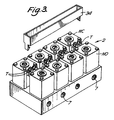
- valve pairs are easily integrated e.g. to enable ABS on four wheels.
- the 16 faston terminals T (for the solenoids) are mounted between the valves of each pair, where all 16 can be easily protected by a detachable rectangular surround 34.
- the input ports 7 of each NO valve 2 can be seen, and are destined to be connected in common to a master brake cylinder in the ABS system described.
Landscapes
- Physics & Mathematics (AREA)
- Electromagnetism (AREA)
- Engineering & Computer Science (AREA)
- Fluid Mechanics (AREA)
- Transportation (AREA)
- Mechanical Engineering (AREA)
- Magnetically Actuated Valves (AREA)
- Regulating Braking Force (AREA)
- Safety Valves (AREA)
- Fluid-Driven Valves (AREA)
Claims (8)
- Drei Anschlüsse aufweisende Ventilvorrichtung, insbesondere zur Verwendung in automatischen Bremssystemen,
mit zwei in einem Grundkörper integrierten Ventilen, wobei jedes der beiden Ventile ein zugehöriges Ventilverschlußglied (12 oder 13) enthält, das seinen zugehörigen gehäuseinneren Raum (H1 oder H2) mit einem zugehörigen ersten oder Zweiten Anschluß (5 oder 6) der Vorrichtung wahlweise verbinden kann, und wobei jedes der beiden Ventile ein Ventil mit zwei Anschlüssen ist, wovon eines der Ventile zwischen seinen Anschlüssen im Ruhezustand abgesperrt (NC) und das andere Ventil zwischen seinen Anschlüssen im Ruhezustand offen ist (NO); und
mit einem Durchlaß (3) zwischen den beiden gehäuseinternen Räumen (H1, H2), der auf der Seite des im Ruhezustand geschlossenen Ventils (NC) unmittelbar (d.h. nicht über eines der Ventilverschlußglieder) mit einem ersten Anschluß (5) der Anordnung verbunden ist und der bei geöffnetem, im Ruhezustand offenem Ventil (NO) über dessen Ventilverschlußglied (13) mit dem dritten Anschluß (7) in Verbindung steht, dadurch gekennzeichnet,
daß der Ventilsitz des im Ruhezustand offenen Ventils (NO) in einem getrennten Ventilsitzkörper (35) angeordnet ist, der an seinem oberen und an seinem unteren Ende gegen axiale Bewegung durch querverlaufende Schultern gesichert ist, die sich an an dem Gehäuse festen Teilen befinden;
daß die beiden Ventilverschlußglieder mit einem beweglichen Ankerteilteil eines zugeordneten zweiteiligen Ankers verbunden sind, der einen Luftspalt (23 oder 29) aufweist;
daß das im Ruhezustand offene Ventil (NO) ebenfalls eine Schubstangenfeder (39) und Anschläge (42, 27b) aufweist, die eine nachgiebige Verbindung mit dem beweglichen Ankerteil 27 bilden, wodurch Stöße bei abrupten Schließbewegungen des Ventilverschlußgliedes (13a) durch die Wirkung der Feder (39) aufgenommen werden; und
daß das im Ruhezustand offene Ventil (NO) einen magnetischen Luftspalt und einen Ventilspalt aufweist, die einstellbar sind, damit anfangs ein schnelles Schließen gegen die öffnend wirkende Vorspanneinrichtung (13c) und anschließend eine zusätzliche Magnetkraft hervorgerufen wird, die von der Schubstangenfeder (39) gemittelt wird. - Drei Anschlüsse aufweisende Ventilvorrichtung nach Anspruch 1, bei der die Schultern an einem festen Anker (28) und/oder an dem Gehäusekörper (4) verwirklicht sind, um axiale Bewegungen des Ventilsitzkörpers des im Ruhezustand offenen Ventils (NO) zu verhindern.
- Drei Anschlüsse aufweisende Ventilvorrichtung nach Anspruch 1 oder 2, bei dem das im Ruhezustand offene Ventil (NO) eine auf Öffnung gerichtete Vorspanneinrichtung (13c) aufweist, die sich gegen den Ventilsitzkörper (35) abstützt.
- Drei Anschlüsse aufweisende Ventilvorrichtung nach Anspruch 1, 2 oder 3, bei der der Durchlaß in seinem Abschnitt zwischen den entsprechenden Gehäuseinnenräumen (H1, H2) der beiden Ventile im wesentlichen gerade ist.
- Drei Anschlüsse aufweisende Ventilvorrichtung nach einem der Ansprüche 1 bis 4, bei der das Ventilverschlußglied (13) des im Ruhezustand offenen Ventils (NO) und sein zugehöriger Ventilsitz (13b) mittels eines im Bypass liegenden Rückschlagventils (11), das von dem gehäuseinternen Durchlaß (3) zwischen dem im Ruhezustand offenem und dem im Ruhezustand geschlossenen Ventil (NO, NC) ausgeht, überbrückt ist, wenn an dem dritten Anschluß (7) ein niedrigerer Druck herrscht als in dem Durchlaß (3).
- Drei Anschlüsse aufweisende Ventilvorrichtung nach einem der Ansprüche 1 bis 5, bei dem das im Ruhezustand offene Ventil (NO), z.B. weil schnelle und einstellbare Ansprechzeiten erforderlich sind, eine Einstellvorrichtung (41) aufweist, die über eine Schubstange (38) wirkt, um das Ventilverschlußglied (13a) und/oder den magnetischen Luftspalt (29) zwischen dem beweglichen und dem feststehenden Teil (27, 28) des magnetischen Kreises zu verändern.
- Vier gleichartige, drei Anschlüsse aufweisende Ventilanordnungen, alle nach einem der Ansprüche 1 bis 6, dadurch gekennzeichnet, daß sie in einem einzigen Grundkörper integriert sind, z.B. zur Verwendung bei einem Einzelrad-ABS, wobei alle Anschlüsse (T) ihrer Magnetspulen gleichsinnig ausgerichtet und gleichgerichtet sind, beispielsweise zur Vereinfachung ihres gemeinsamen Anschlusses an eine einzige Fluidquelle.
- Drei Anschlüsse aufweise Ventilvorrichtung oder Ventilvorrichtungen nach einem der Ansprüche 1 bis 7, die in einer Umgebung angeordnet oder für eine Umgebung gestaltet sind, in der die ersten Anschlüsse (5) an einen jeweils zugehörigen Bremszylinder, die zweiten Anschlüsse (6) an verzweigte Hoch- bzw. Niederdruckquellen und die dritten Anschlüsse (7) gemeinsam an durch den Fahrer steuerbare Druckquellen angeschlossen sind, und bei denen das im Ruhezustand offene Ventil (NO) z.B. durch Wahl des magnetischen Luftspaltes (29) im Sinne der Fähigkeit, schnell zu reagieren, eingestellt ist. (N.B. die beschriebene Umgebung selbst wird nicht beansprucht).
Applications Claiming Priority (4)
| Application Number | Priority Date | Filing Date | Title |
|---|---|---|---|
| GB8819674 | 1988-08-18 | ||
| GB888819674A GB8819674D0 (en) | 1988-08-18 | 1988-08-18 | Electrically operated fluid valve |
| GB8905382 | 1989-03-09 | ||
| GB898905382A GB8905382D0 (en) | 1989-03-09 | 1989-03-09 | Electrically operated fluid valve |
Publications (3)
| Publication Number | Publication Date |
|---|---|
| EP0355055A1 EP0355055A1 (de) | 1990-02-21 |
| EP0355055B1 EP0355055B1 (de) | 1992-06-17 |
| EP0355055B2 true EP0355055B2 (de) | 1996-06-26 |
Family
ID=26294299
Family Applications (1)
| Application Number | Title | Priority Date | Filing Date |
|---|---|---|---|
| EP19890308094 Expired - Lifetime EP0355055B2 (de) | 1988-08-18 | 1989-08-09 | Elektrisch betätigtes Fluidventil |
Country Status (3)
| Country | Link |
|---|---|
| EP (1) | EP0355055B2 (de) |
| DE (2) | DE68901829T4 (de) |
| ES (1) | ES2032655T5 (de) |
Families Citing this family (11)
| Publication number | Priority date | Publication date | Assignee | Title |
|---|---|---|---|---|
| EP0449320B1 (de) * | 1990-03-30 | 1996-12-11 | Akebono Brake Industry Co., Ltd. | Bremssteuereinheit |
| US5188436A (en) * | 1990-08-17 | 1993-02-23 | Allied-Signal Inc. | Linear variable pressure adaptive braking and traction control system |
| DE4204417A1 (de) * | 1990-09-07 | 1993-08-19 | Teves Gmbh Alfred | Elektromagnetventil, insbesondere fuer hydraulische bremsanlagen mit schlupfregelung |
| DE4041506C2 (de) * | 1990-12-22 | 1995-01-19 | Bosch Gmbh Robert | Absperrventil in einer hydraulischen Bremsanlage, insbesondere für Kraftfahrzeuge |
| DE4102626C2 (de) * | 1991-01-30 | 2001-08-09 | Bosch Gmbh Robert | Elektromagnetbetätigtes 2/2-Wegeventil, insbesondere für hydraulische Kraftfahrzeug-Bremsanlagen mit einer Blockierschutz- und Antriebsschlupfregeleinrichtung |
| DE4108028A1 (de) * | 1991-03-13 | 1992-09-17 | Teves Gmbh Alfred | Hydraulikaggregat fuer hydraulische steuer- oder regelvorrichtungen |
| JPH05248557A (ja) * | 1992-03-06 | 1993-09-24 | Sumitomo Electric Ind Ltd | 電磁弁 |
| DE102007028516A1 (de) * | 2007-06-21 | 2008-12-24 | Robert Bosch Gmbh | Magnetventil |
| DE102007053300A1 (de) * | 2007-11-08 | 2009-05-14 | Robert Bosch Gmbh | Magnetventil |
| DE102011006309A1 (de) * | 2011-03-29 | 2012-10-04 | Continental Teves Ag & Co. Ohg | Elektronische Kontrolleinheit für Kraftfahrzeugbremssysteme |
| DE102020104803A1 (de) | 2020-02-24 | 2021-08-26 | Bürkert Werke GmbH & Co. KG | Ventilstellantrieb sowie Baugruppe |
Family Cites Families (9)
| Publication number | Priority date | Publication date | Assignee | Title |
|---|---|---|---|---|
| GB677637A (en) * | 1949-04-26 | 1952-08-20 | Electro Hydraulics Ltd | Improvements in or relating to electrical pull magnets |
| DE2052307A1 (de) * | 1970-10-24 | 1972-05-25 | Teves Gmbh Alfred | Elektromagnetisch betätigtes Sitzventil |
| DE2208183A1 (de) * | 1972-02-22 | 1973-08-30 | Bosch Gmbh Robert | Magnetventil |
| US3818927A (en) * | 1973-06-18 | 1974-06-25 | Control Concepts | Normally open solenoid operated valve assembly with relief function |
| US4206950A (en) * | 1978-04-17 | 1980-06-10 | The Bendix Corporation | Anti-skid and anti-spin brake system |
| DE3609340C2 (de) * | 1986-03-20 | 1995-06-08 | Bosch Gmbh Robert | Steuerventil |
| DE3634349C1 (de) * | 1986-10-09 | 1987-05-21 | Daimler Benz Ag | Baugruppe aus mehreren unabhaengig voneinander elektromagnetisch schaltbaren Wegeventilen |
| DE3737316A1 (de) * | 1986-11-15 | 1988-07-28 | Volkswagen Ag | Schlupfgeregelte hydraulische kraftfahrzeug-bremsanlage |
| DE3729216A1 (de) * | 1987-09-02 | 1989-03-16 | Teves Gmbh Alfred | Hydraulikaggregat |
-
1989
- 1989-08-09 DE DE1989601829 patent/DE68901829T4/de not_active Expired - Lifetime
- 1989-08-09 DE DE1989601829 patent/DE68901829D1/de not_active Expired - Lifetime
- 1989-08-09 EP EP19890308094 patent/EP0355055B2/de not_active Expired - Lifetime
- 1989-08-09 ES ES89308094T patent/ES2032655T5/es not_active Expired - Lifetime
Also Published As
| Publication number | Publication date |
|---|---|
| DE68901829T2 (de) | 1996-09-19 |
| ES2032655T5 (es) | 1996-10-01 |
| EP0355055A1 (de) | 1990-02-21 |
| DE68901829D1 (de) | 1992-07-23 |
| EP0355055B1 (de) | 1992-06-17 |
| ES2032655T3 (es) | 1993-02-16 |
| DE68901829T4 (de) | 1997-02-13 |
Similar Documents
| Publication | Publication Date | Title |
|---|---|---|
| EP0355055B2 (de) | Elektrisch betätigtes Fluidventil | |
| US5167442A (en) | Hydraulic brake system for motor vehicles | |
| CA1265172A (en) | Integrated three way and isolation solenoid valve | |
| JP3305345B2 (ja) | アンチスキッド制御・駆動時スリップ制御装置を装備した自動車の油圧ブレーキ装置用の電磁作動式2ポート2位置切換え弁 | |
| EP0670445B1 (de) | Elektromagnetisches ventil | |
| US5975654A (en) | Valve unit, in particular for hydraulic brake systems with antilock and/or wheel-slip control | |
| US5605386A (en) | Solenoid valve for slip-controlled hydraulic brake systems in motor vehicles | |
| US4634190A (en) | Hydraulic brake system with slip control | |
| US5887956A (en) | Hydraulic brake system with slip control | |
| US5467797A (en) | Two-position three-way solenoid valve | |
| EP0445130A1 (de) | Integriertes dreiweg- und sperrmagnetventil. | |
| US5711583A (en) | Magnetic control valve for a slip-controlled hydraulic brake system for motor vehicles | |
| US5423602A (en) | Fluid pressure control valve | |
| US6390444B1 (en) | Two-stage parallel spring solenoid valve | |
| US5267785A (en) | Method for switching a pressure control device | |
| EP2334962B1 (de) | Ventil zur abgabe von fluiden | |
| US5649748A (en) | Electromagnetically actuated valve for slip-controlled hydraulic brake systems in motor vehicles | |
| EP0251519A2 (de) | Magnetisch betätigte Fluidströmungs-Steuerventile | |
| GB2238092A (en) | Anti-locking brake system for automotive vehicles | |
| US4987923A (en) | Solenoid valve | |
| US5681098A (en) | Anti-locking brake system with a switchable orifice control valve | |
| CN112747124A (zh) | 两级电磁阀 | |
| US3738387A (en) | Control valves for hydraulic fluids | |
| US3871717A (en) | Hydraulically operated brake pressure modulator | |
| US5286102A (en) | Brake control device |
Legal Events
| Date | Code | Title | Description |
|---|---|---|---|
| PUAI | Public reference made under article 153(3) epc to a published international application that has entered the european phase |
Free format text: ORIGINAL CODE: 0009012 |
|
| AK | Designated contracting states |
Kind code of ref document: A1 Designated state(s): DE ES FR GB IT |
|
| RIN1 | Information on inventor provided before grant (corrected) |
Inventor name: DRAGONI, CHRISTIAN VILLA L'ESPARRADOU Inventor name: ASENSIO, LOUIS |
|
| 17P | Request for examination filed |
Effective date: 19900514 |
|
| 17Q | First examination report despatched |
Effective date: 19910425 |
|
| GRAA | (expected) grant |
Free format text: ORIGINAL CODE: 0009210 |
|
| ITF | It: translation for a ep patent filed | ||
| AK | Designated contracting states |
Kind code of ref document: B1 Designated state(s): DE ES FR GB IT |
|
| REF | Corresponds to: |
Ref document number: 68901829 Country of ref document: DE Date of ref document: 19920723 |
|
| ET | Fr: translation filed | ||
| REG | Reference to a national code |
Ref country code: ES Ref legal event code: FG2A Ref document number: 2032655 Country of ref document: ES Kind code of ref document: T5 |
|
| PLBI | Opposition filed |
Free format text: ORIGINAL CODE: 0009260 |
|
| 26 | Opposition filed |
Opponent name: ALFRED TEVES GMBH Effective date: 19930312 |
|
| PUAH | Patent maintained in amended form |
Free format text: ORIGINAL CODE: 0009272 |
|
| STAA | Information on the status of an ep patent application or granted ep patent |
Free format text: STATUS: PATENT MAINTAINED AS AMENDED |
|
| 27A | Patent maintained in amended form |
Effective date: 19960626 |
|
| AK | Designated contracting states |
Kind code of ref document: B2 Designated state(s): DE ES FR GB IT |
|
| ITF | It: translation for a ep patent filed | ||
| ET3 | Fr: translation filed ** decision concerning opposition | ||
| REG | Reference to a national code |
Ref country code: ES Ref legal event code: DC2A Kind code of ref document: T5 Effective date: 19960722 |
|
| REG | Reference to a national code |
Ref country code: ES Ref legal event code: DC2A Kind code of ref document: T5 Effective date: 19960722 |
|
| REG | Reference to a national code |
Ref country code: GB Ref legal event code: IF02 |
|
| PGFP | Annual fee paid to national office [announced via postgrant information from national office to epo] |
Ref country code: ES Payment date: 20020827 Year of fee payment: 14 |
|
| PGFP | Annual fee paid to national office [announced via postgrant information from national office to epo] |
Ref country code: GB Payment date: 20030702 Year of fee payment: 15 |
|
| PGFP | Annual fee paid to national office [announced via postgrant information from national office to epo] |
Ref country code: DE Payment date: 20030829 Year of fee payment: 15 |
|
| PG25 | Lapsed in a contracting state [announced via postgrant information from national office to epo] |
Ref country code: GB Free format text: LAPSE BECAUSE OF NON-PAYMENT OF DUE FEES Effective date: 20040809 |
|
| PG25 | Lapsed in a contracting state [announced via postgrant information from national office to epo] |
Ref country code: ES Free format text: LAPSE BECAUSE OF NON-PAYMENT OF DUE FEES Effective date: 20040810 |
|
| PG25 | Lapsed in a contracting state [announced via postgrant information from national office to epo] |
Ref country code: DE Free format text: LAPSE BECAUSE OF NON-PAYMENT OF DUE FEES Effective date: 20050301 |
|
| GBPC | Gb: european patent ceased through non-payment of renewal fee |
Effective date: 20040809 |
|
| PG25 | Lapsed in a contracting state [announced via postgrant information from national office to epo] |
Ref country code: IT Free format text: LAPSE BECAUSE OF NON-PAYMENT OF DUE FEES;WARNING: LAPSES OF ITALIAN PATENTS WITH EFFECTIVE DATE BEFORE 2007 MAY HAVE OCCURRED AT ANY TIME BEFORE 2007. THE CORRECT EFFECTIVE DATE MAY BE DIFFERENT FROM THE ONE RECORDED. Effective date: 20050809 |
|
| REG | Reference to a national code |
Ref country code: ES Ref legal event code: FD2A Effective date: 20040810 |
|
| PGFP | Annual fee paid to national office [announced via postgrant information from national office to epo] |
Ref country code: FR Payment date: 20080807 Year of fee payment: 20 |
|
| REG | Reference to a national code |
Ref country code: FR Ref legal event code: CA Ref country code: FR Ref legal event code: TP Ref country code: FR Ref legal event code: CD |