EP0355847A2 - Verfahren zur Herstellung planarer Membranen - Google Patents
Verfahren zur Herstellung planarer Membranen Download PDFInfo
- Publication number
- EP0355847A2 EP0355847A2 EP89115720A EP89115720A EP0355847A2 EP 0355847 A2 EP0355847 A2 EP 0355847A2 EP 89115720 A EP89115720 A EP 89115720A EP 89115720 A EP89115720 A EP 89115720A EP 0355847 A2 EP0355847 A2 EP 0355847A2
- Authority
- EP
- European Patent Office
- Prior art keywords
- substrate
- membrane
- long
- lipid
- chain
- Prior art date
- Legal status (The legal status is an assumption and is not a legal conclusion. Google has not performed a legal analysis and makes no representation as to the accuracy of the status listed.)
- Granted
Links
Images
Classifications
-
- B—PERFORMING OPERATIONS; TRANSPORTING
- B82—NANOTECHNOLOGY
- B82Y—SPECIFIC USES OR APPLICATIONS OF NANOSTRUCTURES; MEASUREMENT OR ANALYSIS OF NANOSTRUCTURES; MANUFACTURE OR TREATMENT OF NANOSTRUCTURES
- B82Y30/00—Nanotechnology for materials or surface science, e.g. nanocomposites
-
- A—HUMAN NECESSITIES
- A61—MEDICAL OR VETERINARY SCIENCE; HYGIENE
- A61K—PREPARATIONS FOR MEDICAL, DENTAL OR TOILETRY PURPOSES
- A61K9/00—Medicinal preparations characterised by special physical form
- A61K9/10—Dispersions; Emulsions
- A61K9/127—Synthetic bilayered vehicles, e.g. liposomes or liposomes with cholesterol as the only non-phosphatidyl surfactant
- A61K9/1277—Preparation processes; Proliposomes
-
- B—PERFORMING OPERATIONS; TRANSPORTING
- B01—PHYSICAL OR CHEMICAL PROCESSES OR APPARATUS IN GENERAL
- B01D—SEPARATION
- B01D69/00—Semi-permeable membranes for separation processes or apparatus characterised by their form, structure or properties; Manufacturing processes specially adapted therefor
- B01D69/12—Composite membranes; Ultra-thin membranes
- B01D69/122—Separate manufacturing of ultra-thin membranes
-
- G—PHYSICS
- G01—MEASURING; TESTING
- G01N—INVESTIGATING OR ANALYSING MATERIALS BY DETERMINING THEIR CHEMICAL OR PHYSICAL PROPERTIES
- G01N33/00—Investigating or analysing materials by specific methods not covered by groups G01N1/00 - G01N31/00
- G01N33/48—Biological material, e.g. blood, urine; Haemocytometers
- G01N33/50—Chemical analysis of biological material, e.g. blood, urine; Testing involving biospecific ligand binding methods; Immunological testing
- G01N33/53—Immunoassay; Biospecific binding assay; Materials therefor
- G01N33/543—Immunoassay; Biospecific binding assay; Materials therefor with an insoluble carrier for immobilising immunochemicals
- G01N33/54313—Immunoassay; Biospecific binding assay; Materials therefor with an insoluble carrier for immobilising immunochemicals the carrier being characterised by its particulate form
- G01N33/5432—Liposomes or microcapsules
-
- B—PERFORMING OPERATIONS; TRANSPORTING
- B01—PHYSICAL OR CHEMICAL PROCESSES OR APPARATUS IN GENERAL
- B01J—CHEMICAL OR PHYSICAL PROCESSES, e.g. CATALYSIS OR COLLOID CHEMISTRY; THEIR RELEVANT APPARATUS
- B01J2219/00—Chemical, physical or physico-chemical processes in general; Their relevant apparatus
- B01J2219/00274—Sequential or parallel reactions; Apparatus and devices for combinatorial chemistry or for making arrays; Chemical library technology
- B01J2219/00718—Type of compounds synthesised
- B01J2219/0072—Organic compounds
- B01J2219/00734—Lipids
Definitions
- the present invention relates to a method of forming a planar bilayer membrane with a desired size on a substrate in a liquid phase, using a membrane-forming substance such as lipid or protein, under mild conditions and according to simple procedures.
- biomembrane is comprised of a lipid bilayer membrane as a basic structure, and fulfill a great variety of functions because of the various membrane proteins present in the membrane in a mixed state. If an artificial membrane can be reconstructed to mimick a biomembrane, it can be utilized for the filtration or concentration of useful substances by controlling, for example, the permeability to substances. It can also be used for the adsorption and combination of a trace of biotic substances by utilizing the affinity for the biotic substances. For example, development is made on enzyme or antibody sensors capable of detecting substances by retaining enzymes or antibodies in the membrane and by measuring the membrane potential or change in membrane resistance appearing when they have attached to a specific substrate or antigen.
- a technique of constructing a stable planar bilayer membrane of lipid required first of all is a technique of constructing a stable planar bilayer membrane of lipid. It is further preferred that protein can be introduced into the membrane under mild conditions. Hitherto known methods of preparing a planar membrane include the black membrane process and the Langmuir-Blodgett process (LB process).
- LB process Langmuir-Blodgett process
- the black membrane process utilized the phenomenon that, when a thin sheet made of plastics or the like in which minute holes of about 100 ⁇ m in diameter are made is immersed in an aqueous solution and a lipid dissolved in an organic solvent is applied on the minute holes, the solvent moves over the peripheries of the minute holes, so that a lipid bilayer membrane is formed at the central area.
- the LB process is a process by which a monolayer, membrane or a built-up membrane thereof is formed by utilizing the phenomenon that, in molecules having a hydrophilic part and a hydrophobic part therein, or molecules having the parts that shows a remarkable difference in the hydrophilic characteristics from each other the molecules form a monolayer with hydrophilic groups down on a water surface.
- These membranes are usually prepared using a Langmuir's water tank. This water tank is provided with a partition plate so that a molecular layer dispersed on the gas-liquid interface may not loosely disperse on the aqueous phase.
- the dispersing area of the molecular layer spread can be restricted and hence the assembled state of the molecular layer can be restricted, where a surface pressure is obtained depending on the assembled state.
- the partition plate is moved so that the dispersing area may be reduced, thereby gradually increasing the surface pressure, and a surface pressure of the molecular layer can be set. Then, while maintaining the surface pressure, a clean substrate is gently moved upward and downward in the vertical direction or the substrate is horizontally laid on the molecule surface, so that the molecules can be adhered to and transferred on the substrate.
- the membrane-forming substances such as protein and lipid are not necessarily stable under physical and chemical conditions in the conventional procedures for preparing planar membranes.
- the protein exhibits its function only when the polypeptide chain keeps a specific higher order structure, and tends to be denatured or inactivated as a result of the destruction of the higher order structure by interfacial tension, organic solvents or the like.
- the lipid also tends to undergo oxidation in the presence of oxygen.
- the membrane-forming substance In the LB process, the membrane-forming substance must be previously dispersed as a monolayer membrane on the gas-liquid interface, so that the protein may sometimes be denatured by interfacial tension. There is also a possibility of the oxidation of lipid because of its contact with a gaseous phase.
- the conventional methods of preparing the planar membrane further have the following disadvantages.
- the area and shape of the membrane that can be prepared are so extremely limited that it is impossible to prepare a membrane with a diameter of more than 1 mm.
- a skilled operation is also required. Thus, they are not suitable for their industrial application.
- the LB process is actually subject to various limitations based on, e.g., the shape of apparatus, in regard to the area and shape of the membrane, but is free from any limitations in principles.
- the building-up of membranes in the molecular level is carried out by mechanical action, and hence delicate precision is required in controlling the surface pressure and moving the substrate.
- even a slight vibration of the water surface and inclusion of a trace of dust floating in the air may give defects to the membrane.
- an investment must be made for the installation of an anti-vibration apparatus, a clean room, and so forth.
- An object of the present invention is to overcome the above disadvantages involved in the conventional preparation methods for planar membranes and to form a bilayer membrane with a desired size, on a substrate in a liquid phase under such mild conditions that may not cause any denaturation or inactivation of the membrane-forming substance such as protein or lipid, following simple steps.
- the present invention provides a method of forming a lipid bilayer planar membrane, comprising the step of immersing a substrate having on the surface of at least one side thereof a long-chain hydrocarbon group, in a suspension of liposome.
- the present invention also provides a method of forming a bilayer membrane composed of lipid and protein, comprising the step of immersing a substrate having on the surface of at least one side thereof a long-chain hydrocarbon group, in a suspension of proteoliposome.
- the present invention is basically characterized by utilizing the phenomenon that liposome or proteoliposome is spontaneously cleaved in a liquid phase, on a substrate having a long-chain alkyl group on its surface, and is dispersed thereon to form a planar membrane.
- the liposome or proteoliposome is cleaved at the gas-liquid interface and dispersed to form a monolayer membrane
- the present inventors have found that the liposome or proteoliposome is also cleaved at the interface between a liquid phase and a molecular layer on which the long-chain alkyl groups are arranged and dispersed as a monolayer membrane, and thus accomplished the present invention.
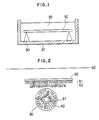
- Figs. 1 and 2 schematically illustrate the constitution of the present invention.
- the numerals 10 and 50 each denotes a substrate; 20, a liposome or proteoliposome suspension; 30, a substrate supporting member; 31, a dispersing tank; 40, the water surface; 51, a molecular layer of long-chain hydrocarbon groups; 52, part at which a planar membrane has been formed as a result of cleavage of liposome or proteoliposome; 60, liposome or proteoliposome (proteoliposome in the drawing); 61, a protein molecule; and 62, a lipid molecule.
- the numerals 10 and 50 each denotes a substrate; 20, a liposome or proteoliposome suspension; 30, a substrate supporting member; 31, a dispersing tank; 40, the water surface; 51, a molecular layer of long-chain hydrocarbon groups; 52, part at which a planar membrane has been formed as a result of cleavage of liposome or proteoli
- a substrate to which long-chain hydrocarbon groups have been bonded is immersed in a liposome or proteoliposome suspension.
- Fig. 2 shows that the liposome or proteoliposome is cleaved on a hydrophobic surface to produce a planar membrane.
- the step of preparing the membrane is carried out in a liquid phase, it is possible to set such conditions that may not result in loss of physiological activities of the membrane-forming substance such as protein or lipid. Since also the liposome or proteoliposome is spontaneously dispersed to form a planar membrane, the operation of, e.g., making precise movement of the substrate as in the conventional LB process is not required, making very simple the steps and apparatus. In addition, there are no limitations on the area of the membrane from the standpoints of both the principle and practice, and hence a planar membrane with a large area can be obtained with simplicity.
- the planar membrane is dispersed on a substrate.
- the substrate may not necessarily be in the form of "true" plane, and there can be utilized those having a round surface or uneven surface.
- the substrate may be of any material so long as the hydrocarbon group can be imparted thereto, and there can be used, for example, glass, metals, ceramics, and resins.
- the substrate may also not necessarily have a smooth surface, and there can be used, for example, porous glass, cellulose films, and colagen films. There can be further used those having been surface-treated with various fillers.
- a planar membrane can be formed on the surface of the substrate immersed in the liquid phase, so long as a molecular layer comprising a hydrocarbon group is formed thereon.
- the planar membrane can be formed on both sides by imparting the hydrocarbon group to both sides of the substrate.
- the former is a simple method, in which a silane coupling agent may include an alkyltrichlorosilane: Cl3Si-R or an alkyltrimethoxysilane: (CH3O)Si-R
- stearyltrichlorosilane is commercially available, and can be treated with simplicity.
- alkyl titanates as exemplified by:
- the method in which a polar group of a lipid is bonded to the substrate to introduce the long-chain hydrocarbon group into the substrate has somewhat complicated steps, but makes it easy to introduce the hydrocarbon group containing an unsaturated bond or enables formation of a gap between the hydrocarbon group and substrate, so that this method is particularly advantageous when using a protein which is large in the part exposed outside the bilayer membrane.
- a liposome or proteoliposome suspension must be prepared in the first place.
- known amphiphatic compounds capable of constituting a monolayer membrane or multilayer membrane can be utilized as materials for the lipid.
- the lipid molecule having the ability of forming these membranes is constituted of a long-chain alkyl group having 8 or more carbon atoms and a hydrophilic group.
- the hydrophilic group may be any of cations as exemplified by:
- glycerophospholipids such as phosphatidylcholine (lecithin), phosphatidylethanolamine, and diphosphatidylglycerol; sphingophospholipids such as sphingomyelin, and ceramide ciliatin; sphingoglycolipids such as cerebroside,sulfatide, and ceramide oligohexocide; and glyceloglycolipids such as glycosyldiacyl glycerol containing a carbohydrate as a hydrophilic group.
- the materials for lipids referred to in the present invention are not limited to the above examples, and there are no particular limitations so long as they are capable of forming a bilayer membrane vesicle.
- the liposome may be prepared by the methods usually used, without any particular expedients.
- a method in which a lipid is solubilized using a detergent to prepare a mixture solution and the detergent is slowly removed from the solution according to dialysis dialysis method
- a method in which a lipid is added in an aqueous solution and suspended therein at a suitable temperature, and the suspension is applied with a mechanical vibration using a Vortex mixer or the like, followed by rapid cooling and gradual thrawing of the resulting suspension (freeze-thraw method)
- a method in which an organic solvent solution of a lipid is mixed with water, followed by removal of the organic solvent reverse phase evaporation method
- a method in which an alternating current electric field is applied to a vesicle suspension prepared (fusion method).
- the proteoliposome may also be prepared by the methods usually used, similar to the methods of forming the liposome, without any particular expedients.
- a detergent removal method such as the dialysis method or a hydrophobic bead treatment method, the freeze-thraw method, the reverse phase evaporation method, and the membrane fusion method are used for convenience. These methods can also be used in combination, or other modified methods can also be used.
- microsome fractions obtained by crushing and centrifuging organism tissues such as cells and organelles, can also be used in the present invention in place of the proteoliposome.
- liver microsome vesicles or muscle endoplasmic recticulum vesicles may be used.
- the suspension of liposome or proteoliposome, prepared by the above methods, may be put in the spreading tank as shown in the drawing and the substrate to which the hydrocarbon groups have been bonded may be immersed therein.
- the present invention is thus accomplished.
- a glass sheet will be used here as an example.
- Silanol groups (-SiOH) are present on the surface of glass, and the use thereof can achieve direct alkylation of the substrate, employing an alkylsilane coupling agent having a methoxy group (-OCH3), an ethoxy group (-OC2H5) or a halogen group (-X).
- an alkylsilane coupling agent having a methoxy group (-OCH3), an ethoxy group (-OC2H5) or a halogen group (-X).
- octadecyltrichlorosilane is published together with a step of pre-treatment of the glass surface [see, for example, T. Ishiguro & M. Nakanishi, J. Biochem.
- silane coupling agents here are no limitations on the length of the alkyl group and the degree of unsaturation. In practice, however, the types of commercially available silane coupling agents are relatively limited. In particular, those having an unsaturated bond are available with difficulty. On the other hand, as phospholipids, those with various lengths and degrees of unsaturation are available including natural ones and synthetic ones. Hence, it is advantageous if polar groups of a phospholipid can be bonded to the substrate. For this purpose, it is possible to use phopholipids having an amino group, phosphatidylethanolamine (PE), and phosphatidylserine (PS).
- PE phosphatidylethanolamine
- PS phosphatidylserine
- Methods of combining the amino group to a solid phase having a plurality of hydroxyl groups exist in variety, among which a cyanogen bromide activation method, and a cross-linking method using a hetero-divalent functional cross-linking reagent and SPDP (N-succinimidyl-3-(2-pyridylthio)propionate) can be advantageously used.
- the cyanogen bromide activation method is a method in which a polysaccharide such as agarose, having a large number of hydroxyl groups, is treated with cyanogen bromide and converted into an active group so that it may be brought into covalent bond to the amino group of the compound such as protein. This can be used as it is, in the bonding between the glass surface having a silanol group and the phospholipid having an amino group.
- the cross-linking method using SPDP is also a method in which SPDP is bonded to the amino group of phospholipid and converted into a thiol group (-SH), ⁇ -mercaptopropyltrimethoxysilane is further bonded to a solid phase to make the surface similarly comprised of a thiol group, and both are reacted to form a disulfide bond.
- SPDP is first bonded to phospholipid.
- the reaction conditions are detailed in a pamphlet of Pharmacia Fine Chemicals, Inc., "SPDP, Heterobifunctional Reagent". In the reaction, however, both the phospholipid and SPDP are dissolved in ethanol in place of an aqueous solution, so that the reaction is carried out in ethanol.
- an end product i.e., a phospholipid-SPDP complex
- column chromatography is carried out in place of gel filtration, using a silica gel column and using chloroform-methanol as a developing solvent.
- the ⁇ -mercaptopropyltrimethoxysilane can be bonded to the glass substrate under entirely the same conditions as in other silane coupling agents. In this way, the glass substrate to which a thiol is introduced is immersed in an ethanol solution of the phospholipid-SPDP complex. As a result, the phospholipid is fixed on the substrate through the disulfide bond.
- the method of imparting hydrocarbon groups to the surface has been described supposing the glass as the substrate.
- substantially the same method can be applied so long as it is made of the material having hydroxyl groups on its surface.
- the surface of a metal has usually been oxidized and the hydroxyl groups are produced in the presence of water.
- Gels of cellulose, agarose, etc. can also be used in the same manner.
- a polyacrylamide gel, having an amino group as a functional group, can also bring about the introduction of a thiol group when the SPDP is used as the cross-linking reagent, so that the hydrocarbon groups can be imparted using the phospholipid-SPDP complex.
- Cover glass (10 mm x 10 mm in approximation) is washed with a heated 5 % Extran (Merck & Co., Inc.) solution, and then treated with a water-bath type ultrasonic washer for 30 minutes. After washing with running water for 30 minutes, the cover glass thus treated is dried in an oven of 110 to 150°C.
- the dried cover glass is immersed in a solution of 2 ml of octadecyltrichlorosilane, 140 ml of n-hexadecane, 30 ml of carbon tetrachloride and 20 ml of chloroform, followed by stirring at room temperature for 2 hours. The cover glass is taken out, washed three times with chloroform and once with ethanol, and thereafter dried in an oven of 110°C.
- a chloroform solution of egg yolk lecithin corresponding to 150 mg of lipid weight is put in a 30 ml round-bottom flask, and, after the solvent is evaporated using a rotary evaporator, put in a desiccator to completely remove the solvent with use of a vacuum pump.
- An aqueous solution of, for example, 0.1M KCl and 10mM Tris-HCl (pH 7.0) is added in an amount of 10 ml, and the resulting mixture is treated with a Vortex mixer for 30 seconds to 1 minute to make lipid thin membranes dispersed, followed by sonication treatment using a probe type sonication oscillator for 30 minutes.
- the liposome suspension is poured into a spreading tank having the structure as illustrated in Fig. 1, and the alkylated cover glass is immersed in the liposome suspension.
- the cleavage of liposome on the alkylated substrate and the formation of the bilayer membrane are effected at a rate that becomes higher with an increase in the concentration of lipid, and completed in about 30 minutes under conditions of a lipid concentration of 20 mg/ml.
- a porous glass for example, MPG-D, produced by Asahi Glass Co., Ltd.; pore size: 40 ⁇ , disc diameter: 10 mm
- the substrate is washed with chloroform, and then dried in an oven.
- the dried substrate is immersed in a 2 % chloroform solution of ⁇ -mercaptopropyltrimethoxysilane (SH6002, available from Shin-Etsu Chemical Co., Ltd.), followed by stirring for 1 hour.
- the substrate is taken out, washed with chloroform, and thereafter dried in an oven of 100°C for 10 minutes.
- the surface of the porous glass substrate is thiolated as a result of the above operation.
- PE phosphatidylethanolamine
- SPDP N-succinimidyl-3-(2-pyridylthio)propionate
- the PE-SPDP complex is formed into an ethanol solution thereof, and the thiolated porous glass substrate is immersed in the solution. As a result, disulfide bonds are formed and thus PE is fixed on the substrate.
- the substrate on which the PE has been fixed is washed with ethanol, followed by suction for 1 hour using a vacuum pump in a desiccator to completely remove ethanol.
- bacteriorhodopsin As an example of the protein introduced into the planar membrane, bacteriorhodopsin is used.
- a purple membrane is extracted from halophilic archaebacterium Halobacterium halobium according to the method of P. Oesterhelt and W. Stoeckenius [Method. Enzymol., 31 , 667-678 (1974)].
- the purple membrane is further subjected to delipidation using the method of K. S. Huang et al [Proc. Natl. Acad. Sci. USA, 77 , 323 (1980)] to prepare bacteriorhodopsin.
- a chloroform solution of soybean phospholipid (asolectin) corresponding to 150 mg of lipid weight is put in a 30 ml round-bottom type flask, and, after the solvent is evaporated using a rotary evaporator, put in a desiccator to completely remove the solvent with use of a vacuum pump. 10 ml of 0.1M KCl is added, and the resulting mixture is treated with a Vortex mixer for 30 seconds, followed by treatment using a probe type ultrasonic oscillator sonicator for 30 minutes.
- a required amount of bacteriorhodopsin is added to the resulting mixture, which is then freezed with liquid nitrogen or dry-ice/acetone, and is then thrawed at room temperature, followed by treatment with a water-bath type sonicator. This cycle is repeated 6 times.
- a unilamellar proteoliposome comprised of bacteriorhodopsin incorporated into the membrane is obtained as a result of the above operations.
- the bacteriorhodopsin-proteoliposome suspension is introduced into a spreading tank, and the porous glass substrate on which PE has been fixed is immersed therein.
- the cleavage on the proteoliposome substrate and the formation of the bilayer membrane composed of lipid and protein are effected at a rate that becomes higher with an increase in the concentration of proteoliposome, and completed in about 30 minutes under conditions of a lipid concentration of 20 mg/ml.
- the method of forming the planar membrane according to the present invention is finished with the step in a liquid phase, and hence not only has the advantage that the contamination by dust in a gaseous phase or the influence by vibration of water surface can be eliminated when compared with the conventional membrane formation method utilizing the cleavage at the gas-liquid interface, but also provides a mild membrane preparation method which is free from the loss of physiological activities of the membrane-forming substance such as protein and lipid. Since the steps are simple and no particular apparatus is required, a planar bilayer membrane composed of lipid and planar which is of large area, stable, and of good quality can be obtained in a low cost and with simplicity.
- a method of forming a lipid planar membrane of a bilayer membrane composed of lipid and protein comprises the step of immersing a substrate, which has a long-chain hydrocarbon group at least on the surface of one side thereof, in a suspension of liposome or proteoliposome, respectively.
- the long-chain hydrocarbon group is introduced into the substrate by bonding a long-chain alkylsilane coupling agent or a long-chain alkyltitanate coupling agent.
Landscapes
- Health & Medical Sciences (AREA)
- Chemical & Material Sciences (AREA)
- Engineering & Computer Science (AREA)
- Life Sciences & Earth Sciences (AREA)
- Immunology (AREA)
- General Physics & Mathematics (AREA)
- Physics & Mathematics (AREA)
- Hematology (AREA)
- Nanotechnology (AREA)
- Molecular Biology (AREA)
- Urology & Nephrology (AREA)
- Biomedical Technology (AREA)
- General Health & Medical Sciences (AREA)
- Medicinal Chemistry (AREA)
- Pharmacology & Pharmacy (AREA)
- Public Health (AREA)
- Biochemistry (AREA)
- Food Science & Technology (AREA)
- Biotechnology (AREA)
- Pathology (AREA)
- Chemical Kinetics & Catalysis (AREA)
- Dispersion Chemistry (AREA)
- Cell Biology (AREA)
- Epidemiology (AREA)
- Animal Behavior & Ethology (AREA)
- Analytical Chemistry (AREA)
- Veterinary Medicine (AREA)
- Composite Materials (AREA)
- Condensed Matter Physics & Semiconductors (AREA)
- Materials Engineering (AREA)
- Crystallography & Structural Chemistry (AREA)
- Microbiology (AREA)
- Manufacturing Of Micro-Capsules (AREA)
- Application Of Or Painting With Fluid Materials (AREA)
- Physical Or Chemical Processes And Apparatus (AREA)
- Separation Using Semi-Permeable Membranes (AREA)
- Peptides Or Proteins (AREA)
- Medicinal Preparation (AREA)
Applications Claiming Priority (2)
| Application Number | Priority Date | Filing Date | Title |
|---|---|---|---|
| JP63211911A JP2632956B2 (ja) | 1988-08-26 | 1988-08-26 | 平面膜の形成方法 |
| JP211911/88 | 1988-08-26 |
Publications (3)
| Publication Number | Publication Date |
|---|---|
| EP0355847A2 true EP0355847A2 (de) | 1990-02-28 |
| EP0355847A3 EP0355847A3 (de) | 1991-08-07 |
| EP0355847B1 EP0355847B1 (de) | 1993-10-27 |
Family
ID=16613697
Family Applications (1)
| Application Number | Title | Priority Date | Filing Date |
|---|---|---|---|
| EP89115720A Expired - Lifetime EP0355847B1 (de) | 1988-08-26 | 1989-08-25 | Verfahren zur Herstellung planarer Membranen |
Country Status (3)
| Country | Link |
|---|---|
| EP (1) | EP0355847B1 (de) |
| JP (1) | JP2632956B2 (de) |
| DE (1) | DE68910227T2 (de) |
Cited By (5)
| Publication number | Priority date | Publication date | Assignee | Title |
|---|---|---|---|---|
| EP0461662A1 (de) * | 1990-06-14 | 1991-12-18 | Canon Kabushiki Kaisha | Verfahren zur Herstellung von Liposomen |
| EP0780133A1 (de) * | 1995-12-22 | 1997-06-25 | BELLCO S.p.A. | Methode zur Entfernung von fettlöslichen Molekülen aus einer kolloidalen Lösung, insbesondere für die Dialyse |
| US6583251B1 (en) | 1997-09-08 | 2003-06-24 | Emory University | Modular cytomimetic biomaterials, transport studies, preparation and utilization thereof |
| US7833978B2 (en) | 2004-02-20 | 2010-11-16 | Emory University | Thrombomodulin derivatives and conjugates |
| CN115768096A (zh) * | 2022-12-13 | 2023-03-07 | 安徽烯宇科技有限公司 | 一种纳米银线-铜线梯度分布电磁屏蔽膜及制备方法 |
Families Citing this family (6)
| Publication number | Priority date | Publication date | Assignee | Title |
|---|---|---|---|---|
| EP0531933B1 (de) * | 1991-09-09 | 1997-07-09 | Canon Kabushiki Kaisha | Quantitativer Nachweis vom Lipid |
| DE19951509A1 (de) * | 1999-10-26 | 2001-10-31 | Biotul Ag I K | Substratgestützte Lipiddoppelschichten |
| FR2840297B1 (fr) * | 2002-05-31 | 2005-03-25 | Centre Nat Rech Scient | Procede pour l'elaboration d'un substrat mineral modifie en surface, et substrat obtenu |
| EP1712909B1 (de) * | 2004-01-21 | 2012-09-19 | Japan Science and Technology Agency | Verfahren zur bildung einer flachen lipiddoppelmembran zur membranproteinanalyse sowie vorrichtung dafür |
| JP5654493B2 (ja) * | 2009-02-03 | 2015-01-14 | アプライド・バイオミメティック・エイ/エス | 重合プロテオリポソームを用いたナノ加工膜 |
| JP5177062B2 (ja) * | 2009-04-09 | 2013-04-03 | 東レ株式会社 | 分離膜デバイスおよびその製造方法 |
Family Cites Families (1)
| Publication number | Priority date | Publication date | Assignee | Title |
|---|---|---|---|---|
| CA1335879C (en) * | 1987-07-27 | 1995-06-13 | Bruce Andrew Cornell | Receptor membranes |
-
1988
- 1988-08-26 JP JP63211911A patent/JP2632956B2/ja not_active Expired - Fee Related
-
1989
- 1989-08-25 EP EP89115720A patent/EP0355847B1/de not_active Expired - Lifetime
- 1989-08-25 DE DE89115720T patent/DE68910227T2/de not_active Expired - Fee Related
Cited By (7)
| Publication number | Priority date | Publication date | Assignee | Title |
|---|---|---|---|---|
| EP0461662A1 (de) * | 1990-06-14 | 1991-12-18 | Canon Kabushiki Kaisha | Verfahren zur Herstellung von Liposomen |
| EP0780133A1 (de) * | 1995-12-22 | 1997-06-25 | BELLCO S.p.A. | Methode zur Entfernung von fettlöslichen Molekülen aus einer kolloidalen Lösung, insbesondere für die Dialyse |
| EP0966980A3 (de) * | 1995-12-22 | 2000-05-31 | BELLCO S.p.A. | Methode zum schnellen Entfernen von fettlöslichen Zielmolekülen aus einer Kolloidlösung und Waschlösung für eine solche Methode |
| US6583251B1 (en) | 1997-09-08 | 2003-06-24 | Emory University | Modular cytomimetic biomaterials, transport studies, preparation and utilization thereof |
| US6699952B2 (en) * | 1997-09-08 | 2004-03-02 | Emory University | Modular cytomimetic biomaterials, transport studies, preparation and utilization thereof |
| US7833978B2 (en) | 2004-02-20 | 2010-11-16 | Emory University | Thrombomodulin derivatives and conjugates |
| CN115768096A (zh) * | 2022-12-13 | 2023-03-07 | 安徽烯宇科技有限公司 | 一种纳米银线-铜线梯度分布电磁屏蔽膜及制备方法 |
Also Published As
| Publication number | Publication date |
|---|---|
| EP0355847B1 (de) | 1993-10-27 |
| DE68910227T2 (de) | 1994-03-03 |
| DE68910227D1 (de) | 1993-12-02 |
| EP0355847A3 (de) | 1991-08-07 |
| JP2632956B2 (ja) | 1997-07-23 |
| JPH0259075A (ja) | 1990-02-28 |
Similar Documents
| Publication | Publication Date | Title |
|---|---|---|
| US5288517A (en) | Method of forming planar membrane | |
| US5846814A (en) | Solid-supported membrane biosensors | |
| AU2005319755B2 (en) | Device and use thereof | |
| Puu et al. | Planar lipid bilayers on solid supports from liposomes–factors of importance for kinetics and stability | |
| Gómez-Hens et al. | The role of liposomes in analytical processes | |
| EP0355847B1 (de) | Verfahren zur Herstellung planarer Membranen | |
| Nollert et al. | Lipid vesicle adsorption versus formation of planar bilayers on solid surfaces | |
| Cutsforth et al. | A new model to describe extrinsic protein binding to phospholipid membranes of varying composition: application to human coagulation proteins | |
| Carmona-Ribeiro | Bilayer vesicles and liposomes as interface agents | |
| Stora et al. | Histidine-tagged amphiphiles for the reversible formation of lipid bilayer aggregates on chelator-functionalized gold surfaces | |
| US5374715A (en) | Method for forming proteoliposome and method for forming giant proteoliposome | |
| Ohki et al. | Divalent cation-induced phosphatidic acid membrane fusion. Effect of ion binding and membrane surface tension | |
| Yang et al. | Self-assembly and immobilization of liposomes in fused-silica capillary by avidin–biotin binding | |
| JP2003511679A (ja) | 脂質二重層アレイおよびその製造および使用方法 | |
| JP4248246B2 (ja) | 支持されたリピドフィルム膜の製造方法およびそれらの使用 | |
| JP2003513901A (ja) | タンパク質又はペプチドをリポソームに封入するための方法及びこの方法で調製されたリポソーム及びその使用 | |
| WO2003029294A1 (en) | Spheroidal hdl particles with a defined phospholipid composition | |
| Damiati | Can we rebuild the Cell Membrane? | |
| WO2003016040A1 (en) | Membrane mimetic architectures on nanoporous materials | |
| Ohki et al. | Effects of proteins on phospholipid vesicle aggregation and lipid vesicle-monolayer interactions | |
| JP3228957B2 (ja) | 巨大リポソームの製造方法及び巨大リポソーム形成用キット | |
| Xiao et al. | Preparation of asymmetric bilayer-vesicles with inner and outer monolayers composed of different amphiphilic molecules | |
| KR800001360B1 (ko) | 리포솜의 제조법 | |
| Saenger et al. | Light-induced coupling of aqueous-soluble proteins to liposomes formed from carbene-generating phospholipids | |
| JPH07107536B2 (ja) | リポソ−ムを用いた高感度免疫学的測定法 |
Legal Events
| Date | Code | Title | Description |
|---|---|---|---|
| PUAI | Public reference made under article 153(3) epc to a published international application that has entered the european phase |
Free format text: ORIGINAL CODE: 0009012 |
|
| AK | Designated contracting states |
Kind code of ref document: A2 Designated state(s): CH DE FR GB LI NL |
|
| 17P | Request for examination filed |
Effective date: 19901221 |
|
| PUAL | Search report despatched |
Free format text: ORIGINAL CODE: 0009013 |
|
| AK | Designated contracting states |
Kind code of ref document: A3 Designated state(s): CH DE FR GB LI NL |
|
| 17Q | First examination report despatched |
Effective date: 19921203 |
|
| GRAA | (expected) grant |
Free format text: ORIGINAL CODE: 0009210 |
|
| AK | Designated contracting states |
Kind code of ref document: B1 Designated state(s): CH DE FR GB LI NL |
|
| REF | Corresponds to: |
Ref document number: 68910227 Country of ref document: DE Date of ref document: 19931202 |
|
| ET | Fr: translation filed | ||
| PLBE | No opposition filed within time limit |
Free format text: ORIGINAL CODE: 0009261 |
|
| STAA | Information on the status of an ep patent application or granted ep patent |
Free format text: STATUS: NO OPPOSITION FILED WITHIN TIME LIMIT |
|
| 26N | No opposition filed | ||
| REG | Reference to a national code |
Ref country code: GB Ref legal event code: IF02 |
|
| PGFP | Annual fee paid to national office [announced via postgrant information from national office to epo] |
Ref country code: NL Payment date: 20040803 Year of fee payment: 16 |
|
| PGFP | Annual fee paid to national office [announced via postgrant information from national office to epo] |
Ref country code: FR Payment date: 20040810 Year of fee payment: 16 |
|
| PGFP | Annual fee paid to national office [announced via postgrant information from national office to epo] |
Ref country code: GB Payment date: 20040825 Year of fee payment: 16 |
|
| PGFP | Annual fee paid to national office [announced via postgrant information from national office to epo] |
Ref country code: CH Payment date: 20040827 Year of fee payment: 16 |
|
| PGFP | Annual fee paid to national office [announced via postgrant information from national office to epo] |
Ref country code: DE Payment date: 20040902 Year of fee payment: 16 |
|
| PG25 | Lapsed in a contracting state [announced via postgrant information from national office to epo] |
Ref country code: GB Free format text: LAPSE BECAUSE OF NON-PAYMENT OF DUE FEES Effective date: 20050825 |
|
| PG25 | Lapsed in a contracting state [announced via postgrant information from national office to epo] |
Ref country code: LI Free format text: LAPSE BECAUSE OF NON-PAYMENT OF DUE FEES Effective date: 20050831 Ref country code: CH Free format text: LAPSE BECAUSE OF NON-PAYMENT OF DUE FEES Effective date: 20050831 |
|
| PG25 | Lapsed in a contracting state [announced via postgrant information from national office to epo] |
Ref country code: NL Free format text: LAPSE BECAUSE OF NON-PAYMENT OF DUE FEES Effective date: 20060301 Ref country code: DE Free format text: LAPSE BECAUSE OF NON-PAYMENT OF DUE FEES Effective date: 20060301 |
|
| REG | Reference to a national code |
Ref country code: CH Ref legal event code: PL |
|
| GBPC | Gb: european patent ceased through non-payment of renewal fee |
Effective date: 20050825 |
|
| PG25 | Lapsed in a contracting state [announced via postgrant information from national office to epo] |
Ref country code: FR Free format text: LAPSE BECAUSE OF NON-PAYMENT OF DUE FEES Effective date: 20060428 |
|
| NLV4 | Nl: lapsed or anulled due to non-payment of the annual fee |
Effective date: 20060301 |
|
| REG | Reference to a national code |
Ref country code: FR Ref legal event code: ST Effective date: 20060428 |