EP0355954A2 - Unterwasser-Mehrfach-Luftkanonenanordnung - Google Patents
Unterwasser-Mehrfach-Luftkanonenanordnung Download PDFInfo
- Publication number
- EP0355954A2 EP0355954A2 EP89305707A EP89305707A EP0355954A2 EP 0355954 A2 EP0355954 A2 EP 0355954A2 EP 89305707 A EP89305707 A EP 89305707A EP 89305707 A EP89305707 A EP 89305707A EP 0355954 A2 EP0355954 A2 EP 0355954A2
- Authority
- EP
- European Patent Office
- Prior art keywords
- module
- barrels
- gun
- pulse
- barrel
- Prior art date
- Legal status (The legal status is an assumption and is not a legal conclusion. Google has not performed a legal analysis and makes no representation as to the accuracy of the status listed.)
- Ceased
Links
Images


Classifications
-
- G—PHYSICS
- G01—MEASURING; TESTING
- G01V—GEOPHYSICS; GRAVITATIONAL MEASUREMENTS; DETECTING MASSES OR OBJECTS; TAGS
- G01V1/00—Seismology; Seismic or acoustic prospecting or detecting
- G01V1/003—Seismic data acquisition in general, e.g. survey design
- G01V1/006—Seismic data acquisition in general, e.g. survey design generating single signals by using more than one generator, e.g. beam steering or focusing arrays
Definitions
- the present invention relates to a module for the generation of seismic pulses in a marine environment.
- marine In marine seismic exploration, the term "marine" as used herein being intended to encompass any body of water regardless of its location or depth, pulses of acoustic energy are released into the water at close intervals to generate acoustic waves that propagate through the water and into the earth's crust. The waves are reflected and refracted by subsurface formations and at interfaces therebetween, thereafter travelling back to receivers, at or just beneath the earth's surface, where the waves are converted into electrical signals which are recorded on instruments as digital data for subsequent processing followed by interpretation and analysis.
- the dominant marine seismic energy source has been the air gun, a device which releases high pressure air, typically at 2,000 to 6,000 psi (13.8 to 41.4 MPa), into the water to create the desired acoustic wave.
- air gun a device which releases high pressure air, typically at 2,000 to 6,000 psi (13.8 to 41.4 MPa), into the water to create the desired acoustic wave.
- One prior art air gun with a unique 360 degrees post design is described in our U.S. patent no. 4,623,033, but there are numerous other designs such as, for example, the dual chamber reciprocating shuttle design described in U.S. patent no. 4,211,300.
- U.S. patent no. 4,108,272 describes grouping three or more air guns tuned to different pulse frequencies to generate a simple, non-repetitive pulse train during a recording cycle.
- U.S. patent no. 4,648,479 describes a multi-chamber air gun wherein the exhaust port sizes and locations may be chosen so that air bubbles emanating therefrom will interact or "coalesce", the benefits of which will be hereinafter discussed; the use of guns timed to different frequencies is also disclosed.
- Another multi-chamber gun is described in U.S. patent no. 4,381,044. Our U.S. patents nos.
- patent application 2176605A describes air guns deployed in a four-gun configuration similar to that disclosed in the aforementioned '987 patent and suggests that a group of three or more guns, at critical intergun distances, maximizes suppression of successive oscillations of the large bubble created by the coalescing smaller bubbles of the individual guns, thereby maximizing the "primary to bubble” ratio, the latter being defined as the amplitude ratio of the primary signal component of the seismic signal to the envelope of the accompanying successive components of the signal.
- An advantage of using multiple "coalesced” air guns is the gain in the higher frequencies, as a smaller air gun has a short pulse length (higher frequency content) than the signature of a larger air gun.
- the small air gun pulse length (higher frequency content) is maintained while the larger air gun bubble pulse is achieved, providing the lower bubble frequencies. This characteristic has the effect of broadening the acoustic spectra without appreciably affecting the lower frequencies, which are primarily generated by the bubble oscillations.
- a problem inherent in the close spacing of coalesced air guns is damage to the guns, air hoses, electrical cables and associated mounting hardware (such as shackles and chains, etc.) due to the recoil of each individual air gun plus the pressure waves caused by each air gun acting on surrounding air guns.
- the continual movement of the reacting air guns can cause catostrophic damage if a chain should part or at the least causes rapid wear of the mounting hardware, thus changing the air gun cluster spacing, which in turn can lead to a change in the cluster's acoustic pulse "signature", changing the frequency spectra and lowering performance from the original design optimum.
- the multi-barrel air gun module of the present invention balances the aforementioned recoil forces by symmetrically disposing the pulse sources, and permanently fixes the location of each gun barrel in the module.
- a module for the generation of seismic pulses in a marine environment comprising: control head means; a plurality of pulse sources symmetrically disposed about and rigidly secured to said control head means; and actuating means associated with said control head means for independently actuating each of said pulse sources; wherein said plurality of sources comprises a plurality of airgun barrels and, said module is suspended from longitudinally extending boom means, and wherein at least one of said four barrels is oriented parallel to said boom means.
- the invention also includes a method of actuating a module for the generation of seismic pulses in a marine environment, wherein said module includes a plurality of pulse sources, in order to attain substantial simultaneity of pulse generation and minimization of unbalanced forces on said module resulting from said pulse generation, said method comprising independently actuating each of said plurality of pulse sources of a module of the invention; monitoring the timing of the actuation of each of said pulse sources with respect to each other; and adjusting the timing of actuation of each of said pulse sources responsive to said monitoring, whereby substantial simultaneity of pulse generation is attained, and unbalanced forces on said module resulting therefrom are minimized.
- the air supply hoses and electrical cables for gun actuation and monitoring can be run from an air gun support, typically a longitudinally extending boom supporting multiple gun modules, to the centered control head of each module, which is the location of least bubble action.
- the present invention thus provides the output enhancement of prior-art clustered guns without the associated propensity for self-destruction and performance drift from design parameters.
- the disposition of barrels in the gun module of the present invention can be effected so that all barrels of the gun module, and therefore all exhaust ports from which high pressure air exits the gun to create a seismic pulse, are located in the same depth in the water, so that the pressure waves from all ports in a module reach the target area at the same time, thereby reducing interwave interference and enhancing the energy of the wave reflected and refracted from subsurface formations to the receiving transducers.
- Figure 1 shows a prior art arrangement of four air guns 10, 12, 14 and 16 disposed in a square or rectangular configuration, guns 10 and 12 being arranged in an upper plane and 14 and 16 being in a parallel, lower plane, all four guns having substantially parallel orientation and having their heads disposed in the same direction to facilitate the connection of air hoses 18 and electrical cables 20 thereto.
- Guns 10-16 are slung under a boom 22 via laterally extending struts or spars 24, to which are connected the chain and shackle assemblies 26 which are secured to guns 10-16 and which generally maintain gun location and orientation.
- Boom 22 is in turn suspended from a float or paravane (not shown) by cables 28, in a manner well known in the art.
- Figure 2 illustrates one embodiment of the present invention, having barrels 10,12,14 and 16 in a multi-barrel gun module 30.
- Barrels 10,12 14 and 16 are disposed at 90° intervals in the same plane about control head 32 of gun module 30 with their head ends adjacent to control head 32.
- Gun module 30 is suspended from boom 34 by shackle and chain assemblies 36 in a manner to minimize water drag by orienting guns 10 and 14 parallel to boom 34. Drag can be further reduced by streamlining the tail of barrel 10 via a nose cone 38 as shown in broken lines, and by giving barrels 12 and 16 an airfoil-type cross section over at least a portion of their length as shown in broken lines at 40 with respect to gun 12.
- control head 32 may be streamlined.
- Additional chains and shackles may be used, if required, to secure the tails of barrels 12 and 16 to boom 34 to prevent rocking or yawing of the gun module 30 while under tow.
- a single air supply hose 42 runs to control head 32 from boom 34, and a master electrical control cable 44 runs from boom 34 to terminal 46, whereat gun control cables 48 which were grouped in master cable 44 extend individually to their respective positions to control head 32 as will be further described shortly with respect to Figures 3 and 3.
- Boom 34 normally with a plurality of gun modules 30 suspended therefrom, is in turn suspended by cables 50 from a float or paravane (not shown) in a manner well known in the art for towing through the water.
- the symmetrical barrel orientation of the preferred embodiment not only balances gun recoil forces, permitting rigid inter-barrel connection, but maintains all of the exhaust ports in the same plane and therefore at equal vertical distances from the target area.
- the rigid connection of barrels 10,12,14 and 16 to control head 32 ensures precise port location relative to the other ports of the module, promoting continued optimum design performance even after many firings.
- overall drag of gun module 30 is less than that of the prior art clusters, and fewer shackles and chains are required, as is only one air hose.
- the consolidation of gun control cables 44 into a master cable until in close proximity to control head 32 provides easier handling, less drag and better cable protection than in a prior art gun cluster.
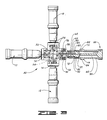
- FIGS 3 and 4 depict the four barrel gun module 30 of the preferred embodiment in greater detail, including a sectional view of barrel 14.
- High pressure air used to generate the acoustic pulses in barrels 10-16, is supplied via hose 42 (not shown, see Figure 2) to inlet 52 at the center of control head 32, inlet 52 communicating with each barrel via a manifold arrangement 54 and fill passage 56 shown with respect to barrel 14. Air from hose 42 thus enters spring chamber 58 of each barrel, gun, again as shown in section on barrel 14.
- pulse chamber 68 is at full line pressure in hose 42, having been filled from fill passage 56 via laterally extending fill orifices 57, and the multi-barrel gun module 30 is ready to fire.
- Firing is effected by sending individual electrical pulses from the towing vessel through cables 48, (see Figure 2) which communicate with a solenoid valve 74 associated with each barrel of the gun module.
- a suitable solenoid valve is shown in detail and described in our U.S. Patent No. 4,623,033, but any suitable solenoid or other type of valve design such as is known in the prior art may be employed.
- the solenoid valves 74 react to the pulses by opening to connect each fill passage 56 to its associated firing passage 76 to allow the high pressure air to enter firing chamber 78 via laterally extending orifices 80.
- Firing chamber 78 is bounded by seal assembly 64 and seal assembly 82, so the firing chamber pressure acts against shuttle 60 in a direction toward control head 32, moving shuttle 60 away from pulse chamber face seal 70 due to the differential between the shuttle surface areas acted upon in firing chamber 78 and spring chamber 58.
- pulse chamber air flows outward across shuttle face 84, but is prevented from leaving the barrel by overlapping lip 86 of pulse chamber housing 90.
- This arrangement provides an additional force in combination with the firing chamber forces to accelerate the shuttle more rapidly to its open position wherein a 360 degree open port is created to discharge the air from pulse chamber 68.
- air is discharged simultaneously from the pulse chamber 68 of each barrel into the surrounding water, resulting in the desired broadband acoustic pulse.
- both the pulse chamber 68 and firing chamber 78 of each barrel are exhausted and the only remaining force on shuttle 60 is that in spring chamber 58, which closes shuttle 60 against face seal 70.
- Each gun 10, 12, 14 and 16 of the multi-barrel gun module 30 then refills with air from hose 42 and the firing cycle is ready to be repeated.
- each barrel of the gun module is monitored by its own timing coil 94, which typically generates a pulse such as is illustrated in FIGURE 5, the pulse data can be employed to adjust the firing times of the individual barrels of the gun module in order to compensate for barrels which fire slower or faster than others in the module due to solenoid variations, manufacturing tolerances, differing frictional drag of components and ongoing wear during a multitude of firing cycles.
- synchronization of the times times of maximum shuttle openings of all module barrels to achieve the most distinct and powerful pulse obtainable can be achieved and maintained throughout an operation, and malfunctioning guns quickly identified. It is, of course, possible to employ only one solenoid valve per module to fire all of the barrels, but this approach forfeits the synchronization ability of a one timing coil and solenoid per barrel arrangement.
- barrel to describe a structure for producing an air discharge to develop a seismic pulse.
- barrel or pulse-generating structure as described herein is for purposes of illustration only and that many other structures as known in the art for performing the same function can be employed with the present invention and will benefit from its novel and unobvious arrangement and characteristics.
- barrels of a module may be of differing pulse chamber volumes; that less than or more than four barrels may be employed, two barrels aligned head to head or three disposed at 120° intervals being equally feasible, three barrels in fact giving the best additive effect per barrel of multiple barrel gun assemblies in excess of two barrels; four barrels may be disposed in a tetrahedral orientation for full recoil balancing, or six in three-axis balancing orientation.
Landscapes
- Engineering & Computer Science (AREA)
- Remote Sensing (AREA)
- Physics & Mathematics (AREA)
- Life Sciences & Earth Sciences (AREA)
- Acoustics & Sound (AREA)
- Environmental & Geological Engineering (AREA)
- Geology (AREA)
- General Life Sciences & Earth Sciences (AREA)
- General Physics & Mathematics (AREA)
- Geophysics (AREA)
- Arc Welding In General (AREA)
- Special Spraying Apparatus (AREA)
- Toys (AREA)
- Nozzles (AREA)
Applications Claiming Priority (2)
| Application Number | Priority Date | Filing Date | Title |
|---|---|---|---|
| US07/236,694 US4858205A (en) | 1988-08-24 | 1988-08-24 | Multi-barrel air gun module |
| US236694 | 1988-08-24 |
Publications (2)
| Publication Number | Publication Date |
|---|---|
| EP0355954A2 true EP0355954A2 (de) | 1990-02-28 |
| EP0355954A3 EP0355954A3 (de) | 1991-09-04 |
Family
ID=22890570
Family Applications (1)
| Application Number | Title | Priority Date | Filing Date |
|---|---|---|---|
| EP19890305707 Ceased EP0355954A3 (de) | 1988-08-24 | 1989-06-06 | Unterwasser-Mehrfach-Luftkanonenanordnung |
Country Status (4)
| Country | Link |
|---|---|
| US (1) | US4858205A (de) |
| EP (1) | EP0355954A3 (de) |
| AU (1) | AU628057B2 (de) |
| NO (1) | NO892197L (de) |
Cited By (1)
| Publication number | Priority date | Publication date | Assignee | Title |
|---|---|---|---|---|
| US5980148A (en) * | 1997-11-18 | 1999-11-09 | Seismic Systems, Inc. | Dynamic system for maintaining spacing between two or more objects |
Families Citing this family (14)
| Publication number | Priority date | Publication date | Assignee | Title |
|---|---|---|---|---|
| NO172872B (no) * | 1990-10-17 | 1993-06-07 | Geco As | Anordning ved seismiske energikilder |
| NO173758C (no) * | 1991-09-04 | 1994-01-26 | Geco As | Anordning for fastholding av to eller flere seismiske energikilder i en fast innbyrdes avstand |
| FI105503B (fi) * | 1997-09-05 | 2000-08-31 | Georesearch Engineering E Jalk | Äänilähdejärjestely |
| US6185156B1 (en) | 1999-06-10 | 2001-02-06 | Hydroacoustics-Inc. | Underwater acoustic impulse source |
| GB9927052D0 (en) * | 1999-11-17 | 2000-01-12 | Geco As | A marine seismic source |
| US8082199B2 (en) * | 2005-04-05 | 2011-12-20 | Ming Yat Kwok | Multiple variable outlets shooting apparatus |
| US8113278B2 (en) | 2008-02-11 | 2012-02-14 | Hydroacoustics Inc. | System and method for enhanced oil recovery using an in-situ seismic energy generator |
| EP2435854B1 (de) | 2009-05-28 | 2021-07-07 | Teledyne Instruments, Inc. | Digitale luftkanone |
| US8830786B1 (en) * | 2013-03-14 | 2014-09-09 | Pgs Geophysical As | Fluid distribution device |
| US11635536B2 (en) * | 2017-09-21 | 2023-04-25 | Sercel Inc. | Device for marine seismic explorations for deposits |
| NL2019642B1 (en) * | 2017-09-29 | 2019-04-08 | Fugro Tech Bv | Frame with acoustic sources for marine survey |
| EP3983826A1 (de) * | 2019-06-17 | 2022-04-20 | ION Geophysical Corporation | Seismisches quellengerät |
| US11598891B2 (en) * | 2020-02-07 | 2023-03-07 | Sercel Inc. | Low frequency and ultra low frequency seismic source having multiple operating heads for marine exploration |
| US12461259B2 (en) | 2020-08-07 | 2025-11-04 | Tgs-Nopec Geophysical Company | Direct fill chamber |
Family Cites Families (13)
| Publication number | Priority date | Publication date | Assignee | Title |
|---|---|---|---|---|
| FR2302656A1 (fr) * | 1975-02-27 | 1976-09-24 | France Etat | Transducteur piezoelectrique pour basses frequences |
| US4034827A (en) * | 1975-04-03 | 1977-07-12 | Texas Instruments Incorporated | Air gun utilizing magnetized shuttle |
| US4016952A (en) * | 1975-10-06 | 1977-04-12 | Atlantic Richfield Company | Marine gas exploder |
| US4384632A (en) * | 1981-01-05 | 1983-05-24 | Atlantic Richfield Company | Charging system for seismic gas exploder |
| NO150016C (no) * | 1981-11-25 | 1984-08-08 | Norway Geophysical Co | Anordning for bruk ved seismiske undersoekelser av havbunnen |
| US4711194A (en) * | 1982-11-24 | 1987-12-08 | The Laitram Corporation | Streamer interface adapter cable mounted leveler |
| US4648479A (en) * | 1983-09-30 | 1987-03-10 | Exxon Production Research Co. | Multiple-port, multiple-chamber, tuned air-powered subsea seismic source |
| US4633970A (en) * | 1984-01-03 | 1987-01-06 | Exxon Production Research Co. | Distributed marine seismic source |
| DE3564410D1 (de) * | 1984-06-19 | 1988-09-22 | Texas Instruments Inc | Bi-planar pontoon paravane seismic source system |
| US4719987A (en) * | 1984-06-19 | 1988-01-19 | Texas Instruments Incorporated | Bi-planar pontoon paravane seismic source system |
| US4658384A (en) * | 1985-01-07 | 1987-04-14 | Western Geophysical Co. Of America | Method for determining the far-field signature of an air gun array |
| NO169566C (no) * | 1985-06-14 | 1994-04-18 | Exxon Production Research Co | Fremgangsmåte for å frembringe en seismisk puls i et vannlegeme, samt en marin seismisk luftkanonoppstilling |
| US4715023A (en) * | 1987-03-18 | 1987-12-22 | Mobil Oil Corporation | Coaxial, dual chamber seismic air gun |
-
1988
- 1988-08-24 US US07/236,694 patent/US4858205A/en not_active Expired - Fee Related
-
1989
- 1989-05-31 NO NO89892197A patent/NO892197L/no unknown
- 1989-06-01 AU AU35893/89A patent/AU628057B2/en not_active Ceased
- 1989-06-06 EP EP19890305707 patent/EP0355954A3/de not_active Ceased
Cited By (1)
| Publication number | Priority date | Publication date | Assignee | Title |
|---|---|---|---|---|
| US5980148A (en) * | 1997-11-18 | 1999-11-09 | Seismic Systems, Inc. | Dynamic system for maintaining spacing between two or more objects |
Also Published As
| Publication number | Publication date |
|---|---|
| NO892197L (no) | 1990-02-26 |
| AU628057B2 (en) | 1992-09-10 |
| NO892197D0 (no) | 1989-05-31 |
| AU3589389A (en) | 1990-03-01 |
| US4858205A (en) | 1989-08-15 |
| EP0355954A3 (de) | 1991-09-04 |
Similar Documents
| Publication | Publication Date | Title |
|---|---|---|
| US4858205A (en) | Multi-barrel air gun module | |
| US4210222A (en) | Air gun monitoring method and apparatus | |
| US3331050A (en) | Method of underwater seismic exploration | |
| EP0519031B1 (de) | Seismisches Quellen-System, zur Verwendung in See-Seismik | |
| US3310128A (en) | Seismic exploration methods and systems | |
| GB2023829A (en) | Method and apparatus for monitoring and controlling a multiplicity of air guns for seismic surveying | |
| US8014228B2 (en) | Marine seismic sources and methods of use | |
| US4715023A (en) | Coaxial, dual chamber seismic air gun | |
| US20140112097A1 (en) | Variable-depth seismic source and method | |
| NO344058B1 (en) | Wide spread seismic source towing configuration | |
| CN105899973A (zh) | 宽源地震拖拽结构 | |
| EP0047547A2 (de) | Verfahren zur meeresseismischen Forschung | |
| GB2201779A (en) | A method of sequential operation of seismic sources to obtain a desired signature | |
| US8787111B2 (en) | Devices and methods for positioning TOWs in marine seismic systems | |
| US3739869A (en) | Apparatus for the attenuation of noise from underwater seismic sources | |
| US3923122A (en) | Seismic pneumatic energy source with attenuation of bubble pulse amplitude and reduction of period of bubble oscillation | |
| EP3983826A1 (de) | Seismisches quellengerät | |
| US4006794A (en) | Seismic pneumatic energy source with flap valves for attenuation of bubble pulse amplitude and reduction of period of bubble oscillation | |
| EP0112696A2 (de) | Seismische Unterwasserenergiequelle | |
| JPH0713660B2 (ja) | 海洋震源アレ−と地震パルス発生方法 | |
| Lugg | Marine seismic sources | |
| US8085617B2 (en) | System and method for reducing the effects of ghosts from the air-water interface in marine seismic exploration | |
| US4774696A (en) | Airgun valve with slidable valve seat | |
| US5263007A (en) | Seismic energy source | |
| CA3188717A1 (en) | Direct fill chamber |
Legal Events
| Date | Code | Title | Description |
|---|---|---|---|
| PUAI | Public reference made under article 153(3) epc to a published international application that has entered the european phase |
Free format text: ORIGINAL CODE: 0009012 |
|
| AK | Designated contracting states |
Kind code of ref document: A2 Designated state(s): DE FR GB NL |
|
| PUAL | Search report despatched |
Free format text: ORIGINAL CODE: 0009013 |
|
| AK | Designated contracting states |
Kind code of ref document: A3 Designated state(s): DE FR GB NL |
|
| 17P | Request for examination filed |
Effective date: 19911015 |
|
| 17Q | First examination report despatched |
Effective date: 19921103 |
|
| STAA | Information on the status of an ep patent application or granted ep patent |
Free format text: STATUS: THE APPLICATION HAS BEEN REFUSED |
|
| 18R | Application refused |
Effective date: 19930625 |