EP0356568B1 - Procédé et arrangement pour la reconnaissance du locuteur dans un central téléphonique - Google Patents
Procédé et arrangement pour la reconnaissance du locuteur dans un central téléphonique Download PDFInfo
- Publication number
- EP0356568B1 EP0356568B1 EP88114368A EP88114368A EP0356568B1 EP 0356568 B1 EP0356568 B1 EP 0356568B1 EP 88114368 A EP88114368 A EP 88114368A EP 88114368 A EP88114368 A EP 88114368A EP 0356568 B1 EP0356568 B1 EP 0356568B1
- Authority
- EP
- European Patent Office
- Prior art keywords
- speaker
- samples
- switching system
- speaker recognition
- telephone
- Prior art date
- Legal status (The legal status is an assumption and is not a legal conclusion. Google has not performed a legal analysis and makes no representation as to the accuracy of the status listed.)
- Expired - Lifetime
Links
- 238000000034 method Methods 0.000 title claims description 23
- 238000005070 sampling Methods 0.000 claims abstract description 12
- 238000004891 communication Methods 0.000 claims abstract description 8
- 239000008186 active pharmaceutical agent Substances 0.000 claims description 6
- 238000012360 testing method Methods 0.000 claims description 5
- 230000000007 visual effect Effects 0.000 claims 1
- 230000011664 signaling Effects 0.000 description 22
- 230000005540 biological transmission Effects 0.000 description 14
- 230000006870 function Effects 0.000 description 10
- 238000006243 chemical reaction Methods 0.000 description 7
- 238000005516 engineering process Methods 0.000 description 4
- 230000001960 triggered effect Effects 0.000 description 4
- 238000012795 verification Methods 0.000 description 4
- 230000003287 optical effect Effects 0.000 description 3
- 238000012549 training Methods 0.000 description 3
- 230000015572 biosynthetic process Effects 0.000 description 2
- 239000002775 capsule Substances 0.000 description 2
- 238000010586 diagram Methods 0.000 description 2
- 238000000926 separation method Methods 0.000 description 2
- 230000003213 activating effect Effects 0.000 description 1
- 230000006978 adaptation Effects 0.000 description 1
- 238000004040 coloring Methods 0.000 description 1
- 238000010606 normalization Methods 0.000 description 1
- 230000002093 peripheral effect Effects 0.000 description 1
- 238000007781 pre-processing Methods 0.000 description 1
- 230000033764 rhythmic process Effects 0.000 description 1
- 230000008054 signal transmission Effects 0.000 description 1
- 238000003786 synthesis reaction Methods 0.000 description 1
- 230000001755 vocal effect Effects 0.000 description 1
Images

Classifications
-
- H—ELECTRICITY
- H04—ELECTRIC COMMUNICATION TECHNIQUE
- H04Q—SELECTING
- H04Q11/00—Selecting arrangements for multiplex systems
- H04Q11/04—Selecting arrangements for multiplex systems for time-division multiplexing
- H04Q11/0428—Integrated services digital network, i.e. systems for transmission of different types of digitised signals, e.g. speech, data, telecentral, television signals
- H04Q11/0435—Details
- H04Q11/0471—Terminal access circuits
-
- H—ELECTRICITY
- H04—ELECTRIC COMMUNICATION TECHNIQUE
- H04M—TELEPHONIC COMMUNICATION
- H04M1/00—Substation equipment, e.g. for use by subscribers
- H04M1/66—Substation equipment, e.g. for use by subscribers with means for preventing unauthorised or fraudulent calling
-
- H—ELECTRICITY
- H04—ELECTRIC COMMUNICATION TECHNIQUE
- H04M—TELEPHONIC COMMUNICATION
- H04M3/00—Automatic or semi-automatic exchanges
- H04M3/38—Graded-service arrangements, i.e. some subscribers prevented from establishing certain connections
- H04M3/382—Graded-service arrangements, i.e. some subscribers prevented from establishing certain connections using authorisation codes or passwords
-
- H—ELECTRICITY
- H04—ELECTRIC COMMUNICATION TECHNIQUE
- H04M—TELEPHONIC COMMUNICATION
- H04M2201/00—Electronic components, circuits, software, systems or apparatus used in telephone systems
- H04M2201/40—Electronic components, circuits, software, systems or apparatus used in telephone systems using speech recognition
-
- H—ELECTRICITY
- H04—ELECTRIC COMMUNICATION TECHNIQUE
- H04Q—SELECTING
- H04Q2213/00—Indexing scheme relating to selecting arrangements in general and for multiplex systems
- H04Q2213/095—User access; PIN code
-
- H—ELECTRICITY
- H04—ELECTRIC COMMUNICATION TECHNIQUE
- H04Q—SELECTING
- H04Q2213/00—Indexing scheme relating to selecting arrangements in general and for multiplex systems
- H04Q2213/103—Memories
-
- H—ELECTRICITY
- H04—ELECTRIC COMMUNICATION TECHNIQUE
- H04Q—SELECTING
- H04Q2213/00—Indexing scheme relating to selecting arrangements in general and for multiplex systems
- H04Q2213/13093—Personal computer, PC
-
- H—ELECTRICITY
- H04—ELECTRIC COMMUNICATION TECHNIQUE
- H04Q—SELECTING
- H04Q2213/00—Indexing scheme relating to selecting arrangements in general and for multiplex systems
- H04Q2213/13103—Memory
-
- H—ELECTRICITY
- H04—ELECTRIC COMMUNICATION TECHNIQUE
- H04Q—SELECTING
- H04Q2213/00—Indexing scheme relating to selecting arrangements in general and for multiplex systems
- H04Q2213/13106—Microprocessor, CPU
-
- H—ELECTRICITY
- H04—ELECTRIC COMMUNICATION TECHNIQUE
- H04Q—SELECTING
- H04Q2213/00—Indexing scheme relating to selecting arrangements in general and for multiplex systems
- H04Q2213/13209—ISDN
-
- H—ELECTRICITY
- H04—ELECTRIC COMMUNICATION TECHNIQUE
- H04Q—SELECTING
- H04Q2213/00—Indexing scheme relating to selecting arrangements in general and for multiplex systems
- H04Q2213/13299—Bus
-
- H—ELECTRICITY
- H04—ELECTRIC COMMUNICATION TECHNIQUE
- H04Q—SELECTING
- H04Q2213/00—Indexing scheme relating to selecting arrangements in general and for multiplex systems
- H04Q2213/13378—Speech recognition, speech analysis
-
- H—ELECTRICITY
- H04—ELECTRIC COMMUNICATION TECHNIQUE
- H04Q—SELECTING
- H04Q2213/00—Indexing scheme relating to selecting arrangements in general and for multiplex systems
- H04Q2213/378—Speech recognition; Speech analysis
Definitions
- the invention relates to a method and an arrangement for speaker recognition in a telephone switching system according to the preamble of claims 1 and 4 respectively.
- a speech recognition device for integrated service communication systems, in particular telephone switching systems, is already known.
- a speech recognition device is connected to the switching system, useful data being transmitted via exactly one B-channel and information being transmitted to the speech recognition device via the D-channel, said information identifying the address and / or the call number of a calling connection element.
- a method and a system for broadband message transmission is already known from German Offenlegungsschrift 2 305 094.
- a transmission of broadband signals, such as video signals, in particular television telephone signals, is provided via existing lines, for example via subscriber lines or local connection lines of low bandwidth.
- a Voice Password System for Access Security and a method for speaker verification are already known.
- the system is connected to a telephone network and consists of a so-called voice verification unit, a computer and an operational facility. Speakers to be verified have to enter an identification number in a verification attempt into a telephone terminal connected to the system and speak a sentence consisting of several passwords (password phrase).
- the speech samples are transmitted over the telephone network and fed to the speech verification unit. Autocorrelation coefficients are first calculated for the signals arriving there. These autocorrelation coefficients are then converted into LPC (linear predictive coding) coefficients; these in turn are made using the cepstrum technique modified. The modified coefficients are then subjected to a further procedure (channel normalization).
- LPC linear predictive coding
- the invention has for its object to provide a method of the type mentioned, which requires less computing effort for speaker recognition.
- preprocessing of the speech samples is already carried out in the telephone terminal.
- the speech samples themselves are not transmitted in analog form over the telephone network; rather, they are already digitized in the telephone device. They are therefore not subject to any transmission-specific interferences that are subject to analog signals.
- harmonic components of the speech signals which characterize the person-specific sound coloring, are also made available to spatially distant speaker recognition devices.
- Frequency components of the speech samples in the area are particularly relevant for reliable speaker recognition between 3 and 4.5 KHz.
- the significant speaker-specific third and fourth resonance point (formant) of the vocal tract lies in this area.
- the fourth formant is usually between 3 and 4 kHz for male voices and between 3 and 4.5 kHz for female voices
- telephone lines allow the transmission of signals with a bandwidth of only 3.2 KHz.
- the invention enables transmission of the speaker-significant, higher-frequency harmonic components above 3.2 KHz.
- the computer effort is reduced with the same speaker recognition quality, with the same computer effort a higher speaker recognition quality is achieved.
- the speech samples entered into the telephone terminal are sampled at a frequency which is double that of the first frequency.
- the formation of this frequency ratio can be implemented in a particularly simple manner in terms of circuitry.
- information representing speaker-specific alphanumeric characters is entered in addition to the speech samples in the context of the speaker recognition attempt, the reference voice samples being selected by means of the information representing speaker-specific alphanumeric characters to carry out the comparison of the reference voice samples and the voice samples entered during the speaker recognition attempt. If this comparison leads to a first signal, which identifies a recognition of the speaker in question, input of predetermined commands into the switching system is released.
- the method according to the invention can therefore be used in conjunction with further procedures which can be carried out as a function of speaker recognition.
- the system for speaker recognition shown schematically in FIG. 1 consists of a telephone switching system VA and of telephone terminals T1, T2 connected to it.
- the switching system VA which is only shown schematically in its parts serving the actual speaker recognition, consists of a programmable system controller ST, which via a first system bus SB1 has access to a peripheral interface S, to a speech recognition device SPR (speech recognition), to the first and second Has memory areas SP1, SP2 and an operator guidance device BF.
- the control unit ST is assigned a memory, not shown in the figure, in which a program for system operation is stored.
- Standard components can be used as system components ST, SB1, S, SPR, SP1, SP2 and BF.
- Telephone interfaces can be connected to the interface S, which are designed, for example, like the terminals T1 and T2 shown in the figure.
- the telephone terminal T1 has, for example, an optical display device ANZ.
- Dialing digits and signals can be generated with numeric keys Z and function keys F, which can be fed via the interface S to the control unit ST of the switching system VA.
- Such signals denote, for example, personal identifications of the respective system user and can be those in the switching system Support speaker recognition to be carried out in such a way that when comparing voice samples that are entered into the system as part of a speaker recognition attempt and reference voice samples already stored in the system, the latter voice samples are selected with the aid of personal identification identifiers.
- function keys F it can also be provided that these digits are stored on a chip card and fed to the system via a chip card reader CL, as symbolically shown in connection with the telephone terminal T2.
- the telephone terminals T1 and T2 are connected to the switching network VA via connecting lines Asl.
- the switching system VA is designed in particular as an ISDN (Integrated Services Digital Network) -enabled system.
- Information between the terminals and the switching system is transmitted bidirectionally in at least one user channel B and one signaling channel D.
- the switching system VA can also be designed as a public switching system.
- the operator guidance device BF known per se forms, triggered by corresponding commands from the control ST, information which signals the speakers to be recognized in a training phase serving to form speaker-specific reference speech feature information and during the actual speaker recognition attempts on the telephone terminals T1, T2 will.
- the signaling can take place acoustically via the earpiece or optically through the optical display device ANZ.
- the signaling information includes the request to enter speech samples as part of the training phase or a speech recognition attempt, possibly texts that have to be repeated by the speaker to be recognized, and the positive or negative result of a speech recognition attempt. If this signaling takes place acoustically, the device BF comprises a speech synthesis device which forms the respective information by speech. In the event of a positive result of a speaker recognition attempt, the control unit ST forms a first signal, which denotes recognition of the speaker in question, or a second signal, which denotes a failure to recognize the speaker in question. Depending on the speaker recognition test results, the speaker concerned can be enabled or denied the use of services. Such services are, for example, performance features in communication switching systems and services in the commercial sector (banking transactions).
- the switching system VA carries out the speaker recognition in a manner known per se. According to the invention, however, the speaker recognition device SPR is supplied with an increased number of speech sample samples than is possible due to the bandwidth of the transmission channel B.
- the memory areas SP1 and SP2 serve to hold information that is formed in connection with the speaker recognition. In order to recognize different speakers, speaker-specific speech features must first be extracted from speech samples in a training phase. The corresponding information is stored as reference information in the first memory areas SP1.
- the second memory areas SP2 are used to hold information that designates speech features extracted during a speaker recognition attempt.
- a speaker to be recognized can transmit to the control unit ST assigned in the switching system VA a person-identifying information assigned only to him. This information is used for the targeted selection of reference information in a comparison carried out in the context of a speaker recognition attempt with the information that designates speech features extracted during the speaker recognition attempt.
- the information originally assigned to the speakers can be stored in the first memory areas SP1 in association with the speaker-specific reference information, while the person-identifying information transmitted as part of a speaker recognition attempt is stored in the second memory areas SP2 together with the speech feature information formed during the speaker recognition attempt.
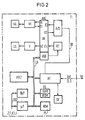
- Fig. 2 shows a block diagram of a telephone terminal T1, which forms part of the system for speaker recognition according to the invention.
- the central device for controlling the subscriber operator procedures, for controlling all acoustic signals to be transmitted in the terminal and for controlling the signaling with the switching system is implemented by a microprocessor system ⁇ P.
- this microprocessor system ⁇ P can be formed by a Siemens microprocessor SAB 80 C 31.
- the microprocessor system ⁇ P also causes the speech samples entered into a speech capsule of a handset HA of the telephone terminal T1 to be scanned, stores them in a buffer memory (DS RAM) and reads them out for transmission to the switching system VA.
- DS RAM buffer memory
- the microprocessor system ⁇ P is connected to a program memory PS and a data memory DS via a local bus LB formed from control, address and data lines.
- the program memory PS implemented in ROM memory technology is designed, for example, for a program comprising a maximum of 64 kbytes.
- Half of the data memory DS which for example also has 64 kbytes, can be implemented in ROM memory technology, for example Read-only memory - for fixed data, parameter data and tables - and the other half contain a memory designed in RAM memory technology for storing speech sample values and, if necessary, user-specific data.
- the microprocessor system ⁇ P additionally has a serial bus interface (not shown in FIG. 2). This serial bus interface is connected via a serial bus SB2 to a control panel microprocessor system B ⁇ P.
- the serial bus SB2 is also connected to the number keys Z, the function keys F and, if appropriate, to a chip card reader (CL, FIG. 1).
- control panel microprocessor system B ⁇ P the coded information generated by the control elements Z, F and possibly CL is recognized, serially transmitted via the serial bus SB2 to the microprocessor system ⁇ P and further processed there for signaling information and for local operator guidance information, which are preferably as optical displays on corresponding display devices ANZ are shown.
- the display device ANZ connected to a local bus LB is implemented, for example, by an LCD display (two lines of 24 characters each).
- the telephone terminal is connected to the subscriber line Asl via a connection device AE. Via this subscriber line Asl, the telephony terminal communicates with the associated switching system VA, which has a central control for carrying out the actual switching processes and the special control ST assigned to it, which is used to implement the procedures in connection with speaker recognition.
- the electrical energy transmitted by the connection device AE is converted into a positive and negative supply voltage required for the operation of the telephone terminal.
- This power supply SV is preferably implemented by a space-saving switching regulator power supply.
- connection device AE The signaling information separated in the connection device AE from information transmitted via the connection line Asl is processed in accordance with the local bus and transmitted to the microprocessor system ⁇ P via the local bus LB. In the microprocessor system ⁇ P, this signaling information is further processed in accordance with the functions assigned to the data link layer and network layer and the corresponding reactions - e.g. B. control of output units - initiated.
- connection device AE The useful information separated in the connection device AE reaches an analog / digital conversion device A / D via a bus BK.
- analog voice signals are formed from the digitized useful information signals which are output by the connection device AE and which represent voice signals.
- the analog voice signals arriving at a further input of the analog / digital conversion device A / D are converted into digital voice signals.
- the coding or decoding the analog or digital voice signals are carried out using the well-known, standardized PCM method.
- the analog voice signals reach a third input E3 of an acoustic device AKE via a corresponding connection.
- the acoustic device AKE is composed of an acoustic coupler AK and a control device ASE.
- the acoustic coupler AK transmits the analog signals arriving from the analog / digital conversion device A / D either only to a first output A1 or to the first and to a second output A1, A2.
- Output A1 is connected to the handset of the telephone terminal via a preamplifier VV.
- the analog voice signals are in any case after switching the connection through the preamplifier VV to an earpiece arranged in the handset HA.
- the speech signals emitted by the speech capsule arranged in the handset HA reach a first input E1 of the acoustic coupler AK via the preamplifier VV.
- the analog voice signals are conveyed through the acoustic coupler AK to a third output A3 connected to the analog / digital conversion device A / D. These analog voice signals are converted into digital signals in the analog / digital conversion device A / D and inserted in the connection device AE in the useful information stream transmitted to the connection line Asl. If the feature "open listening" is activated in the telephone device by, for example, a corresponding key stimulus, the analog voice signals arriving at the third input E3 are simultaneously led to a second output A2 of the acoustic coupler AK. From there, the analog voice signals pass through an amplifier V to a loudspeaker LS arranged in the telephone terminal.
- the control device ASE arranged in the acoustic device AKE is connected both to the acoustic coupler AK and to the local bus LB.
- the control commands transmitted by the microprocessor system ⁇ P via the local bus LB are converted into information by means of which the connection paths in the acoustic coupler AK are set.
- the control device ASE controls a ringing tone generator RT, which generates different ringing tones with corresponding ringing rhythms depending on the control. These ringing tones are transmitted to the handset HA and / or the loudspeaker LS via the acoustic coupler AK under the control of the control device ASE.
- a speaker recognition attempt can be triggered within the scope of the method according to the invention by a command which is entered into a terminal T1, T2 by means of the selection keys Z, the function keys F or the chip card reader CL and which is fed to the control unit ST of the switching system VA.
- the controller ST enables the input of speech samples into the handset HA of the relevant terminal T1, T2.
- the release is signaled acoustically and / or optically on the terminal T1, T2.
- the device BF arranged in the switching system VA triggers signaling information triggered by a corresponding command from the control ST (FIG. 1), which is fed to the microprocessor system ⁇ P of the terminals T1 and T2.
- the microprocessor system ⁇ P issues a command to the analog / digital conversion device A / D, which thus increases the otherwise usual sampling rate (first frequency) from 8 kHz to 16 kHz in particular.
- the speech samples which are then input into the microphone of the handset HA are, after preamplification (VV), sampled by the device A / D with the increased sampling frequency and, as usual, coded according to the standardized PCM method. While the device A / D usually delivers PCM-coded samples with 64 Kbit / sec, according to the invention it forms an increased number of samples, in particular twice the number of samples. The device A / D then outputs samples with 128 Kbit / sec. These samples are first read into the memory DSRAM, then read out at the usual readout rate of 64 kbit / sec and fed to the switching system VA via the connection device AE in the data information channel B. Via the interface S, the samples reach the speaker recognition device SPR, which has an increased number of speech sample samples available for the actual speech recognition.
- Information identifying persons which may have to be provided by the speakers to be recognized in the context of a speaker recognition attempt, is formed by actuating the dialing keys Z, the function keys F or by inserting a chip card in a chip card reader CL.
- This information is recognized by the control panel microprocessor system B ⁇ P, transmitted serially via the serial bus SB2 to the microprocessor system ⁇ P and processed there for signaling information.
- the signaling information is then transmitted via the local bus LB, the connection device AE and the connection line ASL in the signaling information channel D to the switching system VA.
- the controller ST stores the person-identifying information preferably in the second memory areas SP2 and calls them up from the memory areas SP2 to carry out the comparison of reference speech samples with speech samples formed in the context of the speaker recognition attempt.
Landscapes
- Engineering & Computer Science (AREA)
- Computer Security & Cryptography (AREA)
- Signal Processing (AREA)
- Computer Networks & Wireless Communication (AREA)
- Telephonic Communication Services (AREA)
- Interface Circuits In Exchanges (AREA)
- Sub-Exchange Stations And Push- Button Telephones (AREA)
Claims (5)
- Procédé pour identifier un locuteur dans une installation de commutation téléphonique (VA), selon lequel dans le cadre d'une tentative d'identification d'un locuteur, des échantillons vocaux sont introduits dans des appareils téléphoniques (T1,T2) raccordés à l'installation de commutation téléphonique (VA) et sont envoyés à cette installation (VA), et selon lequel les échantillons vocaux sont échantillonnés à une fréquence d'échantillonnage prédéterminée et les valeurs d'échantillonnage formées sont envoyées un dispositif (ST) situé dans l'installation de commutation (VA) et qui forme, par comparaison entre des échantillons vocaux de référence mémorisés initialement dans l'installation de commutation (VA) et des échantillons vocaux introduits dans le cadre de l'essai d'identification du locuteur, un premier signal qui désigne une identification du locuteur concerné, ou un second signal qui désigne un échec d'identification du locuteur considéré, caractérisé par le fait
que la fréquence d'échantillonnage prédéterminée pour les échantillons vocaux introduits dans un appareil téléphonique (T1,T2) est supérieure à ce qui est nécessaire conformément au théorème d'échantillonnage pour la bande utilisée des signaux vocaux, et que les valeurs d'échantillonnage formées sont mémorisées temporairement dans une mémoire (DS RAM) disposée dans le poste téléphonique terminal et sont lus avec une cadence de lecture correspondant à la première fréquence, à partir de la mémoire (DS RAM) et sont envoyés à l'installation de commutation (VA). - Procédé suivant la revendication 1, caractérisé par le fait que les échantillons vocaux introduits dans l'appareil téléphonique terminal (T1,T2) sont échantillonnés avec une fréquence égale au double de la première fréquence.
- Procédé suivant la revendication 1 ou 2, caractérisé par le fait que dans le cadre de la totalité d'identification du locuteur, des informations représentant des caractères alphanumériques, qui sont propres au locuteur, sont introduites en plus des échantillons vocaux, que pour exécuter la comparaison entre les échantillons vocaux de référence et les échantillons vocaux introduits dans le cadre de l'essai d'identification du locuteur, les échantillons vocaux de référence sont sélectionnés au moyen des informations qui sont propres à chaque locuteur et représentent des caractères alphanumériques, et que lors de l'apparition du premier signal, une introduction d'instructions prédéterminées dans l'installation de commutation (VA) est autorisée.
- Dispositif pour identifier un locuteur dans une installation de commutation téléphonique (VA), caractérisé par les composants suivants :- une unité programmable (ST) de commande du système, avec accès par l'intermédiaire d'un bus (SB1) du système à- un dispositif (SPE) d'identification du locuteur,- des première et seconde zones de mémoire (SP1,SP2),- au moins une interface (S), à laquelle peuvent être raccordés, dans un réseau de communication ISDN, des appareils téléphoniques numériques terminaux (T1,T2), qui comportent un dispositif (mP, HA, A/D) pour explorer des échantillons vocaux avec une fréquence d'échantillonnage qui est supérieure à ce qui est nécessaire conformément au théorème d'échantillonnage pour la bande de signaux vocaux utilisée, et une mémoire (DS-RAM) pour la mémorisation intermédiaire des valeurs d'échantillonnage ainsi formées des échantillons vocaux.
- Dispositif suivant la revendication 4, caractérisé par le fait que l'unité de commande (ST) du système est relié à un dispositif (BF) servant à réaliser un guidage acoustique et/ou optique de l'utilisateur.
Priority Applications (4)
| Application Number | Priority Date | Filing Date | Title |
|---|---|---|---|
| DE88114368T DE3887330D1 (de) | 1988-09-02 | 1988-09-02 | Verfahren und Anordnung zur Sprechererkennung in einer Fernsprechvermittlungsanlage. |
| AT88114368T ATE100658T1 (de) | 1988-09-02 | 1988-09-02 | Verfahren und anordnung zur sprechererkennung in einer fernsprechvermittlungsanlage. |
| EP88114368A EP0356568B1 (fr) | 1988-09-02 | 1988-09-02 | Procédé et arrangement pour la reconnaissance du locuteur dans un central téléphonique |
| US07/839,661 US5166971A (en) | 1988-09-02 | 1992-02-24 | Method for speaker recognition in a telephone switching system |
Applications Claiming Priority (1)
| Application Number | Priority Date | Filing Date | Title |
|---|---|---|---|
| EP88114368A EP0356568B1 (fr) | 1988-09-02 | 1988-09-02 | Procédé et arrangement pour la reconnaissance du locuteur dans un central téléphonique |
Publications (2)
| Publication Number | Publication Date |
|---|---|
| EP0356568A1 EP0356568A1 (fr) | 1990-03-07 |
| EP0356568B1 true EP0356568B1 (fr) | 1994-01-19 |
Family
ID=8199263
Family Applications (1)
| Application Number | Title | Priority Date | Filing Date |
|---|---|---|---|
| EP88114368A Expired - Lifetime EP0356568B1 (fr) | 1988-09-02 | 1988-09-02 | Procédé et arrangement pour la reconnaissance du locuteur dans un central téléphonique |
Country Status (4)
| Country | Link |
|---|---|
| US (1) | US5166971A (fr) |
| EP (1) | EP0356568B1 (fr) |
| AT (1) | ATE100658T1 (fr) |
| DE (1) | DE3887330D1 (fr) |
Families Citing this family (23)
| Publication number | Priority date | Publication date | Assignee | Title |
|---|---|---|---|---|
| DE3823913A1 (de) * | 1988-07-14 | 1990-01-18 | Siemens Ag | Komunikationssystem mit vorgegebenen, von einer kommunikationsanlage durch informationsuebermittlung bestimmte und gesteuerte funktionen versehenen kommunikationsendeinrichtungen |
| DE3823914A1 (de) * | 1988-07-14 | 1990-01-18 | Siemens Ag | Verfahren zum uebermitteln endgeraetebestimmender programmparameterdaten von einer kommunikationsanlage zu kommunikationsendgeraeten |
| WO1993001664A1 (fr) * | 1991-07-08 | 1993-01-21 | Motorola, Inc. | Systeme de commande vocale a distance |
| GB2264209B (en) * | 1992-02-06 | 1995-11-08 | Technophone Ltd | Cordless telephone arrangement |
| US5717743A (en) * | 1992-12-16 | 1998-02-10 | Texas Instruments Incorporated | Transparent telephone access system using voice authorization |
| US5502759A (en) * | 1993-05-13 | 1996-03-26 | Nynex Science & Technology, Inc. | Apparatus and accompanying methods for preventing toll fraud through use of centralized caller voice verification |
| JP3263188B2 (ja) * | 1993-06-03 | 2002-03-04 | 株式会社日立テレコムテクノロジー | デジタル伝送方式 |
| US5623539A (en) * | 1994-01-27 | 1997-04-22 | Lucent Technologies Inc. | Using voice signal analysis to identify authorized users of a telephone system |
| JP2561022B2 (ja) * | 1994-05-25 | 1996-12-04 | 日本電気株式会社 | 宛先アドレスによる送信チャネル選択システム |
| JPH0856262A (ja) * | 1994-08-11 | 1996-02-27 | Hitachi Ltd | 電話交換機およびそれを利用した電話交換網 |
| EP0702354A1 (fr) * | 1994-09-14 | 1996-03-20 | Matsushita Electric Industrial Co., Ltd. | Appareil pour modifier l'échelle de temps pour la modification du langage |
| KR970056637A (ko) * | 1995-12-26 | 1997-07-31 | 김광호 | 컴퓨터 및 전화 복합 교환시스템 |
| US5946319A (en) * | 1996-07-04 | 1999-08-31 | Nec Corporation | ISDN communication apparatus |
| GB9620082D0 (en) | 1996-09-26 | 1996-11-13 | Eyretel Ltd | Signal monitoring apparatus |
| DE29621022U1 (de) * | 1996-12-04 | 1997-02-20 | Hepla-Kunststofftechnik GmbH, 34576 Homberg | Mobiles Telefon |
| US5953700A (en) * | 1997-06-11 | 1999-09-14 | International Business Machines Corporation | Portable acoustic interface for remote access to automatic speech/speaker recognition server |
| US6584181B1 (en) | 1997-09-19 | 2003-06-24 | Siemens Information & Communication Networks, Inc. | System and method for organizing multi-media messages folders from a displayless interface and selectively retrieving information using voice labels |
| US6370238B1 (en) | 1997-09-19 | 2002-04-09 | Siemens Information And Communication Networks Inc. | System and method for improved user interface in prompting systems |
| US6069940A (en) * | 1997-09-19 | 2000-05-30 | Siemens Information And Communication Networks, Inc. | Apparatus and method for adding a subject line to voice mail messages |
| US6195636B1 (en) | 1999-02-19 | 2001-02-27 | Texas Instruments Incorporated | Speech recognition over packet networks |
| US20040037399A1 (en) * | 2002-08-21 | 2004-02-26 | Siemens Information And Communication Mobile, Llc | System and method for transferring phone numbers during a voice call |
| KR100640893B1 (ko) * | 2004-09-07 | 2006-11-02 | 엘지전자 주식회사 | 음성 인식용 베이스밴드 모뎀 및 이동통신용 단말기 |
| US8189783B1 (en) * | 2005-12-21 | 2012-05-29 | At&T Intellectual Property Ii, L.P. | Systems, methods, and programs for detecting unauthorized use of mobile communication devices or systems |
Family Cites Families (8)
| Publication number | Priority date | Publication date | Assignee | Title |
|---|---|---|---|---|
| DE2305094C2 (de) * | 1973-02-02 | 1982-04-01 | Licentia Patent-Verwaltungs-Gmbh, 6000 Frankfurt | Verfahren und System zur breitbandigen Nachrichtenübertragung |
| US4229815A (en) * | 1978-11-20 | 1980-10-21 | Bell Telephone Laboratories, Incorporated | Full duplex bit synchronous data rate buffer |
| DE3029823A1 (de) * | 1980-08-06 | 1982-03-04 | Siemens AG, 1000 Berlin und 8000 München | Waehlverfahren zum verbindungsaufbau in einem fernsprechvermittlungssystem mit digitaler sprachuebertragung |
| DE3316492A1 (de) * | 1983-05-05 | 1984-11-08 | Siemens AG, 1000 Berlin und 8000 München | Schaltungsanordnung fuer den teilnehmeranschluss in einem diensteintegrierenden digitalnetz (isdn) |
| DE3422409A1 (de) * | 1984-06-16 | 1985-12-19 | Standard Elektrik Lorenz Ag, 7000 Stuttgart | Einrichtung zur erkennung und umsetzung von wahlinformation sowie von steuerinformation fuer leistungsmerkmale einer fernsprechvermittlungsanlage |
| DE3643838A1 (de) * | 1986-12-20 | 1988-06-30 | Telefonbau & Normalzeit Gmbh | Spracherkennungseinrichtung fuer dienste-integrierende kommunikationsanlagen, insbesondere fernsprechvermittlungsanlagen |
| US4864301A (en) * | 1987-07-24 | 1989-09-05 | Richard J. Helferich | Variable speed transmission recording and retrieval of data |
| DE3886530D1 (de) * | 1988-09-02 | 1994-02-03 | Siemens Ag | Verfahren und Anordnung zur Sprechererkennung in einer Fernsprechvermittlungsanlage. |
-
1988
- 1988-09-02 DE DE88114368T patent/DE3887330D1/de not_active Expired - Fee Related
- 1988-09-02 AT AT88114368T patent/ATE100658T1/de not_active IP Right Cessation
- 1988-09-02 EP EP88114368A patent/EP0356568B1/fr not_active Expired - Lifetime
-
1992
- 1992-02-24 US US07/839,661 patent/US5166971A/en not_active Expired - Lifetime
Also Published As
| Publication number | Publication date |
|---|---|
| DE3887330D1 (de) | 1994-03-03 |
| EP0356568A1 (fr) | 1990-03-07 |
| ATE100658T1 (de) | 1994-02-15 |
| US5166971A (en) | 1992-11-24 |
Similar Documents
| Publication | Publication Date | Title |
|---|---|---|
| EP0356568B1 (fr) | Procédé et arrangement pour la reconnaissance du locuteur dans un central téléphonique | |
| DE4041273C1 (fr) | ||
| DE3851113T3 (de) | Sprachgesteuerte Wählvorrichtung mit Speichern für vollständige Wahl für alle Benutzer und Kurzwahl für befugte Benutzer. | |
| EP0356567B1 (fr) | Procédé et arrangement de reconnaissance du locuteur dans un central téléphonique | |
| DE69839068T2 (de) | System und Verfahren zur automatischen Verarbeitung von Anruf und Datenübertragung | |
| DE69232463T2 (de) | Sprachgesteuertes nachrichtensystem und verarbeitungsverfahren | |
| DE3885683T2 (de) | Telefonapparat. | |
| DE69129883T2 (de) | Rufnummerwahl mit Spracherkennung | |
| DE69333645T2 (de) | Sprachgesteuertes Kommunikationssystem mit gemeinsamen Teilnehmeridentifizierern | |
| DE69425818T2 (de) | System und verfahren zur sprachbefehlssteuerung und sprecheridentitätsprüfung | |
| DE69714880T2 (de) | Mustervergleichsverfahren und Vorrichtung dafür | |
| DE3029823C2 (fr) | ||
| EP0471677B1 (fr) | Systeme de transmission d'informations | |
| EP1044560B1 (fr) | Procede et reseau de communication destines a la taxation de la telephonie classique par reconnaissance vocale | |
| EP0720340A2 (fr) | Méthode d'interception d'appels téléphoniques en réception | |
| EP0589248A2 (fr) | Méthode et disposition pour l'affichage de numéros d'appel aux postes téléphoniques d'un central téléphonique privé | |
| DE19839466A1 (de) | Verfahren und Steuereinrichtung zur Bedienung technischer Einrichtungen eines Fahrzeugs | |
| EP0407882A1 (fr) | Dispositif pour vérifier l'autorisation d'accès d'une personne au système | |
| DE3300053A1 (de) | Auf sprache ansprechende mobile statuseinheit | |
| DE3328059C2 (de) | Verfahren zur empfangsseitigen Auswahl von über eine Vermittlungsstelle einer Fernmelde- bzw. Fernsprechanlage laufende Daten- bzw. Sprechverbindungen | |
| WO1999027695A1 (fr) | Procede permettant de selectionner un abonne d'un reseau de telecommunications | |
| EP1244284B1 (fr) | Méthode et appareil pour établir deux liaisons vocales vers une position d'agent CTI | |
| DE4419506C2 (de) | Interaktives Anrufbeantwortersystem | |
| DE3513244C2 (fr) | ||
| DE2933476A1 (de) | Vorrichtung zur uebertragung von daten zu einem fernsprechapparat |
Legal Events
| Date | Code | Title | Description |
|---|---|---|---|
| PUAI | Public reference made under article 153(3) epc to a published international application that has entered the european phase |
Free format text: ORIGINAL CODE: 0009012 |
|
| AK | Designated contracting states |
Kind code of ref document: A1 Designated state(s): AT BE CH DE ES FR GB GR IT LI LU NL SE |
|
| RBV | Designated contracting states (corrected) |
Designated state(s): AT CH DE FR GB IT LI |
|
| 17P | Request for examination filed |
Effective date: 19900607 |
|
| 17Q | First examination report despatched |
Effective date: 19920722 |
|
| GRAA | (expected) grant |
Free format text: ORIGINAL CODE: 0009210 |
|
| AK | Designated contracting states |
Kind code of ref document: B1 Designated state(s): AT CH DE FR GB IT LI |
|
| REF | Corresponds to: |
Ref document number: 100658 Country of ref document: AT Date of ref document: 19940215 Kind code of ref document: T |
|
| REF | Corresponds to: |
Ref document number: 3887330 Country of ref document: DE Date of ref document: 19940303 |
|
| ITF | It: translation for a ep patent filed | ||
| GBT | Gb: translation of ep patent filed (gb section 77(6)(a)/1977) |
Effective date: 19940325 |
|
| ET | Fr: translation filed | ||
| PLBE | No opposition filed within time limit |
Free format text: ORIGINAL CODE: 0009261 |
|
| STAA | Information on the status of an ep patent application or granted ep patent |
Free format text: STATUS: NO OPPOSITION FILED WITHIN TIME LIMIT |
|
| 26N | No opposition filed | ||
| PGFP | Annual fee paid to national office [announced via postgrant information from national office to epo] |
Ref country code: CH Payment date: 19971217 Year of fee payment: 10 |
|
| PGFP | Annual fee paid to national office [announced via postgrant information from national office to epo] |
Ref country code: AT Payment date: 19980826 Year of fee payment: 11 |
|
| PG25 | Lapsed in a contracting state [announced via postgrant information from national office to epo] |
Ref country code: LI Free format text: LAPSE BECAUSE OF NON-PAYMENT OF DUE FEES Effective date: 19980930 Ref country code: CH Free format text: LAPSE BECAUSE OF NON-PAYMENT OF DUE FEES Effective date: 19980930 |
|
| REG | Reference to a national code |
Ref country code: CH Ref legal event code: PL |
|
| PG25 | Lapsed in a contracting state [announced via postgrant information from national office to epo] |
Ref country code: AT Free format text: LAPSE BECAUSE OF NON-PAYMENT OF DUE FEES Effective date: 19990902 |
|
| REG | Reference to a national code |
Ref country code: GB Ref legal event code: IF02 |
|
| PGFP | Annual fee paid to national office [announced via postgrant information from national office to epo] |
Ref country code: DE Payment date: 20031117 Year of fee payment: 16 |
|
| PGFP | Annual fee paid to national office [announced via postgrant information from national office to epo] |
Ref country code: GB Payment date: 20040907 Year of fee payment: 17 |
|
| PGFP | Annual fee paid to national office [announced via postgrant information from national office to epo] |
Ref country code: FR Payment date: 20040921 Year of fee payment: 17 |
|
| PG25 | Lapsed in a contracting state [announced via postgrant information from national office to epo] |
Ref country code: DE Free format text: LAPSE BECAUSE OF NON-PAYMENT OF DUE FEES Effective date: 20050401 |
|
| PG25 | Lapsed in a contracting state [announced via postgrant information from national office to epo] |
Ref country code: IT Free format text: LAPSE BECAUSE OF NON-PAYMENT OF DUE FEES;WARNING: LAPSES OF ITALIAN PATENTS WITH EFFECTIVE DATE BEFORE 2007 MAY HAVE OCCURRED AT ANY TIME BEFORE 2007. THE CORRECT EFFECTIVE DATE MAY BE DIFFERENT FROM THE ONE RECORDED. Effective date: 20050902 Ref country code: GB Free format text: LAPSE BECAUSE OF NON-PAYMENT OF DUE FEES Effective date: 20050902 |
|
| GBPC | Gb: european patent ceased through non-payment of renewal fee |
Effective date: 20050902 |
|
| PG25 | Lapsed in a contracting state [announced via postgrant information from national office to epo] |
Ref country code: FR Free format text: LAPSE BECAUSE OF NON-PAYMENT OF DUE FEES Effective date: 20060531 |
|
| REG | Reference to a national code |
Ref country code: FR Ref legal event code: ST Effective date: 20060531 |