EP0356579B1 - Fibre colorées d'aramide - Google Patents
Fibre colorées d'aramide Download PDFInfo
- Publication number
- EP0356579B1 EP0356579B1 EP88118954A EP88118954A EP0356579B1 EP 0356579 B1 EP0356579 B1 EP 0356579B1 EP 88118954 A EP88118954 A EP 88118954A EP 88118954 A EP88118954 A EP 88118954A EP 0356579 B1 EP0356579 B1 EP 0356579B1
- Authority
- EP
- European Patent Office
- Prior art keywords
- pigments
- pigment
- colour index
- fibers
- index pigment
- Prior art date
- Legal status (The legal status is an assumption and is not a legal conclusion. Google has not performed a legal analysis and makes no representation as to the accuracy of the status listed.)
- Expired - Lifetime
Links
- 239000004760 aramid Substances 0.000 title claims description 20
- 229920006231 aramid fiber Polymers 0.000 title claims description 10
- 239000000049 pigment Substances 0.000 claims description 90
- 239000000835 fiber Substances 0.000 claims description 40
- QAOWNCQODCNURD-UHFFFAOYSA-N Sulfuric acid Chemical compound OS(O)(=O)=O QAOWNCQODCNURD-UHFFFAOYSA-N 0.000 claims description 26
- 239000012860 organic pigment Substances 0.000 claims description 16
- 239000002245 particle Substances 0.000 claims description 16
- -1 poly(p-phenylene terephthalamide) Polymers 0.000 claims description 13
- 229920000642 polymer Polymers 0.000 claims description 12
- 229920003235 aromatic polyamide Polymers 0.000 claims description 11
- 239000000203 mixture Substances 0.000 claims description 11
- 230000001112 coagulating effect Effects 0.000 claims description 9
- 235000019239 indanthrene blue RS Nutrition 0.000 claims description 8
- 238000000034 method Methods 0.000 claims description 6
- 230000008569 process Effects 0.000 claims description 6
- XLYOFNOQVPJJNP-UHFFFAOYSA-N water Substances O XLYOFNOQVPJJNP-UHFFFAOYSA-N 0.000 claims description 6
- NRCMAYZCPIVABH-UHFFFAOYSA-N Quinacridone Chemical compound N1C2=CC=CC=C2C(=O)C2=C1C=C1C(=O)C3=CC=CC=C3NC1=C2 NRCMAYZCPIVABH-UHFFFAOYSA-N 0.000 claims description 5
- PGEHNUUBUQTUJB-UHFFFAOYSA-N anthanthrone Chemical compound C1=CC=C2C(=O)C3=CC=C4C=CC=C5C(=O)C6=CC=C1C2=C6C3=C54 PGEHNUUBUQTUJB-UHFFFAOYSA-N 0.000 claims description 5
- 125000000664 diazo group Chemical group [N-]=[N+]=[*] 0.000 claims description 5
- PPSZHCXTGRHULJ-UHFFFAOYSA-N dioxazine Chemical compound O1ON=CC=C1 PPSZHCXTGRHULJ-UHFFFAOYSA-N 0.000 claims description 5
- UHOKSCJSTAHBSO-UHFFFAOYSA-N indanthrone blue Chemical compound C1=CC=C2C(=O)C3=CC=C4NC5=C6C(=O)C7=CC=CC=C7C(=O)C6=CC=C5NC4=C3C(=O)C2=C1 UHOKSCJSTAHBSO-UHFFFAOYSA-N 0.000 claims description 5
- PXZQEOJJUGGUIB-UHFFFAOYSA-N isoindolin-1-one Chemical compound C1=CC=C2C(=O)NCC2=C1 PXZQEOJJUGGUIB-UHFFFAOYSA-N 0.000 claims description 5
- NYGZLYXAPMMJTE-UHFFFAOYSA-M metanil yellow Chemical group [Na+].[O-]S(=O)(=O)C1=CC=CC(N=NC=2C=CC(NC=3C=CC=CC=3)=CC=2)=C1 NYGZLYXAPMMJTE-UHFFFAOYSA-M 0.000 claims description 5
- 229920003366 poly(p-phenylene terephthalamide) Polymers 0.000 claims description 5
- YKSGNOMLAIJTLT-UHFFFAOYSA-N violanthrone Chemical compound C12=C3C4=CC=C2C2=CC=CC=C2C(=O)C1=CC=C3C1=CC=C2C(=O)C3=CC=CC=C3C3=CC=C4C1=C32 YKSGNOMLAIJTLT-UHFFFAOYSA-N 0.000 claims description 5
- 239000003513 alkali Substances 0.000 claims description 4
- FLJVQOSHSSGNRL-UHFFFAOYSA-N 3H-pyranthren-4-one Chemical compound C1=CC=CC=2C3=CC4=CC=C5C=C6C=CCC(C6=C6C=C7C=CC(=CC12)C3=C7C4=C56)=O FLJVQOSHSSGNRL-UHFFFAOYSA-N 0.000 claims description 3
- 239000012530 fluid Substances 0.000 claims description 3
- 238000005406 washing Methods 0.000 claims description 3
- 238000013019 agitation Methods 0.000 claims description 2
- 230000001747 exhibiting effect Effects 0.000 claims description 2
- 238000010438 heat treatment Methods 0.000 claims description 2
- 238000002360 preparation method Methods 0.000 claims description 2
- 125000001309 chloro group Chemical group Cl* 0.000 description 10
- 239000000243 solution Substances 0.000 description 10
- 150000003254 radicals Chemical class 0.000 description 9
- 238000009987 spinning Methods 0.000 description 7
- 230000000052 comparative effect Effects 0.000 description 6
- 239000000975 dye Substances 0.000 description 6
- 125000002496 methyl group Chemical group [H]C([H])([H])* 0.000 description 6
- 238000012360 testing method Methods 0.000 description 6
- 239000000984 vat dye Substances 0.000 description 6
- 125000003118 aryl group Chemical group 0.000 description 5
- 230000015271 coagulation Effects 0.000 description 5
- 238000005345 coagulation Methods 0.000 description 5
- 239000004952 Polyamide Substances 0.000 description 3
- 238000006243 chemical reaction Methods 0.000 description 3
- 230000007423 decrease Effects 0.000 description 3
- 125000000956 methoxy group Chemical group [H]C([H])([H])O* 0.000 description 3
- 229920002647 polyamide Polymers 0.000 description 3
- 239000002904 solvent Substances 0.000 description 3
- 125000001140 1,4-phenylene group Chemical group [H]C1=C([H])C([*:2])=C([H])C([H])=C1[*:1] 0.000 description 2
- LYCAIKOWRPUZTN-UHFFFAOYSA-N Ethylene glycol Chemical compound OCCO LYCAIKOWRPUZTN-UHFFFAOYSA-N 0.000 description 2
- 125000001246 bromo group Chemical group Br* 0.000 description 2
- 230000015556 catabolic process Effects 0.000 description 2
- 230000008859 change Effects 0.000 description 2
- 239000003086 colorant Substances 0.000 description 2
- 230000003750 conditioning effect Effects 0.000 description 2
- 238000006731 degradation reaction Methods 0.000 description 2
- 229910052739 hydrogen Inorganic materials 0.000 description 2
- 239000001257 hydrogen Substances 0.000 description 2
- 125000004435 hydrogen atom Chemical class [H]* 0.000 description 2
- KWGKDLIKAYFUFQ-UHFFFAOYSA-M lithium chloride Chemical compound [Li+].[Cl-] KWGKDLIKAYFUFQ-UHFFFAOYSA-M 0.000 description 2
- 238000005259 measurement Methods 0.000 description 2
- 238000002156 mixing Methods 0.000 description 2
- LLBIOIRWAYBCKK-UHFFFAOYSA-N pyranthrene-8,16-dione Chemical compound C12=CC=CC=C2C(=O)C2=CC=C3C=C4C5=CC=CC=C5C(=O)C5=C4C4=C3C2=C1C=C4C=C5 LLBIOIRWAYBCKK-UHFFFAOYSA-N 0.000 description 2
- 239000007787 solid Substances 0.000 description 2
- 239000000126 substance Substances 0.000 description 2
- KOTVVDDZWMCZBT-UHFFFAOYSA-N vat violet 1 Chemical compound C1=CC=C[C]2C(=O)C(C=CC3=C4C=C(C=5C=6C(C([C]7C=CC=CC7=5)=O)=CC=C5C4=6)Cl)=C4C3=C5C=C(Cl)C4=C21 KOTVVDDZWMCZBT-UHFFFAOYSA-N 0.000 description 2
- SGHZXLIDFTYFHQ-UHFFFAOYSA-L Brilliant Blue Chemical compound [Na+].[Na+].C=1C=C(C(=C2C=CC(C=C2)=[N+](CC)CC=2C=C(C=CC=2)S([O-])(=O)=O)C=2C(=CC=CC=2)S([O-])(=O)=O)C=CC=1N(CC)CC1=CC=CC(S([O-])(=O)=O)=C1 SGHZXLIDFTYFHQ-UHFFFAOYSA-L 0.000 description 1
- UXVMQQNJUSDDNG-UHFFFAOYSA-L Calcium chloride Chemical compound [Cl-].[Cl-].[Ca+2] UXVMQQNJUSDDNG-UHFFFAOYSA-L 0.000 description 1
- 230000009471 action Effects 0.000 description 1
- 239000000654 additive Substances 0.000 description 1
- 125000003368 amide group Chemical group 0.000 description 1
- 150000001408 amides Chemical class 0.000 description 1
- 239000007864 aqueous solution Substances 0.000 description 1
- 150000004984 aromatic diamines Chemical class 0.000 description 1
- 125000000751 azo group Chemical group [*]N=N[*] 0.000 description 1
- 125000005337 azoxy group Chemical group [N+]([O-])(=N*)* 0.000 description 1
- 230000000740 bleeding effect Effects 0.000 description 1
- 239000001055 blue pigment Substances 0.000 description 1
- 239000001110 calcium chloride Substances 0.000 description 1
- 229910001628 calcium chloride Inorganic materials 0.000 description 1
- 235000011148 calcium chloride Nutrition 0.000 description 1
- 229920001577 copolymer Polymers 0.000 description 1
- 238000002788 crimping Methods 0.000 description 1
- 239000013078 crystal Substances 0.000 description 1
- 238000002425 crystallisation Methods 0.000 description 1
- 230000008025 crystallization Effects 0.000 description 1
- 239000003822 epoxy resin Substances 0.000 description 1
- 125000005677 ethinylene group Chemical group [*:2]C#C[*:1] 0.000 description 1
- RBTKNAXYKSUFRK-UHFFFAOYSA-N heliogen blue Chemical compound [Cu].[N-]1C2=C(C=CC=C3)C3=C1N=C([N-]1)C3=CC=CC=C3C1=NC([N-]1)=C(C=CC=C3)C3=C1N=C([N-]1)C3=CC=CC=C3C1=N2 RBTKNAXYKSUFRK-UHFFFAOYSA-N 0.000 description 1
- 229920001519 homopolymer Polymers 0.000 description 1
- 125000002887 hydroxy group Chemical group [H]O* 0.000 description 1
- WGCNASOHLSPBMP-UHFFFAOYSA-N hydroxyacetaldehyde Natural products OCC=O WGCNASOHLSPBMP-UHFFFAOYSA-N 0.000 description 1
- 230000006872 improvement Effects 0.000 description 1
- 238000004519 manufacturing process Methods 0.000 description 1
- 230000007246 mechanism Effects 0.000 description 1
- 239000003960 organic solvent Substances 0.000 description 1
- 230000035515 penetration Effects 0.000 description 1
- 125000001997 phenyl group Chemical group [H]C1=C([H])C([H])=C(*)C([H])=C1[H] 0.000 description 1
- 229920001084 poly(chloroprene) Polymers 0.000 description 1
- 229920000647 polyepoxide Polymers 0.000 description 1
- 239000000843 powder Substances 0.000 description 1
- 238000001556 precipitation Methods 0.000 description 1
- 150000003839 salts Chemical class 0.000 description 1
- 230000003381 solubilizing effect Effects 0.000 description 1
- 238000003756 stirring Methods 0.000 description 1
- 125000005407 trans-1,4-cyclohexylene group Chemical group [H]C1([H])C([H])([H])[C@]([H])([*:2])C([H])([H])C([H])([H])[C@@]1([H])[*:1] 0.000 description 1
- 238000002166 wet spinning Methods 0.000 description 1
Images


Classifications
-
- D—TEXTILES; PAPER
- D01—NATURAL OR MAN-MADE THREADS OR FIBRES; SPINNING
- D01F—CHEMICAL FEATURES IN THE MANUFACTURE OF ARTIFICIAL FILAMENTS, THREADS, FIBRES, BRISTLES OR RIBBONS; APPARATUS SPECIALLY ADAPTED FOR THE MANUFACTURE OF CARBON FILAMENTS
- D01F6/00—Monocomponent artificial filaments or the like of synthetic polymers; Manufacture thereof
- D01F6/58—Monocomponent artificial filaments or the like of synthetic polymers; Manufacture thereof from homopolycondensation products
- D01F6/60—Monocomponent artificial filaments or the like of synthetic polymers; Manufacture thereof from homopolycondensation products from polyamides
- D01F6/605—Monocomponent artificial filaments or the like of synthetic polymers; Manufacture thereof from homopolycondensation products from polyamides from aromatic polyamides
-
- D—TEXTILES; PAPER
- D01—NATURAL OR MAN-MADE THREADS OR FIBRES; SPINNING
- D01F—CHEMICAL FEATURES IN THE MANUFACTURE OF ARTIFICIAL FILAMENTS, THREADS, FIBRES, BRISTLES OR RIBBONS; APPARATUS SPECIALLY ADAPTED FOR THE MANUFACTURE OF CARBON FILAMENTS
- D01F1/00—General methods for the manufacture of artificial filaments or the like
- D01F1/02—Addition of substances to the spinning solution or to the melt
- D01F1/04—Pigments
-
- Y—GENERAL TAGGING OF NEW TECHNOLOGICAL DEVELOPMENTS; GENERAL TAGGING OF CROSS-SECTIONAL TECHNOLOGIES SPANNING OVER SEVERAL SECTIONS OF THE IPC; TECHNICAL SUBJECTS COVERED BY FORMER USPC CROSS-REFERENCE ART COLLECTIONS [XRACs] AND DIGESTS
- Y10—TECHNICAL SUBJECTS COVERED BY FORMER USPC
- Y10S—TECHNICAL SUBJECTS COVERED BY FORMER USPC CROSS-REFERENCE ART COLLECTIONS [XRACs] AND DIGESTS
- Y10S8/00—Bleaching and dyeing; fluid treatment and chemical modification of textiles and fibers
- Y10S8/92—Synthetic fiber dyeing
- Y10S8/924—Polyamide fiber
- Y10S8/925—Aromatic polyamide
-
- Y—GENERAL TAGGING OF NEW TECHNOLOGICAL DEVELOPMENTS; GENERAL TAGGING OF CROSS-SECTIONAL TECHNOLOGIES SPANNING OVER SEVERAL SECTIONS OF THE IPC; TECHNICAL SUBJECTS COVERED BY FORMER USPC CROSS-REFERENCE ART COLLECTIONS [XRACs] AND DIGESTS
- Y10—TECHNICAL SUBJECTS COVERED BY FORMER USPC
- Y10T—TECHNICAL SUBJECTS COVERED BY FORMER US CLASSIFICATION
- Y10T428/00—Stock material or miscellaneous articles
- Y10T428/29—Coated or structually defined flake, particle, cell, strand, strand portion, rod, filament, macroscopic fiber or mass thereof
- Y10T428/2913—Rod, strand, filament or fiber
-
- Y—GENERAL TAGGING OF NEW TECHNOLOGICAL DEVELOPMENTS; GENERAL TAGGING OF CROSS-SECTIONAL TECHNOLOGIES SPANNING OVER SEVERAL SECTIONS OF THE IPC; TECHNICAL SUBJECTS COVERED BY FORMER USPC CROSS-REFERENCE ART COLLECTIONS [XRACs] AND DIGESTS
- Y10—TECHNICAL SUBJECTS COVERED BY FORMER USPC
- Y10T—TECHNICAL SUBJECTS COVERED BY FORMER US CLASSIFICATION
- Y10T428/00—Stock material or miscellaneous articles
- Y10T428/29—Coated or structually defined flake, particle, cell, strand, strand portion, rod, filament, macroscopic fiber or mass thereof
- Y10T428/2913—Rod, strand, filament or fiber
- Y10T428/2927—Rod, strand, filament or fiber including structurally defined particulate matter
-
- Y—GENERAL TAGGING OF NEW TECHNOLOGICAL DEVELOPMENTS; GENERAL TAGGING OF CROSS-SECTIONAL TECHNOLOGIES SPANNING OVER SEVERAL SECTIONS OF THE IPC; TECHNICAL SUBJECTS COVERED BY FORMER USPC CROSS-REFERENCE ART COLLECTIONS [XRACs] AND DIGESTS
- Y10—TECHNICAL SUBJECTS COVERED BY FORMER USPC
- Y10T—TECHNICAL SUBJECTS COVERED BY FORMER US CLASSIFICATION
- Y10T428/00—Stock material or miscellaneous articles
- Y10T428/29—Coated or structually defined flake, particle, cell, strand, strand portion, rod, filament, macroscopic fiber or mass thereof
- Y10T428/2913—Rod, strand, filament or fiber
- Y10T428/298—Physical dimension
Definitions
- This invention relates to colored, high strength, high modulus p-aramid fibers and a process for preparing them.
- High strength, high modulus p-aramid fibers are known from U S-A-3 869 429 (Blades). These fibers are extremely difficult to dye. Some improvement in dyeability can be obtained by mechanically crimping these fibers while wet but dye penetration is limited to the crimp nodes of the individual filaments and the mechanical properties of the fibers are degraded.
- EP-A-21 484 describes a process for spinning poly(p-phenylene terephthalamide) fibers by blending finely divided solidified sulfuric acid (purity ⁇ 96% by weight) with finely divided polymer to a mixture in solid state containing 16 to 21% by weight polymer. Pigments may be added during blending.
- the blend is deaerated (preferably in the solid state), its temperature is raised to 70 to 100°C, and the molten mixture is spun.
- the filament is then passed through an air gap of 1 to 100 mm, where it is stretched at a stretch ratio of from 1.9 to 10. It is then passed through a coagulation bath (e.g. water) at a temperature of 0 to 25°C, and washed in aqueous solutions of alkaline substances.
- the fibers obtained preferably have a tenacity of at least 17 cN/tex and an initial modulus of at least 350 cN/tex.
- the aramid used preferably has an inherent viscosity of ⁇
- EP-A-295,672 discloses high strength, high modulus p-aramid fibers which are characterized in that they contain 0.01 to 6% by weight of a completely organic pigment distributed uniformly throughout the fibers and having no particles or agglomerates larger than 0.01 »m.
- This invention provides high strength, high modulus p-aramid fibers exhibiting a filament tenacity of at least 18 g/d and a filament initial modulus of at least 400 g/d, characterized in that they contain 0.01 to 6% by weight of a completely organic pigment selected from the group consisting of (1) monoazo and disazo pigments, (2) anthanthrone pigments, (3) indanthrone pigments, (4) pyranthrone pigments, (5) violanthrone pigments, (6) flavanthrone pigments, (7) quinacridone pigments, (8) dioxazine pigments, (9) indigoid and thioindigoid pigments and (10) isoindolinone pigments, distributed throughout the fibers and having particles or agglomerates with a diameter of more than 0.01 to 0.50 »m.
- a completely organic pigment selected from the group consisting of (1) monoazo and disazo pigments, (2) anthanthrone pigments, (3) indanthrone pigments,
- Monoazo and disazo pigments have the structure wherein R1, R2 and R3 are chloro, nitro, methyl, methoxy, or hydrogen, R4 is hydroxy, and R7 is wherein R5 and R6 are hydrogen, methyl, or chloro.
- Anthanthrone pigments have the structure wherein R1, R2 and R3 are -H, -Cl, or -Br.
- Indanthrone pigments have the structure wherein R1, R2 and R3 are -H, -OH, -Cl, -Br, -NH2, or fused aromatic groups, R4 and R5 are -H, -CH3, or -C2H5.
- Pyranthrone pigments have the structure wherein R1, R2 and R3 are -H, -Cl, or -Br.
- Violanthrone pigments have the structure wherein R1, R2, and R3 are -H, -Cl, -Br, -OCH3, -OC2H5, or a fused aromatic group.
- Flavanthrone pigments having the structure wherein R1, R2 and R3 are -H, -Cl, -Br, -OH, an aromatic group of a fused aromatic group.
- Dioxazine pigments have the structure wherein R1 and R2 are -H or -Cl and R3 and R4 are -CH3 or -C2H5.
- Indigoid pigments have the structure wherein R1, R2, R3, R4, R5 and R6 are -H, -Cl, -Br, -CH3 or -NH2 and thioindigoid pigments have the structure wherein R1, R2, R3, R4, R5 and R6 are -H, -Cl, -NH2, -OC2H5, -SC2H5, -CH3, -OCH3, phenyl or fused aromatic groups.
- Isoindolinone pigments have the structure
- the preferred monoazo pigment is Colour Index Pigment Red 3.
- the preferred disazo pigment is Colour Index Pigment Red 242.
- the preferred anthanthrone pigment is Colour Index Pigment Red 168.
- the preferred indanthrone pigment is Colour Index Pigment Blue 60.
- the preferred pyranthrone pigment is Colour Index Pigment Orange 40.
- the preferred violanthrone pigment is Colour Index Pigment Blue 65.
- the preferred flavanthrone pigment is Colour Index Yellow 24.
- the preferred quinacridone pigment is Colour Index Pigment Red 122.
- the preferred dioxazine pigment is Colour Index Pigment Violet 23.
- the preferred indigoid and thioindigoid pigments are Colour Index Pigment Red 88 and Colour Index Pigment Red 86, respectively.
- the most preferred isoindolinone pigment is Colour Index Pigment Yellow 173.
- organic pigments of the foregoing structures are those pigments named in the Colour Index published by the Society of Dyers and Colourists.
- the colored high strength, high modulus p-aramid fibers of this invention have visible colorant particles when viewed under an electron microscope.
- the particles or agglomerates are consistently smaller than 0.50 in diameter. Above 0.50 »m in diameter, particles cause a decrease in the tenacity attainable; and, as particles increase in size, tensile strength decreases further.
- the fibers have a yarn tenacity of at least 18 g/d (15.9 dN/tex) and an initial modulus of at least 400 g/d (354 dN/tex). Filament tenacity is often higher, by as much as 3 gpd (2.6 dN/tex).
- This invention also provides a process for the preparation of high strength, high modulus p-aramid fibers comprising the steps of:
- the spin stretch factor is the ratio of the velocity of the filaments as they leave the coagulating bath to the velocity of the extrudate as it leaves the spinneret.
- the para-oriented aromatic polyamides (p-aramids) useful in the present invention are those described in U S-A-3 869 429 in which rigid radicals are linked into polymer chains by amide groups.
- the chain-extending bonds of the rigid radicals are either coaxial or parallel and oppositely directed.
- the rigid radicals may be single-ring radicals, multi-ring radicals in which the chain-extending bonds are para-oriented, fused ring radicals or heterocyclic radicals.
- Preferred rigid radicals are 1,4-phenylene, 2,6-naphthalene, 1,5-naphthalene, 4,4'-biphenylene, trans-1,4-cyclohexylene, trans-trans-4,4'-bicyclohexylene, 1,4-pyridylene and 1,4-phenylene groups linked by trans-vinylene, ethynylene, azo or azoxy groups.
- the polyamides may be substituted with simple groups such as chloro- and methyl groups. Both homopolymers and copolymers are suitable as long as the rigid radicals are as defined above. Up to 5 mol percent of non-conforming radicals may be included.
- the polyamides may be prepared by reaction of a suitable aromatic acid halide with a suitable aromatic diamine in a non-reactive amide solvent which may contain solubilizing salts such as LiCl or CaCl2.
- the polyamide should have an inherent viscosity of at least 4.
- high strength is meant a yarn or filament tenacity of at least 18 g/d (15.9 dN/tex).
- high modulus is meant having a yarn or filament initial modulus of at least 400 g/d (354 dN/tex).
- the single fibers of the present invention usually have a denier of 0.5 to 15 but such is not critical.
- the purely organic pigments suitable for use in the present invention are soluble in sulfuric acid having a concentration of at least 98%, but are insoluble in water or organic solvents and do not degrade appreciably in 98% sulfuric acid at 95°C when held at that temperature for three hours. Indications of pigment degradation include change of color in the final fiber, bleeding of the pigment into the coagulation bath and precipitation of the pigment from the polymer solution.
- the amount of organic pigment will depend on the tint desired and the type of organic pigment used but in general 0.01 to 6% by weight pigment in the fibers provides useful results. Suitable organic pigments may show a change in color when dissolved in concentrated sulfuric acid but will return to the original color on coagulation and washing of the fibers.
- the chemical structures of preferred organic pigments have been defined above. Organic pigments with an inorganic component are generally unsatisfactory.
- vat dyes may, also, dissolve in sulfuric acid spinning solutions without severe degradation, and some such spinning solutions may be spun to yield fibers having extremely small particles of vat dyes therein -- on the order of less than 0.01 »m.
- vat dyes have been found to interfere with the crystal structure of the fibers and to cause a severe decrease in fiber tenacity.
- sufficient p-aramid polymer having an inherent viscosity of at least 4.0 is mixed with cold sulfuric acid having a concentration of at least 98% and the desired amount of sulfuric acid soluble organic pigment to provide, when heated, a dope having a p-aramid concentration of at least 18% by weight.
- the dope is heated to 80-105°C with stirring and degassed.
- the hold-up time of the dope may be 1-3 hours in a commercial spinning process.
- the dope is extruded through a spinneret having orifices with a diameter of 0.025 to 0.125 mm through a layer of non-coagulating fluid, usually air, into an aqueous coagulating bath having a temperature of -5 to 25°C.
- the air gap may be from 0.5 to 2.5 cm but preferably is about 0.7 cm.
- the yarn is further washed with dilute alkali and/or water and wound up on bobbins.
- the fibers are of the same color as the original organic pigment added. No color is lost to the aqueous coagulation bath.
- denier This is usually calculated as denier, that is, the weight in grams of a 9000-meter length of yarn. Multiplication of denier by 1.1111 yields linear density in dtex.
- Tenacity is reported as breaking stress divided by linear density. Modulus is reported as the slope of the initial stress/strain curve converted to the same units as tenacity. Elongation is the percent increase in length at break. Both tenacity and modulus are first computed in g/denier units which, when multiplied by 0.8826, yield dN/tex units). Each reported measurement is the average of 10 breaks.
- Tensile properties for yarns are measured at 24°C and 55% relative humidity after conditioning under the test conditions for a minimum of 14 hours. Before testing, each yarn is twisted to a 1.1 twist multiplier (for example, nominal 1500 denier yarn is twisted about 0.8 turns/cm). Each twisted specimen has a test length of 25.4 cm and is elongated 50% per minute (based on the original unstretched length) using a typical recording stress/strain device.
- Tensile properties for filaments are measured at 21°C and 65% relative humidity after conditioning under test conditions for a minimum of 14 hours.
- a single filament is mounted to provide a test length of 2.54 cm using 3B Pneumatic Action Clamps with neoprene faces (available from Instron Corp.). Rate of elongation is 10% per min.
- Tensile properties of filaments are normally at least as large as the properties for yarns.
- the fibers of this invention have colorant particles or agglomerates with a diameter consistently smaller than 0.50.
- Sulfuric acid having a concentration of 100.1% (24,235 g) was cooled in a reaction vessel to -5°C by a circulating -25°C glycol jacket.
- Poly(p-phenylene terephthalamide) having an inherent viscosity of 6.3 (5,889 g) and Sandorin Blue RL (Pigment Blue 60) powder (176.7 g) were added to the reaction vessel.
- the mixture was stirred while the temperature was gradually increased to 85°C.
- the mixture was stirred for two hours at 85°C under a reduced pressure of 33.25 mbar (25 mm (Hg)) to eliminate air bubbles.
- the resulting dope was extruded through a filter pack and then through a 267 hole spinneret having spinning capillaries 0.063 mm in diameter, and finally through an air gap of 0.7 cm length into an aqueous coagulating bath at 5°C.
- the extruded dope was stretched 6.3 X in the air gap.
- the resulting fibers were further washed with dilute aqueous alkali and water, dried on a roll at 180°C and wound up at 732 m/min. No color was lost to the coagulating bath.
- Pigment level was 4% based on weight of fiber.
- Yarn tenacity/elongation/modulus was 18.3 g/d/2.6%/674 g/d (16.1 dN/tex/2.6%/595 dN/tex).
- a spin was, also, conducted identical with the Example, above, except using 4% of a vat dye identified as C.I. Vat Violet 1.
- the fibers from that spin had tenacity/elongation/modulus of 15.5g/d/3.1%/516g/d (13.7 dN/tex/3.1%/456 dN/tex).
- Orientation Angle and Apparent Crystallite Size are determined as described in U S-A-3 869 429. Lower Orientation Angle values indicate higher degrees of polymer orientation and increased tensile strengths.
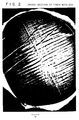
- Fig. 1 is a photomicrograph of a cross-section of the fiber of the example with Sandorin Blue pigment.
- the dark spots in the cross-section are particles of pigment which precipitated from its initial solution in the spinning dope on contact with the coagulation bath after spinning was complete.
- the particles while apparently only relatively few in number, represent a part of the pigment concentration which serves to give the fibers a brilliant blue appearance.
- the pigment particles which are visible are a uniform 0.1 »m in diameter.
- Fig. 2 is a photomicrograph of a cross-section of the fiber of the comparative example with the C.I. Vat Violet 1 vat dye. There are no particles evident in the photograph. It is not understood what mechanism explains this; but, because significant loss in tenacity occurred, it is probable that the dye became bound to the polymer in such a way as to disrupt crystallization to some extent.
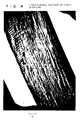
- Figs. 3 and 4 are photomicrographs of longitudinal sections of the fibers of the example and comparative example, respectively. The observations are the same as for Figs. 1 and 2.
Landscapes
- Engineering & Computer Science (AREA)
- Chemical & Material Sciences (AREA)
- Chemical Kinetics & Catalysis (AREA)
- General Chemical & Material Sciences (AREA)
- Textile Engineering (AREA)
- Manufacturing & Machinery (AREA)
- Artificial Filaments (AREA)
- Compositions Of Macromolecular Compounds (AREA)
Claims (7)
- Fibres de p-aramide de résistance et de module élevés présentant une ténacité de filaments d'au moins 18 g/d et un module initial de filament d'au moins 400 g/d, caractérisées en ce qu'elles contiennent de 0,01 à 6% en poids d'un pigment totalement organique sélectionné dans le groupe consistant en (1) pigments monoazo et diazo, (2) pigments à base d'anthanthrone, (3) pigments à base d'indanthrone, (4) pigments à base de pyranthrone, (5) pigments à base de violanthrone, (6) pigments à base de flavanthrone, (7) pigments à base de quinacridone, (8) pigments à base de dioxazine, (9) pigments indigoïde et thioindigoïde, et (10) pigments à base d'isoindolinone, répartis à travers les fibres et constitué de particules ou d'agglomérats d'un diamètre compris dans un intervalle allant d'une valeur supérieure à 0,01 à 0,50 »m.
- Les fibres selon la revendication 1 caractérisée en ce que le p-aramide correspond au poly(p-phénylène téréphthalamide).
- Les fibres selon la revendication 1 caractérisée en ce que le pigment organique est sélectionné dans le groupe consistant en pigment rouge d'indice de couleur 3 et pigment rouge d'indice de couleur 242.
- Les fibres selon la revendication 1 caractérisée en ce que le pigment organique correspond à
pigment bleu d'indice de couleur 60,
pigment orange d'indice de couleur 40,
pigment bleu d'indice de couleur 65,
pigment jaune d'indice de couleur 24,
pigment rouge d'indice de couleur 122,
pigment violet d'indice de couleur 23,
pigment rouge d'indice de couleur 88,
pigment rouge d'indice de couleur 86 ou
pigment jaune d'indice de couleur 173. - Un procédé de préparation de fibres de p-aramide de résistance et de module élevés, comprenant les étapes de:a) agitation d'un mélange constitué de:i) acide sulfurique présentant une concentration d'au moins 98%;ii) polymère de p-aramide présentant une viscosité inhérente d'au moins 4 en une quantité qui représente au moins 18% en poids du mélange; etiii) un pigmentb) chauffage du mélange sous agitation continue à une température de 80 à 105°C pour former une solution uniforme;c) extrusion de la solution à travers une filière;d) passage de la solution extrudée à travers une couche d'un fluide non coagulant de 0,5 à 2,5 cm d'épaisseur de sorte que le facteur d'étirement du filage est de 3 à 10;e) passage de la solution étirée dans et à travers un bain de coagulation aqueux présentant une température de -5 à 25°C pour former des filaments ; etf) lavage des filaments avec de l'eau et/ou une solution alcaline diluée,caractérisé en ce que le pigment correspond à un pigment totalement organique, soluble dans l'acide sulfurique, en une quantité de 0,01 à 6% en poids par rapport au poids du polymère de p-aramide et en ce qu'il est présent dans la fibre sous forme de particules et d'agglomérats dont le diamètre est compris dans un intervalle allant d'un valeur supérieure à 0,01 à 0,5 »m.
- Un procédé selon la revendication 5, dans lequel le p-aramide correspond au poly(p-phénylène téréphthalamide).
- Un procédé selon la revendication 5, caractérisé en ce que le pigment organique est sélectionné dans le groupe consistant en (1) pigments monoazo et diazo, (2) pigments à base d'anthanthrone, (3) pigments à base d'indanthrone, (4) pigments à base de pyranthrone, (5) pigments à base de violanthrone, (6) pigments à base de flavanthrone, (7) pigments à base de quinacridone, (8) pigments à base de dioxazine, (9) pigments indigoïde et thioindigoïde, et (10) pigments à base d'isoindolinone.
Applications Claiming Priority (3)
| Application Number | Priority Date | Filing Date | Title |
|---|---|---|---|
| US226645 | 1988-08-01 | ||
| US07/226,645 US4994323A (en) | 1988-08-01 | 1988-08-01 | Colored aramid fibers |
| CA000581218A CA1335682C (fr) | 1987-06-18 | 1988-10-25 | Fibres aramides couleur |
Publications (3)
| Publication Number | Publication Date |
|---|---|
| EP0356579A2 EP0356579A2 (fr) | 1990-03-07 |
| EP0356579A3 EP0356579A3 (en) | 1990-03-21 |
| EP0356579B1 true EP0356579B1 (fr) | 1994-06-29 |
Family
ID=25672202
Family Applications (1)
| Application Number | Title | Priority Date | Filing Date |
|---|---|---|---|
| EP88118954A Expired - Lifetime EP0356579B1 (fr) | 1988-08-01 | 1988-11-14 | Fibre colorées d'aramide |
Country Status (4)
| Country | Link |
|---|---|
| US (1) | US4994323A (fr) |
| EP (1) | EP0356579B1 (fr) |
| JP (1) | JP2545595B2 (fr) |
| DE (1) | DE3850498T2 (fr) |
Cited By (1)
| Publication number | Priority date | Publication date | Assignee | Title |
|---|---|---|---|---|
| RU2656467C1 (ru) * | 2013-11-22 | 2018-06-05 | Тейджин Арамид Гмбх | Способ изготовления окрашенной при формовании, параарамидной, комплексной нити и ровницы, ленты, пряжи из штапельного волокна и текстильного материала |
Families Citing this family (13)
| Publication number | Priority date | Publication date | Assignee | Title |
|---|---|---|---|---|
| KR930702560A (ko) * | 1990-10-15 | 1993-09-09 | 미리암 디. 메코너헤이 | 파라-아라미드 도프 스트림에 첨가제 용액을 혼합시키는 방법 |
| JPH05163610A (ja) * | 1991-12-18 | 1993-06-29 | Teijin Ltd | 芳香族ポリアミド偏平繊維 |
| US5447540A (en) * | 1992-01-30 | 1995-09-05 | Teijin Limited | Method of dyeing a high heat-resistant synthetic fiber material |
| US5232461A (en) * | 1992-05-28 | 1993-08-03 | E. I. Du Pont De Nemours And Company | Method of dyeing aromatic polyamide fibers with water-soluble dyes |
| DE4400248A1 (de) * | 1994-01-06 | 1995-07-13 | Hoechst Ag | Verfahren zur Herstellung von massegefärbten geformten Gebilden auf der Basis von aromatischen Polyamiden, massegefärbte Fasern, sowie Vermischung zur Herstellung von massegefärbten geformten Gebilden |
| US6497953B1 (en) | 1998-10-09 | 2002-12-24 | Cabot Corporation | Polymeric fibers and spinning processes for making said polymeric fibers |
| US7358203B1 (en) * | 2006-10-10 | 2008-04-15 | E.I. Du Pont De Nemours And Company | Stain-masking cut resistant fabrics and articles and processes for making same |
| US7818982B2 (en) * | 2006-10-10 | 2010-10-26 | E. I. Du Pont De Nemours And Company | Stain masking cut resistant gloves and processes for making same |
| WO2012055685A1 (fr) | 2010-10-28 | 2012-05-03 | Teijin Aramid B.V. | Fibres aramides teintes dans la masse |
| KR101596065B1 (ko) * | 2011-04-08 | 2016-02-29 | 코오롱인더스트리 주식회사 | 아라미드용 조성물 및 이를 이용하여 제조된 아라미드 제품 |
| CN104593898B (zh) * | 2014-12-27 | 2016-08-17 | 烟台泰和新材料股份有限公司 | 一种前着色对位芳纶纤维的制备方法 |
| CN104831385B (zh) * | 2015-05-04 | 2017-07-28 | 浙江纺织服装职业技术学院 | 一种原液着色的棉短绒复合长丝制备方法 |
| US11618996B2 (en) | 2016-10-27 | 2023-04-04 | Dupont Safety & Construction, Inc. | Fabric having a cut-resistant coating comprising para-aramid particles |
Citations (1)
| Publication number | Priority date | Publication date | Assignee | Title |
|---|---|---|---|---|
| EP0295672A2 (fr) * | 1987-06-18 | 1988-12-21 | E.I. Du Pont De Nemours And Company | Fibres d'aramide colorées |
Family Cites Families (10)
| Publication number | Priority date | Publication date | Assignee | Title |
|---|---|---|---|---|
| US3869429A (en) * | 1971-08-17 | 1975-03-04 | Du Pont | High strength polyamide fibers and films |
| US3767756A (en) * | 1972-06-30 | 1973-10-23 | Du Pont | Dry jet wet spinning process |
| US3888821A (en) * | 1972-11-02 | 1975-06-10 | Du Pont | Aromatic polyamide fibers containing ultraviolet light screeners |
| IT1024071B (it) * | 1973-04-09 | 1978-06-20 | Du Pont | Processo per l'impregnazione di fibre tessili di polimero lineare sintetico difficilmente fusibile e fibre prparate con detto processo |
| US4198494A (en) * | 1974-09-30 | 1980-04-15 | E. I. Du Pont De Nemours And Company | Intimate fiber blend of poly(m-phenylene isophthalamide) and poly(p-phenylene terephthalamide) |
| US4144023A (en) * | 1977-10-11 | 1979-03-13 | E. I. Du Pont De Nemours And Company | Dyeing of high strength, high modules aromatic polyamide fibers |
| NL172680C (nl) * | 1979-06-08 | 1983-10-03 | Akzo Nv | Werkwijze ter vervaardiging van vezels uit poly-p-fenyleentereftaalamide en de aldus vervaardigde produkten. |
| US4524168A (en) * | 1981-11-18 | 1985-06-18 | Ciba-Geigy Corporation | Process for the mass coloration of polymers |
| US4705527A (en) * | 1986-05-14 | 1987-11-10 | Burlington Industries, Inc. | Process for the printing of shaped articles derived from aramid fibers |
| US4759770A (en) * | 1986-05-14 | 1988-07-26 | Burlington Industries, Inc. | Process for simultaneously dyeing and improving the flame-resistant properties of aramid fibers |
-
1988
- 1988-08-01 US US07/226,645 patent/US4994323A/en not_active Expired - Lifetime
- 1988-11-14 DE DE3850498T patent/DE3850498T2/de not_active Expired - Lifetime
- 1988-11-14 EP EP88118954A patent/EP0356579B1/fr not_active Expired - Lifetime
- 1988-12-09 JP JP63310274A patent/JP2545595B2/ja not_active Expired - Lifetime
Patent Citations (1)
| Publication number | Priority date | Publication date | Assignee | Title |
|---|---|---|---|---|
| EP0295672A2 (fr) * | 1987-06-18 | 1988-12-21 | E.I. Du Pont De Nemours And Company | Fibres d'aramide colorées |
Cited By (1)
| Publication number | Priority date | Publication date | Assignee | Title |
|---|---|---|---|---|
| RU2656467C1 (ru) * | 2013-11-22 | 2018-06-05 | Тейджин Арамид Гмбх | Способ изготовления окрашенной при формовании, параарамидной, комплексной нити и ровницы, ленты, пряжи из штапельного волокна и текстильного материала |
Also Published As
| Publication number | Publication date |
|---|---|
| DE3850498T2 (de) | 1995-02-23 |
| DE3850498D1 (de) | 1994-08-04 |
| US4994323A (en) | 1991-02-19 |
| EP0356579A2 (fr) | 1990-03-07 |
| JPH0241414A (ja) | 1990-02-09 |
| EP0356579A3 (en) | 1990-03-21 |
| JP2545595B2 (ja) | 1996-10-23 |
Similar Documents
| Publication | Publication Date | Title |
|---|---|---|
| EP0356579B1 (fr) | Fibre colorées d'aramide | |
| AU628177B2 (en) | PVP/para-aramid fibers and process for making them | |
| CA2042099C (fr) | Fibres de polycetone et procede de fabrication | |
| US4320081A (en) | Process for the manufacture of fibres from poly-p-phenylene terephthalamide | |
| US5114652A (en) | Process for making colored aramid fibers | |
| CN118854479B (zh) | 一种白色高导热对位芳纶纤维及制备方法 | |
| EP0295672A2 (fr) | Fibres d'aramide colorées | |
| US5662852A (en) | Mass-colored formed structures based on aromatic polyamides, mass-colored fiber, and premix for producing mass-colored formed structures | |
| US5613987A (en) | Colored high-tenacity filaments of polyethylene and process for their production | |
| CN1027655C (zh) | 着色的芳族聚酰胺纤维 | |
| EP0338534A2 (fr) | Fibre d'alcool polyvinylique ayant une excellente résistance à l'eau chaude et procédé pour sa fabrication | |
| JP2971338B2 (ja) | 易染性メタ型芳香族ポリアミド繊維 | |
| US4658004A (en) | Polyacrylonitrile fiber with high strength and high modulus of elasticity | |
| EP0695381B1 (fr) | Fibres textiles en terephthalamide de poly-p-phenylene sulfone | |
| US5135687A (en) | Process for making PVP/para-aramid fibers | |
| CA1335682C (fr) | Fibres aramides couleur | |
| CA2029477C (fr) | Fibres de poly(p-phenyleneterephtalamide)sulfonees | |
| JP4603208B2 (ja) | ポリケトン繊維 | |
| WO1992007120A1 (fr) | Procede de melange de solutions d'additifs dans des courants de solutions de filage de para-aramide | |
| JP3491400B2 (ja) | 染色された芳香族ポリアミド繊維の製造方法 | |
| US5660779A (en) | Process of making textile fibers of sulfonated poly(p-phenylene terephthalamide) | |
| US5302451A (en) | Fibers of sulfonated poly(p-phenylene terephthalmide) | |
| EP0404145B1 (fr) | Mélange de solvants pour solution de filage d'aramides | |
| JPH08170219A (ja) | 分散染料による内外層染色差のないレーヨン・ケーク糸 | |
| HK1001191B (en) | Pvp/para-aramid fibers and process for making them |
Legal Events
| Date | Code | Title | Description |
|---|---|---|---|
| PUAI | Public reference made under article 153(3) epc to a published international application that has entered the european phase |
Free format text: ORIGINAL CODE: 0009012 |
|
| PUAL | Search report despatched |
Free format text: ORIGINAL CODE: 0009013 |
|
| AK | Designated contracting states |
Kind code of ref document: A2 Designated state(s): DE ES FR GB NL |
|
| AK | Designated contracting states |
Kind code of ref document: A3 Designated state(s): DE ES FR GB NL |
|
| 17P | Request for examination filed |
Effective date: 19900814 |
|
| 17Q | First examination report despatched |
Effective date: 19920519 |
|
| RBV | Designated contracting states (corrected) |
Designated state(s): DE FR GB NL |
|
| GRAA | (expected) grant |
Free format text: ORIGINAL CODE: 0009210 |
|
| AK | Designated contracting states |
Kind code of ref document: B1 Designated state(s): DE FR GB NL |
|
| REF | Corresponds to: |
Ref document number: 3850498 Country of ref document: DE Date of ref document: 19940804 |
|
| ET | Fr: translation filed | ||
| PLBE | No opposition filed within time limit |
Free format text: ORIGINAL CODE: 0009261 |
|
| STAA | Information on the status of an ep patent application or granted ep patent |
Free format text: STATUS: NO OPPOSITION FILED WITHIN TIME LIMIT |
|
| 26N | No opposition filed | ||
| REG | Reference to a national code |
Ref country code: GB Ref legal event code: IF02 |
|
| PGFP | Annual fee paid to national office [announced via postgrant information from national office to epo] |
Ref country code: DE Payment date: 20071108 Year of fee payment: 20 Ref country code: NL Payment date: 20071023 Year of fee payment: 20 |
|
| PGFP | Annual fee paid to national office [announced via postgrant information from national office to epo] |
Ref country code: GB Payment date: 20071114 Year of fee payment: 20 Ref country code: FR Payment date: 20071108 Year of fee payment: 20 |
|
| REG | Reference to a national code |
Ref country code: GB Ref legal event code: PE20 Expiry date: 20081113 |
|
| NLV7 | Nl: ceased due to reaching the maximum lifetime of a patent |
Effective date: 20081114 |
|
| PG25 | Lapsed in a contracting state [announced via postgrant information from national office to epo] |
Ref country code: NL Free format text: LAPSE BECAUSE OF EXPIRATION OF PROTECTION Effective date: 20081114 |
|
| PG25 | Lapsed in a contracting state [announced via postgrant information from national office to epo] |
Ref country code: GB Free format text: LAPSE BECAUSE OF EXPIRATION OF PROTECTION Effective date: 20081113 |