EP0356636A2 - Dispositif pour mesurer la force de tirage pour les moyens de serrage d'outil - Google Patents
Dispositif pour mesurer la force de tirage pour les moyens de serrage d'outil Download PDFInfo
- Publication number
- EP0356636A2 EP0356636A2 EP89110651A EP89110651A EP0356636A2 EP 0356636 A2 EP0356636 A2 EP 0356636A2 EP 89110651 A EP89110651 A EP 89110651A EP 89110651 A EP89110651 A EP 89110651A EP 0356636 A2 EP0356636 A2 EP 0356636A2
- Authority
- EP
- European Patent Office
- Prior art keywords
- shaft
- measuring
- measuring body
- measuring device
- test
- Prior art date
- Legal status (The legal status is an assumption and is not a legal conclusion. Google has not performed a legal analysis and makes no representation as to the accuracy of the status listed.)
- Granted
Links
- 238000012360 testing method Methods 0.000 claims abstract description 61
- 230000001681 protective effect Effects 0.000 claims abstract description 8
- 238000001514 detection method Methods 0.000 claims description 9
- 210000002435 tendon Anatomy 0.000 claims description 5
- 239000000853 adhesive Substances 0.000 claims 1
- 230000001070 adhesive effect Effects 0.000 claims 1
- 230000008878 coupling Effects 0.000 claims 1
- 238000010168 coupling process Methods 0.000 claims 1
- 238000005859 coupling reaction Methods 0.000 claims 1
- 230000005405 multipole Effects 0.000 claims 1
- 229920003002 synthetic resin Polymers 0.000 claims 1
- 239000000057 synthetic resin Substances 0.000 claims 1
- 238000005259 measurement Methods 0.000 abstract description 5
- 238000013461 design Methods 0.000 description 5
- 238000005476 soldering Methods 0.000 description 4
- 230000013011 mating Effects 0.000 description 3
- 238000004026 adhesive bonding Methods 0.000 description 2
- 239000012790 adhesive layer Substances 0.000 description 2
- 238000010276 construction Methods 0.000 description 2
- 230000000694 effects Effects 0.000 description 2
- 238000003754 machining Methods 0.000 description 2
- 239000000463 material Substances 0.000 description 2
- 238000012549 training Methods 0.000 description 2
- 229910000669 Chrome steel Inorganic materials 0.000 description 1
- 239000004831 Hot glue Substances 0.000 description 1
- PWHULOQIROXLJO-UHFFFAOYSA-N Manganese Chemical compound [Mn] PWHULOQIROXLJO-UHFFFAOYSA-N 0.000 description 1
- 229910000831 Steel Inorganic materials 0.000 description 1
- 229910001315 Tool steel Inorganic materials 0.000 description 1
- 238000005452 bending Methods 0.000 description 1
- 230000005540 biological transmission Effects 0.000 description 1
- 238000006243 chemical reaction Methods 0.000 description 1
- 230000006835 compression Effects 0.000 description 1
- 238000007906 compression Methods 0.000 description 1
- 230000007797 corrosion Effects 0.000 description 1
- 238000005260 corrosion Methods 0.000 description 1
- 238000005520 cutting process Methods 0.000 description 1
- 230000003247 decreasing effect Effects 0.000 description 1
- 230000001419 dependent effect Effects 0.000 description 1
- 238000011161 development Methods 0.000 description 1
- 230000018109 developmental process Effects 0.000 description 1
- 238000006073 displacement reaction Methods 0.000 description 1
- 238000005553 drilling Methods 0.000 description 1
- 239000012777 electrically insulating material Substances 0.000 description 1
- 238000011156 evaluation Methods 0.000 description 1
- 230000002349 favourable effect Effects 0.000 description 1
- 239000010410 layer Substances 0.000 description 1
- 239000007788 liquid Substances 0.000 description 1
- 229910052748 manganese Inorganic materials 0.000 description 1
- 239000011572 manganese Substances 0.000 description 1
- 239000012528 membrane Substances 0.000 description 1
- 239000007769 metal material Substances 0.000 description 1
- 238000000034 method Methods 0.000 description 1
- 238000003801 milling Methods 0.000 description 1
- 230000000149 penetrating effect Effects 0.000 description 1
- 229920001296 polysiloxane Polymers 0.000 description 1
- 239000007787 solid Substances 0.000 description 1
- 238000003892 spreading Methods 0.000 description 1
- 239000010959 steel Substances 0.000 description 1
- 238000009966 trimming Methods 0.000 description 1
- XLYOFNOQVPJJNP-UHFFFAOYSA-N water Substances O XLYOFNOQVPJJNP-UHFFFAOYSA-N 0.000 description 1
Images


Classifications
-
- B—PERFORMING OPERATIONS; TRANSPORTING
- B23—MACHINE TOOLS; METAL-WORKING NOT OTHERWISE PROVIDED FOR
- B23Q—DETAILS, COMPONENTS, OR ACCESSORIES FOR MACHINE TOOLS, e.g. ARRANGEMENTS FOR COPYING OR CONTROLLING; MACHINE TOOLS IN GENERAL CHARACTERISED BY THE CONSTRUCTION OF PARTICULAR DETAILS OR COMPONENTS; COMBINATIONS OR ASSOCIATIONS OF METAL-WORKING MACHINES, NOT DIRECTED TO A PARTICULAR RESULT
- B23Q17/00—Arrangements for observing, indicating or measuring on machine tools
- B23Q17/002—Arrangements for observing, indicating or measuring on machine tools for indicating or measuring the holding action of work or tool holders
- B23Q17/005—Arrangements for observing, indicating or measuring on machine tools for indicating or measuring the holding action of work or tool holders by measuring a force, a pressure or a deformation
Definitions
- the invention relates to a measuring device for clamping devices, in particular for machine tools, which have a receptacle for the component to be clamped and a clamping member for clamping this component on the receptacle.
- the measuring device according to the invention has a test shank which is adapted to the holder of the machine tool or the like or which is designed in accordance with the component shanks to be used, which is preferably provided with a clamping force measuring element which can be influenced by the clamping force of the clamping element.
- the degree of resilience of tools, in particular cutting tools, is decisive for the performance of machine tools and depends largely on the seating accuracy and firmness of the tool shank in the machine spindle. This, in turn, is significantly influenced by the pull-in force, since if the pull-in force is too low, vibrations can occur, resulting in shorter tool life, poorer machining surfaces and less precise machining fits. Damage to the machine can also occur, particularly when the tool shank is subjected to radial stress, namely e.g. Fretting corrosion between the spindle and the tool shank.
- the tool shank which usually has a steep taper for centering and axial support relative to the tool holder designed as an inner cone, is mechanically operated, for example, via an inside drawbar located on the machine spindle.
- the tensioning force can also be applied via mechanical tensioning elements, eg a plate spring assembly, while the tensioning force is released or released via a hydraulic working element. Damages in the clamping device, such as breaks in disc springs, changed spring travel and the like, are usually not visible from the outside, but can lead to a considerable drop in the clamping force.
- Other clamping devices such as hydraulic, electrical and similar, should also be able to be measured.
- a pull-in force measuring device could e.g. B. have a hydraulic, enclosed in a load cell measuring element or a membrane measuring system, on whose, the test shaft in the front area enclosing a display element influenced by the measuring element is attached.
- Such a measuring device would have a relatively large measuring path of, for example, approximately 1 mm.
- Such a measuring path which results from the movable mounting of the pull bolt to be engaged with the machine tendon relative to the test shank supported on the tool holder, could falsify the measurement result or the measured value, especially if the pull bolt of the tool clamp used Tool shaft would be arranged rigidly or in one piece on this.
- the falsification can e.g. due to the path-dependent clamping force characteristic curve of the machine clamping device, which in the case of application of the clamping force by means of a disc spring package e.g. is a spring characteristic.
- the invention is further based on the object to avoid disadvantages of known measuring devices, in particular to create a pull-in force measuring device of the type mentioned, which at simple construction has the smallest possible measuring path or such a measuring path which is approximately the same as the tightening path of the pull bolt of the tool shanks to be clamped.
- the measuring element is expediently formed by a measuring body designed as a solid body, which absorbs the clamping force under mechanical deformation, the measured value being derived from this deformation.
- the measuring body is advantageously calibrated with regard to the relationship between its deformation and the clamping force.
- the measuring body which expediently consists of a metallic material such as steel, is advantageously dimensioned such that it is deformed only far below the yield point in the elastic range, compression or bending deformation being conceivable, but tensile deformation is preferred.
- the measuring body expediently consists of a hardenable tool steel, e.g. a manganese chrome steel, such as 16MnCR5.
- the object according to the invention can also be achieved in that the pull stud is rigidly or positively connected in the clamping direction to those parts of the test shaft which are supported on the machine spindle under the clamping force and generally exclusively by the steep cone are formed.
- the pull stud is at most changed in position during the pull-in force measurement compared to the steep taper by an extremely small amount corresponding to the tensile force-tensile elongation of the measuring body, so that there is a measuring path that goes to zero, which can be considerably smaller than a hundredth of a millimeter.
- the measuring body can be a longitudinal section of the test shaft, which practically forms the outer circumference of the test shaft in its area and can be formed with this as a one-piece component. This results in an extremely simple, essentially one-piece construction of the entire test shaft, possibly including the measuring body, made of the same material throughout.
- the measuring body is expediently reduced in its outer width compared to the mean diameter of the steep taper, preferably by at least about half, the measuring body between the steep taper and the pull stud of the test shaft expediently forms that longitudinal section which has the smallest cross sections, so that practically only it is subjected to a longitudinal expansion under the tension and this can be grasped very well.
- the measuring body is also advantageously relatively far away from the pull stud and very close to the steep taper of the test shaft in an area in which the test shaft is at most limited by a smooth surface bore, but not by a threaded bore or the like.
- the shaft area adjoining the measuring body to the front up to the steep taper and / or to the rear end to the rear end of the test shaft expediently has constant outer diameters, so that the measuring body is practically formed by a longitudinal section of the shaft part lying behind the steep taper, which is opposite this shaft part is slightly weakened or reduced in cross-section or in the outer diameter.
- measuring body is offset from the rest of the shaft section by a flat circumferential groove.
- a measuring transducer is provided for the precise detection and representation of the deformation of the measuring body as a measured value, which is preferably attached directly to the measuring body, in particular on its outer surface, for example so that it is subjected to the deformations of the measuring body in the same direction.
- This transducer is preferably formed by at least one strain gauge, preferably several strain gauges are attached so that one or more are subject to changes in resistance due to the strains, while one or more are not subject to such changes in resistance, but in common electrical circuit with the active strain gauges mentioned first are arranged.
- the full bridge expediently has a resistance value of the order of 350 ohms, whereby it is operated with a low voltage in the order of 10 volts.
- the measuring range is, for example, 40 kN, this suitably corresponds to approximately 0.75 mV / V, while for a measuring range of, for example, 25 kN, this value is also approximately 0.75 mV / V with a tolerance of the order of 1% or even at most 0 Corresponds to 5%.
- the security against overloading the measuring electronics is expediently in the order of two and a half times the nominal load.
- test shaft which expediently carries a connecting plug, such as a flange plug, electrically connected to these connecting cables at the front end outside the machine spindle, which e.g. essentially sunk into an end bore of the test shaft.
- a connecting plug such as a flange plug
- the test shaft can be detachably connected to a display device via a flexible line or can be easily inserted into the machine spindle without the connection to this display device.
- the engagement member for the tendon of the machine which is formed by the pull stud, is expediently arranged on the test shaft so that the test shaft can be adapted to different machine pull-in systems by changing the pulling member or pull bolt.
- the design according to the invention creates an electronic measuring system for measuring the pull-in force of spindle clamping devices, the measuring body of which is formed by a precision force measuring rod with precision strain gauges det. Coded plugs on the test shaft can be used to automatically switch the measuring range of the detection or display device, but this can also be done by manually switching the evaluation electronics of the display device.
- the design according to the invention is suitable, for example, for steep taper sizes 30, 40, 45, 50 and 60, in which case the measuring ranges in the same order are expediently around 15, 25, 30, 50 and 100 kN.
- the measuring device can also be part of a case and only be accessible after opening it.
- the case also holds one or more test pins, pull studs, etc.
- the measuring device 1 according to FIG. 1 is intended to be inserted into the tool holder 7 of a work spindle 6 of a machine tool, for example a milling machine, provided with a tool clamping device 5, with a test shaft 2 which can be easily connected to a detection device 3 via a flexible line connection 4 will.
- the work spindle 6 has at its front end an inner cone 8 lying in its axis, on which a steep taper 9 of the Test shank is adapted so that this steep taper 9 is substantially the same and more narrowly tolerated than those of the tool shanks to be used, the steep taper 9 of the test shank 2, on the other hand, can also be considerably shorter, namely in particular corresponds to the front, further end section of the steep taper of the tool shanks and does not extend to the rear over the entire length of the inner cone 8.
- the test shaft 2 which is essentially one-piece over its entire length, forms a measuring body 10 formed in one piece with the steep taper 9 in the form of a short tension section or tension rod, the longitudinal extent of which is effective for determining the measured value, and is substantially smaller than its outside width or outside diameter, in particular smaller than can be half of it.
- the test shank 2 is designed in the same way as the tool shanks to be used to be coupled within the work spindle 6 with a tension member 11 of the tensioning device 5 in a tensile or form-fitting manner, this tension member 11 being, for example, a tie rod 12 lying in the spindle axis and on its front End has a clamping gripper 13 which can be expanded from a closed position and which is designed for positive connection to an engagement member 14 provided at the rear end of the test shaft 2 in the same manner as on the tool shafts.
- this tension member 11 being, for example, a tie rod 12 lying in the spindle axis and on its front End has a clamping gripper 13 which can be expanded from a closed position and which is designed for positive connection to an engagement member 14 provided at the rear end of the test shaft 2 in the same manner as on the tool shafts.
- the surfaces of the engaging member 14 which are effective with regard to the connection with the clamping gripper 13 are expediently the same, but narrower than the steep taper 9 tolerated dimensioning as provided for the tool shanks, the tolerance field being approximately in the middle of the tolerance limits of the tool shanks.
- the engaging member 14 can be formed by a pull bolt 15 which is interchangeably inserted into the rear end of the test shaft 2 so that it can be replaced by a suitable pull bolt 15 in order to adapt the test shaft 2 to the respective clamping gripper 13.
- a pull rod 12 is e.g. a disc spring assembly, not shown, arranged from a plurality of disc springs, which is supported with its rear end biased against a collar of the tie rod 12 and at the front end against a shoulder of the machine spindle 6, a trigger mechanism for the tensioning device 5 being provided behind the disc spring assembly, for example the pull rod 12 is formed by the piston rod of a working cylinder with which the gripper 13 can be pushed forward against the force of the plate spring assembly until it can be released from the pull bolt 15 by spreading.
- the test shaft 2 can also have, in the same way as the tool shafts to be used, adjacent to the front end of the steep taper 9, a shaft flange 16 projecting over its outer circumference with circumferential grooves for the engagement of driving stones of the work spindle 6. It is conceivable to dimension the test shank 2 relative to the tool holder 7 such that the shaft flange 16 is supported with its rear end face on one or the front end face of the work spindle 6 when the test shank 2 is retracted, thereby absorbing the clamping forces of the clamping device 5, in which case the steep taper 9 essentially serves only to center the test shaft 2 with respect to the work spindle 6. A center surface instead of the steep taper could also serve as centering for work spindles with a cylindrical mounting bore.
- test shaft 2 is dimensioned such that the clamping forces are absorbed essentially only by the steep taper 9, so that in the retracted state of the shaft flange 16 either with a short distance in front of the front end Working spindle 6 is or no shaft flange projecting beyond the outer circumference of steep taper 9 is provided at all.
- the longitudinal extent of which suitably corresponds to between about half and a sixth, preferably about one fifth of the longitudinal extent of the inner cone 8, is followed by a shank section 17 which extends to the rear end of the test shank 2 or to the engagement member 14, which has a substantially continuously cylindrical outer circumference and an outer diameter which is slightly smaller than the smallest inner diameter of the inner cone 8.
- the shaft section 17 in front of and / or behind the measuring body 10 can also have a shape that deviates from the cylindrical shape. In the inserted state, this shaft section 17 extends over most of the length of the inner cone 8.
- the test shaft 2 has a front extension, which is also expediently located in the shaft axis 20, preferably in the form of an essentially cylindrical handle shaft 18 whose outer circumference is knurled, corded or similar Way can be roughened.
- the outside diameter of the handle shaft 18 can be of the order of magnitude of the outside diameter of the shaft section 17.
- the handle shaft 18 forms a one-piece continuation of the shaft section 17 and adjoins the front face of the steep taper 9 or the shaft flange 16.
- the steep taper 9 is shown as a further embodiment much shorter than in Fig. 1, but a longer training is preferred at high pull-in forces to avoid excessive surface pressures.
- the shaft section 17 has a flat circumferential groove 19, which could also be formed by two or more axially slot-shaped depressions or the like distributed evenly over the circumference and expediently has a depth of the order of approximately 4 mm.
- the circumferential groove 19 forms a cylindrical shank part, the outer diameter of which is reduced compared to the rest of the shank section 12 and which, in the exemplary embodiment shown, extends to the rear end face of the steep taper 9, its outer circumference being concavely rounded in cross section, in order to avoid notching effects.
- a longitudinal section having an axial distance from both ends of this shaft part forms the effective measuring body 10, which is hollow or tubular due to a shaft bore 21 penetrating it in the shaft axis 20 and expediently has a wall thickness of the order of 5 mm.
- the shaft bore 21, the diameter of which is of the order of half the outer diameter of the shaft section 17, is essentially designed as a blind hole which is open towards the rear end of the shaft section 17 and faces forward partially extends at least beyond the front end of the measuring body 10 and can extend to the rear end face of the steep cone 9 or beyond, so that essentially constant material cross sections are provided at least in the area of the measuring body 10 and on both sides adjacent to it.
- the rear end of the shaft bore 21 is designed as a threaded bore 22 which has the shaft bore 21 as a core bore and which at the rear end of the shaft portion 17 merges into a bore portion which is slightly enlarged beyond the outer thread diameter for receiving a centering collar of the engagement member 14.
- the shaft bore 21 merges into an axial bore 23 of substantially smaller diameter, which extends approximately to the front end of the test shaft 2 or the handle shaft 18 and is expediently designed at this front end for receiving an electrical connector as a plug bore 24, which has the same or larger diameter than the axial bore 23.
- At least one leads in particular two or more radial bores 25 distributed uniformly over the circumference into the shaft bore 21, these radial bores 25 being axially offset from one another or preferably being provided in a common transverse plane.
- the radial bore 25 provided in the area of the measuring body 10, but they are preferably located behind and / or in front of the longitudinal section forming this measuring body 10.
- a transducer 26 is attached directly to the measuring body 10, which e.g. could be formed by a piezoelectric element.
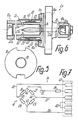
- the mechanical-electrical displacement transducer is formed by a group of strain gauges 27 to 30, the circuit of which can be seen in FIG. 7.
- Two elongate strain gauges 27, 28 are axially parallel to the shaft axis 20a, diametrically opposite each other and with respect to their ends in common planes perpendicular to the shaft axis 20a over their entire length evenly adhered to the reduced outer circumference of the shaft section 17, such that their longitudinal extent corresponds to the length of the Measuring body 10a determined.
- strain gauges 29, 30 Two further, in particular the same elongate strain gauges 29, 30 are attached at a short distance behind the active strain gauges 27, 28 directly to the outer periphery mentioned, but are aligned transversely or at right angles to the strain gauges 27, 28, ie in the circumferential direction, so that their longitudinal , but their width is in the direction of the shaft axis 20a.
- Adjacent or directly connected active and transverse strain gauges are mutually offset in the circumferential direction, in particular by a quotient of 360 °, namely by 90 °, which corresponds to their total number, so that four are evenly distributed over the circumference
- Distributed strain gauges are provided, two of which are diametrically opposite one another and transversely in the circumferential direction.
- These measuring strips 29, 30, in particular with the same, very thin, but electrically insulating adhesive layer 31 adhering over their entire surface extent, are connected to the same shaft part with a reduced cross-section or outer diameter, the adhesive layer 31 advantageously being formed by a hot-melt adhesive.
- the strain gauges which have significant changes in their electrical resistance due to the smallest longitudinal expansions, lie both at a distance from the front and from the rear end of the shaft part with reduced outer diameter and at an axial distance from the radial bores 25a, which are provided behind all strain gauges according to FIG. 6.
- the length of the strain gauges is expediently on the order of four millimeters, and the width of about two millimeters in the region of half the length, the width compared to the circumference of the measuring body 10 being only a very small fraction, namely, for example, about a fiftieth.
- All strain gauges 27 to 30 are connected to one another in the manner of a series circuit or full bridge circuit 41 connected to a ring via connecting lines 42 to 45, which lie directly in the area of the outer circumference of the reduced shaft part or in the circumferential groove 19a.
- the transducer 26 or the strain gauges 27 to 30 and the connecting lines 42 to 45 are completely enclosed in a multi-layer embedding 32 and are therefore embedded in a liquid-tight manner, so that none Oil, drilling water or the like can penetrate.
- This embedding 32 which may for example consist of silicone, completely fills the free spaces of the circumferential groove 19a, such that its outer circumference practically forms a flush subsequent extension of the outer circumference of the remaining shaft section 17a, the embedding 32 likewise being made of an electrically insulating material.
- the transducer 26 or the embedding 32 is protected by a thin-walled tubular cover sleeve, which forms a protective jacket 33, which is fixed on both sides of the circumferential groove 19a on the outer circumference of the shaft section 17a and possibly on the outer circumference of the embedding 32 by gluing, the Protective jacket 33, which can engage in an annular groove on the rear end face of steep taper 9a, extends only slightly beyond the circumferential groove 19a towards the rear.
- the full bridge circuit 41 of the transducer 26 is connected to four connecting lines 34, which are guided through the radial bores 25a into the shaft bore 21a and from there forward through the axial bore 23a to a coded plug-in part 47 which at least partially engages in the plug bore 24a and in this is fixed by gluing or the like.
- Each connecting line is connected within the plug bore 24a to a separate connecting lug of the plug part 47, which has a separate connecting pole for each connecting line at its front plug receptacle for a mating connector 48, preferably more than four-pole, namely, for example, six-pole.
- the Mating connector 48 has a corresponding number of poles, and the line connection 4 is correspondingly multi-core.
- a first supply line 35 is connected as a feed line 35 to a soldering point of the connecting line 42 between one end of an active strain gauge 27 and one end of a transversely arranged strain gauge 30 which is offset by 90 ° in the circumferential direction, in which case feed line 35 is expedient a trimming resistor 39 is interposed, which may be located within the connector bore 24a.
- the second feed line 36 is connected to a soldering point of the direct connecting line 43 between the two other strain gauges 28, 29, which are also circumferentially and axially offset from one another.
- a first signal line 37 is connected to a further soldering point in a further connecting line 44 between two further ends of the strain gauges offset in the circumferential direction, while the second signal line 38 is connected to a soldering point of the fourth connecting line 45, which is between the further connecting ends of the strain gauges 28 and 30 is provided.
- the feed lines and the signal lines which form the connecting lines 34 are connected to separate poles of the plug part 47.
- the two remaining poles can be connected to one another via a removable bridge 40, for example, so that, depending on the mating connector used, a desired switchover in the detection device 3, for example a switchover of the measuring range, can be brought about.
- Each transducer is appropriately given one Zero adjustment of, for example, 0.03 mV / V and / or signal adjustment of, for example, approximately 1.00 mV / V, so that problem-free interchangeability is ensured.
- the shaft bore 2la is expediently sealed so that no liquid or the like can penetrate through the engagement member 14a.
- FIGS. 6 and 8 the same reference numerals are used for parts that correspond to one another as in FIG. 2, but in FIG. 6 with the index "a” and in FIG. 8 with the index "b", which is why the corresponding description parts are used accordingly be valid.
- FIG. 8 there is no shaft flange protruding radially outwards over the steep taper 9b, but rather a cylinder section 16b adjoining the largest outer diameter of the steep taper 9b so that the steep taper 9b can be dimensioned such that it is in the retracted state extends to the front end of the inner cone 8 or even protrudes slightly above it.
- the radial bores 25 are provided axially in front of the effective measuring section or measuring body 10b.
- the shaft section 17b has the same outer diameter on both sides of the circumferential groove 19b, the circumferential groove 19b extending to a few millimeters at the rear end face of the steep taper 9b, so that only a short centering collar for the protective jacket 33b is formed adjacent to the front end of the circumferential groove 19b strikes the rear face of steep taper 9b.
- the side flanks of the circumferential groove 19b expediently merge into a cross-section concavely rounded in cross-section in their bottom surface in order to have notch effects avoid and ensure a long service life of the test shaft 2b.
- the transducer and its wiring and embedding are not shown, and in Fig. 2, the protective jacket is also not shown.
- the electronic detection device 3 has a housing 49 with a display field 50 on the front, in which a value for the respective pull-in force of the tensioning device 5 can be specified.
- the detection device 3 can be carried with a carrying handle 51 and expediently designed such that it can be operated independently of the mains via a mains line 52 with mains current and / or with batteries or accumulators with low current that can be inserted into the housing 49.
- the detection device 3 can be set up separately from the test shaft 2 in any suitable area which is easy to see during the test.
- the respective pull stud 15 has a threaded section 53 for engaging in the threaded bore 22 or 22a or 22b of the test shaft, an adjoining centering section for the centering hole located behind the threaded bore and then an enlarged collar 54 with which the pull stud is connected to this centering section 15 is clamped against the rear end face of the shaft section 17b. Behind this collar 54, the pull stud 15 is provided with an engagement groove 55 for the clamping gripper 13. In the case of the embodiment according to FIG.
- the pull bolt 15c forming the engagement member 14c has the same threaded section 53c with the associated centering section and the same Collar 54c, but the rear end of the pull stud 15c is provided, for example, instead of an engagement groove with a threaded bore for a connecting element of the pull rod which has a corresponding external thread.
Landscapes
- Engineering & Computer Science (AREA)
- Mechanical Engineering (AREA)
- Force Measurement Appropriate To Specific Purposes (AREA)
- Machine Tool Sensing Apparatuses (AREA)
- Gripping On Spindles (AREA)
Applications Claiming Priority (2)
| Application Number | Priority Date | Filing Date | Title |
|---|---|---|---|
| DE3829846 | 1988-09-02 | ||
| DE3829846A DE3829846C2 (de) | 1988-09-02 | 1988-09-02 | Einzugkraft-Meßgerät für Werkzeug-Spannvorrichtungen |
Publications (3)
| Publication Number | Publication Date |
|---|---|
| EP0356636A2 true EP0356636A2 (fr) | 1990-03-07 |
| EP0356636A3 EP0356636A3 (fr) | 1991-04-03 |
| EP0356636B1 EP0356636B1 (fr) | 1995-02-15 |
Family
ID=6362149
Family Applications (1)
| Application Number | Title | Priority Date | Filing Date |
|---|---|---|---|
| EP89110651A Expired - Lifetime EP0356636B1 (fr) | 1988-09-02 | 1989-06-13 | Dispositif pour mesurer la force de tirage pour les moyens de serrage d'outil |
Country Status (4)
| Country | Link |
|---|---|
| EP (1) | EP0356636B1 (fr) |
| JP (1) | JPH0276667A (fr) |
| AT (1) | ATE118392T1 (fr) |
| DE (2) | DE3829846C2 (fr) |
Cited By (9)
| Publication number | Priority date | Publication date | Assignee | Title |
|---|---|---|---|---|
| EP0491259A1 (fr) * | 1990-12-17 | 1992-06-24 | Günter Prof. Dr.-Ing. Drs. h.c. Spur | Dispositif pour contrôler les forces de serrage dans un mandrin |
| EP0635327A1 (fr) * | 1993-05-26 | 1995-01-25 | Harroun Enterprises | Rallonge de broche ayant sa propre tige de serrage |
| DE19826577A1 (de) * | 1998-06-15 | 1999-12-23 | Guehring Joerg | Einzugskraftmeßvorrichtung |
| US6533507B2 (en) * | 2001-05-07 | 2003-03-18 | Jerome D. Sailing | Spindle tool holder tension testing kit |
| US6813965B2 (en) | 2002-01-30 | 2004-11-09 | Jerome D. Sailing | HSK spindle tension testing kit |
| CN103158033A (zh) * | 2011-12-09 | 2013-06-19 | 深圳市大族激光科技股份有限公司 | 一种用于数控机床的测试装置 |
| CN104595313A (zh) * | 2015-01-21 | 2015-05-06 | 中国工程物理研究院总体工程研究所 | 柱式力传感器多片应变计贴片夹具 |
| CN119501127A (zh) * | 2024-11-26 | 2025-02-25 | 西安交通大学 | 一种智能制造生产线用智能化夹具及夹装方法 |
| CN120002028A (zh) * | 2025-02-27 | 2025-05-16 | 上海外高桥造船有限公司 | 船舶艉轴管镗孔作业的镗刀机构 |
Families Citing this family (10)
| Publication number | Priority date | Publication date | Assignee | Title |
|---|---|---|---|---|
| DE4134454A1 (de) * | 1991-10-18 | 1993-04-22 | Klaus Brankamp System Prozessa | Verfahren und vorrichtung zur beruehrungslosen prozessueberwachung von werkzeugmaschinen |
| DE4400037C2 (de) * | 1994-01-04 | 2002-12-12 | Wolfgang Schaefer | Winkelmeßeinrichtung, insbesondere für Fadenzugkraftaufnehmer |
| KR20040017586A (ko) * | 2002-08-22 | 2004-02-27 | 서옥희 | 납와이어 인출식 납땜장치 |
| DE102004003271B3 (de) * | 2004-01-21 | 2005-10-20 | Hakki Ayguen | Vorrichtung zum Prüfen der Spannkraft von Spannvorrichtungen |
| DE202011103763U1 (de) | 2011-07-25 | 2011-12-13 | Kelch Gmbh | Einzugskraftmessgerät |
| DE102013201328B4 (de) * | 2013-01-28 | 2015-06-11 | Deckel Maho Pfronten Gmbh | Bearbeitungseinheit für eine programmgesteuerte Werkzeugmaschine |
| CN103737430B (zh) * | 2013-12-11 | 2016-04-13 | 西安交通大学 | 一种应变式旋转二分量铣削力传感器 |
| CN104880272B (zh) * | 2015-06-15 | 2017-05-03 | 天津商业大学 | 一种可调式滚齿切削力测量装置 |
| GB2561832A (en) * | 2017-04-21 | 2018-10-31 | Eaton Intelligent Power Ltd | Arrangement for working a tube end |
| DE102017123238B4 (de) * | 2017-10-06 | 2022-05-05 | Gühring KG | Messvorrichtung |
Family Cites Families (3)
| Publication number | Priority date | Publication date | Assignee | Title |
|---|---|---|---|---|
| DE3136286A1 (de) * | 1981-09-12 | 1983-03-24 | Paul Forkardt GmbH & Co KG, 4000 Düsseldorf | Vorrichtung zum messen der spannkraft |
| FR2588492B1 (fr) * | 1985-10-14 | 1989-05-26 | Aerospatiale | Porte-outil de securite pour machine-outil |
| DE3540954A1 (de) * | 1985-11-19 | 1987-05-21 | Mohilo Oskar | Verfahren zum erkennen von auf an messkoerpern angebrachten dehnmessstreifen zurueckzufuehrende messfehler |
-
1988
- 1988-09-02 DE DE3829846A patent/DE3829846C2/de not_active Expired - Fee Related
-
1989
- 1989-06-13 DE DE58908994T patent/DE58908994D1/de not_active Expired - Fee Related
- 1989-06-13 AT AT89110651T patent/ATE118392T1/de not_active IP Right Cessation
- 1989-06-13 EP EP89110651A patent/EP0356636B1/fr not_active Expired - Lifetime
- 1989-07-10 JP JP1175776A patent/JPH0276667A/ja active Pending
Cited By (14)
| Publication number | Priority date | Publication date | Assignee | Title |
|---|---|---|---|---|
| EP0491259A1 (fr) * | 1990-12-17 | 1992-06-24 | Günter Prof. Dr.-Ing. Drs. h.c. Spur | Dispositif pour contrôler les forces de serrage dans un mandrin |
| EP0635327A1 (fr) * | 1993-05-26 | 1995-01-25 | Harroun Enterprises | Rallonge de broche ayant sa propre tige de serrage |
| US5639194A (en) * | 1993-05-26 | 1997-06-17 | Harroun; Hugh | Spindle extension with self-contained draw bar |
| DE19826577A1 (de) * | 1998-06-15 | 1999-12-23 | Guehring Joerg | Einzugskraftmeßvorrichtung |
| DE19826577C2 (de) * | 1998-06-15 | 2001-08-23 | Guehring Joerg | Einzugskraftmeßvorrichtung |
| US6453751B1 (en) | 1998-06-15 | 2002-09-24 | Joerg Guehring | Device for measuring pulling-in force |
| US6533507B2 (en) * | 2001-05-07 | 2003-03-18 | Jerome D. Sailing | Spindle tool holder tension testing kit |
| US6813965B2 (en) | 2002-01-30 | 2004-11-09 | Jerome D. Sailing | HSK spindle tension testing kit |
| CN103158033A (zh) * | 2011-12-09 | 2013-06-19 | 深圳市大族激光科技股份有限公司 | 一种用于数控机床的测试装置 |
| CN104595313A (zh) * | 2015-01-21 | 2015-05-06 | 中国工程物理研究院总体工程研究所 | 柱式力传感器多片应变计贴片夹具 |
| CN104595313B (zh) * | 2015-01-21 | 2016-06-15 | 中国工程物理研究院总体工程研究所 | 柱式力传感器多片应变计贴片夹具 |
| CN119501127A (zh) * | 2024-11-26 | 2025-02-25 | 西安交通大学 | 一种智能制造生产线用智能化夹具及夹装方法 |
| CN119501127B (zh) * | 2024-11-26 | 2025-10-10 | 西安交通大学 | 一种智能制造生产线用智能化夹具及夹装方法 |
| CN120002028A (zh) * | 2025-02-27 | 2025-05-16 | 上海外高桥造船有限公司 | 船舶艉轴管镗孔作业的镗刀机构 |
Also Published As
| Publication number | Publication date |
|---|---|
| DE58908994D1 (de) | 1995-03-23 |
| JPH0276667A (ja) | 1990-03-16 |
| DE3829846A1 (de) | 1990-03-08 |
| DE3829846C2 (de) | 2000-02-24 |
| EP0356636B1 (fr) | 1995-02-15 |
| ATE118392T1 (de) | 1995-03-15 |
| EP0356636A3 (fr) | 1991-04-03 |
Similar Documents
| Publication | Publication Date | Title |
|---|---|---|
| EP0356636B1 (fr) | Dispositif pour mesurer la force de tirage pour les moyens de serrage d'outil | |
| EP3507580B1 (fr) | Capteur de couple à transmission de couple élastique radialement | |
| DE102016010552B3 (de) | Drehmomentsensor mit Dichtungsmembran | |
| DE102016010549A1 (de) | Drehmomentsensor mit Nebenschlussspeiche | |
| WO2014177284A1 (fr) | Dispositif de mesure de forces | |
| EP3093641B1 (fr) | Procédé de détermination d'une force de traction axiale appliquée à un composant | |
| DE2759115A1 (de) | Justierstueck fuer die positionierung einer lichtleitfaser in einem verbinder und verfahren zur positionierung einer lichtleitfaser unter verwendung des justierstuecks | |
| DE3248547A1 (de) | Messvorrichtung fuer mechanische werkstuecke | |
| DE3344072C2 (de) | Spindellagerung für Längenmeßgeräte sowie Verfahren zu ihrer Herstellung | |
| DE10217283B4 (de) | Vorrichtung zum Einstellen und Prüfen der Spannkraft von Schraubverbindungen | |
| EP0429398A2 (fr) | Connecteur pour une fibre optique et méthode de positionnement utilisant le connecteur | |
| DE3019751A1 (de) | Vorrichtung zur messung der schnittkraft von schneidwerkzeugen eines mehrfachwerkzeugtraegers | |
| DE2634097C2 (de) | Kombinationswerkzeug zum Wickeln und Abwickeln von Drahtenden um Anschlußstifte sowie zum Abisolieren | |
| DE4024339C2 (de) | Beschleunigungsdetektor | |
| DE8807205U1 (de) | Hydraulisches Spannwerkzeug | |
| EP0074524B1 (fr) | Dispositif pour mesurer la force de serrage | |
| DE19826577C2 (de) | Einzugskraftmeßvorrichtung | |
| DE102004026438A1 (de) | Spannvorrichtung | |
| DE8811107U1 (de) | Einzugskraft-Meßgerät für Werkzeug-Spannvorrichtungen | |
| EP0260337A1 (fr) | Dispositif de mesure de force à transducteur électromagnétique | |
| DE3234057A1 (de) | Werkzeugeinsatz fuer bohrstangen oder dergleichen | |
| WO2007031111A1 (fr) | Axe de mesure de conception modulaire | |
| EP1693659A1 (fr) | Dispositif de mesure de forces à l'intérieur d'une vis de fixation | |
| DE4225533A1 (de) | Elektrischer Wegsensor | |
| DE102016010546B3 (de) | Drehmomentsensor mit axialem Anschlagelement |
Legal Events
| Date | Code | Title | Description |
|---|---|---|---|
| PUAI | Public reference made under article 153(3) epc to a published international application that has entered the european phase |
Free format text: ORIGINAL CODE: 0009012 |
|
| AK | Designated contracting states |
Kind code of ref document: A2 Designated state(s): AT CH DE FR GB IT LI SE |
|
| PUAL | Search report despatched |
Free format text: ORIGINAL CODE: 0009013 |
|
| 17P | Request for examination filed |
Effective date: 19901220 |
|
| AK | Designated contracting states |
Kind code of ref document: A3 Designated state(s): AT CH DE FR GB IT LI SE |
|
| 17Q | First examination report despatched |
Effective date: 19920915 |
|
| GRAA | (expected) grant |
Free format text: ORIGINAL CODE: 0009210 |
|
| AK | Designated contracting states |
Kind code of ref document: B1 Designated state(s): AT CH DE FR GB IT LI SE |
|
| REF | Corresponds to: |
Ref document number: 118392 Country of ref document: AT Date of ref document: 19950315 Kind code of ref document: T |
|
| ET | Fr: translation filed | ||
| REF | Corresponds to: |
Ref document number: 58908994 Country of ref document: DE Date of ref document: 19950323 |
|
| GBT | Gb: translation of ep patent filed (gb section 77(6)(a)/1977) |
Effective date: 19950313 |
|
| ITF | It: translation for a ep patent filed | ||
| PG25 | Lapsed in a contracting state [announced via postgrant information from national office to epo] |
Ref country code: SE Effective date: 19950515 |
|
| PLBE | No opposition filed within time limit |
Free format text: ORIGINAL CODE: 0009261 |
|
| STAA | Information on the status of an ep patent application or granted ep patent |
Free format text: STATUS: NO OPPOSITION FILED WITHIN TIME LIMIT |
|
| 26N | No opposition filed | ||
| PGFP | Annual fee paid to national office [announced via postgrant information from national office to epo] |
Ref country code: GB Payment date: 20000526 Year of fee payment: 12 |
|
| PGFP | Annual fee paid to national office [announced via postgrant information from national office to epo] |
Ref country code: FR Payment date: 20000616 Year of fee payment: 12 |
|
| PGFP | Annual fee paid to national office [announced via postgrant information from national office to epo] |
Ref country code: CH Payment date: 20000623 Year of fee payment: 12 Ref country code: AT Payment date: 20000623 Year of fee payment: 12 |
|
| PG25 | Lapsed in a contracting state [announced via postgrant information from national office to epo] |
Ref country code: GB Free format text: LAPSE BECAUSE OF NON-PAYMENT OF DUE FEES Effective date: 20010613 Ref country code: AT Free format text: LAPSE BECAUSE OF NON-PAYMENT OF DUE FEES Effective date: 20010613 |
|
| PG25 | Lapsed in a contracting state [announced via postgrant information from national office to epo] |
Ref country code: LI Free format text: LAPSE BECAUSE OF NON-PAYMENT OF DUE FEES Effective date: 20010630 Ref country code: CH Free format text: LAPSE BECAUSE OF NON-PAYMENT OF DUE FEES Effective date: 20010630 |
|
| GBPC | Gb: european patent ceased through non-payment of renewal fee |
Effective date: 20010613 |
|
| REG | Reference to a national code |
Ref country code: CH Ref legal event code: PL |
|
| PG25 | Lapsed in a contracting state [announced via postgrant information from national office to epo] |
Ref country code: FR Free format text: LAPSE BECAUSE OF NON-PAYMENT OF DUE FEES Effective date: 20020228 |
|
| PG25 | Lapsed in a contracting state [announced via postgrant information from national office to epo] |
Ref country code: IT Free format text: LAPSE BECAUSE OF NON-PAYMENT OF DUE FEES;WARNING: LAPSES OF ITALIAN PATENTS WITH EFFECTIVE DATE BEFORE 2007 MAY HAVE OCCURRED AT ANY TIME BEFORE 2007. THE CORRECT EFFECTIVE DATE MAY BE DIFFERENT FROM THE ONE RECORDED. Effective date: 20050613 |
|
| PGFP | Annual fee paid to national office [announced via postgrant information from national office to epo] |
Ref country code: DE Payment date: 20070628 Year of fee payment: 19 |
|
| PG25 | Lapsed in a contracting state [announced via postgrant information from national office to epo] |
Ref country code: DE Free format text: LAPSE BECAUSE OF NON-PAYMENT OF DUE FEES Effective date: 20090101 |