EP0356885A2 - Circuit à bande linéairement accordable compensé en fréquence - Google Patents
Circuit à bande linéairement accordable compensé en fréquence Download PDFInfo
- Publication number
- EP0356885A2 EP0356885A2 EP89115479A EP89115479A EP0356885A2 EP 0356885 A2 EP0356885 A2 EP 0356885A2 EP 89115479 A EP89115479 A EP 89115479A EP 89115479 A EP89115479 A EP 89115479A EP 0356885 A2 EP0356885 A2 EP 0356885A2
- Authority
- EP
- European Patent Office
- Prior art keywords
- circuit
- limiter
- resistance
- prefilter
- buffer
- Prior art date
- Legal status (The legal status is an assumption and is not a legal conclusion. Google has not performed a legal analysis and makes no representation as to the accuracy of the status listed.)
- Withdrawn
Links
- 239000000872 buffer Substances 0.000 claims abstract description 29
- 238000011045 prefiltration Methods 0.000 claims abstract description 14
- 239000003990 capacitor Substances 0.000 claims description 13
- 230000005236 sound signal Effects 0.000 claims description 2
- 230000001419 dependent effect Effects 0.000 claims 3
- 230000000694 effects Effects 0.000 description 11
- 230000004044 response Effects 0.000 description 11
- 230000003750 conditioning effect Effects 0.000 description 6
- 238000010586 diagram Methods 0.000 description 5
- 230000007423 decrease Effects 0.000 description 4
- 230000009467 reduction Effects 0.000 description 4
- 230000002238 attenuated effect Effects 0.000 description 3
- 230000003247 decreasing effect Effects 0.000 description 3
- 238000012360 testing method Methods 0.000 description 3
- 238000001914 filtration Methods 0.000 description 2
- 238000012552 review Methods 0.000 description 2
- 239000004065 semiconductor Substances 0.000 description 2
- 230000001629 suppression Effects 0.000 description 2
- 230000005540 biological transmission Effects 0.000 description 1
- 239000007853 buffer solution Substances 0.000 description 1
- 230000008859 change Effects 0.000 description 1
- 230000000295 complement effect Effects 0.000 description 1
- 230000006835 compression Effects 0.000 description 1
- 238000007906 compression Methods 0.000 description 1
- 230000008878 coupling Effects 0.000 description 1
- 238000010168 coupling process Methods 0.000 description 1
- 238000005859 coupling reaction Methods 0.000 description 1
- 238000012217 deletion Methods 0.000 description 1
- 230000037430 deletion Effects 0.000 description 1
- 238000013461 design Methods 0.000 description 1
- 230000009977 dual effect Effects 0.000 description 1
- 229910052732 germanium Inorganic materials 0.000 description 1
- GNPVGFCGXDBREM-UHFFFAOYSA-N germanium atom Chemical compound [Ge] GNPVGFCGXDBREM-UHFFFAOYSA-N 0.000 description 1
- 210000003127 knee Anatomy 0.000 description 1
- 230000008078 mathematical effect Effects 0.000 description 1
- 238000000034 method Methods 0.000 description 1
- 238000012545 processing Methods 0.000 description 1
- 229910052710 silicon Inorganic materials 0.000 description 1
- 239000010703 silicon Substances 0.000 description 1
- 238000012546 transfer Methods 0.000 description 1
Images








Classifications
-
- H—ELECTRICITY
- H03—ELECTRONIC CIRCUITRY
- H03G—CONTROL OF AMPLIFICATION
- H03G9/00—Combinations of two or more types of control, e.g. gain control and tone control
- H03G9/02—Combinations of two or more types of control, e.g. gain control and tone control in untuned amplifiers
- H03G9/12—Combinations of two or more types of control, e.g. gain control and tone control in untuned amplifiers having semiconductor devices
- H03G9/18—Combinations of two or more types of control, e.g. gain control and tone control in untuned amplifiers having semiconductor devices for tone control and volume expansion or compression
-
- H—ELECTRICITY
- H03—ELECTRONIC CIRCUITRY
- H03G—CONTROL OF AMPLIFICATION
- H03G5/00—Tone control or bandwidth control in amplifiers
- H03G5/02—Manually-operated control
- H03G5/04—Manually-operated control in untuned amplifiers
- H03G5/10—Manually-operated control in untuned amplifiers having semiconductor devices
Definitions
- the present invention makes use of a modified Dolby-type expander. Instead of combining this expander with a compressor and decoder, it combines it with a simple, tunable signal conditioning system to create a clean and appealing output signal. The present invention therefore obviates the need of a compressor and decoder presenting instead a simplified, tunable system for sound enhancement.
- the present invention uses a modified Dolby-type expander and couples it to a tunable signal conditioner. Overall the circuit combines the noise suppression characteristics of a Dolby-type expander with carefully tuned pre and post emphasis filters. Together these result in a flat frequency response having substantial noise reduction with no decoding required.
- FIG. 1 is a block diagram of a circuit making use of the present invention.
- the invention is meant for use in audio devices including but not limited to stereos, televisions, dictaphones, telephones, and VCRS.
- audio devices including but not limited to stereos, televisions, dictaphones, telephones, and VCRS.
- Figure 2 discloses in detail the elements of Figure 1.
- the signal enters the signal conditioner (4) where it is attenuated primarily by adjustment of the first potentiometer (114) in the left-most portion of the circuit, (generally designated as (4A) and identified as a pre or input filter stage).
- the first potentiometer (114) is an independent potentiometer, considered a threshold potentiometer, and could be replaced by two separate resistors here denoted R2 and R3.
- the second and third potentiometers (116 and 118) while electrically independent of one another, are ganged together such that an adjustment of potentiometer (116) results in an adjustment of potentiometer (118).
- These potentiometers could also be replaced by set value resistors and mutual adjustability, if dual potentiometers are used, is not mandatory but desirable. Of course adjustment of (114) would affect the desired resistance values of (116) and (118).
- the signal coming from input section (4A) of the signal conditioner passes through buffer (5).
- This buffer is similar to a TLO 82 by Texas Instruments or LM 1458 by National Semiconductor. A LM 833 by National Semiconductor could also be used.
- the signal Before entering the buffer (5), the signal passes through the .047 microfarad capacitor (C2) connected in series with the 7.5 kilo ohm resistor (R5). It is then attenuated about 6db by the clipped signal from limiter 6 (discussed later) and specifically from diodes (D1) and (D2). This signal is then passed to buffer (5) by coupling capacitor (C100) of 10 microfarads value at the base of NPN amplifier (T1) to drive amplifier (T2).
- amplifier (T2) Since the signal on the collector of amplifier (T1) is always within range of that of the power supply, the base of amplifier (T2) will be between the power supply and ground. Therefore amplifier (T2) is in the active region with its base-emitter diode in conduction to add to the signal at node (126). Amplified in this fashion the signal leaves buffer (5) through node (136) to see (4B) of the signal conditioner, the post filter, as well as limiter (6).
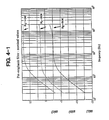
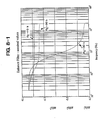
- FIG. 4 Here a test circuit is shown comprised of pre filter (4A) of the signal conditioner (4) and an equivalent circuit representing buffer (5). To isolate the response of these elements, gain was calculated.
- Figures 4-1, 4-2 and 4-3 graph the results.
- Gain 1 represents (R2) at a value of 10 kilo ohms;
- gain 2 represents (R2) at a value of 50 kilo ohms;
- gain 3 represents (R2) at a value of 90 kilo ohms.
- figure 4-1 other than (R2), all values are as shown in figure 4.
- FIG 4-1 it is notable that after a certain frequency there is no increase in gain. It .was found that R1 had essentially no effect on the signal until R2 was made very small. Then R1 acted to keep the high frequency gain from going too high.
- Limiter (6) takes its basis from Figures 6 and 8 of United States Patent RE 28426 but differs in several significant respects some of which are mentioned below and others of which will be readily evident when comparing the circuit of the present invention with those in the noted patent.
- limiter 6 is connected at its input to ground through .1 microfarad capacitor (C5). It is believed that this capacitor operates in conjunction with gain elements in the limiter to attenuate the signal about 6 db (that is to cut the signal in half). This would assist cascading a plurality of circuits of the present invention together for specific circuit design.
- This circuitry then combines the phase advantages of having only one RC network filtering the signal at quiescent conditions while achieving a 12 db per octave attenuation under signal conditions.
- Figure 5 isolates this portion of the circuit which may be considered the signal conditioning sliding high pass filter section.
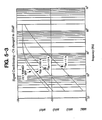
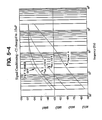
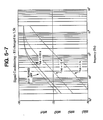
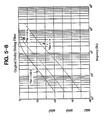
- Figures 5-1 through 5-7 show test outputs resulting from this circuitry. Gain 1 was found with R FET at 100 kilo ohms; gain 2 was found with R FET at 10 kilo ohms; gain 3 was found with R FET at 1 kilo ohm; and gain 4 was found with R FET off.
- R FET represents (F1) and is a variable resistance whose value is determined by the location of potentiometer (120) in figure 2 and on the gate voltage. The higher the gate voltage the lower the resistance and thus the higher the corner frequency. (C6) sends a small signal to ground but has no effect on the frequency response.
- Figure 5-2 shows the result of increasing (C3).
- the gain is raised at all frequencies but the shape left unchanged.
- (C5) is increased which expectedly decreases the high frequency gain and the corner frequency.
- Figure 5-5 shows the response with (C5) removed altogether. No graph is shown for R FET being off. Here gain is higher at high frequencies and the corner frequency is at a higher frequency.
- Figure 5-6 shows that a decrease in the value of R15 results in a slight increase in low frequency gain.
- Figure 5-7 shows a decrease of R6 results in a decrease of low frequency gain.
- the signal leaving this high pass filter section passes to NPN, PNP amplifiers (T3) (T4) respectively, by means of potentiometer (120) which as shown in the cited patent and here lies in a voltage divider line and includes a temperature compensating germanium diode (D11).
- potentiometer 120
- D11 temperature compensating germanium diode
- Z1 8.2 volt zener diode
- Amplifiers (T3, T4) like those in Figure 6 of the U.S. Patent referred to herein, are complementary to yield a high input impedance and a low output impedance.
- the diodes (D1, D2) are silicon having knees at about 1/2 volt.
- Amplifier (T4) drives the diode limiters (D1, D2) whose signal attenuates the output from (4A) (not disclosed in the noted patent) and thus the signal entering buffer (5).
- This section may be referred to as the buffer/limiter.
- the gain from V3 to V2 is
- Diodes (D1, D2) limit the signal going into buffer (5).
- amplifier (T5) is driven by amplifier (T4) and like the cited patent, is an NPN transistor with an emitter time constant network giving increased gain at high frequencies.
- Amplifier (T5) has a fairly low impedance from measures at the collector of (T4) and therefore, the mathematical effect of (R30) of 8.2 kilo ohms and (C30) of .1 micro farad are not so significant.
- the second stage of the signal conditioning unit designated generally by (4B) and referred to as the post or output filter stage affects the system at the final output stage, after it has passed through buffer (5) and been processed by limiter (6).
- This portion of the signal conditioning unit renders a gain approximating one. If potentiometer (118) is turned fully counterclockwise, high frequencies will pass through capacitor (C8) in (4B) which is the .02 micro farad capacitor to ground. At low frequencies, the gain will be high until about 3.7 kilohertz when the first pole is crossed. On the other hand, when potentiometer (118) is turned fully clockwise, the high gain will be much more constant.
- the output circuit (4B) has a close to unity gain at very low frequencies with additional attenuation through the audio band. This is especially noticeable when the potentiometer (118) is turned counterclockwise.
- FIG 8 portion (4B) is isolated for better study.
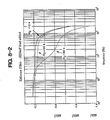
- Figures 8-1 and 8-2 show test results made with respect to this circuit.
- Gain 1 shows (R22) with a value of 10 kilo ohms;
- gain 2 shows (R22) with a value of 50 kilo ohms;
- gain 3 shows (R22) with a value of 90 kilo ohms. From these figures it appears that the effect of (4B) on the output is small.
- Amp 1 in figure 8 circuitry represents buffer (5) as amp 1 with an output resistance (RO) modeled as 600 ohms. There is a strong dependence of the circuit on this output resistance. (C3) (.0056 micro farads) in the limiter (6) also loads the output especially at high frequencies.
- RO output resistance
- Figure 8-2 shows the frequency response with a .0056 micro farad capacitor from output to ground added. While portion (4B) seems mathematically to have little effect on the sound and could theoretically be omitted, it is believed that it has a psycho acoustic effect. Therefore, it should likely not be so lightly dismissed.
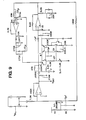
- FIG. 9-1 A modified version of this invention is shown in figures 9 and 9-1.
- integrated circuits have been used to replace other analog components in the buffer (5) and limiter (6).
- AC and DC ground connections are introduced and some resistors and capacitors deleted. Their deletion has been made based upon mathematical calculation. However some of these deleted elements again seem to have psycho acoustic effects on the sound produced and therefore should be tested in any circuit built. Elements not shown are those making up section 4B and (R20) in the limiter (6).
- Figure 9-1 shows the AC/DC ground connections.
- the present invention combines a simple, tunable circuit with a Dolby-type expander to provide an efficient yet simple noise reduction system. Some of this combination may be analyzed mathematically. It is believed that those portions which do not justify themselves mathematically may do so practically, a psycho acoustic effect being possibly created thereby.
Landscapes
- Tone Control, Compression And Expansion, Limiting Amplitude (AREA)
- Networks Using Active Elements (AREA)
- Reduction Or Emphasis Of Bandwidth Of Signals (AREA)
Applications Claiming Priority (2)
| Application Number | Priority Date | Filing Date | Title |
|---|---|---|---|
| US23530688A | 1988-08-23 | 1988-08-23 | |
| US235306 | 1994-04-29 |
Publications (2)
| Publication Number | Publication Date |
|---|---|
| EP0356885A2 true EP0356885A2 (fr) | 1990-03-07 |
| EP0356885A3 EP0356885A3 (fr) | 1991-05-15 |
Family
ID=22884950
Family Applications (1)
| Application Number | Title | Priority Date | Filing Date |
|---|---|---|---|
| EP19890115479 Withdrawn EP0356885A3 (fr) | 1988-08-23 | 1989-08-22 | Circuit à bande linéairement accordable compensé en fréquence |
Country Status (4)
| Country | Link |
|---|---|
| EP (1) | EP0356885A3 (fr) |
| CN (1) | CN1040880A (fr) |
| AU (1) | AU4207089A (fr) |
| WO (1) | WO1990002446A1 (fr) |
Family Cites Families (3)
| Publication number | Priority date | Publication date | Assignee | Title |
|---|---|---|---|---|
| USRE28426E (en) * | 1968-11-01 | 1975-05-20 | Signal compressors and expanders | |
| US3729693A (en) * | 1971-08-02 | 1973-04-24 | R Dolby | Compressor/expander switching methods and apparatus |
| US4736433A (en) * | 1985-06-17 | 1988-04-05 | Dolby Ray Milton | Circuit arrangements for modifying dynamic range using action substitution and superposition techniques |
-
1989
- 1989-08-22 EP EP19890115479 patent/EP0356885A3/fr not_active Withdrawn
- 1989-08-22 WO PCT/US1989/003609 patent/WO1990002446A1/fr not_active Ceased
- 1989-08-22 AU AU42070/89A patent/AU4207089A/en not_active Abandoned
- 1989-08-23 CN CN 89106503 patent/CN1040880A/zh active Pending
Also Published As
| Publication number | Publication date |
|---|---|
| EP0356885A3 (fr) | 1991-05-15 |
| AU4207089A (en) | 1990-03-23 |
| WO1990002446A1 (fr) | 1990-03-08 |
| CN1040880A (zh) | 1990-03-28 |
Similar Documents
| Publication | Publication Date | Title |
|---|---|---|
| US4792977A (en) | Hearing aid circuit | |
| US4135590A (en) | Noise suppressor system | |
| US4405831A (en) | Apparatus for selective noise suppression for hearing aids | |
| US4322641A (en) | Noise reduction system | |
| US3229049A (en) | Hearing aid | |
| US4926139A (en) | Electronic frequency filter | |
| KR20070050930A (ko) | 고 잡음 환경에서의 음향 표현을 위한 오디오 신호 처리시스템 및 방법 | |
| US4207543A (en) | Adaptive filter network | |
| US4912393A (en) | Voltage regulator with variable reference outputs for a hearing aid | |
| US4922131A (en) | Differential voltage threshold detector | |
| US4934770A (en) | Electronic compression system | |
| US4498060A (en) | Circuit arrangements for modifying dynamic range using series arranged bi-linear circuits | |
| US4829270A (en) | Compansion system | |
| US4498055A (en) | Circuit arrangements for modifying dynamic range | |
| EP0356885A2 (fr) | Circuit à bande linéairement accordable compensé en fréquence | |
| JPH0424883B2 (fr) | ||
| EP0490295A1 (fr) | Circuit pour la suppression du bruit produit par la commutation de deux sources de tension, en particulier pour étages de pré-amplification audio | |
| KR890000333B1 (ko) | 다이나믹 레인지(Dynamic range)변경 회로 장치 | |
| US6665408B1 (en) | Dynamic bass control circuit with variable cut-off frequency | |
| CA1164805A (fr) | Expanseur de signaux | |
| US5255320A (en) | Hearing aid | |
| US4786879A (en) | Attenuator circuit employing bootstrapping | |
| KR960014115B1 (ko) | 부우트스트래핑(Bootstrapping)을 사용한 감쇄회로 | |
| GB2111355A (en) | Improvements in circuit arrangements for modifying dynamic range | |
| CA1269138A (fr) | Circuit attenateur a contre-reaction |
Legal Events
| Date | Code | Title | Description |
|---|---|---|---|
| PUAI | Public reference made under article 153(3) epc to a published international application that has entered the european phase |
Free format text: ORIGINAL CODE: 0009012 |
|
| AK | Designated contracting states |
Kind code of ref document: A2 Designated state(s): ES GR |
|
| PUAL | Search report despatched |
Free format text: ORIGINAL CODE: 0009013 |
|
| AK | Designated contracting states |
Kind code of ref document: A3 Designated state(s): ES GR |
|
| STAA | Information on the status of an ep patent application or granted ep patent |
Free format text: STATUS: THE APPLICATION IS DEEMED TO BE WITHDRAWN |
|
| 18D | Application deemed to be withdrawn |
Effective date: 19911116 |