EP0356966A2 - Système de sulfonation dans le moule - Google Patents
Système de sulfonation dans le moule Download PDFInfo
- Publication number
- EP0356966A2 EP0356966A2 EP89115854A EP89115854A EP0356966A2 EP 0356966 A2 EP0356966 A2 EP 0356966A2 EP 89115854 A EP89115854 A EP 89115854A EP 89115854 A EP89115854 A EP 89115854A EP 0356966 A2 EP0356966 A2 EP 0356966A2
- Authority
- EP
- European Patent Office
- Prior art keywords
- mold
- sulfur trioxide
- gaseous
- sulfonation
- plastic article
- Prior art date
- Legal status (The legal status is an assumption and is not a legal conclusion. Google has not performed a legal analysis and makes no representation as to the accuracy of the status listed.)
- Withdrawn
Links
Images
Classifications
-
- B—PERFORMING OPERATIONS; TRANSPORTING
- B29—WORKING OF PLASTICS; WORKING OF SUBSTANCES IN A PLASTIC STATE IN GENERAL
- B29C—SHAPING OR JOINING OF PLASTICS; SHAPING OF MATERIAL IN A PLASTIC STATE, NOT OTHERWISE PROVIDED FOR; AFTER-TREATMENT OF THE SHAPED PRODUCTS, e.g. REPAIRING
- B29C49/00—Blow-moulding, i.e. blowing a preform or parison to a desired shape within a mould; Apparatus therefor
- B29C49/42—Component parts, details or accessories; Auxiliary operations
- B29C49/46—Component parts, details or accessories; Auxiliary operations characterised by using particular environment or blow fluids other than air
-
- B—PERFORMING OPERATIONS; TRANSPORTING
- B60—VEHICLES IN GENERAL
- B60K—ARRANGEMENT OR MOUNTING OF PROPULSION UNITS OR OF TRANSMISSIONS IN VEHICLES; ARRANGEMENT OR MOUNTING OF PLURAL DIVERSE PRIME-MOVERS IN VEHICLES; AUXILIARY DRIVES FOR VEHICLES; INSTRUMENTATION OR DASHBOARDS FOR VEHICLES; ARRANGEMENTS IN CONNECTION WITH COOLING, AIR INTAKE, GAS EXHAUST OR FUEL SUPPLY OF PROPULSION UNITS IN VEHICLES
- B60K15/00—Arrangement in connection with fuel supply of combustion engines or other fuel consuming energy converters, e.g. fuel cells; Mounting or construction of fuel tanks
- B60K15/03—Fuel tanks
-
- C—CHEMISTRY; METALLURGY
- C08—ORGANIC MACROMOLECULAR COMPOUNDS; THEIR PREPARATION OR CHEMICAL WORKING-UP; COMPOSITIONS BASED THEREON
- C08J—WORKING-UP; GENERAL PROCESSES OF COMPOUNDING; AFTER-TREATMENT NOT COVERED BY SUBCLASSES C08B, C08C, C08F, C08G or C08H
- C08J7/00—Chemical treatment or coating of shaped articles made of macromolecular substances
- C08J7/12—Chemical modification
-
- C—CHEMISTRY; METALLURGY
- C08—ORGANIC MACROMOLECULAR COMPOUNDS; THEIR PREPARATION OR CHEMICAL WORKING-UP; COMPOSITIONS BASED THEREON
- C08L—COMPOSITIONS OF MACROMOLECULAR COMPOUNDS
- C08L23/00—Compositions of homopolymers or copolymers of unsaturated aliphatic hydrocarbons having only one carbon-to-carbon double bond; Compositions of derivatives of such polymers
- C08L23/02—Compositions of homopolymers or copolymers of unsaturated aliphatic hydrocarbons having only one carbon-to-carbon double bond; Compositions of derivatives of such polymers not modified by chemical after-treatment
- C08L23/04—Homopolymers or copolymers of ethene
- C08L23/06—Polyethylene
-
- B—PERFORMING OPERATIONS; TRANSPORTING
- B29—WORKING OF PLASTICS; WORKING OF SUBSTANCES IN A PLASTIC STATE IN GENERAL
- B29C—SHAPING OR JOINING OF PLASTICS; SHAPING OF MATERIAL IN A PLASTIC STATE, NOT OTHERWISE PROVIDED FOR; AFTER-TREATMENT OF THE SHAPED PRODUCTS, e.g. REPAIRING
- B29C49/00—Blow-moulding, i.e. blowing a preform or parison to a desired shape within a mould; Apparatus therefor
- B29C49/42—Component parts, details or accessories; Auxiliary operations
- B29C49/46—Component parts, details or accessories; Auxiliary operations characterised by using particular environment or blow fluids other than air
- B29C2049/4673—Environments
- B29C2049/4698—Pressure difference, e.g. over pressure in room
-
- B—PERFORMING OPERATIONS; TRANSPORTING
- B29—WORKING OF PLASTICS; WORKING OF SUBSTANCES IN A PLASTIC STATE IN GENERAL
- B29K—INDEXING SCHEME ASSOCIATED WITH SUBCLASSES B29B, B29C OR B29D, RELATING TO MOULDING MATERIALS OR TO MATERIALS FOR MOULDS, REINFORCEMENTS, FILLERS OR PREFORMED PARTS, e.g. INSERTS
- B29K2023/00—Use of polyalkenes or derivatives thereof as moulding material
- B29K2023/04—Polymers of ethylene
- B29K2023/06—PE, i.e. polyethylene
-
- B—PERFORMING OPERATIONS; TRANSPORTING
- B29—WORKING OF PLASTICS; WORKING OF SUBSTANCES IN A PLASTIC STATE IN GENERAL
- B29K—INDEXING SCHEME ASSOCIATED WITH SUBCLASSES B29B, B29C OR B29D, RELATING TO MOULDING MATERIALS OR TO MATERIALS FOR MOULDS, REINFORCEMENTS, FILLERS OR PREFORMED PARTS, e.g. INSERTS
- B29K2995/00—Properties of moulding materials, reinforcements, fillers, preformed parts or moulds
- B29K2995/0037—Other properties
- B29K2995/0065—Permeability to gases
- B29K2995/0067—Permeability to gases non-permeable
-
- B—PERFORMING OPERATIONS; TRANSPORTING
- B29—WORKING OF PLASTICS; WORKING OF SUBSTANCES IN A PLASTIC STATE IN GENERAL
- B29L—INDEXING SCHEME ASSOCIATED WITH SUBCLASS B29C, RELATING TO PARTICULAR ARTICLES
- B29L2031/00—Other particular articles
- B29L2031/712—Containers; Packaging elements or accessories, Packages
- B29L2031/7172—Fuel tanks, jerry cans
-
- B—PERFORMING OPERATIONS; TRANSPORTING
- B60—VEHICLES IN GENERAL
- B60K—ARRANGEMENT OR MOUNTING OF PROPULSION UNITS OR OF TRANSMISSIONS IN VEHICLES; ARRANGEMENT OR MOUNTING OF PLURAL DIVERSE PRIME-MOVERS IN VEHICLES; AUXILIARY DRIVES FOR VEHICLES; INSTRUMENTATION OR DASHBOARDS FOR VEHICLES; ARRANGEMENTS IN CONNECTION WITH COOLING, AIR INTAKE, GAS EXHAUST OR FUEL SUPPLY OF PROPULSION UNITS IN VEHICLES
- B60K15/00—Arrangement in connection with fuel supply of combustion engines or other fuel consuming energy converters, e.g. fuel cells; Mounting or construction of fuel tanks
- B60K15/03—Fuel tanks
- B60K2015/03032—Manufacturing of fuel tanks
Definitions
- This invention relates to an in-mold method and apparatus for sulfonating plastic articles during molding and to the sulfonated plastic articles so produced. More particularly, it relates to a system for injecting sulfur trioxide into a pre-mold chamber, forming a relatively high-pressure gaseous sulfur trioxide, and then, introducing the gaseous sulfur trioxide into the mold cavity during molding of plastic articles such as plastic containers.
- Plastic containers which are made from most organic polymers, particularly the dominantly hydrocarbon polymers, are non-electroconductive, are non-adherent to polar materials such as inks, paints, dyes and various polar adhesives and are readily permeated and/or stress cracked or swollen by olephilic materials such as liquid and gaseous hydrocarbons e.g., solvents, fumes, vapors, benzene, cyclohexane, xylene, chlorinated solvents, and hexane; gases such as nitrogen, oxygen, helium, hydrogen, carbon dioxide, methane, ethane, propane, butane, halocarbons; fuels such as gasoline, kerosene, fuel oils; oils such as natural fatty oils, lubricating oils, perfumes and agricultural chemicals.
- olephilic materials such as liquid and gaseous hydrocarbons e.g., solvents, fumes, vapors, benzene, cyclo
- these materials can adversely affect the container material.
- natural fatty oils tend to cause stress cracking of polymers formed from olefinic monomers such as polyethylene.
- many of such organic polymers must be treated with various agents which impart varying degrees of electroconductivity, adhesion and impermeability.
- Walles U.S. Patent Nos. 3,613,957 and 3,740,258 relate to a post-mold treatment of plastic containers fabricated of non-aromatic hydrocarbon polymers.
- the surface to be sulfonated preferably the interior surface of the plastic container, is exposed to gaseous sulfur trioxide, preferably diluted with a dry inert gas such as dry air.
- the interior surface may be contacted with a solution of sulfur trioxide in an inert liquid solvent, such as a liquid chlorofluorocarbon.
- the interior surface sulfonated plastic containers are then substantially completely neutralized by contacting them with a dilute aqueous solution of alkali metal hydroxide, ammonium hydroxide, gaseous ammonia or other neutralizing agents.
- a dilute aqueous solution of alkali metal hydroxide, ammonium hydroxide, gaseous ammonia or other neutralizing agents During the neutralization step, salts such as ammonium sulfate and ammonium sulfamate (when ammonia is used as the neutralizing agent) are formed. While such salts are rinseable and/or leachable, washing, rinsing and drying are required to remove these salts. This is especially necessary when the plastic container is to be used as a vehicle gasoline tank because residual salts are not soluble in gasoline and can clog the fuel line and/or fuel filter stalling or otherwise hindering the operation of the vehicle.
- in-mold sulfonation system would, therefore, be desirable in that it could combine the best features of both post-mold sulfonation and in-mold fluorination and thereby eliminate many of the disadvantages of each.
- in-mold sulfonation process it has not been possible to satisfactorily conduct an in-mold sulfonation process. To a large extent this has been because it is difficult to inject gaseous sulfur trioxide into a mold which is under relatively high pressure and to control the time and temperature of the sulfonation treatment so as to achieve the deserved result.
- the present invention provides an apparatus and method for injecting sulfur trioxide, preferably pure liquid sulfur trioxide, preferably pure liquid sulfur trioxide, into a pre-mold chamber where it is converted to a relatively high pressure gaseous sulfur trioxide and, then, introducing the gaseous sulfur trioxide into the mold cavity immediately before or immediately after the plastic article is fully formed.
- the mold is preferably a blow mold or counter-current injection mold for molding thermoplastic resins under heat and pressure to produce plastic articles.
- the method is particularly applicable to blow molded plastic containers such as polyolefin vehicle gasoline tanks in order to sulfonate the interior surface of the plastic container during blow molding, but may also be used to sulfonate the surface of other plastic articles such as tubes, cartridges, and similar shaped articles.
- the sulfur trioxide is converted in the pre-mold chamber to a relatively high pressure gaseous sulfur trioxide.
- the pressure of the gaseous sulfur trioxide in the pre-mold chamber may be in the range of approximately 100 to 120 psi (0.69 to 0.83 Pa). Because there is a fluid communication line between the pre-mold chamber and the mold, when the valve in that line is opened a measured amount of relatively higher pressure gaseous sulfur trioxide, i.e. the amount of gaseous sulfur trioxide produced from the charge of sulfur trioxide initially injected into the pre-mold chamber, is discharged from the pre-mold chamber and introduced into the relatively lower pressure environment in the mold.
- the gaseous sulfur trioxide immediately before or immediately after full expansion of the blow molded plastic article and before any significant cooling of the plastic article in the mold takes place. At that point in time the temperature of the plastic article is such that the sulfonation treatment will be most effective.
- the treated surface of the plastic article upon neutralization with for example ammonia gas, the treated surface of the plastic article will have thereon a barrier layer primarily made up of R-SO3-NH4+ functional groups, wherein RH is the hydrocarbon of the organic polymer being treated, and will contain a minimum of NH2SO3NH4 groups, i.e. undesirable, water leachable, ammonium sulfate salt.
- the molding step takes place at approximately 110 to 180°C
- the pre-mold chamber, and consequently the sulfur trioxide gas is at 80 to 140°C
- the sulfonation step lasts for approximately 0.1 to 1.5 min.
- a neutralizing agent such as ammonia gas
- neutralization is followed by flushing with dry air, not rinsing.
- any remaining gaseous sulfur trioxide, gaseous neutralizing agent, and gaseous reaction products are vented and flushed from the mold cavity prior to cooling the surface sulfonated molded plastic article.
- nearly 100 percent pure sulfur trioxide gas is used and if the moisture level of the carrier gas used in the neutralization step is controlled (a little moisture is desirable as an aid in neutralization, but only a little, i.e. less than about 1 percent based on NH3), then few gaseous reaction produces are encountered and the flushing operation is adequate to place the plastic article in condition for use upon cooling. No subsequent treatments, washings, or rinsings are required.
- the molding/sulfonation cycle may be repeated without interruption.
- the pump for charging the pre-mold chamber with liquid sulfur trioxide is shut down.
- the pump is activated to inject another change of liquid sulfur trioxide into the pre-mold chamber.
- the pump is heated to convert it to relatively higher pressure gaseous sulfur trioxide. All of this takes place during the mold/sulfonation cycle for the preceding plastic article so that immediately upon completion of that cycle there is another supply of relatively high pressure gaseous sulfur trioxide ready for the next cycle. This is possible as long as the valve and the pump cannot open or operate at the same time.
- the present invention provides and in-mold method and apparatus for efficiently sulfonating a surface of molded plastic articles during the molding operation.
- the invention also provides sulfonated plastic articles having a barrier layer thereon relatively free of leachable salts.
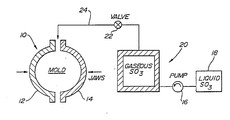
- Mold 10 as shown generally illustrates a blow molding operation for molding thermoplastic resins into plastic articles such as plastic containers, but other types of molding operations such as counter-current injection molding ones, may also use the in-mold sulfonation system of the present invention.
- polyolefin resins are the preferred thermoplastic resins to be molded, others may also be used.
- Suitable thermoplastic polymers include addition-type homopolymers and copolymers and blends thereof prepared from the aliphatic alpha-monoolefins, aliphatic conjugated and non-conjugated dienes, trienes and polyenes, halogenated aliphatic olefins, alpha-beta-ethylenically unsaturated carboxylic acids, vinylesters of nonpolymerizable carboxylic acids, alkyl esters of alpha-beta-ethylenically unsaturated carboxylic acids, monovinylidene aromatic monomers, alpha-beta-ethylenically unsaturated nitriles and amides, ethylenically unsaturated ethers and ketones and other ethylenically unsaturated monomers which polymerize across the ethylenic bond to form polymers having linear carbon to carbon backbone molecular structure with a plurality of free hydrogen atoms attached to
- thermoplastic resins are also included as suitable thermoplastic resins.
- condensation-type polymers exemplified by the polyamides such as nylon, the polyimides, the polyesters such as polyethylene terephthalate, the polycarbonates derived form dihydric phenols such as bisphenol A, the polyethers and the like.
- Organic polymers of special interest are the thermoplastic addition homopolymer, copolymers and mixture of polymers of the following monomers; the aliphatic monolefins such as ethylene, propylene, butene-1 and isobutylene; aliphatic conjugated dienes such as butadiene; monovinylidene aromatic monomers such as styrene and ⁇ , ⁇ -ethylenically unsaturated nitriles such as acrylonitrile.
- monomers such as ethylene, propylene, butene-1 and isobutylene
- aliphatic conjugated dienes such as butadiene
- monovinylidene aromatic monomers such as styrene and ⁇ , ⁇ -ethylenically unsaturated nitriles such as acrylonitrile.
- mold 10 has jaws 12 and 14 between which a parison of thermoplastic resin (not shown), preferably a high density polyethylene, is placed.
- a parison of thermoplastic resin preferably a high density polyethylene
- the jaws 12 and 14 are then closed.
- Heat and fluid (air) pressure are applied to expand or blow the parison into the shape of the mold cavity.
- the fluid pressure involved in doing so is around 80 to 100 psi (0.55 to 0.69 Pa), preferably about 80 psi (0.55 Pa) and the temperature involved is approximately 110 to 180°C. At these temperatures and pressures it generally takes 0.1 to 0.4 minutes to expand fully a parison for a 10 to 25 gallon (37.8 to 94.5 liter) plastic container such as a vehicle gasoline tank.
- a charge of preferably pure liquid sulfur trioxide at about 25°C is pumped by pump 16 from liquid sulfur trioxide supply source 18 and injected into pre-mold chamber 20.
- the liquid sulfur trioxide is heated to above its boiling point (approximately 44°C at 1 atmosphere) to convert the liquid sulfur trioxide to a gaseous sulfur trioxide.
- the pre-mold chamber is at a temperature of approximately 80 to 140°C, most preferably about 100°C.
- the pressure of the gaseous sulfur trioxide is increased to around 100 to 120 psi, preferably about 100 psi (0.69 Pa), to provide in pre-mold chamber 20 a relatively high pressure pure (nearly 100 percent), gaseous sulfur trioxide. It is desirable to use a pressure sensor which allows the pump to operate as long as the pressure is not too high. Thus, the charge of liquid sulfur trioxide is injected into pre-mold chamber at lower pressures. The pressure increase in pre-mold chamber 20 is sensed. Pump 16 shuts down when a pressure level of 100 to 120 psi (0.69 to 0.83 Pa) is reached in pre-mold chamber 20.
- This system makes it possible to inject a precise amount of liquid sulfur trioxide into the system (which is relatively easy to do as compared to trying to inject gaseous sulfur trioxide) and, then, efficiently and effectively convert the liquid sulfur trioxide to relatively high pressure gaseous sulfur trioxide.
- valve 22 Immediately upon or shortly before full expansion of the plastic container in mold 10, valve 22 is opened. Because pump 16 has at this stage been shut down following injection of the charge of liquid sulfur trioxide into pre-mold chamber 20 thereby closing the fluid connection between pre-mold chamber 20 and liquid sulfur trioxide supply source 18, and because the pressure of the gaseous sulfur trioxide in pre-mold chamber 20 is relatively higher than the pressure in mold 10, upon opening valve 22, the gaseous sulfur trioxide in pre-mold chamber 20 flows through fluid communication line 24 into the mold cavity. Actually, because the parison is preferably fully expanded at this stage, the gaseous sulfur trixoide is introduced into the interior of the formed plastic container.
- gaseous sulfur trioxide upon its introduction the gaseous sulfur trioxide will sulfonate the interior surface of the plastic container.
- gaseous sulfur trioxide upon its introduction the gaseous sulfur trioxide will sulfonate the interior surface of the plastic container.
- hot, pure, gaseous sulfur trioxide is introduced into the mold cavity, it will raise the pressure in the mold cavity to approximately 90 psi (0.62 Pa). It will also convert the air in the mold cavity to about 80 percent air and 20 percent sulfur trioxide. At those levels, and after 0.1 to 1.2 minutes, surface sulfonation will take place.
- the timing of the sulfonation step is important in terms of the properties of the barrier layer produced.
- the formed plastic container is at approximately 160°C to 180°C.
- R being the hydrocarbon of the thermoplastic resin.
- R-SO3 ⁇ NH4+ groups are formed and a minimum of leachable salt is produced.
- R-SO3H groups tend to combine forming R-SO2-R (a polymeric sulfone) and H2SO4.
- H2SO4 has a very high boiling point, it does not evaporate during air flushing, it remains on the surface of the plastic container, and it is neutralized by NH3 to give (NH4)2SO4 (ammonium sulfate), which is also a rinseable salt.
- Non-uniform surface sulfonation can also occur if the sulfonation step takes place too soon. Thus, if there is a significant degree of sulfonation which takes place before full expansion of the plastic container, the sulfonated portion of the surface resists expansion, the expansion which does take place is in the poorly sulfonated regions, and "stretchmarks" are created. Because of the non-uniform surface sulfonation, the barrier properties are also not uniform. This makes the plastic container less desirable as a container for organic fluids.
- valve 22 is closed. Pump 16 is then activated and pre-mold chamber 20 is recharged with sulfur trioxide, preferably pure liquid sulfur trioxide, to make ready for the next molding cycle. Following the sulfonation step the mold cavity is vented and the air/gaseous sulfur trioxide mixture flushed from the mold cavity. Thereafter, any sulfonic acid groups on the sulfonated surface of the plastic article are neutralized. This is preferably with a gaseous neutralizing agent such as ammonia or other gaseous amine; although, other neutralizing agents such as lime slurry or caustic may be used but these are not preferred because they are non-gaseous and require rinsing. Air or nitrogen with about 1 percent H2O (based on NH3) is used as a carrier for the ammonia gas in the preferred system.
- a gaseous neutralizing agent such as ammonia or other gaseous amine
- other neutralizing agents such as lime slurry or caustic may be used but these are not preferred because
- any remaining gaseous neutralizing agent and gaseous reaction products are vented/flushed from the mold cavity.
- this is accomplished by venting and, then, using dry air to flush the gases from the mold cavity as the formed plastic container cools in mold 10.
- the vented/flushed gases may be passed through a scrubber as is conventional.
- a scrubber with a water spray may be used to convert gaseous sulfur trixoide which is vented/flushed from the mold cavity prior to neutralization to a dilute sulfuric acid. Then, upon venting/flushing after neutralization, the excess ammonia neutralizes the effluent in the scrubber. After neutralization, venting, and flushing, the plastic article is removed from mold 20 and the molding cycle is repeated.
- a lab simulation of in-mold sulfonation was conducted using preheated polyethylene coupons, thereby avoiding use of an entire blow molding unit in this experiment.
- the temperatures that were used in the experiment were held constant for the duration of the test and did not cool off as the polyethylene would during actual blow molding.
- select temperatures were used covering the molding range (85°C to 105°C) under a variety of sulfonation conditions.
- the SO3 partial pressures were manipulated to achieve an adequate sulfonation concentrations in the range of 15 percent to 25 percent SO3.
- Tables 1B to 1D represent the sulfonation level as a function of sulfonation time (seconds), using a concentration of 22 percent SO3 at the temperatures of 85°C, 95°C, and 105°C, respectively.
- an increase in sulfonation time correlates with an increase in the level of surface sulfonation .
- the sulfonation level increases at a fairly constant rate to a maximum performed sulfonation time of one minute, with an adequate level of surface sulfonation ( ⁇ 200 micrograms SO3/cm ⁇ 2) being reached at approximately 12.5 seconds of sulfonation.
- Table 1E illustrates the relationship between the level of surface sulfonation and the partial pressure of SO3 used during the period of sulfonation. This was compared using the different constant temperatures of 45°C, 65°C and 85°C, respectively and holding the sulfonation time constant at 30 seconds.
- the data demonstrate a direct correlation between the concentration of SO3 used for sulfonation and the surface level sulfonation of the polyethylene sample. It appears that the minimum percentage of SO3 required to reach an adequate level of surface sulfonation ( ⁇ 200 micrograms SO3/cm ⁇ 2) at the low end of the temperature range of the formed plastic article in a typical blow molding process (i.e. around 80°C is about 17 to 18 percent, and at the middle of the temperature range (i.e. around 105°C) about 15 percent.
- a fully automatic blow molding machine capable of handling 20 to 50 pounds (9 to 22.6 kgs) polyethylene at a shot and providing mold clamping pressures of 80 to 100 psi (0.55 to 0.69 Pa) was used to blow mold high density polyethylene vehicle gasoline tanks. That blow molding machine was outfitted with SO3 sources as shown in the drawing figure.
Landscapes
- Chemical & Material Sciences (AREA)
- Engineering & Computer Science (AREA)
- Mechanical Engineering (AREA)
- Health & Medical Sciences (AREA)
- Chemical Kinetics & Catalysis (AREA)
- Medicinal Chemistry (AREA)
- Polymers & Plastics (AREA)
- Organic Chemistry (AREA)
- Manufacturing & Machinery (AREA)
- General Chemical & Material Sciences (AREA)
- Life Sciences & Earth Sciences (AREA)
- Sustainable Development (AREA)
- Sustainable Energy (AREA)
- Combustion & Propulsion (AREA)
- Transportation (AREA)
- Treatments Of Macromolecular Shaped Articles (AREA)
- Blow-Moulding Or Thermoforming Of Plastics Or The Like (AREA)
- Moulds For Moulding Plastics Or The Like (AREA)
- Addition Polymer Or Copolymer, Post-Treatments, Or Chemical Modifications (AREA)
Applications Claiming Priority (2)
| Application Number | Priority Date | Filing Date | Title |
|---|---|---|---|
| US07/237,366 US4861250A (en) | 1988-08-29 | 1988-08-29 | Mold sulfonation system |
| US237366 | 1988-08-29 |
Publications (2)
| Publication Number | Publication Date |
|---|---|
| EP0356966A2 true EP0356966A2 (fr) | 1990-03-07 |
| EP0356966A3 EP0356966A3 (fr) | 1991-07-24 |
Family
ID=22893425
Family Applications (1)
| Application Number | Title | Priority Date | Filing Date |
|---|---|---|---|
| EP19890115854 Withdrawn EP0356966A3 (fr) | 1988-08-29 | 1989-08-28 | Système de sulfonation dans le moule |
Country Status (8)
| Country | Link |
|---|---|
| US (1) | US4861250A (fr) |
| EP (1) | EP0356966A3 (fr) |
| JP (1) | JPH02117929A (fr) |
| KR (1) | KR900003259A (fr) |
| AU (1) | AU615789B2 (fr) |
| BR (1) | BR8904371A (fr) |
| CA (1) | CA1324871C (fr) |
| MX (1) | MX166458B (fr) |
Cited By (1)
| Publication number | Priority date | Publication date | Assignee | Title |
|---|---|---|---|---|
| US8986785B2 (en) | 2011-06-23 | 2015-03-24 | Surface Activation Technologies | Method and apparatus for continuous sulfonization of discrete article |
Families Citing this family (14)
| Publication number | Priority date | Publication date | Assignee | Title |
|---|---|---|---|---|
| US5202161A (en) * | 1991-01-18 | 1993-04-13 | Solvay Automotive, Inc. | High sulfur level plastic container sulfonation process and article produced thereby |
| US5156783A (en) * | 1991-01-18 | 1992-10-20 | Solvay Automotive, Inc. | Two stage process for sulfonating plastic containers |
| US5216114A (en) * | 1991-02-19 | 1993-06-01 | The Dow Chemical Company | Sulfonation of polybenzoxazole and polybenzothiazole for improved adhesion to matrix resins |
| US5236636A (en) * | 1991-10-07 | 1993-08-17 | Ford Motor Company | In-mold plasma treatment |
| US5849818A (en) * | 1993-06-03 | 1998-12-15 | Walles; Wilhelm E. | Skin sulfonated particles in matrices |
| BE1008568A3 (fr) * | 1994-07-20 | 1996-06-04 | Solvay | Procede pour le traitement superficiel d'un article par sulfonation et neutralisation. |
| US5660639A (en) * | 1995-10-17 | 1997-08-26 | Ford Motor Company | Method and apparatus for plasma treating an article |
| US5882739A (en) * | 1996-04-30 | 1999-03-16 | Whirlpool Corporation | Methods for improved drying performance of a dishwasher and resulting products thereof |
| FI107932B (fi) * | 1999-02-16 | 2001-10-31 | Mikael Paronen | Polymeerikalvo ja menetelmä sen valmistamiseksi |
| KR200255692Y1 (ko) * | 2001-08-28 | 2001-12-13 | 강신복 | 밀채가 결합된 굴렁쇠 |
| US6758910B2 (en) * | 2001-11-13 | 2004-07-06 | Thomas E. Schmoyer | Apparatus and method for sulfonating an article and articles made therefrom |
| JP5286634B2 (ja) * | 2005-09-02 | 2013-09-11 | ソニー株式会社 | 芳香族化合物のスルホン化方法及び芳香族スルホン酸化合物からなる粉末 |
| DE102006012367B4 (de) * | 2006-03-17 | 2015-07-16 | Air Liquide Deutschland Gmbh | Verfahren zur Herstellung eines Hohlkörpers aus Kunststoff mit innenseitiger Sperrschicht |
| US9539370B2 (en) * | 2008-10-20 | 2017-01-10 | Sabic Global Technologies, B.V. | Medical device using sulfonated neutralized polymers with reduced adhesion of biological fluids |
Family Cites Families (19)
| Publication number | Priority date | Publication date | Assignee | Title |
|---|---|---|---|---|
| US28497A (en) * | 1860-05-29 | Improvement in hemp-brakes | ||
| US2811468A (en) * | 1956-06-28 | 1957-10-29 | Shulton Inc | Impermeable polyethylene film and containers and process of making same |
| USRE28497E (en) | 1959-10-15 | 1975-07-29 | Method of and apparatus for making a plastic article | |
| US3740258A (en) * | 1968-01-10 | 1973-06-19 | Dow Chemical Co | Resinous enclosure members rendered impermeable by sulfonation |
| US3613957A (en) * | 1968-10-25 | 1971-10-19 | Dow Chemical Co | Resinous enclosure members rendered impermeable by sulfonation and neutralization |
| US3617338A (en) * | 1969-10-20 | 1971-11-02 | Dow Chemical Co | Method for producing a latent striated effect on plastic films |
| US3694424A (en) * | 1970-10-13 | 1972-09-26 | Hunkar Laboratories | Method of internally cooling a blow molded article |
| US3862284A (en) * | 1973-05-10 | 1975-01-21 | Air Prod & Chem | Process for producing blow molded thermoplastic articles having improved barrier properties |
| US4220739A (en) * | 1978-07-28 | 1980-09-02 | The Dow Chemical Company | Method for sulfonating organic materials |
| US4336015A (en) * | 1979-11-27 | 1982-06-22 | Rainville Dewey N | Apparatus for blow molding with active ingredient in blowing gas |
| US4396567A (en) * | 1979-11-27 | 1983-08-02 | Dewey Rainville | Method for blow molding with active ingredient in blowing gas |
| DE3113919A1 (de) * | 1980-04-10 | 1982-01-14 | Basf Ag, 6700 Ludwigshafen | Verfahren zum herstellen von kraftstoffbehaeltern aus polyaethylen, an deren innerer oberflaeche sulfonsaeure-salzgruppen vorliegen |
| JPS5850572B2 (ja) * | 1980-05-09 | 1983-11-11 | 大同酸素株式会社 | ブロ−ガス回収を伴う中空成形品の製造方法 |
| US4743419A (en) * | 1985-03-04 | 1988-05-10 | The Dow Chemical Company | On-line film fluorination method |
| DE3511743A1 (de) * | 1985-03-30 | 1986-10-09 | Messer Griesheim Gmbh, 6000 Frankfurt | Verfahren zur herstellung fluorierter oberflaechen von polymeren |
| DE3529870A1 (de) * | 1985-08-21 | 1987-02-26 | Basf Ag | Verfahren zur verringerung der permeation von blasgeformten hohlkoerpern aus thermoplastischen kunststoffen |
| DE3535602A1 (de) * | 1985-10-05 | 1987-04-09 | Hewing Gmbh & Co | Verfahren zur herstellung von an der innenoberflaeche fluorierten hohlkoerpern aus thermoplastischen kunststoffen durch blasformen |
| US4615914A (en) * | 1985-10-07 | 1986-10-07 | The Dow Chemical Company | Treatment of the interior surfaces of resinous enclosure members |
| US4752428A (en) * | 1987-01-28 | 1988-06-21 | Air Products And Chemicals, Inc. | Injection molding process with reactive gas treatment |
-
1988
- 1988-08-29 US US07/237,366 patent/US4861250A/en not_active Expired - Fee Related
-
1989
- 1989-08-28 MX MX017328A patent/MX166458B/es unknown
- 1989-08-28 BR BR898904371A patent/BR8904371A/pt not_active Application Discontinuation
- 1989-08-28 CA CA000609554A patent/CA1324871C/fr not_active Expired - Fee Related
- 1989-08-28 AU AU40837/89A patent/AU615789B2/en not_active Ceased
- 1989-08-28 EP EP19890115854 patent/EP0356966A3/fr not_active Withdrawn
- 1989-08-28 KR KR1019890012226A patent/KR900003259A/ko not_active Withdrawn
- 1989-08-28 JP JP1218761A patent/JPH02117929A/ja active Pending
Cited By (1)
| Publication number | Priority date | Publication date | Assignee | Title |
|---|---|---|---|---|
| US8986785B2 (en) | 2011-06-23 | 2015-03-24 | Surface Activation Technologies | Method and apparatus for continuous sulfonization of discrete article |
Also Published As
| Publication number | Publication date |
|---|---|
| MX166458B (es) | 1993-01-11 |
| BR8904371A (pt) | 1990-04-17 |
| EP0356966A3 (fr) | 1991-07-24 |
| AU615789B2 (en) | 1991-10-10 |
| KR900003259A (ko) | 1990-03-26 |
| JPH02117929A (ja) | 1990-05-02 |
| CA1324871C (fr) | 1993-12-07 |
| US4861250A (en) | 1989-08-29 |
| AU4083789A (en) | 1990-03-01 |
Similar Documents
| Publication | Publication Date | Title |
|---|---|---|
| US5030399A (en) | Method of in-mold sulfonation of molded plastic article | |
| US4861250A (en) | Mold sulfonation system | |
| US4615914A (en) | Treatment of the interior surfaces of resinous enclosure members | |
| Gardette et al. | Photooxidation of poly (vinyl chloride). 1. A reexamination of the mechanism | |
| US5244615A (en) | Process for the production of permeation resistant containers | |
| US4536266A (en) | Process for the fluorination of a surface layer of formed bodies made of plastics | |
| CA2219217A1 (fr) | Methodes pour eliminer les contaminants des polymeres | |
| US6758910B2 (en) | Apparatus and method for sulfonating an article and articles made therefrom | |
| US5401451A (en) | Process for producing permeation resistant containers | |
| JP3282148B2 (ja) | 物品表面の化学的性質改変方法及び装置 | |
| HUP9904288A2 (hu) | Polimer kigőzölés | |
| KR100216667B1 (ko) | 블로우 성형에 의한 개량된 가스 불투과성을 갖는 열가소성 물질로된 중공체의 제조방법 | |
| US4775587A (en) | Treatment of the interior surfaces of resinous enclosure members | |
| US5156783A (en) | Two stage process for sulfonating plastic containers | |
| US5202161A (en) | High sulfur level plastic container sulfonation process and article produced thereby | |
| CA1042150A (fr) | Procede de moussage de copolymeres ioniques et produits de cette operation | |
| US3100910A (en) | Apparatus for the explosion treatment of a plastic container | |
| DE68921915T2 (de) | Apparat und Verfahren zur Erzeugung von einem schwefeltrioxyd-Reagenz für das Sulfonieren der Oberfläche von Polymerenharzen. | |
| US20030155680A1 (en) | Method of applying hydrocarbon barrier to a plastic fuel tank | |
| EP0045323B1 (fr) | Procédé amélioré pour la sulfonation de polymère organiques solides | |
| JPH0254781B2 (fr) | ||
| FR2598333A1 (fr) | Procede et dispositif de neutralisation d'effluents riches en chaux par l'anhydride carbonique | |
| JPH0160489B2 (fr) | ||
| NO773072L (no) | Fremgangsmaate for noeytralisering av sulfonerte, normalt faste polymerer | |
| CA2165046A1 (fr) | Methodes pour ameliorer l'adherence d'une peinture |
Legal Events
| Date | Code | Title | Description |
|---|---|---|---|
| PUAI | Public reference made under article 153(3) epc to a published international application that has entered the european phase |
Free format text: ORIGINAL CODE: 0009012 |
|
| AK | Designated contracting states |
Kind code of ref document: A2 Designated state(s): BE DE FR GB IT NL SE |
|
| PUAL | Search report despatched |
Free format text: ORIGINAL CODE: 0009013 |
|
| AK | Designated contracting states |
Kind code of ref document: A3 Designated state(s): BE DE FR GB IT NL SE |
|
| 17P | Request for examination filed |
Effective date: 19920123 |
|
| 17Q | First examination report despatched |
Effective date: 19930426 |
|
| STAA | Information on the status of an ep patent application or granted ep patent |
Free format text: STATUS: THE APPLICATION IS DEEMED TO BE WITHDRAWN |
|
| 18D | Application deemed to be withdrawn |
Effective date: 19940824 |