EP0357017A2 - Procédé pour la coagulation de filaments - Google Patents
Procédé pour la coagulation de filaments Download PDFInfo
- Publication number
- EP0357017A2 EP0357017A2 EP89115979A EP89115979A EP0357017A2 EP 0357017 A2 EP0357017 A2 EP 0357017A2 EP 89115979 A EP89115979 A EP 89115979A EP 89115979 A EP89115979 A EP 89115979A EP 0357017 A2 EP0357017 A2 EP 0357017A2
- Authority
- EP
- European Patent Office
- Prior art keywords
- spinneret
- filaments
- warp
- velocity
- common line
- Prior art date
- Legal status (The legal status is an assumption and is not a legal conclusion. Google has not performed a legal analysis and makes no representation as to the accuracy of the status listed.)
- Granted
Links
Images



Classifications
-
- D—TEXTILES; PAPER
- D01—NATURAL OR MAN-MADE THREADS OR FIBRES; SPINNING
- D01D—MECHANICAL METHODS OR APPARATUS IN THE MANUFACTURE OF ARTIFICIAL FILAMENTS, THREADS, FIBRES, BRISTLES OR RIBBONS
- D01D5/00—Formation of filaments, threads, or the like
- D01D5/08—Melt spinning methods
- D01D5/088—Cooling filaments, threads or the like, leaving the spinnerettes
- D01D5/092—Cooling filaments, threads or the like, leaving the spinnerettes in shafts or chimneys
-
- D—TEXTILES; PAPER
- D01—NATURAL OR MAN-MADE THREADS OR FIBRES; SPINNING
- D01D—MECHANICAL METHODS OR APPARATUS IN THE MANUFACTURE OF ARTIFICIAL FILAMENTS, THREADS, FIBRES, BRISTLES OR RIBBONS
- D01D5/00—Formation of filaments, threads, or the like
- D01D5/06—Wet spinning methods
-
- D—TEXTILES; PAPER
- D01—NATURAL OR MAN-MADE THREADS OR FIBRES; SPINNING
- D01F—CHEMICAL FEATURES IN THE MANUFACTURE OF ARTIFICIAL FILAMENTS, THREADS, FIBRES, BRISTLES OR RIBBONS; APPARATUS SPECIALLY ADAPTED FOR THE MANUFACTURE OF CARBON FILAMENTS
- D01F6/00—Monocomponent artificial filaments or the like of synthetic polymers; Manufacture thereof
- D01F6/58—Monocomponent artificial filaments or the like of synthetic polymers; Manufacture thereof from homopolycondensation products
- D01F6/60—Monocomponent artificial filaments or the like of synthetic polymers; Manufacture thereof from homopolycondensation products from polyamides
- D01F6/605—Monocomponent artificial filaments or the like of synthetic polymers; Manufacture thereof from homopolycondensation products from polyamides from aromatic polyamides
Definitions
- This invention relates to an improved process for the spinning production of filaments. More particularly, this invention relates to such an improved process wherein filaments of aromatic polyamide can be spun at a substantially increased rate while maintaining a high tenacity.
- Blades U.S. Patent 3,767,756, describes so-called air-gap spinning of anisotropic acid solutions of aromatic polyamides through a noncoagulating fluid, for example, air, and then into a coagulating liquid, for example, water.
- the spinnerets disclosed in Blades have a radial configuration of apertures and the filaments are coagulated in relatively still coagulating baths.
- Yang U.S. Patent 4,340,559, describes a process improved over that disclosed in Blades.
- the anisotropic spinning solution is passed through a layer of noncoagulating fluid, into a shallow, flowing, bath of coagulating liquid, and out of the bath through an exit orifice at the bottom of the bath, along with overflow coagulating liquid.
- the flow of coagulating liquid in the bath is nonturbulent but becomes turbulent at the site of localized jets arranged symmetrically about the exit tube and below but closely adjacent to the exit orifice.
- flow of the coagulating liquid is increased by the force of the jets.
- Jets mentioned in Yang are radial or circular and are used to direct coagulating liquid in addition to the coagulating liquid which is caused to cascade, by free-fall, down the sides of the spin tube of small, circular, cross-section.
- European Patent Application 85/305646 published February 19, 1986 as EP 172,001, discloses a process for spinning high-strength, high-modulus aromatic polyamide filaments using a free-falling coagulating bath.
- the filaments are produced by air-gap spinning an anisotropic solution of the polyamide in sulfuric acid, forming a single vertical warp of filaments, and conducting the filaments vertically downward into a gravity-accelerated and free-falling coagulating liquid.
- the coagulating liquid may be caused to be free-falling by passing the liquid over the edge of a continuously supplied reservoir so that the liquid forms a waterfall.
- the filaments After the filaments have been formed by contact with the coagulating liquid, they may be contacted with additional coagulating liquid such as by a side stream of liquid fed into the gravity-accelerated and free-falling coagulating liquid. Such a side stream may be fed into the existing stream in a nonturbulent manner and at about the speed of the filaments.
- a "warp” is defined herein as an array of filaments aligned side-by-side and essentially parallel.
- the present invention provides a process and an apparatus for preparing filaments from a solution of polymer by extruding the solution through linearly arranged apertures in a spinneret; that is, through apertures arranged in rows and staggered to provide a vertical warp of uniformly spaced filaments which travel downward through an air gap, and are coagulated and forwarded to a collecting means. Jets are located on each side of the warp adjacent the spinneret for jetting opposed sheets of liquid from each side of the warp at an angle with the warp to meet at a common line across the width of the warp below the face of the spinneret to coagulate the filaments. Each of the sheets of liquid is wider than the warp at the common line and each has a vertically downward component of velocity less than the downward velocity of the filaments.
- This invention is particularly directed toward preparing para-aromatic polyamide filaments from an optically anisotropic acid solution of the para-aromatic polyamide by extruding an acid solution of the aromatic polyamide through linearly arranged apertures and coagulating the warp, thus formed, by jetted sheets of coagulating liquid.
- process problems develop which disrupt the continuity of operation; and, at lower than about 20%, the benefits of the invention are not realized over the processes of the prior art.
- Operation of the invention must be controlled to avoid backsplash of the jetted sheets.
- sheet velocity is too high, or the included angle between the sheets is too great, or the thickness of the jetted sheet is too large, the impingement of the sheets will cause the coagulating liquid to be splashed back on, as yet, uncoagulated filaments;-- thus causing uneven fiber product qualities.
- Backsplash may occur at sheet velocities of less that 99% of the velocity of the filaments if other conditions of the process are altered in such a way to generate such backsplash. Backsplash should be avoided in the practice of the present process.
- the apparatus can include at least one guide for changing direction of the filaments below the location where the jetted sheets of liquid meet.
- the present invention provides fiber quality improvement and increased spinning speeds by mitigating both of the above-mentioned conditions.
- the use of a linear spinneret and a linear coagulating liquid delivery means eliminates the variation in path lengths through the air gap experienced with radial spinneret devices; and the use of high speed, laminar, jets of coagulating liquid -- with no associated low speed or quiescent components -- reduces the relative filament-to-coagulating liquid speeds and substantially eliminates coagulating liquid drag on the filaments. Filaments made by the present invention are not forced together and do not come into contact with any solid or mechanical surfaces until after being coagulated.
- Spinning speeds for practice of this invention can range from less than 100 or 200 meters per minute to 1000 or 2000 meters per minute or, perhaps, higher.
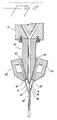
- Fig. 1 generally includes a spinning solution manifold 10 with its spinning solution supply pipe 12 connected thereto and a spinneret body 14 attached to the manifold.
- Spinneret apertures 16 are linearly arranged in accordance with Figs. 5 and 6 wherein apertures 16 are arranged in rows across face 15 of spinneret body 14 and the positions of the apertures in each row are staggered so as to provide a warp 20 of uniformly spaced filaments 22 when coagulated and condensed below the spinneret.
- Two linear jet bodies 30, 32 are located on opposite sides of the spinneret body and are supplied with coagulating liquid by means of supply pipe 34.
- a filament warp direction-changing guide 38 is located above liquid-collecting tank 39.
- a means for forwarding the warp of filaments, such as by a rotating spool, is designated by the element 40.
- jet bodies 30 and 32 are opposed to each other, are mounted at opposite sides of spinneret body 14 and parallel with the array of apertures 16, and can be insulated from the spinneret body by insulation panels 27 and 29.
- the jet bodies are capable of delivering sheets of coagulating liquid 31 and 33 from jet slots 35 and 37 to impinge at common line 21 across the warp 20 of filaments.
- the jet bodies 30 and 32 are directed such that extensions of the slots 35 and 37 meet at common line 21 vertically beneath the face 15 of the spinneret.
- the jet bodies 30 and 32 supply linear, substantially laminar flow, sheets of liquid 31 and 33.
- substantially laminar flow is meant that the sheets of liquid are transparent to the eye.
- the sheets of coagulating liquid are wider than warp 20 at line 21.
- the jet bodies 30 and 32 need not be mounted in direct juxtaposition with the spinneret body 14; but can be affixed to the apparatus separate from the spinneret body.
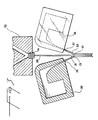
- the angle formed between the jetted sheet of liquid 31 or 33 and the warp 20 is often larger than the angle formed in the arrangement of Fig. 2.
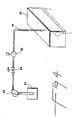
- the coagulating liquid is supplied to a jet body 30 from a source 50 by means of pump 52 through control valve 54 and flow meter 56, all connected serially to pipe 34 supplying the jet body.
- the velocity of the jetted sheets can be varied by altering the operation of pump 52, by changing the setting of control valve 54, and by varying the thickness of jet slots 35 and 37.
- an acid solution of para-aromatic polyamide is extruded through apertures 16 in spinneret 14 as filaments to form a vertical warp 20.
- the warp 20 is passed through an air gap 13 and is then coagulated by jetting two opposed transparent sheets of liquid 31, 33 toward the warp to meet at common line 21 across the warp.
- the liquid flows downwardly with the filaments and is separated from the filaments and caught in container 39 as the filaments change direction around guide 38.
- the filaments are then forwarded by means of element 40.
- the length of the air gap is not necessarily critical to operation of this invention, the preferred air gap is 1 to 3 cm and can range from 0.5 to 7 or, perhaps, slightly more at the highest spinning speeds.
- the preferred coagulating liquids are aqueous, either water alone or water containing minor amounts of sulfuric acid.
- the coagulating liquid is usually at an initial temperature of less than 25°C, often less than 10°C, and preferably no higher than 5°.
- the spinning solution is often at a temperature above 20°C and usually is about 80°C.
- a preferred spinning solution is one that contains poly(p-phenylene terephthalamide).
- Other examples of appropriate aromatic polyamides or copolyamides are described in U.S. 3,767,756.
- the array of apertures in the spinneret plate is preferably in a single row or a few rows, and are preferably less than six rows and not more than ten.
- the warp is usually divided into at least two sections with jetted sheets of coagulating liquid impinging each section.
- the filaments can be more effectively gathered into yarn.
- Each section of a warp can be impinged by an individual pair of jetted sheets or all of the sections in a warp can be coagulated by a single pair of jetted sheets which sheets can, generally, be separated with a portion following each section.
- spinnerets generally, have capillaries of 0.05 to 0.075mm in diameter and the rows of capillaries are, generally, spaced apart 0.5 to 1.5mm.
- the different spinnerets were used with different coagulating jet configurations to demonstrate several embodiments of the invention.
- a pair of coagulating jet bodies were mounted adjacent to and somewhat beneath the face of the spinneret. That configuration is shown in Fig. 3. Due to the bulk of the coagulating jet bodies, the included angle for the line of impingement was 45° and the air gap was about 3.8 to 4.4cm. The included angle is that angle made by the jetted sheets 31 and 33 (or the extension of slots 35 and 37) at common line 21 and the air gap is the distance from the face of spinneret 14 to the common line of impingement 21.
- Tenacity was the yarn property which was used as a measurement of fiber quality for demonstration of the present invention. It would be expected that fibers of high tenacity would exhibit correspondingly high qualities in other areas.
- Twist multiplier is defined as equal to the quantity [(twists/inch)(denier of yarn) 1/2 /73].
- the results of tests on five yarns were averaged.
- the rate of elongation was 10 percent per minute and load-elongation curves were plotted from a tensile testing machine. Denier of the yarn was determined by weighing a known length. Tenacity was obtained from the load-elongation curve and the calculated denier.
- Poly(p-phenylene terephthalamide) was dissolved in 100.1% sulfuric acid to yield a 19.4%, by weight, spinning solution.
- the solution was spun at about 80°C through Spinneret A with the coagulating jets of Design 1. After an air gap of about 3.8cm, the spun filaments met with the opposed jets of coagulating liquid at the line of impingement and, immersed in the jetted coagulating liquid, were conducted past a change of direction pin and to a forwarding roll.
- the jetted coagulating liquid was, also, 3% sulfuric acid and was maintained at a temperature of about 3°C.
- the width of the jets was about 7.6cm and, for this example, the thickness of the jet slots was set at about 0.076mm.
- Spinning was conducted at three speeds using three different speeds for the jetted sheets. Results are shown in Table I.
- Example 1 the spinning solution of Example 1 was spun at about 80 to 85°C through Spinneret B with the coagulating jet bodies of Design 2. After an air gap of about 1.27cm, the spun filaments met with the opposed jets of coagulating liquid at the line of impingement and, immersed in the jetted coagulating liquid, were conducted past a change of direction pin and to a take-up spool.
- the jetted coagulating liquid was 3% sulfuric acid and was maintained at a temperature of about 3°C.
- the width of the jets was about 5.1cm and, for this example, the thickness of the jet slots was set at about 0.127mm.
- Spinning was conducted at two speeds using two different speeds for the jetted sheets. Results are shown in Table I. TABLE I EXAMPLE Spinning Speed (m/m) Jet Speed (m/m) Yarn Tenacity (gpd) 1 594 548 26.2 686 634 25.9 777 676 25.7 2 503 460 25.4 594 543 25.8 686 627 26.1 777 710 25.1* 3 594 574 27.2 686 663 27.2 594 574 27.3** *Backsplash reduced quality of fibers. **Run at 85°C spinning solution temp. The others run at 80°C.
- Example 3 the spinning solution of Example 1 was spun at about 85°C through Spinneret B with coagulating jet bodies of Design 2 as in Example 3.
- the thickness of the jetted sheets was varied in three runs wherein the spinning speed was maintained constant at 594 meters per minute (m/m).
- the jet velocity was set at 578m/m; but was reduced to 486m/m for the thickest jet sheet to avoid backsplash.
- Table II Note that the reduced jet speed resulted in slightly reduced tenacity.
- Example 1 the spinning solution of Example 1 was spun at about 80°C through Spinneret B with coagulating jet bodies of Design 1 and the length of the air gap was varied in three different runs.
- the spinning speed was set at 594m/m
- the jet velocity was set at 548m/m
- the jet slot thickness was set at 0.076mm. Results are shown in Table III. TABLE III Air gap (cm) Yarn Tenacity (gpd) 1.9 27.0 3.2 26.3 4.4 25.6
- Example 1 the spinning solution of Example 1 was spun at about 85°C through Spinneret B with coagulating jet bodies of Design 2 and the spinning speed, the jet velocity, and the jet slot thickness were varied in three runs. The air gap was maintained at about 1.3cm. The results are shown in Table IV. TABLE IV Spinning Speed (m/m) Jet Speed (m/m) Jet Slot Thickness (mm) Yarn Tenacity (gpd) 594 574 0.076 26.0 732 707 0.076 25.8 594 574 0.101 26.3
- Example 1 the spinning solution of Example 1 was spun at about 70 to 80°C through a spinneret similar to Spinneret B and modified slightly such that there were a total of three separate segments of four rows of 63 apertures all in a linear configuration. There were a total of 252 apertures for each segment and the segments were separated by a distance of about 2.5cm.
- the same spinning solution was spun through a radial spinneret having 767 apertures arranged in concentric circles within an outer circle of about 3.8cm and of a diameter to yield a yarn of 1150 denier.
- the solution was spun from the circular array of apertures into a coagulating tray/jet apparatus corresponding to Tray G shown in Fig. 1 of U.S. Patent 4,340,559.
- the spin tube had a diameter of about 7.6mm.
- the solution was spun through an air gap of about 0.65cm at four different spinning speeds with the ]ets of that apparatus increasing correspondingly. Results are shown in Table V and a graphic representation of the yarn tenacity as a function of the spinning speed is provided in Fig. 7.
- Fig. 7 clearly shows that the tenacity of fibers made by the present invention is substantially unchanged by increase in the spinning speed while the tenacity of fibers made by the indicated prior art process and apparatus is markedly reduced with increase in spinning speed.
- TABLE V Spinneret Type Spinning Speed (m/m) Jet Speed (m/m) Yarn Tenacity (gpd) Linear 320 309 25.4 Linear 457 441 25.8 Linear 594 574 25.8 Linear 732 707 25.7 Radial 320 491 25.5 Radial 457 670 24.0 Radial 594 851 23.2 Radial 732 1026 22.6
Landscapes
- Engineering & Computer Science (AREA)
- Textile Engineering (AREA)
- Mechanical Engineering (AREA)
- Chemical & Material Sciences (AREA)
- Chemical Kinetics & Catalysis (AREA)
- General Chemical & Material Sciences (AREA)
- Spinning Methods And Devices For Manufacturing Artificial Fibers (AREA)
- Artificial Filaments (AREA)
Priority Applications (1)
| Application Number | Priority Date | Filing Date | Title |
|---|---|---|---|
| AT89115979T ATE95847T1 (de) | 1988-08-30 | 1989-08-30 | Koagulationsverfahren fuer filamente. |
Applications Claiming Priority (2)
| Application Number | Priority Date | Filing Date | Title |
|---|---|---|---|
| US07/238,109 US4898704A (en) | 1988-08-30 | 1988-08-30 | Coagulating process for filaments |
| US238109 | 1988-08-30 |
Publications (3)
| Publication Number | Publication Date |
|---|---|
| EP0357017A2 true EP0357017A2 (fr) | 1990-03-07 |
| EP0357017A3 EP0357017A3 (en) | 1990-06-20 |
| EP0357017B1 EP0357017B1 (fr) | 1993-10-13 |
Family
ID=22896543
Family Applications (1)
| Application Number | Title | Priority Date | Filing Date |
|---|---|---|---|
| EP89115979A Expired - Lifetime EP0357017B1 (fr) | 1988-08-30 | 1989-08-30 | Procédé pour la coagulation de filaments |
Country Status (19)
| Country | Link |
|---|---|
| US (2) | US4898704A (fr) |
| EP (1) | EP0357017B1 (fr) |
| JP (1) | JPH02104710A (fr) |
| KR (1) | KR920006357B1 (fr) |
| CN (1) | CN1018268B (fr) |
| AR (1) | AR241813A1 (fr) |
| AT (1) | ATE95847T1 (fr) |
| AU (1) | AU613787B2 (fr) |
| BR (1) | BR8904338A (fr) |
| CA (1) | CA1331078C (fr) |
| DE (1) | DE68909868T2 (fr) |
| DK (1) | DK425089A (fr) |
| IL (1) | IL91461A0 (fr) |
| MX (1) | MX166561B (fr) |
| NZ (1) | NZ230453A (fr) |
| PT (1) | PT91585B (fr) |
| RU (1) | RU2041300C1 (fr) |
| TR (1) | TR24328A (fr) |
| ZA (1) | ZA896642B (fr) |
Cited By (6)
| Publication number | Priority date | Publication date | Assignee | Title |
|---|---|---|---|---|
| WO1993006266A1 (fr) * | 1991-09-17 | 1993-04-01 | Akzo Nv | Procede de traitement de fils avec un liquide |
| WO1994024345A1 (fr) * | 1993-04-19 | 1994-10-27 | E.I. Du Pont De Nemours And Company | Fibres en ppd-t presentant une resistance a l'etirement |
| WO1997023669A1 (fr) * | 1995-12-21 | 1997-07-03 | Courtaulds Fibres (Holdings) Limited | Filaments et fibres |
| WO1998018984A1 (fr) * | 1996-10-25 | 1998-05-07 | E.I. Du Pont De Nemours And Company | Procede de fabrication de fibres aramide haute tenacite |
| US5853640A (en) * | 1997-10-14 | 1998-12-29 | E. I. Du Pont De Nemours And Company | Process for making high tenacity aramid fibers |
| RU2250941C2 (ru) * | 2000-05-12 | 2005-04-27 | Циммер Акциенгезельшафт | Способ и устройство для транспортировки без натяжения бесконечных формуемых тел |
Families Citing this family (12)
| Publication number | Priority date | Publication date | Assignee | Title |
|---|---|---|---|---|
| US5366362A (en) * | 1989-12-22 | 1994-11-22 | The United States Of America As Represented By The Secretary Of The Air Froce | Apparatus for extruding a single aromatic heterocyclic polymeric fiber |
| ATA239194A (de) * | 1994-12-22 | 1996-02-15 | Chemiefaser Lenzing Ag | Vorrichtung zur durchführung eines trocken-/nassspinnverfahrens |
| US5984655A (en) * | 1994-12-22 | 1999-11-16 | Lenzing Aktiengesellschaft | Spinning process and apparatus |
| DE69824555T2 (de) * | 1997-02-27 | 2005-06-30 | Asahi Kasei Kabushiki Kaisha | Kontinuierlich geformte artikel aus polyurethanharnstoff und verfahren zu seiner herstellung |
| DE10037922A1 (de) * | 2000-08-03 | 2002-02-28 | Zimmer Ag | Verfahren und Vorrichtung zum Extrudieren eines Endlosformkörpers |
| JP4658194B2 (ja) * | 2005-07-06 | 2011-03-23 | コーロン インダストリーズ インク | 全芳香族ポリアミドフィラメントの製造方法 |
| TWI310414B (en) * | 2007-01-09 | 2009-06-01 | Oriental Inst Technology | Dna falsity-proof fiber and manufacturing method thereof |
| WO2009145446A1 (fr) | 2008-03-31 | 2009-12-03 | Kolon Industries, Inc. | Fibre de para-aramide et son procédé de fabrication |
| EP2321452B8 (fr) | 2008-08-29 | 2012-04-11 | Teijin Aramid B.V. | Processus de production d'une pluralité de filaments en polyamide aromatique à haute résistance et à haut module élastique |
| US9752256B2 (en) | 2014-07-31 | 2017-09-05 | E I Du Pont De Nemours And Company | Process for making a yarn having improved strength retention and yarn made thereby |
| JP7472550B2 (ja) * | 2020-03-05 | 2024-04-23 | 東レ株式会社 | 溶液紡糸口金 |
| CN114921861A (zh) * | 2020-12-22 | 2022-08-19 | 南通新帝克单丝科技股份有限公司 | 一种性能优异的高dpf聚酯工业丝 |
Family Cites Families (12)
| Publication number | Priority date | Publication date | Assignee | Title |
|---|---|---|---|---|
| US2324397A (en) * | 1941-06-04 | 1943-07-13 | Du Pont | Method for production of continuous structures |
| US3061402A (en) * | 1960-11-15 | 1962-10-30 | Dow Chemical Co | Wet spinning synthetic fibers |
| US3767756A (en) * | 1972-06-30 | 1973-10-23 | Du Pont | Dry jet wet spinning process |
| US3833438A (en) * | 1972-08-30 | 1974-09-03 | Asahi Chemical Ind | Process for the manufacture of a non-woven web of continuous filaments through the wet stretch spinning method |
| SU621457A1 (ru) * | 1976-02-26 | 1978-08-30 | Сибирский Металлургический Институт Имени Серго Орджоникидзе | Устройство дл распылени металлических расплавов |
| JPS609124B2 (ja) * | 1977-07-29 | 1985-03-08 | 東レ株式会社 | 繊維状物の湿式製造法 |
| US4298565A (en) * | 1980-02-12 | 1981-11-03 | E. I. Du Pont De Nemours And Company | Spinning process |
| US4340559A (en) * | 1980-10-31 | 1982-07-20 | E. I. Du Pont De Nemours And Company | Spinning process |
| NL8402192A (nl) * | 1984-07-11 | 1986-02-03 | Akzo Nv | Werkwijze voor het vervaardigen van draden uit aromatische polyamiden. |
| US4869860A (en) * | 1984-08-09 | 1989-09-26 | E. I. Du Pont De Nemours And Company | Spinning process for aromatic polyamide filaments |
| JPS61102413A (ja) * | 1984-10-19 | 1986-05-21 | Asahi Chem Ind Co Ltd | ポリ−パラフエニレンテレフタルアミド系繊維の製造方法 |
| JPS6297913A (ja) * | 1985-10-22 | 1987-05-07 | Asahi Chem Ind Co Ltd | ポリ−パラフエニレンテレフタルアミド系繊維の製造方法 |
-
1988
- 1988-08-30 US US07/238,109 patent/US4898704A/en not_active Expired - Lifetime
-
1989
- 1989-06-21 US US07/369,451 patent/US4971539A/en not_active Expired - Lifetime
- 1989-08-23 CA CA000609096A patent/CA1331078C/fr not_active Expired - Lifetime
- 1989-08-28 NZ NZ230453A patent/NZ230453A/en unknown
- 1989-08-29 DK DK425089A patent/DK425089A/da unknown
- 1989-08-29 MX MX017339A patent/MX166561B/es unknown
- 1989-08-29 TR TR89/0683A patent/TR24328A/xx unknown
- 1989-08-29 BR BR898904338A patent/BR8904338A/pt not_active IP Right Cessation
- 1989-08-29 AR AR89314781A patent/AR241813A1/es active
- 1989-08-29 RU SU894614979A patent/RU2041300C1/ru not_active IP Right Cessation
- 1989-08-29 AU AU40850/89A patent/AU613787B2/en not_active Expired
- 1989-08-29 IL IL91461A patent/IL91461A0/xx not_active IP Right Cessation
- 1989-08-30 DE DE68909868T patent/DE68909868T2/de not_active Expired - Lifetime
- 1989-08-30 PT PT91585A patent/PT91585B/pt not_active IP Right Cessation
- 1989-08-30 AT AT89115979T patent/ATE95847T1/de not_active IP Right Cessation
- 1989-08-30 JP JP1221845A patent/JPH02104710A/ja active Granted
- 1989-08-30 ZA ZA896642A patent/ZA896642B/xx unknown
- 1989-08-30 CN CN89106987A patent/CN1018268B/zh not_active Expired
- 1989-08-30 EP EP89115979A patent/EP0357017B1/fr not_active Expired - Lifetime
- 1989-08-30 KR KR1019890012376A patent/KR920006357B1/ko not_active Expired
Cited By (6)
| Publication number | Priority date | Publication date | Assignee | Title |
|---|---|---|---|---|
| WO1993006266A1 (fr) * | 1991-09-17 | 1993-04-01 | Akzo Nv | Procede de traitement de fils avec un liquide |
| WO1994024345A1 (fr) * | 1993-04-19 | 1994-10-27 | E.I. Du Pont De Nemours And Company | Fibres en ppd-t presentant une resistance a l'etirement |
| WO1997023669A1 (fr) * | 1995-12-21 | 1997-07-03 | Courtaulds Fibres (Holdings) Limited | Filaments et fibres |
| WO1998018984A1 (fr) * | 1996-10-25 | 1998-05-07 | E.I. Du Pont De Nemours And Company | Procede de fabrication de fibres aramide haute tenacite |
| US5853640A (en) * | 1997-10-14 | 1998-12-29 | E. I. Du Pont De Nemours And Company | Process for making high tenacity aramid fibers |
| RU2250941C2 (ru) * | 2000-05-12 | 2005-04-27 | Циммер Акциенгезельшафт | Способ и устройство для транспортировки без натяжения бесконечных формуемых тел |
Also Published As
| Publication number | Publication date |
|---|---|
| JPH02104710A (ja) | 1990-04-17 |
| EP0357017B1 (fr) | 1993-10-13 |
| KR920006357B1 (ko) | 1992-08-03 |
| AU613787B2 (en) | 1991-08-08 |
| BR8904338A (pt) | 1990-04-17 |
| ATE95847T1 (de) | 1993-10-15 |
| AR241813A1 (es) | 1992-12-30 |
| IL91461A0 (en) | 1990-04-29 |
| CA1331078C (fr) | 1994-08-02 |
| NZ230453A (en) | 1990-12-21 |
| EP0357017A3 (en) | 1990-06-20 |
| AU4085089A (en) | 1990-03-08 |
| US4898704A (en) | 1990-02-06 |
| PT91585B (pt) | 1995-05-31 |
| MX166561B (es) | 1993-01-18 |
| DE68909868T2 (de) | 1994-05-19 |
| JPH0359161B2 (fr) | 1991-09-09 |
| KR900003436A (ko) | 1990-03-26 |
| DE68909868D1 (de) | 1993-11-18 |
| CN1018268B (zh) | 1992-09-16 |
| PT91585A (pt) | 1990-03-08 |
| CN1040637A (zh) | 1990-03-21 |
| DK425089D0 (da) | 1989-08-29 |
| TR24328A (tr) | 1991-09-13 |
| DK425089A (da) | 1990-03-01 |
| RU2041300C1 (ru) | 1995-08-09 |
| US4971539A (en) | 1990-11-20 |
| ZA896642B (en) | 1991-04-24 |
Similar Documents
| Publication | Publication Date | Title |
|---|---|---|
| EP0357017B1 (fr) | Procédé pour la coagulation de filaments | |
| US4869860A (en) | Spinning process for aromatic polyamide filaments | |
| US4298565A (en) | Spinning process | |
| US4078034A (en) | Air gage spinning process | |
| US3716317A (en) | Pack for spinning heterofilament fibers | |
| EP0244217B2 (fr) | Procédé et dispositif | |
| EP0051265A1 (fr) | Procédé pour le filage de filaments en polyamide aromatique | |
| KR100431679B1 (ko) | 고강도 아라미드 섬유의 제조 방법 | |
| EP0168879B1 (fr) | Procédé de fabrication de filaments de polyamides aromatiques | |
| US2957747A (en) | Process for producing crimpable polyamide filaments | |
| WO1998018984A9 (fr) | Procede de fabrication de fibres aramide haute tenacite | |
| CA1284567C (fr) | Methode et dispositif pour la production de files de polypropylene | |
| EP0245011B1 (fr) | Filaments uniformes de polymères | |
| EP0449197B1 (fr) | Procédé pour le filage de fibres de polyamides aromatiques ayant une haute tenacité et un haut module | |
| US4619803A (en) | Self-texturing nylon yarn spinning process | |
| US5853640A (en) | Process for making high tenacity aramid fibers | |
| IE902168L (en) | Coagulating process for filaments |
Legal Events
| Date | Code | Title | Description |
|---|---|---|---|
| PUAI | Public reference made under article 153(3) epc to a published international application that has entered the european phase |
Free format text: ORIGINAL CODE: 0009012 |
|
| AK | Designated contracting states |
Kind code of ref document: A2 Designated state(s): AT BE CH DE ES FR GB GR IT LI LU NL SE |
|
| PUAL | Search report despatched |
Free format text: ORIGINAL CODE: 0009013 |
|
| AK | Designated contracting states |
Kind code of ref document: A3 Designated state(s): AT BE CH DE ES FR GB GR IT LI LU NL SE |
|
| 17P | Request for examination filed |
Effective date: 19901219 |
|
| 17Q | First examination report despatched |
Effective date: 19921207 |
|
| GRAA | (expected) grant |
Free format text: ORIGINAL CODE: 0009210 |
|
| AK | Designated contracting states |
Kind code of ref document: B1 Designated state(s): AT BE CH DE ES FR GB GR IT LI LU NL SE |
|
| PG25 | Lapsed in a contracting state [announced via postgrant information from national office to epo] |
Ref country code: GR Free format text: LAPSE BECAUSE OF FAILURE TO SUBMIT A TRANSLATION OF THE DESCRIPTION OR TO PAY THE FEE WITHIN THE PRESCRIBED TIME-LIMIT Effective date: 19931013 Ref country code: ES Free format text: THE PATENT HAS BEEN ANNULLED BY A DECISION OF A NATIONAL AUTHORITY Effective date: 19931013 Ref country code: SE Effective date: 19931013 Ref country code: AT Effective date: 19931013 Ref country code: BE Effective date: 19931013 |
|
| REF | Corresponds to: |
Ref document number: 95847 Country of ref document: AT Date of ref document: 19931015 Kind code of ref document: T |
|
| REF | Corresponds to: |
Ref document number: 68909868 Country of ref document: DE Date of ref document: 19931118 |
|
| ITF | It: translation for a ep patent filed | ||
| ET | Fr: translation filed | ||
| PLBE | No opposition filed within time limit |
Free format text: ORIGINAL CODE: 0009261 |
|
| STAA | Information on the status of an ep patent application or granted ep patent |
Free format text: STATUS: NO OPPOSITION FILED WITHIN TIME LIMIT |
|
| PG25 | Lapsed in a contracting state [announced via postgrant information from national office to epo] |
Ref country code: LI Effective date: 19940831 Ref country code: LU Free format text: LAPSE BECAUSE OF NON-PAYMENT OF DUE FEES Effective date: 19940831 Ref country code: CH Effective date: 19940831 |
|
| 26N | No opposition filed | ||
| REG | Reference to a national code |
Ref country code: CH Ref legal event code: PL |
|
| REG | Reference to a national code |
Ref country code: GB Ref legal event code: IF02 |
|
| PGFP | Annual fee paid to national office [announced via postgrant information from national office to epo] |
Ref country code: NL Payment date: 20080803 Year of fee payment: 20 Ref country code: DE Payment date: 20080912 Year of fee payment: 20 |
|
| PGFP | Annual fee paid to national office [announced via postgrant information from national office to epo] |
Ref country code: IT Payment date: 20080827 Year of fee payment: 20 Ref country code: FR Payment date: 20080818 Year of fee payment: 20 |
|
| PGFP | Annual fee paid to national office [announced via postgrant information from national office to epo] |
Ref country code: GB Payment date: 20080903 Year of fee payment: 20 |
|
| REG | Reference to a national code |
Ref country code: GB Ref legal event code: PE20 Expiry date: 20090829 |
|
| NLV7 | Nl: ceased due to reaching the maximum lifetime of a patent |
Effective date: 20090830 |
|
| PG25 | Lapsed in a contracting state [announced via postgrant information from national office to epo] |
Ref country code: GB Free format text: LAPSE BECAUSE OF EXPIRATION OF PROTECTION Effective date: 20090829 Ref country code: NL Free format text: LAPSE BECAUSE OF EXPIRATION OF PROTECTION Effective date: 20090830 |