EP0357148B1 - Méthode et appareil pour séparer les isotopes - Google Patents
Méthode et appareil pour séparer les isotopes Download PDFInfo
- Publication number
- EP0357148B1 EP0357148B1 EP89202200A EP89202200A EP0357148B1 EP 0357148 B1 EP0357148 B1 EP 0357148B1 EP 89202200 A EP89202200 A EP 89202200A EP 89202200 A EP89202200 A EP 89202200A EP 0357148 B1 EP0357148 B1 EP 0357148B1
- Authority
- EP
- European Patent Office
- Prior art keywords
- laser
- raman
- molecules
- pulses
- pulse
- Prior art date
- Legal status (The legal status is an assumption and is not a legal conclusion. Google has not performed a legal analysis and makes no representation as to the accuracy of the status listed.)
- Expired - Lifetime
Links
- 238000000034 method Methods 0.000 title claims description 30
- 238000001069 Raman spectroscopy Methods 0.000 claims description 24
- 238000006243 chemical reaction Methods 0.000 claims description 20
- 230000005855 radiation Effects 0.000 claims description 10
- 230000007704 transition Effects 0.000 claims description 7
- UFHFLCQGNIYNRP-UHFFFAOYSA-N Hydrogen Chemical compound [H][H] UFHFLCQGNIYNRP-UHFFFAOYSA-N 0.000 claims description 4
- 150000001875 compounds Chemical class 0.000 claims description 4
- 230000004044 response Effects 0.000 claims description 4
- 238000001228 spectrum Methods 0.000 claims description 4
- 230000005284 excitation Effects 0.000 description 14
- 230000008569 process Effects 0.000 description 10
- 239000007789 gas Substances 0.000 description 8
- SANRKQGLYCLAFE-UHFFFAOYSA-H uranium hexafluoride Chemical compound F[U](F)(F)(F)(F)F SANRKQGLYCLAFE-UHFFFAOYSA-H 0.000 description 7
- 229910052770 Uranium Inorganic materials 0.000 description 5
- JFALSRSLKYAFGM-UHFFFAOYSA-N uranium(0) Chemical compound [U] JFALSRSLKYAFGM-UHFFFAOYSA-N 0.000 description 5
- 230000008901 benefit Effects 0.000 description 4
- 238000000926 separation method Methods 0.000 description 3
- 239000012159 carrier gas Substances 0.000 description 2
- 239000013078 crystal Substances 0.000 description 2
- 238000010494 dissociation reaction Methods 0.000 description 2
- 230000005593 dissociations Effects 0.000 description 2
- 230000000694 effects Effects 0.000 description 2
- 238000010521 absorption reaction Methods 0.000 description 1
- XKRFYHLGVUSROY-UHFFFAOYSA-N argon Substances [Ar] XKRFYHLGVUSROY-UHFFFAOYSA-N 0.000 description 1
- 229910052786 argon Inorganic materials 0.000 description 1
- 229910052732 germanium Inorganic materials 0.000 description 1
- GNPVGFCGXDBREM-UHFFFAOYSA-N germanium atom Chemical compound [Ge] GNPVGFCGXDBREM-UHFFFAOYSA-N 0.000 description 1
- 150000002431 hydrogen Chemical class 0.000 description 1
- 239000001257 hydrogen Substances 0.000 description 1
- 229910052739 hydrogen Inorganic materials 0.000 description 1
- 230000006872 improvement Effects 0.000 description 1
- 230000003993 interaction Effects 0.000 description 1
- 238000004519 manufacturing process Methods 0.000 description 1
- 239000000463 material Substances 0.000 description 1
- 229910052756 noble gas Inorganic materials 0.000 description 1
- 230000003287 optical effect Effects 0.000 description 1
- 230000010355 oscillation Effects 0.000 description 1
- 239000002699 waste material Substances 0.000 description 1
Images
Classifications
-
- B—PERFORMING OPERATIONS; TRANSPORTING
- B01—PHYSICAL OR CHEMICAL PROCESSES OR APPARATUS IN GENERAL
- B01D—SEPARATION
- B01D59/00—Separation of different isotopes of the same chemical element
- B01D59/34—Separation by photochemical methods
Definitions
- This invention relates to a method of separating isotopes of an element, which comprises bringing a gaseous compound of the element into a condition in which the molecules of the compound are in one well-defined vibrational state, and selectively exciting the molecules containing the pre-determined isotope by means of a radiation, and further exciting, and/or directly dissociating, said selectively excited molecules by means of at least a second radiation, using as at least one source of radiation a Raman cell, in which two laser beams are converted using so-called "four-wave mixing", of which two laser beams one has an energy sufficiently high for Raman conversion.
- the invention further relates to apparatus for the application of the method. A method and apparatus of this kind are disclosed in the article in Il Nuovo Cimento, Vol.
- the molecules of the gas, uranium hexafluoride, consist as to 0.7% of 235UF6 and as to 99.3% of 238UF6. Owing to the difference in mass between the two isotopes, there is a difference in frequency of internal vibration modi in molecules containing either the one or the other isotope; this is a so-called isotope shift. Now, by shining (laser) light of a suitable wavelength on to the gas, it is possible to selectively excite molecules containing one isotope (in practice always 235UF6) into a vibration mode whose frequency exactly matches that of the laser light, whereas molecules containing the other isotope are excited with a much lower probability, if at all.
- laser laser
- the wavelength suitable therefor is in the infrared at about 15.92 ⁇ m.
- the selectively excited molecules should subsequently be removed from the gas or the gas stream in which they are contained, before there is actual separation or enrichment. This is effected in a next step or steps, in which the molecules are excited further to such a high vibration mode that the molecule becomes unstable and disintegrates or dissociates. Further excitation can again be effected by means of laser radiation.
- the first source of radiation needed to effect the first selective excitation of the UF6 is a so-called Raman shifter.
- This is a cell filled with, in this case, hydrogen, into which the light from a CO2 laser ( ⁇ 10.178 ⁇ m) is sent.
- the material system here the hydrogen gas, therefore
- the light from the CO2 laser is converted into light having the desired wavelength of 15.92 ⁇ m. This process is called Stimulated Raman Scattering.
- ⁇ 10 ⁇ ⁇ 16 ⁇ 0-2
- ⁇ 0-2 is the frequency of a rotational transition in the hydrogen molecule which takes place during the scattering process.
- This rotational transition of the molecule characterized by rotational quantum numbers of 0 and 2
- a certain minimum intensity is required for the pump beam ⁇ 1.
- beam 1 (freqency ⁇ 1) has such a low intensity that there is hardly, if at all, any Raman conversion, for the high intensity required for conversion can hardly, if at all be achieved, because rather high requirements must be imposed upon the frequency ⁇ 1s (for the selective excitation) and hence upon the frequency ⁇ 1 of the CO2 laser, (which could mean, for example, that a large number of optical elements, each by itself giving a loss, must be disposed in the CO2 laser oscillation cavity).
- beam 1 can begin to convert as well.
- the efficiency with which beam 1 is converted is virtually equal to that of beam 2
- the resulting beams (frequencies ⁇ 1S , ⁇ 2S ) are thereafter used for selective first excitation ( ⁇ 1S ) and subsequent excitation ( ⁇ 2S ).
- a relatively simple CO2 laser e.g., of the TEA type can be used here.
- a further object is to provide apparatus by means of which the method according to the invention can be used, more particularly for the separation of uranium isotopes.
- the object contemplated is achieved, according to the invention, by a method which comprises using two laser beams for the four-wave mixing process, one of which is a high-energy beam consisting of a train of very short pulses, the distance between successive pulses being selected so short, and hence the repetition frequency so high, that the response of the medium in the Raman cell is not yet finished when the next pulse arrives.
- the apparatus according to the invention is suitable for the separation of uranium isotopes, which, as conventional, comprises a first and a second CO2 laser, the exit beams of which are directed to a para-hydrogen Raman cell disposed behind the CO2 lasers, in which Raman cell the laser beams are brought to "four-wave mixing" in operation, is charactezized in that in one of the CO2 lasers, which is high-intensity laser, a so-called “mode locker” is arranged.
- the method according to the invention comprises in essence the combination of the four-wave mixing process and the use of a high-energy laser beam, the beam of which consists of a train of very short pulses.
- the high-intensity laser always provides only a short pulse (from the pulse train) in the Raman medium. It would be expected that the field of such a short pulse is not present long enough and cannot be active long enough to proceed to efficient conversion. If, however, the distance between successive pulses is selected so short, and hence the repetition frequency so high, that the response of the medium is not yet finished when the next pulse arrives, conversion turns out to be possible after all, and is found to be highly efficient at that, even more efficient than of a long pulse with the same energy content. In view of the higher gain, the conversion by Raman shift of a high-energy CO2 beam ( ⁇ 2) consisting of a train of very short pulses, has a lower threshold value and accordingly can take place at a lower average power.
- the advantage is that a smaller CO2 laser may be used.
- a smaller tunable CO2 laser ( ⁇ 1) which converts by four-wave mixing.
- four-wave mixing conversion can proceed normally, even in the time between the pulses ⁇ 2 when the high-intensity laser is "off", as the medium has a certain finite response time. It is thus achieved that the threshold value for the high intensity laser is reduced, and also the four-wave mixing conversion of the lower-intensity laser continues.
- Another advantage of the method according to the invention is that a train of very high-intensity pulses is generated at frequency ⁇ 2s .
- this train of pulses can now be used to effect the higher excitation of the once-excited 235UF6 molecules.
- this is a multi-step, multi-photon process, the intensity dependency of the efficiency of the process is much stronger than linear.
- MPE multi-photon excitation
- the efficiency can be enhanced further by a suitable selection of the pulse repetition frequency.
- This is based upon the fact that the spectrum of a train of short pulses consists of a number of discrete frequencies spaced apart a distance of 1/ ⁇ t, with ⁇ t being the pulse repetition period, i.e. the period from the beginning of a pulse in the train to the beginning of the next pulse.
- the frequency spectrum can be so adapted that the MPD or MPE is multi-resonant, i.e., that various frequency components exactly match a transition in the UF6.
- the Fourier spectrum of the pulses in the pulse train is so selected that one or more Fourier components is resonant with one ore more transitions of the selectively excited molecules.
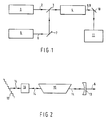
- Fig. 1 schematically shows one embodiment of the apparatus according to this invention.
- the beam 2 is directed through a partially transmitting mirror 3 at the Raman parahydrogen cell 4.
- the apparatus further comprises CO2 laser 5, providing a laser beam 6, consisting of a series of high-energy, very short pulses with a wavelength of, for example, 10.2 ⁇ m.
- the beam 6 is also directed to the Raman cell 4 through a mirror 7 and mirror 3.
- Beams 8 and 9 are directed via a mirror 10 to the enrichment plant 11. Beam 8 has obtained the desired wavelength of 15.92 ⁇ m, suitable for selectively exciting 235UF6. Beam 9, which consists of a train of pulses (it is the converted beam 6) has, for example, a wavelength of about 16 ⁇ m, suitable for further excitation to dissociation of the selectively excited 235UF6. The further excitation can of course also be realized otherwise.
- the selective excitation of the 235UF6 in the uranium hexafluoride in plant 11 requires that the molecules are all in one well-defined state of vibration. This is achieved, for example, by allowing the molecules to expand in a gas expansion through a nozzle together with a carrier gas (for example, a noble gas). The temperature in the expansion is then rapidly reduced and it is thus achieved that all molecules are in the ground vibration state. When this is omitted, and laser beam 8 is shone direct into, for example, a vessel containing gas at room temperature, there can be no selective excitation, as in that case molecules already thermally excited will also begin to absorb with slightly shifted absorption frequency, including molecules containing the heavy isotope 238 u .
- a carrier gas for example, a noble gas
- the CO2 laser 5 of the embodiment of Fig. 1 is shown schematically in more detail.
- Laser 5 which is productive of a beam built up from a train of short high-energy pulses, comprises a grating 12 and an exit mirror 13, between which a beam 14 is reflected, which beam is intensified during its passage through the intensifying medium 15. All this is conventional for a CO2 laser.
- a mode locker 16 Further included in laser 5 is a mode locker 16.
- Mode locker 16 may for example consist of a radio-frequency source plus intensifier with a total output power of 25 W.
- This power is supplied through a (piezoelectric) transducer mounted on a germanium (Ge) crystal in the laser cavity.
- a (piezoelectric) transducer mounted on a germanium (Ge) crystal in the laser cavity.
- the variations in index of refraction generated by the variations in density operate as a grating for the CO2 light, which is scattered by it. It is only at moments when the variations are zero (i.e., the zero passages of the sinusoidal drive) that no scattering takes place. In this way, a pulsed output is obtained with a repetition time equal to the circulation time of the light in the laser resonator.
- the radio frequency source should therefore be operated at half the repetition frequency.
- the mode-locked CO2 laser had an output beam with a repetition frequency of 100 MHz.
- the pulse width was 1-2 ns and the peak intensity 10 MW.
- the pulse energy was 5 mJ.
- the CO2 laser transition was 10 R (18) with a frequency of 974.6 cm ⁇ 1.
- the peak intensity was 100 MW and the pulse energy 50 mJ.
- the total energy in the laser pulse was 3J.
- a selective excitation frequency of 628.3 cm ⁇ 1 was used and a subsequent excitation frequency of 620.3 cm ⁇ 1.
- the gas temperature was maintained at 70 ⁇ 20 K and the total gas pressure of UF6 and the carrier gas, consisting of-argon, at 0.01 at.
- the advantage of the method and apparatus according to the invention is that a lower threshold intensity for conversion is achieved as it has been found that the threshold value for the conversion of a train of pulses is lower than for a more or less continuous, i.e., long pulse.
- a further advantage is that the multi-photon processes have a higher probability owing to the higher intensity peaks in the pulse train.
Landscapes
- Life Sciences & Earth Sciences (AREA)
- Biophysics (AREA)
- Chemical & Material Sciences (AREA)
- Chemical Kinetics & Catalysis (AREA)
- Lasers (AREA)
Claims (3)
- Procédé de séparation des isotopes d'un élément, qui comprend le placement d'un composé gazeux de l'élément dans des conditions dans lesquelles les molécules du composé sont dans un état de vibration bien défini, l'excitation sélective des molécules contenant l'isotope prédéterminé au moyen d'une radiation, et ensuite l'excitation et/ou la dissociation directe desdites molécules excitées sélectivement, au moyen d'au moins une deuxième radiation, en utilisant comme source de radiation au moins une cellule Raman, dans laquelle deux faisceaux laser sont convertis en recourant à ce que l'on appelle un "mélange de quatre ondes", un au moins desdits deux faisceaux laser possédant une énergie suffisamment élevée pour la conversion Raman, caractérisé en ce que ce dernier faisceau laser est un faisceau à haute énergie constitué d'un train d'impulsions très courtes, la distance entre impulsions successives étant choisie assez courte, et par conséquent la fréquence de répétition assez élevée, pour que là réaction du milieu dans la cellule Raman ne soit pas encore terminée quand l'impulsion suivante arrive.
- Procédé selon la revendication 1, caractérisé en ce que par ajustement approprié du temps de répétition de l'impulsion, le spectre de Fourier des impulsions dans le train d'impulsions est choisi de telle sorte qu'une ou plusieurs composantes de Fourier soient en résonance avec une ou plusieurs transitions des molécules excitées sélectivement.
- Appareil pour appliquer le procédé selon la revendication 1 ou 2, comprenant un premier et un deuxième laser à CO₂ dont les faisceaux de sortie sont dirigés vers une cellule Raman à para-hydrogène disposée derrière les lasers à CO₂, les faisceaux laser étant en fonctionnement portés en "mélange de quatre ondes" dans cette cellule de Raman, caractérisé en ce que dans un des lasers à CO₂, qui est un laser à haute intensité, est installé ce que l'on appelle un "verrouilleur de mode".
Applications Claiming Priority (2)
| Application Number | Priority Date | Filing Date | Title |
|---|---|---|---|
| NL8802160A NL8802160A (nl) | 1988-09-01 | 1988-09-01 | Werkwijze en inrichting voor het scheiden van isotopen. |
| NL8802160 | 1988-09-01 |
Publications (2)
| Publication Number | Publication Date |
|---|---|
| EP0357148A1 EP0357148A1 (fr) | 1990-03-07 |
| EP0357148B1 true EP0357148B1 (fr) | 1994-02-16 |
Family
ID=19852840
Family Applications (1)
| Application Number | Title | Priority Date | Filing Date |
|---|---|---|---|
| EP89202200A Expired - Lifetime EP0357148B1 (fr) | 1988-09-01 | 1989-08-31 | Méthode et appareil pour séparer les isotopes |
Country Status (5)
| Country | Link |
|---|---|
| US (1) | US5011584A (fr) |
| EP (1) | EP0357148B1 (fr) |
| JP (1) | JP2815412B2 (fr) |
| DE (1) | DE68913104T2 (fr) |
| NL (1) | NL8802160A (fr) |
Families Citing this family (5)
| Publication number | Priority date | Publication date | Assignee | Title |
|---|---|---|---|---|
| GB2256079B (en) * | 1991-05-24 | 1994-10-05 | Synergetic Resources Ltd | A simple high selectivity, high dissociation system for laser isotope separation |
| US5202005A (en) * | 1991-08-14 | 1993-04-13 | The United States Of America As Represented By The United States Department Of Energy | Gadolinium photoionization process |
| DE10336057B4 (de) * | 2003-08-01 | 2010-12-23 | Albrecht Dr. Lindinger | Verfahren, Vorrichtung und Computerprogramm zur Trennung von Molekülen mit unterschiedlichen Anregungsspektren |
| WO2012145733A1 (fr) | 2011-04-22 | 2012-10-26 | Vanderbilt University | Polariseur para-hydrogène |
| US11307129B2 (en) | 2020-03-23 | 2022-04-19 | Savannah River Nuclear Solutions, Llc | Automatic gas sorption apparatus and method |
Family Cites Families (8)
| Publication number | Priority date | Publication date | Assignee | Title |
|---|---|---|---|---|
| US4061921A (en) * | 1974-05-02 | 1977-12-06 | The United States Of America As Represented By The United States Energy Research & Development Administration | Infrared laser system |
| US4020350A (en) * | 1975-06-23 | 1977-04-26 | Massachusetts Institute Of Technology | Isotope selective excitation and separation method and apparatus utilizing circularly polarized pulsed radiation |
| US4188538A (en) * | 1977-03-30 | 1980-02-12 | University Of Southern California | Efficient particle excitation |
| FR2494596B1 (fr) * | 1977-10-12 | 1986-02-14 | Commissariat Energie Atomique | Procede optique d'excitation selective d'une variete isotopique d'un corps, dispositif de mise en oeuvre et application a la separation isotopique |
| US4297600A (en) * | 1978-06-19 | 1981-10-27 | Board Of Trustees Of Leland Stanford University | Multipath Raman cell for wavelength conversion |
| US4361770A (en) * | 1980-12-15 | 1982-11-30 | Exxon Research And Engineering Co. | Technique for synchronization of raman scattered radiation |
| US4493086A (en) * | 1982-05-20 | 1985-01-08 | Hughes Aircraft Company | Synchronously-pumped phase-conjugate laser |
| US4690742A (en) * | 1983-09-15 | 1987-09-01 | Board Of Regents, The University Of Texas System | Method and apparatus for laser isotope separation |
-
1988
- 1988-09-01 NL NL8802160A patent/NL8802160A/nl not_active Application Discontinuation
-
1989
- 1989-08-31 US US07/401,242 patent/US5011584A/en not_active Expired - Fee Related
- 1989-08-31 EP EP89202200A patent/EP0357148B1/fr not_active Expired - Lifetime
- 1989-08-31 DE DE68913104T patent/DE68913104T2/de not_active Expired - Fee Related
- 1989-09-01 JP JP1224757A patent/JP2815412B2/ja not_active Expired - Lifetime
Non-Patent Citations (1)
| Title |
|---|
| APPLIED PHYSICS LETTERS, vol. 39, no. 11, 01 December 1981; pp. 862-864# * |
Also Published As
| Publication number | Publication date |
|---|---|
| NL8802160A (nl) | 1990-04-02 |
| JPH02107316A (ja) | 1990-04-19 |
| US5011584A (en) | 1991-04-30 |
| DE68913104D1 (de) | 1994-03-24 |
| DE68913104T2 (de) | 1994-08-11 |
| EP0357148A1 (fr) | 1990-03-07 |
| JP2815412B2 (ja) | 1998-10-27 |
Similar Documents
| Publication | Publication Date | Title |
|---|---|---|
| Hartig et al. | A broadly tunable IR waveguide Raman laser pumped by a dye laser | |
| US4151486A (en) | Tunable alkali metallic vapor laser | |
| GB1573507A (en) | High mass isotope separation arrangement | |
| Grasiuk et al. | High-power tunable IR Raman lasers | |
| Gower et al. | Collisionless dissociation of SF6 using two resonant frequency CO2 laser fields | |
| EP0357148B1 (fr) | Méthode et appareil pour séparer les isotopes | |
| Ambartzumian et al. | Isotopically selective dissociation of CCl4 molecules by NH3 laser radiation | |
| Wallmeier et al. | Continuously tunable VUV radiation (129–210 nm) by anti-Stokes Raman scattering in cooled H2 | |
| US4577122A (en) | Method and apparatus for generation of coherent VUV and XUV radiation | |
| EP0012797B1 (fr) | Procédé et dispositif pour la production de radiation cohérente à 16 microns | |
| Cabaret et al. | High resolution spectroscopy of the hydrogen Lyman-α line Stark structure using a VUV single mode pulsed laser system | |
| US4690742A (en) | Method and apparatus for laser isotope separation | |
| US4120767A (en) | Photochemical method for carbon isotopic enrichment | |
| US4336230A (en) | Frequency chirp in isotopically selective photoexcitation | |
| Grasiuk | High-power tunable ir Raman and optically pumped molecular lasers for spectroscopy | |
| US4461686A (en) | Sequential multiphoton excitation method | |
| US5323413A (en) | Apparatus for the laser dissociation of molecules | |
| Grasiuk et al. | Molecular infrared lasers using resonant laser pumping | |
| US4628513A (en) | Tunable indium UV anti-Stokes Raman laser | |
| US4142955A (en) | Method for the initiation of chemical reactions by low pressure optical pumping | |
| US4202741A (en) | Enrichment of nitrogen isotopes by induced isomerization of isocyanides | |
| Ishii et al. | Identification of Excited Gerade States of Molecular Hydrogen with Extreme Ultraviolet‐Visible Double Resonance Excitation Technique | |
| Wang et al. | cw optically resonance pumped transfer laser in DF‐CO2 system | |
| Hirakawa et al. | Generation of coherent XUV radiation by two-photon resonant four-wave mixing combined with stimulated Raman scattering | |
| Ambartsumyan et al. | Isotopically selective dissociation of CCl4 molecules by highpower NH3 laser radiation |
Legal Events
| Date | Code | Title | Description |
|---|---|---|---|
| PUAI | Public reference made under article 153(3) epc to a published international application that has entered the european phase |
Free format text: ORIGINAL CODE: 0009012 |
|
| AK | Designated contracting states |
Kind code of ref document: A1 Designated state(s): DE GB NL |
|
| 17P | Request for examination filed |
Effective date: 19900808 |
|
| 17Q | First examination report despatched |
Effective date: 19920609 |
|
| GRAA | (expected) grant |
Free format text: ORIGINAL CODE: 0009210 |
|
| AK | Designated contracting states |
Kind code of ref document: B1 Designated state(s): DE GB NL |
|
| REF | Corresponds to: |
Ref document number: 68913104 Country of ref document: DE Date of ref document: 19940324 |
|
| PLBE | No opposition filed within time limit |
Free format text: ORIGINAL CODE: 0009261 |
|
| STAA | Information on the status of an ep patent application or granted ep patent |
Free format text: STATUS: NO OPPOSITION FILED WITHIN TIME LIMIT |
|
| 26N | No opposition filed | ||
| PGFP | Annual fee paid to national office [announced via postgrant information from national office to epo] |
Ref country code: GB Payment date: 19980824 Year of fee payment: 10 |
|
| PGFP | Annual fee paid to national office [announced via postgrant information from national office to epo] |
Ref country code: NL Payment date: 19980831 Year of fee payment: 10 |
|
| PGFP | Annual fee paid to national office [announced via postgrant information from national office to epo] |
Ref country code: DE Payment date: 19980923 Year of fee payment: 10 |
|
| PG25 | Lapsed in a contracting state [announced via postgrant information from national office to epo] |
Ref country code: GB Free format text: LAPSE BECAUSE OF NON-PAYMENT OF DUE FEES Effective date: 19990831 |
|
| PG25 | Lapsed in a contracting state [announced via postgrant information from national office to epo] |
Ref country code: NL Free format text: LAPSE BECAUSE OF NON-PAYMENT OF DUE FEES Effective date: 20000301 |
|
| GBPC | Gb: european patent ceased through non-payment of renewal fee |
Effective date: 19990831 |
|
| NLV4 | Nl: lapsed or anulled due to non-payment of the annual fee |
Effective date: 20000301 |
|
| PG25 | Lapsed in a contracting state [announced via postgrant information from national office to epo] |
Ref country code: DE Free format text: LAPSE BECAUSE OF NON-PAYMENT OF DUE FEES Effective date: 20000601 |