EP0357846A1 - Vorrichtung zum Erreichen von Harnkontinenz - Google Patents
Vorrichtung zum Erreichen von Harnkontinenz Download PDFInfo
- Publication number
- EP0357846A1 EP0357846A1 EP88308202A EP88308202A EP0357846A1 EP 0357846 A1 EP0357846 A1 EP 0357846A1 EP 88308202 A EP88308202 A EP 88308202A EP 88308202 A EP88308202 A EP 88308202A EP 0357846 A1 EP0357846 A1 EP 0357846A1
- Authority
- EP
- European Patent Office
- Prior art keywords
- membrane
- bolus
- bladder
- urethra
- valve
- Prior art date
- Legal status (The legal status is an assumption and is not a legal conclusion. Google has not performed a legal analysis and makes no representation as to the accuracy of the status listed.)
- Granted
Links
- 230000002485 urinary effect Effects 0.000 title claims abstract description 12
- 239000012528 membrane Substances 0.000 claims abstract description 108
- 210000003708 urethra Anatomy 0.000 claims abstract description 83
- 238000000034 method Methods 0.000 claims abstract description 43
- 230000005294 ferromagnetic effect Effects 0.000 claims abstract description 30
- 210000002700 urine Anatomy 0.000 claims abstract description 30
- 239000003302 ferromagnetic material Substances 0.000 claims abstract description 24
- 206010021639 Incontinence Diseases 0.000 claims abstract description 19
- 210000003932 urinary bladder Anatomy 0.000 claims description 140
- 239000012530 fluid Substances 0.000 claims description 33
- 206010046543 Urinary incontinence Diseases 0.000 claims description 18
- 239000000463 material Substances 0.000 claims description 13
- 239000007787 solid Substances 0.000 claims description 8
- 239000000560 biocompatible material Substances 0.000 claims description 5
- 229920002635 polyurethane Polymers 0.000 claims description 4
- 239000004814 polyurethane Substances 0.000 claims description 4
- 239000004215 Carbon black (E152) Substances 0.000 claims description 3
- 230000005484 gravity Effects 0.000 claims description 3
- 229930195733 hydrocarbon Natural products 0.000 claims description 3
- 150000002430 hydrocarbons Chemical class 0.000 claims description 3
- 230000005291 magnetic effect Effects 0.000 claims description 3
- 230000035699 permeability Effects 0.000 claims description 2
- 238000007789 sealing Methods 0.000 claims 4
- 230000035515 penetration Effects 0.000 claims 1
- 239000011800 void material Substances 0.000 abstract description 9
- 238000002513 implantation Methods 0.000 abstract description 8
- 238000003780 insertion Methods 0.000 description 23
- 230000037431 insertion Effects 0.000 description 23
- 210000003734 kidney Anatomy 0.000 description 10
- 210000005070 sphincter Anatomy 0.000 description 10
- 230000000451 tissue damage Effects 0.000 description 10
- 231100000827 tissue damage Toxicity 0.000 description 10
- 238000001356 surgical procedure Methods 0.000 description 7
- 239000007788 liquid Substances 0.000 description 6
- 230000007246 mechanism Effects 0.000 description 6
- 210000000626 ureter Anatomy 0.000 description 6
- 238000002474 experimental method Methods 0.000 description 5
- 229920000642 polymer Polymers 0.000 description 5
- 241001465754 Metazoa Species 0.000 description 4
- 238000004891 communication Methods 0.000 description 4
- 230000027939 micturition Effects 0.000 description 4
- YMWUJEATGCHHMB-UHFFFAOYSA-N Dichloromethane Chemical compound ClCCl YMWUJEATGCHHMB-UHFFFAOYSA-N 0.000 description 3
- 239000011554 ferrofluid Substances 0.000 description 3
- 208000015181 infectious disease Diseases 0.000 description 3
- 238000002347 injection Methods 0.000 description 3
- 239000007924 injection Substances 0.000 description 3
- 208000014674 injury Diseases 0.000 description 3
- 210000003205 muscle Anatomy 0.000 description 3
- 210000001519 tissue Anatomy 0.000 description 3
- 230000008733 trauma Effects 0.000 description 3
- FAPWRFPIFSIZLT-UHFFFAOYSA-M Sodium chloride Chemical compound [Na+].[Cl-] FAPWRFPIFSIZLT-UHFFFAOYSA-M 0.000 description 2
- 229920006362 Teflon® Polymers 0.000 description 2
- 230000003187 abdominal effect Effects 0.000 description 2
- 230000002411 adverse Effects 0.000 description 2
- 239000003242 anti bacterial agent Substances 0.000 description 2
- 229940088710 antibiotic agent Drugs 0.000 description 2
- 230000008901 benefit Effects 0.000 description 2
- 230000000903 blocking effect Effects 0.000 description 2
- 239000008280 blood Substances 0.000 description 2
- 210000004369 blood Anatomy 0.000 description 2
- 210000001124 body fluid Anatomy 0.000 description 2
- 239000010839 body fluid Substances 0.000 description 2
- 230000008602 contraction Effects 0.000 description 2
- 239000003822 epoxy resin Substances 0.000 description 2
- 238000007429 general method Methods 0.000 description 2
- 238000003384 imaging method Methods 0.000 description 2
- 238000011065 in-situ storage Methods 0.000 description 2
- 238000004519 manufacturing process Methods 0.000 description 2
- 231100000252 nontoxic Toxicity 0.000 description 2
- 230000003000 nontoxic effect Effects 0.000 description 2
- 229920000647 polyepoxide Polymers 0.000 description 2
- 230000008569 process Effects 0.000 description 2
- 239000011780 sodium chloride Substances 0.000 description 2
- 238000012360 testing method Methods 0.000 description 2
- 238000011282 treatment Methods 0.000 description 2
- XLYOFNOQVPJJNP-UHFFFAOYSA-N water Substances O XLYOFNOQVPJJNP-UHFFFAOYSA-N 0.000 description 2
- 241000270728 Alligator Species 0.000 description 1
- 206010021118 Hypotonia Diseases 0.000 description 1
- 206010061218 Inflammation Diseases 0.000 description 1
- 239000004809 Teflon Substances 0.000 description 1
- 210000001015 abdomen Anatomy 0.000 description 1
- 210000003489 abdominal muscle Anatomy 0.000 description 1
- 230000009471 action Effects 0.000 description 1
- 210000003484 anatomy Anatomy 0.000 description 1
- 238000013459 approach Methods 0.000 description 1
- 230000017531 blood circulation Effects 0.000 description 1
- 238000000071 blow moulding Methods 0.000 description 1
- 210000004556 brain Anatomy 0.000 description 1
- 239000007795 chemical reaction product Substances 0.000 description 1
- 238000012937 correction Methods 0.000 description 1
- 230000001054 cortical effect Effects 0.000 description 1
- 238000002574 cystoscopy Methods 0.000 description 1
- 230000006378 damage Effects 0.000 description 1
- 230000007547 defect Effects 0.000 description 1
- 230000000994 depressogenic effect Effects 0.000 description 1
- 230000001627 detrimental effect Effects 0.000 description 1
- 238000007598 dipping method Methods 0.000 description 1
- 201000010099 disease Diseases 0.000 description 1
- 208000037265 diseases, disorders, signs and symptoms Diseases 0.000 description 1
- 238000001035 drying Methods 0.000 description 1
- 230000000694 effects Effects 0.000 description 1
- 230000005284 excitation Effects 0.000 description 1
- 230000008571 general function Effects 0.000 description 1
- 230000004054 inflammatory process Effects 0.000 description 1
- 238000001746 injection moulding Methods 0.000 description 1
- 229910052500 inorganic mineral Inorganic materials 0.000 description 1
- 238000012966 insertion method Methods 0.000 description 1
- 239000003350 kerosene Substances 0.000 description 1
- 230000000927 lithogenic effect Effects 0.000 description 1
- 238000011866 long-term treatment Methods 0.000 description 1
- 230000002503 metabolic effect Effects 0.000 description 1
- 239000011707 mineral Substances 0.000 description 1
- 210000004877 mucosa Anatomy 0.000 description 1
- 230000036640 muscle relaxation Effects 0.000 description 1
- 230000017074 necrotic cell death Effects 0.000 description 1
- 229910001172 neodymium magnet Inorganic materials 0.000 description 1
- 210000000885 nephron Anatomy 0.000 description 1
- 210000005036 nerve Anatomy 0.000 description 1
- 230000007935 neutral effect Effects 0.000 description 1
- 230000003287 optical effect Effects 0.000 description 1
- 230000003204 osmotic effect Effects 0.000 description 1
- 230000000704 physical effect Effects 0.000 description 1
- 230000035479 physiological effects, processes and functions Effects 0.000 description 1
- 239000004033 plastic Substances 0.000 description 1
- 229920003023 plastic Polymers 0.000 description 1
- 229920005597 polymer membrane Polymers 0.000 description 1
- -1 polytetrafluoroethylene Polymers 0.000 description 1
- 229920001343 polytetrafluoroethylene Polymers 0.000 description 1
- 239000004810 polytetrafluoroethylene Substances 0.000 description 1
- 210000002307 prostate Anatomy 0.000 description 1
- 230000011514 reflex Effects 0.000 description 1
- 238000010125 resin casting Methods 0.000 description 1
- 230000000284 resting effect Effects 0.000 description 1
- 238000005096 rolling process Methods 0.000 description 1
- 229920006395 saturated elastomer Polymers 0.000 description 1
- 210000002460 smooth muscle Anatomy 0.000 description 1
- 239000000243 solution Substances 0.000 description 1
- 239000002904 solvent Substances 0.000 description 1
- 238000005507 spraying Methods 0.000 description 1
- 238000003860 storage Methods 0.000 description 1
- 230000008719 thickening Effects 0.000 description 1
- 230000036977 tonic contraction Effects 0.000 description 1
- 210000001635 urinary tract Anatomy 0.000 description 1
- 230000002792 vascular Effects 0.000 description 1
- 230000036642 wellbeing Effects 0.000 description 1
Images

Classifications
-
- A—HUMAN NECESSITIES
- A61—MEDICAL OR VETERINARY SCIENCE; HYGIENE
- A61F—FILTERS IMPLANTABLE INTO BLOOD VESSELS; PROSTHESES; DEVICES PROVIDING PATENCY TO, OR PREVENTING COLLAPSING OF, TUBULAR STRUCTURES OF THE BODY, e.g. STENTS; ORTHOPAEDIC, NURSING OR CONTRACEPTIVE DEVICES; FOMENTATION; TREATMENT OR PROTECTION OF EYES OR EARS; BANDAGES, DRESSINGS OR ABSORBENT PADS; FIRST-AID KITS
- A61F2/00—Filters implantable into blood vessels; Prostheses, i.e. artificial substitutes or replacements for parts of the body; Appliances for connecting them with the body; Devices providing patency to, or preventing collapsing of, tubular structures of the body, e.g. stents
- A61F2/0004—Closure means for urethra or rectum, i.e. anti-incontinence devices or support slings against pelvic prolapse
- A61F2/0022—Closure means for urethra or rectum, i.e. anti-incontinence devices or support slings against pelvic prolapse placed deep in the body opening
-
- A—HUMAN NECESSITIES
- A61—MEDICAL OR VETERINARY SCIENCE; HYGIENE
- A61F—FILTERS IMPLANTABLE INTO BLOOD VESSELS; PROSTHESES; DEVICES PROVIDING PATENCY TO, OR PREVENTING COLLAPSING OF, TUBULAR STRUCTURES OF THE BODY, e.g. STENTS; ORTHOPAEDIC, NURSING OR CONTRACEPTIVE DEVICES; FOMENTATION; TREATMENT OR PROTECTION OF EYES OR EARS; BANDAGES, DRESSINGS OR ABSORBENT PADS; FIRST-AID KITS
- A61F2/00—Filters implantable into blood vessels; Prostheses, i.e. artificial substitutes or replacements for parts of the body; Appliances for connecting them with the body; Devices providing patency to, or preventing collapsing of, tubular structures of the body, e.g. stents
- A61F2/0004—Closure means for urethra or rectum, i.e. anti-incontinence devices or support slings against pelvic prolapse
-
- Y—GENERAL TAGGING OF NEW TECHNOLOGICAL DEVELOPMENTS; GENERAL TAGGING OF CROSS-SECTIONAL TECHNOLOGIES SPANNING OVER SEVERAL SECTIONS OF THE IPC; TECHNICAL SUBJECTS COVERED BY FORMER USPC CROSS-REFERENCE ART COLLECTIONS [XRACs] AND DIGESTS
- Y10—TECHNICAL SUBJECTS COVERED BY FORMER USPC
- Y10S—TECHNICAL SUBJECTS COVERED BY FORMER USPC CROSS-REFERENCE ART COLLECTIONS [XRACs] AND DIGESTS
- Y10S128/00—Surgery
- Y10S128/25—Artificial sphincters and devices for controlling urinary incontinence
Definitions
- the present invention is related to methods and apparatus for controlling urinary incontinence.
- Urinary incontinence is an extremely widespread problem within the United States and throughout the world. Urinary incontinence affects people of all ages, but is especially common among older people. It is estimated that close to one million Americans are candidates for surgical correction of urinary incontinence through measures such as the implantation of an artificial urinary sphincter. Urinary incontinence has a multiplicity of causes including accidents, disease, or embryonic defect.
- Urinary incontinence is a potentially serious condition, both physiologically and psychologically. In older children and in adults the inability to control one's bladder can have severe psychological impacts. In a patient in an otherwise weakened state, such as an aged person, urinary incontinence may affect the person's very will to live. While in such a condition, dealing with urinary incontinence, including the use of diapers and the like, can be devastating to a person's ego and self-image. As a result, it is necessary that methods and apparatus be developed which can effectively and efficiently control urinary incontinence in order to avoid such adverse impacts.
- Urinary incontinence is also serious and detrimental to a patient's physical well-being. This condition may require surgery, with its associated dangers and traumas, or it may require the use of catheters in treatment. Both alternatives have potential adverse physical effects including tissue damage and infection, as will be discussed below.
- the urinary tract comprises a series of components. Initially, blood flows into the kidneys where it is processed through individual kidney nephrons. Blood then flows out of the kidney and returns to the general vascular system. Excess water, minerals, and metabolic end products are removed from the blood as it flows through the kidneys. This material is collected and eventually becomes urine.
- Ureters comprise tubes which connect the kidneys with the bladder. A pair of ureters, one from each kidney, direct urine flow into the bladder. Thus, urine will continue from the kidneys, through the ureters, and into the bladder.
- the bladder is in essence a storage vessel for urine. Urine will collect in the bladder until the bladder is relatively distended. Generally, an adult bladder will hold approximately one pint of fluid. Once the bladder is full, it is necessary to void the bladder. When this occurs the interconnection between the bladder and the urethra is opened by the mechanism described below, and urine flows into the urethra. The urethra in turn carries urine out of the body.
- Urinary bladder continence is generally attributed to the tonic contraction of the smooth muscle arranged in the bladder neck. This muscle structure forms the so-called internal sphincter. While not a true sphincter, the funnel-like passage formed by this "trigone region" of the bladder and the urethra, effectively prevents urine flow while in the continent state.
- Urinary incontinence occurs when an individual is unable to control the muscle relaxation sequence described above. In incontinent individuals, urine may flow into the urethra regardless of attempts by the individual to control that flow.
- One class of devices essenmerelytially constitutes a cuff or similar structure which is surgically implanted around the exterior wall of the urethra.
- the cuff When it is desired to prevent urine flow, the cuff is hydraulically or mechanically closed so that it is positioned tightly around the urethra.
- the urethra is physically closed by the pressure of the cuff.
- the external urethra cuff When it is desired to void the bladder, the external urethra cuff is retracted or relaxed so that the urethra may again open. Once this occurs, urine is free to pass through the urethra and exit the body.
- the method of operation of these cuff devices is in direct contrast to the natural method of maintaining continence.
- the natural method does not involve compressive forces around the exterior of the urethra, but rather the lifting or dropping of the position of the bladder neck.
- the cuff devices tend to cause severe tissue damage (tissue necrosis) as well as thickening and scaring of the urethra wall. This tissue damage may make it increasingly difficult for the cuff device to effectively close the urethra and for the urethra to reopen when the pressure is released.
- tissue necrosis tissue necrosis
- This tissue damage may make it increasingly difficult for the cuff device to effectively close the urethra and for the urethra to reopen when the pressure is released.
- cuff devices are only usable for a short period of time before serious difficulties with their use develop.
- these devices may become encapsulated during the period of implantation and may fail to properly operate after a relatively short period of time.
- a contracting detrusor muscle can possibly generate pressures high enough to cause tissue damage.
- the cuff type artificial sphincter In a bladder capable of reflexive contraction, the cuff type artificial sphincter must be used with extreme care since to maintain the continent state in the face of increased vesicle pressure requires a very large compressive force around the urethra. The resulting forces can produce severe tissue damage to the patient. Indeed, with reflexive bladders, it is a common practice to resect the nerves to the external sphincter in order to prevent vesicle tissue damage.
- one method involves implanting a cylinder containing a magnet on one side of the urethra external to the urethra.
- the urethra is then compressed by placing a magnet outside of the body on the distal side of the urethra.
- the implanted magnet is forced against the outside wall of the urethra and theoretically contracts or pinches the urethra sufficiently to maintain continence.
- the external magnet is removed and the forces against the urethra are relaxed, thus allowing urine flow.
- This type of device suffers the same disadvantages as those discussed with respect to the cuff.
- the constant pressure against the urethra wall may cause severe tissue damage.
- the implanted magnet may become encapsulated within the body. Further, it may be difficult to provide magnets powerful enough to effectively compress the urethra over long periods of time in the manner disclosed by this device.
- Another approach to controlling incontinence has been to insert an inflatable bulb through the urethra into the bladder.
- a catheter is permanently attached to the bulb and exits the body through the urethra.
- the bulb is inflated by means in communication with the external end of the catheter.
- the bulb is simply deflated such that it no longer blocks the bladder outlet.
- valves Other types of mechanical devices have been inserted through the urethra into the base of the bladder. These devices are generally mechanically or electrically actuated valves of various descriptions. These valves, however, are quickly encrusted by components of the body fluids which they contact. As a result, they generally fail in a short period of time. In addition, having such valves permanently implanted within the urethra or bladder may cause tissue damage of the type described above.
- the present invention is related to methods and apparatus for maintaining urinary continence in incontinent individuals. Essentially, the present invention involves the non-surgical implantation of a bolus of ferromagnetic material into the bladder.
- the ferromagnetic material may be contained within a biocompatible membrane, it may be integral with such a membrane, or it may form the entire bolus.
- the bolus incorporating ferromagnetic material will normally rest at the juncture between the bladder and the urethra, generally referred to as the "trigone region" of the bladder of the bladder neck, and will prevent the flow of urine from the bladder into the urethra.
- the bolus may be held in place by an external magnet.
- the bolus In its rest position within the trigone region, therefore, the bolus will maintain urinary continence. Essentially, the bolus serves as a simple, yet effective, seal between the urethra and the bladder. Together with the bladder neck, which forms a seat for the bolus, the bolus forms an effective valve at the intersection between the bladder and the urethra.
- the bolus containing the ferromagnetic material is moved out of the intersection between the bladder and the urethra. This is accomplished by positioning a magnet along the external surface of the patient's body and manipulating the magnet until the desired movement of the bolus is accomplished. Movement of the magnet is sufficient to displace the bolus such that flow may be initiated from the bladder into the urethra.
- On preferred embodiment of the present invention involves forming a closed membrane from a biocompatible material.
- the biocompatible material may, for example, be comprised of medical grade polyurethane or polytetrafluoroethylene (Teflon ®).
- Teflon ® polytetrafluoroethylene
- the collapsed membrane can then be inserted nonsurgically through a patient's urethra into the bladder. Once it is in place within the bladder, it is filled with a ferromagnetic material, most likely a liquid.
- the membrane itself may be formed of a ferromagnetic material and then be filled with water, saline or other similar liquid.
- the bolus may comprise a ferromagnetic solid or a bolus of ferromagnetic gel.
- One method of accomplishing the implantation of the bolus is to place the empty membrane into the interior of a hollow catheter.
- the membrane is also placed in communication with a needle or other similar structure disposed within the interior of the hollow catheter.
- the needle in turn is connected to a deployment catheter which runs through the interior of the insertion catheter.
- the deployment catheter is connected to a syringe body which remains external to the patient, and which contains a chamber for holding the ferromagnetic fluid.
- ferromagnetic material is injected into the membrane by way of the deployment catheter. Once the membrane contains a sufficient quantity of ferromagnetic material, the needle, or other similar injection means, is withdrawn from the membrane leaving the membrane sealed and full of ferromagnetic fluid. In the alternative, if the membrane itself is ferromagnetic, the injected fluid may not necessarily be ferromagnetic.
- the catheter is removed from the patient.
- a membrane containing a quantity of ferromagnetic material, or a ferromagnetic membrane containing a fluid, deposited nonsurgically within the interior of the bladder In the case of a gel bolous, the bolus may be inserted using a similar catheter arrangement.
- a solid bolus may comprise an epoxy resin formed in situ in the bladder. The position of the bolus within the bladder can then be controlled by the force exerted on the ferromagnetic bolus by a magnetic field external to the body of the patient.
- the bolus will generally rest over the opening between the bladder and the urethra, particularly when the individual is in the upright position. That is, the bolus will generally reside within the trigone region of the bladder or the bladder neck. While in this general location, the bolus will seal the bladder neck and blow the flow of urine from the bladder into the urethra.
- the magnet may be moved such that the device is displaced from the trigone region of the bladder and flow from the bladder into the urethra is permitted.
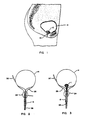
- Figure 1 illustrates the lower abdominal region of the anatomy. Specifically, Figure 1 illustrates the urethra 12 and the bladder 14.
- the bolus 10 of the present invention resting in position within the interior of bladder 14.
- the bolus includes a membrane formed of biocompatible material.
- biocompatible material is a medical grade polyurethane; however, other various types of material, such as teflon, may also be found acceptable.
- Material for constructing the bolus 10 should preferrably be biocompatible, non-toxic, and non-lithogenic.
- the bolus 10 includes a quantity of ferromagnetic material.
- the ferromagnetic material may rest with a membrane or it may be integrally formed within the walls of the bolus. Indeed, the ferromagnetic material may be a solid or a gel and may constitute the entire bolus 10.
- ferromagnetic liquids are available. Such liquids may be hydrocarbon-based or may indeed be aqueous-based.
- One such ferromagnetic liquid is a 900 Gauss saturation ferrofluid manufactured by Ferrofluidics, Inc.
- Such fluids are preferrably non-toxic, biocompatible, chemically stable, and have high magnetic permeability and saturation.
- the bolus 10 is implanted within the interior of bladder 14. Methods of implantation will be discussed in more detail below. When properly in position, bolus 10 will be seated against the interconnection between urethra 12 and bladder 14. This general region is often referred to as the bladder neck or trigone region of the bladder. Closure of the trigone region results in the collection of urine within the bladder. As a result, bolus 10, along with the bladder neck essentially comprise a simple, but effective valve for blocking the flow of fluids between bladder 14 and urethra 12. In particular, the bolus 10 is useful in providing continence for normally incontinent individuals.
- the bolus 10 In order for the bolus 10 to form an adequate seal it is important that it be formed of flexible and compliant material. This allows the bolus to conform to the interior walls of the bladder to effectively prevent fluid flow. Similarly, it may be important that in the case when bolus 10 is a membrane, that the membrane not be filled with fluid to the point that it expands or becomes distended.
- Bolus 10 may be manufactured in any acceptable and desirable method. Essentially, all that is necessary is to provide a continuous outer surface of a spherical or other desirable shape. For most purposes a shape which allows for rolling and flexing within the bladder will be preferred in order to facilitate the operation of the device and to minimize encrustation of the bolus 10 with components of the various fluids within the bladder and urethra.
- One method of manufacturing such a continuous bolus in the form of a membrane is to first obtain a ball of ice in the desired shape and size. The ball of ice is then dipped into a solution of polymer.
- polymer One such acceptable polymer is a medical grade polyurethane dissolved in methylene chloride. Once the spherical ball of ice is sufficiently coated with the polymer plastic material, it is removed to a freezer where the polymer is allowed to dry. The dipping and drying procedure may be repeated as necessary to obtain a membrane of the desired thickness. Once the solvent is sufficiently evaporated from the polymer, the ice encapsulated within the resulting polymer membrane can be melted and removed by a small hypodermic needle or by similar other methods.
- the membrane may be cast on an appropriately shaped conventional mandrel. Once the mandrel is sufficiently coated the membrane may be removed by essentially turning it inside out.
- Other alternative fabrication methods include blow molding, spray coating, resin casting, and injection moldings.
- the bolus 10 may also comprise a ferromagnetic gel or a ferromagnetic solid. Such a gel would be inserted into the bladder and would operate in the same manner as described above.
- the solid may be an epoxy resin which is formed in situ within the bladder.
- Figure 2 illustrates a bladder 14 and a ureter 30 leading into the bladder 14 from a kidney (not shown). Descending from the base of the bladder 14 is the urethra 12. In addition, Figure 2 illustrates generally the trigone region 26 of the bladder 14 as well as a prostate gland 24.
- the operation of the bolus 10 as a seal between bladder 14 and urethra 12 can be fully understood with reference to Figures 4 and 5.
- the bolus 10 is shown in place at the base of the bladder 14.
- the bolus 10 fully covers the intersection between bladder 14 and urethra 12 in the trigone region 26.
- urine flowing into the bladder 14 through ureter 30 is collected within the bladder 14 as long as the bolus 10 remains at the base of the bladder 14.
- Figure 4 illustrates bladder 14 while relatively distended and full of accumulated urine.
- a sufficiently powerful magnet will be required.
- One such magnet is a 25 million Gauss-Oersted neodymium-iron-boron magnet sold by The Magnet Store of Castle Rock, Colorado. This magnet works well when coupled with the 900 Gauss saturated ferrofluid mentioned above.
- An appropriate magnet preferrably has the properties of being light in weight, being moldable, and having high field strength.
- bolus 10 When bladder 14 is empty, bolus 10 may be reinserted into the trigone region 26 so that urine will again begin to accumulate in bladder 14. Simply removing magnet 28 from the area may be sufficient to allow bolus 10 to drop back into place under the force of gravity. In the alternative, magnet 28 may be moved downwardly along the skin of the patient until membrane 10 is again seated within the intersection between bladder 14 and urethra 12.
- FIG. 1 One advantage of the present invention is that the bolus 10 can be inserted and removed nonsurgically.
- the drawings illustrate one method of such nonsurgical implantation of the bolus, particularly when the bolus comprises a membrane or gel material.
- a urinary insertion catheter 36 is shown travelling upwardly through the urethra 12.
- the tip of the catheter 36 is at approximately the intersection between the urethra 12 and the bladder 14.
- Loaded within the interior of the insertion catheter 36 is the membrane 11. It will be appreciated, however, that similar insertion methods could be used to insert a gel bolus. Methods for loading the membrane 11 into the insertion catheter 36 will be described in more detail below.
- FIG. 3 illustrates the membrane 11 being deployed into the bladder and being filled with an appropriate material.
- This may be ferromagnetic fluid, or, in the case of a ferromagnetic membrane, the fluid may be non-ferromagnetic.
- Insertion catheter 36 may be, for example, a conventional catheter used in urology.
- Insertion catheter 36 is in turn securely attached to a syringe body 38, or other similar device which performs the same general functions.
- Syringe body 38 includes a plunger ram 40 which runs through the interior of the syringe body 38.
- reservoir 42 Disposed within the interior of the syringe body 38 is reservoir 42. It will be appreciated that prior to use, reservoir chamber 42 is filled with an appropriate amount of ferromagnetic fluid or other appropriate fluid for injection into the interior of the membrane 11 as it is deployed within the interior of bladder 14.
- deployment catheter 44 Disposed within the interior of insertion catheter 36 is deployment catheter 44.
- Deployment catheter 44 runs through the interior of insertion catheter 36 and terminates at its proximal end within the reservoir 42 of syringe body 38.
- Deployment catheter 44 terminates on its distal end at membrane 11.
- the distal terminus of deployment catheter 44 is in the form of a needle or other injection means for placing fluid within membrane 11.
- deployment catheter 44 On the proximal end of deployment catheter 44, deployment catheter 44 includes a female deployment latch 46.
- the plunger ram 40 which runs through the interior of syringe body 38, contains a male deployment latch 47 which corresponds to the female deployment latch 46 attached to deployment catheter 44.
- the male deployment latch 47 of plunger ram 40 will become attached to the female deployment latch 46 of deployment catheter 44.
- plunger ram 40 may be withdrawn slightly resulting in membrane 11 being pushed off the end of deployment catheter 44 as it contacts the distal base 58 of the catheter mechanism or other similar structure within the distal end of deployment catheter 44.
- deployment slide cavity 48 comprises the space between insertion catheter 36 and the reservoir 42 of deployment catheter 44.
- Deployment catheter 44 is, therefore, relatively free to move within deployment slide cavity 48 and to extend beyond the end of insertion catheter 36 while deploying the membrane 10.
- the membrane 10 On the distal end of the insertion catheter 36, the membrane 10, is packed within the tip of catheter 36.
- the distal end of deployment catheter 44 is placed in communication with the interior of the membrane 11 through the septum 50 of membrane 11, if membrane 11 has been fabricated such that it contains a septum.
- FIG. 7 Illustrated in Figure 7 is the distal end of insertion catheter 36. Disposed within the interior of insertion catheter 36 is deployment catheter 44. Also illustrated in Figure 7 is the septum area 50 of membrane 11. Membrane 11 may be molded such that a slightly enlarged septum area 50 is disposed on one side of membrane 11.
- Opening 52 Disposed through the wall of membrane 11 is an opening 52. Opening 52 may be configured such that it essentially comprises a female joint. At the same time, the distal end of deployment catheter 44 may be configured such that it comprises a male breakaway plug 56. The breakaway plug 56 also contains a filling port 54 through which fluid may be introduced into the interior of membrane 11.
- catheter mechanism 32 The general method of operation of catheter mechanism 32 can be appreciated with reference to Figures 6 and 7. Specifically, the distal end of insertion catheter 36 will be inserted through a patient's urethra 12 into the trigone area of the bladder 14 as shown in Figures 2 and 3. Once the tip of insertion catheter 36 reaches the interior of the bladder 14, plunger ram 40 is depressed. This causes the deployment catheter 44, including reservoir 42 and plunger ram 40, to slide within the deployment slide cavity 48. Thus, the membrane 11 is pushed by the distal base 58 of catheter out of the end of insertion catheter 36 and into the bladder.
- membrane 11 will be adequately filled with fluid.
- the membrane itself may be ferromagnetic and such a membrane may be filled with a non-ferromagnetic fluid.
- a bolus of ferromagnetic gel could be inserted using similar procedures.
- septum plug 56 and opening 52 An alternative to the use of septum plug 56 and opening 52 is simply to place a needle on the end of deployment catheter 44 and to insert the needle into the septum 50. The needle can then be used to fill membrane 11 and can be removed by the same general procedure discussed above. As mentioned above, the septum of the membrane will be constructed such that it is thick enough to seal the interior of membrane 11 once the needle is removed.
- bolus 10 It may also be necessary to periodically remove bolus 10 from the bladder and replace it with a new bolus due to loss of compliance, leakage, encrustation, infection, or other physiological factors. Removal of membrane 10 is easily accomplished. Where the bolus 10 is a membrane, it is only necessary to insert a urinary catheter having an attached means to puncture the membrane, such as a needle or forceps. The bolus 10 is then punctured and the fluid within the interior of bolus 10 is allowed to escape into the bladder. The fluid immediately flows out the urethra 12. At the same time, bolus 10 may be secured by the catheter and pulled through the interior of urethra 12 to the exterior of the patient. This would also be true using a gel bolus. In the case of a solid bolus it may be necessary to shatter the bolus in order to provide for ready removal from the bladder.
- the bolus 10 can easily be removed and replaced with a new bolus as the need arises. Since neither removal nor replacement requires surgery, such procedures are relatively free of trauma to the patient.
- incontinence was mimicked in a continent dog by inserting an open-tipped catheter far enough into the urethra to penetrate the internal sphincter in the trigone region.
- the catheter was not inserted far enough into the bladder to prevent the membrane seal from seating in the bladder neck. It was found that by careful manipulation of the membrane bolus within the bladder by an external magnet it was possible to stop and start voiding.
- the membrane bolus was left within the dog for six days, at which time nonsurgical removal of the membrane was performed. It was found that the membrane could be emptied by holding the membrane immobile with an external magnet and by nipping the membrane with flexible alligator forceps inserted through cystoscope. The fluid was then flushed out of the bladder with a saline wash and the deflated membrane bag was secured and removed. Cystoscopic examination of the mucosal surface of the bladder and the membrane itself revealed nothing remarkable. The mucosa was not inflamed and the membrane was intact.
- the present invention provides methods and apparatus for maintaining continence in incontinent individuals. This is accomplished by nonsurgically inserting a ferromagnetic bolus into the bladder of such individuals.
- the bolus may be constructed of a ferromagnetic material or a ferromagnetic fluid may be used to fill the bolus.
- the bolus is then manipulated by an external magnet to control flow of urine through the bladder. Specifically, a magnet may be used to hold the bolus in place at the intersection between the urethra and the bladder. Alternatively, an external magnet can be used to remove the bolus from the trigone region of the bladder such that a flow of urine will be initiated. All of these manipulations can easily be accomplished directly by the patient.
- the present invention therefore, corrects urinary incontinence using inexpensive materials and apparatus and without the need for surgery.
Landscapes
- Health & Medical Sciences (AREA)
- Urology & Nephrology (AREA)
- Cardiology (AREA)
- Oral & Maxillofacial Surgery (AREA)
- Transplantation (AREA)
- Engineering & Computer Science (AREA)
- Biomedical Technology (AREA)
- Heart & Thoracic Surgery (AREA)
- Vascular Medicine (AREA)
- Life Sciences & Earth Sciences (AREA)
- Animal Behavior & Ethology (AREA)
- General Health & Medical Sciences (AREA)
- Public Health (AREA)
- Veterinary Medicine (AREA)
- External Artificial Organs (AREA)
- Prostheses (AREA)
- Media Introduction/Drainage Providing Device (AREA)
Applications Claiming Priority (1)
| Application Number | Priority Date | Filing Date | Title |
|---|---|---|---|
| US87294686A | 1986-06-11 | 1986-06-11 |
Publications (2)
| Publication Number | Publication Date |
|---|---|
| EP0357846A1 true EP0357846A1 (de) | 1990-03-14 |
| EP0357846B1 EP0357846B1 (de) | 1992-11-04 |
Family
ID=25360663
Family Applications (1)
| Application Number | Title | Priority Date | Filing Date |
|---|---|---|---|
| EP88308202A Expired EP0357846B1 (de) | 1986-06-11 | 1988-09-05 | Vorrichtung zum Erreichen von Harnkontinenz |
Country Status (5)
| Country | Link |
|---|---|
| US (1) | US4850963A (de) |
| EP (1) | EP0357846B1 (de) |
| AT (1) | ATE81960T1 (de) |
| DE (1) | DE3875731T2 (de) |
| ES (1) | ES2035308T3 (de) |
Cited By (3)
| Publication number | Priority date | Publication date | Assignee | Title |
|---|---|---|---|---|
| WO2000047141A1 (es) * | 1999-02-11 | 2000-08-17 | Universidad Complutense De Madrid Rectorado | Valvula de accionamiento magnetico externo para un esfinter urinario artificial intrauretral |
| WO2003075791A3 (en) * | 2002-03-14 | 2004-03-18 | Innoventions Inc | Insertion and retrieval system for inflatable devices |
| CN108025180A (zh) * | 2015-08-12 | 2018-05-11 | 英诺威讯有限公司 | 用于括约肌和其它组织再生的系统 |
Families Citing this family (69)
| Publication number | Priority date | Publication date | Assignee | Title |
|---|---|---|---|---|
| US5234409A (en) * | 1989-07-07 | 1993-08-10 | Cabot Technology Corporation | Female incontinence control device and method |
| US5041092A (en) * | 1989-08-29 | 1991-08-20 | Medical Engineering Corporation | Urethral indwelling catheter with magnetically controlled drainage valve and method |
| US5513660A (en) * | 1990-12-31 | 1996-05-07 | Uromed Corporation | Expandable urethral plug |
| US5509427A (en) * | 1990-12-31 | 1996-04-23 | Uromed Corporation | Urethral plug assembly having adhesive for enhanced sealing capabilities and method of using said plug assembly |
| US5479945A (en) * | 1990-12-31 | 1996-01-02 | Uromed Corporation | Method and a removable device which can be used for the self-administered treatment of urinary tract infections or other disorders |
| US5724994A (en) * | 1990-12-31 | 1998-03-10 | Uromed Corporation | Fluidly expandable urethral plug assembly which receives fluid from an external source and method for controlling urinary incontinence |
| ES2049653B1 (es) * | 1992-10-05 | 1994-12-16 | Velazquez Francisco Farrer | Dispositivo corrector de la incontinencia urinaria femenina. |
| US6635058B2 (en) | 1992-11-13 | 2003-10-21 | Ams Research Corporation | Bone anchor |
| US6406480B1 (en) | 1992-11-13 | 2002-06-18 | American Med Syst | Bone anchor inserter with retractable shield |
| US5769091A (en) * | 1993-09-20 | 1998-06-23 | Uromed Corporation | Urethral plug having adhesive for enhanced sealing capabilities and method of using said plug |
| US5762599A (en) * | 1994-05-02 | 1998-06-09 | Influence Medical Technologies, Ltd. | Magnetically-coupled implantable medical devices |
| US5562598A (en) * | 1994-09-20 | 1996-10-08 | Whalen Biomedical Inc. | Artificial urethral sphincter |
| US5513659A (en) * | 1994-10-24 | 1996-05-07 | Iotek, Inc. | Incontinence device |
| DE29507519U1 (de) * | 1995-05-05 | 1995-08-10 | Angiomed Ag, 76227 Karlsruhe | Endosphinkter und Set zum freigebbaren Verschließen der Urethra |
| US5782916A (en) * | 1996-08-13 | 1998-07-21 | Galt Laboratories, Inc. | Device for maintaining urinary continence |
| US6173199B1 (en) | 1998-05-05 | 2001-01-09 | Syncro Medical Innovations, Inc. | Method and apparatus for intubation of a patient |
| US6464999B1 (en) | 1998-06-17 | 2002-10-15 | Galt Incorporated | Bioadhesive medical devices |
| AU5909399A (en) * | 1998-09-15 | 2000-04-03 | Infinite Biomedical Technologies, Incorporated | Intraurethral continent prothesis |
| US20020165427A1 (en) | 1999-03-15 | 2002-11-07 | Daniel Yachia | Intravesicular device |
| US6293923B1 (en) | 1999-03-15 | 2001-09-25 | Innoventions, Inc. | Intravesicular balloon |
| US6148823A (en) * | 1999-03-17 | 2000-11-21 | Stereotaxis, Inc. | Method of and system for controlling magnetic elements in the body using a gapped toroid magnet |
| US6402684B1 (en) * | 2000-03-10 | 2002-06-11 | Jaime Quintanilla | Apparatus for managing urinary flow in a host |
| US6682473B1 (en) | 2000-04-14 | 2004-01-27 | Solace Therapeutics, Inc. | Devices and methods for attenuation of pressure waves in the body |
| US7374532B2 (en) | 2000-04-14 | 2008-05-20 | Attenuex Technologies, Inc. | High vapor pressure attenuation device |
| US7470228B2 (en) * | 2000-04-14 | 2008-12-30 | Attenuex Technologies, Inc. | Method of treating benign hypertrophy of the prostate |
| US10327880B2 (en) | 2000-04-14 | 2019-06-25 | Attenuex Technologies, Inc. | Attenuation device for use in an anatomical structure |
| US6398718B1 (en) | 2000-06-15 | 2002-06-04 | Innoventions, Inc. | Intravesicular device |
| US6723042B2 (en) | 2000-12-27 | 2004-04-20 | Ams Research Corporation | Penile pump with side release mechanism |
| US6730017B2 (en) * | 2000-12-27 | 2004-05-04 | Ams Research Corporation | Pressure based spontaneous inflation inhibitor with penile pump improvements |
| US6443887B1 (en) | 2000-12-27 | 2002-09-03 | American Medical Systems Inc. | Switch based spontaneous inflation inhibitor in a pump for an inflation prosthesis |
| US6533719B2 (en) | 2000-12-27 | 2003-03-18 | Ams Research Corporation | Diaphragm based spontaneous inflation inhibitor in a pump for an inflatable prosthesis |
| DE20103653U1 (de) | 2001-03-02 | 2001-05-17 | B. Braun Melsungen Ag, 34212 Melsungen | Ureter-Drainagevorrichtung |
| US7249604B1 (en) * | 2002-05-10 | 2007-07-31 | Vasmo, Inc. | Medical devices for occlusion of blood flow |
| US6739341B2 (en) * | 2002-05-15 | 2004-05-25 | Conticare Medical, Inc. | Incontinence device insertion kit |
| US8047206B2 (en) * | 2002-09-06 | 2011-11-01 | Koninklijke Philips Electronics N.V. | Magnetic devices, systems, and methods placed in or on a tongue |
| US6991601B2 (en) * | 2002-12-02 | 2006-01-31 | Ams Research Corporation | Implantable pump |
| US6808490B1 (en) * | 2003-04-25 | 2004-10-26 | Ams Research Corporation | Penile prosthesis with improved tubing junction |
| US7662145B2 (en) * | 2003-09-17 | 2010-02-16 | Prostalund Operations Ab | Partial-length indwelling urinary catheter and method permitting selective urine discharge |
| DE602005026638D1 (de) | 2004-03-18 | 2011-04-14 | Contipi Ltd | Gerät zur behandlung von organvorfall im weiblichen becken |
| DE602005026636D1 (de) | 2004-03-18 | 2011-04-14 | Contipi Ltd | Gerät zur prävention von harninkontinenz bei frauen |
| MX345807B (es) | 2005-03-17 | 2017-02-15 | Kimberly-Clark Worldwide Inc * | Aparatos para el mejoramiento de la incontinencia urinaria en mujeres. |
| US7946975B2 (en) | 2005-04-08 | 2011-05-24 | Ams Research Corporation | Fluid reservoir for penile implant devices |
| US20060271087A1 (en) * | 2005-05-25 | 2006-11-30 | Bowel Management Systems, Llc | Fixed-volume inflation system for balloon catheters |
| US20070225616A1 (en) * | 2005-06-15 | 2007-09-27 | Alpine Biomed Corp. | Wireless urinary incontinence monitoring system |
| IL176883A (en) | 2005-09-22 | 2013-09-30 | Eliahu Eliachar | Devices for reducing urine leakage in women |
| WO2007038476A2 (en) | 2005-09-26 | 2007-04-05 | Atteneux Technologies, Inc. | Pressure attenuation device |
| US20070156028A1 (en) * | 2005-12-29 | 2007-07-05 | Van Lue Stephen J | Magnetic surgical/oral retractor |
| US20070270629A1 (en) * | 2006-05-19 | 2007-11-22 | Charles Filipi J | System and techniques for magnetic manipulation of internal organs during minimally invasive surgery |
| US8109870B2 (en) | 2006-11-10 | 2012-02-07 | Ams Research Corporation | Inflatable penile prosthesis bypass valve noise reduction |
| EP2160149B1 (de) * | 2007-06-11 | 2016-04-13 | ConTIPI Medical Ltd. | Verstellbarer spannring zur linderung von harninkontinenz bei frauen |
| CA2698112A1 (en) * | 2007-08-30 | 2009-03-05 | Syncro Medical Innovations, Inc. | Guided catheter with removable magnetic guide |
| WO2009044394A2 (en) | 2007-10-01 | 2009-04-09 | Contipi Ltd. | Management of urinary incontinence in females |
| US8651109B2 (en) | 2008-04-23 | 2014-02-18 | Contipi Ltd. | Pessaries for prolapse alleviation |
| US20100145147A1 (en) * | 2008-09-02 | 2010-06-10 | Syncro Medical Innovations, Inc. | Magnetic device for guiding catheter and method of use therefor |
| AU2009302970C1 (en) * | 2008-10-10 | 2016-11-03 | Implantica Patent Ltd. | Implantable device for internal urinary control |
| EP2367503A1 (de) | 2008-11-25 | 2011-09-28 | AttenueX Technologies, Inc. | Implantat mit medium mit hohem dampfdruck |
| US8725249B2 (en) * | 2008-12-09 | 2014-05-13 | Nephera Ltd. | Stimulation of the urinary system |
| US8923970B2 (en) | 2008-12-09 | 2014-12-30 | Nephera Ltd. | Stimulation of the urinary system |
| GB2489712A (en) * | 2011-04-05 | 2012-10-10 | Mark Anthony Donbavand | Implantable urine flow control valves |
| US8894563B2 (en) | 2012-08-10 | 2014-11-25 | Attenuex Technologies, Inc. | Methods and systems for performing a medical procedure |
| US9750574B2 (en) * | 2014-05-28 | 2017-09-05 | Coloplast A/S | Surgical system for and a method of identifying an incision site |
| RU2651089C1 (ru) * | 2017-04-05 | 2018-04-18 | Владислав Александрович Корецкий | Уретральный магнитоуправляемый сфинктер |
| AU2019415036A1 (en) * | 2018-12-24 | 2021-07-15 | Innoventions Ltd. | Intravesicular device for controlling urinary incontinence |
| WO2020163625A1 (en) | 2019-02-07 | 2020-08-13 | Solace Therapeutics, Inc. | Pressure attenuation device |
| US11865270B2 (en) | 2020-01-16 | 2024-01-09 | Starling Medical, Inc. | Bodily fluid management system |
| CN113143537B (zh) * | 2021-04-12 | 2023-10-20 | 西安交通大学医学院第一附属医院 | 一种用于治疗女性压力性尿失禁的磁控装置 |
| CN114521991B (zh) * | 2021-12-09 | 2025-04-25 | 广东工业大学 | 一种膀胱配流阀 |
| US11583380B1 (en) | 2022-06-16 | 2023-02-21 | Magnetic Five LLC | Male continence device |
| WO2025101698A1 (en) * | 2023-11-07 | 2025-05-15 | University Of Pittsburgh-Of The Commonwealth System Of Higher Education | Controllable intravesical bladder outlet occlusion for urinary incontinence |
Citations (4)
| Publication number | Priority date | Publication date | Assignee | Title |
|---|---|---|---|---|
| US3812841A (en) * | 1972-08-21 | 1974-05-28 | L Isaacson | Urethra magnetic valve structure |
| DE2537506A1 (de) * | 1975-08-22 | 1977-03-03 | Hennig Gerhard | Einrichtung zum verschliessen und oeffnen des harnblasenausgangs |
| US4210132A (en) * | 1978-07-26 | 1980-07-01 | The Kendall Company | Artificial sphincter |
| DE3139811A1 (de) * | 1981-10-07 | 1983-04-21 | Andreas Dr. 7900 Ulm Grüneberger | Vorrichtung zum verschliessen der weiblichen urethra |
Family Cites Families (9)
| Publication number | Priority date | Publication date | Assignee | Title |
|---|---|---|---|---|
| US2628615A (en) * | 1949-12-28 | 1953-02-17 | Jacob A Saffir | Hypodermic injection device |
| US3419008A (en) * | 1966-02-24 | 1968-12-31 | Paul J. Plishner | Magnetically actuated valve clamp for urethra control |
| US3642004A (en) * | 1970-01-05 | 1972-02-15 | Life Support Equipment Corp | Urethral valve |
| US3750194A (en) * | 1971-03-16 | 1973-08-07 | Fairchild Industries | Apparatus and method for reversibly closing a natural or implanted body passage |
| US3731670A (en) * | 1971-05-03 | 1973-05-08 | David Roy Pressman | Corporeal fluid control using bistable magnetic duct valve |
| US3841304A (en) * | 1972-10-16 | 1974-10-15 | A Jones | Inflatable leakage inhibitor |
| US3939821A (en) * | 1973-11-14 | 1976-02-24 | Altair, Incorporated | Magnetically actuated tube compressing valve |
| US4364377A (en) * | 1979-02-02 | 1982-12-21 | Walker Scientific, Inc. | Magnetic field hemostasis |
| IL59942A (en) * | 1980-04-28 | 1986-08-31 | D P Lab Ltd | Method and device for fluid transfer |
-
1988
- 1988-05-04 US US07/191,858 patent/US4850963A/en not_active Expired - Fee Related
- 1988-09-05 DE DE8888308202T patent/DE3875731T2/de not_active Expired - Fee Related
- 1988-09-05 EP EP88308202A patent/EP0357846B1/de not_active Expired
- 1988-09-05 AT AT88308202T patent/ATE81960T1/de not_active IP Right Cessation
- 1988-09-05 ES ES198888308202T patent/ES2035308T3/es not_active Expired - Lifetime
Patent Citations (4)
| Publication number | Priority date | Publication date | Assignee | Title |
|---|---|---|---|---|
| US3812841A (en) * | 1972-08-21 | 1974-05-28 | L Isaacson | Urethra magnetic valve structure |
| DE2537506A1 (de) * | 1975-08-22 | 1977-03-03 | Hennig Gerhard | Einrichtung zum verschliessen und oeffnen des harnblasenausgangs |
| US4210132A (en) * | 1978-07-26 | 1980-07-01 | The Kendall Company | Artificial sphincter |
| DE3139811A1 (de) * | 1981-10-07 | 1983-04-21 | Andreas Dr. 7900 Ulm Grüneberger | Vorrichtung zum verschliessen der weiblichen urethra |
Cited By (7)
| Publication number | Priority date | Publication date | Assignee | Title |
|---|---|---|---|---|
| WO2000047141A1 (es) * | 1999-02-11 | 2000-08-17 | Universidad Complutense De Madrid Rectorado | Valvula de accionamiento magnetico externo para un esfinter urinario artificial intrauretral |
| ES2150881A1 (es) * | 1999-02-11 | 2000-12-01 | Univ Madrid Complutense | Valvula de accionamiento magnetico externo para un esfinter urinario artificial intrauretral. |
| US6623421B1 (en) | 1999-02-11 | 2003-09-23 | Universidad Complutense De Madrid | External magnetic actuation valve for intraurethral artificial urinary sphincter |
| WO2003075791A3 (en) * | 2002-03-14 | 2004-03-18 | Innoventions Inc | Insertion and retrieval system for inflatable devices |
| CN108025180A (zh) * | 2015-08-12 | 2018-05-11 | 英诺威讯有限公司 | 用于括约肌和其它组织再生的系统 |
| EP3334495A4 (de) * | 2015-08-12 | 2019-05-01 | Innoventions Ltd | System für sphinktergewebe und andere geweberegeneration |
| CN108025180B (zh) * | 2015-08-12 | 2022-05-27 | 英诺威讯有限公司 | 用于括约肌和其它组织再生的系统 |
Also Published As
| Publication number | Publication date |
|---|---|
| EP0357846B1 (de) | 1992-11-04 |
| ES2035308T3 (es) | 1993-04-16 |
| US4850963A (en) | 1989-07-25 |
| DE3875731T2 (de) | 1993-03-18 |
| DE3875731D1 (de) | 1992-12-10 |
| ATE81960T1 (de) | 1992-11-15 |
Similar Documents
| Publication | Publication Date | Title |
|---|---|---|
| US4850963A (en) | Apparatus and methods for achieving urinary continence | |
| AU588477B2 (en) | Hypodermic implantation of a genito urinary prosthesis | |
| KR100252548B1 (ko) | 방광요관 역류의 내시경 치료용의 탈착 가능한 벌룬 카테테르 | |
| US5964806A (en) | Adjustable implantable genitourinary device | |
| ES2252981T3 (es) | Dispositivo de suspension distensible para incontinencia urinaria. | |
| JP2652164B2 (ja) | 尿失禁を処置するための皮下装置 | |
| JP3776455B2 (ja) | 組織成長を促進する装置 | |
| JP2649226B2 (ja) | 尿失禁を処置するための泌尿器補綴器具 | |
| US20120029269A1 (en) | Apparatus and method for inserting an adjustable implantable genitourinary device | |
| US6645138B2 (en) | Adjustable implantable genitourinary device | |
| US6572532B1 (en) | Implant positioning system and method | |
| AU612692B2 (en) | Apparatus and methods for achieving urinary continence | |
| US7585271B2 (en) | Implantable devices and methods for treating urinary incontinence | |
| US7381180B2 (en) | Implantable devices and methods for treating fecal incontinence | |
| US20250359981A1 (en) | Artificial bladder | |
| CN108210137B (zh) | 一种辅助收缩装置 | |
| CN211271437U (zh) | 一种辅助收缩装置 | |
| Hanna | Artificial urinary sphincter for incontinent children | |
| Osther et al. | Teflon injections in post-prostatectomy incontinence | |
| CA2668299A1 (en) | Catheter device for the control of liquid discharge from the urinary bladder by a user person | |
| Choi et al. | A case of urethral replacement with polytetrafluoro-ethylene graft for multiple anterior urethral strictures | |
| WO2025101698A1 (en) | Controllable intravesical bladder outlet occlusion for urinary incontinence | |
| HK1027738B (en) | Adjustable implantable genitourinary device |
Legal Events
| Date | Code | Title | Description |
|---|---|---|---|
| PUAI | Public reference made under article 153(3) epc to a published international application that has entered the european phase |
Free format text: ORIGINAL CODE: 0009012 |
|
| 17P | Request for examination filed |
Effective date: 19890719 |
|
| AK | Designated contracting states |
Kind code of ref document: A1 Designated state(s): AT BE CH DE ES FR GB IT LI NL SE |
|
| 17Q | First examination report despatched |
Effective date: 19910429 |
|
| RAP1 | Party data changed (applicant data changed or rights of an application transferred) |
Owner name: TECHNICAL RESEARCH ASSOCIATES, INC. |
|
| GRAA | (expected) grant |
Free format text: ORIGINAL CODE: 0009210 |
|
| AK | Designated contracting states |
Kind code of ref document: B1 Designated state(s): AT BE CH DE ES FR GB IT LI NL SE |
|
| PG25 | Lapsed in a contracting state [announced via postgrant information from national office to epo] |
Ref country code: FR Free format text: THE PATENT HAS BEEN ANNULLED BY A DECISION OF A NATIONAL AUTHORITY Effective date: 19921104 |
|
| REF | Corresponds to: |
Ref document number: 81960 Country of ref document: AT Date of ref document: 19921115 Kind code of ref document: T |
|
| ET | Fr: translation filed | ||
| REF | Corresponds to: |
Ref document number: 3875731 Country of ref document: DE Date of ref document: 19921210 |
|
| ITF | It: translation for a ep patent filed | ||
| REG | Reference to a national code |
Ref country code: ES Ref legal event code: FG2A Ref document number: 2035308 Country of ref document: ES Kind code of ref document: T3 |
|
| PLBE | No opposition filed within time limit |
Free format text: ORIGINAL CODE: 0009261 |
|
| STAA | Information on the status of an ep patent application or granted ep patent |
Free format text: STATUS: NO OPPOSITION FILED WITHIN TIME LIMIT |
|
| PG25 | Lapsed in a contracting state [announced via postgrant information from national office to epo] |
Ref country code: AT Effective date: 19930905 |
|
| PG25 | Lapsed in a contracting state [announced via postgrant information from national office to epo] |
Ref country code: SE Effective date: 19930906 Ref country code: ES Free format text: LAPSE BECAUSE OF EXPIRATION OF PROTECTION Effective date: 19930906 |
|
| PG25 | Lapsed in a contracting state [announced via postgrant information from national office to epo] |
Ref country code: LI Effective date: 19930930 Ref country code: CH Effective date: 19930930 Ref country code: BE Effective date: 19930930 |
|
| PGFP | Annual fee paid to national office [announced via postgrant information from national office to epo] |
Ref country code: DE Payment date: 19931022 Year of fee payment: 6 |
|
| 26N | No opposition filed | ||
| PGFP | Annual fee paid to national office [announced via postgrant information from national office to epo] |
Ref country code: GB Payment date: 19931028 Year of fee payment: 6 |
|
| BERE | Be: lapsed |
Owner name: TECHNICAL RESEARCH ASSOCIATES INC. Effective date: 19930930 |
|
| PG25 | Lapsed in a contracting state [announced via postgrant information from national office to epo] |
Ref country code: NL Effective date: 19940401 |
|
| NLV4 | Nl: lapsed or anulled due to non-payment of the annual fee | ||
| REG | Reference to a national code |
Ref country code: CH Ref legal event code: PL |
|
| REG | Reference to a national code |
Ref country code: FR Ref legal event code: ST |
|
| PG25 | Lapsed in a contracting state [announced via postgrant information from national office to epo] |
Ref country code: GB Effective date: 19940905 |
|
| EUG | Se: european patent has lapsed |
Ref document number: 88308202.6 Effective date: 19940410 |
|
| GBPC | Gb: european patent ceased through non-payment of renewal fee |
Effective date: 19940905 |
|
| PG25 | Lapsed in a contracting state [announced via postgrant information from national office to epo] |
Ref country code: DE Effective date: 19950601 |
|
| REG | Reference to a national code |
Ref country code: ES Ref legal event code: FD2A Effective date: 19990601 |
|
| PG25 | Lapsed in a contracting state [announced via postgrant information from national office to epo] |
Ref country code: IT Free format text: LAPSE BECAUSE OF NON-PAYMENT OF DUE FEES;WARNING: LAPSES OF ITALIAN PATENTS WITH EFFECTIVE DATE BEFORE 2007 MAY HAVE OCCURRED AT ANY TIME BEFORE 2007. THE CORRECT EFFECTIVE DATE MAY BE DIFFERENT FROM THE ONE RECORDED. Effective date: 20050905 |