EP0358310A1 - Semelle pour fer à repasser à vapeur - Google Patents
Semelle pour fer à repasser à vapeur Download PDFInfo
- Publication number
- EP0358310A1 EP0358310A1 EP89306656A EP89306656A EP0358310A1 EP 0358310 A1 EP0358310 A1 EP 0358310A1 EP 89306656 A EP89306656 A EP 89306656A EP 89306656 A EP89306656 A EP 89306656A EP 0358310 A1 EP0358310 A1 EP 0358310A1
- Authority
- EP
- European Patent Office
- Prior art keywords
- steam
- soleplate
- slot
- openings
- fabric
- Prior art date
- Legal status (The legal status is an assumption and is not a legal conclusion. Google has not performed a legal analysis and makes no representation as to the accuracy of the status listed.)
- Withdrawn
Links
- XEEYBQQBJWHFJM-UHFFFAOYSA-N Iron Chemical compound [Fe] XEEYBQQBJWHFJM-UHFFFAOYSA-N 0.000 title claims abstract description 54
- 229910052742 iron Inorganic materials 0.000 title claims abstract description 27
- 239000004744 fabric Substances 0.000 claims abstract description 29
- 230000033001 locomotion Effects 0.000 claims description 36
- 238000010409 ironing Methods 0.000 claims description 12
- 230000002401 inhibitory effect Effects 0.000 claims 1
- 235000000396 iron Nutrition 0.000 description 8
- 230000000694 effects Effects 0.000 description 7
- 210000003205 muscle Anatomy 0.000 description 4
- 230000008901 benefit Effects 0.000 description 3
- 239000007787 solid Substances 0.000 description 3
- XLYOFNOQVPJJNP-UHFFFAOYSA-N water Substances O XLYOFNOQVPJJNP-UHFFFAOYSA-N 0.000 description 3
- 230000035479 physiological effects, processes and functions Effects 0.000 description 2
- 238000009834 vaporization Methods 0.000 description 2
- 230000009286 beneficial effect Effects 0.000 description 1
- 238000009835 boiling Methods 0.000 description 1
- 238000001035 drying Methods 0.000 description 1
- 238000009434 installation Methods 0.000 description 1
- 230000003993 interaction Effects 0.000 description 1
- 239000002184 metal Substances 0.000 description 1
- 229910052751 metal Inorganic materials 0.000 description 1
- 238000012986 modification Methods 0.000 description 1
- 230000004048 modification Effects 0.000 description 1
- 229920006395 saturated elastomer Polymers 0.000 description 1
- 238000010186 staining Methods 0.000 description 1
- 230000008016 vaporization Effects 0.000 description 1
- 230000037303 wrinkles Effects 0.000 description 1
Images




Classifications
-
- D—TEXTILES; PAPER
- D06—TREATMENT OF TEXTILES OR THE LIKE; LAUNDERING; FLEXIBLE MATERIALS NOT OTHERWISE PROVIDED FOR
- D06F—LAUNDERING, DRYING, IRONING, PRESSING OR FOLDING TEXTILE ARTICLES
- D06F75/00—Hand irons
- D06F75/08—Hand irons internally heated by electricity
- D06F75/10—Hand irons internally heated by electricity with means for supplying steam to the article being ironed
- D06F75/20—Arrangements for discharging the steam to the article being ironed
Definitions
- the present invention relates to a soleplate for a steam iron and a steam iron provided with such a soleplate.
- a soleplate for a steam iron comprising: a generally planar soleplate surface; and at least one steam opening in said soleplate surface; characterized in that a nearest approach of the or each and every steam opening to a perimeter of said soleplate is at least great enough to limit lost steam over at least 180 degrees of direction of linear motion.
- the present invention provides a soleplate for a steam iron including steam openings spaced a predetermined minimum distance from its perimeter to prevent lost steam from escaping.
- the steam openings include at least one longitudinal slot centrally aligned between lateral edges of the soleplate surface. The maximum width of the slot is limited so as to avoid permitting an edge of fabric from entering.
- the slotted shape of the steam opening reduces lint cutting and helps avoid stain spots. Other shapes of steam openings are disclosed.
- a soleplate for a steam iron comprising: a generally planar soleplate surface, at least one steam slot in the soleplate surface, the at least one slot having a width, a forward end and a rear end, the at least one steam slot being laterally centered in the soleplate surface, with it axis parallel to a forward-backward axis of the soleplate, the steam slot including means for preventing an entry therein of an edge of a fabric, and a nearest approach of the at least one steam slot to a perimter of the soleplate being at least great enough to limit lost steam over at least 180 degrees of direction of linear motion.
- a steam iron including a soleplate, the soleplate comprising: a generally planar soleplate surface, at least one steam slot in the soleplate surface, the at least one slot having a width, a forward end and a rear end, the at least one steam slot being laterally centered in the soleplate surface, with it axis parallel to a forward-backward axis of the soleplate, the steam slot including means for preventing an entry therein of an edge of a fabric, and a nearest approach of the at least one steam slot to a perimter of the soleplate being at least great enough to limit lost steam over at least 180 degrees of direction of linear motion.
- a soleplate for an electric iron comprising: a generally planar soleplate surface, a plurality of steam openings in the soleplate surface, the steam openings being all disposed in a line laterally centered in the soleplate surface with an axis of the line parallel to a forward-backward axis of the soleplate, and a nearest approach of any of the steam openings to a perimeter of the soleplate being at least great enough to limit lost steam over at least 180 degrees of direction of linear motion.
- steam is generated and delivered to soleplate openings in steam irons in a number of different ways.
- electrically heated steam irons wherein steam is generated within the iron
- it is also conventional, particularly in commercial installations, to deliver steam from a steam source external to the iron through steam openings in the soleplate of the iron.
- the steam is delivered to the iron through a flexible tube.
- the present invention is indifferent to the manner or location in which the steam is generated. For concreteness of disclosure, however, the invention is described in the environment of an electric steam iron. It should be understood that the insight gained from the present disclosure has utility in any type of steam iron.
- FIG. 1 there is shown, generally at 10, a soleplate of a conventional electric steam iron, not otherwise shown.
- a plurality of steam openings 12 are disposed in a wide array on a soleplate surface 14. It is conventional to place at least some, and in many conventional soleplates 10, most, of steam openings 12 near a perimeter.
- a plurality of arrows 16 indicate directions in which soleplate 10 may move.
- any steam emitted must remain under soleplate surface 14 until the opposite edge of soleplate surface 14 passes over the area. Conversely, if instantaneous motion of soleplate 10 is downward in the figure, any steam emitted from arrow 16 almost immediately finds itself beyond the perimeter of soleplate surfacef 14. Such steam is hereinafter identified as lost steam.
- Lost steam has the exact opposite effect to that desired. That is, it tends to cause a fabric to rumple or wrinkle, rather than flatten.
- a predetermined minimum residence, or dwell, time is required for steam emitted from a steam opening 12 between a fabric and soleplate surface 14 in order to render it fully dry and for the desired flattening effect to take place.
- saturated steam steam at, or just above the boiling temperature of water
- a temperature of soleplate surface 14 on the order of 125 to 275 degrees C.
- the residence time depends on the distance between a steam opening 12 and the perimeter of soleplate surface 14 in a direction opposite to that of motion of soleplate 10, and on the speed with which soleplate 10 is being moved over a fabric.
- an array of steam openings 12 such as shown in Fig. 1, wherein a substantial number of steam openings 12 are near the perimeter of soleplate surface 14, even very slow motion of soleplate 10 cannot avoid a substantial percentage of steam becoming lost steam trailing behind soleplate 10.
- a substantial portion of such lost steam condenses on the surface of the fabric being ironed, thereby permitting the fabric to relax and become rumpled.
- a soleplate having a single steam opening 22 centrally disposed therein there is shown, generally at 18, a soleplate having a single steam opening 22 centrally disposed therein, according to an embodiment of the invention.
- a single steam opening 22 ensures that a substantial amount of heated soleplate surface 20 surrounds any point at which steam may be emitted.
- a conventional soleplate surface 20 may be about 12.7 cm wide. Its length is substantially greater. Thus, ignoring the width of steam opening 22, at least 6.4 cm of heated metal is disposed between steam opening 22 and the perimeter of soleplate surface 20. If the required residence time for complete drying is about 1.0 second, then an ironing speed of about 12.7 cm per second is required before permitting unvaporized steam to escape from the perimeter of soleplate surface 20. It develops that 12.7 cm per second can substantially exceed an ironing speed that an average consumer employs. Accordingly, the central placement of a single steam opening 22 solves the problem of lost steam, when used by the average consumer.
- a single circular steam opening 22 distributes steam under less than an optimum area of soleplate surface 20 to provide the best pressing.
- a soleplate 24, according to an embodiment of the invention includes a soleplate surface 26 having at least one steam slot 28, transversely centered between first and second lateral edges 30 and 32 of soleplate surface 26.
- a forward end 34 and a rear end 36 of steam slot 28 are far distant from a front 38 and a heel 40, respectively, of soleplate 24.
- Any steam emitted from steam slot 28 has a residence time under soleplate surface 26 that is long enough to permit complete vaporisation thereof before it can reach the perimeter of soleplate 24.
- An additional steam slot 44 is centrally disposed forward of steam slot 28, with a relatively narrow solid portion 46 between them. It will be noted that a forward end 48 of steam slot 44 is relatively close to front 38, as well as to lateral edges 30 and 32 to deliver steam toward the nose of the iron.
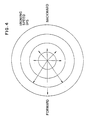
- the residence time of steam under soleplate 24 varies as the distance from steam slot 28 or steam slot 44 to the perimeter of soleplate surface 26 divided the speed with which soleplate 24 is moved. Also, the speed with which soleplate 24 is moved may somewhat vary from user to user. As a consequence, the residence time may also vary from user to user. Within reasonable accuracy, however, the ironing speed for the average user can be characterized for all directions of motion. As will be detailed hereinafter, the physiology of the average user and the average user's normal practices with a steam iron produce different speeds in different directions. Advantage is taken herein of such direction-related speeds in the embodiment of the invention shown in Fig. 3.
- a polar plot is shown of ironing speeds for an average user.
- User physiology dictates the biceps muscles in the user's arm is principally involved in producing motion in the forward direction.
- the biceps being the strongest muscles in the arm, produce the highest ironing speed in that direction.
- Much weaker muscles are employed for producing backward motion and even weaker ones still for producing side motion. Ironing speeds are reduced accordingly in these directions.
- forward end 48 is spaced about 2.5 cm from front 38.
- the closest approach of forward end 48 to lateral edges 30 and 32 is about 1.8 cm in a direction about 45 degrees from a forward direction. It turns out that the muscles combining to produce motion in the opposite direction to the latter direction are among the weakest in the arm. Thus, lost steam is unlikely to be a significant problem to a normal user. It is believed that the embodiment of the invention whose details are specified in this paragraph experiences less than 2 percent lost steam for any direction of motion of its soleplate and experiences substantially zero lost steam for all directions of motion more than 50 degrees from directly rearward. Thus, through a range of at least 260 degrees motion the soleplate produces substantially zero lost steam.
- a further factor improves the performance of soleplate 24 with respect to lost steam. Even if a small amount of lost steam occurs during rearward-quarter motion, most users of a steam iron are inclined to finish the flattening of a fabric with a forward motion. Thus, any negative effect of lost steam from generally rearward motion is overcome by the natural tendency of a user to finish with forward motion.
- the maximum widths of steam slots 28 and 44 are critical. If the widths are too great, the edge of a fabric can enter and become rolled or creased. This is, of course, not desirable.
- the minimum widths are governed by steam-flow capacity. That is, for given lengths of steam slots 28 and 44, at least a certain minimum width is required to permit an adequate flow of steam to pass therethrough.
- the combined overall lengths of steam slots 28 and 44 are as great as possible for good steam distribution, but the maximum is governed by the avoidance of lost steam, discussed in the foregoing.
- steam slots 28 and 44 are about 2.5 mm wide, steam slot 44 is about 5.7 cm long, steam slot 28 is about 5.1 cm long and solid portion 46 is about 0.6 cm Other factors such as, for example, placement of internal components, may require varying the dimensions or locations of steam slots 28 and 44 from the in-line positions shown.
- the drag, or reduced glidability, produced by a steam opening is largely due to the amount of downstream edge it presents to the fabric.
- a round steam opening has a downstream edge approximating its diameter.
- the amount of downstream presented to the fabric depends the direction of motion.
- soleplate motion is parallel to the longitudinal axis of steam slots 28 and 44, the downstream edge is equal to the width of steam slots 28 and 44.
- the lateral edges of steam slots 28 and 44 being parallel to soleplate motion, effect substantially no drag.
- soleplate motion is at right angles to the longitudinal axis of steam slots 28 and 44, the drag is contributed by the entire length of steam slots 28 and 44.
- the contribution to drag of steam slots 28 and 44 is 15 times as great for transverse motion as it is for forward and backward motion.
- FIG. 5 there is shown, generally at 50, a soleplate according to a further embodiment of the invention.
- the two steam slots of Fig. 3 are replaced with four steam slots 52, 54, 56 and 58, centrally aligned in a soleplate surface 60.
- the relationships between steam slots 52, 54, 56 and 58 with lateral edges 62 and 64 and heel 66 and front 68 are as described in the foregoing.
- a soleplate according to a further embodiment of the invention.
- a need to place steam slots in locations where they avoid internal components may make it desirable to move the rearward steam slot off the centerline of soleplate 70.
- some applications make it desirable to distribute at least some steam at laterally displaced locations.
- a single forward steam slot 72 is disposed in a soleplate surfacef 74 as previously described.
- First and second parallel rear steam slot 76 and 78 are offset from a centerline of soleplate surface 74. The distances between steam slot 76 and 78, and their adjacent lateral edges 80 and 82, respectively, are governed by the principles of avoiding lost steam as described in the foregoing.
- slotted shapes are critical from the standpoint of lint cutting, the same is not true from the standpoint of avoiding lost steam. Accordingly, the slots in the embodiments described above could be replaced by round, oval, square, or otherwise shaped openings, provided the distances to the perimeter of the soleplate surface are obeyed for avoidance of lost steam.
Landscapes
- Engineering & Computer Science (AREA)
- Textile Engineering (AREA)
- Irons (AREA)
Applications Claiming Priority (2)
| Application Number | Priority Date | Filing Date | Title |
|---|---|---|---|
| US07/231,367 US4993175A (en) | 1988-08-12 | 1988-08-12 | Soleplate steam slot arrangement |
| US231367 | 1988-08-12 |
Publications (1)
| Publication Number | Publication Date |
|---|---|
| EP0358310A1 true EP0358310A1 (fr) | 1990-03-14 |
Family
ID=22868929
Family Applications (1)
| Application Number | Title | Priority Date | Filing Date |
|---|---|---|---|
| EP89306656A Withdrawn EP0358310A1 (fr) | 1988-08-12 | 1989-06-30 | Semelle pour fer à repasser à vapeur |
Country Status (2)
| Country | Link |
|---|---|
| US (1) | US4993175A (fr) |
| EP (1) | EP0358310A1 (fr) |
Cited By (4)
| Publication number | Priority date | Publication date | Assignee | Title |
|---|---|---|---|---|
| US5532455A (en) * | 1993-04-23 | 1996-07-02 | Moulinex (Societe Anonyme) | Sole for an electric steam iron with alternating vaporization and heating regions |
| DE19735214A1 (de) * | 1996-08-24 | 1998-02-26 | Rowenta Werke Gmbh | Elektrisches Bügeleisen mit einer Bügelsohle |
| US5754475A (en) * | 1996-06-24 | 1998-05-19 | Advanced Micro Devices, Inc. | Bit line discharge method for reading a multiple bits-per-cell flash EEPROM |
| CN103052746A (zh) * | 2010-08-12 | 2013-04-17 | 皇家飞利浦电子股份有限公司 | 以经由底板进行液相服装保湿为特征的熨斗 |
Families Citing this family (2)
| Publication number | Priority date | Publication date | Assignee | Title |
|---|---|---|---|---|
| US7854110B2 (en) * | 2006-11-16 | 2010-12-21 | Siemens Energy, Inc. | Integrated fuel gas characterization system |
| US7886458B2 (en) * | 2006-12-22 | 2011-02-15 | G.A. Braun Inc. | Lint collection apparatus and system for fabric dryers |
Citations (5)
| Publication number | Priority date | Publication date | Assignee | Title |
|---|---|---|---|---|
| US2333693A (en) * | 1939-11-22 | 1943-11-09 | Sussman Arthur | Steam iron |
| US2347588A (en) * | 1940-07-27 | 1944-04-25 | Silex Co | Steam pressing iron |
| GB584560A (en) * | 1942-08-26 | 1947-01-17 | Silex Co | Improvements in combination steaming and pressing iron |
| US2425598A (en) * | 1944-05-30 | 1947-08-12 | Philco Corp | Steam electric iron |
| GB681572A (en) * | 1950-05-25 | 1952-10-29 | William Hewitt Farmer | Improvements in or relating to electric steam irons |
Family Cites Families (8)
| Publication number | Priority date | Publication date | Assignee | Title |
|---|---|---|---|---|
| US1683145A (en) * | 1926-11-29 | 1928-09-04 | Slonaker William Herbert | Steam-supply device for electric irons |
| US2078061A (en) * | 1935-10-14 | 1937-04-20 | Harry P Cooper | Pressing iron |
| US2344098A (en) * | 1940-08-16 | 1944-03-14 | Silex Co | Combination pressing and steaming iron |
| US2987839A (en) * | 1957-11-19 | 1961-06-13 | Reimers Electric Appliance Co | Steam-superheating and steam-emitting pressing irons |
| US3263350A (en) * | 1958-12-18 | 1966-08-02 | Abraham Carlos Salomon | Electric steam iron |
| US4233763A (en) * | 1978-08-21 | 1980-11-18 | Nesco Products, Inc. | Steam iron with low temperature soleplate |
| DE3603409A1 (de) * | 1985-06-05 | 1986-12-11 | Rowenta-Werke Gmbh, 6050 Offenbach | Elektrisch beheiztes dampfbuegeleisen |
| US4665637A (en) * | 1985-07-26 | 1987-05-19 | Braun Aktiengesellschaft | Sole plate coating for a fabric pressing device |
-
1988
- 1988-08-12 US US07/231,367 patent/US4993175A/en not_active Expired - Fee Related
-
1989
- 1989-06-30 EP EP89306656A patent/EP0358310A1/fr not_active Withdrawn
Patent Citations (5)
| Publication number | Priority date | Publication date | Assignee | Title |
|---|---|---|---|---|
| US2333693A (en) * | 1939-11-22 | 1943-11-09 | Sussman Arthur | Steam iron |
| US2347588A (en) * | 1940-07-27 | 1944-04-25 | Silex Co | Steam pressing iron |
| GB584560A (en) * | 1942-08-26 | 1947-01-17 | Silex Co | Improvements in combination steaming and pressing iron |
| US2425598A (en) * | 1944-05-30 | 1947-08-12 | Philco Corp | Steam electric iron |
| GB681572A (en) * | 1950-05-25 | 1952-10-29 | William Hewitt Farmer | Improvements in or relating to electric steam irons |
Cited By (7)
| Publication number | Priority date | Publication date | Assignee | Title |
|---|---|---|---|---|
| US5532455A (en) * | 1993-04-23 | 1996-07-02 | Moulinex (Societe Anonyme) | Sole for an electric steam iron with alternating vaporization and heating regions |
| US5754475A (en) * | 1996-06-24 | 1998-05-19 | Advanced Micro Devices, Inc. | Bit line discharge method for reading a multiple bits-per-cell flash EEPROM |
| DE19735214A1 (de) * | 1996-08-24 | 1998-02-26 | Rowenta Werke Gmbh | Elektrisches Bügeleisen mit einer Bügelsohle |
| DE19735214C2 (de) * | 1996-08-24 | 1998-07-09 | Rowenta Werke Gmbh | Elektrisches Bügeleisen mit einer Bügelsohle |
| US6035563A (en) * | 1996-08-24 | 2000-03-14 | Rowenta-Werke Gmbh | Electric iron with a soleplate and piezoelectric sprayer |
| CN103052746A (zh) * | 2010-08-12 | 2013-04-17 | 皇家飞利浦电子股份有限公司 | 以经由底板进行液相服装保湿为特征的熨斗 |
| CN103052746B (zh) * | 2010-08-12 | 2016-08-03 | 皇家飞利浦电子股份有限公司 | 以经由底板进行液相服装保湿为特征的熨斗 |
Also Published As
| Publication number | Publication date |
|---|---|
| US4993175A (en) | 1991-02-19 |
Similar Documents
| Publication | Publication Date | Title |
|---|---|---|
| US2353604A (en) | Base unit for steam and electric irons | |
| US4993175A (en) | Soleplate steam slot arrangement | |
| JP4469787B2 (ja) | 電気アイロン | |
| US5979089A (en) | Steam iron with independent steam chambers | |
| ES2647290T3 (es) | Un dispositivo de vaporización de prendas | |
| US7305780B2 (en) | Pressing iron having a soleplate provided with a pattern of steam outlet holes | |
| IL22705A (en) | Compressional treatment of materials | |
| US8707593B2 (en) | Clothing iron comprising a sole having a recess equipped with steam exit holes | |
| US5532455A (en) | Sole for an electric steam iron with alternating vaporization and heating regions | |
| US8375611B2 (en) | Clothing iron comprising a sole having a recess equipped with steam exit holes | |
| US2362590A (en) | Flatiron | |
| US5279055A (en) | Steam iron including boiler and overlying extraction channel | |
| US2815592A (en) | Steam iron | |
| US2750690A (en) | Steam iron | |
| US3407521A (en) | Steam iron | |
| US2201601A (en) | Sadiron support | |
| EP3396056A1 (fr) | Semelle pour fer à vapeur et fer à repasser comprenant ladite semelle | |
| DE102020209449A1 (de) | Kleidungsglättungsvorrichtung vom Dampftyp | |
| CA1084542A (fr) | Frein de ski | |
| US3412492A (en) | Steam iron | |
| US3938226A (en) | Apparatus for crimping yarn | |
| US5628131A (en) | Steam surge system for an electric steam iron | |
| US2507029A (en) | Ventilated ironing shoe | |
| CN212533475U (zh) | 一种蒸汽站电烫斗 | |
| US6385873B1 (en) | Steam iron with thickened sole plate region |
Legal Events
| Date | Code | Title | Description |
|---|---|---|---|
| PUAI | Public reference made under article 153(3) epc to a published international application that has entered the european phase |
Free format text: ORIGINAL CODE: 0009012 |
|
| AK | Designated contracting states |
Kind code of ref document: A1 Designated state(s): DE FR GB IT |
|
| 17P | Request for examination filed |
Effective date: 19900827 |
|
| STAA | Information on the status of an ep patent application or granted ep patent |
Free format text: STATUS: THE APPLICATION HAS BEEN WITHDRAWN |
|
| 18W | Application withdrawn |
Withdrawal date: 19901130 |
|
| R18W | Application withdrawn (corrected) |
Effective date: 19901130 |