EP0358417A2 - Handleuchten - Google Patents
Handleuchten Download PDFInfo
- Publication number
- EP0358417A2 EP0358417A2 EP89308897A EP89308897A EP0358417A2 EP 0358417 A2 EP0358417 A2 EP 0358417A2 EP 89308897 A EP89308897 A EP 89308897A EP 89308897 A EP89308897 A EP 89308897A EP 0358417 A2 EP0358417 A2 EP 0358417A2
- Authority
- EP
- European Patent Office
- Prior art keywords
- torch
- light source
- switch
- power supply
- battery voltage
- Prior art date
- Legal status (The legal status is an assumption and is not a legal conclusion. Google has not performed a legal analysis and makes no representation as to the accuracy of the status listed.)
- Withdrawn
Links
- 239000004020 conductor Substances 0.000 claims description 10
- 239000011521 glass Substances 0.000 abstract description 6
- 231100001261 hazardous Toxicity 0.000 abstract description 3
- 238000003491 array Methods 0.000 abstract 1
- 239000003990 capacitor Substances 0.000 description 5
- 238000004880 explosion Methods 0.000 description 2
- 239000003921 oil Substances 0.000 description 2
- 230000001681 protective effect Effects 0.000 description 2
- 239000000126 substance Substances 0.000 description 2
- 230000000007 visual effect Effects 0.000 description 2
- 230000003213 activating effect Effects 0.000 description 1
- OJIJEKBXJYRIBZ-UHFFFAOYSA-N cadmium nickel Chemical compound [Ni].[Cd] OJIJEKBXJYRIBZ-UHFFFAOYSA-N 0.000 description 1
- 230000005669 field effect Effects 0.000 description 1
- 239000007789 gas Substances 0.000 description 1
- 229910052736 halogen Inorganic materials 0.000 description 1
- 150000002367 halogens Chemical class 0.000 description 1
- 239000000463 material Substances 0.000 description 1
- 229910052751 metal Inorganic materials 0.000 description 1
- 239000002184 metal Substances 0.000 description 1
- 230000010349 pulsation Effects 0.000 description 1
Images



Classifications
-
- F—MECHANICAL ENGINEERING; LIGHTING; HEATING; WEAPONS; BLASTING
- F21—LIGHTING
- F21V—FUNCTIONAL FEATURES OR DETAILS OF LIGHTING DEVICES OR SYSTEMS THEREOF; STRUCTURAL COMBINATIONS OF LIGHTING DEVICES WITH OTHER ARTICLES, NOT OTHERWISE PROVIDED FOR
- F21V25/00—Safety devices structurally associated with lighting devices
- F21V25/02—Safety devices structurally associated with lighting devices coming into action when lighting device is disturbed, dismounted, or broken
- F21V25/04—Safety devices structurally associated with lighting devices coming into action when lighting device is disturbed, dismounted, or broken breaking the electric circuit
-
- F—MECHANICAL ENGINEERING; LIGHTING; HEATING; WEAPONS; BLASTING
- F21—LIGHTING
- F21L—LIGHTING DEVICES OR SYSTEMS THEREOF, BEING PORTABLE OR SPECIALLY ADAPTED FOR TRANSPORTATION
- F21L2/00—Systems of electric lighting devices
Definitions
- This invention relates to search lamps and torches, hereinafter referred to as torches.
- the invention relates to a high power torch for use in arduous and hazardous situations, having safety and power level warning features.
- the present invention seeks to provide a torch which can be used in situations where there are likely to be explosions due to, for example, leakages of gases or chemicals, the torch having safety features to prevent exposure of the hot lamp element to atmosphere, and spark generation by the torch in the event that the torch is damaged.
- the present invention also seeks to provide a torch which is of high intensity and which can be used in circumstances such as are encountered by all types of rescue services, military, police, security and airline applications, and in petro-chemical plants, sewers, oil tankers and oils rigs.
- the invention further seeks to provide a torch which can be used underwater and is capable of floating.
- the present invention provides in one aspect, a torch having a direct current power supply, at least one light source connected to the power supply by conductive elements, a part of at least one said element comprising a length of frangible conductive material attached to a removable and breakable part of the torch.
- the torch can comprise a housing having an opening arranged to receive the at least one light source, the opening being closable by a translucent closure member, with the frangible conductive material being attached to the translucent closure member, the ends of the frangible material being arranged to contact terminals on the said one of the conductive elements.
- the torch can have a power supply control circuit having a manually operated switch, the switch having at least two positions allowing the power source to be connected or disconnected to the light source, the frangible conductive material being located in the conductive path to the manual switch.
- the frangible conductive material can be provided in the positive conductive element to the light source from the power source.
- the power supply control circuit can include switching means enabling two or more batteries comprising the power source to be switched into a parallel array or a series array, so as to provide full power or reduced power to the at least one light source.
- the power supply control circuit can also have voltage sensing and indicating means to indicate a state or states of the power source.
- the voltage sensing and indicating means can indicate a first state of the power output from the power source by means of a flashing light and indicate a second state by switching off the power supply to the at least one light source.
- the power supply can include charging means and connecting means enabling the torch to be connected to the battery of a motor vehicle, or any suitable auxiliary supply.
- the circuit comprises a main power supply circuit 10 to a lamp or bulb 12 and an ancillary circuit 14, the two circuits having a common negative line 16, but the circuit 10 has a separate positive line 18.
- the positive supply to the circuit 14 comprises a line 20 which receives a positive supply from the line 18 via a switch 22 and a frangible conductive element (Fig. 8) across two contacts 24 and 26.
- Two components of the ancillary circuit 14, namely two model 8211 integrated circuits 28 and 30 receive a reference voltage directly from a positive line 32 from a power souce 34.
- the power source comprises in this embodiment two 6V batteries which can be arranged in series or parallel by operation of the switch 22 as will be described below.
- the ancillary circuit 14 uses the integrated circuit 28 to sense a first pre-determined voltage from the power source, which voltage when sent causes the integrated circuit 28 to have an output to alternately switch off and on the power supply to the bulb 12 as will be described later.
- the further integrated circuit 30 is arranged to sense a lower voltage than the integrated circuit 28 and when that lower voltage is sensed the output of the integrated circuit 30 causes the power supply to the bulb to be switched off permanently, as will also be described below.
- the bulb 12 is provided with the usual reflector (not shown) together with a translucent protective closure member (Figs. 6 and 8) which is usually formed from a high impact resistance glass.
- the torch comprises a housing, see Figs. 3 to 7 described below having an opening adapted to receive the bulb and reflector and the glass closure.
- the contacts 24 and 26 are provided adjacent the opening in the housing for the closure member and a frangible conductive material usually in the form of a thin strip of metal is attached to the closure member so as to bridge the terminals 24 and 26, thereby providing a conductive path from the positive line 18 to the switch 22.
- both the main circuit 10 and ancillary circuit 14 will be live. If the torch is being used in a hazardous situation, it is essential to reduce the risk of sparks and the exposure of the hot lamp element to atmosphere in case of starting fires or explosion. Should the torch be dropped and the glass in the torch be broken as tends to be the case, the frangible conductive element on the torch glass will break, thereby disconnecting the positive supply to the ancillary circuit 14 directly, and indirectly to the main circuit 10, thereby eliminating any chance of sparks being created within the torch or the exposure of the hot lamp element to atmosphere.
- the ancillary circuit 14 includes a transistor 36 and two relays 38 and 40.
- the relays 38 and 40 are arranged to keep the batteries of the power source 34 in a series array as shown in the drawing when they are in a de-energized state.
- the switch 22 When the switch 22 is moved to the right-hand position in the drawing the power source 34 in series will switch full power to the bulb 12 via the ancilary circuit 14, in particular via a resistor 42, diode 44 and field effect transistor 46.
- the relays 38 and 40 When the switch 22 is moved to the left-hand position the relays 38 and 40 will be energized via the transitor 36 and will cause the relays to move to the position shown in chain lines, thereby connecting the batteries of the power source 34 into a parallel array. The power to the bulb 12 will then be reduced enabling the torch to be operated at that lower power for longer periods of time than would otherwise be the case.
- the integrated circuit 28 which forms one part of the battery voltage sensing and indicating means, has an input 48 taken off between two resistors 50 and 52 in a line 54 across the positive line 32 and the common negative line 16. When the voltage on the input 48 reaches a certain pre-determined level it will trigger an output 56 which causes a transistor 58 to have an output to a model 555 timer 60. There will be an alternating off and on output 62 which will operate the switch 46 to alternately supply or disconnect power to the bulb 12 giving a visual indication that the battery power is reducing.
- the other integrated circuit 30 comprises the other part of the power sensing and indicating means and has an input 64 taken off between two resistors 66 and 68 in a line 70 which also connects the positive line 32 and the common negative line 16.
- the torch can also be powered directly from a 12 volt DC supply by an appropriate plug, socket and power lead.
- the circuit as shown in the drawing includes a relay 76 which when actuated by connection to a 12 volt DC supply moves the relay to the chain line position, not only enabling the positive supply to be fed to line 18 but also disconnecting the power supply from the power source 34.
- FIG. 2 in which components common to both Figures 1 and 2 have been given the same reference, there is shown a circuit for a torch in which the circuit 10, bulb 12, circuit 14 line 16, line 18, line 20, switch 22, contacts 24 and 26, power source 34, transistor 36 and relays 38 and 40 and 76 are the same or similar to the corresponding components shown in Figure 1.
- the power source 34 is identical to the power source 34 in Figure 1, and the switch 22 operates in the same way to switch batteries of the power source 34 into parallel to reduce the power supply to the bulb 12.
- the battery voltage and indicating means comprises first and second voltage sensing and indicating means, having both common and unique components.
- the first battery voltage sensing and indicating means comprises a fixed resistance 78, a variable resistance 80, transistor 82, capacitor 84, a timer 86 which is common to both battery voltage sensing and indicating means, resistance 88, diodes 90 and 92 and transistor 94 and relay 96 which are common to both first and second battery voltage sensing and indicating means.
- the second battery voltage sensing and indicating means includes fixed resistance 98, variable resistance 100, transistor 102, thyristor 104, resistance 106, diodes 108 and 110 capacitor 112 and diodes 114 and 116.
- the first battery voltage sensing and indicating means function to cause the lamp 12 to flash off and on, indicating that the battery out-put voltage has reached a first voltage, which is less than normal.
- This predetermined sensed voltage is set by means of the variable resistance 80.
- the transistor 82 When the battery voltage is normal the transistor 82 is on and prevents the capacitor 84 from charging. When the voltage across resistance 78 drops below the predetermined level, the voltage to transistor 82 drops and the capacitor 84 can charge, thereby activating timer 86.
- a pulse is then passed through resistance 88 and diodes 90 and 92, to switch off the transitor 94, which is normally on, thereby operating relay 96 to open line 18.
- the lamp 12 will be alternately switched off and on at the rate of pulsation of the timer 86, for example every 25 seconds.
- the resistance 100 of the second battery voltage sensing and indicating means is set to detect a lower voltage than the variable resistance 80.
- the transitor 102 is normally on but when the voltages reaches this second lower predetermined level, transistor 102 will switch off and the thyristor 104 will be switched on via resistance 106 and diodes 108 and 110.
- the capacitor 112 can then charge and with the thyristor 104 on, the voltage between diodes 114 and 116 is reduced, reducing the voltage to transitor 94 disabling the relay 96 and opening line 18, thereby switching the lamp 12 off. It will be appreciated that with thyristor 104 activated the lamp 12 will remain permanently off.
- the batteries comprising the power source are preferably of the nickel-cadmium type which can be re-chargeable by a charger integrated within the torch or provided separately.
- the batteries can be charged by using either 110 volt/220 volt/240 mains AC charger or a 12 volt or 24 volt DC vehicle charger.
- the batteries can be trickle charged or fast charged as required.
- the bulb 12 can also be of the enclosed halogen type having its own integral reflector.
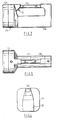
- FIG. 3 there are shown external views of a torch 118 comprising an integrally moulded body including a battery housing 120 and lamp housing 124.
- the battery housing 120 is rectangular in form as is also the lamp housing 124, though having radiused corners.
- the base of the battery housing 120 is continuous with the base of the lamp housing 124 and since both the battery housing 120 and lamp housing 124 are rectangular in section there is no tendency for the torch to roll.
- the lamp can be stood upright on both end without tipping, and also on the handle 122 without tipping.
- the lamp housing 124 includes a cover 126 together with a circular translucent protective closure 128 which locates in a recess 130 in the lamp housing 124.
- the contacts 24, 26 are located in the recess 130 as shown in Figure 7.
- a frangible conductive element 132 is shown and is arranged so that its ends contact the terminals 24 and 26.
Landscapes
- Engineering & Computer Science (AREA)
- General Engineering & Computer Science (AREA)
- Audible And Visible Signals (AREA)
- Arrangement Of Elements, Cooling, Sealing, Or The Like Of Lighting Devices (AREA)
- Secondary Cells (AREA)
Applications Claiming Priority (2)
| Application Number | Priority Date | Filing Date | Title |
|---|---|---|---|
| GB8821846A GB2222449B (en) | 1988-09-06 | 1988-09-06 | Improvements in or relating to search lamps and torches |
| GB8821846 | 1988-09-06 |
Publications (2)
| Publication Number | Publication Date |
|---|---|
| EP0358417A2 true EP0358417A2 (de) | 1990-03-14 |
| EP0358417A3 EP0358417A3 (de) | 1990-06-27 |
Family
ID=10643767
Family Applications (1)
| Application Number | Title | Priority Date | Filing Date |
|---|---|---|---|
| EP89308897A Withdrawn EP0358417A3 (de) | 1988-09-06 | 1989-09-01 | Handleuchten |
Country Status (5)
| Country | Link |
|---|---|
| US (1) | US5027035A (de) |
| EP (1) | EP0358417A3 (de) |
| CA (1) | CA1320939C (de) |
| DK (1) | DK437989A (de) |
| GB (1) | GB2222449B (de) |
Cited By (3)
| Publication number | Priority date | Publication date | Assignee | Title |
|---|---|---|---|---|
| WO1991019938A1 (de) * | 1990-06-20 | 1991-12-26 | Robert Bosch Gmbh | Scheinwerfer für kraftfahrzeuge |
| WO2008036250A1 (en) | 2006-09-19 | 2008-03-27 | Eveready Battery Company, Inc. | Intrinsically safe flashlight |
| US7550943B2 (en) | 2006-09-19 | 2009-06-23 | Eveready Battery Company, Inc. | Intrinsically safe battery-powered device |
Families Citing this family (8)
| Publication number | Priority date | Publication date | Assignee | Title |
|---|---|---|---|---|
| US5214353A (en) * | 1989-09-22 | 1993-05-25 | Nilssen Ole K | Flashlight with boost feature |
| KR100246211B1 (ko) * | 1991-03-20 | 2000-03-15 | 이데이 노부유끼 | 비디오 라이트장치 |
| US6291900B1 (en) | 1997-09-15 | 2001-09-18 | General Electric Company | Electrical energy management for manually powered devices |
| US7004598B2 (en) * | 2003-02-18 | 2006-02-28 | Cheerine Development (Hong Kong) Ltd. | Flashing light system with power selection |
| US7057354B2 (en) * | 2003-09-15 | 2006-06-06 | Cheerine Development (Hong Kong) Limited | Frequency controlled lighting system |
| US7067986B2 (en) * | 2003-09-15 | 2006-06-27 | Cheerine Development (Hong Kong) Limited | Frequency controlled lighting system |
| US7029140B2 (en) * | 2003-12-23 | 2006-04-18 | Cheerine Development (Hong Kong) Ltd. | Flashing light system with multiple voltages |
| US7207688B2 (en) * | 2005-08-18 | 2007-04-24 | Wong Wai Yuen | Interactive shoe light device |
Family Cites Families (5)
| Publication number | Priority date | Publication date | Assignee | Title |
|---|---|---|---|---|
| BE557021A (de) * | ||||
| DE220617C (de) * | 1909-06-22 | 1910-04-05 | ||
| US4039893A (en) * | 1976-03-22 | 1977-08-02 | General Electric Company | Discharge lamp having disconnect effective upon jacket failure |
| US4309745A (en) * | 1978-12-26 | 1982-01-05 | Zelina Jr John H | Reflector |
| US4455509A (en) * | 1983-05-16 | 1984-06-19 | Crum Stephen T | Intrinsically safe lighting system |
-
1988
- 1988-09-06 GB GB8821846A patent/GB2222449B/en not_active Expired - Fee Related
-
1989
- 1989-09-01 EP EP89308897A patent/EP0358417A3/de not_active Withdrawn
- 1989-09-05 DK DK437989A patent/DK437989A/da not_active Application Discontinuation
- 1989-09-06 US US07/403,408 patent/US5027035A/en not_active Expired - Fee Related
- 1989-09-06 CA CA000610458A patent/CA1320939C/en not_active Expired - Fee Related
Cited By (6)
| Publication number | Priority date | Publication date | Assignee | Title |
|---|---|---|---|---|
| WO1991019938A1 (de) * | 1990-06-20 | 1991-12-26 | Robert Bosch Gmbh | Scheinwerfer für kraftfahrzeuge |
| US5289352A (en) * | 1990-06-20 | 1994-02-22 | Robert Bosch Gmbh | Headlamp for motor vehicles |
| WO2008036250A1 (en) | 2006-09-19 | 2008-03-27 | Eveready Battery Company, Inc. | Intrinsically safe flashlight |
| US7550943B2 (en) | 2006-09-19 | 2009-06-23 | Eveready Battery Company, Inc. | Intrinsically safe battery-powered device |
| US7651239B2 (en) | 2006-09-19 | 2010-01-26 | Eveready Battery Co., Inc. | Intrinsically safe flashlight |
| EP2405180A3 (de) * | 2006-09-19 | 2013-11-20 | Eveready Battery Company, Inc. | Intrinsisch sicheres Blitzlicht |
Also Published As
| Publication number | Publication date |
|---|---|
| GB8821846D0 (en) | 1988-10-19 |
| EP0358417A3 (de) | 1990-06-27 |
| DK437989A (da) | 1990-03-07 |
| US5027035A (en) | 1991-06-25 |
| GB2222449A (en) | 1990-03-07 |
| DK437989D0 (da) | 1989-09-05 |
| CA1320939C (en) | 1993-08-03 |
| GB2222449B (en) | 1992-01-02 |
Similar Documents
| Publication | Publication Date | Title |
|---|---|---|
| US4150302A (en) | Emergency light battery charger circuit | |
| US6212054B1 (en) | Spark proof booster cable system | |
| EP0150911A2 (de) | Batterieanordnung mit elektronischer Strombegrenzung zur Versorgung eines elektrischen Verbrauchers | |
| US5027035A (en) | Search lamps and torches | |
| US4156891A (en) | Explosion-proof emergency light | |
| US4217534A (en) | Vehicle battery polarity indicator | |
| ES2132291T3 (es) | Dispositivo electronico, paquete de bateria y cargador para el paquete de bateria. | |
| US20090290333A1 (en) | Battery operated rechargeable light | |
| GB2135537A (en) | Emergency lighting apparatus | |
| KR840000818A (ko) | 자동 동력차단 기구를 가진 전자식 카메라 | |
| US4571533A (en) | Storage battery charging and monitoring apparatus | |
| US20050156578A1 (en) | System and method for detecting a reversed battery cell in a battery pack | |
| US4746853A (en) | Battery jumper cable assembly | |
| US3040211A (en) | Apparatus for indicating an electrically grounded condition | |
| US4536695A (en) | Discharging protection device for battery-operated portable electric light | |
| US5034726A (en) | Portable ground fault detector | |
| US3892182A (en) | Squib control circuit | |
| GB2312343A (en) | Mains powered alarm device with rechargeable battery backup | |
| JPH0714492A (ja) | 漏電表示付きコンセント | |
| KR100572052B1 (ko) | 냉음극 형광램프를 이용한 비상유도등의 작동감시회로 | |
| GB2046538A (en) | Time delay circuits for controlling lights | |
| KR0137233Y1 (ko) | 전기 발파기 | |
| JPH0526910Y2 (de) | ||
| CA2010661C (en) | Ground fault detector | |
| RU42131U1 (ru) | Устройство для определения полного заряда серебряно-цинковой аккумуляторной батареи |
Legal Events
| Date | Code | Title | Description |
|---|---|---|---|
| PUAI | Public reference made under article 153(3) epc to a published international application that has entered the european phase |
Free format text: ORIGINAL CODE: 0009012 |
|
| AK | Designated contracting states |
Kind code of ref document: A2 Designated state(s): AT BE CH DE ES FR GB GR IT LI LU NL SE |
|
| PUAL | Search report despatched |
Free format text: ORIGINAL CODE: 0009013 |
|
| AK | Designated contracting states |
Kind code of ref document: A3 Designated state(s): AT BE CH DE ES FR GB GR IT LI LU NL SE |
|
| 17P | Request for examination filed |
Effective date: 19901220 |
|
| 17Q | First examination report despatched |
Effective date: 19920826 |
|
| STAA | Information on the status of an ep patent application or granted ep patent |
Free format text: STATUS: THE APPLICATION IS DEEMED TO BE WITHDRAWN |
|
| 18D | Application deemed to be withdrawn |
Effective date: 19930929 |