EP0358496B2 - Radauswuchtvorrichtung mit Distanzmessvorrichtung - Google Patents
Radauswuchtvorrichtung mit Distanzmessvorrichtung Download PDFInfo
- Publication number
- EP0358496B2 EP0358496B2 EP89309050A EP89309050A EP0358496B2 EP 0358496 B2 EP0358496 B2 EP 0358496B2 EP 89309050 A EP89309050 A EP 89309050A EP 89309050 A EP89309050 A EP 89309050A EP 0358496 B2 EP0358496 B2 EP 0358496B2
- Authority
- EP
- European Patent Office
- Prior art keywords
- wheel
- radius
- hub
- distance
- balance weight
- Prior art date
- Legal status (The legal status is an assumption and is not a legal conclusion. Google has not performed a legal analysis and makes no representation as to the accuracy of the status listed.)
- Expired - Lifetime
Links
Images



Classifications
-
- G—PHYSICS
- G01—MEASURING; TESTING
- G01M—TESTING STATIC OR DYNAMIC BALANCE OF MACHINES OR STRUCTURES; TESTING OF STRUCTURES OR APPARATUS, NOT OTHERWISE PROVIDED FOR
- G01M1/00—Testing static or dynamic balance of machines or structures
- G01M1/02—Details of balancing machines or devices
Definitions
- the present invention relates to wheel balacing apparatus and to a method for determining the radius of a balance weight receiving location of a wheel from the rotational axis of the wheel, and the distance of the balance weight receiving location from a reference plane which extends transversely of the rotational axis of the wheel.
- vehicle wheel means a wheel of the type having a hub and a tyre mounted on the hub.
- the hub of such vehicle wheels would be of metal, although not necessarily.
- Spaced apart side walls extend radially outwardly from a hoop and terminate in a rim.
- the hoop and side walls form an annular recess for engaging the tyre.
- the side walls are referred to as an inner side wall and an outer side wall.
- the inner side wall is the side wall which in normal use faces inwardly of the vehicle, while the outer side wall faces outwardly of the vehicle.
- a central plate or spokes is provided within the hoop, and with the hoop form a hub well.
- the hoop defines the periphery of the well.
- Such wheels are balanced by attaching one or more balance weights to appropriate balance weight receiving locations.
- the balance weight locations are provided along the hub rim on the inside and/or outside of the wheel. Such weights attached to the hub rim abut the side wall of the hub adjacent the rim.
- balance weight receiving locations may be provided at the well periphery and such weights may be secured, for example, by adhesive to the hoop of the hub forming the hub well periphery.
- the apparatus of the invention is not limited to determining parameters of characteristics of such wheels.
- Wheel balancing apparatus will be well known to those skilled in the art.
- wheel balancing apparatus normally referred to as wheel balancers, comprise a main housing within which is rotatably mounted a wheel support shaft.
- a wheel to be balanced is mounted fast on the support shaft, which is then rotated.
- the support shaft may be rotated by a drive motor, or alternatively by hand, depending on the particular type of balancing apparatus.
- Transducers are provided associated with the support shaft and mountings of the shaft for sensing stresses and strains in the shaft and mountings for in turn determining the out of balance moment of the wheel and the angle through which it acts.
- wheel balancers are microprocessor controlled, and they present the data necessary for balancing the wheel on a visual display.
- the data displayed is the size of the balance weight required to correct the wheel imbalance and the angular position at which it should be mounted on the rim of the hub of the vehicle wheel, where the balance weight is to be hub mounted.
- wheel balancers give this information for the inside and outside of the hub rim. So that the size of weight required to correct the imbalance can be correctly determined, it is necessary for the peripheral diameter of the hub rim to be inputted into the microprocessor. It will be readily appreciated by those skilled in the art that the greater the hub rim diameter, the smaller the weight necessary to correct a given imbalance.
- the distance of either or both the inside and outside side walls of the hub adjacent the rim is required.
- the distance of the inside side wall from the reference plane and the. width of the hub across the side walls adjacent the hub rim is required.
- an operator of the wheel balancer it is necessary for an operator of the wheel balancer to input, generally through a keyboard or by setting programming knobs, the peripheral diameter of the hub rim which is being balanced and the width of the hub across the side walls adjacent the hub rim, and the distance of the inside side wall from the reference plane.
- the balance weights are to be affixed to the hub at other locations besides the rim, the radius of these locations and their distances from the reference plane must likewise be entered into the balancer.
- Attempts to overcome these problems have been made, however, in general, these attempts suffer from a number of disadvantages.
- such attempts have involved providing a wheel balancer with a device mounted on the wheel balancer to enable the radius of the hub rim and the width of the hub adjacent the rim as well as the distance of the inside and outside side walls of the hub adjacent the rim from a reference plane of the wheel balancer to be entered automatically in the wheel balancer.
- such devices comprise a feeler member which is mounted on the housing of the wheel balancer and is movable so that an end of the feeler member engages the hub rim.
- a potentiometer or potentiometers on the feeler member transmit an electrical signal proportional to the distance moved by the feeler member to suitable electronic circuitry.
- the circuitry computes the rim radius and width as well as distance from the reference plane from the transmitted signals.
- hub rims may be provided with a number of steps, and the operator may engage one of the steps adjacent the hub rim rather than the actual hub rim itself.
- a further problem with these devices is the fact that because they are essentially mechanically operated, they can wear relatively easily, thus causing backlash, which in turn leads to inaccurate results.
- the wheel balancer disclosed is British Patent Specification No. 2,130,386 comprises a device for determining the radius of the inner hub rim only and its distance from a reference plane.
- the device comprises a feeler member, one end of which is adapted for engaging the inner hub rim, and the other end is mounted on a shaft rotatable in mountings mounted on the wheel balancer housing.
- the shaft is mounted parallel to the rotational axis of the wheel support shaft and is also slidable longitudinally in the rotatable mountings.
- the feeler member and shaft are mold outwardly of the housing towards the wheel and the feeler member and shaft are pivoted until the feeler member engages the inner rim of the wheel.
- a potentiometer is connected to the shaft to monitor the longitudinal distance moved by the shaft when the feeler member is being brought into engagement with the hub rim to determine the distance of the hub rim from the reference plane and a second potentiometer is connected to the shaft to monitor the angular rotation of the shaft caused by pivoting the feeler member and shaft relative to the mountings to engage the rim. Signals from the two potentiometers are transmitted to suitable electronic circuitry for computing the radius of the inner rim and its distance from a reference plane.
- U.S. Patent Specification No. 3,741,016 discloses a wheel balancer with a device for determining the radius of the inner hub rim of the wheel and its distance from a reference plane which is substantially similar to the device of British Patent Specification No. 2,130,386. However, in the case of the device of the U.S. specification, an additional feeler member is provided for determining the distance of the outer hub rim of the wheel from the reference plane so that the width of the hub adjacent the rim may be computed.
- British Patent Specification No. 2,139,772 discloses a wheel balancer with a device for determining the radius and width of a hub rim.
- This device operates on a substantially similar principle to the device of British Patent Specification No. 2,130,386 with the exception that the shaft on which the feeler member is mounted is arranged in such a way that the shaft and feeler member may be moved outwardly of the wheel so that the feeler member is engagable with both the inner and outer hub rims for determining the width of the hub adjacent the rim as well as the radius of the rim.
- Italian Patent Specification No. 1,215,026 discloses a wheel balancer which also includes a device for inputting the hub rim radius and the distances of the hub rims from a reference plane. Ultrasonic transducers are provided on each side of a wheel for detecting the respective wheel rims.
- a wheel balancer which comprises an apparatus and method for determining the radius of one or more balance weight receiving locations of a vehicle wheel and for determining the distance of each balance weight receiving location from a reference plane.
- a wheel balancer which comprises an apparatus and method for determining the radius of the rim of a hub of a wheel and for determining the distance of a side wall of the hub adjacent the rim from a reference plane.
- the invention overcomes the problems of prior art devices by virtue of the fact that the invention provides wheel balancing apparatus of the type comprising a housing, a receiving means comprising a wheel support shaft rotatably mounted in the housing for receiving a wheel to be balanced, and defining the rotational axis of the wheel, a computing means for determining the imbalance of the wheel, and a sensing means for detecting the wheel and a balance weight receiving location, the sensing means being mounted on a mounting means, the mounting means being movable relative to the housing,wherein the sensing means is adapted to transmit and receive a signal for detecting the wheel and the balance weight receiving location, the sensing means being mounted on the mounting means for transmitting the signal towards a radial side face of the wheel from a predetermined position relative to the mounting means, and the mounting means is constrained to move in a predetermined path relative to the housing so that on movement of the mounting means relative to the housing the signal of the sensing means moves over portion of the radial side face of the wheel, a detecting means for
- the advantage of this feature of the invention is that the apparatus permits the radius and distance of the balance weight receiving location to be inputted directly into the wheel balancer without the need for human intervention, thereby virtually eliminating the possibility of error occuring, which has been a feature of apparatus known heretofore, where an operator had to manually key in or otherwise enter the radius and distance from a reference plane of the balance weight receiving location, and a further advantage of this feature of the invention is that it considerably reduces the labour content required to operate a wheel balancer and also the skill required to operate a wheel balancer.
- a further advantage of the invention is that it provides apparatus which is relatively easy to manufacture and use.
- a pair of sensing means are mounted on the mounting means so that on movement of the mounting means the signals of the sensing means move over portion of respective opposite sides of the wheel.
- the advantage of this feature of the invention is that it permits the distances of both sides of the wheel from a reference plane to be determined relatively easily and accurately.
- the detecting means comprises a transducer for monitoring the position of the mounting means, and each sensing means is provided by an ultrasonic sensor having an ultrasonic transmitter and receiver contained therein.
- the advantage of this feature of the invention is that it provides a device which is particularly accurate, easy to use and relatively easy to manufacture.
- the mounting means is provided by a framework having a pair of spaced apart side members, which in use receive portion of the wheel therebetween, the predetermined position and direction of the signal of the sensing means being fixed relative to respective side members of the framework.
- the predetermined positions from which the signal of the sensing means are transmitted are located on respective side members substantially opposing each other, the signals of the sensing means being transmitted towards the wheel in a direction substantially parallel to the rotational axis of the wheel, and the framework being movable so that the predetermined positions move in a substantially radial direction towards the rotational axis of the wheel.
- one predetermined position is slightly advanced of the other predetermined position in the direction of motion of the framework towards the rotational axis of the wheel.
- This feature of the invention provides a device which provides relatively accurate results, and also provides a device in which errors can be readily easily determined and recognised.
- the mounting means is pivotally mounted to the housing about a pivot axis, the pivot axis being parallel to and spaced apart from the rotational axis of the wheel, the pivot axis and rotational axis together defining a common plane.
- the means for storing reference parameters of reference wheels stores the cross sectional profile of at least portion of the reference wheels
- the computing means comprises means for computing a profile of portion of the wheel and comparing it with the reference profiles for determining at least the radius of the balance weight receiving location of the wheel.
- the advantage of this feature of the invention is that it provides a relatively accurate apparatus and also an apparatus which is relatively easy to use.
- each sensing means detects the periphery of the well of the hub of the wheel and the computing means stores distances of the surfaces of the radial sides of the wheel against corresponding values of radii at intervals on movement of the mounting means
- the computing means comprises means for computing the radius of the periphery of the well of the hub from the signals received from the sensing means and the detecting means, and means for adding a predetermined distance to the computed value of the radius of the periphery of the well for determining the radius of the balance weight receiving location, and means for looking up a stored value of distance of the surface of the or each radial side of the wheel from the reference plane, corresponding to the radius of the balance weight receiving location.
- the radius and distance of balance weight receiving locations on each side of the wheel are determined, the radius of each balance weight receiving location being the radius of the rim of the hub and the distance of each balance weight receiving location being the distance of a surface of a respective side wall of the hub adjacent the rim from the reference plane.
- This feature of the invention is that it eliminates the possibility of errors involved in manually entering the radius and distance from a reference plane of the balance weight locations and also significantly reduces the labour content and the skill required to operate a wheel balancer.
- the invention provides a method for determining the radius of a balance weight receiving location of a wheel from the rotational axis of the wheel and for determining the distance of the balance weight receiving location from a reference plane, using the apparatus according to the invention for use in computing the size of a balance weight, the method comprising the steps of:
- the advantage of this feature of the invention is that it provides a method for determining the radial position and distance from a reference plane of a balance weight receiving location on a vehicle wheel and the use of the method provides relatively accurate results.
- the method includes computing a profile of a cross section of at least portion of the wheel and comparing the computed profile with reference profiles of reference wheels to determine the type of wheel, each profile comprising a profile of a section of the wheel hub adjacent the well periphery of the hub, and the radius of two balance weight receiving locations and distances of two balance weight receiving locations from the reference plane are computed.
- the method further comprises the step of computing the radius of the periphery of the hub well from signals received from the sensing means and detecting means on one or both of the sensing means detecting a relatively large change in distance of the outer surface of a radial side of the hub from the reference plane, adding a predetermined distance corresponding to the difference between the rim radius of the hub and the well peripheral radius to the well peripheral radius to provide the radiusof the hub rim, looking up the stored values of the distances of the surfaces of the radial sides of the wheel from the reference plane corresponding to a radius of the side wall adjacent the hub rim.
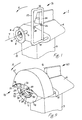
- the wheel balancer 1 comprises a ground engaging pedestal 3 portion of which is illustrated.
- a housing 4 is supported on the pedestal 3.
- a receiving means for receiving a rotatable member to be balanced namely a vehicle wheel 9 is provided by a wheel support shaft 5 rotatable about its central axis 7.
- the wheel support shaft 5 is rotatably mounted in a sub-housing 6 within the housing 4.
- a coupling plate 8 fast on the shaft 5 receives a wheel 9 for balancing so that the rotational axis of the wheel is co-axial with the rotational axis 7 of the shaft 5.
- Suitable transducers are mounted within the sub-housing 6 for sensing stresses and strains in the shaft 5 for determining the out of balance moment of the wheel 9 when it is rotated, see Fig. 3.
- the transducers relay the monitored values to a microprocessor 60 in the wheel balancer 1 which determines the weights and their angular positions required on the inside and outside of the wheel 9 to correct the imbalance.
- a visual display 14 in the housing 4 displays the size of the weights and their angular positions. This aspect of the electronic circuitry for determining the size of the weights and their angular position is not described in further detail, since it will be well known to those skilled in the art.
- the microprocessor 60 is illustrated in Fig. 8 which is described below.
- the wheel balancer 1 is of the type in which the wheel 9 and shaft 5 are rotated by hand, namely of the type disclosed in British Patent Specification No. 2,131,561B and will be well known to those skilled in the art.
- the wheel 9 comprises a hub 10 and tyre 11 mounted on the hub 10.
- An inside side wall 12 and an outside side wall 13 extend from a hoop 32 and form with the hoop 32 an annular recess 35 for receiving the tyre 11.
- the side walls 12 and 13 terminate in rims 15.
- a centre plate 36 within the hoop 32 forms a well 31 and defines a periphery 30 of the well 31.
- the inside radial face of the wheel 9 is indicated by the reference numeral 33 and the outside radial face of the wheel is indicated by the reference numeral 34. Balancing weights for correcting the imbalance in the wheel are secured to suitable balance weight receiving locations on the wheel hub. In the wheel 9 illustrated in Figs.
- the balance weights in general, are clipped on to the rim 15 of either or both the inside wall 12 and the outside wall 13 and in practice the weights abut tightly against outer surfaces 37 of the side walls 12 and 13.
- the radius of the rim 15 of the side walls 12 and 13 and the distances of the outer surfaces 37 of the side walls adjacent the rim 15 from a reference plane described below in the wheel balancer 1.
- other balance weight receiving locations are used.
- balance weights may be secured to the periphery of the hub well formed by the hoop 32.
- the balance weights are secured by adhesive to the hoop 32, generally a balance weight, if necessary, is provided on each side of the centre plate 36.
- Apparatus for determining the radius of a balance weight receiving location of the wheel 9 from the rotational axis 7 of the shaft 5 is indicated generally by the reference numeral 16 and is mounted in the housing 4.
- the apparatus determines the radius of the rim 15 from the rotational axis 7.
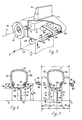
- the radius of the rim 15 from the rotational axis 7 of the shaft 5 is referred to as the radius R 1 , see Fig. 6.
- the apparatus 16 also determines the distance of the characteristic, namely, the balance weight receiving location from a reference plane.
- the apparatus determines the distance of the outer surfaces 37 of the inside side wall 12 and the outside side wall 13 of the hub 10 adjacent the rim 15 from the reference plane of the wheel balancer.
- the reference plane is a face 18 of the coupling plate 8.
- the width of the hub between the outer surfaces 37 of the side walls 12 and 13 adjacent the rim 15 is also determined. This width of the hub 10 adjacent the rim 15 is referred to as a, see Fig. 5.
- the apparatus 16 comprises a mounting means provided by a framework 17, which is constrained to move in a predetermined path relative to the housing.
- the framework 17 pivots in a predetermined path relative to the housing.
- the framework 17 comprises a main pivot member 19 which is pivotally mounted in the housing 4 by bearings 20 and which defines a pivot axis 21.
- the pivot member 19 and bearings 20 are so arranged that longitudinal sliding of the pivot shaft 19 relative to the housing 4 is prevented.
- a pair of side members 22 and 23 in a common plane extend radially from the pivot member 19 to, in use, pass on each side over portion of the radial sides 33 and 34 of the wheel 9 as the framework 17 is pivoted about its pivot axis 21.
- a cross member 24 joins the side members 22 and 23.
- the pivot axis 21 of the pivot member 19 is parallel to the rotational axis 7 of the shaft 5. Further, the two axes 7 and 21 define a common plane and are spaced apart from each other a distance greater than the maximum radius of the largest wheel 9 to be balanced. This can clearly be seen in Fig. 2. Accordingly, when the wheel 9 is mounted on the coupling plate 8 of the wheel balancer 1, the framework 17 can be pivoted downwardly over the wheel 9 in the direction of the arrow A.
- a pair of sensing means namely ultrasonic transducers 26 and 27 are mounted on the side members 22 and 23 for scanning respective radial sides 33 and 34 of the wheel 9 for detecting a characteristic of the wheel 9, in this case for detecting the periphery 30 of the wheel well 31 of the hub 10 as will be described below.
- Each ultrasonic transducer 26 and 27 comprises an ultrasonic transmitter and receiver, neither of which are illustrated.
- the transmitter and receiver of the transducers 26 and 27 direct and receive signals towards the sides 33 and 34 respectively of the wheel 9 from predetermined positions relative to the framework and in predetermined directions.
- the predetermined positions as can be seen are the positions of the transducers 26 and 27 on the side members 22 and 23 of the framework 17.
- the signals are directed in a predetermined direction which is parallel to the rotational axis 7 of the shaft 5.
- the signal from each transmitter strikes the wheel 9 substantially perpendicularly to the plane of the face 18 of the coupling plate 8.
- the output signal from the transducers 26 and 27 are proportional to their distances from the surfaces of the respective sides 33 and 34 of the wheel 9.
- the distance of the transducer 26 from the side 33 of the wheel 9 is referred to as distance x
- the corresponding distance of the transducer 27 from the side 34 is referred to as the distance y, see Fig. 5.
- the distance of the transducer 26 from the reference plane 18 is referred to as b 1 and the distance of the transducer 27 from the reference plane 18 is referred to as b 2 , see Fig. 5. Accordingly, the distance of any point on the surface of the inside 33 of the wheel 9 from the reference plane 18 is b 1 - x, and the distance from any point on the surface of the outside 34 of the wheel 9 from the reference plane 18 is b 2 - y, b 1 and b 2 being known.
- the width of any portion of the wheel 9 is c - x - y where c is the distance between the transducers 26 and 27 which in this case is 60 mm, see Fig. 5.
- the ultrasonic transducers 26 and 27 are mounted on the framework 17 at a distance d from the pivot axis 21 which is substantially equal to the distance e between the rotational axis 7 and the pivot axis 21, see Fig. 7.
- the transducers 26 and 27 move substantially radially towards or away from the rotational axis 7 of the shaft 5.
- the ultrasonic transducers 26 and 27 while they are directed towards each other are not totally aligned with each other, the transducer 26 is advanced a distance f of the transducer 27 in the direction of motion of the framework 17 as it pivots towards the rotational axis 7, see Fig. 4. In this case, the distance f is 10 mm.
- the angle which the ultrasonic transducer 26 defines with the common plane of the axes 7 and 21 about the pivot axis 21 is always slightly less than the equivalent angle of the ultrasonic transducer 27 for any given position of the framework 17. This enables the transducer 27 to confirm certain readings made by the transducer 26 as will be described below.
- Detecting means for detecting the angular position of the framework 7 about its axis 21 relative to the common plane of the axes 7 and 21 and in turn for detecting the angular position of the transducers 26 and 27 is provided by a rotary type potentiometer transducer 28 connected to the pivot member 19 by a semi-rigid band 29.
- the gear ratio between the transducer 28 and the pivot shaft 19 is 2:1 and accordingly the electrical output from the transducer 28 is proportional to K ⁇ 2 where
- Signals from the ultrasonic transducers 26 and 27 and the transducer 28 are fed into computing means, which is provided by the microprocessor 60 of the wheel balancer 1 through circuitry which is described below. Suitable software is provided in the microprocessor 60 for operating on the signals from the transducers 26, 27 and 28.
- the signals from the transducers 26, 27 and 28 are read and stored in storing means provided by memory in the microprocessor 60. In this case, a set of readings is taken at every 2° interval of movement of the framework 17 with the common plane of the axes 7 and 21. In other words, a reading is taken for every 2° change in the angle ⁇ .
- the read values of distances x and y from the transducers 26 and 27 respectively are stored against the corresponding angular position ⁇ of the framework read from the transducer 28.
- R 0 is constant for all hubs of a particular hub rim radius R 1 , and accordingly, the radius R 2 of the well periphery 30 is similarly constant for all hub rims of similar radius R 1 .
- the values of R 0 and R 2 are stored in memory for hubs of different radii R 1 . These are stored in a look up table in memory in the computer 60 so that the microprocessor 60, on determining the radius R 2 of the well periphery 30, can look up the appropriate value of R 0 .
- the microprocessor 60 adds the appropriate value of R 0 to the value of R 2 to obtain the radius R 1 of the rim 15 of the hub 10.
- the transducer 26 Since the ultrasonic transducer 26 is positioned advanced of the transducer 27, the transducer 26 detects the periphery 30 of the hub well 31 first. The angular position of the framework 17 detected by the transducer 28 at which the periphery 30 is detected by the transducer 26 is stored in memory. Further downward movement of the framework 17 over the wheel 9 brings the transducer 27 into alignment with the periphery 30 of the wheel well 31. Provided the transducer 27 detects the periphery 30 in a similar position allowing for the 10 mm offset between the two transducers 26 and 27, and within certain predetermined tolerance limits, the position of the periphery 30 is confirmed.
- the microprocessor 60 of the wheel balancing apparatus 1 under the control of the software determines the radius R 2 from the angular readings of the transducer 28 when the transducers 26 and 27 detected the periphery 30.
- the radius R 1 is then computed by adding the appropriate value of R 0 to R 2 .
- the angular positions of the transducers 26 and 27 which would correspond to the radius of the side walls 12 and 13 adjacent the rim 15, namely a radius just less than the radius R 1 , is then determined.
- the distances x and y of the transducers 26 and 27 from the wheel 9 stored against these particular angular values are read from the memory.
- the distances of the inside side wall 12 and outside side wall 13 of the hub 10 adjacent the rim 15 from the reference plane 18 are computed from the looked up values using the formulae b 1 - x 1 , b 2 - y 1 , respectively.
- the outer surfaces 37 of the inner and outer side walls 12 and 13 are substantially parallel.
- the values of x and y corresponding to an angular position of the framework 17 which corresponds to a radius halfway between the radii R 1 and R 2 may be obtained and will give a relatively accurate value for the values x 1 and y 1 .
- the value of ⁇ is computed by the microprocessor from the value of ⁇ obtained from the transducer 28 when either of the transducers 26 or 27 detect the point P by making an allowance for the known angular offsets of the transducers 26 and 27 from the angle ⁇ which the framework 17 makes with the common plane of the axes 7 and 21 about the pivot axis 21.
- the outputs from the transducers 26 and 27 are calibrated by each transducer 26 and 27 taking a distance reading off the other transducer 27 and 26 respectively. These readings correspond to the distance c between the transducers 26 and 27 which is stored in memory in the microprocessor of the apparatus 1.
- the microprocessor 60 of the apparatus 1 takes a reading from the output of each transducer corresponding to its distance from the other transducer for calibration prior to the framework 17 passing over the wheel 9.
- the distances of the transducers 26 and 27 from the reference plane 18 is periodically checked and calibrated. This is done by pivoting the frame-work 17 over the coupling plate 8 without a wheel being mounted thereon, and determining the distances b 1 and b 2 of the transducers 26 and 27 from the face 18 of the coupling plate 8 by taking readings from the transducers 26 and 27, on the transducer 28 giving a reading at which the transducers 26 and 27 would be aligned with the face 18 of the coupling plate 8.
- the new values of b 1 . and b 2 are stored in the memory of the microprocessor 60 of the wheel balancer 1.
- circuitry 61 associated with the transducer 26 and which connects the transducer 26 to the microprocessor 60 is illustrated. Similar circuitry is provided for the transducer 27.
- the circuit 61 comprises a transistor switching device 63 for switching the transducer 26 from transmit to receive.
- the switching device 63 is controlled by the microprocessor 60.
- a carrier signal generator, namely an oscillator 64 generates a carrier signal for delivery to the transducer 26 for transmission. In this case, the oscillator generates carrier signals at 200 KHz.
- the generated signals are delivered from the oscillator 64 through a gate 65 to an amplifier 66.
- the gate 65 is controlled by the microprocessor 60 through the line 72 to allow a pulse of determined length of the carrier signal through.
- the pulse from the gate 65 is amplified in the amplifier 66 and delivered to the transistor switch 63.
- the pulse signal is transmitted by the transducer 26.
- the transistor switch 63 is switched over by the microprocessor 60 to connect the transducer 26 to a tuned filter 67, so that the reflected signal received by the transducer 26 is fed into the tuned filter 67 which is tuned to deliver pulses at the same frequency as the carrier signal frequency, in this case 200 KHz.
- the filter delivers the filtered signal to an amplifier 68 where it is amplified and delivered to a signal conditioning unit 69.
- the conditioned signal is then delivered to a demodulation unit 70 which removes the carrier frequency, thus delivering a pulse to a delay measurement unit 71.
- the delay measuring unit 71 comprises a timing circuit (not shown) which times the time between the pulse signal being transmitted and it being received.
- the timing circuit in the unit 71 is activated to commence timing when a signal from the microprocessor appears on the line 72 to open the gate 65.
- the timer stops timing when a pulse is received from the demodulation unit 70.
- the time recorded by the unit 71 is read by the microprocessor 60 on the line 74.
- the distance of the wheel surface from which the signal was reflected to the transducer is then computed by the microprocessor 60 from the time value. This thus gives the value of x.
- This value of x is stored in memory of the microprocessor 60 against the corresponding value of ⁇ . Values of y and ⁇ are similarly computed and stored.
- the wheel 9 is mounted co-axially on the coupling plate 8 of the shaft 5.
- the wheel 9 is rotated by hand.
- the framework 17 is then pivoted downwardly in the direction of the arrow A to the position illustrated in Fig. 2.
- the radius R 1 of the rim 15 of the hub 10 and the distances x 1 and y 1 of the outer surfaces 37 of the inside side wall 12 and outside side wall 13 of the hub 10 from the reference plane 18 as well as the width a of the hub 10 across the side walls 12 and 13 adjacent the rim 15 are determined as already described. These values are stored in the memory of the microprocessor 60 of the wheel balancer 1.
- the stored values of R 1 , x 1 and y 1 are used by the microprocessor in computing the size of the weights for the inside and outside positions on the rim 15 under the control of the software.
- the values of the weights and their angular positions are displayed on the visual display 14.
- the wheel balances according to the invention substantially eliminates operator error, and furthermore substantially reduces the labour required to operate the wheel balancer 1.
- a wheel balancer according to another embodiment of the invention indicated generally by the reference numeral 40.
- This wheel balancer 40 is substantially similar to that just described, and similar components are identified by the same reference numerals.
- the wheel support shaft is driven by a motor (not shown) and a hood 41 is provided over the framework 17.
- a relay (not shown) which activates the drive motor of the wheel support shaft is activated by the hood as it is pivoted downwardly in the direction of the arrow A.
- the wheel support shaft drive motor is activated, thereby rotating the wheel 9.
- Further downward pivoting of the hood 40 over the wheel 9 causes the transducers 26 and 27 to pass over portion of the respective sides 33 and 34 of the wheel 9 as in the case of the apparatus 1.
- the apparatus 40 is similar to that of the apparatus 1.
- a framework 50 of apparatus also for mounting on a wheel balancer, such as the wheel balancer 1 for determining the hub rim radius R 1 and the distances of the outer surfaces 37 of the side walls 12 and 13 of the hub 10 adjacent the rim 15 from a reference plane of the wheel balancer.
- This apparatus is substantially similar to the apparatus 16, and only the framework 50 is illustrated.
- the framework 50 is substantially similar to the framework 17 and similar components are identified by the same reference numerals.
- the ultrasonic transducers 26 and 27 which are ultra sonic transducers similar to the transducers 26 and 27 on the framework 17 are mounted on the side members 22 and 23 respectively but towards the cross member 24.
- the transducers 26 and 27 are directed so that the signal transmitted by the two transducers 26 and 27 are directed substantially parallel to the side members 22 and 23.
- Focusing means in this case provided by focusing mirrors 53 and 54 on the side members 22 and 23 respectively, direct the signals illustrated by broken lines 55 fron the transducers 26 and 27 substantially parallel to the rotational axis 7 of the wheel balancer 1 and substantially perpendicular to the reference plane 18 towards the wheel 9.
- the focusing mirrors 53 and 54 are concave and circular having a diameter of approximately 6.35 mm and a radius r of curvature of approximately 35.56 mm.
- the mirrors 53 and 54 are mounted at an angle of 45° to the side members 22 and 23.
- the transducer 26 is mounted towards the bottom of the side member 22 as is the corresponding mirror 53, while the transducer 27 is mounted towards the top of the side member 23 as is the mirror 54. This thus gives the offset f.
- the focusing mirrors 53 and 54 form the predetermined position from which the signals are transmitted from the side members 22 and 23 towards the wheel 9. Further, the focusing mirrors 53 and 54 also determine the angle at which the signal is directed from the side members 22 and 23.
- the framework 50 is pivotally mounted on the wheel balancing apparatus 1 by the pivot member 19 in similar fashion to the framework 17 and accordingly operation of the framework 50 is similar to that of the framework 17.
- focusing mirrors 53 and 54 are used to focus the signals 55 from the transducers 26 and 27 and in turn the reflected signal from the wheel.
- the focused signals give a more precise reading than unfocused signals
- the distance travelled by the transmitted and reflected signals to and from the transducers 26 and 27 is greater than in the case of the transducers 26 and 27 of the framework 17 and this further gives more accurate results and also facilitates handling of the received signals from the transducers 26 and 27 by the circuitry of Fig. 8.
- the distances stored against corresponding angles 5 of the framework 17 have been the distances x and y of the transducers 26 and 27 from the sides 33 and 34 of the wheel 9, it will be appreciated that any distances may be stored. Indeed, it is envisaged in many cases that the distances stored may be the distances of the sides 33 and 34 of the wheel 9 from the reference plane 18.
- a cross sectional profile of a section through the wheel 9 may be computed.
- the cross sectional profile would at least include portion of the hub well and would extend through the side walls 12 and 13 of the hub to at least the rims 15 of the side walls 12 and 13.
- the storing means would store a plurality of known cross sectional profiles of reference hubs and/or wheels, and the computed profile would be compared with the stored profiles to determine the type of hub on the wheel balancer. Knowing the type of hub, the hub rim radius and the width of the hub across the outer surfaces of the inner and outer side walls could then be readily easily looked up.
- the distance of the other side wall could readily easily be computed from the width of the hub 10 across the side walls 12 and 13.
- the profile of the wheel in the wheel balancer is computed and compared with reference profiles, it is envisaged that the profiles would be compared using suitable curve fitting techniques. These will be well known to those skilled in the art.
- the apparatus will determine the radius of that location from the rotational axis of the wheel and will also determine the distance of that location from the reference plane. Where two locations are to be provided, both of different radii and different distances, the apparatus will compute the two radii and the two distances from the reference plane.
- the apparatus may add a constant equivalent to half the width of the balance weight onto the distances of the side walls of the hub from the reference plane to achieve an even more accurate result.
- the apparatus may subtract a constant equivalent to half the width of the balance weight from the distance of one or other of the side walls from the reference plane, depending on the position of the reference plane relative to the particular side wall or side walls. This, of course, will be well known and understood by those skilled in the art.
- a constant may be. added to or subtracted from the computed radius to compensate for the thickness of the balance weight
- the centre of the weight would not directly co-incide with the radius of the rim. Rather, to achieve a particularly accurate result, it would be necessary to deduct a constant from the rim radius to obtain the radius of the point through which the weight of the balance weight acted as the wheel rotated. In general, it is envisaged that by deducting half the thickness of the weight from the computed rim radius, an accurate radius for the point through which the weight of the balance weight acted would be obtained.
- the apparatus 16 could be used with any type of wheel balancer.
- the wheel balancer 1 may be of the type where the wheel support shaft is motor driven.
- other construction of apparatus 16 could be used without departing from the scope of the invention as claimed.
- the ultrasonic transducers may be mounted on any suitable mounting means besides a framework. Any suitable member, housing, frame or the like may be used. Indeed, it will be readily appreciated that it is not necessary for the framework 17 to be pivoted, it could be linearly movable upwardly or downwardly or from side to side, or indeed at any angle to traverse the ultrasonic transducers over the sides of the wheel.
- the radial position of the transducer can be determined.
- the sensing means should move radially relative to the rotational axis of the wheel.
- any point P on a wheel or any member can be readily easily determined by a single transducer, and in certain cases the distances of the inside and outside of the wheel or hub from a reference plane may be determined by a single transducer.
- the transducers 26 and 27 could if desired be aligned with each other rather than one being advanced relative to the other.
- the width of the wheel, and/or the width at the hub adjacent the hub rim could also be determined using a single ultra sonic or other type of transducer by providing suitable reflectors to give multiple reflections.
- sensing means other than ultrasonic transducers may be provided.
- the sensing means may be provided by any other suitable type of transducer, for example, an infra red transducer, laser transducer, a visible light transducer, magnetic transducer.
- readings of the distances x and y may be taken at any desired angular intervals other than 2°. Needless to say, for more precise results, the readings should be taken at smaller angular intervals.
- suitable drive means for example a motor or any other suitable drive could be provided for pivoting the framework 16 in the direction of the arrow A over the wheel and also in the return direction.
- wheel support shaft of the apparatus described with reference to Figs. 1 to 8 could similarly if desired be driven by a drive motor, and if desired, the apparatus of Fig. 9 could be provided by a manually rotatable wheel support shaft.
- the offset f between the transducers 26 and 27 has been described as being of 10 mm, it may be greater or less. Indeed, as mentioned above, the two transducers 26 and 27 may be completely aligned with each other. Alternatively, if desired the transducer 27 may be advanced of the transducer 26.
- the apparatus could be used for balancing wheels of any diameter from the smallest up to and larger than aircraft wheels, and of any other shape and construction besides the wheel just described.
- each transducer will comprise a single internal unit which will act as a receiver and transmitter.
- the apparatus could be used for determining the radial distance of any point on a rotatable member relative to its rotational axis. Further, the apparatus could be used for determining the width of any rotatable member or the width of any rotatable member at a particular point or position and/or the distance of any point on a rotatable member from a reference plane.
- the apparatus may be used for determining the radius and distance from a reference plane of a balance weight receiving location, where the balance weight is to be attached, for example, by adhesive to the periphery of the hub well formed by the hoop 32 of the hub 10.
- the apparatus has been used to determine the width of the hub, it will be readily apparent to those skilled in the art that it is not essential that the width of the hub should be determined.
- the distances of the inside and outside walls of the hub from a reference plane have been determined and the radius of the hub rim has been determined that is all that is necessary for automatic operation of the wheel balancer.
- the width of the hub would then be determined and inputted from the apparatus 16 into the wheel balancer 1.
- the wheel balancer 1 could then determine the distance of the other, namely the outside side wall from the reference plane.
Landscapes
- Physics & Mathematics (AREA)
- General Physics & Mathematics (AREA)
- Testing Of Balance (AREA)
- Length Measuring Devices With Unspecified Measuring Means (AREA)
- Length Measuring Devices Characterised By Use Of Acoustic Means (AREA)
- A Measuring Device Byusing Mechanical Method (AREA)
- Measurement Of Velocity Or Position Using Acoustic Or Ultrasonic Waves (AREA)
Claims (14)
- Radauswuchtvorrichtung der Art mit einem Gehäuse (4), einer Aufnahmevorrichtung (5, 8) mit einer im Gehäuse (4) drehbar gelagerten Radauflagewelle (5) zum Aufnehmen eines auszuwuchtenden Rades (9), welches die Drehachse (7) des Rades (9) bestimmt, einem Rechner (60) zum Ermitteln der Unwucht des Rades (9) und einem Fühler (26, 27) zum Erfassen des Rades (9) und einer ein Ausgleichsgewicht aufnehmenden Stelle (15), wobei der Fühler (26, 27) an einer Befestigungsvorrichtung (17) befestigt ist, die Befestigungsvorrichtung (17) in bezug auf das Gehäuse (4) bewegbar ist, wobei der Fühler (26, 27) dafür eingerichtet ist, ein Signal zum Erfassen des Rades (9) und der ein Ausgleichsgewicht aufnehmenden Stelle (15) zu übertragen und zu empfangen, wobei der Fühler (26, 27) an der Befestigungsvorrichtung (17) zum Übertragen des Signals zu einer radialen Seitenfläche (33, 34) des Rades (9) von einer vorbestimmten Stellung (26, 27, 53, 54) in bezug auf die Befestigungsvorrichtung (17) befestigt ist, und die Befestigungsvorrichtung (17) zwangsläufig auf einer vorbestimmten Bahn in bezug auf das Gehäuse (4) bewegbar ist, so daß sich aufgrund der Bewegung der Befestigungsvorrichtung (17) in bezug auf das Gehäuse (4) das Signal des Fühlers (26, 27) über einen Bereich der radialen Seitenfläche (33, 34) des Rades (9) bewegt, eine Erfassungseinrichtung (28) zum Erfassen der Stellung der Befestigungsvorrichtung (17) in bezug auf das Gehäuse (4) vorgesehen ist und der Rechner eine Speichereinrichtung aufweist zum Speichern von vom Fühler (26, 27) empfangenen Ausgangssignalen, die Abständen der radialen Seitenfläche (33, 34) des Rades (9) von einer Bezugsebene (18) entsprechen, die sich quer zur Drehachse (7) erstreckt, gegenüber in vorbestimmten Intervallen bei Bewegung der Befestigungsvorrichtung (17) empfangenen entsprechenden Ausgangssignalen, der Rechner (60) eine Einrichtung zum Speichern von Bezugsparametern von Bezugsrädern und eine Einrichtung zum Berechnen entsprechender Parameter des Rades (9) aus den in der Speichereinrichtung gespeicherten Ausgangssignalen von dem Fühler (26, 27) und der Erfassungseinrichtung (28) und eine Einrichtung zum Vergleichen der berechneten Parameter des Rades (9) mit den Bezugsparametern der Bezugsräder aufweist, um den Reifentyp des Rades (9) zu bestimmen und aus den Bezugsparametern den radialen Abstand (R1) der ein Ausgleichsgewicht aufnehmenden Stelle (15) von der Drehachse (7) zu bestimmen, und wobei der Rechner aus den vom Fühler empfangenen und in der Speichereinrichtung gespeicherten Ausgangssignalen den Abstand (x1, y1) der ein Ausgleichsgewicht aufnehmenden Stelle (15) von der Bezugsebene (18) berechnete wobei die berechneten Werte des radialen Abstandes (R1) und des Abstandes (x1, y1) von der Bezugsebene (18) vom Rechner (60) beim Berechnen der Größe der Ausgleichsgewichte verwendet werden.
- Vorrichtung nach Anspruch 1, dadurch gekennzeichnet, daß an der Befestigungsvorrichtung (17) zwei Fühler (26, 27) befestigt sind, so daß sich bei Bewegung der Befestigungsvorrichtung (17) die Signale der Fühler (26, 27) über einen Bereich der entsprechenden gegenüberliegenden radialen Seitenflächen (33, 34) des Rades (9) bewegen.
- Vorrichtung nach Anspruch 2, dadurch gekennzeichnet, daß die Befestigungsvorrichtung (17) ein Gestell (17) mit zwei voneinander beabstandeten Seitenteilen (22, 23) ist, die bei Gebrauch einen Teil des Rades (9) zwischen sich aufnehmen, wobei die vorbestimmte Stellung (26, 27, 53, 54) und Richtung des Signals der Fühler (26, 27) in bezug auf jeweilige Seitenteile (22, 23) des Gestells (17) fixiert sind.
- Vorrichtung nach Anspruch 3, dadurch gekennzeichnet, daß die vorbestimmten Stellungen (26, 27, 53, 54), aus denen die Signale der Fühler (26, 27) übertragen werden, auf den jeweiligen, im wesentlichen einander gegenüberliegenden Seitenteilen (22, 23) liegen, wobei die Signale der Fühler (26, 27) zum Rad (9) in einer zur Drehachse (7) des Rades (9) im wesentlichen parallelen Richtung übertragen werden und das Gestell (17) so bewegbar ist, daß sich die vorbestimmten Stellungen (26, 27, 53, 54) in einer zur Drehachse (7) des Rades (9) im wesentlichen radialen Richtung bewegen.
- Vorrichtung nach einem der Ansprüche 2 bis 4, dadurch gekennzeichnet, daß eine vorbestimmte Stellung (26, 53) zu der anderen vorbestimmten Stellung (27, 54) in der Bewegungsrichtung des Gestells (17) zur Drehachse (7) des Rades (9) leicht vorgesetzt ist.
- Vorrichtung nach einem der vorhergehenden Ansprüche, dadurch gekennzeichnet, daß die Befestigungsvorrichtung (17) über eine Schwenkachse (21) am Gehäuse (4) schwenkbar befestigt ist, wobei die schwenkachse (21) parallel und von der Drehachse (7) des Rades (9) beabstandet angeordnet ist, wobei die Schwenkachse (21) und Drehachse (7) zusammen eine gemeinsame Ebene bestimmen.
- Vorrichtung nach einem der vorhergehenden Ansprüche, dadurch gekennzeichnet, daß die Erfassungseinrichtung (28) einen Wandler (28) zum Überwachen der Stellung der Befestigungsvorrichtung (17) aufweist.
- Vorrichtung nach einem der vorhergehenden Ansprüche, dadurch gekennzeichnet, daß jeder Fühler (26, 27) ein Ultraschallfühler (26, 27) mit darin enthaltenem Ultraschallsender und -empfänger ist.
- Vorrichtung nach einem der vorhergehenden Ansprüche, dadurch gekennzeichnet, daß die Einrichtung zum Speichern von Bezugsparametern von Bezugsrädern das Querschnittsprofil zumindest eines Teils der Bezugsräder speichert und der Rechner (60) eine Einrichtung (60) zum Berechnen eines Profils eines Teils des Rades (9) und für dessen Vergleich mit den Bezugsprofilen aufweist, um zumindest den Radius der das Ausgleichsgewicht aufnehmenden Stelle (15) des Rades (9) zu bestimmen.
- Vorrichtung nach einem der Ansprüche 1 bis 8, dadurch gekennzeichnet, daß jeder Fühler (26, 27) den Umfang (30) eines Bettes (31) einer Nabe (10) des Rades (9) erfaßt und der Rechner (60) Abstände der Oberflächen (37) von Seitenwänden (12, 13) des Rades (9) gegenüber entsprechenden Werten von Radien in Intervallen bei Bewegung der Befestigungsvorrichtung (17) speichert und der Rechner (60) eine Einrichtung zum Berechnen des Radius (R2) des Umfangs (30) des Bettes (31) der Nabe (10) aus den von den Fühlern (26, 27) und der Erfassungseinrichtung (28) empfangenen Signalen und eine Einrichtung (60) zum Addieren eines vorbestimmten Abstandes (R0) zum berechneten Wert des Radius (R2) des Umfanges (30) des Bettes (31) zum Bestimmen des Radius (R1) der das Ausgleichsgewicht aufnehmenden Stelle sowie eine Einrichtung zum Suchen eines gespeicherten Abstandswertes der Oberfläche (37) der oder jeder Seitenwand (12, 13) des Rades (9) von der Bezugsebene (18) entsprechend dem Radius (R1) der das Ausgleichsgewicht aufnehmenden Stelle aufweist.
- Vorrichtung nach einem der vorhergehenden Ansprüche, dadurch gekennzeichnet, daß der Radius und der Abstand der das Ausgleichsgewicht aufnehmenden Stellen (15) auf jeder Seite des Rades (9) bestimmt werden, wobei der Radius jeder das Ausgleichsgewicht aufnehmenden stelle (15) der Radius (R1) der Felge (15) der Nabe (10) ist und der Abstand jeder das Ausgleichsgewicht aufnehmenden Stelle (15) der Abstand einer Oberfläche (37) einer jeweiligen Seitenwand (12, 13) der Nabe (10) angrenzend an die Felge (15) von der Bezugsebene (18) ist.
- Verfahren zum Bestimmen des Radius einer das Ausgleichsgewicht aufnehmenden stelle (15) eines Rades (9) von der Drehachse (7) des Rades (9) und zum Bestimmen des Abstands der das Ausgleichsgewicht aufnehmenden Stelle (15) von einer Bezugsebene (18) unter Verwendung der Vorrichtung (16) nach einem der Ansprüche 1 bis 11 zum Gebrauch beim Berechnen der Größe eines Ausgleichgewichts, wobei das Verfahren die folgenden Schritte umfaßt:Bewegen der Befestigungsvorrichtung (17), so daß sich die Signale der Fühler (26, 27) über wenigstens einen Teil der radialen Seiten (33, 34) des Rades (9) bewegen,Aufzeichnen und Speichern der Abstände der Oberfläche (37) eines Teils jeder radialen Seite (33, 34) des Rades (9) von der Bezugsebene (18) gegenüber den entsprechenden Stellungen der Befestigungsvorrichtung (17) in einer Vielzahl verschiedener Stellungen der Befestigungsvorrichtung (17) in Intervallen, während die Befestigungsvorrichtung (17) bewegt wird,Vergleichen einiger der gespeicherten Werte gegenüber Bezugsparametern von Bezugsrädern zum Bestimmen des Reifentyps und zum Bestimmen des Radius (R1) der das Ausgleichsgewicht aufnehmenden Stelle (15) aus den Bezugsparametern,Bestimmen des Abstands der Stelle (12, 13) von der Bezugsebene (18) von wenigstens einigen der gespeicherten Werte der von den Fühlern empfangenen Ausgangssignale, undBerechnen der Größe des Ausgleichsgewichts aus dem berechneten radialen Abstand (R1) und dem Abstand von der Bezugsebene (18).
- Verfahren nach Anspruch 12, dadurch gekennzeichnet, daß , das Verfahren die Berechnung eines Profils eines Querschnitts wenigstens eines Teils des Rades (9) und den Vergleich des berechneten Profils mit Bezugsprofilen von Bezugsrädern zur Bestimmung des Typs eines Reifens (9) umfaßt, wobei das berechnete Profil ein Profil eines Schnitts einer Radnabe (10) angrenzend an einen Bettumfang (30) der Nabe (10) des Rades (9) aufweist, und der Radius von zwei das Ausgleichsgewicht aufnehmenden Stellen (15) und der Abstand (12, 13) der beiden das Ausgleichsgewicht aufnehmenden Stellen (15) von der Bezugsebene (18) berechnet werden.
- Verfahren nach Anspruch 12, dadurch gekennzeichnet, daß das Verfahren weiterhin aufweist den Schritt des Berechnens des Radius (R2) eines Umfangs (30) eines Nabenbettes (31) des Rades (9) aus von den Fühlern (26, 27) und der Erfassungseinrichtung (28) empfangenen Signalen, wenn einer der oder beide Fühler (26, 27) eine relativ große Änderung des Abstands der Außenfläche einer radialen Seite (33, 34) der Nabe (10) von der Bezugsebene (18) erfaßt oder erfassen, des Addierens eines vorbestimmten Abstands (R0) entsprechend der Differenz zwischen dem Felgenradius (R1) der Nabe (10) und dem Umfangsradius (R2) des Bettes, um den Radius (R1) der Nabenfelge (15) zu liefern, und des Suchens der gespeicherten Werte der Abstände der Oberflächen der radialen Seiten (33, 34) des Rades (9) von der Bezugsebene (18) entsprechend einem Radius (R1) der Seitenwand (12, 13) angrenzend an die Nabenfelge (15).
Applications Claiming Priority (4)
| Application Number | Priority Date | Filing Date | Title |
|---|---|---|---|
| IE269488 | 1988-09-07 | ||
| IE269488A IE67342B1 (en) | 1988-09-07 | 1988-09-07 | Wheel measuring apparatus and wheel balancer incorporating same |
| IE273488 | 1988-09-09 | ||
| IE273488 | 1988-09-09 |
Publications (4)
| Publication Number | Publication Date |
|---|---|
| EP0358496A2 EP0358496A2 (de) | 1990-03-14 |
| EP0358496A3 EP0358496A3 (de) | 1991-08-28 |
| EP0358496B1 EP0358496B1 (de) | 1995-02-22 |
| EP0358496B2 true EP0358496B2 (de) | 2001-05-30 |
Family
ID=26319293
Family Applications (1)
| Application Number | Title | Priority Date | Filing Date |
|---|---|---|---|
| EP89309050A Expired - Lifetime EP0358496B2 (de) | 1988-09-07 | 1989-09-06 | Radauswuchtvorrichtung mit Distanzmessvorrichtung |
Country Status (6)
| Country | Link |
|---|---|
| EP (1) | EP0358496B2 (de) |
| AT (1) | ATE118883T1 (de) |
| AU (1) | AU625780B2 (de) |
| DE (1) | DE68921271T3 (de) |
| ES (1) | ES2070908T5 (de) |
| IE (1) | IE67342B1 (de) |
Families Citing this family (12)
| Publication number | Priority date | Publication date | Assignee | Title |
|---|---|---|---|---|
| US5377542A (en) * | 1992-09-04 | 1995-01-03 | Fmc Corporation | Wheel balancer apparatus and method |
| DE4432025B4 (de) * | 1994-09-08 | 2005-03-10 | Beissbarth Gmbh | Wuchtmaschine |
| DE4432016B4 (de) * | 1994-09-08 | 2005-06-02 | Beissbarth Gmbh | Verfahren und Vorrichtung zum Auswuchten eines Rades |
| DE19805779A1 (de) | 1998-02-12 | 1999-08-19 | Hofmann Werkstatt Technik | Verfahren und Vorrichtung zur Bestimmung der Einpreßtiefe eines Reifens an einem Scheibenrad eines Kraftfahrzeugs |
| FR2774742B1 (fr) * | 1998-02-12 | 2000-05-05 | Facom | Organe de protection rabattable et equilibreuse de roue le comportant |
| DE19827247A1 (de) * | 1998-06-18 | 2000-01-05 | Hofmann Werkstatt Technik | Verfahren und Vorrichtung zum Auswuchten eines aus Luftreifen und Scheibenrad bestehenden Kraftfahrzeugrades |
| EP1557655B1 (de) * | 2004-01-26 | 2007-06-20 | Snap-on Equipment Srl a unico socio. | Verfahren und Vorrichtung zum Auswuchten eines Fahrzeugrades |
| EP2060895B1 (de) | 2007-11-19 | 2012-01-18 | Snap-on Equipment Srl a unico socio | Radabdeckung für eine Radauswuchtungsvorrichtung |
| EP2360461B1 (de) | 2010-02-24 | 2016-08-31 | Snap-on Equipment Srl a unico socio | Procédé et appareil pour déterminer les dimensions géométriques d'une roue |
| CN113218277A (zh) * | 2021-03-30 | 2021-08-06 | 嘉兴逸合盛制冷科技有限公司 | 一种可提高汽车检测设备检测精度的装置 |
| IT202100018713A1 (it) | 2021-07-16 | 2023-01-16 | Snap On Equip Srl Unico Socio | Metodo e apparato per determinare le dimensioni geometriche di una ruota |
| CN115248009A (zh) * | 2022-07-15 | 2022-10-28 | 广州广电计量检测股份有限公司 | 一种车轮静力半径的测量装置、方法及系统 |
Citations (3)
| Publication number | Priority date | Publication date | Assignee | Title |
|---|---|---|---|---|
| US3714016A (en) † | 1969-02-05 | 1973-01-30 | Kolene Corp | Aluminum shield for a roll in continuous strip apparatus |
| FR2323139A1 (fr) † | 1975-09-04 | 1977-04-01 | Dunlop Ltd | Appareil destine a etre utilise pour equilibrer des roues |
| DE3101843A1 (de) † | 1981-01-21 | 1982-08-05 | A. Rohé GmbH, 6050 Offenbach | Auswuchtmaschine fuer kraftfahrzeugraeder |
Family Cites Families (4)
| Publication number | Priority date | Publication date | Assignee | Title |
|---|---|---|---|---|
| DE2001972C3 (de) * | 1970-01-16 | 1973-11-22 | Maschinenfabrik Dionys Hofmann Gmbh, 7477 Onstmettingen | Auswuchtmaschine fur Kraftfahr zeugrader |
| IT1198594B (it) * | 1983-05-06 | 1988-12-21 | Fabio Boni | Apparecchiature per l'equilibramento di ruote con copertone pneumatico |
| DE3638158A1 (de) * | 1986-11-08 | 1988-05-11 | Schenck Ag Carl | Unwuchtmessstation |
| EP0267325A1 (de) * | 1986-11-12 | 1988-05-18 | International Flavors & Fragrances IFF (Deutschland) Gesellschaft mit beschränkter Haftung | Verfahren zu Herstellung von Obst-, Gemüse- oder Gewürzschaumspeisen |
-
1988
- 1988-09-07 IE IE269488A patent/IE67342B1/en not_active IP Right Cessation
-
1989
- 1989-09-06 ES ES89309050T patent/ES2070908T5/es not_active Expired - Lifetime
- 1989-09-06 EP EP89309050A patent/EP0358496B2/de not_active Expired - Lifetime
- 1989-09-06 AU AU41122/89A patent/AU625780B2/en not_active Expired
- 1989-09-06 DE DE68921271T patent/DE68921271T3/de not_active Expired - Lifetime
- 1989-09-06 AT AT89309050T patent/ATE118883T1/de not_active IP Right Cessation
Patent Citations (3)
| Publication number | Priority date | Publication date | Assignee | Title |
|---|---|---|---|---|
| US3714016A (en) † | 1969-02-05 | 1973-01-30 | Kolene Corp | Aluminum shield for a roll in continuous strip apparatus |
| FR2323139A1 (fr) † | 1975-09-04 | 1977-04-01 | Dunlop Ltd | Appareil destine a etre utilise pour equilibrer des roues |
| DE3101843A1 (de) † | 1981-01-21 | 1982-08-05 | A. Rohé GmbH, 6050 Offenbach | Auswuchtmaschine fuer kraftfahrzeugraeder |
Also Published As
| Publication number | Publication date |
|---|---|
| ES2070908T3 (es) | 1995-06-16 |
| DE68921271D1 (de) | 1995-03-30 |
| EP0358496A3 (de) | 1991-08-28 |
| AU625780B2 (en) | 1992-07-16 |
| ES2070908T5 (es) | 2001-10-16 |
| IE67342B1 (en) | 1996-03-20 |
| DE68921271T2 (de) | 1995-08-03 |
| AU4112289A (en) | 1990-03-15 |
| EP0358496A2 (de) | 1990-03-14 |
| DE68921271T3 (de) | 2001-12-06 |
| EP0358496B1 (de) | 1995-02-22 |
| ATE118883T1 (de) | 1995-03-15 |
Similar Documents
| Publication | Publication Date | Title |
|---|---|---|
| US5189912A (en) | Ultrasonic wheel measuring apparatus and wheel balancer incorporating same | |
| EP0358496B2 (de) | Radauswuchtvorrichtung mit Distanzmessvorrichtung | |
| US5563342A (en) | Vehicle wheel balancing machine having sensing means for sensing geometrical data of the wheel | |
| EP0925489B2 (de) | Radauswuchtvorrichtung | |
| US5531030A (en) | Self-calibrating wheel alignment apparatus and method | |
| US6484574B1 (en) | Wheel balancer apparatus with improved imbalance correction weight positioning | |
| US4046017A (en) | Wheel balancing apparatus | |
| US5479079A (en) | Apparatus and method for controlling robot travel | |
| US4097157A (en) | Vehicle wheel aligner for measuring front wheel toe with respect to the rear wheel axis of rotation | |
| US4718759A (en) | Apparatus for the alignment and balance of the wheels of a motor vehicle | |
| US7191651B2 (en) | Vehicle wheel balancer system with projection display | |
| US5247839A (en) | Torsion angle detection apparatus and torque sensor | |
| EP0735356B1 (de) | Verfahren und Vorrichtung zum Auswuchten von Fahrzeugrädern mittels Auswucht-Gewichten | |
| US4759217A (en) | Process and apparatus for balancing a vehicle wheel | |
| US5243766A (en) | Wheel alignment measurement system | |
| US5723767A (en) | Method of calibrating a wheel balancer parameter entry device | |
| US4094198A (en) | Machine for balancing a body of revolution | |
| WO2003074330A2 (en) | Gear mechanism for use in controlling vehicle rear-view mirrors and measuring angular deflection of an articulated trailer relative to the tractor | |
| US5475395A (en) | Reflecting mirror-equipped GPS receiving antenna apparatus | |
| US4620092A (en) | Elevation angle measuring device with apparatus for disabling the device when its inclination angle is offset from a predetermined inclination angle | |
| JPH0755436A (ja) | テールクリアランス計測方法及び装置 | |
| JP3369958B2 (ja) | 回転軸のねじれ計測装置及び計測方法 | |
| JPH041344Y2 (de) | ||
| AU637876B2 (en) | Reflecting mirror-equipped gps receiving antenna apparatus | |
| JP2721361B2 (ja) | 回転体のバランス調整装置 |
Legal Events
| Date | Code | Title | Description |
|---|---|---|---|
| PUAI | Public reference made under article 153(3) epc to a published international application that has entered the european phase |
Free format text: ORIGINAL CODE: 0009012 |
|
| AK | Designated contracting states |
Kind code of ref document: A2 Designated state(s): AT BE CH DE ES FR GB GR IT LI LU NL SE |
|
| PUAL | Search report despatched |
Free format text: ORIGINAL CODE: 0009013 |
|
| AK | Designated contracting states |
Kind code of ref document: A3 Designated state(s): AT BE CH DE ES FR GB GR IT LI LU NL SE |
|
| 17P | Request for examination filed |
Effective date: 19920207 |
|
| RAP1 | Party data changed (applicant data changed or rights of an application transferred) |
Owner name: INTERBALCO AG |
|
| 17Q | First examination report despatched |
Effective date: 19930215 |
|
| GRAA | (expected) grant |
Free format text: ORIGINAL CODE: 0009210 |
|
| AK | Designated contracting states |
Kind code of ref document: B1 Designated state(s): AT BE CH DE ES FR GB GR IT LI LU NL SE |
|
| PG25 | Lapsed in a contracting state [announced via postgrant information from national office to epo] |
Ref country code: BE Effective date: 19950222 Ref country code: CH Effective date: 19950222 Ref country code: GR Free format text: LAPSE BECAUSE OF FAILURE TO SUBMIT A TRANSLATION OF THE DESCRIPTION OR TO PAY THE FEE WITHIN THE PRESCRIBED TIME-LIMIT Effective date: 19950222 Ref country code: LI Effective date: 19950222 Ref country code: AT Effective date: 19950222 |
|
| REF | Corresponds to: |
Ref document number: 118883 Country of ref document: AT Date of ref document: 19950315 Kind code of ref document: T |
|
| REF | Corresponds to: |
Ref document number: 68921271 Country of ref document: DE Date of ref document: 19950330 |
|
| ET | Fr: translation filed | ||
| ITF | It: translation for a ep patent filed | ||
| PG25 | Lapsed in a contracting state [announced via postgrant information from national office to epo] |
Ref country code: SE Effective date: 19950522 |
|
| REG | Reference to a national code |
Ref country code: CH Ref legal event code: PL |
|
| REG | Reference to a national code |
Ref country code: ES Ref legal event code: FG2A Ref document number: 2070908 Country of ref document: ES Kind code of ref document: T3 |
|
| PG25 | Lapsed in a contracting state [announced via postgrant information from national office to epo] |
Ref country code: LU Free format text: LAPSE BECAUSE OF NON-PAYMENT OF DUE FEES Effective date: 19950930 |
|
| PLBI | Opposition filed |
Free format text: ORIGINAL CODE: 0009260 |
|
| PLBF | Reply of patent proprietor to notice(s) of opposition |
Free format text: ORIGINAL CODE: EPIDOS OBSO |
|
| 26 | Opposition filed |
Opponent name: HOFMANN WERKSTATT-TECHNIK GMBH Effective date: 19951122 Opponent name: CARL SCHENCK AG Effective date: 19951122 |
|
| PLBF | Reply of patent proprietor to notice(s) of opposition |
Free format text: ORIGINAL CODE: EPIDOS OBSO |
|
| NLR1 | Nl: opposition has been filed with the epo |
Opponent name: CARL SCHENCK AG Opponent name: HOFMANN WERKSTATT-TECHNIK GMBH |
|
| PLBF | Reply of patent proprietor to notice(s) of opposition |
Free format text: ORIGINAL CODE: EPIDOS OBSO |
|
| PLBF | Reply of patent proprietor to notice(s) of opposition |
Free format text: ORIGINAL CODE: EPIDOS OBSO |
|
| PLBF | Reply of patent proprietor to notice(s) of opposition |
Free format text: ORIGINAL CODE: EPIDOS OBSO |
|
| PLBF | Reply of patent proprietor to notice(s) of opposition |
Free format text: ORIGINAL CODE: EPIDOS OBSO |
|
| PLBF | Reply of patent proprietor to notice(s) of opposition |
Free format text: ORIGINAL CODE: EPIDOS OBSO |
|
| RDAH | Patent revoked |
Free format text: ORIGINAL CODE: EPIDOS REVO |
|
| APAC | Appeal dossier modified |
Free format text: ORIGINAL CODE: EPIDOS NOAPO |
|
| APAE | Appeal reference modified |
Free format text: ORIGINAL CODE: EPIDOS REFNO |
|
| APAC | Appeal dossier modified |
Free format text: ORIGINAL CODE: EPIDOS NOAPO |
|
| PLBQ | Unpublished change to opponent data |
Free format text: ORIGINAL CODE: EPIDOS OPPO |
|
| PLAB | Opposition data, opponent's data or that of the opponent's representative modified |
Free format text: ORIGINAL CODE: 0009299OPPO |
|
| R26 | Opposition filed (corrected) |
Opponent name: CARL SCHENCK AG * 951122 HOFMANN WERKSTATT-TECHNIK Effective date: 19951122 |
|
| NLR1 | Nl: opposition has been filed with the epo |
Opponent name: CARL SCHENCK AG Opponent name: HOFMANN WERKSTATT-TECHNIK GMBH |
|
| APAC | Appeal dossier modified |
Free format text: ORIGINAL CODE: EPIDOS NOAPO |
|
| PLAW | Interlocutory decision in opposition |
Free format text: ORIGINAL CODE: EPIDOS IDOP |
|
| PLAW | Interlocutory decision in opposition |
Free format text: ORIGINAL CODE: EPIDOS IDOP |
|
| PUAH | Patent maintained in amended form |
Free format text: ORIGINAL CODE: 0009272 |
|
| STAA | Information on the status of an ep patent application or granted ep patent |
Free format text: STATUS: PATENT MAINTAINED AS AMENDED |
|
| 27A | Patent maintained in amended form |
Effective date: 20010530 |
|
| AK | Designated contracting states |
Kind code of ref document: B2 Designated state(s): AT BE CH DE ES FR GB GR IT LI LU NL SE |
|
| NLR2 | Nl: decision of opposition | ||
| ITF | It: translation for a ep patent filed | ||
| ET3 | Fr: translation filed ** decision concerning opposition | ||
| REG | Reference to a national code |
Ref country code: ES Ref legal event code: DC2A Kind code of ref document: T5 Effective date: 20010829 |
|
| NLR3 | Nl: receipt of modified translations in the netherlands language after an opposition procedure | ||
| REG | Reference to a national code |
Ref country code: GB Ref legal event code: IF02 |
|
| APAH | Appeal reference modified |
Free format text: ORIGINAL CODE: EPIDOSCREFNO |
|
| PGFP | Annual fee paid to national office [announced via postgrant information from national office to epo] |
Ref country code: ES Payment date: 20080926 Year of fee payment: 20 |
|
| PGFP | Annual fee paid to national office [announced via postgrant information from national office to epo] |
Ref country code: FR Payment date: 20080917 Year of fee payment: 20 Ref country code: NL Payment date: 20080924 Year of fee payment: 20 |
|
| PGFP | Annual fee paid to national office [announced via postgrant information from national office to epo] |
Ref country code: GB Payment date: 20080929 Year of fee payment: 20 |
|
| PGFP | Annual fee paid to national office [announced via postgrant information from national office to epo] |
Ref country code: DE Payment date: 20081031 Year of fee payment: 20 |
|
| PGFP | Annual fee paid to national office [announced via postgrant information from national office to epo] |
Ref country code: IT Payment date: 20080929 Year of fee payment: 20 |
|
| REG | Reference to a national code |
Ref country code: GB Ref legal event code: PE20 Expiry date: 20090905 |
|
| NLV7 | Nl: ceased due to reaching the maximum lifetime of a patent |
Effective date: 20090906 |
|
| REG | Reference to a national code |
Ref country code: ES Ref legal event code: FD2A Effective date: 20090907 |
|
| PG25 | Lapsed in a contracting state [announced via postgrant information from national office to epo] |
Ref country code: NL Free format text: LAPSE BECAUSE OF EXPIRATION OF PROTECTION Effective date: 20090906 Ref country code: GB Free format text: LAPSE BECAUSE OF EXPIRATION OF PROTECTION Effective date: 20090905 |
|
| PG25 | Lapsed in a contracting state [announced via postgrant information from national office to epo] |
Ref country code: ES Free format text: LAPSE BECAUSE OF EXPIRATION OF PROTECTION Effective date: 20090907 |