EP0358968A2 - Matériau d'enregistrement thermosensible - Google Patents
Matériau d'enregistrement thermosensible Download PDFInfo
- Publication number
- EP0358968A2 EP0358968A2 EP89115142A EP89115142A EP0358968A2 EP 0358968 A2 EP0358968 A2 EP 0358968A2 EP 89115142 A EP89115142 A EP 89115142A EP 89115142 A EP89115142 A EP 89115142A EP 0358968 A2 EP0358968 A2 EP 0358968A2
- Authority
- EP
- European Patent Office
- Prior art keywords
- recording material
- mixture
- microcapsules
- heat
- material according
- Prior art date
- Legal status (The legal status is an assumption and is not a legal conclusion. Google has not performed a legal analysis and makes no representation as to the accuracy of the status listed.)
- Withdrawn
Links
- 239000000463 material Substances 0.000 title claims abstract description 41
- 239000000203 mixture Substances 0.000 claims abstract description 26
- 239000003094 microcapsule Substances 0.000 claims abstract description 25
- 238000001035 drying Methods 0.000 claims abstract description 12
- 238000004519 manufacturing process Methods 0.000 claims abstract description 7
- 230000008859 change Effects 0.000 claims abstract description 5
- 239000002243 precursor Substances 0.000 claims description 29
- 239000000126 substance Substances 0.000 claims description 19
- 238000000576 coating method Methods 0.000 claims description 18
- 239000011248 coating agent Substances 0.000 claims description 16
- 239000002775 capsule Substances 0.000 claims description 11
- 238000000034 method Methods 0.000 claims description 9
- 239000002253 acid Substances 0.000 claims description 8
- 239000001993 wax Substances 0.000 claims description 8
- 230000008569 process Effects 0.000 claims description 6
- 239000011230 binding agent Substances 0.000 claims description 5
- 239000000049 pigment Substances 0.000 claims description 5
- 239000002738 chelating agent Substances 0.000 claims description 4
- ISWSIDIOOBJBQZ-UHFFFAOYSA-N phenol group Chemical group C1(=CC=CC=C1)O ISWSIDIOOBJBQZ-UHFFFAOYSA-N 0.000 claims description 4
- 238000001816 cooling Methods 0.000 claims description 2
- 150000002148 esters Chemical class 0.000 claims description 2
- 239000007788 liquid Substances 0.000 claims description 2
- 239000012170 montan wax Substances 0.000 claims description 2
- 235000019271 petrolatum Nutrition 0.000 claims description 2
- 229920002451 polyvinyl alcohol Polymers 0.000 claims description 2
- 229940124530 sulfonamide Drugs 0.000 claims description 2
- 150000003456 sulfonamides Chemical class 0.000 claims description 2
- 229910052725 zinc Inorganic materials 0.000 claims description 2
- 239000011701 zinc Substances 0.000 claims description 2
- -1 zinc hydroxy acid Chemical class 0.000 claims description 2
- 239000004372 Polyvinyl alcohol Substances 0.000 claims 1
- 238000002360 preparation method Methods 0.000 claims 1
- 238000006243 chemical reaction Methods 0.000 abstract description 25
- 230000000694 effects Effects 0.000 abstract description 2
- 239000002904 solvent Substances 0.000 description 10
- 239000000243 solution Substances 0.000 description 6
- 229910052751 metal Inorganic materials 0.000 description 4
- 239000002184 metal Substances 0.000 description 4
- 230000004913 activation Effects 0.000 description 3
- 239000002245 particle Substances 0.000 description 3
- 150000003839 salts Chemical class 0.000 description 3
- 239000007787 solid Substances 0.000 description 3
- 238000003756 stirring Methods 0.000 description 3
- VTYYLEPIZMXCLO-UHFFFAOYSA-L Calcium carbonate Chemical compound [Ca+2].[O-]C([O-])=O VTYYLEPIZMXCLO-UHFFFAOYSA-L 0.000 description 2
- 229920000877 Melamine resin Polymers 0.000 description 2
- 239000003377 acid catalyst Substances 0.000 description 2
- 230000008901 benefit Effects 0.000 description 2
- 230000015572 biosynthetic process Effects 0.000 description 2
- 238000003490 calendering Methods 0.000 description 2
- 239000012876 carrier material Substances 0.000 description 2
- 239000008199 coating composition Substances 0.000 description 2
- 238000003746 solid phase reaction Methods 0.000 description 2
- 238000010671 solid-state reaction Methods 0.000 description 2
- XLYOFNOQVPJJNP-UHFFFAOYSA-N water Substances O XLYOFNOQVPJJNP-UHFFFAOYSA-N 0.000 description 2
- 206010013786 Dry skin Diseases 0.000 description 1
- 239000004640 Melamine resin Substances 0.000 description 1
- 239000002174 Styrene-butadiene Substances 0.000 description 1
- 206010057040 Temperature intolerance Diseases 0.000 description 1
- 230000009471 action Effects 0.000 description 1
- IISBACLAFKSPIT-UHFFFAOYSA-N bisphenol A Chemical compound C=1C=C(O)C=CC=1C(C)(C)C1=CC=C(O)C=C1 IISBACLAFKSPIT-UHFFFAOYSA-N 0.000 description 1
- MTAZNLWOLGHBHU-UHFFFAOYSA-N butadiene-styrene rubber Chemical compound C=CC=C.C=CC1=CC=CC=C1 MTAZNLWOLGHBHU-UHFFFAOYSA-N 0.000 description 1
- 229910000019 calcium carbonate Inorganic materials 0.000 description 1
- 239000003054 catalyst Substances 0.000 description 1
- 239000013522 chelant Substances 0.000 description 1
- 239000007795 chemical reaction product Substances 0.000 description 1
- 239000000470 constituent Substances 0.000 description 1
- 238000009792 diffusion process Methods 0.000 description 1
- 239000006185 dispersion Substances 0.000 description 1
- 239000003995 emulsifying agent Substances 0.000 description 1
- 239000000839 emulsion Substances 0.000 description 1
- 230000008543 heat sensitivity Effects 0.000 description 1
- 239000004816 latex Substances 0.000 description 1
- 229920000126 latex Polymers 0.000 description 1
- 230000007246 mechanism Effects 0.000 description 1
- 238000002844 melting Methods 0.000 description 1
- 230000008018 melting Effects 0.000 description 1
- 239000003960 organic solvent Substances 0.000 description 1
- 235000019422 polyvinyl alcohol Nutrition 0.000 description 1
- 230000002028 premature Effects 0.000 description 1
- 239000000047 product Substances 0.000 description 1
- 230000009467 reduction Effects 0.000 description 1
- 238000007127 saponification reaction Methods 0.000 description 1
- 239000006104 solid solution Substances 0.000 description 1
- 239000011115 styrene butadiene Substances 0.000 description 1
- 229920003048 styrene butadiene rubber Polymers 0.000 description 1
Images
Classifications
-
- B—PERFORMING OPERATIONS; TRANSPORTING
- B41—PRINTING; LINING MACHINES; TYPEWRITERS; STAMPS
- B41M—PRINTING, DUPLICATING, MARKING, OR COPYING PROCESSES; COLOUR PRINTING
- B41M5/00—Duplicating or marking methods; Sheet materials for use therein
- B41M5/26—Thermography ; Marking by high energetic means, e.g. laser otherwise than by burning, and characterised by the material used
- B41M5/30—Thermography ; Marking by high energetic means, e.g. laser otherwise than by burning, and characterised by the material used using chemical colour formers
Definitions
- the invention relates to a heat-sensitive recording material, in particular a paper which can be locally discolored by the action of heat, as is used as printing paper in so-called thermal printers, and a method for producing such a recording material.
- the state of the art is that a dye precursor is finely ground in ball or pearl mills and mixed together with pigments, a binder and a color developer.
- the chemical reaction of the color developer substance with the dye precursor then forms the actual dye to an appreciable extent only when the temperature rises, which then becomes visible in the printing process as a contrasting trace on the recording material.
- the coating machine for the production of the recording material must have a high technical outlay in terms of performance and temperature control.
- the drying process of the heat-sensitive recording material is very difficult since the drying must be carried out at relatively low temperatures with a high air conversion.
- the object of the invention is to apply the components undergoing a color reaction to the carrier material in such a way that conventional coating machines are used and special temperature control during the drying process can be omitted.
- This object is achieved in that of several, together a change in color when exposed to heat showing mixture resulting components at least one in broken microcapsules together with the other mixture components on a carrier of the recording material.
- the basic idea of the invention is to put one of the components causing the color reaction in a microcapsule in the mixture, the capsule wall separating the dye precursor and the dye developer substance and thus reliably preventing a reaction even at higher temperatures. Coating and drying can thus take place in wide temperature ranges, so that conventional coating machines, as are known, for example, from the coating of carbonless papers, can also be used in the same way for the production of thermal papers.
- the recording materials thus produced only have to be subjected to a subsequent step in which, after the recording material has cooled, the capsules are broken in a targeted manner so that the dye precursor and the developer substance come into contact with one another and the color reaction can take place when the temperature rises.
- the dye precursor is present in the end product in finely divided form, optionally with an appropriate solvent, in fully active form. In this way, an optimal color yield of the usually very expensive dye precursors can be achieved.
- the component contained in the microcapsules will be contained in a liquid, at least when exposed to heat.
- a solvent is then available for the actual color reaction, so that the color reaction is no longer a solid-state reaction, but rather a reaction in solution which can proceed much faster and therefore with a higher yield and / or requires less activation energy.
- the dye precursor is preferably introduced into the microcapsules because this enables the proportion of the dye precursor to be reduced without the color development being less under otherwise unchanged conditions.
- the heat sensitivity of the paper that is to say the reaction temperature required when printing on the paper, can be influenced by the choice of the medium in which the dye precursor is placed in the capsules.
- Preferred media contain petroleum jelly as a relatively viscous solvent or carrier.
- waxes obtained on the basis of raw montan wax are ester and / or acid waxes.
- their solvency for the dye precursor can be influenced via the acid and the saponification number, so that, for example, a solid solution of the dye precursor can be kept in the capsules.
- the developer substance which is usually placed in the mixture outside the microcapsules, depends on the type of dye precursor.
- Frequently occurring developer / dye precursor combinations contain phenol groups on the part of the developer substance.
- One of the developer substances containing the preferred phenol groups is bisphenol A.
- a very low recording temperature that is to say a very low reaction temperature
- problems arise from this for example the formation of gray veils on the paper, which can be attributed to a creeping color development reaction even at room temperature, that is to say the usual storage temperature for the recording materials.
- so-called acid catalysts can be used for the same dye precursors instead of the phenolic developer substances, in which the acid function is blocked at the storage temperature of the paper, that is to say at room temperature, and which forms an active acid function only when exposed to heat.
- the problem with these developer substances is the relatively high temperature which is required to release the acid functions.
- the high activation temperatures can be remedied by the addition of sulfonamides in the coating mixture, which allow a significant reduction in the reaction temperature, in particular in the case of developer substances with blocked acid function.
- a completely different color former system are colored metal chelate complexes, a metal salt being the dye precursor and the chelating agent being the developer substance. Since these systems dispense with economic considerations such as those made with the dye precursors - none of the components are particularly expensive - either the metal salt or the chelating agent can be encapsulated and applied to the paper.
- One of the preferred metal salts is zinc hydroxy acid, which undergoes color reactions in very good yield with the appropriate chelating agents.
- the recording materials are thus obtained by encapsulating at least one of several components which together result in a mixture which changes color when exposed to heat, in microcapsules, in that a carrier of the recording material is coated with the mixture, and in that the microcapsules are then broken up .
- a calender or a Velcro mechanism is particularly suitable for breaking up the microcapsules.
- the dye precursor is preferably encapsulated in microcapsules, the capsules are mixed together with pigments and binders, and the mixture thus obtained is removed added developer substances that have the ability to convert the dye precursor to its color form when the temperature rises.
- the microcapsules are broken in a targeted manner. Since a fully usable recording material is only obtained by breaking the capsules and the color reaction cannot take place if the microcapsule walls are intact, the recording material can be coated like any other paper before the last process step, in particular like carbonless papers, without fear of a premature dye reaction . This saves special precautionary measures during temperature control during the coating and drying of the carrier materials.
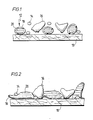
- FIG. 1 schematically shows a section through a recording material according to the invention, although the binders present between the individual mixture components are not shown.
- the carrier 10 identified overall by the reference number 10, will often be a paper layer.
- the capsules consist of a capsule wall 18 which is formed, for example, from melamine resins and which surrounds the so-called core medium or core solvent 20, in which the dye precursor is preferably present in solution.
- the individual components of the mixture namely the microcapsules 12, the developer particles 14 and the pigment particles 16 are held on the carrier 10 by a binder (not shown).
- the paper layer is dried in the customary form, drying temperatures being permitted here which are above the temperature value which triggers the writing effect or the color development when the recording material is used.
- the microcapsules are deliberately destroyed and broken open, for example by calendering, and the paper material then obtained is shown schematically in FIG. 2 in the sectional view.
- the core solvent which is generally viscous to solid, still contains the dye precursor in dissolved form, while the developer particles 14 can be in direct contact with the core solvent regions.
- a reaction does not initially take place at room temperature because, on the one hand, a relatively highly viscous to solid medium can be selected as the core solvent and because the color reaction itself requires a certain activation temperature.
- the developer substances are generally relatively inexpensive, they are dispersed in large numbers in the mixture submitted and the process limiting the color development is then only the diffusion of the dye in the core solvent to the developer substances.
- the dye according to the invention is finely distributed or dissolved in the core solvent, it is possible to work with significantly lower amounts of dye precursors than according to the prior art, in which only a solid-solid reaction can be used for the color development.
- thermal paper according to the invention shows the production of thermal paper according to the invention on the basis of typical dye precursor / developer substances.
- Solutions A and B are mixed together with stirring.
- a permanent coating solution is obtained.
- a paper with a basis weight of 50 g / m2 is coated with a doctor blade.
- the coating weight is 8 g / m2 dry. After drying at 90 o C in a forced air oven, this paper is treated by calendering. During this process it must be ensured that the capsules are destroyed.
Landscapes
- Chemical & Material Sciences (AREA)
- Chemical Kinetics & Catalysis (AREA)
- General Chemical & Material Sciences (AREA)
- Physics & Mathematics (AREA)
- Optics & Photonics (AREA)
- Heat Sensitive Colour Forming Recording (AREA)
- Color Printing (AREA)
Applications Claiming Priority (2)
| Application Number | Priority Date | Filing Date | Title |
|---|---|---|---|
| DE3831591 | 1988-09-16 | ||
| DE3831591 | 1988-09-16 |
Publications (2)
| Publication Number | Publication Date |
|---|---|
| EP0358968A2 true EP0358968A2 (fr) | 1990-03-21 |
| EP0358968A3 EP0358968A3 (fr) | 1991-05-08 |
Family
ID=6363117
Family Applications (1)
| Application Number | Title | Priority Date | Filing Date |
|---|---|---|---|
| EP19890115142 Withdrawn EP0358968A3 (fr) | 1988-09-16 | 1989-08-17 | Matériau d'enregistrement thermosensible |
Country Status (2)
| Country | Link |
|---|---|
| EP (1) | EP0358968A3 (fr) |
| PT (1) | PT91730A (fr) |
Family Cites Families (5)
| Publication number | Priority date | Publication date | Assignee | Title |
|---|---|---|---|---|
| DE1421418A1 (de) * | 1961-04-29 | 1968-10-10 | Lumoprint Zindler Kg | Verfahren zur Herstellung von Kopien und Material zur Durchfuehrung dieses Verfahrens |
| ES388656A1 (es) * | 1970-02-28 | 1974-02-16 | Fuji Photo Film Co Ltd | Mejoras en la obtencion de material registrador utilizable sobre hojas copiadoras sensibles al calor y a la presion. |
| JPS60214990A (ja) * | 1984-03-26 | 1985-10-28 | Fuji Photo Film Co Ltd | 感光感熱記録材料 |
| WO1985004841A1 (fr) * | 1984-04-21 | 1985-11-07 | Mitsubishi Paper Mills, Ltd. | Papier de copie sensible a la pression |
| JPH0686152B2 (ja) * | 1985-01-23 | 1994-11-02 | 富士写真フイルム株式会社 | 感熱記録材料 |
-
1989
- 1989-08-17 EP EP19890115142 patent/EP0358968A3/fr not_active Withdrawn
- 1989-09-15 PT PT9173089A patent/PT91730A/pt not_active Application Discontinuation
Also Published As
| Publication number | Publication date |
|---|---|
| EP0358968A3 (fr) | 1991-05-08 |
| PT91730A (pt) | 1990-05-31 |
Similar Documents
| Publication | Publication Date | Title |
|---|---|---|
| DE2612036C3 (de) | Durchschreibsatz | |
| DE3346601C2 (de) | Mikrokapseln, Verfahren zu ihrer Herstellung und ihre Verwendung in druckempfindlichen kohlefreien Durchschreibepapieren | |
| DE2242250C3 (de) | Druckempfindliches Aufzeichnungspapier | |
| DE3242262C2 (fr) | ||
| DE1955542A1 (de) | Mit Kapseln beschichtetes Blattmaterial | |
| DE3131899C2 (fr) | ||
| DE2153634A1 (de) | Druckempfindliches Aufzeichnungspapier | |
| EP0097910B1 (fr) | Microcapsules avec des parois de produits de polycondensation de polyamines insolubles dans l'eau avec des compositions d'addition de polyisocyanates solubles dans l'eau, leur préparation et quelques applications | |
| EP0266526B1 (fr) | Ruban carbone thermique contenant un colorant fusible à liant plastique et procédé pour la production de ce ruban | |
| DE69321765T2 (de) | Druckempfindliches Aufzeichnungsmaterial | |
| DE1671544B2 (de) | Druckempfindliches aufzeichnungsmaterial | |
| DE2147585B2 (de) | Druckempfindliches Aufzeichnungsmaterial und Farbentwicklerbeschichtungsmasse hierfür | |
| DE2854318C2 (fr) | ||
| DE3503446C2 (fr) | ||
| DE69507063T2 (de) | Verfahren zur Herstellung von hydrophoben Flüssigkeit enthaltenden Mikrokapseln mit einem hohen Trockenextraktgehalt, so erhaltene Mikrokapseln und Verfahren zur Herstellung von druckempfindlichen Papier damit | |
| DE4132338C2 (fr) | ||
| DE1671642B2 (de) | Druckempfindliches Kopierpapier | |
| DE2450733A1 (de) | Druckempfindliches aufzeichnungsmaterial | |
| DE2618271A1 (de) | Druckempfindliches aufzeichnungsmaterial | |
| DE3030478A1 (de) | Farbreaktiospapier | |
| EP0516742B1 (fr) | Microcapsules contenant une phase aqueuse | |
| DE3512565A1 (de) | Mikrokapseln und deren verwendung | |
| DE2138842C3 (de) | Verfahren zur Herstellung ölhaltiger Mikrokapseln | |
| DE2926837C2 (de) | Verfahren zur Herstellung eines Aufzeichnungsmaterials | |
| DE3516065C2 (fr) |
Legal Events
| Date | Code | Title | Description |
|---|---|---|---|
| PUAI | Public reference made under article 153(3) epc to a published international application that has entered the european phase |
Free format text: ORIGINAL CODE: 0009012 |
|
| AK | Designated contracting states |
Kind code of ref document: A2 Designated state(s): AT BE CH DE ES FR GB IT LI LU NL SE |
|
| PUAL | Search report despatched |
Free format text: ORIGINAL CODE: 0009013 |
|
| AK | Designated contracting states |
Kind code of ref document: A3 Designated state(s): AT BE CH DE ES FR GB IT LI LU NL SE |
|
| STAA | Information on the status of an ep patent application or granted ep patent |
Free format text: STATUS: THE APPLICATION HAS BEEN WITHDRAWN |
|
| 18W | Application withdrawn |
Withdrawal date: 19910907 |