EP0359038A2 - Flüssigkristalline Polykondensate mit verbesserter Thermostabilität, Verfahren zu ihrer Herstellung und ihre Verwendung zur Herstellung von Formkörpern, Folien, Fasern und Filamenten - Google Patents
Flüssigkristalline Polykondensate mit verbesserter Thermostabilität, Verfahren zu ihrer Herstellung und ihre Verwendung zur Herstellung von Formkörpern, Folien, Fasern und Filamenten Download PDFInfo
- Publication number
- EP0359038A2 EP0359038A2 EP89116056A EP89116056A EP0359038A2 EP 0359038 A2 EP0359038 A2 EP 0359038A2 EP 89116056 A EP89116056 A EP 89116056A EP 89116056 A EP89116056 A EP 89116056A EP 0359038 A2 EP0359038 A2 EP 0359038A2
- Authority
- EP
- European Patent Office
- Prior art keywords
- aromatic
- radical
- optionally
- polynuclear
- acid
- Prior art date
- Legal status (The legal status is an assumption and is not a legal conclusion. Google has not performed a legal analysis and makes no representation as to the accuracy of the status listed.)
- Withdrawn
Links
- 0 CCC(CC)(*C)[N+]([O-])OC(C=C1)=CCC1I Chemical compound CCC(CC)(*C)[N+]([O-])OC(C=C1)=CCC1I 0.000 description 5
Classifications
-
- C—CHEMISTRY; METALLURGY
- C08—ORGANIC MACROMOLECULAR COMPOUNDS; THEIR PREPARATION OR CHEMICAL WORKING-UP; COMPOSITIONS BASED THEREON
- C08G—MACROMOLECULAR COMPOUNDS OBTAINED OTHERWISE THAN BY REACTIONS ONLY INVOLVING UNSATURATED CARBON-TO-CARBON BONDS
- C08G63/00—Macromolecular compounds obtained by reactions forming a carboxylic ester link in the main chain of the macromolecule
- C08G63/02—Polyesters derived from hydroxycarboxylic acids or from polycarboxylic acids and polyhydroxy compounds
- C08G63/12—Polyesters derived from hydroxycarboxylic acids or from polycarboxylic acids and polyhydroxy compounds derived from polycarboxylic acids and polyhydroxy compounds
- C08G63/16—Dicarboxylic acids and dihydroxy compounds
- C08G63/20—Polyesters having been prepared in the presence of compounds having one reactive group or more than two reactive groups
-
- C—CHEMISTRY; METALLURGY
- C08—ORGANIC MACROMOLECULAR COMPOUNDS; THEIR PREPARATION OR CHEMICAL WORKING-UP; COMPOSITIONS BASED THEREON
- C08G—MACROMOLECULAR COMPOUNDS OBTAINED OTHERWISE THAN BY REACTIONS ONLY INVOLVING UNSATURATED CARBON-TO-CARBON BONDS
- C08G63/00—Macromolecular compounds obtained by reactions forming a carboxylic ester link in the main chain of the macromolecule
- C08G63/02—Polyesters derived from hydroxycarboxylic acids or from polycarboxylic acids and polyhydroxy compounds
- C08G63/60—Polyesters derived from hydroxycarboxylic acids or from polycarboxylic acids and polyhydroxy compounds derived from the reaction of a mixture of hydroxy carboxylic acids, polycarboxylic acids and polyhydroxy compounds
- C08G63/605—Polyesters derived from hydroxycarboxylic acids or from polycarboxylic acids and polyhydroxy compounds derived from the reaction of a mixture of hydroxy carboxylic acids, polycarboxylic acids and polyhydroxy compounds the hydroxy and carboxylic groups being bound to aromatic rings
-
- C—CHEMISTRY; METALLURGY
- C08—ORGANIC MACROMOLECULAR COMPOUNDS; THEIR PREPARATION OR CHEMICAL WORKING-UP; COMPOSITIONS BASED THEREON
- C08G—MACROMOLECULAR COMPOUNDS OBTAINED OTHERWISE THAN BY REACTIONS ONLY INVOLVING UNSATURATED CARBON-TO-CARBON BONDS
- C08G63/00—Macromolecular compounds obtained by reactions forming a carboxylic ester link in the main chain of the macromolecule
- C08G63/64—Polyesters containing both carboxylic ester groups and carbonate groups
-
- C—CHEMISTRY; METALLURGY
- C08—ORGANIC MACROMOLECULAR COMPOUNDS; THEIR PREPARATION OR CHEMICAL WORKING-UP; COMPOSITIONS BASED THEREON
- C08G—MACROMOLECULAR COMPOUNDS OBTAINED OTHERWISE THAN BY REACTIONS ONLY INVOLVING UNSATURATED CARBON-TO-CARBON BONDS
- C08G69/00—Macromolecular compounds obtained by reactions forming a carboxylic amide link in the main chain of the macromolecule
- C08G69/44—Polyester-amides
-
- C—CHEMISTRY; METALLURGY
- C09—DYES; PAINTS; POLISHES; NATURAL RESINS; ADHESIVES; COMPOSITIONS NOT OTHERWISE PROVIDED FOR; APPLICATIONS OF MATERIALS NOT OTHERWISE PROVIDED FOR
- C09K—MATERIALS FOR MISCELLANEOUS APPLICATIONS, NOT PROVIDED FOR ELSEWHERE
- C09K19/00—Liquid crystal materials
- C09K19/04—Liquid crystal materials characterised by the chemical structure of the liquid crystal components, e.g. by a specific unit
- C09K19/38—Polymers
- C09K19/3804—Polymers with mesogenic groups in the main chain
- C09K19/3809—Polyesters; Polyester derivatives, e.g. polyamides
Definitions
- the invention relates to liquid-crystalline polycondensates with improved thermal stability, a process for the preparation of the polycondensates and their use for the production of moldings, films, fibers and filaments.
- Shaped bodies which are made from liquid-crystalline polycondensates have, in particular, special mechanical properties, such as high strength and rigidity with a good level of toughness, and good thermal resistance, so that they play a role in a wide variety of technical applications in which good mechanical properties and high thermal resistance play, come into question.
- the liquid-crystalline (LC) polycondensates have a high melt viscosity, which gives rise to technical problems in the processing of the polycondensates into shaped articles.
- Molding compounds made from LC polymers for example, require a higher processing temperature. However, the higher processing temperature can easily lead to thermal degradation of the LC polymers used, which, for example, adversely affects the mechanical properties of the moldings.
- EP 161 413 describes low-volatility phthalimides containing carboxyl or phenol groups as end-capping agents or chain terminators for liquid-crystalline polyesters. It is emphasized as an advantage that the polyesters are still accessible for subsequent solid condensation. Such polyesters therefore change their molecular weight when subjected to thermal stress. They are therefore not stable in viscosity and can change their flow behavior uncontrollably and thus disadvantageously under processing conditions.
- Preferred radicals -Ar- of the formula (I) are the radicals (Ar1) to (Ar4)
- R 1 and R 2 are H, CH 3 , OCH 3 , cyclohexyl, phenyl, CF 3 , OCF 3 , fluorinated cyclohexyl and fluorinated phenyl.
- Preferred radicals -M- are those of the formulas (1.1), (1.2), (1.5), (1.8), (1.9) and (1.11).
- the compounds of the formula (I) are distinguished by the fact that they pass through a liquid-crystalline phase during melting (see, for example, for liquid-crystalline compounds or phases: D. Demus, L. Richter, Textures of Liquid Crystals, Verlag Chemie, Weinheim - New York 1978 or H. Kelker, R. Hatz, Handbook of Liquid Crystals Verlag Chemie. Weinheim, Deerfield 1080).
- Preferred compounds of the formula (I) are those which contain 3 to 15 aromatic substructures, the radical -Ar- being chosen as a substructure, regardless of whether it is mononuclear or polynuclear.
- Particularly preferred compounds of the formula (I) are those which contain 3 to 11 aromatic substructures, the radical -Ar- again being chosen as an aromatic substructure, irrespective of whether it is core or polynuclear.
- Very particularly preferred compounds of the formula (I) are those which have 3 to 7 aromatic partial structures in the sense defined above.
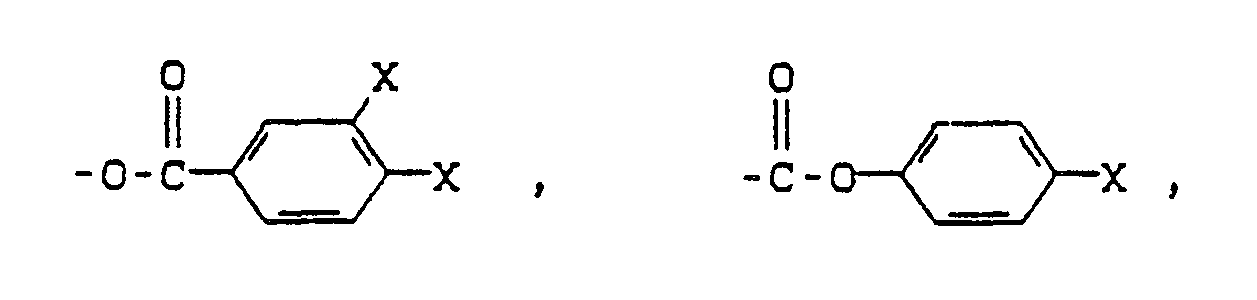
- Preferred radicals R 3 of the formula (II) are alkyl radicals having 1 to 30, particularly preferably 1 to 22, carbon atoms, such as CH 3 , C 2 H s , C 3 H 7 , C 4 H 9 , C 5 H 11 , C 6 H 13 , C 15 H 31 , C 16 H 33 , C 17 H 35 , C 18 H 37 , C 19 H 39 and C 22 H 45 , preferably CH 3 , or aromatic radicals of the formulas (III) and (IV) wherein X is hydrogen, halogen, N0 2 , C 1 -C 4 alkyl, C 3 -C 6 cycloalkyl, C 6 -C 14 aryl, OC 1 -C 4 alkyl, OC 3 -C 6 cycloalkyl, fluorinated C C 1 -C 4 alkyl, fluorinated C 3 -C 6 cycloalkyl or fluorinated C 6 -C 14 aryl.
- Aromatic radicals of the formulas (V) and (VI) are particularly preferred: wherein R represents hydrogen, halogen, such as fluorine, chlorine, C 1 -C 4 alkyl, C 3 -C 6 cycloalkyl, OC 1 -C 4 alkyl, OC 3 -C 6 cycloalkyl, fluorinated C 1 -C 4 - Alkyl or fluorinated C 3 -C 6 cycloalkyl.
- R represents hydrogen, halogen, such as fluorine, chlorine, C 1 -C 4 alkyl, C 3 -C 6 cycloalkyl, OC 1 -C 4 alkyl, OC 3 -C 6 cycloalkyl, fluorinated C 1 -C 4 - Alkyl or fluorinated C 3 -C 6 cycloalkyl.
- Particularly suitable bivalent aromatic radicals (Ar 1 ) of the formula (11) are those which contain the aromatic hydroxycarboxylic acids of the formulas underlying, in which R 6 to R 9 are C 1 -C 4 alkyl (preferably methyl, ethyl), C 1 -C 4 alkoxy (preferably methoxy, ethoxy), C 6 -C 10 aryl or aryloxy (preferably phenyl, phenyloxy, naphthyl , Naphthyloxy, biphenyl, biphenyloxy, tolyl, tolyloxy), C7-C12-alkylaryl (preferably benzyl), halogen (preferably chlorine and bromine) or hydrogen and the valences between the nucleus and hydroxyl groups and between the nucleus and carboxy groups are at an angle of 45 to 180 ° C.
- R 6 to R 9 are C 1 -C 4 alkyl (preferably methyl, ethyl), C 1 -C 4 alkoxy (
- Preferred aromatic hydroxycarboxylic acids are 4-hydroxy-3-methylbenzoic acid, 4-hydroxy-3-phenylbenzoic acid, 4-hydroxy-2-ethylbenzoic acid, 3-chloro-4-hydroxybenzoic acid, 4-hydroxy-3-methoxybenzoic acid, 4-hydroxybenzoic acid, 3-hydroxybenzoic acid, 6-hydroxy-2-naphthoic acid. 4-Hydroxybenzoic acid, 3-hydroxybenzoic acid and 6-hydroxy-2-naphthoic acid are particularly preferred.
- Preferred diphenols are, for example, hydroquinone, 4,4'-dihydroxydiphenyl, 4,4'-dihydroxydiphenyl ether, 4,4'-dihydroxydiphenylethane, 4,4'-dihydroxydiphenoxyethane, 3,5'-dihydroxydiphenyl, 3,5'-dihydroxydiphenyl ether.
- Particularly preferred diphenols are hydroquinone and 4,4'-dihydroxydiphenyl.
- aliphatic dicarboxylic acids are preferred: oxalic acid, malonic acid, succinic acid, glutaric acid, adipic acid, suberic acid, azelaic acid, diethylmalonic acid, trimethyladipic acid, sebacic acid or dodecanoic acid and dimer fatty acid (of the Pripol @ type, from Unichema).
- Preferred aromatic dicarboxylic acids are those based on the following divalent radicals: 1,4-phenylene, 1,4-naphthylene or 4,4'-biphenylene, in which the two bonds extend coaxially in opposite directions, or 1,5-naphthylene, 2 , 6-naphthylene or 3,5'-biphenylene, in which the two bonds pointing in opposite directions are shifted parallel to one another, and 1,3-phenylene, 1,3-, 1,6-, 1,7- or 2,7 -Naphthylene or 3,4-biphenylene, in which the two bonds are not located on adjacent atoms and do not extend coaxially or parallel shifted in opposite directions.
- Aromatic dicarboxylic acids which are preferably mentioned are: 1,4-naphthalenedicarboxylic acid, 1,5-naphthalenedicarboxylic acid, 2,6-naphthalenedicarboxylic acid, biphenyl-4,4'-dicarboxylic acid, bipenyl-3,3'-dicarboxylic acid ,.
- Preferred (cyclo) aliphatic amino carboxylic acids are: amino acetic acid, 3-amino propanoic acid, 4-amino butanoic acid, 6-amino hexanoic acid, 1,1-aminoundecanoic acid and 4-aminocyclohexyl carboxylic acid, very particularly preferably 4-aminobutanoic acid, 6-amino hexanoic acid and 11 Aminoundecanoic acid.
- Preferred (cyclo) aliphatic diamines are ethylenediamine, 1,2-diaminopropane, 1,4-diaminobutane, 1,6-diaminohexane, 2,5-diamino-2,5-dimethylhexane, 1,4-diaminocyclohexane, 5-amino -1-aminomethyl-1,3,3-trimethylcyclohexane, 4,4'-methylenebiscyclohexylamine, bis-4-amino-3-methylcyclohexylmethane, bis-aminomethylhexahydro-4,7-indene, very particularly preferred 1,4-diaminobutane and 1,6-diaminohexane.
- Preferred aminophenols are 3-aminophenol, 5-amino-2-chlorophenol, 4-aminophenol, 3-amino-2-methylphenol, 3-amino-4-methylphenol, 5-amino-1-naphthol, 6-amino-1-naphthol . 8-amino-2-naphthol, 6-amino-2-naphthol and 4-amino-1-hydroxy-biphenyl, very particularly preferably 3-aminophenol and 4-aminophenol.
- Preferred aromatic amino carboxylic acids are 2-aminobenzoic acid, 3-aminobenzoic acid, 4-aminobenzoic acid, 4-chloroanthranilic acid, 5-chloroanthranilic acid, 3-amino-4-chlorobenzoic acid, 4-amino-3-phenylbenzoic acid, 4-amino-3-methoxybenzoic acid, 4-amino-3-phenoxybenzoic acid, 6-amino-5-chloro-2-naphthoic acid, 6-amino-5-methyl-2-naphthoic acid and 6-amino-5-methoxy-2-naphthoic acid, very particularly preferably 3-aminobenzoic acid , 4-aminobenzoic acid and 6-amino-2-naphthoic acid.
- Preferred aromatic diamines are 1,2-diaminobenzene, 1,3-diaminobenzene, 1,4-diaminobenzene, 1,2-diamino-3-methylbenzene, 1,3-diamino-4-methylbenzene, 1,4-diamino-2- methylbenzene, 1,3-diamino-2-methylbenzene, 1,2-diamino-4-methylbenzene, 1,3-bisaminomethylbenzene, 1,4-diaminonaphthalene, 1,5-diaminonaphthalene, 1,8-diaminonaphthalene, 2.7- Diaminonaphthalene, 4,4-diaminobiphenyl, bis (4-aminophenyl) methane, 3-methylbenzizidine, 2,2'-dimethyl- (1,1'-biphenyl) -4,4'-diamine, 3,3'- Dimethylbenzidine, 2,2-bis (4-a
- the above-mentioned amino compounds can be used either individually or in a mixture with one another.
- Preferred oligomers of the formula (11) are those which contain an average of 3 to 25, particularly preferably 4 to 20, aromatic partial structures, an aromatic partial structure as defined under formula (I) ' .
- the abovementioned compounds of the formulas (I) and (11) are generally used in an amount of approximately 0.01 to 10 mol%, preferably 0.1 to 5 mol%, based on the sum of the mol numbers of aromatic hydroxycarboxylic acids, optionally aromatic aminocarboxylic acids, diphenols and optionally aminophenols.
- esters of formula (I) can e.g. according to the teaching of German patent application P 3 824 365.2, namely by reacting corresponding phenolic compounds or their alkali metal salts with corresponding reactive derivatives of aromatic carboxylic acids by known esterification processes.
- thermotropic LC polymers direct esterification process [EP-A 00 88 546], acetate process [EP-A 01 02 719, 134 204], Melt transesterification of carboxylic acid phenyl esters with diphenols (diphenyl ester process) [EP-A 072 540, 070 539, 024 499, 45 499, DE-OS 20 25 971, EP 070 539 and EP 01 32 637]).
- the compounds of the formula (11) according to the invention are particularly preferably prepared by the acetate and / or by the diphenyl ester process.
- the proportion of aromatic hydroxycarboxylic acids is 40 to 85 mol%, preferably 50 to 80 mol%, the proportion of aromatic aminocarboxylic acid 0 to 40 mol% %, preferably 0 to 25 mol%, the proportion of diphenols 60 to 15 mol%, preferably 50 to 20 mol%, and the proportion of aminophenols 0 to 95 mol%, preferably 0 to 20 mol%, based on the sum of building blocks a) to d).
- aromatic dicarboxylic acids and optionally the carbonic acid derivatives are used in equimolar amounts to the diphenols and the aminophenols, that is to say 60 to 15 mol%, preferably 50 to 20 mol%, the proportion of carbonate groups being preferably 0 to 40 mol% 0 to 30 mol% may be in the polycondensate.
- Aromatic hydroxycarboxylic acids a) are, for example, those compounds which are considered as Formula (VII) and (VIII) are given.
- Preferred aromatic hydroxycarboxylic acids (a) are, for example: 4-hydroxy-3-methylbenzoic acid, 4-hydroxy-3-phenylbenzoic acid, 4-hydroxy-2-ethylbenzoic acid, 3-chloro-4-hydroxybenzoic acid, 3-bromo-4-hydroxybenzoic acid, 4 -Hydroxy-3-methoxybenzoic acid, 4-hydroxybenzoic acid, 6-hydroxy-naphthoic acid.
- 4-hydroxy-3-phenoxybenzoic acid 6-hydroxy-5-chloro-2-naphthoic acid, 6-hydroxy-5-methyl-2-naphthoic acid, 6-hydroxy-5-methoxy-2-naphthoic acid, 6-hydroxy- 4,7-dichloro-2-naphthoic acid, 2-hydroxybenzoic acid, 3-hydroxy-4-methylbenzoic acid, 3-hydroxy-4-phenylbenzoic acid, 3-hydroxy-2-ethylbenzoic acid, 4-chloro-3-hydroxybenzoic acid, 4-bromo 3-hydroxybenzoic acid, 3-hydroxy-4-methoxybenzoic acid, 3-hydroxy-4-phenoxybenzoic acid, 3-hydroxy-2-methoxybenzoic acid and 3-hydroxybenzoic acid, particularly preferably 4-hydroxybenzoic acid, 6-hydroxynaphthoic acid and 3-hydroxybenzoic acid.
- Preferred aromatic amino carboxylic acids are 2-aminobenzoic acid, 3-aminobenzoic acid, 4-aminobenzoic acid, 4-chloroanthranilic acid, 5-chloroanthranilic acid, 3-amino-4-chlorobenzoic acid, 3-amino-4-methylbenzoic acid, 4-amino-3-methylbenzoic acid, 4-amino-3-phenylbenzoic acid, 3-bromo-4-aminobenzoic acid, 4-amino-3-methoxybenzoic acid, 6-amino-2-naphthoic acid, 4-amino-3-phenoxybenzoic acid, 6-amino-5-chloro-2- naphthoic acid, 6-amino-5-methyl-2-naphthoic acid, 6-amino-5-methoxy-2-naphthoic acid and 6-amino-4,7-dichloro-2-naphthoic acid, particularly preferably 4-aminobenzo
- Diphenols c) are those of the formula question in what Z has the meaning given in formula (IX).
- Preferred diphenols c) are e.g. Hydroquinone, 4,4'-dihydroxydiphenyl, 4,4'-dihydroxydiphenyl ether, 4,4'-dihydroxydiphenylethane, 4,4'-dihydroxydiphenoxyethane, 3,5'-dihydroxydiphenyl, 3,5'-dihydroxydiphenyl ether, 1,5-dihydroxynaphthalene, 2,6-dihydroxynaphthalene, 1,4-dihydroxynaphthalene, chlorohydroquinone, bromohydroquinone, methylhydroquinone, phenylhydroquinone, ethylhydroquinone, 2,2'-dimethyl-4,4'-dihydroxydiphenyl, 3,3 ', 5,5'-tetramethyl-4, 4'-dihydroxydiphenyl, 3,5'-dimethoxy-4,4'-dihydroxydiphenyl ether, 1,2- (2-chloro-4
- Suitable aminophenols d) are those of the formula question in what Z has the meaning given in formula (IX).
- Aromatic dicarboxylic acids e) are those of the formula question in what A is a divalent aromatic radical having 6 to 24 carbon atoms, preferably having 6 to 16 carbon atoms means the two valences form an angle of 45 to 180 °.
- Preferred aromatic residues (A) are e.g. 1,4-phenylene, 1,4-naphthylene or 4,4-biphenylene, in which the two bonds extend coaxially in opposite directions, or 1,5-naphthylene, 2,6-naphthylene or 3,5'-biphenylene, in which the two bonds pointing in opposite directions are shifted parallel to one another, and 1,3-phenylene, 1,3-, 1,6-, 1,7- or 2,7-naphthylene or 3,4'-biphenylene, in which the two bonds are not are localized to neighboring atoms and do not extend coaxially or parallel shifted in opposite directions.
- Preferred aromatic dicarboxylic acids e) are e.g. 1,4-naphthalenedicarboxylic acid, 1,5-naphthalenedicarboxylic acid, 2,6-naphthalenedicarboxylic acid.
- 1,3-naphthalenedicarboxylic acid 1,6-naphthalenedicarboxylic acid, 1,7-naphthalenedicarboxylic acid, 2,7-naphthalenedicarboxylic acid, biphenyl-3,4'-dicarboxylic acid, diphenyl ether-3,4'-dicarboxylic acid, 4-methylisophthalic acid, 5-methylisophthalic acid, Diphenyl ether-4,4-dichloro-3,3'-dicarboxylic acid, iso- and terephthalic acid.
- aromatic dicarboxylic acids e) are iso- and terephthalic acid.
- diaryl carbonates such as diphenyl carbonate, ditolyl carbonate, phenyl tolyl carbonate and dinaphthyl carbonate
- dialkyl carbonates such as diethyl carbonate, dimethyl carbonate, dimethyl dicarbonate and diethyl dicarbonate, and glycol carbonate.
- a preferred derivative for incorporating the carbonate groups (f) is diphenyl carbonate.
- the melt transesterification of the acyl esters derived from the hydroxycarboxylic acids and diphenols, preferably their acetates or diacetates, with the dicarboxylic acids and elimination of carboxylic acid or acetic acid (acetate process) is, inter alia, described in EP 134 956 and 102 719.
- the melt transesterification of the reactive carboxyl derivatives, preferably the phenyl esters of hydroxycarboxylic acids and dicarboxylic acids, with the diphenols and optionally diphenyl carbonate (diphenyl ester process) is described, for example, in EP 132 637 and 72 540.
- the reactive derivatives e.g. the acetates or diacetates and the phenyl esters or diphenyl esters can either be prepared separately in a reaction step upstream of the polycondensation or can also be formed in situ in the reaction mixture in the presence of the other reaction components.
- Such catalysts are known to be e.g. the oxides, hydrides, hydroxides, halides, alcoholates, phenolates, salts of inorganic or organic acids, the complex salts or mixed salts of the alkali metals, e.g. Lithium, sodium or potassium, the alkaline earth metals, e.g. Magnesium or calcium, the sub-group elements, e.g. Vanadium, titanium, manganese, cobalt, nickel, zinc, lanthanum, cerium or zirconium or their elements from other groups of the periodic table, e.g.
- the alkali metals e.g. Lithium, sodium or potassium
- the alkaline earth metals e.g. Magnesium or calcium
- the sub-group elements e.g. Vanadium, titanium, manganese, cobalt, nickel, zinc, lanthanum, cerium or zirconium or their elements from other groups of the periodic table, e.g.
- alkyltin carboxylates alkali metal carboxylates, such as benzoic acid K salt, p-hydroxybenzoic acid azide.
- the amounts of catalyst are usually about 0.001 to 1, preferably 0.01 to 0.2,% by weight, based on the total weight of the monomers used.
- the liquid-crystalline polycondensates according to the invention can be prepared at temperatures of approximately 150 to 380 ° C., the reaction generally starting at low temperatures and the temperature being increased continuously as the reaction progresses.
- a vacuum can be applied, the pressure preferably being reduced continuously from normal pressure to about 0.1 mbar.
- the esters of the formulas (I) and (11) can be added at any time until a degree of elimination of 95% of volatile polycondensation product has been reached.
- the liquid-crystalline compounds are preferably added at the beginning when the monomer units are weighed out.
- thermotropic polycondensates With increasing concentration of esters used, the molecular weight and thus the melt and solution viscosity of the thermotropic polycondensates decrease. Due to blocked chain ends, the thermotropic polycondensates according to the invention are notable for increased thermal stability and excellent melt viscosity stability under processing conditions.
- esters of the formulas (I) and (11) are added in the amount described above in the process according to the invention.
- thermotropic polycondensates With chain terminators or end-capping agents described in the literature, it was not possible to obtain thermotropic polycondensates with a comparable degree of stability. This also applies to the use of the monomeric building blocks from which the esters to be used were synthesized.
- liquid-crystalline polycondensates according to the invention can easily be processed from the melt in the customary manner to give moldings, foils, fibers and filaments.
- 4-Benzoyloxybenzoic acid 4-benzoyloxyphenyl ester is prepared from 4-hydroxyphenyl 4-hydroxybenzoate and benzoic acid chloride according to the procedure of Example 1. Yield: 530 g (80% of theory) In the range between 190 and 350 C, a liquid crystalline phase was determined by means of polarization microscopy.
- 4- (4-Methoxybenzoyloxy) benzoic acid 4- (4-methoxybenzoyloxy) phenyl ester is prepared from 4-hydroxyphenyl-4-hydroxybenzoate and 4-methoxybenzoic acid chloride according to the procedure of Example 1. Yield: 420 g (84% of theory) In the range between 180 to 330 C, the presence of a liquid crystalline phase was determined by means of polarization microscopy.
- a liquid-crystalline phase was found in the range from 180 to 320 ° C. by means of polarization microscopy.
- a liquid-crystalline phase was found in the range from 220 to 320 ° C. by means of polarization microscopy.
- Tables 1 and 2 summarize the LC polyester carbonates produced in the presence of various chain terminators (end-capping agents).
- the mixture was heated to 170 ° C. using a salt bath under a nitrogen atmosphere. As soon as the distillation of acetic acid ceased (after about 45 minutes), the temperature in the reaction vessel was raised to 250 ° C. in the course of one hour and to 330 ° C. in the course of a further hour. After the distillation had ended, the pressure was reduced to about 1 mbar in the course of 30 minutes. During the vacuum phase, the viscosity of the resulting polymer melt increased significantly. The melt was therefore stirred more slowly. At the end of this phase, the total amount of acetic acid (containing residual acetic anhydride) had been collected. Product description: light beige, highly viscous, strong fiber structure.
- Tables 3 and 4 summarize the LC polyesters produced in the presence of various chain terminators (end-capping agents).
- the improved viscosity stability of the liquid-crystalline polycondensates according to the invention can be demonstrated by a long-term tempering test.
- Example 8 For this purpose, a liquid-crystalline polyester from Example 8 is prepared in the presence of biphenyl-4-carboxylic acid and 2. in the presence of additive 4 (0.5 mol) (Example 4), annealed at 320 ° C. in the melt and the melt viscosity as a function of Time determined.
Landscapes
- Chemical & Material Sciences (AREA)
- Organic Chemistry (AREA)
- Health & Medical Sciences (AREA)
- Chemical Kinetics & Catalysis (AREA)
- Medicinal Chemistry (AREA)
- Polymers & Plastics (AREA)
- Crystallography & Structural Chemistry (AREA)
- Engineering & Computer Science (AREA)
- Materials Engineering (AREA)
- Polyesters Or Polycarbonates (AREA)
- Organic Low-Molecular-Weight Compounds And Preparation Thereof (AREA)
- Artificial Filaments (AREA)
- Manufacture Of Macromolecular Shaped Articles (AREA)
- Liquid Crystal Substances (AREA)
Abstract

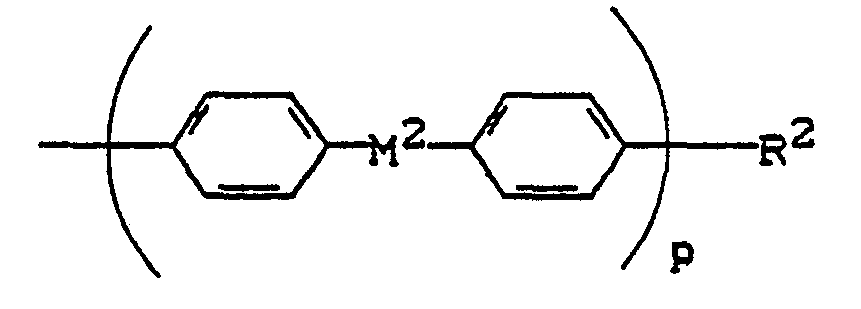
Description
- Die Erfindung betrifft flüssigkristalline Polykondensate mit verbesserter Thermostabilität, ein Verfahren zur Herstellung der Polykondensate und ihre Verwendung zur Herstellung von Formkörpern, Folien, Fasern und Filamenten.
- Thermotrope bzw. flüssigkristalline Polykondensate aus aromatischen Hydroxycarbonsäuren, aromatischen Dicarbonsäuren, aromatischen Dihydroxyverbindungen und gegebenenfalls Kohlensäure sowie gegebenenfalls anderen aromatischen difunktionellen Verbindungen sind seit langem bekannt (vgl. z.B. die Literaturzusammenfassung in der DE-OS 33 38 623, Recent Advances in Liquid Crystalline Polymers, Elsevier, Appl. Sci. Publishers, 1985 (L. Chapoy) oder British Polymer Journal, Vol. 12, No. 4, Seiten 132-146 (1980) (J.-I. Jin et al)).
- Formkörper, die aus flüssigkristallinen Polykondensaten hergestellt werden, besitzen vor allem besondere mechanische Eigenschaften, wie hohe Festigkeit und Steifigkeit bei gutem Zähigkeitsniveau, und eine gute thermische Beständigkeit, so daß sie für verschiedenste technische Einsatzzwecke bei denen gute mechanische Eigenschaften und eine hohe thermische Beständigkeit eine Rolle spielen, in Frage kommen. Im allgemeinen besitzen die flüssigkristallinen (LC)-Polykondensate jedoch eine hohe Schmelzviskosität, die technische Probleme bei der Verarbeitung der Polykondensate zu Formkörpern mit sich bringt. Formmassen aus LC-Polymeren erfordern beispielsweise eine höhere Verarbeitungstemperatur. Durch die höhere Verarbeitungstemperatur kann es jedoch leicht zum thermischen Abbau der eingesetzten LC-Polymeren kommen, wodurch beispielsweise die mechanischen Eigenschaften der Formkörper beeinträchtigt werden. Dies trifft besonders für Polymere zu, deren reaktive Endgruppen nicht durch sogenannte Endverkappungsreagenzien (Kettenabbrecher) geschützt sind. Ein wesentlicher Faktor für die thermische Stabilität solcher Polymere ist deshalb eine entsprechende Blockierung der reaktiven Endgruppen durch sogenannte Endverkappungsagenzien, damit Kettenspaltung, unerwünschte Umlagerungen oder ein verarbeitungsstörender Molgewichtsaufbau unter Abspaltung von flüchtigen Nebenprodukten bei den Polymeren vermieden werden kann. Beispielsweise ist bekannt, daß die in die LC-Polymere eingebauten aromatischen Hydroxycarbonsäuren leicht decarboxylieren (s. D. Sitamanikyam und E.V. Sundaram, Indian J. Chem., 1972, 1011-1013).
- Die Verwendung der bekannten und üblichen Endverkappungsagenzien, wie Phenole, Amine oder Carbonsäuren, ist wegen der hohen Reaktionstemperaturen bei der Schmelzumesterung und der Flüchtigkeit der Endverkappungsagenzien mit großen Problemen verbunden und führt zu schwer reproduzierbaren Ergebnissen (siehe hierzu Vergleichsbeispiele). Aus diesem Grund wird in der EP 162 667 eine Steuerung des Kettenaufbaus über das Molverhältnis von Carboxyl- zu phenolischen OH-Gruppen beschrieben. Diese Produkte enthalten aber reaktive Kettenenden und sind daher nicht genügend thermostabil.
- In der EP 161 413 werden schwerflüchtige, carboxyl- oder phenolgruppenhaltige Phthalimide als Endverkappungsagenzien bzw. Kettenabbrecher für flüssigkristalline Polyester beschrieben. Als Vorteil wird herausgestellt, daß die Polyester noch einer nachträglichen Feststoffkondensation zugänglich sind. Solche Polyester verändern also bei thermischer Belastung ihr Molgewicht. Sie sind somit nicht viskositätsstabil und können sich unter Verarbeitungsbedingungen in ihrem Fließverhalten unkontrolliert und damit nachteilig verändern.
- Gegenstand der Erfindung sind flüssigkristalline Polykondensate auf Basis von
- a) aromatischen Hydroxycarbonsäuren
- b) gegebenenfalls aromatischen Aminocarbonsäuren
- c) Diphenolen
- d) gegebenenfalls Aminophenolen
- e) aromatischen Dicarbonsäuren und
- f) gegebenenfalls Kohlensäure erhältlich durch Schmelzumesterung der von den Hydroxycarbonsäuren, Diphenolen und Aminophenolen abgeleiteten C, bis C4--Acylester, vorzugsweise den Acetaten, mit den Dicarbonsäuren oder durch Schmelzumesterung der Phenylester der Hydroxycarbonsäuren, gegebenenfalls Aminocarbonsäuren, Dicarbonsäuren und Kohlensäure mit den Diphenolen und gegebenenfalls Aminophenolen bei 150 bis 380 C in Gegenwart von aromatischen Estern der Formel (I) mit definierter Sequenz der Struktureinheiten
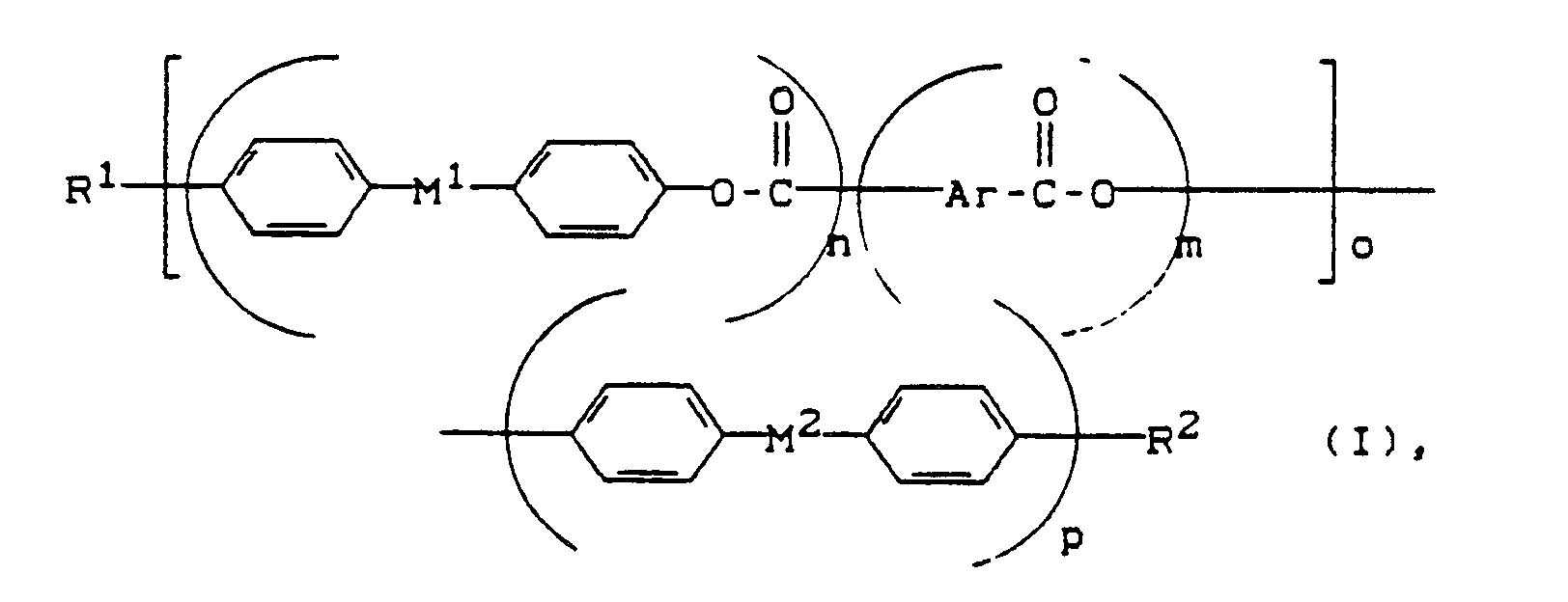
- Ar ein aromatischer Rest ist, der einkernig oder mehrkernig sein kann, wobei der mehrkernige Rest einbindig verknüpft oder annelliert sein kann,
- R' und R2 gleich oder verschieden sein können und H, Chlor, O-C1-C4-Alkyl, -O-C3-C6-Cycloalkyl, O-C6-C14-Aryl, C1-C4-Alkyl, C3-C6-Cycloalkyl, C6-C14-Aryl, fluoriertes C1-C4-Alkyl, fluoriertes C3-C6- Cycloalkyl, fluoriertes C6-C14-Aryl, oder ein Rest der Formeln (I)/a) bis I) sind:


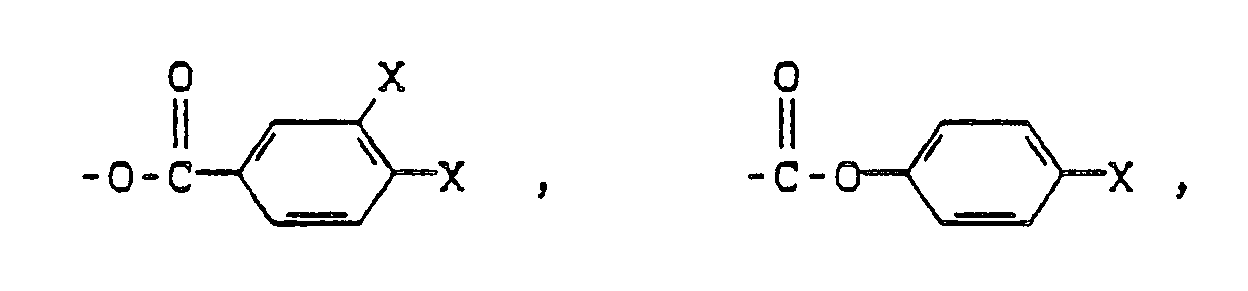

- wobei X für die vorstehend für R1 oder R2 genannten Reste von H bis fluoriertes C6-C14-Aryl steht, M' und M2 gleich oder verschieden sind und zweibindige Reste der Formeln (1.1) bis (1.11);


- sein können
- und worin
- m Null, 1 oder 2,
- n 1 oder 2,
- 0 1, 2 oder 3 und
- p Null oder 1 sind, wobei im Falle von p = Null R2 nur (1 a), (1b), (1c) oder (1d) sein kann, oder von Oligomeren der Formel (II) mit statistischer Verteilung der Struktureinheiten
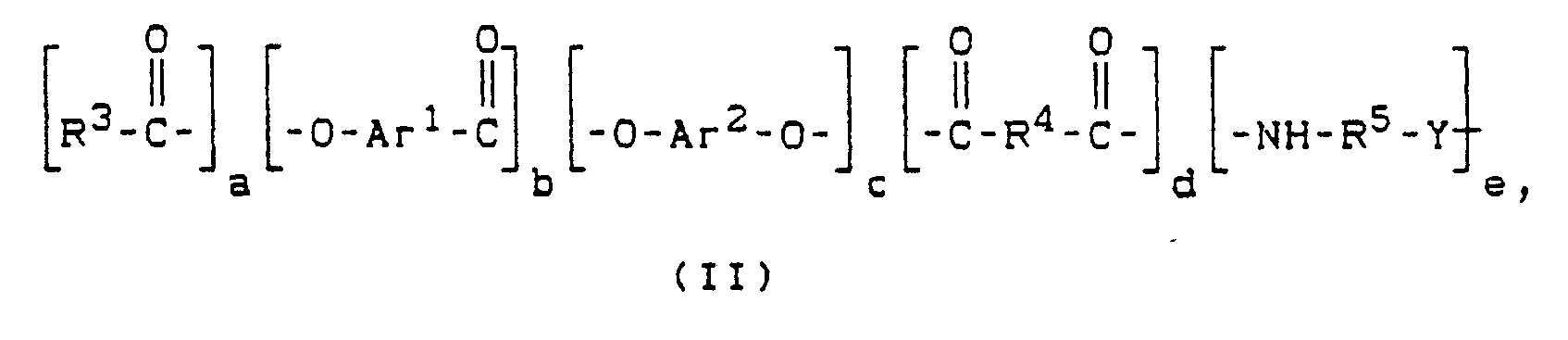
- R3 einen Alkyl- oder einen gegebenenfalls substituierter Arylrest darstellt,
- Ar1 ein bivalenter, gegebenenfalls substituierter ein-oder mehrkerniger aromatischer Rest ist, wobei der mehrkernige Rest einbindig verknüpft oder annelliert sein kann,
- Ar2 einen bivalenten, gegebenenfalls substituierten ein oder mehrkernigen aromatischen Rest darstellt, wobei der mehrkernige Rest unterschiedlich verknüpft sein kann,
- R4 und R5 für CmH2m mit m = 0 bis 50 stehen oder die Bedeutung eines gegebenenfalls substituierten bivalenten ein- oder mehrkernigen aromatischen Rests haben, wobei der mehrkernige Rest unterschiedlich verknüpft sein kann,
- Y für -O-, -CO- oder -NH- steht und im Falle der Verknüpfung mit einer Endgruppe -0- oder -NH bedeutet,
- a = 2,
- b = Null bis 5,
- c = 1 bis 5,
- d = Null bis 4 und
- e = Null bis 3 sind, und worin die Endgruppen durch Strukturelemente des Typs R3CO gebildet werden.
- Bevorzugte Reste -Ar- der Formel (I) sind die Reste (Ar1) bis (Ar4)

- Bevorzugte Reste R1 und R2 sind H, CH3, OCH3, Cyclohexyl, Phenyl, CF3, OCF3, fluoriertes Cyclohexyl und fluoriertes Phenyl.
- Bevorzugte Reste -M- sind solche der Formeln (1.1), (1.2), (1.5), (1.8), (1.9) und (1.11).
- Bevorzugte Indexkombinationen m, n, o, p und q sind
- m = Null, n = 1, o = 1, p = Null;
- m = Null, n = 1, o = 1, p = 1;
- m = Null, n = 2, o = 1, p = 1;
- m = n = o = p = 1;
- m = 1, n = 1, o = 2, p = 1;
- m = Null, n = 2, o = 1, p = Null;
- m = 1, n = 2, o = 1, p = 1 und
- m = 1, n = 1, o = 3, p = 1.
- Die Verbindungen der Formel (I) zeichnen sich dadurch aus, daß sie beim Schmelzen eine flüssigkristalline Phase durchlaufen (Bezüglich flüssigkristalliner Verbindungen bzw. Phasen siehe beispielweise: D. Demus, L. Richter, Textures of Liquid Crystals, Verlag Chemie, Weinheim - New York 1978 oder H. Kelker, R. Hatz, Handbook of Liquid Crystals Verlag Chemie. Weinheim, Deerfield 1080).
- Bevorzugte Verbindungen der Formel (I) sind solche, die 3 bis 15 aromatische Teilstrukturen enthalten, wobei der Rest -Ar- als eine Teilstruktur gewählt ist, unabhängig davon, ob er einkernig oder mehrkernig ist. Besonders bevorzugte Verbindungen der Formel (I) sind solche, die 3 bis 11 aromatische Teilstrukturen enthalten, wobei wiederum der Rest -Ar- als eine aromatische Teilstruktur gewählt ist, unabhängig davon ob er emkernig oder mehrkernig ist. Ganz besonders bevorzugte Verbindungen der Formel (I) sind solche, die 3 bis 7 aromatische Teilstrukturen im vorstehend definierten Sinne haben.
- Als Verbindungen der Formel (I) seien beispielsweise die folgenden vier Gruppen von Verbindungen (I,A) bis (LD) genannt:
- (I,A) Flüssigkristalline Verbindungen der Formel (I) mit drei aromatischen Teilstrukturen, worin
- m = Null, n = 1, o = 1 und p = Null sind:


- m = Null, n = 1, o = 1 und p = Null sind:
- (I,B) Flüssigkristalline Verbindungen der Formel (I) mit vier aromatischen Teilstrukturen, worin wieder m = Null, n = 1, o = 1 und p = Null sind:

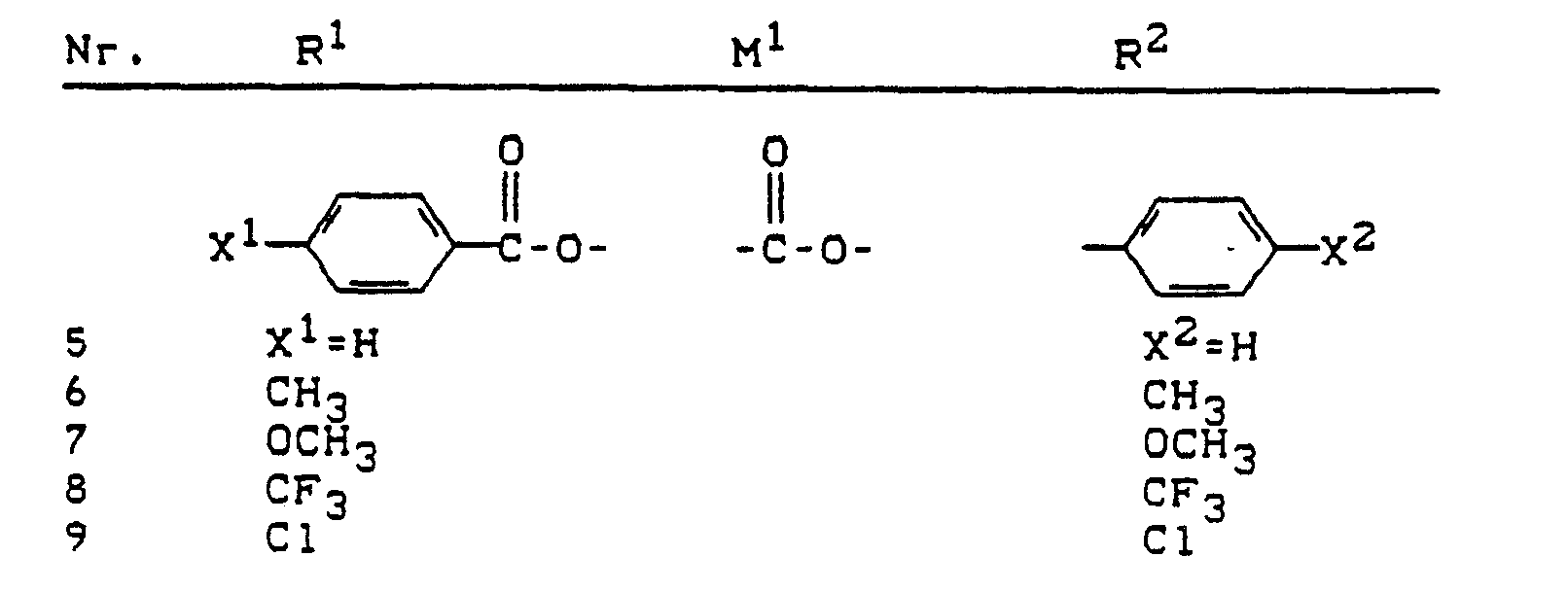
- (I,C) Flüssigkristalline Verbindungen der Formel (I) mit fünf aromatischen Teilstrukturen, worin m = n = o = p = 1 sind.


- (I,D) Flüssigkristalline Verbindungen der Formel (I) mit sieben aromatischen Teilstrukturen, worin wieder m = n = o = p = 1 sind;


- Bevorzugte Reste R3 der Formel (II) sind Alkylreste mit 1 bis 30, besonders bevorzugt 1 bis 22 Kohlenstoffatomen, wie CH3, C2Hs, C3H7, C4H9, C5H11, C6H13, C15H31, C16H33, C17H35, C18H37, C19H39 und C22H45, bevorzugt CH3,
oder aromatische Reste der Formeln (III) und (IV)

X Wasserstoff, Halogen, N02, C1-C4-Alkyl, C3-C6-Cycloalkyl, C6-C14-Aryl, O-C1-C4-Alkyl, O-C3-C6-Cycloalkyl, fluoriertes C1-C4-Alkyl, fluoriertes C3-C6-Cycloalkyl oder fluoriertes C6-C14-Aryl sein kann. - Genannt werden z.B. besonders bevorzugt aromatische Reste der Formeln (V) und (VI):


R für Wasserstoff, Halogen, wie Fluor, Chlor, C1-C4-Alkyl, C3-C6-Cycloalkyl, O-C1-C4-Alkyl, O-C3-C6-Cycloalkyl, fluoriertes C1-C4-Alkyl oder fluoriertes C3-C6-Cycloalkyl steht. - Ganz besonders bevorzugt sind solche aromatischen Reste der Formeln (V) und (VI), in denen R = Wasserstoff bedeutet.
- Als bivalente aromatische Reste (Ar1) der Formel (11) kommen besonders solche in Betracht, die den aromatischen Hydroxycarbonsäuren der Formeln

R6 bis R9 C1-C4-Alkyl (vorzugsweise Methyl, Ethyl), C1-C4-Alkoxy (vorzugsweise Methoxy, Ethoxy), C6-C10-Aryl oder -Aryloxy (vorzugsweise Phenyl, Phenyloxy, Naphthyl, Naphthyloxy, Biphenyl, Biphenyloxy, Tolyl, Tolyloxy), C7-C12-Alkylaryl (vorzugsweise Benzyl), Halogen (vorzugsweise Chlor und Brom) oder Wasserstoff bedeuten und die Valenzen zwischen Kern und Hydroxylgruppen sowie zwischen Kern und Carboxlygruppen einen Winkel von 45 bis 180° C bilden. - Bevorzugte aromatische Hydroxycarbonsäuren sind 4-Hydroxy-3-methylbenzoesäure, 4-Hydroxy-3-phenyl-benzoesäure, 4-Hydroxy-2-ethylbenzoesäure, 3-Chlor-4-hydroxybenzoesäure, 4-Hydroxy-3-methoxybenzoesäure, 4-Hydroxybenzoesäure, 3-Hydroxybenzoesäurel, 6-Hydroxy-2-naphthoesäure. Besonders bevorzugt sind 4-Hydroxybenzoesäure, 3-Hydroxybenzoesäure und 6-Hydroxy-2-naphthoesäure.
- Als bivalente aromatische Reste (Ar2) der Formel (II) kommen besonders solche in Betracht, die den Diphenolen der Formel (IX)
HO-Z-OH (IX) zugrundeliegen,
worin - Z einen zweiwertigen ein- oder mehrkernigen aromatischen Rest mit 6 bis 30 C-Atomen bedeutet, wobei Z derart gebaut ist, daß die beiden OH-Gruppen direkt an je ein C-Atom eines aromatischen Systems gebunden sind und die beiden Valenzen einen Winkel von 45 bis 180 bilden.
- Die aromatischen Reste können durch 1 bis 4 C1-C4-Alkyl-, C1-C4-Alkoxy-, Phenyl-, Phenoxy-, Benzyl-oder Halogenreste (vorzugsweise Chlor und Brom) substituiert sein und umfassen neben Phenylen, Naphthylen und Biphenylen auch durch Sauerstoff, Schwefel, Carbonyl, Sulfonyl oder Azomethin, C1-C4-Alkylen oder -Alkyliden, Cyclohexylen oder -hexyliden oder -O(CH2)nO- mit n = 2 bis 4 verbundene Phenylenreste.
- Bevorzugte Diphenole sind z.B. Hydrochinon, 4,4'-Dihydroxydiphenyl, 4,4'-Dihydroxydiphenylether, 4.4'-Dihydroxydiphenylethan, 4,4'-Dihydroxydiphenoxyethan, 3,5'-Dihydroxydiphenyl, 3,5'-Dihydroxydiphenylether. 1.5-Dihydroxynaphthalin, 2,6-Dihydroxynaphthalin, 1,4-Dihydroxynaphthalin, Chlorhydrochinon, Bromhydrochinon, Methylhydrochinon, Phenylhydrochinon, Ethylhydrochinon, 2.2'-Dimethyl-4,4 -dihydroxydiphenyl, 3,3',5,5'-Tetramethyl
M -4,4'-dihydroxydiphenyl, 3,5'-Dimethoxy-4,4'-dihydroxydiphenylether, 1,2-(2-Chlor-4-hydroxyphjenoxy)ethan, 4-Methoxy-2,6-dihydroxynaphthalin, Resorcin, 3,4'-Dihydroxydiphenyl, 3,4'-Dihydroxydiphenylether, 3,4'-Dihydroxydiphenoxyethan, 1,3-Dihydroxynaphthalin, 1,6-Dihydroxynaphthalin, 1,7-Dihydroxynaphthalin, 2,7-Dihydroxynaphthalin, 4-Chlorresorcin, 4-Bromresorcin, 4-Methylresorcin, 4-Phenylresorcin, 4-Ethoxyresorcin, 2,5-Dichlor-1,6-dihydroxynaphthalin und 4-Methoxy-2,7-dihydroxynaphthalin. - Besonders bevorzugte Diphenole sind Hydrochinon und 4,4'-Dihydroxydiphenyl.
- Als bivalente Reste (R4) der Formel (11) kommen solche in Betracht, die den Dicarbonsäuren der Formel (X)
HOOC-R4-COOH (X) zugrundeliegen,
worin
R4 für CnH2n mit n = 0 bis 50, bevorzugt 2 bis 12 steht, oder bevorzugt
einen bivalenten aromatischen Rest mit 6 bis 24 C-Atomen, vorzugsweise mit 6 bis 16 C-Atomen bedeutet, wobei die beiden Valenzen einen Winkel von 45 bis 180° bilden. Die bivalenten aromatischen Reste können durch 1 bis 4 C1-C4-Alkyl-, C1-C4-Alkoxy-, Phenyl-, Phenoxy-, Benzyl- oder Halogenreste (vorzugsweise Chlor und Brom) substituiert sein und umfassen neben Phenylen, Naphthylen und Biphenylen auch durch Sauerstoff, Schwefel, Carbonyl, Sulfonyl, C1-C4-Alkylen oder -Alkyliden, Cyclohexylen oder -hexyliden oder -0(CH2)nO- mit n = 1 bis 4 verbundene Phenylenreste. - Bevorzugt sind folgende aliphatische Dicarbonsäuren: Oxalsäure, Malonsäure, Bernsteinsäure, Glutarsäure, Adipinsäure, Korksäure, Azelainsäure, Diethylmalonsäure, Trimethyladipinsäure, Sebacinsäure oder Dodecansäure und Dimerfettsäure (vom Typ Pripol@, Fa. Unichema).
- Bevorzugte aromatische Dicarbonsäuren sind solche, die folgenden bivalenten Resten zugrundeliegen: 1,4-Phenylen, 1,4-Naphthylen oder 4,4'-Biphenylen, worin die beiden Bindungen sich koaxial in entgegengesetzte Richtungen erstrecken, oder 1,5-Naphthylen, 2,6-Naphthylen oder 3,5'-Biphenylen, worin die beiden in entgegengesetzte Richtungen zeigenden Bindungen parallel zueinander verschoben sind, sowie 1,3-Phenylen, 1,3-, 1,6-, 1,7- oder 2,7-Naphthylen oder 3,4-Biphenylen, worin die beiden Bindungen nicht an benachbarten Atomen lokalisiert sind und sich nicht koaxial oder parallel verschoben in entgegengesetzte Richtungen erstrecken.
- Als aromatische Dicarbonsäuren werden bevorzugt genannt: 1,4-Naphthalindicarbonsäure, 1,5-Naphthalindicarbonsäure, 2,6-Naphthalindicarbonsäure, Biphenyl-4,4'-dicarbonsäure, Bipenyl-3,3'-dicarbonsäure,. Diphenoxyethan-4,4'-dicarbonsäure, Diphenylether-4,4'-dicarbonsäure, Methylterephthalsäure, Methoxyterephthalsäure, Chlorterephthalsäure, 4-Chlornaphthalin-2.7-dicarbonsäure, 1,3-Naphthalindicarbonsäure, 1,6-Naphthalindicarbonsäure, 1,7-Naphthalindicarbonsäure, 2,7-Naphthalindicarbonsäure, Biphenyl-3,4-dicarbonsäure, Diphenylether-3,4'-dicarbonsäure, 4-Methylisophthalsäure, 5-Methylisophthalsäure, Diphenylether-4,4'-dichlor-3,3'-dicarbonsäure, Iso- und Terephthalsäure.
- Es können sowohl ausschließlich aliphatische oder aromatische Dicarbonsäuren als auch Mischungen von beiden eingesetzt werden.
- Als bivalente Reste (RS) der Formel (II) kommen solche in Betracht, die den Aminoverbindungen der Formel (XI)
H2N-R5-Y (XI) zugrundeliegen,
worin
R5 für CmH2m mit m = 0 bis 20, bevorzugt 1 bis 12,
Y für OH, COOH oder NH2 stehen,
oder worin
R5 einen bivalenten aromatischen Rest mit 6 bis 24 C-Atomen, vorzugsweise mit 6 bis 16 C-Atomen bedeutet, wobei die beiden Valenzen einen Winkel von 45 bis 180° bilden. Die bivalenten aromatischen Reste können durch 1 bis 4 C1-C4-Alkyl-, C,-C4-Alkoxy-, Phenyl-, Phenoxy-, Benzyl- oder Halogenreste (vorzugsweise Chlor und Brom) substituiert sein und umfassen neben Phenylen, Naphthylen und Biphenylen auch durch Sauerstoff, Schwefel, Carbonyl, Sulfonyl, C1-C4-Alkylen oder -Alkyliden, Cyclohexylen oder -hexyliden oder -O(CH2)nO- mit n = 1 bis 4 verbundene Phenylenreste. - Bevorzugte (cyclo)aliphatische Aminocarbonsäuren sind: Aminoessigsäure, 3-Amino-propansäure, 4-Amino-butansäure, 6-Amino-hexansäure, 1,1-Aminoundecansäure sowie 4-Aminocyclohexylcarbonsäure, ganz besonders bevorzugt 4-Aminobutansäure, 6-Aminohexansäure und 11-Aminoundecansäure.
- Bevorzugte (cyclo)aliphatische Diamine sind Ethylendiamin, 1,2-Diaminopropan, 1,4-Diaminobutan, 1,6-Diaminohexan, 2,5-Diamino-2,5-Dimethyl-hexan, 1,4-Diaminocyclohexan, 5-Amino-1-aminomethyl-1,3,3-tri- methylcyclo hexan, 4,4'-Methylenbiscyclohexylamin, Bis-4-amino-3-methylcyclohexyl-methan, Bis- aminomethyl-hexahydro-4,7-inden, ganz besonders bevorzugt 1,4-Diaminobutan und 1,6-Diaminohexan.
- Bevorzugte Aminophenole sind 3-Aminophenol, 5-Amino-2-Chlorphenol, 4-Aminophenol, 3-Amino-2-methylphenol, 3-Amino-4-Methylphenol, 5-Amino-1-naphthol, 6-Amino-1-naphthol. 8-Amino-2-naphthol, 6-Amino-2-naphthol und 4-Amino-1-hydroxy-biphenyl, ganz besonders bevorzugt 3-Aminophenol und 4-Aminophenol.
- Bevorzugte aromatische Aminocarbonsäuren sind 2-Aminobenzoesäure, 3-Aminobenzoesäure, 4-Aminobenzoesäure, 4-Chloranthranilsäure, 5-Chloranthranilsäure, 3-Amino-4-chlorbenzoesäure, 4-Amino-3-phenyl-benzoesäure, 4-Amino-3-methoxybenzoesäure, 4-Amino-3-phenoxybenzoesäure, 6-Amino-5-chlor-2-naphthoesäure, 6-Amino-5-methyl-2-naphthoesäure und 6-Amino-5-methoxy-2-naphthoesäure, ganz besonders bevorzugt 3-Aminobenzoesäure, 4-Aminobenzoesäure und 6-Amino-2-naphthoesäure.
- Bevorzugte aromatische Diamine sind 1,2-Diaminobenzol, 1,3-Diaminobenzol, 1,4-Diaminobenzol, 1,2-Diamino-3-methylbenzol, 1,3-Diamino-4-methylbenzol, 1,4-Diamino-2- methylbenzol, 1,3-Diamino-2-methylbenzol, 1,2-Diamino-4-methylbenzol, 1,3-Bisaminomethylbenzol, 1,4-Diaminonaphthalin, 1,5-Diaminonaphthalin, 1,8-Diaminonaphthalin, 2,7-Diaminonaphthalin, 4,4-Diaminobiphenyl, Bis-(4-aminophenyl)-methan, 3-Methylbendizidin, 2,2'-Dimethyl-(1,1'-biphenyl)-4,4'-diamin, 3,3'-Dimethylbenzidin, 2,2-Bis-(4-aminophenyl)-propan, 1,1-Bis-(4-aminophenyl)-cyclohexan, ganz besonders bevorzugt 1,4-Diaminobenzol, 1,4-Diamino-2-methylbenzol, 2,7-Diaminonaphthalin, Bis-(4-aminophenyl)-methan, 2,2-Bis-(4-aminophenyl)-propan, 1,1-Bis-(4-aminophenyl)-cyclohexan.
- Die oben genannten Aminoverbindungen können sowohl einzeln als auch in Mischung untereinander eingesetzt werden.
- Bevorzugte Oligomere der Formel (11) sind solche die durchschnittlich 3 bis 25, besonders bevorzugt 4 bis 20, aromatische Teilstrukturen enthalten, wobei eine aromatische Teilstruktur wie unter Formel (I)' definiert ist.
- Die zuvor genannten Verbindungen der Formel (I) und (11) werden im allgemeinen in einer Menge von etwa 0,01 bis 10 Mol-%, vorzugsweise 0,1 bis 5 Mol-%, bezogen auf die Summe der Molzahlen von aromatischen Hydroxycarbonsäuren, gegebenenfalls aromatischen Aminocarbonsäuren, Diphenolen und gegebenenfalls Aminophenolen eingesetzt.
- Die Herstellung der obengenannten Ester der Formel (I) kann z.B. gemäß der Lehre der Deutschen Patentanmeldung P 3 824 365.2 erfolgen, nämlich durch Umsetzung entsprechender phenolischer Verbindungen oder deren Alkalisalze mit entsprechenden reaktiven Derivaten aromatischer Carbonsäuren nach bekannten Veresterungsverfahren.
- Die Herstellung der obengenannten Verbindungen der Formel (11) erfolgt nach bekannten Schmelzumesterungsverfahren, die auch zur Herstellung von thermotropen LC-Polymeren herangezogen werden (Direktveresterungsverfahren [EP-A 00 88 546], Acetatverfahren [EP-A 01 02 719, 134 204], Schmelzumesterung von Carbonsäurephenylestern mit Diphenolen (Diphenylesterverfahren) [EP-A 072 540, 070 539, 024 499, 45 499, DE-OS 20 25 971, EP 070 539 und EP 01 32 637]).
- Die erfindungsgemäßen Verbindungen der Formel (11) werden besonders bevorzugt nach dem Acetat-und/oder nach dem Diphenylesterverfahren hergestellt.
- Bei den bevorzugten flüssigkristallinen Polykondensaten, die aus den obengenannten Bausteinen a) bis f) aufgebaut sind, beträgt der Anteil an aromatischen Hydroxycarbonsäuren 40 bis 85 Mol-%, vorzugsweise 50 bis 80 Mol-%, der Anteil an aromatischen Aminocarbonsäure 0 bis 40 Mol-%, vorzugsweise 0 bis 25 Mol-%, der Anteil an Diphenolen 60 bis 15 Mol-%, vorzugsweise 50 bis 20 Mol-%, und der Anteil an Aminophenolen 0 bis 95 Mol-%, vorzugsweise 0 bis 20 Mol-%, bezogen auf die Summe der Bausteine a) bis d).
- Die aromatischen Dicarbonsäuren sowie gegebenenfalls die Kohlensäurederivate werden in äquimolaren Mengen zu den Diphenolen und den Aminophenolen eingesetzt, also zu 60 bis 15 Mol-%, vorzugsweise 50 bis 20 Mol-%, wobei der Anteil an Carbonatgruppen bei 0 bis 40 Mol-%, vorzugsweise 0 bis 30 Mol-% im Polykondensat liegen kann.
- Als aromatische Hydroxycarbonsäuren a) kommen z.B. solche Verbindungen in Frage, wie sie als Formel (VII) und (VIII) angegeben sind.
- Bevorzugte aromatische Hydroxycarbonsäuren (a) sind z.b.: 4-Hydroxy-3-methylbenzoesäure, 4-Hydroxy-3-phenylbenzoesäure, 4-Hydroxy-2-ethylbenzoesäure, 3-Chlor-4-hydroxybenzoesäure, 3-Brom-4-hydroxybenzoesäure, 4-Hydroxy-3-methoxybenzoesäure, 4-Hydroxybenzoesäure, 6-Hydroxy-naphthoesäure. 4-Hydroxy-3-phenoxybenzoesäure, 6-Hydroxy-5-chlor-2-naphthoesäure, 6-Hydroxy-5-methyl-2-naphthoe- säure, 6-Hydroxy-5-methoxy-2-naphthoesäure, 6-Hydroxy-4,7-dichlor-2-naphthoesäure, 2-Hydroxybenzoesäure, 3-Hydroxy-4-methylbenzoesäure, 3-Hydroxy-4-phenylbenzoesäure, 3-Hydroxy-2-ethylbenzoesäure, 4-Chlor-3-hydroxybenzoesäure, 4-Brom-3-hydroxybenzoesäure, 3-Hydroxy-4-methoxybenzoesäure, 3-Hydroxy-4-phenoxybenzoesäure, 3-Hydroxy-2-methoxybenzoesäure und 3-Hydroxybenzoesäure, besonders bevorzugt 4-Hydroxybenzoesäure, 6-Hydroxynaphthoesäure und 3-Hydroxybenzoesäure.
- Als aromatische Aminocarbonsäuren b) kommen z.B. Verbindungen der Formeln
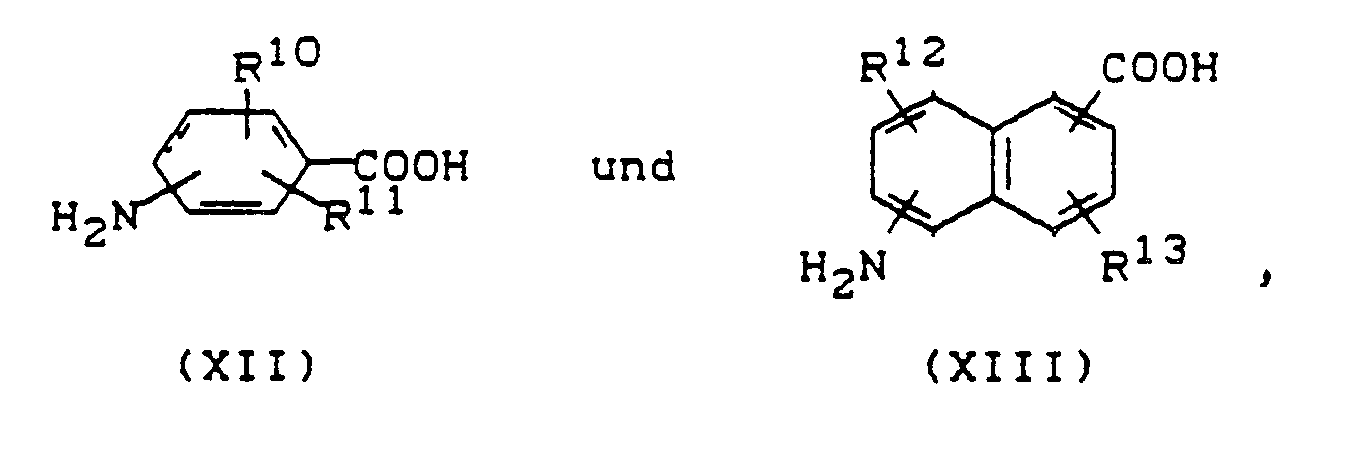
- R'° bis R13 die Bedeutung der Reste R6 bis R9 der Formeln (VII) und (VIII) besitzen,
- in Frage.
- Bevorzugte aromatische Aminocarbonsäuren sind 2-Aminobenzoesäure, 3-Aminobenzoesäure, 4-Aminobenzoesäure, 4-Chloranthranilsäure, 5-Chloranthranilsäure, 3-Amino-4-chlorbenzoesäure, 3-Amino-4-me- thylbenzoesäure, 4-Amino-3-methylbenzoesäure, 4-Amino-3-phenylbenzoesäure, 3-Brom-4-aminobenzoesäure, 4-Amino-3-methoxybenzoesäure, 6-Amino-2-naphthoesäure, 4-Amino-3-phenoxybenzoesäure, 6-Amino-5-chlor-2-naphthoesäure, 6-Amino-5-methyl-2-naphthoesäure, 6-Amino-5-methoxy-2-naphthoesäure und 6-Amino-4,7-dichlor-2-naphthoesäure, besonders bevorzugt 4-Aminobenzoesäure, 3-Aminobenzoesäure und 6-Amino-2-naphthoesäure.
- Als Diphenole c) kommen solche der Formel

Z die in Formel (IX) angegebene Bedeutung hat. - Bevorzugte Diphenole c) sind z.B. Hydrochinon, 4,4'-Dihydroxydiphenyl, 4,4'-Dihydroxydiphenylether, 4,4'-Dihydroxydiphenylethan, 4,4'-Dihydroxydiphenoxyethan, 3,5'-Dihydroxydiphenyl, 3,5'-Dihydroxydiphenylether, 1,5-Dihydroxynaphthalin, 2,6-Dihydroxynaphthalin, 1,4-Dihydroxynaphthalin, Chlorhydrochinon, Bromhydrochinon, Methylhydrochinon, Phenylhydrochinon, Ethylhydrochinon, 2,2'-Dimethyl-4,4'-dihydroxydiphenyl, 3,3',5,5'-Tetramethyl-4,4'-dihydroxydiphenyl, 3,5'-Dimethoxy-4,4'-dihydroxydiphenylether, 1,2-(2-Chlor-4-hydroxyphenoxy)ethan, 4-Methoxy-2,6-dihydroxynaphthalin, Resorcin, 3,4'-Dihydroxydiphenyl, 3,4'-Dihydroxydiphenylether, 3,4'-Dihydroxydiphenoxyethan, 1,3-Dihydroxynaphthalin, 1,6-Dihydroxynaphthalin, 1,7-Dihydroxynaphthalin, 2,7-Dihydroxynaphthalin, 4-Chlorresorcin, 4-Bromresorcin, 4-Methylresorcin, 4-Phenylresorcin, 4-Ethoxyresorcin, 2,5-Dichlor-1,6-dihydroxynaphthalin und 4-Methoxy-2,7-dihydroxynaphthalin, besonders bevorzugt sind Hydrochinon und 4,4'-Dihydroxydiphenyl.
- Als Aminophenole d) kommen solche der Formel

Z die in Formel (IX) angegebene Bedeutung hat. - Bevorzugte Aminophenole sind z.B.:
- 3-Aminophenol, 5-Amino-2-chlorphenol, 4-Aminophenol, 3- Amino-2-methylphenol, 3-Amino-4-methylphenol, 5-Amino-1-naphthol, 6-Amino-1-naphthol, 5-Amino-2-naphthol, 7-Amino-2-naphthol, 8-Amino-2-naphthol, 6-Amino-2-naphthol und 4-Amino-1-hydroxybiphenyl, besonders bevorzugt sind 3-Aminophenol und 4-Aminophenol.
- Als aromatische Dicarbonsäuren e) kommen solche der Formel

A einen bivalenten aromatischen Rest mit 6 bis 24 C-Atomen, vorzugsweise mit 6 bis 16 C-Atomen bedeutet,
wobei die beiden Valenzen einen Winkel von 45 bis 180° bilden. Die bivalenten aromatischen Reste können durch 1 bis 4 C1-C4-Alkyl-, Cl-C4-Alkoxy-, Phenyl-, Phenoxy-, Benzyl- oder Halogenreste (vorzugsweise Chlor und Brom) substituiert sein und umfassen neben Phenylen, Naphthylen und Biphenylen auch durch Sauerstoff, Schwefel, Carbonyl, Sulfonyl, C1-C4-Alkylen oder -Alkyliden, Cyclohexylen oder -hexyliden oder -0(CH2)nO mit n = 1 bis 4 verbundene Phenylenreste. - Bevorzugte aromatische Reste (A) sind z.B. 1,4-Phenylen, 1,4-Naphthylen oder 4,4-Biphenylen, worin die beiden Bindungen sich koaxial in entgegengesetzte Richtungen erstrecken, oder 1,5-Naphthylen, 2,6-Naphthylen oder 3.5'-Biphenylen, worin die beiden in entgegengesetzte Richtungen zeigenden Bindungen parallel zueinander verschoben sind, sowie 1,3-Phenylen, 1,3-, 1,6-, 1,7- oder 2,7-Naphthylen oder 3,4'-Biphenylen, worin die beiden Bindungen nicht an benachbarten Atomen lokalisiert sind und sich nicht koaxial oder parallel verschoben in entgegengesetzte Richtungen erstrecken.
- Bevorzugte aromatische Dicarbonsäuren e) sind z.B. 1,4-Naphthalindicarbonsäure, 1,5-Naphthalindicarbonsäure, 2,6-Naphthalindicarbonsäure. Biphenyl-4,4'-dicarbonsäure, Biphenyl-3,3'-dicarbonsäure, Diphenoxyethan-4,4'-dicarbonsäure, Diphenylether-4,4'-dicarbonsäure, Methylterephthalsäure, Methoxyterephthalsäure, Chlorterephthalsäure, 4-Chlornaphthalin-2,7-dicarbonsäure. 1,3-Naphthalindicarbonsäure, 1,6-Naphthalindicarbonsäure, 1,7-Naphthalindicarbonsäure, 2,7-Naphthalindicarbonsäure, Biphenyl-3,4'-dicarbonsäure, Diphenylether-3,4'-dicarbonsäure, 4-Methylisophthalsäure, 5-Methylisophthalsäure, Diphenylether-4,4 -dichlor-3,3'-dicarbonsäure, Iso- und Terephthalsäure.
- Besonders bevorzugte aromatische Dicarbonsäuren e) sind Iso- und Terephthalsäure.
- Als Derivate zum Einbau der Carbonatgruppen (f) seien genannt: Diarylcarbonate, wie Diphenylcarbonat, Ditolyl-carbonat, Phenyl-tolyl-carbonat und Dinaphthylcarbonat, Dialkylcarbonate, wie Diethylcarbonat, Dimethylcarbonat, Dimethyldicarbonat und Diethyldicarbonat, sowie Glykolcarbonat.
- Ein bevorzugtes Derivat zum Einbau der Carbonatgruppen (f) ist Diphenylcarbonat.
- Gegenstand der Erfindung ist ferner ein Verfahren zur Herstellung von flüssigkristallinen Polykondensaten auf Basis von
- a) aromatischen Hydroxycarbonsäuren,
- b) gegebenenfalls aromatischen Aminocarbonsäuren,
- c) Diphenolen,
- d) gegebenenfalls Aminophenolen,
- e) aromatischen Dicarbonsäuren und
- f) gegebenenfalls Kohlensäure, das dadurch gekennzeichnet ist, daß man eine Schmelzumesterung der von den Hydroxycarbonsäuren, Diphenolen und Aminophenolen abgeleiteten C1 bis C4-Acylester mit den Dicarbonsäuren oder eine Schmelzumesterung der Phenylester der Hydroxycarbonsäuren, gegebenenfalls Aminocarbonsäuren, Dicarbonsäuren und Kohlensäure mit den Diphenolen und gegebenenfalls Aminophenolen bei 150 bis 380 C in Gegenwart von aromatischen Estern der Formel (I) mit definierter Sequenz der Struktureinheiten

- Ar ein aromatischer Rest ist, der einkernig oder mehrkernig sein kann, wobei der mehrkernige Rest einbindig verknüpft oder annelliert sein kann,
- R1 und R2 gleich oder verschieden sein können und H, Chlor, O-C1-C4-Alkyl, -O-C3-C6-Cycloalkyl, O-C6-C14-Aryl, Cl-C4-Alkyl, C3-C6-Cycloalkyl, C6-C14-Aryl, fluoriertes C1-C4-Alkyl, fluoriertes C3-C6-Cycloalkyl, fluoriertes C6-C14-Aryl oder ein Rest der Formeln (I)/a) bis I) sind:


- X für die vorstehend für R' oder R2 genannten Reste von H bis fluoriertes C6-C14-Aryl steht, M1 und M2 gleich oder verschieden sind und zweibindige Reste der Formeln (1.1) bis (1.11);


sein können
und worin
m Null, 1 oder 2,
n 1 oder 2,
o 1, 2 oder 3 und - p Null oder 1 sind, wobei im Falle von p = Null R2 (1 a), (1 b), (1 c) oder (1 d) ist, oder von Oligomeren der Formel (II) mit statistischer Verteilung der Struktureinheiten

R3 einen Alkyl- oder einen gegebenenfalls substituierter Arylrest darstellt,
Ar1 ein bivalenter, gegebenenfalls substituierter ein-oder mehrkerniger aromatischer Rest ist, wobei der mehrkernige Rest einbindig verknüpft oder annelliert sein kann,
Ar2 einen bivalenten, gegebenenfalls substituierten ein- oder mehrkernigen aromatischen Rest darstellt, wobei der mehrkernige Rest unterschiedlich verknüpft sein kann,
R4 und R5 für CmH2m mit m = 0 bis 50 stehen oder die Bedeutung eines gegebenenfalls substituierten bivalenten ein- oder mehrkernigen aromatischen Rests haben, wobei der mehrkernige Rest unterschiedlich verknüpft sein kann, - Y für -0-. -CO- oder -NH- steht und im Falle der Verknüpfung mit einer Endgruppe -0- oder -NH-bedeutet,
- a = 2,
- b = Null bis 5,
- c = 1 bis 5,
- d = Null bis 4 und
- e = Null bis 3 ist, und worin die Endgruppen durch Strukturelemente des Typs R3C0 gebildet werden, durchführt.
- Die Schmelzumesterung der von den Hydroxycarbonsäuren und Diphenolen abgeleiteten Acylester, vorzugsweise deren Acetaten bzw. Diacetaten, mit den Dicarbonsäuren und Abspaltung von Carbonsäure bzw. Essigsäure (Acetat-Verfahren) ist u.a. beschrieben in EP 134 956 und 102 719. Die Schmelzumesterung der reaktionsfähigen Carboxylderivate, vorzugsweise der Phenylester der Hydroxycarbonsäuren und Dicarbonsäuren, mit den Diphenolen und gegebenenfalls Diphenylcarbonat (Diphenylester-Verfahren) ist beschrieben beispielsweise in EP 132 637 und 72 540.
- Die reaktionsfähigen Derivate z.B. die Acetate oder Diacetate sowie die Phenylester oder Diphenylester können entweder in einem der Polykondensation vorgelagerten Reaktionsschritt getrennt hergestellt werden oder auch in situ im Reaktionsgemisch in Gegenwart der anderen Reaktionskomponenten gebildet werden.
- Es ist auch zweckmäßig, sowohl die Ver- bzw. Umesterungsreaktionen als auch die Polykondensationsreaktionen katalytisch zu beschleunigen. Derartige Katalysatoren sind bekanntlich z.B. die Oxide, Hydride, Hydroxide, Halogenide, Alkoholate, Phenolate, Salze anorganischer oder organischer Säuren, die Komplexsalze oder Mischsalze der Alkalimetalle, z.B. Lithium, Natrium oder Kalium, der Erdalkalimetalle, z.B. Magnesium oder Calcium, der Nebengruppenelemente, z.B. Vanadium, Titan, Mangan, Cobalt, Nickel, Zink, Lanthan, Cer oder Zirkonium oder deren Elemente aus anderen Gruppen des Periodensystems, z.B. Germanium, Zinn, Blei oder Antimon, oder auch die Alkalimetalle oder Erdalkalimetalle selbst, insbesondere Natrium, Natriumhydroxid, Lithium-, Natrium-, Kalium-, Calcium-, Magnesium-, Cobalt-, Zinkacetat, Calciumbnzoat, Magnesiumacetylacetonat, Zinkacetylacetonat, Titantetrabutylat, Titantetrapropylat, Zirkoniumbutylat, Zirkoniumpropylat, Titantetraphenolat, Natriumphenolat, Germaniumdioxid, Antimontrioxid, Dibutylzinn-diacetat, Dibutyldimethoxy-zinn, vorzugsweise Alkylzinncarboxylate, Alkalicarboxylate, wie Benzoesäure-K-Salz, p-Hydroxybenzoesäure-K-Salz oder Imidazol.
- Die Katalysatormengen betragen üblicherweise ca. 0,001 bis 1, bevorzugt 0,01 bis 0,2 Gew.-%, bezogen auf das Gesamtgewicht der eingesetzten Monomeren.
- Die erfindungsgemäßen flüssigkristallinen Polykondensate können bei Temperaturen von ca. 150 bis 380 C hergestellt werden, wobei man im allgemeinen die Reaktion bei niedrigen Temperaturen beginnt und im Verlaufe der Reaktionsfortschreitung die Temperatur kontinuierlich erhöht. Bei nachlassender Reaktionsgeschwindigkeit kann ein Vakuum angelegt werden, wobei der Druck vorzugsweise kontinuierlich von Normaldruck bis ca. 0,1 mbar gesenkt wird.
- Bei der Herstellung der erfindungsgemäßen flüssigkristallinen Polykondensate kann die Zugabe der Ester der Formeln (I) und (11) bis zum Erreichen eines Abspaltungsgrades von 95 % an flüchtigem Polykondensationsprodukt zu jedem beliebigen Zeitpunkt erfolgen. Vorzugsweise werden die flüssigkristallinen Verbindungen zu Beginn bei der Einwaage der Monomerbausteine zugegeben.
- Mit steigender Konzentration an eingesetzten Estern sinkt das Molekulargewicht und damit die Schmelz- und Lösungsviskosität der thermotropen Polykondensate. Die erfindungsgemäßen thermotropen Polykondensate zeichnen sich aufgrund blockierter Kettenenden durch eine erhöhte thermische Stabilität und eine ausgezeichnete Schmelzviskositätsstabilität unter Verarbeitungsbedingungen aus.
- Die Ester der Formel (I) und (11) werden bei dem erfindungsgemäßen Verfahren in der zuvor beschriebenen Menge zugesetzt.
- Mit in der Literatur beschriebenen Kettenabbrechern bzw. Endverkappungsagenzien war es nicht möglich, thermotrope Polykondensate mit vergleichbarem Stabilitätsgrad zu erhalten. Dies gilt auch für den Einsatz der monomeren Bausteine, aus denen die einzusetzenden Ester synthetisiert wurden.
- Die erfindungsgemäßen flüssigkristallinen Polykondensate können leicht aus der Schmelze in üblicher Weise zu Formkörpern, Folien, Fasern und Filamenten verarbeitet werden.
-
- - Herstellung der erfindungsgemäß eingesetzten Ester der Formel (I)
- - Herstellung der erfindungsgemäßen flüssigkristallinen Polykondensate in Gegenwart der Ester der Formel (I)
- 4-Hydroxyphenyl-4-hydroxybenzoat wird hergestellt:
- a) aus 4-Hydroxybenzoesäure und Einführung der Carbobenzoxygruppe als Schutzgruppe und Veresterung mit Hydrochinon nach Schotten-Baumann und anschließende Schutzgruppenabspaltung
Lit.: W.R. Krigbaum, Eur. Polym. J. 20, S. 225 (1984)
Schmp.: 245-246 °C - b) durch Direktveresterung analog DE 3 622 611:
138,1 g 4-Hydroxybenzoesäure und 110,1 g Hydrochinon werden zusammen mit 2 g Borsäure und 2,5 g Schwefelsäure in 900 ml Xylol suspendiert und bis zum nde der Wasserabspaltung unter Rückfluß erhitzt. Das Produkt wird abgesaugt, getrocknet und mit verdünnter Na-Bicarbonat-Lösung gewaschen, erneut getrocknet und in 500 ml Aceton gelöst. Es wird heiß vom ungelösten filtriert und das Produkt aus Wasser gefällt, abgesaugt und getrocknet.
Ausbeute: 182 g
Schmp.: 245-247 °C - 345,3 g 4-Hydroxyphenyl-4-hydroxybenzoat werden mit 249 g Pyridin in 3000 ml Methylenchlorid suspendiert und bei T = 0 °C innerhalb von 3 h mit 460 g Methylbenzoesäurechlorid versetzt. Das Reaktionsgemisch wird bei Raumtemperatur 14 h nachgerührt. Das Lösungsmittel wird im Vakuum abdestilliert und der Rückstand mit 1,4 I 5 %iger Salzsäure aufgeführt. Das unlösliche Produkt wurde abgesaugt, mit Wasser neutral gewaschen und getrocknet.
Ausbeute: 643 g (85 % d. Th.)
Im Bereich von 190 bis 350° C kann unter dem Polarisationsmikroskop eine flüssigkristalline Phase festgestellt werden. - 4-Benzoyloxybenzoesäure-4-benzoyloxyphenylester wird aus 4-Hydroxyphenyl-4-hydroxybenzoat und Benzoesäurechlorid nach der Vorschrift aus Beispiel 1 hergestellt.
Ausbeute: 530 g (80 % d. Th.)
Im Bereich zwischen 190 und 350 C wurde mittels Polarisationsmikroskopie eine flüssigkristalline Phase festgestellt. - 4-(4-Methoxybenzoyloxy)benzoesäure-4-(4-methoxybenzoyloxy)-phenylester wird aus 4-Hydroxyphenyl-4-hydroxybenzoat und 4-Methoxybenzoesäurechlorid nach der Vorschrift des Beispiels 1 hergestellt. Ausbeute: 420 g (84 % d. Th.)
Im Bereich zwischen 180 bis 330 C wurde mittels Polarisationsmikroskopie das Vorliegen einer flüssigkristallinen Phase festgestellt. - In einem Reaktionsgefäß mit Rührer, Kolonne und Destillierbrücke werden
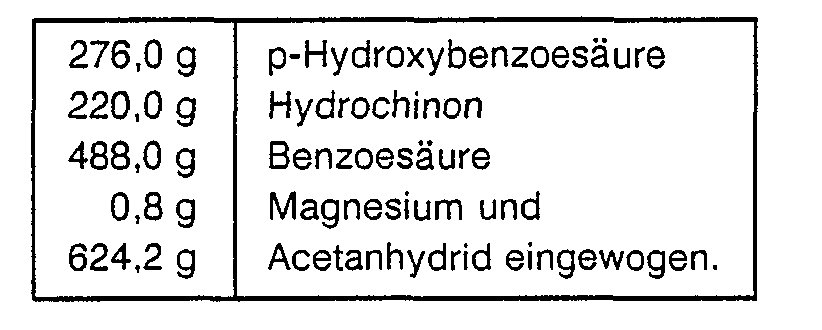
- Be einer Innentemperatur von 160' C begann die Abspaltung der Essigsäure. Mit nachlassender Destillationsgeschwindigkeit wurde die Reaktionstemperatur langsam auf 250 C erhöht.
- Nach Beendigung der Destillation wurde der Druck im Verlauf von 30 min bis auf 1 mbar gesenkt. Während der Vakuumphase wurden restliche Mengen von Essigsäure im Verlauf von 2h abgespalten.
- Das Produkt wurde in einer Weißblechdose abgefüllt und nach dem Erkalten zerkleinert.
Auseute: 876 g - Im Bereich zwischen 190 und 350 C wurde mittels Polarisationsmikroskopie eine flüssigkristalline Phase festgestellt.
- Analog zur Vorschrift in Beispiel 4 werden
-

- Im Bereich von 180 bis 320 °C wurde mittels Polarisationsmikroskopie eine flüssigkristalline Phase festgestellt.
- Analog zur Vorschrift in Beispiel 4 werden

- Im Bereich von 220 bis 320 °C wurde mittels Polarisationsmikroskopie eine flüssigkristalline Phase festgestellt.
- Beispiel 7 Polyestercarbonat
- In einem Reaktionsgefäß mit Rührer, Kolonne und Destillierbrücke wurden

- Bei einer Innentemperatur von 160' C begann die C02-Abspaltung. Die Innentemperatur wurde im Verlauf von 15 Min. auf 180° C erhöht, 60 Min. konstant gehalten, auf 220° C erhöht und bis zum Ende der C02-Abspaltung konstant gehalten.
- Das Reaktionsgemisch wurde auf 250 °C aufgeheizt und der Druck im Reaktor schrittweise bis auf 30 mbar erniedrigt. Nach 1 h hatte die Destillationsgeschwindigkeit soweit nachgelassen, daß die Innentemperatur auf 275 C und anschließend 300° C erhöht werden konnte. Nachdem die Phenolabspaltung weitgehend abgeschlossen war, wurde der Druck im Reaktor auf 0,2 mbar reduziert. Nach 1 h unter diesen Kondensationsbedingungen war die Reaktion beendet.
Produktbeschreibung: hochviskos, sehr starke Faserstruktur
Produktfarbe: beige - In Tabelle 1 und 2 sind die in Gegenwart verschiedener Kettenabbrecher (Endverkappungsagentien) hergestellten LC-Polyestercarbonate zusammengefaßt.
- Die Vergleiche mit anderen monofunktionellen Verbindungen sowie mit Phenylbenzoat zeigen deutlich die gute Wirksamkeit der erfindungsgemäßen Kettenabbrecher.


- In ein 1 I-Pianschliffgefäß mit Planschliffdeckel, Rührer, Stickstoffeinleitung und einem Destillationsaufsatz, der mit einem Kühler verbunden war, wurden

- Unter Stickstoffatmosphäre wurde mittels Salzbad auf 170°C erhitzt. Sobald die Destillation von Essigsäure nachließ (nach ca. 45 Min.), wurde die Temperatur im Reaktionsgefäß im Verlauf einer Stunde auf 250° C und im Verlauf einer weiteren Stunde auf 330 C erhöht. Nach Beendigung der Destillation wurde der Druck im Verlauf von 30 Min. bis auf ca. 1 mbar gesenkt.
Während der Vakuumphase nahm die Viskosität der entstandenen Polymerschmelze stark zu. Die Schmelze wurde daher langsamer gerührt. Am Ende dieser Phase war die Gesamtmenge an Essigsäure (enthält restliches Acetanhydrid) aufgefangen worden.
Produktbeschreibung: hellbeige, hochviskos, starke Faserstruktur. - In Tabelle 3 und 4 sind die in Gegenwart verschiedener Kettenabbrecher (Endverkappungsagentien) hergestellten LC-Polyester zusammengefaßt.


- Vergleichbare gute Resultate hinsichtlich Lösungsviskosität (Molgewichtsregelung) und thermischer Stabilität (TGA) werden auch mit den anderen erfindungsgemäßen Verbindungen der Formeln I und II erzielt.
- Die verbesserte Viskositätsstabilität der erfindungsgemäßen flüssigkristallinen Polykondensate läßt sich durch einen Langzeit-Temperversuch demonstrieren.
- Dazu wird ein flüssigkristalliner Polyester aus Beispiel 8 in Gegenwart von Biphenyl-4-carbonsäure und 2. in Gegenwart des Additivs 4 (0,5 Mol) (Beispiel 4) hergestellt, bei 320° C in der Schmelze getempert und die Schmelzviskosität in Abhängigkeit der Zeit bestimmt.
- Die Fließkurven der beiden Produkte nach einer Standzeit von 4h bei 320 C sind in Abb. 1 dargestellt.
- Ein Vergleich der beiden Produkte zeigt deutlich die überlegene Viskositätsstabilität des in Gegenwart der Verbindung II hergestellten LC-Polymeren gegenüber dem Produkt, das einen monofunktionellen Kettenabbrecher, wie Biphenyl-4-carbonsäure, enthält.
-


Claims (4)
erhältlich durch Schmelzumesterung der von den Hydroxycarbonsäuren, Diphenolen und Aminophenolen abgeleiteten C, bis C4-Acylester mit den Dicarbonsäuren oder durch Schmelzumesterung der Phenylester der Hydroxycarbonsäuren, gegebenenfalls Aminocarbonsäuren; Dicarbonsäuren und Kohlensäure mit den Diphenolen und gegebenenfalls Aminophenolen bei 150 bis 380 C in Gegenwart von aromatischen Estern der Formel (I) mit definierter Sequenz der Struktureinheiten
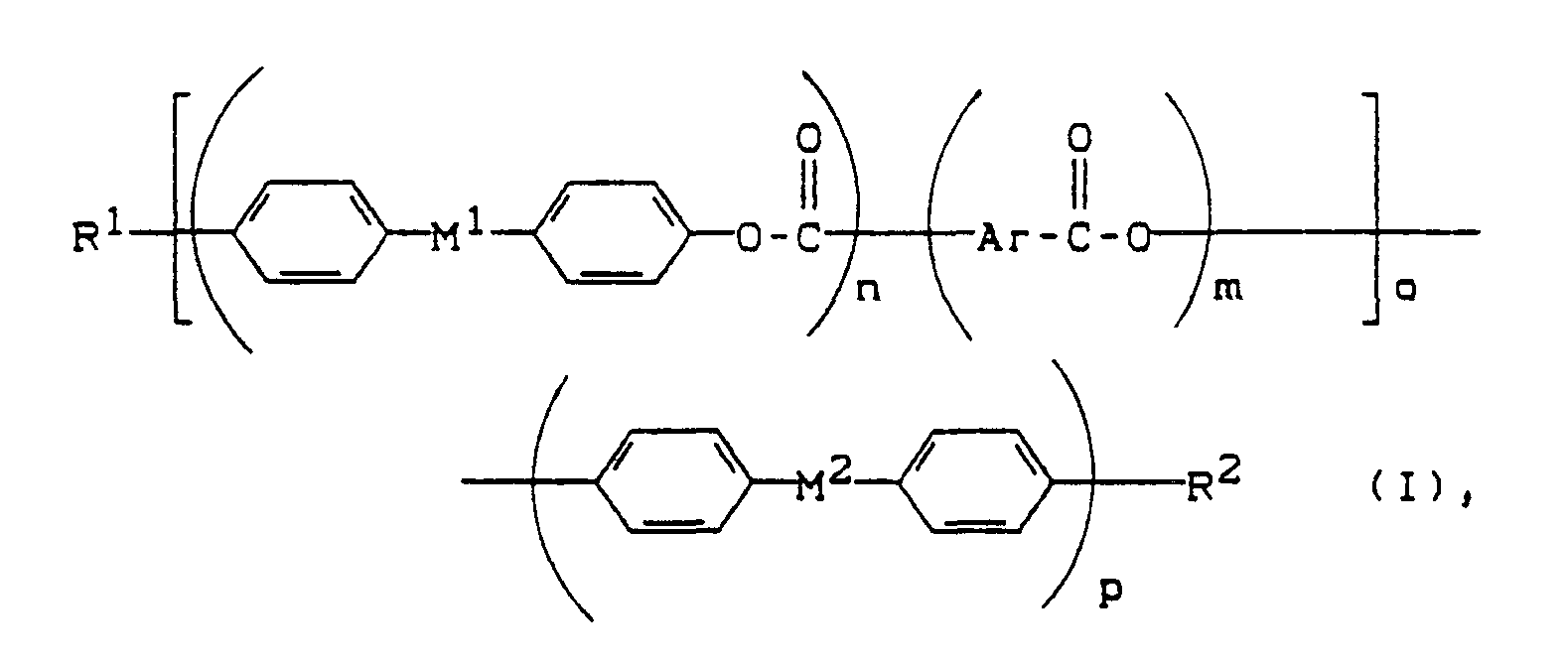



wobei


[entsprechend ihrer Aufeinanderfogle]
und worin
m Null, 1 oder 2,
n 1 oder 2,
o 1, 2 oder 3 und

dadurch gekennzeichnet, daß man eine Schmelzumesterung der von den Hydroxycarbonsäuren, Diphenolen und Aminophenolen abgeleiteten C1 bis C4-Acylester mit den Dicarbonsäuren oder eine Schmelzumesterung der Phenylester der Hydroxycarbonsäuren, gegebenenfalls Aminocarbonsäuren, Dicarbonsäuren und Kohlensäure mit den Diphenolen und gegebenenfalls Aminophenolen bei 150 bis 380 °C in Gegenwart von aromatischen Estern der Formel (I) mit definierter Sequenz der Struktureinheiten



wobei


[entsprechend ihrer Aufeinanderfolge]
und worin
m Null, 1 oder 2,
n 1 oder 2,
o 1. 2 oder 3 und
p Null oder 1 sind, wobei im Falle von p = Null R2 nur (1 a), (1 b), (1 c) oder (1 d) sein kann, oder von Oligomeren der Formel (II) mit statistischer Verteilung der Struktureinheiten

und worin die Endgruppen durch Strukturelemente des Typs R3CO gebildet werden, durchführt.
Applications Claiming Priority (2)
| Application Number | Priority Date | Filing Date | Title |
|---|---|---|---|
| DE3831122A DE3831122A1 (de) | 1988-09-13 | 1988-09-13 | Fluessigkristalline polykondensate mit verbesserter thermostabilitaet, verfahren zu ihrer herstellung und ihre verwendung zur herstellung von formkoerpern, folien, fasern und filamenten |
| DE3831122 | 1988-09-13 |
Publications (2)
| Publication Number | Publication Date |
|---|---|
| EP0359038A2 true EP0359038A2 (de) | 1990-03-21 |
| EP0359038A3 EP0359038A3 (de) | 1991-01-02 |
Family
ID=6362861
Family Applications (1)
| Application Number | Title | Priority Date | Filing Date |
|---|---|---|---|
| EP19890116056 Withdrawn EP0359038A3 (de) | 1988-09-13 | 1989-08-31 | Flüssigkristalline Polykondensate mit verbesserter Thermostabilität, Verfahren zu ihrer Herstellung und ihre Verwendung zur Herstellung von Formkörpern, Folien, Fasern und Filamenten |
Country Status (4)
| Country | Link |
|---|---|
| US (1) | US5030703A (de) |
| EP (1) | EP0359038A3 (de) |
| JP (1) | JPH02113025A (de) |
| DE (1) | DE3831122A1 (de) |
Cited By (4)
| Publication number | Priority date | Publication date | Assignee | Title |
|---|---|---|---|---|
| EP0513545A3 (en) * | 1991-04-19 | 1993-09-29 | Hoechst Celanese Corporation | Melt processable poly(ester-amide) capable of forming an anisotropic melt |
| EP0600161A1 (de) * | 1992-08-12 | 1994-06-08 | United States Surgical Corporation | Aminosäure-terminierte Polyester mit vorbestimmter Monomersequenz |
| US5349047A (en) * | 1992-07-14 | 1994-09-20 | United States Surgical Corporation | Polyesters having predetermined monomeric sequence |
| WO1995033803A1 (en) * | 1994-06-06 | 1995-12-14 | Hoechst Celanese Corporation | Thermotropic liquid crystalline poly(esteramides) |
Families Citing this family (10)
| Publication number | Priority date | Publication date | Assignee | Title |
|---|---|---|---|---|
| IT1236841B (it) * | 1989-11-22 | 1993-04-21 | Eniricerche Spa | Copoliestereammide termotropica,procedimento per la sua preparazione e la sua utilizzazione |
| IT1236842B (it) * | 1989-11-22 | 1993-04-21 | Eniricerche Spa | Copoliestereammide termotropica,procedimento per la sua preparazione e suo impiego |
| US5132390A (en) * | 1991-05-13 | 1992-07-21 | Armstrong World Industries, Inc. | Low melting, soluble, liquid crystalline polyesters |
| US5298593A (en) * | 1991-06-25 | 1994-03-29 | Mitsubishi Petrochemical Company, Ltd. | Method of producing thermotropic liquid crystalline polyester |
| US5688895A (en) * | 1996-06-24 | 1997-11-18 | E. I. Du Pont De Nemours And Company | Liquid crystalline poly(ester-amides) |
| TWI295298B (en) * | 2000-08-29 | 2008-04-01 | Sumitomo Chemical Co | Liquid crystalline polyester and method for producing the same |
| US7582078B2 (en) * | 2006-02-14 | 2009-09-01 | Boston Scientific Scimed, Inc. | Medical device employing liquid crystal block copolymers and method of making the same |
| US7662129B2 (en) * | 2006-02-14 | 2010-02-16 | Boston Scientific Scimed, Inc. | Medical device employing liquid crystal block copolymers and method of making the same |
| US8530612B2 (en) * | 2008-05-19 | 2013-09-10 | Molecon, Inc. | Synthesis of polyesters with precisely sequenced two or more structural units |
| CN102149745B (zh) * | 2008-09-09 | 2014-05-28 | 苏州莫立克新型材料有限公司 | 带有羟基酸嵌段的聚合物 |
Family Cites Families (12)
| Publication number | Priority date | Publication date | Assignee | Title |
|---|---|---|---|---|
| US4333907A (en) * | 1979-06-25 | 1982-06-08 | Teitin Limited | Biaxially oriented wholly aromatic polyester film |
| US4395536A (en) * | 1981-11-17 | 1983-07-26 | Celanese Corporation | Preparation of aromatic copolyesters via in situ esterification with isopropenyl esters of an alkyl acid |
| DE3325787A1 (de) * | 1983-07-16 | 1985-01-24 | Bayer Ag, 5090 Leverkusen | Mesomorphe aromatische polyester mit hoher steifigkeit und zaehigkeit, verfahren zu ihrer herstellung und ihre verwendung zur herstellung von formkoerpern, filamenten, fasern und folien |
| US4603190A (en) * | 1983-07-16 | 1986-07-29 | Bayer Aktiengesellschaft | Thermotropic aromatic polyesters having high rigidity and toughness, process for the production thereof and the use thereof for the production of moulded articles, filaments, fibres and films |
| US4742149A (en) * | 1983-11-30 | 1988-05-03 | Dart Industries, Inc. | Production of melt consistent aromatic polyesters |
| DE3410927A1 (de) * | 1984-03-24 | 1985-10-03 | Hoechst Ag, 6230 Frankfurt | Vollaromatische polyester, verfahren zu ihrer herstellung und entsprechende formkoerper |
| DE3415530A1 (de) * | 1984-04-26 | 1985-10-31 | Bayer Ag, 5090 Leverkusen | Thermotrope aromatische polyester hoher steifigkeit und zaehigkeit, verfahren zu ihrer herstellung und ihre verwendung zur herstellung von formkoerpern, filamenten, fasern und folien |
| DE3427886A1 (de) * | 1984-07-28 | 1986-01-30 | Bayer Ag, 5090 Leverkusen | Thermotrope aromatische polyester mit hoher steifigkeit, verfahren zu ihrer herstellung und ihre verwendung zur herstellung von formkoerpern, filamenten, fasern und folien |
| US4554329A (en) * | 1985-01-30 | 1985-11-19 | Celanese Corporation | Modified PET polymers and copolymers suitable for extrusion blow molding |
| US4680372A (en) * | 1986-02-25 | 1987-07-14 | Celanese Corporation | In-situ end-capping melt prepared aromatic polyester with phenyl benzoate |
| DE3721055A1 (de) * | 1987-06-26 | 1989-01-05 | Bayer Ag | Thermotrope aromatische polyester mit hoher reissdehnung, verfahren zu ihrer herstellung und ihre verwendung zur herstellung von formkoerpern, filamenten, fasern und folien |
| DE3721256A1 (de) * | 1987-06-27 | 1989-01-12 | Akzo Gmbh | In der schmelze verarbeitbare thermotrope voll-aromatische polyester |
-
1988
- 1988-09-13 DE DE3831122A patent/DE3831122A1/de not_active Withdrawn
-
1989
- 1989-08-31 EP EP19890116056 patent/EP0359038A3/de not_active Withdrawn
- 1989-09-05 US US07/402,872 patent/US5030703A/en not_active Expired - Fee Related
- 1989-09-12 JP JP1234815A patent/JPH02113025A/ja active Pending
Cited By (4)
| Publication number | Priority date | Publication date | Assignee | Title |
|---|---|---|---|---|
| EP0513545A3 (en) * | 1991-04-19 | 1993-09-29 | Hoechst Celanese Corporation | Melt processable poly(ester-amide) capable of forming an anisotropic melt |
| US5349047A (en) * | 1992-07-14 | 1994-09-20 | United States Surgical Corporation | Polyesters having predetermined monomeric sequence |
| EP0600161A1 (de) * | 1992-08-12 | 1994-06-08 | United States Surgical Corporation | Aminosäure-terminierte Polyester mit vorbestimmter Monomersequenz |
| WO1995033803A1 (en) * | 1994-06-06 | 1995-12-14 | Hoechst Celanese Corporation | Thermotropic liquid crystalline poly(esteramides) |
Also Published As
| Publication number | Publication date |
|---|---|
| EP0359038A3 (de) | 1991-01-02 |
| DE3831122A1 (de) | 1990-03-15 |
| JPH02113025A (ja) | 1990-04-25 |
| US5030703A (en) | 1991-07-09 |
Similar Documents
| Publication | Publication Date | Title |
|---|---|---|
| DE60013756T2 (de) | Verfahren zur Herstellung von flüssigkristallinem Polymer | |
| US4746694A (en) | Melt processable polyester capable of forming an anisotropic melt comprising a relatively low concentration of 6-oxy-2-naphthoyl moiety, 4-oxybenzoyl moiety, 2,6-dioxynaphthalene moiety, and terephthaloyl moiety | |
| DE3831122A1 (de) | Fluessigkristalline polykondensate mit verbesserter thermostabilitaet, verfahren zu ihrer herstellung und ihre verwendung zur herstellung von formkoerpern, folien, fasern und filamenten | |
| DE3742205A1 (de) | Formmassen bestehend aus einem thermotropen, aromatischen polyester | |
| EP0071447A1 (de) | Polyester aus 6-hydroxy-2 Naphtalensäure, 4-Hydroxy-benzoesäure, 1,4-Cyclohexandicarbonsäure und aromatisches Diol, geeignet zur Bearbeitung in der Schmelze um Gegenstände zu formen mit hoher Schlagfestigkeit | |
| EP0165399A2 (de) | Thermotrope aromatische Polyester mit hoher Steifigkeit und Zähigkeit, Verfahren zu ihrer Herstellung und ihre Verwendung zur Herstellung von Formkörpern, Filamenten, Fasern und Folien | |
| DE69006617T2 (de) | Cholesterischer, flüssigkristalliner, eine optisch aktive Gruppe enthaltender Polyester. | |
| EP0170935A1 (de) | Thermotrope aromatische Polyester mit hoher Steifigkeit, Verfahren zu ihrer Herstellung und ihre Verwendung zur Herstellung von Formkörpern, Filamenten, Fasern und Folien | |
| JPS61197629A (ja) | コレステリック液晶性ポリエステルの製造法 | |
| DE3320260A1 (de) | Diphenolmonoester von carbonsaeuren, ein verfahren zu ihrer herstellung, ihre verwendung zur herstellung von polyestercarbonaten, die erfindungsgemaess erhaeltlichen polyestercarbonate sowie flammwidrige formmassen enthaltend diese polyestercarbonate | |
| EP0464351A2 (de) | Leichtfliessende Polycarbonat-, Polyestercarbonat und Polyesterformmassen | |
| US4284757A (en) | Thermotropic aromatic copolyesters and processes for their preparation | |
| DE3913403A1 (de) | Neue thermotrope polyester, verfahren zu ihrer herstellung sowie ihrer verwendung zur herstellung von formkoerpern, filamenten, fasern und folien | |
| EP0161413B1 (de) | Vollaromatische Polyester, Verfahren zu ihrer Herstellung und entsprechende Formkörper | |
| DE3727730A1 (de) | Verfahren zur herstellung von vollaromatischen, thermotropen polyestern und polyestercarbonaten | |
| DE3325704A1 (de) | Mesomorphe aromatishe polyestercarbonate, verfahren zu ihrer herstellung und ihre verwendung zur herstellung von formkoerpern, filamenten, fasern und folien | |
| EP0330037B1 (de) | Thermoplastische Blockcopolymere aus carboxylgruppenhaltigem Polypropylen einerseits und vollaromatischen Polyestern, Polyestercarbonaten oder Polyesteramiden andererseits. | |
| US4709005A (en) | Thermotropic aromatic polyesters | |
| EP0303935A2 (de) | Thermotrope aromatische Polyestercarbonate, ein Verfahren zu ihrer Herstellung und ihre Verwendung | |
| EP0141320A2 (de) | Thermotrope aromatische Polyester hoher Steifigkeit, Verfahren zu ihrer Herstellung und ihre Verwendung zur Herstellung von Formkörpern, Filamenten, Fasern und Folien | |
| DE69218591T2 (de) | Thermotrope flüssigkristallin-aromatische Polyester | |
| US4346208A (en) | Anisotropic melts which can be shaped, based on aromatic polyesters, and articles formed from these melts | |
| EP0284726B1 (de) | Aromatische Polyester auf Basis von Phenoxyterephthalsäure, Verfahren zu ihrer Herstellung und ihre Verwendung | |
| DE3517948A1 (de) | Thermotrope aromatische polyester mit hervorragenden mechanischen eigenschaften und guter verarbeitbarkeit, verfahren zu ihrer herstellung und ihre verwendung zur herstellung von formkoerpern, filamenten, fasern und folien | |
| JPH0360331B2 (de) |
Legal Events
| Date | Code | Title | Description |
|---|---|---|---|
| PUAI | Public reference made under article 153(3) epc to a published international application that has entered the european phase |
Free format text: ORIGINAL CODE: 0009012 |
|
| 17P | Request for examination filed |
Effective date: 19890831 |
|
| AK | Designated contracting states |
Kind code of ref document: A2 Designated state(s): BE DE FR GB IT NL |
|
| PUAL | Search report despatched |
Free format text: ORIGINAL CODE: 0009013 |
|
| AK | Designated contracting states |
Kind code of ref document: A3 Designated state(s): BE DE FR GB IT NL |
|
| 17Q | First examination report despatched |
Effective date: 19930324 |
|
| STAA | Information on the status of an ep patent application or granted ep patent |
Free format text: STATUS: THE APPLICATION HAS BEEN WITHDRAWN |
|
| 18W | Application withdrawn |
Withdrawal date: 19930713 |