EP0359081A2 - Sportschuh - Google Patents
Sportschuh Download PDFInfo
- Publication number
- EP0359081A2 EP0359081A2 EP89116266A EP89116266A EP0359081A2 EP 0359081 A2 EP0359081 A2 EP 0359081A2 EP 89116266 A EP89116266 A EP 89116266A EP 89116266 A EP89116266 A EP 89116266A EP 0359081 A2 EP0359081 A2 EP 0359081A2
- Authority
- EP
- European Patent Office
- Prior art keywords
- instep
- elevations
- sports shoe
- shoe according
- sports
- Prior art date
- Legal status (The legal status is an assumption and is not a legal conclusion. Google has not performed a legal analysis and makes no representation as to the accuracy of the status listed.)
- Granted
Links
Images
Classifications
-
- A—HUMAN NECESSITIES
- A43—FOOTWEAR
- A43B—CHARACTERISTIC FEATURES OF FOOTWEAR; PARTS OF FOOTWEAR
- A43B5/00—Footwear for sporting purposes
- A43B5/02—Football boots or shoes, i.e. for soccer, football or rugby
- A43B5/025—Football boots or shoes, i.e. for soccer, football or rugby characterised by an element which improves the contact between the ball and the footwear
-
- A—HUMAN NECESSITIES
- A43—FOOTWEAR
- A43B—CHARACTERISTIC FEATURES OF FOOTWEAR; PARTS OF FOOTWEAR
- A43B5/00—Footwear for sporting purposes
- A43B5/02—Football boots or shoes, i.e. for soccer, football or rugby
Definitions
- the invention relates to a sports shoe according to the preamble of claim 1.
- the art of accuracy is to place the impulse on the ball so that its direction is through the center of gravity.
- Conventional sports shoes which follow the anatomy of the human foot in their upper surface, offer only a small-area, more punctiform or more linear contact with the ball when shooting. Depending on the strength of the impulse and the contact surface, the air-filled ball in the area of the shot is fired deformed and thus the touch area slightly enlarged. If the foot with the sports shoe is placed only a few millimeters to the side of a straight line through the center of gravity when hitting the ball, the ball misses the direction specified by the foot movement.
- goal-scoring games are particularly appealing to spectators and the expectation that soccer games with more goals will be played in the future would attract more spectators to the stadiums and thus also offer the clubs a better economic basis.
- the media would be more interested, so that more revenue can be expected from the broadcasting rights.
- the invention has for its object to improve a sports shoe, in particular a soccer shoe, in such a way that the accuracy of the ball is significantly increased during the shot.
- the invention is based on the consideration that the accuracy of a ball can be increased if a) there is a larger contact area when the shot is fired, and b) the ball is given a guide when it is shot. Since this guidance is not provided with the usual surface designed according to the anantomy of the human foot, a less convex but more a plan-shaped and even more a concave design ensures the larger meeting surface or the safe guidance.
- the ball is now hit by at least two contact edges, whereupon a resulting impulse occurs which lies between these two contact edges and thus exactly in the direction of movement of the foot. A lateral deviation the goal is therefore significantly reduced.
- elevations are arranged on both sides of the tension, which extend over the length of the tension.
- This type of configuration allows the concave curvature of the outer material to be designed in a structurally very simple and precise manner, so that reproducible dimensions are achieved.
- the elevations preferably rise in cross-section on both sides of the instep and then bulge in the direction of the sides of the shoe and merge into them.
- the outer shape of the sports shoe according to the invention differs only slightly from the conventional shape, so that the mobility of the foot and the wearing comfort are retained thanks to an imperceptible increase in weight.
- the elevation on the outside of the shoe is larger than the elevation on the inside. This configuration improves the guiding properties of the shoe according to the invention when executing flanks.
- Another embodiment provides that the elevations rise more steeply than the span line. This ensures that the ball is held flatter during the cocking shot, so that more shots get on and into the goal than through the goal, as can be observed frequently up to now.
- the envelope of the upper material is also concave in the area of the heel or at least flat over the entire width of the heel.
- An advantageous embodiment provides that the radius of an arc running through the instep edges of the elevations and through the instep line or heel line is smaller or the same as the radius of a football. This ensures that a guide through two contact surfaces is actually achieved with the measures according to the invention. Due to the smaller radius, contact with the ball on the instep line or the heel line is inevitably reduced and guidance is largely taken over only by the instep edges of the elevations.
- the elevations can be horizontal and / or vertical ones cut or be designed as an arrangement of knobs.
- This measure makes it possible to improve the resilience of the sports shoe, so that the mobility of the foot is maintained when it is rolling while running, even if it is essentially only rolled off in the front area of the shoe. At the same time, weight is saved. The remaining contact area is sufficient to guide the ball through the sports shoe for a decisive short time at the time of the shot.
- An expedient embodiment provides that the instep edges of the elevations are rounded.
- the elevations preferably comprise low-damping material, for example polyurethane or hard rubber.
- the elevations are designed as pockets into which interchangeable cores can preferably be inserted.
- the jacket sleeves of the bags consist of the same material as the rest of the upper material of the sports shoes, for which leather is preferably used.
- the elastic properties can be set by different cores, which e.g. may be necessary to comply with different guidelines at the sports associations.
- the casing sleeves are integrally formed in the upper material of the shoes.
- This configuration can have advantages in terms of production technology if the shoes are machined from a few individual parts. In addition, there is no risk that the bumps can become detached and fall off due to the stresses during the game.
- the jacket sleeves are sewn onto the upper material of the shoes.
- This configuration makes it possible to manufacture the shoes in a conventional manner, so that existing machines can continue to be used, and to mount the elevations separately. In addition, it is then possible to replace the sheath sleeves separately from the rest of the upper material of the shoes when they wear.
- the lacing is arranged in the instep area within the elevations.
- the shoe can be tied in a conventional, simple manner without the protrusions protruding during the tying.
- the lacing in the instep area outside e.g. is arranged on both sides of the elevations or inside and outside of the elevations, it also being possible for the lacing to run through incisions in the elevations or between the knobs. Due to the arrangement on both sides and outside of the lacing, the tensioning range can be changed laterally from inside or outside depending on the individual foot posture by means of different tight lacing.
- the lacing can take some getting used to for the player, but the area of the elevations or nubs is held together better by the lacing, so that the dimensional stability of the elevations is retained even with strong shots.
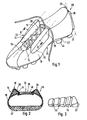
- the sports shoe shown in FIG. 1 is the shoe to be worn on the right foot. It consists, in a manner known per se, of a sole 42 which is provided with knobs 44 and of upper material 10. On the upper material 10, elevations 14 and 16 and 28 and 30 are formed in the area of the instep 12 and in the area of the heel.
- the envelope of these elevations 14 and 16 and 28 and 30 represents a concave curvature.
- the curvature extends over the length of the instep 12 or over the length of the heel 26 in the manner of a fillet or as a flat surface.
- the elevations 14 and 16 initially rise from the area of the instep 12 and then bend in the direction of the sides 22 and 24 until they merge into them.
- the Elevation 14 located on the outside 22 of the shoe is higher than the elevation 16 located on the inside 24. This configuration ensures that the placement of flanks can be carried out more easily and precisely, since the ball is no longer so easily over the instep to the outside of the Can slip.
- the elevations 14 and 16 are sewn onto the upper material 10 of the shoes. It is also possible to form them integrally with the upper 10 of the shoes.
- the lacing 38 of the shoes is located in the instep area 12 within the elevations 14 and 16. This makes the hand The lacing is easier for the player when putting on and taking off and does not require familiarization compared to conventional sports shoes.
- FIG. 2 shows a section through the sports shoe along the section line AA.
- the sole 42, the upper 10, a tab 40 and the lacing 38 are shown.
- the elevations 14 and 16 are designed as pockets and consist of casing sleeves 36, in which cores 34 are located.
- the cores 34 are preferably interchangeable.
- the material used for the casing sleeves 36 is preferably the same material that is also used as the upper material. It is leather. Low-damping material, preferably polyurethane or hard rubber, is used as the material for the cores 34. This ensures that the impulse exerted by the foot passes largely without loss onto the kicked ball.
- the instep edges 18 and 20 of the elevations 14 and 16 are rounded, so that there is a risk of injury to others Players can be avoided by designing the surveys.
- the envelope of the instep edges 18 and 20 of the elevations 14 and 16 with respect to the clamping line 13 is chosen so that the radius of an arc running through the instep edges 18 and 20 of the elevations 14 and 16 and through the instep line 13 is smaller or the same size as the radius of one Football.
- the ball is thus only touched by the instep edges 18 and 20 during the shot and is thus precisely guided for a short time.
- the same dimensioning also applies to the instep edges of the elevations 28 and 30 in connection with the heel line 27. However, it is not illustrated in more detail here.
- FIG. 3 An alternative embodiment of the surveys is shown in FIG. 3.
- the elevations, of which elevation 16 is only shown, have incisions 32 in the horizontal direction. It is also possible to provide vertical incisions or to design the elevation as an arrangement of knobs.
- the incisions 32 facilitate the yielding of the sports shoe when unrolling and also allow it when lacing in the instep rich to let the lacing run through the incisions 32 outside the elevations. As a result, the elevations are additionally stabilized by the lacing.
Landscapes
- Health & Medical Sciences (AREA)
- General Health & Medical Sciences (AREA)
- Physical Education & Sports Medicine (AREA)
- Footwear And Its Accessory, Manufacturing Method And Apparatuses (AREA)
- Acyclic And Carbocyclic Compounds In Medicinal Compositions (AREA)
Abstract
Description
- Die Erfindung betrifft einen Sportschuh nach dem Oberbegriff des Anspruchs 1.
- Bei Ballspielen, insbesondere Fußballspielen besteht die Kunst der Treffsicherheit darin, den auf den Ball ausgeübten Impuls so zu plazieren, daß seine Richtung durch den Schwerpunkt hindurch verläuft. Übliche Sportschuhe, die in ihrer oberen Fläche der Anatomie des menschlichen Fußes folgen, bieten beim Schuß nur eine kleinflächige, mehr punktförmige oder mehr linienförmige Berührung mit dem Ball. Beim Schuß wird in Abhängigkeit von der Stärke des Impulses und der Berührungsfläche der luftgefüllte Ball im Treffbereich verformt und damit die Berührungs fläche etwas vergrößert. Wird nun der Fuß mit dem Sportschuh beim Auftreffen auf den Ball nur wenige Milimeter seitlich einer Geraden durch den Schwerpunkt plaziert, so verfehlt der Ball die durch die Fußbewegung vorgegebene Richtung.
- Während bei ruhendem Ball der richtige Auftreffpunkt noch verhältnismäßig präzise getroffen werden kann, haben selbst Profispieler Schwierigkeiten, einen Ball aus der Bewegung richtig zu plazieren. Abgesehen von Freistößen und Strafstößen, bei denen der Ball ruht, ist der Ball in den übrigen Spielphasen in Bewegung, wobei er entweder über den Boden rollt oder mit mehr oder weniger Drall durch die Luft fliegt.
- Es ist deshalb keine Seltenheit, wenn bei gleich starken Manschaften Spiele ohne Tore unentschieden oder nur mit einer geringen Anzahl von Toren enden. Für die Zuschauer sind aber torreiche Spiele besonders reizvoll und die Erwartung, daß künftig torreichere Fußballspiele ausgetragen werden könnten, würde mehr Zuschauer in die Stadien locken und damit auch den Vereinen bessere wirtschaftliche Grundlagen bieten. Außerdem wären die Medien stärker interessiert, so daß mehr Einnahmen aus den Übertragungsrechten zu erwarten sind.
- Der Erfindung liegt die Aufgabe zugrunde, einen Sportschuh insbesondere Fußballschuh dahingehend zu verbessern, daß beim Schuß die Treffsicherheit des Balles wesentlich erhöht wird.
- Diese Aufgabe wird bei einem Sportschuh nach dem Oberbegriff des Anspruchs 1 durch die im kennzeichnenden Teil angegebenen Merkmale gelöst.
- Die Erfindung geht von der Überlegung aus, daß die Treffgenauigkeit eines Balles erhöht werden kann, wenn a) eine größere Berührungsfläche beim Schuß vorhanden ist, und b) dem Ball beim Abschuß eine Führung erteilt wird. Da diese Führung bei der üblichen, entsprechend der Anantomie des menschlichen Fußes ausgebildeten Oberfläche nicht gegeben ist, sorgt schon eine weniger konvex ausgebildete aber noch mehr eine plan ausgebildete und erst recht eine konkave Ausgestaltung für die größere Trefffläche bzw. die sichere Führung. Dabei wird der Ball nunmehr durch wenigstens zwei Berührungskanten getroffen, woraufhin sich ein resultierender Impuls einstellt, der zwischen diesen beiden Berührungskanten liegt und damit genau in Bewegungsrichtung des Fußes. Eine seitliche Abweichung vom Ziel wird also entscheidend verringert.
- Bei einer praktischen Ausgestaltung der Erfindung sind auf beiden Seiten des Spanns Erhebungen angeordnet, die sich über die Länge des Spanns erstrecken.
- Diese Art der Ausgestaltung gestattet es, die konkave Wölbung des Obermaterials konstruktiv sehr einfach und präzise auszugestalten, damit reproduzierbare Abmessungen erreicht werden. Vorzugsweise steigen die Erhebungen im Querschnitt zu beiden Seiten des Spanns an und wölben sich danach in Richtung der Seiten des Schuhs ab und gehen in diesen über.
- Dadurch unterscheidet sich die äußere Form des erfindungsgemäßen Sportschuhs nur wenig von der konventionellen Form, so daß die Beweglichkeit des Fußes und der Tragkomfort dank einer nur unmerklichen Gewichtserhöhung erhalten bleibt.
- Weiterhin ist vorgesehen, daß die auf der Außenseite des Schuhs befindliche Erhebung größer als die auf der Innenseite befindliche Erhebung ist. Diese Ausgestaltung verbessert die Führungseigenschaften des erfindungsgemäßen Schuhs bei der Ausführung von Flanken.
- Diese können leichter und genauer erfolgen, weil der Ball beim Schuß nicht mehr so leicht über den Spann rutschen kann.
- Eine weitere Ausgestaltung sieht vor, daß die Erhebungen steiler als die Spannlinie ansteigen. Hierdurch wird erreicht, daß beim Spannschuß der Ball flacher gehalten wird, so daß mehr Schüsse auf und in das Tor gelangen, als über das Tor, wie es bisher häufig zu beobachten ist.
- Gemäß einer Fortbildung ist die Einhüllende des Obermaterials auch im Bereich der Ferse konkav oder zumindest plan über die gesamte Breite der Ferse ausgebildet.
- Dadurch ergibt sich die gleiche vorteilhafte Führung bzw. vergrößerte Trefffläche, wie sie durch die Ausgestaltung im Spannbereich erzielt wird beim Treten des Balles mit der Ferse. Dadurch wird der bisher sehr seltene Fall, daß der Tore mit der Ferse erzielt werden, sehr viel wahrscheinlicher.
- Auch bei dieser Ausgestaltung ist vorgesehen, daß auf beiden Seiten der Fersenlinie geradlinige und nicht gewölbte, also sich etwa senkrecht erstreckende Erhebungen angeordnet sind, die sich über die Länge der Ferse erstrecken.
- Hierdurch ergeben sich die gleichen Vorteile bei der konstruktiven Ausgestaltung des Schuhs, wie sie im Zusammenhang mit den Erhebungen des Spanns erläutert wurden.
- Eine vorteilhafte Ausgestaltung sieht vor, daß der Radius eines durch die Ristkanten der Erhebungen und durch die Spannlinie bzw. Fersenlinie verlaufenden Kreisbogens kleiner oder gleich groß wie der Radius eines Fußballs ist. Hierdurch wird sichergestellt, daß mit den erfindungsgemäßen Maßnahmen auch tatsächlich eine Führung durch zwei Berührungsflächen erzielt wird. Durch den kleineren Radius wird zwangsläufig eine Berührung des Balls an der Spannlinie bzw. der Fersenlinie verringert und die Führung weitgehend nur von den Ristkanten der Erhebungen übernommen.
- Gemäß einer alternativen Ausgestaltung können die Erhebungen mit horizontalen und/oder vertikalen Ein schnitten versehen oder als Anordnung von Noppen ausgebildet sein.
- Durch diese Maßnahme läßt sich die Nachgiebigkeit des Sportschuhs verbessern, so daß die Beweglichkeit des Fußes beim Abrollen während des Laufens erhalten bleibt, wenn auch das Abrollen im wesentlichen nur im vorderen Schuhbereich erfolgt. Gleichzeitig tritt eine Gewichtseinsparung ein. Die verbleibende Berührungsfläche reicht dabei aus, um den Ball im Zeitpunkt des Schußes für eine entscheidend kurze Zeit durch den Sportschuh zu führen.
- Eine zweckmäßigen Ausgestaltung sieht vor, daß die Ristkanten der Erhebungen gerundet sind.
- Hierdurch wird sichergestellt, daß die erfindungsgemäßen Maßnahmen in keinem Fall die Verletzungsgefahr erhöhen, wenn ein Spieler in der Hektik des Spiels mit dem Sportschuh am Körper getroffen wird.
- Vorzugsweise umfassen die Erhebungen dämpfungsarmes Material, Z.B. Polyuretan oder Hartgummi.
- Diese Eigenschaften sorgen dafür, daß der vom Fuß des Spielers auf den Ball gerichtete Impuls optimal übertragen wird und somit eine hohe Ballgeschwindigkeit und Schußweite erzielt werden kann.
- Bei einer praktischen Ausgestaltung sind die Erhebungen als Taschen ausgebildet, in die vorzugsweise auswechselbare Kerne einsteckbar sind. Dabei bestehen die Mantelhülsen der Taschen aus dem gleichen Material wie das übrige Obermaterial der Sportschuhe, für das vorzugsweise Leder verwendet wird.
- Hierdurch kann bei Materialermüdung oder Verhärtung ein Austausch erfolgen, ohne daß der ganze Schuh dadurch unbrauchbar wird. Außerdem lassen sich die elastischen Eigenschaften durch unterschiedliche Kerne einstellen, was z.B. zur Einhaltung unterschiedlicher Richtlinien bei den Sportvereinigungen erforderlich sein kann.
- Bei einer möglichen Ausgestaltung sind die Mantelhülsen integral im Obermaterial der Schuhe ausgebildet.
- Diese Ausgestaltung kann herstellungstechnisch Vorteile haben, wenn die Schuhe maschinell aus wenigen Einzelteilen gefertigt werden. Außerdem besteht nicht die Gefahr, daß sich die Erhebungen durch die Beanspruchungen während des Spiels ablösen und abfallen können.
- Bei einer anderen Alternative sind die Mantelhülsen auf das Obermaterial der Schuhe aufgenäht.
- Diese Ausgestaltung ermöglicht es, die Schuhe in konventioneller Weise zu fertigen, so daß vorhandene Maschinen weiter benutzt werden können, und die Erhebungen gesondert anzubringen. Außerdem besteht dann die Möglichkeit, bei Verschleiß der Mantelhülsen diese gesondert vom übrigen Obermaterial der Schuhe zu erneuern.
- Bei einer weiteren Ausgestaltung des erfindungsgemäßen Sportschuhs ist vorgesehen, daß die Schnürung im Spannbereich innerhalb der Erhebungen angeordnet ist.
- Bei dieser Ausgestaltung läßt sich der Schuh in konventioneller einfacher Weise zuschnüren, ohne daß beim Verschnüren die Erhebungen störend hervortreten.
- Eine andere Ausgestaltung sieht vor, daß die Schnürung im Spannbereich außerhalb, Z.B. beidseitig der Erhebungen oder innerhalb und außerhalb der Erhebungen angeordnet ist, wobei ferner die Möglichkeit besteht, daß die Schnürung durch Einschnitte der Erhebungen oder zwischen den Noppen verläuft. Durch die Anordnung beidseitig und außerhalb der Schnürung wird der Spannbereich je nach individueller Fußhaltung durch unterschiedlich stramme Schnürung von innen bzw. außen seitlich veränderbar.
- Bei dieser Ausgestaltung kann die Schnürung für den Spieler zwar gewöhnungsbedürftig sein, dafür wird aber der Bereich der Erhebungen oder Noppen von der Schnürung besser zusammengehalten, so daß die Formstabilität der Erhebungen auch bei kräftigen Schüssen erhalten bleibt.
- Weiterbildungen und vorteilhafte Ausgestaltungen der Erfindung ergeben sich aus den Ansprüchen, der Beschreibung und der Zeichnung, die ein Ausführungsbeispiel veranschaulicht.
- Fig. 1 eine perspektivische Ansicht eines Fußballschuhs nach der Erfindung,
- Fig. 2 einen Schnitt durch den Fußballschuh gemäß Fig. 1 entlang der Schnittlinie AA, und
- Fig. 3 als Detail eine der Erhebungen in der mit Einschnitten versehenen Ausgestaltung.
- Bei dem in Fig. 1 dargestellten Sportschuh handelt es sich um den am rechten Fuß zu tragenden Schuh. Er besteht in an sich bekannter Weise aus einer Sohle 42, die mit Noppen 44 versehen ist und aus Obermaterial 10. Auf dem Obermaterial 10 sind im Bereich des Spanns 12 sowie im Bereich der Ferse 26 Erhebungen 14 und 16 sowie 28 und 30 ausgebildet.
- Die Einhüllende dieser Erhebungen 14 und 16 sowie 28 und 30 stellt eine konkave Wölbung dar. Dabei erstreckt sich die Wölbung über die Länge des Spanns 12 bzw. über die Länge der Ferse 26 nach Art einer Hohlkehle oder als plane Fläche.
- Die Erhebungen 14 und 16 steigen vom Bereich des Spanns 12 zunächst an und knicken dann in Richtung der Seiten 22 und 24 ab, bis sie in diese übergehen. Wie unter zusätzlicher Betrachtung von Fig. 2 erkennbar, ist die auf der Außenseite 22 des Schuhs befindliche Erhebung 14 höher als die auf der Innenseite 24 befindliche Erhebung 16. Durch diese Ausgestaltung wird erreicht, daß die Plazierung von Flanken leichter und genauer erfolgen kann, da der Ball nicht mehr so leicht über den Spann zur Außenseite des Schuhs rutschen kann.
- Durch Vergleich der gestrichelt gezeichneten Spannlinie 13 und der ebenfalls gestrichelt gezeichneten Linien entlang der Ristkanten 18 und 20 der Erhebungen 14 und 16 wird deutlich, daß die Erhebungen 14 und 16 steiler als die Spannlinie 13 ansteigen. Dadurch gelingt es dem Spieler, den Ball flacher zu halten. Er wird beim Schuß nicht mehr so leicht unter seinem Schwerpunkt getroffen, so daß Hochschüsse weitgehend vermieden werden. Dagegen fällt es dem Spieler leichter, den Ball beim Torschuß über den Torwart zu heben und dabei gezielt ins Tor zu treffen.
- Bei der dargestellten Ausführungsform sind die Erhebungen 14 und 16 auf das Obermaterial 10 der Schuhe aufgenäht. Es ist auch möglich, sie integral mit dem Obermaterial 10 der Schuhe zu formen. Die Schnürung 38 der Schuhe befindet sich im Spannbereich 12 innerhalb der Erhebungen 14 und 16. Dadurch ist die Hand habung der Schnürung beim An- und Ausziehen für den Spieler leichter und erfordert keine Umgewöhnung gegenüber konventionellen Sportschuhen.
- Hinsichtlich weiterer Merkmale der Erhebungen 14 und 16 wird auf Fig. 2 Bezug genommen, die einen Schnitt durch den Sportschuh entlang der Schnittlinie AA zeigt. Wie vom konventionallen Schuh bekannt, sind die Sohle 42, das Obermaterial 10, eine Lasche 40 sowie die Schnürung 38 dargestellt. Die Erhebungen 14 und 16 sind als Taschen ausgebildet und bestehen aus Mantelhülsen 36, in denen sich Kerne 34 befinden. Vorzugsweise sind die Kerne 34 auswechselbar.
- Als Material für die Mantelhülsen 36 dient vorzugsweise das gleiche Material, das auch als Obermaterial verwendet wird. Es handelt sich hierbei um Leder. Als Material für die Kerne 34 wird dämpfungsarmes Material, vorzugsweise Polyuretan oder Hartgummi verwendet. Dieses sorgt dafür, daß der vom Fuß ausgeübte Impuls weitgehend verlustlos auf den getretenen Ball übergeht.
- Wie die Zeichnung im Querschnitt weiter verdeutlicht, sind die Ristkanten 18 und 20 der Erhebungen 14 und 16 gerundet, so daß die Gefahr von Verletzungen anderer Spieler durch die Ausgestaltung der Erhebungen vermieden werden.
- Die Hülle der Ristkanten 18 und 20 der Erhebungen 14 und 16 gegenüber der Spannlinie 13 ist so gewählt, daß der Radius eines durch die Ristkanten 18 und 20 der Erhebungen 14 und 16 sowie durch die Spannlinie 13 verlaufenden Kreisbogens kleiner oder gleich groß wie der Radius eines Fußballs.
- Der Ball wird beim Schuß somit nur von den Ristkanten 18 und 20 berührt und dadurch kurzzeitig präzise geführt. Die gleicher Bemessung trifft auch auf die Ristkanten der Erhebungen 28 und 30 in Verbindung mit der Fersenlinie 27 zu. Sie ist allerdings hier nicht näher veranschaulicht.
- Eine alternative Ausgestaltung der Erhebungen ist in Fig. 3 dargestellt. Hierbei weisen die Erhebungen, von denen die Erhebung 16 nur dargestellt ist, Einschnitte 32 in horizontaler Richtung auf. Es ist auch möglich, vertikale Einschnitte vorzusehen oder die Erhebung als Anordnung von Noppen auszubilden. Die Einschnitte 32 erleichtern das Nachgeben des Sportschuhs beim Abrollen und gestatten es ferner, bei Schnürung im Spannbe reich außerhalb der Erhebungen die Schnürung durch die Einschnitte 32 laufen zu lassen. Dadurch werden die Erhebungen zusätzlich durch die Schnürung stabilisiert.
Claims (18)
Applications Claiming Priority (2)
| Application Number | Priority Date | Filing Date | Title |
|---|---|---|---|
| DE3831599A DE3831599A1 (de) | 1988-09-14 | 1988-09-14 | Sportschuh |
| DE3831599 | 1988-09-14 |
Publications (3)
| Publication Number | Publication Date |
|---|---|
| EP0359081A2 true EP0359081A2 (de) | 1990-03-21 |
| EP0359081A3 EP0359081A3 (de) | 1991-07-03 |
| EP0359081B1 EP0359081B1 (de) | 1994-11-30 |
Family
ID=6363122
Family Applications (1)
| Application Number | Title | Priority Date | Filing Date |
|---|---|---|---|
| EP89116266A Expired - Lifetime EP0359081B1 (de) | 1988-09-14 | 1989-09-02 | Sportschuh |
Country Status (4)
| Country | Link |
|---|---|
| EP (1) | EP0359081B1 (de) |
| AT (1) | ATE114420T1 (de) |
| DE (2) | DE3831599A1 (de) |
| ES (1) | ES2066816T3 (de) |
Cited By (13)
| Publication number | Priority date | Publication date | Assignee | Title |
|---|---|---|---|---|
| EP0496931A1 (de) * | 1991-01-31 | 1992-08-05 | RUTIL S.r.l. | überschuh, insbesondere für Fussballschuhe |
| WO1999026503A1 (en) * | 1997-11-21 | 1999-06-03 | Alan Roy Gerrand | Sporting footwear |
| NL1014898C2 (nl) * | 2000-04-10 | 2001-10-11 | Jelle Timmer | Voetbalschoen. |
| WO2002058496A1 (de) * | 2001-01-26 | 2002-08-01 | Anton Breulmann | Fussballschuh |
| WO2005107509A1 (en) | 2004-05-07 | 2005-11-17 | Imagine Sports Pty Ltd | Novel vamp, and injection moulding process for forming a vamp |
| WO2006007827A1 (de) * | 2004-07-20 | 2006-01-26 | Werner Ries | Fussballschuhe |
| EP2366299A1 (de) * | 2010-03-19 | 2011-09-21 | rischcon GmbH | Sportschuh |
| WO2012125333A3 (en) * | 2011-03-15 | 2012-11-08 | Nike International Ltd. | An article of footwear with a ball contacting member |
| US8844171B2 (en) | 2010-04-07 | 2014-09-30 | Nike, Inc. | Article of footwear with a ball contacting surface |
| FR3006151A1 (fr) * | 2013-05-30 | 2014-12-05 | Stephane Franc | Chaussure de sport, notamment football, rugby |
| JP2016521184A (ja) * | 2013-05-15 | 2016-07-21 | コンケイヴ グローバル ピーティワイ リミテッドConcave Global Pty Ltd | フットボールプレー用靴 |
| EP2891422B1 (de) * | 2011-09-26 | 2019-11-13 | NIKE Innovate C.V. | Sportschuh mit Ballkontrollelementen |
| WO2019227178A1 (en) | 2018-05-31 | 2019-12-05 | Concave Global Pty Ltd | Adaptable footwear for playing football |
Families Citing this family (3)
| Publication number | Priority date | Publication date | Assignee | Title |
|---|---|---|---|---|
| WO1992022224A1 (en) * | 1991-06-19 | 1992-12-23 | Zermatt Holdings Ltd. | Football boot |
| WO2005107508A1 (en) * | 2004-05-07 | 2005-11-17 | Imagine Sports Pty Ltd | Ball control systems for footwear |
| DE102024109114A1 (de) * | 2024-03-28 | 2025-10-02 | Adidas Ag | Schuh, der mit Boden- und Seitenlandebereichen geformt ist, um Bewegung zu führen |
Family Cites Families (2)
| Publication number | Priority date | Publication date | Assignee | Title |
|---|---|---|---|---|
| DE8700439U1 (de) * | 1987-01-10 | 1987-06-25 | adidas Sportschuhfabriken Adi Dassler Stiftung & Co KG, 8522 Herzogenaurach | Fußballschuh |
| DE3925288A1 (de) * | 1988-09-02 | 1990-03-22 | Oskar Grundel | Fussballschuh |
-
1988
- 1988-09-14 DE DE3831599A patent/DE3831599A1/de not_active Withdrawn
-
1989
- 1989-09-02 EP EP89116266A patent/EP0359081B1/de not_active Expired - Lifetime
- 1989-09-02 DE DE58908682T patent/DE58908682D1/de not_active Expired - Fee Related
- 1989-09-02 AT AT89116266T patent/ATE114420T1/de not_active IP Right Cessation
- 1989-09-02 ES ES89116266T patent/ES2066816T3/es not_active Expired - Lifetime
Cited By (21)
| Publication number | Priority date | Publication date | Assignee | Title |
|---|---|---|---|---|
| EP0496931A1 (de) * | 1991-01-31 | 1992-08-05 | RUTIL S.r.l. | überschuh, insbesondere für Fussballschuhe |
| CZ301966B6 (cs) * | 1997-11-21 | 2010-08-18 | Sportovní bota | |
| WO1999026503A1 (en) * | 1997-11-21 | 1999-06-03 | Alan Roy Gerrand | Sporting footwear |
| US6421936B1 (en) | 1997-11-21 | 2002-07-23 | Alan Roy Gerrand | Sporting footwear |
| CN1298266C (zh) * | 1997-11-21 | 2007-02-07 | 艾伦·罗伊·杰兰德 | 运动鞋类 |
| AU751150B2 (en) * | 1997-11-21 | 2002-08-08 | Concave Global Pty Ltd | Sporting footwear |
| US6637132B2 (en) | 1997-11-21 | 2003-10-28 | Alan Roy Gerrand | Sporting footwear |
| NL1014898C2 (nl) * | 2000-04-10 | 2001-10-11 | Jelle Timmer | Voetbalschoen. |
| WO2002058496A1 (de) * | 2001-01-26 | 2002-08-01 | Anton Breulmann | Fussballschuh |
| WO2005107509A1 (en) | 2004-05-07 | 2005-11-17 | Imagine Sports Pty Ltd | Novel vamp, and injection moulding process for forming a vamp |
| WO2006007827A1 (de) * | 2004-07-20 | 2006-01-26 | Werner Ries | Fussballschuhe |
| EP2366299A1 (de) * | 2010-03-19 | 2011-09-21 | rischcon GmbH | Sportschuh |
| US9839254B2 (en) | 2010-04-07 | 2017-12-12 | Nike, Inc. | Article of footwear with a ball contacting surface |
| US8844171B2 (en) | 2010-04-07 | 2014-09-30 | Nike, Inc. | Article of footwear with a ball contacting surface |
| WO2012125333A3 (en) * | 2011-03-15 | 2012-11-08 | Nike International Ltd. | An article of footwear with a ball contacting member |
| US9009992B2 (en) | 2011-03-15 | 2015-04-21 | Nike, Inc. | Article of footwear with a ball contacting member |
| EP2891422B1 (de) * | 2011-09-26 | 2019-11-13 | NIKE Innovate C.V. | Sportschuh mit Ballkontrollelementen |
| JP2016521184A (ja) * | 2013-05-15 | 2016-07-21 | コンケイヴ グローバル ピーティワイ リミテッドConcave Global Pty Ltd | フットボールプレー用靴 |
| FR3006151A1 (fr) * | 2013-05-30 | 2014-12-05 | Stephane Franc | Chaussure de sport, notamment football, rugby |
| WO2019227178A1 (en) | 2018-05-31 | 2019-12-05 | Concave Global Pty Ltd | Adaptable footwear for playing football |
| EP4364605A2 (de) | 2018-05-31 | 2024-05-08 | Concave Global Pty Ltd | Anpassbares schuhwerk zum fussballspielen |
Also Published As
| Publication number | Publication date |
|---|---|
| DE58908682D1 (de) | 1995-01-12 |
| ES2066816T3 (es) | 1995-03-16 |
| EP0359081B1 (de) | 1994-11-30 |
| ATE114420T1 (de) | 1994-12-15 |
| DE3831599A1 (de) | 1990-03-15 |
| EP0359081A3 (de) | 1991-07-03 |
Similar Documents
| Publication | Publication Date | Title |
|---|---|---|
| EP0919261B1 (de) | Schutzpolsterung für Fuss und Schienbein einer Person, insbesondere eines Sportlers | |
| EP0359081B1 (de) | Sportschuh | |
| DE112016006128B4 (de) | Fußbekleidungsartikel und Sportschuh jeweils mit Weiteneinstellmerkmal | |
| DE4406066C2 (de) | Schutzhandschuh für Eishockey und ähnliche Sportarten | |
| DE4207433C2 (de) | Golfschläger | |
| DE69832091T2 (de) | Sportschuh | |
| DE10043435C2 (de) | Asymmetrische Schuhe | |
| DE4417563A1 (de) | Fußballschuh | |
| DE3408743A1 (de) | Hockeyschlaeger | |
| DE3135347C2 (de) | Sportschuh | |
| DE2653535A1 (de) | Pelota-aehnliches ballspielgeraet | |
| DE202017003401U1 (de) | Golf-Putter aus Acrylglas | |
| DE2610872A1 (de) | Asymmetrischer tischtennisschlaeger | |
| DE2910082A1 (de) | Schlagelement fuer flugballspiele | |
| DE69712783T2 (de) | Sportschuh | |
| EP0985359A1 (de) | Schlittschuh sowie Aufstehhilfe für einen solchen | |
| AT395292B (de) | Saitenrichter fuer ballschlaeger, beispielsweise tennisschlaeger | |
| DE20305067U1 (de) | Golfschläger, insbesondere Putter | |
| DE8811795U1 (de) | Sportschuh | |
| DE2724652A1 (de) | Anordnung zur verbesserung bzw. veraenderung des spielverhaltens eines schlaegers fuer tennis oder aehnliche spiele | |
| DE2606800A1 (de) | Sportschuh fuer laufspiele, insbesondere fussballschuh | |
| DE102006062299A1 (de) | Bewegungshilfe für Golfspieler | |
| DE2637806C3 (de) | Schußstiefel für Fußballer | |
| DE20005160U1 (de) | Fußgehäuse für einen Spielzeugfußballspieler für ein Spielzeugfußballspiel | |
| DE10320137B3 (de) | Abschlagmattensystem für den Golfsport |
Legal Events
| Date | Code | Title | Description |
|---|---|---|---|
| PUAI | Public reference made under article 153(3) epc to a published international application that has entered the european phase |
Free format text: ORIGINAL CODE: 0009012 |
|
| AK | Designated contracting states |
Kind code of ref document: A2 Designated state(s): AT BE CH DE ES FR GB GR IT LI LU NL SE |
|
| PUAL | Search report despatched |
Free format text: ORIGINAL CODE: 0009013 |
|
| AK | Designated contracting states |
Kind code of ref document: A3 Designated state(s): AT BE CH DE ES FR GB GR IT LI LU NL SE |
|
| 17P | Request for examination filed |
Effective date: 19911231 |
|
| 17Q | First examination report despatched |
Effective date: 19931108 |
|
| GRAA | (expected) grant |
Free format text: ORIGINAL CODE: 0009210 |
|
| AK | Designated contracting states |
Kind code of ref document: B1 Designated state(s): AT BE CH DE ES FR GB GR IT LI LU NL SE |
|
| PG25 | Lapsed in a contracting state [announced via postgrant information from national office to epo] |
Ref country code: GR Free format text: LAPSE BECAUSE OF FAILURE TO SUBMIT A TRANSLATION OF THE DESCRIPTION OR TO PAY THE FEE WITHIN THE PRESCRIBED TIME-LIMIT Effective date: 19941130 |
|
| REF | Corresponds to: |
Ref document number: 114420 Country of ref document: AT Date of ref document: 19941215 Kind code of ref document: T |
|
| ITF | It: translation for a ep patent filed | ||
| REF | Corresponds to: |
Ref document number: 58908682 Country of ref document: DE Date of ref document: 19950112 |
|
| ET | Fr: translation filed | ||
| PG25 | Lapsed in a contracting state [announced via postgrant information from national office to epo] |
Ref country code: SE Effective date: 19950228 |
|
| REG | Reference to a national code |
Ref country code: ES Ref legal event code: FG2A Ref document number: 2066816 Country of ref document: ES Kind code of ref document: T3 |
|
| GBT | Gb: translation of ep patent filed (gb section 77(6)(a)/1977) |
Effective date: 19950419 |
|
| PG25 | Lapsed in a contracting state [announced via postgrant information from national office to epo] |
Ref country code: LU Free format text: LAPSE BECAUSE OF NON-PAYMENT OF DUE FEES Effective date: 19950930 |
|
| PLBE | No opposition filed within time limit |
Free format text: ORIGINAL CODE: 0009261 |
|
| STAA | Information on the status of an ep patent application or granted ep patent |
Free format text: STATUS: NO OPPOSITION FILED WITHIN TIME LIMIT |
|
| 26N | No opposition filed | ||
| REG | Reference to a national code |
Ref country code: GB Ref legal event code: IF02 |
|
| PGFP | Annual fee paid to national office [announced via postgrant information from national office to epo] |
Ref country code: DE Payment date: 20070918 Year of fee payment: 19 |
|
| PGFP | Annual fee paid to national office [announced via postgrant information from national office to epo] |
Ref country code: ES Payment date: 20070925 Year of fee payment: 19 |
|
| PGFP | Annual fee paid to national office [announced via postgrant information from national office to epo] |
Ref country code: CH Payment date: 20070924 Year of fee payment: 19 Ref country code: AT Payment date: 20070926 Year of fee payment: 19 |
|
| PGFP | Annual fee paid to national office [announced via postgrant information from national office to epo] |
Ref country code: GB Payment date: 20070921 Year of fee payment: 19 |
|
| PGFP | Annual fee paid to national office [announced via postgrant information from national office to epo] |
Ref country code: BE Payment date: 20070921 Year of fee payment: 19 Ref country code: IT Payment date: 20070925 Year of fee payment: 19 Ref country code: NL Payment date: 20070917 Year of fee payment: 19 |
|
| PGFP | Annual fee paid to national office [announced via postgrant information from national office to epo] |
Ref country code: FR Payment date: 20070926 Year of fee payment: 19 |
|
| BERE | Be: lapsed |
Owner name: *HERMSTEDT ECKHARD Effective date: 20080930 |
|
| REG | Reference to a national code |
Ref country code: CH Ref legal event code: PL |
|
| GBPC | Gb: european patent ceased through non-payment of renewal fee |
Effective date: 20080902 |
|
| PG25 | Lapsed in a contracting state [announced via postgrant information from national office to epo] |
Ref country code: NL Free format text: LAPSE BECAUSE OF NON-PAYMENT OF DUE FEES Effective date: 20090401 |
|
| NLV4 | Nl: lapsed or anulled due to non-payment of the annual fee |
Effective date: 20090401 |
|
| REG | Reference to a national code |
Ref country code: FR Ref legal event code: ST Effective date: 20090529 |
|
| PG25 | Lapsed in a contracting state [announced via postgrant information from national office to epo] |
Ref country code: BE Free format text: LAPSE BECAUSE OF NON-PAYMENT OF DUE FEES Effective date: 20080930 |
|
| PG25 | Lapsed in a contracting state [announced via postgrant information from national office to epo] |
Ref country code: AT Free format text: LAPSE BECAUSE OF NON-PAYMENT OF DUE FEES Effective date: 20080902 Ref country code: IT Free format text: LAPSE BECAUSE OF NON-PAYMENT OF DUE FEES Effective date: 20080902 Ref country code: DE Free format text: LAPSE BECAUSE OF NON-PAYMENT OF DUE FEES Effective date: 20090401 |
|
| PG25 | Lapsed in a contracting state [announced via postgrant information from national office to epo] |
Ref country code: CH Free format text: LAPSE BECAUSE OF NON-PAYMENT OF DUE FEES Effective date: 20080930 Ref country code: FR Free format text: LAPSE BECAUSE OF NON-PAYMENT OF DUE FEES Effective date: 20080930 Ref country code: LI Free format text: LAPSE BECAUSE OF NON-PAYMENT OF DUE FEES Effective date: 20080930 |
|
| REG | Reference to a national code |
Ref country code: ES Ref legal event code: FD2A Effective date: 20080903 |
|
| PG25 | Lapsed in a contracting state [announced via postgrant information from national office to epo] |
Ref country code: GB Free format text: LAPSE BECAUSE OF NON-PAYMENT OF DUE FEES Effective date: 20080902 |
|
| PG25 | Lapsed in a contracting state [announced via postgrant information from national office to epo] |
Ref country code: ES Free format text: LAPSE BECAUSE OF NON-PAYMENT OF DUE FEES Effective date: 20080903 |