EP0359099A2 - Wiederhärtbare und gehärtete Zellmaterialien - Google Patents
Wiederhärtbare und gehärtete Zellmaterialien Download PDFInfo
- Publication number
- EP0359099A2 EP0359099A2 EP89116390A EP89116390A EP0359099A2 EP 0359099 A2 EP0359099 A2 EP 0359099A2 EP 89116390 A EP89116390 A EP 89116390A EP 89116390 A EP89116390 A EP 89116390A EP 0359099 A2 EP0359099 A2 EP 0359099A2
- Authority
- EP
- European Patent Office
- Prior art keywords
- foam
- recurable
- steam
- cellular
- compress
- Prior art date
- Legal status (The legal status is an assumption and is not a legal conclusion. Google has not performed a legal analysis and makes no representation as to the accuracy of the status listed.)
- Withdrawn
Links
Images

Classifications
-
- C—CHEMISTRY; METALLURGY
- C08—ORGANIC MACROMOLECULAR COMPOUNDS; THEIR PREPARATION OR CHEMICAL WORKING-UP; COMPOSITIONS BASED THEREON
- C08J—WORKING-UP; GENERAL PROCESSES OF COMPOUNDING; AFTER-TREATMENT NOT COVERED BY SUBCLASSES C08B, C08C, C08F, C08G or C08H
- C08J9/00—Working-up of macromolecular substances to porous or cellular articles or materials; After-treatment thereof
- C08J9/36—After-treatment
-
- B—PERFORMING OPERATIONS; TRANSPORTING
- B29—WORKING OF PLASTICS; WORKING OF SUBSTANCES IN A PLASTIC STATE IN GENERAL
- B29C—SHAPING OR JOINING OF PLASTICS; SHAPING OF MATERIAL IN A PLASTIC STATE, NOT OTHERWISE PROVIDED FOR; AFTER-TREATMENT OF THE SHAPED PRODUCTS, e.g. REPAIRING
- B29C44/00—Shaping by internal pressure generated in the material, e.g. swelling or foaming ; Producing porous or cellular expanded plastics articles
- B29C44/34—Auxiliary operations
- B29C44/56—After-treatment of articles, e.g. for altering the shape
-
- C—CHEMISTRY; METALLURGY
- C08—ORGANIC MACROMOLECULAR COMPOUNDS; THEIR PREPARATION OR CHEMICAL WORKING-UP; COMPOSITIONS BASED THEREON
- C08J—WORKING-UP; GENERAL PROCESSES OF COMPOUNDING; AFTER-TREATMENT NOT COVERED BY SUBCLASSES C08B, C08C, C08F, C08G or C08H
- C08J2379/00—Characterised by the use of macromolecular compounds obtained by reactions forming in the main chain of the macromolecule a linkage containing nitrogen with or without oxygen, or carbon only, not provided for in groups C08J2361/00 - C08J2377/00
- C08J2379/04—Polycondensates having nitrogen-containing heterocyclic rings in the main chain; Polyhydrazides; Polyamide acids or similar polyimide precursors
- C08J2379/08—Polyimides; Polyester-imides; Polyamide-imides; Polyamide acids or similar polyimide precursors
Definitions
- This invention relates to the conversion of cured polyimide foams into recurable cellular materials, to the curing of such structures and to uses therefor.
- polyimide foams are usually produced by forming a polyimide precursor and converting the precursors to a foamed polyimide structure.
- the precursor is in essence a mixture of a tetracarboxylic acid or suitable derivative thereof and one or more primary diamines with or without a foaming agent. On heating this mixture these components interact with each other and volatile components are released within the precursor so that a foamed intermediate structure (usually composed of a polyamic acid/ester) is formed which on further heating is transformed into a cured polyimide foam.
- a method for converting polyimide foams into non-flexible, non-resilient recurable cellular materials has now been discovered. This discovery has made it possible to develop a wide variety of new foamed polyimide structures and applications for such structures as well as methods for the production of such structures.
- An embodiment of this invention is a non-flexible, non-resilient foam produced by this method.
- a process which comprises exposing cured polyimide foam to an atmosphere of steam at elevated temperature and pressure for a period of time sufficient to convert said foam into a non-flexible, non-resilient recurable cellular material, and subsequently recuring said cellular material.
- this process is conducted such that said cellular material is recurable to a flexible resilient foam having physical properties similar to the physical properties of the original cured polyimide foam subjected to the process.
- a preferred embodiment of this invention involves conducting the foregoing process in such a way that the glass transition temperature of the original cured polyimide as determined by differential scanning calorimetry is reduced to a glass transition temperature falling within a predetermined range of glass transition temperatures for said original cured polyimide, and is thereupon discontinued.
- this invention provides a process comprising (i) exposing cured polyimide foam to an atmosphere of steam at elevated temperature and pressure for a period of time sufficient to convert said foam into a non-flexible, non-resilient recurable cellular material, (ii) shaping or contouring said cellular material, and (iii) curing the shaped or contoured cellular material into a shaped or contoured cured polyimide foam.
- Still another embodiment is a shaped or contoured cured polyimide foam produced by this process.
- this invention provides a fire-resistant, impact-resistant shipping/storage package which comprises at least one article to be shipped/stored, said article being at least partially encased in a cured resilient polyimide foam having a cavity therein shaped and contoured to at least a portion of the shape and contour of said article.
- the article is fully encased in at least two sections of the foam each of which has a cavity shaped and contoured to a different portion of the shape and contour of the article.
- a still further embodiment is a fire-resistant, impact-resistant shipping/storage container which comprises a cured resilient polyimide foam having a cavity therein shaped and contoured to at least a portion of the shape and contour of an article to be shipped/stored in said container.
- the container comprising at least two sections of the foam each of which has a cavity therein shaped and countoured to a different portion of the shape and contour of the article.
- a feature of this invention is that a polyimide foam which possesses a combination of desirable physical properties, is converted by a hydrolytic process under controlled elevated temperature and pressure conditions into a foamed polymeric material which is devoid of these properties. Nevertheless, the resultant foamed polymeric material by virtue of its malleability and pliability, can easily be shaped or contoured or changed into another desired shape or configuration and, surprisingly, transformed while in this shape or configuration into a corresponding shaped or configured cured polyimide foam. Moreover, by suitable control of the hydrolytic conditions employed, the final shaped or contoured polyimide foam can have properties such as tensile strength which are similar to the corresponding physical properties possessed by the original polyimide foam. Moreover, if conducted under the appropriate controlled conditions of time, temperature and pressure, the steaming or hydrolytic treatment utilized pursuant to this invention, can be repeated over and over again on the same polyimide foamed artifact.
- the conditions used in converting the initial foamed polyimide into the non-flexible, non-resilient foamed material will vary depending upon the makeup of the initial polyimide foam.
- the initial polyimide foam is usually placed in a sealed reaction vessel such as an autoclave and treated with steam at a suitable combination of temperature and pressure conditions to transform the original foam into a foamed material which can readily be penetrated by a foreign object. While in this condition the foam can be shaped or impressed into a desired configuration which is then "set” by subjecting the shaped or impressed foamed mass to thermal curing to reconvert the material into a polyimide foam.
- the conditions used in the steam hydrolysis are such that the resultant foamed structure can be transformed, by thermal curing, into foamed polyimide having tensile strength properties comparable to those of the original polyimide foam.
- a convenient way of gauging the extent of the pressurized steam hydrolysis of the initial polyimide foam is to monitor the progress of this reaction by means of differential scanning calorimetry.
- samples of the foam may be examined by means of a differential scanning calorimeter such as a Mettler TA-3000 System with a TC 10A Processor.
- non-resilient, non-flexible foam formed in the steam treatment will, at least when using foams of the type described in the Examples hereinafter, have a consistency somewhat like lightly packed snow.
- the time-temperature-pressure conditions may vary from one type of foamed polyimide polymer to another.
- temperatures in the range of about 260 to about 274°C pressures in the range of about 680 to about 849 psia
- the time periods used will of course depend on the temperature and pressure used, and the properties desired in the resultant non-flexible, non-resilient foamed material to be produced therefrom.
- the higher the temperature and pressure the shorter may be the steam treatment time.
- the time of exposure to a given set of steam temperature-pressure conditions will be shorter than if it is desired to form a recurable non-flexible, non-resilient foamed material that can be recured to a polyimide foam which does not have tensile strength properties generally as good as those of the initial cured polyimide foam.
- the steam to which the initial cured polyimide foam is exposed may be diluted with other gaseous or vaporous materials, such as air, nitrogen, argon, neon, methanol, or the like.
- the recured polyimide foams produced by the process of this invention can repeatedly be subjected to the steam treatment and recuring steps, over and over again.
- the samples used in these runs were based on cured polyimide foams made from a lower alkyl ester of benzophenone tetracarboxylic acid (predominantly dimethyl ester), 4,4,-methylenedianiline and 2,6-diaminopyridine in a mol ratio of about 1.0:0.7:0.3, respectively.
- Six such samples were placed in a sealed autoclave and subjected to steam at 270°F (about 132°C) for 4 hours. After each hour, the glass transition temperature (Tg) of the foam was determined by differential scanning calorimetry with a Mettler TA-3000 System with a TC 10A Processor, using the 50% Tg values reported by the system.
- Table 1 shows the Tg values for the initial polyimide foam samples, the Tg values of these materials after 1, 2, 3, and 4 hours of exposure to the pressurized steam, and the Tg values of the foams that were recured after 3 and 4 hours of steam exposure, respectively.
- the results of the tensile strength measurements are shown in Table 2.
- Example 3 A series of runs were conducted generally as in Example I except that the samples were exposed to pressurized steam in the autoclave for a total of 6 hours, and tensile strength measurements were made on all samples.
- the initial cured polyimide foam had a Tg of 275.36°C and a tensile strength of 9.08 + 0.40 psi.
- this foam When this foam was subjected to the recuring conditions (without having been exposed to steam) it had a Tg of 280.43°C and a tensile strength of 8.91 + 1.07 psi.
- Table 3 The results of the runs involving use of the steam treatment are summarized in Table 3.
- Example II Using the general procedure of Example II, six samples (12" x 6" x 0.5" in size) of the cured polyimide foam were subjected to pressurized steam in the autoclave. After specified times of steam-treatment, the samples together with a control sample (not steam treated) were subjected to recuring conditions, and Tg and tensile strength measures were made on all samples. Tables 4 and 5 summarize the results so obtained. Table 4 Glass Transition Temperatures, °C Before Autoclave After Autoclave 1 Hr. 2 Hrs. 3 Hrs. 4 Hrs. 5 Hrs. 6 Hrs.
- Rectangular blocks of cured polyimide foam were subjected to pressurized steam as in the above Examples for 3 to 4 hours and cooled.
- Various objects namely a valve made from Teflon fluoropolymer, a glass stirrer bearing, a glass stopcock, and an electronic board for a personal computer, were then impressed into the resultant non-flexible, non-resilient recurable cellular blocks. After removing the objects, the blocks were then recured at 275°C for 45 minutes in a thermal oven. In each case, the resultant recured polyimide foam was found to be contoured to the shape of the object which had been impressed therein and was suitable for use as a shipping/storage container therefor.
- Example IV the objects used in the shaping or contouring will be removed from the recurable foam before conducting the curing operation.
- objects made of temperature-resistant materials may be left in place during the curing.
- a variety of other useful products can be produced from the non-flexible, non-resilient recurable cellular materials producible by the steam-treatment process of this invention.
- composite articles, laminates, foam-filled honeycomb, sound and/or heat insulation tiles and boards and the like can be formed therefrom.
- this invention in one of its basic forms, provides a process for preparing laminate layers, coatings, and other products which comprises compressing and heat curing a non-resilient, non-flexible recurable material formed by subjecting cured polyimide foam to the action of pressurized steam.
- the recurable material is preferably in subdivided or particulate form before it is compressed.
- the recurable material is in the form of a sheet or other shape appropriate for the use at hand.
- the initial cured polyimide foam may be subdivided to the desired size (e.g., by shredding or chopping) and subjected to the action of pressurized steam, or alternatively, the cured polyimide foam may first be subjected to the action of the pressurized steam followed by subdividing the resultant recurable material to the desired size.
- the desired size e.g., by shredding or chopping
- the cured polyimide foam may first be subjected to the action of the pressurized steam followed by subdividing the resultant recurable material to the desired size.
- combinations of such procedures may also be employed, as, for example, subdividing the cured polyimide foam to an intermediate size, subjecting this to the action of pressurized steam, and thereafter further subdividing the resultant recurable material.
- the recurable material When the recurable material is in micro form (i.e., in the form of a very fine powder) it may no longer possess the cellularity, or at least the amount of cellularity, of the material from which it was produced.
- the recurable material when the recurable material is macro form (i.e., in the form of sheets, blocks, discs, spheres, irregular chunks, and other non-finely divided pieces) it will usually possess cellularity and thus be a recurable cellular material.
- the process may be conducted such that the compressing and heat curing are conducted sequentially. Alternatively, the compressing and heat curing may be conducted concurrently. In the sequential mode of operation some heat may be applied even before the material is com severelypressed, but the amount of thermal energy so applied is insufficient to cause the material to cure to any substantial extent.
- the amount of pressure used in compressing the recurable material will largely be dependent upon the type of article being produced and the properties (e.g., density) desired therefor.
- high pressures such as attainable by use of a mechanical or hydraulic presses can yield films or sheets or other shapes having little or no residual cellular configuration.
- lesser pressures will be employed.
- Temperatures used in the heat curing will vary somewhat depending upon the makeup of the raw materials being processed, the amount and character of the filler or reinforcement used, if any, and the like. Generally speaking temperatures above about 200°C (usually above about 250°C) are normally adequate.
- steam foam is used as an abbreviated way of referring to the hydrolytic steaming process which converts cured polyimide foam into the non-resilient, non-flexible recurable material. Also in the interest of brevity such non-resilient, non-flexible recurable material is referred to simply as "material”. When the context indicates that the material contains or has had filler mixed therein, or that it has been subdivided, or otherwise treated, the term “material” should be understood as referring to the material in that particular condition.
- fillers may be or include reinforcing materials, such as continuous, interwoven or chopped fibers or rovings, particulate or powdery material, platelets, or hollow spherical articles or microballoons.
- the term “subdivide” encompasses such operations as crushing, shredding, chopping, grinding, and abrading, and thus “subdivided” refers to materials in forms resulting from the use of such procedures.
- coat and “laminate” are used in their normal sense to refer to applying a coating of material (which may be subdivided or in any other suitable form), or a laminate of material (usually in sheet or film form) to another object or substrate.
- interpose denotes applying the material to one or more articles or substrates so that in the article to be compressed and cured the material is between or among the articles.
- the material may first be applied to (e.g., coated onto a surface of), say, one article and another article placed thereon so that the material is (in this case) between two articles and thus may serve as an adhesive layer therefor.
- this same end product may be achieved for example by holding the two articles in close proximity to each other and sliding or otherwise introducing the material between these two articles, or by coating the surfaces of the two articles with the material and then bringing the two coated faces together.
- the terms "coat”, “laminate”, and “interpose” thus overlap each other to some extent, and are intended to include forming impregnated articles (prepregs and the like), forming coated articles, forming laminated articles, forming sandwich structures, forming articles in which two or more parts are bonded or adhered together, and forming reinforced articles.
- cured polyimide foam (whether in subdivided form or sheet or slab form) is exposed to pressurized steam under time-temperature-pressure conditions yielding a recurable material that is malleable and readily shaped into various configurations. While in this condition it may be subdivided if desired.
- the recurable material in cellular form (e.g., as a cellular sheet) is well-suited for use as a bonding layer for producing laminated composites and panels, and/or as an outer sound or vibration absorbing coating for various planar substrates.
- a feature of this invention is that the initial cured polyimide foam may be scrap or off-specification material which would otherwise have to be disposed of.
- the scrap or off-specification material may be used by itself or used in combination with specification grade cured polyimide foam.
- Laminating materials and substrates for use with the recurable materials in the practice of this invention include sheets, plies, boards, films, foils, fabrics, prepregs, aligned fibers or strands or rovings, or other shapes of metals, plastics, ceramics, composite materials, particle board, wood, paper, paperboard, rubbers and elastomers, and many other such materials. It will be recognized that multilayered and/or composite structures or panels may be used as substrates or laminates. The possibilities are virtually limitless.
- the recurable material used in forming these articles was produced as follows: Pieces of cured polyimide foam roughly 12 inches x 12 inches x 1/2 inch in size were cut from larger sheets, including kerf, taken from a waste pile of cured polyimide foam. This foam had been produced from a precursor composed predominantly of 3,3′,4,4′-benzophenone tetracarboxylic acid dimethyl ester, 4,4′-methylenedianiline and 2,6-diaminopyridene (mol ratio of 1.0:0.7:0.3, respectivly). Areas of crust were left on some of the pieces. These pieces were exposed to steam at 270°F (about 132°C) for 3.5 hours. The resultant cellular material was easily crushed by hand into a fine, low bulk density powder.
- a group of articles was formed from this powder as follows:
- Example V Some waste foam of the type used in Example V was shredded and then subjected to pressurized steam in an autoclave as in Example V.
- the steam treated shreds were pressed together by hand into a pan of rectangular shape constituting a mold therefor.
- the pan was placed in a thermal oven and heated first for 0.5 hour at 500°F (260°C), then for 0.5 hour at 554°F (290°C), and finally for 0.5 hour at 600°F (about 316°C).
- the product was strong, only slightly compressible, and was flexible. It did not burn when exposed to a gas flame.
- the flame and fire resistance of the cured articles of this invention together with their relatively low smoke output when exposed to fire render them ideally suited for use as decorative, construction and/or insultation materials for aircraft and spacecraft, houses and buildings of all types, automobiles and trucks, boats and ships, submarines, furniture and the like.
- the laminated and coated structures are particularly useful as structural members especially when the laminate(s) and/or substrates are themselves composed of flame resistant or non-combustible materials(s).
- Such articles can readily be applied to or used as flame resistant panels for wall and ceiling surfaces, and can serve to dampen sound and other types of vibration. Enhancing all such utilities are the relatively high strengths and variety of densities in which the articles of this invention may be provided.
- the particulate recurable material may be compressed and cured either in molds or through extrusion dies to produce any of a variety of molded articles, such as knobs, handles, plates, rods, and the like.
- a cured polyimide foam is transformed into a body of non-flexible, non-resilient recurable cellular material, physically converted or shaped into a special configuration and then the cellular material is cured while in such configuration.
- this invention provides, inter alia, a process which comprises (i) converting cured polyimide foam into a body of non-flexible, non-resilient recurable cellular material by exposing a body of the foam to the action of steam, (ii) forming in the body of cellular material a plurality of spaced-apart laterally-disposed individual molded portions integral with and extending from a continuous portion of such cellular material, and (iii) heating the resultant unitary or integral body to cause the cellular material to cure.
- this invention provides a process which comprises (i) exposing a body of cured polyimide foam to an atmosphere of steam at an elevated pressure for a period of time sufficient to convert said foam into a body of non-flexible, non-resilient recurable cellular material, (ii) impressing into the body of cellular material to a distance less than the full distance of the body of cellular material a molding structure defining a plurality of spaced-apart laterally-disposed open areas to form a unitary body of such cellular material having a plurality of spaced-apart individual portions of such cellular material generally conforming in shape and pattern to the shape and pattern of the open areas of the molding member, and (iii) heating such unitary body to cause the cellular material to cure.
- the molding structure may be left in the recurable foamy material as it is being cured or it may be removed from the foamy material at any stage before it is fully cured.
- a body e.g., a slab
- a body of cured polyimide foam is converted by a hydrolytic steaming process under controlled temperature-pressure conditions into a body of recurable material which is malleable and pliable and easily cut or shaped. Yet it retains most of its original geometric configuration and cellular structure.
- this non-resilient, non-flexiable easily cut form it can be shaped by means of a cellular molding structure such as a honeycomb or the like. On heating the resultant shaped cellular structure to a suitable temperature the recurable foam returns to a cured resilient state.
- the conditions used in the steam treatment are preferably such as to yield a recurable material that on recuring possesses at least tensile properties comparable to those of the original cured foam.
- the recurable foamy material need not have this characteristic -- it may be a material that is recurable to a cured foam having lower tnesile properties than the initial cured foam, as already observed.
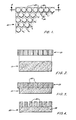
- Figs. 2 and 3 illustrate one preferred way be which the non-flexiable, non-resilient recurable cellular material may be shaped.
- a body 10 e.g., a slab
- a molding member 20 such as a honeycomb
- the precise way in which this is accomplished is not critical and various ways may be used, such as by pressing structure 20 into stationary body 10, or body 10 into stationary structure 20, or by concurrently moving body 10 and structure 20 against each other.
- structure 20 cuts into the recurable cellular material of body 10 to whatever depth may be desired while leaving at least part of the lower portion of body 10 intact. Thereupon the resultant structure is heated to a curing temperature, for example in an oven. Before, during or after this curing operation, molding member 20 may be withdrawn from body 10. If the shape and materials of construction of the molding member are such that it would become tightly bonded to the cured cellular material, it is desirable to remove the molding member before or during the early stages of the curing operation. As indicated in Figs. 1 and 4, these operations result in the formation of structures of this invention 40 which the integral body of cured polyimide foam has a plurality of spaced apart laterally-disposed individual molded portions 30 extending from a continuous portion 25 of the cured polyimide foam 25.
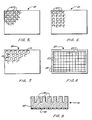
- Figs. 5, 6, 7 and 8 indicate that the configuration of molding member 20 can vary widely.
- the interior walls 15 of molding member 20 define a diamond shaped pattern of cells.
- molding member 20 has a rectangular or square pattern of cells whereas in Fig. 7 a pattern of adjacent offset circular cells is defined by the interior walls 15 of molding member 20.
- molding member 20 consists of a frame 23 across which are stretched a plurality of thin wires 27, 29. In the form depicted, these wires are stretched tightly at right angles to each other thereby forming a series of laterally adjacent rectangular spaces. Wires 27, 29 may be interwoven as in a screen or one set may be superposed one set above the other. Other configurations for the molding members are possible and permissible.
- molding member 20 may be composed of metals, polymers and plastics (e.g., polyimide, fluoropolymers such as TEFLON polymer, polybenzimidazole, and polypropylene), resin coated or impregnated paper or cardboard, fiber composites, and the like.
- the size of the individual cells within the molding member and the thickness of the walls separating such cells can range from large to small -- this is primarily a matter of choice to be governed by such factors as intended use of the resultant product, cost, and availability of materials. It will be appreciated however that the walls of the molding member should not be so thick as to completely crush the cellular material within and below the cells so that the material within and below the cells no longer has any cellular structure whatever.
- Fig. 1 depicts one preferred form of the structures of this invention. It will be seen from Fig. 1 that the structure is composed of an integral body referred to generally as 40 comprising a lower continuous portion 25 from which a plurality of laterally disposed individual molded portions 30 extend in an upward direction from portion 25.
- the entire structure may thus be composed of cured polyimide foam (as depicted in Fig. 1).
- the cured polyimide structure of this invention may be modified by applying one or more laminates 50 to the continuous portion 25 of the structure. Such laminates are preferably applied to the side of the body opposite the spaced apart laterally disposed individual molded portions 30 integral therewith.
- the shape and depth of the individual molded portions 30 may be varied. Thus, in Fig. 1 these portions are hexagonal in shape.
- Use of the molding members of Figs. 5, 6 and 7 would produce a diamond shaped pattern of individual molded portions, a rectangular pattern of square individual molded portions, and an offset pattern of circular individual molded portions, respectivly.
- Use of the molding member of Fig. 8 would produce a member of similar character to that resulting from use of molding member of Fig. 6 with the exception that the distance between adjacent individual molded portions would be much smaller that in the case of molding member of Fig. 8.
- the walls of the molded portions 30 may be stepped, tapered, or vertically ribbed.
- laminating materils include sheets, plies, boards, films, foils or other suitable generally flat forms of metal, plastics, fiber-reinforced composite materials, reinforced ceramic composites, resin-coated fibrous materials, paper or paperboard, particle board, rubbers and elastomers, and many other similar materials.
- Laminating material 50 may be applied before, during or after the curing operation. Suitable adhesives may be used in order to secure or assist in securing laminating material 50 to the structure.
- an adhesive may not be necessary, as when the laminating material 50 is applied tightly against the body of shaped cellular material before curing is effected whereby the cured polyimide serves as an adhesive. However ordinarily it is convenient and desirable to employ an adhesive to insure tight bonding between the parts.
- the types and identities of adhesives suitable for this use are so well known to those skilled in the art as to require no further explanation.
- Laminating material 50 may also be in the form of tapes or sheets having adhesive on either or both sides.
- the composition of the tape or sheet and adhesive will of course be dependent on the use for which the resultant composite article is intended.
- a wide variety of commercially-available tapes are suitable for making such composite articles. Some of these materials are described, for example, in product brochures such as "Scotch 3M Industrial Tapes and Related Products” (No. 70-0701-06748(151) DPI) and “Scotch 3M Specialty Tapes and Related Products” (No. 70-0701-5000-1), (both available from the 3M Company) or equivalent brochures, and "temp-r-tape/electrical-mechanical" (No. TRT-4-2/83), or equivalent brochure (available from CHR Industries, Inc.)
- Examples VII and VIII illustrate the production and properties of cellular structures of this invention.
- a slab 0.87 inch in thickness of cured polyimide foam of the type described in Example I was treated with steam in an autoclave at about 132°C for 3 to 4 hours.
- a commercially-available honeycomb approximately 0.36 inch in thickness made from paperboard coated with a phenolic resin was impressed into the resultant slab of recurable non-flexible, non-resilient recurable cellular material to a depth of 0.37 inch to fill the cells of the honeycomb therewith. This left the bottom 0.5 inch thickness of the cellular material intact and uncut.
- the major axis (apex to opposite apex) across the individual honeycomb cells was about 0.15 inch and the minor axis (sidewall to opposite sidewall) was about 0.10 inch.
- the resultant article with the honeycomb in place was heated in a thermal oven at about 274°C for about one hour to recure the foam into polyimide foam.
- the honeycomb was removed leaving an integral body of cured polyimide foam having a plurality of spaced-apart laterally-proximate individual portions of cured polyimide foam approximately 0.37 inch in length integral with and extending from said base portion.
- the finished article had a density of 0.56 pounds per cubic foot and an areal density of 0.47 pound per square foot. It exhibited considerable flexibility and resiliency. For example, it could be bent repeatedly 90° around a right angle corner of a wall. It was flame resistant.
- Example VII Using the same general procedure as in Example VII, a similar article was produced form a 1.5 inch thick slab of the same kind of cured polyimide foam and a 1.0 inch thick a phenolic resin coated paperboard honeycomb (major axis: ca. 0.23 inch; minor axis: ca 0.2 inch).
- the honeycomb was impressed in the steam-treated slab to a depth of one inch leaving the lower 0.5 inch portion of the slab intact and uncut.
- the unitary article of this invnetion had a density of 0.49 pound per square foot and an areal density of 0.41 pound per square foot. It had a plurality of individual hexagonally shaped projections of polyimide foam one inch long extending from a one-half inch base of polyimide foam integral therewith.
- the article was flexible, resilient and flame resistant.
- Laminates of this invention suitable for use as sound and vibration damping self-adhesive panels can be formed by applying to the underside of a cured, shaped polyimide foam article (such as those of Examples VII and VIII) a tape or sheet coated with adhesive on both sides (e.g., a Kapton® polyimide tape having a silicone adhesive on both sides available from CHR Industries as temp-r-tape® product number K-100).
- a tape or sheet coated with adhesive on both sides e.g., a Kapton® polyimide tape having a silicone adhesive on both sides available from CHR Industries as temp-r-tape® product number K-100.
- the panels, whether laminated or unlaminated may be installed by conventional fasteners such as nails, screws, or the like. Such panels have thermal insulative and flame resistant properties as well.
- the laminated structures are particularly useful as wall and ceiling panel structural members especially when the laminate(s) used have an exterior adhesive surface and are themselves composed of flame resistant or non-combustible material(s).
- Such articles can readily be applied to wall and ceiling surfaces, as flame resistant and serve to dampen sound and other types of vibration. Enhancing all such utilities are the relatively low densities and high strengths in which the structures of this invention may be provided.
- this invention provides a new type of composite based on polyimide foam which possesses enhanced strength, yet is lightweight and flame resistant, and thus is useful for structural, vibration damping and thermal insulation applications
- These composites make effective use of the strength and lightweight characteristics of open-celled structural materials, such as honeycomb, and the combination of desirable properties of cured polyimide foams, such as low density, flame resistance, sound and vibration damping characteristics, thermal insulative qualities, and desirable low temperature properties.
- This invention thus involves, inter alia, the discovery of a novel method for filling the cells of cellular structures with polyimide foam.
- the method makes it possible produce the filled structures without applying the precursor by dipping or spraying and foaming the material in situ followed by trimming or by crushing preformed foam into the cells.
- new and highly useful lightweight, flame resistant composite structures can be readily produced, and such composite structures and their production constitute additional embodiments of this invention.
- such preformed foamy material curable to a polyimide foam is introduced into the open cells of the honeycomb or like cellular structure and cured therein by the application of thermal energy.
- a preformed body of cured polyimide foam is used.
- This body is first converted into a body of non-flexible, non-resilient recurable cellular material in which the cellular structure of the initial foam remains substantially intact.
- the cellular material is easily forced into the cells of a cellular structure for example by pressing the honeycomb or like cellular structure into the cellular material, or vice versa.
- the resultant filled structure is then heated to effect curing of the cellular material within the cells of the honeycomb or the like.
- this heating step may be conducted before, during or after the application of the laminating materials used in covering one or both ends of the filled cells of the core or substrate of the laminated or sandwich composite sheet or panel.
- this invention provides a process which comprises converting cured polyimide foam into a non-flexible, non-resilient recurable cellular material by exposing the foam to the action of pressurized steam, impressing into the cellular material a structure having a plurality of laterally disposed open cells therein to at least partially fill such open cells with the non-flexible, non-resilient recurable cellular material, and heating the structure and contained cellular material to cause such material to cure.
- this invention provides a process which comprises (i) introducing a non-flexible, non-resilient recurable cellular material, prepared by exposing cured polyimide foam to an atmosphere of steam at an elevated pressure, into a structure having a plurality of walls defining a plurality of laterally disposed open cells so that such open cells are at least partially filled with such recurable cellular material, and (ii) curing the cellular material while contained within such cells to form a composite polyimide foam-containing structure.
- a preferred process of this type comprises (i) impressing into a non-flexible, non-resilient recurable impressible cellular material, prepared by exposing cured polyimide foam to an atmosphere of steam at an elevated pressure, a structure having a plurality of walls defining a plurality of laterally disposed open cells so that such open cells are at least partially filled with such recurable cellular material, and (ii) heating the recurable cellular material to cause it to cure while contained within such cells to form a composite polyimide foam-containing structure.
- the cellular structures used in these operations are preferably honeycomb structures because of their strength characteristics and commercial availability, although a variety of other types of cellular structures can be employed.
- a cured polyimide foam is converted by a hydrolytic steaming process under controlled temperature-pressure conditions into a recurable material which is malleable and pliable and easily cut or shaped. Yet it retains most of its original geometric configuration and cellular structure. It is introduced into the cells of a cellular structure such as a honeycomb, while in its malleable, pliable, easily cut form. On heating the resultant foam-filled cellular structure to a suitable temperature the recurable foam returns to a cured state within the honeycomb or like cellular structure.
- the conditions used in the steam treatment are preferably such as to yield a recurable material that on recuring possesses at least tensile properties comparable to those of the original cured foam.
- the recurable foamy material need not have this characteristic -- it may be a material that is recurable to a cured foam having lower tensile properties than the initial cured foam, as already observed.
- Fig. 11 illustrates one preferred way by which the non-flexible, non-resilient recurable cellular material may be introduced into the cells of a honeycomb or other cellular structure.
- a body 10 e.g., a slab
- an open cellular structure 20 such as a honeycomb
- the precise way in which this is accomplished is not critical and various ways may be used, such as by pressing structure 20 into stationary body 10, or body 10 into stationary structure 20, or by concurrently moving body 10 and structure 20 against each other.
- the cells of structure 20 become filled with the recurable cellular material of body 10 to whatever depth may be desired. Thereupon the resultant foam-filled structure is heated to a curing temperature, for example in an oven. As indicated in Figs. 10 and 12, this results in the formation in the cells of structure 20 of a plurality of plugs 30 of cured polyimide adhering to the adjacent walls 25 of the structure.
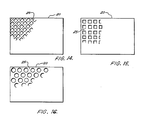
- Figs. 14, 15 and 16 indicate that the configuration of cell arrangement of structure 20 can vary widely.
- the interior walls of structure 20 define a diamond shaped pattern of cells.
- structure 20 has a rectangular or square pattern of cells whereas in Fig. 16 a pattern of adjacent offset circular cells is defined by the interior walls of structure 20.
- Other configurations for the cells are possible and permissible.
- structure 20 may be composed of metals, polymers and plastics (e.g., polyimide, fluoropolymers such as TEFLON polymer, polybenzimidazole, and polypropylene), resin coated or impregnated paper or cardboard, fiber composites, and the like.
- polymers and plastics e.g., polyimide, fluoropolymers such as TEFLON polymer, polybenzimidazole, and polypropylene
- the size of the individual cells can range from large to small -- this is primarily a matter of choice to be governed by such factors as intended use of the resultant product, cost, and availability of materials.
- the non-flexible, non-resilient recurable cellular material may be introduced into the cells of the cellular structure by means of a spatula, or other suitable extrusion device, or the like if care is exercised not to excessively destroy the structure of the recurable foam.
- a foam-filled laminated structure 40 may be formed by applying a suitable laminating material 50 over the ends of the foam-filled structure 20 to cover some if not all of the filled cells.
- Laminating material 50 may be applied to both sides of foam-filled structure 20 (as indicated in Fig. 13) or it may be applied to just one side, if desired.
- Laminating material 50 may be applied before, during or after the curing operation. Suitable adhesives may be used in order to secure or assist in securing laminating material 50 to the ends of the foam-filled cells of structure 20. In some cases an adhesive may not be necessary, as when the laminating material 50 is applied tightly against the ends of plugs 30 before curing is effected whereby the cured polyimide serves as an adhesive.
- Laminating material 50 may also be in the form of tapes having adhesive on either or both sides.
- the composition of the tape and adhesive will of course be dependent on the use for which the resultant foam-filled composite article is intended, and a wide variety of commercially-available tapes are suitable for making such composite articles.
- Some of these materials are described, for example, in product brochures such as "Scotch 3M Industrial Tapes and Related Products” (No. 70-0701-06748(151) DPI) and “Scotch 3M Specialty Tapes and Related Products” (No. 70-0701-5000-1), (both available from the 3M Company) or equivalent brochures, and "temp-r-tape/electrical-mechanical” (No. TRT-4-2/83), or equivalent brochure (available from CHR Industries, Inc.).
- Examples IX and X illustrate the production and properties of laminated foam-filled cellular structures of this invention.
- a slab of cured polyimide foam of the type described in Example I was treated with steam in an autoclave at about 132°C for 4 hours.
- a commercially-available honeycomb approximately 0.36 inch in thickness made from paperboard coated with a phenolic resin was impressed into the resultant slab of recurable non-flexible, non-resilient recurable cellular material to fill the cells of the honeycomb therewith.
- the major axis (apex to opposite apex) across the individual honeycomb cells was about 0.15 inch and the minor axis (sidewall to opposite sidewall) was about 0.10 inch.
- the foam-filled structure was heated in a thermal oven for 40 to 45 minutes at about 274°C to recure the foam into polyimide foam within the cells of the honeycomb.
- the resultant structure was then laminated on both sides (over the ends of the filled cells) with a polyimide tape having a silicone adhesive (CHR Product No. K105, of CHR Industries, Inc., New Haven, CT).
- the finished composite had a density of 9.62 pounds per cubic foot and an areal density of 0.32 pound per square foot. It exhibited a burn-through time through its 0.37 inch thickness of 44 seconds when exposed to a propane torch with a flame temperature of 1960°F (about 1071°C).
- Example IX Using the same general procedure as in Example IX, a composite laminated on one side only was produced from a phenolic resin coated paperboard honeycomb (thickness: 1 inch; major axis: ca. 0.23 inch; minor axis: ca. 0.2 inch). The laminate was formed from a glass cloth tape, 7 mils in total thickness (Scotch brand industrial tape No. 361, of 3M Company). The cured flame-resistant laminate had a density of 4.2 pounds per cubic foot and an areal density of 0.35 pound per square foot.
- Examples XI and XII illustrate the formation of foam-filled cellular structures of this invention, which may be used as is or subsequently laminated on either or both sides.
- the so-treated foams were non-flexible and non-resilient in character.
- Each of these slabs was pressed into a resin coated paperboard honeycomb and the resultant filled honeycomb structures subjected to curing at 260°C for one hour.
- the recured polyimide filled honeycombs exhibited excellent integrity -- the polyimide foam was well-bonded to the interior honeycomb structure and all cells were substantially filled with the polyimide foam.
- the Tg of the polyimide foam in the composite articles was: Foam in article from Slab A: 278°C; Foam in article from Slab B: 283°C.
- a slab of cured polyimide foam made by reaction between substantially equimolar amounts of benzophenone tetracarboxylic acid dimethyl ester and a mixture composed of 50 mol percent of 4,4′-methylenedianiline, 30 mol percent 2,6-diaminopyridine and 20 mol percent of 1,6-diaminohexane was treated with steam in an autoclave for 2.15 hours. At the end of this time, the foam was non-resilient, non-flexible, deformable and readily penetratable. While in this condition, it was used to fill a resin-coated paperboard honeycomb and the resultant composite was subjected to thermal curing for two hours at 260°C. At the end of this time the foam filled composite was cooled to room temperature. It was found that the foam tightly adhered to the honeycomb structure and that the cells thereof were substantially completely filled with a uniform polyimide foam.
- the flame and fire resistance of the foams of the foam- filled cellular structures of this invention together with their relatively low smoke output when exposed to fire render the foam-filled structures ideally suited for use as construction and/or insulation materials for aircraft and spacecraft, houses and buildings of all types, automobiles and trucks, boats and ships, submarines, furniture, and the like.
- the foam-filled laminated and sandwich structures are particularly useful as structural members (e.g., flooring, wall panels, etc.) especially when the honeycomb or other cellular structure and the laminate(s) used are themselves composed of flame resistant or non-combustible material(s). Enhancing all such utilities are the relatively low densities and high strengths in which the foam-filled structures of this invention may be provided.
- the cured foams within the cellular structures also serve to dampen sound and other types of vibration.
- the initial cured polyimide foams used in the practice of this invention can vary widely in composition and can be specification or off-specification grade materials. In general, they are produced from polyimide precursors composed of a mixture comprising at least (i) one or more organic tetracarboxylic acids or derivatives thereof, and (ii) one or more organic diamines co-reactive therewith, preferably including at least an aromatic or heterocyclic primary diamine. Components (i) and (ii) are usually present in the mixture in essentially stoichiometric quantities.
- the organic tetracarboxylic acids or derivatives thereof are preferably based on aromatic tetracarboxylic acids having the general formula: wherein A is a tetravalent organic group preferably an aromatic group.
- the tetravalent organic group A is most preferably an aromatic group having one of the following structures: wherein X is one or more of the following: - -; -O-; -S; -SO2-; -CH2; -CH2CH2-; although other aromatic groups are suitable.
- the derivatives which may be employed include acid halides, acid salts, esters, and the like. Of these, esters are preferred and are most generally used for foam production.
- esters are preferred and are most generally used for foam production.
- tetracarboxylic acid esters are the alkyl esters of 3,3′,4,4′-benzophenone tetracarboxylic acid, most preferably the lower alkyl diesters thereof. Mixtures of two or more aromatic esters, most preferably predominating in diesters, may be employed, if desired.
- the tetracarboxylic acid derivative employed in the manufacture of the polyimide foams be a caprolactam as taught by U. S. 4,161,477, 4,183,838 and 4,183,839.
- bis-imide is formed by reaction of a tetracarboxylic acid dianhydride with an oxoimine such as caprolactam and then reacted with the diamine or diamines to produce the desired polyimides.
- the caprolactam is displaced during the reaction, in much the same way as is the ester portion of the tetracarboxylic acid ester.
- the tetracarboxylic acid derivative used in the manufacture of the initial polyimide foams employed in the practice of this invention may also be an N-substituted imido acid ester of the tetracarboxylic acid as taught by U. S. 4,647,597 and 4,656,198.
- the N-substituted imido acid ester may be formed by reacting an aromatic tetracarboxylic acid dianhydride with an amino acid and an alcohol or mixture of alcohols.
- the acid ester group bonded to the nitrogen atom of the N-substituted imido acid ester is displaced so that the desired polyimide is formed.
- organic diamines with which the foregoing mixture of tetracarboxylic acids or derivatives is employed may be represented by the formula: H2N-R′-NH2 wherein R, is an aromatic group containing 5 to 16 carbon atoms and containing up to one hetero atom in the ring, the hetero atom being nitrogen, oxygen or sulfur.
- aromatic groups such as:
- diamines include: 2,6-diaminopyridine; 3,5-diaminopyridine; 3,3′-diaminodiphenylsulfone; 4,4′-diaminodiphenylsulfone; 4,4′-diaminodiphenylsulfide; 3,3′-diaminodiphenylether; 4,4′-diaminodiphenylether; meta-phenylenediamine; para-phenylenediamine; 4,4′-methylene dianiline; 2,6-diamino toluene; 2,4-diamino toluene; and the like.
- aliphatic diamines are preferably alpha-omega diaminoalkanes having the formula: H2N-(CH2) n -NH2 (I) wherein n is an integer from 2 to 16.
- Representatives of such diamines include 1,3-diaminopropane, 1,4-diaminobutane, 1,5-diaminopentane, 1,6-diaminohexane, etc.
- aliphatic etherified polyamines of the type polyoxypropylene amines having the formula: H2N-CH(CH3)CH2-[OCH2CH(CH3)] x -NH2 (II) wherein x varies from 1 to about 5 carbon atoms.
- R is either a phenylene group or an alkylene group
- R1 is hydrogen or methyl
- butadiene constitute at least 50% by weight of the butadiene and nitrile monomer.
- the nitrile monomer copolymerized with the butadiene can either be acrylonitrile or methacrylonitrile.
- Such copolymers generally have low molecular weights, preferably less than 3,000 to insure that they are sufficiently fluid to react
- Still another type of primary diamines which may be included in the polyimide foams used in this invention is the aromatic amino-terminated silicones, such as those having the general formula: wherein R is a C2 to C6 alkylene group, R1 and R2 are each independently lower alkyl containing 1 to 3 carbon atoms and n is an integer from 1 to 4.
- diamines which may be utilized in forming the foams for use in this invention are the diesters of an amino-substituted aromatic carboxylic acid and a polymethylene glycol.
- diesters may be represented by the general formula: H2N-ArCOO-R-OOCAr-NH2 (V) wherein R is an alkylene group (which may be branched or straight chain) and which preferably contains from 3 to 8 carbon atoms, most preferably trimethylene; and Ar is an aromatic group which may be composed of one or more fused or non-fused benzene rings which in turn may carry suitable substituents (e.g., nitro or alkoxy) in addition to the primary amino groups.
- R is an alkylene group (which may be branched or straight chain) and which preferably contains from 3 to 8 carbon atoms, most preferably trimethylene
- Ar is an aromatic group which may be composed of one or more fused or non-fused benzene rings which in turn may carry suitable substituents
- a few exemplary diesters of this type include: ethylene glycol-4-aminobenzoic acid diester; ethylene glycol-3-aminobenzoic acid diester; ethylene glycol-2-aminobenzoic acid diester; trimethylene glycol-3-aminobenzoic acid diester; trimethylene glycol-2-aminobenzoic acid diester; trimethylene glycol-3-amino-2-nitrobenzoic acid diester; tetramethylene glycol-3-amino-4-nitrobenzoic acid diester; tetramethylene glycol-3-amino-5-nitrobenzoic acid diester; tetramethylene glycol-4-amino-2-nitrobenzoic acid diester; 1,5-pentanediol-4-amino-3-nitrobenzoic acid diester; 1,6-hexanediol-5-amino-2-nitrobenzoic acid diester; neopentyl glycol-4-amino-2-methylbenzoic acid diester
- a particularly preferred diester of this type is the diester of trimethylene glycol (1,3-propanediol) and 4-aminobenzoic acid.
- the organic tetracarboxylic acid preferably in the form of its diester, most preferably from methanol or ethanol, is reacted with the above-referred-to amine(s) to form a prepolymer in the form of a consolidated, fragile foam structure, which is then subjected to additional heating in order to effect imide formation and thereby cure the polymer.
- this operation can be conducted either in the presence or absence of an added blowing agent to provide the desired polyimide foam.
- the relative proportions used in the preparation of the polyimide and polymers can be varied. In general, it is preferred to employ essentially stoichiometric proportions as between the mixture of tetracarboxylic acids or derivatives thereof and the primary diamine(s). However, non-stoichiometric mixtures can be used although the excess of the reactant present in excess usually does not participate in the reaction.
- the resulting alcohol produced in the reaction as well as the water released during the reaction can be used as the blowing agent during polymerization to form the desired polyimide foams.
- use can be made of any of a variety of organic or inorganic blowing agents.
- a solid blowing agent such as Celogen TSH, Celogen OT, Celogen AZ 130, Celogen RA, Celogen HT 500, Celogen HT 550, sodium bicarbonate, benzenesulfonyl hydrazide, boric acid, benzoic acid, and Expandex 5 PT of controlled particle size
- a solid blowing agent such as Celogen TSH, Celogen OT, Celogen AZ 130, Celogen RA, Celogen HT 500, Celogen HT 550, sodium bicarbonate, benzenesulfonyl hydrazide, boric acid, benzoic acid, and Expandex 5 PT of controlled particle size
- Preferred for such use are solid blowing agents which have been subjected to ball milling or other grinding so that the blowing agent is less than 200 microns in diameter, with 98 percent of the blowing agent particle sizes being less than 150 microns in diameter.
- blowing agents identified by trade name above follow: Blowing Agent Chemical Composition
- Celogen HT 550 hydrazol dicarboxylate Expandex 5 PT 5-phenyltetrazole
- Variations in the concentration of the blowing agent can be used to achieve specific densities and ILD values. Concentrations of up to 10 percent based on the weight of the polyimide precursor, and preferably 1 to 5 percent, can be employed. A concentration of about 2.5 weight percent is particularly preferred.
- Hydrated organic compounds of the type referred to in U. S. 4,621,015 may also be used as blowing agents in forming polyimide foams suitable for use in the practice of this invention.
- the initial foams may contain various filler and/or reinforcing materials.
- various filler and/or reinforcing materials For example, graphite, glass and other synthetic fibers can be added to the precursor composition to produce a fiber-reinforced product. Microballons may be added for density adjustment, if desired. It is frequently desirable to employ a surfactant thereby increasing cellular structure stability and uniformity, and increase fatigue resistance and make the foam more flexible and resilient. The nature of such surfactants for this use is well known and reported in the patent literature.
- a blowing agent and/or microballons should be employed in order to achieve a suitable cellular structure.
- a blowing agent and/or microballons should be employed in order to achieve a suitable cellular structure.
- the initial foam contain a suitable quantity of a flame retardant material in order to still further increase the flame resistance of the foam.
- the temperatures at which the precursor is converted to the polyimide foam are generally those temperatures used in the preparation of other polyimide polymers. As a general rule temperatures ranging from 200 to 400°C can be used, with heating times from 5 to 60 minutes or longer. As those skilled in the art will appreciate, the time for carrying out the reaction is somewhat dependent upon the reaction temperature, higher temperatures enabling the use of shorter reaction times. It is also possible to heat to a lower temperature in the first stage of the reaction and then to higher temperatures in the later stages.
- Heating can be carried out in a conventional oven if desired.
- the foaming and curing of the precursor into a foamed polyimide polymer can be effected by means of microwave heating.
- the precursor is exposed for 1 to 120 minutes to radio frequencies within the range of 915 to 2450 mHz, with the power output ranging from 1 to 100 kw.
- the power output to prepolymer weight ratio generally falls within the range of 0.1 to 10 kw per kg.
Landscapes
- Chemical & Material Sciences (AREA)
- Engineering & Computer Science (AREA)
- Materials Engineering (AREA)
- Health & Medical Sciences (AREA)
- Chemical Kinetics & Catalysis (AREA)
- Medicinal Chemistry (AREA)
- Polymers & Plastics (AREA)
- Organic Chemistry (AREA)
- Manufacture Of Porous Articles, And Recovery And Treatment Of Waste Products (AREA)
- Laminated Bodies (AREA)
Applications Claiming Priority (12)
| Application Number | Priority Date | Filing Date | Title |
|---|---|---|---|
| US240802 | 1988-09-06 | ||
| US07/240,802 US4883827A (en) | 1988-09-06 | 1988-09-06 | Recurable and cured cellular materials |
| US255447 | 1988-10-11 | ||
| US07/255,447 US4964936A (en) | 1988-10-11 | 1988-10-11 | Method of making foam-filled cellular structures |
| US26111488A | 1988-10-24 | 1988-10-24 | |
| US07/261,126 US4999070A (en) | 1988-10-24 | 1988-10-24 | New articles of manufacture and their production |
| US07/261,124 US4874452A (en) | 1988-10-24 | 1988-10-24 | Articles of manufacture and their production |
| US261124 | 1988-10-24 | ||
| US261114 | 1988-10-24 | ||
| US07/261,125 US4897234A (en) | 1988-10-24 | 1988-10-24 | Articles of manufacture and their production |
| US261125 | 1988-10-24 | ||
| US261126 | 1994-06-14 |
Publications (2)
| Publication Number | Publication Date |
|---|---|
| EP0359099A2 true EP0359099A2 (de) | 1990-03-21 |
| EP0359099A3 EP0359099A3 (de) | 1992-04-15 |
Family
ID=27559302
Family Applications (1)
| Application Number | Title | Priority Date | Filing Date |
|---|---|---|---|
| EP19890116390 Withdrawn EP0359099A3 (de) | 1988-09-06 | 1989-09-05 | Wiederhärtbare und gehärtete Zellmaterialien |
Country Status (2)
| Country | Link |
|---|---|
| EP (1) | EP0359099A3 (de) |
| JP (1) | JPH02127448A (de) |
Cited By (3)
| Publication number | Priority date | Publication date | Assignee | Title |
|---|---|---|---|---|
| EP0464490A3 (en) * | 1990-06-29 | 1992-12-23 | Basf Aktiengesellschaft | Method for manufacturing three-dimensional objects of open cell, elastic thermosetting foam materials |
| WO2003103940A1 (de) * | 2002-06-11 | 2003-12-18 | Schunk Kohlenstofftechnik Gmbh | Kohlenstoffwabenkörper |
| FR3028882A1 (fr) * | 2014-11-20 | 2016-05-27 | Snecma | Procede de realisation d'un revetement abradable multicouches avec structure tubulaire integree, et revetement abradable obtenu par un tel procede |
Family Cites Families (6)
| Publication number | Priority date | Publication date | Assignee | Title |
|---|---|---|---|---|
| US3764449A (en) * | 1969-10-06 | 1973-10-09 | Brunswick Corp | Method of making a polyimide and laminated product made therefrom |
| US3876493A (en) * | 1972-01-12 | 1975-04-08 | Sw Ind Inc | Foam product |
| US4070312A (en) * | 1975-05-27 | 1978-01-24 | International Harvester Company | Closed cell polyimides |
| CA1131399A (en) * | 1978-02-13 | 1982-09-07 | International Harvester Company | Polyimides |
| US4639343A (en) * | 1985-05-20 | 1987-01-27 | Long John V | Forming techniques for shaping polyimide foams |
| US4708972A (en) * | 1986-06-26 | 1987-11-24 | Imi-Tech Corporation | Steam resistant modified polyimide foams |
-
1989
- 1989-09-05 JP JP1228457A patent/JPH02127448A/ja active Pending
- 1989-09-05 EP EP19890116390 patent/EP0359099A3/de not_active Withdrawn
Cited By (3)
| Publication number | Priority date | Publication date | Assignee | Title |
|---|---|---|---|---|
| EP0464490A3 (en) * | 1990-06-29 | 1992-12-23 | Basf Aktiengesellschaft | Method for manufacturing three-dimensional objects of open cell, elastic thermosetting foam materials |
| WO2003103940A1 (de) * | 2002-06-11 | 2003-12-18 | Schunk Kohlenstofftechnik Gmbh | Kohlenstoffwabenkörper |
| FR3028882A1 (fr) * | 2014-11-20 | 2016-05-27 | Snecma | Procede de realisation d'un revetement abradable multicouches avec structure tubulaire integree, et revetement abradable obtenu par un tel procede |
Also Published As
| Publication number | Publication date |
|---|---|
| EP0359099A3 (de) | 1992-04-15 |
| JPH02127448A (ja) | 1990-05-16 |
Similar Documents
| Publication | Publication Date | Title |
|---|---|---|
| US4964936A (en) | Method of making foam-filled cellular structures | |
| US5188879A (en) | Polyimide foam filled structures | |
| US4305796A (en) | Methods of preparing polyimides and artifacts composed thereof | |
| US4433068A (en) | Process for producing bonded macroballoon structures and resulting product | |
| US5135959A (en) | Method of impregnating reticulated foam with polymide foam and products thereof | |
| US4425441A (en) | Closed cell polyimide foams and methods of making same | |
| US4407980A (en) | Closed cell polyimide foams and methods of making same | |
| JPH07506060A (ja) | フォームを充填したハニカム材料およびその製造法 | |
| JPS61219635A (ja) | ポリイミド発泡体およびその製造方法 | |
| JPS60112437A (ja) | ポリイミド コンポジド | |
| US5665787A (en) | Loaded syntactic foam-core material | |
| EP0019748A1 (de) | Verfahren zum Herstellen faserverstärkten Harzschaums und faserverstärkter Harzschaum | |
| EP0359099A2 (de) | Wiederhärtbare und gehärtete Zellmaterialien | |
| US4898763A (en) | Cured polyimide foam structures and their production | |
| US4273886A (en) | Polyimides | |
| US4908265A (en) | Articles of manufacture and their production | |
| US4897234A (en) | Articles of manufacture and their production | |
| US4874452A (en) | Articles of manufacture and their production | |
| US4999070A (en) | New articles of manufacture and their production | |
| US5192810A (en) | Method and apparatus for manufacturing dimpled structures from elastic cloth | |
| EP0514623A2 (de) | Verfahren zur Herstellung von gleichmässig gefüllten Multizell-Wabenstrukturen mit am Platz geschäumten Polyimidschaum | |
| CA1213099A (en) | Methods of preparing polyimides and artifacts composed thereof | |
| JPH0249612B2 (de) | ||
| WO2002048243A1 (en) | High-density polyimide foam insulation | |
| US4943598A (en) | Recurable and cured cellular materials |
Legal Events
| Date | Code | Title | Description |
|---|---|---|---|
| PUAI | Public reference made under article 153(3) epc to a published international application that has entered the european phase |
Free format text: ORIGINAL CODE: 0009012 |
|
| AK | Designated contracting states |
Kind code of ref document: A2 Designated state(s): DE FR GB IT |
|
| PUAL | Search report despatched |
Free format text: ORIGINAL CODE: 0009013 |
|
| AK | Designated contracting states |
Kind code of ref document: A3 Designated state(s): DE FR GB IT |
|
| STAA | Information on the status of an ep patent application or granted ep patent |
Free format text: STATUS: THE APPLICATION HAS BEEN WITHDRAWN |
|
| 18W | Application withdrawn |
Withdrawal date: 19920504 |