EP0359110B1 - Anzeigesystem einer Texterfassungseinrichtung - Google Patents
Anzeigesystem einer Texterfassungseinrichtung Download PDFInfo
- Publication number
- EP0359110B1 EP0359110B1 EP89116460A EP89116460A EP0359110B1 EP 0359110 B1 EP0359110 B1 EP 0359110B1 EP 89116460 A EP89116460 A EP 89116460A EP 89116460 A EP89116460 A EP 89116460A EP 0359110 B1 EP0359110 B1 EP 0359110B1
- Authority
- EP
- European Patent Office
- Prior art keywords
- text
- characters
- line
- cursor
- character
- Prior art date
- Legal status (The legal status is an assumption and is not a legal conclusion. Google has not performed a legal analysis and makes no representation as to the accuracy of the status listed.)
- Expired - Lifetime
Links
Images


Classifications
-
- G—PHYSICS
- G06—COMPUTING OR CALCULATING; COUNTING
- G06F—ELECTRIC DIGITAL DATA PROCESSING
- G06F40/00—Handling natural language data
- G06F40/10—Text processing
- G06F40/103—Formatting, i.e. changing of presentation of documents
Definitions
- the present invention relates to an entry text display system in text generation and document production devices such as Japanese language word processors or office work stations having print and editing equipment.
- kana characters similar to alphabets
- a suitable conversion operation is effected to change some of the kana character or characters to corresponding kanji characters (chinese characters).
- the total number of the characters used in a sentence expressed only by kana characters is often reduced after the sentence is converted to mixed kana-kanji text.
- the word wrapping is not necessary since in Japanese language, it is accustomed to put a carry return any place within a word. Therefore, depending on the selected format, every line within the document has the same number of characters including spaces.
- kana character data entered from a keyboard is converted to mixed kana-kanji text in a manner described above.
- the result of this conversion is displayed on a CRT or other display device for editing, and can be printed out as hard copy or stored on an external storage medium.
- the object of the present invention is to provide an improved entry text display system which has a fast display response, while still enabling complex display processing, thereby providing the user with a feeling of smoother operation and better responsiveness.
- the entry text display system according to the present invention is for use in a document editing device having the features of appended claim 1.
- the non-defined text detector detects the character and causes the non-defined text storage means to sequentially store each character of the non-defined character string in the temporary line buffer.
- the cursor at the end of the non-defined text string moves to the right each time a single character is entered, and when this cursor comes to the right end of the insertion line, its position there is detected by the cursor position detector.
- the display scrolling means thus causes characters entered thereafter to the non-defined text string to scroll to the left, and displays this insertion text only in the insertion line.
- the defined text display means causes the non-defined text stored in the line buffer to be displayed on the screen, across several lines if necessary.
- the inserted non-defined text scrolls only across one line at which the text is inserted until the text define command is received, much time is not required to process display data before the text is converted.
- the display response is improved, and the kana characters of the non-defined text do not appear across several lines of existing text until character conversion begins.
- operation feels much smoother and more comfortable for the user. Specifically, operability and the ease of text insertion and editing on screen are improved.
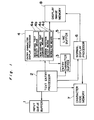
- FIG. 1 a block diagram of a Japanese language word processor using the entry text display system according to the present invention is shown.
- reference number 1 is an input queue buffer which sequentially stores the character string entered as kana characters from a keyboard, which is the data entry means and is not shown in the figure;
- 2 is a text entry processor which sequentially reads character data from the head of input queue buffer 1, executes the kana-kanji text conversion and other processing, and stores the read character data to entry character buffer 3;
- 4 is an entry character display processor which processes the insertion text for display on the CRT or other display means (not shown in the figure) when the command is received from text entry processor 2.
- the entry character display processor 4 also includes a non-defined text detector means 4a, non-defined text storage means 4b, cursor position detector means 4c, and scrolling means 4d; these will be described in detail later.
- non-defined text is a text which is not finally arranged in a final form, such as a text expressed only in kana characters.
- the non-defined text is a non-converted text.
- Reference number 5 is a line buffer which when the command is received from entry character display processor 4 sequentially stores the non-defined text character by character;
- 6 is a normal display processor which converts character data sent from entry character buffer 3 in response to the text define command from text entry processor 2 to codes for the display, with reference to the contents of chracter code memory 7 thereby defining a defined or converted text for the display;
- 8 is a display image memory which stores the character code data output from normal display processor 6 and entry character display processor 4 for output as image data to the pixels of the CRT or other display means.
- the text entry processor 2 determines whether the keyboard action was a character entry, command input, or other action. If the result is character entry, control operations will take place mainly in entry character display processor 4. It is further detected whether or not the key enter is the text define command. if the key entry is the text define command, and the text define command described previously is entered.
- the non-defined text detector 4a of the entry character display processor 4 determines whether the entered character was the first character of the non-defined text inserted at the cursor position on the display (Fig. 2, step S1). If the result is such that the character was the first character in a non-defined text string, the non-defined text storage means 4b sequentially sends and stores each character in the non-defined text string to line buffer 5.
- the display area and location are determined by the length of the line in which the cursor is resident and the present cursor position, and a line start pointer is set at the leading character in the buffer (Fig. 2, steps S2 and S3).
- the cursor position detector means 4c of entry character display processor 4 determines whether or not the cursor, which shifts one character pitch to the right each time a character is inserted, has reached the ultimate right end of the line, to which non-defined text insertion was started (Fig. 2, step S4). If the result is that the cursor is at the right end of the line, the scrolling means 4d is activated to scroll horizontally all characters of the non-defined text entered thereafter sequentially to the left so that only one line is used for displaying the insertion text. When the scrolling takes place, the line start pointer is shifted one character back (to the right), so that the starting point character of the display line is changed. Thus, line buffer 5 is used to display one line length characters from the character associated with the line start pointer. (Fig. 2, steps S5 and S6). Accordingly, the character which has been shifted to the left end then disappears from the screen in response to the entry of the next character.
- the existing text is indicated by the repetition of Japanese kana characters "a i u e o". Also, it is assumed that the character string entered by the user at cursor K in Fig. 3(a) is " kiyou ha kumo hitotsu nai yoi tenki dearu .” (Today is a fine day with no cloud in the sky.)
- text entry processor 2 determines that the keyboard action was a character entry, and processing is passed to entry character display processor 4.
- the non-defined text detector 4a of entry character display processor 4 determines that the " ki " which is the leading character of " kiyou " string is the first character in the non-defined text string as indicated by step S1.
- a line buffer 5 having a size sufficiently large to store characters in the line in which the cursor is located is formed at step S2, as previously described.
- the non-defined text storage means 4b inserts the character code for " ki " at the position in line buffer 5 correspondingly to the cursor position.
- the cursor position descriminator 4c at step S4 determines whether or not the cursor K, which moved one character right in response to the insertion of " ki ", is at the right end of the line. In this instance, the cursor K is not at the right end of the line, and processing thus proceeds to step S6 where entry character display processor 4 displays the contents of line buffer 5 on the CRT or other display via display image memory 8 as shown in Fig. 3b.
- the single line character string in line buffer 5 displayed at the next step S6 reads " a i u ki yo u ha ku mo e " (in which underlined characters are the newly inserted characters).
- steps S3, S4, S5, S6 are again repeated so that as shown in Fig. 3c, the character " a " leading the line scrolls out of view and the leading character becomes " i " to which the line start pointer is now associated; the character " hi " appears immediately before the cursor K, and the display appears as though it had scrolled one character to the left. Entry and display of the following characters " to " through the final " ru " is achieved by repeating steps S3, S4, S5, and S6.
- the leading character " ki “ in the insertion text also scrolls off the display. The display as it appears when all characters in the non-defined text insertion string have been entered is shown in Fig. 3d.
- the text define command from text entry processor 2 causes all non-defined text stored to that point in entry character buffer 3 to be read and output to normal display processor 6 where the string is processed and output to the CRT or other display via display image memory 8 so that all non-defined text characters are revived in the CRT.
- the final display of the insertion text when being revived is as shown in Fig. 3e. It is, of course, possible at this point to convert the non-defined text string to mixed kana-kanji text using the conversion key on the keyboard.
- non-defined text inserted before the text define command is entered, is sequentially scrolled across only one line of the display, processing for text convention or sophisticated layouts does not require excessive time to process the display data in order to display unnecessary non-defined text strings, and the display response is therefore improved.
- non-defined text strings are not inserted to existing defined text across several lines of the display as is done with existing text entry systems, defined and non-defined text can be clearly distinguished. Thus, operation is therefore smoother and easier for the user during text insertion and editing operations.
Landscapes
- Engineering & Computer Science (AREA)
- Theoretical Computer Science (AREA)
- Health & Medical Sciences (AREA)
- Artificial Intelligence (AREA)
- Audiology, Speech & Language Pathology (AREA)
- Computational Linguistics (AREA)
- General Health & Medical Sciences (AREA)
- Physics & Mathematics (AREA)
- General Engineering & Computer Science (AREA)
- General Physics & Mathematics (AREA)
- Document Processing Apparatus (AREA)
Claims (3)
- Anzeigesystem für Eingabetexte in einer Dokumenteneditiereinrichtung, die eingegebene Kana-Zeichen in ein vorhandenes Dokument einfügt, und dann dieses in einen japanischen Text konvertiert, der in einer der Form des vorhandenen Dokuments entsprechenden Form ist, wobei das Texteingabe-Anzeigesystem enthält:Detektionsmittel (4a) für die entgegengenommenen Kana-Zeichen; Speichermittel (4b, 5) für die entgegengenommenen Kana-Zeichen; Detektionsmittel (4c) für die Position eines Anzeigesymbols, das sich jedesmal nach rechts bewegt, wenn ein Zeichen eingegeben wird;Mittel (4d) zum horizontalen Blättern der Textzeichen in einer Zeile nach links als Antwort auf die Einfügung von Kana-Zeichen; Mittel (4) zum Anzeigen der in einer Zeile entgegengenommenen Kana-Zeichen, in der das Anzeigesymbol positioniert ist derart, daß Kana-Zeichen nacheinander nach rechts hin angezeigt werden, bis sich das Anzeigesymbol, wie durch die Detektionsmittel für die Position eines Anzeigesymbols festgestellt wird, ans rechte Ende der Zeile bewegt, und danach die ganze Zeile nach links hin verschoben wird, während die Kana-Zeichen an der linken Seite des Anzeigesymbols eingefügt werden, und die am linken Ende der Zeile ankommenden Zeichen von der Anzeige verschwinden; und Mitteln zur Anzeige aller in das vorhandene Dokument eingefügten Kana-Zeichen auf der Anzeige.
- Anzeigesystem nach Anspruch 1, das ferner Mittel zum Konvertieren der schließlich eingefügten Kana-Zeichen in einen gemischten Kana-Kanji-Text enthält.
- Verfahren zur Anzeige von Eingabetexten in einer Dokumenteneditiereinrichtung, die Kana-Zeichen übernimmt und in ein vorhandenes Dokument einfügt und dann dieses in einen japanischen Text konvertiert, der in einer der Form des vorhandenen Dokuments entsprechenden Form ist, wobei das Anzeigeverfahren folgende Schritte enthält:Detektieren (4a) der entgegengenommenen Kana-Zeichen;Speichern (4b, 5) der entgegengenommenen Kana-Zeichen;Detektieren (4c) der Position eines Anzeigesymbols, das sich jedesmal nach rechts bewegt, wenn ein Zeichen eingegeben wird;horizontales Blättern (4d) der Textzeichen in einer Zeile nach links als Antwort auf die Einfügung von Kana-Zeichen;Anzeigen (4) der in einer Zeile entgegengenommenen Kana-Zeichen, in der das Anzeigesymbol positioniert ist derart, daß Kana-Zeichen nacheinander nach rechts hin angezeigt werden, bis sich das Anzeigesymbol, wie durch die Detektionsmittel für die Position eines Anzeigesymbols festgestellt wird, ans rechte Ende der Zeile bewegt, und danach die ganze Zeile nach links hin verschoben wird, während die Kana-Zeichen an der linken Seite des Anzeigesymbols eingefügt werden, und die am linken Ende der Zeile ankommenden Zeichen von der Anzeige verschwinden;und Anzeigen aller in das vorhandene Dokument eingefügten Kana-Zeichen auf der Anzeige.
Applications Claiming Priority (2)
| Application Number | Priority Date | Filing Date | Title |
|---|---|---|---|
| JP63223191A JPH02250161A (ja) | 1988-09-06 | 1988-09-06 | 入力文字表示方式 |
| JP223191/88 | 1988-09-06 |
Publications (3)
| Publication Number | Publication Date |
|---|---|
| EP0359110A2 EP0359110A2 (de) | 1990-03-21 |
| EP0359110A3 EP0359110A3 (de) | 1992-12-30 |
| EP0359110B1 true EP0359110B1 (de) | 1996-06-12 |
Family
ID=16794227
Family Applications (1)
| Application Number | Title | Priority Date | Filing Date |
|---|---|---|---|
| EP89116460A Expired - Lifetime EP0359110B1 (de) | 1988-09-06 | 1989-09-06 | Anzeigesystem einer Texterfassungseinrichtung |
Country Status (4)
| Country | Link |
|---|---|
| US (1) | US5084820A (de) |
| EP (1) | EP0359110B1 (de) |
| JP (1) | JPH02250161A (de) |
| DE (1) | DE68926646T2 (de) |
Families Citing this family (11)
| Publication number | Priority date | Publication date | Assignee | Title |
|---|---|---|---|---|
| KR0121574B1 (ko) * | 1987-08-24 | 1997-11-22 | 나까가와 가즈오 | 데이터 처리장치 및 이것을 사용하는 편집장치 |
| US5230062A (en) * | 1989-03-07 | 1993-07-20 | Sanyo Electric Co., Ltd. | Data processing apparatus and method for defining size and type of data field |
| JP2911257B2 (ja) * | 1991-06-28 | 1999-06-23 | 三洋電機株式会社 | オンスクリーン表示装置 |
| US5384700A (en) * | 1992-10-29 | 1995-01-24 | International Business Machines Corporation | Method and system for storing multiple, modifiable Yomi and Kanji strings in a structured document |
| US5689723A (en) * | 1993-02-03 | 1997-11-18 | International Business Machines Corp | Method for allowing single-byte character set and double-byte character set fonts in a double-byte character set code page |
| JPH0793335A (ja) * | 1993-06-07 | 1995-04-07 | Internatl Business Mach Corp <Ibm> | テキストの言語機能を提供する方法 |
| CA2105847C (en) * | 1993-09-09 | 1996-10-01 | Adrian Storisteanu | Method of editing text in column sensitive environments |
| US5742838A (en) * | 1993-10-13 | 1998-04-21 | International Business Machines Corp | Method for conversion mode selection in hangeul to hanja character conversion |
| US6101461A (en) * | 1997-02-28 | 2000-08-08 | Justsystem Corp. | Command inputting method |
| US7409637B2 (en) * | 2005-06-17 | 2008-08-05 | Sap Aktiengesellschaft | Least-effort variable-length text replacement |
| US9348512B2 (en) * | 2012-08-08 | 2016-05-24 | Nuance Communications, Inc. | Methods for facilitating text entry |
Family Cites Families (1)
| Publication number | Priority date | Publication date | Assignee | Title |
|---|---|---|---|---|
| DE3174925D1 (en) * | 1981-04-08 | 1986-08-21 | Ibm | Text processing apparatus with two-stage formatting of text |
-
1988
- 1988-09-06 JP JP63223191A patent/JPH02250161A/ja active Pending
-
1989
- 1989-09-06 DE DE68926646T patent/DE68926646T2/de not_active Expired - Fee Related
- 1989-09-06 EP EP89116460A patent/EP0359110B1/de not_active Expired - Lifetime
- 1989-09-06 US US07/403,384 patent/US5084820A/en not_active Expired - Lifetime
Also Published As
| Publication number | Publication date |
|---|---|
| EP0359110A2 (de) | 1990-03-21 |
| EP0359110A3 (de) | 1992-12-30 |
| DE68926646D1 (de) | 1996-07-18 |
| US5084820A (en) | 1992-01-28 |
| DE68926646T2 (de) | 1997-01-30 |
| JPH02250161A (ja) | 1990-10-05 |
Similar Documents
| Publication | Publication Date | Title |
|---|---|---|
| US5754873A (en) | Method and apparatus for scaling a selected block of text to a preferred absolute text height and scaling the remainder of the text proportionately | |
| EP0125458B1 (de) | Menü/Kartenanzeigetaste | |
| EP0253653B1 (de) | Vorrichtung zur Eingabesteuerung | |
| EP0359110B1 (de) | Anzeigesystem einer Texterfassungseinrichtung | |
| US4931987A (en) | Word processor for locating beginning position of text element and displaying corresponding formatting data and formatting mark separately | |
| US4717911A (en) | Technique for chaining lines of a document together to facilitate editing or proofreading | |
| EP0449322B1 (de) | Textverarbeitungsvorrichtung mit Textformatierung | |
| JP3471854B2 (ja) | 文字処理装置及びその方法 | |
| JPH0128975B2 (de) | ||
| JPH0823744B2 (ja) | 文字列処理装置 | |
| JP2571043B2 (ja) | 文字置換装置 | |
| JP2555036B2 (ja) | 文字列入力装置 | |
| JP3371435B2 (ja) | 入力モード自動設定方法あるいは入力モード自動設定装置 | |
| JPH0615317Y2 (ja) | 文書処理装置 | |
| JPH0666066B2 (ja) | 振仮名付加機能付き文書処理装置 | |
| JP2590643B2 (ja) | 文書処理方法および文書処理装置 | |
| JPS60201467A (ja) | 日本語処理装置 | |
| JPH024026A (ja) | 文書処理装置 | |
| JPS63146157A (ja) | 文書処理装置 | |
| JPH0666065B2 (ja) | 振仮名付加機能付き文書処理装置 | |
| JPH06187486A (ja) | 手書き文字入力装置 | |
| JPH07325798A (ja) | 文書作成装置 | |
| JPH0661080B2 (ja) | 振仮名付加機能付き文書処理装置 | |
| JPH1074199A (ja) | 文字処理装置及び方法、並びに文字処理プログラムを記憶した記憶媒体 | |
| JPS6341923A (ja) | キ−ボ−ド入力における字種変更方法 |
Legal Events
| Date | Code | Title | Description |
|---|---|---|---|
| PUAI | Public reference made under article 153(3) epc to a published international application that has entered the european phase |
Free format text: ORIGINAL CODE: 0009012 |
|
| AK | Designated contracting states |
Kind code of ref document: A2 Designated state(s): DE GB |
|
| 17P | Request for examination filed |
Effective date: 19901219 |
|
| PUAL | Search report despatched |
Free format text: ORIGINAL CODE: 0009013 |
|
| AK | Designated contracting states |
Kind code of ref document: A3 Designated state(s): DE GB |
|
| 17Q | First examination report despatched |
Effective date: 19931223 |
|
| GRAH | Despatch of communication of intention to grant a patent |
Free format text: ORIGINAL CODE: EPIDOS IGRA |
|
| GRAH | Despatch of communication of intention to grant a patent |
Free format text: ORIGINAL CODE: EPIDOS IGRA |
|
| GRAA | (expected) grant |
Free format text: ORIGINAL CODE: 0009210 |
|
| AK | Designated contracting states |
Kind code of ref document: B1 Designated state(s): DE GB |
|
| REF | Corresponds to: |
Ref document number: 68926646 Country of ref document: DE Date of ref document: 19960718 |
|
| PLBE | No opposition filed within time limit |
Free format text: ORIGINAL CODE: 0009261 |
|
| STAA | Information on the status of an ep patent application or granted ep patent |
Free format text: STATUS: NO OPPOSITION FILED WITHIN TIME LIMIT |
|
| 26N | No opposition filed | ||
| REG | Reference to a national code |
Ref country code: GB Ref legal event code: IF02 |
|
| PGFP | Annual fee paid to national office [announced via postgrant information from national office to epo] |
Ref country code: GB Payment date: 20020904 Year of fee payment: 14 |
|
| PGFP | Annual fee paid to national office [announced via postgrant information from national office to epo] |
Ref country code: DE Payment date: 20020911 Year of fee payment: 14 |
|
| PG25 | Lapsed in a contracting state [announced via postgrant information from national office to epo] |
Ref country code: GB Free format text: LAPSE BECAUSE OF NON-PAYMENT OF DUE FEES Effective date: 20030906 |
|
| PG25 | Lapsed in a contracting state [announced via postgrant information from national office to epo] |
Ref country code: DE Free format text: LAPSE BECAUSE OF NON-PAYMENT OF DUE FEES Effective date: 20040401 |
|
| GBPC | Gb: european patent ceased through non-payment of renewal fee |
Effective date: 20030906 |