EP0359210A2 - Inverter mit breitem Ausgangskontrollbereich - Google Patents
Inverter mit breitem Ausgangskontrollbereich Download PDFInfo
- Publication number
- EP0359210A2 EP0359210A2 EP89116891A EP89116891A EP0359210A2 EP 0359210 A2 EP0359210 A2 EP 0359210A2 EP 89116891 A EP89116891 A EP 89116891A EP 89116891 A EP89116891 A EP 89116891A EP 0359210 A2 EP0359210 A2 EP 0359210A2
- Authority
- EP
- European Patent Office
- Prior art keywords
- voltage
- switching transistor
- generating
- lighting
- capacitor
- Prior art date
- Legal status (The legal status is an assumption and is not a legal conclusion. Google has not performed a legal analysis and makes no representation as to the accuracy of the status listed.)
- Withdrawn
Links
Images




Classifications
-
- H—ELECTRICITY
- H02—GENERATION; CONVERSION OR DISTRIBUTION OF ELECTRIC POWER
- H02M—APPARATUS FOR CONVERSION BETWEEN AC AND AC, BETWEEN AC AND DC, OR BETWEEN DC AND DC, AND FOR USE WITH MAINS OR SIMILAR POWER SUPPLY SYSTEMS; CONVERSION OF DC OR AC INPUT POWER INTO SURGE OUTPUT POWER; CONTROL OR REGULATION THEREOF
- H02M1/00—Details of apparatus for conversion
- H02M1/42—Circuits or arrangements for compensating for or adjusting power factor in converters or inverters
-
- H—ELECTRICITY
- H05—ELECTRIC TECHNIQUES NOT OTHERWISE PROVIDED FOR
- H05B—ELECTRIC HEATING; ELECTRIC LIGHT SOURCES NOT OTHERWISE PROVIDED FOR; CIRCUIT ARRANGEMENTS FOR ELECTRIC LIGHT SOURCES, IN GENERAL
- H05B41/00—Circuit arrangements or apparatus for igniting or operating discharge lamps
- H05B41/14—Circuit arrangements
- H05B41/26—Circuit arrangements in which the lamp is fed by power derived from DC by means of a converter, e.g. by high-voltage DC
- H05B41/28—Circuit arrangements in which the lamp is fed by power derived from DC by means of a converter, e.g. by high-voltage DC using static converters
- H05B41/282—Circuit arrangements in which the lamp is fed by power derived from DC by means of a converter, e.g. by high-voltage DC using static converters with semiconductor devices
- H05B41/2821—Circuit arrangements in which the lamp is fed by power derived from DC by means of a converter, e.g. by high-voltage DC using static converters with semiconductor devices by means of a single-switch converter or a parallel push-pull converter in the final stage
- H05B41/2822—Circuit arrangements in which the lamp is fed by power derived from DC by means of a converter, e.g. by high-voltage DC using static converters with semiconductor devices by means of a single-switch converter or a parallel push-pull converter in the final stage using specially adapted components in the load circuit, e.g. feed-back transformers, piezoelectric transformers; using specially adapted load circuit configurations
-
- H—ELECTRICITY
- H02—GENERATION; CONVERSION OR DISTRIBUTION OF ELECTRIC POWER
- H02M—APPARATUS FOR CONVERSION BETWEEN AC AND AC, BETWEEN AC AND DC, OR BETWEEN DC AND DC, AND FOR USE WITH MAINS OR SIMILAR POWER SUPPLY SYSTEMS; CONVERSION OF DC OR AC INPUT POWER INTO SURGE OUTPUT POWER; CONTROL OR REGULATION THEREOF
- H02M1/00—Details of apparatus for conversion
-
- Y—GENERAL TAGGING OF NEW TECHNOLOGICAL DEVELOPMENTS; GENERAL TAGGING OF CROSS-SECTIONAL TECHNOLOGIES SPANNING OVER SEVERAL SECTIONS OF THE IPC; TECHNICAL SUBJECTS COVERED BY FORMER USPC CROSS-REFERENCE ART COLLECTIONS [XRACs] AND DIGESTS
- Y02—TECHNOLOGIES OR APPLICATIONS FOR MITIGATION OR ADAPTATION AGAINST CLIMATE CHANGE
- Y02B—CLIMATE CHANGE MITIGATION TECHNOLOGIES RELATED TO BUILDINGS, e.g. HOUSING, HOUSE APPLIANCES OR RELATED END-USER APPLICATIONS
- Y02B20/00—Energy efficient lighting technologies, e.g. halogen lamps or gas discharge lamps
-
- Y—GENERAL TAGGING OF NEW TECHNOLOGICAL DEVELOPMENTS; GENERAL TAGGING OF CROSS-SECTIONAL TECHNOLOGIES SPANNING OVER SEVERAL SECTIONS OF THE IPC; TECHNICAL SUBJECTS COVERED BY FORMER USPC CROSS-REFERENCE ART COLLECTIONS [XRACs] AND DIGESTS
- Y10—TECHNICAL SUBJECTS COVERED BY FORMER USPC
- Y10S—TECHNICAL SUBJECTS COVERED BY FORMER USPC CROSS-REFERENCE ART COLLECTIONS [XRACs] AND DIGESTS
- Y10S315/00—Electric lamp and discharge devices: systems
- Y10S315/05—Starting and operating circuit for fluorescent lamp
-
- Y—GENERAL TAGGING OF NEW TECHNOLOGICAL DEVELOPMENTS; GENERAL TAGGING OF CROSS-SECTIONAL TECHNOLOGIES SPANNING OVER SEVERAL SECTIONS OF THE IPC; TECHNICAL SUBJECTS COVERED BY FORMER USPC CROSS-REFERENCE ART COLLECTIONS [XRACs] AND DIGESTS
- Y10—TECHNICAL SUBJECTS COVERED BY FORMER USPC
- Y10S—TECHNICAL SUBJECTS COVERED BY FORMER USPC CROSS-REFERENCE ART COLLECTIONS [XRACs] AND DIGESTS
- Y10S315/00—Electric lamp and discharge devices: systems
- Y10S315/07—Starting and control circuits for gas discharge lamp using transistors
Definitions
- the present invention relates to a self-excited, one-transistor inverter, and more particularly to an inverter for use in a discharge lighting device that provides high-frequency lighting of a discharge lamp such as a fluorescent lamp.
- inverters are known as devices for converting DC power to AC power.
- This inverter comprises a DC voltage source, a transistor used as a switching element, and a parallel resonant circuit.
- the transistor is turned on and off at a frequency as high as 20 to 100 KHz, thus applying the high-frequency voltage to the resonant circuit.
- the parallel resonant circuit generates an AC voltage in response to the high-frequency voltage.
- the AC voltage, thus generated, is applied to a load, i.e., a discharge lamp such as a fluorescent lamp, whereby the lamp is lighted.
- the first method is to connect a capacitor to the base of the transistor and control the capacitance of this capacitor by means of a switch.
- the second method is to connect a variable resistor to the base of the transistor and change the resistance of this variable resistor.
- the output voltage of the inverter cannot be continuously changed since that kind of switch only allows a discrete change in voltage.
- the second method the output voltage of the inverter cannot be controlled over a suffiently broad range, though it can be varied continuously.
- an inverter which comprises: DC voltage source for supplying a DC voltage; switching transistor for switching the DC voltage supplied from the DC voltage source; a parallel resonant circuit, including an inductor and a resonant capacitor, for receiving the DC voltage switched by the switching transistor and for generating an AC output, the resonant circuit being connected in series to the switching transistor and connected so as to be fed from the DC voltage source through the switching transistor; self-excited oscillation means, including means for detecting at least part of the AC output from the resonant circuit, for supplying the detection output of the detecting means between the base and emitter of the switching transistor so as to control the ON and OFF of the switching transistor and for supplying a base current to the switching transistor; variable impedance means, connected to the self-excited oscillation means and including a series circuit comprised of a variable resistance element and a capacitor, for changing the resistance value of the variable resistance element, thereby to change the combined impedance value to
- Fig. 1 is a circuit diagram showing a discharge lamp-lighting device having an inverter which is a first embodiment of the invention.
- the lamp-lighting device comprises a battery 1 as a DC power source, and an output transformer 2.
- the battery 1 can be replaced by a rectifier for rectifying an AC, which is of smoothing, partially smoothing, or non-smoothing type.
- the transformer 2 has a primary winding 2p and a secondary winding 2s. One end of the primary winding 2p is connected to the positive terminal of the DC power source 1. The other end of the primary winding 2p is connected to the collector of a bipolar transistor 3 which is used as a switching element.
- a resonant capacitor 4 is connected in parallel to the secondary winding 2s of the transformer 2.
- the transformer 2 and the capacitor 4 constitute a parallel resonant circuit.
- a discharge lamp 8, such as a fluorescent lamp, and a capacitor 9 for previously heating the filament of the discharge lamp 8 are connected in parallel to the secondary winding 2s of the transformer 2.
- a saturable current transformer (CT) 7 is connected to one end of the secondary winding 2s, for positively feeding back the current flowing through the lamp 8 or capacitor 9 to the base of the transistor 3.
- the negative terminal of the DC power source 1 is connected to the emitter of the transistor 3.
- a series circuit comprised of a diode 5 and a resistor 6 is connected between the base and emitter of the transistor 3.
- Capacitors 10 and 11 are connected so as to control the switching frequency of the transistor 3.
- a field-effect transistor (FET) 112 is used as a variable impedance element (refer to the circuit shown in Fig. 7), and a control circuit 13 is connected to the gate of the FET 112, for controlling the impedance of the FET 112 in accordance with various physical quantities. The circuit construction of the control circuit 13 will be described later on.
- a starting circuit keeps supplying a small current (i.e., a base current) to the transistor 3, and the transistor 3 is made slightly conductive.
- a small current i.e., a base current
- the primary winding 2p of the output transformer 2 is slightly excited and therefore a load current flows through the secondary winding 2s.
- This load current is also flows through the primary winding 2p and therefore an output signal appears at the secondary winding 2s.
- This output signal is positively fed back to the base of the transistor 3.
- the transistor 3 is rapidly turned on by means of the positive feedback loop composed of its base, emitter, and the secondary winding of the CT 7.
- the capacitors 10 and 11 accumulate the base current, whereby the base current of the transistor 3 decreases. As a result, the transistor 3 is rapidly turned off by means of the positive feedback loop. As this time, an AC voltage is generated in the secondary winding 2s of the output transformer 2, by virtue of the resonance of the parallel resonant circuit composed of the primary winding 2p and the capacitor 4. This AC voltage inverts the polarity of the load current, more precisely, changing the load current to a positive current. The voltage applied to the base of the transistor 3 is thereby changed to a positive one. The transistor 3 is, therefore, turned on again by means of the positive feedback loop.
- the inverter outputs AC power to the discharge lamp 8.
- Fig. 2 illustrates the control circuit 13 in greater detail, and corresponds to Fig. 3 of U.S. Patent Application Serial No. 284,377.
- the circuit 13 has a transistor 508 which is used as an error detector.
- the base of the transistor 508 is connected to the connection point of the resistors 406 and 408 of a peak-voltage detecting circuit 401.
- the emitter of the transistor 508 is connected by a resistor 510 to the positive terminal of a DC power source 102 which corresponds to the DC power source 2 shown in Fig. 1.
- the collector of the transistor 508 is connected by a resistor 512 to the negative terminal of the DC power source 102.
- a zener diode 514 which functions as a reference voltage source, is connected between the emitter of the transistor 508 and the negative terminal of the DC power source 102 in a manner that its cathode faces the emitter of the transistor 508. Further, the collector of the transistor 508 is connected to the gate of the FET 516 (equivalent to reference numeral 12 of Fig. 1), the source of which is connected to the negative terminal of the DC power source 102.
- the other structural features of the control circuit 13 refer to U.S. Patent Application Serial No. 284,377.
- the capacitor 520 is cut off from other circuits, whereby only capacitor 522 is, in effect, connected to the base of the transistor 302.
- V p ⁇ (V ref - V BE ) ⁇ n the transistor 508 becomes active or conductive.
- the FET 516 functions as a variable impedance element, and has an impedance corresponding to the collector voltage of the transistor 508.
- the off-period of the transistor 3 (Fig. 1) is constant since it is determined by the parallel resonance.
- the on-period of the transistor 3 is variable, for the following reason. The on-period is determined by the base current of the transistor 3, which flows through the capacitors 10 and 11.
- This base current is determined by the capacitor 10 and 11 connected in series to the base of the transistor 3 and also by the specific impedance of the FET 112.
- the on-period can be varied by changing the specific impedance of the FET 112 by means of the control circuit 13.
- the operating frequency f1 of the inverter it is possible to change the operating frequency f1 of the inverter, by controlling the on-period of the transistor 3. It is preferable that the operating frequency fall in a audible range, from 20 to 100 KHz. Nonetheless, the operating frequency need not be limited to this range.
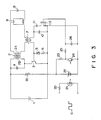
- Fig. 3 illustrates a lighting control device having an inverter according to a second embodiment of the present invention.
- the series circuit comprised of a resistor 20 and a light-emitting diode 21 functions as a light-emitting section for generating an optical, lighting-control signal.
- a zener diode 22, a resistor 23, and a phototransistor 24 constitute a light-receiving section.
- On end of the zener diode 22 is connected to a resistor 35.
- the diode 21 emits a lighting-control signal.
- the phototransistor 24 Upon receipt of this signal, the phototransistor 24 generates a current which corresponds to the pulse width of the signal. Thus current flows from the phototransistor 24 via a resistor 25 into a capacitor 26, thus charging the capacitor 26. The voltage across the charged capacitor 26 is applied to the gate-source of an FET 112. Since the voltage corresponds to the pulse width of the lighting-control signal, the gate voltage of the FET 112 can be varied to control the lighting of a lamp 8, by changing the pulse width of the lighting-control signal.
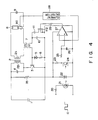
- Fig. 4 illustrates a discharge lamp-lighting device having an inverter according to a third embodiment of the invention, which is a modification of the inverter shown in Fig. 3.
- a current detector 28 detects the current output from the current transformer 8a of a discharge lamp 8, and converts the current into a voltage. This voltage is applied to the inverting input of an operational amplifier 27. The voltage across a capacitor 26, which corresponds to the pulse width of a lighting-control signal, is applied to the non-inverting input of the operational amplifier 27.
- the operational amplifier 27 outputs a voltage which is the difference between the voltages applied to the inverting and non-inverting inputs.
- the output voltage of the operational amplifier 27 is applied to the gate of a FET 112. Therefore, the voltage corresponding to the output current of the lamp 8 is compared with the reference voltage corresponding to the pulse width of the lighting-control signal, and the difference between these compared voltages is negatively fed back to the discharge lamp 8, thereby controlling the lighting of the lamp 8.
- Fig. 5 shows a discharge lamp-lighting device having an inverter according to a fourth embodiment of this invention.
- This embodiment comprises an inverter identical with the first embodiment shown in Fig. 1, and a series circuit comprised of an FET and a capacitor and connected in parallel to the inverter (Fig. 1).
- Capacitors 11 and 15 are connected to the drains of FETs 14 and 16, respectively.
- Drive sections 17 and 18 are connected to the gates of the FETs 14 and 16, respectively. Both drive sections 17 and 18 are connected to a control circuit 19. Because of this circuit structure, the power loss in the capacitor is reduced to a third. Hence, the equivalent resistance of the capacitor is proportionally reduced, and therefore the inverter is superior to the inverter shown in Fig. 1 in terms of switching characteristic.
- a saturable current transformer (CT) 7 is used for detecting the current flowing through the lamp 8 and positively feeding this current back to the base of the transistor 3.
- the feedback winding of this transformer 7 can be replaced by an inverter transformer or a ballast choke coil.
- the control circuit 13 can control the impedance of the FET 112, thereby to maintain various physical quantities, such as currents and voltages at various circuit points of the operating inverter, the temperature of the lamp 8, and the luminance of the lamp 8. More specifically, the impedance of the FET 112 can be controlled, thus rendering the peak value V p of the collector voltage of the switching transistor 3 constant, whereby the voltage applied to the transistor 3 is limited, and no surge voltages are applied to the transistor 3. In this case, since the peak value V p is constant, the fluctuation of the AC voltage applied to the lamp 8 can be minimized even if the power-source voltage changes. Further, due to the control of the impedance of the FET 112, the inverter according to the invention can operate stably despite of the surges in the input voltage.
- a small-sized MOSFET 112 is used as a variable resistance element.
- This MOSFET can be replaced by, as is shown in Fig. 6, a bipolar transistor 61 by changing the circuit condition.
- the base voltage of the bipolar transistor 61 is controlled by a control circuit 62.
- the MOSFET 112 can be replaced by a CdS element, in which case the impedance of the CdS element is controlled by changing the intensity of the light applied to this element.
- the inverter according to the present invention can provide a continuous output power control over a broad range, though it is a self-excited inverter.
- the inverter When the inverter is used in a device for lighting a discharge lamp, it can control the flux of the lamp, achieve the temperature-compensation for the lamp and the inverter, start the lamp smoothly, protect the lamp after a long use thereof, reduce the output voltage at the time of disconnecting the lamp from the device, output a desired voltage even if the components have characteristics different from the design values, and operate stably despite of the surges in the input voltage.
Landscapes
- Engineering & Computer Science (AREA)
- Power Engineering (AREA)
- Inverter Devices (AREA)
- Circuit Arrangements For Discharge Lamps (AREA)
- Discharge-Lamp Control Circuits And Pulse- Feed Circuits (AREA)
Applications Claiming Priority (2)
| Application Number | Priority Date | Filing Date | Title |
|---|---|---|---|
| JP227394/88 | 1988-09-13 | ||
| JP63227394A JP2780177B2 (ja) | 1988-09-13 | 1988-09-13 | 放電灯点灯装置 |
Publications (2)
| Publication Number | Publication Date |
|---|---|
| EP0359210A2 true EP0359210A2 (de) | 1990-03-21 |
| EP0359210A3 EP0359210A3 (de) | 1991-10-23 |
Family
ID=16860135
Family Applications (1)
| Application Number | Title | Priority Date | Filing Date |
|---|---|---|---|
| EP19890116891 Withdrawn EP0359210A3 (de) | 1988-09-13 | 1989-09-12 | Inverter mit breitem Ausgangskontrollbereich |
Country Status (4)
| Country | Link |
|---|---|
| US (1) | US5036254A (de) |
| EP (1) | EP0359210A3 (de) |
| JP (1) | JP2780177B2 (de) |
| KR (1) | KR940009873B1 (de) |
Cited By (3)
| Publication number | Priority date | Publication date | Assignee | Title |
|---|---|---|---|---|
| EP0420251A3 (en) * | 1989-09-29 | 1992-07-15 | Toshiba Lighting & Technology Corporation | Discharge lamp lighting device having level shift control function |
| DE4328306A1 (de) * | 1993-08-23 | 1994-03-17 | Spindler Bernhard Dipl Ing | Schaltungsanordnung zur Einstellung und Regelung des Betriebszustandes von Niederdruckentladungslampen im Hochfrequenz- und Niederfrequenzbetrieb |
| WO1997014273A1 (en) * | 1995-10-09 | 1997-04-17 | Philips Electronics N.V. | Circuit arrangement |
Families Citing this family (3)
| Publication number | Priority date | Publication date | Assignee | Title |
|---|---|---|---|---|
| US5414327A (en) * | 1992-07-20 | 1995-05-09 | U.S. Philips Corporation | High frequency discharge lamp operating circuit with frequency control of the ignition voltage |
| JP3547837B2 (ja) * | 1995-03-31 | 2004-07-28 | ミネベア株式会社 | インバ−タ装置 |
| US6285139B1 (en) * | 1999-12-23 | 2001-09-04 | Gelcore, Llc | Non-linear light-emitting load current control |
Family Cites Families (9)
| Publication number | Priority date | Publication date | Assignee | Title |
|---|---|---|---|---|
| JPS5118057B1 (de) * | 1970-03-27 | 1976-06-07 | ||
| US3681711A (en) * | 1970-10-16 | 1972-08-01 | Tasker Ind | Blocking oscillator with extended variable pulse |
| JPS4972896U (de) * | 1972-10-17 | 1974-06-25 | ||
| GB1571564A (en) * | 1977-05-18 | 1980-07-16 | Sonca Ind Ltd | Inverter circuit for fluorescent lamps |
| FR2503954A1 (fr) * | 1981-04-09 | 1982-10-15 | Sefli | Procede de decoupage essentiellement sinusoidal d'une tension continue avec regulation et dispositif pour sa mise en oeuvre |
| US4611150A (en) * | 1984-08-16 | 1986-09-09 | Microlite, Inc. | Load responsive inverter for electroluminescent lamp |
| US4745535A (en) * | 1986-03-14 | 1988-05-17 | Mitsubishi Denki Kabushiki Kaisha | Ringing choke type DC/DC converter |
| JP2628158B2 (ja) * | 1987-02-13 | 1997-07-09 | 三菱電機株式会社 | 放電灯点灯装置 |
| DE68912764T2 (de) * | 1989-03-22 | 1994-05-11 | Toshiba Electric Equip | Arbeitsfrequenzbestimmender Wechselrichter. |
-
1988
- 1988-09-13 JP JP63227394A patent/JP2780177B2/ja not_active Expired - Fee Related
-
1989
- 1989-08-24 KR KR1019890012069A patent/KR940009873B1/ko not_active Expired - Fee Related
- 1989-09-12 EP EP19890116891 patent/EP0359210A3/de not_active Withdrawn
- 1989-09-12 US US07/406,610 patent/US5036254A/en not_active Expired - Fee Related
Cited By (3)
| Publication number | Priority date | Publication date | Assignee | Title |
|---|---|---|---|---|
| EP0420251A3 (en) * | 1989-09-29 | 1992-07-15 | Toshiba Lighting & Technology Corporation | Discharge lamp lighting device having level shift control function |
| DE4328306A1 (de) * | 1993-08-23 | 1994-03-17 | Spindler Bernhard Dipl Ing | Schaltungsanordnung zur Einstellung und Regelung des Betriebszustandes von Niederdruckentladungslampen im Hochfrequenz- und Niederfrequenzbetrieb |
| WO1997014273A1 (en) * | 1995-10-09 | 1997-04-17 | Philips Electronics N.V. | Circuit arrangement |
Also Published As
| Publication number | Publication date |
|---|---|
| JP2780177B2 (ja) | 1998-07-30 |
| KR940009873B1 (ko) | 1994-10-18 |
| EP0359210A3 (de) | 1991-10-23 |
| JPH0279778A (ja) | 1990-03-20 |
| US5036254A (en) | 1991-07-30 |
| KR900005673A (ko) | 1990-04-14 |
Similar Documents
| Publication | Publication Date | Title |
|---|---|---|
| US4992702A (en) | Inverter capable of controlling operating frequency | |
| EP0418612B1 (de) | Gerät zur Versorgung einer Leuchtstofflampe | |
| US5500792A (en) | Zero-voltage switching type electronic ballast for fluorescent lamp | |
| KR100480670B1 (ko) | 방전램프 점등장치 및 조명기구 | |
| US5757140A (en) | Electronic ballast with frequency control | |
| JP3349150B2 (ja) | スイッチングモード電源 | |
| CA2434108A1 (en) | Drive for a half-bridge inverter | |
| JP2793836B2 (ja) | 照明負荷制御装置 | |
| US6107750A (en) | Converter/inverter circuit having a single switching element | |
| JPH11251083A (ja) | 放電灯点灯装置 | |
| EP0359210A2 (de) | Inverter mit breitem Ausgangskontrollbereich | |
| US6144173A (en) | Single switch electronic ballast | |
| EP0388492B1 (de) | Arbeitsfrequenzbestimmender Wechselrichter | |
| JP2868240B2 (ja) | 放電灯点灯装置 | |
| JP4069687B2 (ja) | 放電灯点灯装置 | |
| JPH0850994A (ja) | 放電灯点灯装置 | |
| JP2697815B2 (ja) | インバータ装置 | |
| JP3669088B2 (ja) | 放電灯点灯装置 | |
| JP2984012B2 (ja) | スイッチング電源装置 | |
| US20100033104A1 (en) | Circuit configuration for starting and operating at least one discharge lamp | |
| JP2868242B2 (ja) | 放電灯点灯装置 | |
| JP3242125B2 (ja) | インバータ装置 | |
| JPH03190566A (ja) | インバータ装置 | |
| JP2942272B2 (ja) | 放電灯点灯装置 | |
| JP2915976B2 (ja) | 照明負荷制御装置 |
Legal Events
| Date | Code | Title | Description |
|---|---|---|---|
| PUAI | Public reference made under article 153(3) epc to a published international application that has entered the european phase |
Free format text: ORIGINAL CODE: 0009012 |
|
| 17P | Request for examination filed |
Effective date: 19891009 |
|
| AK | Designated contracting states |
Kind code of ref document: A2 Designated state(s): DE FR GB |
|
| PUAL | Search report despatched |
Free format text: ORIGINAL CODE: 0009013 |
|
| AK | Designated contracting states |
Kind code of ref document: A3 Designated state(s): DE FR GB |
|
| 17Q | First examination report despatched |
Effective date: 19931007 |
|
| STAA | Information on the status of an ep patent application or granted ep patent |
Free format text: STATUS: THE APPLICATION IS DEEMED TO BE WITHDRAWN |
|
| 18D | Application deemed to be withdrawn |
Effective date: 19940218 |