EP0359622A1 - Plaque multicouche à base de polycarbonate protégée contre le rayonnement uv. - Google Patents
Plaque multicouche à base de polycarbonate protégée contre le rayonnement uv. Download PDFInfo
- Publication number
- EP0359622A1 EP0359622A1 EP19890402410 EP89402410A EP0359622A1 EP 0359622 A1 EP0359622 A1 EP 0359622A1 EP 19890402410 EP19890402410 EP 19890402410 EP 89402410 A EP89402410 A EP 89402410A EP 0359622 A1 EP0359622 A1 EP 0359622A1
- Authority
- EP
- European Patent Office
- Prior art keywords
- polycarbonate
- layer
- outer layer
- agent
- radiation
- Prior art date
- Legal status (The legal status is an assumption and is not a legal conclusion. Google has not performed a legal analysis and makes no representation as to the accuracy of the status listed.)
- Granted
Links
Images

Classifications
-
- B—PERFORMING OPERATIONS; TRANSPORTING
- B32—LAYERED PRODUCTS
- B32B—LAYERED PRODUCTS, i.e. PRODUCTS BUILT-UP OF STRATA OF FLAT OR NON-FLAT, e.g. CELLULAR OR HONEYCOMB, FORM
- B32B27/00—Layered products comprising a layer of synthetic resin
- B32B27/36—Layered products comprising a layer of synthetic resin comprising polyesters
- B32B27/365—Layered products comprising a layer of synthetic resin comprising polyesters comprising polycarbonates
-
- B—PERFORMING OPERATIONS; TRANSPORTING
- B32—LAYERED PRODUCTS
- B32B—LAYERED PRODUCTS, i.e. PRODUCTS BUILT-UP OF STRATA OF FLAT OR NON-FLAT, e.g. CELLULAR OR HONEYCOMB, FORM
- B32B27/00—Layered products comprising a layer of synthetic resin
- B32B27/36—Layered products comprising a layer of synthetic resin comprising polyesters
-
- B—PERFORMING OPERATIONS; TRANSPORTING
- B32—LAYERED PRODUCTS
- B32B—LAYERED PRODUCTS, i.e. PRODUCTS BUILT-UP OF STRATA OF FLAT OR NON-FLAT, e.g. CELLULAR OR HONEYCOMB, FORM
- B32B27/00—Layered products comprising a layer of synthetic resin
- B32B27/06—Layered products comprising a layer of synthetic resin as the main or only constituent of a layer, which is next to another layer of the same or of a different material
- B32B27/08—Layered products comprising a layer of synthetic resin as the main or only constituent of a layer, which is next to another layer of the same or of a different material of synthetic resin
-
- B—PERFORMING OPERATIONS; TRANSPORTING
- B32—LAYERED PRODUCTS
- B32B—LAYERED PRODUCTS, i.e. PRODUCTS BUILT-UP OF STRATA OF FLAT OR NON-FLAT, e.g. CELLULAR OR HONEYCOMB, FORM
- B32B27/00—Layered products comprising a layer of synthetic resin
- B32B27/18—Layered products comprising a layer of synthetic resin characterised by the use of special additives
-
- E—FIXED CONSTRUCTIONS
- E04—BUILDING
- E04C—STRUCTURAL ELEMENTS; BUILDING MATERIALS
- E04C2/00—Building elements of relatively thin form for the construction of parts of buildings, e.g. sheet materials, slabs, or panels
- E04C2/54—Slab-like translucent elements
- E04C2/543—Hollow multi-walled panels with integrated webs
-
- E—FIXED CONSTRUCTIONS
- E06—DOORS, WINDOWS, SHUTTERS, OR ROLLER BLINDS IN GENERAL; LADDERS
- E06B—FIXED OR MOVABLE CLOSURES FOR OPENINGS IN BUILDINGS, VEHICLES, FENCES OR LIKE ENCLOSURES IN GENERAL, e.g. DOORS, WINDOWS, BLINDS, GATES
- E06B3/00—Window sashes, door leaves, or like elements for closing wall or like openings; Layout of fixed or moving closures, e.g. windows in wall or like openings; Features of rigidly-mounted outer frames relating to the mounting of wing frames
- E06B3/66—Units comprising two or more parallel glass or like panes permanently secured together
- E06B3/67—Units comprising two or more parallel glass or like panes permanently secured together characterised by additional arrangements or devices for heat or sound insulation or for controlled passage of light
- E06B3/6715—Units comprising two or more parallel glass or like panes permanently secured together characterised by additional arrangements or devices for heat or sound insulation or for controlled passage of light specially adapted for increased thermal insulation or for controlled passage of light
-
- B—PERFORMING OPERATIONS; TRANSPORTING
- B32—LAYERED PRODUCTS
- B32B—LAYERED PRODUCTS, i.e. PRODUCTS BUILT-UP OF STRATA OF FLAT OR NON-FLAT, e.g. CELLULAR OR HONEYCOMB, FORM
- B32B2307/00—Properties of the layers or laminate
- B32B2307/70—Other properties
- B32B2307/71—Resistive to light or to UV
-
- B—PERFORMING OPERATIONS; TRANSPORTING
- B32—LAYERED PRODUCTS
- B32B—LAYERED PRODUCTS, i.e. PRODUCTS BUILT-UP OF STRATA OF FLAT OR NON-FLAT, e.g. CELLULAR OR HONEYCOMB, FORM
- B32B2369/00—Polycarbonates
-
- Y—GENERAL TAGGING OF NEW TECHNOLOGICAL DEVELOPMENTS; GENERAL TAGGING OF CROSS-SECTIONAL TECHNOLOGIES SPANNING OVER SEVERAL SECTIONS OF THE IPC; TECHNICAL SUBJECTS COVERED BY FORMER USPC CROSS-REFERENCE ART COLLECTIONS [XRACs] AND DIGESTS
- Y10—TECHNICAL SUBJECTS COVERED BY FORMER USPC
- Y10T—TECHNICAL SUBJECTS COVERED BY FORMER US CLASSIFICATION
- Y10T428/00—Stock material or miscellaneous articles
- Y10T428/24—Structurally defined web or sheet [e.g., overall dimension, etc.]
- Y10T428/24628—Nonplanar uniform thickness material
- Y10T428/24661—Forming, or cooperating to form cells
-
- Y—GENERAL TAGGING OF NEW TECHNOLOGICAL DEVELOPMENTS; GENERAL TAGGING OF CROSS-SECTIONAL TECHNOLOGIES SPANNING OVER SEVERAL SECTIONS OF THE IPC; TECHNICAL SUBJECTS COVERED BY FORMER USPC CROSS-REFERENCE ART COLLECTIONS [XRACs] AND DIGESTS
- Y10—TECHNICAL SUBJECTS COVERED BY FORMER USPC
- Y10T—TECHNICAL SUBJECTS COVERED BY FORMER US CLASSIFICATION
- Y10T428/00—Stock material or miscellaneous articles
- Y10T428/31504—Composite [nonstructural laminate]
- Y10T428/31507—Of polycarbonate
-
- Y—GENERAL TAGGING OF NEW TECHNOLOGICAL DEVELOPMENTS; GENERAL TAGGING OF CROSS-SECTIONAL TECHNOLOGIES SPANNING OVER SEVERAL SECTIONS OF THE IPC; TECHNICAL SUBJECTS COVERED BY FORMER USPC CROSS-REFERENCE ART COLLECTIONS [XRACs] AND DIGESTS
- Y10—TECHNICAL SUBJECTS COVERED BY FORMER USPC
- Y10T—TECHNICAL SUBJECTS COVERED BY FORMER US CLASSIFICATION
- Y10T428/00—Stock material or miscellaneous articles
- Y10T428/31504—Composite [nonstructural laminate]
- Y10T428/31533—Of polythioether
Definitions
- the present invention relates to a multilayer plastic plate protected against ultraviolet radiation.
- the invention relates more particularly to a plastic plate, composed of a core layer of polycarbonate comprising on at least one of its faces a reservoir layer based on polycarbonate containing between 5 and 15% by weight of an absorbent agent. UV radiation, itself covered with an outer layer of synthetic resin containing a low-volatile ultraviolet absorbing agent.
- EP-A-0110238 corresponding to US-A-4707393, describes a method for manufacturing a multi-layer cellular synthetic resin panel by coextrusion using a multi-layer die composed of a core layer in alveolar polycarbonate carrying on at least one of its faces a UV radiation absorption layer in synthetic resin containing 2 to 15% by weight of a volatile agent absorbing UV radiation, itself covered with an outer layer containing less than 2% by weight of a volatile agent absorbing UV radiation. It is indicated in the description that most of the UV radiation absorbing agents commonly used are volatile in the sense that at a content of 0.5% by weight, there is a noticeable sublimation at 260 ° C. under normal pressure and a more pronounced sublimation under vacuum, accompanied by the deposition of the condensed UV absorption agent on the cooler parts of the installation (col. 3, l 32-37 of US-A-4707393).
- Such panels are not satisfactory because an aging of the outer layer is observed over time, manifested by yellowing and the appearance of microcracks causing a drop in optical and mechanical properties.
- EP-A-0110221 describes a plastic panel composed of a polycarbonate core layer coated on at least one of its faces with a polycarbonate covering layer containing at least 2% by weight, preferably 5 to 15% by weight, of a usual agent for absorbing UV radiation.
- UV-absorbing agents which are present in a significant proportion in the covering layer, occurs under the conditions of implementation of the method and gives rise to the crucial problem of fouling of the installation and in especially calibrating plates (honeycomb plates) or casting drums (solid plates) and disrupts the line's progress. Deposits and scratches appear on the surface of the plate, which constitutes a crippling defect.
- EP-A-0247480 describes branched polycarbonate containing a determined structure hydroxybenzotriazole, known from DOS 1670951, giving it protection against UV radiation.
- This application also describes the use of such a polycarbonate for the manufacture of multilayer plastic panels by coextrusion, the support core layer, preferably composed of branched polycarbonate, being covered on at least one of its faces, with a UV-absorbing layer based on branched polycarbonate, containing between 1% by weight and 15% by weight, preferably between 5% by weight and 15% by weight, of the absorbent of the UV radiation concerned and having a thickness from 10 to 50 ⁇ m (p. 1, l. 15-27, p. 4, l. 20-21 and p. 8, l. 16-29).
- This UV absorption layer can be covered with another covering layer having a thickness of 10-30 ⁇ m and practically free from UV absorbing agents (p. 8, l. 31-34).
- the agents for absorbing UV radiation contained in the reservoir layer are intended to protect the plate as a result of their migration to the surface. They thus compensate for the drop in the effectiveness of the agents for absorbing UV radiation from the outer layer due to their extraction during exposure of the plate to the weather or their degradation by a photochemical process.
- the agents for absorbing UV radiation from the reservoir layer are common products, for example hydroxybenzotriazoles of formula: among which mention may be made of Tinuvin 350, Cyasorb 5411 and Tinuvin 234.
- the outer layer (3) covering the reservoir layer (2) is a synthetic resin, for example based on branched polycarbonate, linear polycarbonate or polyarylate, for example of the ARDEL D 240 type.
- the outer layer ensures the protection of the plate against The UV radiation. Its thickness is small but sufficient to avoid the migration of volatile UV radiation absorption agents contained in the reservoir layer to the surface of the plate. A thickness of 5 to 50 ⁇ m is appropriate.
- the content of agent for absorbing UV radiation in the outer layer must be greater than 2% by weight, and generally between 2 and 15% by weight.
- the upper limit of the concentration of absorption agent in UV radiation of the outer layer is not critical and that it is in practice determined in particular by the solubility of said agent for absorbing UV radiation in the resin making up the outer layer and by economic considerations.
- the UV absorption agents used for the outer layer are characterized by the fact that they are not very volatile.
- Anti UV agents used in the outer layer must meet the following criteria: - molecular efficiency equivalent to that of the anti-UV agents commonly used for polycarbonate, - low volatility at the processing temperatures of the polycarbonate.
- the anti-UV agents used in the outer layer are therefore different from those used in the reservoir layer.
- the volatility of the anti-UV product can be determined by a thermogravimetric analysis carried out on the pure anti-UV agent with a rise in temperature of 10 ° C./minute under scanning of argon.
- the product is considered to be not very volatile if the temperature corresponding to a weight loss of 1% is higher than 300 ° C.
- Such products are for example benzotriazoles as described in DOS 1670951.
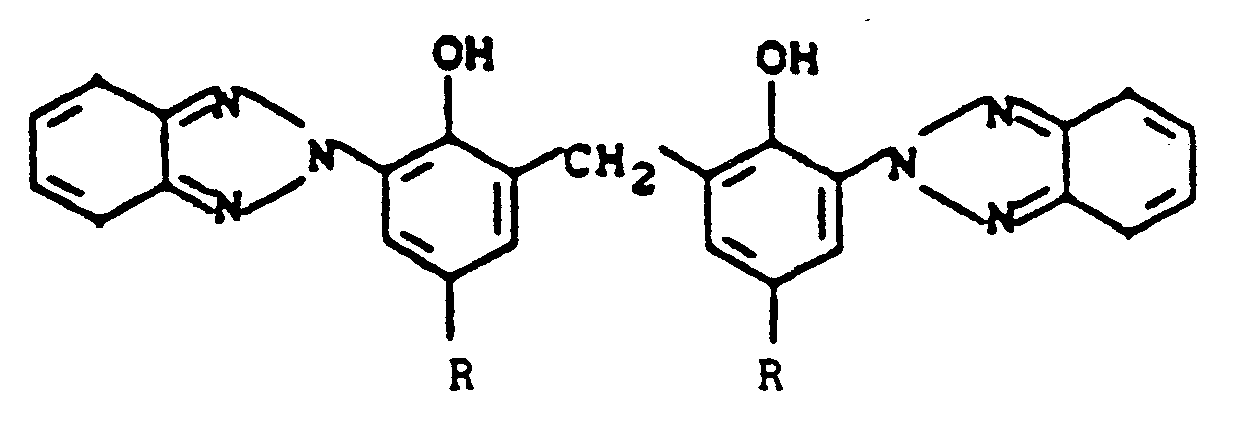
- UV stabilizers which can be used according to the present invention for the outer layer, mention may be made of LSBT 620 sold by the company ADEKA ARGUS and having the formula: where R is the group
- the present invention therefore meets the above-mentioned objects and provides multilayer plastic plates with protection against UV radiation provided by 2 different anti-UV agents.
- the anti-UV agent contained in the outer layer which is not very volatile, prevents aging of the surface of the plate.
- the anti UV agent contained in the reservoir layer is a product commonly used for the stabilization of polycarbonate. Due to its migration to the surface, it makes it possible to compensate for the loss by extraction or photodegradation of the anti UV agent contained in the outer layer. Thereby the or the surfaces of the plate are protected in a durable manner against aging.
- the present invention also provides a method of manufacturing the claimed plates.
- a process of coextrusion of a flow in three layers is carried out in which said reservoir layer and said external layer, loaded as indicated above, with said agents for absorbing UV radiation, are deposited simultaneously on said layer. from the heart by means of a coextrusion block, often referred to in the art as the "feed-block".
- the process used in the present invention consists in gathering the three material flows in the coextrusion block, then in conducting the single stream to the die where it is distributed over the whole width.
- the same structure of the plate can be obtained using a multilayer die.
- the material is calibrated under vacuum using a shaping device at the outlet of the die.
- the present invention providing for the presence of an agent for absorbing low-volatility UV radiation in the external layer, makes it possible to avoid any disruption of the smooth running of the process, as well as fouling of the template.
- the very low volatility of the agent for absorbing UV radiation in the external layer makes it possible to avoid deposits on the casting drums.
Landscapes
- Engineering & Computer Science (AREA)
- Architecture (AREA)
- Civil Engineering (AREA)
- Structural Engineering (AREA)
- Laminated Bodies (AREA)
- Extrusion Moulding Of Plastics Or The Like (AREA)
Abstract
Description
- La présente invention se rapporte à une plaque multicouche en matière plastique protégée contre le rayonnement ultraviolet. L'invention concerne plus particulièrement une plaque en matière plastique, composée d'une couche de coeur en polycarbonate comportant sur au moins une de ses faces une couche réservoir à base de polycarbonate contenant entre 5 et 15 % en poids d'un agent absorbant le rayonnement UV, elle-même recouverte d'une couche externe en résine synthétique contenant un agent absorbant le rayonnement ultraviolet peu volatil.
- De nombreux procédés de fabrication de plaques en matière plastique protégées contre le rayonnement UV ont été décrits dans l'art antérieur.
- L'EP-A-0110238, correspondant à l'US-A-4707393, décrit un procédé de fabrication d'un panneau en résine synthétique alvéolaire multicouche par coextrusion à l'aide d'une filière multicouche composé d'une couche de coeur en polycarbonate alvéolaire portant sur au moins une de ses faces une couche d'absorption du rayonnement UV en résine synthétique contenant 2 à 15 % en poids d'un agent volatil absorbant le rayonnement UV, elle même recouverte d'une couche externe contenant moins de 2 % en poids d'un agent volatil absorbant le rayonnement UV. Il est indiqué dans la description que la plupart des agents d'absorption du rayonnement UV utilisés habituellement sont volatils en ce sens qu'à une teneur de 0,5 % en poids, il se produit une sublimation perceptible à 260°C sous pression normale et une sublimation plus prononcée sous vide, accompagnée du dépôt de l'agent d'absorption des UV condensé sur les parties plus froides de l'installation (col. 3, l 32-37 de l'US-A-4707393).
- De tels panneaux ne sont pas satisfaisants car on observe un vieillissement de la couche externe au cours du temps se manifestant par un jaunissement et l'apparition de microfissures entraînant une baisse des propriétés optiques et mécaniques.
- L'EP-A-0110221 décrit un panneau en matière plastique composé d'une couche de coeur en polycarbonate revêtue sur au moins une de ses faces d'une couche de recouvrement en polycarbonate contenant au moins 2 % en poids, de préférence 5 à 15 % en poids, d'un agent d'absorption usuel du rayonnement UV.
- Les agents d'absorption du rayonnement UV cités comme étant appropriés dans ce brevet sont les mêmes que ceux de l'EP-A-0110238 qui y sont qualifiés de volatils. Une extraction de ces agents d'absorption du rayonnement UV, qui sont présents en proportion importante dans la couche de recouvrement, se produit dans les conditions de mise en oeuvre du procédé et entraîne le problème crucial de l'encrassement de l'installation et en particulier des plateaux calibrants (plaques alvéolaires) ou des tambours de coulée (plaques pleines) et perturbe la marche de la ligne. Des dépôts et des rayures apparaissent à la surface de la plaque, ce qui constitue un défaut rédhibitoire.
- L'EP-A-0247480 décrit du polycarbonate ramifié contenant une hydroxybenzotriazole de structure déterminée, connu d'après le DOS 1670951, lui conférant une protection contre le rayonnement UV. Cette demande décrit également l'emploi d'un tel polycarbonate pour la fabrication de panneaux multicouche en matière plastique par coextrusion, la couche de coeur support, composée de préférence de polycarbonate branché, étant recouverte sur au moins une de ses faces, d'une couche d'absorption du rayonnement UV à base de polycarbonate ramifié, contenant entre 1 % en poids et 15 % en poids, de préférence entre 5 % en poids et 15 % en poids, de l'absorbant du rayonnement UV concerné et ayant une épaisseur de 10 à 50 µm (p. 1, l. 15-27, p. 4, l. 20-21 et p. 8, l. 16-29). Cette couche d'absorption du rayonnement UV peut être recouverte d'une autre couche de recouvrement ayant une épaisseur de 10-30 µm et pratiquement exempte d'agents d'absorption du rayonnement UV (p. 8, l. 31-34).
- Dans le mode de réalisation où un tel panneau ne comprend pas de couche de recouvrement, il verrait sa protection contre le rayonnement UV se dégrader au cours du temps du fait de la diminution de la concentration en agent anti UV au cours du vieillissement causée par une extraction due aux intempéries ou une dégradation par un processus photochimique. D'autre part, dans le mode de réalisation où ce panneau comprend une couche de recouvrement, qui ne contient pratiquement pas d'agent d'absorption des UV, le vieillissement de cette dernière au cours du temps ne pourrait être évité.
- En outre, l'EP-A-247480 ne concerne que le polycarbonate ramifié ; il y est indiqué en effet, et cela est confirmé par l'exemple comparatif, que les hydroxybenzotriazoles (connus d'après le DOS 1670951) utilisés comme agents d'absorption du rayonnement UV n'apportent une amélioration par rapport aux hydroxybenzotriazoles utilisés auparavant que pour le polycarbonate ramifié, et non pour le polycarbonate linéaire.
Un objet de la présente invention est de fournir une plaque multicouche en matière plastique avec une protection contre le rayonnement UV dont la ou les faces externes sont protégées de façon durable contre le vieillissement.
Un objet de l'invention est encore de fournir une plaque multicouche protégée contre le rayonnement UV dont la fabrication par coextrusion ne provoque pas d'encrassement de l'installation, et notamment pas d'encrassement des plaques de calibrage ou des tambours de coulée ni de dépôt ou de rayure sur les plaques.
Selon la présente invention, il est fourni une plaque, composée d'une couche de coeur (âme) en polycarbonate comportant sur au moins une de ses faces une couche réservoir à base de polycarbonate contenant entre 5 et 15 % en poids d'un agent d'absorption du rayonnement UV, elle même recouverte d'une couche externe en résine synthétique contenant au moins 2 % en poids, de préférence entre 3 et 15 % en poids, d'un agent d'absorption du rayonnement UV peu volatil, différent de celui contenu dans la couche réservoir. - La Figure 1 annexée représente schématiquement une plaque selon l'invention, dans le mode de réalisation où la couche de coeur, en polycarbonate compact, n'est recouverte que sur une de ses faces des couches réservoir et externe.
- La Figure 2 annexée représente schématiquement une plaque selon l'invention, dans le mode de réalisation où la couche de coeur, en polycarbonate alvéolaire, n'est recouverte que sur une de ses faces des couches réservoir et externe.
- Les agents d'absorption du rayonnement UV contenus dans la couche réservoir sont destinés à assurer la protection de la plaque par suite de leur migration vers la surface. Ils compensent ainsi la baisse de l'efficacité des agents d'absorption du rayonnement UV de la couche externe du fait de leur extraction lors de l'exposition de la plaque aux intempéries ou de leur dégradation par un processus photochimique. Les agents d'absorption du rayonnement UV de la couche réservoir sont des produits usuels, par exemple des hydroxybenzotriazoles de formule :

- Ces produits peuvent être utilisés seuls ou en combinaison. La couche externe (3) recouvrant la couche réservoir (2) est une résine synthétique par exemple à base de polycarbonate ramifié, de polycarbonate linéaire ou de polyarylate, par exemple de type ARDEL D 240. La couche externe assure la protection de la plaque contre le rayonnement UV. Son épaisseur est faible mais suffisante pour éviter la migration des agents d'absorption du rayonnement UV volatils contenus dans la couche réservoir jusqu'à la surface de la plaque. Une épaisseur de 5 à 50 µm est appropriée. La teneur en agent d'absorption du rayonnement UV de la couche externe doit être supérieure à 2 % en poids, et généralement comprise entre 2 et 15 % en poids.
- Il faut comprendre que la limite supérieure de la concentration en agent d'absorption en rayonnement UV de la couche externe n'est pas critique et qu'elle est en pratique déterminée notamment par la solubilité dudit agent d'absorption du rayonnement UV dans la résine composant la couche externe et par des considérations économiques.
- Les agents d'absorption du rayonnement UV utilisés pour la couche externe sont caractérisés par le fait qu'ils sont peu volatils.
- Les agents anti UV utilisés dans la couche externe doivent répondre aux critères suivants :
- efficacité moléculaire équivalente à celle des agents anti-UV couramment utilisés pour le polycarbonate,
- faible volatilité aux températures de mise en oeuvre du polycarbonate. - Les agents anti UV utilisés dans la couche externe sont donc différents de ceux utilisés dans la couche réservoir.
- La volatilité du produit anti UV peut être déterminée par une analyse thermogravimétrique effectuée sur l'agent anti UV pur avec une montée en température de 10°C/minute sous balayage d'argon. Le produit est considéré comme peu volatil si la température correspondant à une perte de poids de 1 % est supérieure à 300°C. De tels produits sont par exemple des benzotriazoles tels que décrits dans le DOS 1670951.
- Parmi les anti UV utilisables selon la présente invention pour la couche externe on peut citer le LSBT 620 commercialisé par la Société ADEKA ARGUS et ayant la formule :

- Ces produits peuvent être utilisés seuls ou en combinaison.
- La présente invention répond donc aux objets sus-mentionnés et fournit des plaques multicouche en matière plastique avec une protection contre le rayonnement UV assurée par 2 agents anti UV différents. L'agent anti UV contenu dans la couche externe, peu volatil, évite le vieillissement de la surface de la plaque. L'agent anti UV contenu dans la couche réservoir est un produit couramment utilisé pour la stabilisation du polycarbonate. Du fait de sa migration vers la surface, il permet de compenser la perte par extraction ou photodégradation de l'agent anti UV contenu dans la couche externe. De ce fait la, ou les surfaces de la plaque sont protégées de façon durable contre le vieillissement.
- La présente invention fournit également un procédé de fabrication des plaques revendiquées.
- Selon l'invention, on effectue un procédé de coextrusion d'un flux en trois couches dans lequel ladite couche réservoir et ladite couche externe, chargées comme indiqué plus haut, en lesdits agents d'absorption du rayonnement UV, sont déposées simultanément sur ladite couche de coeur au moyen d'un bloc de coextrusion, souvent désigné dans la technique sous l'appellation "feed-block".
Le procédé utilisé dans la présente invention consiste à rassembler les trois flux de matière dans le bloc de coextrusion, puis à conduire le courant unique jusqu'à la filière où il est réparti sur l'ensemble de la laize.
La même structure de la plaque peut être obtenue en utilisant une filière multicouche.
Dans le cas d'une plaque alvéolaire, la matière est calibrée sous vide à l'aide d'un conformateur à la sortie de la filière. La présente invention, prévoyant la présence d'un agent d'absorption du rayonnement UV peu volatil dans la couche externe, permet d'éviter toute perturbation de la bonne marche du procédé, ainsi que l'encrassement du calibre.
Dans le cas d'une plaque pleine, la très faible volatilité de l'agent d'absorption du rayonnement UV dans la couche externe, selon l'invention, permet d'éviter les dépôts sur les tambours de coulée.
La couche réservoir (2) qui recouvre la couche de coeur (1) sur au moins une de ses faces est à base de polycarbonate linéaire ou ramifié. Elle a une teneur en agent d'absorption du rayonnement UV élevée : de 2 % à 15 % en poids et plus généralement de 7 % à 12 % en poids. L'épaisseur de la couche réservoir est de 5 à 50 µm. Elle doit être suffisante pour absorber le rayonnement UV qui ne serait pas totalement filtré par la couche externe.
Claims (5)
Applications Claiming Priority (2)
| Application Number | Priority Date | Filing Date | Title |
|---|---|---|---|
| FR8811703 | 1988-09-07 | ||
| FR8811703A FR2636005B1 (fr) | 1988-09-07 | 1988-09-07 | Plaque multicouche a base de polycarbonate protegee contre le rayonnement uv |
Publications (3)
| Publication Number | Publication Date |
|---|---|
| EP0359622A1 true EP0359622A1 (fr) | 1990-03-21 |
| EP0359622B1 EP0359622B1 (fr) | 1994-06-15 |
| EP0359622B2 EP0359622B2 (fr) | 2001-11-28 |
Family
ID=9369796
Family Applications (1)
| Application Number | Title | Priority Date | Filing Date |
|---|---|---|---|
| EP89402410A Expired - Lifetime EP0359622B2 (fr) | 1988-09-07 | 1989-09-05 | Plaque multicouche à base de polycarbonate protégée contre le rayonnement uv. |
Country Status (5)
| Country | Link |
|---|---|
| US (1) | US5098790A (fr) |
| EP (1) | EP0359622B2 (fr) |
| AT (1) | ATE107225T1 (fr) |
| DE (1) | DE68916141T3 (fr) |
| FR (1) | FR2636005B1 (fr) |
Cited By (6)
| Publication number | Priority date | Publication date | Assignee | Title |
|---|---|---|---|---|
| EP0569878A3 (fr) * | 1992-05-15 | 1994-02-16 | Roehm Gmbh | |
| EP0649724A1 (fr) * | 1993-10-18 | 1995-04-26 | Bayer Ag | Procédé pour la fabrication de panneaux multicouches en plastique |
| EP0657280A1 (fr) | 1993-12-09 | 1995-06-14 | Kaysersberg Packaging | Procédé de fabrication d'une plaque à base de polycarbonate, destinée à la fabrication de bâtiment, notamment de serre |
| EP0716919A3 (fr) * | 1994-12-16 | 1996-12-27 | Bayer Ag | Panneaux multicouches à base de polycarbonate protégés contre le rayonnement UV |
| US5856012A (en) * | 1993-10-18 | 1999-01-05 | Bayer Ag | Process for the production of multilayer plastic sheets |
| ES2142180A1 (es) * | 1994-03-23 | 2000-04-01 | Gentex Optics Inc | Metodo de teñir copolimeros policarbonato-poliester. |
Families Citing this family (16)
| Publication number | Priority date | Publication date | Assignee | Title |
|---|---|---|---|---|
| US7036286B1 (en) * | 2001-07-06 | 2006-05-02 | Blackwell Grover M | Exterior window coverings |
| IL162235A0 (en) * | 2001-12-10 | 2005-11-20 | Bayer Materialscience Ag | Multi-layer, weather-resistant, coloured panel |
| US20030200715A1 (en) * | 2002-04-27 | 2003-10-30 | Blackwell Grover M. | Corrosion resistant window shutter |
| DE10331670A1 (de) * | 2003-07-14 | 2005-03-03 | Bayer Materialscience Ag | Mehrschichtiges Erzeugnis mit verbesserter Erkennbarkeit der coextrudierten Seite |
| GB0320572D0 (en) * | 2003-09-03 | 2003-10-01 | Ultraframe Uk Ltd | Glazing panels |
| US7641954B2 (en) * | 2003-10-03 | 2010-01-05 | Cabot Corporation | Insulated panel and glazing system comprising the same |
| US7621299B2 (en) * | 2003-10-03 | 2009-11-24 | Cabot Corporation | Method and apparatus for filling a vessel with particulate matter |
| BE1016732A5 (nl) * | 2005-08-23 | 2007-05-08 | Cotiere Grand Large | Samengesteld paneel voor dakconstructies en dergelijke. |
| DE102007040258A1 (de) | 2007-08-24 | 2009-02-26 | Evonik Röhm Gmbh | Lichtdurchlässiger Sonnenenergiekollektor |
| CN102355995B (zh) * | 2009-02-09 | 2015-06-10 | 斯泰隆欧洲有限责任公司 | 透明多层碳酸酯制品和其制造方法 |
| DE102009032820A1 (de) * | 2009-07-13 | 2011-01-20 | Mitsubishi Polyester Film Gmbh | Ein- oder mehrschichtige, stabilisierte Polyesterfolie |
| MX380274B (es) | 2011-06-30 | 2025-03-12 | Gallo Winery E & J | Colorante cristalino natural y proceso para producción. |
| AU2014232364B2 (en) | 2013-03-15 | 2018-07-12 | E & J Gallo Winery | Dryer using adjustable conditioned air flow |
| US20160316641A1 (en) * | 2013-09-27 | 2016-11-03 | Mustafa METIN | Transparent cover element with high thermal insulation |
| US11221179B2 (en) | 2018-10-26 | 2022-01-11 | E. & J. Gallo Winery | Low profile design air tunnel system and method for providing uniform air flow in a refractance window dryer |
| CN113022072A (zh) * | 2021-04-12 | 2021-06-25 | 上海品诚控股集团有限公司 | 一种表面有纹理的免喷涂中空板及其制备方法 |
Citations (2)
| Publication number | Priority date | Publication date | Assignee | Title |
|---|---|---|---|---|
| GB2028228A (en) * | 1978-07-26 | 1980-03-05 | Roehm Gmbh | Method of coating |
| US4707393A (en) * | 1982-12-04 | 1987-11-17 | Rohm Gmbh | Method for making hollow multilayer multiple-wall synthetic resin panels |
-
1988
- 1988-09-07 FR FR8811703A patent/FR2636005B1/fr not_active Expired - Lifetime
-
1989
- 1989-09-05 AT AT89402410T patent/ATE107225T1/de not_active IP Right Cessation
- 1989-09-05 DE DE68916141T patent/DE68916141T3/de not_active Expired - Lifetime
- 1989-09-05 EP EP89402410A patent/EP0359622B2/fr not_active Expired - Lifetime
- 1989-09-07 US US07/403,863 patent/US5098790A/en not_active Expired - Fee Related
Patent Citations (2)
| Publication number | Priority date | Publication date | Assignee | Title |
|---|---|---|---|---|
| GB2028228A (en) * | 1978-07-26 | 1980-03-05 | Roehm Gmbh | Method of coating |
| US4707393A (en) * | 1982-12-04 | 1987-11-17 | Rohm Gmbh | Method for making hollow multilayer multiple-wall synthetic resin panels |
Cited By (8)
| Publication number | Priority date | Publication date | Assignee | Title |
|---|---|---|---|---|
| EP0569878A3 (fr) * | 1992-05-15 | 1994-02-16 | Roehm Gmbh | |
| EP0649724A1 (fr) * | 1993-10-18 | 1995-04-26 | Bayer Ag | Procédé pour la fabrication de panneaux multicouches en plastique |
| US5856012A (en) * | 1993-10-18 | 1999-01-05 | Bayer Ag | Process for the production of multilayer plastic sheets |
| EP0657280A1 (fr) | 1993-12-09 | 1995-06-14 | Kaysersberg Packaging | Procédé de fabrication d'une plaque à base de polycarbonate, destinée à la fabrication de bâtiment, notamment de serre |
| FR2713548A1 (fr) * | 1993-12-09 | 1995-06-16 | Kaysersberg Packaging Sa | Procédé de fabrication d'une plaque à base de polycarbonate destinée à la fabrication de bâtiment, notamment de serre. |
| ES2142180A1 (es) * | 1994-03-23 | 2000-04-01 | Gentex Optics Inc | Metodo de teñir copolimeros policarbonato-poliester. |
| EP0716919A3 (fr) * | 1994-12-16 | 1996-12-27 | Bayer Ag | Panneaux multicouches à base de polycarbonate protégés contre le rayonnement UV |
| US5846659A (en) * | 1994-12-16 | 1998-12-08 | Bayer Aktiengesellschaft | UV-protected, multilayer polycarbonate sheets |
Also Published As
| Publication number | Publication date |
|---|---|
| DE68916141D1 (de) | 1994-07-21 |
| DE68916141T3 (de) | 2002-05-02 |
| ATE107225T1 (de) | 1994-07-15 |
| EP0359622B2 (fr) | 2001-11-28 |
| EP0359622B1 (fr) | 1994-06-15 |
| FR2636005A1 (fr) | 1990-03-09 |
| US5098790A (en) | 1992-03-24 |
| FR2636005B1 (fr) | 1990-10-19 |
| DE68916141T2 (de) | 1994-09-22 |
Similar Documents
| Publication | Publication Date | Title |
|---|---|---|
| EP0359622B1 (fr) | Plaque multicouche à base de polycarbonate protégée contre le rayonnement uv. | |
| EP0733475B1 (fr) | Materiaux complexes de fluorure de polyvinylidene et d'un thermoplaste incompatible | |
| FR2515197A1 (fr) | Ruban adhesif | |
| FR2675140A1 (fr) | Vitrage feuillete. | |
| EP0434572A1 (fr) | Matériau pour la réalisation d'équipements de protection à l'encontre des agressions nucléaires, biologiques et chimiques | |
| CA3025230A1 (fr) | Film multicouche | |
| EP1636399B1 (fr) | Revetement pour une piece mecanique comprenant au moins une couche externe de carbone amorphe hydrogene et une couche de carbure de silicium hydrogene en contact avec la piece, et procede de depot d'un tel revetement | |
| FR2692598A1 (fr) | Procédé de dépôt d'un film contenant du silicium à la surface d'un substrat métallique et procédé de traitement anti-corrosion. | |
| FR2547809A1 (fr) | Vitrage de securite, en particulier vitrage anti-balles | |
| JP2001151902A (ja) | 光学フィルム及びその製造方法 | |
| EP3083410B1 (fr) | Utilisation de film polymere pour l'emballage de milieu de culture | |
| EP2714609B1 (fr) | Couche barriere aux alcalins | |
| EP0657280B1 (fr) | Procédé de fabrication d'une plaque à base de polycarbonate, destinée à la fabrication de bâtiment, notamment de serre | |
| FR2958206A1 (fr) | Films fluores multicouche | |
| FR2667579A1 (fr) | Materiau d'emballage etanche pour l'emballage de solutions a infuser. | |
| BE1004488A3 (fr) | Procede pour rendre hydrophile la surface d'articles en resines a base de chlorure de vinyle. | |
| EP2747996B1 (fr) | Vitrage anti-feu | |
| EP0299884A1 (fr) | Film souple auto-adhésif de protection temporaire | |
| EP3237346B1 (fr) | Vitrage comprenant une couche de protection superieure a base de carbone | |
| EP1717021B1 (fr) | Film thermorétractable, de haute clarté et de haute rigidité | |
| EP4210941A1 (fr) | Film multicouche étiré présentant une haute résistance à la température et son procédé de préparation | |
| FR2873593A1 (fr) | Procede d'elimination de composes phenoliques polyhalogenes dans les boissons et notamment dans le vin | |
| WO2006108873A1 (fr) | Vitrage anti-feu | |
| CN110643944B (zh) | 银层透明保护膜及其应用 | |
| WO2023126214A1 (fr) | Materiau comportant un empilement pluri-couches fonctionnelles a couche dielectrique de nitrure a base d'aluminium et de silicium et vitrage comportant ce materiau |
Legal Events
| Date | Code | Title | Description |
|---|---|---|---|
| PUAI | Public reference made under article 153(3) epc to a published international application that has entered the european phase |
Free format text: ORIGINAL CODE: 0009012 |
|
| AK | Designated contracting states |
Kind code of ref document: A1 Designated state(s): AT BE CH DE ES FR GB GR IT LI LU NL SE |
|
| 17P | Request for examination filed |
Effective date: 19900406 |
|
| RAP1 | Party data changed (applicant data changed or rights of an application transferred) |
Owner name: KAYSERSBERG EMBALLAGES |
|
| RAP3 | Party data changed (applicant data changed or rights of an application transferred) |
Owner name: KAYSERSBERG PACKAGING |
|
| RAP1 | Party data changed (applicant data changed or rights of an application transferred) |
Owner name: KAYSERSBERG PACKAGING (ANCIENNE STE. CHOUANARD) |
|
| 17Q | First examination report despatched |
Effective date: 19930506 |
|
| GRAA | (expected) grant |
Free format text: ORIGINAL CODE: 0009210 |
|
| AK | Designated contracting states |
Kind code of ref document: B1 Designated state(s): AT BE CH DE ES FR GB GR IT LI LU NL SE |
|
| PG25 | Lapsed in a contracting state [announced via postgrant information from national office to epo] |
Ref country code: GR Free format text: LAPSE BECAUSE OF FAILURE TO SUBMIT A TRANSLATION OF THE DESCRIPTION OR TO PAY THE FEE WITHIN THE PRESCRIBED TIME-LIMIT Effective date: 19940615 Ref country code: NL Effective date: 19940615 Ref country code: ES Free format text: THE PATENT HAS BEEN ANNULLED BY A DECISION OF A NATIONAL AUTHORITY Effective date: 19940615 |
|
| REF | Corresponds to: |
Ref document number: 107225 Country of ref document: AT Date of ref document: 19940715 Kind code of ref document: T |
|
| ITF | It: translation for a ep patent filed | ||
| REF | Corresponds to: |
Ref document number: 68916141 Country of ref document: DE Date of ref document: 19940721 |
|
| PG25 | Lapsed in a contracting state [announced via postgrant information from national office to epo] |
Ref country code: SE Effective date: 19940915 |
|
| PG25 | Lapsed in a contracting state [announced via postgrant information from national office to epo] |
Ref country code: LU Free format text: LAPSE BECAUSE OF NON-PAYMENT OF DUE FEES Effective date: 19940930 |
|
| GBT | Gb: translation of ep patent filed (gb section 77(6)(a)/1977) |
Effective date: 19940913 |
|
| NLV1 | Nl: lapsed or annulled due to failure to fulfill the requirements of art. 29p and 29m of the patents act | ||
| PLBI | Opposition filed |
Free format text: ORIGINAL CODE: 0009260 |
|
| 26 | Opposition filed |
Opponent name: ROEHM GMBH Effective date: 19950217 |
|
| PLBO | Opposition rejected |
Free format text: ORIGINAL CODE: EPIDOS REJO |
|
| APAC | Appeal dossier modified |
Free format text: ORIGINAL CODE: EPIDOS NOAPO |
|
| APAA | Appeal reference recorded |
Free format text: ORIGINAL CODE: EPIDOS REFN |
|
| APAC | Appeal dossier modified |
Free format text: ORIGINAL CODE: EPIDOS NOAPO |
|
| PLAW | Interlocutory decision in opposition |
Free format text: ORIGINAL CODE: EPIDOS IDOP |
|
| PLAW | Interlocutory decision in opposition |
Free format text: ORIGINAL CODE: EPIDOS IDOP |
|
| PUAH | Patent maintained in amended form |
Free format text: ORIGINAL CODE: 0009272 |
|
| STAA | Information on the status of an ep patent application or granted ep patent |
Free format text: STATUS: PATENT MAINTAINED AS AMENDED |
|
| 27A | Patent maintained in amended form |
Effective date: 20011128 |
|
| AK | Designated contracting states |
Kind code of ref document: B2 Designated state(s): AT BE CH DE ES FR GB GR IT LI LU NL SE |
|
| REG | Reference to a national code |
Ref country code: CH Ref legal event code: AEN Free format text: MAINTIEN DU BREVET DONT L'ETENDUE A ETE MODIFIEE |
|
| REG | Reference to a national code |
Ref country code: GB Ref legal event code: IF02 |
|
| GBTA | Gb: translation of amended ep patent filed (gb section 77(6)(b)/1977) | ||
| APAH | Appeal reference modified |
Free format text: ORIGINAL CODE: EPIDOSCREFNO |
|
| REG | Reference to a national code |
Ref country code: FR Ref legal event code: CD |
|
| REG | Reference to a national code |
Ref country code: CH Ref legal event code: PFA Owner name: DS SMITH KAYSERSBERG Free format text: KAYSERSBERG PACKAGING (ANCIENNE STE CHOUANARD)#ROUTE DE LAPOUTROIE#KAYSERSBERG (FR) -TRANSFER TO- DS SMITH KAYSERSBERG#11 ROUTE INDUSTRIELLE#68320 KUNHEIM (FR) Ref country code: CH Ref legal event code: NV Representative=s name: ING. MARCO ZARDI C/O M. ZARDI & CO. S.A. |
|
| PGFP | Annual fee paid to national office [announced via postgrant information from national office to epo] |
Ref country code: CH Payment date: 20080826 Year of fee payment: 20 |
|
| PGFP | Annual fee paid to national office [announced via postgrant information from national office to epo] |
Ref country code: IT Payment date: 20080913 Year of fee payment: 20 Ref country code: AT Payment date: 20080825 Year of fee payment: 20 |
|
| PGFP | Annual fee paid to national office [announced via postgrant information from national office to epo] |
Ref country code: GB Payment date: 20080827 Year of fee payment: 20 |
|
| PGFP | Annual fee paid to national office [announced via postgrant information from national office to epo] |
Ref country code: DE Payment date: 20081002 Year of fee payment: 20 |
|
| PGFP | Annual fee paid to national office [announced via postgrant information from national office to epo] |
Ref country code: BE Payment date: 20080829 Year of fee payment: 20 |
|
| PGFP | Annual fee paid to national office [announced via postgrant information from national office to epo] |
Ref country code: FR Payment date: 20080929 Year of fee payment: 20 |
|
| REG | Reference to a national code |
Ref country code: CH Ref legal event code: PL |
|
| BE20 | Be: patent expired |
Owner name: *KAYSERSBERG PACKAGING (ANCIENNE STE. CHOUANARD) Effective date: 20090905 |
|
| REG | Reference to a national code |
Ref country code: GB Ref legal event code: PE20 Expiry date: 20090904 |
|
| PG25 | Lapsed in a contracting state [announced via postgrant information from national office to epo] |
Ref country code: GB Free format text: LAPSE BECAUSE OF EXPIRATION OF PROTECTION Effective date: 20090904 |