EP0359708B1 - Composés monoazoiques avec des restes alkyles à longue chaîne - Google Patents
Composés monoazoiques avec des restes alkyles à longue chaîne Download PDFInfo
- Publication number
- EP0359708B1 EP0359708B1 EP89810664A EP89810664A EP0359708B1 EP 0359708 B1 EP0359708 B1 EP 0359708B1 EP 89810664 A EP89810664 A EP 89810664A EP 89810664 A EP89810664 A EP 89810664A EP 0359708 B1 EP0359708 B1 EP 0359708B1
- Authority
- EP
- European Patent Office
- Prior art keywords
- formula
- alkyl
- och
- radical
- compound
- Prior art date
- Legal status (The legal status is an assumption and is not a legal conclusion. Google has not performed a legal analysis and makes no representation as to the accuracy of the status listed.)
- Expired - Lifetime
Links
- 125000000217 alkyl group Chemical group 0.000 title description 14
- NYGZLYXAPMMJTE-UHFFFAOYSA-M metanil yellow Chemical group [Na+].[O-]S(=O)(=O)C1=CC=CC(N=NC=2C=CC(NC=3C=CC=CC=3)=CC=2)=C1 NYGZLYXAPMMJTE-UHFFFAOYSA-M 0.000 title description 5
- -1 phenyloxy Chemical group 0.000 claims description 45
- 150000001875 compounds Chemical class 0.000 claims description 37
- 125000001309 chloro group Chemical group Cl* 0.000 claims description 25
- 125000000956 methoxy group Chemical group [H]C([H])([H])O* 0.000 claims description 25
- 125000002496 methyl group Chemical group [H]C([H])([H])* 0.000 claims description 22
- 238000000034 method Methods 0.000 claims description 12
- 125000000043 benzamido group Chemical group [H]N([*])C(=O)C1=C([H])C([H])=C([H])C([H])=C1[H] 0.000 claims description 9
- 229910052799 carbon Inorganic materials 0.000 claims description 9
- 229910052736 halogen Inorganic materials 0.000 claims description 9
- 150000002367 halogens Chemical class 0.000 claims description 9
- 229920000098 polyolefin Polymers 0.000 claims description 9
- 125000004432 carbon atom Chemical group C* 0.000 claims description 8
- 125000004093 cyano group Chemical group *C#N 0.000 claims description 5
- 125000004178 (C1-C4) alkyl group Chemical group 0.000 claims description 4
- 125000000229 (C1-C4)alkoxy group Chemical group 0.000 claims description 3
- 239000003086 colorant Substances 0.000 claims description 3
- 125000004430 oxygen atom Chemical group O* 0.000 claims description 3
- 125000004434 sulfur atom Chemical group 0.000 claims description 3
- 125000002023 trifluoromethyl group Chemical group FC(F)(F)* 0.000 claims description 3
- 125000006615 aromatic heterocyclic group Chemical group 0.000 claims description 2
- 125000004433 nitrogen atom Chemical group N* 0.000 claims description 2
- 238000012505 colouration Methods 0.000 claims 1
- 125000001424 substituent group Chemical group 0.000 claims 1
- YXFVVABEGXRONW-UHFFFAOYSA-N Toluene Chemical compound CC1=CC=CC=C1 YXFVVABEGXRONW-UHFFFAOYSA-N 0.000 description 12
- 239000000047 product Substances 0.000 description 12
- LFQSCWFLJHTTHZ-UHFFFAOYSA-N Ethanol Chemical compound CCO LFQSCWFLJHTTHZ-UHFFFAOYSA-N 0.000 description 11
- 239000000203 mixture Substances 0.000 description 11
- 239000000049 pigment Substances 0.000 description 11
- 150000003254 radicals Chemical class 0.000 description 10
- 239000002904 solvent Substances 0.000 description 10
- 239000004698 Polyethylene Substances 0.000 description 9
- 150000001412 amines Chemical class 0.000 description 9
- 230000008878 coupling Effects 0.000 description 8
- 238000010168 coupling process Methods 0.000 description 8
- 238000005859 coupling reaction Methods 0.000 description 8
- 238000004043 dyeing Methods 0.000 description 8
- 235000019441 ethanol Nutrition 0.000 description 8
- 239000008187 granular material Substances 0.000 description 7
- ZMXDDKWLCZADIW-UHFFFAOYSA-N N,N-Dimethylformamide Chemical compound CN(C)C=O ZMXDDKWLCZADIW-UHFFFAOYSA-N 0.000 description 6
- LQNUZADURLCDLV-UHFFFAOYSA-N nitrobenzene Chemical compound [O-][N+](=O)C1=CC=CC=C1 LQNUZADURLCDLV-UHFFFAOYSA-N 0.000 description 6
- 229920003023 plastic Polymers 0.000 description 6
- 239000004033 plastic Substances 0.000 description 6
- 150000001721 carbon Chemical group 0.000 description 5
- 230000005494 condensation Effects 0.000 description 5
- 229920000573 polyethylene Polymers 0.000 description 5
- 239000004800 polyvinyl chloride Substances 0.000 description 5
- 229920000915 polyvinyl chloride Polymers 0.000 description 5
- RFFLAFLAYFXFSW-UHFFFAOYSA-N 1,2-dichlorobenzene Chemical compound ClC1=CC=CC=C1Cl RFFLAFLAYFXFSW-UHFFFAOYSA-N 0.000 description 4
- QTBSBXVTEAMEQO-UHFFFAOYSA-N Acetic acid Chemical compound CC(O)=O QTBSBXVTEAMEQO-UHFFFAOYSA-N 0.000 description 4
- 0 C1*2C1CCC2 Chemical compound C1*2C1CCC2 0.000 description 4
- SECXISVLQFMRJM-UHFFFAOYSA-N N-Methylpyrrolidone Chemical compound CN1CCCC1=O SECXISVLQFMRJM-UHFFFAOYSA-N 0.000 description 4
- MVPPADPHJFYWMZ-UHFFFAOYSA-N chlorobenzene Chemical compound ClC1=CC=CC=C1 MVPPADPHJFYWMZ-UHFFFAOYSA-N 0.000 description 4
- 230000003750 conditioning effect Effects 0.000 description 4
- JHIVVAPYMSGYDF-UHFFFAOYSA-N cyclohexanone Chemical compound O=C1CCCCC1 JHIVVAPYMSGYDF-UHFFFAOYSA-N 0.000 description 4
- 229920000642 polymer Polymers 0.000 description 4
- 150000003839 salts Chemical class 0.000 description 4
- 239000000243 solution Substances 0.000 description 4
- NGNBDVOYPDDBFK-UHFFFAOYSA-N 2-[2,4-di(pentan-2-yl)phenoxy]acetyl chloride Chemical compound CCCC(C)C1=CC=C(OCC(Cl)=O)C(C(C)CCC)=C1 NGNBDVOYPDDBFK-UHFFFAOYSA-N 0.000 description 3
- ALKYHXVLJMQRLQ-UHFFFAOYSA-N 3-Hydroxy-2-naphthoate Chemical compound C1=CC=C2C=C(O)C(C(=O)O)=CC2=C1 ALKYHXVLJMQRLQ-UHFFFAOYSA-N 0.000 description 3
- UHOVQNZJYSORNB-UHFFFAOYSA-N Benzene Chemical compound C1=CC=CC=C1 UHOVQNZJYSORNB-UHFFFAOYSA-N 0.000 description 3
- RTZKZFJDLAIYFH-UHFFFAOYSA-N Diethyl ether Chemical compound CCOCC RTZKZFJDLAIYFH-UHFFFAOYSA-N 0.000 description 3
- 239000004952 Polyamide Substances 0.000 description 3
- GWEVSGVZZGPLCZ-UHFFFAOYSA-N Titan oxide Chemical compound O=[Ti]=O GWEVSGVZZGPLCZ-UHFFFAOYSA-N 0.000 description 3
- 239000000987 azo dye Substances 0.000 description 3
- 239000003054 catalyst Substances 0.000 description 3
- 238000004040 coloring Methods 0.000 description 3
- 238000009833 condensation Methods 0.000 description 3
- 125000000664 diazo group Chemical group [N-]=[N+]=[*] 0.000 description 3
- 239000000835 fiber Substances 0.000 description 3
- 239000010408 film Substances 0.000 description 3
- 239000000463 material Substances 0.000 description 3
- 239000003960 organic solvent Substances 0.000 description 3
- 229920002647 polyamide Polymers 0.000 description 3
- 229920000515 polycarbonate Polymers 0.000 description 3
- 239000000843 powder Substances 0.000 description 3
- 239000000725 suspension Substances 0.000 description 3
- 239000004753 textile Substances 0.000 description 3
- XLYOFNOQVPJJNP-UHFFFAOYSA-N water Substances O XLYOFNOQVPJJNP-UHFFFAOYSA-N 0.000 description 3
- VEXZGXHMUGYJMC-UHFFFAOYSA-M Chloride anion Chemical compound [Cl-] VEXZGXHMUGYJMC-UHFFFAOYSA-M 0.000 description 2
- IAZDPXIOMUYVGZ-UHFFFAOYSA-N Dimethylsulphoxide Chemical compound CS(C)=O IAZDPXIOMUYVGZ-UHFFFAOYSA-N 0.000 description 2
- 239000004129 EU approved improving agent Substances 0.000 description 2
- KFZMGEQAYNKOFK-UHFFFAOYSA-N Isopropanol Chemical compound CC(C)O KFZMGEQAYNKOFK-UHFFFAOYSA-N 0.000 description 2
- 239000004743 Polypropylene Substances 0.000 description 2
- QAOWNCQODCNURD-UHFFFAOYSA-N Sulfuric acid Chemical compound OS(O)(=O)=O QAOWNCQODCNURD-UHFFFAOYSA-N 0.000 description 2
- 229960000583 acetic acid Drugs 0.000 description 2
- 239000002253 acid Substances 0.000 description 2
- 150000001298 alcohols Chemical class 0.000 description 2
- 238000007112 amidation reaction Methods 0.000 description 2
- 150000001408 amides Chemical class 0.000 description 2
- RDOXTESZEPMUJZ-UHFFFAOYSA-N anisole Chemical compound COC1=CC=CC=C1 RDOXTESZEPMUJZ-UHFFFAOYSA-N 0.000 description 2
- 238000009835 boiling Methods 0.000 description 2
- 150000001732 carboxylic acid derivatives Chemical group 0.000 description 2
- 239000003795 chemical substances by application Substances 0.000 description 2
- 150000001805 chlorine compounds Chemical class 0.000 description 2
- 239000003599 detergent Substances 0.000 description 2
- 150000004816 dichlorobenzenes Chemical class 0.000 description 2
- UKMSUNONTOPOIO-UHFFFAOYSA-N docosanoic acid Chemical compound CCCCCCCCCCCCCCCCCCCCCC(O)=O UKMSUNONTOPOIO-UHFFFAOYSA-N 0.000 description 2
- 238000001035 drying Methods 0.000 description 2
- 239000000975 dye Substances 0.000 description 2
- 125000001495 ethyl group Chemical group [H]C([H])([H])C([H])([H])* 0.000 description 2
- 239000012362 glacial acetic acid Substances 0.000 description 2
- 239000011521 glass Substances 0.000 description 2
- ZXEKIIBDNHEJCQ-UHFFFAOYSA-N isobutanol Chemical compound CC(C)CO ZXEKIIBDNHEJCQ-UHFFFAOYSA-N 0.000 description 2
- 125000001449 isopropyl group Chemical group [H]C([H])([H])C([H])(*)C([H])([H])[H] 0.000 description 2
- 150000002576 ketones Chemical class 0.000 description 2
- 125000001421 myristyl group Chemical group [H]C([*])([H])C([H])([H])C([H])([H])C([H])([H])C([H])([H])C([H])([H])C([H])([H])C([H])([H])C([H])([H])C([H])([H])C([H])([H])C([H])([H])C([H])([H])C([H])([H])[H] 0.000 description 2
- 229920001643 poly(ether ketone) Polymers 0.000 description 2
- 229920003229 poly(methyl methacrylate) Polymers 0.000 description 2
- 239000004417 polycarbonate Substances 0.000 description 2
- 239000004926 polymethyl methacrylate Substances 0.000 description 2
- 229920001155 polypropylene Polymers 0.000 description 2
- 229920002635 polyurethane Polymers 0.000 description 2
- 239000004814 polyurethane Substances 0.000 description 2
- LPXPTNMVRIOKMN-UHFFFAOYSA-M sodium nitrite Chemical compound [Na+].[O-]N=O LPXPTNMVRIOKMN-UHFFFAOYSA-M 0.000 description 2
- 238000003756 stirring Methods 0.000 description 2
- FYSNRJHAOHDILO-UHFFFAOYSA-N thionyl chloride Chemical compound ClS(Cl)=O FYSNRJHAOHDILO-UHFFFAOYSA-N 0.000 description 2
- JOXIMZWYDAKGHI-UHFFFAOYSA-N toluene-4-sulfonic acid Chemical compound CC1=CC=C(S(O)(=O)=O)C=C1 JOXIMZWYDAKGHI-UHFFFAOYSA-N 0.000 description 2
- 238000005809 transesterification reaction Methods 0.000 description 2
- 238000011282 treatment Methods 0.000 description 2
- 239000008096 xylene Substances 0.000 description 2
- 150000003738 xylenes Chemical class 0.000 description 2
- MHCVCKDNQYMGEX-UHFFFAOYSA-N 1,1'-biphenyl;phenoxybenzene Chemical compound C1=CC=CC=C1C1=CC=CC=C1.C=1C=CC=CC=1OC1=CC=CC=C1 MHCVCKDNQYMGEX-UHFFFAOYSA-N 0.000 description 1
- RELMFMZEBKVZJC-UHFFFAOYSA-N 1,2,3-trichlorobenzene Chemical class ClC1=CC=CC(Cl)=C1Cl RELMFMZEBKVZJC-UHFFFAOYSA-N 0.000 description 1
- JTPNRXUCIXHOKM-UHFFFAOYSA-N 1-chloronaphthalene Chemical compound C1=CC=C2C(Cl)=CC=CC2=C1 JTPNRXUCIXHOKM-UHFFFAOYSA-N 0.000 description 1
- XNWFRZJHXBZDAG-UHFFFAOYSA-N 2-METHOXYETHANOL Chemical group COCCO XNWFRZJHXBZDAG-UHFFFAOYSA-N 0.000 description 1
- ZNQVEEAIQZEUHB-UHFFFAOYSA-N 2-ethoxyethanol Chemical compound CCOCCO ZNQVEEAIQZEUHB-UHFFFAOYSA-N 0.000 description 1
- JFGQHAHJWJBOPD-UHFFFAOYSA-N 3-hydroxy-n-phenylnaphthalene-2-carboxamide Chemical compound OC1=CC2=CC=CC=C2C=C1C(=O)NC1=CC=CC=C1 JFGQHAHJWJBOPD-UHFFFAOYSA-N 0.000 description 1
- OCISOSJGBCQHHN-UHFFFAOYSA-N 3-hydroxynaphthalene-1-carboxylic acid Chemical compound C1=CC=C2C(C(=O)O)=CC(O)=CC2=C1 OCISOSJGBCQHHN-UHFFFAOYSA-N 0.000 description 1
- OEEJOGRTURXKDF-UHFFFAOYSA-N 3-oxo-n-(2-oxobenzimidazol-4-yl)butanamide Chemical compound CC(=O)CC(=O)NC1=CC=CC2=NC(=O)N=C12 OEEJOGRTURXKDF-UHFFFAOYSA-N 0.000 description 1
- MHEBKJBEJUTXJQ-UHFFFAOYSA-N 6-amino-3-methyl-1h-benzimidazol-2-one Chemical compound C1=C(N)C=C2NC(=O)N(C)C2=C1 MHEBKJBEJUTXJQ-UHFFFAOYSA-N 0.000 description 1
- RSWGJHLUYNHPMX-UHFFFAOYSA-N Abietic-Saeure Natural products C12CCC(C(C)C)=CC2=CCC2C1(C)CCCC2(C)C(O)=O RSWGJHLUYNHPMX-UHFFFAOYSA-N 0.000 description 1
- QGZKDVFQNNGYKY-UHFFFAOYSA-N Ammonia Chemical compound N QGZKDVFQNNGYKY-UHFFFAOYSA-N 0.000 description 1
- 235000021357 Behenic acid Nutrition 0.000 description 1
- WKBOTKDWSSQWDR-UHFFFAOYSA-N Bromine atom Chemical compound [Br] WKBOTKDWSSQWDR-UHFFFAOYSA-N 0.000 description 1
- LOLBGKXMTFEMQC-ICWBMWKASA-N C/C=C/N=C\SC Chemical compound C/C=C/N=C\SC LOLBGKXMTFEMQC-ICWBMWKASA-N 0.000 description 1
- OKTJSMMVPCPJKN-UHFFFAOYSA-N Carbon Chemical compound [C] OKTJSMMVPCPJKN-UHFFFAOYSA-N 0.000 description 1
- ZAMOUSCENKQFHK-UHFFFAOYSA-N Chlorine atom Chemical compound [Cl] ZAMOUSCENKQFHK-UHFFFAOYSA-N 0.000 description 1
- 239000004921 DEGALAN® Substances 0.000 description 1
- 239000001856 Ethyl cellulose Substances 0.000 description 1
- ZZSNKZQZMQGXPY-UHFFFAOYSA-N Ethyl cellulose Chemical compound CCOCC1OC(OC)C(OCC)C(OCC)C1OC1C(O)C(O)C(OC)C(CO)O1 ZZSNKZQZMQGXPY-UHFFFAOYSA-N 0.000 description 1
- PXGOKWXKJXAPGV-UHFFFAOYSA-N Fluorine Chemical compound FF PXGOKWXKJXAPGV-UHFFFAOYSA-N 0.000 description 1
- 239000004425 Makrolon Substances 0.000 description 1
- AFVFQIVMOAPDHO-UHFFFAOYSA-N Methanesulfonic acid Chemical compound CS(O)(=O)=O AFVFQIVMOAPDHO-UHFFFAOYSA-N 0.000 description 1
- 229920000426 Microplastic Polymers 0.000 description 1
- 239000000020 Nitrocellulose Substances 0.000 description 1
- REYJJPSVUYRZGE-UHFFFAOYSA-N Octadecylamine Chemical compound CCCCCCCCCCCCCCCCCCN REYJJPSVUYRZGE-UHFFFAOYSA-N 0.000 description 1
- 229920002367 Polyisobutene Polymers 0.000 description 1
- KHPCPRHQVVSZAH-HUOMCSJISA-N Rosin Natural products O(C/C=C/c1ccccc1)[C@H]1[C@H](O)[C@@H](O)[C@@H](O)[C@@H](CO)O1 KHPCPRHQVVSZAH-HUOMCSJISA-N 0.000 description 1
- 229920001800 Shellac Polymers 0.000 description 1
- 229920002125 Sokalan® Polymers 0.000 description 1
- 235000021355 Stearic acid Nutrition 0.000 description 1
- RTAQQCXQSZGOHL-UHFFFAOYSA-N Titanium Chemical compound [Ti] RTAQQCXQSZGOHL-UHFFFAOYSA-N 0.000 description 1
- FJWGYAHXMCUOOM-QHOUIDNNSA-N [(2s,3r,4s,5r,6r)-2-[(2r,3r,4s,5r,6s)-4,5-dinitrooxy-2-(nitrooxymethyl)-6-[(2r,3r,4s,5r,6s)-4,5,6-trinitrooxy-2-(nitrooxymethyl)oxan-3-yl]oxyoxan-3-yl]oxy-3,5-dinitrooxy-6-(nitrooxymethyl)oxan-4-yl] nitrate Chemical compound O([C@@H]1O[C@@H]([C@H]([C@H](O[N+]([O-])=O)[C@H]1O[N+]([O-])=O)O[C@H]1[C@@H]([C@@H](O[N+]([O-])=O)[C@H](O[N+]([O-])=O)[C@@H](CO[N+]([O-])=O)O1)O[N+]([O-])=O)CO[N+](=O)[O-])[C@@H]1[C@@H](CO[N+]([O-])=O)O[C@@H](O[N+]([O-])=O)[C@H](O[N+]([O-])=O)[C@H]1O[N+]([O-])=O FJWGYAHXMCUOOM-QHOUIDNNSA-N 0.000 description 1
- DYRDKSSFIWVSNM-UHFFFAOYSA-N acetoacetanilide Chemical compound CC(=O)CC(=O)NC1=CC=CC=C1 DYRDKSSFIWVSNM-UHFFFAOYSA-N 0.000 description 1
- 150000007513 acids Chemical class 0.000 description 1
- 229920000122 acrylonitrile butadiene styrene Polymers 0.000 description 1
- 239000013543 active substance Substances 0.000 description 1
- 125000001931 aliphatic group Chemical group 0.000 description 1
- 125000003545 alkoxy group Chemical group 0.000 description 1
- 150000003973 alkyl amines Chemical group 0.000 description 1
- 125000005599 alkyl carboxylate group Chemical group 0.000 description 1
- 125000005907 alkyl ester group Chemical group 0.000 description 1
- 230000009435 amidation Effects 0.000 description 1
- 125000003368 amide group Chemical group 0.000 description 1
- 239000003963 antioxidant agent Substances 0.000 description 1
- 230000003078 antioxidant effect Effects 0.000 description 1
- 125000003118 aryl group Chemical group 0.000 description 1
- 229940116226 behenic acid Drugs 0.000 description 1
- 150000001555 benzenes Chemical group 0.000 description 1
- 230000015572 biosynthetic process Effects 0.000 description 1
- GDTBXPJZTBHREO-UHFFFAOYSA-N bromine Substances BrBr GDTBXPJZTBHREO-UHFFFAOYSA-N 0.000 description 1
- 229910052794 bromium Inorganic materials 0.000 description 1
- 229920002301 cellulose acetate Polymers 0.000 description 1
- 239000007795 chemical reaction product Substances 0.000 description 1
- 239000000460 chlorine Substances 0.000 description 1
- 229910052801 chlorine Inorganic materials 0.000 description 1
- 238000009838 combustion analysis Methods 0.000 description 1
- 230000001143 conditioned effect Effects 0.000 description 1
- 238000001816 cooling Methods 0.000 description 1
- 229920001577 copolymer Polymers 0.000 description 1
- 125000002704 decyl group Chemical group [H]C([H])([H])C([H])([H])C([H])([H])C([H])([H])C([H])([H])C([H])([H])C([H])([H])C([H])([H])C([H])([H])C([H])([H])* 0.000 description 1
- 150000008049 diazo compounds Chemical class 0.000 description 1
- 238000006193 diazotization reaction Methods 0.000 description 1
- JGFBRKRYDCGYKD-UHFFFAOYSA-N dibutyl(oxo)tin Chemical compound CCCC[Sn](=O)CCCC JGFBRKRYDCGYKD-UHFFFAOYSA-N 0.000 description 1
- 235000014113 dietary fatty acids Nutrition 0.000 description 1
- 125000003438 dodecyl group Chemical group [H]C([H])([H])C([H])([H])C([H])([H])C([H])([H])C([H])([H])C([H])([H])C([H])([H])C([H])([H])C([H])([H])C([H])([H])C([H])([H])C([H])([H])* 0.000 description 1
- 238000009837 dry grinding Methods 0.000 description 1
- 238000005516 engineering process Methods 0.000 description 1
- 150000002148 esters Chemical class 0.000 description 1
- 150000002170 ethers Chemical class 0.000 description 1
- 229920001249 ethyl cellulose Polymers 0.000 description 1
- 235000019325 ethyl cellulose Nutrition 0.000 description 1
- 239000000194 fatty acid Substances 0.000 description 1
- 229930195729 fatty acid Natural products 0.000 description 1
- 150000004665 fatty acids Chemical class 0.000 description 1
- 238000001914 filtration Methods 0.000 description 1
- 239000010419 fine particle Substances 0.000 description 1
- 229910052731 fluorine Inorganic materials 0.000 description 1
- 239000011737 fluorine Substances 0.000 description 1
- 238000000227 grinding Methods 0.000 description 1
- 125000005843 halogen group Chemical group 0.000 description 1
- 229920001903 high density polyethylene Polymers 0.000 description 1
- 239000004700 high-density polyethylene Substances 0.000 description 1
- 125000002887 hydroxy group Chemical group [H]O* 0.000 description 1
- 239000012442 inert solvent Substances 0.000 description 1
- 238000002347 injection Methods 0.000 description 1
- 239000007924 injection Substances 0.000 description 1
- 238000001746 injection moulding Methods 0.000 description 1
- 239000000543 intermediate Substances 0.000 description 1
- 239000013067 intermediate product Substances 0.000 description 1
- 229910052740 iodine Inorganic materials 0.000 description 1
- 125000000959 isobutyl group Chemical group [H]C([H])([H])C([H])(C([H])([H])[H])C([H])([H])* 0.000 description 1
- 238000004898 kneading Methods 0.000 description 1
- SIAPCJWMELPYOE-UHFFFAOYSA-N lithium hydride Chemical compound [LiH] SIAPCJWMELPYOE-UHFFFAOYSA-N 0.000 description 1
- 229920001684 low density polyethylene Polymers 0.000 description 1
- 239000004702 low-density polyethylene Substances 0.000 description 1
- 238000004519 manufacturing process Methods 0.000 description 1
- 238000002074 melt spinning Methods 0.000 description 1
- 238000002844 melting Methods 0.000 description 1
- 230000008018 melting Effects 0.000 description 1
- 229910052751 metal Chemical class 0.000 description 1
- 239000002184 metal Chemical class 0.000 description 1
- UZKWTJUDCOPSNM-UHFFFAOYSA-N methoxybenzene Substances CCCCOC=C UZKWTJUDCOPSNM-UHFFFAOYSA-N 0.000 description 1
- 238000002156 mixing Methods 0.000 description 1
- 125000004108 n-butyl group Chemical group [H]C([H])([H])C([H])([H])C([H])([H])C([H])([H])* 0.000 description 1
- 125000004123 n-propyl group Chemical group [H]C([H])([H])C([H])([H])C([H])([H])* 0.000 description 1
- 125000001624 naphthyl group Chemical group 0.000 description 1
- 125000000449 nitro group Chemical group [O-][N+](*)=O 0.000 description 1
- 229920001220 nitrocellulos Polymers 0.000 description 1
- 229940079938 nitrocellulose Drugs 0.000 description 1
- QIQXTHQIDYTFRH-UHFFFAOYSA-N octadecanoic acid Chemical compound CCCCCCCCCCCCCCCCCC(O)=O QIQXTHQIDYTFRH-UHFFFAOYSA-N 0.000 description 1
- OQCDKBAXFALNLD-UHFFFAOYSA-N octadecanoic acid Natural products CCCCCCCC(C)CCCCCCCCC(O)=O OQCDKBAXFALNLD-UHFFFAOYSA-N 0.000 description 1
- TVBNPIFEVDWHCT-UHFFFAOYSA-N octadecyl 3-amino-4-methoxybenzoate Chemical compound CCCCCCCCCCCCCCCCCCOC(=O)C1=CC=C(OC)C(N)=C1 TVBNPIFEVDWHCT-UHFFFAOYSA-N 0.000 description 1
- 239000003973 paint Substances 0.000 description 1
- 239000002245 particle Substances 0.000 description 1
- 239000003208 petroleum Substances 0.000 description 1
- 229920002037 poly(vinyl butyral) polymer Polymers 0.000 description 1
- 229920000058 polyacrylate Polymers 0.000 description 1
- 239000004584 polyacrylic acid Substances 0.000 description 1
- 229920000728 polyester Polymers 0.000 description 1
- 229920000570 polyether Polymers 0.000 description 1
- 229920000193 polymethacrylate Polymers 0.000 description 1
- LPNYRYFBWFDTMA-UHFFFAOYSA-N potassium tert-butoxide Chemical compound [K+].CC(C)(C)[O-] LPNYRYFBWFDTMA-UHFFFAOYSA-N 0.000 description 1
- 239000002244 precipitate Substances 0.000 description 1
- 238000002360 preparation method Methods 0.000 description 1
- 238000007639 printing Methods 0.000 description 1
- 125000001436 propyl group Chemical group [H]C([*])([H])C([H])([H])C([H])([H])[H] 0.000 description 1
- 238000000746 purification Methods 0.000 description 1
- 239000011347 resin Substances 0.000 description 1
- 229920005989 resin Polymers 0.000 description 1
- 235000010288 sodium nitrite Nutrition 0.000 description 1
- 239000000992 solvent dye Substances 0.000 description 1
- HXJUTPCZVOIRIF-UHFFFAOYSA-N sulfolane Chemical compound O=S1(=O)CCCC1 HXJUTPCZVOIRIF-UHFFFAOYSA-N 0.000 description 1
- 238000003786 synthesis reaction Methods 0.000 description 1
- 125000004213 tert-butoxy group Chemical group [H]C([H])([H])C(O*)(C([H])([H])[H])C([H])([H])[H] 0.000 description 1
- 125000000999 tert-butyl group Chemical group [H]C([H])([H])C(*)(C([H])([H])[H])C([H])([H])[H] 0.000 description 1
- 239000004408 titanium dioxide Substances 0.000 description 1
- KHPCPRHQVVSZAH-UHFFFAOYSA-N trans-cinnamyl beta-D-glucopyranoside Natural products OC1C(O)C(O)C(CO)OC1OCC=CC1=CC=CC=C1 KHPCPRHQVVSZAH-UHFFFAOYSA-N 0.000 description 1
Classifications
-
- C—CHEMISTRY; METALLURGY
- C08—ORGANIC MACROMOLECULAR COMPOUNDS; THEIR PREPARATION OR CHEMICAL WORKING-UP; COMPOSITIONS BASED THEREON
- C08K—Use of inorganic or non-macromolecular organic substances as compounding ingredients
- C08K5/00—Use of organic ingredients
- C08K5/16—Nitrogen-containing compounds
- C08K5/22—Compounds containing nitrogen bound to another nitrogen atom
- C08K5/23—Azo-compounds
-
- C—CHEMISTRY; METALLURGY
- C08—ORGANIC MACROMOLECULAR COMPOUNDS; THEIR PREPARATION OR CHEMICAL WORKING-UP; COMPOSITIONS BASED THEREON
- C08K—Use of inorganic or non-macromolecular organic substances as compounding ingredients
- C08K5/00—Use of organic ingredients
- C08K5/0008—Organic ingredients according to more than one of the "one dot" groups of C08K5/01 - C08K5/59
- C08K5/0041—Optical brightening agents, organic pigments
-
- C—CHEMISTRY; METALLURGY
- C09—DYES; PAINTS; POLISHES; NATURAL RESINS; ADHESIVES; COMPOSITIONS NOT OTHERWISE PROVIDED FOR; APPLICATIONS OF MATERIALS NOT OTHERWISE PROVIDED FOR
- C09B—ORGANIC DYES OR CLOSELY-RELATED COMPOUNDS FOR PRODUCING DYES, e.g. PIGMENTS; MORDANTS; LAKES
- C09B29/00—Monoazo dyes prepared by diazotising and coupling
- C09B29/0003—Monoazo dyes prepared by diazotising and coupling from diazotized anilines
-
- C—CHEMISTRY; METALLURGY
- C09—DYES; PAINTS; POLISHES; NATURAL RESINS; ADHESIVES; COMPOSITIONS NOT OTHERWISE PROVIDED FOR; APPLICATIONS OF MATERIALS NOT OTHERWISE PROVIDED FOR
- C09B—ORGANIC DYES OR CLOSELY-RELATED COMPOUNDS FOR PRODUCING DYES, e.g. PIGMENTS; MORDANTS; LAKES
- C09B29/00—Monoazo dyes prepared by diazotising and coupling
- C09B29/10—Monoazo dyes prepared by diazotising and coupling from coupling components containing hydroxy as the only directing group
- C09B29/18—Monoazo dyes prepared by diazotising and coupling from coupling components containing hydroxy as the only directing group ortho-Hydroxy carbonamides
- C09B29/20—Monoazo dyes prepared by diazotising and coupling from coupling components containing hydroxy as the only directing group ortho-Hydroxy carbonamides of the naphthalene series
-
- C—CHEMISTRY; METALLURGY
- C09—DYES; PAINTS; POLISHES; NATURAL RESINS; ADHESIVES; COMPOSITIONS NOT OTHERWISE PROVIDED FOR; APPLICATIONS OF MATERIALS NOT OTHERWISE PROVIDED FOR
- C09B—ORGANIC DYES OR CLOSELY-RELATED COMPOUNDS FOR PRODUCING DYES, e.g. PIGMENTS; MORDANTS; LAKES
- C09B29/00—Monoazo dyes prepared by diazotising and coupling
- C09B29/32—Monoazo dyes prepared by diazotising and coupling from coupling components containing a reactive methylene group
- C09B29/33—Aceto- or benzoylacetylarylides
- C09B29/335—Aceto- or benzoylacetylarylides free of acid groups
- C09B29/337—Carbocyclic arylides
-
- C—CHEMISTRY; METALLURGY
- C09—DYES; PAINTS; POLISHES; NATURAL RESINS; ADHESIVES; COMPOSITIONS NOT OTHERWISE PROVIDED FOR; APPLICATIONS OF MATERIALS NOT OTHERWISE PROVIDED FOR
- C09B—ORGANIC DYES OR CLOSELY-RELATED COMPOUNDS FOR PRODUCING DYES, e.g. PIGMENTS; MORDANTS; LAKES
- C09B29/00—Monoazo dyes prepared by diazotising and coupling
- C09B29/32—Monoazo dyes prepared by diazotising and coupling from coupling components containing a reactive methylene group
- C09B29/33—Aceto- or benzoylacetylarylides
- C09B29/335—Aceto- or benzoylacetylarylides free of acid groups
- C09B29/338—Heterocyclic arylides, e.g. acetoacetylaminobenzimidazolone
Definitions
- the present invention relates to new monoazo compounds containing at least one long-chain alkyl radical and their use for the bulk dyeing of plastics, in particular polyolefins.
- Azo pigments with alkyl residues have long been known.
- Red monoazo pigments are e.g. in U.S. Patent No. 3,124,565 and UK Patent No. 1,238,896 (2,3-oxynaphthoylaminobenzimidazolone base) and U.S. Patent Nos. 4,229,344, No. 4,392,999 and No. 3,113,938 ( 2,3-oxynaphthoic acid heteroarylide base), while yellow monoazo compounds, for example in U.S. Patents No. 3,096,321 (acetoacetylaminobenzene base), No. 3,555,002, No. 3,555,003 and No.
- EP-A 41605 describes compounds of a similar structure which contain certain alkoxy or phenoxyphenyl residues or naphthyl residues on the one hand and decyl residues as long-chain alkyl residues on the other hand, as dyes for dyeing and / or printing cellulosic textile material.
- Swiss Patent No. 329048 describes fat-soluble azo dyes, which are e.g. derived from a naphthol AS component and in the diazo component a long chain alkyl carboxylate, e.g. with 18 carbon atoms.
- monoazo pigments containing at least one long-chain alkyl radical are surprisingly very well suited for the mass dyeing of plastics, in particular polyolefins. These pigments have excellent dispersibility, a low tendency to bloom and good general pigment properties.
- Halogen in the groups listed above means fluorine, bromine and especially chlorine.
- C 1 -C 4 alkyl as R 2 and R 5 or in the radicals -NHCO-C 1 -C 4 alkyl at X 3 means methyl, ethyl, n-propyl, isopropyl, n-butyl, isobutyl and tert-butyl , but especially methyl.
- C 1 -C 4 alkoxy as R 2 and R 5 means, for example, methoxy, ethoxy, n-propoxy, isopropoxy, n-butoxy and tert-butoxy, but especially methoxy.
- Z is preferably -H.
- C 12 -C 35 -alkyl in the definition of R 3 is branched or straight-chain alkyl, for example n-dodecyl, n-tridecyl, isotridecyl, n-tetradecyl (myristyl), n-pentadecyl, n-hexadecyl, 1-methylpentadecyl, n -Octadecyl, n-eicosyl, n-tetracosyl, n-hexacosyl, n-triacontyl and n-pentatriacontyl.
- R 3 preferably represents C 12 -C 18 -alkyl, or mixtures thereof, and is derived, for example, from the alcohols known and commercially available as alfoles, which are used as starting products and essentially have alkyl groups with the same C number and predominantly branched are.
- the alkyl groups are referred to here as "alfyl", for example alfyl-C 12 , alfyl-C 14 .
- Long-chain alkylamine residues with 12-35 C atoms, which are used as starting products, are derived from, for example, lauryl, myristyl and stearylamine.
- X 1 , X 2 and X 3 have the meaning given above .
- X 1 and X 2 are preferably -H, -CI or -CH 3 and X 3 are unsubstituted or substituted by -CI or -CH 3 benzoylamino.
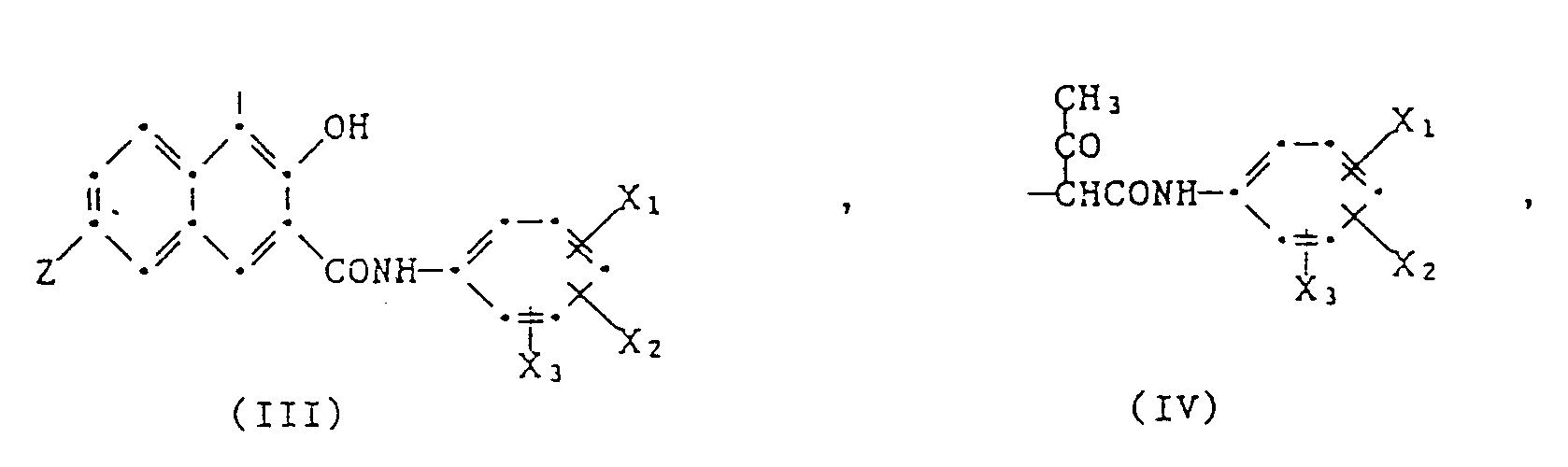
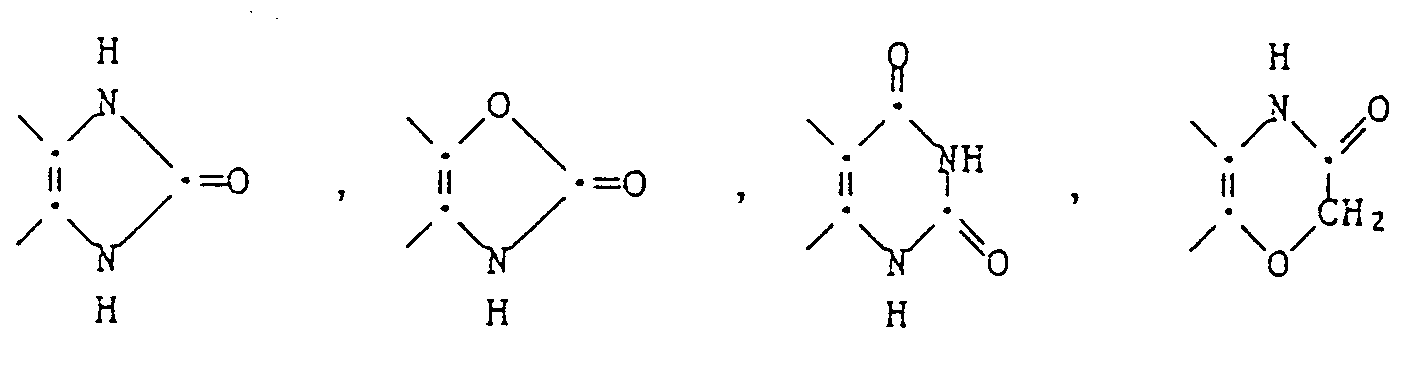
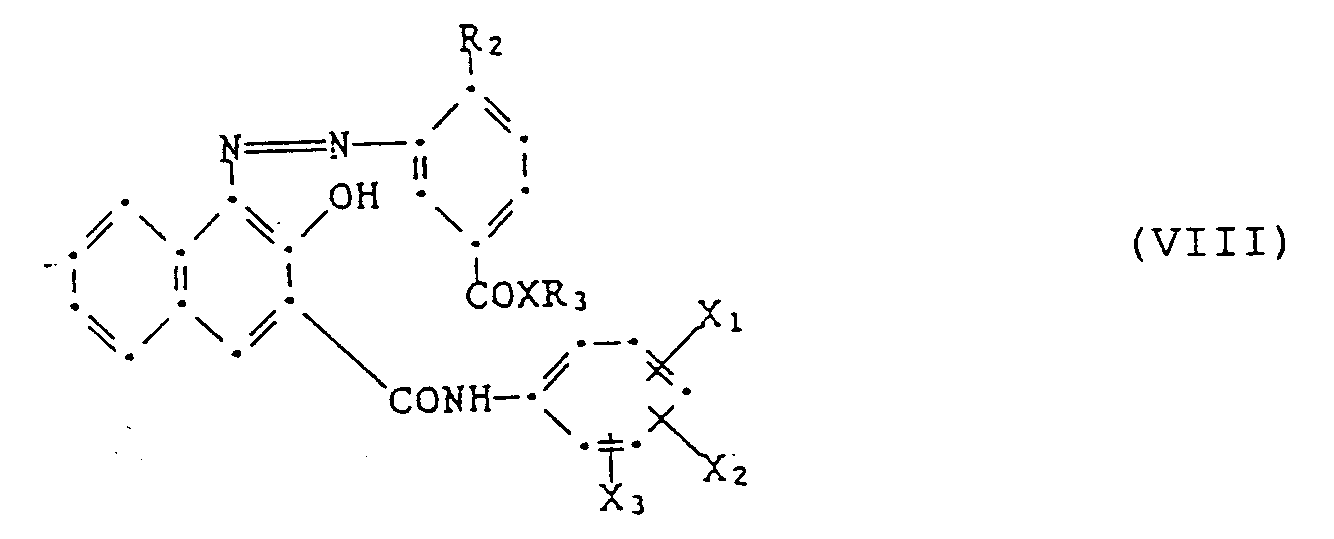
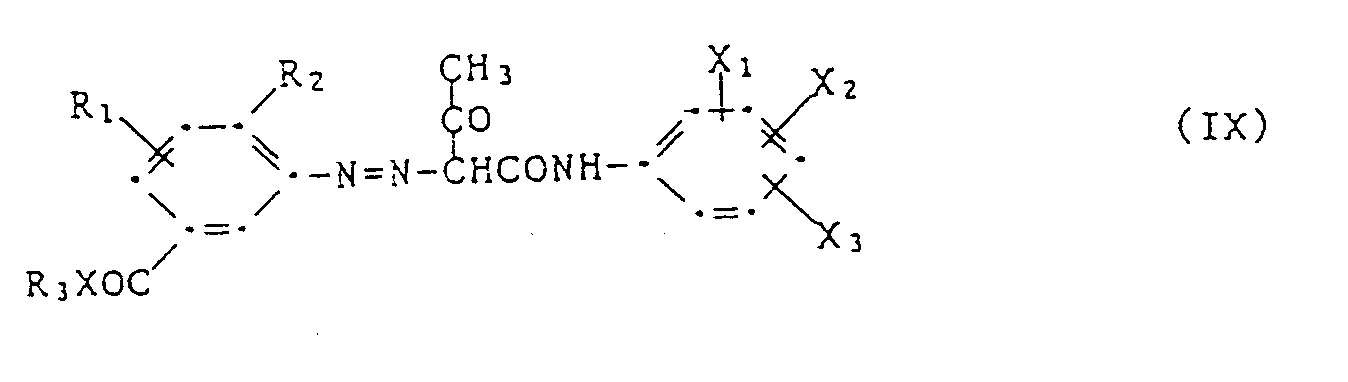
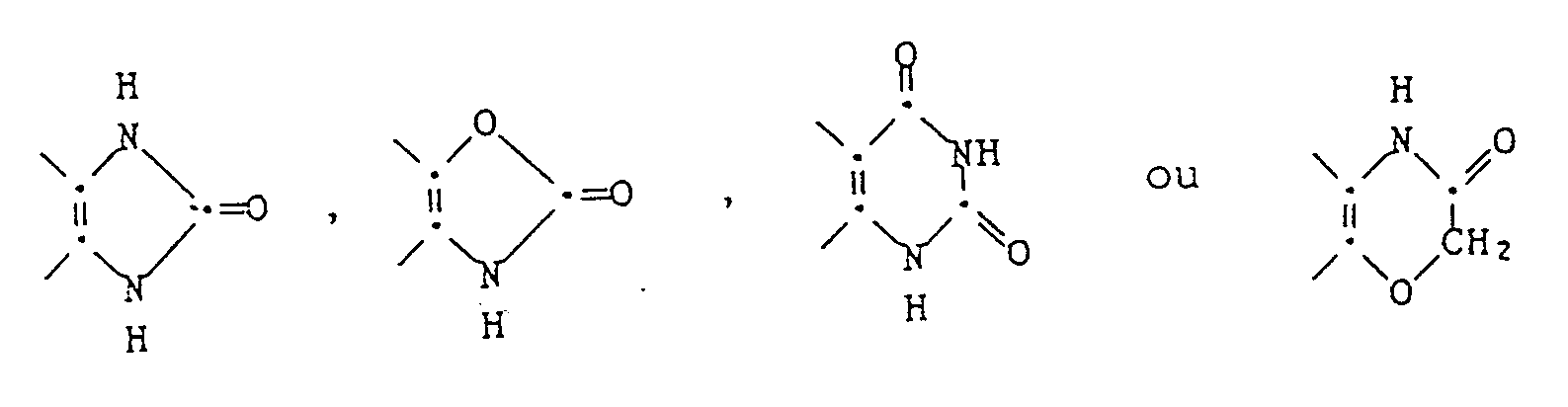
- X is -O- or -NH-, R 1 -H or -CI, R 2 -Cl, -CH 3 or -OCH 3 and R 3 C 12 -C 18 - Alkyl means X 1 and X 2 independently of one another -H, -CI, -CH 3 or -OCH 3 , and X 3 -H, -NHCOCH 3 , unsubstituted or by one or two chlorine atoms and / or one or two methyl or Methoxy groups or benzoylamino substituted by -NHCOCH 3 , or X 2 and X 3 together with the carbon atom to which they are attached form a ring of the formulas form.
- the condensation process according to scheme a) above is expediently carried out in the presence of an organic inert solvent at normal or elevated pressure, with or without a catalyst.
- Suitable solvents are e.g. Toluene, chlorobenzene, dichlorobenzenes, such as o-dichlorobenzene, also trichlorobenzenes, nitrobenzene or mixtures of aromatic and / or aliphatic solvents, such as @Shellsole.
- the compounds of the formula I in which X denotes -O- or -NH-, can also be prepared via a transesterification or amidation reaction by using a compound of the formulas in which R is expediently C 1 -C 3 -alkyl, and the other radicals n, A, R 1 and R 2 have the meaning given above, with an alcohol of the formula R 3 -OH or an amine of the formula R 3 -NH 2 , transesterified or amidated to give compounds of the formula I by known processes.
- R represents methyl, ethyl, propyl or isopropyl.
- the transesterification or amidation is advantageously carried out directly in an excess of the corresponding long-chain alcohol or amine, if appropriate in the presence of an organic solvent, such as, for example, toluene, xylenes, dichlorobenzenes, nitrobenzene, chloronaphthalene, anisole, ®Dowtherm, or ketones, such as cyclohexanone elevated temperature, for example in the boiling range of the solvent used, under normal pressure or under pressure, with or without catalysts.
- an organic solvent such as, for example, toluene, xylenes, dichlorobenzenes, nitrobenzene, chloronaphthalene, anisole, ®Dowtherm, or ketones, such as cyclohexanone elevated temperature, for example in the boiling range of the solvent used, under normal pressure or under pressure, with or without catalysts.
- catalysts sulfuric acid, p-toluenesulfonic acid, methylsulfonic acid, LiH, LiNH 2 , NaOCH 3 , potassium tert-butoxide, tetraalkyl titanates, dibutyltin oxide or rare earths are suitable, for example.
- the compounds of the formula II can be prepared by, for example, diazotizing an amine of the formula H 2 ND and the resulting diazo component with a coupling component of the formula couples, wherein D, R 4 , Rs, Y and R 3 have the meaning given above.
- Another object of the invention is therefore compounds of the following formulas XI and XII: wherein R 1 and R 4 -H or -CI, R 2 and R 5 -H, halogen, -N0 2 , -CN, C1-C 4 -alkyl, C1-C 4 -alkoxy, -CF 3 or unsubstituted or by one or two chlorine atoms and / or one or two methyl or methoxy groups substituted phenyloxy, R 3 C1 2 -C 35 alkyl, Z -H, -Br, -OCH 3 , -CN or -N0 2 , and T -OH or Are halogen, X is a radical of the formulas -NH-, -O-, or stands, wherein R 1 and R 2 have the meaning given above, and Y stands for a radical of the formulas -COO-or -CONH-.
- T preferably represents -OH or -Cl.
- Very preferred compounds have the formula XIII, in which R 1 is -H, R 2 -CI, -CH 3 or -OCH 3 , R 3 is C 12 -C 18 -alkyl, X -O- or -NH- and T -OH or -CI mean.
- the compounds of the formulas I and 11 are isolated as usual after their synthesis, e.g. by filtration.
- the filter material is e.g. washed with one of the solvents already mentioned above and then appropriately with water. They are generally obtained in good yield and purity and can be used without further purification in finely divided form for the mass dyeing of plastics, in particular of polyolefins.
- the compounds according to the application can be further conditioned. Conditioning is the production of a fine particle shape and size that is optimal for the application, for example by dry grinding with or without salt, by solvent or aqueous grinding or by salt kneading or by subsequent thermal solvent treatment.
- Thermal solvent treatments can e.g. in organic solvents, preferably with those boiling above 100 ° C.
- benzenes substituted by halogen atoms, alkyl or nitro groups such as toluene, chlorobenzene, o-dichlorobenzene, xylenes or nitrobenzene, alcohols, such as isopropanol or isobutanol, and also ketones, such as cyclohexanone, ethers, such as ethylene glycol monomethyl or monoethyl ether , Amides, such as dimethylformamide or N-methyl-pyrrolidone, and also dimethyl sulfoxide, sulfolane or water alone, optionally under pressure.
- the aftertreatment can also be carried out in water in the presence of organic solvents and / or with the addition of surface-active substances or aliphatic amines, or in liquid ammonia.
- texture-improving agents to the compound according to the invention of the formulas 1 or 11 before or after the conditioning process.
- fatty acids with at least 18 carbon atoms for example stearic or behenic acid or their amides or metal salts, in particular Mg salts, are suitable as such.
- the texture-improving agents are preferably added in amounts of 0.1-30% by weight, in particular 2-15% by weight, based on the end product.
- the compounds of the formulas I and II obtained according to the invention can often be incorporated directly into polyolefins for their coloring without further conditioning, such as mechanical comminution or preparation.
- polystyrene resins are particularly suitable for bulk dyeing polyolefins, they can also be advantageously used for bulk dyeing other polymers, e.g. Polyvinyl chloride, but especially of engineering materials, such as Polycarbonates, polyacrylates, polymethacrylates, ABS, polyesters, polyamides, polyether ketones, polyurethanes, individually or in mixtures, can be used. They are expediently used in a concentration of 0.01 to 5% by weight, based on the polymer.
- engineering materials such as Polycarbonates, polyacrylates, polymethacrylates, ABS, polyesters, polyamides, polyether ketones, polyurethanes, individually or in mixtures. They are expediently used in a concentration of 0.01 to 5% by weight, based on the polymer.
- polyolefins that can be colored with the compounds of the formulas I and II according to the invention are high and low density polyethylene (HD-PE, LD-PE and LLD-PE), polypropylene and polyisobutylene, and copolymers of polyolefins with e.g. Polyethers, polyether ketones or polyurethanes mentioned.
- HD-PE high and low density polyethylene
- LD-PE and LLD-PE low density polyethylene
- polypropylene and polyisobutylene polypropylene and polyisobutylene
- copolymers of polyolefins with e.g. Polyethers, polyether ketones or polyurethanes mentioned.
- the dyeing is carried out by the customary methods, for example by mixing a compound of the formulas 1 or 11 with the plastic granules or powder and extruding the mixture into fibers, films or granules. The latter can then be injection molded into objects.
- the colorations obtained have high purity and high saturation and are distinguished by good resistance, in particular to heat and light, and by their low tendency to bloom.
- a particular advantage of polyethylene objects colored with the compounds of the formulas I and 11 according to the invention is that, particularly in the case of HD-PE, they do not show an increased tendency to warping and deformation.
- the fibers dyed with the compounds of the formulas I and II according to the invention have excellent textile properties, such as Light and wet resistance to detergents and solvents.
- Example 1 4.05 g of 4-methyl-3-amino-benzoic acid stearate and 3.8 g of 4-benzoylamino-1- (2'-hydroxy-3'-naphthoylamino) benzene are mixed in a mixture of 125 ml of glacial acetic acid and 125 ml of N-methylpyrrolidone dissolved at 70 ° C. The clear red-brown solution is cooled to 40 ° C. and 2.55 ml of a 4N sodium nitrite solution are added dropwise at this temperature. A red precipitate fails. The red suspension obtained is stirred for a further 6 hours. The product is then suction filtered and washed with 300 ml of ethyl alcohol. After drying in vacuo at 60 ° C., 7.2 g (90.5% of theory) of an intensely red powder of the formula are obtained with the following combustion analysis (C 50 H 60 N 4 O 5 ):
- This product after-treated in ethylene glycol monoethyl ether for 1 hour at 125 ° C, colors polyethylene in strong, pure red tones of excellent heat and light resistance.
- Examples 2 to 51 The table below describes further compounds which are obtained analogously to Example 1 above by coupling the diazotized amine according to column I with a coupling component from column II. Column III indicates the color of the PVC film colored with the compounds thus obtained. In cases where the components of columns I and II are already clearly soluble in glacial acetic acid up to 80 ° C, the addition of N-methyl-pyrrolidone can be dispensed with. Otherwise, the procedure is as in Example 1.
- Example 58 12.4 g of the azo dye from diazotized 4-methoxy-3-amino-benzoic acid stearyl ester and 2-hydroxy-3-naphthoic acid are suspended in 120 ml of anhydrous toluene. 2 ml of thionyl chloride and 4 drops of dimethylformamide are added to the mixture and the mixture is heated to 80 ° C. for one hour and 15 minutes with stirring. The red-burgundy colored solution is fully concentrated in vacuo. The product obtained is then removed from the flask with 50 ml of petroleum ether, suction filtered and in vacuo at 50 ° C. dried. 12.2 g (95.7% of theory) of the azocarboxylic acid chloride of the formula are obtained and from melting point 129 to 130 ° C.
- 6.4 g of the azocarboxylic acid chloride thus prepared are stirred with 100 ml of N-methylpyrrolidone and heated to 60 ° C.
- the clear black solution is mixed with 1.6 g of 5-amino-1-methylbenzimidazolone at this temperature. This creates a thick red suspension. It is heated to 92 ° C. with stirring and stirred further at this temperature for 7 hours.
- the suspension is cooled to room temperature and diluted with 60 ml of ethanol.
- the product is finally filtered off and washed with 200 ml of ethanol.
- the following table contains other pigments which can be prepared by the process of Example 58 above, by coupling the diazo compound of an amine listed in column I to 2-hydroxy-3-naphthoic acid, then converting the azocarboxylic acid thus obtained into the corresponding acid chloride and this is condensed with one of the amines indicated in column II.
- Column III characterizes the shade of the polyvinyl chloride film colored with the pigments obtained.
- Example 67 A mixture of 1.0 g of the product obtained according to Example 1), 1.0 g of antioxidant (@IRGANOX 1010, CIBA-GEIGY AG) and 1000 g of polyethylene HD granulate (®VESTOLEN A 60-16, HUELS) is used premixed for 15 minutes in a 3 liter glass bottle on a trestle. The mixture is then extruded twice through a single-screw extruder and then granulated. The granules thus obtained are then on an injection molding machine (@Allround Arburg 200) at 220 ° C, 250 ° C and 300 ° C sprayed into plates with a dwell time of 5 minutes each.
- an injection molding machine @Allround Arburg 200
- the plates obtained in this way have uniformly strong red colorations and are as warp-free as molded parts of the undyed polyethylene. If the sprayed plates colored in this way are stored in an oven at 100 ° C. for 24 hours, no blooming of the pigment from the plastic can be determined.
- Example 68 If the procedure is analogous to that described in Example 67 and 10 g of titanium dioxide @KRONOS RN 57-P (KRONOS Titan GmbH) are used in addition to the colored pigment, red press plates with equally good heat resistance are obtained. The press plates sprayed between 200 and 300 ° C show no color deviations after cooling.
- Example 69 1000 g of polypropylene granules (®DAPLEN PT-55, Chemie LINZ) and 1.0 g of the product obtained according to Example 1) are mixed in a 3 liter bottle for 15 minutes on a trestle. The mixture is then extruded twice through a single-screw extruder and then granulated. The granules thus obtained are spun at 280-285 ° C by the melt spinning process. The fibers dyed in this way have very good lightfastness and excellent textile fastness properties, such as rub fastness and wet fastness to detergents and solvents. The heat resistance at 285 ° C is excellent.
- Example 70 100 g of polymethyl methacrylate granules (®DEGALAN 7E from DEGUSSA AG) and 0.2 g of the product obtained according to Example 1) are premixed for 20 minutes in a 500 ml glass bottle on a trestle. The mixture is then extruded into a belt on a single-screw extruder. A transparent, strongly red-colored plastic tape is obtained, which has excellent heat and light resistance.
- Example: 71 If the procedure is analogous to that described in Example 70 and, instead of polymethyl methacrylate, polycarbonate granules (®MAKROLON 2800 from BAYER) are used, transparent, intensely red bands with excellent heat and light resistance are obtained.
- polycarbonate granules (®MAKROLON 2800 from BAYER) are used, transparent, intensely red bands with excellent heat and light resistance are obtained.
Landscapes
- Chemical & Material Sciences (AREA)
- Organic Chemistry (AREA)
- Health & Medical Sciences (AREA)
- Chemical Kinetics & Catalysis (AREA)
- Medicinal Chemistry (AREA)
- Polymers & Plastics (AREA)
- Organic Low-Molecular-Weight Compounds And Preparation Thereof (AREA)
- Compositions Of Macromolecular Compounds (AREA)
- Coloring (AREA)
- Thiazole And Isothizaole Compounds (AREA)
- Heterocyclic Carbon Compounds Containing A Hetero Ring Having Nitrogen And Oxygen As The Only Ring Hetero Atoms (AREA)
Claims (10)








Applications Claiming Priority (2)
| Application Number | Priority Date | Filing Date | Title |
|---|---|---|---|
| CH343088 | 1988-09-14 | ||
| CH3430/88 | 1988-09-14 |
Publications (3)
| Publication Number | Publication Date |
|---|---|
| EP0359708A2 EP0359708A2 (fr) | 1990-03-21 |
| EP0359708A3 EP0359708A3 (fr) | 1991-09-18 |
| EP0359708B1 true EP0359708B1 (fr) | 1994-09-28 |
Family
ID=4255803
Family Applications (1)
| Application Number | Title | Priority Date | Filing Date |
|---|---|---|---|
| EP89810664A Expired - Lifetime EP0359708B1 (fr) | 1988-09-14 | 1989-09-05 | Composés monoazoiques avec des restes alkyles à longue chaîne |
Country Status (4)
| Country | Link |
|---|---|
| US (1) | US4997920A (fr) |
| EP (1) | EP0359708B1 (fr) |
| JP (1) | JPH02131455A (fr) |
| DE (1) | DE58908442D1 (fr) |
Families Citing this family (5)
| Publication number | Priority date | Publication date | Assignee | Title |
|---|---|---|---|---|
| US5186718A (en) * | 1989-05-19 | 1993-02-16 | Applied Materials, Inc. | Staged-vacuum wafer processing system and method |
| US6136081A (en) * | 1999-08-10 | 2000-10-24 | Eastman Kodak Company | Ink jet printing method |
| US6132501A (en) * | 1999-08-10 | 2000-10-17 | Eastman Kodak Company | Co-milled pigments in ink jet ink |
| DE10138770A1 (de) | 2001-08-07 | 2003-02-20 | Clariant Gmbh | Neue Azopigmente |
| DE102015211829A1 (de) * | 2015-06-25 | 2016-12-29 | Clariant International Ltd | Verwendung von neuen Naphthol AS-Pigment-Mischungen in Printing-Materialien |
Family Cites Families (18)
| Publication number | Priority date | Publication date | Assignee | Title |
|---|---|---|---|---|
| US3124565A (en) * | 1964-03-10 | Water-insoluble benzimidazolone mono- | ||
| US2888452A (en) * | 1954-07-23 | 1959-05-26 | Ciba Ltd | Fat-soluble azo-dyestuffs |
| US3113938A (en) * | 1959-12-12 | 1963-12-10 | Hoechst Ag | Water-insoluble monoazo-dyestuffs and process for their manufacture |
| US3096321A (en) * | 1960-07-02 | 1963-07-02 | Hoechst Ag | Water-insoluble monoazo-dyestuffs |
| CH477521A (de) * | 1966-08-15 | 1969-08-31 | Ciba Geigy | Verfahren zur Herstellung neuer Disazofarbstoffpigmente |
| ES359999A1 (es) * | 1967-11-09 | 1970-06-16 | Farwerke Hoechst A G Vormals M | Procedimiento para la preparacion de colorantes monoazoicosinsolubles en agua. |
| US3555002A (en) * | 1968-10-22 | 1971-01-12 | Hoechst Ag | Water-insoluble benzimidazolone containing monoazo dyestuffs |
| US3555003A (en) * | 1968-10-22 | 1971-01-12 | Hoechst Ag | Water-insoluble benzimidazolone containing monoazo dyestuffs |
| US4065448A (en) * | 1970-02-03 | 1977-12-27 | Ciba-Geigy Ag | Tertiary alkyl substituted disazo pigments |
| US4150019A (en) * | 1970-03-24 | 1979-04-17 | Hoechst Aktiengesellschaft | Water-insoluble yellow terephthalate-azo-acetoacetylamido-benzimidazolone dyestuffs |
| US4003886A (en) * | 1970-09-11 | 1977-01-18 | Ciba-Geigy Ag | Tetracarboxylic acid ester substituted disazo pigments |
| US3845032A (en) * | 1972-03-22 | 1974-10-29 | Gaf Corp | Alkylbenzoateazohydroxynaphtharylide dyestuffs |
| CH625819A5 (fr) * | 1977-06-03 | 1981-10-15 | Ciba Geigy Ag | |
| DE3018713A1 (de) * | 1980-05-16 | 1981-12-03 | Basf Ag, 6700 Ludwigshafen | Verfahren zum faerben und/oder bedrucken von cellulosehaltigem textilmaterial und neue farbstoffe |
| AU546000B2 (en) * | 1981-01-28 | 1985-08-08 | Heubach Inc. | Monoazo pigments made by diazotising o-aminobenzamide |
| EP0088726A1 (fr) * | 1982-03-04 | 1983-09-14 | Ciba-Geigy Ag | Pigments monoazoiques, procédés pour leur préparation et leur utilisation |
| US4602961A (en) * | 1983-09-14 | 1986-07-29 | Ciba-Geigy Corporation | Process for pigmenting high molecular weight organic material |
| US4737581A (en) * | 1984-04-25 | 1988-04-12 | Ciba-Geigy Corporation | Phenyl-azo-hydroxynaphthoic acid amide pigments containing at least one carbonamide group |
-
1989
- 1989-09-05 EP EP89810664A patent/EP0359708B1/fr not_active Expired - Lifetime
- 1989-09-05 DE DE58908442T patent/DE58908442D1/de not_active Expired - Fee Related
- 1989-09-11 US US07/405,612 patent/US4997920A/en not_active Expired - Fee Related
- 1989-09-14 JP JP1237362A patent/JPH02131455A/ja active Pending
Also Published As
| Publication number | Publication date |
|---|---|
| EP0359708A3 (fr) | 1991-09-18 |
| DE58908442D1 (de) | 1994-11-03 |
| US4997920A (en) | 1991-03-05 |
| JPH02131455A (ja) | 1990-05-21 |
| EP0359708A2 (fr) | 1990-03-21 |
Similar Documents
| Publication | Publication Date | Title |
|---|---|---|
| EP0224445B1 (fr) | Préparations des pigments pyrrolo-pyrroles, leur procédé de préparation et leur application | |
| EP0190999B1 (fr) | Procédé de production de pigments à haut pouvoir tinctorial | |
| EP3470467B1 (fr) | Colorants methine pour colorer les plastiques | |
| EP3470471B1 (fr) | Colorants méthyne | |
| EP3508536B1 (fr) | Colorants méthyne pour la teinture dans la masse de polyamides synthetiques | |
| EP0225553A2 (fr) | Laque de colorant azoique | |
| EP3470472B1 (fr) | Nouveaux colorants méthyne | |
| EP3247749B1 (fr) | Colorants au méthyle jaunes | |
| EP0277914A2 (fr) | Solutions solides de pyrrolo-[3,4-c]-pyrroles avec des quinacridones | |
| EP3489229A1 (fr) | Nouveaux colorants méthyne | |
| EP0263074A2 (fr) | Cristaux mixtes de colorants azoiques laqués | |
| DE2236250C2 (de) | Neue Disazo-Pigmente, deren Herstellung und Verwendung | |
| EP0241413B1 (fr) | Sels d'amine de composés azoiques | |
| DE2243999A1 (de) | Neue disazopigmente, verfahren zu deren herstellung und verwendung | |
| EP0359708A2 (fr) | Composés monoazoiques avec des restes alkyles à longue chaîne | |
| DE2823930A1 (de) | Neue monoazopigmente und verfahren zu deren herstellung | |
| EP0859032B1 (fr) | Anthraquinones pontées | |
| EP0358604B1 (fr) | Composés disazoiques avec des restes alkylester ou alkylamino à longues chaînes | |
| EP0523005B1 (fr) | Colorants disazoiques comportant des restes de type cycloalkylester ou cycloalkylamide | |
| EP0591105A2 (fr) | Composés bisazoiques, bisazométhiniques et azo-azométhiniques | |
| EP0376158A1 (fr) | Solution solide cristalline de pigments du type anthanthrone, leurs procédés de préparation et leur application | |
| EP0442846A2 (fr) | Composés disazoiques avec groupes ester ou amide alkyliques à longue chaîne | |
| DE2441924C3 (de) | Disazopigmentfarbstoffe | |
| DE2021326C3 (de) | Neue Monoazopigmente und deren Verwendung | |
| EP0000737B1 (fr) | Pigments monoazoiques de la série acétoacétylaminobenzimidazolone, leur préparation et utilisation pour la pigmentation de matières organiques macromoléculaires |
Legal Events
| Date | Code | Title | Description |
|---|---|---|---|
| PUAI | Public reference made under article 153(3) epc to a published international application that has entered the european phase |
Free format text: ORIGINAL CODE: 0009012 |
|
| 17P | Request for examination filed |
Effective date: 19890908 |
|
| AK | Designated contracting states |
Kind code of ref document: A2 Designated state(s): DE FR GB IT |
|
| PUAL | Search report despatched |
Free format text: ORIGINAL CODE: 0009013 |
|
| AK | Designated contracting states |
Kind code of ref document: A3 Designated state(s): DE FR GB IT |
|
| 17Q | First examination report despatched |
Effective date: 19930608 |
|
| GRAA | (expected) grant |
Free format text: ORIGINAL CODE: 0009210 |
|
| AK | Designated contracting states |
Kind code of ref document: B1 Designated state(s): DE FR GB IT |
|
| REF | Corresponds to: |
Ref document number: 58908442 Country of ref document: DE Date of ref document: 19941103 |
|
| ITF | It: translation for a ep patent filed | ||
| GBT | Gb: translation of ep patent filed (gb section 77(6)(a)/1977) |
Effective date: 19941115 |
|
| ET | Fr: translation filed | ||
| PLBE | No opposition filed within time limit |
Free format text: ORIGINAL CODE: 0009261 |
|
| STAA | Information on the status of an ep patent application or granted ep patent |
Free format text: STATUS: NO OPPOSITION FILED WITHIN TIME LIMIT |
|
| PG25 | Lapsed in a contracting state [announced via postgrant information from national office to epo] |
Ref country code: GB Effective date: 19950905 |
|
| 26N | No opposition filed | ||
| GBPC | Gb: european patent ceased through non-payment of renewal fee |
Effective date: 19950905 |
|
| PG25 | Lapsed in a contracting state [announced via postgrant information from national office to epo] |
Ref country code: FR Effective date: 19960531 |
|
| PG25 | Lapsed in a contracting state [announced via postgrant information from national office to epo] |
Ref country code: DE Effective date: 19960601 |
|
| REG | Reference to a national code |
Ref country code: FR Ref legal event code: ST |
|
| PG25 | Lapsed in a contracting state [announced via postgrant information from national office to epo] |
Ref country code: IT Free format text: LAPSE BECAUSE OF NON-PAYMENT OF DUE FEES Effective date: 20050905 |