EP0359899A2 - Véhicule binodal pour utilisation de remorques convertibles rail-route - Google Patents
Véhicule binodal pour utilisation de remorques convertibles rail-route Download PDFInfo
- Publication number
- EP0359899A2 EP0359899A2 EP89105514A EP89105514A EP0359899A2 EP 0359899 A2 EP0359899 A2 EP 0359899A2 EP 89105514 A EP89105514 A EP 89105514A EP 89105514 A EP89105514 A EP 89105514A EP 0359899 A2 EP0359899 A2 EP 0359899A2
- Authority
- EP
- European Patent Office
- Prior art keywords
- transition vehicle
- coupler
- trailer
- vehicle
- rail
- Prior art date
- Legal status (The legal status is an assumption and is not a legal conclusion. Google has not performed a legal analysis and makes no representation as to the accuracy of the status listed.)
- Withdrawn
Links
Images



Classifications
-
- B—PERFORMING OPERATIONS; TRANSPORTING
- B61—RAILWAYS
- B61C—LOCOMOTIVES; MOTOR RAILCARS
- B61C11/00—Locomotives or motor railcars characterised by the type of means applying the tractive effort; Arrangement or disposition of running gear other than normal driving wheel
-
- B—PERFORMING OPERATIONS; TRANSPORTING
- B61—RAILWAYS
- B61D—BODY DETAILS OR KINDS OF RAILWAY VEHICLES
- B61D3/00—Wagons or vans
- B61D3/16—Wagons or vans adapted for carrying special loads
- B61D3/18—Wagons or vans adapted for carrying special loads for vehicles
- B61D3/182—Wagons or vans adapted for carrying special loads for vehicles specially adapted for heavy vehicles, e.g. public work vehicles, trucks, trailers
- B61D3/184—Wagons or vans adapted for carrying special loads for vehicles specially adapted for heavy vehicles, e.g. public work vehicles, trucks, trailers the heavy vehicles being of the trailer or semi-trailer type
-
- B—PERFORMING OPERATIONS; TRANSPORTING
- B60—VEHICLES IN GENERAL
- B60F—VEHICLES FOR USE BOTH ON RAIL AND ON ROAD; VEHICLES CAPABLE OF TRAVELLING IN OR ON DIFFERENT MEDIA, e.g. AMPHIBIOUS VEHICLES
- B60F1/00—Vehicles for use both on rail and on road; Conversions therefor
- B60F1/04—Vehicles for use both on rail and on road; Conversions therefor with rail and road wheels on different axles
- B60F1/046—Semi-trailer or trailer type vehicles without own propelling units
-
- B—PERFORMING OPERATIONS; TRANSPORTING
- B62—LAND VEHICLES FOR TRAVELLING OTHERWISE THAN ON RAILS
- B62D—MOTOR VEHICLES; TRAILERS
- B62D49/00—Tractors
- B62D49/005—Tractors for semi-trailers
- B62D49/007—Tractors for handling trailers, e.g. roll-trailers in terminals
Definitions
- This invention relates generally to trains of highway trailers which have been modified to be carried over a rail track.
- Such convertible trailers eliminate the need for piggyback flat cars. Examples of such trailers can be found in U.S. Patent No. 4,202,277.
- the invention relates to a transition vehicle which can be used to connect such convertible trailers in a pulling or pushing relationship with the railway coupling means normally found on a locomotive or a preceding railcar and which can also be converted to roadway use and coupled to a yard tractor for off-rail relocation.
- the convertible rail-highway trailer to which the present invention relates has a body of conventional semi-trailer dimensions and is fitted with a coupling tongue at its front end and a female coupler at its rear end.
- a plurality of such trailers can be directly coupled end-to-end, in the manner disclosed in U.S. Patent No. 4,202,454, or connected through an intermodal adaptor mounted on a conventional railtruck or bogie, as is disclosed in U.S. Patent No. 4,669,391.
- the convertible trailer also includes a conventional king pin adjacent its front end for removable coupling to the fifth wheel of a tractor for the roadway mode of operation, thus forming an over-the-road tractor-semi-trailer combination.
- a structure which comprises a vehicle body in the form of a central tube supported on a circular centerplate configured to allow rotating and limited rocking movement within the bowl of a railtruck bolster supporting the central tube, a load carrying shelf mounted on the upper surface of the central tube for supporting the lower surface of a convertible trailer and receiving and engaging a king pin mounted near the front end of such trailer, a female coupler socket for engaging the coupling tongue of such trailer, a pair of opposing clamps adjustably mounted transversely to the central tube to grasp the side rails of the trailer, a telescopic gooseneck coupler for coupling with the fifth wheel of a yard tractor formed of two tubes slidingly engaged at one end in two pockets fixedly mounted alongside the central tube and secured at the opposite end to a horizontal support plate and king pin, a railway coupler near the leading end of the central tube for connecting the structure to a locomotive coupler or a preceding railcar for rail use, a railtruck for engaging a rail during rail use
- a transition vehicle located in the yard can be relocated by a yard tractor of the type commonly known in the railroad industry as a hostling tractor or a yard hostler.
- the yard tractor is positioned in front of the transition vehicle and the gooseneck coupler on the transition vehicle is extended and coupled to the fifth wheel of the yard tractor.
- the air spring suspension system is then inflated to lower the roadway wheel-set axle unit and the yard tractor's fifth wheel is raised, thereby raising the rail wheel-set axle unit clear of the track and the ground.
- the transition vehicle can then be transported to a rail site for installation in a train of convertible trailers.
- the air spring suspension system is deflated to raise the wheel-set axle unit and the yard tractor's fifth wheel is lowered to permit the transition vehicle's rail wheel-set to engage the rail track.
- the transition vehicle is then backed underneath the first intermodal trailer in the train such that they are coupled by engagement of the trailer's tongue and the transition vehicle's female coupler socket, and of the trailer king pin and a receptacle therefor in the load carrying shelf.
- the gooseneck coupler is then disconnected from the yard tractor and retracted, and the yard tractor is pulled away.
- a locomotive or a preceding railcar can then be backed up to the transition vehicle to effect coupling at the railway coupler near the leading end of the transition vehicle.
- the present invention provides a transition vehicle 10 which can be used to connect a convertible trailer 12 to either a road vehicle 14, as shown in FIG. 1, or a locomotive 16, as shown in FIG. 2.
- a transition vehicle 10 which can be used to connect a convertible trailer 12 to either a road vehicle 14, as shown in FIG. 1, or a locomotive 16, as shown in FIG. 2.
- like numbers will be used to denote similar parts throughout the several accompanying figures and in the discussion below.
- the convertible trailer 12 includes a body 18 of conventional semi-trailer dimensions and has a coupling tongue 15 at its front end and a female coupler socket 17 at its rear end to receive the coupling tongue of an adjacent trailer to form a train for the rail mode of operation.
- the convertible trailer 12 also includes a king pin 19 adjacent its front end for removable coupling to the fifth wheel of a tractor or truck for the roadway mode of operation.
- convertible trailer 12 includes conventionally placed trailer landing gear 20 and roadway running gear 22, including tandem axles 24 (although a single suspension can be used) with each axle mounting dual tired wheels 26.
- convertible trailer 12 has or is fitted with a railroad bogie 28, which includes tandem axles 30 (again, a single axle can be used) each having a pair of flanged railroad wheels 32.
- the road vehicle would be a yard tractor, and such roadway use would be limited to yard activity, such as moving a transition vehicle between a storage location and a rail track or between tracks. It will be appreciated, however, that the transition vehicle 10 can be suitably equipped for highway-rated use and still accomplish all of the functions and provide all of the advantages of the present invention.
- the transition vehicle 10 is shown configured for roadway use and connected to hostling tractor 14.
- the transition vehicle 10 is shown positioned to be backed up to the first in a train of convertible trailers on a rail track.
- the landing gear 20 is lowered and the tired wheels 26 are the ground surface.
- Rail bogie 28 has been placed underneath the rear end of trailer 12 and on rail 38.
- Flanged railroad wheels 32 are in contact with rail 38.
- the roadway wheel-set axle unit 34 is lowered into a ground engaging position and the gooseneck coupler 36 is extended out from the transition vehicle and coupled to the fifth wheel of tractor 14.
- FIG. 2 shows the transition vehicle 10 configured for the rail mode of travel and installed between trailer 12 and locomotive 16.
- the landing gear 20 on trailer 12 is lifted.
- the roadway wheel-set axle unit 34 has been raised and the rail wheel-set axle unit 40 is resting on rail 38.
- Gooseneck coupler 36 is retracted and transition vehicle 10 is coupled to locomotive 16 through railway coupler 42.
- convertible trailer 12 is coupled to transition vehicle 10 utilizing the trailer tongue 15 and king pin 19, in a manner described more fully hereinbelow.
- the female coupler socket 44 which receives the coupler tongue of trailer 12, is seen in FIGs. 1 and 2.
- trailer 12 is further secured to vehicle 10 with clamping means 46, which engages side rails 48 along the sides of trailer 12.
- the transition vehicle 10 of the present invention will be described in greater detail.
- the vehicle is built around a central structural member, also known as a draft sill, which in the preferred embodiment takes the form of a long rectangular tube 50 running through the center of the vehicle.
- the inside dimensions of the central tube 50 are approximately 12-1/2 inches vertical by 12-7/8 inches horizontal.
- Railway coupler 42 sometimes referred to as a drawbar, is mounted in the front of central tube 50, and the other coupling components are mounted on the central tube.
- a standard diameter thrust bearing or centerplate 52 On the lower surface of tube 50, and approximately 10 feet from the railway coupler end, is mounted a standard diameter thrust bearing or centerplate 52 which fits into a comparable diameter centerplate bowl 54 in the bolster 56 of the railtruck.
- a downwardly projecting shaft 57 fits into an aperture 55 in the railtruck bolster, below the centerplate bowl.
- the aperture acts as a guide for the motion of shaft 57 and permits limited side-to-side rocking movement of the transition vehicle while restricting fore and aft rocking.
- Railtruck bolster 56 and shaft 57 running therethrough thus permit rotating and limited rocking movement of the central tube 50 with respect to its longitudinal axis.
- Gravity loads on the load carrying shelf 59 of the transition vehicle 10 are transmitted along a normal load path to the centerplate 52 and then to the bolster 56.
- the rail wheel-set axle unit 40 of the rail bogie of the present invention includes tandem axles 61, with each axle having a pair of flanged railroad wheels 63.
- the bolster 56, in combination with side frames, springs and rail wheel-set axle unit 40, comprise a conventional rail bogie, except for the fact that the rail bogie of the present invention does not require brakes.
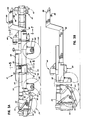
- FIGs. 3A and 3B At the rear end of the central tube 50 is mounted the air spring means and lifting mechanism for the roadway wheel-set axle unit 34 of transition vehicle 10.
- Suitable air spring suspension systems for this application are embodied in commercially available apparatus such as, for example, Model ARR-655-157-120 marketed by Neway Division, Lear Siegler, Inc., Muskegon, Michigan.
- One end of the trailing arm is pivoted for movement around a transverse axis as at 64 to a bracket 66 which is bolted to the central tube 50.
- a bracket 66 which is bolted to the central tube 50.
- a conventional trailer air spring 68 which is secured at its upper end to the central tube.
- this suspension differs from the customary manner in that the left hand trailing arm is mounted on the right hand side of the central tube and vice-versa.
- This mounting arrangement has the effect of moving the arms inward to 25 inch centers rather than the normal 35 inch centers, thus allowing a more compact design.
- the spring centers remain at the normal 30 inches and the suspension is mounted to a standard 96 inch wide highway axle 58.
- Two tires, such as Dunlop 255/70R-22.5 tires, having a load capacity of approximately 6,000 lbs. each (at low speeds) and a diameter of 36.4 inches, are selected for use in the preferred embodiment.
- the combination of the small tires, the 96 inch axle and the 25 inch arm centers affords ample clearance for the wheels of the railtruck to swivel 10 degrees.
- the air from the bag 68 is released, thereby allowing the roadway wheel-set axle unit 34 to be raised by a spring mechanism which is common to air spring suspensions of the type thus far described.
- the air bag 68 is pressurized and the roadway wheel-set axle unit 34 is caused to engage the ground.
- Shock absorber 70 limits the downward motion of highway axle 58.
- Convertible trailer 12 is coupled to transition vehicle 10 by coupling components mounted to the top of the central tube 50. These coupling components are best illustrated in accompanying FIGs. 3A, 4 and 8.
- the tongue of the trailer is received by and coupled to the female coupler socket 44 mounted to the top surface of the central tube 50.
- the trailer king pin depending downwardly from the bottom of the front end of the trailer, is received by the load carrying shelf 59 on top of the central tube 50.
- load carrying shelf 59 has an elongated slot with a funnel-shaped entrance-way which is shaped to engage and vertically retain the annular groove in the king pin and which can also accommodate a variety of king pin spacings relative to the front of the trailer. With its king pin engaged, a portion of the trailer's lower surface rests upon the load carrying shelf 59 in much the same fashion as the trailer would lie on a fifth wheel if the trailer were mounted to a tractor.
- the gravity load of the front end of the trailer resting on the load carrying shelf is transmitted through the centerplate 52 to the railtruck bolster 56.
- Female coupler socket 44 is of a type commonly used today in intermodal transportation vehicles, and is described in U.S. Patent No. 4,202,454. To facilitate an understanding of the present invention, a brief description of its operation will be provided, with particular reference to components shown in FIG. 8. Not shown are the details of the male coupler tongue on the trailer, which include a vertical hole around which is a spherical bearing. In operation of this coupler, the trailer tongue enters the tapered female opening 74 until its nose abuts the surface 76 of the casting 78. A coupler linkage 80 is then employed to actuate a coupler pin operating link 82 and in turn coupler pin 84, to raise coupler pin 84 upwardly through the vertical hole in the coupler tongue.
- the centerline of the coupler pin 84 is approximately 52 inches forward of the centerline of the load carrying plate 59. This distance is required to overcome the overturning moment generated by the difference in height of the locomotive's or preceding vehicle's railway coupling and the trailer's socket when the transition vehicle 10 is pulled by a locomotive or a preceding railcar.
- FIGs. 3A, 3B and 7 depict a telescopic gooseneck-style coupler 36 having a trailer king pin 86 depending downwardly from a horizontal support plate 88 at its coupling end for attachment to a yard tractor.
- FIGs. 3A and 3B respectively show gooseneck coupler 36 in its retracted railroad mode position relative to the fore end of transition vehicle 10 and in its extended position for roadway travel.
- Tubes 92 comprise a boom which has at its outer coupling end a support plate 88 and a downwardly projecting king pin 86.
- the support plate 88 on the boom is approximately 52 inches above the railroad track when the vehicle is resting on the track. In its normal closed position, the end of support plate 88 will be approximately even with and above the railway coupler 42.
- the telescoping gooseneck coupler 36 is held in its selected position -- in during railroad mode use and out during roadway mode use -- by a spring-loaded locking pin 96 in each of the slider pockets 90, as shown in FIG. 7. Locking pin 96 engages mating holes in the pockets 90 and the tubes 92.
- transition vehicle 10 is coupled to a locomotive 16 or a preceding railcar through a drawbar or railway coupler 42 mounted at the fore end of the central tube 50 below the support plate 88 of the gooseneck coupler 36.
- Railway coupler 42 is generally an E-style rail coupler of the kind manufactured and sold by American Steel Foundries, Chicago, Illinois. It differs from the standard railway coupler in that it has a ledge or shelf 41 on the top in addition to the shelf 43 on the bottom to allow transfer of overturning moment generated by the difference in height of the locomotive's or preceding railcar's coupling and the trailer's socket.
- Railway coupler 42 also serves the function of preventing vertical disengagement of the locomotive or a preceding railcar coupler. Because of the upper and lower shelves, railway coupler 42 is known as a double shelf coupler.
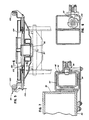
- a clamping mechanism 46 is shown mounted transversely to the central tube 50 for securing a convertible trailer having side rails or equivalent members to the transition vehicle of the present invention.
- Clamping mechanism 46 is adjustable through a screw mechanism and works in conjunction with railway coupler 42 to resist the aforementioned overturning moment.
- Clamping mechanism 46 comprises opposing clamps 100, which separate or draw closer as right hand screw thread 102 and left hand screw thread 104 are moved in response to the turning of handle 106.
- the degree of clamping which results from the turning of handle 106 is determined by the number of teeth on the ratchet wheel 108.
- spring-loaded pawl 110 engages consecutive teeth of ratchet wheel 108.
- Clamps 100 are readily disengaged from the trailer side rails by releasing pawl 110 from ratchet wheel 108 and turning handle 106 clockwise.
- clamps 100 are configured to register with grooves or rails in the side of a convertible trailer.
- transition vehicle 10 With the foregoing description of transition vehicle 10 in mind, its operation is readily understood. Assume that the vehicle has been operating in the roadway mode, or that it has been stored in the yard, and that it has been brought to a rail yard location where it is to be coupled to a train of convertible trailers, as shown in FIG. 1. At this point, the transition vehicle is coupled to a hostling tractor by way of the extended gooseneck coupler 36 as shown in FIG. 3B. The wheel-set axle unit 34 is lowered to the ground and the tractor's fifth wheel is raised. The transition vehicle is backed over the rail in front of the train of convertible trailers.
- Air spring 68 is deflated to raise the wheel-set axle unit 34 and the tractor's fifth wheel is lowered to permit the rail wheel-set unit 40 to engage the railroad track.
- the transition vehicle is then pushed back underneath the first trailer in the train such that the trailer tongue is coupled to the female coupler socket 44 on the central tube 50 and the trailer king pin is engaged by the funnel-shaped slot 72 in the load carrying shelf 59.
- Gooseneck coupler 36 is then disengaged from the tractor, retracted and locked into its retracted position by boom locking pins 96.
- the yard tractor is pulled away, and the transition vehicle is further secured to the trailer using the clamping mechanism 46.
- a locomotive is backed onto the track in front of the transition vehicle until its coupling components are engaged by the railway coupler 42.
- transition vehicle is now configured for use in the rail mode. It will be appreciated that a similar procedure could be employed to install the transition vehicle of the present invention between a railcar and a convertible trailer. Further, it will be seen that reverse steps may be employed to convert the transition vehicle of the present invention for operation in the roadway mode. It should also be understood that certain of the above steps can be performed in a different sequence without substantially differing from the novel method described herein.
Landscapes
- Engineering & Computer Science (AREA)
- Transportation (AREA)
- Mechanical Engineering (AREA)
- Chemical & Material Sciences (AREA)
- Combustion & Propulsion (AREA)
- Vehicle Body Suspensions (AREA)
- Machines For Laying And Maintaining Railways (AREA)
- Handcart (AREA)
- Platform Screen Doors And Railroad Systems (AREA)
- Vehicle Cleaning, Maintenance, Repair, Refitting, And Outriggers (AREA)
Applications Claiming Priority (2)
| Application Number | Priority Date | Filing Date | Title |
|---|---|---|---|
| US244712 | 1981-03-17 | ||
| US07/244,712 US4917020A (en) | 1988-09-14 | 1988-09-14 | Transition vehicle for use with convertible rail-highway trailers |
Publications (2)
| Publication Number | Publication Date |
|---|---|
| EP0359899A2 true EP0359899A2 (fr) | 1990-03-28 |
| EP0359899A3 EP0359899A3 (fr) | 1990-11-28 |
Family
ID=22923830
Family Applications (1)
| Application Number | Title | Priority Date | Filing Date |
|---|---|---|---|
| EP19890105514 Withdrawn EP0359899A3 (fr) | 1988-09-14 | 1989-03-29 | Véhicule binodal pour utilisation de remorques convertibles rail-route |
Country Status (8)
| Country | Link |
|---|---|
| US (1) | US4917020A (fr) |
| EP (1) | EP0359899A3 (fr) |
| JP (1) | JPH0288357A (fr) |
| KR (1) | KR900004572A (fr) |
| CN (1) | CN1041567A (fr) |
| AU (1) | AU3330889A (fr) |
| BR (1) | BR8902263A (fr) |
| ZA (1) | ZA893990B (fr) |
Cited By (1)
| Publication number | Priority date | Publication date | Assignee | Title |
|---|---|---|---|---|
| WO1997021558A1 (fr) * | 1995-12-08 | 1997-06-19 | John Warren Sticpewich | Vehicule ferroviaire |
Families Citing this family (29)
| Publication number | Priority date | Publication date | Assignee | Title |
|---|---|---|---|---|
| US5009169A (en) * | 1988-03-15 | 1991-04-23 | Jacques Viens | Twin axle rail bogie for convertible rail-highway vehicles |
| US5103740A (en) * | 1990-02-28 | 1992-04-14 | Masse Kenneth J | Vehicle for road and rail operation with air suspension for adjusting weight on both the road wheels and rail wheels |
| US5152228A (en) * | 1991-06-04 | 1992-10-06 | Wabash National Corporation | Universal coupling adapter for rail-highway vehicles |
| US5375532A (en) * | 1992-05-26 | 1994-12-27 | Larson; Jr.; Ernest J. | Convertible railway-roadway vehicle and method of use |
| US5220870A (en) * | 1992-05-26 | 1993-06-22 | Larson Ernest J | Convertible highway-railway hauling vehicle |
| EP1145928B1 (fr) | 1994-08-08 | 2005-10-12 | Ernest J. Larson, Jr. | Système de raccordement de bogie destiné à un véhicule convertible rail/route |
| US5868078A (en) * | 1995-07-21 | 1999-02-09 | Harsco Technologies Corporation | Road and rail vehicle using rail wheel drive and apparatus |
| US6758536B2 (en) * | 1999-03-03 | 2004-07-06 | Charles Jacob | Braking system for railroad car/semi-tractor combination |
| SE520032C2 (sv) * | 2002-05-24 | 2003-05-13 | Sjoelanders Smides Och Mek Ver | Fordon för körning på såväl väg som järnvägsspår |
| US6981452B2 (en) * | 2004-02-06 | 2006-01-03 | Herzog Contracting Corp. | Method and apparatus for unloading ribbon rails from rail cars |
| US7537219B1 (en) | 2005-11-10 | 2009-05-26 | Dennis Sherwood | Trailer wheel system |
| US20080105159A1 (en) * | 2006-11-03 | 2008-05-08 | Joseph Lombardo | Reinforced Bi-Modal Open Top Trash/Refuse Trailer |
| US7707943B2 (en) * | 2006-12-19 | 2010-05-04 | Herzog Contracting Corp. | Self-propelled rail unloading machine |
| IL200903A0 (en) * | 2008-09-22 | 2010-05-17 | Avraham Levi | Vehicle conversion |
| US20110280695A1 (en) * | 2010-05-11 | 2011-11-17 | David Kun | Railroad Freight Car Loading Or Unloading |
| US20120009054A1 (en) * | 2010-07-07 | 2012-01-12 | David Kun | Railroad Freight Car Loading Or Unloading |
| US8800452B2 (en) | 2010-05-11 | 2014-08-12 | David Kun | Railroad freight car loading or unloading |
| CN102700370A (zh) * | 2012-06-07 | 2012-10-03 | 朱瑞彪 | 一种公路铁路两用挂车 |
| CN105501011B (zh) * | 2015-12-22 | 2017-10-10 | 常州市瑞泰工程机械有限公司 | 公铁两用车铁路走行装置 |
| KR101642456B1 (ko) * | 2015-12-29 | 2016-07-25 | 김동근 | 화물 운반용 트레일러 |
| US10308087B1 (en) * | 2016-03-02 | 2019-06-04 | Drm Industries Corp. | Universal equipment trailer |
| US9682831B1 (en) | 2016-05-02 | 2017-06-20 | Sea-Train Express-Llc | Method and apparatus for intermodal container handling |
| US9637327B1 (en) | 2016-05-02 | 2017-05-02 | Sea-Train Express—Llc | Method and apparatus for intermodal container handling |
| US10053306B2 (en) | 2016-05-02 | 2018-08-21 | Sea-Train Express—Llc | Apparatus and method for intermodal container handling |
| CN106240659B (zh) * | 2016-08-24 | 2018-10-23 | 衡阳合力工业车辆有限公司 | 一种轨道牵引车 |
| CN108608819B (zh) * | 2016-12-12 | 2024-02-09 | 扬州中集通华专用车有限公司 | 挂车及其悬挂系统 |
| CN109159794A (zh) * | 2018-11-01 | 2019-01-08 | 西南交通大学 | 一种悬挂式单轨列车径向转向架 |
| CN110884510B (zh) * | 2019-12-03 | 2024-07-26 | 中车齐齐哈尔车辆有限公司 | 锁紧装置及具有其的驮背运输车 |
| CN112248729B (zh) * | 2020-11-16 | 2024-04-19 | 中车眉山车辆有限公司 | 一种公铁两用机械冷藏厢式半挂车 |
Family Cites Families (11)
| Publication number | Priority date | Publication date | Assignee | Title |
|---|---|---|---|---|
| US3342141A (en) * | 1965-05-03 | 1967-09-19 | Chesapeake & Ohio Railway | Convertible rail-highway vehicle truck |
| US3905306A (en) * | 1974-02-21 | 1975-09-16 | Standard Oil Co Ohio | Convertible rail-highway mine car |
| US4202454A (en) * | 1977-06-27 | 1980-05-13 | Bi-Modal Corporation | Coupler to connect convertible rail-highway vehicles end to end |
| US4202277A (en) * | 1977-06-27 | 1980-05-13 | Bi-Modal Corporation | Convertible rail-highway semi-trailer |
| US4213400A (en) * | 1978-04-28 | 1980-07-22 | Pullman Incorporated | Resilient railway body center plate |
| US4547107A (en) * | 1981-02-17 | 1985-10-15 | Krause Robert A | Intermodal rail truck and coupling system |
| US4416571A (en) * | 1981-02-17 | 1983-11-22 | Krause Robert A | Truck and rail transportation system |
| US4537137A (en) * | 1982-03-01 | 1985-08-27 | White Machinery Corporation | Combination railcar moving vehicle and trailer spotter |
| US4669391A (en) * | 1983-02-24 | 1987-06-02 | Railmaster System, Inc. | Train of highway trailers |
| GB2147551B (en) * | 1983-09-30 | 1988-05-18 | Baker Dorian R W | Road/rail intermodal transport |
| GB8517409D0 (en) * | 1985-07-10 | 1985-08-14 | Trailer Train Ltd | Adapter |
-
1988
- 1988-09-14 US US07/244,712 patent/US4917020A/en not_active Expired - Fee Related
-
1989
- 1989-03-29 EP EP19890105514 patent/EP0359899A3/fr not_active Withdrawn
- 1989-04-17 JP JP1095447A patent/JPH0288357A/ja active Pending
- 1989-04-21 AU AU33308/89A patent/AU3330889A/en not_active Abandoned
- 1989-05-16 BR BR898902263A patent/BR8902263A/pt unknown
- 1989-05-25 ZA ZA893990A patent/ZA893990B/xx unknown
- 1989-08-25 KR KR1019890012121A patent/KR900004572A/ko not_active Withdrawn
- 1989-09-09 CN CN89107059A patent/CN1041567A/zh active Pending
Cited By (1)
| Publication number | Priority date | Publication date | Assignee | Title |
|---|---|---|---|---|
| WO1997021558A1 (fr) * | 1995-12-08 | 1997-06-19 | John Warren Sticpewich | Vehicule ferroviaire |
Also Published As
| Publication number | Publication date |
|---|---|
| EP0359899A3 (fr) | 1990-11-28 |
| KR900004572A (ko) | 1990-04-12 |
| JPH0288357A (ja) | 1990-03-28 |
| CN1041567A (zh) | 1990-04-25 |
| ZA893990B (en) | 1990-02-28 |
| US4917020A (en) | 1990-04-17 |
| BR8902263A (pt) | 1990-08-21 |
| AU3330889A (en) | 1990-03-22 |
Similar Documents
| Publication | Publication Date | Title |
|---|---|---|
| US4917020A (en) | Transition vehicle for use with convertible rail-highway trailers | |
| US5020445A (en) | Truck-train system for transporting truck trailers along rails using railway dollies | |
| US5826517A (en) | Bogie coupling system for convertible railway-railroad vehicle | |
| US4669391A (en) | Train of highway trailers | |
| US5291835A (en) | Retractable intermodal vehicle | |
| US2841094A (en) | System of transporting highway vehicles by rail | |
| US6460468B1 (en) | Intermodal transport system | |
| US4773336A (en) | Railroad bogie for removably supporting coupled semi-trailers | |
| US5375532A (en) | Convertible railway-roadway vehicle and method of use | |
| US4955292A (en) | Dual-mode rail-highway semi-trailer with separable bogie | |
| CA2058755A1 (fr) | Systeme de rampes permettant de monter des remorques sur roues de camion et sur bogies de wagons et de les demonter, en transport intermodal | |
| US4386880A (en) | Trailer transporting rail-way car | |
| US4766818A (en) | Train of highway trailers and method of making | |
| US5040466A (en) | Train of highway trailers and method of making | |
| CA1337027C (fr) | Vehicule de transport routier et ferroviaire | |
| EP0403021B1 (fr) | Système de chemin de fer et bogie, wagon arrière, châssis de véhicule, élément de support et remorque à cet effet | |
| US4653966A (en) | Drop-deck intermodal bogie | |
| US4981083A (en) | Dual-mode rail-highway semi-trailer | |
| US4981082A (en) | Railway highway vehicle | |
| US5890433A (en) | Intermodal vehicle for forming train of trailers | |
| GB2168020A (en) | Railways vehicles | |
| US4907514A (en) | Train of highway trailers and method of making | |
| US4869177A (en) | Rail-highway semitrailer | |
| CA2196882C (fr) | Accouplement de bogie pour vehicule de ferroutage | |
| EP1145928B1 (fr) | Système de raccordement de bogie destiné à un véhicule convertible rail/route |
Legal Events
| Date | Code | Title | Description |
|---|---|---|---|
| PUAI | Public reference made under article 153(3) epc to a published international application that has entered the european phase |
Free format text: ORIGINAL CODE: 0009012 |
|
| AK | Designated contracting states |
Kind code of ref document: A2 Designated state(s): AT BE CH DE ES FR GB GR IT LI LU NL SE |
|
| PUAL | Search report despatched |
Free format text: ORIGINAL CODE: 0009013 |
|
| AK | Designated contracting states |
Kind code of ref document: A3 Designated state(s): AT BE CH DE ES FR GB GR IT LI LU NL SE |
|
| STAA | Information on the status of an ep patent application or granted ep patent |
Free format text: STATUS: THE APPLICATION HAS BEEN WITHDRAWN |
|
| 18W | Application withdrawn |
Withdrawal date: 19910111 |