EP0360076A2 - Blockcopolymerisate auf der Basis von cyclischen aliphatischen Carbonaten und/oder Estern einerseits und cyclischen aromatischen Carbonaten andererseits - Google Patents
Blockcopolymerisate auf der Basis von cyclischen aliphatischen Carbonaten und/oder Estern einerseits und cyclischen aromatischen Carbonaten andererseits Download PDFInfo
- Publication number
- EP0360076A2 EP0360076A2 EP89116495A EP89116495A EP0360076A2 EP 0360076 A2 EP0360076 A2 EP 0360076A2 EP 89116495 A EP89116495 A EP 89116495A EP 89116495 A EP89116495 A EP 89116495A EP 0360076 A2 EP0360076 A2 EP 0360076A2
- Authority
- EP
- European Patent Office
- Prior art keywords
- cyclic
- cyclic aliphatic
- carbonates
- block
- carbonate
- Prior art date
- Legal status (The legal status is an assumption and is not a legal conclusion. Google has not performed a legal analysis and makes no representation as to the accuracy of the status listed.)
- Withdrawn
Links
Classifications
-
- C—CHEMISTRY; METALLURGY
- C08—ORGANIC MACROMOLECULAR COMPOUNDS; THEIR PREPARATION OR CHEMICAL WORKING-UP; COMPOSITIONS BASED THEREON
- C08G—MACROMOLECULAR COMPOUNDS OBTAINED OTHERWISE THAN BY REACTIONS ONLY INVOLVING UNSATURATED CARBON-TO-CARBON BONDS
- C08G64/00—Macromolecular compounds obtained by reactions forming a carbonic ester link in the main chain of the macromolecule
- C08G64/18—Block or graft polymers
Definitions
- the invention relates to copolymers of blocks of polymers of cyclic aliphatic carbonates, cyclic aliphatic esters or cyclic aliphatic carbonates and cyclic aliphatic esters on the one hand and blocks of polymers of cyclic aromatic carbonates on the other.
- the block copolymers can by the idealized formula A - C (I) are described, whereby A the aliphatic and C the aromatic polymer block represents.
- Block A is special A1 is a polymer of one or more cyclic aliphatic carbonates.
- A2 is a polymer of a cyclic aliphatic ester,
- A3 is a block copolymer of blocks A1 and A2.
- the blocks A 1 are polymers of cyclic aliphatic carbonates of the formula (III) and / or the formula (IV)
- the blocks A2 are polymers of cyclic aliphatic esters of the formula (V)
- the blocks A3 contain both compounds of the formulas (III) and / or (IV) and those of the formula (V) in polymerized form.
- C in formula (I) is a polymer of cyclic aromatic carbonate oligomers of formula (VI)
- R3, R4, R5 and R6 in formula (V) independently of one another hydrogen, C1-C6-alkyl, C3-C6-alkylene, C1-C6-alkoxy and C2-C6-alkyleneoxy-C1-C6-alkyl (preferably hydrogen, CH3 , C2H5) m and n in formula (V) independently of one another O or an integer from 1 to 6.
- p in formula (VI) is an integer from 1 to 30 (preferably 1 to 20, particularly preferably 1 to 12), R7 in formula (VI) residue of a diphenol of formula (VII); R8 in formula (VII) is a single bond, C1-C5-alkylene, C2-C5-alkylidene, C5-C6-cycloalkylidene, -O-, -SO-, -S-, -SO2-, -CO- or R9 in formula (VII) is chlorine, bromine or methyl, q in formula (VII) is 0, 1 or 2 and r in formula (VII) is 1 or 0.
- Suitable diphenols of the formula (VII) are: Hydroquinone, Resorcinol, Dihydroxyphenyls, Bis (hydroxyphenyl) -C1-C5 alkanes Bis- (hydroxyphenyl) -C1-C6-cycloalkanes, Bis (hydroxyphenyl) ether, Bis (hydroxyphenyl) sulfoxides, Bis (hydroxyphenyl) ketones, Bis (hydroxyphenyl) sulfides, Bis (hydroxyphenyl) sulfones and ⁇ , ⁇ ′-bis (hydroxyphenyl) diisopropylbenzenes and their core chlorinated, core brominated or nuclear methylated derivatives.
- Preferred diphenols of the formula (VII) are 2,2-bis (4-hydroxyphenyl) propane, 2,2-bis (3,5-dimethyl-4-hydroxyphenyl) propane, 2,4-bis (4 -hydroxyphenyl) -2-methylbutane, 1,1-bis- (4-hydroxyphenyl) cyclohexane, 4,4-dihydroxyphenyl sulfide, 4,4-dihydroxyphenyl sulfone and their di- and tertrabrominated or chlorinated derivatives such as 2,2-bis- ( 3-chloro-4-hydroxyphenyl) propane, 2,2-bis (3,5-dichloro-4-hydroxyphenyl) propane or 2,2-bis (3,5-dibromo-4-hydroxyphenyl) propane .
- a particularly preferred diphenol is 2,2-bis (4-hydroxyphenyl) propane.
- Cyclic, aliphatic carbonates of the formulas (III) and (IV) which are preferably used are trimethylene glycol carbonate, neopentyl glycol carbonate, 1,4-butanediol carbonate, the dimeric carbonate of pentanediol and the dimeric carbonate of hexanediol.
- Cyclic aliphatic carbonate of the formula (III) to be used with particular preference is neopentyl glycol carbonate.
- Cyclic aliphatic esters of the formula (V) which are preferably used are pivalolactone and ⁇ -caprolactone. ⁇ -Caprolactone is particularly preferred.
- the average molecular weights (weight average M w ) blocks A and C in the idealized formula (I) may be the same or different.
- the average molecular weights M w for A are between 2,000 and 500,000 g / mol, preferably between 5,000 and 250,000 g / mol, for C between 2,000 and 500,000 g / mol, preferably between 5,000 and 250,000 g / mol.
- the blocks A can be either a polymer A1 or a polymer A2 or a combination of both polymers, ie a block copolymer A3.
- the polymers contain blocks A and C, in each case in amounts of 5 to 95% by weight (based on total amount A + C), preferably in amounts of 10 to 90% by weight (based on total amount A + C).
- the block A3 in the copolymer of the formula (I) is a copolymer of a cyclic aliphatic carbonate of the formula (III) and / or (IV) and a cyclic, aliphatic ester of the formula (V). It itself has a sequence-like structure according to the idealized formula (VIII) (A1-X-A2) y (VIII).
- A1 in formula (VIII) is a polymer of a cyclic aliphatic carbonate of the formula (III) and / or (IV).
- A2 in formula (VIII) is a polymer of a cyclic aliphatic ester of the formula (V).
- y in formula (VIII) is an integer from 1 to 10, preferably 1 to 5, particularly preferably 1.
- X in formula (VIII) is a polymer which contains both the cyclic aliphatic carbonates (III) and / or (IV) and the cyclic aliphatic esters (V) in polymerized form, the concentration of the polymerized aliphatic carbonates (III) and / or (IV) in the direction of block A2 and the concentration of the polymerized esters (V), each in the direction of block A1 continuously decreases ("tapered structure").
- the average molecular weights (weight average M w ) of the blocks A1 and A2 in the formula (VIII) can be the same or different.
- the average molecular weights M w for A1 are between 1900 and 475,000 g / mol, preferably between 4,500 and 225,000, for A2 between 1,900 and 475,000 g / mol, preferably between 4,500 and 225,000 g / mol.
- the invention further relates to a process for the preparation of block copolymers of the idealized formula (I) A - C (I) in which, in a first step, a cyclic aliphatic carbonate of the formula (III) and / or (IV) or a cyclic aliphatic ester of the formula (V) or a cyclic aliphatic carbonate and a cyclic aliphatic ester simultaneously in an aprotic organic solvent with a Alkylalkali metal or arylalkali metal compound polymerizes at temperatures from + 50 ° C to -78 ° C, preferably + 20 ° C to -30 ° C at a monomer / solvent weight ratio of 5 to 35: 100, preferably 10 to 25: 100, which in a second stage, polymerization-active solution is added a solution of cyclic aromatic carbonate oligomers of the formula VI in an aprotic organic solvent, the oligomer / solvent weight ratio being in the range from 5 to 35
- the first stage of the polymerization is known per se (cf. DE-OS 3 607 625).
- the copolymerization of cyclic aliphatic carbonates and esters to build up the A3 block in formula (I) takes place at temperatures from + 50 ° C to -78 ° C, preferably at + 20 ° C to -30 ° C.
- the monomer / solvent weight ratio is in the range from 5 to 35: 100, preferably 10 to 25: 100.
- the subsequent polymerization of the cyclic aromatic carbonate oligomers is carried out at -20 to + 80 ° C, preferably at 0 to + 60 ° C.
- the oligomer / solvent weight ratio is 5 to 35: 100, preferably 8 to 25: 100. After the polymerization, the polymerization-active centers are deactivated.
- the first stage of the polymerization to build copolymers of the formula A3 is also known in principle (see. DE-OS 3 700 193).
- copolymerization of cyclic aliphatic carbonates of the formulas (III) and / or (IV) and / or cyclic aliphatic esters of the formula (V) with cyclic aromatic carbonate oligomers of the formula (VI) is described as "living" anionic polymerization in the presence of aprotic, organic Solvents carried out using organic alkali metal compounds as initiators and under an inert atmosphere (exclusion of air and moisture).
- Initiators are aryl alkali metal and alkyl alkali metal compounds and alcoholates of the alkali metals.
- Preferred initiators are: n-butyllithium, s-butyllithium, naphthalene potassium, naphthalene sodium, potassium phenolate, potassium tert-butoxide.
- N-Butyl and s-butyllithium are particularly preferred.
- Cyclic ethers or aromatic or aliphatic hydrocarbons or mixtures of cyclic ethers and aromatic or aliphatic hydrocarbons are used as aprotic organic solvents.
- Preferred solvents are tetrahydrofuran, tetrahydropyran, dioxane and toluene.
- Tetrahydrofuran and mixtures of tetrahydrofuran and toluene are particularly preferred.
- the polymerization-active centers are deactivated.
- Protic compounds such as e.g. Water, alcohols, acids or mixtures thereof are used.
- Preferred deactivators are mixtures of methanol / hydrochloric acid and methanol / phosphoric acid.
- the copolymers can be isolated by known methods, e.g. by precipitation with alcohols, filtration and subsequent drying or by direct evaporation of the copolymer solution using evaporation units, such as screw extruders or thin-film evaporators.
- copolymers can be stabilized in a known manner, pigmented and given antistatic and / or flame-resistant properties using conventional additives or filled with fillers.
- the processing of the copolymers depends on their properties. For example, Moldings are produced from copolymers with thermoplastic properties using known thermoplastic processing methods.
- the copolymers are suitable for the production of foils, seals, coatings or thermoplastic packaging.
- the pure cyclic bisphenol A carbonate oligomers were obtained by extracting the crude product with acetone (yield: 23.5 g (40%) based on the tube product).
- the HPLC analysis showed the following cycle distribution: Number of bisphenol A carbonate units in the cycle Quantity (% by weight) 2nd 5 3rd 25th 4th 19th 5 15 6 10th 7 8th 8th 6 9 4th > 9 8th relative viscosity: 1.04 (CH2Cl2, 20 ° C, 2% by weight solution)
Landscapes
- Chemical & Material Sciences (AREA)
- Health & Medical Sciences (AREA)
- Chemical Kinetics & Catalysis (AREA)
- Medicinal Chemistry (AREA)
- Polymers & Plastics (AREA)
- Organic Chemistry (AREA)
- Polyesters Or Polycarbonates (AREA)
Abstract
Description
- Gegenstand der Erfindung sind Copolymere aus Blöcken von Polymeren cyclischer aliphatischer Carbonate, cyclischer aliphatischer Ester oder cyclischer aliphatischer Carbonate und cyclischer aliphatischer Ester einerseits und Blöcken von Polymeren cyclischer aromatischer Carbonate andererseits. Die Blockcopolymeren können durch die idealisierte Formel
A - C (I)
beschrieben werden, wobei
A den aliphatischen und
C den aromatischen Polymerblock
darstellt. - Der Block A ist insbesondere
A₁ ein Polymer eines oder mehrerer cyclischer aliphatischer Carbonate.
A₂ ein Polymer eines cyclischen aliphatischen Esters,
A₃ ein Blockcopolymer aus Blöcken A₁ und A₂. - Die Blöcke A₁ sind Polymere von cyclischen aliphatischen Carbonaten der Formel (III)


- Die Blöcke A₂ sind Polymere cyclischer aliphatischer Ester der Formel (V)

- Die Blöcke A₃ enthalten sowohl Verbindungen der Formeln (III) und/oder (IV) als auch solche der Formel (V) in polymerisierter Form.
- C in der Formel (I) ist ein Polymeres aus cyclischen aromatischen Carbonatoligomeren der Formel (VI)

- In den Formeln haben die allgemeinen Bezeichnungen folgende Bedeutungen:
R¹ in Formel (III)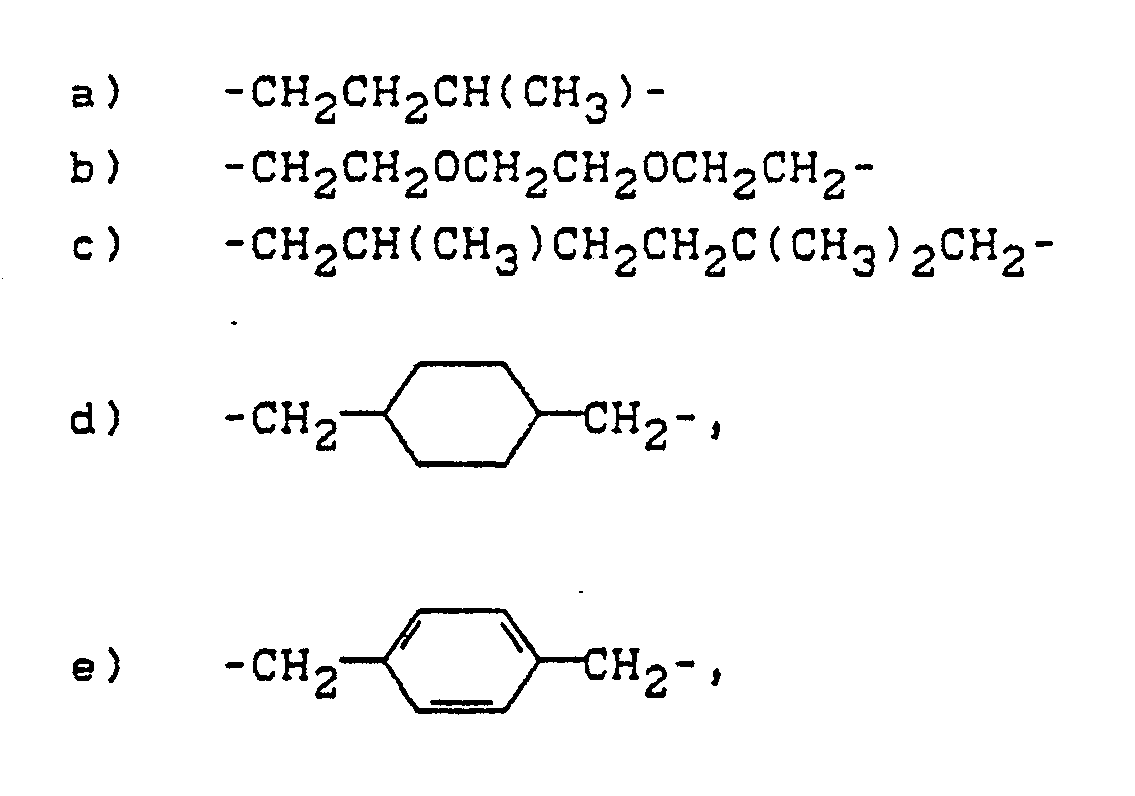

- a) -(-CH₂-)bis 12 ,

- b) CH₂CH₂OCH₂CH₂-
- c) -CH₂CH₂OCH₂CH₂OCH₂CH₂-.
- R³, R⁴, R⁵ und R⁶ in Formel (V) unabhängig voneinander Wasserstoff, C₁-C₆-Alkyl, C₃-C₆-Alkylen, C₁-C₆-Alkoxy und C₂-C₆-Alkylenoxy-C₁-C₆-alkyl (vorzugsweise Wasserstoff, CH₃, C₂H₅)
m und n in Formel (V) unabhängig voneinander O oder eine ganze Zahl von 1 bis 6.
p in Formel (VI) ist eine ganze Zahl von 1 bis 30 (bevorzugt 1 bis 20, besonders bevorzugt 1 bis 12),
R⁷ in Formel (VI) Rest eines Diphenols der Formel (VII);

q in Formel (VII) ist 0, 1 oder 2 und
r in Formel (VII) ist 1 oder 0. - Die Verbindungen der Formeln III bis VII und ihre Herstellung sind bekannt.
- Geeignete Diphenole der Formel (VII) sind:
Hydrochinon,
Resorcin,
Dihydroxyphenyle,
Bis-(hydroxyphenyl)-C₁-C₅-alkane
Bis-(hydroxyphenyl)-C₁-C₆-cycloalkane,
Bis-(hydroxyphenyl)-ether,
Bis-(hydroxyphenyl)-sulfoxide,
Bis-(hydroxyphenyl)-ketone,
Bis-(hydroxyphenyl)-sulfide,
Bis-(hydroxyphenyl)-sulfone und
α,α′-Bis-(hydroxyphenyl)-diisopropylbenzole
sowie deren kernchlorierte, kernbromierte oder kernmethylierte Derivate. - Bevorzugte Diphenole der Formel (VII) sind 2,2-Bis-(4-hydroxyphenyl)-propan, 2,2-Bis-(3,5-dimethyl-4-hydroxyphenyl)-propan, 2,4-Bis-(4-hydroxyphenyl)-2-methylbutan, 1,1-Bis-(4-hydroxyphenyl)-cyclohexan, 4,4-Dihydroxyphenylsulfide, 4,4-Dihydroxyphenylsulfon sowie deren di- und tertrabromierte oder chlorierte Derivate wie 2,2-Bis-(3-chloro-4-hydroxyphenyl)-propan, 2,2-Bis-(3,5-dichlor-4-hydroxyphenyl)-propan oder 2,2-Bis-(3,5-dibrom-4-hydroxyphenyl)-propan.
- Besonders bevorzugtes Diphenol ist 2,2-Bis-(4-hydroxyphenyl)-propan.
- Bevorzugt einzusetzende cyclische, aliphatische Carbonate der Formel (III) und (IV) sind Trimethylenglykolcarbonat, Neopentylglykolcarbonat, 1,4-Butandiolcarbonat, das dimere Carbonat des Pentandiols und das dimere Carbonat des Hexandiols.
- Besonders bevorzugt einzusetzendes cyclisches aliphatisches Carbonat der Formel (III) ist Neopentylglykolcarbonat.
- Bevorzugt einzusetzende cyclische aliphatische Ester der Formel (V) sind Pivalolacton und ε-Caprolacton. Besonders bevorzugt ist ε-Caprolacton.
- Die Herstellung der cyclischen aromatischen Carbonatoligomeren der Formel (VI) ist beispielsweise in EP-A 0 162 379, EP-A 0 224 131, DE-OS 2 937 332, DE-OS 3 717 626, US-PS 3 274 214, US-PS 3 422 119, US-PS 3 155 683, DE-AS 1 229 101 beschrieben.
- Die mittleren Molekulargewichte (Gewichtsmittl
M w) der Blöcke A und C in der idealisierten Formel (I) können gleich oder verschieden sein. Die mittleren MolekulargewichteM w für A liegen zwischen 2.000 und 500.000 g/mol, vorzugsweise zwischen 5.000 und 250.000 g/mol, für C zwischen 2.000 und 500.000 g/mol, vorzugsweise zwischen 5.000 bis 250.000 g/mol. (Die Blöcke A können dabei entweder ein Polymer A₁ oder ein Polymer A₂ oder eine Kombination beider Polymeren, d.h. ein Blockcopolymer A₃ sein. - Die Polymerisate enthalten die Blöcke A und C, jeweils in Mengen von 5 bis 95 Gew.-% (bezogen auf Gesamtmenge A + C), vorzugsweise in Mengen von 10 bis 90 Gew.-% (bezogen auf Gesamtmenge A + C).
- Der Block A₃ im Copolymerisat der Formel (I) ist ein Copolymeres aus einem cyclischen aliphatischen Carbonat der Formel (III) und/oder (IV) und einem cyclischen, aliphatischen Ester der Formel (V). Er weist selbst einen sequenzartigen Aufbau auf gemäß der idealisierten Formel (VIII)
(A₁-X-A₂)y (VIII). - A₁ in Formel (VIII) ist ein Polymerisat eines cyclischen aliphatischen Carbonats der Formel (III) und/oder (IV).
- A₂ in Formel (VIII) ist ein Polymerisat eines cyclischen aliphatischen Esters der Formel (V).
- y in Formel (VIII) ist eine ganze Zahl von 1 bis 10, bevorzugt 1 bis 5, besonders bevorzugt 1.
- X in Formel (VIII) ist ein Polymerisat, das sowohl die cyclischen aliphatischen Carbonate (III) und/oder (IV) als auch die cyclischen aliphatischen Ester (V) in polymerisierter Form enthält, wobei die Konzentration der polymerisierten aliphatischen Carbonate (III) und/oder (IV) jeweils in Richtung auf den Block A₂ und die Konzentration der polymerisierten Ester (V), jeweils in Richtung auf den Block A₁ kontinuierlich abnimmt ("tapered structure").
- Die mittleren Molekulargewichte (Gewichtsmittel
M w) der Blöcke A₁ und A₂ in den Formel (VIII) können gleich oder verschieden sein. Die mittleren MolekulargewichteM w für A₁ liegen zwischen 1900 und 475.000 g/mol, vorzugsweise zwischen 4.500 und 225.000, für A₂ zwischen 1.900 und 475.000 g/mol, vorzugsweise zwischen 4.500 und 225.000 g/mol. - Weiterer Gegenstand der Erfindung ist ein Verfahren zur Herstellung von Blockcopolymerisaten der idealisierten Formel (I)
A - C (I)
in dem man in einer ersten Stufe ein cyclisches aliphatisches Carbonat der Formel (III) und/oder (IV) oder einen cyclischen aliphatischen Ester der Formel (V) oder ein cyclisches aliphatisches Carbonat und einen cyclischen aliphatischen Ester gleichzeitig in einem aprotischen organischen Lösungsmittel mit einer Alkylalkalimetall- oder Arylalkalimetallverbindung bei Temperaturen von +50°C bis -78°C, vorzugsweise +20°C bis -30°C bei einem Monomer/Lösungsmittel-Gewichtsverhältnis von 5 bis 35:100, vorzugsweise 10 bis 25:100 polymerisiert, der polymerisationsaktiven Lösung in einer zweiten Stufe eine Lösung von cyclischen aromatischen Carbonatoligomeren der Formel VI in einem aprotischen organischen Lösungsmittel zusetzt, wobei das Oligomer/Lösungsmittel-Gewichtsverhältnis im Bereich von 5 bis 35:100, vorzugsweise 8 bis 25:100 liegt, bei -20°C bis +80°C, vorzugsweise 0°C bis +60°C, weiter polymerisiert und dann die polymerisationsaktiven Zentren desaktiviert. - Die erste Stufe der Polymerisation ist an sich bekannt (vgl. DE-OS 3 607 625).
- Die Herstellung der Blockcopolymerisate A₃ wird im folgenden an Beispielen erläutert:
- 1. Zum Aufbau eines Blocks A₃ mit der Struktur (A₁-X-A₂)y polymerisiert man ein Gemisch aus einem cyclischen aliphatischen Carbonat der Formel (III) und/oder (IV) und einem cyclischen aliphatischen Ester der Formel (V) in einem aprotischen organischen Lösungsmittel mittels Alkylalkalimetall- oder Arylalkalimetallverbindungen, wobei zuerst der Block A₁ und dann das "getaperte" Übergangssegment X und dann der Block A₂ aufgebaut wird. Das Polymer weist die Struktur (A₁-X-A₂) auf und ist polymerisationsaktiv. (Die anschließende Zugabe einer Lösung von cyclischen aromatischen Carbonatoligomeren (IV) führt zum Aufbau des C-Blockes, d.h., es wird ein Copolymer der idealisierten Struktur (A₁-X-A₂)-C erhalten.)
- 2. Wird ein Copolymerisat der Struktur A₁-X-A₂-A₁-X-A₂ gewünscht, so wird ein weiteres Gemisch aus einem cyclischen aliphatischen Carbonat der Formel (III) und/oder (IV) und einem cyclischen aliphatischen Ester in einem aprotischen organischen Lösungsmittel zu einer polymerisationsaktiven Lösung des Copolymersats (A₁-X-A₂) gegeben und polymerisiert. Der B-Block weist nun die Struktur A₁-X-A₂-A₁-X-A₂ auf und ist weiterhin polymerisationsaktiv. (Die anschließende Zugabe einer Lösung von cyclischen aromatischen Carbonatoligomeren (IV) führt zum Aufbau des C-Blocks, d.h. es wird ein Copolymerisat der idealisierten Struktur A₁-X-A₂-A₁-X-A₂-C erhalten.)
- Entsprechend kann man Blöcke (A₁-X-A₂)y mit y >2 aufbauen.
- Die Copolymerisation von cyclischen aliphatischen Carbonaten und Estern zum Aufbau des A₃-Blocks in Formel (I) erfolgt bei Temperaturen von +50°C bis -78°C, vorzugsweise bei +20°C bis -30°C. Das Monomer/Lösungsmittel-Gewichtsverhältnis liegt im Bereich von 5 bis 35:100, vorzugsweise 10 bis 25:100. Die anschließende Polymerisation der cyclischen aromatischen Carbonatoligomeren wird bei -20 bis +80°C, vorzugsweise bei 0 bis +60°C, durchgeführt. Das Oligomer/Lösungsmittel-Gewichtsverhältnis beträgt 5 bis 35:100, vorzugsweise 8 bis 25:100. Nach erfolgter Polymerisation werden die polymerisationsaktiven Zentren desaktiviert.
- Die erste Stufe der Polymerisation zum Aufbau von Copolymeren der Formel A₃ ist ebenfalls grundsätzlich bekannt (vgl. DE-OS 3 700 193).
- Die Copolymerisation von cyclischen aliphatischen Carbonaten der Formeln (III) und/oder (IV) und/oder cyclischen aliphatischen Estern der Formel (V) mit cyclischen aromatischen Carbonatoligomeren der Formel (VI) wird als "lebende" anionische Polymerisation in Gegenwart von aprotischen, organischen Lösungsmitteln unter Verwendung von alkalimetallorganischen Verbindungen als Initiatoren und unter inerter Atmosphäre (Luft- und Feuchtigkeitsausschluß) durchgeführt.
- Initiatoren sind Arylalkalimetall- und Alkylalkalimetallverbindungen sowie Alkoholate der Alkalimetalle. Bevorzugte Initiatoren sind:
n-Butyllithium, s-Butyllithium, Naphthalinkalium, Naphthalinnatrium, Kaliumphenolat, Kalium-tert.-butylat. Besonders bevorzugt sind n-Butyl und s-Butyllithium. - Als aprotische organische Lösungsmittel finden cyclische Ether oder aromatische oder aliphatische Kohlenwasserstoffe oder Mischungen aus cyclischen Ethern und aromatischen oder aliphatischen Kohlenwasserstoffen Verwendung. Bevorzugte Lösungsmittel sind Tetrahydrofuran, Tetrahydropyran, Dioxan und Toluol.
- Besonders bevorzugt sind Tetrahydrofuran und Mischungen aus Tetrahydrofuran und Toluol.
- Nach erfolgter Polymerisation werden die polymerisationsaktiven Zentren desaktiviert. Als Desaktivatoren werden protische Verbindungen, wie z.B. Wasser, Alkohole, Säuren oder Mischungen daraus eingesetzt. Bevorzugte Desaktivatoren sind Mischungen aus Methanol/Salzsäure und Methanol/Phosphorsäure.
- Die Copolymerisate lassen sich nach bekannten Verfahren isolieren, z.B. durch Ausfällen mit Alkoholen, Filtrieren und anschließende Trocknung oder durch direktes Eindampfen der Copolymerlösung mittels Ausdampfaggregaten, wie Schneckenextrudern oder Dünnschichtverdampfern.
- Die Copolymerisate lassen sich in bekannter Weise stabilisieren, pigmentieren und mittels üblicher Additive antistatisch und/oder flammfest ausrüsten oder mit Füllstoffen füllen.
- Die Verarbeitung der Copolymerisate richtet sich nach ihren Eigenschaften. So können z.B. aus Copolymerisaten mit thermoplastischen Eigenschaften über bekannte Thermoplastverarbeitungsverfahren Formkörper hergestellt werden.
- Die Copolymerisate eignen sich je nach ihrem chemischen Aufbau - zur Herstellung von Folien, Dichtungen, Beschichtungen oder von thermoplastischen Verpackungen.
- Unter Stickstoff werden 2,4 g (0,0024 mol) Triethylamin, 600 ml Methylenchlorid, 1800 ml Wasser und 36 ml 45 %ige Natronlauge (0,6 mol) vorgelegt. Hierzu ließ man bei langsamer Rührgeschwindigkeit (149 U/min) im Verlauf einer Stunde gleichzeitig eine Lösung von 9,72 g (0,096 mol) Triethylamin in 600 ml Methylenchlorid und eine Lösung von 84,8 g (0,24 mol) Bisphenol A-Bischlorkohlensäureester in 1200 ml Methylenchlorid bei Raumtemperatur zutropfen. Nach 10-minütigem Nachrühren wurde mit 3,6 %iger Salzsäure hydrolisiert und eine Phasentrennung durchgeführt. Die wäßrige Phase wurde mit Methylenchlorid gewaschen. Die organischen Phasen wurden vereinigt, mit Wasser gewaschen und das Rohprodukt durch Ausdampfung des Lösungsmittels isoliert (Ausbeute: 58,8 g (90 %)).
- Die reinen cyclischen Bisphenol A-Carbonat-oligomeren wurden durch Extraktion des Rohproduktes mit Aceton gewonnen (Ausbeute: 23,5 g (40 %) bezogen auf Rohrprodukt).
- Die HPLC-Analyse ergab folgende Cyclen-Verteilung:
Anzahl der Bisphenol A-Carbonat-Einheiten im Cyclus Menge (Gew.%) 2 5 3 25 4 19 5 15 6 10 7 8 8 6 9 4 >9 8 - Zu einer Lösung von 5 g Neopentylglykolcarbonat in 35 ml Tetrahydrofuran wurden bei 15°C 0,5 ml sec.-Butyllithium (1,3 molare Lösung in Cyclohexan) unter Rühren und unter Stickstoff gegeben. Nach einer Reaktionszeit von 120 min bei dieser Temperatur wurden 8 ml Lösung entnommen und das Polymere in 50 ml Methanol/1-molare Phosphorsäure (99:1) gefällt. Das Polymere wurde isoliert und getrocknet.
Ausbeute: 1,1 g.
relative Viskosität: ηrel: 1,25 (CH₂Cl₂, 20°C, 2 gew.-%ige Lösung.
GPC-Analyse (Eichung für Polyneopentylglykolcarbonat):
Molekulargewicht: (bestimmt im Maximum der Elutionspeaks) = 18.000 g/mol - Nach Entnahme der Probe wurde dem Reaktionsgemisch eine Lösung von 5 g cyclischen Bisphenol A-Carbonatoligomeren in 30 ml Tetrahydrofuran zugesetzt. Die Reaktionszeit betrug bei 15°C 90 min. Das Reaktionsgemisch wurde dann in 400 ml Methanol/1-molare Phosphorsäure (99:1) gegossen. Das Copolymere wurde isoliert, mit Methanol neutral gewaschen und getrocknet.
Ausbeute: 8,4 g.
relative Viskosität ηrel: 1,48 (CH₂Cl₂, 20°C, 2 gew.-%ige Lösung).
GPC-Analyse (Eichung für Polyneopentylglykolcarbonat):
Molekulargewicht (bestimmt im Maximum des Elutionspeaks) = 34.000 g/mol
DSC-Analyse (2. Aufheizung mit 20°C/min):
Schmelztemperatur Tm = 106°C
Glastemperatur Tg = 131°C. - Zu einer Lösung von 10 g Neopentylglycolcarbonat in 70 ml Toluol wurden bei 15°C 0,4 ml sec.-Butyllithium (1,3 molare Lösung in Cyclohexan) unter Rühren und unter Stickstoff gegeben. Nach einer Reaktionszeit von 60 min bei dieser Temperatur wurde das Gemisch zu einer Lösung von 10 g cyclischen Bisphenol A-Carbonatoligomeren in 75 ml Tetrahydrofuran gegeben. Die Reaktionszeit betrug bei 15°C 120 min. Das Reaktionsgemisch wurde dann in 400 ml Methanol/l-molare Phosphorsäure (99:1) gegossen. Das Copolymere wurde isoliert, mit Methanol neutral gewaschen und getrocknet.
Ausbeute: 15,5 g
relative Viskosität ηrel: 1,60 (CH₂Cl₂, 20°C, 2 gew.-%ige Lösung). - Zu einer Lösung von 5 g ε-Caprolacton in 35 ml Tetrahydrofuran wurden bei 15°C 0,5 ml sec.-Butyllithium (1,3 molare Lösung in Cyclohexan) unter Rühren und unter Stickstoff gegeben. Nach einer Reaktionszeit von 120 min bei dieser Temperatur wurden 10 ml Lösung entnommen und das Polymere in 50 ml Methanol/1-molare Phosphorsäure (99:1) gefällt. Das Polymere wurde isoliert und getrocknet.
Ausbeute: 1,3 g
relative Viskosität ηrel: 1,39 (CH₂Cl₂, 20°C, 2 gew.-%ige Lösung).
GPC-Analyse (Eichung für Poly-ε-Caprolacton)
Molekulargewicht (bestimmt im Maximum des Elutionspeaks) = 15.000 g/mol. - Nach Entnahme der Probe wurde dem Reaktionsgemisch eine Lösung von 5 g cyclischen Bisphenol A-Carbonatoligomeren in 30 ml Tetrahydrofuran zugesetzt. Die Reaktionszeit betrug bei 15°C 90 min. Das Reaktionsgemisch wurde dann in 400 ml Methanol/1-molare Phosphorsäure (99:1) gegossen. Das Copolymere wurde isoliert, mit Methanol neutral gewaschen und getrocknet.
Ausbeute: 7,9 g
relative Viskosität ηrel: 1,65 (CH₂Cl₂, 20°C, 2 gew.-%ige Lösung)
GPC-Analyse (Eichung für Poly-ε-Caprolacton): Molekulargewicht (bestimmt im Maximum des Elutionspeaks) = 29.000 g/mol
DSC-Analyse (2. Aufheizung mit 20°C/min):
Schmelzpunkt Tm = 50°C
Glastemperatur
Tg₁ = -60°C
Tg₂ = 86°C. - Zu einer Lösung von 10 g ε-Caprolacton in 70 ml Toluol wurden bei 15°C 0,5 ml sec.-Butyllithium (1,3 molare Lösung in Cyclohexan) unter Rühren und unter Stickstoff gegeben. Nach einer Reaktionszeit von 60 min bei dieser Temperatur wurde das Gemisch zu einer Lösung von 10 g cyclischen Bisphenol A-Carbonatoligomeren in 75 ml Tetrahydrofuran gegeben. Die Reaktionszeit betrug bei 15°C 120 min. Das Reaktionsgemisch wurde dann in 400 ml Methanol/1-molare Phosphorsäure (99:1) gegossen. Das Copolymere wurde isoliert, mit Methanol neutral gewaschen und getrocknet.
Ausbeute: 18,5 g
relative Viskosität ηrel: 1,43 (CH₂Cl₂, 20°C, 2 gew.-%ige Lösung). - Zu einer Lösung von 2,5 g Neopentylglykolcarbonat und 2,5 g ε-Caprolacton in 35 ml Tetrahydrofuran wurden bei 15°C 0,5 ml sec.-Butyllithium (1,3-molare Lösung in Cyclohexan) unter Rühren und unter Stickstoff gegeben. Nach einer Reaktionszeit von 60 min bei dieser Temperatur wurden 10 ml Lösung entnommen und das Polymere in 50 ml Methanol/1-molare Phosphorsäure (99:1) gefällt. Das Polymere wurde isoliert und getrocknet.
Ausbeute: 1,3 g
relative Viskosität ηrel: 1,52 (CH₂Cl₂, 20°C, 2 gew.-%ige Lösung) - Nach Entnahme der Probe wurde dem Reaktionsgemisch eine Lösung von 5 g cyclischen Bisphenol A-Carbonatoligomeren in 35 ml Tetrahydrofuran zugesetzt. Die Reaktionszeit betrug bei 15°C 150 min.
- Das Reaktionsgemisch wurde dann in 400 ml Methanol/1-molare Phosphorsäure gegossen. Das Copolymere wurde isoliert, mit Methanol neutral gewaschen und getrocknet.
Ausbeute: 8,45 g
relative Viskosität ηrel: 1,62 (CH₂Cl₂, 20°C, 2 gew.-%ige Lösung)
DSC-Analyse (2. Aufheizung mit 20°C/min):
Glastemperaturen
Tg₁ = -24°C
Tg₂ = 97°C. - Zu einer Lösung von 5 g ε-Caprolacton und 5 g Neopentylglycolcarbonat in 70 ml Toluol wurden bei 15°C 0,5 ml sec.-Butyllithium (1,3 molare Lösung in Cyclohexan) unter Rühren und unter Stickstoff gegeben. Nach einer Reaktionszeit von 60 min bei dieser Temperatur wurde das Gemisch zu einer Lösung von 10 g cyclischen Bisphenol A-Carbonatoligomeren in 75 ml Tetrahydrofuran gegeben. Die Reaktionszeit betrug bei 15°C 120 min. Das Reaktionsgemisch wurde dann in 400 ml Methanol/1-molare Phosphorsäure (99:1) gegossen. Das Copolymere wurde isoliert, mit Methanol neutral gewaschen und getrocknet.
Ausbeute: 16,1 g
relative Viskosität ηrel: 1,44 (CH₂Cl₂, 20°C, 2 gew.-%ige Lösung).
Claims (4)
Applications Claiming Priority (2)
| Application Number | Priority Date | Filing Date | Title |
|---|---|---|---|
| DE3831887A DE3831887A1 (de) | 1988-09-20 | 1988-09-20 | Blockcopolymerisate auf der basis von cyclischen aliphatischen carbonaten und/oder estern einerseits und cyclischen aromatischen carbonaten andererseits |
| DE3831887 | 1988-09-20 |
Publications (2)
| Publication Number | Publication Date |
|---|---|
| EP0360076A2 true EP0360076A2 (de) | 1990-03-28 |
| EP0360076A3 EP0360076A3 (de) | 1991-11-06 |
Family
ID=6363312
Family Applications (1)
| Application Number | Title | Priority Date | Filing Date |
|---|---|---|---|
| EP19890116495 Withdrawn EP0360076A3 (de) | 1988-09-20 | 1989-09-07 | Blockcopolymerisate auf der Basis von cyclischen aliphatischen Carbonaten und/oder Estern einerseits und cyclischen aromatischen Carbonaten andererseits |
Country Status (4)
| Country | Link |
|---|---|
| US (1) | US5084524A (de) |
| EP (1) | EP0360076A3 (de) |
| JP (1) | JPH02120322A (de) |
| DE (1) | DE3831887A1 (de) |
Families Citing this family (3)
| Publication number | Priority date | Publication date | Assignee | Title |
|---|---|---|---|---|
| US5120802A (en) * | 1987-12-17 | 1992-06-09 | Allied-Signal Inc. | Polycarbonate-based block copolymers and devices |
| JP2002265585A (ja) * | 2001-03-14 | 2002-09-18 | Mitsui Chemicals Inc | ポリカーボネート共重合体およびその用途 |
| US7666973B2 (en) * | 2007-07-30 | 2010-02-23 | Tyco Healthcare Group Lp | Carbonate copolymers |
Family Cites Families (14)
| Publication number | Priority date | Publication date | Assignee | Title |
|---|---|---|---|---|
| DE1229101B (de) * | 1961-08-02 | 1966-11-24 | Bayer Ag | Verfahren zur Herstellung oligomerer cyclischer Carbonate |
| US3274214A (en) * | 1962-12-26 | 1966-09-20 | Gen Electric | Aromatic carbonates |
| US3422119A (en) * | 1963-06-03 | 1969-01-14 | Gen Electric | Cyclic aromatic carbonate dimers |
| US3155683A (en) * | 1963-06-03 | 1964-11-03 | Gen Electric | Preparation of aromatic cyclic carbonates |
| US3641200A (en) * | 1969-01-17 | 1972-02-08 | Union Carbide Corp | Block copolycarbonates containing polylactone blocks and dihydric phenol polycarbonate blocks |
| FR2235965A1 (en) * | 1973-06-15 | 1975-01-31 | Ugine Kuhlmann | Sequenced polycarbonate-polycaprolactone copolymers - prepd. from oligomers with reactive end gps |
| DE2827325A1 (de) * | 1978-06-22 | 1980-01-10 | Bayer Ag | Verfahren zur herstellung von aliphatisch-aromatischen polycarbonaten mit diphenolcarbonat-endgruppen und ihre verwendung zur herstellung von thermoplastisch verarbeitbaren, hochmolekularen, segmentierten, aliphatisch-aromatischen polycarbonat-elastomeren |
| DE2937332A1 (de) * | 1979-09-14 | 1981-04-09 | Bayer Ag, 5090 Leverkusen | Makrocyclische polycarbonate |
| US4644053A (en) * | 1984-05-11 | 1987-02-17 | General Electric Company | Cyclic polycarbonate oligomers and methods for their preparation and use |
| US4727134A (en) * | 1985-02-22 | 1988-02-23 | General Electric Company | Method for preparing cyclic polycarbonate oligomer mixtures |
| US4699974A (en) * | 1986-08-07 | 1987-10-13 | General Electric Company | Method of preparing copolyester carbonate from cyclic aromatic polycarbonate oligomer and lactone |
| US4616077A (en) * | 1985-11-22 | 1986-10-07 | General Electric Company | Method for preparing cyclic polycarbonate oligomer from bischloroformate composition |
| DE3607625A1 (de) * | 1986-03-07 | 1987-09-10 | Bayer Ag | Verfahren zur herstellung von linearen aliphatischen polycarbonaten |
| DE3700193A1 (de) * | 1987-01-06 | 1988-07-14 | Bayer Ag | Sequenziert aufgebaute copolymere auf der basis von cyclischen carbonaten und estern |
-
1988
- 1988-09-20 DE DE3831887A patent/DE3831887A1/de not_active Withdrawn
-
1989
- 1989-09-07 EP EP19890116495 patent/EP0360076A3/de not_active Withdrawn
- 1989-09-14 US US07/407,166 patent/US5084524A/en not_active Expired - Fee Related
- 1989-09-20 JP JP1242413A patent/JPH02120322A/ja active Pending
Also Published As
| Publication number | Publication date |
|---|---|
| JPH02120322A (ja) | 1990-05-08 |
| EP0360076A3 (de) | 1991-11-06 |
| DE3831887A1 (de) | 1990-04-05 |
| US5084524A (en) | 1992-01-28 |
Similar Documents
| Publication | Publication Date | Title |
|---|---|---|
| EP0025937B1 (de) | Thermoplastische Polycarbonate, Verfahren zu ihrer Herstellung, Bis-halogen-kohlensäureester von Hexahydro-furo(3,2-b) furan-3,6-diolen, sowie Polycarbonatmassen | |
| EP0360073A2 (de) | Verfahren zur Herstellung von aromatischen Polycarbonaten | |
| EP0006516B1 (de) | Verfahren zur Herstellung von aliphatisch-aromatischen Polycarbonaten mit Diphenolcarbonat-Endruppen, die nach dem Verfahren erhaltenen Polycarbonate und ihre Verwendung zur Herstellung von thermoplastisch verarbeitbaren, hochmolekularen, segmentierten, aliphatisch-aromatischen Polycarbonat-Elastomeren | |
| EP0000732B1 (de) | Abmischungen von verzweigtem Polyarylsulfon-Polycarbonat sowie ihre Verwendung zur Herstellung von Extrusionsfolien | |
| EP0006579A1 (de) | Polycarbonate mit UV-Licht-vernetzbaren Doppelbindungen, Verfahren zu ihrer Herstellung, Verfahren zu ihrer Modifizierung sowie die hierbei erhaltenen Produkte | |
| EP0004020A1 (de) | Polycarbonat-Formmassen mit verbesserten zähelastischen Eigenschaften | |
| DE2712435C2 (de) | ||
| DE2726416A1 (de) | Verfahren zur herstellung von kohlensaeure-bis-diphenol-estern von ueber carbonat-gruppen-verlaengerten polyalkylenoxiddiolen und ihre verwendung zur herstellung von hochmolekularen, segmentierten, thermoplastisch verarbeitbaren polyaether-polycarbonaten | |
| EP0097861B1 (de) | Aromatische Polyestercarbonate mit hoher Kerbschlagzähigkeit und Verfahren zu ihrer Herstellung | |
| EP0201830B1 (de) | Verfahren zur Herstellung von Copolyphosphonaten mit hoher Kerbschlagzähigkeit | |
| EP0065728B1 (de) | Neue Copolyestercarbonate und deren Abmischung mit bekannten Polycarbonaten zu thermoplastischen Formmassen | |
| EP0023571A1 (de) | Verfahren zur Herstellung von Polycarbonaten, die so erhältlichen Polycarbonate sowie ihre Verwendung | |
| DE2726417C2 (de) | ||
| EP0075772A1 (de) | Verfahren zur Isolierung von Polycarbonaten auf Basis von 4,4-Dihydroxidiphenylsulfonen | |
| DE2636784A1 (de) | Verfahren zur herstellung von kohlensaeure-bis-diphenolestern von polyalkylenoxiddiolen und ihre verwendung zur herstellung von hochmolekularen, segmentierten, thermoplastisch verarbeitbaren polyaether-polycarbonaten | |
| EP0191916B1 (de) | Block-Polyether-Poly(ester)-carbonaten | |
| EP0432580B1 (de) | Zweistufen-Verfahren zur Herstellung von Polycarbonaten auf Basis von speziellen Dihydroxydiphenylalkanen | |
| DE3831887A1 (de) | Blockcopolymerisate auf der basis von cyclischen aliphatischen carbonaten und/oder estern einerseits und cyclischen aromatischen carbonaten andererseits | |
| DE3638323A1 (de) | Cyclische oligomere enthaltende zubereitungen | |
| EP0392251B1 (de) | Blockcopolymere | |
| EP0014412A1 (de) | Thermoplastische Massen und Verfahren zu ihrer Herstellung | |
| DE2650533A1 (de) | Verfahren zur herstellung von kohlensaeurearylestern von ueber carbonat- gruppen-verlaengerten polyalkylenoxiddiolen | |
| DE2601957A1 (de) | Mikrostrukturierte polyesterpolymere und verfahren zu ihrer herstellung | |
| DE2601959A1 (de) | Copolyesterharze mit hohem molekulargewicht und hohem grad an alternierender struktur und verfahren zu ihrer herstellung | |
| AT246429B (de) | Verfahren zur Herstellung eines schmelzbaren, im wesentlichen linearen, polymeren aromatischen Esters |
Legal Events
| Date | Code | Title | Description |
|---|---|---|---|
| PUAI | Public reference made under article 153(3) epc to a published international application that has entered the european phase |
Free format text: ORIGINAL CODE: 0009012 |
|
| 17P | Request for examination filed |
Effective date: 19890907 |
|
| AK | Designated contracting states |
Kind code of ref document: A2 Designated state(s): DE FR GB IT NL |
|
| PUAL | Search report despatched |
Free format text: ORIGINAL CODE: 0009013 |
|
| AK | Designated contracting states |
Kind code of ref document: A3 Designated state(s): DE FR GB IT NL |
|
| 17Q | First examination report despatched |
Effective date: 19931215 |
|
| STAA | Information on the status of an ep patent application or granted ep patent |
Free format text: STATUS: THE APPLICATION HAS BEEN WITHDRAWN |
|
| 18W | Application withdrawn |
Withdrawal date: 19950316 |