EP0360127A2 - Oxygenated bicyclic derivatives and their use as perfuming ingredients - Google Patents
Oxygenated bicyclic derivatives and their use as perfuming ingredients Download PDFInfo
- Publication number
- EP0360127A2 EP0360127A2 EP89116817A EP89116817A EP0360127A2 EP 0360127 A2 EP0360127 A2 EP 0360127A2 EP 89116817 A EP89116817 A EP 89116817A EP 89116817 A EP89116817 A EP 89116817A EP 0360127 A2 EP0360127 A2 EP 0360127A2
- Authority
- EP
- European Patent Office
- Prior art keywords
- formula
- beta
- ketone
- ketones
- catalytic hydrogenation
- Prior art date
- Legal status (The legal status is an assumption and is not a legal conclusion. Google has not performed a legal analysis and makes no representation as to the accuracy of the status listed.)
- Granted
Links
Classifications
-
- C—CHEMISTRY; METALLURGY
- C11—ANIMAL OR VEGETABLE OILS, FATS, FATTY SUBSTANCES OR WAXES; FATTY ACIDS THEREFROM; DETERGENTS; CANDLES
- C11B—PRODUCING, e.g. BY PRESSING RAW MATERIALS OR BY EXTRACTION FROM WASTE MATERIALS, REFINING OR PRESERVING FATS, FATTY SUBSTANCES, e.g. LANOLIN, FATTY OILS OR WAXES; ESSENTIAL OILS; PERFUMES
- C11B9/00—Essential oils; Perfumes
- C11B9/0042—Essential oils; Perfumes compounds containing condensed hydrocarbon rings
- C11B9/0046—Essential oils; Perfumes compounds containing condensed hydrocarbon rings containing only two condensed rings
- C11B9/0049—Essential oils; Perfumes compounds containing condensed hydrocarbon rings containing only two condensed rings the condensed rings sharing two common C atoms
- C11B9/0053—Essential oils; Perfumes compounds containing condensed hydrocarbon rings containing only two condensed rings the condensed rings sharing two common C atoms both rings being six-membered
-
- C—CHEMISTRY; METALLURGY
- C07—ORGANIC CHEMISTRY
- C07C—ACYCLIC OR CARBOCYCLIC COMPOUNDS
- C07C45/00—Preparation of compounds having >C = O groups bound only to carbon or hydrogen atoms; Preparation of chelates of such compounds
- C07C45/61—Preparation of compounds having >C = O groups bound only to carbon or hydrogen atoms; Preparation of chelates of such compounds by reactions not involving the formation of >C = O groups
- C07C45/62—Preparation of compounds having >C = O groups bound only to carbon or hydrogen atoms; Preparation of chelates of such compounds by reactions not involving the formation of >C = O groups by hydrogenation of carbon-to-carbon double or triple bonds
-
- C—CHEMISTRY; METALLURGY
- C07—ORGANIC CHEMISTRY
- C07C—ACYCLIC OR CARBOCYCLIC COMPOUNDS
- C07C49/00—Ketones; Ketenes; Dimeric ketenes; Ketonic chelates
- C07C49/385—Saturated compounds containing a keto group being part of a ring
- C07C49/417—Saturated compounds containing a keto group being part of a ring polycyclic
- C07C49/423—Saturated compounds containing a keto group being part of a ring polycyclic a keto group being part of a condensed ring system
- C07C49/427—Saturated compounds containing a keto group being part of a ring polycyclic a keto group being part of a condensed ring system having two rings
- C07C49/447—Saturated compounds containing a keto group being part of a ring polycyclic a keto group being part of a condensed ring system having two rings the condensed ring system containing ten carbon atoms
-
- C—CHEMISTRY; METALLURGY
- C07—ORGANIC CHEMISTRY
- C07C—ACYCLIC OR CARBOCYCLIC COMPOUNDS
- C07C2602/00—Systems containing two condensed rings
- C07C2602/02—Systems containing two condensed rings the rings having only two atoms in common
- C07C2602/14—All rings being cycloaliphatic
- C07C2602/26—All rings being cycloaliphatic the ring system containing ten carbon atoms
- C07C2602/28—Hydrogenated naphthalenes
Definitions
- the present invention relates to oxygenated decalin derivatives, their use as odoriferous ingredients in the preparation of perfumes and perfumed products and a process for the preparation of said decalin derivatives.
- acyl group is meant a radical C1 to C6, preferably saturated linear or branched, for example formyl, acetyl, propionyl or butyryl. It preferably represents a formyl or acetyl group.
- formula (I) is used to denote both esters, such as perhydro-5,8a-dimethyl-2-naphthyl formate or perhydro-5,8a-dimethyl-2-naphthyl acetate, as the corresponding ketone , or perhydro-5,8a-dimethyl-2-naphthalenone.
- Patent FR-B 1,593,814 describes decalinic compounds of formula in which X represents either oxygen or two monovalent radicals, one of these radicals being hydrogen and the other a residue -O-CO-R in which R represents hydrogen or an aliphatic, saturated hydrocarbon group , linear or branched from 1 to 6 carbon atoms or also an unsaturated aliphatic hydrocarbon group, linear or branched from 2 to 6 carbon atoms. Said compounds are endowed with useful odorous properties and have found a popular use in perfumery where they contribute to developing a woody and amber note of great distinction and elegance in a good number of compositions.
- concentration values depend not only on the specific effect desired, but also on the nature of the product which it is desired to flavor and that of the co-ingredients in a given composition. Furthermore, such values may be lower than those indicated above when the compounds of the invention are used for the perfuming of products such as soaps, cosmetics, detergents or when they are incorporated into various supports, for example example minerals or polymers for the manufacture of air fresheners. In these cases, their concentration can be of the order of 0.2 to 1.0% by weight relative to the total weight of the product thus perfumed.
- the ketone of formula (II), used as starting material in the process described above, can be obtained according to a process analogous to a known process, in particular described by CR Bennett and RC Cambie in Tetrahedron 23 , 927 (1967).
- the ketone (II) can also be prepared according to Marshall et al. [see J. Am. Chem. Soc. 88 , 3408 (1966)].
- the compounds of formula (I) can be in the form of racemic derivatives or isomers of optically active configuration. Although the odor of these different compounds belongs to the same olfactory family, their own character can vary depending on the structure of each compound.
- the compounds (I) can be used either in the form of a mixture of isomers, or in the form of a particular enantiomer.
- catalytic hydrogenation which characterizes stages a. and B. of the process of the invention described above can be carried out using conventional catalysts known to promote the reduction of a cyclohexene double bond, respectively of the ketone function.
- catalysts constituted by a metal such as platinum, palladium or nickel, or an oxide such as PtO2 may be perfectly suitable for these operations.
- the product obtained has a fairly discreet and pleasant woody odor with shades of iris and a slightly camphorous character.
- the product obtained has a distinct woody note, vaguely amber and powdery; has a green undertone.
- Example 2 250 mg (1.37 mMole) of perhydro-5,8a-dimethyl-2-trans-naphthalenol were acetylated.
- the desired acetate having Eb. 110 ° / 0.4 mmHg, the analytical characteristics of which were identical in all respects to those of the product obtained according to Example 2.
- the product has a woody note, with floral and green nuances, slightly camphorated.
- a basic perfuming composition was prepared by mixing the following ingredients (parts by weight): Essence of bergamot synth. 140 10% galbanum essence * 80 p-tert-Butyl-cyclohexylacetaldehyde 80 Ald. 10% methyl-octyl acetic * 80 Essence of jasmine synth.
- compositions were then prepared (parts by weight): Based DIPG comp. 1 1) comp. 2 2) AT 90 10 - - B 90 - 10 - VS 90 - - 10 1) compound according to Example 1 2) compound according to Example 2
- Composition A represents a Cyprus type composition, woody, lavender, citrus, whose olfactory characters are not very balanced.
- Composition B on the other hand, acquired a pleasant equilibrium thanks to the addition of compound 1; it is more woody than composition A and the citrus note is harmoniously integrated into the whole.
- Composition C also has a more rounded character than composition A. It is more woody and also shows an amber-aromatic nuance.
Landscapes
- Chemical & Material Sciences (AREA)
- Organic Chemistry (AREA)
- Chemical Kinetics & Catalysis (AREA)
- Life Sciences & Earth Sciences (AREA)
- Engineering & Computer Science (AREA)
- Oil, Petroleum & Natural Gas (AREA)
- Wood Science & Technology (AREA)
- Fats And Perfumes (AREA)
- Organic Low-Molecular-Weight Compounds And Preparation Thereof (AREA)
- Cosmetics (AREA)
Abstract
Les dérivés oxygénés bicycliques possèdent la formule <IMAGE> dans laquelle la ligne pointillée peut désigner une liaison simple ou double, l'indice n vaut zéro ou 1 et X sert à définir un groupe acyle inférieur (n = 1) ou l'oxygène (n = 0). Les composés de formule (I) possèdent des notes odorantes de type boisé et trouvent de ce fait une utilisation dans la parfumerie. Procédé pour leur préparation à partir des cétones de formule <IMAGE> contenant une double liaison dans l'une des positions indiquées par les pointillés.Bicyclic oxygen derivatives have the formula <IMAGE> in which the dotted line can denote a single or double bond, the index n is zero or 1 and X is used to define a lower acyl group (n = 1) or oxygen ( n = 0). The compounds of formula (I) have fragrant woody notes and therefore find use in perfumery. Process for their preparation from ketones of formula <IMAGE> containing a double bond in one of the positions indicated by the dotted lines.
Description
La présente invention concerne des dérivés oxygénés de la décaline, leur utilisation comme ingrédients odoriférants dans la préparation de parfums et de produits parfumés et un procédé de préparation desdits dérivés de la décaline.The present invention relates to oxygenated decalin derivatives, their use as odoriferous ingredients in the preparation of perfumes and perfumed products and a process for the preparation of said decalin derivatives.
Les dérivés de la présente invention répondent à la formule générale
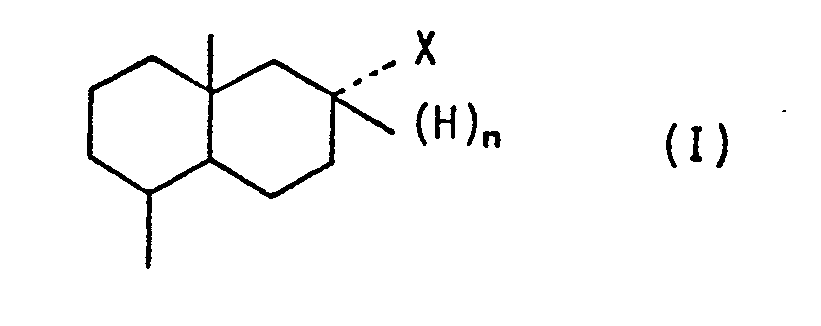
Comme groupe acyle inférieur on entend un radical C₁ à C₆, de préférence saturé linéaire ou ramifié, par exemple le formyle, l'acétyle, le propionyle ou le butyryle. Il représente de préférence un groupe formyle ou acétyle. C'est ainsi que la formule (I) sert à désigner aussi bien des esters, tels le perhydro-5,8a-diméthyl-2-naphtyl formiate ou perhydro-5,8a-diméthyl-2-naphtyl acétate, que la cétone correspondante, ou perhydro-5,8a-diméthyl-2-naphtalénone.As the lower acyl group is meant a radical C₁ to C₆, preferably saturated linear or branched, for example formyl, acetyl, propionyl or butyryl. It preferably represents a formyl or acetyl group. Thus, formula (I) is used to denote both esters, such as perhydro-5,8a-dimethyl-2-naphthyl formate or perhydro-5,8a-dimethyl-2-naphthyl acetate, as the corresponding ketone , or perhydro-5,8a-dimethyl-2-naphthalenone.
Le brevet FR-B 1'593'814 décrit des composés décaliniques de formule

Nous avons maintenant découvert que les composés représentés par la série de leurs homologues inférieures de formule (I) sert à conférer, modifier ou renforcer les propriétés olfactives de parfums, bases parfumées et produits parfumés dans lesquels ils sont incorporés. Tout en développant une note odorante de type boisé, comme leurs homologues supérieurs mentionnés dans l'antériorité citée, ils possèdent des caractères distincts qui rendent leur utilisation nouvelle et originale. Ils servent en effet à développer des notes odorantes boisées, vertes, terreuses qui rappellent, pour certains d'entre eux, l'odeur d'iris ou celle plus particulière du bois de cèdre. Les proportions dans lesquelles les composés de l'invention peuvent être employés pour produire les effets désirés varient dans une gamme assez étendue. Des concentrations de l'ordre de 2 à 10, voire 20% en poids par rapport au poids total de la composition dans laquelle ils sont incorporés peuvent être parfaitement indiquées pour atteindre les effets recherchés. L'homme de l'art sait par expérience que ces valeurs de concentration dépendent non seulement de l'effet spécifique souhaité, mais également de la nature du produit que l'on désire parfumer et de celle des coingrédients dans une composition donnée. Par ailleurs, de telles valeurs peuvent être inférieures à celles indiquées ci-dessus lorsque les composés de l'invention sont utilisés pour le parfumage de produits tels les savons, les cosmétiques, les détergents ou lorsqu'ils sont incorporés à des supports variés, par exemple minéraux ou polymériques pour la manufacture des désodorisants d'air ambiant. Dans ces cas, leur concentration peut être de l'ordre de 0,2 à 1,0% en poids par rapport au poids total du produit ainsi parfumé.We have now discovered that the compounds represented by the series of their lower counterparts of formula (I) serve to confer, modify or reinforce the olfactory properties of perfumes, perfumed bases and perfumed products in which they are incorporated. While developing a woody-like fragrant note, like their higher counterparts mentioned in the cited prior art, they have distinct characters which make their use new and original. They serve in fact to develop fragrant woody, green, earthy notes which recall, for some of them, the smell of iris or that more particular of cedar wood. The proportions in which the compounds of the invention can be used to produce the desired effects vary within a fairly wide range. Concentrations of the order of 2 to 10 or even 20% by weight relative to the total weight of the composition in which they are incorporated can be perfectly indicated in order to achieve the desired effects. Those skilled in the art know from experience that these concentration values depend not only on the specific effect desired, but also on the nature of the product which it is desired to flavor and that of the co-ingredients in a given composition. Furthermore, such values may be lower than those indicated above when the compounds of the invention are used for the perfuming of products such as soaps, cosmetics, detergents or when they are incorporated into various supports, for example example minerals or polymers for the manufacture of air fresheners. In these cases, their concentration can be of the order of 0.2 to 1.0% by weight relative to the total weight of the product thus perfumed.
Les exemples spécifiques indiqués ci-après donnent un aperçu des possibilités d'utilisation des composés (I). Bien entendu l'emploi de ces composés ne saurait y être limité. Les composés de l'invention s'accordent en effet avec la plupart des coingrédients parfumants usuels ainsi qu'avec les supports couramment utilisés en parfumerie. Comme indiqué plus haut, ils servent à parfumer une grande variété de produits de consommation dont les savons, les cosmétiques, les détergents, les adoucissants, les produits d'entretien ou les désodorisants aussi bien corporels que d'ambiance.The specific examples indicated below give an overview of the possibilities of using the compounds (I). Of course, the use of these compounds cannot be limited thereto. The compounds of the invention in fact agree with most of the usual perfume coingredients as well as with the supports commonly used in perfumery. As indicated above, they are used to flavor a wide variety of consumer products including soaps, cosmetics, detergents, fabric softeners, cleaning products and air fresheners, both body and room.
Les composés de formule (I) sont des entités chimiques nouvelles. Ils sont préparés à l'aide d'un procédé original, procédé qui constitue également un objet de la présente invention. Ledit procédé est caractérisé par
- a. une hydrogénation catalytique d'une cétone décalinique de formule


- b. suivie d'une hydrogénation catalytique de ladite cétone (Ia) pour donner le carbinol de formule

- c. de l'estérification dudit carbinol pour fournir l'ester de formule

- at. a catalytic hydrogenation of a decalinic ketone of formula
- b. followed by catalytic hydrogenation of said ketone (Ia) to give the carbinol of formula
- vs. esterification of said carbinol to provide the ester of formula
La cétone de formule (II), utilisée comme produit de départ dans le procédé décrit ci-dessus, peut être obtenue suivant un procédé analogue à un procédé connu, notamment décrit par C.R. Bennett et R.C. Cambie dans Tetrahedron 23, 927 (1967).The ketone of formula (II), used as starting material in the process described above, can be obtained according to a process analogous to a known process, in particular described by CR Bennett and RC Cambie in Tetrahedron 23 , 927 (1967).
La cétone (II) peut également être préparée suivant Marshall et al. [voir J. Am. Chem. Soc. 88, 3408 (1966)].The ketone (II) can also be prepared according to Marshall et al. [see J. Am. Chem. Soc. 88 , 3408 (1966)].
L'ensemble du procédé défini plus haut peut être illustré à l'aide du schéma que voici :

Les composés (I), sous leur forme optiquement active, peuvent être obtenus grâce au procédé décrit plus haut (voir Schéma) à partir des cétones (II), eux-mêmes obtenus à partir d'acide podocarpique ou du cétoester de formule

L'hydrogénation catalytique qui caractérise les étapes a. et b. du procédé de l'invention décrit plus haut peut être effectuée au moyen de catalyseurs usuels connus pour promouvoir la réduction d'une double liaison cyclohexénique, respectivement de la fonction cétonique. Ainsi des catalyseurs constitués par un métal tel le platine, le palladium ou le nickel, ou un oxyde tel le PtO₂ peuvent parfaitement convenir pour ces opérations.The catalytic hydrogenation which characterizes stages a. and B. of the process of the invention described above can be carried out using conventional catalysts known to promote the reduction of a cyclohexene double bond, respectively of the ketone function. Thus, catalysts constituted by a metal such as platinum, palladium or nickel, or an oxide such as PtO₂ may be perfectly suitable for these operations.
Des exemples spécifiques de préparation et d'utilisation des composés de l'invention sont donnés ci-après. Les températures sont indiquées en degrés centigrades et les abréviations ont le sens usuel dans l'art.Specific examples of preparation and use of the compounds of the invention are given below. The temperatures are indicated in degrees centigrade and the abbreviations have the usual meaning in art.
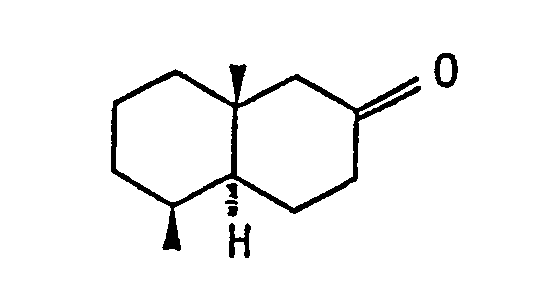
0,89 g (5 mMole) d'un mélange de cétones décaliniques insaturées de formule (II), obtenu comme indiqué ci-après, ont été hydrogénés sous pression atmosphérique dans 25 ml d'acide acétique glacial et en présence de 50 mg de PtO₂. Après absorption de la quantité théorique d'hydrogène (env. 2 h à température ambiante), le mélange réactionnel a été filtré, concentré, repris à l'éther. La phase éthérée a été lavée avec du NaHCO₃, puis avec de l'eau jusqu'à neutralité et enfin séchée sur du MgSO₄, concentré et distillé dans un four à boules [Eb. 95°/0,9 mmHg]. 0,90 g de la cétone désirée ont été ainsi obtenus sous forme cristallisée. La recristallisation dans l'alcool éthylique a fourni un échantillon analytique ayant F. = 67-70° ; [alpha]²⁰D = -51,4° (CH₃OH).
SM : M⁺ = 180(27) ; m/e : 162(15) ; 147(31) ; 138(24) ; 122(67) ; 109(77) ; 95(100) ; 81(73) ; 67(68) ; 55(64) ; 41(61).
RMN (360 MHz ; CDCl₃) : 0,89(3H,s) ; 0,93(3H,d,J=7 cps) ; 1,98(1H,dd, J₁=13, J₂=2 cps) ; 2,15(1H,d,J=13 cps) ; 2,33(1H,ddd,J₁=J₂=12 ; J₃=7 cps) ; 2,43(dddd,J₁=12 ; J₂=5,5 ; J₃=J₄=2 cps) delta ppm.0.89 g (5 mMole) of a mixture of unsaturated decalinic ketones of formula (II), obtained as indicated below, were hydrogenated under atmospheric pressure in 25 ml of glacial acetic acid and in the presence of 50 mg of PtO₂. After absorption of the theoretical quantity of hydrogen (approx. 2 h at room temperature), the reaction mixture was filtered, concentrated, taken up in ether. The ethereal phase was washed with NaHCO₃, then with water until neutral and finally dried over MgSO₄, concentrated and distilled in a ball oven [Eb. 95 ° / 0.9 mmHg]. 0.90 g of the desired ketone were thus obtained in crystallized form. Recrystallization from ethyl alcohol provided an analytical sample having M = 67-70 °; [alpha] ²⁰ D = -51.4 ° (CH₃OH).
MS: M⁺ = 180 (27); m / e: 162 (15); 147 (31); 138 (24); 122 (67); 109 (77); 95 (100); 81 (73); 67 (68); 55 (64); 41 (61).
NMR (360 MH z ; CDCl₃): 0.89 (3H, s); 0.93 (3H, d, J = 7 cps); 1.98 (1H, dd, J₁ = 13, J₂ = 2 cps); 2.15 (1H, d, J = 13 cps); 2.33 (1H, ddd, J₁ = J₂ = 12; J₃ = 7 cps); 2.43 (dddd, J₁ = 12; J₂ = 5.5; J₃ = J₄ = 2 cps) delta ppm.
Le produit obtenu possède une odeur boisée assez discrète et agréable avec des nuances d'iris et un caractère un peu camphré.The product obtained has a fairly discreet and pleasant woody odor with shades of iris and a slightly camphorous character.
Le mélange des cétones décaliniques de formule (II), utilisé comme produit de départ dans le procédé décrit ci-dessus, a été obtenu à partir de l'acide (4aR)-perhydro-1 alpha,4a bêta-diméthyl-6-oxo-1-trans-naphtalène carboxylique par oxydation à l'aide de tétracétate de plomb selon le procédé décrit par Bennett et Cambie [Tetrahedron 23, 927 (1967)]. Ledit acide naphtalène carboxylique a été préparé à son tour à partir de l'hydroperoxyde obtenu à partir d'acide podocarpique suivant Austr. J. Chem. 35, 183 (1982) ou à partir de (4aR)-perhydro-1 alpha,4a bêta-diméthyl-6-oxo-1-trans-naphtalène carboxylate de méthyle [voir Can. J. Chem. 48, 1105 (1970)]. Le mélange des cétones obtenu était constitué à raison de 52 : 17 : 31 parties par les cétones de structure

RMN (360 MHz, CDCl₃) :
- (a) : 0,78(3H,s) ; 5,41(1H,m) delta ppm ;
- (b) : 1,04(3H,s) delta ppm
- (c) : 0,72(3H,s) ; 4,52 et 4,83(1H chacun, 2 m) delta ppm.
NMR (360 MH z , CDCl₃):
- (a): 0.78 (3H, s); 5.41 (1H, m) delta ppm;
- (b): 1.04 (3H, s) delta ppm
- (c): 0.72 (3H, s); 4.52 and 4.83 (1H each, 2m) delta ppm.
Le mélange a été utilisé pour l'étape suivante.The mixture was used for the next step.
-
a. Le cétone obtenue comme décrit à l'Exemple 1, a été soumise à une hydrogénation dans le méthanol en présence de palladium sous une pression de 15 bar (durée : 20 h, temp. : 70°). Le mélange réactionnel a été refroidi et filtré, puis concentré et repris à l'éther. La phase éthérée a été séchée et concentrée. Une distillation dans un four à boules à fourni à une température du four de 105°, 230 mg de (+)-(2S)-perhydro-5 bêta, 8a bêta-diméthyl-2 bêta-trans-naphtalénol ayant F = 68-71° et [alpha]²⁰D = +11,4°(CH₃OH) ;
SM : M⁺ = 182(6) ; m/e : 164(25) ; 149(100) ; 135(32) ; 121(35) ; 108(58) ; 95(76) ; 81(75) ; 67(69) ; 55(62) ; 41(61).
RMN (360 MHz, CDCl₃) : 0,91(3H,d,J=7 cps) ; 1,14(3H,s) ; 4,11(1H,m) delta ppm.at. The ketone obtained as described in Example 1 was subjected to hydrogenation in methanol in the presence of palladium under a pressure of 15 bar (duration: 20 h, temp.: 70 °). The reaction mixture was cooled and filtered, then concentrated and taken up in ether. The ethereal phase was dried and concentrated. A distillation in a ball oven provided at an oven temperature of 105 °, 230 mg of (+) - (2S) -perhydro-5 beta, 8a beta-dimethyl-2 beta-trans-naphthalenol having F = 68- 71 ° and [alpha] ²⁰ D = + 11.4 ° (CH₃OH);
MS: M⁺ = 182 (6); m / e: 164 (25); 149 (100); 135 (32); 121 (35); 108 (58); 95 (76); 81 (75); 67 (69); 55 (62); 41 (61).
NMR (360 MH z , CDCl₃): 0.91 (3H, d, J = 7 cps); 1.14 (3H, s); 4.11 (1H, m) delta ppm. -
b. Un mélange constitué par 265 mg (1,45 mMole) du carbinol obtenu sous lettre a. ci-dessus, 180 mg d'anhydride acétique (1,76 mMole) et 10 ul d'acide sulfurique concentré a été maintenu sous agitation pendant 1 h à 40°, puis il a été dilué à l'eau et extrait à l'éther. Les extraits organiques combinés ont été lavés avec du NaHCO₃, de l'eau jusqu'à neutralité, séchés, concentrés et distillés à l'aide d'un four à boules [Eb. 105°/0,5 mmHg].
276,7 mg de l'acétate désiré ont été ainsi obtenus. Par chromatographie sur colonne remplie de gel de silice avec hexane/diéthyl éther comme éluant, on a obtenu 255,8 mg de l'acétate pur ; [alpha]²⁰D = +9,25° (CH₃OH).
SM : M⁺ = 224(0) ; m/e : 164(54), 149(72), 135(80), 121(43), 108(87), 95(59), 51(55), 67(53), 55(50), 43(100) ;
RMN (360 MHz, CDCl₃) : 0,92(3H,d,J=7 cps) ; 1,04(3H,s) ; 2,04(3H,s) ; 5,03(1H,m) delta ppm.b. A mixture consisting of 265 mg (1.45 mMole) of the carbinol obtained under letter a. above, 180 mg of acetic anhydride (1.76 mMole) and 10 μl of concentrated sulfuric acid was kept stirring for 1 h at 40 °, then it was diluted with water and extracted with ether. The combined organic extracts were washed with NaHCO₃, water until neutral, dried, concentrated and distilled using a ball oven [Eb. 105 ° / 0.5 mmHg].
276.7 mg of the desired acetate were thus obtained. By column chromatography filled with silica gel with hexane / diethyl ether as eluent, 255.8 mg of pure acetate were obtained; [alpha] ²⁰ D = + 9.25 ° (CH₃OH).
MS: M⁺ = 224 (0); m / e: 164 (54), 149 (72), 135 (80), 121 (43), 108 (87), 95 (59), 51 (55), 67 (53), 55 (50), 43 (100);
NMR (360 MH z , CDCl₃): 0.92 (3H, d, J = 7 cps); 1.04 (3H, s); 2.04 (3H, s); 5.03 (1H, m) delta ppm.
Le produit obtenu possède une note boisée distincte, vaguement ambrée et poudrée ; possède une nuance verte.The product obtained has a distinct woody note, vaguely amber and powdery; has a green undertone.
Un mélange de 500 mg (2,8 mMole) de 3,4,6,7,8,8a-hexahydro-5,8a-diméthyl-2(1H)-naphtalénone [préparée suivant Marshall et al., J. Am. Chem. Soc. 88, 3408 (1966)], 20 ml d'acide acétique glacial et 50 mg de PtO₂ a été hydrogéné dans les conditions définies à l'Exemple 1. L'hydrogénation toutefois a été poursuivie pendant 48 h au lieu de 2 h.
Après purification sur colonne de gel de silice avec un mélange 9 : 1 d'hexane/diéthyl éther comme éluant, on a obtenu 171,7 mg de la cétone désirée dont les données analytiques étaient en tous points identiques à celle du produit obtenu conformément à l'Exemple 1. La cétone était accompagnée de 250 mg de perhydro-5,8a-diméthyl-2-trans-naphtalénol.A mixture of 500 mg (2.8 mMole) of 3,4,6,7,8,8a-hexahydro-5,8a-dimethyl-2 (1H) -naphthalenone [prepared according to Marshall et al., J. Am. Chem. Soc. 88 , 3408 (1966)], 20 ml of glacial acetic acid and 50 mg of PtO₂ was hydrogenated under the conditions defined in Example 1. The hydrogenation, however, was continued for 48 h instead of 2 h.
After purification on a column of silica gel with a 9: 1 mixture of hexane / diethyl ether as eluent, 171.7 mg of the desired ketone were obtained, the analytical data of which were identical in all respects to that of the product obtained in accordance with Example 1. The ketone was accompanied by 250 mg of perhydro-5,8a-dimethyl-2-trans-naphthalenol.
Suivant le procédé décrit à l'Exemple 2, on a acétylé 250 mg (1,37 mMole) de perhydro-5,8a-diméthyl-2-trans-naphtalénol. Par distillation dans un four à boules, on a obtenu l'acétate désiré ayant Eb. 110°/0,4 mmHg dont les caractères analytiques étaient en tous points identiques à ceux du produit obtenu suivant l'Exemple 2. Le produit possède une note boisée, avec des nuances fleuries et vertes, légèrement camphrée.According to the method described in Example 2, 250 mg (1.37 mMole) of perhydro-5,8a-dimethyl-2-trans-naphthalenol were acetylated. By distillation in a ball oven, the desired acetate having Eb. 110 ° / 0.4 mmHg, the analytical characteristics of which were identical in all respects to those of the product obtained according to Example 2. The product has a woody note, with floral and green nuances, slightly camphorated.
On a préparé une composition parfumante de base en mélangeant les ingrédients suivants (parties en poids) :
A l'aide de la base ainsi obtenue, on a ensuite préparé les compositions suivantes (parties en poids) :
Claims (12)



Applications Claiming Priority (2)
| Application Number | Priority Date | Filing Date | Title |
|---|---|---|---|
| CH3554/88 | 1988-09-23 | ||
| CH355488 | 1988-09-23 |
Publications (3)
| Publication Number | Publication Date |
|---|---|
| EP0360127A2 true EP0360127A2 (en) | 1990-03-28 |
| EP0360127A3 EP0360127A3 (en) | 1991-08-07 |
| EP0360127B1 EP0360127B1 (en) | 1994-12-07 |
Family
ID=4258493
Family Applications (1)
| Application Number | Title | Priority Date | Filing Date |
|---|---|---|---|
| EP89116817A Expired - Lifetime EP0360127B1 (en) | 1988-09-23 | 1989-09-12 | Oxygenated bicyclic derivatives and their use as perfuming ingredients |
Country Status (2)
| Country | Link |
|---|---|
| EP (1) | EP0360127B1 (en) |
| DE (1) | DE68919780T2 (en) |
Cited By (1)
| Publication number | Priority date | Publication date | Assignee | Title |
|---|---|---|---|---|
| WO2015135606A1 (en) * | 2014-02-14 | 2015-09-17 | Beiersdorf Ag | Cosmetic or dermatological preparations having a content of decaline derivatives and use of decaline derivatives for tanning the skin |
Family Cites Families (2)
| Publication number | Priority date | Publication date | Assignee | Title |
|---|---|---|---|---|
| FR2203641A1 (en) * | 1972-05-29 | 1974-05-17 | Firmenich & Cie | |
| LU65499A1 (en) * | 1972-06-12 | 1973-12-21 |
-
1989
- 1989-09-12 EP EP89116817A patent/EP0360127B1/en not_active Expired - Lifetime
- 1989-09-12 DE DE68919780T patent/DE68919780T2/en not_active Expired - Fee Related
Cited By (1)
| Publication number | Priority date | Publication date | Assignee | Title |
|---|---|---|---|---|
| WO2015135606A1 (en) * | 2014-02-14 | 2015-09-17 | Beiersdorf Ag | Cosmetic or dermatological preparations having a content of decaline derivatives and use of decaline derivatives for tanning the skin |
Also Published As
| Publication number | Publication date |
|---|---|
| DE68919780T2 (en) | 1995-05-04 |
| EP0360127A3 (en) | 1991-08-07 |
| EP0360127B1 (en) | 1994-12-07 |
| DE68919780D1 (en) | 1995-01-19 |
Similar Documents
| Publication | Publication Date | Title |
|---|---|---|
| EP0472966B1 (en) | Esters and their use in perfumery | |
| EP0685444A1 (en) | Aromatic compounds and their use in perfumery | |
| EP0405427B1 (en) | Aromatic compounds, process for their preparation and their use as perfuming ingredients | |
| US5464824A (en) | Use of furanones as perfuming ingredients | |
| EP0121828B1 (en) | Aliphatic alcohols, their preparation and use as perfuming components | |
| EP0694605A2 (en) | Cyclic diesters and their use as perfuming ingredients | |
| EP0167709B1 (en) | 1,2,3,4,4a,5,8,8a-octahydro-2,2,6,8-tetramethyl-1-naphthalenol, its use as a perfuming agent and process for its preparation | |
| EP0465936B1 (en) | Decalinylketones, their use in perfumery and process for their preparation | |
| EP0360127B1 (en) | Oxygenated bicyclic derivatives and their use as perfuming ingredients | |
| EP1022265B1 (en) | 2-Indanemethanol derivatives and their use as perfuming ingredients | |
| US3996169A (en) | Perfume uses of tricyclic alcohols and processes | |
| CH644341A5 (en) | HYDROXYLATED TRICYCLIC COMPOUNDS AND THEIR USE AS PERFUMING INGREDIENTS. | |
| EP0504592A1 (en) | Tertiary alcohol with a campholene substructure unit and its use as a perfumery ingredient | |
| EP0449034B1 (en) | Cyclic ketones, method for their preparation and their application in perfumery | |
| EP0882697B1 (en) | Perfurming agents with woody and fruity aromas | |
| EP1321508B1 (en) | Fragrance composition containing 3-(3-Hexenyl)-2-cyclopentenone | |
| EP0066684B1 (en) | Tricyclic oxygenated compounds derived from norbornane, and their use as perfuming ingredients | |
| EP0676393B1 (en) | Cyclic ketones and their use in perfumery | |
| EP0282798B1 (en) | Aliphatic bicyclic alcools and their use as flavouring compounds | |
| CH629468A5 (en) | UNSATURATED ALICYCLIC COMPOUNDS, THEIR USE AS PERFUMERIC INGREDIENTS AND METHOD FOR THEIR PREPARATION. | |
| CH645337A5 (en) | UNSATURATED CYCLOALIPHATIC COMPOUNDS, PROCESS FOR THEIR PREPARATION AND PERFUMING COMPOSITION CONTAINING THEM. | |
| CH626533A5 (en) | ||
| EP0148399B1 (en) | Polycyclic alcohol, process for its preparation, its use as smelling ingredient, and composition containing it | |
| CH685390A5 (en) | New poly:alkyl-tetra:hydro-furan derivs | |
| CH603071A5 (en) | Di:methyl-cyclohexene-alkenone cpds. |
Legal Events
| Date | Code | Title | Description |
|---|---|---|---|
| PUAI | Public reference made under article 153(3) epc to a published international application that has entered the european phase |
Free format text: ORIGINAL CODE: 0009012 |
|
| AK | Designated contracting states |
Kind code of ref document: A2 Designated state(s): CH DE FR GB LI NL |
|
| 17P | Request for examination filed |
Effective date: 19901108 |
|
| PUAL | Search report despatched |
Free format text: ORIGINAL CODE: 0009013 |
|
| AK | Designated contracting states |
Kind code of ref document: A3 Designated state(s): CH DE FR GB LI NL |
|
| 17Q | First examination report despatched |
Effective date: 19930716 |
|
| GRAA | (expected) grant |
Free format text: ORIGINAL CODE: 0009210 |
|
| AK | Designated contracting states |
Kind code of ref document: B1 Designated state(s): CH DE FR GB LI NL |
|
| REF | Corresponds to: |
Ref document number: 68919780 Country of ref document: DE Date of ref document: 19950119 |
|
| GBT | Gb: translation of ep patent filed (gb section 77(6)(a)/1977) |
Effective date: 19950308 |
|
| PGFP | Annual fee paid to national office [announced via postgrant information from national office to epo] |
Ref country code: NL Payment date: 19950929 Year of fee payment: 7 |
|
| PLBE | No opposition filed within time limit |
Free format text: ORIGINAL CODE: 0009261 |
|
| STAA | Information on the status of an ep patent application or granted ep patent |
Free format text: STATUS: NO OPPOSITION FILED WITHIN TIME LIMIT |
|
| 26N | No opposition filed | ||
| PGFP | Annual fee paid to national office [announced via postgrant information from national office to epo] |
Ref country code: FR Payment date: 19960808 Year of fee payment: 8 |
|
| PGFP | Annual fee paid to national office [announced via postgrant information from national office to epo] |
Ref country code: CH Payment date: 19960812 Year of fee payment: 8 |
|
| PGFP | Annual fee paid to national office [announced via postgrant information from national office to epo] |
Ref country code: GB Payment date: 19960820 Year of fee payment: 8 |
|
| PGFP | Annual fee paid to national office [announced via postgrant information from national office to epo] |
Ref country code: DE Payment date: 19960826 Year of fee payment: 8 |
|
| PG25 | Lapsed in a contracting state [announced via postgrant information from national office to epo] |
Ref country code: NL Effective date: 19970401 |
|
| NLV4 | Nl: lapsed or anulled due to non-payment of the annual fee |
Effective date: 19970401 |
|
| PG25 | Lapsed in a contracting state [announced via postgrant information from national office to epo] |
Ref country code: GB Free format text: LAPSE BECAUSE OF NON-PAYMENT OF DUE FEES Effective date: 19970912 |
|
| PG25 | Lapsed in a contracting state [announced via postgrant information from national office to epo] |
Ref country code: LI Free format text: LAPSE BECAUSE OF NON-PAYMENT OF DUE FEES Effective date: 19970930 Ref country code: FR Free format text: THE PATENT HAS BEEN ANNULLED BY A DECISION OF A NATIONAL AUTHORITY Effective date: 19970930 Ref country code: CH Free format text: LAPSE BECAUSE OF NON-PAYMENT OF DUE FEES Effective date: 19970930 |
|
| GBPC | Gb: european patent ceased through non-payment of renewal fee |
Effective date: 19970912 |
|
| REG | Reference to a national code |
Ref country code: CH Ref legal event code: PL |
|
| PG25 | Lapsed in a contracting state [announced via postgrant information from national office to epo] |
Ref country code: DE Free format text: LAPSE BECAUSE OF NON-PAYMENT OF DUE FEES Effective date: 19980603 |
|
| REG | Reference to a national code |
Ref country code: FR Ref legal event code: ST |