EP0360192A1 - Un procédé pour la fabrication d'un tambour de refroidissement granuleux - Google Patents
Un procédé pour la fabrication d'un tambour de refroidissement granuleux Download PDFInfo
- Publication number
- EP0360192A1 EP0360192A1 EP89117221A EP89117221A EP0360192A1 EP 0360192 A1 EP0360192 A1 EP 0360192A1 EP 89117221 A EP89117221 A EP 89117221A EP 89117221 A EP89117221 A EP 89117221A EP 0360192 A1 EP0360192 A1 EP 0360192A1
- Authority
- EP
- European Patent Office
- Prior art keywords
- layer
- roller
- copper
- blasting
- pattern
- Prior art date
- Legal status (The legal status is an assumption and is not a legal conclusion. Google has not performed a legal analysis and makes no representation as to the accuracy of the status listed.)
- Granted
Links
- 238000004519 manufacturing process Methods 0.000 title claims abstract description 18
- 238000000034 method Methods 0.000 title claims description 35
- RYGMFSIKBFXOCR-UHFFFAOYSA-N Copper Chemical compound [Cu] RYGMFSIKBFXOCR-UHFFFAOYSA-N 0.000 claims abstract description 44
- 229910052802 copper Inorganic materials 0.000 claims abstract description 44
- 239000010949 copper Substances 0.000 claims abstract description 44
- 239000011324 bead Substances 0.000 claims abstract description 31
- 238000005422 blasting Methods 0.000 claims abstract description 27
- PXHVJJICTQNCMI-UHFFFAOYSA-N Nickel Chemical compound [Ni] PXHVJJICTQNCMI-UHFFFAOYSA-N 0.000 claims abstract description 26
- 239000011521 glass Substances 0.000 claims abstract description 24
- VYPSYNLAJGMNEJ-UHFFFAOYSA-N Silicium dioxide Chemical compound O=[Si]=O VYPSYNLAJGMNEJ-UHFFFAOYSA-N 0.000 claims abstract description 20
- 229910052759 nickel Inorganic materials 0.000 claims abstract description 13
- 239000002245 particle Substances 0.000 claims abstract description 12
- 238000009713 electroplating Methods 0.000 claims abstract description 11
- 235000012239 silicon dioxide Nutrition 0.000 claims abstract description 10
- 239000000377 silicon dioxide Substances 0.000 claims abstract description 10
- 238000004049 embossing Methods 0.000 claims description 6
- 229920001169 thermoplastic Polymers 0.000 claims description 6
- 239000004416 thermosoftening plastic Substances 0.000 claims description 6
- 238000003754 machining Methods 0.000 claims description 3
- 238000005498 polishing Methods 0.000 claims description 3
- 239000011347 resin Substances 0.000 abstract description 22
- 229920005989 resin Polymers 0.000 abstract description 22
- 239000010410 layer Substances 0.000 description 28
- 238000007747 plating Methods 0.000 description 6
- 238000000576 coating method Methods 0.000 description 5
- 229910000831 Steel Inorganic materials 0.000 description 3
- 239000011248 coating agent Substances 0.000 description 3
- 229910003460 diamond Inorganic materials 0.000 description 3
- 239000010432 diamond Substances 0.000 description 3
- 239000010959 steel Substances 0.000 description 3
- 239000004698 Polyethylene Substances 0.000 description 2
- 239000000463 material Substances 0.000 description 2
- -1 polyethylene Polymers 0.000 description 2
- 229920000573 polyethylene Polymers 0.000 description 2
- XLYOFNOQVPJJNP-UHFFFAOYSA-N water Substances O XLYOFNOQVPJJNP-UHFFFAOYSA-N 0.000 description 2
- 206010067482 No adverse event Diseases 0.000 description 1
- 238000005270 abrasive blasting Methods 0.000 description 1
- 238000005520 cutting process Methods 0.000 description 1
- 230000001419 dependent effect Effects 0.000 description 1
- 238000007516 diamond turning Methods 0.000 description 1
- 230000000694 effects Effects 0.000 description 1
- 230000008030 elimination Effects 0.000 description 1
- 238000003379 elimination reaction Methods 0.000 description 1
- 238000007689 inspection Methods 0.000 description 1
- 239000007788 liquid Substances 0.000 description 1
- 239000012260 resinous material Substances 0.000 description 1
- 239000002344 surface layer Substances 0.000 description 1
Images

Classifications
-
- G—PHYSICS
- G03—PHOTOGRAPHY; CINEMATOGRAPHY; ANALOGOUS TECHNIQUES USING WAVES OTHER THAN OPTICAL WAVES; ELECTROGRAPHY; HOLOGRAPHY
- G03C—PHOTOSENSITIVE MATERIALS FOR PHOTOGRAPHIC PURPOSES; PHOTOGRAPHIC PROCESSES, e.g. CINE, X-RAY, COLOUR, STEREO-PHOTOGRAPHIC PROCESSES; AUXILIARY PROCESSES IN PHOTOGRAPHY
- G03C1/00—Photosensitive materials
- G03C1/76—Photosensitive materials characterised by the base or auxiliary layers
- G03C1/775—Photosensitive materials characterised by the base or auxiliary layers the base being of paper
- G03C1/79—Macromolecular coatings or impregnations therefor, e.g. varnishes
-
- C—CHEMISTRY; METALLURGY
- C25—ELECTROLYTIC OR ELECTROPHORETIC PROCESSES; APPARATUS THEREFOR
- C25D—PROCESSES FOR THE ELECTROLYTIC OR ELECTROPHORETIC PRODUCTION OF COATINGS; ELECTROFORMING; APPARATUS THEREFOR
- C25D5/00—Electroplating characterised by the process; Pretreatment or after-treatment of workpieces
- C25D5/48—After-treatment of electroplated surfaces
-
- Y—GENERAL TAGGING OF NEW TECHNOLOGICAL DEVELOPMENTS; GENERAL TAGGING OF CROSS-SECTIONAL TECHNOLOGIES SPANNING OVER SEVERAL SECTIONS OF THE IPC; TECHNICAL SUBJECTS COVERED BY FORMER USPC CROSS-REFERENCE ART COLLECTIONS [XRACs] AND DIGESTS
- Y10—TECHNICAL SUBJECTS COVERED BY FORMER USPC
- Y10S—TECHNICAL SUBJECTS COVERED BY FORMER USPC CROSS-REFERENCE ART COLLECTIONS [XRACs] AND DIGESTS
- Y10S205/00—Electrolysis: processes, compositions used therein, and methods of preparing the compositions
- Y10S205/917—Treatment of workpiece between coating steps
-
- Y—GENERAL TAGGING OF NEW TECHNOLOGICAL DEVELOPMENTS; GENERAL TAGGING OF CROSS-SECTIONAL TECHNOLOGIES SPANNING OVER SEVERAL SECTIONS OF THE IPC; TECHNICAL SUBJECTS COVERED BY FORMER USPC CROSS-REFERENCE ART COLLECTIONS [XRACs] AND DIGESTS
- Y10—TECHNICAL SUBJECTS COVERED BY FORMER USPC
- Y10T—TECHNICAL SUBJECTS COVERED BY FORMER US CLASSIFICATION
- Y10T29/00—Metal working
- Y10T29/49—Method of mechanical manufacture
- Y10T29/49544—Roller making
- Y10T29/49565—One-piece roller making
Definitions
- the present invention relates to the manufacture of grain chill rollrs of the kind used for manufacturing resin coated photographic paper, for example.
- thermoplastic embossing process in which raw (uncoated) paper stock is coated with a molten resin, such as polyethylene.
- the paper with the molten resin thereon is brought into contact with a grain chill roller having a surface pattern. Chilled water is pumped through the roller to extract heat from the resin, causing it to solidify and adhere to the paper.
- the surface texture on the chill roller's surface is embossed into the resin coated paper.
- the surface pattern on the chill grain roller is critical to the surface produced in the resin on the coated paper.
- One known prior process for preparing grain chill rollers comprises several major steps. These steps include electroplating copper over a steel shell, creating a main surface pattern using a mechanical engraving process and then abrasively blasting the engraved surface to disguise tool lines caused by misalignment of the engraving tool. Finally, the roller is bright nickel electroplated to produce a durable glossy surface.
- an engraving tool essentially a knurl
- the pattern on the engraving tools have been specially designed for the manufacture of grain chill rollers.
- the engraving process has many limitations. For example, any misalignment of the tool will always cause tool lines in the surface. Tool lines produce a directional or linear appearance to the surface texture leading to a non-uniform paper product. Also, the engraving process previously used requires that the copper layer have a hardness of between 45 HRB and 55 HRB. If the copper layer is too hard the tool is unable to plastically deform the copper enough to completely emboss the pattern on the chill roller surface. On the other hand, if the copper is too soft any slight misalignment of the engraving tool will cause unacceptable tool lines.
- the prior engraving process requires a layer of copper having a minimum thickness of about 0.014 inches.
- the engraving process typically needs to be performed by an outside vendor having the necessary engraving equipment to provide the high quality surface required for grain chill rollers. Because such rollers may be three feet or so in diameter and about eight feet long, the engraving step can take several weeks to complete.
- engraving is an expensive process that constitutes a significant portion of the total cost of manufacture of a grain chill roller. Accordingly, it is desirable to eliminate the engraving step in the manufacture of grain chill rollers.
- This object is accomplished by manufacturing the roller with a process including the steps of electroplating a layer of copper onto the surface of a roller, and then abrasively blasting the surface of the copper layer with glass beads to create a surface texture with hemispherical down features having a substantially uniform depth. Then the surface of the copper layer is abrasively blasted with particles of silicon dioxide to modify the pattern formed during the step of blasting with glass beads. The resulting blasted surface is bright nickel electroplated to a depth that results in a leveling of the down pattern of the surface but without eliminating the down pattern in order to provide a high gloss in the surface formed during the thermoplastic embossing process.
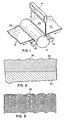
- the present invention relates to the manufacture of a grain chill roller as generally designated 10 in Figure 1.
- This Figure illustrates the use of the roller for applying a coating of resin to a web of photographic paper. More specifically, a web 12 of uncoated paper is fed between the roller 10 and a nip roller 14, and travels approximately 180 degrees around the roller 10 to a stripping roller 16. After the paper passes between rollers 10 and 16 it is pulled away from the chill roller.
- An extruder 18 delivers a curtain of hot, molten resin material 20, such as molten polyethylene, into the nip between rollers 10 and 14 so that the upper surface of the uncoated web 12 receives the molten resin.
- Cold water is circulated through the chill roller so that the molten resin is cooled as it travels between the nip roller 14 and the stripping roller 16.
- the coating 22 of resin material is firmly adhered to the upper surface of the paper.
- the surface texture on the chill roller's surface is embossed into the resin on the paper.
- the process of the present invention for manufacturing a roller 10 can be applied to cylindrical shells or base rollers of various kinds, for example, a steel shell designated 30 in Figure 2.
- a typical roller shell used for a chill roll can be approximately three feet in diameter and eight feet or more in length.
- the process of the invention is applicable to roller shells of substantially any size.
- Initially shell 30 is electroplated with a layer of copper 32 that substantially completely covers the surface of the shell 30.
- the electroplated copper layer seals any imperfections in the steel shell and provides a good bonding layer for the nickel layer described later.
- the hardness of the copper layer can vary over a wide range of values. More specifically, a layer hardness of between 45 HRB to 73 HRB has been found to be satisfactory for the process of this invention. A hardness of from 60-65 HRB is preferred.
- the copper layer 32 preferably has an average thickness of 0.010 to 0.015 inches, and can have an average thickness as small as 0.008 inches. In the prior manufacturing process described earlier in which layer 32 was engraved, a minimum thickness of 0.014 inches of copper was considered essential.
- the copper layer 32 is machined, preferably by using a diamond lathe cutting tool, to establish the cylindrical geometry of the chill roller and to produce a good surface finish 34.
- the finish of surface 34 after diamond turning is approximately 20 to 25 microinches Ra.
- Ra refers to the roughness average and is sometimes referred to as C.L.A. or AA.
- the roughness average is the arithmetic average of all departures of the roughness profile from the mean line. It is measured in microinches.
- a topograph of the diamond turned surface is illustrated in Figure 3. Drawing Figures 2 and 3 are aligned so that the surface characteristics shown in Figure 2 in section are directly above the corresponding portion of the surface shown in Figure 3.
- surface 34 of the copper layer 32 is abrasively blasted with glass beads to create a surface texture illustrated in Figure 4. More specifically, the surface texture comprises a multiplicity of hemispherical down features 36 that extend throughout the length and the circumference of the surface 34 of layer 32.
- the glass bead blasting operation preferably is carried out using an automated direct pressure system in which the nozzle feed rate, nozzle distance from the roller surface 34, the roller rotation rate during the blasting operation and the velocity of the glass particles are accurately controlled to essentially constant values.
- the hemispherical down features 36 formed during the glass bead blasting operation have a depth that is determined by the momentum of the glass beads as they strike the copper surface.
- the size of the glass beads is substantially uniform so that the mass of each bead is also constant.
- the momentum of the glass bead is dependent only on the velocity of the beads.
- the velocity of the beads is influenced by the nozzle geometry and the blasting pressure utilized. Since the nozzle geometry is constant, the air pressure is the only variable that determines the depth of the down features 36. Air pressure is controlled to a substantially constant pressure. Thus, the depth of the down features can be accurately controlled and a substantially uniform depth is obtained. Air pressures ranging from 3 to 7 psig are preferred for the process of the invention.
- the number of the down features 36 is determined by the bead size and the pattern depth. Larger bead diameters and deeper patterns result in fewer numbers of features in a given area. Therefore the number of features is inherently determined by the bead size and the pattern depth.
- the glass beads used conform to military size and shape specification MIL-G-9954A No. 4.
- the pattern depth obtained by bead blasting can be varied between about 500 to 700 microinches, but preferably is between 550 and 650 microinches. Because of the ductility of copper and the mass of the glass beads, extremely low pressures are required to achieve pattern depth within this range. Pattern depth within this range can be obtained with pressures of between 3 and 7 psig using a direct pressure blasting system.
- the process of the invention utilizing glass bead blasting is relatively insensitive to the hardness of the copper layer 32 as compared to the engraving step used in the prior process described at the beginning of this specification.
- copper hardness varying from 45 to 73 HRB have been used successfully with little effect on the blasting pressure required to obtain the desired pattern depth.
- the prior process using an engraving step required a copper hardness of between 45 and 55 HRB. If the copper layer were too hard, the engraving tool was unable to plastically deform the copper sufficiently to emboss the pattern on the roll surface, but if the copper was too soft any slight misalignment of the engraving tool caused unacceptable tool lines.
- the glass bead blasting step enables the thickness of the copper layer to be as small as 0.008 inches with no adverse effects whereas the prior engraving step required a minimum thickness of 0.014 inches of copper.
- the next step in the manufacture of the grain chill roll 10 is a surface texturing step for the copper layer 32.
- the preferred surface texturing process comprises abrasively blasting the surface of layer 32 with particles of silicon dioxide to modify the surface pattern shown in Figure 4 to the pattern shown in Figure 5.
- the pattern depth resulting from the silicon dioxide blasting step is controlled by the air pressure used since other factors such as bead size, mass of particle, etc., are constant.
- the surface texturing step can use silicon dioxide particles of between 100 and 150 U.S. standard mesh size particles.
- the resulting surface, designated 38 in Figure 6 retains the general pattern of down features shown at 36 in Figure 4, but introduces an increased number of smaller down patterns within the overall surface configuration.
- the final step in the process comprises bright nickel electroplating the blasted copper surface 38 to provide a surface layer of bright nickel designated 40 in Figure 6.
- the thickness of layer 40 is about 350 to 450 microinches.
- the bright nickel deposited during the electroplating step smoothes out the surface 38 of the copper layer and produces a reflective and durable surface. Because of the release characteristics of the bright nickel surface, the resin 20 will not adhere to the surface of the roller.
- the electroplating step is carefully controlled so that the final depth of the electroplated surface texture is within plus or minus 50 microinches. This will assure proper gloss and sensitometry of the resin coated paper prepared by the process described in connection with Figure 1.
- the leveling characteristics of the bright nickel plating process cause the resulting surface texture to be an inverse function of the plating time. More specifically, the longer plating time produces smoother, higher gloss surfaces. Knowing the surface texture of surface 38 before the plating process, the duration of plating is determined based on historical results and experience.
- Online inspection equipment can be used to indicate when the desired surface texture of electroplated nickel layer 40 has been achieved, and thus when to stop the plating step.
- This equipment may comprise a gloss meter capable of detecting small changes in specular reflection of the surface covered with a thin layer of liquid.
- the final surface texture achieved can be varied depending upon the characteristics that the manufacturer desires to impart to the resin coating applied to the web 12 by the process described hereinbefore with regard to Figure 1.
- Coated paper produced by the process described relative to Figure 1 using the chill grain roller 10 of the invention has a surface texture characteristic that is similar to prior grain chill rollers manufactured using a mechanical engraving step.
- eliminating the engraving step provides a number of desirable advantages. For example, any misalignment of the tool used for engraving produces tool lines in the surface which result in a directional or linear appearance to the surface texture leading to non-uniform paper product. Such lines are eliminated by the glass bead abrasive blasting step.
- the engraving process required a copper hardness within narrow limits, and a thicker copper layer.
- the prior process required a hardness of about 45 to 55 HRB and a minimum thickness of 0.014 inches for the copper layer compared to a hardness of about 45 to 73 HRB and a thickness of 0.008 inches for the process of the present invention.
- the cost of the engraving step is about 10 to 12 times more expensive than the bead blasting step that replaces it.
- the engraving step required 8 to 10 times as many man hours to complete as does the glass bead blasting step that replaces it.
Landscapes
- Chemical & Material Sciences (AREA)
- Materials Engineering (AREA)
- Physics & Mathematics (AREA)
- Engineering & Computer Science (AREA)
- Chemical Kinetics & Catalysis (AREA)
- General Physics & Mathematics (AREA)
- Spectroscopy & Molecular Physics (AREA)
- Electrochemistry (AREA)
- Metallurgy (AREA)
- Organic Chemistry (AREA)
- Shaping Of Tube Ends By Bending Or Straightening (AREA)
- Rolls And Other Rotary Bodies (AREA)
- Electroplating And Plating Baths Therefor (AREA)
- Electroplating Methods And Accessories (AREA)
Applications Claiming Priority (2)
| Application Number | Priority Date | Filing Date | Title |
|---|---|---|---|
| US248469 | 1988-09-23 | ||
| US07/248,469 US4875262A (en) | 1988-09-23 | 1988-09-23 | Process for manufacturing a grain chill roller |
Publications (2)
| Publication Number | Publication Date |
|---|---|
| EP0360192A1 true EP0360192A1 (fr) | 1990-03-28 |
| EP0360192B1 EP0360192B1 (fr) | 1993-11-24 |
Family
ID=22939276
Family Applications (1)
| Application Number | Title | Priority Date | Filing Date |
|---|---|---|---|
| EP89117221A Expired - Lifetime EP0360192B1 (fr) | 1988-09-23 | 1989-09-18 | Un procédé pour la fabrication d'un tambour de refroidissement granuleux |
Country Status (4)
| Country | Link |
|---|---|
| US (1) | US4875262A (fr) |
| EP (1) | EP0360192B1 (fr) |
| JP (1) | JP2914683B2 (fr) |
| DE (1) | DE68910915T2 (fr) |
Cited By (2)
| Publication number | Priority date | Publication date | Assignee | Title |
|---|---|---|---|---|
| FR2708940A1 (fr) * | 1993-08-12 | 1995-02-17 | Snecma | Procédé de durcissement de pièces métalliques. |
| WO2007011642A1 (fr) * | 2005-07-14 | 2007-01-25 | 3M Innovative Properties Company | Outil et procede de production et d'utilisation de ce dernier |
Families Citing this family (8)
| Publication number | Priority date | Publication date | Assignee | Title |
|---|---|---|---|---|
| DE19812445C2 (de) * | 1998-03-21 | 2000-12-07 | Schoeller Felix Jun Foto | Trägermaterial mit niedrigem Pitsniveau |
| US6287672B1 (en) | 1999-03-12 | 2001-09-11 | Rexam, Inc. | Bright metallized film laminate |
| US6344100B1 (en) | 1999-09-29 | 2002-02-05 | Robert A. Hipskind | Method of resurfacing a roll |
| US6858287B2 (en) | 2001-08-10 | 2005-02-22 | Soliant Llc | Formable bright film having discontinuous metallic layers |
| US20080173548A1 (en) * | 2007-01-23 | 2008-07-24 | Richard Lee Macary | Chrome plated articles of variable surface appearance |
| US8110500B2 (en) * | 2008-10-21 | 2012-02-07 | International Business Machines Corporation | Mitigation of plating stub resonance by controlling surface roughness |
| EP4729665A1 (fr) * | 2023-11-21 | 2026-04-22 | Nippon Steel Corporation | Tôle d'acier plaquée de cuivre |
| CN121729526A (zh) * | 2023-11-21 | 2026-03-24 | 日本制铁株式会社 | 镀铜钢板 |
Family Cites Families (3)
| Publication number | Priority date | Publication date | Assignee | Title |
|---|---|---|---|---|
| US2114072A (en) * | 1935-05-07 | 1938-04-12 | Ralph E Cleveland | Press roll for paper making machines and the method of making same |
| US3869535A (en) * | 1969-09-15 | 1975-03-04 | Stauffer Chemical Co | Embossing rollers and method of embossing |
| JPS54153940U (fr) * | 1978-03-23 | 1979-10-26 |
-
1988
- 1988-09-23 US US07/248,469 patent/US4875262A/en not_active Expired - Lifetime
-
1989
- 1989-09-18 DE DE68910915T patent/DE68910915T2/de not_active Expired - Fee Related
- 1989-09-18 EP EP89117221A patent/EP0360192B1/fr not_active Expired - Lifetime
- 1989-09-25 JP JP1248958A patent/JP2914683B2/ja not_active Expired - Lifetime
Non-Patent Citations (1)
| Title |
|---|
| PATENT ABSTRACTS OF JAPAN, unexamined applications, section P, vol. 6, no. 171, September 4, 1982 THE PATENT OFFICE JAPANESE GOVERNMENT page 62 P 140 * |
Cited By (3)
| Publication number | Priority date | Publication date | Assignee | Title |
|---|---|---|---|---|
| FR2708940A1 (fr) * | 1993-08-12 | 1995-02-17 | Snecma | Procédé de durcissement de pièces métalliques. |
| US5549809A (en) * | 1993-08-12 | 1996-08-27 | Societe Nationale D'etude Et De Construction De Moteurs D'aviation "Snecma" | Method for hardening metallic elements |
| WO2007011642A1 (fr) * | 2005-07-14 | 2007-01-25 | 3M Innovative Properties Company | Outil et procede de production et d'utilisation de ce dernier |
Also Published As
| Publication number | Publication date |
|---|---|
| JP2914683B2 (ja) | 1999-07-05 |
| EP0360192B1 (fr) | 1993-11-24 |
| DE68910915T2 (de) | 1994-05-19 |
| US4875262A (en) | 1989-10-24 |
| JPH02146308A (ja) | 1990-06-05 |
| DE68910915D1 (de) | 1994-01-05 |
Similar Documents
| Publication | Publication Date | Title |
|---|---|---|
| US4250135A (en) | Roller for producing continuous sueded or grit type finish and method of making | |
| US4875262A (en) | Process for manufacturing a grain chill roller | |
| EP0373481B1 (fr) | Rouleau de guidage de bande et procédé pour la réalisation d'un tel rouleau | |
| US20040003638A1 (en) | Transfer of holographic images into metal sporting and fitness products | |
| US5321889A (en) | Base drum of electrophotographic photoconductor and method for the preparation thereof | |
| US3752731A (en) | Plastic film made by a film casting article | |
| US5868957A (en) | Mold assembly for creating a solid-surface countertop having a built-up edge exhibiting a non-constant outer radius | |
| WO1987004095A1 (fr) | Procede de preparation de bases pour disques de memoire | |
| US4977656A (en) | Nickel coated shot blasted web conveying roller | |
| US5510143A (en) | Method and apparatus for impressing a pattern on flocked materials | |
| JPH0569014A (ja) | 圧延ロールの表面加工方法 | |
| US4352235A (en) | Method of producing a decorative, cylindrical, coated article | |
| EP1309423B1 (fr) | Finition de surfaces metalliques | |
| US4816295A (en) | Method for imparting an apparent finish to the surface of an article | |
| US5183551A (en) | Method for making a continous metal band having surface impressions | |
| JPH06279B2 (ja) | 鋼板圧延用ダルロ−ルの製造方法 | |
| US3069769A (en) | Process of making aluminum coated steel of high reflectivity | |
| JP2738004B2 (ja) | ディスクホイールの製造方法 | |
| JP3435105B2 (ja) | プラスチック製容器の移送工程において使用する摺接板の製造方法 | |
| JPS60102222A (ja) | 冷延プロセス用セラミツク溶射ロ−ル | |
| JPS63256207A (ja) | 圧延用ロ−ル | |
| WO1993008941A1 (fr) | Rouleau pour dispositif de coulee a deux rouleaux jumeles | |
| JPH0413403A (ja) | ダルロールおよびその製造方法 | |
| JPS5850549B2 (ja) | 凹凸模様を有する無機質板材の塗装方法 | |
| JPH02133581A (ja) | ステンレス意匠鋼板及びその製造方法 |
Legal Events
| Date | Code | Title | Description |
|---|---|---|---|
| PUAI | Public reference made under article 153(3) epc to a published international application that has entered the european phase |
Free format text: ORIGINAL CODE: 0009012 |
|
| AK | Designated contracting states |
Kind code of ref document: A1 Designated state(s): DE FR GB |
|
| 17P | Request for examination filed |
Effective date: 19900905 |
|
| 17Q | First examination report despatched |
Effective date: 19920312 |
|
| GRAA | (expected) grant |
Free format text: ORIGINAL CODE: 0009210 |
|
| AK | Designated contracting states |
Kind code of ref document: B1 Designated state(s): DE FR GB |
|
| REF | Corresponds to: |
Ref document number: 68910915 Country of ref document: DE Date of ref document: 19940105 |
|
| ET | Fr: translation filed | ||
| PLBE | No opposition filed within time limit |
Free format text: ORIGINAL CODE: 0009261 |
|
| STAA | Information on the status of an ep patent application or granted ep patent |
Free format text: STATUS: NO OPPOSITION FILED WITHIN TIME LIMIT |
|
| 26N | No opposition filed | ||
| PGFP | Annual fee paid to national office [announced via postgrant information from national office to epo] |
Ref country code: DE Payment date: 19951004 Year of fee payment: 7 |
|
| PG25 | Lapsed in a contracting state [announced via postgrant information from national office to epo] |
Ref country code: DE Effective date: 19970603 |
|
| PGFP | Annual fee paid to national office [announced via postgrant information from national office to epo] |
Ref country code: FR Payment date: 19980902 Year of fee payment: 10 |
|
| PG25 | Lapsed in a contracting state [announced via postgrant information from national office to epo] |
Ref country code: FR Free format text: LAPSE BECAUSE OF NON-PAYMENT OF DUE FEES Effective date: 20000531 |
|
| REG | Reference to a national code |
Ref country code: FR Ref legal event code: ST |
|
| REG | Reference to a national code |
Ref country code: GB Ref legal event code: IF02 |
|
| PGFP | Annual fee paid to national office [announced via postgrant information from national office to epo] |
Ref country code: GB Payment date: 20020808 Year of fee payment: 14 |
|
| PG25 | Lapsed in a contracting state [announced via postgrant information from national office to epo] |
Ref country code: GB Free format text: LAPSE BECAUSE OF NON-PAYMENT OF DUE FEES Effective date: 20030918 |
|
| GBPC | Gb: european patent ceased through non-payment of renewal fee |
Effective date: 20030918 |