EP0360210B1 - Dispositif de commande et procédé pour commander un inverseur pour la commande d'un moteur à courant alternatif - Google Patents
Dispositif de commande et procédé pour commander un inverseur pour la commande d'un moteur à courant alternatif Download PDFInfo
- Publication number
- EP0360210B1 EP0360210B1 EP89117283A EP89117283A EP0360210B1 EP 0360210 B1 EP0360210 B1 EP 0360210B1 EP 89117283 A EP89117283 A EP 89117283A EP 89117283 A EP89117283 A EP 89117283A EP 0360210 B1 EP0360210 B1 EP 0360210B1
- Authority
- EP
- European Patent Office
- Prior art keywords
- motor
- frequency
- current
- sampling
- control apparatus
- Prior art date
- Legal status (The legal status is an assumption and is not a legal conclusion. Google has not performed a legal analysis and makes no representation as to the accuracy of the status listed.)
- Expired - Lifetime
Links
- 238000000034 method Methods 0.000 title description 3
- 238000005070 sampling Methods 0.000 claims description 46
- 230000002159 abnormal effect Effects 0.000 claims description 24
- 230000033764 rhythmic process Effects 0.000 claims 1
- 238000010586 diagram Methods 0.000 description 17
- 239000013598 vector Substances 0.000 description 12
- 230000004907 flux Effects 0.000 description 4
- 230000006698 induction Effects 0.000 description 4
- 238000001228 spectrum Methods 0.000 description 3
- 230000010354 integration Effects 0.000 description 2
- 238000004804 winding Methods 0.000 description 2
- 230000005856 abnormality Effects 0.000 description 1
- 150000001875 compounds Chemical class 0.000 description 1
- 239000012141 concentrate Substances 0.000 description 1
- 239000004020 conductor Substances 0.000 description 1
- 230000003247 decreasing effect Effects 0.000 description 1
- 230000000694 effects Effects 0.000 description 1
- 230000002349 favourable effect Effects 0.000 description 1
- 230000001360 synchronised effect Effects 0.000 description 1
Images




Classifications
-
- H—ELECTRICITY
- H02—GENERATION; CONVERSION OR DISTRIBUTION OF ELECTRIC POWER
- H02M—APPARATUS FOR CONVERSION BETWEEN AC AND AC, BETWEEN AC AND DC, OR BETWEEN DC AND DC, AND FOR USE WITH MAINS OR SIMILAR POWER SUPPLY SYSTEMS; CONVERSION OF DC OR AC INPUT POWER INTO SURGE OUTPUT POWER; CONTROL OR REGULATION THEREOF
- H02M7/00—Conversion of AC power input into DC power output; Conversion of DC power input into AC power output
- H02M7/42—Conversion of DC power input into AC power output without possibility of reversal
- H02M7/44—Conversion of DC power input into AC power output without possibility of reversal by static converters
- H02M7/48—Conversion of DC power input into AC power output without possibility of reversal by static converters using discharge tubes with control electrode or semiconductor devices with control electrode
- H02M7/53—Conversion of DC power input into AC power output without possibility of reversal by static converters using discharge tubes with control electrode or semiconductor devices with control electrode using devices of a triode or transistor type requiring continuous application of a control signal
- H02M7/537—Conversion of DC power input into AC power output without possibility of reversal by static converters using discharge tubes with control electrode or semiconductor devices with control electrode using devices of a triode or transistor type requiring continuous application of a control signal using semiconductor devices only, e.g. single switched pulse inverters
- H02M7/5387—Conversion of DC power input into AC power output without possibility of reversal by static converters using discharge tubes with control electrode or semiconductor devices with control electrode using devices of a triode or transistor type requiring continuous application of a control signal using semiconductor devices only, e.g. single switched pulse inverters in a bridge configuration
- H02M7/53871—Conversion of DC power input into AC power output without possibility of reversal by static converters using discharge tubes with control electrode or semiconductor devices with control electrode using devices of a triode or transistor type requiring continuous application of a control signal using semiconductor devices only, e.g. single switched pulse inverters in a bridge configuration with automatic control of output voltage or current
- H02M7/53873—Conversion of DC power input into AC power output without possibility of reversal by static converters using discharge tubes with control electrode or semiconductor devices with control electrode using devices of a triode or transistor type requiring continuous application of a control signal using semiconductor devices only, e.g. single switched pulse inverters in a bridge configuration with automatic control of output voltage or current with digital control
-
- H—ELECTRICITY
- H02—GENERATION; CONVERSION OR DISTRIBUTION OF ELECTRIC POWER
- H02M—APPARATUS FOR CONVERSION BETWEEN AC AND AC, BETWEEN AC AND DC, OR BETWEEN DC AND DC, AND FOR USE WITH MAINS OR SIMILAR POWER SUPPLY SYSTEMS; CONVERSION OF DC OR AC INPUT POWER INTO SURGE OUTPUT POWER; CONTROL OR REGULATION THEREOF
- H02M7/00—Conversion of AC power input into DC power output; Conversion of DC power input into AC power output
- H02M7/42—Conversion of DC power input into AC power output without possibility of reversal
- H02M7/44—Conversion of DC power input into AC power output without possibility of reversal by static converters
- H02M7/48—Conversion of DC power input into AC power output without possibility of reversal by static converters using discharge tubes with control electrode or semiconductor devices with control electrode
- H02M7/53—Conversion of DC power input into AC power output without possibility of reversal by static converters using discharge tubes with control electrode or semiconductor devices with control electrode using devices of a triode or transistor type requiring continuous application of a control signal
- H02M7/537—Conversion of DC power input into AC power output without possibility of reversal by static converters using discharge tubes with control electrode or semiconductor devices with control electrode using devices of a triode or transistor type requiring continuous application of a control signal using semiconductor devices only, e.g. single switched pulse inverters
- H02M7/5387—Conversion of DC power input into AC power output without possibility of reversal by static converters using discharge tubes with control electrode or semiconductor devices with control electrode using devices of a triode or transistor type requiring continuous application of a control signal using semiconductor devices only, e.g. single switched pulse inverters in a bridge configuration
- H02M7/53871—Conversion of DC power input into AC power output without possibility of reversal by static converters using discharge tubes with control electrode or semiconductor devices with control electrode using devices of a triode or transistor type requiring continuous application of a control signal using semiconductor devices only, e.g. single switched pulse inverters in a bridge configuration with automatic control of output voltage or current
- H02M7/53875—Conversion of DC power input into AC power output without possibility of reversal by static converters using discharge tubes with control electrode or semiconductor devices with control electrode using devices of a triode or transistor type requiring continuous application of a control signal using semiconductor devices only, e.g. single switched pulse inverters in a bridge configuration with automatic control of output voltage or current with analogue control of three-phase output
- H02M7/53876—Conversion of DC power input into AC power output without possibility of reversal by static converters using discharge tubes with control electrode or semiconductor devices with control electrode using devices of a triode or transistor type requiring continuous application of a control signal using semiconductor devices only, e.g. single switched pulse inverters in a bridge configuration with automatic control of output voltage or current with analogue control of three-phase output based on synthesising a desired voltage vector via the selection of appropriate fundamental voltage vectors, and corresponding dwelling times
Definitions
- the present invention relates to a control method and a control apparatus for controlling an inverter for driving an AC motor, which are particularly capable of effectively using electromagnetic vibration tones, i.e., noises generated from an AC motor such as an induction motor or a synchronous motor driven by a PWM inverter.
- this abnormal state Upon occurrence of overcurrent, overspeed or abnormal state in a motor, this abnormal state is generally detected and displayed on a display device or informed of by means of an alarm device.
- An object of the present invention is to make electromagnetic vibration tones generated by an AC motor nonoffensive to the ear.
- Another object of the present invention is to inform of an abnormal state or the like of an AC motor by using electromagnetic vibration tones generated from the AC motor.
- the electromagnetic tone generated from the motor serves as an information tone, and it becomes nonoffensive to the ear and can be used as an alarm tone or the like.
- Fig. 1 is a circuit configuration diagram of a control apparatus of an inverter for driving an AC motor according to an embodiment of the present invention.
- Fig. 2 is a circuit configuration diagram of an inverter section.
- Figs. 3A to 3D are diagrams for illustrating the operation of the inverter section.
- Fig. 4 is a waveform diagram showing sampling pulses, voltage vectors, output voltage and output current.
- Fig. 5 is a diagram for illustrating the operation caused when an abnormal running state occurs.
- Fig. 6 is a diagram for illustrating contents of a data table.
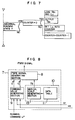
- Fig. 7 is a flow chart for illustrating contents of processing performed when an abnormal running state occurs.
- Fig. 8 is a configuration diagram of a control circuit showing another embodiment.
- Fig. 9 is a diagram showing relationship between musical interval and frequency.
- Fig. 10 is a characteristic diagram showing power spectrum distribution with respect to tone frequency.
- Figs. 11 to 15 are diagrams showing other embodiments.
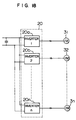
- Figs. 16 to 18 are configuration diagrams showing the case where the present invention is applied to a multi-inverter apparatus.
- Fig. 1 is a circuit configuration diagram of a control apparatus of an inverter for driving an AC motor according to an embodiment of the present invention.
- numeral 1 denotes a commercial three-phase AC power source
- numeral 2 denotes an inverter apparatus comprising an inverter section 2a and a converter section 2b.
- This inverter apparatus 2 is supplied with the output of the commercial three-phase AC power source 1 and outputs three-phase AC having voltages V u , V v and V w and a frequency f1 to drive a three-phase induction motor 3.
- Numeral 4 denotes a tachometer generator, 5 a current detector, 6 a base drive circuit, and 7 a control circuit.
- This control circuit 7 comprises a PWM signal generating section 8, a command value generating section 9, and a sampling period control section 10 which in turn comprises a data table 11 and an abnormal state detecting section 12.
- the command value generating section 9 calculates and outputs a voltage command value V* and an inverter frequency command value f I * on the basis of a detected current value i f and a detected speed value ⁇ f detected respectively by the current detector 5 and the tachometer generator 4.
- This command value generating section 9 is provided to calculate a torque, which should be applied to the motor in order to correct the deviation of the motor speed ⁇ f from the command value ⁇ *, on the basis of the above described deviation and the detected current value i f and then calculate the voltage command V* and the frequency command value f I * corresponding to the torque.
- this command value generating section 9 a circuit as shown in 1988 National Convention Record, IEE of Japan -Industry Application Society- Report No. 74, for example, is used. Upon receiving these command values, the PWM signal generating section 8 generates a PWM signal. This PWM signal is supplied to respective switching devices included in the inverter section 2a via the base drive circuit 6.
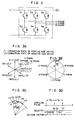
- Fig. 2 is a circuit configuration diagram of the inverter section 2a.
- Figs. 3A to 3D are diagrams for illustrating the operation of the inverter section 2a. The method for generating the PWM signal will now be described by referring to Figs. 2 and 3A to 3D.
- switching states of switching devices S1 to S6 of the inverter section 2a there are eight combinations, i.e., (0, 0, 0), (1, 0, 0), (1, 1, 0), (0, 1, 0), (0, 1, 1), (0, 0, 1), (1, 0, 1) and (1, 1, 1).
- Each set represents successively states of switching devices of phases U, V and W.
- "1" represents a state under which a switching device of positive side of one phase is conducting and a switching device of negative side of the phase is nonconducting
- 0 represents a state under which a switching device of positive side of one phase is nonconducting and a switching device of the phase is conducting.
- Voltage vectors V0 to V7 corresponding to these states become as shown in Fig. 3A.
- a vector ⁇ of magnetic flux generated by a stationary primary winding of the three-phase induction motor 3 so as to make interlinkage with a rotary secondary winding or a rotary cage conductor draws a circle rotating with an angular velocity ⁇ as shown in Fig. 3B.
- the voltage vectors V0 to V7 are selected so that the magnetic flux vector may change along a circle drawn by the interlinkage magnetic flux vector ⁇ .
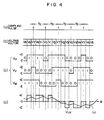
- Figs. 4(a) to 4(d) are waveform diagrams showing the sampling pulse, voltage vector, output voltage and output current.
- the period T s of the sampling pulse is defined by the sampling period control section 10.
- the abnormal state detecting section 12 always monitors the detected current value i f and the detected speed value ⁇ f by comparing them with their limit values respectively set. Under a normal running state with respective detected values less than limit values, the abnormal state detecting section 10 outputs the constant sampling period T s .
- the frequency of the electromagnetic vibration tone generated from the motor changes from nearly 1/T s0 successively to nearly 1/T s1 , 1/T s2 , 1/T s3 and so on. Therefore, it is possible to inform of the abnormal running state by such a change in electromagnetic vibration tone.
- the sampling period control section 10 is provided. As shown in Fig. 6, the sampling periods T s1 , T s2 , T s3 , ---, T sn under the abnormal running state are so stored into the data table 11 as to be associated with their durations L1, L2, L3, ---, L n . When the abnormal running state is detected, these data are called by the abnormal state detecting section 12.
- the sampling period T s0 under the normal running state is changed successively to sampling periods T s1 , T s2 and so on under the abnormal running state and outputted. Durations L1, L2 ---, L n have such length that the human ear can distinguish the tone change, and are preferably 100 ms to several seconds.
- an alarm informing of this fact can be conveyed as a tone change by using an electromagnetic vibration tone generated from the motor. Therefore, it is not necessary to specially provide a display device or an alarm device for informing of the abnormal running state unlike the prior art. As a result, the apparatus can be provided at a lower cost.
- Fig. 8 shows another embodiment of the present invention.
- Fig. 8 is a configuration diagram of a control circuit capable of producing a musical sound at the normal running state of the motor.
- the sampling period control section 13 included in the control circuit 7 comprises the data table 11 and a musical scale generating section 13. If data of the sampling period T s stored in the data table 11 is so set as to be limited to one period of the frequency of each musical interval of the musical scale included in music, it is possible to make the electromagnetic vibration tone of the motor nearly equivalent to the frequency of each musical interval of the musical scale.
- Fig. 9 shows relationship between musical interval and frequency.
- reference tone (la) has a frequency of 440 Hz
- (la) higher than that by one octave has a frequency of 880 Hz.
- frequencies of respective musical intervals are defined.
- the power of the electromagnetic vibration tone of the motor becomes large at lower frequencies and small at higher frequencies.
- power spectrum distribution of comfortable tone with respect to frequency has large power in a low frequency region and has small power in a high frequency region as shown in Fig. 10. Therefore, it is known that the power spectrum distribution of Fig. 10 is also attained by making the electromagnetic vibration tones music as in the present embodiment, resulting in comfortable feeling.
- Figs. 11 and 12 show other embodiments of the present invention.
- the ripple frequency of the motor current is directly detected, and the sampling period is so changed as to attain the desired ripple frequency.
- the command value T s * of the sampling period is supplied from the abnormal state detecting section 12 shown in Fig. 11 or the musical scale generating section 13 to a comparing and calculating section 701.
- the comparing and calculating section 701 performs the following proportion calculation and integration to derive the sampling period T s .
- K P and K I are proportion constant and integration constant, respectively.
- the precision in setting the ripple frequency of the motor current becomes high. It is thus possible to set the frequency of the electromagnetic tone generated from the motor at a predetermined value with higher precision so much.
- Figs. 13 and 14 show other embodiments of the present invention.
- the command value of the current ripple frequency outputted from the sampling period control section 10 is inputted to a function generating section 705, which in turn outputs a permissible change width ⁇ i* of current ripple.
- a comparing and calculating section 703 applies comparison and calculation to an instantaneous current command value i* outputted from an instantaneous current command generating section 704, the detected motor current value i f , and the ⁇ i* to derive the PWM signal.
- the frequency of current ripple is changed from f r1 to f r2 . If ⁇ i1* ⁇ ⁇ i2*, the relation f r1 > f r2 generally holds true. By controlling ⁇ i* according to this relation, the ripple frequency f r of the motor current i f can be made equal to the desired value f r *.
- Fig. 16 shows another embodiment of the present invention.
- Fig. 16 is a circuit configuration diagram showing the case where the present invention is applied to a multi-inverter apparatus.
- An inverter apparatus 20 comprises a plurality of unit inverters 20a to 20n run so as to have running phases shifted by respectively. Their output voltages are summed up by a multiple transformer 30. The resultant voltage is supplied to a three-phase induction motor 3 to drive the motor 3.
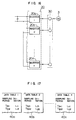
- each unit inverter is associated with a circuit equivalent to the control circuit shown in Fig. 1. Sampling periods and their durations as shown in Fig. 17 stored beforehand into data tables 40a to 40n respectively associated with the unit inverters 20a to 20n. By doing so, the electromagnetic vibration tone generated from the motor 3 becomes a compound of frequencies nearly equivalent to sampling frequencies of the unit inverters.
- the information tone generated as the electromagnetic vibration tone when an abnormal running state has been detected can be made more complex than that of the above described embodiments. If a combination of frequencies to be composed is made to agree with frequency components of voice, for example, the information tone can be changed to a voice message such as a message "overspeed has occurred in the motor" to inform of the abnormal running state more clearly.
- the present invention is applied to house hold appliances using a PWM inverter drive motor system, it is possible to use effectively the electromagnetic vibration tones as an alarm, a message or BGM (background music), resulting in favorable feeling of use without noises.
- BGM background music
- the present embodiment is applied to a plant system using a PWM inverter drive motor system, it becomes possible to use effectively the electromagnetic vibration tones especially as an alarm when abnormality occurs in the system.
Landscapes
- Engineering & Computer Science (AREA)
- Power Engineering (AREA)
- Control Of Ac Motors In General (AREA)
Claims (6)
- Dispositif de commande pour commander au moins un onduleur MID (2), qui reçoit une puissance en courant alternatif et produit un signal de sortie en courant alternatif possédant une fréquence commandée et devant être envoyé à au moins un moteur à courant alternatif (3) pour entraîner le ou lesdits moteurs au moyen d'un courant if et à une vitesse ωf, ledit dispositif de commande comprenant :
des moyens de commande (7) contenant des moyens générateurs de valeur de commande (9) pour produire une valeur de commande pour une fréquence de sortie de l'onduleur (2) basée sur une commande de vitesse ω* du moteur, appliquée de l'extérieur aux moyens générateurs, et des moyens générateurs de signal MID (8) pour échantillonner périodiquement la valeur de commande à une fréquence d'échantillonnage donnée et produire, sur la base de la valeur de commande échantillonnée, un signal MID pour commander l'onduleur;
caractérisé en ce
qu'une section de détection d'état anormal (12) contrôle la valeur détectée du courant if et la valeur détectée de la vitesse ωf moyennant leur comparaison à leurs valeurs limites iLIM et ωLIM respectivement réglées;
dans un état de fonctionnement normal, avec des valeurs respectives détectées inférieures auxdites valeurs limites, la section de détection d'état anormal (12) délivre une période d'échantillonnage constante Ts; et
lorsque les valeurs détectées du courant if et de la vitesse ωf dépassent ladite valeur limite iLIM du courant et ladite valeur limite ωLIM de la vitesse, la période d'échantillonnage suivante Ts est modifiée en fonction de valeurs mémorisées au préalable de périodes d'échantillonnage et de leurs durées L dans une table (11), ce qui a pour effet que ledit moteur à courant alternatif (3) produit des fréquences de vibrations électromagnétiques, qui correspondent à ces périodes d'échantillonnage Tsn. - Dispositif de commande selon la revendication 1, dans lequel lesdits moyens de commande (7) comprennent des moyens (702) pour détecter une fréquence d'ondulation fr dudit courant if du moteur, et des moyens (701) pour commander le courant if du moteur de sorte que la fréquence d'ondulation détectée prend une valeur fr* choisie.
- Dispositif de commande selon la revendication 1, dans lequel lesdits moyens de commande (7) comprennent des moyens pour détecter l'amplitude du courant d'ondulation dudit courant if du moteur et des moyens (701) pour commander la durée de variation de ladite amplitude du courant d'ondulation détecté de manière qu'elle se situe dans une gamme sélectionnée.
- Dispositif de commande selon l'une des revendications 2 ou 3, dans lequel ladite fréquence d'échantillonnage est commandée de manière à diminuer lorsque la puissance de la fréquence de vibration électromagnétique dudit moteur augmente.
- Dispositif de commande selon la revendication 2, dans lequel dans ladite table (11) sont mémorisés par avance des profils de variation de la période d'échantillonnage et sa durée, et dans lequel lesdites périodes d'échantillonnage sont commandées en fonction desdits profils mémorisés de sorte que la fréquence de vibration électromagnétique possède un rythme représentant l'état de fonctionnement du moteur à courant alternatif (3).
- Dispositif de commande selon la revendication 1, caractérisé en ce que l'onduleur MID comprend une pluralité d'unités d'onduleurs MID (20a, 20b, ... 20n), dont chacune reçoit la puissanceen courant alternatif et produit un signal de sortie à courant alternatif possédant une fréquence commandée de sorte que le moteur à courant alternatif est entraîné par une combinaison des signaux de sortie des unités d'onduleurs MID,
que les moyens de production de valeurs de commande (9), les moyens de production de signal MID (8) et les moyens de commande de fréquence d'échantillonnage (10) sont prévus pour chacune des unités d' onduleurs MID, et
que la fréquence d'échantillonnage dans les moyens de production de signal MID est commandée dans chacune des unités d'onduleurs MID de sorte que le moteur à courant alternatif produit une fréquence électromagnétique présélectionnée lorsque le moteur à courant alternatif est commandé par une combinaison des signaux de sortie des unités d'onduleurs MID.
Applications Claiming Priority (2)
| Application Number | Priority Date | Filing Date | Title |
|---|---|---|---|
| JP233619/88 | 1988-09-20 | ||
| JP23361988 | 1988-09-20 |
Publications (3)
| Publication Number | Publication Date |
|---|---|
| EP0360210A2 EP0360210A2 (fr) | 1990-03-28 |
| EP0360210A3 EP0360210A3 (en) | 1990-11-28 |
| EP0360210B1 true EP0360210B1 (fr) | 1994-06-22 |
Family
ID=16957885
Family Applications (1)
| Application Number | Title | Priority Date | Filing Date |
|---|---|---|---|
| EP89117283A Expired - Lifetime EP0360210B1 (fr) | 1988-09-20 | 1989-09-19 | Dispositif de commande et procédé pour commander un inverseur pour la commande d'un moteur à courant alternatif |
Country Status (3)
| Country | Link |
|---|---|
| US (1) | US4965504A (fr) |
| EP (1) | EP0360210B1 (fr) |
| DE (1) | DE68916350T2 (fr) |
Families Citing this family (27)
| Publication number | Priority date | Publication date | Assignee | Title |
|---|---|---|---|---|
| DE3912706A1 (de) * | 1989-04-18 | 1990-10-25 | Siemens Ag | Verfahren zum geraeuscharmen betrieb einer von einem pulswechselrichter gespeisten maschine |
| JPH0378490A (ja) * | 1989-08-18 | 1991-04-03 | Fujitsu Ltd | スピンドルモータのpwm制御方式 |
| US5418932A (en) * | 1990-02-01 | 1995-05-23 | Hitachi, Ltd. | Generation of width modulated pulses by relatively adjusting rising and falling edges upon comparison of counter with programmably stored values |
| US5483167A (en) * | 1992-09-08 | 1996-01-09 | Mitsubishi Denki Kabushiki Kaisha | Computer controlled ground detecting method for inverter unit and apparatus therefor |
| JP2846203B2 (ja) * | 1992-12-09 | 1999-01-13 | 三菱電機株式会社 | 並列多重インバータ装置 |
| US5473497A (en) * | 1993-02-05 | 1995-12-05 | Franklin Electric Co., Inc. | Electronic motor load sensing device |
| IT1266377B1 (it) * | 1993-05-31 | 1996-12-27 | Merloni Antonio Spa | Metodo di alimentazione di motori elettrici a induzione mediante inverter elettronici |
| US5625545A (en) * | 1994-03-01 | 1997-04-29 | Halmar Robicon Group | Medium voltage PWM drive and method |
| US5528446A (en) * | 1994-07-05 | 1996-06-18 | Ford Motor Company | Integrated power module diagnostic unit |
| JP3091388B2 (ja) * | 1995-04-19 | 2000-09-25 | ファナック株式会社 | モータの暴走検出方法および暴走検出装置 |
| JPH0923501A (ja) * | 1995-07-03 | 1997-01-21 | Hitachi Ltd | 電気車制御装置 |
| US5656912A (en) * | 1995-09-29 | 1997-08-12 | A. O. Smith Corporation | Method and apparatus for controlling a motor |
| JPH1023756A (ja) * | 1996-06-28 | 1998-01-23 | Mitsubishi Electric Corp | 電圧形インバータ装置及びその制御方法 |
| US6226324B1 (en) | 1997-12-17 | 2001-05-01 | The Foxboro Company | Methods and systems for trimming a PWM signal |
| KR100318228B1 (ko) * | 1998-07-30 | 2002-04-22 | 윤종용 | 냉장고의압축기제어방법 |
| DE19938670A1 (de) * | 1999-08-14 | 2001-05-17 | Braun Gmbh | Als elektro-akustischer Wandler angesteuerter elektrischer Elektromotor |
| US6239991B1 (en) * | 2000-08-21 | 2001-05-29 | Nidec America Corporation | Control circuit compensating for malfunction of pulse width modulation circuitry |
| JP3978348B2 (ja) * | 2002-02-14 | 2007-09-19 | 株式会社日立エルジーデータストレージ | 光ディスク装置及び光ピックアップの移動制御方法 |
| JP2008099412A (ja) * | 2006-10-11 | 2008-04-24 | Futaba Corp | モータ制御装置 |
| JP4833812B2 (ja) * | 2006-11-30 | 2011-12-07 | パナソニック株式会社 | Pwm駆動装置及びその出力オフセット補正方法 |
| JP2008295161A (ja) * | 2007-05-23 | 2008-12-04 | Daikin Ind Ltd | 電力変換装置 |
| JP5205461B2 (ja) * | 2008-08-28 | 2013-06-05 | 日産自動車株式会社 | 車両の作動音制御装置及び制御方法 |
| JP4877397B2 (ja) * | 2010-01-22 | 2012-02-15 | 株式会社デンソー | 電流センサの異常診断装置、およびセンサの異常診断装置 |
| US20140043870A1 (en) * | 2012-08-07 | 2014-02-13 | Yaskawa America, Inc. | Three phase boost converter to achieve unity power factor and low input current harmonics for use with ac to dc rectifiers |
| US9914228B1 (en) * | 2016-08-31 | 2018-03-13 | Michael Matthews | Smart clipper |
| FR3072227B1 (fr) * | 2017-10-06 | 2019-10-18 | Foundation Brakes France Sas | Moteur electrique emetteur de son |
| CN113691173A (zh) * | 2021-07-23 | 2021-11-23 | 江苏东成工具科技有限公司 | 一种电流控制方法 |
Family Cites Families (6)
| Publication number | Priority date | Publication date | Assignee | Title |
|---|---|---|---|---|
| JPS5944975A (ja) * | 1982-09-03 | 1984-03-13 | Hitachi Ltd | Pwmインバ−タの制御方法および装置 |
| US4470092A (en) * | 1982-09-27 | 1984-09-04 | Allen-Bradley Company | Programmable motor protector |
| JPS59122392A (ja) * | 1982-12-27 | 1984-07-14 | Hitachi Ltd | 誘導電動機の制御装置 |
| US4467260A (en) * | 1983-04-20 | 1984-08-21 | Westinghouse Electric Corp. | Motor control apparatus with rotor heating protection |
| EP0175154B1 (fr) * | 1984-08-21 | 1991-11-06 | Hitachi, Ltd. | Méthode pour commander un moteur à induction par un convertisseur |
| JPH07118956B2 (ja) * | 1987-02-17 | 1995-12-18 | 株式会社明電舎 | ベクトル制御装置 |
-
1989
- 1989-09-13 US US07/406,516 patent/US4965504A/en not_active Expired - Fee Related
- 1989-09-19 DE DE68916350T patent/DE68916350T2/de not_active Expired - Fee Related
- 1989-09-19 EP EP89117283A patent/EP0360210B1/fr not_active Expired - Lifetime
Also Published As
| Publication number | Publication date |
|---|---|
| DE68916350T2 (de) | 1994-12-08 |
| US4965504A (en) | 1990-10-23 |
| EP0360210A2 (fr) | 1990-03-28 |
| DE68916350D1 (de) | 1994-07-28 |
| EP0360210A3 (en) | 1990-11-28 |
Similar Documents
| Publication | Publication Date | Title |
|---|---|---|
| EP0360210B1 (fr) | Dispositif de commande et procédé pour commander un inverseur pour la commande d'un moteur à courant alternatif | |
| US4656572A (en) | PWM inverter | |
| US6922037B2 (en) | Rotating induction apparatus | |
| US5872435A (en) | Electrical drive arrangement | |
| JP2000505638A (ja) | 直接トルク制御インバータ装置 | |
| EP0078698B1 (fr) | Méthode et disposition de commande pour moteur à courant alternatif | |
| US5422557A (en) | Method and apparatus for controlling the speed of a single phase induction motor using frequency variation | |
| US4565955A (en) | Synchronous motor device for timepiece | |
| JPS5915478B2 (ja) | 交流電動機を運転する方法および装置 | |
| US4924168A (en) | Control apparatus for PWM-controlled, variable voltage/variable frequency inverters | |
| JPH0789753B2 (ja) | 交流電動機駆動用インバータの制御装置 | |
| HK10792A (en) | Apparatus for controlling a three-phase inverter supplying the a.c. motor of a lift | |
| CA2129322A1 (fr) | Commande par flux statorique | |
| EP0600635A2 (fr) | Système onduleur multiple en connexion parallèle et méthode de contrôle pour celui-ci | |
| JPH04200294A (ja) | インバータ装置 | |
| JPH0314000Y2 (fr) | ||
| CA1296384C (fr) | Methode de commande pour convertisseur de frequence et convertisseur utilisant cette methode | |
| JPH05344740A (ja) | インバータ装置 | |
| EP0293844A2 (fr) | Dispositif de commande pour onduleurs à tension variable/fréquence variable à modulation d'impulsion | |
| GB2171266A (en) | PWM inverter | |
| SU1302416A1 (ru) | Регул тор частоты электромашинного преобразовател посто нного напр жени в переменное | |
| JPH0145275Y2 (fr) | ||
| JP2852083B2 (ja) | インバータのpwm制御法及びpwmインバータ | |
| JPH01218363A (ja) | インバータ制御装置 | |
| RU2001500C1 (ru) | Способ формировани трехфазного напр жени , подводимого к асинхронному двигателю при питании его от однофазной сети |
Legal Events
| Date | Code | Title | Description |
|---|---|---|---|
| PUAI | Public reference made under article 153(3) epc to a published international application that has entered the european phase |
Free format text: ORIGINAL CODE: 0009012 |
|
| AK | Designated contracting states |
Kind code of ref document: A2 Designated state(s): DE FR GB NL SE |
|
| PUAL | Search report despatched |
Free format text: ORIGINAL CODE: 0009013 |
|
| AK | Designated contracting states |
Kind code of ref document: A3 Designated state(s): DE FR GB NL SE |
|
| 17P | Request for examination filed |
Effective date: 19901106 |
|
| 17Q | First examination report despatched |
Effective date: 19921228 |
|
| GRAA | (expected) grant |
Free format text: ORIGINAL CODE: 0009210 |
|
| RBV | Designated contracting states (corrected) |
Designated state(s): DE FR NL SE |
|
| AK | Designated contracting states |
Kind code of ref document: B1 Designated state(s): DE FR NL SE |
|
| REF | Corresponds to: |
Ref document number: 68916350 Country of ref document: DE Date of ref document: 19940728 |
|
| ET | Fr: translation filed | ||
| EAL | Se: european patent in force in sweden |
Ref document number: 89117283.5 |
|
| PLBE | No opposition filed within time limit |
Free format text: ORIGINAL CODE: 0009261 |
|
| STAA | Information on the status of an ep patent application or granted ep patent |
Free format text: STATUS: NO OPPOSITION FILED WITHIN TIME LIMIT |
|
| 26N | No opposition filed | ||
| PGFP | Annual fee paid to national office [announced via postgrant information from national office to epo] |
Ref country code: FR Payment date: 19950718 Year of fee payment: 7 |
|
| PGFP | Annual fee paid to national office [announced via postgrant information from national office to epo] |
Ref country code: SE Payment date: 19950724 Year of fee payment: 7 |
|
| PGFP | Annual fee paid to national office [announced via postgrant information from national office to epo] |
Ref country code: NL Payment date: 19950929 Year of fee payment: 7 |
|
| PGFP | Annual fee paid to national office [announced via postgrant information from national office to epo] |
Ref country code: DE Payment date: 19951130 Year of fee payment: 7 |
|
| PG25 | Lapsed in a contracting state [announced via postgrant information from national office to epo] |
Ref country code: SE Effective date: 19960920 |
|
| PG25 | Lapsed in a contracting state [announced via postgrant information from national office to epo] |
Ref country code: FR Effective date: 19960930 |
|
| PG25 | Lapsed in a contracting state [announced via postgrant information from national office to epo] |
Ref country code: NL Effective date: 19970401 |
|
| NLV4 | Nl: lapsed or anulled due to non-payment of the annual fee |
Effective date: 19970401 |
|
| PG25 | Lapsed in a contracting state [announced via postgrant information from national office to epo] |
Ref country code: DE Effective date: 19970603 |
|
| EUG | Se: european patent has lapsed |
Ref document number: 89117283.5 |
|
| REG | Reference to a national code |
Ref country code: FR Ref legal event code: ST |
|
| REG | Reference to a national code |
Ref country code: FR Ref legal event code: ST |