EP0360379A2 - Reaktor und Verfahren zur Erzeugung von Russ hoher Oberflächenaktivität - Google Patents
Reaktor und Verfahren zur Erzeugung von Russ hoher Oberflächenaktivität Download PDFInfo
- Publication number
- EP0360379A2 EP0360379A2 EP89305567A EP89305567A EP0360379A2 EP 0360379 A2 EP0360379 A2 EP 0360379A2 EP 89305567 A EP89305567 A EP 89305567A EP 89305567 A EP89305567 A EP 89305567A EP 0360379 A2 EP0360379 A2 EP 0360379A2
- Authority
- EP
- European Patent Office
- Prior art keywords
- chamber
- carbon black
- hot gas
- flow
- feedstock hydrocarbon
- Prior art date
- Legal status (The legal status is an assumption and is not a legal conclusion. Google has not performed a legal analysis and makes no representation as to the accuracy of the status listed.)
- Withdrawn
Links
- 239000006229 carbon black Substances 0.000 title claims abstract description 73
- 230000000694 effects Effects 0.000 title claims abstract description 23
- 238000004519 manufacturing process Methods 0.000 title claims description 12
- 238000000034 method Methods 0.000 title claims description 8
- 241000872198 Serjania polyphylla Species 0.000 title abstract description 5
- 239000004215 Carbon black (E152) Substances 0.000 claims abstract description 62
- 229930195733 hydrocarbon Natural products 0.000 claims abstract description 62
- 150000002430 hydrocarbons Chemical class 0.000 claims abstract description 62
- 238000006243 chemical reaction Methods 0.000 claims description 56
- 239000000376 reactant Substances 0.000 claims description 27
- 238000004891 communication Methods 0.000 claims description 7
- 230000007423 decrease Effects 0.000 claims description 2
- 238000011144 upstream manufacturing Methods 0.000 claims 2
- 239000002245 particle Substances 0.000 abstract description 19
- 235000019241 carbon black Nutrition 0.000 description 67
- 239000007789 gas Substances 0.000 description 41
- 238000002485 combustion reaction Methods 0.000 description 29
- 239000000571 coke Substances 0.000 description 8
- OKTJSMMVPCPJKN-UHFFFAOYSA-N Carbon Chemical compound [C] OKTJSMMVPCPJKN-UHFFFAOYSA-N 0.000 description 7
- QVGXLLKOCUKJST-UHFFFAOYSA-N atomic oxygen Chemical compound [O] QVGXLLKOCUKJST-UHFFFAOYSA-N 0.000 description 7
- 229920001971 elastomer Polymers 0.000 description 7
- 238000002347 injection Methods 0.000 description 7
- 239000007924 injection Substances 0.000 description 7
- 239000001301 oxygen Substances 0.000 description 7
- 229910052760 oxygen Inorganic materials 0.000 description 7
- 239000007921 spray Substances 0.000 description 7
- XLYOFNOQVPJJNP-UHFFFAOYSA-N water Substances O XLYOFNOQVPJJNP-UHFFFAOYSA-N 0.000 description 7
- 229910052799 carbon Inorganic materials 0.000 description 6
- 239000000806 elastomer Substances 0.000 description 6
- 239000001257 hydrogen Substances 0.000 description 6
- 229910052739 hydrogen Inorganic materials 0.000 description 6
- UFHFLCQGNIYNRP-UHFFFAOYSA-N Hydrogen Chemical compound [H][H] UFHFLCQGNIYNRP-UHFFFAOYSA-N 0.000 description 4
- 239000000567 combustion gas Substances 0.000 description 4
- 150000001875 compounds Chemical class 0.000 description 3
- 239000000463 material Substances 0.000 description 3
- 244000043261 Hevea brasiliensis Species 0.000 description 2
- 239000005062 Polybutadiene Substances 0.000 description 2
- 230000008030 elimination Effects 0.000 description 2
- 238000003379 elimination reaction Methods 0.000 description 2
- 150000002431 hydrogen Chemical class 0.000 description 2
- VNWKTOKETHGBQD-UHFFFAOYSA-N methane Chemical compound C VNWKTOKETHGBQD-UHFFFAOYSA-N 0.000 description 2
- 239000000203 mixture Substances 0.000 description 2
- 229920003052 natural elastomer Polymers 0.000 description 2
- 229920001194 natural rubber Polymers 0.000 description 2
- 230000000704 physical effect Effects 0.000 description 2
- 229920002857 polybutadiene Polymers 0.000 description 2
- 230000007847 structural defect Effects 0.000 description 2
- 238000005299 abrasion Methods 0.000 description 1
- 230000015572 biosynthetic process Effects 0.000 description 1
- 239000000356 contaminant Substances 0.000 description 1
- 238000011109 contamination Methods 0.000 description 1
- 238000005336 cracking Methods 0.000 description 1
- 239000012530 fluid Substances 0.000 description 1
- 239000000446 fuel Substances 0.000 description 1
- 229910002804 graphite Inorganic materials 0.000 description 1
- 239000010439 graphite Substances 0.000 description 1
- 239000012535 impurity Substances 0.000 description 1
- 239000000976 ink Substances 0.000 description 1
- 238000012986 modification Methods 0.000 description 1
- 230000004048 modification Effects 0.000 description 1
- 239000003345 natural gas Substances 0.000 description 1
- 239000003973 paint Substances 0.000 description 1
- 230000002093 peripheral effect Effects 0.000 description 1
- 230000010399 physical interaction Effects 0.000 description 1
- 239000000049 pigment Substances 0.000 description 1
- 239000004033 plastic Substances 0.000 description 1
- 229920003023 plastic Polymers 0.000 description 1
- 238000011027 product recovery Methods 0.000 description 1
- 238000000197 pyrolysis Methods 0.000 description 1
- 239000002994 raw material Substances 0.000 description 1
- 230000002787 reinforcement Effects 0.000 description 1
- 239000005060 rubber Substances 0.000 description 1
- 230000035939 shock Effects 0.000 description 1
- 229920003048 styrene butadiene rubber Polymers 0.000 description 1
Images
Classifications
-
- C—CHEMISTRY; METALLURGY
- C09—DYES; PAINTS; POLISHES; NATURAL RESINS; ADHESIVES; COMPOSITIONS NOT OTHERWISE PROVIDED FOR; APPLICATIONS OF MATERIALS NOT OTHERWISE PROVIDED FOR
- C09C—TREATMENT OF INORGANIC MATERIALS, OTHER THAN FIBROUS FILLERS, TO ENHANCE THEIR PIGMENTING OR FILLING PROPERTIES ; PREPARATION OF CARBON BLACK ; PREPARATION OF INORGANIC MATERIALS WHICH ARE NO SINGLE CHEMICAL COMPOUNDS AND WHICH ARE MAINLY USED AS PIGMENTS OR FILLERS
- C09C1/00—Treatment of specific inorganic materials other than fibrous fillers; Preparation of carbon black
- C09C1/44—Carbon
- C09C1/48—Carbon black
-
- C—CHEMISTRY; METALLURGY
- C09—DYES; PAINTS; POLISHES; NATURAL RESINS; ADHESIVES; COMPOSITIONS NOT OTHERWISE PROVIDED FOR; APPLICATIONS OF MATERIALS NOT OTHERWISE PROVIDED FOR
- C09C—TREATMENT OF INORGANIC MATERIALS, OTHER THAN FIBROUS FILLERS, TO ENHANCE THEIR PIGMENTING OR FILLING PROPERTIES ; PREPARATION OF CARBON BLACK ; PREPARATION OF INORGANIC MATERIALS WHICH ARE NO SINGLE CHEMICAL COMPOUNDS AND WHICH ARE MAINLY USED AS PIGMENTS OR FILLERS
- C09C1/00—Treatment of specific inorganic materials other than fibrous fillers; Preparation of carbon black
- C09C1/44—Carbon
- C09C1/48—Carbon black
- C09C1/50—Furnace black ; Preparation thereof
Definitions
- the present invention relates to reactors and methods for the production of carbon black. More particularly, the present invention relates to reactors and methods for the production of carbon black having a high surface activity.
- carbon black is produced by injecting a hydrocarbon raw material (hereinafter called "feedstock hydrocarbon") into a flow of hot oxygen-containing gas wherein the feedstock hydrocarbon is partially pyrolyzed before being quenched by a water spray.
- feedstock hydrocarbon a hydrocarbon raw material
- the hot gas is produced by burning a fuel in a combustion chamber.
- the combustion chamber is in open axial communication with a cylindrical reactor and the hot gas produced in the combustion chamber flows through the reactor, where the feedstock hydrocarbon is introduced into the flow of hot gas.
- Carbon black is used in a variety of applications which are well known to those skilled in the art. Carbon black is primarily used to reinforce elastomeric compounds such as the rubber in automobile tires. Carbon black is also used as a black pigment in inks, paints, plastics, xerographic toner, and elastomeric compounds.
- the surface activity is such a physical property of carbon black.
- the surface activity of a carbon black is defined as the ability of the carbon black to interact physically or chemically with the compound or mixture in which the carbon black is mixed.
- the overall state of disorder of the carbon black particles affects the surface activity of the carbon black. As the overall state of disorder of the carbon black increases, the surface activity of the carbon black increases.
- the carbon black particles comprise layers of graphitic carbon. Less continuity in the graphite layers and more structural defects in the graphitic layers increase the overall state of disorder and the surface acitivity of the carbon black. The presence of unpaired electrons and free radicals in the carbon black particles also increases the overall state of disorder and the surface activity of the carbon black.
- the presence of carbon-bound hydrogen on the exposed edges of the graphitic layers of the carbon black particles increases the surface activity of the carbon black.
- the carbon-bound hydrogen also aids in maintaining the state of disorder of the carbon black by preventing the graphitic layers at the surface of the carbon black particles from aligning and becoming more continuous.
- the presence of carbon-bound hydrogen and overall state of disorder of the carbon black contribute primarily to the surface activity of carbon blacks in high unsaturation elastomers such as styrene-butadiene rubber (SBR), butadiene rubber (BR), and natural rubber (NR).
- SBR styrene-butadiene rubber
- BR butadiene rubber
- NR natural rubber
- the carbon-bound hydrogen on the carbon black particles can be transferred to the elastomer during mixing, thereby forming active sites on the surface of the carbon black particles for covalent bonding to the elastomer.
- the reinforcement of the elastomer by carbon black results in an elastomeric composition which is more tear resistant, more abrasion resistant, and more readily dissipates energy.
- Prior art carbon black reactors normally comprise a cylindrical combustion chamber axially connected to one end of a cylindrical reaction chamber.
- a reactor choke is often axially connected to the other end of the reaction chamber.
- the reactor choke has a diameter substantially less than the diameter of the reaction chamber.
- the reactor choke connects the reaction chamber to an exit chamber.
- the exit chamber has a substantially uniform diameter which is substantially larger than the diameter of the reactor choke, and the exit chamber is connected to the reaction choke so that there is an abrupt, 90 degree expansion in diameter from the reaction choke to the exit chamber.
- the feedstock hydrocarbon is introduced into the flow of hot gas as the flow of hot gas passes through the reaction chamber and choke, thereby forming a pyrolyzing reactant mass.
- the pyrolyzing reactant mass passes from the choke into the exit chamber, the pyrolyzing reactant mass is subjected to an immediate expansion.
- some of the pyrolyzing reactant mass flows laterally towards the inner wall of the exit chamber from the reaction choke and forms eddies in the rearward portion of the exit chamber, instead of flowing forward through the exit chamber towards the water spray which quenches the pyrolyzing reaction. Accordingly, the residence time of the eddying reactant mass is longer than the reaction mass which travels immediately forward through the exit chamber.
- the feedstock hydrocarbon in the eddying reactant mass is over-pyrolyzed and the physical characteristics of the forming carbon black particles which promote surface activity are substantially destroyed.
- the carbon-bound hydrogen, unpaired electrons and free radicals are combusted.
- the additional residence time also allows the graphitic layers to become more aligned and more orderly, and the additional exposure to high temperatures tends to harden and smooth the outer surface of the carbon black particles. The end result is a carbon black with low surface activity.
- High surface activity carbon black has previously been produced in carbon black reactors wherein a feedstock hydrocarbon is injected into a relatively low velocity spiraling flow of hot oxygen-containing gas.
- Carbon black reactors which have a spiraling flow of hot gas are often called "tangential flow” reactors.
- tangential flow reactors There are some disadvantages in producing carbon black in a tangential flow reactor.
- One disadvantage of the tangential flow reactor is that the centrifugal force created by the spiraling gas flow tends to force the injected feedstock hydrocarbon to impinge against the hot inner walls of the reactor.
- the feedstock hydrocarbon turns into coke upon contact with the hot inner walls of the reactor and can often cause thermal shock and cracking of the inner walls of the reactor.
- the coke is often called “impingement coke” and pieces of the cracked reactor are often called “refractory grit.”
- the impingement coke and refractory grit often detach from the inner walls of the reactor, reenter the flow of hot gas, and contaminate the carbon black product.
- feedstock hydrocarbon impingement increases as the amount of feedstock hydrocarbon injected into the flow of hot gas increases. This limits the amount of feedstock hydrocarbon which can be injected into the spiraling hot gas flow without the impingement coke and the refractory grit becoming a significant contamination problem.
- a lower amount of injected feedstock hydrocarbon results in a lower density of feedstock hydrocarbon in the flow of hot gas.
- the lower density of feedstock hydrocarbon in the flow of hot gas results in a lower yield of carbon black per unit of hot gas and per unit of injected feedstock hydrocarbon.
- a higher density results in a higher yield of carbon black. Accordingly, there is a low production rate of carbon black with a tangential flow reactor.
- the present invention solves the above described problems in the prior art by providing an elongated reactor having an exit chamber with a gradually increasing diameter.
- the diameter of the exit chamber gradually increases towards an exit opening.
- the reactor produces a flow of hot gas and directs the flow of hot gas substantially axially through the reactor.
- the reactor introduces a feedstock hydrocarbon into the axial flow of hot gas, thereby forming a substantially axial flow of pyrolyzing reactant mass.
- the gradually increasing diameter of the exit chamber provides for a substantially plug flow of pyrolyzing reactant mass through the exit chamber and an exit chamber with a lesser volume than abrupt expansion exit chambers of the same length.
- the residence time of the pyrolyzing reactant mass in the exit chamber is substantially uniform. As a result, substantially the entire flow of reactant mass is uniformly pyrolyzed and the overpyrolyzation of portions of feedstock hydrocarbon in the reactant mass is substantially eliminated. Also, because the volume of the exit chamber is reduced, the average residence time of the reactant mass in the exit chamber is reduced and the overpyrolyzation of the feedstock hydrocarbon in the reactant mass is further reduced. Accordingly, carbon-bound hydrogen, unpaired electrons, and free radicals on the surface of the carbon black particles are less likely to be combusted. In addition, the graphitic layers of the carbon black particles have less time to become aligned and the structural defects in those layers remain intact. Consequently, the surface activity of the carbon black particles is preserved.
- the feedstock hydrocarbon is less likely to impinge on the inner walls of the reactor because the axial flow of the hot gas carries the pyrolyzing particles of feedstock hydrocarbon axially through the reactor. Accordingly, the pyrolyzing feedstock hydrocarbon travels substantially parallel to the central longitudinal axis and the inner walls of the reactor, and the formation of coke and refractory grit contaminants is substantially reduced.
- the feedstock hydrocarbon is less likely to impinge on the inner walls of the reactor, the feedstock hydrocarbon can be introduced at a greater rate into the axial flow of hot gas thereby increasing the density of the feedstock hydrocarbon in the flow of hot gas. Accordingly, the yield of the carbon black produced per unit of hot gas and per unit of feedstock hydrocarbon is improved.
- an object of the present invention is to provide an improved apparatus for the production of high surface activity carbon black.
- Another object of the present invention is to provide an apparatus for the production of high surface activity which substantially reduces the presence of impingement coke and refractory grit in the carbon black product.
- Another object of the present invention is to provide an apparatus and method for the production of high surface activity carbon black in increased yield.
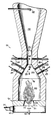
- the figure is a perspective view of the reactor according to a preferred embodiment of the present invention.
- a carbon black reactor for the production of carbon black with high surface activity is shown generally at 10 in Fig. 1.
- the carbon black reactor 10 includes a combustion section 12.
- the combustion section 12 comprises a cylindrical air inlet chamber 15 having an inlet opening 18 in the rearward end of the air inlet chamber for the introduction of a hydrocarbon burner and a second opening 21 in the peripheral wall of the air inlet chamber for the introduction of an oxygen-containing gas.
- a cylindrical combustion choke 24 extends from the forward end of the air inlet chamber 15 and is axially aligned with the air inlet chamber.
- the combustion choke is in open communication with the air inlet chamber 15 through an opening 27 in the forward end of the air inlet chamber.
- a cylindrical combustion chamber 30 is mounted to the forward end of the combustion choke 24.
- the combustion chamber 30 is axially aligned with the combustion choke 24 and the air inlet chamber 15 and extends forward from the front end of the combustion choke.
- the combustion chamber 30 is in open communication with the combustion choke 24 through an opening 33 in the rearward end of the combustion
- the reactor 10 also includes a reaction section 36 axially aligned with the combustion section 12.
- the reaction section 36 comprises a cone-shaped reaction chamber 39 extending forward from the front end of the combustion chamber 30.
- the reaction chamber 39 is in open communication with the combustion chamber 30 through the open front end 42 of the combustion chamber.
- the reaction chamber 39 has an inner diameter which gradually decreases as the reaction chamber converges towards a cylindrical reaction choke 45.
- the reaction choke 45 has a diameter substantially less than the diameter of the combustion chamber.
- the reaction choke 45 extends forward from the convergent end of the reaction chamber 39, and the reaction choke is in open communication with the reaction chamber through an opening 48 in the convergent end of the reaction chamber.
- Feedstock hydrocarbon injection nozzles 51 are positioned along the length of the reaction chamber 39 and the reaction choke 45.
- the feedstock hydrocarbon injection nozzles 51 preferably extend through the outer walls of the reaction chamber 39 and the reaction choke 45 and protrude into the interior of the carbon black reactor 10 as shown in Fig. 1; however, it is also possible to position a feedstock injection nozzle axially within the reactor.
- three sets of feedstock hydrocarbon injection nozzles are shown in Fig. 1, it should be understood that the reactor of the present invention is not limited to a specific number of feedstock hydrocarbon injection nozzles.
- a cone shaped exit chamber 54 extends from the front end of the reaction choke 45.
- the exit chamber 54 is axially aligned with the reaction section 36 and the combustion section 12 of the carbon black reactor 10 and is in open communication with the reaction choke 45 through an opening 57 in the rearward end of the exit chamber.
- the inner wall of the exit chamber is substantially flush with the inner wall of the reaction choke 45.
- the diameter of the exit chamber 54 gradually increases from the opening 57 in the rearward end of the exit chamber towards a water spray nozzle 60 positioned distal from the opening in the rearward end of the exit chamber.
- Fig. 1 Although the combustion chamber 30, the reaction chamber 39, the reaction choke 45, and the exit chamber 54 are all shown in Fig. 1 as having cylindrical cross sections, it should be understood that the reactor of the present invention is not limited to one of circular cross-section.
- the carbon black production process begins in the combustion section 12 of the carbon black reactor 10 where a hydrocarbon material such as natural gas is mixed with an oxygen-containing gas such as air and combusted.
- a hydrocarbon material such as natural gas
- an oxygen-containing gas such as air and combusted.
- a quantity of oxygen-containing gas in excess of the amount necessary for complete combustion of the hydrocarbon material is introduced through the air inlet opening 21 in the air inlet chamber 15.
- the oxygen-containing gas is directed by the air inlet opening 21 into the air inlet chamber 15 substantially directly towards the center of the air inlet chamber so as not to cause a swirling or tangential gas flow along the inner walls of the air inlet chamber.
- the hydrocarbon material is introduced through the hydrocarbon inlet opening 18 into the air inlet chamber 15.
- the hot gas produced by the combustion of the hydrocarbon in the oxygen-containing gas flows substantially axially through the reactor 10.
- the hot gas flows substantially parallel to the longitudinal axis of the reactor.
- the hot gas flows substantially axially from the air inlet chamber 15, through the opening 27 in the front end of the air inlet chamber, axially through the combustion choke 24, through the opening 33 in the rearward end of the combustion chamber 30, and then axially through the combustion chamber towards the reaction chamber 39.
- feedstock hydrocarbon is injected through the injection nozzles 51 into the flow of hot combustion gas.
- the feedstock hydrocarbon is preferably injected transverse to the flow of hot gas. It is possible to inject the feedstock hydrocarbon through an axially positioned injection nozzle; however, such a nozzle tends to interfere with the axial flow of hot gas.
- the hot oxygen-containing combustion gas begins pyrolyzing the feedstock hydrocarbon as the feedstock hydrocarbon enters the flow of hot oxygen-containing gas thereby forming a substantially axial flow of pyrolyzing reactant mass.
- the carbon black particles formed from the pyrolyzed feedstock hydrocarbon flow from the reaction choke 45 through the opening 57 in the rearward end of the exit chamber 54, and through the exit chamber towards a spray of water formed by the water spray nozzle 60 which quenches the pyrolyzing reaction. Because the inner wall of the exit chamber 54 is substantially flush with the inner wall of the exit chamber at the opening 57 in the rearward end of the exit chamber, and the diameter of the exit chamber gradually increases from the opening 57, the entire pyrolyzing reactant mass flows substantially forward and gradually expands radially as the mass moves towards the water spray nozzle 60. After the water spray quenches the pyrolysis reaction, the carbon black particles are then separated from the flow of gases. It should be understood that the carbon black product recovery is not a part of this invention and thus is not discussed here in detail.
- the gradual expansion of the pyrolyzing reactant mass provides for a substantially "plug" flow of pyrolyzing reactant mass through the exit chamber 54.
- plug flow no element of fluid overtakes or mixes with any other element ahead or behind.
- there may be lateral mixing in a plug flow as the mass undergoes radial expansion while moving through the exit chamber 54.
- the residence time for the entire pyrolyzing reactant mass flowing through the exit chamber 54 is substantially uniform.
- the exit chamber 54 has a lesser volume than abrupt expansion exit chambers of the same length.
- the average residence time of the pyrolyzing reactant mass in the exit chamber is reduced. As a result, the feedstock hydrocarbon in the reactant mass is not over-pyrolyzed and the surface activity of the carbon black particles is preserved.
- the axial flow of hot combustion gas through the carbon black reactor 10 substantially reduces impingement of the feedstock hydrocarbon on the inner walls of the reaction chamber 39 and the reaction choke 45. Because the flow of hot gas through the reactor 10 is axial, the hot gas travels substantially parallel to the inner walls of the reaction chamber 39 and the reactor choke 45. Accordingly, when the feedstock hydrocarbon enters the flow of hot gas, the flow of hot gas carries the pyrolyzing feedstock hydrocarbon particles parallel to the inner walls of the reaction chamber and the reaction choke, thereby substantially avoiding contact with the inner walls of the reaction chamber and the reaction choke. The elimination of the impingement of the feedstock hydrocarbon substantially eliminates the presence of impingement coke and refractory grit in the carbon black product.
Landscapes
- Chemical & Material Sciences (AREA)
- Organic Chemistry (AREA)
- Pigments, Carbon Blacks, Or Wood Stains (AREA)
Applications Claiming Priority (2)
| Application Number | Priority Date | Filing Date | Title |
|---|---|---|---|
| US24408488A | 1988-09-14 | 1988-09-14 | |
| US244084 | 1988-09-14 |
Publications (2)
| Publication Number | Publication Date |
|---|---|
| EP0360379A2 true EP0360379A2 (de) | 1990-03-28 |
| EP0360379A3 EP0360379A3 (de) | 1990-12-27 |
Family
ID=22921312
Family Applications (1)
| Application Number | Title | Priority Date | Filing Date |
|---|---|---|---|
| EP19890305567 Withdrawn EP0360379A3 (de) | 1988-09-14 | 1989-06-02 | Reaktor und Verfahren zur Erzeugung von Russ hoher Oberflächenaktivität |
Country Status (7)
| Country | Link |
|---|---|
| EP (1) | EP0360379A3 (de) |
| JP (1) | JPH02163170A (de) |
| KR (1) | KR900004873A (de) |
| AU (1) | AU3591789A (de) |
| BR (1) | BR8903830A (de) |
| ES (1) | ES2014836A6 (de) |
| PT (1) | PT91710A (de) |
Families Citing this family (1)
| Publication number | Priority date | Publication date | Assignee | Title |
|---|---|---|---|---|
| JP2009167288A (ja) * | 2008-01-16 | 2009-07-30 | Asahi Carbon Kk | カーボンブラック製造装置 |
Family Cites Families (3)
| Publication number | Priority date | Publication date | Assignee | Title |
|---|---|---|---|---|
| US2851337A (en) * | 1951-08-22 | 1958-09-09 | Columbian Carbon | Carbon black process |
| US4058590A (en) * | 1976-04-14 | 1977-11-15 | Sid Richardson Carbon & Gasoline Co. | Carbon black reactor with turbofan |
| US4391789A (en) * | 1982-04-15 | 1983-07-05 | Columbian Chemicals Company | Carbon black process |
-
1989
- 1989-05-31 AU AU35917/89A patent/AU3591789A/en not_active Abandoned
- 1989-06-02 EP EP19890305567 patent/EP0360379A3/de not_active Withdrawn
- 1989-06-06 KR KR1019890007804A patent/KR900004873A/ko not_active Withdrawn
- 1989-07-31 ES ES8902717A patent/ES2014836A6/es not_active Expired - Fee Related
- 1989-07-31 BR BR898903830A patent/BR8903830A/pt unknown
- 1989-08-30 JP JP1221860A patent/JPH02163170A/ja active Pending
- 1989-09-13 PT PT91710A patent/PT91710A/pt not_active Application Discontinuation
Also Published As
| Publication number | Publication date |
|---|---|
| ES2014836A6 (es) | 1990-07-16 |
| AU3591789A (en) | 1990-03-22 |
| EP0360379A3 (de) | 1990-12-27 |
| BR8903830A (pt) | 1991-03-19 |
| KR900004873A (ko) | 1990-04-13 |
| JPH02163170A (ja) | 1990-06-22 |
| PT91710A (pt) | 1990-03-30 |
Similar Documents
| Publication | Publication Date | Title |
|---|---|---|
| US4391789A (en) | Carbon black process | |
| US3490869A (en) | Vortex reactor for carbon black manufacture | |
| US20080031786A1 (en) | Process and Apparatus For Producing Carbon Black | |
| US5252297A (en) | Process for producing carbon black and apparatus therefor | |
| US4228131A (en) | Apparatus for the production of carbon black | |
| AU617710B2 (en) | Non-cylindrical reactor for carbon black production | |
| US5009854A (en) | Axial reactor with coaxial oil injection | |
| US4822588A (en) | Process for producing carbon black | |
| KR101864901B1 (ko) | 카본 블랙 반응기 | |
| EP0360379A2 (de) | Reaktor und Verfahren zur Erzeugung von Russ hoher Oberflächenaktivität | |
| KR950011799B1 (ko) | 카본블랙 제조방법 | |
| US4824643A (en) | Apparatus for producing carbon black | |
| US4904454A (en) | Reactor for producing furnace carbon black | |
| EP0392121A2 (de) | Russerzeugungsreaktor mit einer langgestreckten Drossel und Anwendungsverfahren | |
| US5069882A (en) | Carbon black reactor with a choke extension | |
| US5256388A (en) | Method for consistently producing carbon black having a high tint | |
| US3607065A (en) | Production of carbon black | |
| SU1024485A1 (ru) | Реактор дл производства сажи | |
| EP1593714A1 (de) | verfahren und einrichtung zur herstellung von russ | |
| WO1996034918A1 (en) | Method for producing carbon black |
Legal Events
| Date | Code | Title | Description |
|---|---|---|---|
| PUAI | Public reference made under article 153(3) epc to a published international application that has entered the european phase |
Free format text: ORIGINAL CODE: 0009012 |
|
| AK | Designated contracting states |
Kind code of ref document: A2 Designated state(s): DE FR GB IT NL SE |
|
| PUAL | Search report despatched |
Free format text: ORIGINAL CODE: 0009013 |
|
| AK | Designated contracting states |
Kind code of ref document: A3 Designated state(s): DE FR GB IT NL SE |
|
| STAA | Information on the status of an ep patent application or granted ep patent |
Free format text: STATUS: THE APPLICATION IS DEEMED TO BE WITHDRAWN |
|
| 18D | Application deemed to be withdrawn |
Effective date: 19910628 |